🏓 Real Court Battles: When Eyewear Saved (or Lost) Vision
Share
Real Court Battles: When Eyewear Saved—or Failed to Save—Vision in Pickleball
A pickleball rally can change in an instant. Players stand relatively close to one another, paddles move quickly, and the ball can strike the face or eye before a player has time to react.
Documented pickleball eye injuries show why eyewear deserves serious consideration. But there's an equally important distinction: wearing ordinary glasses, sports sunglasses, or impact-resistant lenses is not automatically the same as wearing eyewear certified for a particular protective standard.
This guide examines the types of eye trauma that can occur on the pickleball court, what real injury scenarios can teach players, and how to evaluate eyewear without assuming that any particular pair can guarantee injury prevention.
Explore Pickleball Eyewear
Choose eyewear according to your vision needs, playing environment, and any specific protection requirements you have.
Why Pickleball Eye Injuries Deserve Attention
Eye trauma can involve very different structures of the eye and can range considerably in severity. A direct impact from a ball, paddle, or another object can potentially injure the front or internal structures of the eye.
Examples of injuries associated with sports-related eye trauma can include:
- Corneal abrasions
- Inflammation following trauma
- Bleeding within the eye
- Retinal injury
- Damage to structures surrounding the eye
- Changes in vision following trauma
The outcome of an individual injury depends on what was damaged and the severity of the trauma. A seemingly minor impact should therefore not be used to predict how another eye injury will turn out.
What Real Pickleball Eye-Injury Cases Can Teach Players
Reports of pickleball-related eye trauma have included players experiencing injuries such as retinal tears, corneal abrasions, and inflammation after direct impacts.
The useful lesson from these cases is not that a particular commercial frame would definitely have prevented the injury. Without knowing the exact impact, eyewear, fit, testing standard, and circumstances, that conclusion cannot be made responsibly.
Instead, real incidents highlight a broader point: the eye can be vulnerable to direct trauma during court sports, and players should understand what their eyewear is—and is not—designed to do.
Court Scenario #1: A Direct Ball Impact and Retinal Injury
A ball striking the eye can transfer force to structures beyond the visible surface of the eye. Retinal injuries are particularly important because the retina plays a central role in vision.
If a player experiences a significant direct eye impact followed by new visual symptoms, the situation should be evaluated by an appropriate medical professional rather than assuming the symptoms will resolve on their own.
What This Scenario Teaches
- Eye trauma can involve internal structures of the eye.
- The severity of an injury may not be obvious immediately after impact.
- Vision changes after an eye impact deserve attention.
- No ordinary sports frame should be described as guaranteeing prevention of retinal injury.
Court Scenario #2: Paddle Contact, Corneal Injury, and Inflammation
The pickleball itself isn't the only object capable of reaching a player's face. Doubles partners move within close proximity, and paddles can create another source of accidental contact.
A corneal abrasion involves injury to the cornea at the front of the eye. Trauma can also be associated with inflammation inside the eye.
This is another reason players shouldn't think about eye safety exclusively in terms of the ball.
Potential Sources of Court Impact
- The pickleball
- Your own paddle
- A partner's paddle
- Another player's body or equipment
- Falls or collisions
Different impacts create different risks, and no single eyewear design should be presented as eliminating all of them.
Court Scenario #3: Vision Changes After an Eye Impact
One of the most serious possibilities following eye trauma is a change in vision. The degree and duration of vision loss depend on the nature and severity of the injury.
Rather than claiming a specific pair of sunglasses would have prevented a reported case, players should use these incidents as a reason to evaluate the actual protective characteristics of their eyewear.
If certified protective eyewear is important to you, verify that the exact product documents the specific certification you require.
Eye Hit by a Pickleball? Don't Ignore New Symptoms
A hard eye impact followed by new symptoms should not be treated simply as an equipment problem. Medical evaluation may be appropriate depending on the injury and symptoms.
Symptoms following trauma that warrant particular attention can include:
- New or worsening vision changes
- Significant eye pain
- New flashes or floaters
- Loss or obstruction of part of the visual field
- Bleeding or obvious physical injury
- Persistent redness or light sensitivity after trauma
This article is educational and isn't a substitute for medical evaluation after an eye injury.
Sports Glasses, Impact Resistance, and Protective Eyewear Are Not the Same Thing
One of the easiest mistakes to make when shopping for pickleball glasses is treating several different terms as interchangeable.
| Term | What It Tells You | What It Does Not Automatically Mean |
|---|---|---|
| Prescription eyewear | Contains corrective lenses | Certified eye protection |
| Sports eyewear | Eyewear intended or marketed for active use | Compliance with a specific protective standard |
| Impact-resistant lens | Describes an impact-related lens characteristic | Shatterproof, indestructible, or certified protection |
| Protective certification | Indicates testing against a specified standard when documented | Protection from every possible injury |
This distinction matters when the primary reason you're purchasing eyewear is eye protection rather than tint, vision correction, or style.
For a deeper explanation, read Why Impact Resistance Matters in Sports Eyewear.
Prescription Does Not Automatically Mean Protective
Prescription sports glasses serve an important purpose for players who need vision correction, but the presence of an RX does not establish a protective rating.
Think of the characteristics separately:
- Prescription: provides the wearer's required vision correction.
- Tint: changes the amount and characteristics of visible light passing through the lens depending on the exact configuration.
- Polarization: uses an added filter to reduce certain reflected glare.
- Impact resistance: describes a physical characteristic of the eyewear or lens.
- Protective certification: must be verified for the exact product and applicable standard.
A pair can possess one of these characteristics without possessing all of them.
Where Blinded Wear Sports Eyewear Fits
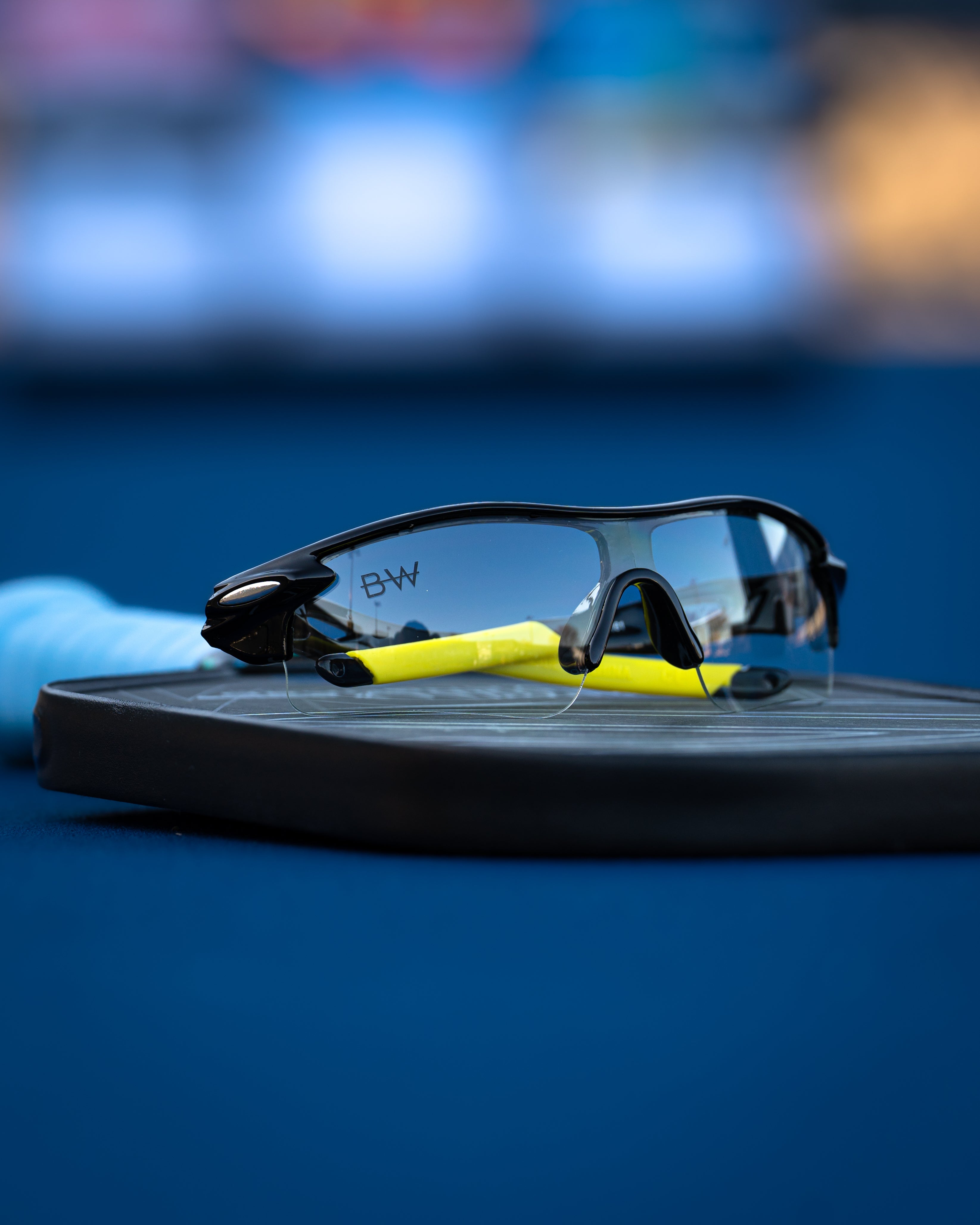
Blinded Wear offers prescription and non-prescription sports eyewear for pickleball players, including eyewear with impact-resistant lenses.
That should not be expanded into unsupported claims that every model is shatterproof, ANSI Z87.1-certified, ASTM F803-certified, or guaranteed to prevent an eye injury.
If you specifically require eyewear tested to a particular protective standard, verify the certification of the exact model before purchasing.
Players who need prescription correction can explore the Blinded Wear RX Pickleball Collection. Players who don't need an RX can browse the Non-Prescription Pickleball Sunglasses Collection.
RX Pickleball Eyewear Options to Explore
If you require vision correction, Blinded Wear offers multiple prescription sports-eyewear styles. These models are presented as shopping options—not as claims that any individual model would have prevented a particular documented injury.
| RX Model | Explore |
|---|---|
| H Blue Shield RX | View H Blue Shield RX |
| Crystal Wave II RX | View Crystal Wave II RX |
| Frost RX | View Frost RX |
| Rocket Fire RX | View Rocket Fire RX |
| Silver Line RX | View Silver Line RX |
Blinded Wear RX products include high-index prescription lenses at no additional cost. Players submit a clear photo of their eyeglass prescription before purchasing.
How to Evaluate Pickleball Eyewear for Eye Safety
If eye safety is a major reason for purchasing sports eyewear, look beyond appearance and marketing terminology.
- Determine whether you need prescription correction.
- Check the documented impact characteristics.
- Verify any protective certification you require.
- Compare frame dimensions and fit.
- Choose a lens appropriate for your playing environment.
- Don't assume “sports,” “impact-resistant,” or “RX” means certified protective eyewear.
- Replace or professionally evaluate damaged eyewear when appropriate.
The goal is to understand exactly what you're buying rather than relying on broad promises such as “full court protection” or “guaranteed eye safety.”
Can Pickleball Eyewear Prevent an Eye Injury?
No pair of glasses can guarantee that an eye injury will never occur. The type of impact, direction of force, fit of the eyewear, frame and lens construction, and severity of the incident can all affect what happens.
That is why statements such as “this frame would have prevented the injury” should be avoided unless there is evidence supporting that conclusion for the specific incident.
A more useful question is: What protective characteristics does the exact eyewear actually have?
| Question | Why to Ask It |
|---|---|
| Are the lenses impact-resistant? | Establishes an impact-related characteristic without assuming certification |
| Is a protective standard documented? | Helps distinguish general sports eyewear from eyewear tested to a particular standard |
| Does the frame fit appropriately? | Fit is part of how eyewear sits on the face during movement |
| Has the eyewear already been damaged? | Previous damage may be relevant when deciding whether to continue using it |
| Do I need an RX? | Determines whether prescription correction needs to be incorporated into the eyewear |
Are Regular Prescription Glasses Enough for Pickleball?
Everyday prescription glasses provide vision correction, but that doesn't automatically make them protective sports eyewear.
If you rely on an RX, there are several possible approaches:
- Prescription sports eyewear
- Contact lenses combined with separate sports eyewear
- Everyday prescription glasses, while understanding their documented characteristics and limitations
Players concerned specifically about impact protection should evaluate the protective characteristics of the eyewear rather than assuming that any lens positioned in front of the eye provides the same level of protection.
Do You Need Prescription Glasses for Eye Safety?
No. Prescription and non-prescription describe whether the eyewear contains corrective lenses; they don't determine whether a player cares about eye safety.
If you don't need vision correction, you can explore non-prescription pickleball eyewear. If you need correction built into your court glasses, explore the RX pickleball collection.
In either category, impact resistance and any protective certification should be evaluated separately.
Clear vs. Tinted Eyewear for Pickleball Eye Coverage
A dark tint is not what makes eyewear impact-resistant. Likewise, a clear lens isn't inherently less impact-resistant simply because it has no dark sunglass tint.
These are separate characteristics:
- Clear vs. tinted: relates to visible-light transmission and lens appearance.
- Prescription vs. non-prescription: relates to vision correction.
- Polarized vs. non-polarized: relates to the presence of a polarization filter.
- Impact resistance: relates to physical lens characteristics.
- Protective certification: relates to documented testing against a specified standard.
Players who don't want a dark tint for indoor or evening play can explore clear lens sports eyewear.
Impact-Resistant vs. Certified Protective Eyewear
This distinction is particularly important in an article about real eye injuries.
Impact-resistant describes a characteristic of the lens or eyewear. It should not automatically be translated into a claim that the product has passed a particular sports-protection standard.
Certified protective eyewear requires documentation showing that the specific product has been tested according to the applicable standard being claimed.
Therefore, avoid assuming that:
- Impact-resistant means shatterproof
- Sports glasses are automatically safety glasses
- Prescription sports glasses are automatically certified protective eyewear
- A wrap-style frame automatically provides certified protection
- A thicker-looking frame is necessarily more protective
- Any eyewear guarantees prevention of eye injury
If a particular certification is important to you, confirm it for the exact model rather than relying on general marketing terminology.
Pickleball Ball Impact vs. Paddle Impact
Not every court accident happens the same way. A direct ball strike and accidental paddle contact create different impact scenarios.
| Scenario | What Players Should Understand |
|---|---|
| Direct ball strike | The eye can experience direct blunt trauma |
| Paddle contact | Close-range equipment contact can also injure the eye or surrounding area |
| Doubles collision | Partners moving in the same space can create accidental contact |
| Fall | Eye and facial injuries can also occur without direct ball contact |
This is why eye-safety decisions shouldn't focus on a single type of accident or assume that one product characteristic addresses every possible court scenario.
What Should You Do With Eyewear After a Hard Impact?
If your glasses take a significant hit, inspect them before continuing to rely on them.
Look for visible signs such as:
- Cracked lenses
- Cracked or distorted frame sections
- Loose components
- Lenses that have shifted from their normal position
- Other visible structural damage
Damage isn't always something that should be solved by simply pushing a component back into place and continuing to play. If you're unsure whether damaged eyewear remains suitable for use, consider replacing it or having it appropriately evaluated.
What If Your Blinded Wear Glasses Break?
Active-use eyewear can be dropped, damaged during transportation, or broken during use.
Blinded Wear provides 50% lifetime replacement support for eligible eyewear that breaks, subject to the current policy terms.
This is replacement support rather than a claim that the glasses are indestructible or that every form of cosmetic wear or damage automatically qualifies.
Review the current Protection Plan & Returns for complete terms and eligibility.
Common Pickleball Eye-Safety Myths
Myth: “I'm a recreational player, so eye impacts aren't relevant to me.”
Recreational play still involves paddles, balls, partners, opponents, and movement around the court. Skill level alone doesn't eliminate the possibility of accidental contact.
Myth: “Any pair of glasses protects my eyes.”
Eyewear varies in construction, impact characteristics, fit, and testing. Prescription correction or a sports appearance alone doesn't establish a particular level of protection.
Myth: “Impact-resistant means the lens can't break.”
No. Impact-resistant should not be interpreted as shatterproof or indestructible.
Myth: “If my glasses survived one hard impact, they're definitely fine.”
Eyewear should be inspected after significant impacts rather than assuming continued suitability solely because it remained in one piece.
Myth: “Prescription sports glasses are automatically safer than non-RX sports glasses.”
Prescription status tells you whether corrective vision is incorporated into the eyewear. Protective characteristics must be evaluated separately.
Myth: “A dark lens offers more impact protection than a clear lens.”
Lens tint and impact resistance are different characteristics. Darkness alone doesn't establish impact performance.
Choosing Eyewear Based on Your Court Needs
| Player Need | Starting Point |
|---|---|
| Needs prescription correction | RX Pickleball Eyewear |
| Doesn't need prescription correction | Non-RX Pickleball Eyewear |
| Doesn't want a dark tint | Clear Lens Sports Eyewear |
| Requires a particular protective standard | Verify certification for the exact product before purchasing |
| Unsure which Blinded Wear style to consider | Pickleball Sunglasses Quiz |
Pickleball Eyewear Safety Checklist
Before choosing court eyewear primarily because you're concerned about eye impacts, ask:
- Do I need prescription correction?
- Are the lenses documented as impact-resistant?
- Do I require a specific protective certification?
- If so, is that certification documented for this exact model?
- Does the frame fit me appropriately?
- Am I confusing tint or lens color with impact protection?
- Am I assuming “sports eyewear” means certified protective eyewear?
- Does the eyewear show any existing damage?
- Do I understand the replacement policy if the glasses break?
For more context on choosing between different eyewear categories, visit the 2026 Pickleball Glasses Guide.
Frequently Asked Questions About Pickleball Eye Injuries and Eyewear
Can a pickleball cause a serious eye injury?
A direct impact to the eye can cause trauma, and the severity depends on the circumstances and structures affected. Players shouldn't assume that an injury is minor simply because the object involved is a pickleball.
Can a pickleball paddle injure your eye?
Yes. Accidental paddle contact is another potential source of eye and facial trauma, particularly when players are moving close to one another during doubles.
Can pickleball eyewear guarantee that I won't injure my eyes?
No eyewear should be described as guaranteeing prevention of every eye injury. Impact direction, force, fit, construction, and the nature of an accident can all matter.
Are Blinded Wear lenses impact-resistant?
Blinded Wear sports eyewear uses impact-resistant lenses. Impact-resistant does not mean shatterproof, indestructible, or certified to a particular protective standard unless that certification is separately documented for the exact product.
Are Blinded Wear glasses ANSI Z87.1 certified?
Do not assume ANSI Z87.1 certification across the collection. If you require ANSI Z87.1 or another specific protective standard, verify that certification for the exact model before purchasing.
Are Blinded Wear glasses ASTM F803 certified?
Do not assume ASTM F803 certification unless it is specifically documented for the exact model. Sports eyewear and impact-resistant lenses are not automatically equivalent to ASTM-certified protective eyewear.
Do prescription glasses provide more eye protection than non-prescription glasses?
Not simply because they're prescription. RX describes vision correction. Impact characteristics and protective certifications are separate considerations.
Can I wear non-prescription eyewear for pickleball?
Yes. If you don't require prescription correction, non-RX sports eyewear is an option. Evaluate its impact characteristics and any protection requirements separately.
Are clear lenses less protective than tinted lenses?
Not inherently. Tint relates to visible-light transmission, while impact resistance and protective certification are separate characteristics.
Does a wraparound frame guarantee better eye protection?
No. Frame shape and coverage can differ between products, but appearance alone doesn't establish compliance with a protective standard.
Should I replace sports glasses after they are hit?
Inspect eyewear after a significant impact. Cracks, deformation, displaced lenses, loose components, or other damage can be reasons to stop relying on the eyewear until it is appropriately evaluated or replaced.
What should I do if my vision changes after being hit in the eye?
New or worsening vision changes after eye trauma can require prompt medical evaluation. Equipment advice isn't a substitute for assessment of an actual eye injury.
What Real Court Injuries Don't Prove
Individual injury stories can make eye safety feel more immediate, but they can also lead to conclusions that the evidence doesn't support.
| Claim | Better Interpretation |
|---|---|
| “This pair would have prevented that retinal injury.” | The incident demonstrates that direct eye trauma can be serious; prevention by a specific untested product cannot be assumed. |
| “The player wasn't wearing glasses, so any glasses would have prevented it.” | Different eyewear has different construction, fit, impact characteristics, and certifications. |
| “Impact-resistant means the eye can't be injured.” | Impact resistance is a product characteristic, not a guarantee against injury. |
| “My glasses didn't break, so my eye was completely protected.” | Eyewear condition alone doesn't establish what happened to the eye. |
| “RX sports glasses are automatically safety glasses.” | Prescription correction and protective certification are separate characteristics. |
The 3 Questions Every Pickleball Player Should Ask About Eyewear
1. Can I See Properly With It?
If you require vision correction, make sure the eyewear accommodates your prescription needs. Blinded Wear offers dedicated prescription pickleball eyewear with high-index prescription lenses included at no additional cost.
2. Is the Lens Configuration Appropriate for Where I Play?
Outdoor, indoor, evening, and changing-light environments can create different lens preferences. Clear, tinted, polarized, and non-polarized are lens characteristics—not measures of impact protection by themselves.
3. What Protection Is Actually Documented?
If impact protection is your priority, look for the exact product's documented characteristics. If you require a specific protective standard, verify that certification rather than inferring it from terms such as “sports,” “impact-resistant,” or “protective.”
RX vs. Non-RX Eyewear After Seeing Real Court Injuries
The decision between prescription and non-prescription eyewear should primarily be based on whether you require vision correction.
| Need | RX Sports Eyewear | Non-RX Sports Eyewear |
|---|---|---|
| Built-in vision correction | Yes | No |
| Relevant to players without an RX | Usually unnecessary | Yes |
| Can use impact-resistant lenses | Yes, depending on product | Yes, depending on product |
| Automatically certified protective eyewear | No | No |
| Can guarantee prevention of eye injury | No | No |
Players who use contact lenses can also wear their contacts for vision correction and select non-prescription sports eyewear separately.
A Simple Response Plan After a Pickleball Eye Impact
If an impact occurs, separate the condition of the player from the condition of the equipment.
- Pay attention to symptoms. New vision changes, significant pain, flashes, floaters, visual-field changes, bleeding, or other concerning symptoms shouldn't be dismissed.
- Seek appropriate medical evaluation when warranted. An article or product page cannot determine the severity of an eye injury.
- Inspect the eyewear separately. Check for cracks, distortion, loose parts, displaced lenses, and other damage.
- Don't assume intact eyewear means the eye is uninjured. The condition of the glasses cannot diagnose the condition of the eye.
- Replace damaged eyewear when appropriate. Don't continue relying on obviously compromised equipment.
Learn More About Pickleball Eyewear and Vision
Continue with these guides for a deeper understanding of sports eyewear, vision, and impact-related considerations:
Replacement Support for Active-Use Eyewear
Sports eyewear can be dropped, transported in gear bags, or damaged during active use. Blinded Wear provides 50% lifetime replacement support for eligible eyewear that breaks, subject to current policy terms.
The program should not be interpreted as proof that the eyewear is indestructible, as a guarantee against injury, or as automatic coverage for every type of wear or damage.
Review the Protection Plan & Returns for current eligibility and terms.
The Bottom Line: What Real Pickleball Eye Injuries Teach Us
Real court injuries make one point especially clear: the eye can be vulnerable when a ball, paddle, or another object reaches the face.
But responsible eye-safety guidance requires more than saying “wear glasses.” Players should understand the difference between ordinary eyewear, prescription correction, impact-resistant sports lenses, and eyewear tested to a particular protective standard.
Blinded Wear offers prescription and non-prescription sports eyewear with impact-resistant lenses. That characteristic should be presented accurately—not expanded into unsupported promises that a particular frame will prevent retinal injuries, stop every impact, or meet a certification that hasn't been documented.
If a specific protective certification is important to you, verify it for the exact product. If you need prescription correction, choose eyewear compatible with your RX needs. And if an actual eye impact produces concerning symptoms, treat it as a medical issue rather than simply an equipment problem.