
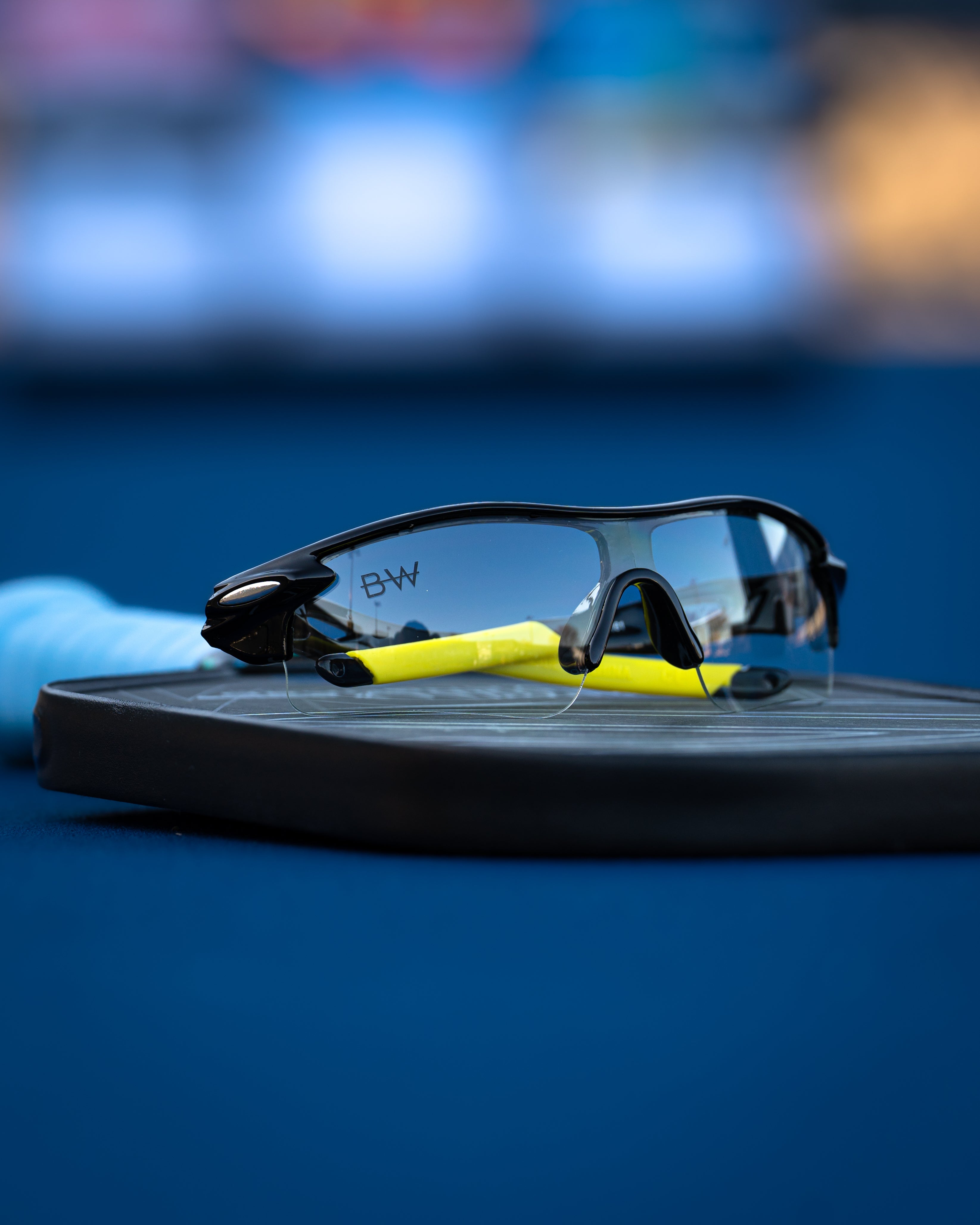
From Gym to Game Day: Adaptive RX Sports Glasses for Every Environment
Share
From Gym to Game Day: Adaptive RX Sports Glasses for Every Environment
Your prescription needs do not disappear when your environment changes. One day can include a morning workout, hours in front of a screen, an indoor pickleball session, an outdoor match, and travel between all of them.
That is where adaptive RX sports glasses become worth comparing—not because eyewear magically adjusts your reflexes or athletic ability, but because modern prescription configurations can be selected around the different environments in which you actually need corrective vision.
For pickleball players and active adults, that may mean comparing clear RX lenses, photochromic or transition RX, blue-light-filtering options, and dedicated indoor or outdoor setups. The goal is to build an eyewear system that makes sense from everyday activity to game day.
This guide breaks down what “adaptive” should actually mean, which features matter in different environments, and how to choose RX sports eyewear without relying on exaggerated claims about contrast, depth perception, glare, fatigue, or reaction time.
Find Your Pickleball Eyewear
What Are Adaptive RX Sports Glasses?
“Adaptive RX” is most useful as a way to think about prescription eyewear that fits different parts of an active routine.
That adaptability can come from two different strategies:
- A versatile lens configuration that can function across changing environments.
- Multiple purpose-built pairs selected for substantially different conditions.
For example, a player moving between indoor and outdoor courts might compare a photochromic RX setup with carrying separate clear RX and outdoor RX glasses.
The important point is that adaptive does not automatically mean electronically intelligent, instantaneously responsive, or performance-enhancing.
One Athlete, Multiple Environments: What Actually Changes?
Your prescription may remain the same throughout the day, while the way you use your eyewear changes significantly.
| Environment | RX Consideration | Option to Compare |
|---|---|---|
| Gym | Prescription correction without necessarily needing dark sunglass tint | Clear RX |
| Indoor Pickleball | Corrective vision in an indoor sports environment | Clear RX |
| Outdoor Pickleball | Corrective vision in outdoor conditions | Current outdoor RX configurations |
| Indoor + Outdoor | Changing environments throughout the day | Photochromic RX or dedicated pairs |
| Screen / Work | Everyday prescription use and optional filtering preferences | Clear RX or available blue-light-filtering RX |
| Tournament Travel | Multiple environments plus dependence on corrective eyewear | Versatile primary RX + suitable backup |
RX Sports Glasses for the Gym
A gym can involve weight training, cardio, mobility work, and other activities where you still need the prescription correction you normally use.
For primarily indoor activity, a clear RX configuration provides a straightforward starting point because it delivers prescription correction without a dark sunglass tint.
When comparing gym-friendly prescription sports eyewear, focus on verified characteristics rather than assuming you need special “adaptive coatings” to exercise effectively.
Relevant considerations include:
- Your prescription
- Frame dimensions
- Lightweight construction
- Impact-resistant lenses
- Your comfort with the frame
- Whether you also intend to use the glasses for sports
From the Gym to Indoor Pickleball
If both activities happen indoors, you may not need radically different lens technology for each one.
A clear prescription sports setup may provide the corrective vision you require across both environments without introducing dark sunglass tint.
This is where simplifying your eyewear can make more sense than adding unnecessary features. You do not need a separate “gym lens” and “pickleball lens” simply because the activities are different.
The appropriate prescription and the actual characteristics of the eyewear matter more than giving every environment its own marketing category.
RX Glasses for Indoor Pickleball
Indoor pickleball is one of the clearest use cases for prescription sports eyewear without dark sunglass tint.
If you require corrective vision, compare clear RX based on:
- Your prescription requirements
- Current frame dimensions
- Impact-resistant lenses
- Lightweight sports-frame construction
- Whether you want additional features such as blue-light filtering
Clear RX should not automatically be marketed as increasing available light, enhancing contrast, improving depth perception, or helping you track the ball faster.
Its fundamental purpose is simpler: prescription correction without dark sunglass tint.
Where Do Blue-Light RX Lenses Fit?
Blue-light filtering is another feature that can be incorporated into selected prescription eyewear configurations.
It may interest athletes who specifically want that filtering feature as part of eyewear they also use for activities such as:
- Working at a computer
- Reviewing match footage
- Using a phone or tablet
- General indoor wear
- Indoor training
But blue-light filtering should not automatically be credited with reducing digital fatigue, improving concentration, enhancing contrast, or increasing athletic performance.
If blue-light filtering is specifically part of your preferences, compare an available configuration offering that feature.
What Changes When You Move From Indoor Training to Outdoor Play?
Moving outdoors can change the type of lens configuration you prefer even though your underlying prescription needs remain.
This creates an important distinction:
Your environment changes. Your prescription eyewear strategy may change with it. That does not mean the glasses are changing your athletic ability.
Players who frequently move between environments can compare two approaches: changing-light photochromic RX or separate dedicated RX pairs.
Photochromic RX: The Most Literal Form of Adaptive Eyewear
Photochromic or transition RX lenses are designed to change tint in response to environmental conditions.
That makes them especially relevant to the idea of adaptive prescription eyewear because the lens itself can change rather than remaining at one fixed tint.
A player might wear the same RX setup while moving through:
Home → Gym → Indoor Court → Outdoors → Travel → Everyday Activities
For someone who requires prescription correction throughout that routine, changing-light functionality may reduce how often separate clear and tinted prescription pairs need to be swapped.
What “Adaptive” Photochromic RX Does—and Doesn't—Mean
| Claim | Better Interpretation |
|---|---|
| “Adapts to changing environments” | Photochromic technology can change tint in response to environmental conditions |
| “Instantly changes” | Do not assume an instant or universal transition time |
| “Automatically optimizes contrast” | Do not assume contrast enhancement without product-specific support |
| “Keeps reflexes sharp” | Changing tint does not automatically increase reaction speed |
| “Eliminates glare” | Do not assume universal glare elimination |
| “Reduces eye strain” | Do not automatically attribute reduced eye strain to photochromic functionality |
Photochromic technology remains useful without those additional promises. Its core benefit is changing-tint functionality.
How Fast Do Adaptive RX Lenses Change?
Avoid treating every photochromic lens as if it changes at exactly the same speed.
Transition behavior can depend on the particular lens technology and environmental conditions. That means an exact universal statement such as “changes in seconds” should not be applied to every product without verification.
Instead, evaluate the exact photochromic configuration you are considering if transition speed is an important purchasing factor.
RX Sports Glasses for Outdoor Pickleball
Players who spend most of their time outdoors may prefer a dedicated outdoor RX configuration rather than prioritizing a lens designed to move between environments.
That highlights an important point: adaptability is only valuable when you actually need it.
If your routine is almost exclusively outdoor pickleball, compare current outdoor RX options based on:
- Your prescription requirements
- Lens configuration
- Frame dimensions
- Impact-resistant lenses
- Non-polarized design
- Lightweight sports construction
- Current replacement support
One Adaptive RX Pair vs. Multiple Dedicated Pairs
There are two valid ways to build prescription eyewear around a multi-environment routine.
| Strategy | Potential Advantage | Tradeoff |
|---|---|---|
| One Photochromic RX Pair | Changing-light functionality with fewer eyewear changes | One lens configuration must serve multiple environments |
| Clear RX + Outdoor RX | Dedicated configurations for substantially different conditions | Requires carrying and switching pairs |
| Primary RX + Backup RX | Provides redundancy for someone dependent on corrective eyewear | Requires owning another suitable corrective option |
The right strategy depends on how often you change environments, how heavily you depend on prescription correction, and how much you value carrying fewer pairs.
Can the Same RX Sports Glasses Work Across Multiple Sports?
Potentially. A prescription sports frame does not automatically become limited to one activity simply because it is marketed toward pickleball.
If you plan to use the same eyewear for multiple activities, evaluate whether the actual product characteristics and your prescription needs make sense for each use.
That could include:
- Pickleball
- Tennis
- Gym training
- Running
- General active use
However, avoid assuming one frame has sport-specific curvature, adjustable fit components, non-slip features, or certifications unless those characteristics are verified for that exact product.
Why Tournament Travel Changes the RX Eyewear Equation
Travel creates one of the strongest practical arguments for versatile prescription sports eyewear.
A tournament trip can move through multiple settings:
- Home
- Airport or road travel
- Hotel
- Indoor practice facility
- Outdoor courts
- Restaurants and everyday activities
- Competition
If you require prescription correction throughout the day, carrying fewer specialized pairs may be convenient.
At the same time, tournament travel increases the value of redundancy. If your primary RX eyewear becomes unavailable, another suitable corrective option can matter more than having every optional lens feature.
High-Index Lenses & Adaptive RX Eyewear
High-index is another prescription term that may appear alongside photochromic, clear, or other RX options.
It describes a category of prescription lens material. It does not mean that a lens automatically:
- Adapts to lighting
- Filters blue light
- Improves reaction time
- Improves depth perception
- Enhances contrast
- Eliminates optical distortion
Blinded Wear includes high-index prescription lenses at no additional cost with RX eyewear.
That feature is separate from the particular lens configuration you select.
Impact Resistance Matters More Than Marketing Buzzwords
For sports eyewear, verified physical characteristics can be more useful than broad claims about “lens intelligence.”
Blinded Wear sports eyewear uses impact-resistant lenses.
Impact-resistant should not be confused with claims such as:
- Shatterproof
- Unbreakable
- Certified protective eyewear
- Compliance with a specific safety standard
Those are separate characteristics and require their own verification.
Why Blinded Wear Uses Non-Polarized Sports Lenses
Blinded Wear sports eyewear uses non-polarized lenses, meaning a polarization filter is not added and the visual information available without that filter is preserved.
Some court players prefer non-polarized eyewear.
That preference should remain separate from unsupported claims that non-polarized lenses inherently improve depth perception, reaction time, spin recognition, or ball tracking.
Non-polarized also does not tell you whether a lens is clear, photochromic, high-index, or blue-light filtering. Those are different characteristics.
Blinded Wear RX Glasses to Compare for an Active Routine
| RX Model | What to Compare | Explore |
|---|---|---|
| Rocket Fire RX | Current RX configuration, frame design, and available dimensions | Rocket Fire RX |
| Frost RX | Current RX configuration, frame design, and available dimensions | Frost RX |
| Ocean Wave RX | Current RX configuration and sports-frame design | Ocean Wave RX |
| H Blue Shield RX | Compare when blue-light filtering is specifically part of your preferences | H Blue Shield RX |
| Phantom II RX | Current RX configuration and frame design | Phantom II RX |
| Silver Line RX | Current prescription sunglass configuration and frame design | Silver Line RX |
What Blinded Wear RX Sports Glasses Actually Offer
When comparing Blinded Wear RX eyewear, start with characteristics that can be stated directly rather than adding unsupported performance promises.
- Designed for pickleball players
- Prescription correction
- Lightweight sports frames
- Impact-resistant lenses
- Non-polarized lenses
- Comfort for extended matches
- Performance-first design
- Suitable for recreational and competitive players
- High-index prescription lenses included at no additional cost
- 50% lifetime replacement support if glasses break, subject to current policy terms
Those features create a useful foundation for active prescription eyewear without claiming the glasses automatically make an athlete faster, more accurate, or more visually responsive.
Adaptive RX Sports Glasses: 8 Myths to Avoid
1. “Adaptive RX Means the Glasses Optimize Themselves for Every Sport”
No. Adaptive can describe a versatile eyewear strategy or changing-light functionality. It does not mean the eyewear automatically recognizes different sports.
2. “Photochromic Lenses Instantly Change Indoors and Outdoors”
Do not assume an instant or universal transition time. Response depends on the particular technology and conditions.
3. “Adaptive Coatings Improve Reaction Time”
A coating or changing tint should not automatically be credited with faster neurological responses.
4. “Adaptive RX Automatically Eliminates Glare”
Do not assume universal glare elimination unless that function is verified for the exact lens.
5. “Hydrophobic Coatings Are Standard on Every Sports Lens”
Do not assume a moisture-repelling coating is present unless the specific product confirms it.
6. “Adaptive Lenses Improve Depth Perception”
Changing-light functionality should not automatically be credited with improved depth perception.
7. “One Pair Is Always Better Than Two”
Some athletes value one versatile RX setup. Others prefer dedicated eyewear for different environments.
8. “More Lens Technology Means Better Sports Performance”
The most useful configuration is the one that appropriately addresses your prescription and actual use.
FAQs About Adaptive RX Sports Glasses
What are adaptive prescription sports glasses?
The term can describe RX eyewear selected to function across an active routine, particularly configurations such as photochromic RX that can change tint as environmental conditions change.
Can I use the same RX sports glasses at the gym and for pickleball?
Potentially. If the prescription, lens configuration, frame, and verified product characteristics suit both activities, one sports pair may work across multiple parts of your routine.
What RX glasses should I use indoors?
If you require prescription correction and do not want dark sunglass tint, clear RX is a straightforward category to compare.
What RX glasses should I use indoors and outdoors?
Compare photochromic RX with the alternative of dedicated clear and outdoor prescription pairs.
Do adaptive RX glasses improve reaction time?
Do not automatically attribute faster reactions to changing-light technology or other lens features.
Do adaptive RX glasses improve depth perception?
Prescription correction addresses corrective vision needs, but improved depth perception should not automatically be attributed to adaptive lens technology.
Do adaptive lenses automatically improve contrast?
No universal contrast-enhancement claim should be assumed. Verify any such feature for the exact lens configuration.
Are adaptive RX glasses anti-fog?
Do not assume anti-fog functionality unless it is verified for the specific product.
Are Blinded Wear RX lenses hydrophobic?
Do not assume a hydrophobic coating unless it is specified for the exact current product configuration.
Are Blinded Wear RX lenses scratch-resistant?
Do not assume scratch resistance unless it is verified for the specific lens configuration.
Does Blinded Wear include high-index RX lenses?
Yes. High-index prescription lenses are included at no additional cost with Blinded Wear RX eyewear.
Does Blinded Wear offer replacement support?
Blinded Wear offers 50% lifetime replacement support if glasses break, subject to current policy terms.
How do I submit my prescription?
Upload a clear photo or picture of your eyeglass prescription before purchasing RX eyewear.
Where can I compare all Blinded Wear RX glasses?
What Does an Adaptive RX Day Actually Look Like?
The easiest way to understand adaptive prescription sports eyewear is to follow the glasses through a realistic day.
| Time | Environment | Eyewear Consideration |
|---|---|---|
| Morning | Gym or general activity | Prescription correction in an active indoor environment |
| Midday | Work, phone, or computer | Everyday RX use; optional blue-light filtering if desired |
| Afternoon | Outdoor activity | Outdoor RX or changing-light functionality |
| Evening | Indoor pickleball | Prescription correction without dark sunglass tint |
| Weekend | Tournament or travel | Versatile primary RX plus another suitable corrective option |
The prescription may remain consistent while the environment changes repeatedly. Your eyewear strategy determines whether you handle those changes with one versatile configuration or several dedicated pairs.
4 Ways to Build an Adaptive RX Sports Eyewear System
1. One Clear RX Pair
This is the simplest approach for someone whose active routine happens primarily indoors or in environments where dark sunglass tint is not preferred.
2. One Photochromic RX Pair
This approach prioritizes changing-light functionality and fewer eyewear swaps as environmental conditions change.
3. Clear RX + Outdoor RX
This creates dedicated prescription configurations for substantially different environments.
4. Primary RX + Backup RX
This prioritizes redundancy for players who depend on corrective eyewear during tournaments, travel, and competition.
These strategies can overlap. For example, your primary pair could use photochromic technology while another suitable RX pair stays in your tournament bag as a backup.
Which Adaptive RX Strategy Fits You?
| Your Priority | Strategy to Compare |
|---|---|
| Simplicity | One appropriate RX setup |
| Indoor + Outdoor Flexibility | Photochromic RX |
| Dedicated Environments | Clear RX + outdoor RX |
| Indoor / Lower-Light Use | Clear RX |
| Specific Blue-Light-Filtering Preference | Available blue-light-filtering RX |
| Tournament Redundancy | Primary RX + suitable backup |
From Training Day to Competition Day
The eyewear you use for competition should not feel like a completely unfamiliar piece of equipment.
If you plan to compete in a particular RX setup, introduce it during normal pickleball first.
A simple progression could include:
- Serves and returns
- Controlled dinks
- Volley exchanges
- Transition-zone drills
- Open recreational games
- Longer practice sessions
- Competitive match simulations
This gives you experience using the frame and prescription configuration during the movements and situations you will encounter on game day.
New Prescription? Separate Adaptation From Performance Claims
If you recently changed prescriptions, changed lens designs, or started wearing a different RX sports frame, the new setup may feel different from what you normally wear.
That does not mean the lens needs to “train your brain” for pickleball.
Use the prescription as directed and become familiar with the eyewear during appropriate everyday and sports activity. If the corrective vision itself feels wrong, address that as a prescription or vision-care concern rather than trying to overcome it through additional drills.
Clear RX vs. Transition RX for a Multi-Environment Athlete
| Question | Clear RX | Photochromic RX |
|---|---|---|
| Prescription Correction? | Yes | Yes |
| Dark Sunglass Tint Indoors? | No | Designed to move toward a lighter state under appropriate conditions |
| Changing Tint? | No | Yes, under appropriate environmental conditions |
| Good Category to Compare for Indoor Use? | Yes | Potentially, depending on the exact configuration |
| Good Category to Compare Across Changing Environments? | May require another outdoor pair | Yes |
| Automatically Improves Sports Performance? | No | No |
Contacts + Non-RX Sports Glasses vs. RX Sports Glasses
Adaptive sports eyewear does not have to mean putting your prescription directly into the sports frame.
If contact lenses provide the correction you require during sports, another approach is combining them with non-prescription pickleball eyewear.
| Setup | How Correction Is Provided | Eyewear Role |
|---|---|---|
| RX Sports Glasses | Prescription lenses in the sports frame | Correction and sports eyewear in one setup |
| Contacts + Non-RX Glasses | Contact lenses | Non-prescription sports eyewear worn over the corrective setup |
Neither approach is universally better. The decision depends on your corrective needs, preferences, and how you normally use contacts or glasses.
Do You Actually Need Blue-Light Filtering for an Adaptive Setup?
Not necessarily.
If you want one clear RX pair for the gym, indoor pickleball, and everyday use, blue-light filtering is an additional feature to consider—not a requirement for making the eyewear versatile.
Ask yourself:
- Do I specifically want blue-light filtering?
- Is that feature available in the RX configuration I want?
- Am I choosing it for its actual filtering function?
- Am I avoiding unsupported expectations about focus, fatigue, or athletic performance?
If blue-light filtering is not important to you, clear RX can still serve as an indoor prescription sports-eyewear category.
Where Do Progressive RX Lenses Fit Into an Adaptive Setup?
Progressive and adaptive are not synonyms.
Progressive lenses provide multiple corrective powers across different portions of one lens. Photochromic lenses change tint in response to environmental conditions.
A person whose prescription requires progressive correction may also want changing-light functionality, but those are two separate decisions:
- What prescription design do I require?
- What additional lens functionality fits my environment?
This distinction prevents shoppers from assuming that progressive lenses are inherently more adaptive or more suitable for sports than single-vision correction.
Adaptive RX Feature Map: Know What Each Term Means
| Feature | What It Tells You | What It Does Not Automatically Tell You |
|---|---|---|
| RX | The lens provides prescription correction | How it performs athletically |
| Clear | No dark sunglass tint | That it increases available light |
| Photochromic | The tint can change with environmental conditions | That it changes instantly |
| Blue-Light Filtering | The lens includes a filtering feature | That it improves concentration |
| Progressive | Multiple corrective powers are present | That it improves sports performance |
| High-Index | A category of prescription lens material | That it improves reaction time |
| Impact-Resistant | The lens is designed to resist impact | That it is unbreakable or certified under a specific standard |
| Non-Polarized | No polarization filter is added | That depth perception or ball tracking automatically improves |
An Adaptive Lens Still Needs the Right Frame
Lens technology can dominate the shopping conversation, but the frame remains part of the experience.
Before ordering, compare:
- Current frame dimensions
- Available RX configurations
- Frame design
- Your intended activities
- Your current prescription needs
If you do not know which dimensions work for you, compare the current product measurements with a pair of glasses that already fits you well.
Do not assume a frame includes adjustable nose pads, non-slip components, special curvature, reinforced hinges, or a specific material unless those details are verified for that model.
What About Sweat, Fog & Moisture During Training?
Sweat and changing conditions are real parts of active use, but they should not be used to invent product features.
Unless a specific RX model is verified to include them, do not assume the lenses have:
- Anti-fog treatment
- Hydrophobic coating
- Sweat-repelling technology
- Scratch-resistant coating
Instead, evaluate the actual characteristics listed for the product you are considering.
Does Your RX Setup Need to Change by Court Position?
No special lens is automatically required for the baseline, transition zone, or kitchen.
The visual and movement demands of the rally change as court position changes, but your prescription eyewear continues serving its fundamental corrective role.
| Court Area | Typical Playing Demand |
|---|---|
| Baseline | Serves, returns, drives, drops, and movement forward |
| Transition Zone | Movement, resets, volleys, and positioning decisions |
| Kitchen | Dinks, volleys, counters, and faster exchanges |
Do not assume an “adaptive” lens automatically recalibrates itself for different shot distances or court positions.
Adaptive RX Tournament Bag Checklist
If prescription correction is important to your ability to compete comfortably, build your tournament bag around reliability rather than carrying technology for its own sake.
- Primary RX sports glasses
- Another suitable corrective option when appropriate
- Appropriate eyewear storage
- A lens configuration suited to the expected playing environment
- Eyewear you have already used during practice
For multi-day events, consider whether the expected environments make one versatile RX configuration practical or whether dedicated pairs would better suit your routine.
5 Athlete Scenarios: Which RX Strategy Makes Sense?
Scenario 1: The Indoor League Player
You play almost exclusively at an indoor facility and do not want dark sunglass tint. Start by comparing clear RX.
Scenario 2: The Indoor + Outdoor Player
Your schedule regularly moves between indoor facilities and outdoor courts. Compare photochromic RX with dedicated indoor and outdoor pairs.
Scenario 3: The Tournament Traveler
You compete in unfamiliar environments and depend heavily on prescription correction. Consider a versatile primary setup plus another suitable corrective option.
Scenario 4: The Gym + Pickleball Athlete
You want one sports frame for indoor workouts and pickleball. Compare clear RX based on your prescription, frame dimensions, and verified sports characteristics.
Scenario 5: The Contact Lens Player
Your contacts provide your required sports correction. Compare non-RX pickleball eyewear rather than assuming you need prescription lenses in the frame.
Adaptive RX Sports Glasses Buying Checklist
Before ordering, work through these questions in order:
- What prescription correction do I require?
- Do I normally wear single-vision, progressive, or another prescribed design?
- Where will I use these glasses most?
- Do I need clear lenses without dark sunglass tint?
- Would changing-light functionality simplify my routine?
- Do I specifically want blue-light filtering?
- Would dedicated indoor and outdoor pairs make more sense?
- What frame dimensions work for me?
- What features are actually verified for this product?
- Do I need another suitable corrective option as a backup?
How to Order Blinded Wear RX Sports Glasses
- Browse the RX collection. Compare current prescription sports frames.
- Select your preferred frame. Review current dimensions and available configurations.
- Choose the RX setup that matches your needs. Consider prescription requirements and where you intend to use the eyewear.
- Prepare your prescription. Have a clear photo or picture of your eyeglass prescription ready.
- Upload the prescription before purchasing.
Blinded Wear includes high-index prescription lenses at no additional cost with RX eyewear.
More FAQs About RX Glasses for Changing Environments
Can one pair of RX sports glasses work all day?
Potentially. Whether one pair suits your entire routine depends on your prescription, lens configuration, environment, and personal preferences.
Are photochromic RX glasses the best option for changing environments?
They are one option to compare because they provide changing-tint functionality. Dedicated clear and outdoor RX pairs are another strategy.
Should I own separate indoor and outdoor RX sports glasses?
Some players prefer dedicated configurations, while others value the convenience of one changing-light pair. Neither strategy is universally better.
Can I wear clear RX glasses at the gym?
If the prescription and eyewear are appropriate for your needs and activity, clear RX can be considered for indoor active use.
Can I use my pickleball RX glasses for other sports?
Potentially. Evaluate whether the prescription, frame, lens configuration, and verified product characteristics suit each intended activity.
Do transition lenses automatically improve outdoor visibility?
Photochromic lenses provide changing-tint functionality. Additional improvements in contrast, depth perception, ball tracking, or performance should not automatically be assumed.
Do adaptive RX lenses respond to sweat?
Do not assume photochromic technology changes based on sweat or that a lens includes sweat-repelling features unless the exact product specifies them.
Do adaptive RX glasses stop fogging?
Not automatically. Anti-fog functionality is a separate feature and should only be claimed when verified for the specific product.
Can adaptive RX lenses improve my reflexes?
Changing-light functionality and prescription correction should not automatically be credited with faster neurological reaction time.
Can adaptive RX glasses improve depth perception?
Appropriate prescription correction addresses corrective vision needs, but adaptive lens functionality itself should not automatically be credited with improving depth perception.
Do I need polarized lenses for outdoor pickleball?
Polarization is a lens preference rather than a universal requirement. Blinded Wear sports eyewear uses non-polarized lenses, and some court players prefer eyewear without a polarization filter.
Do I need blue-light filtering for indoor courts?
No. Blue-light filtering is an optional feature to compare if you specifically want it, not a requirement for indoor pickleball.
Are high-index lenses included with Blinded Wear RX?
Yes. Blinded Wear includes high-index prescription lenses at no additional cost with RX eyewear.
What if my RX glasses break?
Blinded Wear offers 50% lifetime replacement support if glasses break, subject to current policy terms.
How do I find the right Blinded Wear RX frame?
Compare your prescription needs, playing environment, desired lens configuration, frame dimensions, and current product options. You can also use the Pickleball Glasses Quiz →
Your Adaptive RX Game-Day Plan
Once you have chosen your prescription sports eyewear, the next step is making the setup part of a predictable game-day routine.
A simple plan looks like this:
- Before leaving: Confirm that your primary RX eyewear and another suitable corrective option are packed.
- Before warm-up: Put on the eyewear you expect to compete in.
- During warm-up: Use normal serves, returns, dinks, volleys, and movement to settle into the equipment.
- During competition: Keep the setup consistent unless there is a practical reason to change it.
- After play: Store your eyewear appropriately so it is ready for the next session.
The objective is not to make the eyewear the center of your performance. A well-planned RX setup should simply become another familiar part of your equipment.
Which RX Setup Fits Your Environment?
| If This Sounds Like You... | Start Here |
|---|---|
| “Almost everything I do is indoors.” | Compare clear RX |
| “I go from the gym to indoor pickleball.” | Compare one clear RX sports setup for both environments |
| “I constantly switch between indoor and outdoor courts.” | Compare photochromic RX with separate clear and outdoor RX pairs |
| “I mostly compete outdoors.” | Compare current outdoor RX configurations |
| “I specifically want blue-light filtering too.” | Compare an available blue-light-filtering RX configuration |
| “I travel for tournaments.” | Consider a versatile primary RX setup plus another suitable corrective option |
| “My contacts provide my sports correction.” | Compare non-RX pickleball eyewear |
How to Evaluate New RX Sports Glasses on Court
Instead of judging new prescription sports eyewear after a few swings, use it through a representative practice session.
Minutes 1–5: Basic Movement & Warm-Up
Move normally around the court and begin with easy exchanges.
Minutes 6–10: Serves & Returns
Use the eyewear while performing normal baseline shots.
Minutes 11–15: Dinks
Move into controlled kitchen exchanges.
Minutes 16–20: Volleys & Transition Play
Add faster exchanges and movement through the transition zone.
Minutes 21–30: Open Points
Finish with normal rallies so the glasses are used during realistic pickleball rather than only controlled drills.
This is not a scientific test of whether the eyewear improves performance. It is a practical way to become familiar with the frame and prescription configuration during the activity for which you purchased it.
RX Sports Glasses Problem Solver
If something does not feel right on court, identify the type of problem before assuming you need different lens technology.
| What You're Experiencing | What to Consider |
|---|---|
| Dark tint isn't preferred indoors | Compare clear RX or another appropriate indoor configuration |
| Constantly switching between environments | Compare photochromic RX with dedicated pairs |
| Need multiple corrective powers | Consider the prescription design recommended for your visual needs and available progressive options |
| Want blue-light filtering | Compare an RX configuration that specifically includes that feature |
| Unsure about frame size | Compare current dimensions with eyewear that already fits you |
| Primary pair is your only corrective option | Consider another suitable RX or corrective backup |
| Persistent blur or incorrect correction | Treat it as a prescription or vision-care question rather than an equipment-training problem |
When an Eyewear Issue Is More Than a Lens-Feature Question
Sports eyewear can be selected around your environment, but optional lens technology is not a substitute for appropriate corrective vision.
If you experience persistent problems such as unexpected blur, double vision, headaches associated with your vision, dizziness, or a sudden change in vision, consider discussing the issue with an eye-care professional rather than trying to solve it by changing tint or adding another lens feature.
Your prescription comes first. The sports configuration is built around it.
The 6-Step Adaptive RX Shopping Framework
Step 1: Start With Your Prescription
Determine the correction you actually require before choosing optional lens features.
Step 2: Map Your Environments
Think about where the glasses will actually be worn: gym, indoor court, outdoor court, travel, everyday use, or some combination.
Step 3: Decide Whether You Want One Pair or Multiple Pairs
A versatile configuration can simplify your routine, while dedicated pairs can provide separate setups for substantially different environments.
Step 4: Choose Relevant Lens Functionality
Compare clear, photochromic, blue-light-filtering, or other currently available options based on an actual need rather than the number of technologies included.
Step 5: Compare Frames
Review design, dimensions, available RX configurations, and verified sports characteristics.
Step 6: Plan for Game Day
Practice in the intended setup and consider another suitable corrective option if you depend heavily on RX eyewear.
The Future of Adaptive Sports Eyewear Is More Choice, Not More Hype
“Adaptive” sports eyewear can sound futuristic, but the most useful advances are often practical ones: giving athletes more ways to build prescription eyewear around different parts of their lives.
A modern RX setup can potentially be selected around:
- Indoor sports
- Outdoor sports
- Changing environments
- Everyday prescription use
- Travel
- Different prescription designs
- Optional filtering preferences
The goal should not be to make the lens sound intelligent enough to replace training. The goal is to make prescription sports eyewear more useful for the person wearing it.
Final FAQs: Adaptive Prescription Sports Glasses
What makes RX sports glasses adaptive?
Adaptive can describe eyewear selected for use across multiple environments. Photochromic RX is a particularly direct example because the lens is designed to change tint in response to environmental conditions.
Are adaptive RX glasses the same as transition glasses?
Not necessarily. Photochromic or transition lenses are one type of changing-light technology, while an adaptive RX strategy can more broadly describe how you configure eyewear for different environments.
Can I wear RX sports glasses all day?
Potentially, depending on your prescription, the eyewear configuration, intended use, and individual needs.
Can I wear the same RX glasses for the gym and pickleball?
Potentially. If your prescription and the verified characteristics of the eyewear are appropriate for both activities, one sports pair may fit both parts of your routine.
Can I wear the same RX glasses indoors and outdoors?
Photochromic RX is one configuration to compare when you want changing-light functionality. Another approach is owning separate indoor and outdoor RX pairs.
Are clear RX glasses good for indoor pickleball?
Clear RX is a logical category to compare when you require prescription correction without dark sunglass tint.
Are transition RX glasses good for pickleball?
They can be useful to compare if you require prescription correction and regularly move between different environments. Their core function is changing tint, not automatically improving athletic performance.
Are adaptive RX glasses good for tournament travel?
A versatile RX setup may reduce the number of prescription pairs you need to switch between, while another suitable corrective option can provide redundancy during travel.
Do transition lenses change instantly?
Do not assume an instant or universal transition time. Photochromic response depends on the specific technology and environmental conditions.
Do adaptive RX glasses improve reaction time?
No automatic reaction-time improvement should be attributed to prescription correction, photochromic technology, or other lens features.
Do adaptive RX glasses improve ball tracking?
Prescription eyewear provides corrective vision. Improved ball-tracking performance should not automatically be attributed to adaptive lens technology.
Do adaptive RX lenses improve contrast?
Do not assume contrast enhancement unless that feature is verified for the exact lens configuration.
Do adaptive RX glasses reduce eye strain?
Do not automatically attribute reduced eye strain to photochromic, blue-light-filtering, or other adaptive lens features.
Are adaptive RX lenses anti-fog?
Anti-fog is a separate feature and should not be assumed unless verified for the exact product.
Are adaptive RX lenses scratch-resistant?
Scratch resistance is also a separate characteristic and should only be claimed when verified for the specific lens.
Are Blinded Wear RX lenses impact-resistant?
Yes. Blinded Wear sports eyewear uses impact-resistant lenses.
Are Blinded Wear RX lenses polarized?
Blinded Wear sports eyewear uses non-polarized lenses.
Does Blinded Wear include high-index prescription lenses?
Yes. High-index prescription lenses are included at no additional cost with Blinded Wear RX eyewear.
What happens if my Blinded Wear glasses break?
Blinded Wear offers 50% lifetime replacement support if glasses break, subject to current policy terms.
How do I submit my RX prescription?
Upload a clear photo or picture of your eyeglass prescription before purchasing RX eyewear.
Build Your Complete Pickleball Eyewear Setup
Adaptive RX Sports Glasses in 30 Seconds
| Need | What to Compare |
|---|---|
| Prescription correction for indoor activity | Clear RX |
| Changing indoor/outdoor environments | Photochromic RX or dedicated pairs |
| Specific blue-light-filtering preference | Available blue-light-filtering RX |
| Dedicated outdoor use | Current outdoor RX configurations |
| Multiple corrective powers | Available progressive RX based on prescription needs |
| Contacts already provide correction | Non-RX sports eyewear |
| Tournament reliability | Primary RX + another suitable corrective option |
Take Your RX Eyewear From Training to Game Day
The best adaptive RX setup is not necessarily the one with the most coatings, technologies, or marketing claims. It is the setup that matches your prescription, your environment, and the way you actually live and play.
For one athlete, that might be clear RX for the gym and indoor pickleball. For another, it could be photochromic RX for days that move between indoor and outdoor environments. Frequent competitors may prefer dedicated pairs plus a backup.
Blinded Wear RX eyewear combines prescription correction with lightweight sports frames, impact-resistant non-polarized lenses, comfort for extended matches, performance-first design, and high-index prescription lenses included at no additional cost.
The Bottom Line: Adapt the Eyewear to Your Routine
Moving from the gym to an indoor court, outdoor match, tournament, or everyday activity does not require eyewear that promises to transform your athletic performance.
It requires a prescription setup that makes sense for the environments in which you need it.
Clear RX handles prescription correction without dark sunglass tint. Photochromic RX adds changing-light functionality. Blue-light filtering is an optional filtering feature. Progressive lenses provide multiple corrective powers when your prescription requires them. Dedicated pairs give you separate configurations for different environments.
Start with your prescription. Map your environments. Choose the functionality you actually need. Practice in the eyewear you plan to compete in. Keep another suitable corrective option available when reliability matters.
That is what adaptive RX sports eyewear should mean: prescription vision built around an active life—from gym to game day.