
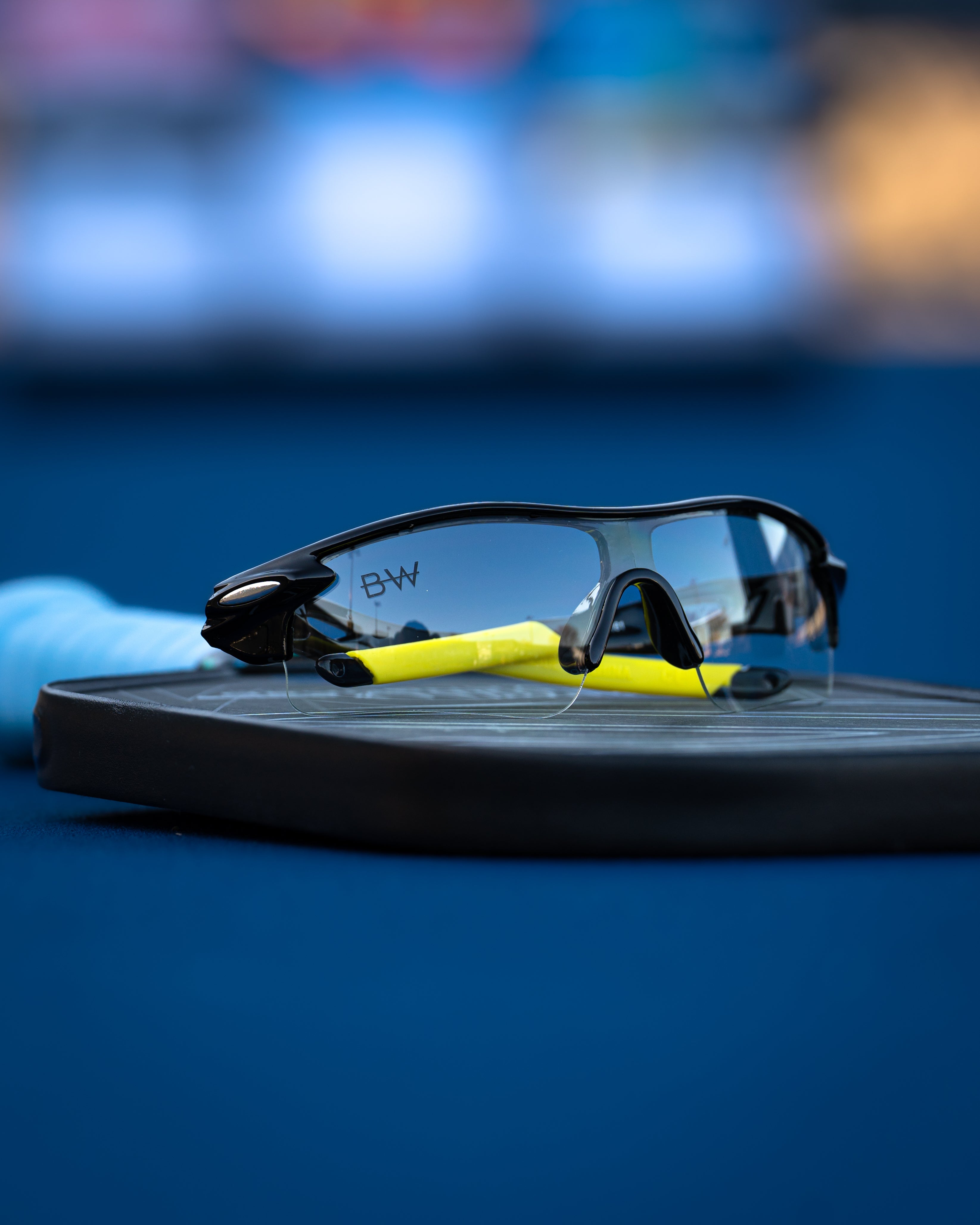
Adaptive RX Sunglasses: From Cloudy Mornings to Sunlit Courts
Share
Adaptive RX Sunglasses: From Cloudy Mornings to Sunlit Courts
A pickleball session can begin beneath heavy clouds and finish under direct afternoon sun. For players who require prescription correction, those changing conditions create a practical eyewear question: how do you maintain the correction you need while moving between different outdoor light environments?
Adaptive RX sunglasses—commonly called photochromic prescription lenses—are one option. Photochromic lenses are designed to change tint in response to environmental conditions, giving players a lens configuration that can change rather than remaining at one fixed tint.
That versatility can be useful, but it is important to separate what adaptive lenses actually do from sports-performance claims. A changing tint does not automatically improve reaction time, depth perception, ball tracking, contrast, shot accuracy, or competitive performance.
The real advantage is adaptability: prescription correction combined with changing-tint functionality for players whose routines take them through different lighting conditions.
Find the Right Pickleball Eyewear for Your Environment
What Are Adaptive RX Sunglasses?
Adaptive RX sunglasses combine prescription correction with lenses that can change tint in response to environmental conditions.
They are often described as photochromic or transition-style lenses. Instead of choosing one permanently clear or permanently tinted configuration, the wearer gets a lens designed to change its tint.
| Feature | What It Means |
|---|---|
| RX Correction | The lenses are made according to the wearer's prescription needs |
| Adaptive / Photochromic Function | The lens tint changes in response to environmental conditions |
| Sports Frame | The prescription lenses are paired with a frame intended for active use |
| Variable Tint | The wearer is not limited to one fixed tint level throughout the entire session |
The previous version of this guide described adaptive RX lenses as automatically preventing glare from disrupting play and optimizing contrast and depth perception. It also connected the lenses directly to faster reactions and more accurate visual calculations. Those athletic outcomes go beyond what changing-tint functionality alone establishes. :contentReference[oaicite:0]{index=0}
Why Adaptive RX Lenses Make Sense From Cloudy Mornings to Sunny Courts
Imagine arriving for an outdoor session early in the morning. The sky is overcast, so you may not want the same dark tint you would choose for stronger sunlight later in the day.
As conditions change, an adaptive lens can change tint rather than forcing the wearer to begin every session with one fixed lens state.
That makes photochromic RX worth considering for:
- Outdoor practices that last several hours
- Morning sessions that continue toward midday
- Players who frequently encounter variable outdoor conditions
- Tournament days with multiple matches
- Travel routines involving different environments
- Players who prefer changing-tint functionality over repeatedly switching between separate pairs
The benefit is primarily convenience and adaptability rather than a guaranteed improvement in athletic performance.
How Do Photochromic Prescription Lenses Work?
Photochromic lenses use light-responsive technology that allows the lens tint to change as environmental exposure changes.
For shoppers, the important concept is simple:
the lens is designed to change tint instead of remaining permanently clear or permanently dark.
Actual behavior can depend on the specific lens technology and conditions, so avoid assuming that every photochromic lens reaches the same darkness or changes at exactly the same speed.
Do Adaptive RX Sunglasses Change Tint Instantly?
No universal instant-transition claim should be made.
The previous article stated that Blinded Wear adaptive lenses darken or lighten “in seconds.” That exact transition speed should only be used when it has been verified for the specific lens being sold. :contentReference[oaicite:1]{index=1}
Photochromic behavior can vary by lens technology and environment. If transition speed is important to you, compare the current specifications of the exact lens configuration rather than assuming all adaptive lenses behave identically.
Adaptive RX vs. Clear RX vs. Fixed-Tint RX Sunglasses
There is no single lens configuration that is automatically best for every pickleball player. The useful comparison is how each option fits the environments in which you actually play.
| Lens Type | Primary Characteristic | Consider It When... |
|---|---|---|
| Clear RX | No dark sunglass tint | You require correction and commonly play indoors or in environments where you do not want dark tint |
| Fixed-Tint RX | Tint remains generally consistent | You prefer a tinted prescription sunglass configuration for your outdoor routine |
| Adaptive / Photochromic RX | Tint changes with environmental conditions | You want one RX configuration capable of changing tint across variable conditions |
Your prescription needs, environment, preferences, and the specifications of the exact product should drive the decision.
Adaptive RX Glasses for Cloudy Pickleball Mornings
Overcast weather does not mean every player wants the same eyewear setup. Cloud cover can vary, and outdoor conditions may change throughout the session.
An adaptive lens gives players who require prescription correction a changing-tint option instead of committing to a permanently dark sunglass lens for the entire session.
That can be especially practical when the forecast is variable or when a morning session is expected to continue as conditions change.
What Happens When the Sun Comes Out Mid-Match?
This is the scenario that gives adaptive RX sunglasses their strongest practical appeal.
You may begin in one outdoor condition and encounter another later without changing courts or ending the match.
A photochromic configuration is designed to respond by changing tint as conditions change.
What should not be added automatically is the claim that this tint change:
- Improves reaction time
- Enhances depth perception
- Makes spin easier to read
- Improves ball tracking
- Guarantees better contrast
- Increases shot accuracy
Those are separate performance outcomes that require their own evidence.
Changing Light vs. Changing Performance
It helps to separate the lens function from everything the athlete still has to do.
environment changes → lens tint responds → prescription correction remains part of the setup → athlete observes → athlete recognizes → athlete decides → athlete moves → athlete executes
The adaptive lens operates within the eyewear portion of that chain.
It does not automatically perform the recognition, anticipation, movement, or execution stages for the player.
Can Adaptive RX Glasses Work for Indoor and Outdoor Pickleball?
Photochromic RX lenses may appeal to players who move between environments, but the exact behavior of a specific lens should be verified before treating it as a universal indoor/outdoor solution.
If most of your play is indoors and you do not want dark sunglass tint, a clear RX configuration may be simpler.
If most of your play occurs outdoors under relatively consistent conditions, you may prefer a fixed-tint RX sunglass.
If your routine regularly involves changing environments, adaptive RX becomes particularly worth comparing.
Can One Adaptive RX Pair Replace Multiple Pairs?
For some players, the appeal of adaptive RX eyewear is reducing the need to manually switch between clear and tinted prescription eyewear as conditions change.
But “one pair for everything” should not be treated as a universal rule.
Separate pairs may still make sense if you:
- Prefer a specific fixed tint outdoors
- Want completely clear eyewear for indoor play
- Use different frames for different activities
- Want a backup prescription pair for tournaments
- Prefer more control over which lens configuration you wear
Adaptive RX is a versatility option—not a requirement for every player.
Why Adaptive RX Sunglasses Can Be Convenient for Pickleball Travel
Tournament travel can expose a player to unfamiliar schedules and environments. A morning practice, afternoon outdoor match, and later session may not occur under identical conditions.
For an RX wearer, photochromic functionality can simplify the eyewear setup by providing a prescription lens capable of changing tint.
That convenience should remain separate from claims that the lens automatically makes travel performance more consistent.
Do Adaptive RX Lenses Improve Depth Perception?
No automatic improvement in biological depth perception should be attributed to changing-tint lenses.
If you require prescription correction, RX lenses can provide that correction while you judge changing distances on the court. Photochromic functionality adds the ability for the tint to change.
Those are two useful characteristics without claiming that the adaptive technology itself upgrades the brain's spatial-processing ability.
Do Adaptive RX Sunglasses Improve Reaction Time?
Adaptive lenses should not automatically be marketed as reaction-time technology.
Fast pickleball responses involve multiple stages:
- Visual information is available
- The player recognizes the developing situation
- A response is selected
- Movement begins
- The paddle is controlled through contact
- The player recovers for the next ball
The previous version of this article claimed athletes using adaptive RX glasses improved return accuracy by up to 18% in dynamic lighting conditions. Unless that result is supported by reliable evidence for the relevant product and population, it should not be presented as an established Blinded Wear performance result. :contentReference[oaicite:2]{index=2}
Do Photochromic Lenses Automatically Improve Contrast?
No universal contrast-enhancement claim should be attached to photochromic functionality alone.
“Changes tint” and “enhances contrast” are different claims.
If a specific lens has verified contrast-related characteristics, those can be described accurately. Otherwise, the safer and more useful description is that the lens provides changing-tint functionality.
Do Adaptive RX Lenses Eliminate Glare?
Do not assume that an adaptive lens eliminates glare simply because it darkens.
Likewise, photochromic and polarized are not interchangeable terms.
Blinded Wear sports eyewear uses non-polarized lenses. A non-polarized lens does not add a polarization filter and preserves the visual information available without that filter.
Some court players prefer non-polarized eyewear, but that configuration should not automatically be credited with improved depth perception, ball tracking, or reaction time.
Adaptive Does Not Mean Polarized
This distinction matters when comparing prescription sunglasses.
| Term | What It Describes |
|---|---|
| Prescription / RX | Vision correction according to the wearer's prescription |
| Photochromic / Adaptive | A lens designed to change tint in response to environmental conditions |
| Polarized | A separate lens-filter characteristic |
| Non-Polarized | A lens without an added polarization filter |
| High-Index | A prescription lens-material category |
The original article described Ocean Wave RX as providing “polarized clarity,” but Blinded Wear's sports eyewear is non-polarized, so that wording should not be carried into the refreshed article. :contentReference[oaicite:3]{index=3}
High-Index Prescription Lenses: What RX Players Should Know
High-index refers to a prescription lens-material category. It should not be confused with adaptive tint technology.
Blinded Wear includes high-index prescription lenses at no additional cost with RX eyewear.
That means shoppers can evaluate two different characteristics separately:
- High-index: the prescription lens-material category
- Adaptive/photochromic: changing-tint functionality when offered in the selected configuration
The previous article specified an exact 1.61 index. Unless the exact index is currently verified for the product being purchased, the broader verified term high-index prescription lenses is more appropriate. :contentReference[oaicite:4]{index=4}
Impact-Resistant Lenses for Active Use
Blinded Wear sports eyewear uses impact-resistant lenses, a relevant physical characteristic for eyewear intended for active environments.
Impact-resistant should remain precise terminology. It does not automatically mean:
- Shatterproof
- Unbreakable
- Certified to a particular protective standard
- Guaranteed against all damage
It should also remain separate from adaptive-tint performance claims.
Which Blinded Wear RX Glasses Should You Compare?
Start with your prescription requirements and playing environment rather than assuming every RX frame offers the same adaptive lens configuration.
| RX Eyewear | What to Compare | Shop |
|---|---|---|
| Phantom II RX | Current lens options, frame design, prescription configuration, and dimensions | Phantom II RX |
| Ocean Wave RX | Current RX configuration, frame design, dimensions, and intended environment | Ocean Wave RX |
| Silver Line RX | Prescription sunglass configuration and outdoor routine | Silver Line RX |
| H Blue Shield RX | Blue-light filtering when that verified characteristic is specifically desired | H Blue Shield RX |
| Rocket Fire RX | Current RX configuration, frame design, and available dimensions | Rocket Fire RX |
| Frost RX | Current prescription configuration, frame design, and dimensions | Frost RX |
Check the current product configuration before assuming a particular frame includes adaptive/photochromic functionality.
What Blinded Wear RX Eyewear Actually Offers
Rather than relying on exaggerated claims about “automatic performance adaptation,” focus on verified product characteristics:
- Designed for pickleball players
- Lightweight sports frames
- Impact-resistant lenses
- Non-polarized lenses
- Comfortable for extended matches
- Suitable for recreational and competitive players
- Performance-first design
- High-index prescription lenses included at no additional cost
- 50% lifetime replacement support if glasses break, subject to current policy terms
Adaptive/photochromic functionality should be described only for the specific lens configurations in which it is currently offered.
7 Myths About Adaptive RX Sunglasses
1. “Adaptive RX Lenses Instantly Change From Clear to Dark”
Transition behavior varies. Do not assume every photochromic lens changes at the same speed.
2. “Adaptive Lenses Automatically Improve Reaction Time”
Changing tint should not be treated as a neurological reaction-time technology.
3. “Photochromic Means Polarized”
No. Photochromic and polarized describe different lens characteristics.
4. “Adaptive RX Automatically Improves Depth Perception”
Prescription correction and changing tint do not establish a universal improvement in biological depth perception.
5. “One Adaptive Pair Is Always Better Than Two Specialized Pairs”
Some players value versatility; others prefer separate clear and fixed-tint configurations.
6. “Adaptive Lenses Guarantee Better Ball Tracking”
Ball tracking involves more than tint and should not be presented as an automatic photochromic benefit.
7. “Every RX Frame Is Automatically Adaptive”
Always verify the current lens options available with the exact product you are considering.
FAQs About Adaptive RX Sunglasses for Pickleball
What are adaptive RX sunglasses?
They are prescription sunglasses using a lens configuration designed to change tint in response to environmental conditions.
Are adaptive and photochromic lenses the same thing?
“Adaptive” is commonly used to describe changing-tint eyewear, while photochromic is the more specific lens term frequently used for this functionality.
Are adaptive RX sunglasses useful for cloudy days?
They can be worth considering when you want prescription correction combined with tint that can change as outdoor conditions change.
Can photochromic lenses get darker when conditions become brighter?
Photochromic technology is designed to change tint in response to environmental exposure. Exact behavior depends on the specific lens and conditions.
Do adaptive lenses change instantly?
Do not assume an instant transition. The rate of change can vary with the lens technology and environment.
Can I use adaptive RX glasses for indoor pickleball?
That depends on the behavior of the specific lens and your preferences. If you primarily play indoors and do not want dark tint, clear RX eyewear is another category to compare.
Are adaptive lenses polarized?
Photochromic and polarized are separate characteristics. Blinded Wear sports eyewear uses non-polarized lenses.
Do adaptive lenses improve depth perception?
No universal improvement should be assumed. RX lenses provide prescription correction, while photochromic functionality changes tint.
Do adaptive lenses improve reaction time?
No automatic reaction-time improvement should be attributed to changing-tint lenses.
Do adaptive RX glasses improve ball tracking?
No automatic ball-tracking improvement should be promised. Ball tracking involves multiple visual, attentional, movement, and experience-related factors.
Are adaptive RX glasses good for tournament travel?
They can be convenient for RX wearers who encounter changing environments and prefer a changing-tint configuration rather than repeatedly switching eyewear.
Does Blinded Wear charge extra for high-index RX lenses?
High-index prescription lenses are included at no additional cost with Blinded Wear RX eyewear.
How do I submit my prescription?
Upload a clear photo or picture of your eyeglass prescription before purchasing RX eyewear.
Does Blinded Wear offer replacement support?
Yes. Blinded Wear offers 50% lifetime replacement support if glasses break, subject to current policy terms.
How Changing Light Actually Plays Out During a Pickleball Session
Outdoor lighting rarely changes in a perfectly predictable sequence. A player might warm up under cloud cover, play a first game in brighter conditions, experience intermittent shade, and finish later in the afternoon.
For an RX wearer, there are several ways to approach those changes:
- Wear one fixed-tint prescription sunglass
- Carry separate clear and tinted prescription eyewear
- Use an adaptive/photochromic RX configuration when available
The adaptive approach is appealing because the lens itself can change tint as conditions change. That reduces the need to make a manual eyewear change every time the environment shifts.
It does not mean every lighting change will produce an identical lens response, so players should become familiar with the exact configuration they intend to use.
Cloudy Morning to Midday Sun: Where Adaptive RX Can Be Most Practical
Consider a three-hour outdoor session beginning early in the morning.
| Stage of Session | Possible Conditions | Adaptive RX Role |
|---|---|---|
| Warm-Up | Overcast or lower outdoor brightness | Lens remains responsive to the current environment |
| Early Games | Clouds begin breaking | Tint can change as environmental exposure changes |
| Midday Play | Stronger sunlight | Photochromic functionality continues responding to conditions |
| Passing Clouds | Outdoor exposure changes again | Lens tint can continue adapting rather than remaining permanently fixed |
This is the core use case for adaptive RX sunglasses: one corrective setup designed to respond to changing outdoor conditions.
When Is Fixed-Tint RX Better Than Adaptive RX?
Adaptive technology is useful, but versatility is not automatically the most important feature for every player.
A fixed-tint prescription sunglass may make more sense when:
- You almost always play outdoors under similar conditions
- You already know which tint configuration you prefer
- You prefer a relatively consistent tint throughout the session
- You use separate eyewear for indoor play
- You do not need one pair to cover multiple environments
The goal is not to choose the lens with the longest feature list. It is to choose the configuration that fits how you actually play.
When Is Clear RX Better Than Adaptive RX?
Clear prescription sports eyewear can be the simpler option for players who primarily compete indoors or in environments where they do not want dark sunglass tint.
Choose based on environment rather than assuming adaptive technology is inherently superior:
| Playing Routine | Category to Compare |
|---|---|
| Mostly indoor pickleball | Clear RX |
| Mostly consistent outdoor conditions | Fixed-tint RX |
| Frequently changing outdoor conditions | Adaptive/photochromic RX |
| Regular indoor + outdoor routine | Compare adaptive RX with separate environment-specific pairs |
Adaptive RX Sunglasses for All-Day Pickleball Tournaments
Tournament days can create a strong use case for versatile prescription eyewear because a player may spend hours moving between warm-ups, matches, breaks, and changing outdoor conditions.
Instead of thinking about adaptive RX as a competitive shortcut, think about it as an equipment-management option.
An RX player may value:
- Keeping the same prescription eyewear through changing outdoor conditions
- Reducing the number of eyewear swaps during the day
- Using a familiar sports frame across multiple matches
- Carrying fewer primary eyewear configurations
Even with adaptive lenses, carrying another suitable corrective option can still be useful if your primary pair becomes unavailable.
Do You Still Need Backup Glasses If You Use Adaptive RX?
Adaptive functionality can reduce the need to switch between certain lens configurations, but it does not eliminate the value of a backup prescription option.
If your primary RX glasses are important to your normal corrected vision, another suitable pair can provide redundancy during tournaments and travel.
A backup is particularly worth considering when:
- You are traveling away from home
- You have multiple tournament days
- You depend on prescription correction during play
- Replacing damaged or unavailable eyewear immediately would be difficult
Adaptive RX vs. Multiple Pairs for Tournament Travel
There are two reasonable approaches for an RX player traveling between different environments.
| Approach | Potential Advantage | Consideration |
|---|---|---|
| Adaptive RX + Backup | Primary pair can change tint across conditions | Exact photochromic behavior depends on the lens and environment |
| Clear RX + Tinted RX | Direct control over which lens configuration you wear | Requires carrying and switching between pairs |
| Fixed-Tint RX + Backup | Simple setup for primarily outdoor competition | Less versatile if conditions or environments change substantially |
The best setup depends on whether you prioritize versatility, direct control over tint, or simplicity.
Practice in Adaptive RX Glasses Before Tournament Day
If you plan to compete in a new RX configuration, use it during normal practice first.
Try the eyewear during:
- Morning outdoor sessions
- Brighter afternoon sessions
- Cloudy conditions
- Dinks and kitchen exchanges
- Returns and drives
- Transition-zone movement
- Full games
The objective is not to prove that the changing tint improves your performance. It is to understand how your specific eyewear behaves during the environments and movements you actually encounter.
What Should You Notice When Trying Adaptive RX for the First Time?
Instead of searching for an immediate performance boost, evaluate practical characteristics.
- Prescription: Does the finished eyewear provide the correction you expect?
- Frame: How does the frame feel during normal play?
- Environment: How does the lens behave in the conditions where you actually use it?
- Tint Preference: Do you like the changing-tint experience?
- Familiarity: Does the setup feel normal after repeated sessions?
If your corrected vision seems persistently or unexpectedly wrong, that is different from simply deciding you prefer another tint configuration.
Weather Changes More Than Just Brightness
Outdoor pickleball can involve cloud cover, direct sunlight, shade, temperature changes, and shifting court orientation throughout the day.
An adaptive lens addresses one part of that environment through changing-tint functionality.
It does not automatically compensate for every variable associated with outdoor play.
Players still need to adapt through:
- Positioning
- Shot selection
- Movement
- Experience with the court
- Normal equipment preparation
Keeping the lens claim narrow makes the benefit easier to understand: adaptive RX provides prescription correction with tint that can change as conditions change.
What About Courts With Both Shade and Sun?
Some courts create especially variable visual environments because nearby buildings, trees, court orientation, or changing conditions can create different levels of light exposure during a session.
Photochromic RX may be worth comparing when you prefer changing-tint functionality rather than a permanently fixed tint.
However, avoid assuming that the lens will instantly change every time you cross between small areas of shade and sunlight. The response of a photochromic lens is not the same as an electronic display changing brightness instantaneously.
Learn how your specific lens behaves before relying on it during competition.
Do Photochromic RX Lenses Behave the Same Everywhere?
No. Photochromic performance can depend on the specific technology and environmental exposure.
That is important for players who want one prescription pair for sports, travel, and everyday use. Do not assume the lens will reach the same tint level or transition identically in every setting.
When adaptive behavior is an important buying factor, review the current specifications for the exact lens configuration you are considering.
Can Changing Light Affect How Pickleball Feels?
Players can notice differences when the visual environment changes. But noticing a different environment does not establish that one specific lens technology will automatically improve performance within it.
Keep three questions separate:
| Question | What It Evaluates |
|---|---|
| Do I need prescription correction? | Your corrective requirement |
| Do I want changing tint? | Your lens-configuration preference |
| How do I play better in changing conditions? | Practice, recognition, positioning, decisions, and experience |
Adaptive RX eyewear can answer the first two questions when the selected product supports that configuration. It does not automatically answer the third.
Do Adaptive RX Sunglasses Make the Pickleball Easier to Track?
No automatic ball-tracking improvement should be promised from adaptive tint.
Tracking a moving pickleball can involve:
- Prescription correction when required
- Attention
- Eye and head movement
- Recognition of the developing trajectory
- Player positioning
- Experience
Photochromic functionality changes the tint behavior of the lens. It should not be treated as a substitute for those other components.
Do Adaptive Lenses Help You Read Pickleball Spin?
Do not automatically credit changing tint with improved spin recognition.
Players can use information from the opponent's contact, the ball's movement, its bounce, and previous experience when responding to spin.
Prescription eyewear provides required correction while that process occurs. Adaptive functionality changes tint as conditions change. Neither characteristic should be converted into an unsupported guarantee of improved spin recognition.
Adaptive Tint vs. Dynamic Depth Perception
Dynamic depth perception involves interpreting changing spatial relationships while the ball or player is moving.
Adaptive tint is a lens function.
They should not be treated as the same thing.
| Eyewear Function | Player Process |
|---|---|
| Prescription correction | Spatial interpretation |
| Changing tint | Recognition |
| Sports frame | Movement |
| Impact-resistant lens | Positioning |
| Non-polarized configuration | Decision-making |
| Equipment familiarity | Technique and execution |
Can Adaptive RX Sunglasses Increase On-Court Confidence?
Competitive confidence should not be promised as an automatic result of changing-tint eyewear.
A player may appreciate having a familiar prescription setup across changing conditions, but confidence can also depend on:
- Preparation
- Practice
- Experience
- Strategy
- Equipment familiarity
- Response to mistakes
A more useful goal is to make your eyewear one familiar part of the overall setup rather than expecting the lens to create confidence by itself.
Don't Forget the Frame When Comparing Adaptive RX Glasses
Lens technology receives most of the attention, but the frame is still part of the finished eyewear.
When current measurements are available, compare:
- Overall frame width
- Lens dimensions
- Bridge measurements
- Temple length
- General frame shape
If you are unsure about fit, compare those dimensions with a pair of glasses you already wear comfortably.
Avoid assuming that any frame is universally secure or perfectly fitted without product-specific information and an individual fit comparison.
8 Questions to Ask Before Buying Adaptive RX Sunglasses
- Do I actually require prescription correction in this pair?
- Is adaptive/photochromic functionality currently offered with this exact product?
- Where will I use the glasses most often?
- Would I prefer changing tint or a fixed tint?
- Would separate clear and tinted pairs fit my routine better?
- What verified lens characteristics are included?
- How do the frame dimensions compare with eyewear that already fits me?
- Do I have another suitable corrective option for important events?
These questions are more useful than choosing a product because it promises to make you react faster or see spin better.
30-Second Adaptive RX Decision Guide
Do you require prescription correction?
→ No: Start with the non-RX pickleball collection.
→ Yes: Continue below.
Do you primarily play indoors?
→ Yes: Compare clear RX options and any other current indoor configurations.
→ No: Continue below.
Are your outdoor conditions usually similar?
→ Yes: Compare fixed-tint RX sunglasses with available adaptive options.
→ No: Adaptive/photochromic RX may be particularly worth comparing.
Do you regularly travel or play across different environments?
→ Yes: Compare the convenience of adaptive RX against carrying separate environment-specific pairs.
Adaptive RX Marketing Claims: Feature or Hype?
| Claim | How to Evaluate It |
|---|---|
| “Adaptive tint” | Verify that the selected lens actually offers photochromic/changing-tint functionality |
| “Instant transition” | Look for verified transition specifications for the exact lens |
| “Perfect glare control” | Ask what specific lens characteristic supports the claim |
| “Enhanced contrast” | Look for product-specific evidence rather than assuming tint automatically enhances contrast |
| “Improved depth perception” | Do not infer a biological depth-perception improvement from adaptive tint alone |
| “Faster reactions” | Look for relevant performance evidence rather than treating it as an inherent lens function |
| “Better spin recognition” | Ask whether actual spin-recognition performance was tested |
| “One pair for everything” | Compare that convenience claim with your actual indoor, outdoor, travel, and backup needs |
7 Mistakes to Avoid When Shopping for Adaptive RX Sunglasses
1. Assuming Every Photochromic Lens Behaves the Same
Specific lens technologies and environments can produce different behavior.
2. Assuming Adaptive Means Polarized
Photochromic and polarization are separate characteristics.
3. Buying a Performance Promise Instead of a Lens Feature
Changing tint is a real function. Claims about reaction time, depth perception, or shot accuracy require separate evidence.
4. Ignoring Where You Actually Play
A primarily indoor player may value a different configuration from someone who spends hours outdoors.
5. Assuming One Pair Must Replace Every Other Pair
Adaptive RX can be versatile while a backup or specialized pair can still be useful.
6. Ignoring Frame Fit
Compare available measurements with eyewear that already fits rather than assuming every sports frame fits every player.
7. Trying New Eyewear for the First Time at a Tournament
Use the finished prescription setup during normal practice so you understand how it feels and behaves before an important event.
How to Evaluate New Adaptive RX Glasses Over Your First Week
| Session | What to Evaluate |
|---|---|
| Session 1 | Prescription correction, basic frame comfort, and general familiarity |
| Session 2 | Normal pickleball movement and frame feel |
| Session 3 | Behavior in your typical outdoor conditions |
| Session 4 | Changing conditions if naturally available |
| Session 5+ | Whether the eyewear fits naturally into your normal playing routine |
Do not deliberately stare toward intense light or create unsafe conditions just to test the lenses. Evaluate them during normal use.
When Is It More Than an Adaptive-Lens Preference?
Disliking how a particular tint behaves is different from experiencing an unexpected visual problem.
If you notice persistent unexpected blur, double vision, a concerning change in your visual field, or another significant change from your normal corrected vision, consider appropriate professional evaluation.
Changing lens tint is an eyewear feature. It is not a substitute for addressing an underlying corrective or visual concern.
How to Order Blinded Wear RX Pickleball Glasses
- Have your current eyeglass prescription available.
- Browse the Blinded Wear RX collection.
- Choose a frame based on your preferences and available measurements.
- Review the current lens configurations available for that product.
- Confirm adaptive/photochromic functionality when that is the feature you want.
- Upload a clear photo or picture of your eyeglass prescription before purchasing.
Blinded Wear includes high-index prescription lenses at no additional cost with RX eyewear.
Replacement Support for Your RX Eyewear
Blinded Wear offers 50% lifetime replacement support if glasses break, subject to current policy terms.
This is different from claiming that the eyewear is unbreakable or that every replacement is free.
More Questions About Adaptive Prescription Sunglasses
Are adaptive RX sunglasses worth it for pickleball?
They can be worth comparing if you require prescription correction and regularly play through changing outdoor conditions. Their primary benefit is changing-tint versatility rather than a guaranteed performance improvement.
Who benefits most from adaptive RX eyewear?
Players who require RX correction and frequently encounter variable outdoor conditions, long sessions, or changing environments may find the functionality particularly convenient.
Are adaptive RX glasses better than regular prescription sunglasses?
Not universally. Adaptive lenses change tint, while fixed-tint prescription sunglasses provide a more consistent tint. Which is preferable depends on your routine.
Should I buy adaptive RX if I mostly play indoors?
If you primarily play indoors and do not want dark tint, compare clear RX eyewear as well. Adaptive functionality may be less important to your routine.
Can I wear adaptive RX glasses on cloudy days?
Photochromic lenses are designed to respond to environmental conditions, making them a category worth considering for variable outdoor sessions. Exact behavior depends on the specific lens.
Do adaptive RX lenses work in shade?
Photochromic behavior depends on the specific lens technology and environmental exposure. Do not assume identical tint behavior in every shaded setting.
Will adaptive RX glasses change every time a cloud passes?
The lens can respond as conditions change, but it should not be imagined as an instantaneous electronic switch. Actual transition behavior depends on the lens and environment.
Are photochromic lenses the same as clear lenses?
No. Clear lenses do not use dark sunglass tint, while photochromic lenses are designed to change tint under appropriate conditions.
Are photochromic lenses the same as tinted sunglasses?
Not exactly. A fixed-tint sunglass maintains its tint configuration, while a photochromic lens is designed to change tint.
Can adaptive RX replace clear and sunglass pairs?
It may reduce the need for switching for some players, but others may still prefer separate clear and fixed-tint pairs.
Should tournament players carry backup RX eyewear?
If prescription correction is important to your play, another suitable corrective option can provide useful redundancy if the primary pair becomes unavailable.
Does adaptive tint improve pickleball accuracy?
No automatic improvement in shot accuracy should be attributed to changing-tint functionality.
Does adaptive tint improve reaction time?
No automatic neurological reaction-time improvement should be claimed.
Does adaptive tint improve depth perception?
No universal improvement in biological depth perception should be assumed from changing tint.
Does Blinded Wear use polarized sports lenses?
Blinded Wear sports eyewear uses non-polarized lenses.
Are Blinded Wear RX lenses impact-resistant?
Yes. Blinded Wear sports eyewear uses impact-resistant lenses. Impact-resistant does not automatically mean shatterproof or certified to a particular protective standard.
Are high-index prescription lenses included?
Yes. Blinded Wear includes high-index prescription lenses at no additional cost with RX eyewear.
How to Use Adaptive RX Sunglasses on Match Day
Adaptive RX eyewear works best when it is treated as familiar equipment rather than a last-minute performance upgrade.
Before competition:
- Check your prescription setup. Use the corrective eyewear you have already practiced in.
- Review the environment. Consider whether play will be indoor, outdoor, or spread across changing conditions.
- Clean your lenses. Start with a clean visual surface rather than blaming environmental conditions for something easily corrected.
- Warm up normally. Experience the eyewear during real movement before scored points begin.
- Keep a backup available. If RX correction is important to your play, another suitable corrective option provides redundancy.
The goal is simple: arrive already familiar with how your eyewear behaves instead of discovering it during an important match.
Which RX Setup Fits Different Pickleball Days?
| Scenario | RX Setup to Compare | Why |
|---|---|---|
| Indoor league night | Clear RX | Useful when prescription correction is needed without dark sunglass tint |
| Consistently bright outdoor session | Fixed-tint RX or available adaptive RX | Compare consistent tint with changing-tint versatility |
| Cloudy morning becoming sunnier | Adaptive/photochromic RX | Changing-tint functionality matches a changing outdoor environment |
| Long outdoor tournament | Adaptive RX or preferred outdoor RX + backup | Prioritize familiarity, environment, and redundancy |
| Indoor and outdoor play in the same routine | Adaptive RX vs. separate clear and outdoor RX pairs | Compare versatility with greater control over each environment |
| Tournament travel | Primary RX + suitable backup | Reduces dependence on one corrective pair |
Why Familiarity Matters More Than Chasing the “Perfect” Tint
It can be tempting to keep changing eyewear every time the court looks slightly different. But equipment changes also introduce new variables.
A more practical approach is to choose a setup appropriate for your prescription and environment, then gain experience using it.
Familiarity can include knowing:
- How the frame feels during movement
- How the selected lens behaves outdoors
- How the eyewear fits into your warm-up routine
- Whether you prefer adaptive or fixed tint
- Which backup option you will use if needed
None of this means familiarity biologically improves vision. It means fewer parts of your equipment setup are unfamiliar when competition begins.
What Adaptive RX Controls vs. What the Athlete Controls
| Eyewear | Athlete |
|---|---|
| Provides prescription correction | Recognizes the developing play |
| Can provide changing-tint functionality | Anticipates opponent patterns |
| Provides a sports-oriented frame | Moves into position |
| Uses non-polarized lenses | Selects the appropriate response |
| Uses impact-resistant lenses | Controls paddle angle and swing |
| Can become familiar through repeated use | Develops technique through practice |
| Addresses the corrective component | Builds sport-specific experience |
Adaptive RX manages part of your eyewear setup. You still play the point.
What Adaptive RX Sunglasses Should—and Shouldn't—Promise
Photochromic technology is useful without turning it into a cure-all for athletic vision.
| Reasonable Product Description | Claim That Requires Separate Evidence |
|---|---|
| Prescription correction | Faster reaction time |
| Changing-tint functionality | Better depth perception |
| Useful for variable outdoor conditions | Better spin recognition |
| Can reduce the need to manually switch between certain lens configurations | Improved shot accuracy |
| High-index RX lenses included at no additional cost | Faster visual processing |
| Impact-resistant lenses | Shatterproof protection |
| Non-polarized lenses | Guaranteed better ball tracking |
Accurate product language gives shoppers a clearer reason to choose adaptive RX: prescription correction plus changing-tint versatility.
Three Practical RX Setups for Pickleball Players
Setup 1: The Adaptive Minimalist
Primary: Adaptive/photochromic RX when available
Backup: Another suitable corrective pair
This setup prioritizes versatility and minimizes the number of primary eyewear changes across variable outdoor conditions.
Setup 2: The Environment Specialist
Indoor: Clear RX
Outdoor: Preferred fixed-tint RX sunglasses
This approach gives the player direct control over the lens configuration used in each environment.
Setup 3: The Tournament Traveler
Primary: Preferred RX sports eyewear
Secondary: Environment-specific or adaptive RX option
Backup: Another suitable corrective option
This setup prioritizes redundancy when competing away from home.
What Should an RX Player Keep in a Tournament Bag?
For players who rely on prescription correction, a simple eyewear kit can prevent unnecessary equipment problems.
- Primary RX sports glasses
- Another suitable corrective option
- Appropriate eyewear storage
- Lens-cleaning supplies
- Any separate environment-specific eyewear you intentionally use
Adaptive RX can simplify this setup for some players, but it does not eliminate the usefulness of a backup.
Choose Adaptive RX Based on Your Actual Playing Environment
Before buying, think about your last several weeks of pickleball rather than an imaginary perfect playing day.
Ask yourself:
- How often do I play outdoors?
- How often do outdoor conditions change during my sessions?
- Do I regularly play both indoors and outdoors?
- Do I prefer changing tint or a predictable fixed tint?
- Would I rather carry multiple specialized pairs?
- Do I travel frequently for pickleball?
- How important is having one versatile RX configuration to me?
Your answers can tell you more about whether adaptive RX makes sense than a generic “best lens” ranking.
Who Should Consider Adaptive RX Sunglasses?
| Player | Why Adaptive RX May Be Worth Comparing |
|---|---|
| Outdoor Recreational Player | Sessions may continue through changing outdoor conditions |
| Tournament Player | Competition can span multiple hours and environments |
| Traveling Player | Different locations may introduce unfamiliar conditions |
| Morning-to-Afternoon Player | Outdoor conditions can change substantially during a long session |
| Indoor/Outdoor Player | Changing-tint functionality may be worth comparing with separate specialized pairs |
| RX Minimalist | May prefer one versatile primary corrective setup |
Who May Not Need Adaptive RX?
Photochromic functionality is not automatically necessary just because you play pickleball.
You may prefer another configuration if:
- You play almost exclusively indoors
- You already prefer clear RX for your primary environment
- You play outdoors under relatively consistent conditions and prefer fixed tint
- You like carrying separate specialized pairs
- You do not value changing-tint functionality enough to make it a buying priority
The right eyewear category depends on your routine—not on whether one technology sounds more advanced.
Adaptive RX Sunglasses: 30-Second Buyer Checklist
| Question | If Yes... |
|---|---|
| Do you require prescription correction? | Start with RX eyewear |
| Do outdoor conditions frequently change? | Compare adaptive/photochromic options |
| Do you primarily play indoors? | Compare clear RX options |
| Do you prefer one consistent outdoor tint? | Compare fixed-tint RX sunglasses |
| Do you play across several environments? | Compare adaptive RX with separate specialized pairs |
| Do you depend on RX correction during competition? | Consider another suitable corrective option as backup |
Final FAQs About Adaptive RX Sunglasses
What is the biggest advantage of adaptive RX sunglasses?
The primary advantage is combining prescription correction with changing-tint functionality in one eyewear setup.
Are adaptive RX sunglasses good for pickleball?
They can be a practical option for RX players who regularly encounter changing outdoor conditions and value a lens that changes tint.
Are photochromic lenses better for sports?
Not universally. Their changing-tint functionality can be useful, while other players may prefer clear or fixed-tint lenses.
Can adaptive RX sunglasses replace regular prescription glasses?
Whether one pair fits your complete routine depends on the specific lens configuration, your prescription needs, environments, and personal preferences.
Do photochromic lenses stay dark all the time?
No. Photochromic lenses are designed to change tint in response to environmental conditions rather than remain at one fixed dark tint.
Do photochromic lenses always become completely clear indoors?
Do not assume identical behavior across every lens technology and environment. Check the current specifications of the exact configuration you are considering.
How quickly do adaptive lenses change?
Transition behavior varies by lens technology and environmental conditions. Avoid assuming every adaptive lens changes at the same rate.
Are adaptive lenses useful on partly cloudy days?
Changing outdoor conditions are one of the situations in which photochromic functionality may be particularly convenient.
Are adaptive RX glasses useful for morning pickleball?
They may be useful when an early session continues into changing outdoor conditions and the player wants a changing-tint prescription setup.
Are adaptive RX sunglasses good for long tournaments?
They can simplify eyewear management for some RX players because the primary lens can change tint as outdoor conditions change.
Do adaptive RX glasses make you react faster?
No automatic reaction-time improvement should be attributed to photochromic tint.
Do adaptive RX glasses improve depth perception?
No universal biological depth-perception improvement should be assumed from changing-tint technology.
Do adaptive lenses improve contrast?
Changing tint and contrast enhancement are separate claims. Only describe contrast characteristics that are verified for the specific lens.
Do adaptive lenses eliminate glare?
Do not assume that changing tint automatically eliminates glare.
Are adaptive RX sunglasses polarized?
Photochromic and polarized describe different lens characteristics. Blinded Wear sports eyewear uses non-polarized lenses.
Are Blinded Wear RX lenses impact-resistant?
Yes. Blinded Wear sports eyewear uses impact-resistant lenses. Impact-resistant does not automatically mean shatterproof, unbreakable, or certified to a particular protective standard.
Does Blinded Wear include high-index prescription lenses?
Yes. High-index prescription lenses are included at no additional cost with Blinded Wear RX eyewear.
How do I submit my prescription?
Upload a clear photo or picture of your eyeglass prescription before purchasing RX eyewear.
What if my glasses break?
Blinded Wear offers 50% lifetime replacement support if glasses break, subject to current policy terms.
Explore More Pickleball RX Eyewear Resources
Adaptive RX Sunglasses in 30 Seconds
| Question | Bottom Line |
|---|---|
| What are adaptive RX sunglasses? | Prescription eyewear with changing-tint functionality |
| When are they most useful? | When an RX wearer regularly encounters changing outdoor conditions |
| Are they the same as polarized lenses? | No |
| Do they automatically improve reaction time? | No |
| Do they automatically improve depth perception? | No |
| Do they automatically improve ball tracking? | No |
| Can they reduce eyewear switching? | They may for players whose changing-tint configuration fits multiple conditions |
| Are they always better than fixed tint? | No; the best configuration depends on the player's routine and preferences |
| Should RX players consider a backup? | A backup can provide useful redundancy during tournaments and travel |
One Prescription Setup for a Day That Doesn't Stay the Same
The strongest reason to consider adaptive RX sunglasses is not a promise of faster reactions, better depth perception, or automatic competitive improvement.
It is much simpler:
your outdoor environment can change, and an adaptive lens is designed to change tint with it.
For pickleball players who require prescription correction, that can create a versatile setup for cloudy mornings, brighter afternoons, long outdoor practices, tournament days, and travel.
Blinded Wear RX eyewear combines prescription correction with lightweight sports frames, impact-resistant non-polarized lenses, comfort for extended matches, performance-first design, and high-index prescription lenses included at no additional cost.
When adaptive/photochromic functionality is available in the configuration you choose, it adds another practical feature: changing tint for changing conditions.
The Bottom Line: Adapt the Tint to the Environment, Not the Claims to the Marketing
Adaptive RX sunglasses solve a practical eyewear problem: players who require prescription correction may encounter substantially different outdoor conditions during the same session.
A photochromic lens can provide changing-tint functionality within that corrective setup.
That is already a meaningful feature. It does not need unsupported promises about reaction speed, depth perception, contrast, spin recognition, or shot accuracy to be useful.
Choose your RX eyewear by asking what you actually need:
prescription → environment → lens configuration → frame → familiarity → backup.
If changing outdoor conditions are a regular part of your pickleball routine, adaptive RX may be a practical configuration to compare with clear and fixed-tint alternatives.
Clouds change. Sunlight changes. Your prescription needs remain—and adaptive RX gives you a lens option designed to change with the environment.