
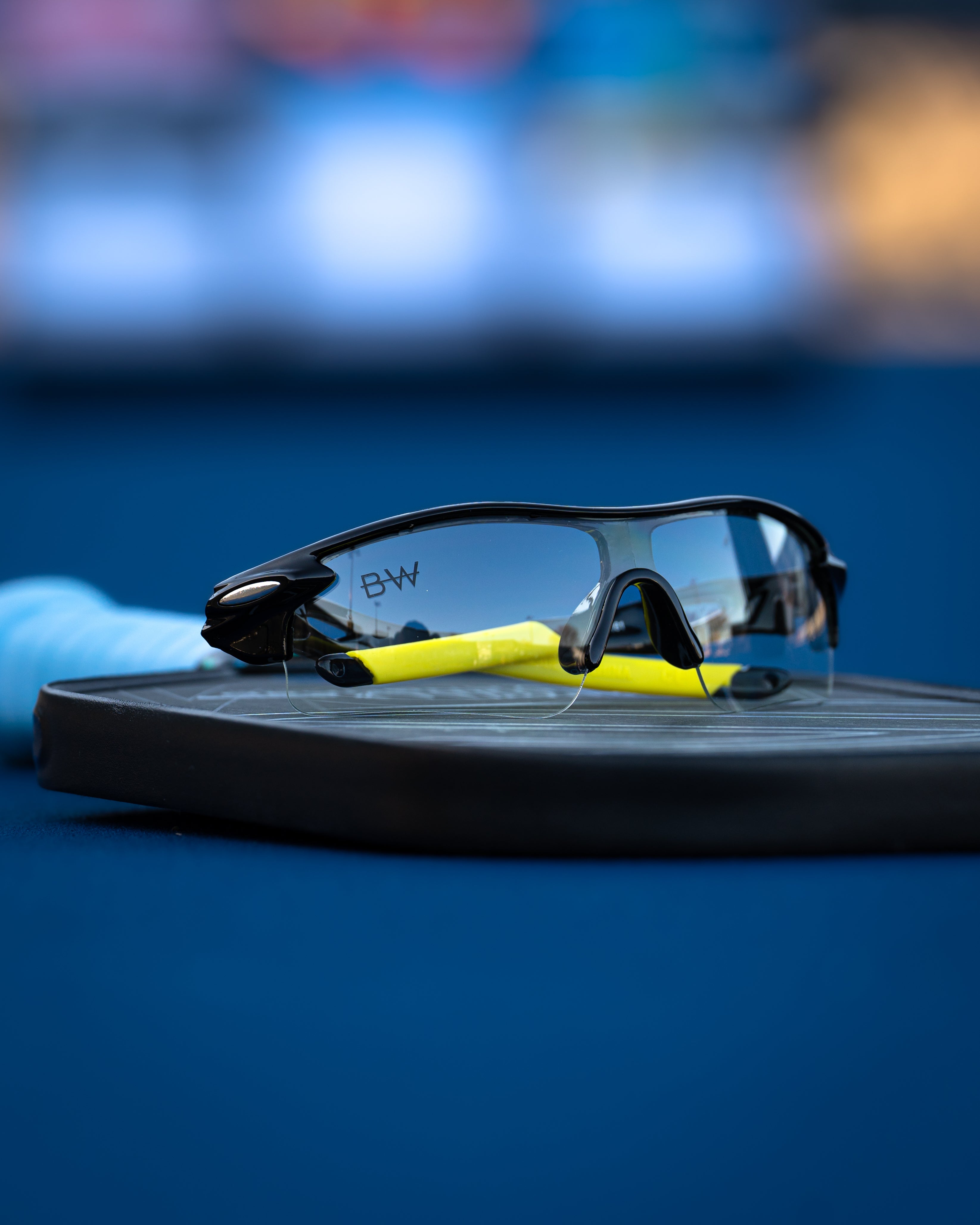
AI-Enhanced Vision: How Smart RX Glasses Are Redefining Pickleball Performance
Share
AI-Enhanced Vision: How Smart RX Glasses Are Redefining Pickleball Performance
Artificial intelligence is changing sports training, video analysis, equipment design, and vision care—but what does that actually mean for RX pickleball glasses?
The answer requires separating two very different ideas: real AI-powered technology used around sports vision and prescription eyewear that is marketed as if artificial intelligence is actively operating inside the lenses.
Most prescription sports glasses are not computers. They do not watch the pickleball, predict its trajectory, calculate your next shot, or electronically adjust your vision in real time. Instead, their most important job remains much more fundamental: providing the prescription correction you require in eyewear designed for active use.
AI can still have a meaningful role in the future of sports vision—from data analysis and personalized training to increasingly sophisticated vision-care technology. This guide explains what is real today, what remains emerging, and what pickleball players should actually look for when buying RX sports glasses.
Find Your Pickleball Eyewear
What Are AI-Enhanced RX Sports Glasses?
The phrase “AI-enhanced RX glasses” can describe several very different technologies, which is why shoppers should look beyond the label.
| Technology | Where AI May Be Used | Is AI Actively Inside the Lens? |
|---|---|---|
| Prescription Sports Glasses | AI may potentially support surrounding design, manufacturing, fitting, or vision-care processes | Not automatically |
| Sports Video Analysis | Software can analyze recorded movement, positioning, or other data | No |
| Vision Training Systems | Software may help generate or analyze training tasks and results | Not necessarily |
| Electronic Smart Glasses | Software can power device-specific electronic functions | Potentially, depending on the device |
| Photochromic RX | Tint changes through photochromic lens technology | No AI required |
That last distinction is especially important. A lens that changes tint, filters certain wavelengths, uses high-index material, or provides progressive correction is not automatically an AI-powered lens.
Smart RX Sports Glasses vs. Electronic Smart Glasses
“Smart glasses” can refer to electronic wearable devices containing components such as cameras, speakers, displays, processors, or sensors.
Prescription sports glasses are a different product category unless those electronic components are specifically built into the eyewear.
Blinded Wear RX sports glasses should not be described as battery-powered AI devices unless a specific product actually includes that technology.
That means you should not assume an RX sports frame:
- Needs charging
- Contains a processor
- Contains cameras or sensors
- Tracks the pickleball
- Analyzes your opponent
- Predicts shot trajectory
- Changes optical correction electronically
- Provides an augmented-reality display
Prescription sports eyewear can still be modern and performance-focused without pretending a computer is operating inside the lens.
Where Is AI Actually Useful in Pickleball?
AI becomes much more concrete when it is separated from the glasses themselves.
Potential applications around pickleball include:
- Video and match analysis
- Movement analysis
- Shot-pattern analysis
- Training feedback
- Practice planning
- Performance-data organization
- Equipment research and development
- Vision-care and optical workflows
These applications can help athletes and professionals work with information. That is different from claiming an ordinary RX lens is independently analyzing a rally in real time.
AI Doesn't Replace the Human Visual System
During a pickleball rally, your visual system and brain are continuously processing information while your body responds.
You may be reading:
- Ball position
- Ball movement
- Your opponent's positioning
- Your partner's positioning
- Available court space
- Paddle movement
- Your own movement and balance
Appropriate prescription correction can help ensure that uncorrected refractive error is not unnecessarily compromising the vision correction you require.
But the glasses themselves should not be credited with thinking for you. Anticipation, decision-making, positioning, technique, and reaction are still athlete skills.
Do AI RX Glasses Improve Reaction Time?
Not simply because the eyewear is described with the word “AI.”
Reaction time involves multiple stages. A player must detect relevant information, process it, make a decision, and produce a physical response.
Prescription correction addresses a different problem: providing the optical correction prescribed for the wearer.
That distinction matters because claims such as “18% faster reactions,” “zero visual lag,” or “AI-powered reflex enhancement” require specific evidence for the exact technology being sold. They should not be applied broadly to prescription sports glasses.
Can RX Glasses Eliminate “Visual Lag”?
“Visual lag” is often used loosely in sports marketing.
A standard prescription lens does not contain a processor waiting for an image and then accelerating it before it reaches your brain.
If you require vision correction, properly prescribed lenses serve their corrective optical purpose. They should not automatically be described as:
- Accelerating neural processing
- Synchronizing the eye and hand
- Reducing neurological latency
- Making the brain process motion faster
- Predicting the next visual event
Those are fundamentally different claims from prescription correction.
What About “Predictive Lens Mapping”?
Terms such as predictive optics, AI lens mapping, neural synchronization, dynamic contrast tuning, and intelligent focus can sound impressive, but they should only be used when they describe a verified technology in the exact product.
Do not assume a prescription sports lens:
- Predicts where the ball will travel
- Changes prescription based on shot distance
- Tracks your eye movement
- Repositions optical zones during a rally
- Automatically changes contrast for the pickleball
If a future electronic eyewear system offers those capabilities, it should be evaluated based on what the actual device does—not because similar terminology appears in marketing for conventional lenses.
Can AI-Enhanced Glasses Automatically Optimize Contrast?
Do not assume they can.
Contrast, tint, filtering, prescription correction, and electronic image processing are different concepts.
| Feature | What It Actually Describes |
|---|---|
| Prescription Correction | Optical correction for the wearer's prescription |
| Tint | Color or darkness characteristics of a lens |
| Blue-Light Filtering | A filtering characteristic |
| Photochromic | A lens that can change tint in response to environmental conditions |
| Electronic Image Processing | Digital processing requiring an appropriate electronic system |
Do not convert one characteristic into another. For example, photochromic tint change does not automatically mean AI-driven contrast optimization.
Are Transition RX Lenses Powered by AI?
No AI is required for a photochromic lens to change tint.
Photochromic technology is designed to respond to environmental conditions. That makes it adaptive in a practical sense, but not artificially intelligent.
This is an important example of why adaptive and AI-powered should not be treated as interchangeable terms.
A player moving between indoor and outdoor environments may still find changing-light functionality useful without the lens containing software, sensors, or a processor.
Are Blue-Light RX Glasses AI-Enhanced?
Blue-light filtering is also a lens characteristic rather than evidence that artificial intelligence is operating inside the eyewear.
If a prescription lens includes blue-light filtering, describe the verified filtering feature directly.
Do not automatically extend that feature into claims that it:
- Improves concentration
- Reduces sports fatigue
- Improves reaction time
- Enhances pickleball contrast
- Improves ball tracking
- Makes visual processing faster
Players specifically interested in blue-light-filtering RX eyewear can compare H Blue Shield RX →
Are High-Index RX Lenses “Smart” Lenses?
No. High-index describes a category of prescription lens material.
It does not mean the lens contains artificial intelligence, electronics, predictive software, or automatic focus technology.
High-index also does not automatically establish:
- Better reaction time
- Enhanced depth perception
- Improved ball tracking
- Better contrast
- Blue-light filtering
- Photochromic functionality
- Scratch resistance
Blinded Wear includes high-index prescription lenses at no additional cost with RX eyewear.
Are Progressive RX Lenses a Form of AI?
No. Progressive lenses provide multiple corrective powers across different areas of a lens.
They can be technologically sophisticated without being artificially intelligent.
A progressive lens should not automatically be described as detecting where you are looking and electronically changing focus. Its multiple corrective zones are part of the optical lens design.
For pickleball players who require multiple corrective powers, the relevant question is whether an available progressive RX configuration fits their prescription and intended use—not whether the lens can be labeled AI.
What Would Truly Smart Pickleball Glasses Look Like?
A genuinely electronic smart-eyewear system could theoretically incorporate capabilities that conventional prescription sports lenses do not have.
Depending on the specific future device, those could include:
- Sensors
- Cameras
- On-device processing
- Heads-up information
- Connectivity
- Recorded performance data
- Computer-vision features
- Software-based coaching tools
But each capability would need to be verified for the actual product.
The existence of AI elsewhere in sports does not mean every modern-looking sports frame should be marketed as an AI device.
AI Training Tools vs. AI Lenses: Don't Confuse the Two
| AI Training Tool | Prescription Sports Lens |
|---|---|
| May analyze data | Provides prescribed optical correction |
| May analyze recorded video | Does not automatically record video |
| May identify patterns | Does not automatically identify shot patterns |
| May help structure practice | Does not coach the athlete by itself |
| Requires software or computing | Does not require AI to provide prescription correction |
The technologies can potentially complement each other. An athlete could wear RX sports glasses while using AI-assisted video analysis away from the rally, for example. But those remain separate tools solving different problems.
Where AI and Vision Training Could Meet
AI may be particularly useful as an analytical layer around training.
For example, software could potentially help organize or analyze information from visual-motor drills, recorded practices, or other measurable training activities.
That still leaves the athlete responsible for developing skills through practice.
A useful framework is:
Corrective eyewear → provides the prescribed correction you need.
Training → develops sport-specific skills.
AI tools → may help analyze information or support training workflows.
Keeping those roles separate prevents an ordinary RX lens from receiving credit for improvements that actually came from coaching, practice, physical development, decision-making, or other factors.
So Where Does Blinded Wear RX Eyewear Fit?
Blinded Wear does not need to claim that a computer is operating inside its prescription lenses for the eyewear to have a clear role in pickleball.
Verified characteristics include:
- Designed for pickleball players
- Prescription correction
- Lightweight sports frames
- Impact-resistant lenses
- Non-polarized lenses
- Comfort for extended matches
- Performance-first design
- Suitable for recreational and competitive players
- High-index prescription lenses included at no additional cost
- 50% lifetime replacement support if glasses break, subject to current policy terms
Those characteristics provide a stronger buying foundation than calling conventional RX lenses “predictive optics” without verified predictive technology.
RX Pickleball Glasses to Compare
| RX Model | What to Compare | Explore |
|---|---|---|
| Rocket Fire RX | Current prescription options, frame design, and dimensions | Rocket Fire RX |
| Phantom II RX | Current prescription options and sports-frame design | Phantom II RX |
| Frost RX | Current prescription configuration, design, and dimensions | Frost RX |
| Ocean Wave RX | Current RX configuration and sports-frame design | Ocean Wave RX |
| Silver Line RX | Current prescription sunglass configuration and design | Silver Line RX |
| H Blue Shield RX | Compare when blue-light filtering is specifically part of your preferences | H Blue Shield RX |
10 AI Sports Eyewear Myths Pickleball Players Should Know
1. “AI RX Glasses Predict Where the Ball Will Go”
Do not assume conventional prescription sports glasses contain predictive computer-vision technology.
2. “AI Lenses Make Your Brain React Faster”
Prescription correction should not automatically be credited with faster neural processing.
3. “Smart RX Lenses Track the Ball for You”
Ball tracking requires actual tracking technology if the claim is meant electronically. A standard RX lens does not automatically contain it.
4. “AI Optics Automatically Optimize Contrast”
Do not assume real-time electronic contrast adjustment without verified technology.
5. “Photochromic Means AI-Powered”
No. Photochromic tint change does not require artificial intelligence.
6. “Progressive Lenses Electronically Refocus”
Standard progressive lenses use multiple corrective zones rather than automatically changing prescription through AI.
7. “High-Index Means Digitally Enhanced Vision”
No. High-index describes a lens-material category.
8. “Blue-Light Filtering Makes Visual Processing Faster”
Do not automatically convert a filtering characteristic into a neurological performance claim.
9. “AI Sports Glasses Guarantee Fewer Mistakes”
Pickleball outcomes depend on numerous factors, including technique, positioning, decision-making, physical execution, and the opponent.
10. “The More Technology in the Name, the Better the Glasses”
Start with your prescription, environment, frame fit, verified lens characteristics, and intended use.
FAQs About AI-Enhanced RX Pickleball Glasses
Are Blinded Wear RX glasses powered by AI?
Do not interpret Blinded Wear RX sports glasses as battery-powered AI devices unless a specific product explicitly includes electronic AI technology. Their primary role is prescription sports eyewear.
Do Blinded Wear RX glasses need charging?
Conventional Blinded Wear RX sports eyewear does not require charging simply to provide its prescription correction.
Can RX glasses predict pickleball trajectory?
Not without a specific electronic tracking and prediction system. Conventional prescription lenses should not be described as predicting ball trajectory.
Can AI glasses make me react faster?
Do not assume faster reaction time simply because eyewear is described as AI-enhanced or smart.
Can RX glasses improve hand-eye coordination?
Prescription correction provides the correction you require. It should not automatically be described as directly training or improving hand-eye coordination.
Do smart RX lenses automatically adjust focus?
Do not assume electronic focus adjustment unless the exact product contains and verifies that technology.
Are transition lenses smart lenses?
They can be described as changing-light or adaptive lenses, but photochromic functionality does not require artificial intelligence.
Are progressive lenses AI lenses?
No. Standard progressive lenses provide multiple corrective powers across different lens areas and do not inherently require AI.
Are blue-light RX glasses AI-powered?
Blue-light filtering is a lens characteristic and does not itself indicate artificial intelligence.
Are high-index lenses AI-designed?
High-index describes a prescription lens-material category. Do not assume an AI feature based on the term high-index.
Does Blinded Wear include high-index RX lenses?
Yes. High-index prescription lenses are included at no additional cost with Blinded Wear RX eyewear.
Are Blinded Wear RX lenses impact-resistant?
Yes. Blinded Wear sports eyewear uses impact-resistant lenses. Impact-resistant should not automatically be interpreted as shatterproof, unbreakable, or certified under a particular safety standard.
Are Blinded Wear sports lenses polarized?
Blinded Wear sports eyewear uses non-polarized lenses.
How do I order Blinded Wear RX glasses?
Choose your RX frame and available configuration, then upload a clear photo or picture of your eyeglass prescription before purchasing.
What Actually Helps an RX Pickleball Player Perform?
The most useful way to think about prescription sports eyewear is to separate vision correction from skill development.
If you require prescription correction, eyewear addresses that corrective need. Your pickleball performance is then built through factors such as:
- Practice quality
- Shot selection
- Footwork
- Positioning
- Anticipation
- Technique
- Decision-making
- Communication in doubles
- Physical conditioning
- Experience recognizing patterns
That distinction creates a much more realistic role for RX eyewear: correct what needs to be corrected, then let training develop the athlete.
The Pickleball Vision Performance Stack
Instead of searching for one “smart” lens that supposedly creates a performance advantage by itself, think of visual performance as a stack of different components.
| Layer | Primary Role |
|---|---|
| Prescription Correction | Provides the corrective vision prescribed for the athlete |
| Sports Eyewear | Places that correction into eyewear intended for active use |
| Lens Configuration | Matches features such as clear, photochromic, or other available options to the environment |
| Visual-Motor Practice | Practices responding to sport-specific visual information |
| Pickleball Training | Develops technique, positioning, anticipation, and decision-making |
| AI / Data Tools | May help analyze information and support training workflows |
Each layer solves a different problem. Combining them conceptually is useful; pretending they are all happening inside the prescription lens is not.
AI Video Analysis May Be More Useful Than an “AI Lens”
One of the more practical ways artificial intelligence can intersect with pickleball is through analysis outside the eyewear itself.
Recorded match or practice footage can potentially be used with software to organize and analyze information about play. Depending on the particular system, that could include areas such as:
- Court positioning
- Shot selection
- Recurring patterns
- Movement
- Practice trends
- Performance data
The important distinction is that the software is doing the analysis—not the RX lens.
A player can therefore use prescription sports eyewear for corrective vision while separately using modern analysis tools to study their game.
A Smarter Pickleball Feedback Loop
The most realistic AI-assisted performance system may look less like futuristic glasses and more like a repeating training cycle:
- Play: Practice or compete in your normal RX sports eyewear.
- Record: Capture useful practice or match footage when appropriate.
- Review: Examine positioning, decisions, technique, and recurring patterns.
- Analyze: Use available coaching or software tools to organize useful information.
- Practice: Turn identified weaknesses into specific drills.
- Repeat: Compare future sessions with earlier performance.
In this model, technology supports the learning process rather than claiming to replace it.
Can Smart Glasses Improve Pickleball Anticipation?
Anticipation is an athlete skill involving the interpretation of information before and during an opponent's shot.
A player may learn to recognize cues involving:
- Opponent positioning
- Paddle preparation
- Contact location
- Available court space
- Previous shot patterns
- Partner positioning
AI-assisted video tools could potentially help players review patterns after a session. Conventional RX lenses, however, should not be described as automatically predicting those patterns during play.
Your prescription eyewear provides correction. Your experience and training develop anticipation.
Can AI RX Glasses Track the Pickleball?
Actual automated ball tracking requires technology capable of detecting and following the ball.
A conventional prescription lens does not gain that capability because it has been described as “smart,” “AI-optimized,” or “predictive.”
There is also an important difference between:
| Phrase | What It Means |
|---|---|
| Human Ball Tracking | The athlete visually follows and responds to the ball |
| Computer Ball Tracking | A camera/software system detects and follows the ball |
| Prescription Correction | The lens provides the wearer's prescribed optical correction |
These concepts should not be blended into one performance claim.
Can AI RX Glasses Improve Depth Perception?
Depth perception is another area where careful wording matters.
If someone requires corrective lenses, appropriate prescription correction addresses the vision correction they need. That is different from claiming an AI-enhanced lens independently upgrades depth perception beyond the wearer's corrected visual function.
Do not assume AI terminology, high-index material, non-polarized lenses, tint, or blue-light filtering automatically improves depth perception.
When evaluating RX pickleball eyewear, begin with the prescription rather than searching for a lens marketed as a “depth perception enhancer.”
Can AI Glasses Read Pickleball Spin?
A conventional RX sports lens does not identify topspin, backspin, or sidespin for the player.
Players learn to interpret spin using visual information, experience, anticipation, and practice.
Electronic computer-vision systems may eventually provide increasingly sophisticated analysis of sports footage, but that is different from claiming a passive prescription lens recognizes spin during a rally.
If a future wearable claims real-time spin analysis, evaluate the exact sensors, cameras, software, processing, and evidence behind that specific product.
Could Future Smart Glasses Predict Pickleball Shots?
In theory, increasingly sophisticated wearable technology could combine sensors, cameras, computer vision, and software to process information about an athlete's environment.
Whether a particular future device could reliably predict useful shot information during live pickleball would depend on the actual technology and evidence behind that device.
Several challenges would have to be addressed, including:
- Capturing useful visual data
- Processing rapidly changing scenes
- Recognizing the ball and players
- Understanding court geometry
- Interpreting movement
- Presenting information without interfering with play
- Maintaining practical size and weight
- Power and battery requirements
That is a genuine smart-eyewear discussion. It should remain separate from conventional RX sports glasses available today.
What About Augmented-Reality Pickleball Glasses?
Augmented-reality eyewear could theoretically display digital information within or near the wearer's field of view.
Future sports applications might explore information such as training prompts, recorded statistics, or other digital overlays.
But an ordinary prescription sports frame should not be described as augmented reality unless it actually contains the required display and electronic system.
For today's RX pickleball shopper, the more immediate priorities remain:
- Correct prescription
- Appropriate lens configuration
- Frame dimensions
- Verified lens characteristics
- Intended playing environment
If Electronic Smart Sports Glasses Arrive, They Will Have Tradeoffs
Adding electronics to sports eyewear could create new capabilities, but it could also introduce considerations that conventional prescription glasses do not have.
| Potential Smart Feature | Potential Consideration |
|---|---|
| Camera | Privacy, placement, weight, and durability |
| Display | Visibility, distraction, and interface design |
| Processor | Power use and heat management |
| Wireless Connectivity | Battery use and connection requirements |
| Sensors | Accuracy and practical usefulness |
| AI Software | Quality of the underlying data and analysis |
| Battery | Charging, weight, and operating time |
“Smarter” does not automatically mean better for every athlete. Sports equipment still has to function well in the real environment where it will be used.
AI Is Only as Useful as the Data Behind It
Artificial intelligence can process large amounts of information, but the quality of its output depends heavily on the system, inputs, and intended task.
For athletes, that means an AI-generated recommendation should not automatically be treated as objective truth.
A useful training insight should still be considered alongside:
- Actual match context
- Coaching feedback
- Player experience
- Physical limitations
- Quality of recorded data
- The specific goal being trained
The same principle applies to eyewear. A “data-driven” or “AI-matched” label does not replace checking your actual prescription and product specifications.
Is the Blinded Wear Pickleball Glasses Quiz an AI Vision Diagnosis?
No. The Blinded Wear pickleball eyewear quiz should be used as a shopping tool to help narrow eyewear options around your preferences—not as an AI eye examination, prescription generator, medical diagnosis, or guaranteed performance predictor.
Your eyeglass prescription should come from the appropriate vision-care process.
The quiz can then help you explore eyewear based on the information relevant to shopping.
How to Buy “Smart” RX Pickleball Glasses Without Falling for Hype
When a product uses terms such as AI, smart, intelligent, neural, predictive, optimized, or adaptive, ask a simple question:
What does the technology actually do?
Then work through this checklist:
- Does the eyewear contain electronics? If yes, identify what they do.
- Does it contain AI software? Determine which specific function uses it.
- Does the lens itself change? Identify whether this is photochromic, electronic, or another technology.
- Are performance claims quantified? Look for evidence specific to the actual product and claim.
- Does the technology address your prescription? Smart features do not replace corrective requirements.
- Are basic specifications clear? Frame and lens fundamentals still matter.
- Does the feature solve a problem you actually have? More technology is not automatically more useful.
7 Smart-Eyewear Marketing Red Flags
1. “AI-Powered” With No Explanation of the AI
If no processor, software, algorithmic function, or supporting workflow is identified, determine what the phrase actually refers to.
2. Guaranteed Athletic Improvements
Be cautious when eyewear promises a guaranteed increase in reaction time, accuracy, depth perception, or wins.
3. Precise Performance Percentages Without Product-Specific Evidence
A precise number can sound scientific without necessarily supporting the exact eyewear being sold.
4. Ordinary Lens Features Renamed as AI
Photochromic, progressive, high-index, clear, tinted, and filtering lenses are not automatically AI technologies.
5. “Predictive” Without a Prediction System
If a product claims to predict something, determine what information is collected, how it is processed, and what is actually predicted.
6. “Real-Time” Without Electronics
A passive lens can respond physically to certain conditions, but real-time digital analysis requires an appropriate electronic system.
7. Testimonials Used as Proof of Neurological Improvement
Individual experiences should not substitute for evidence supporting a specific physiological or performance claim.
AI Smart Glasses vs. Conventional RX Sports Glasses
| Question | Conventional RX Sports Glasses | True Electronic Smart Glasses |
|---|---|---|
| Prescription Correction | Can provide it | Depends on the specific device/configuration |
| Battery Required | No for conventional prescription function | Typically required for electronic functions |
| Processor | Not required | May be included |
| Sensors | Not required | May be included |
| Camera | Not required | May be included |
| Software Updates | Not required for conventional lens function | May be required |
| Real-Time Data Analysis | Not an inherent feature | Potentially, depending on the device |
| Charging | Not required for conventional RX eyewear | May be required |
What Matters More Than AI for Today's RX Pickleball Player?
For most players shopping for prescription sports eyewear today, practical fundamentals deserve attention before futuristic terminology.
Your Prescription
The eyewear needs to provide the correction you require.
Your Playing Environment
Indoor, outdoor, and mixed environments can influence which lens configuration you prefer.
Your Frame
Compare dimensions and current product information rather than assuming fit from appearance alone.
Your Lens Configuration
Clear, photochromic, blue-light-filtering, progressive, and other terms describe different characteristics. Choose the ones relevant to your needs.
Your Backup Plan
If you depend on corrective eyewear during competition, another suitable corrective option can be useful during tournaments and travel.
Your Training
Technique, positioning, anticipation, decision-making, and repetition remain athlete responsibilities.
How Blinded Wear RX Ordering Works
You do not need an AI-generated eye profile to order prescription pickleball glasses.
- Start with your eyeglass prescription.
- Browse the Blinded Wear RX collection.
- Compare frames and currently available lens configurations.
- Select the option that fits your prescription and intended environment.
- Upload a clear photo or picture of your eyeglass prescription before purchasing.
Blinded Wear includes high-index prescription lenses at no additional cost with RX eyewear.
Smart RX Feature Decoder
| Term You See | Question to Ask |
|---|---|
| AI-Enhanced | Which exact function uses artificial intelligence? |
| Smart | Is there an electronic feature, or is this descriptive marketing? |
| Adaptive | What specifically adapts and through what mechanism? |
| Predictive | What is being predicted and what data is used? |
| Dynamic | Which characteristic actually changes? |
| Optimized | Optimized for what, and how was that determined? |
| Photochromic | What changing-light functionality does the exact lens provide? |
| High-Index | What prescription lens material is being provided? |
| Blue-Light Filtering | What filtering feature is actually specified? |
More FAQs About AI, Smart Glasses & Pickleball Vision
Is AI currently used in sports?
AI can be used in areas such as data analysis, video analysis, training software, and other technology workflows. That does not mean every piece of sports equipment contains AI.
Can AI analyze pickleball footage?
Computer-vision and analysis systems can potentially process sports video depending on the capabilities of the particular software.
Can AI teach me to read opponents?
AI tools may potentially help organize or analyze patterns, but learning to recognize and respond to opponents remains part of training and experience.
Can AI glasses tell me where to hit the ball?
Do not assume conventional RX sports eyewear can provide real-time shot recommendations. That would require specific electronic hardware and software designed for that purpose.
Can AI glasses identify spin?
Not simply because they are called smart glasses. Real-time spin identification would require appropriate sensing, imaging, and processing technology.
Can smart glasses record pickleball matches?
Some electronic smart-glasses products may contain cameras, but conventional RX sports eyewear does not automatically include recording capability.
Do RX sports glasses contain sensors?
Not inherently. Sensors are electronic components that would need to be specifically included in the product.
Do RX glasses electronically adjust my prescription?
Conventional prescription sports lenses should not be assumed to electronically change corrective power during play.
Does photochromic technology use AI?
No AI is required for standard photochromic tint-changing functionality.
Is blue-light filtering an AI technology?
No. Blue-light filtering is a lens characteristic, not artificial intelligence by itself.
Is non-polarized technology AI-powered?
No. Non-polarized means a polarization filter is not added.
Will AI replace prescription sports glasses?
AI software and prescription correction solve different problems. Future technologies may combine additional digital functions with eyewear, but corrective needs still have to be addressed appropriately.
Should I wait for future smart glasses before buying RX sports eyewear?
If you currently require prescription correction for sports, evaluate currently available eyewear based on your present needs rather than assuming an unverified future product will solve them better.
What should I prioritize when buying RX pickleball glasses?
Start with your prescription, intended environment, frame dimensions, available lens configuration, verified product characteristics, and your need for a backup corrective option.
Where can I compare Blinded Wear RX options?
Visit the Blinded Wear RX Collection →
How to Combine RX Eyewear, AI Tools & Real Pickleball Training
The strongest use of technology is not replacing practice. It is helping make practice more intentional.
A player who requires prescription correction could build a simple system around three separate tools:
- RX sports eyewear: provides the prescription correction required during play.
- Practice: develops technique, positioning, anticipation, and decision-making.
- AI or analysis tools: may help organize information from training or recorded play.
This keeps each technology in its proper role while still allowing modern tools to become part of an athlete's development.
A Practical AI-Assisted Pickleball Training Week
| Session | Primary Focus | Role of RX Eyewear | Possible Technology Role |
|---|---|---|---|
| Drill Session | Dinks, volleys, serves, returns, or resets | Provides required prescription correction | Record or organize training information |
| Open Play | Decision-making and realistic rallies | Provides required prescription correction | Capture footage for later review |
| Review | Identify recurring patterns | Not the analytical tool | Software may assist with analysis |
| Targeted Practice | Work on identified weaknesses | Use the eyewear intended for competition | Track progress when useful |
| Match Simulation | Apply improvements under realistic conditions | Keep competition setup familiar | Collect another comparison point |
The feedback loop matters more than attaching “AI” to every piece of equipment.
The Human Skills Smart Glasses Can't Replace
Even as sports technology becomes more sophisticated, pickleball remains a game of human decisions and physical execution.
Technology does not remove the need to develop:
- Consistent contact
- Serve and return technique
- Dink control
- Reset ability
- Volley technique
- Footwork
- Court positioning
- Partner communication
- Shot selection
- Pattern recognition
- Anticipation
- Competitive decision-making
RX sports eyewear can address corrective vision needs. Training develops the player who uses that vision.
Smart RX Shopping Still Starts With Your Playing Environment
Before worrying about artificial intelligence, determine where you actually play.
| Environment | RX Category to Consider |
|---|---|
| Primarily Indoor Pickleball | Clear RX |
| Primarily Outdoor Pickleball | Current outdoor RX configurations |
| Indoor + Outdoor | Photochromic RX or dedicated indoor/outdoor pairs |
| Indoor + Specific Blue-Light-Filtering Preference | Available blue-light-filtering RX |
| Multiple Corrective Powers Required | Available progressive RX based on prescription needs |
| Contacts Provide Correction | Non-RX pickleball eyewear |
These distinctions solve more immediate shopping questions than an undefined “AI-enhanced” label.
Practice in Your RX Glasses Before Game Day
Whether your eyewear is clear, photochromic, progressive, blue-light filtering, or another available RX configuration, become familiar with it before an important match.
A useful progression can include:
- Basic warm-up
- Serves and returns
- Dinks
- Volleys
- Transition-zone movement
- Open rallies
- Full games
The purpose is not to prove that the eyewear improves performance. It is to avoid making important competition the first time you use an unfamiliar frame or prescription configuration during realistic play.
The Smartest Tournament Technology Might Be a Backup Pair
A futuristic feature is not always the most useful upgrade.
If you depend on prescription correction to play, another suitable corrective option can solve a very practical problem: what happens if your primary eyewear becomes unavailable during a tournament or trip?
Your backup does not necessarily need every optional feature found in your primary pair. Its first job is to provide a suitable alternative for your corrective needs.
5 Questions That Will Define the Future of Smart Sports Glasses
1. Can Electronic Eyewear Stay Practical During Fast Sports?
Additional components have to coexist with the movement and physical demands of athletic use.
2. Can Real-Time Information Be Useful Without Becoming Distracting?
More information is not automatically better during a fast rally.
3. How Accurate Will Sports Computer Vision Become?
Any system attempting to interpret live play must correctly process complex, rapidly changing information.
4. How Will Prescription Correction Integrate With Electronics?
A smart device still needs to accommodate the corrective needs of athletes who require prescription lenses.
5. Which Features Will Actually Matter to Players?
A technology can be impressive without solving a meaningful problem. The strongest sports technologies are likely to be those athletes can practically use.
Future Smart Eyewear vs. What RX Players Need Today
| Future Possibility | Today's Practical Priority |
|---|---|
| Computer-Vision Analysis | Appropriate prescription correction |
| Digital Overlays | A lens configuration suited to the environment |
| Real-Time Sensors | A sports frame suited to intended use |
| Automated Coaching | Quality practice and coaching |
| Predictive Analytics | Developing anticipation through experience |
| Connected Eyewear | Reliable competition equipment |
You can be interested in the future of AI sports technology while still making today's purchase based on today's verified features.
8 Mistakes to Avoid When Shopping for Smart RX Sports Glasses
1. Buying the Buzzword Instead of the Feature
Ask what “AI,” “smart,” or “adaptive” actually means for the exact product.
2. Assuming a Conventional Lens Contains Electronics
Prescription correction, tint, photochromic technology, and high-index materials do not inherently require a computer.
3. Expecting Eyewear to Replace Training
Technique and decision-making still have to be developed through practice.
4. Believing Precise Performance Claims Without Specific Evidence
Numbers involving reaction time, accuracy, or other athletic improvements should be supported by evidence relevant to the exact claim and technology.
5. Ignoring Your Prescription
Optional features do not replace the correction you require.
6. Ignoring Your Playing Environment
An indoor player and someone regularly moving between indoor and outdoor courts may prefer different lens configurations.
7. Assuming Every Frame Has the Same Features
Check current product information rather than transferring one model's characteristics to another.
8. Forgetting Reliability
If prescription eyewear is essential to your game, another suitable corrective option may be more useful than an additional unneeded feature.
Find Your RX Pickleball Setup in 30 Seconds
I need prescription correction for pickleball.
Start with the RX Pickleball Glasses Collection →
I primarily play indoors.
Compare clear RX configurations without dark sunglass tint.
I move between indoor and outdoor courts.
Compare photochromic RX with the alternative of dedicated indoor and outdoor prescription pairs.
I specifically want blue-light filtering.
Explore H Blue Shield RX →
I wear contacts during pickleball.
Compare the Non-RX Pickleball Collection →
I don't know which category fits me.
Use the Pickleball Glasses Quiz →
Final FAQs: The Future of AI & RX Pickleball Eyewear
Are AI pickleball glasses real?
Electronic smart eyewear and AI-powered technologies exist as broader technology categories, but do not assume conventional prescription pickleball glasses contain AI hardware or software unless the specific product verifies it.
Can smart glasses analyze my pickleball game?
A device would need the appropriate sensors, cameras, software, and processing capabilities. Do not assume this functionality from the term “smart glasses” alone.
Can AI predict where a pickleball is going?
Computer-vision systems may analyze sports information depending on their capabilities, but a conventional RX lens should not be described as predicting ball trajectory.
Can AI glasses tell what shot my opponent will hit?
Do not assume real-time opponent prediction unless a specific system demonstrates that capability. Anticipation remains a skill players develop through experience and practice.
Can AI improve my pickleball reaction time?
AI tools may potentially support training analysis, but RX eyewear should not automatically be credited with faster neurological reaction time.
Can RX sports glasses help me see the ball sooner?
Prescription eyewear provides the corrective vision prescribed for you. Claims that a particular lens makes you perceive the ball earlier require separate support.
Do non-polarized lenses improve ball tracking?
Blinded Wear sports eyewear uses non-polarized lenses, meaning a polarization filter is not added and the visual information available without that filter is preserved. Some court players prefer non-polarized eyewear, but improved ball tracking should not automatically be attributed to it.
Do clear RX lenses improve indoor visibility?
Clear RX provides prescription correction without dark sunglass tint. Do not automatically interpret that as increasing available light, contrast, reaction time, or ball tracking.
Do photochromic lenses use sensors?
Standard photochromic functionality does not require electronic sensors or artificial intelligence.
Will future RX glasses have cameras and displays?
Future electronic eyewear may continue exploring cameras, displays, sensors, connectivity, and other functions. Whether those features are appropriate for sports depends on the specific product.
Are more technologically complex glasses always better?
No. The useful question is whether a feature solves a real need for the athlete.
What should I buy if I simply need prescription pickleball glasses?
Start with your prescription and compare current RX sports frames, dimensions, lens configurations, intended environment, and verified product characteristics.
Does Blinded Wear include high-index prescription lenses?
Yes. High-index prescription lenses are included at no additional cost with Blinded Wear RX eyewear.
What replacement support does Blinded Wear provide?
Blinded Wear offers 50% lifetime replacement support if glasses break, subject to current policy terms.
How do I submit my prescription?
Upload a clear photo or picture of your eyeglass prescription before purchasing RX eyewear.
Explore Pickleball Vision & RX Eyewear
AI-Enhanced RX Pickleball Glasses: What's Real in 30 Seconds
| Claim or Technology | What to Know |
|---|---|
| Prescription RX | Provides the corrective vision prescribed for the wearer |
| AI Sports Analysis | Software may help analyze data, footage, or training information |
| Electronic Smart Glasses | May contain cameras, sensors, processors, displays, or other device-specific technology |
| Photochromic RX | Changes tint under appropriate environmental conditions; AI is not required |
| Blue-Light Filtering | A filtering characteristic, not AI by itself |
| Progressive RX | Provides multiple corrective powers; not inherently AI |
| High-Index RX | A prescription lens-material category; not inherently AI |
| Predictive Ball Tracking | Would require appropriate sensing, imaging, software, and processing technology |
| Reaction-Time Enhancement | Should not automatically be attributed to RX eyewear or AI terminology |
Choose RX Technology for What It Actually Does
Artificial intelligence is opening new possibilities across sports, training, analysis, and vision technology. But the smartest approach to RX pickleball eyewear is still remarkably simple: understand what each feature actually does before buying it.
Prescription correction is prescription correction. Photochromic technology changes tint. Blue-light filtering is a filtering characteristic. Progressive lenses provide multiple corrective powers. High-index describes a lens-material category. True AI functionality requires an actual AI system performing an identifiable task.
Blinded Wear RX eyewear focuses on the practical foundation pickleball players need: prescription correction, lightweight sports frames, impact-resistant non-polarized lenses, comfort for extended matches, performance-first design, and high-index prescription lenses included at no additional cost.
The Bottom Line: Smarter Vision Starts With Smarter Expectations
The future of sports eyewear may include increasingly sophisticated combinations of prescription optics, sensors, cameras, displays, computer vision, and artificial intelligence. Those developments are worth watching.
But today's pickleball player does not need fictional technology to make a smart eyewear decision.
Start with the prescription correction you require. Choose a lens configuration that makes sense for your environment. Compare verified frame and lens characteristics. Practice in the eyewear you intend to compete in. Use AI analysis tools for the tasks they can actually perform, and let training develop the skills technology cannot replace.
That is the real future of AI-enhanced sports vision: not a lens that plays pickleball for you, but better tools, better information, and better-informed eyewear choices supporting the athlete behind the glasses.