
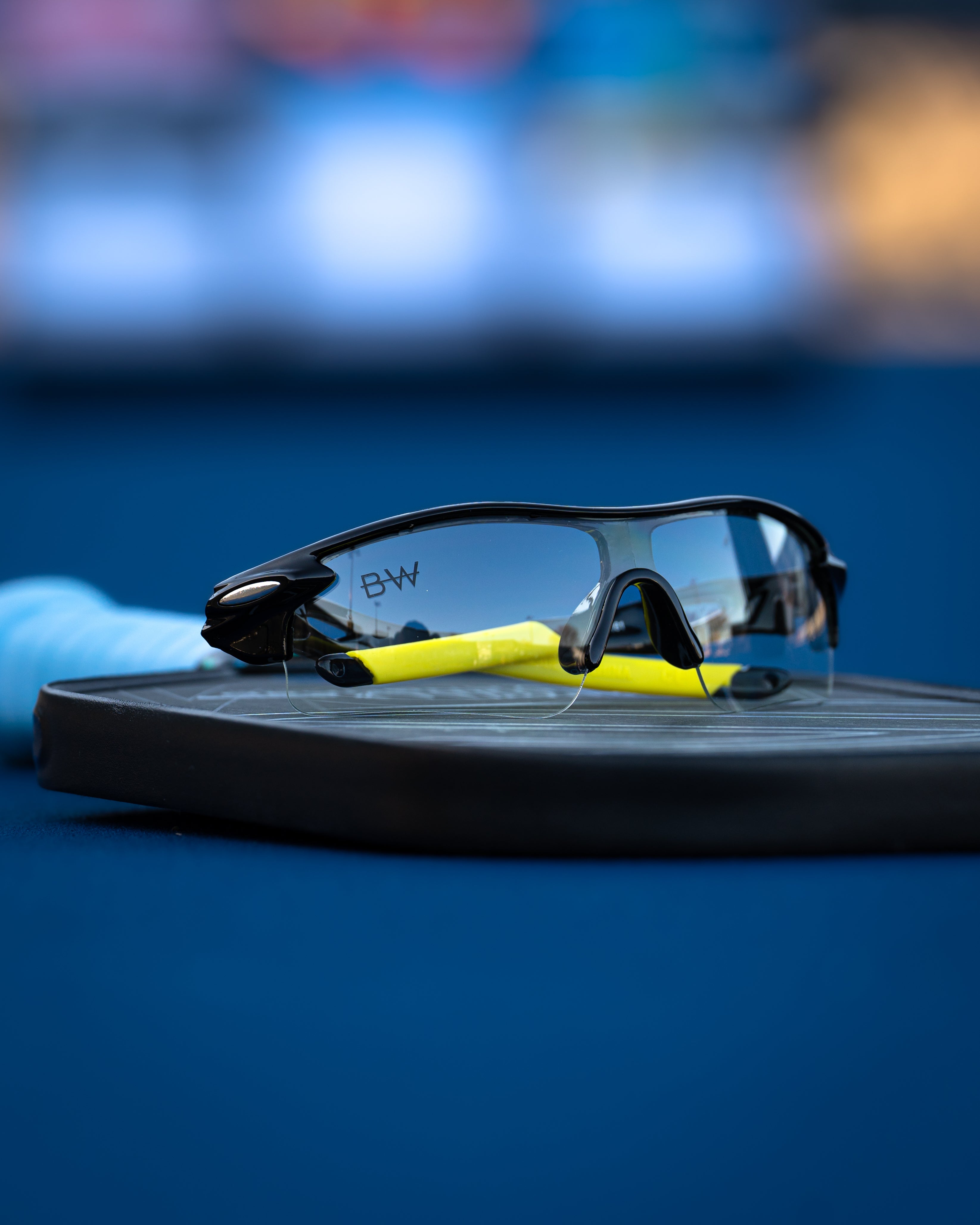
AI Training Lenses — The Future of Adaptive Pickleball Eyewear
Share
AI Training Lenses & Adaptive Pickleball Eyewear: What's Real, What's Next & What Players Need Today
Artificial intelligence is changing how athletes analyze movement, training, strategy, and performance. That makes the idea of AI training lenses for pickleball sound like a natural next step: eyewear that could analyze the court, react to changing conditions, collect performance data, or help athletes train their visual skills.
But there is an important distinction between the future of AI-powered sports eyewear and prescription lens technologies available today.
Photochromic lenses can respond to changing light. Prescription lenses can provide the correction a player requires. Electronic smart glasses can potentially incorporate sensors, cameras, displays, software, and artificial intelligence. These technologies are not automatically the same thing.
For pickleball players shopping today, the smarter approach is to understand what adaptive eyewear actually does, what genuine AI training glasses could eventually offer, and how to choose RX sports eyewear based on your prescription, playing environment, and verified product features.
Find Your Pickleball Eyewear
What Are AI Training Lenses?
The phrase “AI training lenses” does not describe one universal type of prescription lens. To genuinely involve artificial intelligence during use, eyewear would need access to data and a system capable of processing that information.
Depending on the technology, future AI sports glasses could potentially combine components such as:
- Cameras
- Motion sensors
- Eye-tracking sensors
- Electronic displays
- Onboard or connected processors
- Training software
- Wireless connectivity
- Computer-vision systems
- Performance-data analysis
A normal prescription lens does not become an AI training device simply because it corrects vision, changes tint, filters certain wavelengths, or uses a modern lens material.
Adaptive Lenses vs. AI Lenses: What's the Difference?
This is where sports-eyewear terminology can become confusing. Adaptive does not automatically mean artificial intelligence.
| Technology | What It Can Mean | Is AI Required? |
|---|---|---|
| Prescription Lens | Provides corrective vision based on a prescription | No |
| Clear Lens | Provides a lens without dark sunglass tint | No |
| Blue-Light Filtering Lens | Filters a portion of blue light according to its design | No |
| Photochromic Lens | Changes tint in response to changing light conditions | No |
| Electronic Smart Glasses | Can incorporate cameras, displays, sensors, connectivity, or processing | Not necessarily |
| AI-Powered Smart Glasses | Use an artificial-intelligence system to process relevant inputs | Yes |
Are Transition or Photochromic RX Lenses AI-Powered?
No. A lens does not need artificial intelligence to respond to changing light.
Photochromic lenses are designed to change tint as lighting conditions change. That can make them worth comparing for players whose schedules include different environments, but the changing tint should not be confused with an AI algorithm analyzing your game.
A photochromic lens does not inherently:
- Track the pickleball
- Measure ball speed
- Analyze your eye movement
- Predict your opponent's shot
- Measure reaction time
- Analyze paddle mechanics
- Train your visual system
Its useful role is much simpler: changing-light functionality.
What Could AI Pickleball Glasses Actually Do in the Future?
Where artificial intelligence becomes more interesting is when eyewear has access to real information about the athlete or playing environment.
A future purpose-built system could potentially use sensors, cameras, or connected devices to collect information and software to analyze it.
| Potential Technology | Possible Application |
|---|---|
| Computer Vision | Analyze recorded court or ball information |
| Eye Tracking | Collect information about where a player directs visual attention |
| Motion Sensors | Collect movement information |
| Heads-Up Display | Present information within the user's field of view |
| Connected Training Software | Review collected information after practice |
| AI Analysis | Identify patterns within collected training data |
Whether any future implementation actually improves pickleball performance would depend on the specific technology, how it is used, and evidence for the claimed outcome.
Could AI Eyewear Analyze Where Pickleball Players Look?
Eye tracking is one potential direction for sports technology because it can collect information about visual attention.
In a training environment, appropriately designed technology could potentially help researchers, coaches, or athletes examine questions such as:
- Where does a player direct attention before an opponent makes contact?
- How does visual attention change during a fast kitchen exchange?
- What happens to gaze behavior during serves and returns?
- How do visual-attention patterns differ across repeated drills?
That would require actual eye-tracking hardware and supporting software. Standard RX sports glasses do not track gaze simply because they are designed for athletes.
Computer Vision Could Be More Important Than an “AI Lens”
When people imagine AI eyewear recognizing a pickleball, opponent, or court position, the underlying concept is closer to computer vision than a conventional optical lens.
A camera-enabled system could potentially capture visual information. Software could then attempt to identify patterns or objects within that information.
For a system to claim real-time pickleball analysis, important questions would include:
- What cameras or sensors collect the information?
- What exactly does the software identify?
- Where is the information processed?
- How quickly can the system produce useful output?
- How is that output communicated to the player?
- How accurate is the system under real court conditions?
Without those components, phrases such as “AI ball tracking” or “predictive court vision” should not be assumed to describe a real product function.
AI Training Glasses vs. Sports Vision Training
These concepts should also be separated.
| Concept | Primary Function |
|---|---|
| RX Sports Eyewear | Provides required prescription correction in sports-oriented eyewear |
| Sports Practice | Repeatedly develops pickleball-specific skills |
| Visual Training Exercise | Practices a defined visual or visual-motor task |
| Training Technology | Can provide structured drills, measurements, or feedback depending on the system |
| AI Analysis | Can analyze appropriate data when a system is designed and trained to do so |
A prescription lens should not automatically be described as retraining the brain, teaching the eyes to react faster, or recalibrating eye-to-brain communication.
Can AI Training Lenses Improve Pickleball Reaction Time?
That depends entirely on the technology being tested and the evidence behind it. A fixed reaction-time improvement should not be assigned to prescription or adaptive eyewear simply because research exists on sports vision training.
Pickleball response speed can involve:
- Visual information
- Attention
- Anticipation
- Pattern recognition
- Decision-making
- Ready position
- Movement
- Paddle preparation
- Technique
A player who anticipates a shot and is already prepared may appear to react extremely quickly even though anticipation and positioning contributed substantially to the response.
Sports Vision Research vs. Product Performance Claims
Research showing that athletes can practice visual or visual-motor skills does not automatically prove that a commercial prescription lens improves those same skills.
That distinction matters when evaluating claims about adaptive or AI eyewear.
| Evidence Might Show... | It Does Not Automatically Establish... |
|---|---|
| Athletes can practice visual tasks | A particular RX lens trains those tasks |
| Reaction time can change with training | Prescription eyewear causes that change |
| Eye tracking can measure gaze behavior | Ordinary sports glasses contain eye tracking |
| AI can analyze sports data | A lens without sensors or processing is AI-powered |
| Photochromic lenses respond to light | The lens intelligently analyzes the pickleball environment |
The key question is always: what was actually tested?
What Data Would Real AI Pickleball Eyewear Need?
Artificial intelligence requires input. If eyewear claims to analyze your performance, there should be a clear explanation of where the relevant information comes from.
Depending on the claimed function, inputs could potentially include:
- Video
- Eye-position information
- Head movement
- Body movement
- Location data
- Timing information
- Connected sensor data
The AI system would then need to process those inputs and produce some useful output.
If a pair of glasses contains no mechanism for collecting the information necessary for a claimed feature, shoppers should question how that feature could function.
The Biggest Opportunity May Be Feedback, Not Automatic Performance
One potentially useful direction for AI sports technology is not eyewear that magically makes an athlete better, but technology that helps the athlete review training information.
For example, a properly designed system could potentially collect data during drills and later help organize patterns for review.
The athlete would still have to:
- Interpret the feedback
- Practice appropriate skills
- Improve technique
- Develop positioning
- Learn tactical patterns
- Apply those changes during competition
AI could become another training tool. It would not replace the player.
Future AI Sports Glasses Will Also Raise Privacy Questions
Camera-equipped or sensor-equipped eyewear introduces considerations that ordinary prescription glasses do not.
If future pickleball eyewear collects training information, users may want to understand:
- What information is being recorded
- Whether video or audio is captured
- Where data is processed
- Whether information is stored
- How long it is retained
- Whether information is shared with other services
- What controls the athlete has over the data
Those questions become increasingly important as sports eyewear moves from passive optics toward connected technology.
What Should Pickleball Players Focus on Right Now?
You do not need to wait for futuristic eyewear to build a practical prescription setup today.
If you require corrective vision, start with:
- Your prescription needs
- Your primary playing environment
- The current lens configuration
- The frame design and available dimensions
- Verified sports-oriented characteristics
- Familiarity with the eyewear before competition
Those factors are less futuristic than AI terminology, but they are far more useful when choosing eyewear you can actually wear on court today.
Clear RX Glasses for Indoor Pickleball
If you require prescription correction and primarily play indoors, clear RX can be a straightforward category to compare when dark sunglass tint is not preferred.
Clear lenses can also be relevant for evening and night sessions where you do not want a dark sunglass tint.
That does not mean clear lenses automatically:
- Increase reaction speed
- Improve ball tracking
- Enhance contrast
- Train visual attention
- Increase available light
Their role can remain simple: provide your prescription correction without dark sunglass tint.
Blue-Light RX Lenses: Adaptive Technology or Optional Lens Feature?
Blue-light filtering should be treated as a specific lens characteristic rather than an artificial-intelligence training system.
If blue-light filtering is something you specifically want in your RX setup, compare a product that currently offers that characteristic.
Do not assume that blue-light filtering automatically improves:
- Reaction time
- Ball recognition
- Pickleball accuracy
- Mental focus
- Visual processing speed
- Athletic endurance
Photochromic RX: Today's Practical Form of Changing-Light Eyewear
Players who regularly move between different lighting environments may want to compare a currently available photochromic RX configuration.
The value proposition is straightforward: the lens can change tint as lighting conditions change.
That can be useful for players who prefer one changing-light configuration rather than carrying separate eyewear for every environment.
It should not be described as:
- An AI tint algorithm
- Motion-responsive artificial intelligence
- Ball-speed detection
- Gaze-responsive tinting
- Neural calibration
- Automatic sports-performance optimization
High-Index RX Lenses Aren't AI—But They Still Matter to the RX Offer
High-index refers to a prescription lens-material category. It does not mean the lens contains artificial intelligence or automatically improves athletic performance.
Blinded Wear includes high-index prescription lenses at no additional cost with RX eyewear.
That is a concrete part of the prescription offering without needing to connect high-index material to reaction time, ball tracking, cognitive performance, or other unsupported athletic outcomes.
Why Non-Polarized Doesn't Mean AI-Optimized
Blinded Wear sports eyewear uses non-polarized lenses. A non-polarized lens does not add a polarization filter and preserves the visual information available without that filter.
Some court players prefer non-polarized eyewear, but this characteristic should not automatically be translated into claims that the lens:
- Improves depth perception
- Speeds up reactions
- Detects spin earlier
- Improves ball tracking
- Increases accuracy
It is a lens characteristic shoppers can consider alongside their prescription, environment, and other preferences.
Blinded Wear RX Pickleball Glasses to Explore Today
Instead of assigning fictional AI functions to individual frames, compare RX models based on their current configurations, available dimensions, frame designs, and your own prescription needs.
| RX Model | Why Explore It | Shop |
|---|---|---|
| Rocket Fire RX | Compare if you prefer the Rocket Fire prescription sports-frame design | Rocket Fire RX |
| Phantom II RX | Compare if you prefer the Phantom II prescription sports-frame design | Phantom II RX |
| Frost RX | Compare if you prefer the Frost lightweight sports-frame design | Frost RX |
| Ocean Wave RX | Compare if you prefer the Ocean Wave prescription sports-frame design | Ocean Wave RX |
| Silver Line RX | Compare if you prefer the Silver Line prescription sunglass design | Silver Line RX |
| H Blue Shield RX | Compare when blue-light filtering is specifically part of your lens preferences | H Blue Shield RX |
AI Pickleball Eyewear: 8 Claims to Look at More Closely
1. “The Lens Learns Your Eye Movements”
A product would need appropriate sensing and processing technology to collect and analyze eye-movement data.
2. “Adaptive Tint Means Artificial Intelligence”
Photochromic lenses can change tint without AI.
3. “AI Lenses Automatically Improve Reaction Time”
A reaction-time improvement requires evidence for the specific technology and measured outcome.
4. “The Lens Predicts Ball Movement”
Prediction would require appropriate input data, processing, and a system designed for that task.
5. “RX Lenses Train the Brain”
Prescription lenses provide corrective vision. They should not automatically be described as neurological training devices.
6. “Blue-Light Lenses Increase Athletic Focus”
Blue-light filtering should not automatically be credited with improved sports concentration.
7. “High-Index Lenses Process Vision Faster”
High-index describes a lens-material category, not neural-processing technology.
8. “More Technology Always Means Better Pickleball Eyewear”
The most useful eyewear is the setup that matches your actual prescription, environment, and preferences.
FAQs About AI Training Lenses & Adaptive Pickleball Eyewear
What are AI training lenses?
The phrase can describe a concept in which artificial intelligence is incorporated into a vision-training or eyewear system. Genuine AI functionality would require relevant data and a system capable of processing it.
Does Blinded Wear currently sell electronic AI glasses?
Blinded Wear RX sports eyewear should not be described as containing onboard AI processors, cameras, electronic displays, gaze tracking, or other electronic smart-glasses functions unless a specific product explicitly documents those technologies.
Are transition lenses AI?
No. Photochromic lenses can respond to changing light without artificial intelligence.
Can adaptive lenses detect movement?
Do not assume that a lens detects player or ball movement unless the specific product contains verified sensing technology designed for that purpose.
Can AI glasses track a pickleball?
A system would require appropriate cameras or sensors and supporting processing technology to electronically track a ball.
Can AI glasses improve reaction time?
A universal improvement should not be assumed. Any performance claim would need evidence for the specific technology and outcome being measured.
Can prescription lenses train my eyes?
Prescription lenses provide corrective vision. Training a visual or visual-motor skill is a separate process.
Can AI eyewear analyze my gaze?
Potentially, if a purpose-built system contains appropriate eye-tracking hardware and software. Ordinary RX sports glasses do not automatically provide gaze analysis.
Are photochromic RX lenses useful for pickleball?
They can be worth comparing for players who regularly move through different lighting environments and want a changing-light configuration.
Are clear RX glasses useful for indoor pickleball?
Clear RX is a straightforward category to compare when you require prescription correction without dark sunglass tint.
Does Blinded Wear include high-index RX lenses?
Yes. High-index prescription lenses are included at no additional cost with Blinded Wear RX eyewear.
Are Blinded Wear lenses impact-resistant?
Yes. Blinded Wear sports eyewear uses impact-resistant lenses.
Are Blinded Wear lenses polarized?
Blinded Wear sports eyewear uses non-polarized lenses.
How do I submit my prescription?
Upload a clear photo or picture of your eyeglass prescription before purchasing Blinded Wear RX eyewear.
Which Players Could Benefit Most From Adaptive RX Options?
The usefulness of adaptive eyewear depends less on skill rating and more on where, when, and how often you play. A 3.0 recreational player who constantly switches between indoor and outdoor courts may have different lens priorities than a 4.5 tournament player who competes almost exclusively indoors.
| Player Profile | Primary Need | RX Strategy to Compare |
|---|---|---|
| Indoor Player | Prescription correction without dark sunglass tint | Clear RX |
| Outdoor Player | Prescription eyewear suited to normal outdoor use | Current outdoor RX configurations |
| Indoor + Outdoor Player | Flexibility across changing environments | Photochromic RX or dedicated pairs |
| Evening Player | Correction when dark tint is not preferred | Clear RX |
| Tournament Traveler | Preparation for different venues and backup correction | Primary RX plus another suitable corrective option |
| Contact Lens Player | Sports eyewear without prescription lenses in the frame | Contacts plus non-RX pickleball eyewear when appropriate |
Could AI Training Eyewear Change Indoor Pickleball?
Indoor pickleball presents an interesting future use case for connected training technology because the environment can be relatively controlled. A purpose-built system could potentially collect information during repeated drills and compare patterns across sessions.
Future technology might help athletes or coaches review variables such as:
- Visual-attention patterns during drills
- Head movement during different shots
- Timing across repeated training sequences
- Movement patterns around the court
- Consistency across multiple practice sessions
Those capabilities would require actual sensing, data collection, and software. Today's clear RX lenses should not be confused with an electronic training system.
For players shopping now, clear RX remains a practical category when prescription correction is required and dark sunglass tint is not preferred.
Could Smart Eyewear Adapt to Outdoor Pickleball?
Outdoor courts introduce changing environmental conditions, making them an obvious area for future smart-eyewear development.
A genuinely connected system could potentially combine environmental sensors with software, but that is fundamentally different from passive lens technology.
Today's photochromic lenses can already provide changing-light functionality without needing artificial intelligence. That distinction is important:
Responding to light does not mean a lens is analyzing the court.
When choosing outdoor RX pickleball glasses today, compare the current lens configuration, your prescription requirements, frame preferences, and the conditions where you normally play.
Could Future AI Glasses Become a Pickleball Coach?
One of the more ambitious possibilities for wearable sports technology is real-time or post-session coaching assistance.
Imagine a purpose-built system capable of collecting relevant training information and helping organize it into useful feedback. Depending on the hardware and software, future systems could potentially help athletes review patterns involving:
- Court positioning
- Movement during drills
- Visual-attention behavior
- Repeated training sequences
- Shot-selection patterns when paired with appropriate court data
But there is an important difference between analyzing information and developing athletic skill.
Even sophisticated AI feedback would not replace practice, coaching, tactical understanding, movement training, or match experience.
AI vs. Augmented Reality: Another Important Difference
Artificial intelligence and augmented reality are often discussed together, but they describe different technologies.
| Technology | Basic Role |
|---|---|
| Artificial Intelligence | Processes appropriate information to generate analysis, classifications, predictions, or other outputs |
| Augmented Reality | Places digital information into or over a user's view of the physical environment |
| Computer Vision | Uses computing systems to analyze visual information |
| Eye Tracking | Measures information about gaze or eye position |
| Photochromic Lens | Changes tint in response to changing light conditions |
A future pair of pickleball glasses could theoretically combine several of these technologies, but one does not automatically imply the others.
Would a Heads-Up Display Help Pickleball Players?
A heads-up display could potentially place information within a user's field of view. In sports training, that creates interesting possibilities—but also important design questions.
Any useful pickleball implementation would need to consider:
- Whether displayed information distracts the player
- When feedback should appear
- How much information can be shown practically
- Whether feedback belongs during or after a rally
- How the system affects the eyewear's weight and usability
- How long electronic components can operate between charges
More information is not automatically better. A useful sports wearable would need to provide relevant feedback without unnecessarily competing for the athlete's attention.
What Would an AI-Assisted Pickleball Training Session Look Like?
A future training system could be most useful when paired with structured practice rather than expected to improve performance passively.
Step 1: Establish a Drill
The athlete performs a repeatable pickleball drill such as dinking, returning, resetting, or volleying.
Step 2: Collect Relevant Data
Purpose-built sensors, cameras, or connected equipment gather information appropriate to the system.
Step 3: Analyze the Session
Software evaluates the collected information according to its designed function.
Step 4: Present Useful Feedback
The system organizes information the athlete or coach can review.
Step 5: Practice Again
The player applies useful feedback and repeats the drill.
Step 6: Compare Sessions
Longer-term data could potentially help identify patterns that are difficult to notice from a single practice.
The improvement would come from the complete training-feedback-practice cycle, not simply from wearing a lens.
Train Today Without Waiting for AI Glasses
You can already practice many of the visual-motor situations that future training technology might attempt to measure.
Dink Pattern Drill
Practice repeated crosscourt and straight-ahead exchanges while maintaining court position and preparing for the next shot.
Serve + Return Drill
Repeat serves and returns while building familiarity with positioning and recovery.
Transition Reset Drill
Practice controlling developing shots while moving through the transition zone.
Kitchen Reaction Drill
Practice normal volleys and counters with an emphasis on ready position and paddle preparation.
Pattern Recognition Games
Use structured points that repeatedly create similar situations so you become more familiar with common rally patterns.
Full Match Play
Apply attention, anticipation, movement, decision-making, and technique under less predictable conditions.
If you require prescription correction, use your intended RX eyewear during training so the equipment is familiar before competition.
What Should AI Pickleball Training Technology Measure?
The usefulness of future AI eyewear will depend heavily on whether it measures information that athletes and coaches can actually use.
| Potential Measurement | Question It Could Help Explore |
|---|---|
| Gaze Data | Where is visual attention directed during a defined drill? |
| Head Movement | How does head position change during repeated situations? |
| Movement Data | How does the athlete move through a defined court sequence? |
| Timing Data | How consistent is a repeated training response? |
| Video | What patterns can be reviewed after practice? |
| Session History | How do measured patterns change across repeated sessions? |
Each measurement would still require appropriate hardware, reliable analysis, and careful interpretation.
Could AI Create Personalized Pickleball Vision Training?
Personalization is one area where AI-assisted training could become useful. Instead of giving every athlete the same drill sequence, a future system could potentially use relevant training data to help identify patterns and adjust a training program.
For example, software might eventually help organize:
- Drill history
- Training frequency
- Repeated performance patterns
- Areas selected for additional practice
- Progress across defined measurements
But personalization should not be confused with a prescription lens automatically “learning your eyes.” The prescription and the AI training system would perform different jobs.
Where Would Prescription Lenses Fit Into Future AI Glasses?
For players who require corrective vision, one of the most important challenges for future smart sports glasses will be combining electronic functionality with appropriate prescription correction.
The system could conceptually contain multiple layers of functionality:
| Component | Job |
|---|---|
| Prescription Optics | Provide the player's required corrective vision |
| Sensors / Cameras | Collect information |
| Processor / Connected Device | Handle relevant computation |
| AI Software | Analyze appropriate collected data |
| Display / App | Present information or feedback |
This helps explain why AI-powered prescription glasses are much more than a special lens material. Genuine smart eyewear is a complete hardware-and-software system.
What Challenges Must AI Pickleball Glasses Solve?
Adding electronics to sports eyewear creates challenges that ordinary prescription glasses do not have.
Weight
Cameras, batteries, processors, and displays can add hardware to a frame intended for active movement.
Battery Life
Electronic features require power, especially if cameras or continuous processing are involved.
Durability
Sports eyewear experiences movement, transportation, sweat, and normal equipment handling.
Data Accuracy
Training recommendations are only as useful as the information collected and the analysis performed.
Distraction
Real-time information could become counterproductive if it interferes with attention during play.
Privacy
Cameras, microphones, or other sensors can introduce privacy considerations for the wearer and people nearby.
Prescription Integration
Players who require corrective vision still need appropriate prescription optics alongside any electronic functionality.
AI Pickleball Glasses: Future Potential vs. What You Can Buy Today
| Capability | Possible Future Smart System | Standard RX Sports Eyewear |
|---|---|---|
| Prescription Correction | Potentially | Yes |
| Changing-Light Lens | Potentially | Available through photochromic technology when offered |
| Eye Tracking | Possible with appropriate sensors | No |
| Court Video Analysis | Possible with appropriate cameras and software | No |
| Training Data Collection | Possible with appropriate hardware | No |
| AI Feedback | Possible with an appropriate AI system | No |
| Heads-Up Display | Possible with electronic display technology | No |
How to Shop for “AI” or Adaptive Sports Glasses Without Falling for Hype
As smart eyewear becomes more popular, shoppers will encounter increasingly technical product descriptions. A few questions can separate useful technology from vague terminology.
- What exactly makes the glasses “AI”?
- What sensors or cameras collect information?
- What information is collected?
- Where is the information processed?
- What does the AI actually analyze?
- What feedback does the athlete receive?
- Does the feature operate during play or only after training?
- What evidence supports any performance claim?
- Was the exact product tested?
- Would the eyewear still fit your needs without the AI feature?
Be Careful With Percentage-Based Performance Claims
Claims such as “20% faster reactions,” “25% better ball tracking,” or “instant neural optimization” sound precise, but precision in the wording does not prove the result.
Before relying on a percentage, look for:
- The exact product tested
- The population studied
- The number of participants
- The outcome being measured
- The testing method
- The comparison or control condition
- The duration of the intervention
- Whether the result applies to pickleball
Research involving sports vision or visual training should not automatically be converted into a performance percentage for an unrelated commercial lens.
Choose Today's RX Glasses Around Today's Needs
While AI sports eyewear continues developing, players can make a strong RX decision right now by focusing on practical factors.
| Question | Why It Matters |
|---|---|
| What prescription correction do I require? | Correction is the primary purpose of RX eyewear |
| Where do I play? | Your environment helps narrow the lens configuration |
| Do I want dark tint? | Indoor, evening, and outdoor needs may differ |
| Do I regularly change environments? | A photochromic configuration or multiple pairs may be worth comparing |
| What frame dimensions fit me? | Compare current dimensions with eyewear that already fits you |
| Which features are actually verified? | Separates useful product information from unsupported claims |
Adaptive RX vs. Dedicated Indoor and Outdoor Pairs
Players who move between different environments have two straightforward strategies to compare.
Strategy 1: One Changing-Light RX Configuration
An available photochromic RX option can provide changing-light functionality in one setup.
Strategy 2: Dedicated RX Configurations
A player may instead prefer one configuration for outdoor play and clear RX for environments where dark sunglass tint is not preferred.
| Approach | Potential Advantage |
|---|---|
| Photochromic RX | Changing-light functionality in one configuration |
| Dedicated Indoor + Outdoor RX | Separate configurations for substantially different environments |
| Primary + Backup RX | Provides another corrective option if the primary pair becomes unavailable |
Could AI Eyewear Transform Pickleball Tournament Preparation?
Tournament preparation may eventually become one of the more interesting applications for connected sports eyewear.
A future training system could potentially help organize information collected across practice sessions, allowing athletes and coaches to review patterns before competition.
But tournament-day fundamentals would still matter:
- Use familiar equipment
- Understand the venue
- Prepare for expected conditions
- Bring appropriate corrective eyewear
- Carry a backup option when useful
- Rely on practiced technique and strategy
Technology can provide information. The athlete still has to compete.
One Piece of “Smart” Eyewear Technology That Requires No Electronics: A Backup Pair
For prescription-dependent players, preparation can be more valuable than futuristic terminology.
If your primary RX eyewear is damaged, lost, or misplaced during tournament travel, another suitable corrective option can prevent a simple equipment problem from becoming a larger issue.
Where Blinded Wear Fits Into the Future of Pickleball Eyewear
The future of sports technology may include increasingly connected eyewear, but today's Blinded Wear RX offering can be evaluated around concrete features rather than fictional AI functions.
Blinded Wear RX eyewear offers:
- Prescription correction integrated into sports eyewear
- High-index prescription lenses included at no additional cost
- Lightweight sports frames
- Impact-resistant lenses
- Non-polarized lenses
- Performance-first design
- Comfort for extended matches
- Options for recreational and competitive pickleball players
- 50% lifetime replacement support if glasses break, subject to current policy terms
These are practical characteristics players can compare today while the broader smart-eyewear category continues evolving.
Explore Blinded Wear RX Pickleball Glasses
| RX Model | Reason to Explore | Shop |
|---|---|---|
| Rocket Fire RX | You prefer the Rocket Fire prescription sports-frame design | Rocket Fire RX |
| Frost RX | You prefer the Frost lightweight sports-frame design | Frost RX |
| Ocean Wave RX | You prefer the Ocean Wave prescription sports-frame design | Ocean Wave RX |
| Phantom II RX | You prefer the Phantom II prescription sports-frame design | Phantom II RX |
| H Blue Shield RX | Blue-light filtering is a characteristic you specifically want to compare | H Blue Shield RX |
| Silver Line RX | You prefer the Silver Line prescription sunglass design | Silver Line RX |
How to Order Blinded Wear RX Pickleball Glasses
- Browse the RX collection. Compare the current prescription frame options.
- Choose your preferred frame. Review its current product information and available dimensions.
- Select your lens configuration. Base the decision on your prescription and normal playing environment.
- Prepare your prescription. Have a clear photo or picture of your eyeglass prescription ready.
- Upload your prescription before purchasing.
Blinded Wear includes high-index prescription lenses at no additional cost with RX eyewear.
More FAQs About AI & Adaptive Pickleball Eyewear
Can AI glasses analyze my pickleball game?
A purpose-built system could potentially analyze appropriate data if it contains or connects to the hardware and software required to collect and process that information.
Can AI glasses tell where I am looking?
Eye-tracking technology can collect gaze-related information when appropriate sensors and software are present. Standard RX sports glasses do not automatically contain eye tracking.
Could AI glasses recognize a pickleball?
Computer-vision systems can be designed to recognize objects from visual data, but eyewear would require appropriate cameras, processing, and software for that functionality.
Could AI glasses predict where the ball will go?
A predictive system would require relevant input data, a model designed for the task, sufficient processing, and demonstrated accuracy. It should not be assumed from ordinary sports eyewear.
Could smart glasses provide live coaching?
Future systems could potentially deliver information through a display or connected device, but usefulness would depend on the specific implementation and whether the feedback can be delivered without becoming distracting.
Are photochromic lenses intelligent?
They can respond to changing light, but that does not mean they contain artificial intelligence.
Do transition lenses react to player speed?
Do not assume photochromic lenses respond to running speed, ball speed, or paddle movement unless a specific product explicitly documents another technology that does so.
Can AI prescription glasses automatically change my prescription?
Do not assume that functionality unless a specific electronic optical system explicitly documents it. Standard prescription lenses do not electronically rewrite their prescription during a rally.
Can AI eyewear replace a pickleball coach?
AI may become useful for organizing or analyzing certain training information, but coaching also involves technique, strategy, observation, communication, and individualized judgment.
Can AI glasses replace practice?
No. Training technology can potentially provide measurements or feedback, but players still need sport-specific practice to develop skills.
Are clear RX lenses adaptive?
A standard clear lens does not automatically adapt. Its practical role can simply be providing prescription correction without dark sunglass tint.
Do blue-light RX lenses use AI?
Blue-light filtering does not require artificial intelligence.
Are high-index lenses smart lenses?
High-index describes a prescription lens-material category. It does not mean the lens contains electronics or AI.
Can I wear contacts with non-RX pickleball glasses?
If your contacts provide the correction you require and you comfortably use them during sports, non-prescription sports eyewear is another option.
Should tournament players carry backup RX eyewear?
If you depend heavily on prescription correction, another suitable corrective option can provide useful redundancy during tournaments and travel.
Does Blinded Wear offer electronic AI training glasses?
Blinded Wear RX eyewear should not be described as containing onboard AI, cameras, electronic displays, gaze tracking, or other electronic smart-glasses functions unless a specific product explicitly documents those features.
The Future of Adaptive Pickleball Eyewear: What Comes Next?
The most exciting future of pickleball eyewear may not be a lens that magically improves performance. It may be the combination of prescription optics, wearable sensors, computer vision, artificial intelligence, and useful training feedback in one practical sports platform.
If those technologies continue developing, future eyewear could move through several stages:
- Better connected training tools that collect information during practice.
- More advanced sensor integration capable of measuring specific athlete behaviors.
- AI-assisted analysis that helps organize large amounts of training data.
- More personalized feedback based on repeated sessions rather than one isolated drill.
- Smaller wearable hardware that makes advanced technology more practical during sport.
- Prescription integration that allows athletes who require corrective vision to use the same platform.
Whether those systems ultimately become valuable for pickleball will depend on accuracy, usability, comfort, evidence, and whether the information actually helps players train more effectively.
What Would Next-Generation Pickleball Glasses Need?
For true AI pickleball eyewear to become more than a futuristic concept, several technologies would need to work together reliably.
| Technology | Potential Role |
|---|---|
| Prescription Optics | Provide required corrective vision for players who need RX lenses |
| Cameras | Capture visual information from the playing environment |
| Eye Tracking | Collect information about gaze behavior |
| Motion Sensors | Measure certain movements of the wearer |
| Computer Vision | Analyze relevant visual information |
| Artificial Intelligence | Identify useful patterns within appropriate data |
| Display or Connected App | Communicate information to the athlete or coach |
| Battery | Power electronic components |
The challenge is fitting useful technology into sports eyewear without sacrificing the characteristics athletes expect from something worn throughout active play.
Real-Time AI vs. Post-Training Analysis: Which Makes More Sense?
Not every piece of training information needs to appear while a rally is happening. In fact, one of the more practical applications of future AI eyewear may be post-training analysis.
| Real-Time Feedback | Post-Training Feedback |
|---|---|
| Delivered during activity | Reviewed after the session |
| Could provide immediate information | Allows more detailed review without interrupting play |
| Must avoid distracting the athlete | Can organize larger amounts of collected information |
| May require rapid onboard or connected processing | May allow analysis after data collection is complete |
| Useful only if information can be acted on safely and effectively | Could potentially support planning for the next practice |
For many training applications, collecting information during practice and reviewing it afterward could be more practical than placing constant data directly in front of the athlete.
AI + Coach + Athlete: A More Realistic Training Model
The strongest future use of AI in pickleball may be as an additional source of information rather than a replacement for human coaching.
A potential workflow could look like this:
Wearable technology collects information → software organizes patterns → athlete and coach review useful findings → training is adjusted → player practices → future sessions provide additional data.
That model keeps each part of the system in its proper role.
- Technology collects and organizes information.
- AI can help analyze appropriate data.
- The coach provides context, instruction, and strategy.
- The athlete practices and executes.
No lens replaces the final step.
What Does “Adaptive Pickleball Eyewear” Actually Mean?
Adaptive is a broad word. Before buying eyewear described as adaptive, identify exactly what is adapting.
| Claim | Question to Ask |
|---|---|
| Adaptive Tint | What causes the tint to change? |
| Adaptive Prescription | Does the product actually contain technology capable of changing optical power? |
| Adaptive Training | What training data changes the program? |
| Adaptive AI | What information is the AI processing? |
| Adaptive Display | What information changes on the display and why? |
| Adaptive Performance | What measurable performance outcome is being claimed? |
The more specific the explanation, the easier it becomes to understand whether “adaptive” describes a genuine technology or simply marketing language.
7 Red Flags When Shopping for AI Sports Eyewear
1. AI Is Mentioned but No Hardware or Software Is Explained
If a product claims to use artificial intelligence, look for an explanation of what information enters the system and what the AI does with it.
2. Photochromic Technology Is Renamed “AI Tint”
Changing-light lenses do not require artificial intelligence.
3. Reaction-Time Improvements Are Guaranteed
Precise athletic-performance improvements require evidence for the exact product and measured outcome.
4. The Lens Claims to “Train Your Brain” Simply by Being Worn
Prescription optics and training interventions should not be treated as the same thing.
5. Generic Research Is Presented as Product Testing
A study involving athletes, vision, or reaction time does not automatically validate a commercial lens.
6. No Explanation Is Given for the Data
An AI training system requires information to analyze. Look for how that information is collected.
7. Every Technical Term Leads to the Same Performance Promise
High-index, non-polarized, photochromic, blue-light filtering, and AI each describe different concepts. They should not all be treated as synonyms for faster reactions.
What Pickleball Players Should Prioritize in 2026
The smart-eyewear category may evolve quickly, but the buying priorities for prescription pickleball players remain practical.
- Correct the vision you need corrected.
- Choose eyewear for the environments where you actually play.
- Understand the current lens configuration.
- Compare available frame dimensions and designs.
- Separate verified features from performance marketing.
- Practice in your intended eyewear before competition.
- Carry backup correction when losing your primary pair would significantly affect your ability to play.
Find Your Pickleball Eyewear in 30 Seconds
I need prescription glasses for pickleball.
Start with the RX Pickleball Glasses Collection →
I play primarily indoors.
Compare clear RX when you require prescription correction without dark sunglass tint.
I play primarily outdoors.
Compare current outdoor RX configurations in the frames you prefer.
I constantly switch between indoor and outdoor courts.
Compare an available photochromic RX configuration with dedicated indoor and outdoor pairs.
I specifically want blue-light filtering.
Explore the current configuration of H Blue Shield RX →
I wear contacts during pickleball.
If your contacts provide the correction you require, compare Non-RX Pickleball Glasses →
I don't know which category fits me.
Take the Pickleball Glasses Quiz →
Before You Order RX Pickleball Glasses
- □ I know the prescription correction I require
- □ I have a clear photo or picture of my eyeglass prescription
- □ I know whether I primarily play indoors, outdoors, or both
- □ I reviewed the current lens configuration for the exact product
- □ I compared available frame dimensions
- □ I understand what each additional lens feature actually does
- □ I know that photochromic technology is not automatically AI
- □ I am not relying on unsupported reaction-time or ball-tracking percentages
- □ I have considered whether I need backup prescription eyewear
- □ I plan to practice in the eyewear before important competition
Future Technology Is Exciting—Practical Replacement Support Matters Today
Electronic sports eyewear may become increasingly advanced, but current pickleball glasses still face a much simpler reality: they are equipment used during an active sport.
Blinded Wear offers 50% lifetime replacement support if glasses break, subject to current policy terms.
AI Training Lenses FAQs
Are AI training lenses available for pickleball?
“AI training lenses” can describe different concepts, so examine the exact product. Genuine AI functionality requires appropriate data and a system capable of processing that information.
What is adaptive pickleball eyewear?
Adaptive can refer to different technologies. For example, photochromic lenses can change tint as lighting conditions change without using artificial intelligence.
Are adaptive RX glasses the same as smart glasses?
No. A prescription or photochromic lens can provide adaptive optical functionality without containing electronics, sensors, displays, or AI.
Are photochromic lenses considered smart lenses?
They may sometimes be described informally as adaptive or smart because they respond to changing light, but that does not mean they contain artificial intelligence.
Can AI glasses track a pickleball in real time?
A purpose-built system could potentially use cameras, sensors, computer vision, and processing to attempt ball tracking. Standard RX sports glasses do not provide that functionality.
Could AI glasses analyze my opponent?
A computer-vision system could potentially analyze appropriate visual data, but that would require cameras, processing, software, and a system specifically designed for the task.
Could smart glasses measure reaction time?
A purpose-built training system could potentially measure defined timing variables if it has appropriate sensors and a valid measurement method.
Could AI glasses analyze where I look?
Potentially, when genuine eye-tracking sensors and supporting software are incorporated into the system.
Could AI eyewear improve pickleball training?
Future systems may become useful for collecting and organizing training information. Whether a specific system improves training outcomes depends on its design, accuracy, how the information is used, and supporting evidence.
Will AI glasses replace pickleball coaches?
AI can potentially assist with data analysis, but coaching also involves observation, communication, strategy, technique, context, and individualized instruction.
Will AI glasses replace practice?
No. Technology may provide information or feedback, while sport-specific improvement still requires practice and application.
Do transition RX lenses use AI?
No. Photochromic lenses can change tint without artificial intelligence.
Do blue-light lenses use AI?
No. Blue-light filtering does not require artificial intelligence.
Are high-index RX lenses AI-powered?
No. High-index describes a prescription lens-material category.
Can RX lenses automatically train reaction time?
Prescription lenses provide corrective vision and should not automatically be described as reaction-time training devices.
Can AI lenses automatically improve ball tracking?
No improvement should be assumed simply from an AI label. Any claimed effect would need evidence for the specific technology and outcome.
Are clear RX glasses useful for indoor pickleball?
Clear RX is a practical category to compare when you require prescription correction and do not want dark sunglass tint.
What RX setup should I use if I play indoors and outdoors?
Compare an available photochromic RX configuration with dedicated eyewear for substantially different environments.
Does Blinded Wear sell prescription pickleball glasses?
Yes. Blinded Wear offers RX sports eyewear designed for pickleball players, with high-index prescription lenses included at no additional cost.
How do I submit my prescription?
Upload a clear photo or picture of your eyeglass prescription before purchasing RX eyewear.
Explore More Pickleball Eyewear Resources
AI Training Lenses: The 30-Second Reality Check
| Question | Answer |
|---|---|
| Do photochromic lenses require AI? | No |
| Does blue-light filtering require AI? | No |
| Does high-index mean AI-powered? | No |
| Can ordinary RX glasses track gaze? | No |
| Can ordinary RX glasses electronically track a pickleball? | No |
| Could future smart eyewear include eye tracking? | Potentially, with appropriate hardware and software |
| Could AI analyze sports-training data? | Yes, when provided appropriate data and a system designed for the task |
| Can RX eyewear provide required prescription correction during pickleball? | Yes |
| Should you match your RX configuration to your playing environment? | Yes |
Train Smarter Today While Pickleball Eyewear Evolves
The future of sports eyewear could be genuinely exciting. Cameras, eye tracking, computer vision, connected training platforms, augmented displays, and artificial intelligence may eventually create new ways for athletes to collect and review information.
But you do not need fictional AI features to make a smart eyewear decision today.
If you require corrective vision, start with your prescription. Match the lens configuration to your normal environment. Compare frame dimensions and designs. Understand what each feature actually does. Then train in the eyewear you intend to use.
Blinded Wear RX eyewear combines prescription correction, lightweight sports frames, impact-resistant non-polarized lenses, performance-first design, and comfort for extended matches. High-index prescription lenses are included at no additional cost.
The Bottom Line: The Future Is Smart—Your Buying Decision Should Be Smarter
True AI sports eyewear is about more than putting the word “AI” next to a lens. A genuine intelligent training system needs information, hardware capable of collecting it, software capable of processing it, and a useful way of delivering the resulting feedback.
Photochromic lenses can adapt to changing light without AI. Prescription lenses can correct vision without AI. Blue-light filtering can exist without AI. High-index lens materials can exist without AI.
Future smart glasses may eventually combine those optical technologies with sensors, cameras, displays, computer vision, and artificial intelligence in increasingly sophisticated ways.
Until then, the smartest pickleball eyewear strategy remains remarkably practical: use the correction you need, choose the lens configuration that matches your environment, understand the technology you're buying, and develop your game through deliberate practice.