
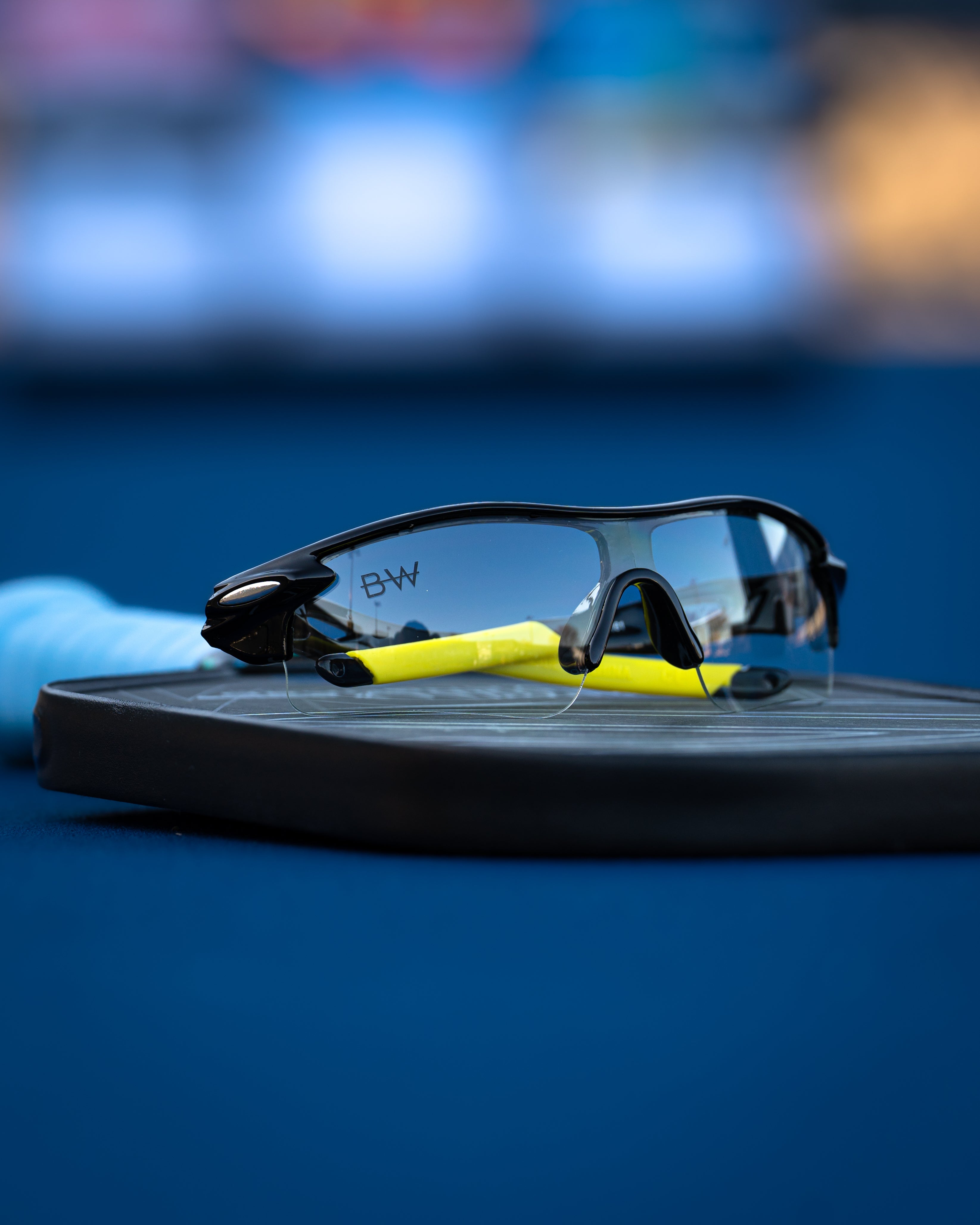
Anti-Lens Warping Tips for Traveling with RX Sunglasses
Share
Protect Your RX Pickleball Glasses While Traveling
Prescription sports eyewear can travel with you from local courts to tournaments, vacations, road trips, and flights. The key is protecting the complete eyewear system from excessive heat, crushing pressure, impact, and improper storage.
Anti-Lens Warping Tips for Traveling With RX Sunglasses
Travel can expose prescription sunglasses to conditions they may not encounter during normal daily use. Hot vehicles, tightly packed luggage, accidental drops, pressure from other belongings, and improper storage can all potentially damage eyewear.
If you travel with RX sunglasses for pickleball, outdoor activities, or everyday vision, prevention starts with protecting both the lenses and the frame.
The most practical travel habits are simple:
- Keep RX sunglasses in a protective case when you are not wearing them.
- Avoid leaving eyewear in excessively hot vehicles or on hot surfaces.
- Do not place loose glasses underneath heavy luggage or equipment.
- Avoid forcing eyewear into an overcrowded bag.
- Handle prescription lenses by the frame when practical.
- Inspect your eyewear after a significant drop, impact, or crushing event.
- Carry backup corrective eyewear when your prescription is necessary for travel or competition.
This guide explains why prescription eyewear can become distorted or damaged during travel, how to pack RX sunglasses, what to avoid in cars and airplanes, and what to do if your glasses no longer look or feel right after a trip.
Can Prescription Sunglasses Warp During Travel?
Prescription eyewear can potentially become damaged or distorted when exposed to unfavorable conditions. However, what appears to be "lens warping" is not always a problem with the prescription lens material itself.
Changes to the frame or the way a lens sits within the frame can also affect how the eyewear fits and how the wearer experiences the prescription.
Potential travel-related problems can include:
- Frame deformation
- Lens displacement
- Cracked or damaged lenses
- Loose frame components
- Changes in frame alignment
- Pressure damage from luggage
- Heat-related damage to eyewear components
If your prescription sunglasses suddenly look distorted, sit differently, or no longer provide the visual experience you expect after travel, inspect the entire pair rather than assuming the prescription lenses themselves have warped.
What Causes RX Sunglasses to Warp or Become Distorted?
Travel introduces several potential sources of stress to eyewear. Understanding them makes prevention easier.
| Travel Risk | Potential Problem | Practical Prevention |
|---|---|---|
| Excessive Heat | Can potentially affect frames, lenses, coatings, or other eyewear components depending on their materials | Avoid leaving eyewear in excessively hot vehicles or directly against hot surfaces |
| Crushing Pressure | Can deform a frame, displace a lens, or damage components | Store eyewear in a protective case away from heavy objects |
| Impact | Can crack lenses, damage frames, or alter alignment | Keep eyewear protected when not being worn and inspect it after a significant impact |
| Overpacked Luggage | Can place sustained pressure on the frame and case | Avoid forcing the eyewear case into a tightly compressed space |
| Loose Storage | Allows eyewear to move against other belongings | Use a protective case rather than placing loose RX sunglasses in a bag |
| Improper Handling | Can place unnecessary stress on the frame or lenses | Handle eyewear carefully and avoid intentionally bending the frame |
1. Use a Protective Case When Traveling With RX Sunglasses
One of the simplest ways to reduce travel-related damage is to store prescription sunglasses in a protective case whenever you are not wearing them.
A case creates a physical barrier between the eyewear and other belongings. This is particularly useful inside:
- Carry-on luggage
- Suitcases
- Backpacks
- Pickleball bags
- Gym bags
- Vehicle storage areas
A case does not make eyewear indestructible. Heavy compression can still damage the case or its contents, so placement inside your luggage remains important.
2. Do Not Pack RX Sunglasses Loose in Your Luggage
Loose eyewear can come into direct contact with shoes, electronics, chargers, sports equipment, toiletry containers, and other objects inside a bag.
Even if the lenses are impact-resistant, the complete pair can still be damaged.
Impact resistance should not be interpreted as meaning the eyewear is:
- Crush-proof
- Scratch-proof
- Shatterproof
- Indestructible
- Immune to frame deformation
Use a protective case instead of relying on the lens material alone.
3. Keep Heavy Items Away From Your Glasses
A protective case works best when it is not subjected to excessive external pressure.
Avoid placing your RX sunglasses underneath heavy objects such as:
- Shoes
- Laptops
- Large electronics
- Pickleball equipment
- Heavy toiletry bags
- Overpacked clothing compartments
When possible, place the protected eyewear where the surrounding contents are less likely to crush the case.
4. Avoid Leaving Prescription Sunglasses in a Hot Car
A parked vehicle can become extremely hot, especially when exposed to direct sunlight.
Instead of assuming a particular temperature will damage every pair of glasses, treat excessive vehicle heat as an avoidable source of stress for the complete eyewear system.
Avoid routinely leaving RX sunglasses:
- On the dashboard
- On a seat in direct sunlight
- Inside an exposed center console for extended periods
- Against hot interior surfaces
- Inside a parked vehicle for long periods during hot weather
If you are leaving the vehicle, taking your prescription eyewear with you is generally the simpler preventive choice.
5. Keep RX Sunglasses Away From Direct Heat Sources
Vehicle interiors are not the only source of travel-related heat.
Be mindful of where you place prescription eyewear around:
- Heaters
- Hot outdoor surfaces
- Direct heat-producing equipment
- Areas exposed to intense heat for extended periods
The exact response to heat depends on the materials and construction of the eyewear, so there is no need to invent a universal temperature at which every lens or frame will warp.
6. Avoid Trying to Bend Warped Glasses Back Into Shape Yourself
If your frame appears noticeably bent after traveling, aggressively bending it in the opposite direction can create additional stress.
This is especially important with prescription eyewear because frame geometry affects how the prescription lenses sit relative to your eyes.
If the frame is significantly distorted, damaged, or no longer fits correctly, consider having the eyewear evaluated rather than repeatedly bending it by hand.
7. Inspect RX Sunglasses After a Drop or Impact
Travel creates many opportunities for glasses to fall from a bag, hotel counter, rental car, airplane seat area, or other surface.
After a substantial impact, inspect the eyewear for:
- Visible lens cracks
- Lens displacement
- Frame cracks
- Noticeable frame deformation
- Loose components
- A significant change in how the glasses sit
- New visual distortion while wearing them
Do not assume that a pair is undamaged simply because the lens did not visibly shatter.
8. Do Not Store RX Sunglasses Lens-Down
When your prescription sunglasses are temporarily outside their case, avoid placing the lens surface directly against a table, counter, or other potentially abrasive surface.
This does not mean every prescription lens will scratch immediately. It simply reduces unnecessary contact between the optical surface and dirt, grit, or rough materials.
9. Clean Your RX Sunglasses Before Packing Them
Travel can expose eyewear to perspiration, skin oils, sunscreen, dust, and other residue.
Before storing your glasses for an extended trip, remove loose debris carefully and use appropriate lens-care materials.
A basic approach includes:
- Remove loose particles before rubbing the lens.
- Use a clean microfiber cloth intended for eyewear.
- Use a lens-safe cleaner when necessary.
- Avoid abrasive fabrics or dirty cleaning cloths.
- Allow wet eyewear to dry appropriately before extended storage.
10. Do Not Assume Prescription Lenses Are Scratch-Resistant
Scratch resistance is a separate lens characteristic and should be verified for the exact product.
High-index prescription material, impact resistance, polarization status, lens tint, and prescription strength do not automatically establish a particular scratch-resistant treatment.
This is another reason a protective case and appropriate lens-cleaning method remain useful while traveling.
11. Carry RX Sunglasses in Your Carry-On When Flying
If your prescription sunglasses are important for vision or your planned activities, keeping them accessible in your carry-on can be practical.
This gives you more direct control over where the eyewear is stored and makes it easier to access during the trip.
Regardless of which bag you use, keep the glasses protected rather than placing them loose among other belongings.
Can Airplane Cabin Pressure Warp Prescription Lenses?
Normal air travel should not automatically be described as causing prescription lenses to warp simply because cabin pressure changes during a flight.
For most travelers, the more practical physical risks involve how the eyewear is packed and handled.
Examples include:
- A bag being compressed in an overhead bin
- A case being placed beneath heavy luggage
- Glasses being left loose in a seat pocket or bag
- Dropping eyewear while boarding or leaving the aircraft
- Accidentally sitting on loose glasses
Focus on physical storage and handling rather than assuming routine cabin-pressure changes will deform your lenses.
Can Airport X-Ray Machines Damage RX Sunglasses?
Routine airport security screening should not automatically be treated as a lens-warping event.
The more practical concern is physical handling while your belongings move through security.
Keep prescription sunglasses protected inside your luggage rather than placing loose eyewear into a crowded security bin with heavy objects.
Should You Put RX Sunglasses in Checked Luggage?
You can travel with eyewear in luggage, but if your prescription sunglasses are essential to your vision, keeping them accessible in your carry-on may be more practical.
Checked luggage can be handled, stacked, and compressed outside your direct control.
If you do pack RX eyewear in a suitcase, use a protective case and position it away from areas likely to experience substantial pressure.
12. Do Not Overpack the Eyewear Case
A protective case should hold the eyewear without requiring excessive force to close.
Avoid stuffing unrelated objects into the same case if doing so presses against the frame or lenses.
The purpose of the case is to reduce external stress, not transfer additional pressure directly onto the eyewear.
13. Carry Backup Prescription Eyewear When It Matters
If you depend on prescription correction to drive, travel, compete, or complete everyday activities, a backup pair can be useful.
A backup is especially worth considering for:
- Pickleball tournaments away from home
- Multi-day trips
- International travel
- Road trips
- Trips where replacing custom RX eyewear quickly could be difficult
The backup does not need to be identical to your primary sunglasses. Its purpose is to ensure you still have appropriate corrective vision if your primary pair becomes lost or damaged.
14. Keep Your Prescription Information Accessible
When traveling away from home, having access to your current prescription information can be useful if an unexpected eyewear problem occurs.
This does not replace an appropriate eye examination or guarantee that replacement eyewear can be produced immediately, but it can make your existing prescription information easier to reference when necessary.
15. Be Careful With Temperature Changes and Condensation
Moving between air-conditioned buildings and hot, humid outdoor environments can cause temporary condensation on lenses.
Fogging or condensation does not automatically mean the prescription lens has warped.
Allow the eyewear to adjust to the environment and clean it appropriately when necessary rather than repeatedly rubbing a wet or dirty lens with abrasive material.
Does Humidity Warp Prescription Sunglasses?
Humidity and condensation should not automatically be described as causing prescription lenses to warp.
Humid conditions can affect the wearing and cleaning experience, particularly when moisture forms on the lenses. The practical response is appropriate storage and lens care rather than assuming moisture exposure has permanently changed the prescription lens.
Do Anti-Fog Wipes Prevent Lens Warping?
Anti-fog products and lens warping address different issues.
An anti-fog product, when appropriate for a particular lens, is intended to address condensation or fogging. It should not be described as preventing structural deformation of the frame or lens.
Before applying any cleaning or anti-fog product to prescription eyewear, make sure it is appropriate for the lens and any treatments present.
High-Index RX Lenses and Travel: What Actually Matters
High-index refers to a category of prescription lens material commonly used to help manage lens thickness, particularly as prescription strength increases.
It should not be treated as a travel-durability rating.
High-index prescription lenses are not automatically:
- More impact-resistant than every other lens material
- More resistant to heat
- More resistant to warping
- Scratch-proof
- Shatterproof
- Safety-certified
Finished lens thickness can depend on your individual prescription, lens dimensions, frame geometry, and other optical requirements.
Blinded Wear custom RX eyewear includes high-index prescription lenses at no additional cost.
Are High-Index Lenses Better for Travel?
High-index lenses should not automatically be described as superior travel lenses simply because of their refractive index.
The practical travel habits remain largely the same regardless of prescription lens category:
- Use a protective case.
- Avoid crushing pressure.
- Avoid excessive heat.
- Handle the frame carefully.
- Use appropriate lens-cleaning methods.
- Inspect the eyewear after significant impact.
Choosing high-index prescription lenses is primarily an optical and prescription-related consideration rather than a substitute for proper travel storage.
Does a Thinner Prescription Lens Mean It Is More Durable?
No. Lens thickness and durability should not automatically be treated as the same characteristic.
A thinner finished prescription lens is not inherently:
- More impact-resistant
- Less likely to warp
- More scratch-resistant
- More heat-resistant
Likewise, a thicker lens should not automatically be assumed to be more durable.
RX Sunglasses vs. Regular Sunglasses When Traveling
Prescription sunglasses require many of the same storage precautions as Non-RX eyewear, but damage can create an additional problem when you depend on the glasses for corrective vision.
| Consideration | RX Sunglasses | Non-RX Sunglasses |
|---|---|---|
| Protective Storage | Recommended | Recommended |
| Avoid Excessive Heat | Yes | Yes |
| Avoid Crushing Pressure | Yes | Yes |
| Prescription Dependency | May be essential to the wearer | No built-in corrective prescription |
| Backup Eyewear | Especially useful when corrective vision is necessary | Optional according to individual needs |
| Replacement Complexity | Custom prescription information may be required | Does not require custom prescription correction |
Traveling to Pickleball Tournaments With RX Sunglasses
Pickleball tournament travel can mean carrying paddles, shoes, clothing, electronics, water bottles, and other equipment in the same luggage as your eyewear.
Keep RX glasses separated from equipment that can place substantial pressure on the frame.
A simple tournament travel routine is:
- Clean and inspect your RX eyewear before leaving.
- Place it in a protective case.
- Pack the case where it will not be crushed by equipment.
- Keep essential prescription eyewear accessible during travel.
- Bring backup corrective eyewear when appropriate.
- Inspect your glasses again before tournament play.
What Should You Check Before Playing After a Flight or Road Trip?
Before stepping onto the court, inspect eyewear that has spent several hours inside luggage.
Check whether:
- The frame appears symmetrical and undamaged.
- The lenses remain seated appropriately.
- There are any visible cracks or substantial defects.
- The glasses sit as expected on your face.
- Your vision through the prescription feels as expected.
If something seems significantly different after travel, investigate the issue before relying on the eyewear for competition.
Traveling With Direct RX vs. RX Clip Pickleball Glasses
Blinded Wear offers both direct RX and RX clip configurations depending on the product.
With direct RX eyewear, the prescription correction is incorporated into the RX lens configuration.
With an RX clip system, corrective vision is provided by a separate inner prescription insert within compatible eyewear.
Both configurations should be protected from crushing pressure, impact, and excessive heat during travel.
For an RX clip configuration, pay attention to the complete system rather than treating the prescription insert as an unrelated accessory.
How to Order Blinded Wear RX Pickleball Glasses Before a Trip
- Select the product and available options.
- Have your current eyeglass prescription ready.
- Upload a clear photo or picture of your eyeglass prescription on the product page before adding the eyewear to your cart.
- Your prescription information will be associated with your custom RX order.
Browse the Blinded Wear Prescription Pickleball Eyewear Collection to compare current RX options.
RX Sunglasses Travel Mistakes to Avoid
| Travel Mistake | Better Approach |
|---|---|
| Leaving glasses loose in a backpack | Store them in a protective case |
| Putting heavy equipment on top of the case | Place the case away from substantial pressure |
| Leaving RX sunglasses on a hot dashboard | Take them with you rather than leaving them exposed to excessive vehicle heat |
| Trying to aggressively bend a distorted frame back into shape | Have significant frame distortion evaluated |
| Cleaning dirty lenses with an abrasive fabric | Remove loose debris and use appropriate lens-care materials |
| Assuming impact-resistant means damage-proof | Continue using appropriate storage and handling |
| Traveling with your only essential prescription pair unprotected | Consider accessible backup corrective eyewear |
| Assuming fogging means the lens has warped | Allow condensation to clear and evaluate the eyewear afterward |
16. Store RX Sunglasses Carefully at Hotels and Vacation Rentals
Travel-related eyewear damage does not only happen while your luggage is moving. Glasses can also be damaged after you arrive at your destination.
Avoid leaving prescription sunglasses:
- Loose on a bed or chair where someone could sit on them
- Under clothing or towels
- Near the edge of a nightstand or bathroom counter
- Inside an overpacked drawer
- On surfaces exposed to substantial heat
When you remove your RX sunglasses, returning them to their protective case can reduce the chance of accidental crushing, dropping, or contact with other objects.
17. Be Careful With RX Sunglasses at the Beach and Pool
Beach and pool trips can expose prescription sunglasses to sand, moisture, sunscreen, towels, bags, and frequent handling.
Sand and other particles can become especially problematic if they remain on the lens while it is being wiped. Remove loose debris before rubbing the lens surface with a cleaning cloth.
When you are not wearing your glasses, avoid placing them loose in a beach bag underneath towels, bottles, shoes, or other belongings.
A protective case remains useful even after you have reached your destination.
18. Do Not Leave RX Sunglasses Under a Towel or Clothing
Covering glasses with a towel, jacket, or other clothing can make them easy to forget.
Someone may place another object on top of them, sit on them, or pack the clothing without realizing the eyewear is underneath.
Use a consistent storage location during travel so your prescription sunglasses are less likely to be accidentally crushed.
19. Protect RX Sunglasses Inside a Pickleball Bag
A pickleball bag can contain paddles, balls, shoes, water bottles, clothing, and other equipment. Prescription eyewear should not simply be dropped into the same compartment without protection.
When packing RX sunglasses for a tournament or recreational trip:
- Place the eyewear in a protective case.
- Keep the case away from heavy equipment when possible.
- Avoid forcing additional gear into a compartment that is already tightly packed.
- Check that the case is not being compressed before closing the bag.
- Inspect the eyewear before putting it on for play.
20. Avoid Storing RX Sunglasses With Loose Pickleball Equipment
Paddles and other sports equipment can shift while a bag is carried, placed in a vehicle, or stored during a flight.
Even impact-resistant lenses do not make the complete eyewear system immune to crushing, bending, or frame damage.
Separating the eyewear from heavier equipment provides another layer of practical protection.
21. Keep RX Sunglasses Accessible During Road Trips
If prescription sunglasses are part of your normal driving or outdoor routine, pack them somewhere accessible rather than underneath luggage.
This reduces the need to unpack or move heavy objects simply to retrieve your eyewear.
When you remove the glasses, avoid placing them on a seat where someone may sit on them or on a dashboard exposed to substantial heat.
22. Avoid Using a Car Dashboard as Eyewear Storage
A dashboard can combine two avoidable travel risks: heat exposure and an unsecured surface.
Prescription sunglasses left on a dashboard can be exposed to substantial heat and may also slide or fall when the vehicle moves.
A protective case stored away from excessive heat is a more appropriate long-term storage choice.
23. Can Cold Weather Warp Prescription Sunglasses?
It is better to avoid universal claims about a specific cold temperature permanently warping every prescription lens or frame. Eyewear materials and constructions vary.
For travel in very cold environments, focus on careful handling and storage. Moving between cold outdoor conditions and warm indoor environments can also create temporary condensation on the lenses.
Condensation should not automatically be interpreted as permanent lens distortion.
24. Does Going From Cold to Hot Warp RX Lenses?
Temperature changes and permanent structural warping should not automatically be treated as the same thing.
Moving between different climates can produce temporary fogging or condensation. If your glasses clear and continue to fit and function as expected, temporary moisture on the lens does not by itself establish that the lens has warped.
Continue to avoid excessive heat and handle the eyewear carefully during major changes in environment.
25. Do Not Use Hot Water to Clean Prescription Sunglasses
When cleaning RX sunglasses during travel, there is no need to expose the eyewear to very hot water.
Use appropriate lens-care methods and follow any care instructions provided for the exact eyewear.
The goal is to remove dirt and residue without unnecessarily exposing the lenses, frame, or any lens treatments to extreme conditions.
26. Be Careful With Unverified Cleaning Products
Travel-size cleaners, wipes, and sprays are convenient, but not every product should automatically be assumed appropriate for every prescription lens or lens treatment.
If you use a cleaning solution or wipe, make sure it is intended for the type of eyewear you are cleaning.
A clean microfiber cloth intended for eyewear can also be useful when traveling.
27. Avoid Cleaning RX Lenses With Your Shirt
Using whatever fabric is available may be convenient, but clothing can contain dirt, dust, or other particles.
Rather than repeatedly rubbing prescription lenses with an unknown or dirty fabric, use appropriate lens-cleaning materials.
This is a lens-care practice rather than a claim that every shirt will immediately damage a lens.
28. Remove Loose Debris Before Wiping Prescription Lenses
Dust, sand, and other particles can accumulate during road trips, flights, outdoor tournaments, and beach travel.
Before rubbing the lens surface, remove loose debris carefully. Then use appropriate lens-care materials.
This is especially relevant after outdoor travel where fine particles may not be immediately obvious on the lens.
29. Keep Your Microfiber Cloth Clean During Travel
A microfiber cloth is most useful when it remains clean.
A cloth stored loose in a bag can collect dirt, dust, or other particles before being used on the lens.
Keep your lens-cleaning cloth stored appropriately rather than treating the cloth itself as immune to contamination.
30. Do Not Assume Anti-Reflective Coatings Prevent Warping
Anti-reflective characteristics and structural lens distortion are separate issues.
An anti-reflective treatment, when present, should not be described as making a prescription lens resistant to:
- Crushing
- Frame deformation
- Excessive heat
- Physical impact
- Structural warping
Likewise, do not assume a Blinded Wear RX lens includes a particular anti-reflective treatment unless that characteristic is verified for the exact product.
31. Anti-Fog and Anti-Warping Are Different
Fogging occurs when moisture condenses on the lens surface. Warping or structural distortion involves a physical change to the eyewear.
They should not be treated as the same problem.
| Issue | What It Can Look Like | What to Know |
|---|---|---|
| Fogging | Temporary moisture or haze on the lens | Can occur with humidity and temperature changes |
| Dirty Lens | Smudges, oils, dust, or residue | May affect what you see until appropriately cleaned |
| Frame Misalignment | Glasses sit differently or appear uneven | Can affect how prescription lenses sit relative to your eyes |
| Lens Displacement | Lens no longer appears properly seated | Should be evaluated rather than ignored |
| Physical Lens Damage | Cracks or other visible defects | Do not assume damaged eyewear remains appropriate for continued use |
32. How Can You Tell if Your RX Sunglasses Are Actually Warped?
Do not diagnose every visual change after travel as lens warping.
Start by examining the complete eyewear system. Ask:
- Does the frame look noticeably bent?
- Do the temples appear uneven?
- Are the lenses still seated correctly?
- Is there a visible crack or other lens defect?
- Do the glasses sit differently on your face?
- Is the apparent distortion still present after the lenses are appropriately cleaned?
- Does the prescription suddenly feel substantially different?
If the eyewear appears damaged or your vision through it has changed unexpectedly, stop treating the problem as a simple cleaning issue and have the glasses evaluated.
33. What Does Lens Distortion Look Like?
A wearer may describe a potential eyewear problem as blurring, unusual distortion, a changed visual experience, or a prescription that suddenly does not feel the same.
Those symptoms do not prove that the lens material itself has warped.
Possible explanations can include problems with frame alignment, lens position, physical damage, contamination on the lens, or other optical issues.
If the change persists after appropriate cleaning and inspection, consider having the eyewear professionally evaluated.
34. Can a Bent Frame Make RX Lenses Feel Wrong?
Yes, a significant change in frame geometry can change how prescription lenses sit relative to the wearer's eyes.
This is one reason frame protection matters during travel even when the lenses themselves show no obvious cracks.
If the frame becomes noticeably distorted, repeatedly bending it by hand may create additional problems. Consider having significant misalignment evaluated.
35. Can Crushing Pressure Damage Prescription Sunglasses Without Breaking the Lens?
Yes. Visible lens breakage is not the only possible form of eyewear damage.
Pressure can potentially affect:
- Frame alignment
- Lens seating
- Temple alignment
- Other frame components
This is why a pair should be inspected after a substantial crushing event even if the lenses remain in one piece.
36. Can an Eyewear Case Prevent All Warping or Damage?
No protective case should be treated as making RX sunglasses indestructible.
A case can provide useful physical separation between eyewear and surrounding objects, but sufficiently strong compression, impact, or heat can still create problems.
Think of the case as one part of a travel-storage strategy rather than a guarantee against all damage.
37. Hard Case vs. Soft Pouch for RX Sunglasses
Different storage products provide different levels and types of physical separation.
A soft pouch can help keep eyewear separated from some dirt and direct surface contact, while a more rigid protective case can provide additional resistance against objects pressing directly against the glasses.
Regardless of the storage type, avoid placing substantial weight on top of the eyewear.
38. Should You Keep RX Sunglasses in Their Case Overnight?
Returning prescription sunglasses to a protective case when they are not being used can be a simple travel habit.
Hotel rooms, vacation rentals, and shared accommodations can contain unfamiliar surfaces and limited storage space. A consistent case location can reduce the chance of the glasses being knocked onto the floor, covered by clothing, or accidentally crushed.
39. How to Pack Multiple Pairs of Glasses for Travel
If you travel with prescription sunglasses, regular prescription glasses, and additional sports eyewear, avoid forcing multiple pairs together without adequate separation.
Each pair should be stored in a way that prevents frames and lenses from pressing directly against one another.
This can be especially useful for pickleball players who bring different eyewear configurations for outdoor daytime and indoor or evening play.
40. Should You Bring Both RX Sunglasses and Regular RX Glasses?
If you depend on prescription correction, carrying more than one appropriate pair can provide redundancy during a trip.
For example, a traveler may use RX sunglasses outdoors while keeping another prescription pair available for conditions where dark sunglass tint is not desired.
This decision depends on your individual prescription needs, itinerary, and available eyewear.
41. Traveling Between Indoor and Outdoor Pickleball Courts
Tournament and recreational travel can involve multiple court environments during the same trip.
A tinted RX configuration may match one player's preference for bright outdoor conditions, while another prescription configuration may be preferred indoors or later in the evening.
Do not assume a particular lens tint automatically improves ball tracking, contrast, depth perception, or reaction time. Choose according to your visual requirements and environment.
For more information about lens options, visit the Pickleball Performance Lens Guide.
42. Does Lens Tint Affect Warping Risk?
Lens color or tint should not automatically be treated as a measure of resistance to structural warping.
A dark, clear, mirrored, or colored appearance does not by itself establish:
- Heat resistance
- Impact resistance
- Scratch resistance
- Structural durability
- Safety certification
Evaluate those characteristics separately rather than judging durability from lens appearance.
43. Does Polarization Affect Lens Warping?
Polarization and structural lens warping are separate topics.
A polarized lens uses technology designed to reduce certain reflected light. Polarization status should not automatically be interpreted as making a lens more or less resistant to heat, crushing, impact, or deformation.
Likewise, non-polarized lenses should not automatically be described as more durable for travel.
44. Does UV400 Make RX Sunglasses More Heat-Resistant?
No. UV specifications and heat resistance are separate characteristics.
A verified UV400 specification should not automatically be interpreted as meaning the eyewear is more resistant to:
- Hot vehicle interiors
- Frame deformation
- Crushing pressure
- Impact
- Structural lens damage
Similarly, a lens should not be assumed to have UV400 based on tint darkness or appearance.
45. Does Impact Resistance Prevent RX Lens Warping?
Impact resistance and resistance to structural deformation are not interchangeable concepts.
An impact-resistant lens option should not automatically be described as resistant to every form of heat exposure, sustained pressure, crushing, or frame distortion.
Continue using appropriate storage even when traveling with impact-resistant eyewear.
46. Can Prescription Sunglasses Warp While Stored?
Eyewear does not need to be actively worn for travel-related damage to occur.
Improper storage can expose the frame and lenses to pressure, impact, heat, or contact with other objects.
When storing prescription sunglasses for a longer period:
- Use a protective case.
- Avoid placing heavy objects on top of the case.
- Keep the eyewear away from excessive heat.
- Do not force the case into an overpacked compartment.
- Store the eyewear dry and appropriately cleaned.
47. What to Do if RX Sunglasses Were Left in a Hot Car
If your prescription sunglasses have been exposed to substantial vehicle heat, avoid assuming they are either definitely damaged or definitely unaffected.
After the eyewear has returned to a comfortable handling temperature, inspect it for:
- Visible frame deformation
- Changes in fit
- Lens displacement
- Visible lens damage
- A persistent change in the visual experience
If something appears significantly different, consider having the eyewear evaluated rather than trying to reshape it aggressively yourself.
48. What to Do if Your RX Sunglasses Were Crushed in Luggage
First, inspect the complete pair before wearing it again.
- Check the frame for visible deformation or cracks.
- Check that each lens remains properly seated.
- Look for visible lens damage.
- Check whether the temples appear unusually misaligned.
- Determine whether the glasses still sit as expected.
- Pay attention to any persistent change in vision through the eyewear.
If the pair appears significantly damaged, do not assume that simply bending the frame back by hand fully restores the original eyewear geometry.
49. What to Do if Your RX Sunglasses Look Distorted After Travel
Start by determining whether the problem is temporary or structural.
Clean the lenses appropriately and make sure fogging, moisture, dirt, or residue is not creating the apparent distortion.
Then inspect the frame and lens position.
If the distortion persists, the frame appears damaged, or the prescription no longer feels correct, discontinue relying on the damaged pair until the issue has been evaluated.
50. Do Not Keep Using Visibly Damaged RX Eyewear Just Because You Are Traveling
Being away from home can make replacement inconvenient, but visible damage should not simply be ignored.
If prescription eyewear has a cracked lens, substantially deformed frame, displaced lens, or another significant defect, use appropriate backup corrective eyewear if available and determine the next appropriate step.
This is another reason travelers who depend heavily on prescription correction may benefit from carrying a backup pair.
Blinded Wear Lifetime Replacement Support for Damaged RX Glasses
Blinded Wear offers 50% lifetime replacement support if eligible glasses break, subject to current policy terms.
This should not be confused with the old claim that every pair has a lifetime warranty providing free replacement for any warping or travel damage.
For an eligible claim, the damaged eyewear must be returned. Once the claim and return meet the applicable policy requirements, the customer can receive 50% credit toward a replacement pair.
Customized RX eyewear being final sale does not automatically eliminate applicable 50% lifetime replacement support for eligible broken glasses.
For damaged RX eyewear, contact blindedwearco@gmail.com before returning the pair.
Review the Blinded Wear Protection Plan, Replacement & Returns information for current eligibility and policy details.
Does Blinded Wear Cover Every Type of Travel Damage?
Do not interpret lifetime replacement support as an unlimited free warranty covering every travel scenario.
Eligibility is subject to the current policy terms, and the program should not automatically be described as covering:
- Lost eyewear
- Glasses left behind during travel
- Prescription changes
- Every type of cosmetic wear
- Every possible form of damage
- A free full replacement
Review the current policy before relying on replacement support for a particular situation.
Can You Return Custom RX Sunglasses After a Trip?
Blinded Wear offers a 30-day return policy for eligible standard purchases, but customized RX eyewear is final sale and excluded from the standard 30-day return policy.
Final-sale status is separate from applicable lifetime replacement support for eligible broken eyewear.
Review the current replacement and returns information for the applicable terms.
Traveling With Zebra II RX
Zebra II RX is one of the prescription pickleball-eyewear options available from Blinded Wear.
When traveling with Zebra II RX, use the same practical protection principles that apply to other custom RX eyewear:
- Store the glasses in a protective case when not in use.
- Avoid crushing pressure inside luggage.
- Avoid excessive heat.
- Keep the eyewear separated from heavy sports equipment.
- Inspect the pair after significant impact.
Do not assume that a particular frame or high-index prescription configuration makes the eyewear immune to travel-related damage.
Traveling With Havana Melt RX
Havana Melt RX is another direct RX option available for pickleball players.
Protect the complete frame-and-lens system while traveling rather than relying on unsupported claims about scratch resistance, heat resistance, or indestructibility.
A protective case, appropriate packing location, careful cleaning, and avoidance of excessive heat remain the practical priorities.
Traveling With Crystal Wave II RX
Crystal Wave II RX is another prescription option available from Blinded Wear.
When packing it for a flight, road trip, vacation, or pickleball tournament, protect it from substantial pressure and heat just as you would other prescription eyewear.
Do not assume a particular lens technology, transition feature, anti-reflective treatment, or other characteristic unless it is verified for the exact current product configuration.
More Blinded Wear RX Options for Traveling Pickleball Players
Players can compare additional current prescription options through the Blinded Wear RX Pickleball Glasses Collection.
Available direct RX options include models such as:
Choose according to your prescription requirements, fit, available product options, and individual preferences rather than assuming one model is universally the most travel-resistant.
How to Choose Travel-Friendly RX Pickleball Glasses
There is no need to invent a special category of "travel-proof" prescription eyewear. Instead, choose RX glasses that meet your vision and fit requirements, then protect them appropriately while traveling.
Consider:
- Your current prescription
- Frame dimensions
- Overall fit
- Direct RX vs. RX clip configuration
- Playing environment
- Available lens options
- Verified impact characteristics
- How easily you can protect the eyewear during your normal travel routine
RX Sunglasses Travel Protection Checklist
Before leaving home, run through this checklist:
- My RX sunglasses are clean and free of obvious damage.
- I have a protective case available.
- I will not pack the eyewear loose with heavy objects.
- I know where the case will be stored in my luggage.
- I will avoid leaving the eyewear in excessive vehicle heat.
- I have appropriate lens-cleaning materials.
- I have access to my prescription information if needed.
- I have backup corrective eyewear if losing my primary pair would create a significant problem.
- I know how to inspect the frame and lenses after an impact.
- I know not to aggressively reshape significantly distorted RX eyewear myself.
RX Sunglasses Travel FAQ
What is the best way to travel with prescription sunglasses?
Keep prescription sunglasses in a protective case when you are not wearing them, avoid placing heavy objects on top of the case, keep the eyewear away from excessive heat, and carry backup corrective eyewear when losing or damaging your primary pair would create a significant problem.
Can RX sunglasses warp in a suitcase?
Improperly packed eyewear can potentially be damaged inside luggage. Crushing pressure can affect the frame, lens seating, or other components even when the lens does not visibly break.
Store RX sunglasses in a protective case and avoid placing the case beneath heavy objects or forcing it into an overpacked compartment.
Can heat warp prescription sunglasses?
Excessive heat can potentially affect eyewear components depending on their materials and construction. Avoid leaving prescription sunglasses in excessively hot vehicles, directly on hot surfaces, or near strong heat sources for extended periods.
What temperature will warp prescription lenses?
There is no useful universal temperature that should be presented as the warping point for every prescription lens and frame. Eyewear materials, lens construction, treatments, frames, and exposure conditions can differ.
A more practical rule is to avoid unnecessary exposure to excessive heat rather than relying on a single temperature threshold.
Can leaving glasses in a hot car damage them?
Hot vehicle interiors are an avoidable source of heat exposure. Rather than routinely storing prescription eyewear in a parked vehicle, take it with you when practical.
Can sunlight warp prescription sunglasses?
Do not assume that ordinary outdoor use in sunlight will automatically warp prescription sunglasses. The greater concern is unnecessary exposure to excessive heat, such as leaving eyewear inside a hot parked vehicle or against a very hot surface for an extended period.
Can airplane pressure warp prescription lenses?
Normal changes in airplane cabin pressure should not automatically be described as causing prescription lenses to warp.
For air travel, physical storage is a more practical concern. Protect your glasses from crushing pressure, drops, and heavy luggage.
Can airport security scanners damage prescription glasses?
Routine airport security screening should not automatically be treated as a lens-warping event. Protect the eyewear physically while your belongings move through security and avoid placing loose glasses in a crowded bin with heavy objects.
Should prescription sunglasses go in a carry-on or checked bag?
If you depend on your prescription eyewear, keeping it accessible in your carry-on can be practical because you maintain greater control over its storage and handling.
If you place RX sunglasses in checked luggage, use a protective case and position it away from areas likely to experience substantial pressure.
Can I put RX sunglasses in my backpack?
Yes, but avoid placing them loose in the bag. Use a protective case and keep the case away from heavy objects such as electronics, shoes, bottles, and sports equipment.
Should I use a hard case for prescription sunglasses?
A more rigid protective case can provide additional physical separation between eyewear and objects pressing against it. However, no case makes eyewear immune to sufficiently strong crushing, impact, or heat.
Is a soft pouch enough for RX sunglasses?
A soft pouch can separate the eyewear from some dirt and direct surface contact, but it does not provide the same type of resistance against external pressure as a more rigid case.
Can glasses warp even inside a case?
A case reduces certain physical risks but does not make prescription eyewear indestructible. Substantial compression, impact, or excessive heat can still potentially affect the eyewear.
Can a bent frame make my prescription look distorted?
A significant change in frame geometry can change how prescription lenses sit relative to your eyes. This can alter the wearing experience even when the lenses themselves have not visibly cracked.
How do I know if my prescription lenses are warped?
Do not assume every unexpected visual change is lens warping. First appropriately clean the lenses and inspect the complete eyewear system.
Look for frame deformation, displaced lenses, cracks, substantial changes in fit, or a persistent change in the visual experience.
Why do my RX glasses feel different after traveling?
Several issues can potentially change the wearing experience after travel, including frame misalignment, lens displacement, physical damage, dirt or residue on the lens, or other optical issues.
If the change persists after appropriate cleaning and inspection, consider having the eyewear evaluated.
Can I fix warped RX glasses myself?
Avoid aggressively bending significantly distorted prescription eyewear back into shape. Frame geometry influences how the lenses sit relative to your eyes, and repeated bending can create additional stress.
Significant deformation is better evaluated than repeatedly reshaped by hand.
Can I keep wearing RX sunglasses if the frame is bent?
If the frame is substantially distorted, the lenses are displaced, or your vision through the eyewear has changed unexpectedly, do not simply assume the glasses remain appropriate for continued use.
Can humidity warp RX lenses?
Humidity should not automatically be described as permanently warping prescription lenses. Humid conditions can contribute to temporary condensation or fogging, which is different from structural deformation.
Does lens fog mean my RX sunglasses are damaged?
No. Temporary condensation on a lens does not by itself establish permanent damage or warping.
Do anti-fog wipes prevent prescription lenses from warping?
No. Anti-fog products and structural deformation address different issues. An anti-fog product should not be described as preventing a frame or lens from being damaged by heat, crushing, or impact.
Do high-index prescription lenses warp more easily?
High-index should not automatically be described as more or less resistant to warping solely because of its refractive index.
High-index is primarily a prescription-lens category used to help manage lens thickness, particularly as prescription strength increases.
Are high-index lenses more durable for travel?
Not automatically. High-index is not a travel-durability rating and does not inherently establish heat resistance, impact resistance, scratch resistance, or safety certification.
Are thinner RX lenses less likely to warp?
Lens thickness should not automatically be used as a measure of resistance to structural deformation. Finished prescription lens thickness and physical characteristics involve different considerations.
Are impact-resistant lenses warp-resistant?
Impact resistance and resistance to heat or structural deformation are separate characteristics. An impact-resistant lens should not automatically be described as resistant to every form of crushing, pressure, or heat exposure.
Are RX sunglasses scratch-resistant?
Only when that characteristic has been established for the exact lens. High-index material, impact resistance, prescription status, and sports styling do not automatically establish scratch resistance.
Can polarized prescription sunglasses warp?
Polarization and structural durability are separate characteristics. Polarized status should not automatically be interpreted as making a lens more or less resistant to warping.
Are non-polarized RX sunglasses more durable?
Not automatically. Non-polarized status does not establish heat resistance, impact resistance, scratch resistance, or resistance to deformation.
Does UV400 protect sunglasses from heat?
No. UV specifications and resistance to excessive heat are separate characteristics.
Should I bring backup prescription glasses when traveling?
If you depend on corrective vision for driving, competition, or everyday activities, backup prescription eyewear can be useful, particularly during multi-day or long-distance travel.
Should I bring backup RX glasses to a pickleball tournament?
Backup corrective eyewear can be especially useful when traveling for competition because damage to your primary pair could otherwise affect your ability to see as required.
Should I travel with a copy of my eyeglass prescription?
Having access to your current prescription information can be useful if an unexpected eyewear problem occurs away from home. It does not guarantee immediate replacement, but it makes your existing prescription information easier to reference.
How to Pack RX Sunglasses for a Flight
A simple packing routine can reduce avoidable travel risks:
- Inspect the glasses before leaving home.
- Clean the lenses using appropriate lens-care materials.
- Place the eyewear in a protective case.
- Keep the case in your carry-on if the glasses are important for your vision.
- Position the case where heavy belongings will not continually press against it.
- Avoid placing loose glasses directly into an airport security bin.
- Confirm that you still have the eyewear before leaving the aircraft or airport.
- Inspect the pair again if your bag experienced substantial impact or compression.
How to Pack RX Sunglasses for a Road Trip
Road trips create a different set of practical risks because eyewear may repeatedly move between the vehicle, hotel, court, restaurant, and other locations.
- Choose a consistent storage location for your eyewear case.
- Avoid leaving glasses on seats where someone could sit on them.
- Do not use the dashboard as long-term storage.
- Avoid leaving prescription eyewear inside an excessively hot parked vehicle.
- Keep heavy luggage from pressing against the eyewear case.
- Return the glasses to their case when they are not being worn.
How to Pack RX Sunglasses for a Pickleball Tournament
Pickleball travel often means packing eyewear alongside heavier sports equipment, making storage location especially important.
- Inspect your prescription eyewear before the trip.
- Use a protective case.
- Keep the case separated from paddles, shoes, bottles, and other heavy equipment when possible.
- Do not force the case into an already overpacked pickleball bag.
- Carry backup corrective eyewear when appropriate.
- Inspect your glasses before tournament play.
- Return the eyewear to its case after use rather than leaving it loose in the bag.
How to Store RX Sunglasses During a Beach Vacation
Beach travel introduces sand, sunscreen, towels, bags, heat, and frequent transitions between indoor and outdoor environments.
Protect prescription eyewear by:
- Keeping it in a protective case when not being worn
- Removing loose sand or debris before wiping the lens
- Avoiding storage underneath towels or clothing
- Keeping heavy beach items away from the case
- Using appropriate lens-cleaning materials
- Avoiding unnecessary exposure to excessive heat
Travel Risk Levels for RX Sunglasses
| Situation | Primary Concern | Better Practice |
|---|---|---|
| Loose in Backpack | Pressure, impact, and contact with other objects | Use a protective case |
| Inside Protective Case | Still vulnerable to extreme compression or heat | Position case away from heavy items and excessive heat |
| Hot Parked Car | Unnecessary heat exposure | Take eyewear with you when practical |
| Checked Luggage | Handling and compression outside your control | Use a protective case and consider keeping essential RX eyewear in your carry-on |
| Carry-On | Pressure from surrounding belongings | Protect and position the case carefully |
| Pickleball Bag | Pressure from paddles, shoes, bottles, and equipment | Separate protected eyewear from heavier gear |
| Beach Bag | Sand, loose storage, and pressure from other belongings | Use a case and remove debris before cleaning |
| Hotel Room | Accidental drops, sitting, or crushing | Use a consistent protected storage location |
RX Sunglasses Travel Myths vs. Facts
| Common Claim | What to Know |
|---|---|
| "Airplane pressure will warp prescription lenses." | Normal cabin-pressure changes should not automatically be described as a cause of RX lens warping. |
| "A hard case makes glasses crush-proof." | A protective case can reduce physical risk but does not make eyewear indestructible. |
| "High-index lenses are more impact-resistant." | Refractive index should not automatically be treated as an impact-resistance rating. |
| "Thinner lenses cannot warp." | Finished lens thickness does not by itself establish resistance to structural deformation. |
| "Impact-resistant means crush-proof." | Impact characteristics do not make the complete eyewear system immune to crushing pressure. |
| "UV400 protects lenses from heat." | UV specifications and heat resistance are separate characteristics. |
| "Polarized lenses warp more easily." | Polarization status alone does not establish resistance to structural deformation. |
| "Fogging means the lens warped." | Temporary condensation is different from permanent structural distortion. |
| "If the lens did not crack, the glasses are fine." | Frame deformation, lens displacement, and other damage can occur without visible lens breakage. |
| "You can always bend a warped frame back yourself." | Aggressively reshaping prescription eyewear can create additional stress and may not restore the original geometry. |
What to Do if Your RX Sunglasses Are Damaged While Traveling
If your prescription eyewear experiences substantial heat, crushing, or impact, inspect it before continuing to rely on it.
- Check the frame. Look for cracks, substantial deformation, or unusual alignment.
- Check the lenses. Look for cracks, displacement, or other visible defects.
- Clean the lenses appropriately. Make sure dirt, fogging, or residue is not creating apparent distortion.
- Check the fit. Determine whether the glasses sit differently than they did before the incident.
- Check your visual experience. Pay attention to persistent unexpected changes while looking through the prescription.
- Use backup corrective eyewear when necessary.
- Avoid aggressively bending a significantly distorted frame back into shape.
- Contact Blinded Wear if an eligible RX pair has broken.
What to Do if Blinded Wear RX Glasses Break During Travel
Blinded Wear offers 50% lifetime replacement support if eligible glasses break, subject to current policy terms.
For damaged RX eyewear, contact blindedwearco@gmail.com before returning the pair.
Eligible claims require the damaged eyewear to be returned. Once the applicable claim and return requirements are met, the customer can receive 50% credit toward a replacement pair.
This is not a free full-replacement warranty and should not automatically be interpreted as coverage for loss, prescription changes, forgotten eyewear, or every possible form of damage.
Review the Blinded Wear Protection Plan, Replacement & Returns information for current eligibility and policy details.
Are Blinded Wear Custom RX Glasses Returnable After Travel?
Blinded Wear offers a 30-day return policy for eligible standard purchases. Customized RX eyewear is final sale and excluded from the standard 30-day return policy.
RX final-sale status is separate from applicable 50% lifetime replacement support for eligible broken glasses.
Review the current Protection Plan, Replacement & Returns information before submitting a claim or return.
Traveling With Blinded Wear RX Pickleball Glasses
Blinded Wear prescription eyewear is designed for pickleball players who require corrective vision, with direct RX and RX clip configurations available depending on the product.
Blinded Wear custom RX eyewear also includes high-index prescription lenses at no additional cost.
High-index does not mean the eyewear is travel-proof. Continue to protect the complete frame-and-lens system from excessive heat, crushing pressure, and significant impact.
Browse the Prescription Pickleball Eyewear Collection to compare current RX options.
How to Order Blinded Wear RX Glasses
- Select the product and available options.
- Have your current eyeglass prescription ready.
- Upload a clear photo or picture of your eyeglass prescription on the product page before adding the eyewear to your cart.
- Your prescription information will be associated with your custom RX order.
For additional ordering information, visit How to Order RX Glasses.
Final RX Sunglasses Travel Checklist
Before your next flight, road trip, vacation, or pickleball tournament, check the following:
- Inspect RX sunglasses before packing them.
- Clean the lenses with appropriate lens-care materials.
- Store the eyewear in a protective case.
- Do not pack glasses loose inside luggage.
- Keep heavy objects away from the eyewear case.
- Avoid forcing the case into an overpacked compartment.
- Keep essential RX eyewear accessible when flying.
- Avoid leaving glasses in excessively hot parked vehicles.
- Do not store glasses on a dashboard for extended periods.
- Remove loose debris before wiping the lenses.
- Keep your microfiber cloth clean.
- Carry backup corrective eyewear when appropriate.
- Keep access to your current prescription information.
- Inspect eyewear after substantial impact or crushing.
- Do not assume fogging is permanent lens warping.
- Do not aggressively bend significantly distorted RX frames back into shape.
Anti-Lens Warping Tips for Traveling With RX Sunglasses: Final Take
Protecting prescription sunglasses while traveling does not require complicated equipment. The most important habits are controlling heat, pressure, impact, storage, and handling.
Keep your RX eyewear in a protective case, avoid crushing it beneath luggage or pickleball equipment, do not routinely leave it in excessive vehicle heat, and inspect the complete pair if it experiences a significant impact.
It is also important to separate different eyewear characteristics. High-index does not automatically mean more impact-resistant. Impact-resistant does not mean crush-proof or shatterproof. UV specifications do not determine heat resistance. Polarization does not determine structural durability. Anti-fog products do not prevent physical warping.
If something looks or feels different after travel, inspect the frame and lenses rather than automatically assuming the prescription lens material has warped.
For travelers who depend on corrective vision, one of the simplest additional precautions is carrying backup prescription eyewear.
Explore Blinded Wear Prescription Pickleball Eyewear
If you are looking for prescription sports eyewear for pickleball, explore Blinded Wear's current RX options and choose according to your prescription requirements, fit, available lens configuration, and playing environment.
Blinded Wear Returns and Lifetime Replacement Support
Blinded Wear offers a 30-day return policy for eligible standard purchases. Customized RX eyewear is final sale and excluded from the standard 30-day return policy.
Blinded Wear also offers 50% lifetime replacement support if eligible glasses break, subject to current policy terms. Eligible claims require the damaged eyewear to be returned.
Once the applicable claim and return requirements are satisfied, the customer can receive 50% credit toward a replacement pair. This is not a free full-replacement guarantee.
For damaged RX eyewear, contact blindedwearco@gmail.com before returning the pair.
Review the current Blinded Wear Protection Plan, Replacement & Returns information for current eligibility and complete policy details.