
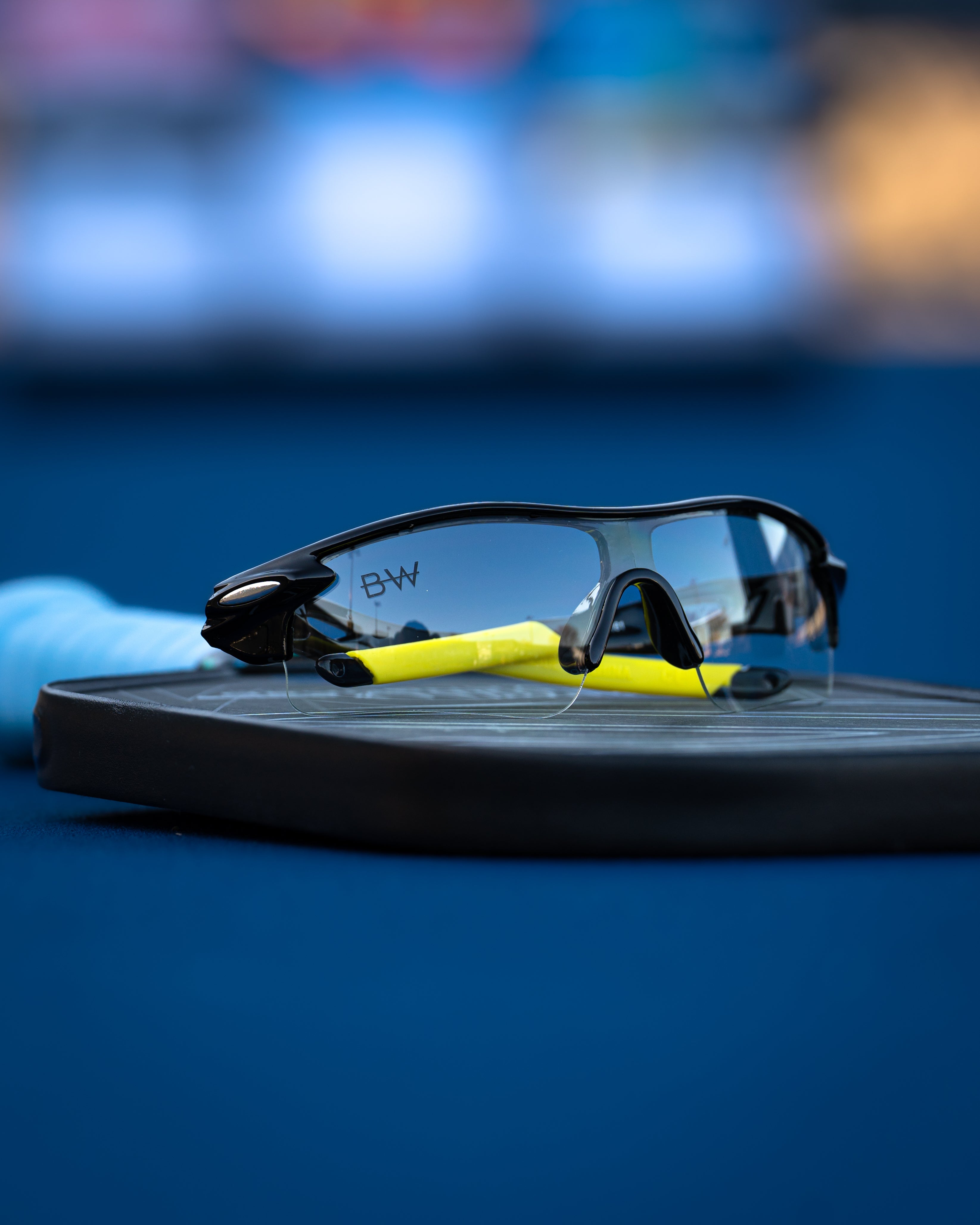
Are Transitional Lenses Worth It for Competitive Athletes?
Share
Find Your Perfect Pickleball Glasses
Whether you need prescription (RX) or non-prescription eyewear, start with Blinded Wear's current collections and 2026 pickleball glasses guide.
Are Transitional Lenses Worth It for Competitive Athletes?
Transitional, or photochromic, prescription lenses can be worth considering for competitive athletes who value the convenience of one pair that can change tint as environmental conditions change. They are not automatically the best choice for every player, every court, or every lighting condition.
The biggest potential advantage is convenience. Instead of choosing between a fixed sunglass tint and a lens without a dark sunglass tint, compatible photochromic lenses are designed to change tint in response to particular activating environmental conditions.
That can be useful for pickleball players whose day includes changing environments. But photochromic technology should not be marketed as a reaction-time enhancer, ball-tracking upgrade, depth-perception tool, or guaranteed solution for every lighting transition.
The right choice depends on where you play, when you play, how frequently the lighting changes, your prescription, the exact lens technology available, and whether you prefer automatic tint changes or direct control over which lens you wear.
What Are Transitional or Photochromic Lenses?
Photochromic lenses are designed to change tint in response to particular activating environmental conditions. Depending on the exact technology and environment, the lenses can become more tinted under some conditions and return toward a lighter state when those activating conditions decrease.
“Transitional” is commonly used conversationally to describe this category, while photochromic is the broader technical term.
The exact behavior is technology-dependent. Do not assume every photochromic lens has the same:
- Darkened state
- Lightened state
- Visible Light Transmission
- Activation speed
- Clearing speed
- Temperature response
- Behavior behind glass
- Response under artificial lighting
- Available tint color
Do Transitional Lenses React Only to UV?
It is too broad to say that every photochromic lens works exclusively from UV exposure.
The activating wavelengths and behavior can differ among photochromic technologies. For that reason, statements such as “they always darken outside because of UV and never darken behind glass” should not be applied universally without specifications for the exact lens technology.
The more accurate description is that photochromic lenses respond to particular activating environmental conditions according to the technology used.
Does the Tint Change Your Prescription?
No. Photochromic behavior and prescription power are separate concepts.
The lens changing tint does not independently change prescribed values such as:
- SPH
- CYL
- AXIS
- ADD
- Prism
The photochromic function concerns tint behavior. The prescription provides the refractive correction prescribed for the wearer.
Why Competitive Athletes Consider Photochromic Lenses
The strongest argument for photochromic sports eyewear is not that it makes an athlete faster. It is that one compatible prescription pair may be convenient across changing environments.
That can matter during tournament days involving:
- Morning and afternoon matches
- Changing cloud cover
- Sun and shade
- Outdoor courts and covered areas
- Time spent on court and between matches
- Travel between different playing environments
Whether that convenience outweighs the limitations depends on the individual athlete.
Benefit 1: One Pair Can Cover More Situations
A fixed tint remains substantially fixed as the environment changes. A photochromic lens is designed to change tint according to its activating conditions.
For an RX wearer, that can reduce the number of situations in which changing between separate prescription eyewear configurations feels necessary.
This does not mean one photochromic pair is automatically optimal for every environment. It means the technology can offer greater convenience across changing conditions.
Benefit 2: Automatic Tint Changes
Some athletes prefer not to manually decide when to switch between clear-looking prescription eyewear and fixed-tint prescription sunglasses.
Photochromic technology automates part of that process by changing tint according to the conditions that activate the specific lens.
This can be attractive during a long day when environmental conditions vary, but “automatic” should not be confused with “instantaneous.”
Benefit 3: Potentially Fewer RX Pairs to Manage
For athletes who travel with prescription eyewear, one photochromic pair may reduce the need to manage separate prescription configurations for some situations.
That can mean:
- Fewer pairs to keep track of
- Fewer eyewear changes during the day
- Less gear devoted to separate fixed-tint and non-dark-tint RX options
However, athletes who depend heavily on prescription correction may still prefer a backup pair for redundancy.
What Transitional Lenses Do Not Automatically Improve
Photochromic technology should not be marketed as directly improving athletic performance.
Do not assume that a changing tint automatically improves:
- Reaction time
- Ball tracking
- Depth perception
- Peripheral vision
- Decision speed
- Anticipation
- Shot accuracy
- Contrast sensitivity
- Competitive results
Prescription correction, lighting, individual vision, experience, attention, anticipation, positioning, and physical execution are distinct factors.
Do Transitional Lenses Improve Reaction Time?
No direct reaction-time improvement should be attributed to photochromic lenses.
Changing the amount of visible light transmitted through a lens is not the same thing as making the nervous system process a pickleball faster.
A player may personally prefer one lens configuration over another in particular lighting, but that subjective preference should not be converted into a universal reaction-time claim.
Do Transitional Lenses Improve Ball Tracking?
Photochromic technology should not be described as a ball-tracking technology.
Tracking a moving ball involves multiple visual and cognitive processes. A changing tint does not independently establish improved tracking performance.
The same caution applies to claims about reading spin, seeing paddle position, recognizing opponents' movement, or anticipating shots faster.
Do Transitional Lenses Improve Depth Perception?
No universal improvement in depth perception should be attributed to photochromic technology.
Tint behavior and depth perception are separate concepts. If an athlete has concerns about depth perception or other aspects of vision, those concerns are better addressed with an eye-care professional.
Do Transitional Lenses Reduce Eye Strain?
Avoid treating photochromic lenses as a universal treatment for eye strain.
Some wearers may prefer a changing tint in bright environments, but discomfort, headache, squinting, or visual fatigue can have multiple causes.
Persistent symptoms should not automatically be attributed to the absence of photochromic lenses or treated simply by changing lens technology.
Do Transitional Lenses Protect Long-Term Eye Health?
Do not infer a specific eye-health benefit merely because a lens is photochromic.
Photochromic behavior, UV characteristics, prescription correction, impact resistance, polarization, and other lens properties should be evaluated separately.
Any specific protection claim should come from verified specifications for the exact lens rather than the fact that its tint changes.
How Fast Do Transitional Lenses Change?
There is no universal activation or clearing time that applies to every photochromic lens.
The response can depend on the exact technology and environmental conditions. Avoid promising:
- Instant darkening
- Instant clearing
- A universal one-minute transition
- A universal two-minute transition
- The same response in every temperature
- The same response in every location
If transition speed is particularly important to you, evaluate the specifications of the exact photochromic option being considered.
Do Transitional Lenses Instantly Adjust During a Rally?
Do not think of photochromic technology as an electronic lens continuously selecting the perfect tint for every moment of a rally.
The lenses respond according to their technology and environmental conditions. They should not be marketed as instantaneously optimizing themselves each time a player moves between a sunny and shaded portion of a court.
Are Transitional Lenses Useful at Dawn?
Dawn by itself does not determine how a photochromic lens will behave.
Actual environmental conditions matter more than the clock. Consider:
- Available daylight
- Cloud cover
- Shade
- Court orientation
- Surrounding structures
- The exact photochromic technology
A photochromic lens should not automatically be described as completely clear or lightly tinted simply because a match starts early in the morning.
Are Transitional Lenses Useful at Dusk?
The same principle applies at dusk. Time of day alone does not predict the exact lens state.
As environmental conditions change, a compatible photochromic lens can change tint according to its technology. The exact degree and speed should not be assumed without specifications for that lens.
What About Bright Midday Matches?
Photochromic lenses may become more tinted under activating outdoor conditions, but do not promise that every technology reaches the same darkness or that it will match a dedicated fixed sunglass tint.
Players who strongly prefer a specific fixed tint in bright conditions may still prefer dedicated prescription sunglasses.
Do Transitional Lenses Work on Cloudy Days?
Cloud cover does not create a universal photochromic response.
Outdoor conditions can still provide activating wavelengths even when the sun is obscured, but the resulting lens state depends on the exact technology and environment.
Do not assume “cloudy” automatically means completely clear or fully tinted.
What Happens in Shade?
Moving into shade changes the environment around the lens, but it does not guarantee an immediate or complete change in tint.
The exact response depends on the technology and surrounding conditions.
This matters for courts where trees, roofs, buildings, or other structures create mixed sun and shade throughout the day.
Are Photochromic Lenses Good for Covered Courts?
Covered courts can create more complicated conditions than simply “indoors” or “outdoors.”
A roof may change exposure to activating wavelengths while open sides can still expose the lenses to outdoor conditions.
Because court structures vary, do not promise a specific tint state for every covered pickleball court.
Do Transitional Lenses Work Indoors?
Do not universally promise that every photochromic lens becomes perfectly clear under every indoor lighting system.
The behavior depends on the exact technology and environment. Artificial lighting should not automatically be treated as equivalent to outdoor daylight.
If most of your competitive play takes place indoors and you do not need automatic tint changes, a lens without a dark sunglass tint may be the simpler option.
What About Indoor Courts With Large Windows?
Large windows can create another mixed environment. Glass can alter which wavelengths reach the lenses, and different photochromic technologies can behave differently under those conditions.
Do not assume a windowed court guarantees either full activation or no activation.
Do Transitional Lenses Darken in a Car?
Avoid the blanket statement that photochromic lenses never darken behind a windshield.
Vehicle glass can alter exposure to wavelengths that activate photochromic technologies, and the behavior of the exact lens can vary.
If driving performance matters to your buying decision, check the specifications for the exact photochromic technology rather than assuming all transitional lenses behave identically in vehicles.
Does Temperature Affect Transitional Lenses?
Temperature can influence some photochromic technologies, but there is no universal formula that applies to every lens.
Avoid blanket promises such as:
- They always become darker in cold weather
- They always remain lighter in hot weather
- Heat makes them unsuitable for tournaments
- Cold makes them too slow for competition
The exact behavior depends on the specific photochromic technology and environmental conditions.
Transitional vs. Fixed-Tint RX Lenses
| Feature | Photochromic RX | Fixed-Tint RX |
|---|---|---|
| Tint behavior | Designed to change according to activating conditions | Substantially fixed |
| Convenience across changing environments | Potentially higher | May require another pair when a different tint is desired |
| Exact tint control | Environment and technology influence the state | More predictable fixed state |
| Instant switching between two lens states | No | Only by physically switching eyewear |
| Automatically improves sports performance | No | No |
| Best for every athlete | No | No |
Transitional vs. Clear-Looking RX Lenses
A lens without a dark sunglass tint can be straightforward for indoor, evening, or other environments where the wearer does not want a dark tint.
A photochromic lens adds automatic tint-changing behavior when its activating conditions are present.
The tradeoff is straightforward: simplicity and a more consistent lens appearance versus automatic adaptation to environmental conditions.
Neither option should be described as universally better for reaction time, tracking, depth perception, or competitive performance.
Photochromic vs. a Two-Pair RX Setup
Some competitive athletes prefer one photochromic prescription pair. Others prefer two dedicated prescription pairs—for example, one configuration for brighter outdoor conditions and another without a dark sunglass tint.
A two-pair strategy offers more direct control over which lens you use. A photochromic strategy can reduce the need to make those changes manually.
The better option depends on your schedule and preferences rather than a universal performance ranking.
When Photochromic RX Lenses May Make Sense
| Your Situation | Photochromic May Be Worth Considering? | Why |
|---|---|---|
| You regularly move between changing outdoor conditions | Yes | Automatic tint changes may be convenient |
| You want to manage fewer RX pairs | Yes | One compatible pair may cover more situations |
| You strongly prefer one exact tint at all times | Maybe not | A fixed tint provides more predictable tint behavior |
| You play almost entirely indoors | Depends | Automatic outdoor tint changes may offer less practical value |
| You need instant manual control over lens state | Maybe not | Photochromic changes are not instantaneous manual switches |
| You play across dawn, daylight, and evening | Potentially | Changing conditions can make a one-pair solution convenient |
| You expect better reaction time from the technology | No | Photochromic tint is not a reaction-time enhancement |
The Most Important Question: Convenience or Control?
For competitive athletes, the choice often comes down to what you value more.
Photochromic lenses emphasize convenience. The lens changes tint according to environmental conditions without requiring you to switch eyewear.
Dedicated fixed lenses emphasize control. You choose the exact pair you want for the conditions and change eyewear when necessary.
Neither approach is inherently more competitive.
Understanding VLT With Transitional Lenses
VLT stands for Visible Light Transmission. It describes the percentage of visible light transmitted through a lens.
Higher VLT means more visible light is transmitted. Lower VLT means less visible light is transmitted.
With photochromic technology, VLT can change as the lens changes tint. However, do not assign generic VLT percentages to Blinded Wear photochromic lenses unless those specifications are verified for the exact configuration.
Do Transitional Lenses Get as Dark as Sunglasses?
There is no universal answer across all photochromic technologies and conditions.
The darkest state depends on the exact technology and environment. Do not assume that every photochromic lens will match a particular fixed sunglass tint.
If a very specific level of visible-light transmission is important to you, a verified fixed-tint option may provide more predictable behavior.
Do Transitional Lenses Become Completely Clear?
Avoid promising that every photochromic lens becomes perfectly clear under every condition.
The lightened state depends on the exact technology and environment. “Clear” in product language should also not automatically be interpreted as 100% VLT.
Are Transitional Lenses Always Gray?
No. Photochromic technology and lens color are related only through the specific product configuration being offered.
Do not assume every photochromic lens is gray, and do not assume every gray lens is photochromic.
Availability of a particular photochromic color should be verified for the exact product before ordering.
Are Transitional Lenses Polarized?
Photochromic and polarized are separate lens technologies.
Photochromic describes changing tint behavior. Polarization is designed to reduce certain reflected light.
A lens should not be described as polarized simply because it is photochromic, and polarization should not be inferred from lens color or darkness.
Photochromic and High-Index Are Separate Features
High-index refers to a prescription lens material category commonly used to help manage lens thickness. Photochromic describes tint-changing technology.
One does not automatically establish the other.
Blinded Wear includes high-index prescription lenses at no additional cost with its RX eyewear. Availability of photochromic technology should still be verified for the exact RX product and configuration rather than assumed across the entire collection.
Does Photochromic Mean Impact Resistant?
No. Tint-changing behavior and impact resistance are separate characteristics.
Blinded Wear offers impact-resistant lens options, but do not use photochromic technology as proof of impact performance.
Likewise, impact resistance should not be interpreted as shatterproof, ballistic, or safety-certified unless the exact applicable claim is documented.
Are Transitional Lenses Scratch Resistant?
Do not infer scratch resistance from photochromic technology.
Scratch behavior depends on the finished lens, applicable surface characteristics, care, storage, and the type of contact the lens experiences.
Regardless of lens technology, avoid grinding dust, sand, or grit across the surface during cleaning.
Are Transitional Lenses Anti-Fog?
Photochromic behavior does not establish anti-fog performance.
Fogging involves condensation and environmental conditions. A lens changing tint does not mean it automatically prevents condensation.
Do not assume anti-fog treatment unless it is verified for the exact lens.
Photochromic Behavior and UV Claims Should Be Kept Separate
Do not infer a specific UV rating solely because a lens changes tint.
UV characteristics should be based on verified specifications for the exact lens. Likewise, darker appearance alone should not be used as proof of greater UV protection.
Photochromic Does Not Mean Safety-Certified
A changing tint does not establish compliance with a protective-eyewear standard.
If a sport or activity requires a specific level of certified eye protection, verify the applicable standard for the exact product rather than relying on photochromic technology, frame shape, or sports-oriented styling.
Frame Fit Still Matters
Photochromic technology does not determine whether a frame fits your face well during sports.
Fit can depend on:
- Frame dimensions
- Bridge interaction
- Temple fit
- Head and face shape
- Movement
- Perspiration
- Individual preference
No lens technology can guarantee zero movement for every athlete.
Photochromic Technology Does Not Make an RX More Accurate
Prescription accuracy and tint-changing technology are separate.
The appropriate prescription remains the foundation of prescription sports eyewear. Photochromic technology should be considered only after the correction and product configuration are appropriate for the wearer.
Use an Eyeglass Prescription, Not a Contact-Lens Prescription
Contact-lens prescriptions and eyeglass prescriptions are not interchangeable.
If you order custom Blinded Wear RX eyewear, use the appropriate eyeglass prescription rather than copying numbers from contact-lens packaging.
Photochromic Lenses Do Not Change Your PD
Pupillary distance relates to positioning prescription lenses appropriately for the wearer. Tint-changing technology does not create a different PD.
Do not alter PD because the glasses will be used outdoors, indoors, for pickleball, or with photochromic technology.
Practice in New Photochromic RX Glasses Before Competition
If you purchase a new prescription configuration, use it during practice before relying on it in an important tournament.
Pay attention to:
- General frame comfort
- Fit during realistic movement
- Your experience in the lighting conditions where you normally play
- How you feel about the changing tint
- Whether you would still prefer a separate fixed-tint or non-dark-tint backup
Do not try to evaluate the lenses with unsafe or exaggerated movement tests.
Think About Your Entire Tournament Schedule
Do not choose a lens solely for the lighting expected during your first match.
A tournament day can include:
- Early warmups
- Morning matches
- Midday outdoor play
- Long breaks
- Covered waiting areas
- Late-afternoon matches
- Evening play
The more varied your environments are, the more relevant the convenience of photochromic technology may become.
The Limitation of a One-Pair Solution
Convenience does not mean perfection.
A single photochromic pair may reduce the need for multiple prescription pairs, but it cannot guarantee your preferred tint at every moment.
An athlete who is highly particular about lens darkness in different environments may prefer separate dedicated pairs instead.
Should You Still Carry a Backup?
If prescription correction is essential to your ability to compete, a backup can still be useful even when your primary pair is photochromic.
The backup protects against problems such as:
- Loss
- Accidental damage
- A significant scratch
- A cracked lens
- Frame damage
- A practical preference for a different lens configuration
A backup is about redundancy, not an expectation that photochromic lenses will fail.
How to Care for Photochromic RX Sports Glasses
Use appropriate lens-care practices for the exact eyewear.
- Inspect visibly dirty lenses before wiping them.
- Avoid aggressively rubbing grit across the surface.
- Keep cleaning material clean.
- Avoid abrasive DIY polishing.
- Protect unworn eyewear from unnecessary compression and hard objects.
- Avoid forcing lenses out of the frame.
- Inspect the eyewear after a significant drop or impact.
Photochromic technology does not make the lens scratchproof, crushproof, or indestructible.
Choosing a Blinded Wear RX Frame
Start with the complete Blinded Wear Prescription Pickleball Glasses Collection and compare frames according to your prescription needs, dimensions, verified lens options, intended environment, and personal fit.
Current RX models to explore include:
- Havana Melt RX
- Blue Shield RX
- Steel Ice RX
- Zebra II RX
- Frost RX
- Gray Wash RX
- Lava Rock RX
- Rippled X RX
- Crystal Wave II RX
Do not assume photochromic technology is available on every RX frame or every configuration simply because a product appears in the RX collection. Verify the current options on the exact product before ordering.
Do Not Infer Photochromic Features From a Frame Name
A frame's name, lens color, photograph, or styling does not establish that it is photochromic.
Likewise, appearance alone cannot establish:
- Activation behavior
- Clearing speed
- VLT range
- Polarization
- UV characteristics
- Impact rating
- Anti-fog treatment
- Scratch resistance
Use the current specifications for the exact lens configuration.
How to Order Blinded Wear RX Glasses
Blinded Wear customers ordering custom prescription eyewear upload a clear image of their eyeglass prescription on the applicable product page before adding the eyewear to the cart.
Review How to Order RX Glasses for the current ordering process.
Do not guess or modify prescription information to accommodate a preferred lens technology.
Custom RX Eyewear Is Final Sale
Customized Blinded Wear RX eyewear is final sale and excluded from the standard 30-day return policy.
Before purchasing, verify your prescription information and the exact lens configuration you want, including photochromic availability when that feature is important to your decision.
Lifetime Replacement Support for Eligible Broken Eyewear
Blinded Wear offers 50% lifetime replacement support if eligible glasses break, subject to current policy terms.
Eligible damaged eyewear must be returned according to the applicable process. Once the claim meets current policy requirements, the customer can receive 50% credit toward a replacement pair.
For damaged RX eyewear, contact blindedwearco@gmail.com before returning the pair.
Review the Blinded Wear Protection Plan, Replacement & Returns information for current eligibility and policy details.
Transitional Lens Myths vs. Reality
| Myth | Reality |
|---|---|
| They change instantly | Response time depends on the exact technology and environment |
| They always become completely clear indoors | The lightened state depends on the lens and conditions |
| They always become very dark outdoors | The darkened state varies by technology and conditions |
| They only respond to UV | Activating wavelengths depend on the exact photochromic technology |
| They never work behind glass | Behavior behind glass depends on the lens technology and environment |
| They improve reaction time | No direct reaction-time improvement should be attributed to photochromic technology |
| They improve ball tracking | Photochromic tint is not a ball-tracking technology |
| They improve depth perception | No universal depth-perception improvement should be claimed |
| They are automatically polarized | Polarization is a separate technology |
| They are automatically impact resistant | Impact resistance must be evaluated separately |
| They are best for every athlete | The value depends on the athlete's environment and preferences |
FAQ: Transitional Lenses for Competitive Athletes
Are transitional and photochromic lenses the same thing?
“Transitional” is commonly used to describe lenses that change tint, while photochromic is the broader technical term for this category of lens technology.
Do photochromic lenses change prescription strength?
No. Tint-changing behavior does not independently alter your prescribed SPH, CYL, AXIS, ADD, or prism.
Are photochromic lenses worth it for pickleball?
They can be worthwhile for players who value one-pair convenience across changing environments. They are not automatically better for every player.
Are they good for tournaments?
They may be convenient for tournament schedules involving changing outdoor conditions, but their usefulness depends on the exact lens technology, environment, and player preference.
Do they change instantly?
No universal instant response should be promised. Activation and clearing behavior vary.
Do they become completely clear indoors?
Do not assume a perfectly clear state under every indoor condition. Exact behavior depends on the technology and environment.
Do they work at dawn?
The exact response depends on environmental conditions rather than clock time alone.
Do they work at dusk?
Again, actual environmental conditions and the exact technology determine the lens response.
Do they work on cloudy days?
They can respond under some cloudy outdoor conditions, but the exact state should not be predicted from the word “cloudy” alone.
Do they work under a covered court?
Potentially, but covered courts create varied exposure conditions. Do not assume a universal response.
Do they work indoors?
Behavior depends on the exact technology and indoor environment. Artificial lighting should not automatically be treated like outdoor daylight.
Do they work behind a windshield?
Behavior behind vehicle glass varies with the exact technology and environmental conditions.
Does heat affect them?
Temperature can affect some photochromic technologies, but the exact behavior is product-dependent.
Are they always gray?
No. Color availability depends on the exact photochromic product.
Are they polarized?
Not automatically. Photochromic behavior and polarization are separate technologies.
Are they anti-fog?
Not automatically. Anti-fog characteristics should be verified separately.
Are they scratchproof?
No. Photochromic technology does not make a prescription lens scratchproof.
Are they safety glasses?
Not simply because they are photochromic. Safety certification must be verified separately for the exact product.
Do they improve reaction time?
No direct reaction-time improvement should be attributed to photochromic technology.
Do they help track the pickleball?
Photochromic lenses should not be marketed as a ball-tracking technology.
Should I still carry a backup RX pair?
If prescription correction is essential to you, a backup can provide useful redundancy during tournaments or travel.
Who Should Consider Transitional RX Lenses?
Photochromic prescription lenses may be particularly appealing if:
- You regularly play across changing outdoor conditions.
- You want to reduce how often you manually switch RX eyewear.
- You prefer the convenience of an automatically changing tint.
- Your tournament days span multiple environments or times of day.
- You understand that the exact tint state depends on the technology and environment.
A dedicated fixed-tint or non-dark-tint configuration may be more appealing if:
- You want direct control over the exact lens you wear.
- You strongly prefer a consistent fixed tint.
- Your playing environment rarely changes.
- You do not want to depend on environmental conditions to determine tint state.
Are Transitional Lenses Worth It? The Practical Answer
For competitive athletes, transitional lenses are best viewed as a convenience technology rather than a performance-enhancement technology.
They can make sense for an RX athlete who moves through changing environments and prefers one prescription pair that can change tint automatically. They may be less compelling for a player who wants a specific fixed tint, plays almost entirely in one lighting environment, or prefers direct control through separate eyewear.
They should not be sold on promises of faster reactions, better ball tracking, improved depth perception, guaranteed eye comfort, or automatic optimization for every court.
Explore the Blinded Wear Prescription Pickleball Glasses Collection and verify the current lens options available for the exact RX frame you are considering.
How Transitional Lenses Fit Different Competitive Scenarios
The value of photochromic prescription lenses becomes easier to judge when you look at your actual playing schedule instead of asking whether transitional lenses are universally “better.”
A player who competes outdoors from early morning through late afternoon has different needs from someone who plays almost exclusively under indoor court lighting. Likewise, an athlete who wants one versatile RX pair may make a different choice from someone comfortable traveling with multiple prescription pairs.
| Competitive Scenario | Potential Photochromic Value | Main Consideration |
|---|---|---|
| Outdoor tournament spanning several hours | Potentially high | Environmental conditions can change throughout the day |
| Morning match followed by afternoon play | Potentially high | One pair may be convenient across changing conditions |
| Mostly indoor competition | Potentially lower | Automatic outdoor tint changes may provide less practical value |
| Indoor and outdoor courts in one event | Potentially high | Photochromic technology may reduce manual eyewear changes |
| Player who wants one exact tint | Potentially lower | A fixed tint gives more direct control |
| Player who dislikes carrying multiple RX pairs | Potentially high | One adaptable pair may simplify the gear bag |
| Night-only competition | Depends | A changing outdoor tint may offer limited practical benefit |
Scenario 1: Early-Morning Tournament
An early start can involve changing daylight as the tournament progresses. The conditions during warmups may be substantially different from those during later matches.
A photochromic RX configuration can be convenient because the athlete does not necessarily need to choose one fixed tint for the entire morning.
However, avoid describing photochromic lenses as automatically “perfect for sunrise.” The exact tint state depends on the lens technology and actual environmental conditions rather than the time shown on a clock.
Scenario 2: All-Day Outdoor Tournament
An all-day event is one of the clearer use cases for considering photochromic prescription eyewear.
A player might encounter:
- Lower-light morning conditions
- Increasing daylight
- Cloud cover
- Direct sun
- Shade between matches
- Covered rest areas
- Late-afternoon conditions
Instead of carrying separate RX eyewear for every change, a compatible photochromic pair may simplify the day.
The tradeoff is that the environment and lens technology determine the tint state. A player who wants complete control over lens darkness may still prefer separate dedicated pairs.
Scenario 3: Indoor and Outdoor Courts at the Same Event
Events that use both indoor and outdoor courts can make eyewear selection more complicated.
A photochromic pair may reduce the number of manual changes required as the athlete moves between environments. However, do not promise an instantaneous transition from a darkened state to a completely clear state.
If the schedule requires very rapid movement between dramatically different environments, athletes who are highly sensitive to lens tint may prefer dedicated eyewear for each setting.
Scenario 4: Covered Outdoor Pickleball
Covered outdoor courts can create mixed activation conditions. A roof changes direct exposure while open sides still allow substantial outdoor light into the playing environment.
This makes exact photochromic behavior difficult to predict without knowing the lens technology, court design, weather, and position of the sun.
If covered courts are where you play most frequently, testing the exact eyewear during practice is more useful than relying on a generic statement about how transitional lenses “should” behave.
Scenario 5: Mostly Indoor Competitive Player
If nearly all of your competition takes place indoors, photochromic technology may offer less practical value than it does for an athlete regularly moving through outdoor conditions.
You may still appreciate photochromic behavior outside the facility or during everyday use, but that is a convenience consideration rather than an on-court performance advantage.
For indoor-focused athletes, prescription compatibility, fit, appropriate lens configuration, and individual visual needs remain more important than adding tint-changing technology simply because it is available.
Scenario 6: Evening and Night Competition
Players who primarily compete after sunset should consider how often they actually need a changing sunglass tint.
Artificial court lighting should not be assumed to activate a photochromic lens in the same way as outdoor daylight. The response depends on the exact technology and environment.
If you predominantly play at night, the convenience advantage may be smaller than it is for a daytime outdoor athlete.
Scenario 7: Traveling Tournament Athlete
Travel adds another reason some RX athletes consider photochromic lenses: reducing the number of prescription pairs they need to manage.
One adaptable pair can potentially cover more situations during:
- Travel days
- Outdoor warmups
- Tournament matches
- Walking between courts
- Time spent indoors between matches
- Post-match activities
That convenience does not eliminate the value of a backup prescription pair when vision correction is essential.
Photochromic Lenses for Multi-Day Tournaments
Multi-day competition can involve substantially different weather and lighting from one day to the next.
For example, day one might be overcast while day two is bright and sunny. A photochromic configuration may reduce the need to predict one fixed tint that will suit the entire event.
But photochromic technology does not guarantee the same subjective experience in every condition. Competitive athletes should still become familiar with their eyewear before traveling.
What Happens When the Weather Changes?
Weather can alter the environmental conditions reaching the lens, but broad weather labels are not enough to predict an exact photochromic state.
Instead of thinking:
- Sunny = fully dark
- Cloudy = clear
- Cold = maximum darkness
- Hot = minimal activation
think of photochromic behavior as a range determined by the interaction between the exact lens technology and its environment.
What If One Side of the Court Is Sunny and the Other Is Shaded?
A court divided between sun and shade is a good example of why photochromic lenses should not be described as instant adaptive electronics.
Moving from one side of a court to another does not mean the lens immediately selects a perfect new tint for that side.
Photochromic lenses respond over time according to their technology and environment. Athletes should not expect a separate instantaneous lens state for every step they take around the court.
Low Sun and Direct Sun Are Not the Same as Lens Technology
A low sun angle can create challenging viewing conditions, but photochromic technology does not physically block the sun from a player's line of sight.
Likewise, a changing tint should not be described as eliminating glare or solving every issue caused by sun position.
Lens tint, polarization, frame coverage, physical shade, and court orientation are different considerations.
Can You Combine Photochromic Glasses With a Hat or Visor?
Yes, an athlete can use physical shade such as a hat or visor with prescription sports eyewear when comfortable and appropriate.
The two serve different functions. A hat or visor physically shades part of the wearer's field from overhead light, while photochromic technology changes lens tint according to its activating conditions.
Neither should be described as eliminating all glare or guaranteeing better athletic performance.
Fixed Gray RX vs. Photochromic RX
Fixed gray and photochromic lenses solve different problems.
A fixed gray tint reduces visible-light transmission according to that specific lens and remains substantially fixed as conditions change.
A photochromic lens changes tint according to its technology and environment.
| Priority | Fixed Gray RX | Photochromic RX |
|---|---|---|
| Consistent tint | Strong fit | Not the primary purpose |
| Changing conditions | Does not automatically change | Designed to change tint |
| Exact predictable lens state | Generally more direct | Environment-dependent |
| One-pair convenience | Depends on environment | Potential advantage |
| Automatic reaction-time improvement | No | No |
| Automatic ball-tracking improvement | No | No |
Photochromic and Non-Polarized Are Not Opposites
Photochromic describes changing tint behavior. Polarization describes a different optical technology designed to reduce certain reflected light.
A lens can therefore involve multiple independent characteristics. Do not use “photochromic,” “non-polarized,” “gray,” “high-index,” or “impact resistant” as interchangeable terms.
Each describes a different aspect of the eyewear.
Does Polarization Determine Whether Photochromic Lenses Are Good for Sports?
No universal sports-performance ranking should be based on polarization alone.
Polarization should not automatically be described as harming depth perception, and non-polarized lenses should not automatically be described as improving reaction time, ball tracking, or depth perception.
Evaluate the exact lens configuration and your individual preferences instead.
Direct RX, RX Clip, and Photochromic Technology
Direct prescription eyewear and prescription clip systems are different configurations.
With a direct RX configuration, prescription correction is incorporated into the primary prescription lenses. In a compatible RX clip system, prescription correction is provided by a separate inner prescription insert.
Do not assume photochromic technology is available in every direct RX or RX clip configuration. Verify the current options for the exact product.
Is Direct RX Better Than an RX Clip for Transitional Lenses?
There is no universal optical-performance winner simply because one configuration is direct RX and another uses a prescription insert.
Consider:
- Prescription compatibility
- Available lens technologies
- Frame dimensions
- Individual fit
- Preferred configuration
- Playing environment
Do not claim that one configuration produces faster reactions, better tracking, or superior depth perception without appropriate evidence.
Photochromic RX Glasses vs. Contacts and Non-RX Eyewear
Some athletes use prescription glasses while others use contact lenses with compatible non-prescription sports eyewear.
These approaches correct vision differently. Contact lenses sit directly on the eye, while prescription glasses position corrective lenses in front of the eyes.
There is no universal rule that photochromic RX glasses are better than contacts for competitive athletes.
Contact-lens wearers should follow the care instructions for their exact lenses and guidance from their eye-care professional.
Is Switching Between Two RX Pairs a Bad Thing?
No. Carrying two dedicated prescription pairs is a legitimate alternative to photochromic technology.
For example, an athlete may prefer one fixed-tint pair for bright outdoor conditions and another prescription pair without a dark sunglass tint for lower-light conditions.
The disadvantage is additional gear and manual switching. The advantage is greater direct control over which lens configuration you are wearing.
Use Tournament Breaks to Evaluate Conditions
If you carry multiple prescription options, between-match breaks provide a practical opportunity to evaluate the next playing environment and choose the pair you prefer.
If you use photochromic eyewear, breaks also give you time to observe how the lens behaves as environmental conditions change.
There is no need to turn every tint change into a mid-rally equipment decision.
Warm Up in the Eyewear You Plan to Use
When possible, use your intended competition eyewear during warmups.
This gives you a chance to evaluate:
- Frame comfort
- Practical fit
- Current lighting
- Your preference for the lens state
- Whether the lenses are clean
- Whether any issue is actually related to tint
Warmup experience is more informative than making assumptions based only on weather forecasts or the time of day.
Transitional RX Troubleshooting During Competition
| What You Notice | Possible Category | What to Check |
|---|---|---|
| Lens seems darker than preferred | Tint/environment | Current conditions and exact photochromic behavior |
| Lens seems lighter than preferred | Tint/environment | Current conditions and whether a fixed tint better suits your preference |
| View looks hazy | Surface condition | Fog, moisture, fingerprints, sunscreen, or dirt |
| Frame keeps moving | Fit | Frame position and individual fit |
| Persistent blur despite clean lenses | Prescription or optical concern | Do not assume photochromic technology is the cause |
| Visible line remains after cleaning | Possible physical damage | Inspect for a scratch or crack |
| New double vision or meaningful visual change | Vision concern | Seek appropriate professional evaluation |
Do Not Confuse Dirty Lenses With Photochromic Problems
A lens can appear hazy or visually distracting because of sweat, sunscreen, fingerprints, dust, water, or condensation.
Those issues are separate from photochromic activation.
Before deciding the tint technology is causing a visual problem, inspect the lens surface and clean it appropriately when needed.
Fogging Is Separate From Tint Change
Fog is condensation on the lens surface. It should not be confused with a lens becoming darker through photochromic behavior.
Photochromic technology does not automatically prevent fogging, and a temporarily fogged lens does not mean its photochromic function is defective.
Sweat Does Not Change Your Prescription
Sweat can affect comfort, frame position, and lens cleanliness, but it does not rewrite your prescription values.
Likewise, photochromic technology should not be described as sweatproof or as preventing frame movement unless those characteristics are separately verified for the exact product.
Sunscreen and Lens Residue
Sunscreen can transfer from the face or hands to eyewear and create visible residue.
If the lens appears smeared, treat that as a cleaning issue rather than assuming the photochromic technology is malfunctioning.
Use appropriate lens-care methods and avoid aggressive rubbing when particles are visible.
Photochromic RX Glasses in Rain
Rain can leave water on the lens surface, but water droplets and photochromic tint are separate issues.
Do not describe photochromic lenses as water-repellent unless a verified treatment supports that claim for the exact lens.
Likewise, rain does not independently change the prescription power of an intact lens.
Photochromic RX Glasses in Dusty Conditions
Photochromic technology does not create a dust barrier.
Ordinary open sports glasses may provide some physical coverage depending on their geometry and fit, but they should not be described as airtight or dustproof.
If grit is visible on the lens, avoid aggressively rubbing it across the surface during cleaning.
Photochromic RX Glasses in Wind
Wind exposure and tint-changing technology are separate considerations.
A frame's shape can affect physical coverage, but photochromic lenses do not make eyewear windproof.
If actual particle protection is required for an activity, appropriately designed and rated protective eyewear should be considered rather than relying on photochromic technology.
Does a Wraparound Frame Make Photochromic Lenses Better?
Frame geometry and photochromic technology should be evaluated separately.
A more wrapped frame does not automatically:
- Make the lens change tint faster
- Improve reaction time
- Improve depth perception
- Improve ball tracking
- Prevent fogging
- Create a dustproof seal
- Guarantee better optical performance
Prescription compatibility and individual fit remain important when evaluating any sports-oriented frame shape.
Do Stronger Prescriptions Change Photochromic Performance?
Prescription strength and photochromic tint behavior are separate characteristics.
A stronger prescription may affect considerations such as finished lens thickness and frame compatibility, but it should not be used to predict photochromic activation speed or tint darkness.
High-Index RX and Lens Thickness
Blinded Wear includes high-index prescription lenses at no additional cost with RX eyewear.
High-index is commonly used to help manage finished lens thickness, particularly as prescription strength increases. However, final thickness depends on factors including:
- Individual prescription
- Frame dimensions
- Lens shape
- Required optical positioning
- Lens design
High-index should not be described as making photochromic lenses more durable, faster to activate, darker, or better for athletic performance.
Frame Position and Tint Are Different Issues
If your frame moves during play, do not assume the photochromic lens is causing the problem.
Frame movement is primarily a fit issue. Tint behavior concerns the lens technology.
Separating these issues makes troubleshooting easier and helps prevent unnecessary changes to a lens configuration when the actual concern is frame fit.
Photochromic Technology Does Not Determine Optical Centering
Prescription lens positioning and photochromic tint behavior are separate.
Photochromic technology does not:
- Change your PD
- Create a new optical center
- Correct inaccurate positioning
- Guarantee perfect alignment
- Make a frame immune to movement
If you have a persistent optical concern, appropriate professional evaluation is more useful than assuming the tint-changing technology is responsible.
A New RX Can Feel Different Even Without Photochromic Technology
A new pair of prescription glasses can differ from an older pair in frame dimensions, wearing position, lens design, prescription, and other characteristics.
If new photochromic RX eyewear feels different, do not automatically attribute every difference to the changing tint.
There is also no universal adaptation period that applies to every prescription wearer.
Do Not Use Photochromic Technology to Compensate for an Old Prescription
Changing lens tint does not update refractive correction.
If your prescription is outdated or your vision has meaningfully changed, adding photochromic technology does not solve that underlying issue.
If you are unsure whether your eyeglass prescription remains appropriate, consult your eye-care professional before ordering custom RX eyewear.
Ordering Photochromic RX Eyewear Starts With the Correct Prescription
When ordering Blinded Wear custom RX eyewear, upload a clear image of the appropriate eyeglass prescription on the applicable product page before adding the eyewear to your cart.
Do not:
- Guess missing prescription values
- Change plus or minus signs
- Round prescription values
- Convert a contact-lens prescription yourself
- Alter the prescription because the eyewear will be used for sports
- Alter the prescription because you want photochromic lenses
See How to Order RX Glasses for the current Blinded Wear ordering process.
How to Choose an RX Frame if You Want Photochromic Lenses
Start with the frame and prescription requirements before assuming a particular lens technology is available.
- Use an appropriate current eyeglass prescription.
- Choose an RX product compatible with your prescription needs.
- Review frame dimensions and fit considerations.
- Check the current lens options for that exact product.
- Verify photochromic availability rather than assuming it.
- Review custom RX policies before ordering.
- Practice in the finished eyewear before important competition.
Current Blinded Wear RX Frames to Explore
Players interested in prescription pickleball eyewear can browse the full Blinded Wear RX Collection.
Current RX options include:
- Blue Shield RX
- Steel Ice RX
- Havana Melt RX
- Zebra II RX
- Frost RX
- Gray Wash RX
- Lava Rock RX
- Rippled X RX
- Crystal Wave II RX
Photochromic availability should be verified for the exact product and configuration before purchasing. A frame appearing in the RX collection does not by itself prove that every lens technology is available for that frame.
Is There a “Best” Blinded Wear Frame for Transitional Lenses?
Do not rank one frame as the best photochromic option without verified comparative testing and exact lens availability.
Instead, compare frames using factors that can actually help you make a buying decision:
- Prescription compatibility
- Frame dimensions
- Individual fit
- Verified lens options
- Playing environment
- Style preference
A product name or frame appearance does not establish superior photochromic performance.
Are Transitional Lenses Worth the Cost?
The answer depends on the current price of the exact configuration and how much value you place on the convenience.
A useful way to think about value is to ask:
- Would I otherwise buy two separate RX pairs?
- How often do my playing conditions change?
- Do I dislike switching glasses?
- Do I prefer one adaptable pair or dedicated lens configurations?
- Will I actually use the photochromic function regularly?
Do not assume photochromic technology is automatically included or automatically costs extra. Check the current configuration before ordering.
Does “Competitive” Automatically Mean You Need Photochromic Lenses?
No. Competitive level does not determine the correct lens technology.
A recreational player with constantly changing outdoor conditions may value photochromic lenses more than a high-level competitor who always plays under the same indoor lighting.
Choose eyewear around your prescription, environment, fit, and preferences rather than assuming that more competitive play requires more lens technology.
Why Performance Claims Need to Stay Separate From Convenience
Photochromic lenses can have practical value without making exaggerated athletic claims.
The strongest evidence-based positioning is straightforward:
Photochromic RX lenses can give prescription athletes the convenience of a tint that changes with environmental conditions, potentially reducing the need to switch between separate prescription eyewear configurations.
That value does not require claims about faster reactions, better tracking, improved depth perception, tournament-winning advantages, or enhanced brain processing.
Common Mistakes When Buying Transitional Sports Glasses
- Assuming every RX frame supports photochromic lenses
- Assuming every photochromic lens behaves identically
- Expecting instant transitions
- Expecting one perfect tint for every environment
- Confusing photochromic with polarization
- Confusing photochromic with UV specifications
- Confusing photochromic with impact resistance
- Assuming a dark lens automatically provides more UV protection
- Expecting photochromic lenses to improve reaction time
- Expecting them to improve depth perception
- Expecting them to improve ball tracking
- Ignoring prescription accuracy and frame fit
- Trying a new RX configuration for the first time at a tournament
Pre-Tournament Photochromic RX Checklist
Before leaving for competition, check:
- My prescription eyewear is physically intact.
- The lenses are clean.
- The frame feels comfortable during normal athletic movement.
- I have already practiced in this RX pair.
- I understand how I personally feel about its tint behavior.
- I have not confused fog, dirt, or scratches with tint changes.
- I have appropriate lens-cleaning supplies available.
- I have protected storage for unworn eyewear.
- I have a backup correction option if I depend on RX eyewear.
- I know which pair I plan to use if conditions change substantially.
Travel Checklist for Transitional RX Glasses
For tournaments away from home, consider packing:
- Your primary RX eyewear
- An appropriate backup RX pair if needed
- Protected eyewear storage
- Clean lens-care material
- Any other eyewear configuration you specifically prefer for certain conditions
- Your prescription information or access to it when practical
Do not assume a case, cloth, spray, or other accessory is included with every eyewear purchase unless the exact product listing confirms it.
Store Photochromic RX Glasses Like Prescription Eyewear
Photochromic lenses still require sensible storage.
Avoid leaving unworn glasses:
- Lens-down on abrasive surfaces
- Loose with keys or hard objects
- Under heavy tournament equipment
- Where someone may sit or step on them
- Exposed unnecessarily to prolonged extreme conditions
Photochromic technology does not make the complete eyewear system indestructible.
Cleaning Transitional RX Lenses
Cleaning should remove contamination without intentionally altering the lens surface.
Avoid abrasive home remedies such as:
- Toothpaste
- Baking soda polishing
- Car wax
- Abrasive compounds
- Scraping
- Unknown household cleaners
Follow appropriate care for the exact lens and keep cleaning material free from obvious grit.
What If a Transitional Lens Gets Scratched?
A scratch is physical surface damage. It should not be confused with the lens changing tint.
A scratch also does not rewrite your prescription values.
Do not attempt to polish away a prescription-lens scratch using abrasive DIY methods. If the damage materially interferes with use, evaluate appropriate replacement options.
What If the Lens Cracks?
A crack is structural damage rather than a tint problem.
A cracked prescription lens should not be treated as normal intact eyewear simply because the photochromic function still appears to work.
For damaged Blinded Wear RX eyewear, review the current replacement policy and contact Blinded Wear before returning the pair.
How Blinded Wear Replacement Support Works
Blinded Wear offers 50% lifetime replacement support for eligible broken eyewear, subject to current policy terms.
The program should not be described as:
- A free lifetime warranty
- An automatic full replacement
- A no-questions-asked replacement
- Automatic coverage for lost eyewear
- Automatic coverage for every scratch
- Automatic replacement when your prescription changes
Eligible damaged eyewear must be returned according to the applicable process. Once the claim meets current policy requirements, the customer can receive 50% credit toward a replacement pair.
For damaged RX eyewear, contact blindedwearco@gmail.com before returning it.
Review the Blinded Wear Protection Plan, Replacement & Returns information for current details.
Why Lens Selection Matters Before You Order
Customized Blinded Wear RX eyewear is final sale and excluded from the standard 30-day return policy.
Before ordering, confirm:
- Your appropriate eyeglass prescription
- The exact RX product
- Frame dimensions
- Required prescription information
- The lens configuration you want
- Whether photochromic technology is currently available for that configuration
Final-sale status does not eliminate applicable 50% lifetime replacement support for eligible broken eyewear.
More Questions About Transitional Lenses for Athletes
Are transitional lenses better than sunglasses for pickleball?
Not universally. Photochromic lenses emphasize changing tint and convenience, while fixed prescription sunglasses provide a more consistent tint. The better option depends on your environment and preferences.
Are transitional lenses better for outdoor tournaments?
They can be convenient when outdoor conditions change, but they are not automatically the best choice for every outdoor player.
Are transitional lenses worth it if I only play indoors?
The on-court value may be smaller if your environment rarely creates a need for changing tint.
Are transitional lenses good for all-day pickleball?
They can be useful for athletes who value one-pair convenience across changing conditions, but exact behavior depends on the lens technology and environment.
Can I use transitional lenses from morning through evening?
Potentially, depending on the exact product and your preferences. Do not assume one photochromic configuration will be optimal in every condition.
Will they instantly clear when the sun goes behind a cloud?
No universal instant clearing should be expected.
Will they instantly darken when the sun comes out?
No. Photochromic response is not an instantaneous electronic switch.
Can one side of the lens become different from the other?
Do not use unusual tint appearance to self-diagnose a defect. If the finished eyewear appears to behave unexpectedly, evaluate the exact conditions and contact the eyewear provider when appropriate.
Does photochromic technology make high-index lenses stronger?
No. Photochromic behavior, refractive index, and mechanical durability are separate characteristics.
Are photochromic lenses shatterproof?
No shatterproof claim should be inferred from photochromic technology.
Can photochromic lenses scratch?
Yes, prescription lenses can potentially sustain surface damage. Photochromic technology does not mean scratchproof.
Can photochromic lenses fog?
Photochromic technology does not inherently prevent condensation.
Does a darker photochromic state mean more impact protection?
No. Tint darkness and impact resistance are separate.
Does a darker photochromic state mean a stronger prescription?
No. Prescription power does not increase when the lens darkens.
Does the tint change my PD?
No. PD and tint-changing behavior are separate.
Do I need a special sports prescription for photochromic lenses?
Do not alter an eyeglass prescription simply because the lenses will be photochromic or used for pickleball.
Can I order using my contact-lens prescription?
Contact-lens and eyeglass prescriptions are not interchangeable. Use the appropriate eyeglass prescription for custom prescription eyewear.
Should I test new transitional glasses before a tournament?
Yes. Practice use can help you evaluate fit, comfort, and your preference for the lens behavior before an important competition.
Should I bring another pair anyway?
If you depend on prescription correction, a backup can be useful protection against loss, damage, or a preference for a different configuration.
The Competitive Athlete's Photochromic Decision
Transitional prescription lenses make the most sense when their convenience matches the athlete's real playing environment.
If your competitive schedule regularly moves through changing outdoor conditions, covered areas, different times of day, or indoor and outdoor environments, one photochromic RX pair may simplify your eyewear setup.
If you play in one predictable environment or want precise control over your lens tint, dedicated fixed configurations may be a better fit for your preferences.
Neither approach should be sold as a shortcut to faster reactions, better ball tracking, improved depth perception, or more wins. The value of photochromic technology is its ability to change tint according to environmental conditions—not to change the athlete.
Use the Blinded Wear Pickleball Performance Lens Guide to learn more about lens considerations, or browse the Prescription Pickleball Glasses Collection to compare current RX eyewear.
Final Selection Framework: Should a Competitive Athlete Choose Photochromic RX?
By this point, the decision should be less about whether transitional lenses are universally “worth it” and more about whether their specific advantage matches your needs.
Use three questions:
- How often does my playing environment change?
- How important is one-pair convenience to me?
- Would I rather let the lens respond to environmental conditions or manually choose a dedicated lens configuration?
If changing environments and one-pair convenience are major priorities, photochromic RX may deserve serious consideration. If predictable tint and direct control matter more, dedicated prescription eyewear may make more sense.
Quick Decision Tree for Transitional Sports Glasses
Do you regularly compete outdoors?
If no, consider whether photochromic behavior would provide enough practical value outside competition to justify choosing it.
If yes, continue to the next question.
Do your lighting conditions regularly change during the same playing day?
If yes, the convenience of photochromic technology becomes more relevant.
If no, a fixed lens configuration may provide all the consistency you want.
Do you want to minimize how many prescription pairs you carry?
If yes, photochromic RX can be attractive because one pair may cover more environmental situations.
If no, carrying separate dedicated prescription configurations gives you more direct control.
Do you expect the lens to change instantly?
If yes, adjust that expectation before purchasing. Photochromic lenses respond according to their technology and environmental conditions rather than switching instantaneously between two preset states.
Are you buying them specifically to improve reaction time or ball tracking?
If yes, photochromic technology is not the appropriate basis for that expectation. Its primary value here is tint-changing convenience.
Three Types of Athletes and the Lens Setup That May Fit Them
| Athlete | Potential Approach | Why |
|---|---|---|
| All-day outdoor competitor | Consider photochromic RX | Conditions may change substantially throughout the event |
| Indoor specialist | Consider a non-dark-tint RX configuration | Automatic outdoor tint changes may provide less on-court value |
| Player who wants maximum tint control | Consider multiple dedicated RX configurations | Manual switching gives direct control over which lens is worn |
These are starting points rather than universal prescriptions. Individual vision, prescription requirements, available product configurations, fit, and personal preference still matter.
How to Plan an All-Day Tournament With Photochromic RX
A good tournament eyewear plan begins before the first match.
Before Leaving
- Inspect the frame and lenses for visible damage.
- Clean the lenses appropriately.
- Pack protected storage.
- Bring a backup correction option if prescription eyewear is essential to you.
- Check the expected playing environments rather than relying only on the weather description.
During Warmups
- Use the eyewear you expect to compete in.
- Check frame comfort during realistic movement.
- Notice whether the current tint state suits your preference.
- Check for fog, fingerprints, sunscreen, water, or other contamination.
Between Matches
- Store eyewear safely when it is not being worn.
- Inspect dirty lenses before wiping them.
- Reassess conditions if the next match is in a different environment.
- Use a different RX configuration if you carry one and strongly prefer it for the next conditions.
After Competition
- Inspect the eyewear for damage.
- Remove contamination using appropriate lens-care methods.
- Store the glasses where they will not be compressed by other gear.
Build a Backup Strategy Around Vision Correction, Not Tint Alone
If you cannot comfortably compete without prescription correction, your backup strategy should preserve access to appropriate correction rather than merely duplicate a tint.
A backup might be another appropriate prescription pair or another correction method that you already use appropriately.
The purpose is straightforward: if the primary pair is lost or materially damaged, you still have a usable correction option.
A backup prescription should also be appropriate for you. An old pair is not automatically a good backup simply because it is still physically intact.
Can You Use an Older RX Pair as a Tournament Backup?
Possibly, but age alone does not tell you whether an older prescription remains appropriate.
A physically intact older pair may contain a prescription that no longer matches your current visual needs. Conversely, a familiar older pair is not automatically inaccurate simply because it is older.
If you are uncertain whether an older prescription remains suitable, ask your eye-care professional rather than guessing based on how long you have owned the glasses.
Verify Your Prescription Before Ordering Custom RX Eyewear
Photochromic technology cannot compensate for incorrect prescription information.
Before ordering, review the prescription image you intend to submit and make sure it is clear and complete enough to use appropriately.
Common prescription terminology can include:
- OD: right eye
- OS: left eye
- SPH: spherical lens power
- CYL: cylinder power when prescribed
- AXIS: orientation associated with prescribed cylinder correction
- ADD: additional power when prescribed
- Prism: prism correction when prescribed
Do not add missing values, remove values, round numbers, change signs, or attempt to convert a contact-lens prescription into an eyeglass prescription yourself.
PD and Photochromic Technology: What to Know
Pupillary distance is associated with positioning prescription lenses for the wearer. It is not a photochromic setting.
Changing from a fixed tint to a photochromic lens does not create a new PD.
Also remember that a binocular PD should not automatically be divided equally and treated as two monocular PD values. If required information is unclear or missing, obtain appropriate guidance rather than inventing measurements.
Prescription Positioning Still Matters
Photochromic behavior should not distract from the fundamental optical requirements of prescription eyewear.
Depending on the prescription and lens design, relevant factors can include horizontal positioning, vertical positioning, frame geometry, and the way the finished eyewear sits on the wearer.
Photochromic technology does not correct an optical-positioning problem, and a darker or lighter lens state does not indicate whether a prescription has been positioned correctly.
What About Stronger Prescriptions?
Players with stronger or more complex prescriptions should focus first on whether the chosen frame and lens configuration are appropriate for their prescription.
Blinded Wear includes high-index prescription lenses at no additional cost with RX eyewear. High-index material is commonly used to help manage lens thickness, particularly as prescription strength increases.
Finished lens thickness can still vary based on:
- Prescription strength
- Frame dimensions
- Lens shape
- Lens design
- Required optical positioning
High-index does not mean photochromic, and photochromic does not mean high-index. Treat them as separate lens characteristics.
Can Athletes With Astigmatism Consider Photochromic RX?
Astigmatism correction and photochromic technology address different characteristics of the lens.
If cylinder and axis values are prescribed, those values relate to prescription correction. Photochromic technology concerns changing tint.
Actual compatibility depends on the prescription and exact product configuration rather than the fact that the wearer has astigmatism alone.
What If Your Prescription Includes Prism?
Prism is intentional when prescribed and should not be changed or removed simply because you are ordering sports eyewear or want photochromic technology.
More complex prescriptions can require additional compatibility considerations. Verify that the exact RX configuration can appropriately accommodate your prescription before purchasing.
Secure Fit Does Not Mean the Tightest Possible Frame
A sports frame should not automatically be considered better because it feels extremely tight.
A useful fit should balance stability and comfort for the individual wearer. Excessive pressure is not proof of better sports performance.
Likewise, photochromic technology has no role in determining how tightly a frame should fit.
What If Your RX Glasses Move During Play?
Some movement does not automatically mean the prescription is wrong or that the photochromic technology is failing.
Evaluate the issue as a fit question first. Consider whether the frame consistently returns to a comfortable wearing position and whether movement materially interferes with use.
Do not attempt aggressive DIY frame bending if you are unsure how the frame should be adjusted.
Separate Lens State From Actual Vision Problems
If something looks wrong during play, identify the category before blaming the tint.
| Observation | First Thing to Consider |
|---|---|
| Lens looks darker | Photochromic state and environmental conditions |
| Lens looks cloudy | Fog, residue, moisture, or contamination |
| Visible permanent line | Possible scratch or physical damage |
| Frame sits differently | Fit or physical frame condition |
| Persistent blur through clean intact lenses | Prescription or optical evaluation may be appropriate |
| New double vision | Professional evaluation rather than tint troubleshooting |
When an Eye or Vision Problem Is More Than an Eyewear Question
Not every visual problem during a tournament should be solved by cleaning the glasses or changing lens tint.
Significant or persistent eye pain, marked redness, light sensitivity, discharge, a persistent foreign-body sensation, new double vision, or a meaningful unexplained change in vision deserves appropriate professional attention.
Photochromic lenses are eyewear technology, not a treatment for eye-health problems.
Inspect RX Eyewear After a Significant Impact
If your glasses are dropped, stepped on, compressed in a bag, or struck significantly, inspect them before continuing to rely on them.
Look for:
- Visible cracks
- Chipped lens edges
- A displaced lens
- Frame deformation
- Damaged hinges or temples
- New scratches in the viewing area
- Any obvious change in how the eyewear sits
Impact resistance does not mean indestructible, and photochromic technology does not increase the eyewear's resistance to every type of physical stress.
Scratch, Crack, or Residue? Know the Difference
Residue
Residue sits on the surface and may come from sweat, sunscreen, fingerprints, dust, or water. Appropriate cleaning may remove it.
Scratch
A scratch is physical surface damage. Cleaning does not remove the damaged material.
Crack
A crack is structural damage and should be treated differently from ordinary surface contamination.
None of these conditions should be diagnosed solely by whether a photochromic lens appears darker or lighter.
Be Careful With Dust, Sand, and Grit
If visible particles are sitting on the lens, aggressively rubbing them across the surface can create unnecessary abrasion risk.
Use appropriate lens-care methods that remove loose contamination without intentionally grinding it into the lens.
Keep reusable cleaning material clean as well. A cloth carrying trapped grit can defeat the purpose of careful cleaning.
Heat and Photochromic RX Eyewear
Do not assume that a sports-oriented prescription lens is immune to every temperature-related condition.
Avoid unnecessary prolonged exposure to extreme environments, such as leaving eyewear in particularly harsh conditions when safer storage is available.
There is no universal temperature threshold that should be applied to every Blinded Wear RX configuration without exact product specifications.
Temperature Changes Can Also Create Condensation
Moving between environments can sometimes create condensation on a lens surface. That temporary fog should not be confused with a photochromic tint change or permanent lens damage.
If visibility is affected, allow the lens to clear and clean it appropriately when necessary before deciding there is an optical problem.
Think Separately About Tournament Play and Driving
The eyewear you prefer on the court does not automatically have to be your preferred driving eyewear.
Because photochromic behavior behind vehicle glass depends on the exact technology and environment, athletes who care strongly about driving tint should evaluate that requirement separately.
Do not assume one photochromic pair will behave exactly the way you want in every court, car, building, and outdoor environment.
Protect Your RX Glasses During Tournament Travel
Whether your prescription lenses are photochromic or fixed, travel can expose eyewear to different stresses:
- Compression
- Drops
- Abrasion
- Repeated handling
- Heat
- Moisture
- Dust and residue
These are separate types of stress. A lens that performs well against one does not automatically resist all the others.
Protected storage is especially useful when the glasses are not being worn.
Keep Essential Prescription Eyewear Accessible When Traveling
If you rely on RX eyewear, keeping your primary correction accessible during travel can be practical.
Checked baggage can be delayed, lost, or subjected to handling outside your control. No sports frame should be marketed as guaranteed to survive checked luggage or heavy compression.
If possible, separate your primary and backup prescription options so a single lost bag does not eliminate both.
Transitional Sports Glasses Are Not Indestructible
Terms such as “sports,” “high-index,” “impact resistant,” and “photochromic” do not mean:
- Crushproof
- Scratchproof
- Shatterproof
- Heatproof
- Fogproof
- Dustproof
- Airline-proof
- Guaranteed for a particular lifespan
Accurate product expectations are more useful than treating one lens technology as protection against every type of damage.
Sports Eyewear and Certified Protective Eyewear Are Not Automatically the Same
Sports-oriented styling, impact-resistant lens options, or photochromic technology should not automatically be interpreted as certification to a particular protective-eyewear standard.
If your activity requires a specific safety rating, verify that rating for the exact product.
Photochromic tint behavior does not establish impact certification.
How to Compare Blinded Wear RX Frames Without Inventing Performance Claims
When comparing prescription frames, focus on characteristics you can actually verify rather than assigning untested athletic advantages.
| Compare | Why It Matters |
|---|---|
| Prescription compatibility | The frame and lens configuration must work with your RX requirements |
| Frame dimensions | Useful when comparing potential physical fit |
| Direct RX or compatible RX clip configuration | Determines how prescription correction is incorporated |
| Verified lens options | Confirms whether the technology you want is actually available |
| High-index availability | Relevant to prescription lens thickness management |
| Individual fit | Important for comfort during active use |
| Style | Personal preference still matters |
Explore Current Blinded Wear Prescription Pickleball Glasses
Browse the complete Prescription Pickleball Glasses Collection to compare current RX products.
Current options to explore include:
- Blue Shield RX
- Steel Ice RX
- Havana Melt RX
- Zebra II RX
- Frost RX
- Gray Wash RX
- Lava Rock RX
- Rippled X RX
- Crystal Wave II RX
Check the current product configuration before assuming photochromic availability, tint color, polarization, VLT, coatings, or other lens specifications.
Compare Lens Options Before Choosing
The Pickleball Performance Lens Guide provides another starting point for understanding lens choices.
When comparing options, keep these characteristics separate:
- Prescription correction
- Photochromic behavior
- Fixed tint
- Visible Light Transmission
- Polarization
- High-index material
- Impact resistance
- UV specifications
- Surface treatments
One characteristic should not be used as proof of another.
Need Help Narrowing Down Your Pickleball Eyewear?
You can also use the Blinded Wear Pickleball Sunglasses Quiz as another way to explore eyewear choices.
A quiz can help narrow product preferences, but it does not replace an eye-care professional's role in determining an appropriate prescription or evaluating eye-health concerns.
How to Order Blinded Wear Prescription Eyewear
For custom Blinded Wear RX eyewear, upload a clear image of your appropriate eyeglass prescription on the applicable product page before adding the eyewear to your cart.
For additional ordering information, review How to Order RX Glasses.
Because custom RX eyewear is made using submitted prescription information, carefully review your order before purchasing.
Remember the Custom RX Return Policy
Customized Blinded Wear prescription eyewear is final sale and excluded from the standard 30-day return policy.
That makes it especially important to verify the prescription, product, and desired lens configuration before ordering.
Custom RX final-sale status does not eliminate applicable 50% lifetime replacement support for eligible broken eyewear under the current replacement policy.
50% Lifetime Replacement Support
Blinded Wear offers 50% lifetime replacement support if eligible glasses break, subject to current policy terms.
This means eligible damaged eyewear can qualify for 50% credit toward a replacement pair after the applicable policy process is completed. It is not a promise of a free replacement for every circumstance.
For damaged RX eyewear, contact blindedwearco@gmail.com before returning the pair.
Review the Blinded Wear Protection Plan, Replacement & Returns information for current eligibility and policy details.
Before You Buy: 15 Transitional Lens Claims to Understand Correctly
- Photochromic does not mean instant. Response behavior depends on the exact technology and conditions.
- Photochromic does not mean polarized. They are separate technologies.
- Photochromic does not establish a UV rating. Verify UV specifications separately.
- Photochromic does not mean impact certified. Safety ratings are separate.
- Photochromic does not mean scratchproof. Physical surface damage remains possible.
- Photochromic does not mean anti-fog. Condensation is a separate issue.
- Photochromic does not improve prescription strength. Tint and refractive correction are separate.
- Photochromic does not change PD. Tint behavior does not alter pupillary distance.
- Photochromic does not guarantee better ball tracking. It is not a tracking technology.
- Photochromic does not guarantee faster reaction time. Tint-changing behavior is not a neurological performance enhancement.
- Photochromic does not guarantee improved depth perception. Tint and depth perception should not be equated.
- Photochromic does not guarantee zero eye strain. Visual discomfort can have multiple causes.
- Photochromic does not guarantee one ideal tint for every court. Lens state depends on the technology and environment.
- Photochromic does not eliminate the value of a backup. RX-dependent athletes may still benefit from redundancy.
- Photochromic does not make one athlete more competitive than another. Its primary value is practical tint-changing convenience.
Final FAQ: Are Transitional Lenses Worth It for Competitive Athletes?
What is the biggest advantage of transitional RX sports glasses?
For many athletes, the biggest potential advantage is convenience across changing environmental conditions without manually switching between separate prescription eyewear configurations as often.
What is the biggest limitation?
The wearer does not directly choose an exact tint state at every moment. The lens responds according to its technology and environment.
Are they better than fixed sunglasses?
Not universally. Photochromic lenses emphasize adaptability and convenience, while fixed-tint prescription sunglasses provide a more consistent tint.
Are they better than clear-looking RX glasses?
That depends on your environment. If you rarely need a sunglass tint, automatic tint-changing behavior may provide less value.
Are they worth it for all-day tournaments?
They can be particularly convenient when an event spans changing outdoor conditions, but they are not automatically optimal for every athlete.
Are they worth it for indoor players?
Potentially, but the on-court benefit may be limited if your competition environment rarely creates a need for changing tint.
Should I choose them because I am a serious competitor?
No. Competitive level alone does not determine the appropriate lens technology.
Will they make me react faster?
No direct reaction-time improvement should be attributed to photochromic lenses.
Will they make the pickleball easier to track?
Photochromic technology should not be marketed as a ball-tracking enhancement.
Will they improve depth perception?
No universal depth-perception improvement should be attributed to photochromic technology.
Can they replace multiple RX pairs?
They may reduce the need to switch between multiple configurations for some athletes, but some players will still prefer dedicated pairs or a backup.
Can I use them indoors and outdoors?
That is one potential reason athletes consider photochromic technology, but exact behavior in each environment depends on the specific lens technology and conditions.
Will they be perfectly clear indoors?
Do not assume a universal perfectly clear state. Exact lightened-state behavior depends on the lens and environment.
Will they get extremely dark in direct sunlight?
The darkened state varies by technology and conditions. Verify exact specifications when a particular level of darkness is important.
Can temperature affect them?
Temperature can influence some photochromic technologies, but there is no universal response that applies to every lens.
Are all Blinded Wear RX frames available with transitional lenses?
Do not assume universal availability. Check the current options for the exact product and prescription configuration you are considering.
Does Blinded Wear include high-index RX lenses?
Yes. Blinded Wear includes high-index prescription lenses at no additional cost with its RX eyewear.
Does high-index mean the lens is photochromic?
No. High-index describes a prescription lens material category, while photochromic describes tint-changing technology.
Should I practice in new photochromic RX glasses before competing?
Yes. Practice gives you an opportunity to evaluate fit, comfort, your prescription experience, and your preference for the lens behavior before an important event.
What if something looks wrong through my new glasses?
First distinguish between contamination, fog, physical damage, frame fit, tint behavior, and a potential prescription or optical concern. Persistent meaningful visual problems deserve appropriate professional evaluation.
10 Rules for Choosing Transitional RX Sports Glasses
- Start with the appropriate eyeglass prescription.
- Choose a frame compatible with your prescription requirements.
- Verify photochromic availability for the exact configuration.
- Do not assume every photochromic technology behaves the same.
- Do not expect instantaneous tint changes.
- Keep photochromic, polarization, UV, impact resistance, high-index, and coatings separate.
- Choose based on your actual playing environments rather than marketing claims.
- Practice in new RX eyewear before important competition.
- Carry backup correction when losing your primary RX would prevent you from competing comfortably.
- Treat photochromic technology as a convenience feature, not a shortcut to better athletic performance.
Continue Exploring Pickleball Eyewear
Final Verdict: Are Transitional Lenses Worth It for Competitive Athletes?
Yes, transitional prescription lenses can be worth considering for competitive athletes whose playing environments change and who value the convenience of managing fewer RX eyewear configurations. But they are not automatically the best choice for every competitor.
The strongest reason to choose photochromic RX is simple: convenience across changing environmental conditions. Instead of selecting one fixed tint for an entire day or manually switching prescription pairs whenever conditions change, a compatible photochromic lens is designed to change tint according to its technology and environment.
The tradeoff is control. A fixed-tint lens provides a more predictable tint state, while photochromic behavior depends on environmental conditions. Athletes who strongly prefer a specific lens tint for specific courts may therefore prefer dedicated prescription configurations.
Most importantly, transitional lenses should not be sold as a performance shortcut. They do not automatically improve reaction time, ball tracking, depth perception, anticipation, decision speed, or competitive results.
Choose them when their practical advantage matches the way you actually play.
Explore the Blinded Wear Prescription Pickleball Glasses Collection, compare current lens options, and verify photochromic availability for the exact RX configuration you are considering before ordering.