
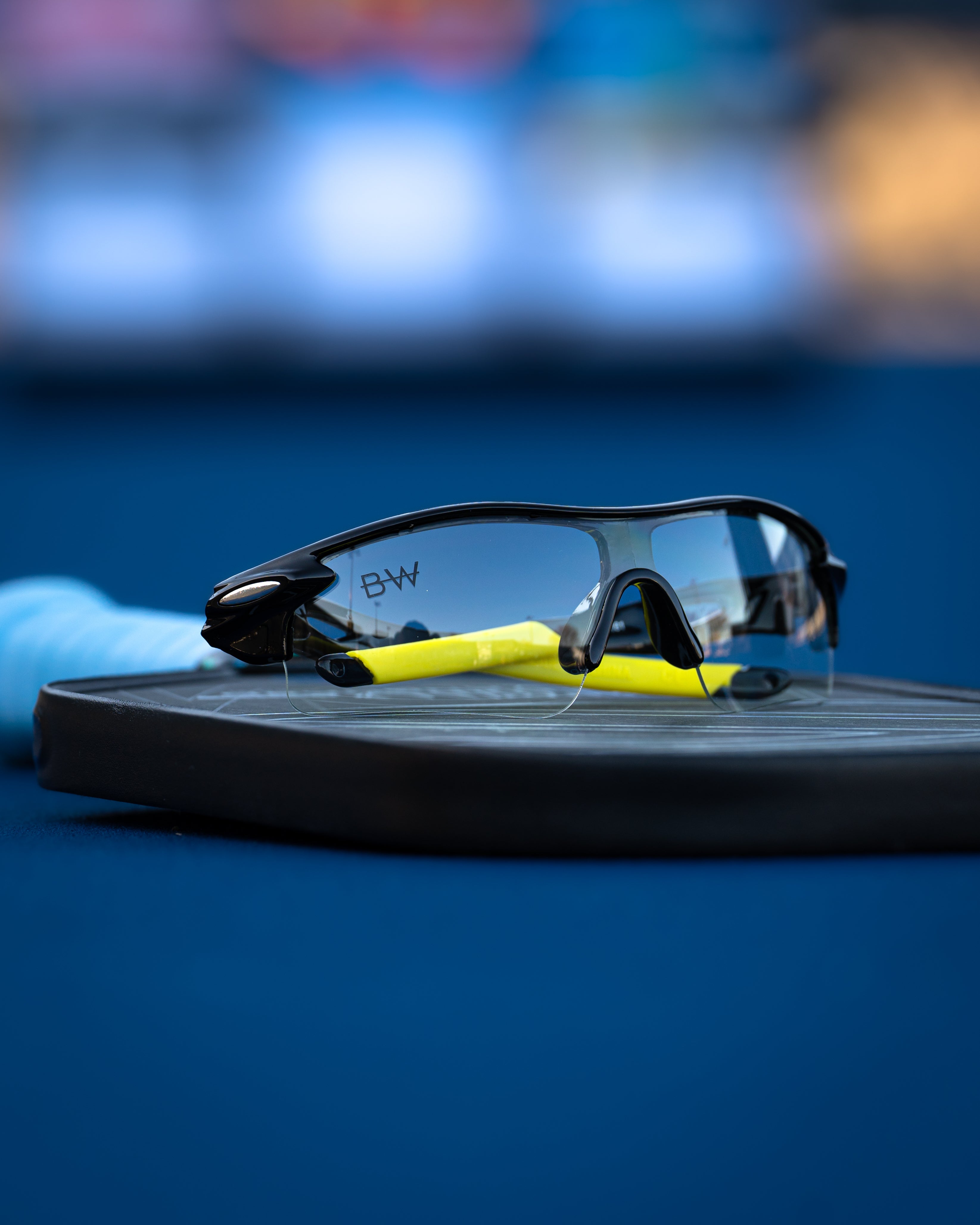
🌈 The Best Lens Colors for Pickleball: Prescription Options Explained
Share
The Best Lens Colors for Pickleball: Prescription Options Explained
There is no single best lens color for every pickleball player. The right prescription lens depends on where you play, how much light is available, the court and background colors, your prescription, and your personal visual preferences. Clear lenses are a practical starting point for many indoor and lower-light courts, while neutral gray tints can be useful when reducing brightness outdoors. Other colors such as amber, yellow, rose, or copper may change how colors and contrast appear, but they should not be treated as guaranteed ball-tracking or performance upgrades.
For prescription players, lens color is only one part of the decision. Accurate correction, frame fit, lens construction, comfort, and suitability for your normal playing environment should come first.
This guide explains the major pickleball lens colors, when different tints may make sense, what prescription players should consider, and how to avoid exaggerated claims about contrast, glare, depth perception, and sports performance.
Quick Answer: What Is the Best Lens Color for Pickleball?
The best starting point is to match the lens to the amount of available light rather than choosing a color solely because it is marketed for pickleball.
| Playing Condition | Lens Color to Consider | Main Reason |
|---|---|---|
| Indoor courts | Clear | Does not intentionally darken the environment |
| Night pickleball | Clear | Preserves available visible light rather than adding a dark tint |
| Cloudy or lower-light conditions | Clear or a carefully selected light tint | Avoids unnecessarily darkening an already dim environment |
| Bright outdoor sun | Gray or another appropriate sunglass tint | Reduces visible-light transmission |
| Changing indoor/outdoor conditions | Clear plus a separate outdoor pair, or a verified adaptive option | Provides flexibility across substantially different lighting |
| Player interested in color-based contrast | Amber, yellow, rose, or copper may be worth personally testing | Colored tints can alter color relationships, but the effect depends on the environment and wearer |
Prescription players should not choose by lens color alone. The prescription itself must remain appropriate, and any tint or adaptive technology should be verified for the exact lens configuration.
Why Does Lens Color Matter in Pickleball?
A lens tint changes which wavelengths and how much visible light reach your eyes. That can change the brightness and color appearance of the scene in front of you.
On a pickleball court, that means lens color can influence how you perceive:
- Overall brightness
- The apparent colors of the ball, court, walls, and sky
- The visual relationship between the ball and its background
- Comfort in bright or changing light
However, the original version of this guide went too far by presenting lens color as a direct way to reduce reaction time and improve performance. Lens tint should not be expected to automatically make you react faster, improve your ranking, or produce better match results. :contentReference[oaicite:0]{index=0}
Can Lens Color Help You See a Pickleball Against the Background?
Potentially, because colored lenses alter the spectral composition of the light reaching your eyes. A tint can make some colors appear different relative to others.
But there is an important limitation: the effect depends on the ball color, background, court surface, lighting, lens transmission, and individual wearer.
A yellow ball against a blue court is a different visual situation from the same ball against a pale gym wall or bright sky. That is why a tint marketed as “high contrast” should not automatically be described as the best choice for every pickleball court.
Clear Lenses for Pickleball: Best for Indoor and Lower-Light Play?
Clear prescription lenses are a practical starting point when reducing visible light is not the goal. That makes them especially relevant for indoor courts, nighttime play, and some lower-light environments.
When Clear Lenses Make Sense
- Indoor pickleball
- Nighttime courts
- Lower-light environments
- Players who want relatively natural color appearance
- Prescription players who need correction without a dark sunglass tint
What Clear Lenses Do Not Automatically Provide
- Better ball tracking
- Improved reaction time
- Anti-reflective treatment
- Anti-fog treatment
- Scratch resistance
- A specific UV rating
- Protective sports certification
The previous article correctly identified clear lenses as relevant to indoor and lower-light play, but it also tied specific coating and product-performance claims to them that should be verified separately. :contentReference[oaicite:1]{index=1}
Gray Lenses for Pickleball: A Practical Outdoor Option
Gray is a common sunglass tint and can be a practical option when the primary goal is reducing visible-light transmission in bright outdoor conditions.
Compared with strongly colored tints, a neutral gray lens generally aims to reduce brightness without intentionally emphasizing a particular color range.
Consider Gray Lenses If You:
- Play primarily outdoors in bright conditions
- Want a neutral-looking sunglass tint
- Prefer less intentional alteration of scene colors than strongly colored lenses
- Need prescription sunglasses specifically for daytime outdoor play
Gray should not automatically be described as the best lens for ball contrast. Its primary appeal is a relatively neutral approach to reducing brightness.
Are Yellow Lenses Good for Pickleball?
Yellow lenses are often marketed for sports and low-light environments because they alter the color balance of the scene. Some players may prefer the resulting appearance, but yellow lenses do not create additional light.
They also are not automatically better than clear lenses indoors.
Potential Reasons to Try Yellow
- You personally prefer the warmer color appearance.
- The tint creates a useful visual separation between the ball and your normal court background.
- You have tested it under the actual lighting where you play.
Reasons Not to Choose Yellow Automatically
- It changes color perception.
- It still filters some incoming light depending on the exact lens.
- Its usefulness can change with ball and background color.
- “Brighter-looking” does not mean the lens physically increases available light.
For many indoor players, clear remains the simpler starting point when preserving available light and relatively natural color appearance are the priorities.
Amber and Bronze Lenses for Pickleball
Amber and bronze tints alter the color balance more noticeably than neutral gray lenses. They are commonly considered by athletes who prefer a warmer-looking view of their environment.
Whether that is useful for pickleball depends on what you are looking at.
| Potential Advantage | Important Limitation |
|---|---|
| Changes the apparent relationship between certain colors | Effect depends on the ball, court, background, and exact tint |
| May feel comfortable to some players outdoors | Comfort is subjective |
| Can provide a different visual experience from neutral gray | Different does not automatically mean better |
Do not assume amber or bronze lenses universally improve clarity, depth perception, or ball tracking.
Rose and Copper Lenses for Pickleball
Rose and copper tints are another category often marketed around sports contrast. These colors can change how different parts of a scene appear relative to one another.
That makes them worth testing for some players, particularly when a specific court and ball combination feels visually difficult.
However, the original article described rose and copper as a “top pick” for outdoor contrast. That is too universal because the result depends on the exact lens and environment. :contentReference[oaicite:2]{index=2}
A more useful rule is: test colored tints against the ball and background you actually encounter rather than assuming a tint name guarantees better contrast.
What About Blue-Tinted Pickleball Lenses?
Blue or other fashion-oriented tints can change the appearance of the court, but color alone does not establish a sports-performance benefit.
If considering a blue tint, evaluate it using the same questions as any other lens:
- How much visible light does it transmit?
- How does the ball appear against your usual background?
- Does the color remain comfortable through a full match?
- Is it available in your prescription?
- Is it appropriate for the lighting where you play?
Pickleball Lens Color Comparison
| Lens Color | Good Starting Environment | Primary Consideration |
|---|---|---|
| Clear | Indoor, night, lower light | Does not intentionally add a dark tint |
| Gray | Bright outdoor conditions | Neutral approach to reducing brightness |
| Yellow | Situational indoor or lower-light use | Changes color appearance; should be personally tested |
| Amber/Bronze | Outdoor or variable conditions depending on darkness | Warmer color rendering and altered color relationships |
| Rose/Copper | Situational outdoor use | Changes color relationships and should be tested against your court |
| Other colored tints | Depends on exact lens | Evaluate transmission and color effects rather than tint name alone |
Should You Match Your Lens Color to the Pickleball Color?
Ball color matters, but it is only half of the visual relationship. The background behind the ball changes constantly during a rally.
You may see the ball against:
- A blue or green court
- A fence
- A wall
- The sky
- Other players
- Spectators
- Indoor curtains or dividers
Instead of asking only, “Which lens is best for a yellow pickleball?” ask, “Which lens makes this ball comfortable for me to see against the backgrounds on my actual court?”
What Is the Best Lens Color for Indoor Pickleball?
Clear is usually the most straightforward starting point for indoor pickleball when you do not need to reduce brightness.
That does not make clear universally superior. A lightly colored lens may feel preferable to some players depending on the gym, lighting, wall colors, and ball.
For indoor prescription eyewear, prioritize:
- Correct prescription
- Enough available light
- Comfortable frame fit
- Lens cleanliness
- Your response to the actual court lighting
- Optional lens color only when it solves a specific visual preference
What Is the Best Lens Color for Outdoor Pickleball?
For bright outdoor play, a tint that appropriately reduces visible-light transmission can be more useful than clear lenses.
Gray is a practical neutral starting point. Amber, bronze, copper, rose, and other colors may also appeal to players who prefer how those tints change the appearance of their court environment.
The best choice depends on:
- Sun intensity
- Time of day
- Cloud cover
- Court color
- Ball color
- Surrounding backgrounds
- Your sensitivity to brightness
- The exact transmission characteristics of the lens
A tint should not be considered “best for outdoor pickleball” based on color name alone.
What Is the Best Lens Color for Night Pickleball?
Clear prescription lenses are a practical starting point for nighttime pickleball. When available light is already limited, a dark sunglass tint can make the environment darker.
Yellow or amber lenses are sometimes marketed as nighttime sports lenses, but they do not create light. Whether a light-colored tint feels preferable is individual and should be tested under the actual court lights.
If nighttime glare, halos, double vision, or other visual symptoms remain significant even with clean and appropriate prescription lenses, consider discussing those symptoms with an eye-care professional rather than assuming a different tint will solve them.
Best Pickleball Lens Color for Cloudy or Overcast Days
Cloudy conditions vary substantially. A lightly overcast afternoon can still be bright, while a stormy evening may provide much less available light.
Rather than assigning one color to every cloudy day:
- Use clear when preserving available light is the priority.
- Use an appropriate tint when conditions remain uncomfortably bright.
- Consider a verified adaptive option if you frequently encounter changing conditions.
Are Transition or Photochromic Lenses Good for Pickleball?
Photochromic lenses change tint in response to environmental conditions, but their behavior depends on the exact lens technology.
They can appeal to players who move between different lighting environments because one pair may cover a broader range of conditions.
However, do not assume every photochromic lens:
- Becomes completely clear indoors
- Gets equally dark outdoors
- Changes at the same speed
- Responds identically in different temperatures
- Works identically behind different types of glass
- Is ideal for every rapid lighting transition
The original article presented transitional lenses as a standard Blinded Wear RX option and assigned specific behavior to them. Exact availability and behavior should instead be verified for the individual lens configuration. :contentReference[oaicite:3]{index=3}
Lens Color and Polarization Are Not the Same Thing
A gray, amber, yellow, copper, or other colored lens can potentially be polarized or non-polarized depending on how it is manufactured. Tint color does not tell you whether a lens is polarized.
Blinded Wear uses non-polarized lenses as part of its performance-first pickleball approach. This is intended to preserve natural visual information and avoid potential depth-perception concerns associated with polarization during court play.
Polarization does not universally cause depth-perception problems, and non-polarized lenses do not guarantee better performance.
Lens Color vs. Anti-Reflective Coating
Lens tint and anti-reflective coating address different optical characteristics.
- Lens tint changes the amount and spectral distribution of visible light transmitted through the lens.
- Anti-reflective coating is intended to reduce reflections from lens surfaces.
A clear lens does not automatically have AR coating, and a tinted lens does not automatically eliminate lens reflections.
If anti-reflective treatment matters to you, verify it separately for the exact lens configuration.
Does Lens Color Affect Fogging?
Lens color itself should not be treated as an anti-fog feature.
Fogging can be affected by moisture, temperature, airflow, frame position, perspiration, and any specific anti-fog treatment used on the lens.
Do not assume clear, gray, yellow, or another color is automatically more fog-resistant.
Does Lens Color Affect Impact Resistance?
No. Tint and impact resistance are separate characteristics.
A dark sports lens is not automatically more protective than a clear lens, and a clear lens is not automatically less durable.
Blinded Wear uses impact-resistant lenses. That does not mean impact-proof, shatter-proof, unbreakable, or certified protective eyewear unless a specific standard is documented for the exact product.
Prescription Players: What Matters More Than Lens Color?
If you need prescription pickleball glasses, color should not be the first filter in your buying decision.
-
Prescription Accuracy
The eyewear needs to provide the correction you require.
-
Frame and Prescription Compatibility
Confirm the frame can accommodate your prescription.
-
Fit During Movement
The frame should remain comfortable and usable while you move around the court.
-
Lens Construction
Verify impact resistance and any other characteristics that matter to you.
-
Playing Environment
Choose a lens configuration around indoor, outdoor, nighttime, or mixed use.
-
Lens Color
Then select the tint that best fits the environment and your visual preference.
High-Index Prescription Lenses and Lens Color
High-index and lens color describe different characteristics.
High-index refers to the optical properties of the lens material. Tint refers to how the lens filters visible light.
Blinded Wear includes high-index prescription lenses at no additional cost, helping prescription shoppers compare the finished RX value without a separate high-index upcharge.
This does not mean every tint, coating, or adaptive lens technology is automatically available on every frame. Verify the exact configuration before ordering.
What Blinded Wear Prescription Pickleball Glasses Offer
When choosing lens color, separate verified Blinded Wear characteristics from features that need to be confirmed for a particular lens.
| Feature | Status |
|---|---|
| Prescription eyewear | Available |
| High-index prescription lenses | Included at no additional cost |
| Lightweight sports frames | Verified |
| Impact-resistant lenses | Verified |
| Non-polarized lenses | Verified |
| Designed for pickleball players | Verified |
| Comfort for extended matches | Verified |
| Recreational and competitive use | Suitable |
| 50% lifetime replacement warranty if glasses break | Verified |
| Exact tint availability | Verify for the specific product and RX configuration |
| Photochromic technology | Verify exact availability and behavior |
| Anti-reflective coating | Verify separately |
| Anti-fog treatment | Verify separately |
| Scratch-resistant treatment | Verify separately |
| Specific UV rating | Verify documented specification |
| Protective certification | Verify the exact named standard if required |
What About Interchangeable Colored Shields and Clip-On Lenses?
Interchangeable shields and clip-on tints can be useful in principle because they allow a player to change lens color without replacing the underlying prescription eyewear.
However, do not assume every Blinded Wear RX frame supports a clip-on or interchangeable shield system. Compatibility must be verified for the exact frame.
The previous version of this guide described a Clip Shield system as broadly available across Blinded Wear RX frames and claimed players could switch colored shields mid-match. That availability should not be presented as universal without product-specific verification. :contentReference[oaicite:4]{index=4}
Prescription Pickleball Glasses to Compare
Once you understand your playing environment and lens needs, compare verified Blinded Wear RX frames. Check each product page for the exact prescription and lens configurations currently available.
- Frost RX
- Smoked Shadow RX
- Lava Rock RX
- Blue Shield RX
- Crystal Wave II RX
- Heatseek RX
- Runway RX
- Cold Slate RX
Do not infer a particular tint, coating, photochromic option, or protective certification from the product name. Verify the exact configuration you intend to purchase.
How to Choose Your Pickleball Lens Color in 5 Steps
-
Identify Where You Play Most
Start with indoor, outdoor, nighttime, or mixed conditions.
-
Determine Whether Brightness Is Actually a Problem
If the environment is already dim, adding a dark tint may work against your goal.
-
Consider the Ball and Background Together
Do not choose a tint based only on the color of the pickleball.
-
Prioritize Your Prescription and Fit
A preferred lens color cannot compensate for inappropriate corrective vision or an uncomfortable frame.
-
Test the Lens in Real Conditions
If possible, judge the tint on the type of court and under the lighting where you actually play.
Find Prescription Pickleball Glasses for Your Court
Start with your prescription, playing environment, and frame fit. Then choose the lens configuration that makes the most sense for how you actually play.
Shop Prescription Pickleball Glasses →
Looking specifically for clear eyewear?
Want to compare the broader lineup?
View the 2026 Pickleball Glasses Guide →
Not sure which direction fits your court conditions?
Lens Color Matters, but Visible-Light Transmission Matters More
Two lenses can look similar in color while allowing very different amounts of visible light to pass through. That means the tint name alone does not tell you whether a lens will feel too dark, too bright, or appropriate for a particular court.
When comparing pickleball lenses, ask about the actual lens configuration rather than relying only on labels such as gray, amber, yellow, or rose.
In practical terms:
- A lightly tinted gray lens may behave very differently from a dark gray lens.
- A pale amber lens may be usable in lower light while a darker bronze lens may not be.
- Two photochromic lenses can reach different darkness levels and behave differently in changing conditions.
The best color choice is therefore a combination of tint hue, tint darkness, available light, and your personal visual preference.
Tint Color vs. Tint Darkness: What Is the Difference?
Color describes the hue of the lens. Darkness describes how much visible light the lens blocks.
| Lens Characteristic | What It Changes |
|---|---|
| Color | Changes the spectral balance and appearance of the scene |
| Darkness | Changes how much visible light reaches your eyes |
| Prescription | Changes how the lens corrects your vision |
| Coating | May change surface reflection, fog behavior, or durability depending on the exact treatment |
This is why asking only, “Is gray good for pickleball?” is incomplete. A better question is, “Is this exact gray lens appropriate for the brightness level where I play?”
How Court Color Changes the Best Lens Tint
Pickleball courts vary widely in color, and the background behind the ball changes throughout a rally.
Common visual backgrounds include:
- Blue courts
- Green courts
- Gray courts
- Tan or concrete surroundings
- Dark windscreens
- White or pale indoor walls
- Bright sky
A tint that makes a yellow ball stand out well against one background may not create the same effect against another.
That is why the most useful approach is to think about the ball-background combination, not simply the ball color alone.
Best Lens Color for a Yellow Pickleball
There is no universal best lens color for a yellow ball.
Players may experiment with:
- Clear lenses for natural color appearance
- Gray lenses for brightness reduction outdoors
- Amber or bronze lenses for a warmer visual appearance
- Rose or copper lenses for a different color relationship between the ball and surroundings
What matters is whether the ball remains easy for you to locate against the actual court, walls, sky, and background under real playing conditions.
What About Green or Neon Pickleballs?
Neon green and yellow-green balls can interact differently with tinted lenses than traditional yellow balls.
A lens that makes one ball color feel more distinct may make another feel less natural.
For this reason, players who rotate between facilities or ball colors should be cautious about choosing a highly specific tint based on a single environment.
A neutral or flexible lens strategy may be more practical when the playing environment changes frequently.
Lens Color for Indoor Courts With White or Bright Walls
Bright indoor walls can create a visually different environment from a darker gym or warehouse-style court.
Clear lenses are still a practical starting point because they do not intentionally darken the scene, but some players may prefer a light tint if it makes the environment more comfortable.
The key is to avoid assuming that a colored tint automatically improves contrast simply because the walls are bright.
Lens Color for Dark Indoor Backgrounds
If the court is surrounded by dark curtains, black windscreens, or dim backgrounds, preserving available light becomes more important.
In these environments, a dark sunglass tint is often a poor starting point because it reduces the light already available.
Clear or lightly tinted lenses may be more practical, depending on the exact environment and your visual preferences.
Best Lens Color for Dusk Pickleball
Dusk is a challenging environment because the amount of available light can change significantly during one match.
A lens that feels comfortable at the beginning of play may become too dark later.
Options to consider include:
- Clear RX lenses
- A light tint that remains comfortable as conditions dim
- A separate daytime and low-light pair
- A verified adaptive lens option
If using photochromic lenses, evaluate the exact technology rather than assuming all transition lenses darken and clear at the same rate.
What Lens Color Works When You Move Between Sun and Shade?
Courts surrounded by trees, buildings, or partially covered structures can move players between bright sun and shade repeatedly.
That can make a very dark fixed tint less comfortable during shaded portions of the match.
Possible strategies include:
- A moderate fixed tint
- Separate eyewear for different conditions
- A verified adaptive lens
- A tint personally tested in the mixed-light environment
There is no single color that automatically solves all sun-and-shade transitions.
Clear vs. Yellow Lenses for Pickleball
| Factor | Clear | Yellow |
|---|---|---|
| Natural color appearance | Generally preserves scene colors more naturally | Introduces a warm color shift |
| Indoor use | Practical starting point | May appeal to some players, but should be tested |
| Night use | Practical starting point | Does not create additional light |
| Contrast claims | No automatic contrast enhancement | Can alter apparent color relationships but does not guarantee better tracking |
| Best for everyone? | No | No |
Gray vs. Amber Lenses for Outdoor Pickleball
Both can work outdoors, but they provide different visual experiences.
| Factor | Gray | Amber/Bronze |
|---|---|---|
| Color appearance | More neutral | Warmer |
| Brightness reduction | Depends on exact darkness | Depends on exact darkness |
| Color alteration | Usually less intentional color shifting | More noticeable color shift |
| Best use | Players wanting a neutral outdoor tint | Players who prefer a warmer appearance and have tested it on court |
Neither color should be described as universally better for pickleball.
Gray vs. Copper Lenses for Pickleball
Gray is usually the more neutral choice. Copper produces a stronger color shift.
If your priority is simply reducing brightness while preserving a relatively neutral appearance, gray may be the simpler starting point.
If you prefer a warmer view and want to experiment with how court colors appear, copper may be worth testing.
Again, the word “contrast” should not be used as a guarantee that copper will make the ball easier for every player to track.
Yellow vs. Amber Pickleball Lenses
Yellow and amber both create warmer color rendering, but they can differ substantially in darkness and transmission.
A very light yellow lens might be considered for lower-light conditions, while a darker amber lens may be more appropriate for brighter environments.
The tint name alone is not enough to determine suitability.
Photochromic vs. Fixed-Tint Lenses for Pickleball
| Factor | Fixed Tint | Photochromic |
|---|---|---|
| Lens darkness | More predictable for a given lens | Changes with environmental conditions |
| Mixed lighting | May require changing glasses | Potentially more flexible |
| Transition behavior | No transition | Depends on exact technology |
| Indoor behavior | Depends on chosen tint | Depends on exact photochromic lens |
| Best choice | Useful when your environment is consistent | Worth considering when conditions vary and the exact behavior fits your needs |
Prescription Sunglasses vs. Regular RX Glasses for Pickleball
If you play mainly outdoors, dedicated prescription sunglasses can combine your corrective vision with a tint intended for brighter conditions.
If you play mostly indoors, your everyday clear prescription may be usable if it fits securely, but a dedicated sports-oriented RX pair can still be useful for repeated play.
Players who switch frequently between indoor and outdoor courts may find one of these approaches practical:
- One clear RX sports pair plus one outdoor RX pair
- A verified adaptive RX setup
- Contacts plus non-RX sports eyewear, for existing contact-lens wearers
Contacts + Non-RX Tinted Pickleball Glasses
Players who already wear contact lenses comfortably can separate prescription correction from sports-lens choice.
This may make it easier to experiment with:
- Different tint colors
- Clear lenses indoors
- Darker lenses outdoors
- Different sports frames
This is not a recommendation to begin wearing contacts solely for pickleball. Contact-lens suitability should be determined individually.
Should Pickleball Lenses Be Polarized?
Polarization and tint color are separate features.
Blinded Wear uses non-polarized lenses as part of its performance-first pickleball approach. This is intended to preserve natural visual information and avoid potential depth-perception concerns associated with polarization during court play.
That does not mean polarized lenses universally harm depth perception, and it does not mean non-polarized lenses automatically improve performance.
The more accurate takeaway is that polarization should be treated as a separate purchasing decision rather than assumed to be better simply because you play outdoors.
Does Lens Color Affect Depth Perception?
Colored lenses alter the visual appearance of the scene, but they should not be marketed as guaranteed depth-perception enhancers.
If a new tint makes distance judgment feel unusual, give yourself time to evaluate the eyewear in a safe practice environment.
Persistent visual distortion, double vision, or unusual spatial perception should not simply be dismissed as a normal sports-lens effect.
Can a Lens Color Make You React Faster?
Do not expect a tint to automatically reduce reaction time.
Sports marketing sometimes implies that a specific color directly improves speed or response, but lens color is only one visual variable among many.
Reaction to the ball depends on:
- Visual acuity
- Attention
- Experience
- Ball speed
- Positioning
- Lighting
- Fatigue
- Individual visual processing
A lens you find comfortable may help remove a distraction, but that is different from proving faster reactions.
Can the Right Lens Color Reduce Eye Strain?
A lens that feels comfortable in the available light may reduce visual annoyance for some players, but eye strain can have multiple causes.
These may include:
- Incorrect prescription
- Dry eyes
- Excessive brightness
- Lighting reflections
- General fatigue
- Lens surface damage
- Frame discomfort
Do not treat tint color as a universal cure for headaches or eye fatigue.
Does a Darker Lens Mean More UV Protection?
No. Lens darkness and UV specifications are separate characteristics.
A dark tint should not be assumed to provide a particular UV rating, and a clear lens can potentially have UV-related properties depending on the exact product.
If a specific UV specification matters to you, verify it directly rather than inferring it from lens color.
Do Mirrored Pickleball Lenses Change the Best Tint?
A mirror finish is another separate lens characteristic. It can alter the appearance of the eyewear and may influence how some light interacts with the lens, but it should not be treated as proof of better ball tracking or sports performance.
If considering a mirrored lens, evaluate:
- The underlying tint
- How dark the finished lens is
- Your playing environment
- Prescription availability
- Any documented coating characteristics
Can Tinted Lenses Also Have Anti-Reflective Coating?
Potentially, yes. Tint and anti-reflective coating are separate technologies and can potentially exist on the same lens if the product supports that configuration.
Do not assume every tinted prescription sports lens includes AR coating.
If reflections from court lights or the back surface of a sunglass lens are important to you, verify the exact coating configuration.
Lens Color for Progressive or Multifocal Pickleball Glasses
For progressive or multifocal wearers, prescription design and fitting should take priority over tint color.
The most attractive lens color will not compensate for a lens design that feels uncomfortable while scanning the court or tracking a moving ball.
Prioritize:
- Appropriate prescription design
- Correct measurements
- Frame compatibility
- Comfort during real court movement
- Then choose a tint for the lighting environment
Lens Color for Strong Prescriptions
Players with stronger prescriptions should first confirm that the preferred frame and lens configuration can accommodate their correction.
Then evaluate tint options.
Blinded Wear includes high-index prescription lenses at no additional cost, but exact tint availability should still be verified for the specific model and prescription.
One Lens Color or Two Pairs of Pickleball Glasses?
If you play in drastically different environments, one fixed tint may require compromise.
| One Pair | Two Pairs |
|---|---|
| Less gear to carry | Each pair can be optimized for a different environment |
| Potentially lower cost | Provides a complete backup |
| May need to compromise across lighting conditions | Clear pair can serve indoor/night use while tinted pair serves bright outdoor use |
| Adaptive technology may add versatility if available | No need to rely on one lens to cover every condition |
Is It Worth Paying More for a Special Pickleball Lens Color?
Only if the lens solves a real need for you.
Before paying extra for a specialized tint, ask:
- Do I play in the environment this lens is intended for?
- Have I tested a similar color before?
- Does the tint improve my comfort?
- Will it be too dark for part of my normal playing schedule?
- Is it available in my prescription?
- Would a simpler clear or gray option meet my needs?
Do not pay a premium solely because a lens is labeled “pickleball,” “high contrast,” or “performance.”
Think About Cost Per Wear, Not Just Tint Price
A lens color that matches your most common playing environment may be more valuable than a specialized tint you rarely use.
For example:
- A frequent indoor player may get more use from clear RX sports glasses.
- A frequent daytime outdoor player may get more use from a dedicated sunglass tint.
- A player who regularly switches environments may value a second pair or a verified adaptive solution.
The best value comes from eyewear you actually wear comfortably and consistently.
How to Test a New Lens Color Before Competition
-
Wear It in the Correct Environment
Do not judge an outdoor tint solely indoors or vice versa.
-
Look at the Actual Ball Color
See how the ball appears against your normal court.
-
Scan Across Multiple Backgrounds
Look at the ball against the court, fence, wall, and sky if applicable.
-
Play a Full Practice Session
Notice whether the tint remains comfortable over time.
-
Test Late in the Session
If light changes while you play, see whether the lens becomes too dark or too bright.
Signs Your Current Lens Color May Not Match the Court
Consider testing a different configuration if:
- Your outdoor glasses feel unnecessarily dark in shade.
- Your indoor lenses make an already dim court feel darker.
- You repeatedly remove your glasses because the tint feels uncomfortable.
- The color shift bothers you during extended play.
- The lens works well at the beginning of a match but poorly after sunset.
- You depend on one dark tint for both daytime and nighttime play.
These do not necessarily mean the lens is defective. They may simply indicate a mismatch between the tint and environment.
Pickleball Lens Color Claims to Be Skeptical Of
| Claim | Better Question |
|---|---|
| “This tint makes you react faster” | What evidence supports a direct reaction-time improvement? |
| “Best contrast for every court” | How does it behave with my ball, background, and lighting? |
| “Improves depth perception” | Is there evidence for that exact lens? |
| “Perfect for indoor and outdoor use” | How much light does it transmit in both environments? |
| “Yellow lenses brighten the court” | Does the lens merely alter color appearance while still filtering light? |
| “Darker means more UV protection” | What actual UV specification is documented? |
| “Polarized means better for sports” | Is polarization actually useful for my court and visual preference? |
Where Blinded Wear Fits Into the Lens-Color Decision
Blinded Wear's verified value is not that one proprietary tint automatically makes players perform better.
The brand's verified prescription-eyewear characteristics include:
- Prescription availability
- High-index prescription lenses at no additional cost
- Lightweight sports frames
- Impact-resistant lenses
- Non-polarized lenses
- Pickleball-focused design
- Comfort for extended matches
- Options for recreational and competitive players
- 50% lifetime replacement warranty if glasses break
Exact tint, coating, photochromic, UV, and protective-certification details should be verified for the specific lens configuration.
Blinded Wear RX Pickleball Glasses to Compare
Choose the frame first based on prescription compatibility and fit, then confirm which lens configurations are available.
- Frost RX
- Smoked Shadow RX
- Lava Rock RX
- Sea Sand RX
- Blue Shield RX
- Crystal Wave II RX
- Heatseek RX
- Runway RX
- Cold Slate RX
Do not infer exact lens color availability from the frame name. Confirm the options offered for the product you intend to order.
Best Lens Direction by Pickleball Player Scenario
| Player Scenario | Good Starting Direction |
|---|---|
| Indoor-only prescription player | Clear RX |
| Night-only player | Clear RX |
| Bright daytime outdoor player | Gray or another appropriate sunglass tint |
| Player who dislikes color distortion | Clear indoors and neutral gray outdoors |
| Player interested in warmer color rendering | Test amber, bronze, rose, or copper |
| Player moving between sun and shade | Moderate tint, multiple pairs, or verified adaptive option |
| Player who competes indoors and outdoors | Consider separate clear and outdoor RX pairs |
| Existing contact-lens wearer | Contacts plus non-RX sports eyewear can provide tint flexibility |
12 Questions to Ask Before Choosing a Pickleball Lens Color
- Do I play mostly indoors or outdoors?
- Do I regularly play at night?
- How bright is my normal court?
- What color ball is typically used?
- What colors surround the court?
- Do I prefer neutral or warmer color rendering?
- How dark is the exact tint?
- Will the lens still work if the light changes?
- Is the tint available in my prescription?
- Does the exact frame support my prescription?
- Am I paying for a documented feature or only a marketing label?
- Would a clear plus outdoor pair serve me better than one compromise lens?
Simple Rule for Choosing a Pickleball Lens Color
Choose based on available light first, personal color preference second, and sports-marketing claims last.
For many players, the simplest starting framework is:
- Indoor or night: clear
- Bright outdoor: gray or another appropriately dark sunglass tint
- Warmer color preference: test amber, bronze, rose, or copper
- Changing conditions: consider multiple pairs or a verified adaptive option
Then refine the choice based on your specific court, ball color, prescription, and comfort.
Choose Your Pickleball Eyewear Around Your Real Court Conditions
Start with the right prescription and frame fit, then select a lens configuration that matches how much light you actually play in.
Shop Prescription Pickleball Glasses →
Need a clear option for indoor or lower-light play?
Don't need prescription lenses?
Explore Non-RX Pickleball Glasses →
Want a broader comparison before deciding?
View the 2026 Pickleball Glasses Guide →
Need help narrowing down the options?
Frequently Asked Questions About the Best Lens Colors for Pickleball
What is the best lens color for pickleball?
There is no single best color for every player. Clear is a practical starting point for indoor and nighttime play, while gray is a common neutral option for bright outdoor conditions. Amber, bronze, yellow, rose, and copper may appeal to players who prefer how those tints change the appearance of the court, but they should be personally tested rather than assumed to improve performance.
What lens color is best for indoor pickleball?
Clear lenses are usually the simplest starting point indoors because they do not intentionally darken the environment. A light tint may still be comfortable for some players depending on the facility and lighting.
What lens color is best for outdoor pickleball?
For bright outdoor conditions, gray or another appropriately dark sunglass tint can be practical. The exact choice should depend on brightness, court color, ball color, background, and personal preference.
What lens color is best for night pickleball?
Clear lenses are a practical starting point at night because available light is already limited. Yellow or amber lenses may change the visual appearance of the court but do not create additional light.
Are yellow lenses good for pickleball?
They can be comfortable for some players, but yellow is not automatically better for contrast or ball tracking. Test the exact lens under your normal court conditions.
Are gray lenses good for pickleball?
Yes, especially as a neutral outdoor option when reducing brightness is the main goal. Gray does not automatically provide superior ball contrast compared with other colors.
Are amber or bronze lenses good for pickleball?
They may be worth testing if you prefer warmer color rendering. Their usefulness depends on the exact tint, lighting, ball color, and court background.
Are rose or copper lenses good for pickleball?
They can alter the visual relationship between the ball and background, but they are not universally best for outdoor contrast. Their value is personal and environment-dependent.
Do colored lenses improve ball tracking?
Colored lenses can change how the ball and background appear, but they should not be expected to automatically improve tracking ability. Any perceived benefit depends on the environment and the wearer.
Do lens colors improve reaction time?
No lens color should be marketed as guaranteeing faster reactions. Reaction time depends on many factors beyond tint.
Do darker lenses provide more UV protection?
Not necessarily. Tint darkness and UV specifications are separate characteristics. Verify the documented UV properties of the exact lens.
Are polarized lenses better for pickleball?
Not automatically. Polarization is separate from tint color. Blinded Wear uses non-polarized lenses as part of its pickleball-focused approach, while recognizing that polarization does not universally cause depth-perception problems.
Are transition lenses good for pickleball?
They can be useful for changing conditions, but exact behavior depends on the specific photochromic technology and environment. Do not assume all adaptive lenses darken, clear, or respond at the same speed.
Can prescription pickleball glasses come in different lens colors?
Potentially, depending on the frame, prescription, and lens configuration. Exact tint availability should be confirmed for the specific product.
Does Blinded Wear charge extra for high-index prescription lenses?
No. Blinded Wear includes high-index prescription lenses at no additional cost.
Best Lens Direction by Court Environment
| Environment | Good Starting Lens | Why |
|---|---|---|
| Indoor gym | Clear | Preserves available light and relatively natural color appearance |
| Indoor warehouse court | Clear or light tint | Depends on lighting strength and background |
| Night court | Clear | Avoids unnecessary darkening |
| Overcast daytime | Clear, light tint, or moderate tint | Depends on actual brightness |
| Bright midday sun | Gray or another appropriate sunglass tint | Reduces visible-light transmission |
| Sun and shade | Moderate tint, multiple pairs, or verified adaptive lens | Balances changing brightness |
| Indoor and outdoor mix | Clear plus outdoor pair, or verified adaptive option | Different environments may need different light transmission |
How Ball and Background Combinations Affect Lens Choice
Lens color should be evaluated against the entire visual scene, not just the ball.
| Visual Situation | What to Consider |
|---|---|
| Yellow ball on blue court | Test whether the tint preserves comfortable separation between ball and court |
| Yellow ball against bright sky | Brightness control may matter more than tint color alone |
| Neon ball against dark windscreen | Preserving available light may be more important |
| Indoor ball against pale walls | Clear or light tint may be more practical than a dark lens |
| Mixed backgrounds during rallies | A versatile lens may be more useful than a highly specialized tint |
What You Should Not Assume From Lens Color Alone
The color of a lens does not automatically tell you:
- How much visible light it transmits
- Whether it is polarized
- Whether it has anti-reflective treatment
- Whether it has anti-fog treatment
- Whether it is scratch-resistant
- Whether it has a specific UV rating
- Whether it is impact-resistant
- Whether it carries a protective certification
- Whether it will improve contrast for you
- Whether it will improve sports performance
Each characteristic should be verified separately.
Pickleball Lens Color Claims vs. Reality
| Claim | More Accurate Interpretation |
|---|---|
| “Yellow lenses make the ball brighter” | Yellow changes color appearance but does not create additional light |
| “Copper gives the best contrast” | Copper changes color relationships, but usefulness depends on the environment |
| “Gray is best for every outdoor court” | Gray is a neutral option, not a universal winner |
| “Polarized is always better outdoors” | Polarization is a separate feature and not automatically superior for pickleball |
| “Photochromic works perfectly everywhere” | Behavior varies by lens technology and conditions |
| “Dark lenses mean better UV protection” | UV specification must be verified separately |
| “A sports tint improves reaction time” | No automatic reaction-time improvement should be promised |
| “A high-contrast tint improves your ranking” | Lens color does not guarantee better match outcomes |
10 Mistakes to Avoid When Choosing Pickleball Lens Colors
-
Choosing Only by Tint Name
Gray, yellow, amber, and copper can all vary substantially in darkness.
-
Ignoring the Amount of Available Light
A dark tint can be uncomfortable in an already dim environment.
-
Choosing Based Only on Ball Color
The background changes throughout every rally.
-
Assuming “High Contrast” Means Better for Everyone
Contrast preferences are individual and environment-dependent.
-
Expecting a Tint to Fix an Outdated Prescription
Corrective vision should be addressed first.
-
Confusing Tint With Polarization
They are separate properties.
-
Assuming Darker Means More Protective
Impact resistance, UV specifications, and certifications must be verified separately.
-
Using One Dark Pair for Day and Night
A lens appropriate at noon may be too dark after sunset.
-
Buying a Specialty Tint Without Testing It
Real court conditions matter more than marketing descriptions.
-
Ignoring Comfort and Fit
A preferred lens color does not compensate for an uncomfortable frame.
The 3-Step Pickleball Lens Color Decision
Step 1: Start With Light Level
Ask whether your normal environment is low light, moderate light, or bright sun.
Step 2: Choose the General Lens Category
- Lower light: clear or carefully selected light tint
- Bright outdoor: gray or another appropriate sunglass tint
- Changing conditions: multiple pairs or a verified adaptive option
Step 3: Fine-Tune Color Preference
Once brightness is handled, compare whether neutral gray, amber, bronze, rose, copper, or another tint feels more comfortable on your actual court.
How to Test Your New Prescription Lens Color After It Arrives
-
Confirm the Prescription First
Make sure corrective vision feels appropriate before judging the tint.
-
Check the Frame Fit
Make sure the frame remains comfortable during movement.
-
Use the Lens in Its Intended Environment
Test an outdoor tint outdoors and an indoor lens under your actual court lighting.
-
Compare Multiple Backgrounds
Look at the ball against the floor, wall, fence, sky, and other players.
-
Play a Full Session
A tint that looks good for five minutes may feel different after an hour.
-
Test Changing Light
If you play near dusk or in mixed shade, evaluate whether the lens becomes too dark.
Keep the Lens or Try a Different Color?
| If You Notice... | Consider... |
|---|---|
| Comfortable visibility throughout the session | Keeping the current lens |
| Lens feels too dark indoors | Clear or lighter tint |
| Bright sun remains uncomfortable | More appropriate outdoor tint |
| Strong color shift is distracting | Neutral gray or clear |
| Lens works at noon but not dusk | Second pair or verified adaptive option |
| Ball is difficult to see only on one court | Test the ball-background interaction before changing your entire setup |
Final Pickleball Lens Color Buying Checklist
- Confirm your prescription is current.
- Verify the frame supports your prescription.
- Identify whether you play mainly indoors, outdoors, or at night.
- Consider the brightness level rather than tint color alone.
- Think about the ball and court background together.
- Decide whether you prefer neutral or warmer color rendering.
- Check the exact tint darkness or transmission information if available.
- Verify polarization separately.
- Verify anti-reflective treatment separately.
- Verify anti-fog treatment separately.
- Verify scratch resistance separately.
- Verify photochromic availability separately.
- Verify specific UV specifications separately.
- Verify any protective certification separately.
- Compare the complete RX price.
- Test the lens in real court conditions before important competition.
- Consider a second pair if you play in very different lighting environments.
Key Takeaways: Best Lens Colors for Pickleball
- There is no single best pickleball lens color for every player.
- Clear is a practical starting point for indoor, nighttime, and lower-light play.
- Gray is a practical neutral option for bright outdoor conditions.
- Yellow, amber, bronze, rose, and copper alter color relationships and should be personally tested.
- Lens darkness can matter as much as lens color.
- Ball color alone should not determine your tint because the background constantly changes.
- Photochromic behavior varies by lens technology and environment.
- Tint color does not automatically indicate polarization, UV protection, anti-fog, scratch resistance, impact resistance, or certification.
- Lens color does not guarantee improved ball tracking, reaction time, depth perception, ranking, or match results.
- Prescription accuracy, frame fit, comfort, and playing environment should come before tint preference.
- Blinded Wear includes high-index prescription lenses at no additional cost.
- Blinded Wear uses lightweight sports frames, impact-resistant lenses, and non-polarized lenses.
- Exact tint availability should be verified for the specific Blinded Wear product and prescription configuration.
Compare Prescription Pickleball Lens Options
Final Verdict: What Lens Color Should You Choose for Pickleball?
Choose the lens that matches your real lighting conditions first, then refine by color preference.
For many players, that means starting with clear lenses indoors or at night and an appropriate sunglass tint outdoors. Gray is a straightforward neutral outdoor option, while yellow, amber, bronze, rose, and copper can be worth testing if you prefer the way they alter the visual scene.
The mistake is assuming one color automatically produces better contrast, faster reactions, improved depth perception, or better pickleball performance. Lens color can change how the court looks, but the best choice remains individual.
For prescription players, the priority order should remain accurate correction, frame compatibility, comfortable fit, appropriate lens construction, playing environment, and then tint preference.
If you play in substantially different lighting environments, two dedicated pairs may be more practical than forcing one fixed tint to handle everything.
Find the Right Prescription Pickleball Eyewear for Your Court
Blinded Wear offers prescription pickleball eyewear with high-index RX lenses included at no additional cost, lightweight sports frames, impact-resistant lenses, non-polarized lenses, and a performance-first approach for recreational and competitive players.
Shop Prescription Pickleball Glasses →
Looking for clear eyewear for indoor or lower-light conditions?
Want to compare the complete lineup first?
Explore the 2026 Pickleball Glasses Guide →
Need help narrowing down which direction makes sense for your playing conditions?