
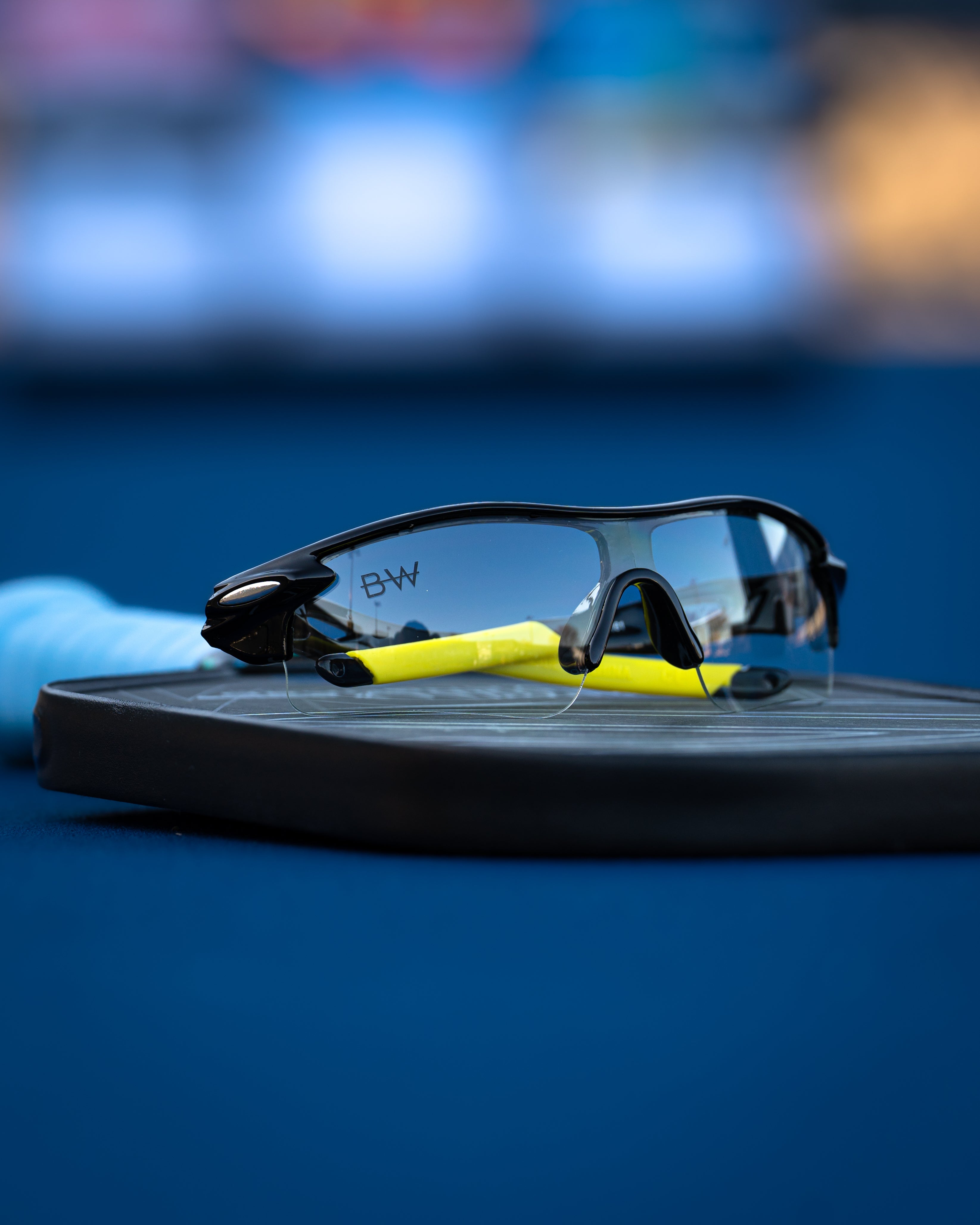
What Lens Thickness Is Best for Active Adults?
Share
What Lens Thickness Is Best for Active Adults?
For active adults who rely on prescription eyewear, lens thickness can affect how a finished pair looks, feels, and fits inside a frame. But there is an important misconception to clear up first: there is no single lens thickness or lens index that is automatically best for every active adult.
The appropriate prescription lens depends on several connected factors, including your prescription strength, frame size and shape, lens material, optical measurements, and the configuration available for the frame you choose.
Blinded Wear includes high-index prescription lenses at no additional cost with RX eyewear. Rather than assuming one exact numerical index is universally optimal, this guide explains what lens index actually means, why prescription lenses become thicker in different places, and what active adults should consider when shopping for RX sports eyewear.
Explore Prescription Sports Eyewear
What Is Prescription Lens Thickness?
Lens thickness describes the physical thickness of a finished prescription lens. It is not determined by one number alone.
Two people can order prescription eyewear using the same general lens-material category and still receive lenses with noticeably different finished thicknesses.
Important variables include:
- Your sphere prescription
- Your cylinder and astigmatism correction
- The overall strength of the prescription
- Whether the prescription is primarily plus or minus power
- Lens material and refractive index
- Frame size and shape
- Lens dimensions
- How your prescription is positioned within the frame
- The exact lens design and configuration
This is why asking “What lens thickness should I buy?” is usually better reframed as: “What lens material and frame combination makes sense for my prescription?”
Lens Index vs. Lens Thickness: They Are Not the Same Thing
The terms lens index and lens thickness are often used interchangeably online, but they describe different things.
| Term | What It Means |
|---|---|
| Lens Index | A property related to how a lens material refracts light |
| High-Index Lens | A category of lens material with a higher refractive index than conventional lens materials |
| Lens Thickness | The physical thickness of the finished prescription lens |
| Prescription Strength | One major factor influencing the shape and thickness required for correction |
| Frame Choice | Another factor that can influence the dimensions of the finished lens |
A higher-index material can allow a prescription to be produced differently than a lower-index material, but the final thickness still depends on the complete prescription and eyewear configuration.
What Are High-Index Prescription Lenses?
High-index lenses are prescription lenses made from materials with a relatively higher refractive index. This allows the material to bend light differently than lower-index lens materials.
For shoppers, high-index lenses are often considered when lens thickness and the finished prescription profile are important concerns.
However, “high-index” should not be treated as a synonym for:
- Better vision for every prescription
- Better sports performance
- Better depth perception
- Faster reaction time
- Better ball tracking
- Automatic impact certification
- Automatic scratch resistance
- Automatic anti-fog performance
It describes a lens-material characteristic—not an athletic-performance upgrade.
Does Blinded Wear Include High-Index Prescription Lenses?
Yes. Blinded Wear includes high-index prescription lenses at no additional cost with RX eyewear.
That means shoppers comparing Blinded Wear prescription sports eyewear do not need to treat high-index lenses as a separate paid upgrade.
However, you should not assume an exact numerical index such as 1.61 or 1.67 unless that number has been confirmed for the exact prescription and configuration being ordered.
Why Does Lens Thickness Matter for Active Adults?
For someone who regularly wears prescription eyewear during sports, workouts, travel, and everyday activities, finished lens thickness can be worth considering as part of the complete eyewear setup.
It can influence:
1. The Finished Appearance
Prescription strength and lens configuration can affect how much lens material is visible around or within a frame.
2. Overall Eyewear Weight
Lens material contributes to total eyewear weight, although the frame itself also matters. A thinner-looking lens does not automatically tell you the exact finished weight of the complete glasses.
3. Frame Compatibility
Prescription strength and lens requirements can affect which frame and lens combinations are practical.
4. Long-Wear Preferences
Active adults who wear their prescription glasses for many hours may place greater importance on the overall finished eyewear configuration.
5. Aesthetics
Some wearers simply prefer a lower-profile appearance when their prescription and frame allow it.
These are legitimate reasons to consider lens thickness without turning a high-index lens into an unsupported claim about athletic performance.
Why Are Some Prescription Lenses Thick at the Edge and Others in the Center?
Prescription lenses do not all become thicker in the same place.
| General Prescription Type | Typical Lens Shape Consideration |
|---|---|
| Minus Prescription | Often thinner toward the center and thicker toward the edges |
| Plus Prescription | Often thicker toward the center and thinner toward the edges |
| Astigmatism Correction | Can further influence the finished lens profile depending on the prescription |
This is one reason broad statements such as “strong prescriptions always have thick edges” are incomplete. The actual result depends on the prescription.
Does a Stronger Prescription Mean Thicker Lenses?
Prescription strength is one of the major variables affecting finished lens thickness, but it is not the only one.
As prescription requirements become stronger, lens-material and frame decisions can become more important. However, there is no universal prescription number at which every person must switch to the same high-index material.
Instead of using a generic threshold such as “everyone above -4.00 needs this lens,” evaluate the complete prescription and available configuration.
Your eye-care professional can help explain your prescription, while the eyewear provider can confirm compatibility with the frame and lens options being considered.
How Frame Size Can Affect Prescription Lens Thickness
Lens material gets much of the attention, but frame choice can also matter when managing the finished profile of prescription lenses.
When comparing frames, consider:
- Overall lens dimensions
- Frame shape
- How the frame works with your prescription
- Your individual fit
- The position of your eyes within the frame
- The available RX configuration
This means choosing a high-index lens and then ignoring the frame is not a complete strategy.
For some prescriptions, two different frame choices can produce meaningfully different finished eyewear even when the prescription itself has not changed.
What Lens Thickness Is Best for an Active Adult?
The most accurate answer is: the appropriate finished lens thickness for your prescription, frame, and intended use.
There is no universal millimeter measurement or lens index that every active adult should choose.
| Your Situation | What to Prioritize |
|---|---|
| Mild Prescription | Prescription compatibility, frame fit, lens configuration, and overall eyewear needs |
| Moderate Prescription | Compare lens-material options and frame dimensions alongside fit |
| Stronger Prescription | Pay closer attention to prescription compatibility, lens material, frame selection, and finished profile |
| Frequent Sports Use | Prescription compatibility, appropriate sports lens construction, individual fit, and environment |
| All-Day Active Wear | Complete eyewear weight, fit, prescription configuration, and comfort |
| Style-Focused Wearer | Choose among technically suitable options based on preferred frame and finished appearance |
Do Thinner High-Index Lenses Improve Sports Performance?
High-index lenses should not automatically be credited with making an athlete faster, more accurate, or better at tracking a ball.
A properly prescribed lens provides the vision correction it was designed to provide. Athletic performance involves many additional factors, including:
- Visual abilities
- Experience
- Anticipation
- Decision-making
- Movement
- Technique
- Attention
- Practice
A different lens material may affect the physical characteristics of the finished eyewear, but that is different from proving that it improves reaction time or sports performance.
Do Thinner Lenses Automatically Make Glasses More Comfortable?
Not necessarily.
Lens material can contribute to the weight and physical profile of finished eyewear, but comfort depends on the complete pair.
Other important variables include:
- Frame dimensions
- Frame weight
- Individual facial fit
- How the eyewear sits on your face
- Your prescription
- How long you wear the glasses
- The activities you perform while wearing them
This is why “thinner = automatically more comfortable” is too simplistic.
The better goal is a well-matched prescription, lens, and frame combination.
Does High-Index Mean Impact-Resistant?
Not automatically. Lens index and impact resistance describe different characteristics.
Blinded Wear sports eyewear uses impact-resistant lenses, but you should not assume that a lens is impact-resistant merely because it is described as high-index.
| Term | What It Tells You |
|---|---|
| High-Index | Describes a characteristic of the lens material related to refractive index |
| Impact-Resistant | Describes resistance to impact |
| Shatterproof | A stronger claim that should not be assumed from impact resistance |
| Protective Certification | Requires verification of a specific standard for the exact product |
Do not treat these terms as interchangeable.
What Should Pickleball Players Consider About Lens Thickness?
If you need prescription correction for pickleball, start with the prescription itself rather than choosing a lens solely because it is advertised as thin.
Your decision should consider:
- Your prescription requirements
- RX compatibility with the frame
- Lens material
- Frame dimensions
- Individual fit
- Your indoor or outdoor playing environment
- The exact lens configuration
- Whether you need backup prescription correction
Lens thickness is one part of the system—not the entire buying decision.
What About Lens Thickness for Gym and Training Use?
The same principle applies to gym workouts and other active routines.
If you wear RX eyewear while training, consider the finished pair as a whole:
- Prescription compatibility
- Lens material
- Frame dimensions
- Total eyewear fit
- Comfort during your actual exercises
- Lens configuration for the environment
A high-index lens can be part of an active RX setup, but it does not automatically prevent slipping, fogging, or movement. Those are separate considerations that should be evaluated or verified independently.
Lens Thickness Myths Active Adults Should Avoid
| Myth | Reality |
|---|---|
| “There is one best lens index for everyone.” | The appropriate configuration depends on prescription, frame, and other factors. |
| “Higher index always means better glasses.” | A higher numerical index is not automatically the best choice for every prescription. |
| “Thin lenses improve reaction time.” | Lens thickness alone does not establish faster athletic reactions. |
| “High-index means impact-resistant.” | These are separate characteristics. |
| “Impact-resistant means shatterproof.” | Impact resistance should not be expanded into a shatterproof claim. |
| “Stronger prescriptions always have thick edges.” | Plus and minus prescriptions have different lens-shape characteristics. |
| “Thinner always means lighter.” | Finished weight depends on material, prescription, dimensions, frame, and other variables. |
| “Thinner automatically means more comfortable.” | Comfort depends on the complete eyewear setup and individual fit. |
Before Choosing an RX Lens, Check These 8 Things
- ☐ I have my current eyeglass prescription.
- ☐ I understand that lens index and finished lens thickness are different.
- ☐ I verified that my prescription works with the frame I want.
- ☐ I considered frame dimensions as well as lens material.
- ☐ I am not choosing an index based only on a generic prescription threshold.
- ☐ I understand that high-index does not automatically mean impact-resistant.
- ☐ I understand that thinner lenses do not automatically improve sports performance.
- ☐ I have considered the complete finished eyewear rather than lens thickness alone.
Lens Thickness FAQ for Active Adults
What lens thickness is best for sports?
There is no universal lens thickness that is best for every sport or wearer. The appropriate finished lens depends on your prescription, lens material, frame, fit, and intended use.
What is a high-index prescription lens?
A high-index lens is made from a material with a relatively higher refractive index. High-index materials can be useful when managing the physical profile of prescription lenses, depending on the prescription and frame.
Are high-index lenses thinner?
High-index materials can allow prescription lenses to be produced with a different physical profile than lower-index alternatives, but exact finished thickness depends on the complete prescription and frame configuration.
Does Blinded Wear include high-index lenses?
Yes. Blinded Wear includes high-index prescription lenses at no additional cost with RX eyewear.
Does Blinded Wear use 1.61 lenses?
Do not assume one exact numerical index applies to every prescription and configuration. Blinded Wear includes high-index prescription lenses at no additional cost; the exact configuration should be confirmed when needed.
Are high-index lenses better for pickleball?
High-index lenses are not automatically better for pickleball performance. Choose prescription eyewear based on your correction needs, frame compatibility, lens configuration, fit, and playing environment.
Will thinner lenses help my glasses stay in place?
Do not assume so. Lens material can affect the finished eyewear, but how glasses stay in place depends on the complete frame, dimensions, fit, and wearer.
Do high-index lenses improve clarity?
A higher lens index should not automatically be interpreted as better visual clarity. Appropriate prescription correction and the complete lens design are more relevant than assuming a higher index is universally superior.
How Do Common Prescription Lens Indexes Compare?
When shopping for prescription eyewear, you may see numerical lens indexes such as 1.50, 1.59, 1.60 or 1.61, 1.67, and 1.74. These numbers describe the refractive index of the lens material—not a universal ranking from “worst” to “best.”
A higher number does not automatically mean you should choose that material.
| Lens Category | General Shopping Consideration | Important Reminder |
|---|---|---|
| Conventional / Lower-Index | Can be appropriate for many prescriptions depending on the frame and configuration | Do not assume it is automatically too thick for active use |
| Mid / Higher-Index | May be considered when managing the physical profile of a prescription lens | Finished thickness still depends on prescription and frame |
| Higher High-Index Options | May be considered for prescriptions where additional management of the finished lens profile is useful | The highest available index is not automatically the best choice |
Instead of shopping by index number alone, compare the complete prescription-lens-frame combination.
Is 1.61 the Best Lens Index for Active Adults?
No single numerical lens index should be called the best choice for every active adult.
A 1.60/1.61-class high-index material may be appropriate for many prescriptions and frames, while another configuration may make more sense for someone else. The decision depends on variables such as:
- Prescription strength
- Plus vs. minus correction
- Astigmatism correction
- Frame dimensions
- Lens shape
- Available lens materials
- Intended use
- The complete RX configuration
For that reason, it is more accurate to say that Blinded Wear includes high-index prescription lenses at no additional cost than to promise that one exact index is universally optimal.
Is a Higher Lens Index Always Better?
No. Lens index is a specification, not a quality score.
Moving to a higher-index material can change the physical characteristics of a prescription lens, but that does not mean every wearer should automatically select the highest index available.
When comparing lens materials, consider the reason you are considering a higher index in the first place.
Are you trying to:
- Manage the finished profile of a stronger prescription?
- Find an appropriate lens for a particular frame?
- Reduce visible lens bulk where possible?
- Build an RX setup for frequent active use?
Those are more useful questions than simply asking for the largest index number.
Frame Choice Can Matter as Much as Lens Index
One of the biggest mistakes prescription-eyewear shoppers make is focusing entirely on lens material while treating the frame as an aesthetic decision.
The frame determines the physical space the finished prescription lens needs to occupy.
When lens thickness is an important concern, evaluate:
Lens Width
The dimensions of the lens opening can affect the amount of lens material involved in the finished configuration.
Lens Height
Overall lens dimensions should be considered alongside width rather than looking at a single measurement.
Frame Shape
Different shapes can interact differently with a prescription and the position of the wearer's eyes.
Your Eye Position
How your eyes are positioned within the frame can influence the finished lens configuration.
Prescription Compatibility
Not every frame should be assumed to accommodate every prescription or lens configuration.
If lens thickness matters to you, choose the frame and lens together rather than selecting them as unrelated decisions.
What Frames Should You Consider With a Stronger Prescription?
People with stronger prescriptions may benefit from paying particularly close attention to frame selection.
Instead of choosing the largest or boldest frame first and worrying about the finished lenses later, consider:
- Available frame dimensions
- Prescription compatibility
- Lens-material options
- Your eye position within the frame
- Your individual fit
- Your intended sports and activities
Do not assume that every strong prescription requires a tiny frame or that every larger sports frame is unsuitable. The complete prescription and configuration need to be evaluated together.
Lens Thickness for Nearsighted Prescriptions
Minus-powered prescriptions used to correct nearsightedness commonly produce lenses that are thinner toward the center and thicker toward the outer edges.
As the prescription becomes stronger, managing the finished edge profile can become a more noticeable consideration.
For a nearsighted active adult, useful questions include:
- How strong is the complete prescription?
- What lens material is available?
- How large is the selected frame?
- Where will the eyes sit within the frame?
- Is the prescription compatible with that frame?
This is why two people with different frame choices can receive noticeably different finished lenses even when their prescriptions are similar.
Lens Thickness for Farsighted Prescriptions
Plus-powered prescriptions used to correct farsightedness commonly have more thickness toward the center of the lens rather than the outer edge.
That means advice written only around minimizing thick lens edges does not apply equally to every prescription.
For plus prescriptions, the final lens profile still depends on the complete prescription, frame dimensions, lens material, and other optical measurements.
The important takeaway is simple: lens-thickness advice should account for the type of prescription, not just the strength of the numbers.
Does Astigmatism Affect Lens Thickness?
Astigmatism correction can influence the finished lens profile because cylinder power and axis are part of the complete prescription.
This is another reason not to make a lens-material decision using only the sphere number from your prescription.
A prescription can contain several pieces of information, and the complete prescription should be considered when determining compatibility with a frame and lens configuration.
If you are unsure what the values on your prescription mean, do not modify or estimate them when ordering eyewear. Use the prescription provided for your vision needs and ask your eye-care professional about anything you do not understand.
Do Thinner Prescription Lenses Weigh Less?
Not necessarily in every comparison.
Finished lens weight can depend on:
- Lens material
- Material density
- Prescription
- Lens dimensions
- Finished thickness
- Frame size and design
The total weight you feel on your face also includes the frame itself.
For active adults, this makes complete eyewear weight more useful than assuming a lens is lighter simply because it appears thinner.
Does Lens Thickness Affect How Sports Glasses Fit?
Lens characteristics can contribute to the complete weight and balance of finished prescription eyewear, but lens thickness alone does not determine fit.
How a pair feels during activity also depends on:
- Frame dimensions
- Frame design
- Total finished eyewear weight
- Your individual facial fit
- Your movements
- How long you wear the glasses
A thinner prescription lens therefore should not automatically be marketed as preventing slipping, bouncing, or movement.
The finished pair needs to be tested on the individual wearer.
Does a Thinner Lens Give You Better Vision?
Not simply because it is thinner.
The purpose of your prescription lenses is to provide the correction prescribed for your vision needs. Lens thickness or refractive index should not be treated as a simple scale where a higher index automatically produces better vision.
Similarly, high-index lenses should not automatically be described as providing:
- Sharper sports vision
- Better depth perception
- Better peripheral vision
- Faster ball recognition
- Improved contrast
- Faster reactions
Those claims require more than the fact that a lens uses a particular refractive index.
What About Lens Thickness in Sports-Style Frames?
Sports-oriented frames can introduce additional prescription-compatibility considerations depending on their exact geometry and lens configuration.
Do not assume that:
- Every prescription works in every sports frame
- Every high-index material works with every frame
- A curved appearance automatically improves peripheral vision
- A sports-style frame automatically reduces distortion
- A wrap-style appearance automatically provides certified protection
Verify compatibility for the exact prescription and frame rather than choosing a frame based on appearance alone.
What About Lens Thickness for Progressive Prescriptions?
If you use progressive lenses, there are additional considerations beyond simply selecting a high-index material.
Frame dimensions and the exact progressive configuration can matter, and you should not assume that every RX sports frame supports every progressive prescription.
Before ordering, verify:
- Whether the exact frame supports your prescription
- Whether the desired progressive configuration is available
- Whether the frame dimensions are appropriate for that configuration
- Any measurements required for the finished lenses
Progressive compatibility should always be confirmed rather than inferred from a general “RX available” label.
Choosing Lens Thickness for an Active Lifestyle
An active adult may use the same prescription eyewear for far more than one pickleball match.
Your week might include:
- Gym workouts
- Pickleball
- Running or walking
- Travel
- Other compatible sports
- Outdoor activities
- Everyday errands
If one pair will be worn frequently, consider the complete setup rather than optimizing one specification in isolation.
| Factor | Why It Matters |
|---|---|
| Prescription | Determines the correction the lenses need to provide |
| Lens Material | Influences characteristics of the finished prescription lens |
| Frame | Influences fit and the physical dimensions of the lens |
| Lens Configuration | Should match the environments where you plan to wear the glasses |
| Individual Fit | Determines how the complete eyewear works for you |
| Activity | Determines what you need the eyewear to handle |
Can One High-Index RX Pair Work Across Multiple Activities?
Potentially. If the prescription, frame, fit, and lens configuration are appropriate for several activities, one RX sports pair can serve multiple parts of an active routine.
For example, an appropriate configuration may be used across:
- Gym training
- Indoor pickleball
- Walking
- Travel
- Other compatible activities
However, high-index material itself does not make the pair versatile. The complete configuration determines whether the eyewear works across environments.
How to Shop for RX Sports Glasses When Lens Thickness Matters
Use this process instead of choosing a frame based solely on a lens-index number.
- Start with your current prescription. Do not estimate or alter the values.
- Identify your primary activities. Determine where you expect to use the eyewear.
- Choose RX-compatible frames. Do not assume universal prescription compatibility.
- Compare frame dimensions. Frame selection can influence the finished lens configuration.
- Review the available lens material. Understand what is actually included.
- Consider your complete prescription. Sphere alone does not tell the entire story.
- Verify special requirements. Confirm progressive or other configuration compatibility when applicable.
- Upload a clear photo or picture of your eyeglass prescription.
- Review the finished order configuration before submitting.
Blinded Wear includes high-index prescription lenses at no additional cost with RX eyewear.
Do High-Index Prescription Lenses Cost More?
Pricing depends on the eyewear provider. Some sellers structure high-index materials as an additional lens upgrade.
With Blinded Wear RX eyewear, high-index prescription lenses are included at no additional cost.
This matters when comparing total RX eyewear value because the advertised frame price alone may not tell you what the finished prescription configuration will cost with another provider.
When comparing prescription sports eyewear, look at what is actually included rather than comparing only the initial displayed price.
What If Your Prescription Sports Glasses Break?
Lens thickness and lens index are only part of the long-term ownership equation. Active eyewear can also be exposed to frequent handling, travel, workouts, sports bags, and court use.
Blinded Wear provides 50% lifetime replacement support if glasses break, subject to the current policy terms.
This should not be interpreted as:
- Free unlimited replacements
- Automatic coverage for every type of damage
- Automatic coverage for scratches
- Automatic replacement for lost or stolen eyewear
- Automatic replacement because your prescription changes
Review the current terms for eligibility and replacement details.
10 Lens Thickness Mistakes to Avoid
- Assuming lens index and finished lens thickness are the same thing.
- Choosing the highest index simply because the number is larger.
- Ignoring frame dimensions when lens thickness matters.
- Looking only at sphere power instead of the complete prescription.
- Assuming every strong prescription requires the same lens material.
- Assuming high-index automatically means impact-resistant.
- Assuming impact-resistant automatically means shatterproof or certified.
- Assuming thinner lenses automatically provide better vision.
- Assuming thinner lenses automatically make sports glasses stay in place.
- Choosing eyewear based on lens thickness while ignoring prescription compatibility and individual fit.
Lens Thickness Decision Guide for Active Adults
| Question | If Yes... |
|---|---|
| Do you have a stronger prescription? | Pay closer attention to lens material, frame dimensions, and the finished lens profile. |
| Are you concerned about visible lens thickness? | Evaluate frame choice and lens material together. |
| Will you wear the glasses for sports? | Consider prescription compatibility, sports lens construction, fit, and environment in addition to thickness. |
| Will you wear them for many hours? | Evaluate the complete finished eyewear for fit and comfort rather than focusing on one lens specification. |
| Do you use progressives? | Verify progressive compatibility with the exact frame and configuration. |
| Do you want the highest index available? | First determine whether a higher index is actually appropriate for your prescription and frame. |
| Are you comparing RX eyewear prices? | Compare what lens material is included in the finished price. |
More Questions About High-Index Lens Thickness
What is the thinnest prescription lens?
There is no single finished thickness for prescription lenses because thickness depends on prescription strength, lens material, frame dimensions, lens design, and other measurements. Higher-index materials can be used when managing lens profile, but the highest index is not automatically appropriate for every wearer.
What lens index should I get?
The appropriate lens material depends on your complete prescription, frame, and available configuration. Avoid choosing solely from a generic chart based on one prescription number.
Are 1.61 lenses good?
A 1.60/1.61-class high-index material can be appropriate in many prescription configurations, but it should not be labeled universally best for every wearer.
Are 1.67 lenses better than 1.61?
A higher refractive index is not automatically better. The appropriate material depends on your prescription, frame, lens design, and other configuration factors.
Are 1.74 lenses always better for strong prescriptions?
No. Stronger prescriptions can make lens-material selection more important, but the highest available index should not automatically be selected without considering the complete configuration.
Why are my prescription lenses thick?
Finished thickness can be influenced by prescription strength, plus or minus power, astigmatism correction, lens material, frame dimensions, lens shape, eye position, and other optical measurements.
Can changing frames make prescription lenses look thinner?
Frame choice can influence the finished lens profile, so it is worth considering frame dimensions alongside lens material when visible thickness is a concern.
Are high-index lenses lighter?
Do not assume that a thinner-looking lens will always be lighter. Finished lens weight depends on material properties, prescription, lens dimensions, and the complete configuration.
Do high-index lenses prevent glasses from slipping?
No. How eyewear stays in place depends on the complete frame, dimensions, finished weight, individual fit, and movement—not lens index alone.
Are high-index lenses worth it for active adults?
They can be a useful part of an RX setup depending on your prescription and frame. The value is in selecting an appropriate complete configuration rather than expecting high-index material itself to improve athletic performance.
What Should You Verify Before Ordering High-Index RX Eyewear?
Lens terminology can sound technical, but you do not need to choose prescription sports eyewear based on marketing language alone.
Before ordering, verify the details that actually affect your finished pair.
| What to Check | Why It Matters |
|---|---|
| Current Prescription | The complete prescription determines the correction your lenses need to provide. |
| Frame Compatibility | Not every prescription should be assumed to work with every frame. |
| Lens Material | Know what type of prescription lens is actually included. |
| Frame Dimensions | Frame size and shape can influence the finished lens configuration. |
| Progressive Compatibility | Verify this separately when progressive correction is needed. |
| Transition / Photochromic Availability | Do not assume every frame supports every lens configuration. |
| Impact Resistance | Keep this separate from lens-index claims and protective certification. |
| Specific Coatings | Verify anti-reflective, anti-fog, scratch-resistant, hydrophobic, or other treatments individually. |
| Protective Certification | Verify the exact standard and product if certification matters for your activity. |
What to Check When Your New RX Sports Glasses Arrive
The finished pair matters more than a specification viewed in isolation. Once your prescription eyewear arrives, evaluate the complete setup.
- Confirm the order. Make sure you received the frame and configuration you selected.
- Begin with normal wear. Evaluate the prescription experience before immediately using the eyewear for intense activity.
- Evaluate the fit. Pay attention to how the complete pair sits on your face.
- Move naturally. Walk, look in different directions, and introduce ordinary movement.
- Add your normal activity. Test the eyewear during a familiar workout, practice, or other intended use.
- Evaluate longer wear. If you bought the glasses for extended use, test them over a realistic period.
- Test before competition. Do not make an important tournament the first serious test of new prescription eyewear.
How the finished eyewear works for you is more useful than judging the pair solely by whether its lenses look thin.
When Should Active Adults Reevaluate Their RX Lens Setup?
You do not need a new lens material simply because another index becomes available. Reevaluate your prescription eyewear when something meaningful changes.
Examples include:
- Your eyeglass prescription changes
- Your current eyewear becomes damaged
- You select a significantly different frame
- You begin using prescription eyewear for sports
- You increase how frequently you wear the glasses
- You begin competing or traveling regularly
- Your current frame no longer fits appropriately
- You need a different lens configuration
- Your vision-care needs change
A change in your actual prescription, frame, or use case is a stronger reason to reconsider your lens setup than a larger index number appearing in an advertisement.
People Also Ask About Prescription Lens Thickness
What is the best lens thickness for glasses?
There is no universal finished lens thickness that is best for everyone. Prescription strength, lens material, frame dimensions, lens design, and other optical measurements all influence the finished lens.
What lens index is best for an active adult?
No single index is automatically best for active adults. Choose an appropriate prescription-lens-frame combination based on your complete prescription, intended activities, available lens materials, and frame compatibility.
What lens index is best for sports glasses?
Sports use does not create one universal lens-index requirement. Prescription compatibility, frame selection, appropriate sports lens construction, individual fit, and the requirements of the activity should all be considered.
What lens index is best for pickleball glasses?
Pickleball does not require one specific refractive index. If you need prescription correction, select an appropriate RX configuration for your prescription, frame, fit, and playing environment.
What is the difference between lens index and lens thickness?
Lens index describes a property of the lens material related to how it refracts light. Lens thickness describes the physical thickness of the finished lens. They are related considerations but are not the same measurement.
Are high-index lenses thinner than regular lenses?
High-index materials can allow a prescription to be produced with a different physical profile than lower-index alternatives. The exact finished thickness still depends on the prescription, frame, lens dimensions, and complete configuration.
What prescription needs high-index lenses?
There is no single prescription threshold that determines the correct lens material for every person. Stronger prescriptions can make lens-material selection more important, but frame dimensions and the complete prescription also matter.
Should I get 1.61 or 1.67 lenses?
Do not choose solely because one number is higher. The appropriate material depends on your prescription, frame, lens configuration, and available options.
Is 1.74 always the thinnest option?
A higher refractive index can affect the physical profile of a prescription lens, but the finished lens is determined by more than index alone. The highest index is also not automatically the most appropriate material for every prescription.
Can high-index lenses be used for sports?
High-index prescription lenses can be part of sports eyewear when the complete prescription and frame configuration are appropriate. High-index itself does not establish impact resistance or protective certification.
Do thinner lenses reduce distortion?
Do not assume that a physically thinner lens automatically provides less distortion or better optical performance. Lens design, prescription, material, measurements, and other factors contribute to the finished optical experience.
Do high-index lenses improve peripheral vision?
A higher refractive index alone should not be claimed to improve peripheral vision. It is a lens-material characteristic rather than a universal sports-vision enhancement.
Are thinner prescription lenses more comfortable for sports?
They may affect the physical characteristics of the finished eyewear, but comfort depends on the complete pair, including the frame, prescription, dimensions, weight, individual fit, and activity.
Are high-index lenses worth paying extra for?
That depends on your prescription, frame, provider, and available alternatives. With Blinded Wear RX eyewear, high-index prescription lenses are included at no additional cost.
What Blinded Wear RX Eyewear Includes
When shopping for prescription sports eyewear, separating verified features from assumptions makes comparison easier.
| Feature | Blinded Wear RX Eyewear |
|---|---|
| Prescription Sports Eyewear | Yes |
| High-Index Prescription Lenses | Included at no additional cost |
| Impact-Resistant Sports Lenses | Yes |
| Non-Polarized Sports Lenses | Yes |
| Lightweight Sports-Frame Options | Yes |
| Multiple RX Frame Styles | Yes |
| Pickleball-Focused Options | Yes |
| Prescription Upload | Upload a clear photo or picture of your eyeglass prescription when ordering |
| Lifetime Replacement Support | 50% replacement support if glasses break, subject to current policy terms |
Do not assume one exact numerical high-index value applies to every prescription or configuration unless it has been confirmed for the exact order.
Likewise, additional features such as anti-fog treatments, scratch-resistant coatings, anti-reflective coatings, hydrophobic treatments, exact UV specifications, progressive compatibility, transition/photochromic availability, or specific protective certifications should be verified for the exact configuration when those features matter to you.
Learn More About Prescription Sports Eyewear
Final Lens Thickness Checklist for Active Adults
Before choosing prescription sports eyewear, make sure you can check the following boxes:
- ☐ I have my current eyeglass prescription.
- ☐ I am considering the complete prescription, not only one number.
- ☐ I understand that lens index and finished lens thickness are different.
- ☐ I verified that my prescription is compatible with the frame I want.
- ☐ I considered frame dimensions alongside lens material.
- ☐ I understand that the highest available index is not automatically the best choice.
- ☐ I understand that high-index does not automatically mean better sports performance.
- ☐ I understand that high-index and impact resistance are separate characteristics.
- ☐ I understand that impact-resistant does not automatically mean shatterproof or certified protective eyewear.
- ☐ I understand that thinner does not automatically mean lighter or more comfortable.
- ☐ I understand that frame choice can influence the finished lens profile.
- ☐ I verified progressive compatibility if I need progressive correction.
- ☐ I verified any special coatings or lens features that matter to me.
- ☐ I considered the activities and environments where I will wear the eyewear.
- ☐ I plan to evaluate the finished pair rather than judging it from lens index alone.
Key Takeaways: What Lens Thickness Is Best?
- There is no single lens thickness or refractive index that is best for every active adult.
- Lens index and finished lens thickness are related but different concepts.
- Your complete prescription is one of the biggest factors affecting finished lens thickness.
- Minus prescriptions commonly become thicker toward the edges, while plus prescriptions commonly become thicker toward the center.
- Astigmatism correction can also influence the finished lens profile.
- Frame size and shape can matter when managing prescription lens thickness.
- A higher refractive index is not automatically a better lens.
- The highest available index is not automatically appropriate for every prescription.
- Thinner lenses do not automatically improve clarity, depth perception, reaction time, or sports performance.
- Thinner lenses do not automatically make glasses fit more securely.
- High-index and impact resistance are separate characteristics.
- Impact-resistant does not automatically mean shatterproof or certified protective eyewear.
- Blinded Wear includes high-index prescription lenses at no additional cost with RX eyewear.
- Blinded Wear sports eyewear uses impact-resistant, non-polarized lenses.
- The best approach is to evaluate your prescription, lens material, frame, fit, and intended use together.
Build the Right RX Setup for Your Active Lifestyle
Lens thickness matters, but it should never be the only specification guiding your prescription-eyewear purchase.
The stronger approach is to start with your prescription, choose a compatible frame, consider the available lens material, compare frame dimensions, and think about where you will actually wear the finished eyewear.
Blinded Wear includes high-index prescription lenses at no additional cost with RX eyewear, helping active adults build their prescription sports setup without treating high-index lenses as a separate paid upgrade.
Bottom Line: Choose the Complete RX Setup, Not Just a Lens Number
If you are an active adult shopping for prescription glasses, there is no reason to chase a particular lens index simply because it is advertised as thinner, lighter, or more premium.
Your prescription determines what correction is needed. Your lens material influences characteristics of the finished lens. Your frame influences the physical configuration. Your individual fit determines how the finished eyewear works for you.
Those factors belong together.
For active adults, the goal is not to find the highest lens index available. It is to find an appropriate prescription, lens, and frame combination for the way you actually live and move.