
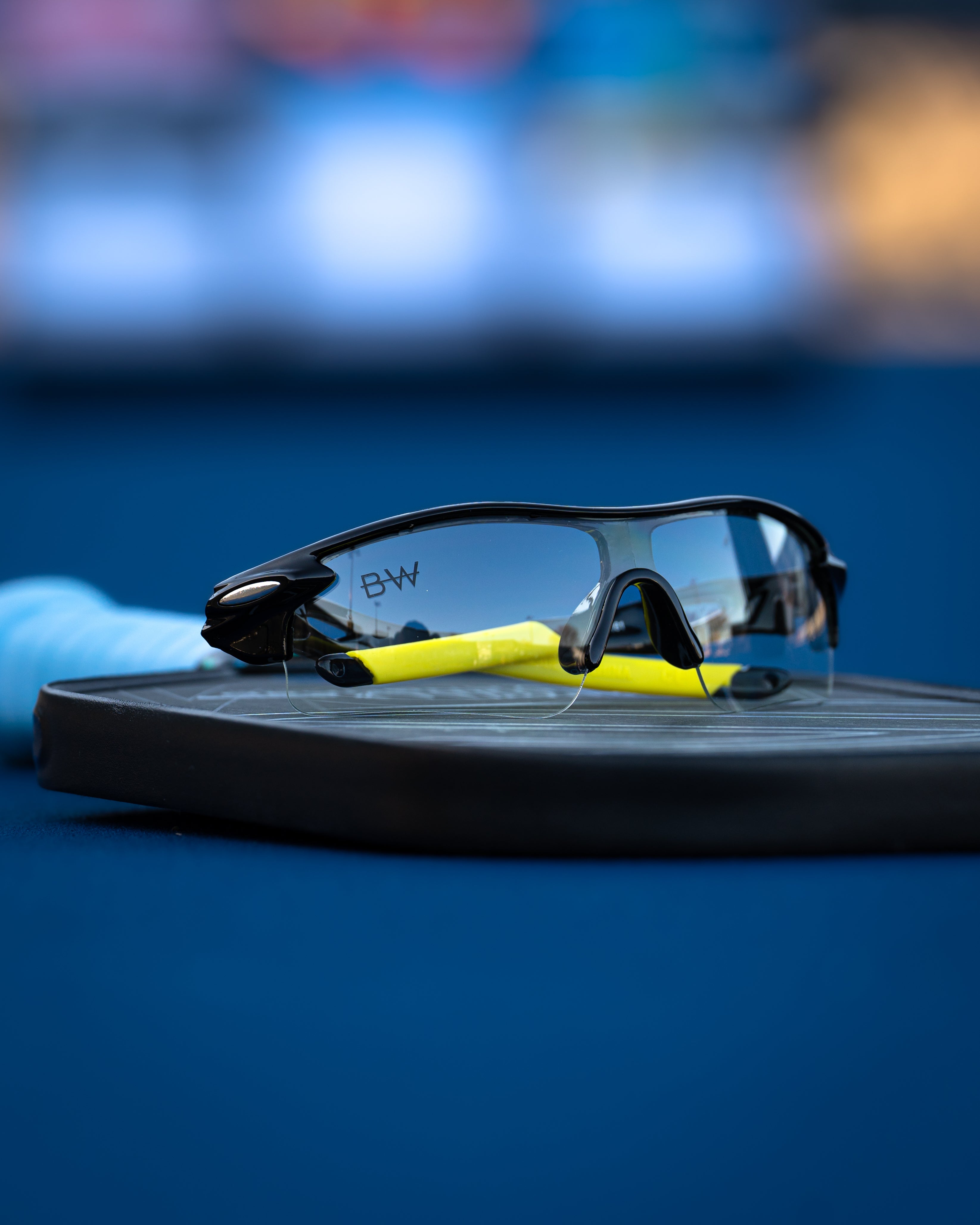
Best Pickleball Sunglasses for Clarity, Comfort, and Court Performance
Share
Find Your Pickleball Sunglasses
Looking for eyewear for pickleball? Compare prescription and Non-RX options by playing environment, frame fit, physical coverage, lens preferences, and verified product characteristics.
Best Pickleball Sunglasses for Clarity, Comfort, and Court Performance
The best pickleball sunglasses are not determined by one lens color, one frame shape, or one performance claim. The right eyewear depends on your individual vision, playing environment, fit preferences, prescription requirements, and the verified characteristics of the specific frame-and-lens configuration.
Pickleball also places practical demands on eyewear. Players move laterally, approach the kitchen, retreat toward the baseline, bend, reach, serve, volley, and may spend hours on the court during a single session.
That makes several characteristics worth comparing:
- Prescription or Non-RX construction
- Frame fit and dimensions
- Physical lens coverage
- Clear or tinted lens preferences
- Polarized or non-polarized options
- Indoor versus outdoor use
- Impact-resistant lens options
- Comfort during extended play
- Verified UV specifications
- Personal style
This guide explains how to compare those characteristics without relying on unsupported promises about reaction time, depth perception, ball tracking, or guaranteed athletic performance.
What Makes Sunglasses Good for Pickleball?
Good pickleball eyewear should make sense for the individual player and the environment in which it will be used.
Important characteristics can include:
Appropriate Vision Correction
If you require an eyeglass prescription, your corrective-vision needs should be addressed before considering style or performance marketing.
Comfortable Frame Fit
Consider frame width, bridge fit, temple fit, frame geometry, and how the complete eyewear feels during your normal playing duration.
Physical Coverage
Sports-oriented frames can provide different amounts of physical coverage. Choose according to your preferences and intended use.
Appropriate Lens Configuration
Outdoor sunlight, indoor courts, evening play, and mixed environments can lead players to prefer different lens configurations.
Verified Product Characteristics
Impact resistance, UV specifications, polarization, anti-fog properties, scratch resistance, and other characteristics should be verified for the specific eyewear rather than assumed.
Quick Guide: Choosing Pickleball Sunglasses by Player Need
| Player Need | What to Consider |
|---|---|
| Outdoor Player | Tint preference, fit, physical coverage, prescription needs, and verified lens characteristics |
| Indoor Player | Clear or other available lens configurations appropriate for the environment |
| Prescription Player | RX compatibility, direct RX or RX Clip construction, fit, and playing environment |
| Non-RX Player | Frame fit, coverage, available lens configuration, and environment |
| Frequent Player | Long-session comfort, fit, playing environments, and equipment condition |
| Tournament Player | Comfort, prescription needs, multiple environments, and potential backup eyewear |
| Style-Focused Player | Frame and lens appearance after practical requirements are addressed |
Do Pickleball Sunglasses Improve Court Performance?
Sunglasses should not be treated as automatic athletic-performance enhancers.
Pickleball performance involves:
- Technique
- Positioning
- Anticipation
- Decision-making
- Reaction time
- Movement
- Communication
- Experience
- Physical conditioning
Appropriate eyewear can support the player's individual vision requirements and provide an eyewear configuration suited to court use. It does not create those athletic skills.
Pickleball Sunglasses and Visual Clarity
"Clarity" is commonly used when discussing sports eyewear, but it should not be treated as a promise that one pair of sunglasses will make every player see a pickleball better.
What you see on the court can be influenced by:
- Your individual vision
- Your prescription when corrective vision is required
- Environmental brightness
- Indoor or outdoor lighting
- Lens tint
- Ball color
- Court color
- Background colors
- Weather conditions
- The complete eyewear configuration
The goal is to select eyewear appropriate for your visual requirements and playing environment rather than assuming one lens produces superior clarity for everyone.
Can Pickleball Sunglasses Improve Ball Tracking?
No pair of sunglasses can guarantee better ball tracking.
Tracking a moving pickleball involves individual vision, attention, experience, anticipation, lighting, environmental conditions, ball movement, and other factors.
Lens color can change how an environment appears through the lens, but a particular tint should not automatically be described as making the ball easier to track for every player.
Can Pickleball Sunglasses Improve Reaction Time?
Sunglasses do not directly increase neurological reaction speed.
Reaction time involves receiving visual information, processing that information, making a decision, and initiating a physical response.
Appropriate vision correction can address a player's corrective-vision needs, but sunglasses should not be marketed as making the nervous system react faster.
Do Pickleball Sunglasses Improve Depth Perception?
No lens configuration should automatically be described as improving depth perception.
Depth perception involves the visual system and is not determined solely by:
- Lens tint
- Lens color
- Polarization
- Non-polarization
- Frame shape
- Wraparound styling
Players who require corrective vision should prioritize an appropriate prescription rather than relying on claims that a particular sunglass lens will enhance depth perception.
Polarized vs. Non-Polarized Pickleball Sunglasses
Polarization is one of the most commonly misunderstood characteristics in court eyewear.
Polarized lenses contain a filter designed to reduce certain reflected light. Non-polarized lenses do not contain that polarization filter.
| Characteristic | Polarized | Non-Polarized |
|---|---|---|
| Polarization Filter | Yes | No |
| Designed to Reduce Certain Reflected Light | Yes | No added polarization filter |
| Automatically Improves Depth Perception | No | No |
| Automatically Improves Ball Tracking | No | No |
| Automatically Improves Reaction Time | No | No |
| Determines UV Specifications | No | No |
Are Non-Polarized Sunglasses Better for Pickleball?
Some pickleball and court-sport players prefer non-polarized lenses, but non-polarized sunglasses are not universally better for pickleball.
In particular, non-polarized eyewear should not automatically be claimed to provide:
- Better depth perception
- More accurate depth perception
- Better contrast
- Better ball tracking
- Faster reaction time
- Greater shot accuracy
Blinded Wear offers non-polarized lens options for players who prefer that configuration.
Do Polarized Sunglasses Distort Depth Perception?
Polarization alone should not be described as distorting depth perception.
Likewise, choosing a non-polarized lens does not automatically improve depth perception.
Your individual vision, prescription if applicable, lighting, playing environment, and complete eyewear configuration all contribute to what you see on the court.
Can Polarized Sunglasses Affect Digital Screens?
Polarized lenses can interact with some digital displays depending on the display technology, viewing angle, screen orientation, and lens orientation.
This characteristic is separate from depth perception and should not be used as evidence that polarized lenses are inherently unsuitable for pickleball.
Best Lens Color for Pickleball Sunglasses
There is no single lens color that is universally best for every pickleball player.
When choosing a tint, consider:
- Environmental brightness
- Indoor versus outdoor play
- Your individual vision
- Your prescription if applicable
- Personal tint preferences
- The complete lens configuration
Lens color can affect visible-light transmission and how an environment appears through the lens, but color alone does not guarantee better contrast, ball tracking, depth perception, or reaction time.
For a deeper explanation, visit the Pickleball Performance Lens Guide.
Are Gray Lenses Good for Pickleball?
Gray is one possible tint preference for outdoor sports eyewear.
However, gray lenses should not automatically be described as the best choice for pickleball or as guaranteeing better contrast, visibility, or ball tracking.
The appropriate tint depends on the individual player and playing environment.
Are Blue Lenses Good for Pickleball?
Blue lens appearances are available in some sports-eyewear designs and can be chosen as a style or lens preference where offered.
A blue appearance alone should not be interpreted as evidence that the lens improves contrast, reaction time, depth perception, or ball tracking.
Does a Darker Lens Mean Better Pickleball Sunglasses?
No. A darker lens is not automatically a better sports lens.
Tint darkness should be considered in relation to the environment where the eyewear will be used.
Darkness also does not by itself establish:
- UV specifications
- Impact resistance
- Polarization
- Anti-glare coatings
- Better contrast
- Better ball tracking
Best Pickleball Sunglasses for Outdoor Courts
Players who spend most of their time on bright outdoor courts may prefer tinted sports sunglasses.
When comparing outdoor pickleball eyewear, consider:
- Tint preferences
- Environmental brightness
- Frame fit
- Physical coverage
- Prescription requirements
- Polarized or non-polarized preferences where available
- Verified UV specifications
- Verified impact-resistant characteristics
- Comfort during longer sessions
No single outdoor model is universally best for every player.
Best Pickleball Eyewear for Indoor Courts
Players who do not want a dark sunglass tint indoors can consider clear sports eyewear.
Blinded Wear's Clear Lens Collection provides Non-RX options for players who prefer sports-oriented eyewear without a dark tint.
Clear does not automatically mean:
- Anti-fog
- Anti-reflective
- Scratch-resistant
- Blue-light filtering
- Contrast-enhancing
- Prescription
Those characteristics should be verified separately where relevant.
Can Clear Lenses Improve Indoor Pickleball Performance?
A clear lens avoids a dark sunglass tint. It does not create additional environmental light or automatically improve contrast, reaction time, depth perception, or ball tracking.
Players should choose indoor eyewear according to their individual vision, prescription requirements if applicable, fit preferences, and available lens configuration.
Can You Use the Same Pickleball Glasses Indoors and Outdoors?
Potentially. Whether one pair works for both environments depends on the lens configuration, environmental conditions, your individual vision, and your preferences.
Some players may prefer one versatile setup, while others may prefer separate eyewear for indoor and outdoor courts.
There is no requirement that every pickleball player use the same pair in every environment.
Prescription vs. Non-RX Pickleball Sunglasses
The main difference is whether the eyewear itself provides prescription correction.
| Feature | Prescription Pickleball Eyewear | Non-RX Pickleball Eyewear |
|---|---|---|
| Corrective Vision | Yes | No |
| For Players Who Require an Eyeglass Prescription | Designed to incorporate prescription correction | Does not provide prescription correction |
| Sports-Oriented Designs | Available | Available |
| Automatically Better for Pickleball | No | No |
If you require corrective vision, browse Prescription Pickleball Glasses.
If you do not need prescription correction in the eyewear itself, browse Non-RX Pickleball Sunglasses.
Direct RX vs. RX Clip Pickleball Eyewear
Blinded Wear prescription eyewear can use different RX constructions depending on the product.
Direct RX
With direct RX eyewear, the primary prescription lenses provide corrective vision.
RX Clip
With an RX Clip system, a separate inner prescription insert provides corrective vision within compatible eyewear.
The primary outer sports lens remains separate from the prescription insert in an RX Clip configuration.
Neither construction is universally better. The appropriate option depends on your prescription, frame preferences, available product configurations, fit, and intended use.
High-Index Prescription Lenses for Pickleball
Blinded Wear RX products include high-index prescription lenses at no additional cost.
High-index refers to a category of prescription lens material commonly used to help manage lens thickness, particularly as prescription strength increases.
Final lens thickness depends on factors including:
- Your individual prescription
- Lens dimensions
- Frame dimensions
- Lens geometry
- Lens design
- Other optical requirements
High-index does not automatically mean more durable, more impact-resistant, shatterproof, lighter in every configuration, or safety-certified.
Impact-Resistant Pickleball Sunglasses
Impact resistance is a practical characteristic to consider for eyewear used during an active court sport.
Blinded Wear offers impact-resistant lens options.
Impact-resistant does not mean shatterproof and does not establish a particular protective-eyewear certification or safety rating.
If your activity requires eyewear meeting a specific protective standard, verify that requirement and certification separately.
Are Pickleball Sunglasses Protective Eyewear?
Not automatically.
Sports-oriented styling, wraparound geometry, physical coverage, or impact-resistant lens characteristics do not by themselves establish a particular protective-eyewear certification.
Players seeking eyewear for a specific protective requirement should verify the relevant certification for the complete frame-and-lens system.
Does Wraparound Eyewear Improve Peripheral Vision?
Wraparound-style eyewear can provide different frame geometry and physical coverage than flatter everyday frames.
However, wraparound construction should not automatically be described as improving biological peripheral vision.
It also does not by itself establish better ball tracking, faster reaction time, impact resistance, or safety certification.
Comfort: One of the Most Important Pickleball Eyewear Factors
Pickleball sessions can last far longer than a single game, making comfort an important part of comparing sports eyewear.
Consider:
- Overall frame dimensions
- Bridge fit
- Temple fit
- Frame geometry
- Physical coverage
- Finished eyewear weight
- Prescription lens configuration if applicable
- How the eyewear feels during your typical playing duration
Comfort is individual. A frame that feels comfortable to one player may fit another player differently.
Do Pickleball Sunglasses Need a No-Slip Fit?
Players naturally want eyewear that fits appropriately during movement, but terms such as "no-slip," "bounce-free," and "locked in" should not be treated as universal guarantees.
Fit can vary according to:
- Individual facial dimensions
- Bridge fit
- Temple fit
- Frame geometry
- Movement
- Perspiration
- Environmental conditions
Compare actual frame dimensions and your individual fit rather than relying exclusively on fit-related marketing language.
Do Pickleball Sunglasses Need Anti-Fog Lenses?
Anti-fog performance is not an automatic characteristic of sports sunglasses.
Fogging can be influenced by temperature, humidity, perspiration, airflow, frame geometry, and transitions between environments.
If anti-fog performance is important to you, verify whether the exact product or lens configuration includes a relevant feature.
Are Pickleball Sunglasses Scratch-Resistant?
Not automatically.
Scratch resistance is separate from:
- Impact resistance
- Polarization
- Lens tint
- Prescription correction
- High-index lens material
- Sports-oriented frame design
Verify scratch-resistant characteristics for the specific lens rather than assuming every pair of pickleball sunglasses includes them.
How to Compare the Best Pickleball Sunglasses
A useful comparison should focus on the characteristics that actually differ between eyewear options.
- Determine whether you need RX or Non-RX eyewear.
- Identify your primary playing environment. Consider indoor, outdoor, evening, or mixed use.
- Compare frame dimensions and fit.
- Decide how much physical coverage you prefer.
- Compare clear and tinted options where available.
- Consider polarized or non-polarized preferences where available.
- Verify impact-resistant characteristics.
- Verify UV specifications rather than assuming them from tint.
- Verify specialized features such as anti-fog or scratch resistance separately.
- Consider comfort during your typical playing duration.
- Choose the appearance you prefer once your practical needs are addressed.
Best Pickleball Sunglasses by Playing Environment
The conditions around the court can be just as important as the frame itself. A player who spends most sessions outdoors in bright conditions may prefer a different lens configuration than someone who primarily plays indoors.
Instead of looking for one pair labeled "best for every court," compare eyewear according to where and when you actually play.
| Playing Environment | What to Consider |
|---|---|
| Bright Outdoor Courts | Tint preference, physical coverage, frame fit, prescription needs, and verified lens characteristics |
| Indoor Courts | Clear or other available lens configurations appropriate for the environment |
| Evening Play | Available lens configuration, remaining environmental light, fit, and prescription needs |
| Mixed Indoor and Outdoor Play | Whether one configuration meets your needs or separate eyewear is preferable |
| Long Tournament Days | Comfort, changing environments, prescription needs, fit, and backup eyewear |
Best Pickleball Sunglasses for Bright Outdoor Courts
Outdoor pickleball players often spend extended periods in changing natural light. A tinted sports lens may be preferable when playing in brighter environments.
When comparing outdoor sunglasses, evaluate the complete configuration rather than assuming the darkest lens is automatically the best.
Consider:
- Your individual vision
- Your prescription if corrective vision is required
- Environmental brightness
- Available tint
- Frame fit
- Physical coverage
- Polarized or non-polarized preferences where available
- Verified UV specifications
- Verified impact-resistant characteristics
Best Pickleball Eyewear for Indoor Courts
Indoor players may not want the same dark tint they would choose for bright outdoor conditions.
Players who do not require prescription correction in their sports eyewear can explore the Blinded Wear Non-RX Clear Lens Collection.
Clear lenses provide an option for players who want sports-oriented eyewear without a dark sunglass tint.
Clear should not be interpreted as automatically providing better contrast, improved ball tracking, enhanced depth perception, faster reaction time, or additional environmental light.
Best Pickleball Eyewear for Evening Play
As environmental light changes later in the day, a dark sunglass tint may not match every player's preferences.
For evening pickleball, compare:
- Available environmental light
- Clear versus tinted lens preferences
- Your prescription requirements
- Frame fit
- Physical coverage
- The specific lens configuration available
There is no universal lens that automatically adapts to every evening court or lighting condition.
Best Pickleball Sunglasses for Recreational Players
Recreational players do not necessarily need the most complicated eyewear configuration available.
Start with practical needs:
- Do you require prescription correction?
- Where do you normally play?
- How long are your typical sessions?
- What frame dimensions fit your preferences?
- How much physical coverage do you want?
- Do you prefer clear or tinted eyewear?
A recreational player can benefit from the same careful product comparison as a competitive player without needing equipment marketed as "professional" or "elite."
Best Pickleball Sunglasses for Beginners
Beginners can keep the selection process simple.
- Determine whether you need prescription correction.
- Identify whether you primarily play indoors or outdoors.
- Compare frame dimensions and fit.
- Choose the amount of physical coverage you prefer.
- Compare available lens configurations.
- Verify specialized lens characteristics separately.
Your pickleball skill level does not determine your vision requirements or automatically require a particular lens color.
Best Pickleball Sunglasses for Competitive Players
Frequent and competitive players may place greater emphasis on extended-wear comfort, consistent fit preferences, changing court environments, prescription correction when needed, and backup eyewear.
Useful comparison points include:
- Comfort during longer sessions
- Frame fit during active movement
- Prescription requirements
- Indoor and outdoor court use
- Physical coverage
- Verified lens characteristics
- Condition of the eyewear
- Whether backup eyewear would be useful
Competitive use does not mean a particular frame will create a competitive advantage. The purpose of the eyewear is to meet the player's visual, fit, environmental, and equipment preferences.
Best Pickleball Sunglasses for Long Playing Sessions
Comfort becomes increasingly important when eyewear is worn through multiple games or extended court sessions.
When comparing frames for longer use, consider:
- Frame dimensions
- Bridge fit
- Temple fit
- Frame geometry
- Finished eyewear weight
- Physical coverage
- Prescription lens configuration if applicable
Comfort is personal. No frame can be guaranteed to feel the same for every wearer.
Are Lightweight Sunglasses Better for Pickleball?
Some players prefer lightweight sports eyewear, particularly during extended sessions.
However, finished eyewear weight can depend on several components:
- Frame construction
- Frame dimensions
- Lens dimensions
- Lens material
- Prescription strength where applicable
- Finished lens thickness
Lower weight may contribute to personal comfort, but it should not automatically be described as improving reaction time, endurance, or pickleball performance.
How Should Pickleball Sunglasses Fit?
Fit should be evaluated according to the individual wearer rather than broad promises that a frame will never move.
Consider:
- Overall frame width
- Bridge fit
- Temple fit
- Frame geometry
- Physical coverage
- Finished eyewear weight
- How the eyewear feels during movement
A frame that works well for one player may fit another player differently.
Do Face Shape Guides Help Choose Pickleball Sunglasses?
Face-shape categories can be used as a general style reference, but they should not replace actual frame dimensions and individual fit.
Instead of assuming one frame is automatically best for a round, oval, narrow, or wide face, compare measurable characteristics such as:
- Frame width
- Bridge dimensions
- Temple dimensions
- Lens dimensions
- Frame geometry
Your experience with the dimensions of eyewear you already find comfortable can also provide a useful comparison point.
How Much Lens Coverage Do Pickleball Players Need?
There is no universal amount of physical coverage required for every pickleball player.
Some players prefer larger sports-oriented lens shapes or wraparound-style frames, while others prefer a lower-profile design.
More physical coverage should not automatically be interpreted as:
- Better peripheral vision
- Better ball tracking
- Faster reactions
- Better depth perception
- Greater impact resistance
- Safety certification
Choose according to fit, intended use, and personal preference.
Should Pickleball Sunglasses Have UV Protection?
UV specifications are an important consideration for eyewear used outdoors, but they should be verified for the exact lens rather than inferred from its appearance.
A dark tint, mirrored appearance, lens color, or polarization does not by itself establish a particular UV specification.
When UV characteristics matter to your purchase, review the verified specifications for the specific lens configuration.
Does UV400 Mean the Same Thing as Polarized?
No. UV specifications and polarization describe different lens characteristics.
Polarization refers to a filter designed to reduce certain reflected light. UV specifications concern ultraviolet light.
A lens should not be assumed to have a particular UV specification simply because it is polarized, non-polarized, dark, clear, or mirrored.
Do Pickleball Sunglasses Need Glare-Reducing Lenses?
Glare-related characteristics should be evaluated according to the specific lens rather than assumed from sports marketing.
Polarized lenses are designed to reduce certain reflected light, but polarization is only one lens characteristic and is not universally required for pickleball.
Terms such as "anti-glare" or "glare-reducing" should only be applied when those characteristics are verified for the particular lens.
Do Contrast-Enhancing Lenses Help Pickleball Players?
Different lens tints can change how colors and environmental brightness appear through the lens.
However, "contrast-enhancing" should not be applied broadly to every sports lens unless that characteristic is established for the specific product.
Even when a particular lens changes perceived contrast, it should not automatically be claimed to improve:
- Ball tracking
- Depth perception
- Reaction time
- Shot accuracy
- Match performance
Top Blinded Wear Prescription Pickleball Styles to Compare
Players who require corrective vision can browse the full Blinded Wear Prescription Pickleball Glasses Collection.
Direct RX styles to compare include:
- Zebra II RX
- Steel Ice RX
- Blue Shield RX
- Frost RX
- Gray Wash RX
- Crystal Wave II RX
- Lava Rock RX
- Havana Melt RX
These styles should be compared according to your prescription requirements, frame preferences, fit, physical coverage, playing environment, available lens configuration, and personal style rather than being ranked by unsupported performance claims.
How to Compare Prescription Pickleball Sunglasses
If you require corrective vision, start with your prescription rather than the appearance of the frame.
Then compare:
- Direct RX versus RX Clip construction where available
- Prescription compatibility
- Frame dimensions
- Lens dimensions
- Frame geometry
- Physical coverage
- Available lens configuration
- Indoor versus outdoor use
- Comfort
- Personal style
For a dedicated RX comparison, browse the Prescription Pickleball Eyewear Collection.
How to Compare Non-RX Pickleball Sunglasses
Players who do not need corrective vision in the eyewear itself can focus on frame fit, playing environment, physical coverage, available lens configuration, verified product characteristics, and personal style.
Browse the Blinded Wear Non-RX Pickleball Sunglasses Collection to compare available options.
If you wear contact lenses for vision correction, you may also choose to use contacts with Non-RX sports eyewear according to your individual vision-care needs and preferences.
How to Compare Clear vs. Tinted Pickleball Eyewear
| Characteristic | Clear Lens | Tinted Lens |
|---|---|---|
| Dark Sunglass Tint | No | Yes, depending on the lens |
| Potential Use | Indoor, evening, or players who do not want a dark tint | Often considered for outdoor environments depending on tint |
| Automatically Improves Contrast | No | No |
| Automatically Improves Ball Tracking | No | No |
| Automatically Establishes UV Specifications | No | No |
| Automatically Safety-Certified | No | No |
Should Tournament Players Carry Backup Pickleball Eyewear?
Backup eyewear is optional, but some frequent or tournament players may find it practical.
A second pair may be useful when:
- You depend on prescription eyewear to play
- You travel for events
- You play in different lighting environments
- You prefer different eyewear for indoor and outdoor courts
- Your primary pair becomes damaged
Backup eyewear is an equipment-planning choice rather than a performance requirement.
Can Pickleball Sunglasses Be Used for Tennis?
Potentially. Sports eyewear can sometimes be used across multiple court activities when its fit, lens configuration, prescription correction if applicable, physical coverage, and other characteristics are appropriate for the intended use.
If another sport or activity requires a specific protective-eyewear standard, verify that requirement separately.
How Often Should You Replace Pickleball Sunglasses?
There is no universal replacement schedule for every pair of sports sunglasses.
Consider reevaluating your eyewear when:
- The frame becomes damaged
- The lenses become damaged
- The eyewear no longer fits appropriately
- Your prescription changes
- Your playing environment changes
- Your eyewear preferences change
- The eyewear experiences a significant impact and you are uncertain about its condition
How to Care for Pickleball Sunglasses
Sports eyewear can be exposed to perspiration, repeated handling, transportation, and frequent cleaning.
Useful care habits include:
- Following the care instructions for your specific eyewear
- Using appropriate lens-cleaning materials
- Using a clean microfiber cloth when appropriate
- Avoiding rubbing abrasive debris across the lens surface
- Avoiding placing lenses face-down on hard surfaces
- Storing eyewear securely when it is not being worn
- Protecting eyewear appropriately during transportation
Sports eyewear should not be assumed to be scratch-proof, shatterproof, or immune to damage.
Common Mistakes When Buying Pickleball Sunglasses
Choosing by Marketing Claims Instead of Your Needs
Claims about faster reactions, improved ball tracking, or automatic performance advantages should not replace practical product comparison.
Assuming Non-Polarized Means Better Depth Perception
Polarization status alone does not determine depth perception.
Assuming Dark Lenses Provide Better UV Protection
Tint darkness and UV specifications are separate characteristics.
Assuming Every Sports Lens Is Impact-Proof
Impact-resistant does not mean impact-proof or indestructible.
Assuming Wraparound Means Safety-Certified
Frame geometry and physical coverage do not establish a particular protective standard.
Ignoring Your Prescription
Players who require corrective vision should consider their prescription requirements before choosing a sports frame based primarily on appearance.
Assuming Clear Lenses Are Automatically Better Indoors
Clear lenses avoid a dark sunglass tint but do not automatically improve indoor vision or athletic performance.
Ignoring Fit
Even a frame with desirable lens characteristics may not be appropriate if its dimensions and geometry do not work for your individual fit preferences.
Pickleball Sunglasses Buying Checklist
Before choosing your eyewear, ask:
- Do I need prescription or Non-RX eyewear?
- If I need RX, do I prefer direct RX or an RX Clip configuration where available?
- Do I primarily play indoors, outdoors, or both?
- Do I prefer clear or tinted lenses?
- Do I prefer polarized or non-polarized eyewear where available?
- Do the frame dimensions work for my fit preferences?
- How much physical coverage do I want?
- How long are my typical playing sessions?
- What impact-resistant characteristics are verified?
- What UV specifications are verified?
- Have I verified any anti-fog or scratch-resistant characteristics separately?
- Does my activity require a particular protective-eyewear certification?
- Would separate indoor and outdoor eyewear make sense for me?
- Would backup eyewear be useful?
- Am I comparing verified characteristics instead of unsupported performance promises?
Pickleball Sunglasses FAQ
What are the best sunglasses for pickleball?
There is no single pair of sunglasses that is universally best for every pickleball player. Compare eyewear according to your prescription needs, playing environment, frame fit, physical coverage, available lens configuration, verified product characteristics, comfort, and personal style.
What should I look for in pickleball sunglasses?
Start with whether you need prescription correction, then consider where you normally play, frame dimensions, fit, physical coverage, clear or tinted lens preferences, polarized or non-polarized preferences where available, verified impact characteristics, verified UV specifications, and comfort.
Are pickleball sunglasses different from regular sunglasses?
Sports-oriented sunglasses can differ from everyday eyewear in frame geometry, physical coverage, fit, and available lens configurations. However, a "pickleball" or "sports" label does not automatically establish better performance, impact resistance, UV specifications, or safety certification.
Do I need sunglasses to play pickleball?
No. Sunglasses are not universally required to play pickleball. Players may choose eyewear according to their individual vision, environment, comfort preferences, and other needs.
Do I need different glasses for indoor and outdoor pickleball?
Not necessarily. Some players use one configuration across multiple environments, while others prefer different eyewear for indoor and outdoor courts. Consider the available light, lens configuration, prescription needs, and your individual preferences.
Are clear lenses good for indoor pickleball?
Clear sports eyewear can be considered by players who do not want a dark sunglass tint indoors. Clear lenses should not automatically be described as improving contrast, ball tracking, reaction time, or depth perception.
Does Blinded Wear offer clear pickleball glasses?
Yes. Blinded Wear offers a Non-RX Clear Lens Collection for players who prefer sports-oriented eyewear without a dark sunglass tint.
Are clear Blinded Wear glasses prescription?
The Clear Lens Collection referenced in this guide is Non-RX. Players who require corrective vision should browse the Prescription Pickleball Glasses Collection.
What lens color is best for outdoor pickleball?
No lens color is universally best for outdoor pickleball. Environmental brightness, individual vision, prescription requirements, available lens configurations, and personal preferences can all influence the choice.
Are gray lenses good for pickleball?
Gray is one possible tint preference for sports sunglasses. It should not automatically be described as the best pickleball tint or as guaranteeing improved contrast, visibility, or ball tracking.
Are darker sunglasses better for pickleball?
Not automatically. Tint darkness should be appropriate for the environment. A darker appearance does not by itself establish better UV protection, impact resistance, contrast, or sports performance.
Does a dark lens mean it has UV protection?
No. Tint darkness and UV specifications are separate characteristics. Verify the UV specifications for the exact lens configuration.
Does polarization mean UV protection?
No. Polarization and UV specifications describe different lens characteristics.
Are polarized sunglasses good for pickleball?
Some players may prefer polarized eyewear while others prefer non-polarized eyewear. Polarized lenses contain a filter designed to reduce certain reflected light, but polarization alone does not determine whether a pair is appropriate for an individual pickleball player.
Are non-polarized sunglasses better for pickleball?
Some pickleball and court-sport players prefer non-polarized lenses, but they are not universally better for pickleball.
Do polarized sunglasses distort depth perception?
Polarization alone should not be described as distorting depth perception.
Do non-polarized sunglasses improve depth perception?
No. Polarization status alone does not determine depth perception.
Do non-polarized lenses improve ball tracking?
No lens should be claimed to automatically improve ball tracking based solely on its polarization status.
Can pickleball sunglasses improve reaction time?
Sunglasses do not directly increase neurological reaction speed. Reaction time involves visual input, neurological processing, decision-making, anticipation, and physical response.
Can pickleball sunglasses improve ball tracking?
No pair can guarantee better ball tracking. Individual vision, prescription correction when needed, attention, experience, lighting, ball movement, court color, and background conditions can all contribute to what a player sees.
Can pickleball sunglasses improve depth perception?
Sunglasses should not automatically be described as improving depth perception. Depth perception involves the visual system and is not determined solely by tint, lens color, polarization, or frame shape.
Are wraparound sunglasses better for pickleball?
Some players prefer wraparound-style frames because of their geometry and physical coverage. Wraparound construction is not automatically better and does not by itself improve peripheral vision, reaction time, depth perception, or ball tracking.
Are lightweight sunglasses better for pickleball?
Some players prefer lightweight eyewear for extended use. Lower weight may contribute to personal comfort, but it should not automatically be described as improving athletic performance.
Should pickleball sunglasses stay completely still during play?
An appropriate fit is important, but no frame should be guaranteed to remain completely stationary for every wearer. Fit varies by individual facial dimensions, frame geometry, movement, perspiration, and environmental conditions.
Are pickleball sunglasses shatterproof?
Do not assume so. Blinded Wear offers impact-resistant lens options, but impact-resistant does not mean shatterproof, impact-proof, or indestructible.
Are pickleball sunglasses safety glasses?
Not automatically. Sports styling, physical coverage, wraparound geometry, or impact-resistant characteristics do not by themselves establish a particular protective-eyewear certification or safety rating.
Are pickleball sunglasses anti-fog?
Not automatically. If anti-fog performance is important to you, verify whether the exact product or lens configuration includes a relevant feature.
Are pickleball sunglasses scratch-resistant?
Not automatically. Scratch resistance should be verified separately for the specific lens configuration.
Can I get prescription pickleball sunglasses?
Yes. Blinded Wear offers Prescription Pickleball Glasses for players who require corrective vision.
What is direct RX pickleball eyewear?
Direct RX means the primary prescription lenses provide the wearer's corrective vision.
What is an RX Clip?
An RX Clip is a separate inner prescription insert within a compatible eyewear system. The inner RX insert provides prescription correction while the primary outer sports lens remains separate.
Does Blinded Wear include high-index prescription lenses?
Yes. Blinded Wear RX products include high-index prescription lenses at no additional cost.
Can I wear contacts with Non-RX pickleball sunglasses?
Some players use contact lenses for corrective vision and wear Non-RX sports eyewear over them. Whether that approach is appropriate depends on your individual vision-care needs and preferences.
Pickleball Sunglasses Myths vs. Facts
| Common Claim | What to Know |
|---|---|
| "The best pickleball sunglasses make you play better." | Eyewear does not automatically increase athletic skill or guarantee better results. |
| "Non-polarized lenses improve depth perception." | Polarization status alone does not determine depth perception. |
| "Polarized lenses distort depth perception." | Polarization alone should not be described as distorting depth perception. |
| "Certain lens colors improve ball tracking." | No lens color universally guarantees better ball tracking. |
| "Sports sunglasses improve reaction time." | Sunglasses do not directly increase neurological reaction speed. |
| "Darker lenses provide more UV protection." | Tint darkness and UV specifications are separate characteristics. |
| "Polarized means UV-protected." | Polarization and UV specifications are separate lens characteristics. |
| "Impact-resistant means shatterproof." | Impact-resistant eyewear can still potentially break or become damaged. |
| "Wraparound sunglasses are automatically safety glasses." | Frame geometry does not establish a protective-eyewear certification. |
| "Clear lenses improve indoor vision." | Clear lenses avoid a dark tint but do not automatically improve visual performance. |
| "Lightweight sunglasses improve endurance." | Weight can affect personal comfort preferences but does not automatically improve athletic endurance. |
| "One pair is best for every pickleball player." | Individual vision, prescription needs, fit, environment, and preferences differ between players. |
How to Order Blinded Wear Prescription Pickleball Glasses
If you require corrective vision, Blinded Wear offers dedicated RX sports-eyewear options.
- Select your preferred RX product and available options.
- Have your current eyeglass prescription ready.
- Upload a clear photo or picture of your eyeglass prescription on the product page before adding the eyewear to your cart.
- Your prescription information will be associated with your custom RX eyewear order.
For additional information, visit How to Order RX Glasses.
Blinded Wear RX Returns and Final-Sale Policy
Blinded Wear maintains a 30-day return policy for eligible purchases. However, customized prescription eyewear is final sale and excluded from the standard 30-day return policy.
Because prescription eyewear is customized, review your prescription information, selected frame, and currently available product options carefully before ordering.
For current eligibility and policy details, review the Blinded Wear Protection Plan, Replacement & Returns information.
Blinded Wear 50% Lifetime Replacement Support
Blinded Wear offers 50% lifetime replacement support if eligible glasses break, subject to current policy terms.
For an eligible replacement claim:
- The damaged eyewear must be returned.
- The claim and returned eyewear must meet current policy requirements.
- Once those requirements are met, the customer can receive 50% credit toward a replacement pair.
This is not a free full-replacement guarantee and should not automatically be interpreted as coverage for loss, a prescription change by itself, or every possible type of damage.
For damaged RX eyewear, contact blindedwearco@gmail.com before returning the pair.
Review the Blinded Wear Protection Plan, Replacement & Returns information for current eligibility and policy details.
How to Choose the Best Pickleball Sunglasses for You
Instead of starting with a product ranking, narrow your options in this order:
- Determine your vision requirements. Decide whether you need prescription or Non-RX eyewear.
- Identify your primary environment. Consider indoor, outdoor, evening, or mixed court use.
- Choose your general lens preference. Compare clear and tinted options where available.
- Consider polarization preferences. Compare polarized and non-polarized options where available without assuming either automatically improves depth perception or ball tracking.
- Compare frame dimensions. Use measurable fit characteristics rather than face-shape labels alone.
- Choose your preferred physical coverage.
- Verify product characteristics. Check impact resistance, UV specifications, anti-fog properties, scratch resistance, and other features individually when they matter to you.
- Consider extended-wear comfort.
- Choose your preferred style. Once your practical requirements are addressed, select the design you like.
Final Pickleball Sunglasses Checklist
Before purchasing, ask:
- Do I need prescription or Non-RX eyewear?
- If I need prescription correction, is my prescription current for my needs?
- Do I primarily play indoors, outdoors, or both?
- Do I want clear or tinted lenses?
- Do I prefer polarized or non-polarized eyewear where available?
- Do the frame dimensions work for my fit preferences?
- How much physical coverage do I prefer?
- How long are my normal playing sessions?
- What impact-resistant characteristics are verified?
- What UV specifications are verified?
- Have I separately verified any anti-fog or scratch-resistant characteristics that matter to me?
- Does my intended activity require a specific protective-eyewear certification?
- Would separate indoor and outdoor eyewear be useful?
- Would backup eyewear be practical?
- Am I evaluating verified characteristics rather than unsupported performance claims?
Explore More Pickleball Eyewear Resources
Continue comparing your options with these Blinded Wear resources:
- Best Pickleball Glasses 2026 — explore the main RX and Non-RX pickleball eyewear guide.
- Non-RX Pickleball Sunglasses — browse sports eyewear without prescription correction.
- Prescription Pickleball Glasses — browse RX eyewear for players who require corrective vision.
- Non-RX Clear Lens Collection — explore sports eyewear without a dark sunglass tint.
- Pickleball Performance Lens Guide — learn about lens colors, clarity considerations, and RX options.
- How to Order RX Glasses — review the prescription-ordering process.
- Pickleball Sunglasses Quiz — narrow your eyewear options according to your preferences.
- Protection Plan, Replacement & Returns — review current policy information.
Clarity, Comfort, and Court Performance: What Actually Matters?
The best pickleball sunglasses are not the pair with the longest list of performance promises. They are the eyewear configuration that appropriately addresses your individual vision, playing environment, fit preferences, and intended use.
For clarity, begin with your individual vision and prescription requirements when applicable.
For comfort, compare actual frame dimensions, geometry, physical coverage, finished eyewear configuration, and how the frame works for you during extended use.
For court performance, remember that the player creates the performance. Eyewear does not manufacture reaction speed, anticipation, positioning, ball tracking, depth perception, technique, or decision-making.
Choose eyewear that supports your needs without relying on promises that a particular tint, frame, or lens will transform your game.
Find Your Blinded Wear Pickleball Eyewear
Ready to narrow your options?
If you do not need prescription correction in the eyewear itself, browse Non-RX Pickleball Sunglasses.
If you require corrective vision, explore Prescription Pickleball Glasses.
For indoor, evening, or other situations where you prefer eyewear without a dark sunglass tint, explore the Non-RX Clear Lens Collection.
Still deciding? Take the Pickleball Sunglasses Quiz or visit the 2026 Pickleball Glasses Guide to continue comparing your options.