
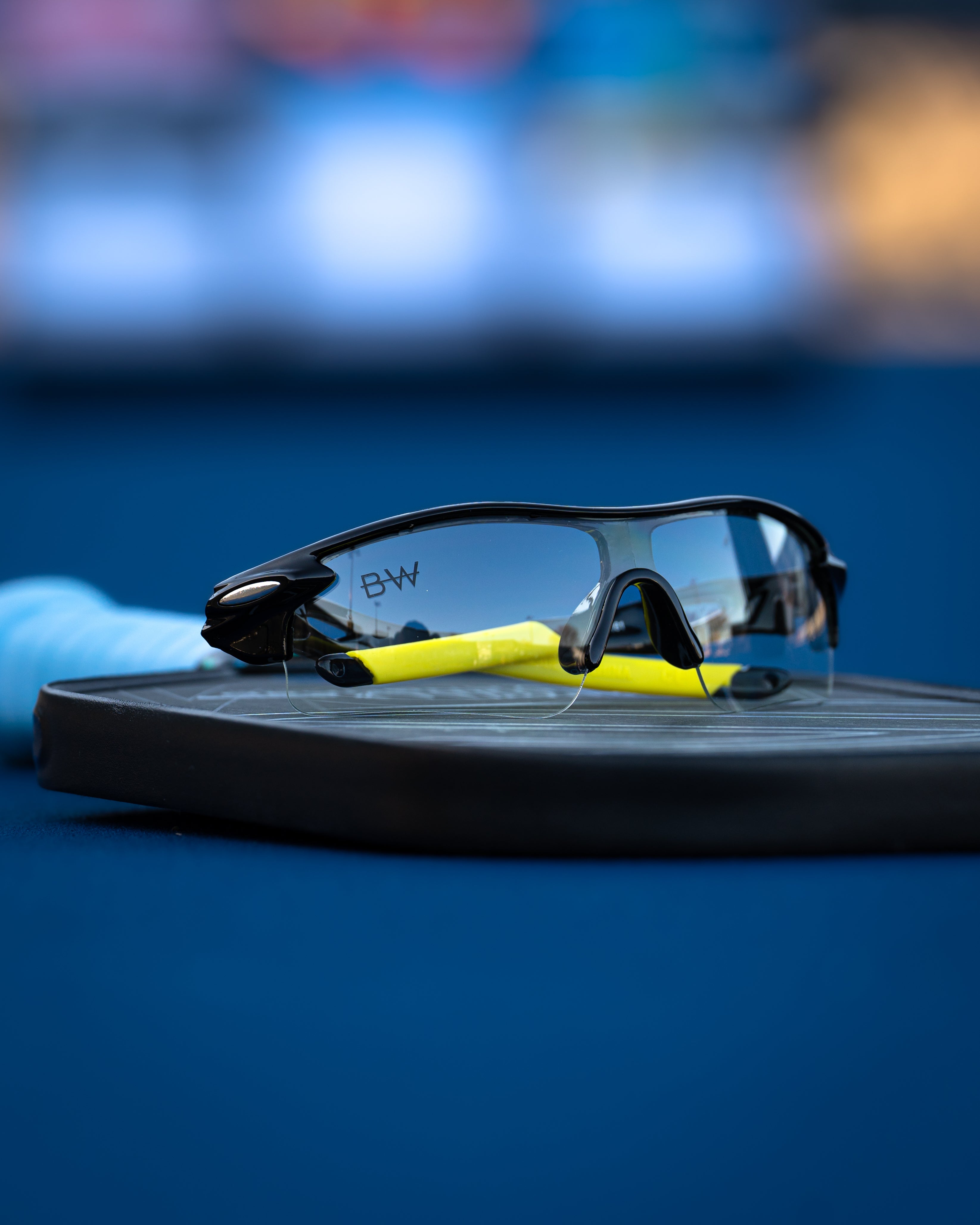
Best Prescription Pickleball Glasses for Every Skill Level
Share
Best Prescription Pickleball Glasses for Every Skill Level
The best prescription pickleball glasses depend less on whether you are a beginner, intermediate, or advanced player and more on your prescription, fit, playing environment, comfort needs, and how often you play. Skill level can still help shape the buying decision because newer players may prioritize simplicity and value, while frequent or competitive players may care more about extended comfort, dedicated sports fit, and having a reliable backup setup.
Blinded Wear offers prescription pickleball eyewear with high-index RX lenses at no additional cost, lightweight sports frames, impact-resistant lenses, non-polarized lenses, and performance-first designs intended for both recreational and competitive players.
This guide breaks down the best way to choose prescription pickleball glasses for beginners, intermediate players, advanced players, and tournament competitors without relying on unsupported performance claims or fake rankings.
Shop Prescription Pickleball Glasses
Why Prescription Pickleball Glasses Matter at Every Skill Level
If you need prescription correction to see clearly during everyday life, your pickleball setup should also account for those visual needs.
Prescription sports eyewear can provide a dedicated solution that combines corrective lenses with a frame selected for active use. That does not mean sports RX glasses automatically improve your game, but they can be more practical for players who want a separate court-focused setup.
Useful buying factors include:
- Prescription compatibility
- Frame fit
- Frame weight
- Lens construction
- Comfort during movement
- Playing environment
- How often you play
- Total prescription cost
- Replacement coverage
Do Beginners and Advanced Players Need Different Pickleball Glasses?
Not necessarily.
A beginner and an advanced player can both need the same fundamental things:
- An appropriate prescription
- A frame that fits
- Comfort during movement
- A lens setup suited to the court
- Verified lens construction
The main difference is often how heavily each factor is weighted.
| Skill Level | Typical Buying Priority |
|---|---|
| Beginner | Simplicity, comfort, value, and prescription compatibility |
| Intermediate | More frequent use, fit, court versatility, and comfort |
| Advanced | Extended wear, consistent fit, verified lens features, and backup planning |
| Tournament player | Familiarity, reliability, long-session comfort, and a tested backup setup |
Best Prescription Pickleball Glasses for Beginners
Beginners should usually keep the decision simple.
Instead of chasing advanced coatings, extreme frame shapes, or marketing-heavy performance claims, focus first on:
- Correct prescription information
- Frame compatibility
- Comfort
- Lightweight construction
- Verified impact-resistant lenses
- A lens configuration that works where you normally play
- A completed RX price that fits your budget
For a first dedicated sports pair, the best choice is often the one that removes obvious problems without adding unnecessary complexity.
What Beginners Should Avoid
New players are especially vulnerable to exaggerated sports-eyewear marketing.
Avoid buying solely because a product claims to:
- Improve reaction time
- Track the ball better
- Increase court awareness
- Prevent all fogging
- Never slip
- Improve rankings
- Guarantee better performance
Appropriate eyewear can support your vision and comfort, but your improvement as a pickleball player comes primarily from practice, technique, positioning, movement, and decision-making.
Beginners: Start With Where You Actually Play
Your playing environment should guide lens selection more than your skill rating.
| Where You Play | What to Consider |
|---|---|
| Mostly indoors | An untinted or otherwise appropriate lower-brightness setup |
| Mostly outdoors | An available lens configuration suited to brighter conditions |
| Indoor and outdoor | Whether one versatile configuration or separate pairs makes more sense |
| Evenings or night | A lens setup appropriate for lower-light conditions |
Do not assume every Blinded Wear RX frame offers every tint, clear, or photochromic option. Verify the exact product before ordering.
Best Value for New Pickleball Players
Beginners often benefit from comparing the finished prescription price rather than the frame price alone.
Blinded Wear includes high-index prescription lenses at no additional cost, which can make the total RX package easier to evaluate.
Compare:
- Frame cost
- Prescription lens cost
- High-index lens upcharges
- Any selected lens options
- Shipping or other applicable charges
- Replacement coverage
Best Prescription Pickleball Glasses for Intermediate Players
Intermediate players often start playing more frequently, joining leagues, trying different facilities, or spending longer periods on court.
At this stage, the buying decision may shift toward:
- Extended comfort
- Reliable active fit
- A lens setup suited to multiple common environments
- Durability considerations
- Cost per use
- Whether a dedicated sports pair is more practical than everyday glasses
The more often you play, the more noticeable small fit and comfort issues can become.
Intermediate Players Should Pay More Attention to Fit
A frame that feels fine during a short recreational session may become distracting when you are playing several times per week.
Evaluate:
- Bridge comfort
- Temple pressure
- Overall frame width
- Frame weight
- How the eyewear feels during lateral movement
- How it feels after several games
No sports frame should be assumed to be completely slip-proof. Fit remains individual.
What if You Play Indoors and Outdoors?
Intermediate players frequently encounter more varied conditions as they join different leagues or courts.
Possible setups include:
- One prescription pair that works acceptably in your most common environment
- Separate indoor and outdoor prescription pairs
- An available photochromic configuration if it suits your needs
- Contacts combined with different non-RX sports glasses
Photochromic lenses should not be assumed to change instantly or behave identically in every environment. Availability and behavior depend on the exact lens technology.
Are Transition Lenses Good for Intermediate Pickleball Players?
They can be useful for some players who regularly move between lighting conditions, but they are not inherently an “intermediate-level” feature.
Before choosing a photochromic option:
- Confirm it is available for the exact frame.
- Understand how that specific technology behaves.
- Consider where you normally play.
- Decide whether convenience is more important than having separate specialized pairs.
Do Intermediate Players Need Anti-Fog Lenses?
Not automatically.
Fogging can depend on humidity, temperature, airflow, perspiration, frame position, and lens treatments.
If fogging is a recurring issue for you, verify whether the exact lens configuration includes a documented anti-fog treatment. Do not assume anti-fog technology comes standard with all prescription sports eyewear.
Best Prescription Pickleball Glasses for Advanced Players
Advanced players typically do not need “more advanced” glasses simply because their skill rating is higher.
What changes is how demanding their use can become.
Advanced players may care more about:
- Comfort across longer sessions
- A frame they already trust during movement
- Consistent prescription setup
- Verified lens construction
- Playing-environment compatibility
- Backup eyewear
- Replacement coverage
For frequent players, small discomforts or inconsistencies can become more annoying simply because the eyewear is being used more often.
Advanced Players Should Be Especially Skeptical of Performance Claims
High-level players may be targeted with claims that premium eyewear will create a competitive advantage.
Be cautious with promises of:
- Faster hand speed
- Improved reaction time
- Better depth perception
- Higher shot accuracy
- Superior ball tracking
- Improved rankings
A well-matched prescription and comfortable sports setup can remove distractions, but eyewear should not be presented as a shortcut to skill.
Impact Resistance Matters at Every Level
Blinded Wear uses impact-resistant lenses across its performance-first pickleball eyewear.
Impact resistance should not be confused with:
- Impact-proof construction
- Shatter-proof construction
- Unbreakability
- A guaranteed ability to prevent eye injury
- A specific protective certification unless documented
If you require a particular sports-protection certification, verify that standard for the exact product.
Should Advanced Players Use Polarized Pickleball Glasses?
Not necessarily.
Polarized lenses can reduce certain reflected glare, but they are not automatically superior for every pickleball player.
Blinded Wear uses non-polarized lenses as part of its performance-first approach, intended to preserve natural visual information while avoiding potential depth-perception concerns associated with polarization in court play.
Polarization does not universally cause depth-perception problems, and non-polarized lenses do not guarantee better depth perception or performance.
Best Prescription Pickleball Glasses for Tournament Players
Tournament players should focus less on novelty and more on familiarity.
The best tournament prescription glasses are generally the pair you have already tested extensively in conditions similar to competition.
Before tournament day:
- Practice in the finished prescription eyewear.
- Test the frame during long sessions.
- Use the lens configuration under similar lighting.
- Inspect the frame and lenses for significant damage.
- Bring an appropriate case and cleaning cloth.
- Have a backup vision-correction plan if you rely on RX eyewear.
Why Tournament Players Should Consider a Backup Pair
If you cannot comfortably play without corrective vision, losing or damaging your primary pair can create a bigger problem during a tournament than during a casual game.
Your backup might be:
- A second prescription sports pair
- Your regular prescription glasses
- Contact lenses if you already wear them comfortably
Whatever you choose, test it before competition.
How Frame Priorities Change by Skill Level
| Factor | Beginner | Intermediate | Advanced / Tournament |
|---|---|---|---|
| Prescription compatibility | Essential | Essential | Essential |
| Comfort | High priority | Very high priority | Very high priority |
| Lightweight frame | Useful | Important for frequent play | Important for extended sessions |
| Active fit | Important | Very important | Very important |
| Lens configuration | Match your main court | May need more versatility | Match competition conditions |
| Backup eyewear | Optional | Useful | Strongly worth considering |
| Replacement coverage | Useful | More valuable with frequent use | Useful for high-use gear |
Your Prescription Matters More Than Your Pickleball Rating
Whether you are a 2.5 recreational player or a high-level tournament competitor, the frame still needs to work with your prescription.
Consider:
- Prescription strength
- Single-vision versus multifocal needs
- Frame compatibility
- Lens material
- Lens dimensions
Blinded Wear includes high-index RX lenses at no additional cost, but that does not mean every prescription works with every frame.
High-Index Lenses: Useful at Every Skill Level
High-index is a prescription lens-material characteristic, not a performance level.
Depending on the prescription and lens design, high-index material can influence how a completed prescription lens is produced.
Blinded Wear includes high-index prescription lenses at no additional cost.
High-index should not be interpreted as proof of:
- Better reaction time
- Better ball tracking
- Greater impact resistance
- Scratch resistance
- Improved rankings
Best RX Pickleball Glasses for Indoor Players
Indoor players at any skill level may find an untinted prescription lens practical when reducing brightness is not the goal.
Clear lenses are not automatically superior for every indoor facility, because lighting and personal preference vary.
Best RX Pickleball Glasses for Outdoor Players
Outdoor players should choose based on the available lens configuration and their typical brightness conditions rather than their skill level.
Do not assume:
- Darker automatically means better
- Gray is always the best tint
- Polarized is always superior
- A tinted lens automatically proves a particular UV rating
- Any lens color guarantees improved contrast or ball tracking
Verify exact lens characteristics before ordering.
Scratch Resistance Is Not the Same as Impact Resistance
Players at every skill level should understand this distinction.
- Impact resistance concerns how a lens responds to physical impact.
- Scratch resistance concerns surface abrasion.
Blinded Wear's verified impact-resistant lenses should not be interpreted as proof that every product includes a separate scratch-resistant treatment.
If scratch resistance matters to you, verify it for the exact lens configuration.
Anti-Fog Features Should Be Verified, Not Assumed
Fogging can affect beginners and advanced players alike.
It can be influenced by:
- Humidity
- Temperature
- Perspiration
- Airflow
- Frame position
- Lens treatments
Sports eyewear should not automatically be marketed as fog-proof. Verify anti-fog treatment for the exact product if it is important to you.
Blinded Wear RX Pickleball Glasses to Compare at Any Skill Level
Rather than assigning one unverified “best” frame to beginners and another to advanced players, compare models according to your prescription, fit, court environment, and style.
Do not assume these models have identical dimensions, coatings, lens tints, or photochromic availability. Verify the exact product configuration before purchasing.
Verified Blinded Wear Features for Players at Every Level
| Feature | Blinded Wear RX Eyewear |
|---|---|
| Prescription availability | Yes |
| High-index RX lenses | Included at no additional cost |
| Frame design | Lightweight sports frames |
| Lens construction | Impact-resistant lenses |
| Polarization | Non-polarized lenses |
| Primary use | Designed for pickleball players |
| Comfort focus | Designed with extended-match comfort in mind |
| Player range | Recreational and competitive players |
| Replacement | 50% lifetime replacement warranty if the glasses break |
Specific anti-fog, scratch-resistant, anti-reflective, photochromic, UV, grip, wraparound, or protective-certification claims should be verified for the exact product rather than assumed across the entire RX collection.
The 6-Step Prescription Pickleball Glasses Buying Framework
-
Confirm Your Prescription
Start with your actual corrective needs.
-
Check Frame Compatibility
Make sure the selected frame supports your prescription.
-
Compare Fit and Dimensions
Use glasses you already know fit well as a reference.
-
Match the Lens Setup to Your Court
Indoor, outdoor, daytime, and evening conditions can require different priorities.
-
Verify Lens Characteristics
Separate impact resistance, polarization, coatings, tint, and any certification claims.
-
Compare Total RX Value
Look at finished prescription price, expected usage, and replacement coverage.
Find RX Pickleball Glasses for Your Level of Play
Whether you are learning your first dink or competing regularly, the right prescription pickleball glasses should match your vision needs, fit, playing environment, and frequency—not just a skill-level label.
Shop Prescription Pickleball Glasses →
Want help narrowing down your options?
Beginner Pickleball Players: What Should You Buy First?
If you are buying your first pair of prescription pickleball glasses, start with the fundamentals before paying for optional features.
Your first pair should ideally answer these questions:
- Does the frame support my prescription?
- Does it fit comfortably?
- Is it lightweight enough for longer sessions?
- Are the lenses impact-resistant?
- Does the lens configuration suit where I normally play?
- Is the finished RX price reasonable for me?
For most beginners, those factors matter more than premium-sounding claims about faster reactions, better tracking, or competitive advantage.
Intermediate Pickleball Players: When Is It Time to Upgrade?
As you play more often, you may start noticing limitations in a basic or everyday eyewear setup.
An upgrade may make sense if:
- Your current glasses become uncomfortable during longer sessions.
- You are playing several times per week.
- You want a dedicated sports pair rather than using everyday glasses.
- You play in multiple lighting environments.
- You want verified impact-resistant lenses.
- You want a lightweight sports frame designed around active use.
The upgrade should solve a real problem rather than simply give you a more expensive frame.
Advanced Players: Prioritize Consistency Over Novelty
Advanced players often benefit more from a familiar, well-tested setup than from constantly changing eyewear.
Once you find a pair that works, consistency can become more valuable than chasing every new lens feature.
Prioritize:
- A prescription you are comfortable playing in
- A frame that fits consistently
- Long-session comfort
- A lens setup suited to your normal courts
- Verified lens characteristics
- A backup setup for important matches
Do not switch eyewear immediately before a tournament without testing it in real play first.
Tournament Players: Build a Reliable RX Setup
For tournament use, reliability matters more than marketing.
Your competition setup should already be familiar in:
- Fit
- Prescription feel
- Frame comfort
- Lighting conditions
- Extended wear
Players who depend on prescription correction should also consider a tested backup pair or alternate correction option.
How Often You Play Can Matter More Than Your Rating
Two players with the same skill rating can need very different eyewear if one plays once per month and the other plays five times per week.
| Playing Frequency | What to Prioritize |
|---|---|
| Occasional play | Comfort, prescription correction, simplicity, and value |
| 1–2 times per week | Fit, lightweight comfort, and court-appropriate lens setup |
| 3+ times per week | Extended comfort, dedicated sports use, durability considerations, and cost per use |
| Frequent competition | Familiarity, backup eyewear, long-session comfort, and verified lens characteristics |
Use Cost Per Wear to Judge Value
Frequent players can evaluate prescription pickleball glasses using a simple cost-per-use calculation:
Finished RX price ÷ expected number of playing sessions = approximate cost per use.
This does not mean a more expensive pair is automatically better. It helps put the purchase into context based on how often you expect to use the glasses.
For someone playing several times per week, a dedicated sports pair may provide more practical value than it would for someone who plays only occasionally.
Do You Need Dedicated RX Sports Glasses at Every Skill Level?
No. Some players use regular prescription glasses successfully, especially when those glasses already fit comfortably and work well in their playing environment.
Dedicated RX pickleball glasses become more compelling when you want:
- A lightweight sports-oriented frame
- Impact-resistant lenses
- A separate pair for athletic use
- A different lens setup from your everyday glasses
- More emphasis on active comfort
The need for dedicated sports eyewear should be based on your use case, not your rating alone.
RX Pickleball Glasses vs. Contacts by Skill Level
Players who comfortably wear contacts have another option: contact lenses for vision correction paired with non-prescription sports eyewear.
| Setup | Best Fit For |
|---|---|
| Dedicated RX pickleball glasses | Players who prefer prescription correction built directly into their sports eyewear |
| Regular prescription glasses | Players whose everyday eyewear already works comfortably on court |
| Contacts + non-RX sports glasses | Players who already tolerate contacts well and want more non-RX frame flexibility |
No option is automatically better for beginners, intermediates, or advanced players.
How to Test Fit Before Relying on Your Glasses in a Match
Regardless of skill level, test new prescription eyewear in realistic movement before important competition.
-
Check Normal Vision
Make sure the prescription feels appropriate during everyday viewing.
-
Look Side to Side
Turn your head and eyes through typical court movements.
-
Look Up and Down
Simulate tracking a lob and looking toward your feet or kitchen line.
-
Move Laterally
Practice controlled side-to-side movement.
-
Play a Full Practice Session
Short try-ons do not always reveal long-session comfort issues.
Signs a Frame May Not Be Working for You
Consider reassessing the fit if you notice:
- Persistent temple pressure
- Bridge discomfort
- Frequent frame movement during play
- Distraction from the frame after longer sessions
- An overall width that feels too narrow or too wide
Do not assume the problem is caused by your skill level. It is usually a fit issue specific to the frame and wearer.
Why Lightweight Frames Can Matter More as You Play More Often
A lightweight frame can be useful at any skill level, but frequent players may notice the benefit more simply because they wear the glasses for longer periods.
Blinded Wear uses lightweight sports frames designed with active use and extended-match comfort in mind.
Lightweight does not automatically mean better fit, stronger construction, or improved performance. It is one factor in the overall comfort equation.
Best Prescription Pickleball Glasses for Indoor Play by Skill Level
Indoor players should focus primarily on prescription, fit, and an appropriate lens configuration rather than their rating.
| Player Type | Indoor Priority |
|---|---|
| Beginner | Simple, comfortable untinted or otherwise appropriate setup |
| Intermediate | Comfort for longer sessions and frequent use |
| Advanced | Familiar prescription setup and consistent fit |
| Tournament player | Tested eyewear that has already been used in similar indoor lighting |
Best Prescription Pickleball Glasses for Outdoor Play by Skill Level
Outdoor players should compare available lens configurations based on actual brightness and court conditions.
Skill level does not determine whether you need a particular tint.
Verify:
- Available lens configurations
- Whether the lens is polarized or non-polarized
- Any documented UV specification
- Whether the configuration suits your usual playing conditions
Do not assume the darkest lens is automatically the best outdoor option.
Do Better Players Need Polarized Lenses?
No. Polarization is not a skill-level upgrade.
Polarized lenses can reduce certain types of reflected glare, but they are not automatically better for pickleball.
Blinded Wear uses non-polarized lenses as part of its performance-first approach, intended to preserve natural visual information while avoiding potential depth-perception concerns associated with polarization during court play.
Polarization does not universally cause depth-perception problems, and non-polarized lenses do not guarantee improved performance.
Does More Lens Curvature Mean Better Performance?
No. Curvature can affect frame geometry, coverage, prescription compatibility, and visual experience, but it should not be treated as a direct measure of performance.
More wrap or curvature does not automatically mean:
- Better peripheral vision
- Less distortion
- Less glare
- Better depth perception
- Better ball tracking
Evaluate the exact frame and prescription rather than using curvature as a shortcut for quality.
Impact Resistance vs. Protective Certification
Players at every level should understand that these are not the same thing.
| Term | Meaning |
|---|---|
| Impact-resistant lenses | Designed to resist impact; this alone does not establish a specific protective certification |
| Sports eyewear | Designed or marketed for active use |
| Certified protective eyewear | Documented as meeting a named protective standard |
| Impact-proof | A much stronger claim that should not be inferred from impact resistance |
Blinded Wear's verified claim is impact-resistant lenses.
Style Still Matters at Every Skill Level
There is no reason prescription sports eyewear has to look purely utilitarian.
Once you confirm the important functional requirements, choose a frame that matches your personal style.
You may prefer:
- A minimal athletic frame
- A bold sports look
- A more casual design
- A frame you are comfortable wearing beyond the court
Style does not create a competitive advantage, but it can still be an important part of the buying decision.
How to Compare RX Pickleball Glasses Prices at Any Skill Level
Do not compare frames by sticker price alone.
Compare the completed cost of:
- The frame
- Prescription lenses
- High-index lens charges
- Any selected lens options
- Shipping or other applicable charges
- Replacement coverage
Blinded Wear includes high-index prescription lenses at no additional cost, which can be relevant when comparing the total RX package.
Replacement Coverage Matters More for Frequent Players
The more frequently you use eyewear for sport, the more relevant replacement terms may become.
Blinded Wear offers a 50% lifetime replacement warranty if the glasses break.
Do not assume that every scratch, prescription change, cosmetic issue, or form of wear is covered. Review the current terms for exact details.
Features to Verify Before You Buy
| Feature | What to Do |
|---|---|
| Prescription compatibility | Confirm for the exact frame |
| Impact resistance | Look for documented lens construction |
| Anti-fog treatment | Verify for the exact lens configuration |
| Scratch resistance | Verify separately from impact resistance |
| Anti-reflective treatment | Verify rather than assuming it comes standard |
| Photochromic availability | Check the exact model |
| UV specification | Verify the documented lens specification |
| Protective certification | Verify any standard you specifically require |
10 Mistakes Players Make When Buying Prescription Pickleball Glasses
-
Buying Based Only on Skill Level
Your prescription, fit, court conditions, and frequency often matter more.
-
Assuming Advanced Players Need More Expensive Glasses
Higher price does not automatically mean better fit or better performance.
-
Ignoring Prescription Compatibility
Not every frame works with every prescription.
-
Assuming Sports Glasses Never Slip
Fit depends on the frame and wearer.
-
Assuming Sports Glasses Never Fog
Fogging depends on environment, fit, airflow, perspiration, and lens treatment.
-
Confusing Impact Resistance With Protective Certification
Those are different claims.
-
Assuming Polarized Means Better
Polarization is not automatically best for pickleball.
-
Choosing Tint Based on Skill Level
Choose based on playing conditions instead.
-
Comparing Frame Price Instead of Total RX Price
The prescription lens package can change the final cost significantly.
-
Trying New Glasses for the First Time in Competition
Practice in them first.
Prescription Pickleball Glasses Decision Scorecard
| Question | Importance |
|---|---|
| Does the frame support my prescription? | Essential |
| Does it fit comfortably? | Essential |
| Is it comfortable during movement? | Essential |
| Does the lens setup suit my court? | Essential |
| Are the lens characteristics verified? | Essential |
| Is it comfortable for long sessions? | Increasingly important with frequent play |
| Does it fit my budget? | Important |
| Does replacement coverage add value? | Useful for frequent players |
| Do I like the style? | Important after the fundamentals are satisfied |
The Best RX Pickleball Glasses Grow With Your Needs, Not Your Rating
A beginner does not need “beginner glasses,” and an advanced player does not automatically need “pro glasses.”
The best prescription pickleball eyewear is the pair that continues to work as your playing frequency, court environment, and priorities evolve.
At every level, the strongest buying order is:
- Prescription compatibility
- Fit
- Comfort
- Lens construction
- Playing environment
- Finished price
- Replacement coverage
- Style
Compare Prescription Pickleball Glasses for Your Playing Needs
Whether you are a beginner building your first setup or a competitive player looking for dedicated RX eyewear, compare Blinded Wear models based on the way you actually play.
Want to compare models before choosing?
Compare the 2026 Pickleball Glasses Guide →
Need help narrowing down your options?
Frequently Asked Questions About Prescription Pickleball Glasses by Skill Level
What are the best prescription pickleball glasses for beginners?
The best prescription pickleball glasses for beginners are usually the pair that keeps the buying process simple: confirm prescription compatibility, comfortable fit, lightweight construction, verified lens characteristics, and a lens setup that matches the courts you actually use.
What are the best prescription pickleball glasses for intermediate players?
Intermediate players often benefit from putting more emphasis on long-session comfort, active fit, court versatility, and total value because they tend to play more frequently than new players.
What are the best prescription pickleball glasses for advanced players?
Advanced players should prioritize consistency, prescription compatibility, verified lens construction, long-session comfort, and familiarity with the frame rather than chasing features simply because they sound more technical.
Do tournament players need different prescription glasses?
Not necessarily. Tournament players benefit most from a prescription setup they have already tested extensively in similar playing conditions. A reliable backup vision-correction option can also be useful if you depend on RX eyewear to play.
Do better pickleball players need more expensive glasses?
No. Price and skill level are not directly connected. A more expensive frame is not automatically more comfortable, more protective, or better for your prescription.
Can the same RX pickleball glasses work for beginners and advanced players?
Yes. If the prescription, fit, comfort, lens setup, and verified specifications meet both players' needs, the same model can be appropriate across different skill levels.
Should beginners buy sports glasses or use regular prescription glasses?
Some beginners can use regular prescription glasses if they already fit comfortably and meet their needs on court. Dedicated RX pickleball glasses become more useful when a player wants a lightweight sports frame, impact-resistant lenses, or a separate setup specifically for athletic use.
Do advanced players need polarized lenses?
No. Polarization is not a skill-level upgrade. Blinded Wear uses non-polarized lenses as part of its performance-first court approach while avoiding the claim that polarization universally causes depth-perception problems.
Are clear prescription lenses good for beginner pickleball players?
Clear or untinted prescription lenses can be practical for indoor or lower-brightness conditions when reducing light is not the goal. Their usefulness depends more on the environment than on skill level.
Do competitive pickleball players need photochromic lenses?
Not automatically. Photochromic lenses can be convenient for some players who move between lighting conditions, but availability and behavior depend on the exact lens technology and environment.
Do all prescription sports glasses protect against impacts?
No. Impact resistance should be verified for the exact product. Blinded Wear uses impact-resistant lenses, but impact-resistant does not mean impact-proof or certified to a specific protective standard unless that certification is documented.
Does Blinded Wear charge more for high-index RX lenses?
No. Blinded Wear includes high-index prescription lenses at no additional cost.
Best Prescription Pickleball Glasses by Player Scenario
| Player Scenario | What to Prioritize |
|---|---|
| First-time pickleball player | Simple fit, prescription compatibility, comfort, and value |
| Beginner playing indoors | Comfortable untinted or otherwise appropriate lens configuration |
| Beginner playing outdoors | Available outdoor lens configuration, comfort, and prescription fit |
| Intermediate player increasing court time | Long-session comfort, active fit, and cost per use |
| Intermediate player using multiple facilities | A setup that matches the lighting environments you use most often |
| Advanced recreational player | Consistency, prescription reliability, and verified lens characteristics |
| League player | Extended comfort, frequent-use value, and dedicated sports setup |
| Tournament player | Familiarity, long-session comfort, court-specific lens setup, and backup planning |
| Frequent traveler | A tested setup that works across your most common environments |
| Player with a stronger prescription | Prescription compatibility first, then fit and style |
How to Compare Blinded Wear RX Models Without Guessing
Instead of assigning one unverified “beginner winner” and one “advanced winner,” use the same comparison process across every skill level.
-
Confirm Prescription Compatibility
Make sure the exact frame supports your prescription before comparing style or optional features.
-
Compare Frame Dimensions
Use a pair you already know fits well as a reference point.
-
Check the Lens Configuration
Confirm what is actually available for the exact model rather than assuming the full collection has identical options.
-
Review Verified Features
Separate confirmed product characteristics from unsupported marketing claims.
-
Choose Based on Your Court and Style
Once the practical requirements are satisfied, select the frame you prefer visually.
Useful Blinded Wear RX product pages to compare include:
Beginner vs. Advanced RX Pickleball Glasses: What Actually Changes?
| Factor | Beginner | Advanced / Tournament |
|---|---|---|
| Prescription compatibility | Essential | Essential |
| Frame fit | Essential | Essential |
| Comfort | Important | Very important during longer use |
| Court-specific lens setup | Match your main environment | Match normal training and competition conditions |
| Verified lens construction | Important | Important |
| Cost per use | May be lower priority | More relevant with frequent use |
| Backup pair | Optional | Often more useful |
| Familiarity with eyewear | Useful | Especially important before competition |
The fundamentals stay almost identical. Advanced players simply tend to use their eyewear more often and under more demanding conditions.
Sports Eyewear Claims to Verify Before You Buy
| Claim | What to Check |
|---|---|
| “Impact-resistant” | Confirm the actual lens construction |
| “Certified protective eyewear” | Look for the named standard and exact documented certification |
| “Anti-fog” | Verify the treatment for the exact product |
| “Scratch-resistant” | Verify separately from impact resistance |
| “Anti-reflective” | Verify the exact lens treatment |
| “Transition” or “photochromic” | Confirm availability and the exact lens technology |
| “UV protection” | Verify the documented specification |
| “Polarized” | Confirm rather than assuming based on tint |
| “Never slips” | Treat as an overstatement; fit is individual |
| “Improves reaction time” | Do not treat as a guaranteed eyewear outcome |
Why Blinded Wear Can Make Sense Across Different Skill Levels
Blinded Wear does not need a separate product category for every pickleball rating. The same performance-first foundation can apply from recreational play through competition.
| Verified Feature | Why Players May Value It |
|---|---|
| Prescription availability | Allows corrective vision to be incorporated into sports eyewear |
| High-index RX lenses at no additional cost | Simplifies the finished prescription price |
| Lightweight sports frames | Supports active-use and extended-match comfort |
| Impact-resistant lenses | Provides a verified lens-construction characteristic |
| Non-polarized lenses | Matches Blinded Wear's performance-first pickleball approach |
| Pickleball-focused design | Built around the intended sport rather than general everyday eyewear |
| Recreational and competitive use | Not limited to one player rating |
| 50% lifetime replacement warranty if glasses break | Adds long-term value for frequently used eyewear |
Why High-Index Pricing Matters More Than Skill-Level Labels
When comparing prescription pickleball glasses, the total RX package can matter more financially than whether a product is marketed as “beginner,” “pro,” or “elite.”
Some prescription eyewear purchases can include separate charges for lens-material upgrades. Blinded Wear includes high-index prescription lenses at no additional cost.
That does not make high-index a performance technology. It simply means there is no separate Blinded Wear high-index upcharge to factor into the finished RX price.
Shop by Court Environment Before Skill Level
If you are deciding between two RX setups, where you play is often more useful than whether you call yourself a beginner or advanced player.
| Environment | Main Buying Question |
|---|---|
| Indoor gym | Which available lens configuration works comfortably under that facility's lighting? |
| Bright outdoor court | Which available configuration suits the brightness you normally experience? |
| Shaded outdoor court | Will your lens choice remain practical when brightness changes? |
| Evening or night | Does the lens configuration preserve the amount of light you need? |
| Mixed indoor and outdoor play | Is one versatile setup enough, or would separate pairs make more sense? |
Should You Buy RX or Non-RX Pickleball Glasses?
If you need prescription correction while playing, you generally have two common paths:
- Prescription sports eyewear with your correction built into the lenses
- Contact lenses paired with non-prescription sports eyewear
If you do not need corrective lenses, there is usually no reason to pay for an RX configuration simply because you are an advanced player.
Do Frequent Players Need More Than One Pair?
Not necessarily, but multiple pairs can become useful when you regularly play in very different conditions.
A second pair may make sense when:
- Your indoor and outdoor environments require very different lens setups.
- You want a backup for tournaments.
- You rely on prescription correction and cannot comfortably play without it.
- You want to keep one pair permanently in your pickleball bag.
For many recreational players, one well-chosen RX pair may be enough.
What to Do When Your New RX Pickleball Glasses Arrive
-
Check the Prescription in Normal Use
Make sure the eyewear feels appropriate before testing it in competition.
-
Check Fit While Standing and Moving
Evaluate comfort at the bridge and temples.
-
Practice Court Movement
Move laterally, look up for simulated lobs, and look down toward the kitchen line.
-
Use Them in the Correct Lighting
Test the lens configuration under the conditions where you actually plan to play.
-
Play a Full Practice Session
Give yourself enough time to notice comfort or fit issues that may not appear during a quick try-on.
-
Do Not Introduce Untested Eyewear at a Tournament
Competition should not be your first extended session in new prescription glasses.
What if Your New Prescription Sports Glasses Feel Wrong?
Persistent blur, double vision, unusual distortion, significant headaches associated with the eyewear, or other unexpected visual symptoms should not simply be treated as normal sports-glasses adjustment.
Seek guidance from an appropriate eye-care or optical professional if the prescription eyewear does not feel right.
Changes in your vision should also be evaluated rather than addressed only by changing frames.
How to Care for RX Pickleball Glasses at Any Skill Level
- Store the glasses in a protective case when not in use.
- Avoid placing the lenses face-down.
- Remove loose debris before wiping.
- Use a clean, appropriate microfiber cloth.
- Follow any product-specific cleaning instructions.
- Do not assume any lens is scratch-proof.
- Inspect the frame and lenses after significant impacts or visible damage.
Final Prescription Pickleball Glasses Buying Checklist
- Start with your prescription, not your skill rating.
- Confirm that the exact frame supports your prescription.
- Compare actual frame dimensions.
- Prioritize comfortable active fit.
- Consider how the frame feels over longer sessions.
- Match the lens configuration to your normal playing environment.
- Verify impact resistance.
- Do not interpret impact-resistant as impact-proof.
- Verify any protective certification you specifically require.
- Verify anti-fog treatment separately.
- Verify scratch-resistant treatment separately.
- Verify anti-reflective treatment separately.
- Verify photochromic availability separately.
- Verify any specific UV rating you need.
- Confirm whether the lens is polarized or non-polarized.
- Compare the finished RX price rather than the frame price alone.
- Review replacement coverage.
- Choose a style you want to wear consistently.
- Practice in the glasses before important matches.
- Consider a backup correction option if you depend on RX eyewear to play.
Key Takeaways: The Best RX Pickleball Glasses for Every Skill Level
- The best prescription pickleball glasses are chosen primarily by prescription, fit, comfort, court conditions, and playing frequency—not skill rating alone.
- Beginners should prioritize simplicity, fit, prescription compatibility, and value.
- Intermediate players may place more emphasis on extended comfort, active fit, and court versatility.
- Advanced and tournament players benefit from consistency, familiar eyewear, long-session comfort, and backup planning.
- Blinded Wear includes high-index prescription lenses at no additional cost.
- Blinded Wear uses lightweight sports frames and impact-resistant lenses.
- Blinded Wear uses non-polarized lenses as part of its performance-first pickleball approach.
- Impact-resistant does not mean impact-proof or automatically certified protective eyewear.
- Optional coatings, photochromic technology, UV specifications, and certifications should be verified for the exact product.
- No prescription eyewear should be claimed to guarantee faster reactions, better rankings, improved depth perception, or more wins.
Compare Prescription Pickleball Glasses and Find Your Best Fit
Final Verdict: What Are the Best Prescription Pickleball Glasses for Your Skill Level?
The best prescription pickleball glasses for beginners, intermediate players, advanced players, and tournament competitors all begin with the same fundamentals: accurate prescription compatibility, good fit, active comfort, appropriate lens configuration, and verified product characteristics.
Skill level mainly changes how heavily you prioritize certain factors. A beginner may care most about simplicity and value. A frequent intermediate player may care more about long-session comfort. A tournament player may place greater importance on familiarity, reliability, and having a backup.
Blinded Wear provides a performance-first RX foundation with high-index prescription lenses at no additional cost, lightweight sports frames, impact-resistant lenses, non-polarized construction, and options intended for recreational and competitive pickleball players.
Choose your eyewear based on how you actually play—not on a marketing label telling you that one frame is for beginners and another is for pros.
Find the Best Prescription Pickleball Glasses for Your Game
Ready to compare prescription pickleball eyewear for your current level of play?
Shop Prescription Pickleball Glasses →
Want a broader model comparison first?
Compare the 2026 Pickleball Glasses Guide →
Not sure which option fits how and where you play?