
What Are the Best Prescription Sports Glasses for Active Adults?
Share
What Are the Best Prescription Sports Glasses for Active Adults?
The best prescription sports glasses for active adults are the pair that combines the right prescription, a secure and comfortable sports-oriented fit, appropriate lens construction, and a lens setup matched to the activities you actually do. There is no single frame that is best for every runner, pickleball player, hiker, cyclist, or multi-sport adult.
For most active adults, the buying decision should start with prescription compatibility and fit, then move to impact resistance, playing or training environment, lens tint, and any optional coatings.
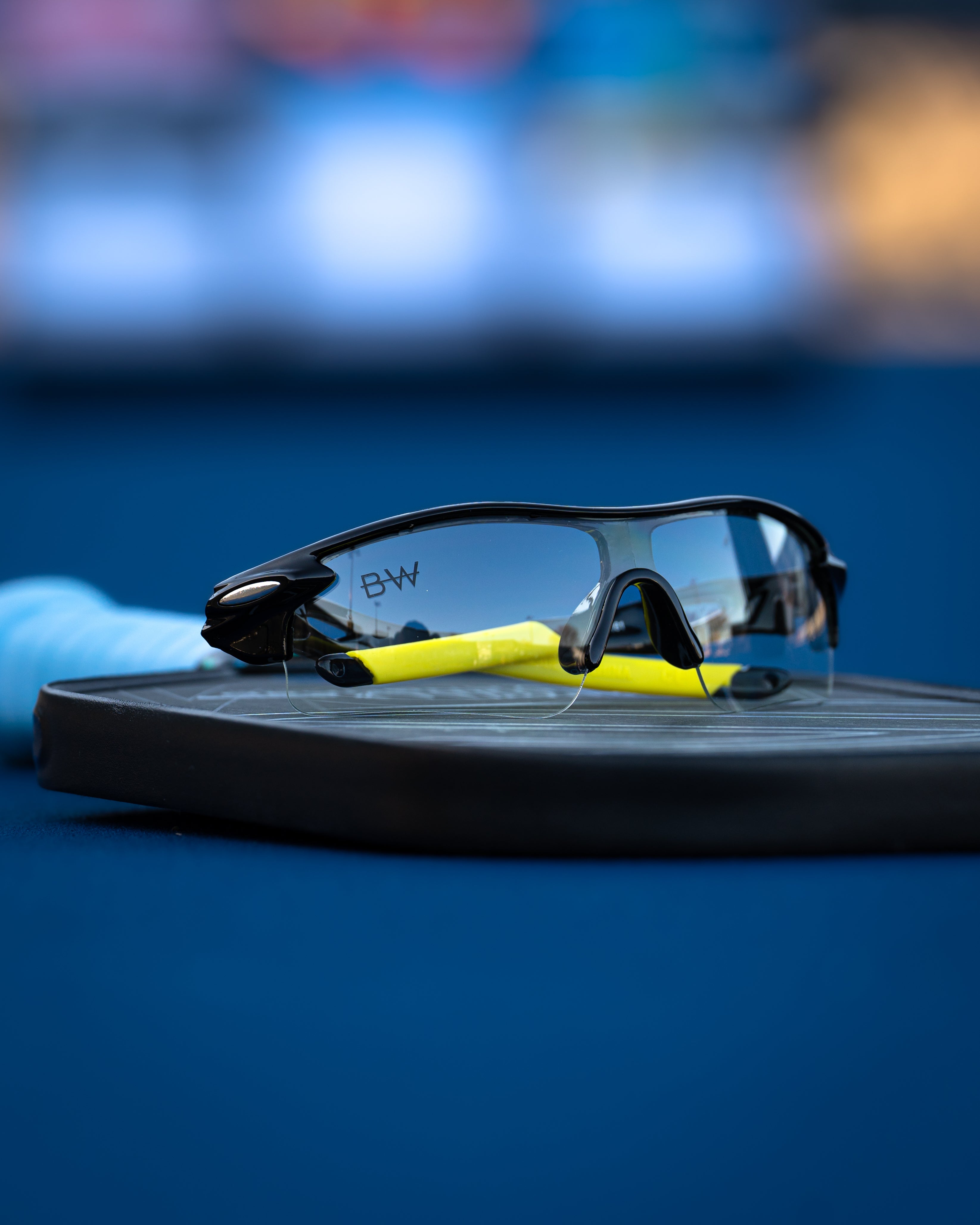
Blinded Wear offers prescription sports eyewear with high-index prescription lenses included at no additional cost, lightweight sports frames, impact-resistant lenses, non-polarized lenses, and designs intended for recreational and competitive pickleball players.
Quick Answer: What Should Active Adults Look for in Prescription Sports Glasses?
| Priority | Why It Matters |
|---|---|
| Correct prescription | The eyewear must first provide the correction you need |
| Frame fit | A comfortable, stable frame is easier to use during movement |
| Impact-resistant lenses | Useful for sports and active environments where accidental contact can occur |
| Lightweight construction | Can improve comfort during longer sessions |
| Lens configuration | Should match indoor, outdoor, daytime, or lower-light use |
| Verified optional features | AR, anti-fog, scratch resistance, photochromic behavior, and UV specifications should be confirmed individually |
Why Active Adults Consider Prescription Sports Glasses
Regular prescription glasses can work for some recreational activities, but adults who exercise or play sports frequently may prefer a separate pair designed around movement and repeated active use.
A dedicated RX sports pair can provide:
- A sports-oriented frame selected for movement
- Impact-resistant lens construction
- A separate pair so your everyday glasses are not your only option
- A lens setup matched to your usual activity environment
- Comfort for extended wear
The original article framed sports glasses as automatically superior because regular glasses would slip, fog, crack, or fail under activity. That is too broad. Some everyday glasses can work adequately, while others may be less suitable depending on fit, lens construction, and activity.
Who Benefits Most From Dedicated Prescription Sports Glasses?
Dedicated RX sports eyewear may be especially useful for adults who:
- Play pickleball, tennis, or other court sports regularly
- Run, hike, or train outdoors frequently
- Depend on prescription correction during activity
- Want a separate sports pair instead of risking their everyday glasses
- Exercise several times per week
- Compete in leagues, tournaments, or organized events
- Frequently switch between indoor and outdoor environments
Age itself is not the deciding factor. A 25-year-old and a 65-year-old may have very different prescription, fit, and activity needs.
Best Features to Prioritize in Prescription Sports Glasses
1. Prescription Accuracy
The best sports frame is still the wrong choice if the prescription or lens design is inappropriate for you.
2. Secure, Comfortable Fit
Look for a frame that remains comfortable when you move, turn your head, bend, or exercise for an extended period.
3. Impact-Resistant Lenses
Impact resistance is worth considering for active use, but it should not be confused with certified protective eyewear unless a specific standard is documented.
4. Lightweight Sports Frame
Lighter eyewear can be easier to tolerate during longer workouts, matches, or outdoor sessions.
5. Environment-Appropriate Lens Setup
Indoor courts, bright sun, shaded trails, and nighttime activity can require very different lens choices.
How Important Is Impact Resistance?
Impact resistance is a useful characteristic for sports and active environments, but marketing language often overstates what it means.
Impact-resistant does not automatically mean:
- Impact-proof
- Shatter-proof
- Unbreakable
- Guaranteed injury prevention
- Certified protective eyewear
Blinded Wear uses impact-resistant lenses. If your sport or workplace requires a specific protective standard, verify the exact certification separately.
How Should Prescription Sports Glasses Fit?
A good sports frame should feel secure without causing excessive pressure.
Check:
- Bridge comfort
- Temple pressure
- Whether the frame shifts during lateral movement
- Whether it stays comfortable when you sweat
- Whether it remains usable for a full training session
Do not rely only on labels such as “men's,” “women's,” “senior,” or “athletic fit.” Actual frame measurements are more useful.
Which Lens Type Is Best for Active Adults?
The best lens type depends on the activity and lighting environment.
| Activity Environment | Practical Starting Direction |
|---|---|
| Indoor court or gym | Clear prescription lens |
| Night activity | Clear or another appropriate low-light configuration |
| Bright outdoor activity | Prescription sunglass configuration |
| Mixed indoor and outdoor activity | Separate pairs or verified adaptive lens option |
| Contact-lens wearer | Contacts plus non-RX sports eyewear may provide flexibility |
Clear Prescription Sports Glasses for Indoor Activity
Clear prescription lenses are a practical starting point when reducing visible light is not the goal.
They can make sense for:
- Indoor pickleball
- Indoor training
- Nighttime activity
- Lower-light environments
A clear lens does not automatically include anti-reflective, anti-fog, scratch-resistant, or UV-related features. Those should be verified separately.
Prescription Sports Sunglasses for Outdoor Adults
Outdoor activity may call for a tinted prescription lens if brightness is uncomfortable.
When choosing an outdoor configuration, consider:
- Time of day
- Sun intensity
- Shade
- Cloud cover
- Activity duration
- Your sensitivity to brightness
Do not assume the darkest tint is automatically best. Lens darkness should match the environment.
What Lens Colors Work Best for Active Adults?
There is no universal best tint for all sports.
A useful starting framework is:
- Clear: indoor or lower-light activity
- Gray: neutral outdoor brightness reduction
- Amber/Bronze: warmer color appearance some athletes prefer
- Rose/Copper: another color-changing option worth personally testing
- Photochromic: potentially useful for changing environments when available and suitable
Lens color should not be expected to automatically improve reaction time, tracking, depth perception, or performance.
Are Transition or Photochromic Lenses Good for Active Adults?
They can be useful for people who move between different lighting environments, but exact performance depends on the lens technology and conditions.
Do not assume every photochromic lens:
- Becomes completely clear indoors
- Gets equally dark outdoors
- Responds at the same speed
- Works identically in every temperature
- Is available on every prescription frame
Verify exact availability and behavior for the lens you are considering.
Should Prescription Sports Glasses Be Polarized?
Not automatically.
Polarization can reduce certain reflected light, but it is not universally required for sports. Blinded Wear uses non-polarized lenses as part of its performance-first pickleball approach, intended to preserve natural visual information and avoid potential depth-perception concerns associated with polarization during court play.
Polarization does not universally cause depth-perception problems, and non-polarized lenses do not guarantee better performance.
Do Active Adults Need Anti-Reflective Coating?
Anti-reflective coating can be useful if lens-surface reflections bother you, particularly under indoor or nighttime artificial lighting.
AR should not be confused with:
- Anti-fog treatment
- Scratch resistance
- Polarization
- Impact resistance
- UV specifications
Verify AR separately for the exact product and lens configuration.
What About Fogging During Exercise?
Fogging can be frustrating during sports, but it is affected by more than lens coatings.
Contributing factors may include:
- Heat
- Humidity
- Perspiration
- Airflow
- Frame position
- Temperature changes
Do not assume every sports lens includes anti-fog treatment or that an anti-fog claim guarantees zero condensation.
High-Index Prescription Lenses for Active Adults
High-index refers to lens material and how it bends light. It is separate from tint, coatings, polarization, and impact resistance.
Blinded Wear includes high-index prescription lenses at no additional cost, which can improve value for customers who need prescription eyewear.
Exact prescription compatibility should still be verified for the frame you choose.
Can One Pair of Prescription Sports Glasses Work for Multiple Activities?
Potentially, but different activities can have different fit, environmental, and protective requirements.
A pair that works well for:
- Pickleball
- Walking
- Running
- General fitness
may not automatically meet the needs of a higher-contact sport or an activity requiring a specific protective standard.
Multi-sport use should be evaluated activity by activity rather than assuming one frame is ideal for everything.
Prescription Sports Glasses for Pickleball Players
Pickleball players should prioritize:
- Correct prescription
- Comfortable frame fit
- Impact-resistant lenses
- Appropriate lens configuration for indoor or outdoor play
- Comfort during extended matches
Blinded Wear is specifically designed around pickleball-focused eyewear, making its RX collection a logical place to start if pickleball is one of your primary activities.
Prescription Sports Glasses for Running
Runners typically care about comfort, frame movement, outdoor brightness, and long-wear usability.
Before using any sports frame for running, verify:
- Fit during repeated movement
- Prescription compatibility
- Whether the lens configuration matches daylight conditions
- Whether the frame remains comfortable over longer distances
Blinded Wear's core verified positioning is pickleball-focused, so do not assume every frame is specifically engineered or certified for running unless documented.
Prescription Sports Glasses for Hiking and Outdoor Activity
Outdoor enthusiasts should consider changing light, shade, temperature, and extended wear.
A practical hiking setup may prioritize:
- Prescription correction
- Comfort
- Appropriate outdoor tint
- Lightweight construction
- A case or secure storage option
If using the same frame for hiking and court sports, verify that its fit and lens configuration work in both environments.
Do Prescription Sports Glasses Change as You Get Older?
Age itself does not determine the best sports frame, but prescription needs can change over time.
Some adults may need:
- Updated distance correction
- Progressive or multifocal designs
- Different frame compatibility
- A revised sports setup as their visual needs change
There is no universal age at which someone should switch to a different sports lens design.
Can Active Adults Wear Progressive Sports Glasses?
Potentially, yes, if the exact frame and lens design are appropriate.
Progressive wearers should prioritize:
- Correct fitting measurements
- Frame compatibility
- Comfort during head movement
- How the lens feels during the specific activity
Do not assume every sports frame supports every progressive prescription.
Blinded Wear RX Sports Glasses to Compare
Once you know your prescription, activity, and environment, compare verified Blinded Wear RX frames. Exact tints, coatings, and lens configurations should be confirmed for each product.
Features to Verify Instead of Assuming
The original article assigned several specific features to individual products, including anti-fog coatings, scratch resistance, wrap designs, UV protection, transitions, adjustable temple arms, and multi-sport suitability. Those details should not be treated as universal unless they are documented for the exact product.
- Anti-fog treatment
- Scratch-resistant treatment
- Anti-reflective coating
- Photochromic availability
- Exact tint options
- Specific UV specifications
- Adjustable frame components
- Specific protective certifications
- Sport-specific suitability outside pickleball
Verified Blinded Wear Features for Active Adults
| Feature | Status |
|---|---|
| Prescription eyewear | Available |
| High-index prescription lenses | Included at no additional cost |
| Lightweight sports frames | Verified |
| Impact-resistant lenses | Verified |
| Non-polarized lenses | Verified |
| Pickleball-focused design | Verified |
| Comfort for extended matches | Verified |
| Recreational and competitive use | Suitable |
| 50% lifetime replacement warranty if glasses break | Verified |
For current warranty, replacement, and return information, review Protection Plan & Returns.
How to Choose Prescription Sports Glasses in 6 Steps
-
Identify Your Main Activity
Start with the sport or activity you do most often.
-
Confirm Your Prescription Needs
Make sure the frame and lens configuration can support your correction.
-
Match the Lens to the Environment
Indoor, outdoor, daytime, and nighttime activity can require different lens setups.
-
Compare Frame Measurements
Use dimensions from glasses that already fit you well.
-
Verify Optional Features
Check any tint, AR, anti-fog, scratch-resistant, photochromic, UV, or certification claims individually.
-
Test the Eyewear During Real Activity
Practice in the glasses before relying on them during an important game, race, or event.
Not Sure Which RX Sports Glasses Fit Your Routine?
If pickleball is part of your active lifestyle, the Blinded Wear Pickleball Glasses Quiz can help narrow your starting options.
For a broader comparison, use the 2026 Pickleball Glasses Guide.
Prescription Sports Eyewear Links for Active Adults
Find Prescription Sports Glasses for Your Active Lifestyle
If pickleball is one of your main sports, start with eyewear built around prescription correction, sports-oriented fit, impact-resistant lenses, and court use.
Shop Prescription Pickleball Glasses →
Need a clear option for indoor or lower-light activity?
Want help narrowing down your options?
Take the Pickleball Glasses Quiz →
Want to compare the full lineup first?
Indoor vs. Outdoor Prescription Sports Glasses
Active adults often use the same prescription across several environments, but the best lens configuration can change dramatically between an indoor court and bright outdoor conditions.
| Environment | Practical Starting Point |
|---|---|
| Indoor gym or court | Clear RX lenses |
| Nighttime activity | Clear or another appropriate low-light setup |
| Bright outdoor conditions | Prescription sunglass tint |
| Cloudy or variable outdoor light | Clear, lighter tint, or verified adaptive option depending on brightness |
| Indoor and outdoor use | Separate pairs or a verified adaptive configuration |
Should Active Adults Own One Pair or Two?
If your activities take place in very different lighting environments, one fixed lens may require compromise.
| One Pair | Two Pairs |
|---|---|
| Less gear to carry | Each pair can be selected for a specific environment |
| Potentially lower total cost | Provides a complete backup |
| May require compromise across lighting conditions | Clear pair can serve indoor or night use while a tinted pair handles bright outdoor activity |
| Adaptive technology may add flexibility if available | No dependence on one lens to cover every condition |
Adults who depend heavily on prescription correction may also value a second pair simply for redundancy.
Contacts Plus Non-RX Sports Eyewear
Adults who already wear contact lenses comfortably can separate prescription correction from sports-eyewear selection.
This can make it easier to switch between:
- Clear sports glasses
- Tinted outdoor eyewear
- Different sports frames
- Different activity-specific setups
This is not a recommendation to start wearing contacts solely for sports. Contact-lens suitability should be determined individually.
What Runners Should Look for in RX Sports Glasses
For running, fit and comfort usually matter more than sport-specific marketing language.
Evaluate:
- Whether the frame shifts during repeated motion
- Whether the temples create pressure over time
- Whether the bridge remains comfortable as you sweat
- Whether the lens configuration matches daylight conditions
- Whether the frame works with your prescription
A lightweight sports frame may be useful, but specific running certification or performance claims should not be assumed without documentation.
What Hikers Should Look for in Prescription Sports Glasses
Hiking can expose you to changing brightness, shade, long wear times, and varying weather.
That makes these priorities especially relevant:
- Comfort over several hours
- Appropriate outdoor lens darkness
- Prescription accuracy
- Secure fit
- A protective case for storage
If your hike moves between dense shade and open sun, a moderate fixed tint, multiple pairs, or a verified adaptive option may be more practical than a very dark lens.
Prescription Sports Glasses for Cycling
Cyclists often care about wind exposure, fit, brightness, and long-session comfort.
Before using any frame for cycling, verify:
- Prescription compatibility
- Comfort under movement
- Suitability for outdoor light conditions
- Whether the frame works comfortably with any helmet or gear you use
Blinded Wear's verified focus is pickleball, so specific cycling features should not be assumed unless they are documented for the product.
Prescription Sports Glasses for Tennis
Tennis and pickleball share some visual and movement demands, but they are still different sports.
For tennis, look for:
- Correct prescription
- Stable fit during lateral movement
- Appropriate lens setup for the court environment
- Impact-resistant lens construction
- Long-session comfort
Do not assume a frame is specifically engineered for tennis simply because it works well for pickleball.
Prescription Sports Glasses for Gym and Fitness Use
For general gym use, a lightweight, secure RX frame can be useful if you prefer wearing glasses instead of contacts.
Focus on:
- Comfort under repeated movement
- Whether the frame shifts during bending or lifting
- Prescription clarity
- Lens cleanliness
- Whether a sports-oriented frame feels more practical than your everyday pair
There is no need to buy highly specialized sports technology if your actual activity does not require it.
What About Prescription Glasses for Basketball?
Basketball involves more direct contact than many recreational activities, so the distinction between sports-oriented eyewear and certified protective eyewear becomes more important.
Do not assume impact-resistant prescription glasses are automatically suitable for basketball contact or certified for sports protection.
If you need protective eyewear for basketball, verify the exact protective standard required for your use.
Sports Glasses vs. Certified Protective Eyewear
These terms should not be treated as interchangeable.
| Category | What It Means |
|---|---|
| Prescription sports glasses | Prescription eyewear intended for active use |
| Impact-resistant lenses | Lenses with documented impact-resistant characteristics |
| Certified protective eyewear | Eyewear documented to meet a named protective standard |
One category does not automatically imply the others.
How Should Active Adults Choose Lens Color?
Choose by lighting environment first and color preference second.
| Condition | Lens Direction |
|---|---|
| Indoor or night | Clear |
| Bright outdoor sun | Gray or another appropriate sunglass tint |
| Warmer color preference | Amber, bronze, rose, or copper may be worth testing |
| Changing conditions | Separate pairs or verified adaptive option |
No tint should be expected to automatically improve tracking, reaction time, depth perception, or athletic performance.
Does Lens Darkness Tell You the UV Protection Level?
No. Tint darkness and UV specifications are separate characteristics.
A darker lens should not automatically be assumed to provide more UV protection, and a clear lens can still have documented UV-related properties depending on the product.
If a particular UV specification matters to you, verify it directly.
Should Anti-Fog Coating Be a Priority?
It can be useful if fogging is a recurring problem, but anti-fog treatment is only one part of fog management.
Before paying extra for a coating, ask:
- Is it included?
- Is it optional?
- How should it be cleaned?
- Does the exact product document the treatment?
Do not assume every sports frame includes anti-fog technology.
When Is Anti-Reflective Coating Worth It?
AR coating may be useful if lens-surface reflections bother you, especially under indoor or nighttime artificial lighting.
AR does not automatically:
- Stop fogging
- Prevent scratches
- Improve impact resistance
- Eliminate all glare
- Improve athletic performance
Verify the coating for the exact lens configuration.
Scratch Resistance and Sports Eyewear
Scratch resistance is separate from impact resistance.
A lens can be impact-resistant without a documented scratch-resistant treatment, and a scratch-resistant lens is not scratch-proof.
If surface durability matters to you, verify the exact treatment instead of inferring it from the sports label.
How Much Should Style Matter?
Style matters because eyewear you like is more likely to be worn consistently.
But it should come after:
- Prescription compatibility
- Fit
- Comfort
- Lens construction
- Activity environment
Once those are right, choose the frame style you prefer.
What if You Have a Strong Prescription?
Start by confirming that the exact frame can support your correction.
Then evaluate:
- Lens design
- Frame measurements
- Comfort
- Lens thickness considerations
- Activity environment
Blinded Wear includes high-index prescription lenses at no additional cost, but frame compatibility should still be verified individually.
What if You Wear Progressives?
Progressive wearers should focus first on lens design and fitting rather than tint or coatings.
Key considerations include:
- Correct fitting measurements
- Frame compatibility
- Comfort while moving the head and eyes
- How the lens performs during the activity you actually do
Do not assume every sports frame supports every progressive prescription.
Do Active Adults Need a Backup Prescription Pair?
A backup becomes more valuable when you depend on prescription correction during activity or everyday life.
Your backup could be:
- A second sports pair
- Your regular prescription glasses
- Contacts if you already use them appropriately
The goal is practical redundancy, not buying extra eyewear without a reason.
How Much Should You Spend on Prescription Sports Glasses?
Instead of focusing only on the frame price, compare the complete finished prescription cost.
Ask whether the total includes:
- Prescription lenses
- High-index material
- Any requested tint
- Any optional coating
- Shipping or processing charges
- Replacement or warranty coverage
Blinded Wear includes high-index prescription lenses at no additional cost, which can simplify the finished-price comparison.
Think About Cost Per Wear
A dedicated RX sports pair can make more financial sense for someone who exercises or plays several times per week than for someone who participates once every few months.
Consider:
- How often you will actually use the eyewear
- Whether it replaces the need to use your everyday glasses during activity
- Whether one pair can serve several low-risk activities
- Whether a second pair is justified by different lighting conditions
Blinded Wear RX Models for Active Adults to Compare
| Model | What to Compare |
|---|---|
| Frost RX | Frame fit, prescription compatibility, and current lens options |
| Smoked Shadow RX | Measurements, prescription compatibility, and available configurations |
| Lava Rock RX | Fit, frame style, and current prescription options |
| Sea Sand RX | Prescription setup, fit, and current lens choices |
| Blue Shield RX | Current lens configuration and prescription compatibility |
| H Blue Shield RX | Fit, dimensions, and exact RX availability |
| Crystal Wave II RX | Current prescription and lens configurations |
| Heatseek RX | Frame dimensions and available RX options |
| Runway RX | Prescription compatibility and current lens options |
| Cold Slate RX | Fit, prescription, and available lens configurations |
Prescription Sports Glasses Marketing Claims to Question
| Claim | Better Question |
|---|---|
| “Won't slip” | How does the exact frame fit me during movement? |
| “Fog-proof” | Is a documented anti-fog treatment actually included? |
| “Shatter-proof” | What impact characteristics or certifications are documented? |
| “Perfect for every sport” | Does this frame meet the needs of my specific activity? |
| “Improves performance” | What direct evidence supports that claim? |
| “Maximum UV protection” | What specific UV specification is documented? |
| “Anti-glare” | Does that mean tint, polarization, AR coating, or something else? |
How to Test New Prescription Sports Glasses
-
Confirm the Prescription
Make sure your corrected vision feels appropriate before evaluating anything else.
-
Check the Fit at Rest
Look for pressure, looseness, or discomfort.
-
Move Normally
Turn your head, bend, walk, jog, or perform the motions your activity requires.
-
Test the Correct Lighting
Evaluate the eyewear in the environment where you actually plan to use it.
-
Wear It for a Full Session
Long-session comfort matters more than a brief try-on.
-
Resolve Problems Before Competition
Do not rely on unfamiliar eyewear for an important event without testing it first.
Simple Decision Rule for Active Adults
Choose prescription sports glasses based on your main activity, prescription, fit, and lighting environment—not on the largest list of advertised features.
For most people:
- Correct prescription comes first.
- Comfortable sports fit comes second.
- Lens construction and environment come next.
- Optional coatings and special tints come after the fundamentals.
Useful Blinded Wear Links for Active Adults
Build Your Prescription Sports Setup Around How You Actually Move
Start with your prescription and main activity, then choose a frame and lens configuration that makes sense for the environment where you spend the most time.
Shop Prescription Sports Eyewear →
Need an indoor or lower-light option?
Want help narrowing down the right direction?
Take the Pickleball Glasses Quiz →
Want a broader comparison before choosing?
Frequently Asked Questions About Prescription Sports Glasses for Active Adults
What are the best prescription sports glasses for active adults?
The best pair is one that matches your prescription, fits securely and comfortably, uses appropriate lens construction, and suits the lighting and movement demands of your main activity. There is no single best frame for every active adult.
Are prescription sports glasses better than regular glasses for exercise?
They can be more practical for frequent activity because they are selected around movement and sports use, but regular glasses may still work for some lower-intensity activities if they fit well and provide the correction you need.
Do I need prescription sports glasses for pickleball?
Not necessarily, especially if you play occasionally and your current prescription glasses work well. A dedicated sports pair becomes more useful as playing frequency increases or if you want impact-resistant lenses, a separate court pair, or a frame better suited to movement.
What lens is best for indoor sports?
Clear prescription lenses are a practical starting point when reducing visible light is not the goal.
What lens is best for outdoor sports?
An appropriate prescription sunglass tint can be useful in bright conditions. The best darkness and color depend on the activity, time of day, environment, and personal comfort.
Are polarized sports glasses always better outdoors?
No. Polarization is one lens feature, not a universal requirement for sports. Blinded Wear uses non-polarized lenses in its pickleball-focused eyewear.
Are impact-resistant lenses the same as protective sports goggles?
No. Impact resistance is a lens characteristic. Protective certification requires verification of a specific named standard.
Can adults wear progressive lenses for sports?
Potentially, yes, if the frame and progressive design are appropriate. Fit, measurements, and comfort during movement become especially important.
Are high-index lenses useful for active adults?
High-index lenses can be useful depending on prescription needs, but high-index is not a sports-performance feature. Blinded Wear includes high-index prescription lenses at no additional cost.
Do active adults need anti-fog coating?
Not everyone does. It may be useful if fogging is a recurring issue, but exact availability should be verified for the product and lens configuration.
Do active adults need anti-reflective coating?
Not necessarily. AR coating may help reduce lens-surface reflections, especially under certain indoor or nighttime lights, but it is separate from fog resistance, scratch resistance, impact resistance, and tint.
Should I own a backup prescription pair?
A backup can be valuable if you rely heavily on prescription correction during sports or daily life.
Can one pair work for several sports?
Possibly, especially for lower-contact activities with similar lighting and fit needs. Do not assume one pair is appropriate for every sport, particularly when a specific protective standard may be required.
Does Blinded Wear offer prescription sports glasses?
Yes. Blinded Wear offers prescription pickleball eyewear with high-index lenses included at no additional cost, lightweight sports frames, impact-resistant lenses, and non-polarized lenses.
What warranty does Blinded Wear offer?
Blinded Wear offers a 50% lifetime replacement warranty if the glasses break. Review the current Protection Plan & Returns for details.
Best RX Sports Glasses Direction by Active Lifestyle
| Active Lifestyle | Good Starting Direction |
|---|---|
| Indoor pickleball player | Clear RX sports eyewear |
| Outdoor pickleball player | RX sports sunglasses with an appropriate tint |
| Runner | Lightweight RX frame with secure fit and appropriate outdoor lens setup |
| Hiker | Comfortable RX eyewear matched to changing outdoor light |
| Gym-focused adult | Lightweight RX frame that stays comfortable during repeated movement |
| Tennis player | Stable RX sports frame with environment-appropriate lenses |
| Cyclist | Comfortable RX frame compatible with movement and any additional gear |
| Multi-sport adult | Versatile pair for lower-contact activities or separate pairs where requirements differ |
| Contact-lens wearer | Contacts plus non-RX sports eyewear can provide flexibility |
Keep Your Regular Glasses or Upgrade to RX Sports Glasses?
| Keep Your Current Glasses If... | Consider RX Sports Glasses If... |
|---|---|
| They fit securely during your activity | They frequently shift during movement |
| You play or exercise occasionally | You train or play several times per week |
| You are comfortable risking your everyday pair during activity | You want a separate sports pair |
| Your current lens configuration works in your environment | You need a different indoor or outdoor lens setup |
| Your current lenses meet your needs | You want documented impact-resistant lens construction |
Rank Sports Eyewear Features in This Order
-
Prescription Accuracy
The lens must provide the correction you actually need.
-
Frame Compatibility
The frame needs to support your prescription and lens design.
-
Fit and Comfort
The frame should remain comfortable during real movement and extended wear.
-
Lens Construction
Evaluate impact resistance and any protective requirements.
-
Activity Environment
Indoor, outdoor, daytime, nighttime, and mixed-light activity can require different setups.
-
Optional Lens Features
Tint, AR, anti-fog, scratch resistance, and photochromic technology should come after the fundamentals.
-
Style
Among frames that meet your functional requirements, choose the look you prefer.
Prescription Sports Glasses Claims vs. Reality
| Claim | More Accurate Interpretation |
|---|---|
| “Won't slip” | Fit should be tested on the individual wearer |
| “Fog-proof” | Fogging can still depend on environment, airflow, and treatment |
| “Shatter-proof” | Impact resistance should not be described as unbreakable without documentation |
| “Perfect for every sport” | Different sports can require different fit or protective standards |
| “Improves reaction time” | No automatic performance improvement should be promised |
| “Protects your eyes” | Specific protection claims should be tied to documented lens or certification details |
| “Maximum UV protection” | Verify the exact UV specification rather than relying on general wording |
10 Mistakes Active Adults Make When Buying RX Sports Glasses
-
Choosing by Style Before Prescription Compatibility
Confirm that the frame works with your prescription first.
-
Assuming Every Sports Frame Fits Securely
Fit varies from person to person.
-
Confusing Impact Resistance With Certification
These are not the same thing.
-
Buying a Dark Outdoor Tint for Indoor Use
Indoor and nighttime conditions may require more available light.
-
Assuming Polarization Is Required
It is an optional lens feature, not a universal sports requirement.
-
Expecting Anti-Fog to Mean Zero Fogging
Fog behavior depends on multiple factors.
-
Assuming a Sports Lens Is Scratch-Proof
Scratch resistance must be verified separately.
-
Using One Pair for a Sport With Different Protective Requirements
Evaluate each activity separately.
-
Skipping a Practice Test
New sports glasses should be tested before important competition.
-
Forgetting About a Backup
If you depend on your prescription, redundancy can be valuable.
Blinded Wear: Verified Features vs. Features to Check
| Feature | Status |
|---|---|
| Prescription eyewear | Verified |
| High-index prescription lenses | Included at no additional cost |
| Lightweight sports frames | Verified |
| Impact-resistant lenses | Verified |
| Non-polarized lenses | Verified |
| Pickleball-focused design | Verified |
| Comfort for extended matches | Verified |
| Recreational and competitive pickleball use | Suitable |
| 50% lifetime replacement warranty if glasses break | Verified |
| Exact tint availability | Verify by product and RX configuration |
| Anti-fog treatment | Verify separately |
| Anti-reflective coating | Verify separately |
| Scratch-resistant treatment | Verify separately |
| Photochromic technology | Verify availability and exact behavior |
| Specific UV rating | Verify documented specification |
| Protective certification | Verify the exact named standard if required |
Final Buying Checklist for Active Adults
- Confirm your prescription is current.
- Confirm the frame supports your prescription.
- Compare frame measurements with glasses that already fit you well.
- Identify your main activity.
- Identify whether you mostly exercise indoors, outdoors, or both.
- Choose a lens setup appropriate for your normal lighting.
- Verify impact-resistant construction.
- Verify any protective certification you specifically need.
- Verify tint availability.
- Verify anti-reflective coating if important to you.
- Verify anti-fog treatment if important to you.
- Verify scratch resistance if important to you.
- Verify photochromic availability if important to you.
- Verify specific UV specifications if important to you.
- Compare the complete finished prescription price.
- Review replacement and return terms.
- Test the glasses during real activity before relying on them in competition.
Key Takeaways: Best Prescription Sports Glasses for Active Adults
- There is no single best RX sports frame for every active adult.
- Prescription accuracy, fit, and activity type should guide your decision.
- Impact-resistant lenses are useful for sports but do not automatically equal certified protective eyewear.
- Clear lenses are a practical starting point for many indoor and nighttime activities.
- Outdoor activity may call for an appropriate sunglass tint.
- One pair can work for several lower-contact activities, but not every sport has the same requirements.
- Progressive and stronger prescriptions require careful frame compatibility.
- Polarization is not automatically required for sports.
- Optional coatings should be verified rather than assumed.
- Blinded Wear includes high-index prescription lenses at no additional cost.
- Blinded Wear uses lightweight sports frames, impact-resistant lenses, and non-polarized lenses.
- Blinded Wear offers a 50% lifetime replacement warranty if glasses break.
Prescription Sports Eyewear Resources for Active Adults
Final Verdict: What Are the Best Prescription Sports Glasses for Active Adults?
The best prescription sports glasses are the ones that fit your vision, movement, environment, and activity—not the pair with the longest list of marketing claims.
For active adults, the decision should begin with prescription compatibility, frame fit, comfort, and lens construction. From there, choose a lens setup that matches whether you train indoors, outdoors, at night, or across multiple environments.
If pickleball is one of your primary sports, Blinded Wear's RX collection offers a strong starting point with high-index prescription lenses at no additional cost, lightweight sports frames, impact-resistant lenses, non-polarized lenses, and designs focused on pickleball use.
If you participate in several different activities, evaluate each one separately. One sports frame may work across running, walking, fitness, and recreational court play, while another sport may call for a different protective standard or lens setup.
Find the Right Prescription Sports Glasses for Your Routine
Start with your prescription, fit, and main activity, then choose the lens configuration that makes sense for where and how you move.
Shop Prescription Sports Eyewear →
Need an indoor or lower-light option?
Want help narrowing down your starting point?
Take the Pickleball Glasses Quiz →
Want to compare the full lineup first?
View the 2026 Pickleball Glasses Guide →
Want to review replacement and return information before ordering?