
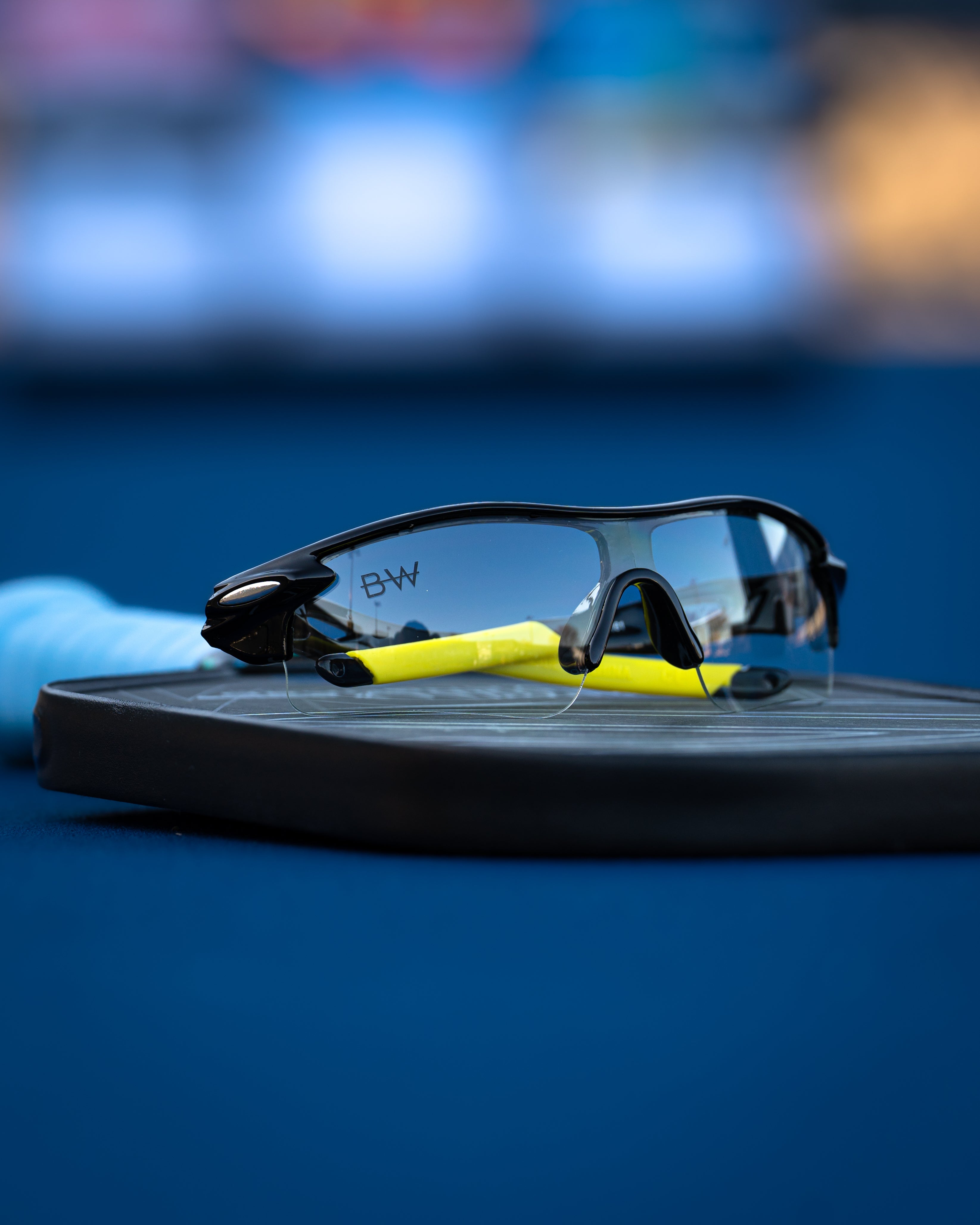
Best RX Glasses for Players Who Cover a Lot of Court Ground
Share
Find Your Perfect Pickleball Glasses
Looking for prescription eyewear that suits an active pickleball playing style? Explore Blinded Wear's RX and non-RX collections, compare current frame options, and find eyewear that fits your prescription requirements and court routine.
Best RX Glasses for Players Who Cover a Lot of Court Ground
Some pickleball players rarely stop moving. They defend from the baseline, advance through the transition zone, move laterally at the kitchen line, and recover when opponents send the ball into open space.
If that describes your playing style, choosing the right prescription pickleball glasses involves more than selecting an attractive frame.
Your eyewear needs to accommodate your prescription, feel comfortable during extended play, and fit appropriately while you perform the movements that are part of your game.
Blinded Wear offers prescription sports eyewear designed for pickleball players, including direct RX and compatible RX Clip configurations.
In this guide, we'll explore:
- RX glasses to consider if you cover a lot of court ground.
- How to compare frames for active pickleball.
- What matters when moving between the baseline, transition zone, and kitchen.
- How to evaluate prescription lenses, frame fit, and comfort.
- What high-index and impact-resistant lens characteristics actually mean.
- How to select eyewear for singles, doubles, recreational play, and tournaments.
The goal is to help you choose prescription eyewear that suits your needs without promising that a particular frame will make you faster, improve your reaction time, or increase your court coverage.
What Does Covering a Lot of Court Ground Mean in Pickleball?
Full-court coverage describes a playing style involving frequent movement across different areas of the pickleball court.
Depending on the rally, a player may need to move forward, retreat, shift laterally, change direction, or recover after an overhead shot.
Baseline Defense
When defending from the baseline, players may move laterally to return deep shots or recover after being pulled toward a sideline.
Transition-Zone Movement
Moving from the baseline toward the kitchen involves repeated changes in position as players advance, stop, reset, or respond to an opponent's shot.
Kitchen-Line Coverage
At the non-volley zone, players frequently look between the ball, opponents, and different areas of the court.
Lob Recovery
Responding to a lob may require a player to turn, locate the ball, and move into a safe recovery position.
Doubles Coverage
In doubles, players also adjust their positions relative to their partner, the opponents, and the developing rally.
These movements make active fit and extended-wear comfort useful considerations when comparing prescription sports eyewear.
What Should Full-Court Players Look for in RX Glasses?
There is no single frame that is universally best for every active pickleball player.
Instead, evaluate five practical characteristics.
1. Prescription Compatibility
The eyewear must accommodate your individual prescription requirements. Start here before comparing frame appearance or other characteristics.
2. Comfortable Frame Fit
A frame should feel comfortable during normal wear and realistic pickleball movement. The tightest frame is not automatically the most appropriate choice.
3. Active-Fit Stability
Evaluate whether the eyewear requires frequent adjustment during lateral movement, quick turns, and longer sessions.
4. Appropriate Lens Configuration
Consider the available prescription configuration and the environments where you normally play. Lens tint, polarization, refractive index, and impact resistance are separate characteristics.
5. Long-Term Ownership Support
Review the current return and replacement policies before purchasing customized prescription eyewear.
These considerations provide a more useful buying framework than relying on claims such as "zero-slip," "instant tracking," or "guaranteed performance."
Blinded Wear RX Glasses to Consider for Active Pickleball
The following prescription options are worth comparing if you regularly move across different areas of the court.
These are shopping options, not a ranking based on measured athletic performance or comparative durability testing.
Crystal Wave II RX
Consider if: You want to compare a current Blinded Wear RX option for frequent pickleball sessions.
Crystal Wave II RX is one of the prescription options available from Blinded Wear.
When considering this frame for an active playing style, review its current prescription configuration, frame dimensions, lens information, and fit.
During practice, evaluate how the completed eyewear feels when you move laterally, look upward, and transition between different areas of the court.
Do not assume that its frame geometry guarantees zero movement or that it provides a measured improvement in peripheral vision.
Blue Shield RX
Consider if: You want another current RX option to compare for your regular playing environment.
Blue Shield RX can be evaluated alongside other prescription frames according to your prescription requirements, current lens configuration, frame information, and personal fit.
For doubles players who frequently move between the kitchen and transition zone, test the completed eyewear during those movements rather than relying on an unverified grip or stability claim.
Its product name should not be interpreted as proof of blue-light filtering, a particular tint specification, or an athletic performance benefit.
Steel Ice RX
Consider if: You want to compare another Blinded Wear prescription frame for regular court use.
Steel Ice RX belongs on your shortlist when evaluating current RX options for pickleball.
If you spend significant time defending from the baseline, pay particular attention to comfort and frame position during controlled lateral movement and changes of direction.
Do not assume Steel Ice RX has specialized friction zones, reinforced temples, or guaranteed no
Covering a lot of court ground does not require a magical “speed frame.” It does make prescription accuracy, active fit, comfort, and familiarity especially important. A mobile pickleball player may repeatedly move through: Your eyewear does not create those movements or make you faster. The goal is to choose prescription eyewear that works comfortably with the way you already play. Moving from deeper court positions toward the non-volley zone can involve changes in speed, body position, and head direction. When testing RX eyewear, notice whether the frame remains comfortable and whether you repeatedly feel the need to reposition it during normal transitions. Side-to-side movement is common when defending wide shots or repositioning with a partner. Test lateral movement at realistic playing intensity rather than aggressively shaking your head to see whether a frame moves. Looking upward changes head position and can reveal fit characteristics that may not be obvious while standing still. During practice, safely move into position for lobs and overheads and notice how the eyewear feels as your head angle changes. Pickleball frequently requires stopping one movement and beginning another. A player covering significant court space may experience these changes repeatedly during a session. The relevant eyewear question is not whether a frame is guaranteed to be “locked in.” It is whether the frame's active fit works for you. Doubles can require frequent scanning between the ball, opponents, open court, and your partner's position. Prescription correction and comfortable fit remain more important than unsupported claims that a particular frame creates wider awareness or faster visual processing. A frame can feel comfortable while you are standing still and feel different once you begin playing. For players who cover substantial court ground, evaluate fit under conditions that resemble an actual session. This is a personal fit evaluation, not a standardized performance test. Players sometimes assume that a sports frame should squeeze the head as tightly as possible. That can create unnecessary pressure and discomfort during longer sessions. A better objective is balance: The ideal balance can differ from one player to another. No frame should automatically be described as never moving on every player. Face shape, frame dimensions, perspiration, movement, fit preference, and other variables can influence frame position. That is why absolute promises such as these should be treated carefully: A more useful goal is finding a frame that requires an acceptable amount of adjustment during your actual style of play. One simple way to compare two RX frames is to notice how often you deliberately reposition them during a normal practice session. For example, ask yourself: Adjustment frequency is not a scientific performance score. It is simply a practical way to compare your experience with different frames. For an active player, the beginning of a session tells only part of the story. Evaluate the same frame again after you have been playing long enough to perspire. Ask: A successful personal test should not be converted into a universal claim that the frame is sweat-proof or incapable of slipping. During a demanding session, a player may experience a visibility problem and assume the frame itself is responsible. Separate the possibilities. Do not describe every Blinded Wear RX frame as anti-fog unless the exact configuration supports that claim. Before deciding whether a frame suits a player who covers the entire court, start with the primary purpose of RX eyewear: prescription correction. A useful selection order is: A frame's styling or sports positioning should not override prescription compatibility. Blinded Wear includes high-index prescription lenses at no additional cost with custom RX eyewear. High-index refers to a category of prescription lens material commonly used to help manage lens thickness, particularly as prescription strength increases. Finished lens thickness can depend on: This can be useful information when comparing prescription eyewear, but high-index should not be turned into an unsupported athletic-performance claim. Not necessarily. Higher refractive index can help manage lens thickness in comparable prescriptions, but thinner does not automatically mean lighter. Finished weight can also depend on material density, prescription strength, lens dimensions, frame construction, and the complete configuration. High-index should therefore be discussed primarily as a prescription lens-material characteristic rather than a guarantee of lighter sports eyewear. High-index lenses should not be described as improving: Those are separate from refractive index. The relevant benefit in this context is that high-index prescription lenses are included at no additional cost with Blinded Wear custom RX eyewear. Rapid movement does not automatically mean your prescription lenses will become blurry. Your visual experience during pickleball can involve several variables, including: If something feels wrong, avoid immediately assuming that the frame, lens material, or movement speed is the sole cause. Prescription eyewear should not be marketed as creating faster athletic reaction time. Proper prescription correction may be important to an individual player who needs corrective lenses, but that is different from claiming a particular frame makes the player's nervous system respond faster. Choose RX eyewear for prescription suitability, fit, comfort, verified specifications, and your playing environment—not a promised reaction-time improvement. Do not promise that a particular frame improves ball tracking solely because it is designed for sports. What a player sees during a rally can depend on prescription correction, individual vision, lighting, ball movement, attention, and other factors. A player's subjective preference for one frame or lens configuration can still be meaningful without turning that preference into a universal performance claim. Depth perception should not be attributed to one simple eyewear feature. A frame, tint, polarization status, or high-index material should not automatically be described as improving depth perception. If prescription vision or depth perception is a concern, rely on guidance from a qualified eye-care professional rather than a marketing claim. Polarization status should remain separate from claims about speed, reaction time, depth perception, and ball tracking. Polarized lenses are designed to reduce certain reflected light. Some pickleball players may prefer non-polarized lenses for their particular court environment, while others may prefer a different configuration. Do not claim that non-polarized lenses inherently: Prescription, individual vision, lighting, playing environment, and the complete eyewear configuration all contribute to what a player sees. Blinded Wear offers impact-resistant lens options. That can be a relevant characteristic when evaluating sports eyewear, but impact resistance does not make someone faster or improve court coverage. It also should not automatically be translated into: If a particular safety certification matters to you, verify that exact specification independently. Blinded Wear offers lightweight sports frames, and overall comfort can matter when eyewear is worn through extended pickleball sessions. However, lighter is not automatically better for every player. Overall fit depends on more than total weight. Frame dimensions, bridge interaction, temple pressure, prescription lens configuration, and personal preference can all contribute to comfort. The best test is wearing the completed eyewear for the amount of time you normally play. A frame can feel comfortable when first put on and feel different after extended use. During a longer practice, pay attention to: A player covering significant court ground should evaluate the frame during the type of session they actually play. Crystal Wave II RX is a current Blinded Wear prescription option worth comparing if you are building a shortlist for active pickleball use. Rather than labeling it “best for agility” or promising 360-degree clarity, compare it according to: Its suitability for a particular full-court player ultimately depends on the individual wearer. Blue Shield RX is another current prescription option to compare. Do not assume features such as a hybrid nose grip, anti-shift construction, or blue-light filtering from the product name alone. Instead, evaluate the current product information, your prescription requirements, frame dimensions, fit, and the environments where you normally play. Steel Ice RX can also be included in a comparison for players who spend substantial time moving between different areas of the court. It should not automatically be described as having aggressive side grip, friction zones, or guaranteed stability unless those exact features are verified. Use the same active-fit test you would use with any other sports frame. Frost RX is a direct RX option with a white frame and bright blue lens appearance. Do not infer from that appearance that Frost RX automatically provides: Compare the current product configuration and test personal fit during your normal playing routine. Ocean Wave RX is another current RX product to review when comparing prescription pickleball eyewear. Do not assume that lens shape automatically improves peripheral vision or ball tracking. Likewise, do not assume grip modifications or low-pressure temples unless those specifications are confirmed for the exact configuration. Focus on prescription compatibility, current product specifications, fit, and your individual experience. Gray Wash RX expands the current RX shortlist for players comparing Blinded Wear frames. The product name should not be used to infer an exact tint transmission, polarization status, contrast benefit, or playing environment. Review the current configuration before deciding whether it suits your prescription and preferences. Havana Melt RX is another current prescription option. Rather than assigning it a specific playing style, compare it using the same criteria as the rest of your shortlist: Zebra II RX can be considered alongside other current Blinded Wear prescription options. A player's movement style may influence which frame they prefer, but do not label Zebra II RX as universally superior for a particular court position without evidence supporting that comparison. Lava Rock RX provides another current frame to compare. Evaluate the complete product rather than trying to predict fit from appearance alone. The way a frame interacts with an individual player's face during movement is best evaluated through actual wear. Rippled X RX is another current prescription option that can be added to your shortlist. Review its current configuration and compare it with your prescription requirements, frame preferences, and typical playing environment rather than assigning unsupported performance benefits. This comparison intentionally avoids declaring a universal winner. The best option for a player who covers substantial court ground depends on prescription requirements, fit, comfort, and personal preferences. Blinded Wear prescription eyewear can include direct RX options as well as compatible RX Clip systems. In a direct RX configuration, prescription correction is incorporated into the direct prescription setup. In an RX Clip system, prescription correction comes from a separate inner prescription insert within compatible eyewear rather than the primary outer sports lens. Neither configuration should automatically be labeled better for fast movement. Compare: Blinded Wear includes high-index prescription lenses at no additional cost in custom RX Clip configurations. The prescription correction is contained in the inner RX insert. The primary outer sports lens is a separate component. Keep the specifications of those components separate when comparing tint, polarization, impact characteristics, or other lens features. Movement style is only one part of selecting prescription sports eyewear. A player may cover substantial ground on: Evaluate the current lens configuration for the environments where you actually play rather than assuming one tint or lens color is universally best for mobile players. Different lens tints can change visible-light transmission and color appearance, but a particular tint should not automatically be described as improving movement, reaction time, depth perception, or ball tracking. Some players may prefer one lens color or darkness in a particular environment. That subjective preference can be useful without becoming a universal performance claim. Potentially, depending on the exact lens configuration and your preferences. Do not assume that every Blinded Wear RX product offers clear, gray, and photochromic options or that every configuration is equally suited to every lighting environment. Verify the current lens options for the exact RX product you are considering. For additional lens-selection information, review the Pickleball Performance Lens Guide. A clear lens avoids a dark sunglass tint, which may appeal to players using eyewear indoors, during evening sessions, or in other environments where they do not want a dark tint. However, clear appearance does not automatically establish: The Blinded Wear Clear Lens Collection is non-prescription. Players requiring prescription correction should use the RX Pickleball Glasses Collection to explore current prescription options. If your prescription requires a progressive or another specialized lens configuration, prescription compatibility should be confirmed before choosing a frame based on playing style. Do not assume that every RX sports product supports every prescription design. If a new prescription or lens design feels unfamiliar during movement, allow appropriate time for normal wear and follow the guidance of your qualified eye-care professional. A prescription containing cylinder and axis correction does not automatically require a particular sports frame, tint, polarization status, or playing style. Start with prescription compatibility and evaluate the completed eyewear normally. If your prescription vision feels incorrect or unexpectedly different, consult a qualified eye-care professional rather than trying to solve an optical issue by changing your movement mechanics. If you find yourself repeatedly changing your head position, tilting your face unnaturally, or adjusting your normal movement simply to see comfortably through the eyewear, investigate the cause. Possible factors can include: The goal is to find eyewear that works with your normal activity—not to redesign your court movement around the frame. Once your custom RX eyewear arrives, use a normal practice session to evaluate it. Do not create an artificial eyewear test that introduces unnecessary injury risk. Instead of sprinting backward while staring upward, use normal pickleball footwork and safe positioning during lob practice. The objective is simply to see how the frame feels when your head angle and body position change—not to stress-test the eyewear or your balance. Doubles is useful for evaluating active fit because movement patterns can change rapidly. During ordinary points, notice the frame while you: You are evaluating whether the eyewear feels comfortable and appropriately positioned—not whether it creates better court awareness. Singles typically requires one player to cover more open court than doubles, which can make it a useful environment for evaluating sports-eyewear fit. Pay attention to comfort during: A frame that one player prefers for singles may not be another player's preferred option, so keep the evaluation personal. Prescription-dependent players should become familiar with new eyewear before an important event. Use the completed pair during practice and normal recreational play first. Before tournament day: If you cannot comfortably play without prescription correction, a backup corrective option can be useful for leagues, tournaments, travel, and long playing days. This is not an admission that your primary eyewear is unreliable. It is simply contingency planning. Even well-selected sports eyewear can be misplaced or damaged, and prescription-dependent players may have fewer practical alternatives once play begins. Your playing style is not the only thing that affects the ownership experience. Storage and handling matter too. After playing: Sports-focused eyewear should still be treated as prescription eyewear rather than intentionally abused to prove durability. Blinded Wear offers 50% lifetime replacement support if eligible glasses break, subject to current policy terms. For an eligible claim, the damaged eyewear must be returned. Once applicable claim and return requirements are satisfied, qualifying customers can receive 50% credit toward a replacement pair. This is not a free full replacement and should not be assumed to cover loss, prescription changes, every type of damage, or every circumstance. For damaged RX eyewear, contact blindedwearco@gmail.com before returning the glasses. Review the Blinded Wear Protection Plan, Replacement & Returns information for current eligibility and policy details. Blinded Wear maintains a 30-day return policy for eligible standard purchases, but customized RX eyewear is final sale and excluded from that standard return policy. That makes it especially important to review your prescription information, the exact RX product, current configuration, and applicable policies before purchasing. Final-sale status does not eliminate applicable 50% lifetime replacement support for eligible broken glasses. Once you have narrowed your frame choice, have your complete current eyeglass prescription ready. For more information, visit the How to Order RX Glasses guide. Do not assume a particular measurement process or ordering requirement from an older article or unverified guide. Follow the current instructions provided for the exact Blinded Wear RX product and prescription-ordering process. If additional prescription measurements are required and you are uncertain about them, use appropriate professional guidance rather than guessing an optical measurement. Tighter is not automatically more secure or more comfortable. “Best for defenders” or “best for aggressive players” can sound useful but may oversimplify individual fit. Overall comfort depends on the complete configuration, not weight alone. Polarization status alone does not determine depth perception. Refractive index does not determine reaction time or ball tracking. The frame must first work with your prescription requirements. Active players should evaluate fit during realistic movement. Build familiarity during practice before relying on new prescription eyewear in an important match. Players who cover a lot of court ground may put their eyewear through frequent changes in direction, head position, perspiration, and extended wear. That makes active fit and comfort especially useful parts of the selection process. But there is no need to claim that one frame makes players faster, improves reaction time, creates better depth perception, or guarantees zero movement. Start with prescription compatibility. Then compare current frame options, verified lens characteristics, active fit, comfort, playing environment, and your individual preferences. The strongest RX choice is the one that works with your prescription and remains comfortable through the way you actually play. Part three can finish the guide with an expanded FAQ, singles-versus-doubles considerations, troubleshooting, a frame-selection decision tree, pre-purchase and tournament checklists, internal resources, and the final shopping framework. There is no single prescription frame that is best for every high-movement pickleball player. Start with prescription compatibility, then compare frame dimensions, current lens configuration, comfort, active fit, and your primary playing environment. Current Blinded Wear options worth comparing include Crystal Wave II RX, Blue Shield RX, Steel Ice RX, Frost RX, Gray Wash RX, Havana Melt RX, Zebra II RX, Lava Rock RX, and Rippled X RX. Prioritize your prescription requirements first. After that, evaluate active fit, extended-wear comfort, frame dimensions, verified lens characteristics, and the environments where you normally play. They should not automatically be as tight as possible. Excessive pressure can become uncomfortable during extended wear. Look for a balance between a frame position you are comfortable with during movement and comfort over the duration of your normal sessions. Not necessarily. Lightweight construction may contribute to comfort, but overall fit depends on the complete eyewear configuration, including frame dimensions, bridge interaction, temple pressure, prescription lenses, and personal preference. No. Eyewear should not be presented as increasing running speed, agility, footwork, or physical court coverage. Prescription eyewear provides vision correction for players who need it, while frame selection can be evaluated for fit and comfort during the player's existing movement patterns. Fit varies by player and frame. Instead of promising zero movement, evaluate the completed eyewear during realistic lateral movement, transitions, changes in head position, and extended play. No universal zero-slip claim should be assumed. Face shape, frame dimensions, perspiration, movement, and individual fit can affect frame position. Wear them during a normal practice session and pay attention to adjustment frequency. If you repeatedly need to reposition the frame during your ordinary movement patterns, investigate the fit rather than assuming that repeated adjustment is unavoidable. Aggressive head shaking does not closely represent normal pickleball movement. Test the eyewear during realistic play instead. Yes. A frame can feel different later in a session than it does during the first few minutes. Reevaluate fit and comfort after perspiration begins without describing the result as proof that a frame is universally sweat-proof. Not automatically. The more useful question is whether its position and adjustment frequency are acceptable to you during actual play. A particular RX frame should not be claimed to make your nervous system react faster. Prescription correction can be important for a player who requires it, but that is different from a guaranteed improvement in athletic reaction time. No particular frame should automatically be described as improving ball tracking. Prescription correction, individual vision, lighting, attention, ball movement, and other factors can contribute to what a player sees during a rally. Do not assume that a sports frame, tint, high-index lens material, or polarization status independently improves depth perception. Movement alone does not automatically cause prescription blur. Your visual experience can involve your prescription, individual vision, frame position, eye and head movement, lighting, ball movement, and familiarity with the eyewear. First distinguish among prescription experience, frame position, lighting, moisture, dirty lenses, and other possible factors. If your prescription vision appears incorrect or concerning, consult a qualified eye-care professional. You should not deliberately redesign your natural court movement around a frame. If you repeatedly need an unusual head position to see comfortably, investigate the prescription and eyewear configuration. Yes. Blinded Wear includes high-index prescription lenses at no additional cost with custom RX eyewear. High-index refers to a category of prescription lens material commonly used to help manage finished lens thickness, particularly as prescription strength increases. Use the verified specifications for the exact prescription configuration rather than assuming one exact refractive index across every current product. High-index material can help manage thickness in comparable prescriptions, but finished lens thickness also depends on prescription strength, frame dimensions, lens geometry, and other optical requirements. No. Finished weight can also depend on material density, lens dimensions, prescription strength, and the complete eyewear configuration. No. Refractive index should not be used as a measurement of athletic performance. No. Refractive index and impact resistance are separate characteristics. No. High-index should not automatically be interpreted as shatterproof or unbreakable. There is no universal rule connecting polarization status to the amount of court a player covers. Some court players may prefer non-polarized lenses, while individual preferences and playing environments differ. Polarization alone should not be described as reducing depth perception. Prescription, individual vision, lighting, playing environment, and the complete eyewear configuration all matter. No universal depth-perception improvement should be attributed solely to non-polarized construction. No. Polarization status alone does not determine athletic reaction time. No universal ball-tracking improvement should be attributed solely to non-polarized construction. Polarized lenses are designed to reduce certain reflected light. That function is separate from prescription strength, tint darkness, refractive index, physical impact resistance, and athletic performance. There is no universal tint determined by movement style. Choose according to the exact available lens configuration, your playing environment, and your personal preferences. No universal improvement in ball tracking should be attributed simply to a darker tint. A particular lens color should not be marketed as inherently increasing athletic reaction time. Potentially, depending on the exact lens configuration and your preferences. Do not assume every current RX model offers the same lens choices or is equally appropriate for every lighting environment. A clear lens avoids a dark sunglass tint, which may appeal to players who do not want dark tint indoors or in other lower-light environments. Clear appearance alone does not establish other lens specifications. Do not assume an exact visible-light-transmission percentage solely because a lens appears clear. No. Tint darkness and UV specifications are separate characteristics. Do not assume those options are available across every RX product. Verify the current configuration for the exact product you are considering. Yes. Blinded Wear offers impact-resistant lens options. No. Impact resistance does not mean eyewear is impossible to damage. No. Do not automatically convert an impact-resistance claim into a shatterproof claim. No particular safety standard or certification should be inferred solely from the term “impact-resistant.” No. Physical lens characteristics and athletic movement are separate issues. Do not apply an anti-fog claim across every RX product or lens configuration unless that exact feature is verified. No. Condensation on a lens surface and prescription correction are separate issues. Do not automatically apply scratch-resistance claims across every configuration without verification. Not necessarily. First distinguish a lens-surface issue from a prescription or frame-fit issue. During a demanding session, perspiration, condensation, surface contamination, frame position, lighting, and prescription experience can feel like one general “vision problem.” Identifying the actual issue makes troubleshooting more useful. Singles and doubles can place different movement demands on a player, but that does not mean they automatically require different RX frames. Singles often requires one player to cover more open court. That can make it particularly useful to evaluate eyewear during wide lateral movement, forward transitions, recovery toward the middle, and longer movement sequences. Doubles frequently involves coordinated lateral positioning, kitchen-line movement, transition-zone play, and adjustment relative to a partner. In either format, use the same core selection priorities: A frame does not become a “singles frame” or “doubles frame” simply because one player prefers it for that format. If you frequently defend from deeper positions, test eyewear while moving laterally and transitioning forward. Pay attention to frame position, bridge comfort, temple comfort, and adjustment frequency. Do not assume a frame needs special “friction zones” or another unverified feature to work for baseline play. Players spending substantial time at the non-volley zone may frequently change head and eye direction while responding to the developing rally. The eyewear should first provide the prescription correction you require and fit comfortably during your normal movement. Do not interpret close-range play as evidence that a particular lens or frame improves reaction time. If your game involves repeated movement between deeper positions and the kitchen, test the frame through those same transitions. Notice whether comfort or frame position changes as movement intensity increases. That practical evaluation is more useful than assigning an unsupported “transition-zone technology” label to a frame. Looking upward and changing body position can reveal fit characteristics that are less obvious while standing normally. Practice lob coverage safely and evaluate whether the frame remains comfortable as your head position changes. Avoid unsafe backward running simply to stress-test the eyewear. If yes, begin with the Blinded Wear Prescription Pickleball Glasses Collection rather than selecting a non-RX frame first. If not, remove it from your shortlist regardless of appearance or playing-style marketing. Understand where the prescription correction is located and review the complete eyewear configuration. Compare current dimensions and other verified frame information. Consider your normal lighting environment and verify the exact available lens characteristics. Evaluate lateral movement, forward transitions, changes in head position, and longer play. Consider bridge pressure, temple pressure, frame position, and adjustment frequency. Reevaluate the same factors later in the session. Use new prescription eyewear during practice before relying on it during an important event. Reality: Excessive pressure can reduce comfort. Active fit should balance your preferred frame position with extended-wear comfort. Reality: Refractive index is a prescription lens-material characteristic, not a reaction-time rating. Reality: Polarization status alone does not determine depth perception. Reality: Do not infer a measurable tracking advantage from appearance alone. Reality: Impact resistance does not mean eyewear cannot be damaged. Reality: Tint darkness should be considered according to lighting and personal preference, not running speed or court coverage. Reality: Price alone cannot predict personal fit. Reality: Fit varies among players. Evaluate adjustment frequency during your own play. Reality: Verify the exact lens configuration before assuming a coating or treatment. Reality: Prescription requirements, face shape, fit preference, lighting, and individual comfort can produce different choices. When evaluating reviews of prescription pickleball glasses, look for genuine ownership details rather than dramatic performance claims. Useful review topics can include: One player's experience can provide useful context, but it does not prove that every player will experience identical fit, comfort, or durability. Upload a clear photo or picture of your eyeglass prescription on the applicable product page before adding the RX eyewear to your cart and before purchasing. Have your complete prescription information available before completing a custom RX order. Use the How to Order RX Glasses guide for current ordering information. Customized RX eyewear is final sale and excluded from the standard 30-day return policy for eligible standard purchases. No. Final-sale status does not eliminate applicable 50% lifetime replacement support for eligible broken glasses, subject to current policy terms. Blinded Wear offers 50% lifetime replacement support for eligible broken glasses, subject to current policy terms. No. The program should not be described as a free full replacement. The damaged eyewear must be returned as part of an eligible claim. Once applicable claim and return requirements are satisfied, qualifying customers can receive 50% credit toward a replacement pair. For damaged RX eyewear, contact blindedwearco@gmail.com before returning the glasses. Do not assume loss qualifies under a program for eligible broken glasses. Do not assume a prescription change by itself qualifies for replacement support. Review the Blinded Wear Protection Plan, Replacement & Returns information for current eligibility and policy details. This framework is more useful than declaring one model the universal winner based on unsupported claims about speed, grip, tracking, or reaction time. Use these current prescription options as a starting point rather than treating the order below as a performance ranking: Review the full Prescription Pickleball Glasses Collection for current availability. If you are the player who seems to be everywhere during a rally, resist the temptation to shop according to claims that one frame is specifically engineered to make you faster. Instead, work through the factors that can actually help you make a more informed choice: The purpose of prescription sports eyewear is easy to exaggerate, particularly when discussing fast-moving athletes. Players who cover a lot of court ground ask more of themselves physically, but that does not mean their eyewear needs exaggerated performance claims. The strongest approach is simpler: get the prescription component right, choose a frame that fits your needs, evaluate the completed eyewear during realistic movement, and make sure it remains comfortable through the length of your normal sessions. Blinded Wear offers prescription eyewear designed for pickleball players, high-index prescription lenses at no additional cost, impact-resistant lens options, and 50% lifetime replacement support for eligible broken glasses, subject to current policy terms. Those are concrete characteristics you can evaluate without claiming that a pair of glasses will make you run faster, react sooner, cover more court, or track the ball better. Whether your game keeps you at the baseline, moving through the transition zone, defending the kitchen, chasing wide shots, or doing a little of everything, choose RX eyewear around your prescription, your fit, your environment, and your actual movement. Explore the current Blinded Wear RX collection and compare prescription compatibility, frame options, lens configurations, fit considerations, and your primary playing environment. Shop Prescription Pickleball Glasses Need more guidance before choosing? Review the Pickleball Performance Lens Guide, use the Pickleball Sunglasses Quiz, or follow the How to Order RX Glasses guide. Cover the court with your footwork. Choose your RX eyewear around the prescription, fit, and comfort you need to play your game.Going Deeper: RX Eyewear for Players Who Move Everywhere
Five Movement Patterns to Consider When Choosing RX Pickleball Glasses
1. Baseline-to-Kitchen Transitions
2. Lateral Court Coverage
3. Tracking Lobs and Overheads
4. Quick Direction Changes
5. Doubles Partner Coverage
Why Active Fit Matters More Than a Standing Fit Check
Secure Fit Does Not Mean the Tightest Possible Frame
Why “Zero-Slip” Is the Wrong Standard
Use Adjustment Frequency as a Personal Comparison
Test RX Eyewear Before and After Perspiration
Frame Movement and Fogging Are Different Problems
What You Notice
What to Investigate
Frame changes position
Fit and frame position
Lens becomes hazy
Moisture or condensation
Lens surface looks dirty
Surface contamination
Prescription feels unfamiliar
Prescription experience and adaptation
Visibility changes with lighting
Lens configuration and environment
Prescription Accuracy Comes Before Playing Style
High-Index Prescription Lenses for Active Pickleball Players
Does High-Index Automatically Make RX Sports Glasses Lighter?
High-Index Does Not Make You Cover More Court
Does Moving Quickly Cause Prescription Blur?
Can RX Sports Glasses Improve Reaction Time?
Can a Particular RX Frame Improve Ball Tracking?
What About Depth Perception?
Non-Polarized Lenses and Full-Court Movement
Impact Resistance Matters Separately From Court Coverage
How Important Is Lightweight Eyewear for Long Sessions?
Test Comfort for a Full Session, Not Five Minutes
Crystal Wave II RX for Active Pickleball Players
Blue Shield RX for Frequent Court Movement
Steel Ice RX for Your Full-Court Shortlist
Frost RX for Players Comparing Direct RX Options
Ocean Wave RX: Verify the Exact Configuration
Gray Wash RX as Another Current Option
Havana Melt RX for Your Frame Comparison
Zebra II RX for Active Players
Lava Rock RX for a Broader RX Shortlist
Rippled X RX for Prescription Pickleball Players
Compare Current RX Options for High-Movement Pickleball
RX Option
What to Evaluate
Crystal Wave II RX
Prescription compatibility, current configuration, dimensions, active fit, and comfort
Blue Shield RX
Current product specifications, prescription requirements, and fit
Steel Ice RX
Frame information, prescription compatibility, active fit, and comfort
Ocean Wave RX
Exact current RX configuration, lens information, and fit
Frost RX
Direct RX configuration, current lens information, and fit
Gray Wash RX
Current lens configuration and prescription compatibility
Havana Melt RX
Current configuration, dimensions, comfort, and personal fit
Zebra II RX
Prescription requirements, frame information, and active fit
Lava Rock RX
Current specifications, fit, and playing environment
Rippled X RX
Prescription compatibility, current configuration, and personal fit
Direct RX vs. RX Clip for Players Who Cover a Lot of Court
High-Index Lenses Are Included With Custom RX Clips Too
Full-Court Players Still Need to Consider Lighting
Tint Does Not Determine Court Coverage
Can the Same RX Glasses Work Indoors and Outdoors?
What About Clear Lenses for Indoor Play?
What If You Wear Progressive Prescription Lenses?
What If Your Prescription Includes Astigmatism Correction?
Do Not Change Your Natural Movement to Compensate for Eyewear
A Full Practice Test for High-Movement RX Eyewear
Stage 1: Warm-Up
Stage 2: Controlled Court Movement
Stage 3: Normal Play
Stage 4: Post-Session Review
Test Lob Coverage Safely
Test the Frame During Real Doubles Movement
Singles Can Reveal Different Fit Preferences
Do Not Make Tournament Day Your First Full-Court Test
Why a Backup Matters for Players Who Depend on RX Eyewear
Care for RX Eyewear Between High-Movement Sessions
What Happens If Your RX Glasses Eventually Break?
Remember: Custom RX Eyewear Is Final Sale
How to Order Blinded Wear RX Pickleball Glasses
What About Pupillary Distance?
Common Mistakes High-Movement Players Make When Choosing RX Eyewear
Choosing the Tightest Frame
Choosing by Playing-Style Label Alone
Assuming Lightweight Means Better
Assuming Non-Polarized Means Better Depth Perception
Assuming High-Index Means Faster Vision
Ignoring Prescription Compatibility
Testing Only While Standing Still
Testing New RX Eyewear for the First Time at a Tournament
Full-Court RX Eyewear Checklist
Part Two Takeaway: Match the Eyewear to the Player, Not a Marketing Label
Frequently Asked Questions About RX Glasses for Players Who Cover a Lot of Court
What are the best RX glasses for pickleball players who move a lot?
What should I prioritize if I cover the entire pickleball court?
Should pickleball glasses fit tightly?
Are lightweight RX glasses better for fast players?
Will prescription sports glasses make me cover more court?
Frame Stability and Movement FAQs
Will Blinded Wear RX glasses stay in place while I run around the court?
Can any sports frame guarantee zero slip?
How do I know if my RX glasses are stable enough?
Should I shake my head to test frame stability?
Should I test the frame after I start sweating?
Does a frame moving slightly mean it is a bad sports frame?
Vision and Prescription FAQs for High-Movement Players
Can RX pickleball glasses improve reaction time?
Can RX glasses improve ball tracking?
Do sports glasses improve depth perception?
Does moving quickly make RX lenses blurry?
What if my new RX glasses feel different while I play?
Should I change how I hold my head to see better through my RX glasses?
High-Index RX Lens FAQs
Does Blinded Wear include high-index prescription lenses?
What does high-index mean?
Does high-index mean 1.61?
Are high-index lenses always thinner?
Are thinner high-index lenses always lighter?
Does high-index improve reaction time or court coverage?
Does high-index mean impact-resistant?
Does high-index mean shatterproof?
Polarization FAQs for Active Pickleball Players
Are non-polarized lenses better for players who cover more court?
Do polarized lenses hurt depth perception?
Do non-polarized lenses improve depth perception?
Do non-polarized lenses improve reaction time?
Do non-polarized lenses improve ball tracking?
What does polarization actually do?
Lens Tint and Lighting FAQs
What lens tint is best for players who move all over the court?
Do darker lenses improve ball tracking?
Do certain lens colors improve reaction time?
Can I use the same RX glasses indoors and outdoors?
Are clear lenses good for indoor pickleball?
Does clear mean 100% visible-light transmission?
Does a darker lens mean better UV protection?
Are all Blinded Wear RX glasses available with clear, gray, and transition lenses?
Impact-Resistance FAQs
Does Blinded Wear offer impact-resistant lenses?
Does impact-resistant mean unbreakable?
Does impact-resistant mean shatterproof?
Does impact-resistant mean safety-certified?
Does impact resistance help me cover more court?
Fogging and Lens-Surface FAQs
Are Blinded Wear RX glasses anti-fog?
Does fogging mean my prescription is wrong?
Are Blinded Wear RX lenses scratch-resistant?
Does a dirty lens mean I need different sports glasses?
Why is that distinction important for active players?
RX Glasses for Singles vs. Doubles Pickleball
Singles
Doubles
RX Eyewear for Baseline-Heavy Players
RX Eyewear for Kitchen-Line Players
RX Eyewear for Players Constantly Moving Through the Transition Zone
RX Eyewear for Frequent Lob Recovery
Decision Tree: Choosing RX Glasses for Full-Court Pickleball
Step 1: Do You Need Prescription Correction?
Step 2: Does the Exact Product Work With Your Prescription Requirements?
Step 3: Is It Direct RX or an RX Clip Configuration?
Step 4: Does the Frame Match Your Fit Preferences?
Step 5: Does the Lens Configuration Match Where You Play?
Step 6: Have You Tested It During Realistic Movement?
Step 7: Does It Remain Comfortable?
Step 8: Have You Tested It After Perspiration Begins?
Step 9: Are You Familiar With It Before Competition?
Troubleshooting RX Eyewear During High-Movement Play
What You Notice
What to Check
Frequent frame repositioning
Frame fit, dimensions, and position
Bridge discomfort
Fit and pressure distribution
Temple discomfort
Frame fit and extended-wear comfort
Hazy lens surface
Moisture or condensation
Dirty or smeared view
Lens-surface condition
Visibility changes with environment
Lighting and exact lens configuration
New prescription feels unfamiliar
Prescription experience and professional guidance when needed
Frame feels different after sweating
Reevaluate active fit under those conditions
Vision feels incorrect
Prescription and professional eye-care guidance
Common Myths About RX Glasses for Fast-Moving Pickleball Players
Myth: The Tightest Frame Is the Best Sports Frame
Myth: High-Index Lenses Make You React Faster
Myth: Non-Polarized Lenses Improve Depth Perception
Myth: A Wider-Looking Lens Automatically Improves Ball Tracking
Myth: Impact-Resistant Means Unbreakable
Myth: Darker Lenses Are Better for Fast Players
Myth: Expensive RX Glasses Automatically Fit Better
Myth: A Frame Designed for Sports Never Needs Adjustment
Myth: Anti-Fog Is Standard on Every Sports Lens
Myth: One Frame Is Best for Every Full-Court Player
Use Real Experience Without Inventing Performance Claims
Pre-Purchase Checklist for Full-Court RX Players
What to Do When Your RX Pickleball Glasses Arrive
Tournament-Day RX Eyewear Checklist
Ordering Blinded Wear RX Glasses
How do I submit my prescription?
Should I order before I have my prescription?
Where can I learn more about ordering?
Are custom RX glasses returnable?
Does final sale remove replacement support?
Lifetime Replacement Support FAQs
What happens if eligible Blinded Wear glasses break?
Do I receive a completely free replacement?
What happens with an eligible claim?
What should I do if my RX pair breaks?
Does replacement support cover losing my glasses?
Does it cover a new prescription?
How to Compare Two RX Frames Without Guessing
Factor
Question to Ask
Prescription
Does the exact configuration support my prescription requirements?
Frame dimensions
How do the current measurements compare with eyewear that fits me?
Initial comfort
How does the bridge and temple area feel?
Active fit
How does the frame behave during my normal movement?
Extended wear
Is it still comfortable after a complete session?
Perspiration
Does my personal fit experience change later in the session?
Lens configuration
Are the exact verified characteristics appropriate for where I play?
Adjustment frequency
How often do I deliberately reposition the frame?
Ownership policy
What happens if the eyewear is damaged?
Current Blinded Wear RX Shortlist
Helpful Pickleball Eyewear Resources
How to Choose Your RX Glasses for Full-Court Pickleball
What the Right RX Eyewear Can and Cannot Do
Reasonable Consideration
Claim to Avoid
Prescription correction for a player who requires it
Guaranteed faster reaction time
Personal comfort during extended play
Guaranteed zero pressure
Personal active-fit evaluation
Guaranteed zero slip or bounce
High-index prescription lenses included at no additional cost
High-index makes you faster or improves tracking
Impact-resistant lens options
Unbreakable or shatterproof eyewear
Choosing a lens configuration for your environment
A tint automatically improves athletic performance
Some players may prefer non-polarized lenses
Non-polarized lenses improve depth perception
Testing a frame through your own movement patterns
One frame is universally best for every fast player
Final Takeaway: Your RX Glasses Should Work With the Way You Already Play
Find Your Prescription Pickleball Glasses