
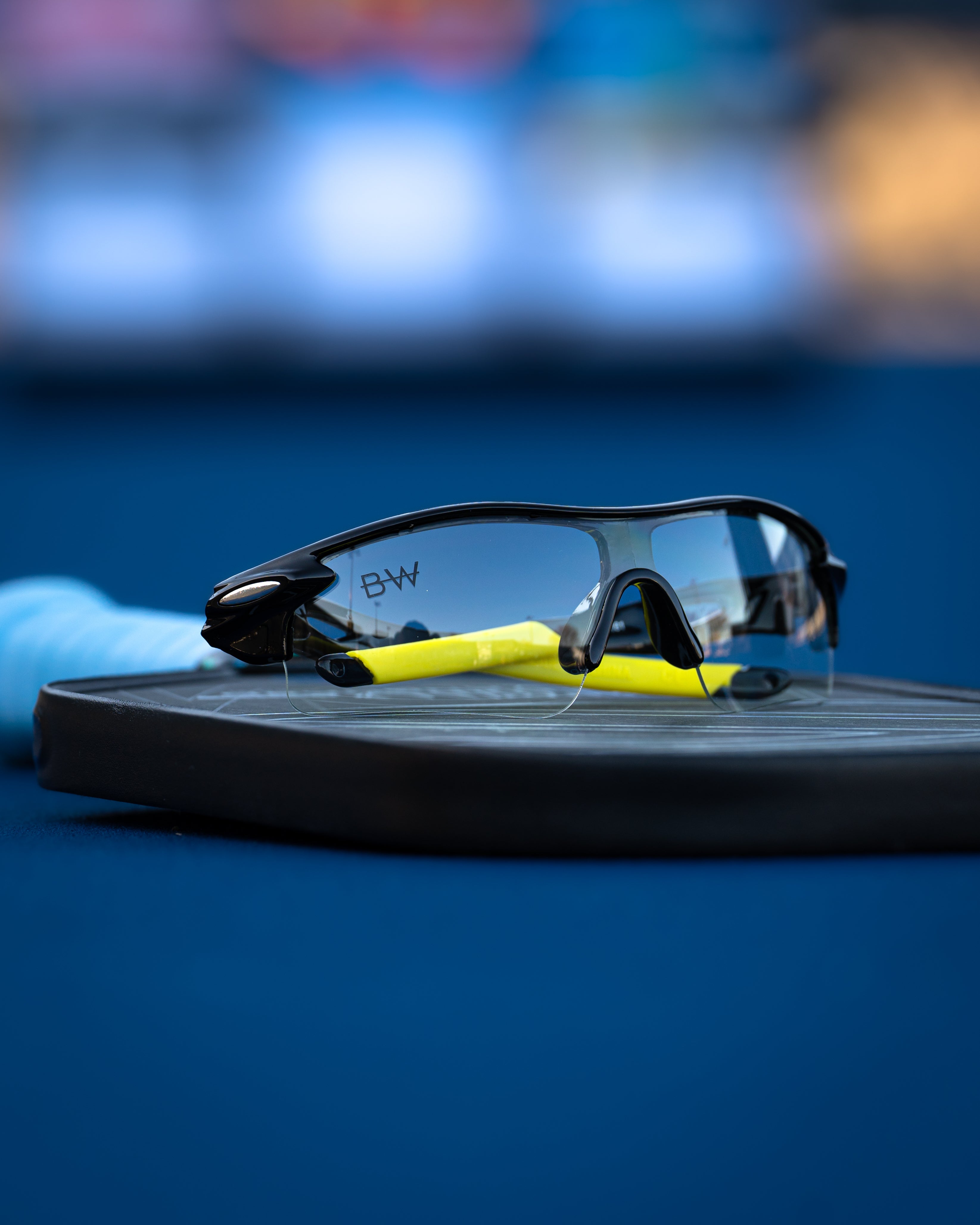
🏆 Best Rx Sunglasses for Court Sports [Pickleball, Volleyball, Tennis]
Share
Best Prescription Sunglasses for Pickleball, Volleyball, and Tennis in 2026
Whether you're chasing a dink across the pickleball kitchen, preparing for a serve on the beach volleyball court, or tracking a high lob during a tennis match, clear vision matters.
For athletes who need prescription correction, choosing sunglasses can be more complicated than selecting a frame that looks athletic.
Different court sports involve different lighting conditions, movements, and eye-protection considerations. A prescription sunglass configuration that works well for outdoor tennis may not be appropriate for indoor volleyball or evening pickleball.
That's why finding the best RX sunglasses for court sports starts with understanding your actual playing environment.
In this guide, we'll compare prescription eyewear considerations for pickleball, volleyball, and tennis, explore three Blinded Wear eyewear models, and explain how to choose lenses that suit your prescription and activities.
We'll also cover frame fit, UV protection, sports impact standards, ordering instructions, and what to know before purchasing customized RX eyewear.
Quick recommendation: For outdoor court sports, prioritize accurate prescription correction, appropriate sunglass tint, documented UV protection, comfortable fit, and any required impact certification. For indoor sports, clear or otherwise suitable lenses may be preferable to dark sunglasses.
Find Your Court Sports Eyewear
Not sure whether you need prescription sunglasses, non-prescription eyewear, or a different lens configuration?
- Prescription (RX) Eyewear — Explore frames and available prescription lens options.
- Non-Prescription Sunglasses — Browse eyewear if you don't need vision correction.
- Clear Lens Eyewear — Explore options for activities where dark lenses may be unsuitable.
- 2026 Pickleball Glasses Guide — Compare eyewear considerations for pickleball players.
- Pickleball Sunglasses Quiz — Explore your frame and lens preferences.
For prescription purchases, always verify the selected product's current lens options and compatibility before checkout.
Quick Comparison: What RX Sunglasses Do Different Court Sports Need?
Pickleball, volleyball, and tennis share some visual demands, but their playing environments can differ significantly.
The best eyewear configuration depends on where and how you play.
| Court Sport | Common Environment | RX Eyewear Priorities | Important Consideration |
|---|---|---|---|
| Outdoor pickleball | Sunlit hard courts, changing sun angles. | Prescription accuracy, suitable tint, UV protection, comfortable fit. | Check protective requirements and lens suitability. |
| Indoor pickleball | Recreation centers and indoor courts. | Appropriate prescription correction, adequate light transmission. | Dark sunglass lenses may be unsuitable. |
| Beach volleyball | Bright sunlight, sand, changing reflections. | Suitable sunglass tint, UV protection, secure fit. | Sand, sweat, and accidental ball contact require consideration. |
| Indoor volleyball | Gyms with artificial lighting. | Clear vision correction, suitable light transmission, appropriate protection. | Outdoor sunglasses generally aren't the default choice. |
| Outdoor tennis | Sunlit courts with changing light. | Prescription correction, UV protection, lens tint, comfortable fit. | Evaluate glare and any applicable protective requirements. |
| Indoor tennis | Indoor courts with artificial lighting. | Appropriate correction and sufficient visible light. | Check lens transmission and frame comfort. |
Key takeaway: There is no single RX sunglass configuration that is automatically best for all three sports.
In This Guide
Why Prescription Eyewear Matters for Pickleball, Volleyball, and Tennis
Court sports involve moving balls, changing viewing distances, and frequent head and body movements.
For athletes with refractive errors, appropriate prescription correction can help address blurry vision.
However, the relationship between eyewear and athletic performance is more complicated than simply claiming that clearer lenses produce faster reactions.
1. Accurate Prescription Correction
Prescription glasses are designed to correct refractive errors such as nearsightedness, farsightedness, and astigmatism.
For an athlete who needs correction, wearing an appropriate prescription can make distant objects appear clearer.
That may be particularly relevant when looking across a tennis court, following a volleyball serve, or viewing a pickleball opponent.
However, improved visual acuity does not guarantee better shot placement, reaction time, or competitive results.
2. Managing Bright Outdoor Conditions
Outdoor courts can expose athletes to direct sunlight and uncomfortable brightness.
Appropriate prescription sunglasses may help reduce visible-light intensity while maintaining the wearer's required vision correction.
However, the amount of light reduction depends on the selected lenses.
Darkness alone does not establish UV protection.
3. Choosing Eyewear for Frequent Movement
Pickleball players change direction quickly near the kitchen line.
Tennis players move laterally and frequently look upward during serves and overhead shots.
Volleyball players jump, dive, and turn their heads throughout rallies.
In each sport, eyewear fit matters.
Frames that move excessively or create pressure may become uncomfortable or distracting.
Actual fit depends on the wearer's facial dimensions and the selected frame design.
4. Understanding Sports Eye Protection
Court sports involve the possibility of accidental contact with balls, racquets, paddles, or other players.
Ordinary prescription sunglasses are not automatically certified protective sports eyewear.
Where protective eyewear is required or recommended, verify that the complete frame-and-lens assembly meets the applicable standard.
Do not assume a product is impact-certified simply because it has a wraparound appearance or is marketed for athletes.
5. Reducing the Need to Switch Between Glasses and Sunglasses
For some outdoor athletes, prescription sunglasses provide a convenient way to combine vision correction and sun protection in one pair.
However, that convenience does not mean one configuration is appropriate for indoor and outdoor conditions alike.
Players who frequently alternate between different lighting environments may benefit from separate eyewear configurations.
6. Considering Contact Lenses as an Alternative
Some athletes prefer contact lenses combined with suitable non-prescription eyewear.
Others prefer prescription glasses because they don't want to wear contact lenses during every activity.
Neither approach is universally best.
Comfort, prescription needs, environmental conditions, and protective requirements should guide the decision.
Bottom line: Prescription eyewear is valuable when it addresses your actual vision needs while remaining appropriate for your activity.
What to Look for in the Best RX Sunglasses for Court Sports
Before comparing individual frames, identify the features that matter for your prescription and intended activity.
Prescription Compatibility
Not every frame can accommodate every prescription or lens design.
Stronger prescriptions, certain lens configurations, and highly curved frames may require additional consideration.
Confirm compatibility before purchasing customized eyewear.
Comfortable, Appropriate Frame Fit
Frame width, bridge dimensions, and temple length can influence how eyewear sits on your face.
Frames should fit without excessive pressure or instability.
Sport-inspired styling alone does not guarantee secure retention during athletic movement.
Wraparound Design: Benefits and Tradeoffs
Wraparound frames may provide additional coverage around the sides of the face, depending on their geometry.
However, highly curved frames can create prescription compatibility considerations.
Wraparound styling also does not establish impact certification.
Suitable Lens Tint
Gray, brown, amber, and other lens tints affect visible-light transmission and color perception differently.
Some players prefer certain tints for particular outdoor environments.
However, no lens color should be assumed to improve ball tracking or reaction time for every athlete.
Documented UV Protection
Outdoor prescription sunglasses should provide appropriate UV protection.
Look for documented specifications rather than relying on lens darkness or marketing language.
A dark lens is not automatically a UV-protective lens.
Fogging and Lens Maintenance
Fogging can occur when temperature, humidity, and moisture conditions cause condensation on lenses.
Frame ventilation, environmental conditions, and lens treatments may influence fogging.
However, no frame should be described as fog-free unless that claim is supported.
Check whether a particular anti-fog treatment is actually available or included.
Lens Material and Durability
Different lens materials have different optical and physical characteristics.
Material selection should account for the prescription, frame, and intended use.
Do not confuse ordinary lens durability with certified sports impact protection.
High-Index Prescription Lenses
High-index materials can reduce lens thickness compared with certain lower-index alternatives for some prescriptions.
Blinded Wear includes high-index prescription lenses at no additional cost with RX eyewear.
However, high-index lenses are not automatically impact-certified.
Purchase and Replacement Policies
Because prescription eyewear is customized, buyers should review return and replacement terms before ordering.
Blinded Wear customized RX eyewear is final sale and excluded from the standard 30-day return policy.
Eligible broken eyewear may qualify for 50% lifetime replacement support under the current policy.
Best Prescription Sunglasses for Pickleball: What Matters Most?
Pickleball is played on relatively compact courts and involves quick exchanges, changes in direction, and a wide range of shot trajectories.
Players may compete indoors, outdoors, or in both environments.
That makes lens selection and frame fit especially important considerations.
Outdoor Pickleball: Prioritize Appropriate Sunglass Lenses
Outdoor players may encounter bright sunlight, reflections, and changing cloud cover.
Prescription sunglasses with suitable tint and documented UV protection may be appropriate.
However, the ideal tint depends on the environment and individual preferences.
Indoor Pickleball: Consider Clear RX Lenses
Indoor facilities often have artificial lighting and lower brightness than outdoor courts.
Clear prescription lenses may be more practical than dark sunglasses.
Always verify any applicable protective eyewear requirements.
Pickleball Frame Fit
Players should consider whether their glasses remain comfortably positioned during lateral movement and frequent head turns.
Frame measurements are more useful than assuming every sport-inspired frame provides a secure fit.
What About Ball Tracking and Reaction Time?
Appropriate prescription correction can address refractive blur.
However, a particular lens tint or frame cannot be assumed to improve ball tracking, reaction time, or competitive performance without supporting evidence.
Which Blinded Wear RX Glasses Should Pickleball Players Explore?
Start by comparing the available prescription eyewear models and their current lens options.
Models discussed later in this guide include Crystal Wave II RX and Gray Hound RX.
Waved II is also included as a non-prescription eyewear option; prescription-insert compatibility should be confirmed before treating it as an RX solution.
Best RX Sunglasses for Volleyball: Beach vs. Indoor Courts
Volleyball presents a different set of eyewear considerations depending on whether the game is played on sand or indoors.
Players frequently look upward, track serves and sets, jump, and move quickly across the court.
Eyewear selection should account for both vision correction and the playing environment.
Beach Volleyball: Sunlight, Sand, and Frame Fit
Beach volleyball commonly involves bright outdoor conditions and exposure to sand.
Prescription sunglasses may be useful for athletes who need vision correction and want lenses suitable for outdoor brightness.
Important considerations include documented UV protection, appropriate lens tint, comfort, and fit during movement.
Sand can also create maintenance concerns, especially if abrasive particles are rubbed across lens surfaces.
Indoor Volleyball: Clear Vision Without Excessive Tint
Indoor volleyball is generally played under artificial lighting.
Dark prescription sunglasses may reduce visible light unnecessarily.
Clear prescription eyewear or another suitable configuration may be preferable, depending on the athlete's needs.
Volleyball Eye Protection
Volleyball involves the possibility of accidental contact with the ball or another player.
Ordinary prescription sunglasses should not automatically be treated as protective sports eyewear.
Verify the appropriate protective requirements and eyewear certification for your activity.
Can the Same RX Glasses Work for Beach Volleyball and Pickleball?
Potentially, if the prescription, frame fit, lens configuration, and protective characteristics meet the needs of both activities.
However, a frame that works comfortably in one setting is not guaranteed to be suitable for every sport.
Volleyball RX Eyewear Buying Priorities
- Appropriate prescription correction.
- Lens tint suited to indoor or outdoor conditions.
- Documented UV protection for outdoor use.
- Comfortable frame fit during movement.
- Applicable impact-protection certification when needed.
- Practical cleaning and maintenance.
Volleyball takeaway: The best eyewear setup for beach volleyball may be different from the best setup for indoor volleyball.
Best Prescription Sunglasses for Tennis: Outdoor and Indoor Buying Guide
Tennis players may encounter changing sun angles, long rallies, overhead shots, and frequent movement across the court.
For prescription wearers, choosing suitable eyewear involves balancing vision correction, lighting, comfort, and protective considerations.
Outdoor Tennis: Lens Tint and UV Protection
Outdoor tennis courts can be bright, particularly during midday sessions.
Prescription sunglasses with appropriate visible-light transmission and documented UV protection may help manage outdoor brightness.
Gray, brown, and other tints can affect visual perception differently.
Personal preference and actual lens specifications should guide the choice.
Indoor Tennis: Adequate Light Transmission
Indoor tennis players generally need lenses suited to artificial lighting.
Dark sunglasses may not be appropriate.
Clear prescription lenses or another suitable configuration may be worth considering.
Fit During Serves and Overhead Shots
Tennis players frequently tilt their heads upward while serving or preparing for overhead shots.
Comfortable frame positioning matters during these movements.
However, no frame should be assumed to remain secure for every wearer without evaluating fit.
Do Polarized Lenses Help Tennis Players?
Polarized lenses reduce certain types of reflected glare.
Some players may prefer them in particular outdoor conditions.
Others may prefer non-polarized configurations because polarization can affect the appearance of certain surfaces and displays.
Neither option is universally best.
Are Prescription Sunglasses Better Than Contact Lenses for Tennis?
Both can provide vision correction, but they involve different considerations.
Some players prefer contacts with non-prescription sunglasses, while others prefer prescription eyewear.
The appropriate choice depends on individual needs, comfort, and protective requirements.
Tennis RX Eyewear Buying Priorities
- Current, accurate prescription correction.
- Lens configuration appropriate for court lighting.
- Documented UV protection for outdoor use.
- Frame comfort during movement and upward viewing.
- Verified protective suitability when required.
- Compatibility with the athlete's prescription.
Tennis takeaway: Choose prescription sunglasses based on the court environment and your visual needs, not unsupported claims of automatic improvements in shot accuracy or reaction time.
Are Prescription Sunglasses Safe for Pickleball, Volleyball, and Tennis?
Before choosing prescription sunglasses for court sports, it's important to understand the difference between ordinary eyewear, sport-inspired sunglasses, and certified protective sports eyewear.
These categories are not interchangeable.
A frame can look athletic, feature a curved design, or use durable materials without necessarily meeting a recognized sports eye-protection standard.
Why Court Sports Eye Protection Matters
Pickleball, volleyball, and tennis all involve moving balls and the possibility of accidental contact with equipment or other players.
Although the circumstances differ by sport, eye injuries can occur during recreational and competitive play.
Prescription correction addresses refractive vision needs. Protective sports eyewear is intended to address certain injury risks.
When both are needed, the complete eyewear configuration must be appropriate for both purposes.
What Is ASTM F803?
ASTM F803 is a standard specification covering eye protectors for selected sports.
Its requirements vary by the activities covered and the applicable edition of the standard.
When shopping for protective eyewear, confirm whether the complete product meets the standard relevant to your sport.
Do not assume an ordinary pair of prescription sunglasses qualifies merely because the frame is marketed for athletic use.
Are Polycarbonate Lenses Automatically Safe for Sports?
Polycarbonate is commonly used in certain protective eyewear applications because of its impact-related material properties.
However, lens material alone does not establish that the complete frame-and-lens assembly is certified for a particular sport.
Frame retention, lens mounting, product construction, and testing requirements also matter.
For activities where certified protection is needed, verify the actual eyewear assembly rather than relying on material descriptions.
Does a Wraparound Frame Provide Eye Protection?
Wraparound frames may offer additional side coverage depending on their shape and dimensions.
However, coverage and impact certification are separate considerations.
A curved frame is not automatically protective eyewear.
What About Prescription Inserts?
Some sports eyewear systems use prescription inserts positioned behind an outer lens.
These systems can offer an alternative to directly glazed prescription lenses, depending on the design.
However, prescription-insert compatibility must be specifically confirmed for the product.
Inserts should not be assumed compatible with every non-prescription sunglass frame.
Which Court Sports Need the Most Protection?
Eye-injury risks depend on the activity, level of play, equipment, and circumstances.
Pickleball and tennis involve paddles or racquets as well as moving balls. Volleyball involves ball contact and player collisions.
Rather than ranking one sport as universally more dangerous, evaluate the protective eyewear recommendations appropriate to your activity.
Safety Checklist Before Purchasing RX Court Sports Eyewear
- Confirm whether your activity calls for protective sports eyewear.
- Check the applicable certification of the complete eyewear assembly.
- Verify prescription compatibility.
- Review frame fit and retention.
- Choose lens tint appropriate for the playing environment.
- Confirm documented UV protection for outdoor use.
- Do not confuse scratch resistance with impact protection.
Important: The Blinded Wear products discussed below should not be treated as certified protective eyewear unless the current product documentation explicitly establishes that certification.
1. Waved II Sunglasses: A Sport-Inspired Option for Court Players
Waved II Sunglasses are worth exploring for shoppers interested in a distinctive sport-inspired eyewear appearance.
However, there's an important distinction to make before considering them for prescription use.
Waved II is linked as a non-prescription sunglass product in this guide. Prescription-insert compatibility should be verified before treating it as an RX solution.
Who Might Be Interested in Waved II?
Waved II may appeal to recreational athletes who prefer an athletic sunglass aesthetic and want to compare non-prescription eyewear for outdoor activities.
Potential shoppers include:
- Outdoor pickleball players who don't require prescription correction.
- Tennis players comparing sport-inspired sunglasses.
- Beach volleyball players evaluating outdoor eyewear styles.
- Contact lens wearers who prefer separate non-prescription sunglasses.
- Buyers who like a more pronounced athletic frame appearance.
Actual suitability depends on the current product specifications, fit, and lens characteristics.
Waved II for Pickleball
Pickleball players frequently move between the baseline and kitchen line while turning their heads to follow rallies.
For non-prescription sunglass wearers, frame comfort and suitable outdoor lenses are important considerations.
If you wear prescription glasses, confirm whether Waved II offers an officially supported prescription configuration before ordering.
Do not assume an RX insert can be added to any frame.
Waved II for Tennis
Outdoor tennis players may want sunglasses that complement their preferred playing conditions and frame style.
When evaluating Waved II, consider the documented lens tint, UV protection, frame dimensions, and fit.
A sport-inspired design alone does not guarantee secure retention during serves or overhead movements.
Waved II for Beach Volleyball
Beach volleyball players often face bright sunlight, sand, and frequent movement.
For these conditions, appropriate lens protection and practical frame maintenance matter.
Check the current Waved II product specifications before selecting the model for beach use.
Can Waved II Be Used With Contact Lenses?
Some athletes who wear contact lenses choose non-prescription sunglasses for outdoor activities.
Whether Waved II is suitable depends on the selected product configuration, fit, and any protective requirements.
Contact lenses themselves do not provide the same protection as appropriately certified protective sports eyewear.
Are Waved II Sunglasses Impact-Certified?
Do not assume impact certification without documentation identifying the relevant standard and complete eyewear assembly.
The same caution applies to claims about shatter resistance, anti-fog performance, or other technical features.
Waved II: What to Verify Before Buying
| Feature | Buying Consideration |
|---|---|
| Prescription availability | Verify whether an RX insert or prescription configuration is officially supported. |
| Lens tint | Review the current lens options and visible-light transmission. |
| UV protection | Check documented protection specifications. |
| Frame fit | Compare available dimensions with your existing eyewear. |
| Sports protection | Verify certification if protective eyewear is required. |
| Intended use | Determine whether the available configuration suits your sport and lighting. |
Waved II: Our Buying Verdict
Waved II is worth considering as a non-prescription sunglass option for shoppers who prefer an athletic frame appearance.
For athletes who require prescription correction, however, it should not be treated as a confirmed RX product without verifying compatibility.
Best reason to explore: Sport-inspired sunglass styling for buyers evaluating non-prescription eyewear.
Important limitation: RX insert availability and protective certifications must be verified.
Need dedicated prescription eyewear instead? Browse the Blinded Wear RX Collection.
2. Crystal Wave II RX: Prescription Sunglasses for Athletes Who Prefer Understated Styling
For athletes who need vision correction, dedicated prescription eyewear can be more straightforward to evaluate than a non-prescription frame with uncertain RX insert compatibility.
Crystal Wave II RX is one Blinded Wear prescription eyewear model worth comparing.
Its appeal in this guide centers on its understated styling and the opportunity to evaluate a dedicated RX option.
Why Consider Crystal Wave II RX for Court Sports?
Some athletes want prescription sunglasses that complement recreational activities and casual clothing.
Others prioritize the ability to select a frame compatible with their prescription without relying on an additional insert system.
Crystal Wave II RX is worth exploring if these considerations align with your preferences.
However, actual lens availability and compatibility should be confirmed on the current product page.
Crystal Wave II RX for Outdoor Pickleball
Outdoor pickleball players may encounter bright sunlight and changing court conditions.
When considering Crystal Wave II RX, review whether the available prescription lenses provide suitable visible-light transmission and documented UV protection.
Also compare frame dimensions with eyewear you already wear comfortably.
Do not assume a specific lens color will automatically improve ball tracking or reaction time.
Crystal Wave II RX for Tennis
Tennis players frequently change viewing direction while moving across the court.
Comfortable fit and accurate prescription correction are important considerations.
If selecting Crystal Wave II RX for outdoor tennis, verify the chosen lens configuration is suitable for the lighting conditions.
For indoor tennis, a dark sunglass configuration may be inappropriate.
Crystal Wave II RX for Volleyball
Beach volleyball and indoor volleyball create different eyewear requirements.
Prescription sunglasses may be relevant for beach volleyball when suitable for outdoor brightness and the athlete's needs.
For indoor volleyball, clear or otherwise appropriate lenses may be preferable.
Check the current product page to determine which prescription configurations are actually available.
Does Crystal Wave II RX Provide Better Ball Tracking?
Appropriate prescription correction can address refractive blur.
However, a particular frame or lens tint should not be assumed to improve athletic ball tracking without supporting evidence.
Visual performance also depends on factors such as lighting, visual processing, experience, and attention.
What About Peripheral Vision?
Frame geometry and lens design can affect the amount of visible frame material and the usable field of view.
However, a sleek or minimalist appearance does not establish superior peripheral vision.
Compare actual frame dimensions and optical requirements rather than relying on appearance alone.
High-Index RX Lenses at No Additional Cost
Blinded Wear includes high-index prescription lenses at no additional cost with RX eyewear.
For certain prescriptions, high-index materials can help reduce finished lens thickness compared with some lower-index alternatives.
However, the benefit depends on prescription strength, lens design, and frame dimensions.
High-index materials should not be confused with certified sports impact protection.
Crystal Wave II RX: Buyer Evaluation Table
| Feature | What to Consider |
|---|---|
| Prescription configuration | Verify compatibility with your eyeglass prescription. |
| Styling | Understated appearance for buyers who prefer a less pronounced athletic aesthetic. |
| Outdoor pickleball | Choose lenses suited to outdoor brightness and documented UV protection. |
| Tennis | Evaluate prescription clarity, fit, and available lens options. |
| Volleyball | Consider different lens requirements for beach and indoor play. |
| High-index lenses | Included at no additional cost with Blinded Wear RX eyewear. |
| Protective certification | Verify separately if required for your sport. |
Who Should Explore Crystal Wave II RX?
- Prescription wearers who prefer understated frame styling.
- Outdoor pickleball players comparing RX sunglass options.
- Tennis players looking for prescription eyewear with suitable available lenses.
- Beach volleyball players evaluating prescription sunglasses for bright conditions.
- Buyers who want to compare the complete cost of prescription eyewear.
Our verdict: Crystal Wave II RX is worth exploring for its dedicated prescription format and styling. Its suitability for a particular court sport depends on lens configuration, fit, and any required protective certification.
3. Gray Hound RX: A Prescription Sunglass Option for Outdoor Court Sports
Outdoor athletes often want prescription eyewear that fits their personal style while meeting practical needs for vision correction and sun exposure.
Gray Hound RX is another Blinded Wear prescription sunglass model worth comparing.
Its sport-inspired styling may appeal to players who want a frame they can consider for recreational court activities and everyday outdoor use.
Why Consider Gray Hound RX?
For prescription wearers, the ability to choose a frame designed to accommodate RX lenses is an important starting point.
However, the final eyewear configuration must also suit the individual's prescription, facial dimensions, and playing environment.
Gray Hound RX should be evaluated using its current product specifications rather than unsupported assumptions about performance.
Gray Hound RX for Outdoor Tennis
Outdoor tennis can involve prolonged exposure to bright conditions and frequent changes in viewing direction.
When considering Gray Hound RX for tennis, focus on:
- Prescription compatibility.
- Available sunglass lens configurations.
- Documented UV protection.
- Frame measurements and comfort.
- Appropriate protective certification if needed.
No particular frame should be assumed to improve serves, volleys, or reaction time automatically.
Gray Hound RX for Pickleball
Pickleball players may want prescription sunglasses that are comfortable during quick movement and suitable for outdoor court lighting.
Before purchasing Gray Hound RX, review frame dimensions and lens options.
Remember that a frame's athletic styling does not guarantee secure fit for every wearer.
Gray Hound RX for Beach Volleyball
Beach volleyball involves sunlight, sand, and repeated movement.
Prescription sunglasses may be appropriate when their lenses and fit suit these conditions.
However, a product should not be assumed to provide certified impact protection or sand resistance without documentation.
Can Gray Hound RX Accommodate Strong Prescriptions?
Prescription compatibility depends on several factors, including lens power, frame dimensions, curvature, and available lens designs.
High-index materials may help manage lens thickness for some prescriptions, but they do not guarantee that every frame will accommodate every prescription.
Confirm compatibility before ordering.
Are Gray Hound RX Sunglasses Suitable for All-Day Wear?
Comfort depends on frame fit, lens configuration, and individual preferences.
A frame that feels comfortable to one wearer may not fit another person the same way.
Compare measurements and consider how long you intend to wear the eyewear.
What About Lens Tint?
Gray and other sunglass tints can reduce visible-light transmission, depending on their specifications.
However, the model name does not establish which lens options are available or what their technical properties are.
Check the current Gray Hound RX product page before selecting a configuration.
Gray Hound RX: Buyer Evaluation Table
| Feature | What to Consider |
|---|---|
| Prescription | Compatibility with your current eyeglass prescription. |
| Frame appearance | Sport-inspired styling for buyers who prefer an athletic look. |
| Outdoor use | Suitable tint and documented UV protection. |
| Fit | Frame dimensions and individual comfort. |
| Stronger prescriptions | Confirm lens compatibility and finished lens considerations. |
| Sports protection | Verify applicable certification where required. |
| Returns | Customized RX eyewear is final sale. |
Who Should Explore Gray Hound RX?
Gray Hound RX is worth considering for prescription wearers who prefer sport-inspired sunglass styling and want to compare options for outdoor recreational activities.
It may appeal to tennis, pickleball, and beach volleyball players, provided the selected eyewear configuration meets their needs.
Our verdict: Gray Hound RX is a dedicated prescription sunglass option worth comparing for outdoor court use. Choose based on verified lens specifications, prescription compatibility, fit, and protective requirements.
Waved II vs. Crystal Wave II RX vs. Gray Hound RX: Court Sports Eyewear Comparison
These three models offer different shopping considerations.
The most important distinction is that Crystal Wave II RX and Gray Hound RX are presented as prescription eyewear, while Waved II is linked as a non-prescription sunglass product.
Before choosing, consider whether you need built-in prescription correction or plan to wear contact lenses with non-prescription sunglasses.
At-a-Glance Product Comparison
| Comparison | Waved II | Crystal Wave II RX | Gray Hound RX |
|---|---|---|---|
| Product category | Non-prescription sunglasses; verify RX insert compatibility. | Prescription sunglasses. | Prescription sunglasses. |
| Styling direction | Pronounced athletic aesthetic. | Understated styling. | Sport-inspired styling. |
| Outdoor pickleball | Evaluate as a non-RX option. | Evaluate available RX lenses. | Evaluate available RX lenses. |
| Outdoor tennis | Review fit and sunglass specifications. | Review prescription and lens compatibility. | Review prescription and lens compatibility. |
| Beach volleyball | Verify outdoor lens suitability. | Verify outdoor lens suitability. | Verify outdoor lens suitability. |
| Indoor volleyball | Dark lenses may be unsuitable. | Check appropriate lens availability. | Check appropriate lens availability. |
| High-index RX lenses | Not established for this non-RX product. | Included at no additional cost with RX eyewear. | Included at no additional cost with RX eyewear. |
| Prescription compatibility | Confirm whether an RX solution is supported. | Verify your prescription. | Verify your prescription. |
| Impact certification | Verify documentation. | Verify documentation. | Verify documentation. |
| Product page | Waved II | Crystal Wave II RX | Gray Hound RX |
Which Is Best for Prescription Wearers?
Crystal Wave II RX and Gray Hound RX are the more direct options to investigate because they are listed as prescription eyewear.
Choose between them based on current frame dimensions, lens availability, prescription compatibility, and styling preferences.
Which Is Best for Contact Lens Wearers?
Contact lens wearers may prefer non-prescription sunglasses in some situations.
Waved II is worth exploring as a non-RX option, provided its actual lens specifications and fit suit the activity.
However, contact lenses do not replace appropriate protective sports eyewear when needed.
Which Is Best for Pickleball?
For prescription wearers, begin by comparing Crystal Wave II RX and Gray Hound RX.
For non-prescription wearers, Waved II may be another option to investigate.
No model should be declared the universal best without evidence supporting that ranking.
Which Is Best for Beach Volleyball?
Prioritize documented UV protection, suitable lens tint, comfortable fit, and any relevant protective requirements.
The best choice depends on whether you need prescription correction and the available configuration of each model.
Which Is Best for Tennis?
Prescription tennis players should compare the two RX models based on their actual prescription and lens needs.
Non-prescription shoppers can also evaluate Waved II.
Frame style alone does not determine which model is better for tennis.
Which Is Best for Indoor Court Sports?
Indoor players generally need lenses that provide sufficient visible-light transmission.
Dark prescription sunglasses may not be appropriate.
Consider clear prescription eyewear or another suitable configuration, and verify the product's available options.
Which Offers the Best Value?
For prescription buyers, compare the complete price of the frame and lenses.
Blinded Wear includes high-index prescription lenses at no additional cost with RX eyewear, which may be relevant when comparing complete prescription purchases.
Also consider fit, lens options, and the final-sale policy for customized RX eyewear.
Which Has the Best Reviews?
A meaningful review ranking requires authentic ratings, review counts, and customer feedback for each product.
Without verified review data, it would be misleading to identify any of these models as the highest-rated.
Our Recommendation by Shopper Type
| Shopper | Where to Start | Why |
|---|---|---|
| Outdoor pickleball player who needs RX | Crystal Wave II RX or Gray Hound RX | Both are listed as prescription eyewear. |
| Tennis player who needs RX | Crystal Wave II RX or Gray Hound RX | Compare prescription compatibility and available lenses. |
| Beach volleyball player who needs RX | Crystal Wave II RX or Gray Hound RX | Evaluate outdoor lens options and fit. |
| Contact lens wearer seeking sunglasses | Waved II | Explore a non-prescription sunglass option. |
| Indoor volleyball player | Clear or appropriately configured RX eyewear | Dark sunglass lenses may be unsuitable indoors. |
| Buyer needing certified sports protection | Verified protective sports eyewear | Certification must be established independently of frame styling. |
Final comparison takeaway: Start with your prescription needs, then evaluate lighting, fit, lens specifications, and protection. The best-looking frame isn't automatically the best-performing option for your sport.
Find Prescription Eyewear That Matches Your Court and Your Vision
Whether you play pickleball, tennis, or beach volleyball, the right eyewear decision starts with understanding your individual needs.
Compare these featured models:
- Explore Waved II — Sport-inspired non-prescription sunglasses; verify any RX compatibility.
- Explore Crystal Wave II RX — Dedicated prescription sunglasses with understated styling.
- Explore Gray Hound RX — Prescription sunglasses with a sport-inspired aesthetic.
Need to compare more frames?
Browse the Complete Blinded Wear RX Collection
Want guidance on choosing lens colors and configurations?
Read the Blinded Wear Performance Lens Guide
Remember: The right court sports eyewear should meet your prescription, lighting, comfort, and protective requirements—not simply promise better athletic performance.
Best Prescription Lens Colors for Pickleball, Volleyball, and Tennis
Choosing the right prescription sunglasses for court sports involves more than selecting a frame. The lens configuration can influence how comfortable your eyewear feels in different lighting environments.
Outdoor pickleball, beach volleyball, and tennis can involve direct sunlight, reflected brightness, and changing weather conditions. Indoor court sports typically require a different approach.
There is no universally best lens color for every athlete or court.
Gray Prescription Lenses: A Versatile Outdoor Choice
Gray sunglass lenses generally reduce visible-light transmission while preserving relatively neutral color perception.
They may appeal to athletes who prefer a more natural-looking color balance in bright outdoor conditions.
Consider gray lenses for:
- Outdoor pickleball in bright sunlight.
- Daytime tennis matches.
- Beach volleyball when a suitable sunglass tint is needed.
- Outdoor recreational activities beyond court sports.
However, gray lenses are available in different levels of darkness. Check the actual visible-light transmission and documented UV protection of the selected lenses.
Brown and Amber Lenses: Understanding Contrast and Color
Brown and amber lenses alter the way certain colors and contrasts appear.
Some athletes prefer these characteristics in particular outdoor conditions.
However, preferences vary, and no tint should be assumed to guarantee improved ball tracking, depth perception, or reaction time.
Before selecting a contrast-oriented lens, consider your court surface, surrounding environment, and personal visual preferences.
Clear Prescription Lenses: Often More Practical Indoors
For indoor pickleball, volleyball, and tennis, clear prescription lenses may be more appropriate than dark sunglasses.
Indoor courts often have less available light than outdoor facilities, making sufficient visible-light transmission important.
Clear lenses can provide prescription correction without the light reduction associated with dark sunglass tints.
However, clear prescription lenses are not automatically certified protective sports eyewear.
Explore Blinded Wear Clear Lens Eyewear.
Photochromic Prescription Lenses: Can One Pair Handle Changing Light?
Photochromic lenses change tint in response to environmental conditions, depending on the specific lens technology.
They may appeal to athletes who frequently move between different outdoor lighting environments.
However, their performance varies according to lens formulation, temperature, UV exposure, and other factors.
Photochromic lenses may not become sufficiently dark for every bright outdoor situation, and their behavior indoors or behind certain windows can differ.
Check whether a compatible photochromic option is available for your selected Blinded Wear RX frame.
Polarized RX Sunglasses: Helpful for Glare, but Not Always Necessary
Polarized lenses can reduce certain types of reflected glare.
This may be useful in some outdoor environments, including areas with reflective surfaces.
However, polarization is not universally preferable for pickleball, tennis, or beach volleyball.
It can affect the appearance of certain surfaces and electronic displays, and individual preferences vary.
Do not assume polarized lenses are automatically superior to non-polarized lenses for ball tracking.
High-Index RX Lenses: What Athletes With Stronger Prescriptions Should Know
High-index prescription lens materials can help reduce lens thickness compared with some lower-index alternatives for certain prescriptions.
This may be particularly relevant when comparing frames for stronger prescriptions.
Blinded Wear includes high-index prescription lenses at no additional cost with RX eyewear.
However, finished lens thickness and weight also depend on prescription strength, frame size, lens shape, and material characteristics.
High-index materials are not automatically certified for sports impact protection.
Prescription Lens Comparison for Court Sports
| Lens Type | Potential Court Sports Use | Primary Consideration | Limitation |
|---|---|---|---|
| Gray RX sunglasses | Outdoor pickleball, tennis, beach volleyball. | Outdoor brightness and neutral color perception. | May be too dark indoors. |
| Brown or amber RX lenses | Selected outdoor court conditions. | Individual contrast and color preferences. | No guaranteed athletic improvement. |
| Clear RX lenses | Indoor pickleball, volleyball, tennis. | Adequate visible-light transmission. | Not automatically impact-certified. |
| Photochromic RX lenses | Some changing-light environments. | Adaptation to environmental conditions. | Activation varies by technology. |
| Polarized RX sunglasses | Selected reflected-glare environments. | Reduction of certain reflected glare. | Not universally best for every sport. |
| High-index RX lenses | Prescription correction across suitable activities. | Lens thickness for certain prescriptions. | Not equivalent to certified impact protection. |
Important: This comparison explains general lens categories. It does not mean every Blinded Wear frame is available with every lens option.
For more guidance, visit the Blinded Wear Performance Lens Guide.
Do You Need One Pair or Two Pairs of Prescription Sports Glasses?
If you play more than one court sport, you may wonder whether a single pair of prescription sunglasses can handle every activity.
The answer depends primarily on your playing environments, prescription requirements, and eyewear configuration.
Scenario 1: You Play Only Outdoor Pickleball and Tennis
If both sports are played under similar outdoor lighting conditions, one suitable pair of prescription sunglasses may be practical.
However, you should still confirm that the frame, lenses, and any required protective characteristics are appropriate for both activities.
Scenario 2: You Play Indoor Pickleball and Outdoor Tennis
These environments can require substantially different levels of visible-light transmission.
Dark sunglasses may work outdoors but reduce visibility excessively indoors.
Separate clear prescription eyewear and outdoor prescription sunglasses may be more practical.
Scenario 3: You Play Beach Volleyball and Indoor Volleyball
Beach volleyball often involves bright sunlight, while indoor volleyball typically takes place under artificial lighting.
Because the environments differ, separate eyewear configurations may be appropriate.
Protective requirements should also be considered independently of lens tint.
Scenario 4: You Play All Three Court Sports
For athletes who regularly play pickleball, volleyball, and tennis in both indoor and outdoor settings, a two-configuration approach may be worth considering.
- Outdoor configuration: Prescription sunglasses with appropriate tint and documented UV protection.
- Indoor configuration: Clear or otherwise suitable prescription eyewear with adequate light transmission.
Both configurations should meet any applicable protective requirements.
Can Photochromic Lenses Replace Two Pairs?
They may provide convenience for some wearers, but their suitability depends on the specific lens technology and lighting conditions.
They should not automatically be considered a complete replacement for separate indoor and outdoor eyewear.
One Pair vs. Two Pairs: Decision Table
| Your Playing Routine | Eyewear Approach to Consider | Why |
|---|---|---|
| Outdoor pickleball only | Suitable RX sunglasses. | Consistent outdoor lighting needs. |
| Outdoor tennis and pickleball | One suitable outdoor RX configuration may work. | Similar environmental requirements. |
| Indoor pickleball only | Clear or appropriately configured RX eyewear. | Dark sunglass tint may be unnecessary. |
| Beach and indoor volleyball | Consider separate outdoor and indoor configurations. | Different lighting conditions. |
| Indoor and outdoor court sports | Consider two configurations or evaluate compatible adaptive lenses. | Greater lighting variability. |
| Contact lens wearer | Contacts with suitable non-RX eyewear may be an option. | Depends on comfort and protective needs. |
Our recommendation: Don't purchase multiple pairs simply because you play multiple sports. Determine whether your actual lighting, prescription, and protective needs justify different configurations.
12-Point Buying Checklist for Prescription Court Sports Sunglasses
Before ordering customized RX eyewear, use this checklist to evaluate the product and your own requirements.
1. Start With a Current Eyeglass Prescription
Use an appropriate prescription from your eye-care professional. Contact lens prescriptions are not interchangeable with eyeglass prescriptions.
2. Identify Your Primary Court Sport
Consider whether you primarily play pickleball, tennis, beach volleyball, or indoor volleyball.
3. Identify Your Playing Environment
Determine whether your eyewear needs to accommodate bright sunlight, artificial lighting, or changing conditions.
4. Confirm Prescription Compatibility
Not every frame can accommodate every prescription. Verify compatibility before placing a customized order.
5. Compare Frame Dimensions
Review available width, bridge, and temple measurements. Compare them with glasses you already wear comfortably.
6. Choose an Appropriate Lens Configuration
Consider tint, visible-light transmission, and available lens materials.
7. Verify UV Protection for Outdoor Use
Check documented lens specifications rather than assuming dark lenses provide adequate UV protection.
8. Check Sports Impact Requirements
If protective eyewear is required or recommended, verify the complete eyewear assembly meets the relevant standard.
9. Evaluate Lens Treatments
Check whether any anti-fog, scratch-resistant, or other treatment is actually available. Do not assume these features are included.
10. Compare the Complete Prescription Price
Evaluate the total purchase cost, including any selected options. Blinded Wear includes high-index prescription lenses at no additional cost with RX eyewear.
11. Understand the Final-Sale Policy
Customized Blinded Wear RX eyewear is final sale and excluded from the standard 30-day return policy.
12. Review Replacement Support
Understand eligibility and return requirements for Blinded Wear's 50% lifetime replacement support for qualifying broken eyewear.
Buying takeaway: A well-informed purchase begins with verified product details, your prescription, and the activities you actually play.
How to Order Prescription Sports Sunglasses From Blinded Wear
Ordering prescription eyewear online requires accurate information and careful review of your selected product.
Here's how to approach a Blinded Wear RX purchase.
Step 1: Get Your Eyeglass Prescription Ready
Have a clear, current eyeglass prescription available.
Check that all relevant prescription information is readable.
Do not substitute a contact lens prescription for an eyeglass prescription.
Step 2: Choose Your RX Frame
Browse the Blinded Wear Prescription Eyewear Collection.
Two prescription models featured in this guide are:
Waved II is linked as a non-prescription sunglass product, so confirm whether an officially supported prescription configuration exists before treating it as an RX option.
Step 3: Review Available Prescription Lens Options
Check the selected product page for current lens options and prescription compatibility.
Available configurations may differ by model.
Step 4: Upload Your Prescription Before Adding to Cart
On the selected RX product page, upload a clear picture of your current eyeglass prescription before adding the item to your cart.
Make sure the image is readable and contains the necessary prescription details.
Step 5: Review Your Order Carefully
Confirm the frame, lens selections, prescription upload, and order total.
Because customized RX eyewear is final sale, accuracy before checkout is particularly important.
Step 6: Complete Checkout
Review the shipping information and applicable policies before submitting your order.
Do not assume a guaranteed production or delivery timeframe unless it is confirmed in the current ordering information.
Step 7: Contact Blinded Wear if You Need Help
For questions about prescription compatibility or ordering, contact blindedwearco@gmail.com.
Blinded Wear RX Returns, Final Sales, and 50% Lifetime Replacement Support
Prescription eyewear is a customized purchase, so understanding the applicable policies is important before ordering.
Can You Return Customized RX Sunglasses?
Customized Blinded Wear RX eyewear is final sale and excluded from the standard 30-day return policy.
Eligible noncustomized items may qualify for standard returns under the current policy terms.
What Is the 50% Lifetime Replacement Support?
Blinded Wear offers 50% lifetime replacement support for eligible broken eyewear, subject to its policy.
Qualifying customers receive 50% credit toward a replacement pair.
Eligible damaged eyewear must be returned as part of the replacement process.
Does This Mean Free Lifetime Lenses?
No.
The replacement support should not be interpreted as unlimited free scratch replacements, free routine prescription updates, or automatic replacement of lenses for life.
Is a Replacement Pair Completely Free?
No. The policy provides qualifying credit toward a replacement purchase, not a guaranteed free replacement pair.
What If My Glasses Break During Play?
Contact Blinded Wear to discuss whether your damaged eyewear qualifies for replacement support.
Contact blindedwearco@gmail.com before returning damaged RX eyewear.
Follow the instructions provided for the eligibility review and return process.
Where Can I Find the Full Policy?
Read the Blinded Wear Protection and Returns Policy.
Important: Current written policy terms govern eligibility and replacement support.
Frequently Asked Questions About RX Sunglasses for Court Sports
1. What are the best prescription sunglasses for court sports?
The best choice depends on your prescription, sport, playing environment, frame fit, and protective requirements. No single pair is universally best for pickleball, volleyball, and tennis.
2. Can I wear the same prescription sunglasses for pickleball and tennis?
Potentially, if the lenses, frame fit, prescription correction, and protective characteristics are suitable for both activities.
3. Are prescription sunglasses good for beach volleyball?
They may be appropriate for players who need prescription correction and outdoor sun protection. Confirm lens suitability, frame fit, and any relevant protective requirements.
4. Should I wear sunglasses for indoor volleyball?
Dark sunglasses are generally not the default choice for indoor volleyball. Clear or otherwise appropriately configured eyewear may be more suitable.
5. What color lenses are best for pickleball?
There is no universally best color. Gray, brown, amber, and other tints affect light transmission and visual perception differently.
6. Are gray prescription sunglasses good for tennis?
Gray lenses are commonly used in bright outdoor conditions because they generally preserve relatively neutral color perception. Suitability depends on the actual lens specifications.
7. Are polarized sunglasses better for pickleball?
Not necessarily. Polarization reduces certain reflected glare but is not universally preferable for every court or player.
8. Can RX sunglasses improve reaction time?
Appropriate prescription correction can address refractive blur, but a specific pair of sunglasses does not guarantee faster reactions.
9. Can prescription sunglasses help me track a tennis ball?
Correcting refractive blur may help a wearer see more clearly, but ball tracking depends on multiple factors. No particular frame guarantees improved tracking.
10. Are wraparound RX sunglasses better for sports?
Wraparound frames may offer additional side coverage, but their prescription compatibility, fit, and protective certification must be evaluated separately.
11. Are regular prescription sunglasses impact-resistant?
Do not assume ordinary prescription sunglasses meet protective sports eyewear standards. Verify the complete eyewear assembly's certification.
12. What is ASTM F803?
ASTM F803 is a standard specification for eye protectors used in selected sports. Check whether a product meets the applicable requirements for your activity.
13. Are polycarbonate lenses automatically safe for court sports?
No. Lens material alone does not establish that the complete eyewear assembly is certified for sports impacts.
14. Are high-index lenses good for athletes?
High-index materials may reduce lens thickness for certain prescriptions, but they are not automatically impact-certified.
15. Does Blinded Wear charge extra for high-index RX lenses?
No. Blinded Wear includes high-index prescription lenses at no additional cost with RX eyewear.
16. Can I wear RX sunglasses for indoor pickleball?
Dark lenses may be unsuitable indoors. Consider clear prescription eyewear or another configuration appropriate for the lighting.
17. Can photochromic lenses work for indoor and outdoor court sports?
They may be convenient for some environments, but their activation and darkness vary by lens technology and conditions.
18. Are Waved II sunglasses prescription-ready?
Waved II is linked as a non-prescription sunglass product in this guide. Confirm whether a supported RX insert or prescription configuration is available before purchasing it for prescription use.
19. Is Crystal Wave II RX suitable for pickleball?
It is a prescription eyewear option worth comparing. Suitability depends on your prescription, selected lenses, frame fit, and protective requirements.
20. Is Gray Hound RX suitable for outdoor tennis?
It is worth evaluating as a prescription sunglass option. Confirm available lens configurations, documented UV protection, fit, and prescription compatibility.
21. Can I use a contact lens prescription to order RX sunglasses?
No. Contact lens prescriptions are not interchangeable with eyeglass prescriptions.
22. How do I upload my prescription to Blinded Wear?
Upload a clear picture of your current eyeglass prescription on the selected RX product page before adding the eyewear to your cart.
23. Can I return customized Blinded Wear RX sunglasses?
Customized RX eyewear is final sale and excluded from the standard 30-day return policy.
24. What happens if my Blinded Wear RX glasses break?
Eligible broken eyewear may qualify for 50% lifetime replacement support, subject to policy terms. Contact blindedwearco@gmail.com before returning damaged RX eyewear.
25. Where can I buy Blinded Wear prescription sports sunglasses?
Browse the Blinded Wear Prescription Eyewear Collection to compare current models and available options.
Final Verdict: Which RX Sunglasses Should You Choose for Your Court Sport?
The best prescription sunglasses for court sports are the ones that meet your actual vision, lighting, fit, and protective needs.
Pickleball, volleyball, and tennis involve different playing environments, so no single frame or lens tint is automatically ideal for every athlete.
Best Starting Point for Outdoor Pickleball Players
Explore prescription sunglasses with appropriate tint, documented UV protection, comfortable fit, and verified protective suitability when required.
Crystal Wave II RX and Gray Hound RX are two Blinded Wear prescription models worth comparing.
Best Starting Point for Beach Volleyball Players
Prioritize prescription compatibility, suitable outdoor lenses, fit, and practical maintenance in sandy conditions.
Verify protective suitability before using ordinary prescription sunglasses as sports eye protection.
Best Starting Point for Outdoor Tennis Players
Compare prescription sunglasses based on lens tint, UV protection, frame comfort, and compatibility with your prescription.
Choose based on verified specifications rather than claims of guaranteed improved reaction time or ball tracking.
Best Starting Point for Indoor Court Sports
Consider clear prescription eyewear or another configuration with adequate visible-light transmission.
Dark sunglasses may be inappropriate for indoor lighting.
Best Starting Point for Athletes Who Wear Contact Lenses
Non-prescription sunglasses may be an option for outdoor use.
Waved II is worth exploring as a non-RX sunglass product, provided the lens specifications, fit, and protective characteristics suit your needs.
Best Starting Point for Athletes With Stronger Prescriptions
Compare frame dimensions and prescription compatibility carefully.
Blinded Wear includes high-index prescription lenses at no additional cost with RX eyewear, although the appropriate lens configuration depends on individual requirements.
Our Overall Recommendation
For prescription wearers comparing the featured models, begin with Crystal Wave II RX and Gray Hound RX.
For shoppers who do not require prescription correction, Waved II offers another sport-inspired eyewear option to investigate.
Choose the frame and lenses that fit your prescription and playing environment—not simply the product with the boldest performance claims.
Find Your Court Sports Eyewear at Blinded Wear Co.
Whether you're preparing for a pickleball tournament, practicing tennis outdoors, or playing beach volleyball, choosing eyewear starts with understanding your individual needs.
Explore the featured models:
- Crystal Wave II RX — Explore prescription eyewear with understated styling.
- Gray Hound RX — Compare sport-inspired prescription sunglass options.
- Waved II — Explore non-prescription sunglasses with an athletic aesthetic.
Still Comparing Your Options?
These resources can help you narrow your search:
- Shop All Prescription Eyewear — Browse Blinded Wear RX models.
- Shop Non-Prescription Sunglasses — Explore eyewear without RX correction.
- Explore Clear Lens Eyewear — Compare options for lower-light environments.
- 2026 Pickleball Glasses Guide — Explore pickleball-specific eyewear considerations.
- Performance Lens Guide — Learn about lens tint and RX options.
- Take the Eyewear Quiz — Explore frame and lens preferences.
- How to Order RX Glasses — Review prescription upload instructions.
Have Questions Before Ordering?
Contact blindedwearco@gmail.com for assistance with prescription ordering or product questions.
Learn More About the Blinded Wear Mission
Blinded Wear Co. connects its eyewear business with a mission focused on supporting children's vision.
Learn more about The Blinded Wear Mission.
Choose Your Next Pair With Confidence
Start with your prescription. Understand your playing conditions. Compare the available lenses and frame specifications. Review the policies before checkout.
Then choose the eyewear that best matches your needs.
Shop Blinded Wear Prescription Sports Sunglasses
Blinded Wear Co. — See Better. Play Harder.