Top Picks for Youth Athletes: Safety and Style Combined
Share
Best Pickleball Eyewear for Different Lighting Conditions in 2026
The best pickleball eyewear for changing lighting conditions is the pair that matches the environment where you actually play while also meeting your vision needs. Bright outdoor courts, cloudy afternoons, indoor facilities, and evening matches can all create very different visual conditions, so one lens setup is not automatically best for every player.
Prescription players also need to consider corrective vision alongside tint, visible-light conditions, frame comfort, and impact resistance. Blinded Wear offers both prescription and non-prescription sports eyewear, including clear-lens options for environments where a dark sun tint may not make sense.
Shop RX Pickleball Eyewear | Shop Non-RX Pickleball Eyewear | View the 2026 Pickleball Glasses Guide
Quick Answer: Which Pickleball Glasses Are Best for Different Lighting?
Choose pickleball eyewear based on the amount and type of light you face most often. Bright outdoor play may call for a sunglass lens that reduces visible brightness, while indoor or evening play may be better suited to clear or lighter-looking eyewear. Mixed conditions require a more flexible approach.
| Playing Condition | Useful Starting Point | What to Evaluate |
|---|---|---|
| Bright outdoor sun | Sunglass lens appropriate for bright visible light | Comfort, tint, fit, verified UV specification, and prescription needs |
| Cloudy or overcast | Lighter or environment-appropriate lens | Available light, visual comfort, and whether a dark tint feels excessive |
| Indoor courts | Clear or other indoor-appropriate sports eyewear | Prescription correction, impact resistance, comfort, and lighting quality |
| Dusk or evening play | Clear or lighter-looking lens may be more appropriate | Available light and individual visual comfort |
| Changing sun and shade | Evaluate whether one lens setup works across your typical conditions | Frequency and severity of lighting changes |
Why Lighting Matters in Pickleball
Pickleball involves constant visual attention. Players track the ball, opponents, court lines, net position, and changing play patterns throughout each rally.
Lighting can affect how comfortable and usable a visual environment feels. Bright sun may cause squinting or discomfort, while dim or uneven lighting can make details harder to distinguish. The purpose of appropriate eyewear is not to guarantee faster reactions or better performance, but to help create a lens environment that makes sense for the conditions where you play.
Lighting conditions can vary because of:
- Time of day
- Cloud cover
- Indoor vs. outdoor courts
- Artificial court lighting
- Shadows from buildings, fences, or trees
- Direction of the sun
- Weather changes
- Personal sensitivity to brightness
This is why the best pickleball eyewear decision starts with your playing environment rather than with a single lens buzzword.
Best Pickleball Eyewear for Bright Sunlight
Bright midday or afternoon sunlight can create intense visible brightness on outdoor courts. In these conditions, a sunglass lens may make the environment more comfortable by reducing visible-light transmission.
When choosing eyewear for bright outdoor pickleball, consider:
- How dark the lens appears in your typical conditions
- Whether the tint feels comfortable for extended play
- Whether you need prescription correction
- How the frame fits during movement
- Whether the lenses are impact resistant
- Whether the exact UV specification you care about is verified
A darker lens is not automatically a better lens. The goal is to reduce visible brightness to a level that feels appropriate without assuming maximum darkness provides maximum performance.
Best Pickleball Eyewear for Cloudy or Overcast Conditions
Overcast conditions can reduce overall brightness while still leaving enough light for outdoor play. A very dark sunglass lens may feel unnecessary to some players in these conditions.
Instead of choosing by label alone, evaluate whether your lens lets in enough visible light for the environment while still remaining comfortable.
Players may want to compare:
- Clear lenses
- Lighter-looking sunglass lenses
- Prescription or non-prescription versions
- Photochromic options if available for the exact product
No one tint should be described as universally best for cloudy pickleball because player preferences and actual light levels vary.
Best Eyewear for Indoor Pickleball Courts
Indoor pickleball usually does not require the same visible-light reduction as bright outdoor play. Clear sports eyewear is often a more logical starting point when a dark tint would unnecessarily reduce available light.
Indoor players should consider:
- Prescription correction if needed
- Clear lens availability
- Impact-resistant lens construction
- Frame comfort during extended matches
- How the eyewear feels under the actual facility lighting
Artificial lighting can vary significantly between facilities, so one indoor court may feel very different from another.
Best Pickleball Eyewear for Dusk and Evening Play
As daylight decreases, a dark sunglass lens may become less useful. Evening players should consider whether their lens continues to make sense once available light drops.
Clear or lighter-looking sports eyewear may be a better starting point for lower-light conditions, especially if the court relies heavily on artificial lighting.
For prescription players, this can mean comparing a clear RX sports lens with a darker outdoor prescription sunglass rather than expecting one dark pair to handle every environment equally well.
What About Courts With Sun, Shade, and Changing Light?
Some outdoor pickleball courts move repeatedly between bright sun and shadow. This can happen because of trees, buildings, court orientation, clouds, or the changing position of the sun.
Mixed-light conditions can be harder to solve with a single fixed tint because the lens that feels comfortable in direct sun may feel too dark in deeper shade.
Players in these environments should ask:
- How often do I move between bright and shaded areas?
- How dramatic is the difference in brightness?
- Do I play mostly at one time of day?
- Would a second pair for lower-light conditions be useful?
- Is an appropriate photochromic option available for my prescription and frame?
The right answer depends on how variable your real playing conditions are.
Clear vs. Tinted Pickleball Glasses
The simplest distinction is that clear lenses preserve more visible light, while tinted lenses reduce visible-light transmission according to the tint.
| Lens Type | Often Best Suited For | What to Consider |
|---|---|---|
| Clear lenses | Indoor, evening, or lower-light environments | Prescription needs, frame fit, impact resistance, and facility lighting |
| Tinted lenses | Brighter outdoor conditions | Tint darkness, comfort, UV specification, and playing environment |
Neither category is universally superior. The better choice depends on where and when you play.
How Prescription Needs Change the Lighting Decision
Players who require corrective vision need to consider two separate questions:
- What prescription correction do I need?
- What lens environment makes sense for the lighting where I play?
A prescription can be incorporated into sports eyewear, but the presence of RX correction does not determine whether the lens should be clear, tinted, or another type. Those are separate decisions.
Blinded Wear offers prescription sports and pickleball eyewear with high-index lenses included without an additional high-index upcharge.
High-index refers to a category of prescription lens materials. It should not be interpreted as one universal numerical index across every order.
How Blinded Wear Prescription Ordering Works
Blinded Wear RX customers upload a clear picture of their eyeglass prescription before purchasing. The prescription information can then be associated with the custom RX order.
Before submitting your prescription:
- Make sure the image is clear and readable
- Use your actual prescription information rather than estimating values
- Verify compatibility if you have specific or more complex prescription requirements
- Consult an eye-care professional if you have questions about your current prescription or notice meaningful changes in your vision
Polarized vs. Non-Polarized Lenses for Pickleball Lighting
Polarization and lens darkness are often discussed together, but they are different characteristics.
Polarized lenses use a filter designed to reduce certain reflected glare. Non-polarized lenses do not add that polarization filter.
Blinded Wear uses non-polarized lenses. This preserves natural visual information without adding a polarization filter.
That does not mean non-polarized lenses automatically improve depth perception or athletic performance. It also does not mean polarized lenses are universally wrong for pickleball. Individual preference and environment matter.
| Lens Type | What It Does | What It Does Not Guarantee |
|---|---|---|
| Polarized | Uses a filter designed to reduce certain reflected glare | Better depth perception, better ball tracking, or universal pickleball performance |
| Non-polarized | Does not add a polarization filter | Faster reaction time, better depth perception, or automatic performance improvement |
What About Glare on Pickleball Courts?
Bright reflected light can be uncomfortable, but glare should not be treated as a single problem with one universal lens solution.
Reflections can come from:
- Bright court surfaces
- Nearby vehicles
- Windows
- Water
- Light-colored structures
- Artificial lighting
If reflected glare is a major concern, evaluate the exact lens technology and environment rather than assuming all sports eyewear provides the same glare management.
Do not assume Blinded Wear lenses include a specific anti-glare coating unless that feature is stated for the exact product.
Do High-Contrast Lenses Improve Ball Tracking?
Lens-color and contrast claims should be evaluated carefully.
Different tints can change how colors and brightness appear, but no single tint should be presented as universally improving ball tracking, reaction time, or pickleball performance.
Ball tracking can depend on many factors, including:
- Vision correction
- Available light
- Background colors
- Player experience
- Anticipation
- Individual visual preferences
Choose a lens because it feels appropriate for your environment rather than because it promises a guaranteed competitive advantage.
Are Photochromic or Transition Lenses Good for Pickleball?
Photochromic lenses are designed to change tint in response to environmental conditions. They can be appealing to players who move between different lighting environments.
However, exact behavior depends on the specific lens technology and conditions. Before choosing a photochromic option, verify:
- How dark the lens can become
- How it behaves in your normal playing environment
- How quickly its appearance changes
- How it behaves indoors or in lower-light conditions
- Any stated UV specification
- Whether it is available with your prescription
Do not assume every Blinded Wear model offers a photochromic option unless that feature is listed for the exact product.
UV Protection and Lens Darkness Are Not the Same Thing
A common mistake is assuming a darker lens automatically provides better UV protection.
Visible-light darkness and UV filtering are separate characteristics. A lens can look dark without that appearance alone proving a specific UV rating.
If UV filtering is important to you for outdoor pickleball, verify the exact UV specification for the specific lens rather than assuming every product has identical protection.
Why Impact Resistance Still Matters in Every Lighting Condition
Whether you play indoors, outdoors, during the day, or at night, pickleball remains an active sport. Impact resistance is therefore an important characteristic to consider independently from lens tint.
Blinded Wear uses impact-resistant lenses in its sports-focused eyewear.
Impact resistance does not mean:
- Impact proof
- Unbreakable
- Guaranteed injury prevention
- Automatically certified to a particular protective standard
If you require a specific protective certification, confirm it for the exact product.
2026 Pickleball Lighting Comparison Guide
| Condition | Lens Starting Point | Main Decision |
|---|---|---|
| Strong midday sunlight | Tinted sports eyewear | How much visible-light reduction feels comfortable? |
| Cloudy outdoor play | Lighter or environment-appropriate lens | Is a dark tint reducing more light than you want? |
| Sun and shade | Flexible setup based on your normal court | Can one pair realistically handle the changes? |
| Indoor pickleball | Clear sports eyewear | Do you need RX correction and impact-resistant construction? |
| Evening play | Clear or lighter-looking eyewear | How much available light remains? |
| Multiple environments | Consider more than one pair or another suitable lens solution | How different are your most common playing conditions? |
Start With Your Most Common Playing Environment
If you are unsure which lens to choose, begin with the court conditions you encounter most often rather than trying to solve every possible lighting scenario at once.
Ask yourself:
- Do I mostly play indoors or outdoors?
- What time of day do I normally play?
- Are my courts usually bright, shaded, or mixed?
- Do I need prescription correction?
- Do I regularly switch between very different environments?
- Would separate clear and sunglass options make more sense?
If you still are not sure where to start, the Blinded Wear Pickleball Sunglasses Quiz can help narrow your options based on your needs.
RX vs. Non-RX Pickleball Eyewear for Different Lighting Conditions
The lighting decision is separate from the prescription decision.
If you need corrective vision, prescription sports eyewear can combine your required correction with a lens setup suited to your playing environment. If you wear contact lenses or do not need prescription correction, non-RX sports eyewear may be the simpler option.
| Player Need | Starting Point | Lighting Question |
|---|---|---|
| Needs prescription correction | RX pickleball eyewear | Do you need a clear, tinted, or other environment-appropriate lens? |
| Wears contact lenses | Non-RX sports eyewear | Which lens setup best matches your normal court lighting? |
| No prescription needed | Non-RX sports eyewear | How bright or dim are your normal playing conditions? |
| Plays across multiple environments | RX or non-RX depending on vision needs | Can one lens realistically cover all of your common conditions? |
The best choice starts with your vision needs and then narrows based on the lighting environments where you actually play.
Brightness Control, UV Filtering, and Impact Resistance Are Different Features
These three characteristics are often discussed together, but they solve different problems.
- Visible-light reduction affects how bright the environment appears through the lens.
- UV filtering refers to how the lens handles ultraviolet radiation and should be verified for the exact product.
- Impact resistance relates to how the lens responds to physical impact.
A dark lens does not automatically prove a specific UV rating. A UV claim does not automatically establish impact resistance. And an impact-resistant lens does not automatically mean the lens is suitable for every lighting environment.
Evaluate each feature separately rather than assuming one marketing term covers all three.
How Court Orientation Can Change Your Eyewear Needs
Two outdoor courts can feel completely different even at the same time of day.
The direction a court faces can affect whether players regularly look toward the sun, move between shadow and direct light, or play with bright light entering from one side.
Before choosing a lens, think about your actual court rather than only the weather forecast.
Ask:
- Is the sun frequently in my line of sight?
- Does one side of the court stay shaded?
- Do nearby buildings create strong shadows?
- Does the court become much darker late in the day?
- Do I usually play at the same facility or many different ones?
This practical information can be more useful than choosing a tint based on a generic “outdoor” label.
Not All Indoor Pickleball Lighting Is the Same
Indoor pickleball facilities can vary substantially in brightness, fixture placement, ceiling height, wall color, and floor reflectivity.
One venue may feel bright and evenly lit, while another may have darker areas or more noticeable overhead reflections.
This means “indoor pickleball eyewear” should not be treated as one universal lens category.
For most players, clear sports eyewear is a logical place to begin because it does not intentionally darken the environment. From there, comfort and prescription needs become the more important considerations.
What If Your Match Starts in Daylight and Ends After Sunset?
This is one of the most difficult lighting scenarios for fixed-tint eyewear.
A lens that feels comfortable while the sun is still bright may feel too dark later in the match. Players who regularly compete across sunset should consider whether their eyewear remains usable as natural light decreases.
Possible approaches include:
- Using a lighter lens from the beginning
- Keeping a clear second pair available
- Considering an appropriate photochromic option if one is available for the exact frame and prescription
- Choosing eyewear based on the darker portion of the session if that is where most play occurs
There is no universal answer because sunset timing, court lighting, and individual visual comfort vary.
Do Pickleball Players Need More Than One Pair of Glasses?
Not always, but players who regularly switch between very different lighting environments may find that separate eyewear setups are easier than forcing one lens to handle everything.
For example, a player who competes outdoors at noon and also plays indoors at night may prefer:
- One sunglass setup for bright outdoor play
- One clear-lens setup for indoor or lower-light play
Players who only use one type of court may not need that level of flexibility.
The goal is not to own more eyewear unnecessarily. It is to avoid using a lens that is mismatched to the environment simply because it is the only pair available.
Are Yellow Lenses Better for Low-Light Pickleball?
Yellow and amber lenses are often marketed for low-light sports, but they should not be described as universally improving visibility or ball tracking.
A colored tint changes the way the wearer perceives certain colors and brightness. Whether that feels helpful is subjective and can depend on the player, background, court environment, and exact lens.
For players who want maximum available visible light in darker conditions, a clear lens may be the more straightforward starting point.
If you are considering a colored low-light tint, evaluate the exact lens rather than assuming the color itself guarantees better performance.
Does Ball Color Change Which Lens You Should Choose?
Ball color can influence how easy the ball feels to distinguish from the surrounding court and background, but lens selection should not be reduced to a single “best color for yellow pickleballs” rule.
Visibility depends on the full visual environment, including:
- Ball color
- Court color
- Background scenery
- Available light
- Lens tint
- Vision correction
- Individual visual perception
If a particular lens tint feels good with the ball and court colors you usually encounter, that can be useful personal information. It should not be presented as a guaranteed performance advantage for every player.
What If You Squint During Bright Outdoor Pickleball?
Frequent squinting can be a sign that the visible-light environment feels uncomfortably bright.
A sunglass lens that reduces visible brightness may make outdoor play more comfortable, but the solution should still be matched to the conditions.
Do not assume that choosing the darkest available lens is automatically best. A lens that is comfortable in intense midday sun may be unnecessarily dark once clouds move in or the sun gets lower.
Players who routinely experience unusual light sensitivity or meaningful changes in vision should discuss those concerns with an eye-care professional.
Can the Wrong Lens Make a Court Feel More Visually Fatiguing?
A lens that feels too dark, too bright, uncomfortable, or visually distracting can make the playing environment less pleasant over time.
However, eyewear should not be marketed as guaranteeing reduced eye fatigue or improved endurance.
Visual comfort depends on multiple factors, including:
- Prescription accuracy
- Available light
- Lens tint
- Frame fit
- Length of play
- Individual visual needs
If persistent eye strain occurs despite appropriate eyewear, an eye-care professional can help evaluate whether another issue may be contributing.
Lighting Is Only One Part of Good Pickleball Eyewear
The right lens for the court will not help much if the frame itself is uncomfortable or distracting.
In addition to lighting, evaluate:
- Frame weight
- Comfort during longer matches
- Fit during head movement
- Coverage
- Prescription compatibility
- Impact-resistant lens construction
- Whether the frame suits your face and playing preferences
Blinded Wear uses lightweight sports frames and impact-resistant lenses, both of which are relevant regardless of whether you choose a clear or tinted lens setup.
Does Clear or Tinted Eyewear Provide Better Protection?
Lens tint and impact resistance are different characteristics.
A clear impact-resistant sports lens may be better suited to an indoor court than a dark sunglass lens, while a tinted impact-resistant lens may be better suited to bright outdoor play.
The tint itself does not establish how protective the eyewear is against physical impact.
Likewise, “sports eyewear” does not automatically mean a frame is certified to a specific protective standard. If a particular certification matters to you, verify it for the exact product.
How Blinded Wear Fits Into the Lighting Decision
Blinded Wear offers both prescription and non-prescription sports eyewear for players comparing different court environments.
Verified Blinded Wear characteristics include:
- Prescription eyewear availability
- Non-prescription sports eyewear
- Clear-lens options
- High-index prescription lenses without an additional high-index upcharge
- Lightweight sports frames
- Impact-resistant lenses
- Non-polarized lenses
- Comfort intended for extended matches
- Performance-first design
The exact tint, UV specification, photochromic availability, or specialized coating should still be verified for the specific product you are considering.
Bird's Eye Clear Lens for Indoor and Lower-Light Comparison
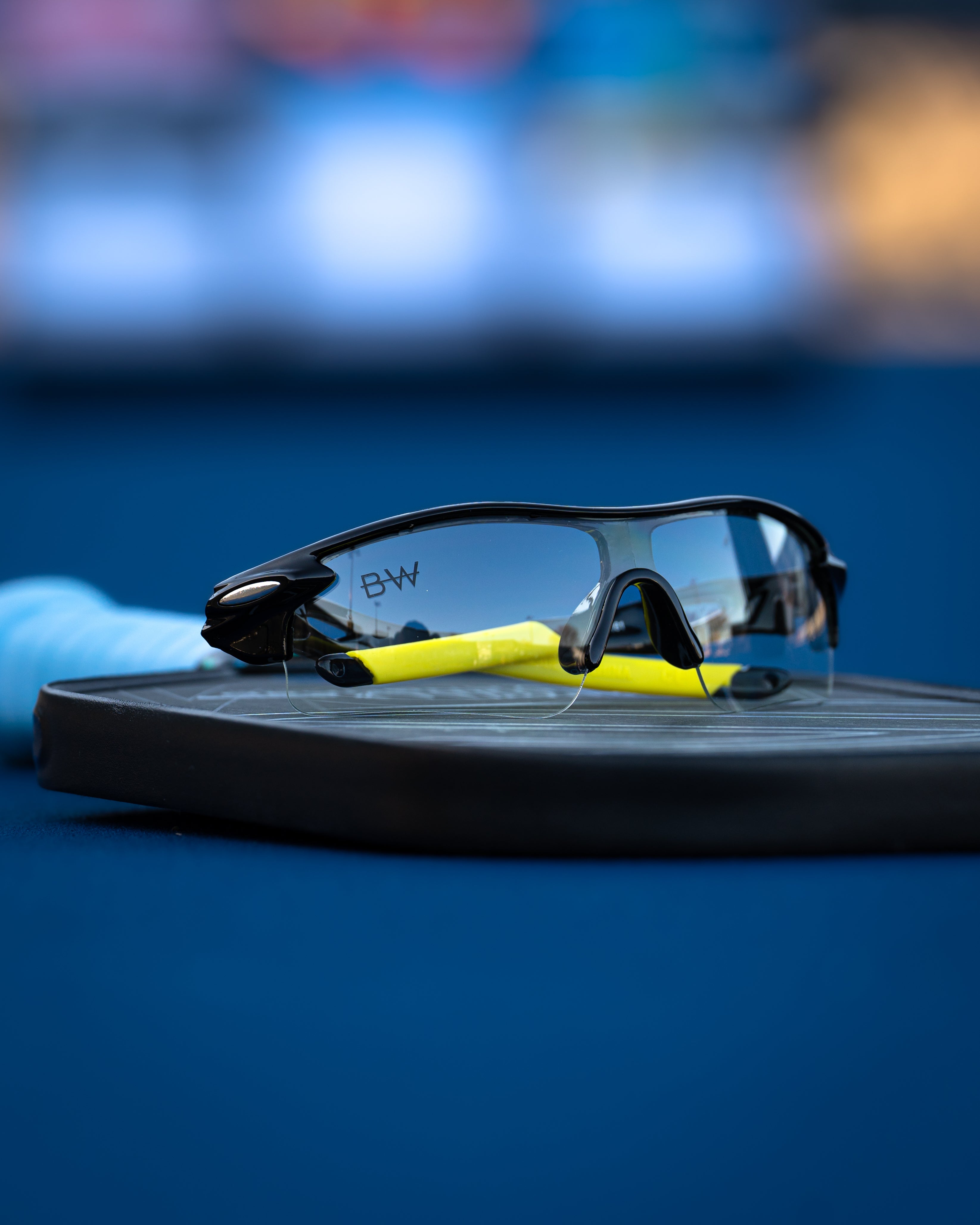
Bird's Eye Clear Lens Pickleball Sunglasses are one Blinded Wear option to compare if your main priority is a clear lens rather than a dark sunglass tint.
Clear lenses can be particularly relevant for players who:
- Play primarily indoors
- Play in lower-light environments
- Do not want to intentionally reduce visible light
- Want sports eyewear for active use without a dark sunglass tint
Do not assume this model includes a particular anti-glare, anti-fog, UV, or coating specification unless it is currently stated for the exact product.
What RX Players Should Compare Beyond Lens Tint
Prescription players should avoid focusing so heavily on lighting that they overlook the rest of the RX purchase.
Compare:
- Prescription compatibility
- Completed RX price
- Lens material
- Frame fit
- Impact resistance
- Clear or tinted configuration
- Verified UV information if relevant
- Any available photochromic option
- Return and replacement terms
Blinded Wear includes high-index lenses with its prescription eyewear without an additional high-index upcharge, which can be useful when comparing total RX value rather than only the initial frame price.
Replacement Support for Active Eyewear
Pickleball eyewear can be exposed to repeated use, travel, drops, and accidental damage, so replacement support may be worth considering alongside frame and lens features.
Blinded Wear offers 50% lifetime replacement support for eligible eyewear that breaks, subject to current policy terms.
This is not the same as unlimited free replacement, so review current eligibility and policy details before purchasing.
10 Common Mistakes When Choosing Pickleball Eyewear for Lighting
1. Assuming the Darkest Lens Is Always Best Outdoors
Lens darkness should match the actual visible-light conditions rather than a simple outdoor label.
2. Wearing a Dark Sunglass Lens Indoors
If the tint removes more visible light than you want, clear sports eyewear may be a more logical option.
3. Assuming Polarization Is Required
Polarization is one lens technology, not a universal requirement for pickleball.
4. Assuming Non-Polarized Automatically Improves Depth Perception
Blinded Wear uses non-polarized lenses, but that fact alone does not guarantee improved depth perception.
5. Treating UV Protection and Lens Darkness as the Same Thing
Visible-light reduction and UV filtering are separate lens characteristics.
6. Assuming Yellow Lenses Always Improve Ball Tracking
Tint preferences vary, and no color should be marketed as guaranteeing better tracking.
7. Ignoring Your Prescription
Players who require corrective vision should address that need alongside the lighting decision.
8. Assuming One Pair Must Work Everywhere
Players who regularly switch between bright outdoor and darker indoor environments may prefer more than one setup.
9. Believing Every Sports Lens Has the Same Coatings
Anti-fog, anti-scratch, anti-glare, and other treatments should be verified for the exact product.
10. Buying Based on Performance Promises
No eyewear can guarantee faster reactions, better ball tracking, improved depth perception, or match wins.
Which Pickleball Lens Setup Should You Start With?
| If You Mostly Play... | Start by Comparing... |
|---|---|
| Outdoors in strong sunlight | A sports sunglass lens suited to bright visible-light conditions |
| Outdoors under cloud cover | A lighter or environment-appropriate lens that does not feel unnecessarily dark |
| Indoors | Clear lens sports eyewear |
| In the evening | Clear or lighter-looking eyewear appropriate for the available light |
| Across very different conditions | Multiple lens setups or a suitable alternative that can accommodate changing conditions |
| With prescription correction | Prescription pickleball eyewear matched to your normal lighting environment |
Still Not Sure Which Pickleball Eyewear Fits Your Conditions?
If you are comparing multiple lens setups, start with three questions: Do you need prescription correction? Where do you play most often? How bright is that environment?
Those answers can quickly narrow the choices between clear, tinted, RX, and non-RX sports eyewear.
Pickleball Eyewear and Lighting FAQ
What color lens is best for pickleball?
There is no single lens color that is best for every pickleball player. The right choice depends on available light, court environment, background colors, personal preference, and whether you need prescription correction. Bright outdoor conditions may call for a tinted lens, while clear eyewear can be a better starting point indoors or in lower light.
What are the best pickleball glasses for indoor courts?
Clear sports eyewear is a practical starting point for indoor pickleball because it does not intentionally darken an already enclosed environment. Players should also consider prescription needs, impact resistance, frame comfort, and the lighting at their specific facility.
What are the best pickleball glasses for bright sunlight?
A sports sunglass lens that reduces visible brightness can be useful during bright outdoor play. The ideal tint is not necessarily the darkest available. Choose a lens that feels appropriate for your normal conditions and verify any UV specification that matters to you.
Should I wear clear glasses for evening pickleball?
Clear sports eyewear can be a sensible option as natural light decreases because it does not intentionally reduce visible light with a dark tint. The best setup still depends on the brightness of the court and its artificial lighting.
Are darker lenses always better for outdoor pickleball?
No. A darker lens reduces more visible light, but that does not automatically make it better. Very dark lenses may feel appropriate in intense sunlight but unnecessarily dark in clouds, shade, or late-afternoon conditions.
Do dark sunglasses provide more UV protection?
Lens darkness alone does not establish a specific UV filtering level. Visible-light transmission and UV filtering are separate characteristics. Verify the stated UV specification for the exact lens you are considering.
Are polarized sunglasses better for pickleball?
Not universally. Polarized lenses use a filter designed to reduce certain reflected glare. Some players may prefer that characteristic, while others may prefer non-polarized lenses. Blinded Wear uses non-polarized lenses, which do not add a polarization filter.
Do polarized lenses hurt depth perception in pickleball?
Polarized lenses should not be described as universally damaging depth perception, just as non-polarized lenses should not be described as automatically improving it. Depth perception and sports vision involve multiple aspects of the visual system.
Do non-polarized lenses reduce glare?
Non-polarized lenses do not use the polarization filter specifically designed to reduce certain reflected glare. Other characteristics of a lens can affect brightness and visual comfort, so evaluate the exact lens rather than assuming all non-polarized eyewear handles glare identically.
Are yellow lenses best for indoor pickleball?
Not necessarily. Colored tints can change how colors and brightness appear, but yellow lenses should not be presented as universally improving ball visibility or contrast. Clear lenses are a straightforward option for players who do not want to intentionally reduce available visible light.
Are photochromic lenses good for pickleball?
Photochromic lenses may appeal to players who encounter changing lighting conditions. Their behavior depends on the specific lens technology and environmental conditions, so verify how the exact option works and whether it is compatible with your prescription.
Can I get prescription pickleball glasses?
Yes. Blinded Wear offers prescription sports and pickleball eyewear. RX customers upload a clear picture of their eyeglass prescription before purchasing so the prescription information can be associated with the custom RX order.
Does Blinded Wear charge extra for high-index prescription lenses?
No additional high-index upcharge is applied to Blinded Wear prescription eyewear. High-index describes a category of prescription lens materials rather than one universal numerical lens index.
Are Blinded Wear pickleball glasses impact resistant?
Blinded Wear uses impact-resistant lenses. Impact resistant does not mean impact proof, unbreakable, guaranteed to prevent injury, or automatically certified to a particular protective standard.
Do pickleball glasses improve reaction time?
No pair of glasses should be marketed as guaranteeing faster reactions. Appropriate prescription correction and a lens suited to the environment can support a comfortable visual setup, but reaction time depends on many factors beyond eyewear.
Can pickleball glasses make it easier to track the ball?
Appropriate vision correction and a lens that works well in your environment can help you avoid unnecessary visual obstacles, but eyewear should not be presented as guaranteeing better ball tracking. Player vision, lighting, background, experience, anticipation, and other factors all contribute.
Match Your Pickleball Eyewear to Where You Actually Play
Instead of searching for one universally “best” pickleball lens, identify your most common playing environment and work outward from there.
| Your Typical Play | What to Compare First | Potential Mistake to Avoid |
|---|---|---|
| Mostly indoor | Clear sports eyewear | Using a dark tint that removes more visible light than you want |
| Mostly bright outdoor | Sports sunglasses appropriate for bright conditions | Assuming the darkest lens is automatically best |
| Mostly evening | Clear or environment-appropriate lighter eyewear | Continuing to use a dark daytime lens after available light falls |
| Cloudy outdoor courts | A lens that remains comfortable without excessive visible-light reduction | Choosing solely by an “outdoor” label |
| Mixed sun and shade | A setup that works across your actual range of conditions | Assuming one fixed tint will feel ideal everywhere |
| Indoor and outdoor | Consider whether separate clear and sunglass options make sense | Forcing one pair to cover dramatically different environments |
| Needs corrective vision | RX sports eyewear plus an appropriate lens environment | Choosing tint before confirming prescription compatibility |
How to Test Pickleball Eyewear in Real Court Lighting
A lens can look very different inside your home than it does on a pickleball court. Before relying on new eyewear for an important match or tournament, evaluate it in conditions similar to those where you normally play.
- Wear the glasses in your normal playing environment. Indoor lighting, direct sun, cloud cover, and evening conditions can produce very different experiences.
- Check the brightness level. Ask whether the lens feels too dark, too bright, or comfortable for the environment.
- Move naturally. Make sure the frame remains comfortable while looking up, down, and side to side.
- Evaluate the prescription. If you ordered RX eyewear, pay attention to how the prescription feels during normal use.
- Try a normal playing session. Extended use can reveal comfort issues that are not obvious after a few minutes.
- Reevaluate if your conditions change. A lens that works well at noon may not be your preferred setup for an evening match.
If new prescription eyewear causes persistent blur, unusual distortion, or other visual concerns, address the issue rather than simply trying to adapt during competitive play.
What Should Tournament Players Consider?
Tournaments can expose players to more lighting variation than a normal recreational session. Matches may begin at different times, courts may face different directions, and weather can change throughout the day.
Before tournament day, consider:
- Whether matches are indoors or outdoors
- Your earliest and latest possible playing times
- Whether courts have significant sun and shade differences
- Whether you need prescription correction throughout the event
- Whether one lens works across the expected conditions
- Whether bringing a second clear or tinted pair would be useful
Having an alternative does not guarantee better performance. It simply gives you another option if the lighting changes enough that your original lens is no longer appropriate.
2026 Pickleball Eyewear Lighting Checklist
Before buying pickleball eyewear, use this checklist to separate features you actually need from claims that simply sound impressive.
- Where do I play most often: indoors, outdoors, or both?
- What time of day do I usually play?
- How bright are my normal courts?
- Do the courts frequently move between sun and shade?
- Do I need prescription correction?
- Would clear or tinted eyewear make more sense?
- Is the frame lightweight and comfortable for active use?
- Are the lenses impact resistant?
- Is the lens polarized or non-polarized?
- Have I verified any UV specification that matters to me?
- Have I verified any claimed anti-fog, anti-glare, scratch-resistant, or photochromic feature?
- Does the exact frame work with my prescription if I need RX lenses?
- Would a second pair be useful for substantially different lighting conditions?
- Do I understand the return and replacement terms?
Shop Pickleball Eyewear by Your Vision and Lighting Needs
| What You Need | Where to Start |
|---|---|
| Prescription pickleball eyewear | Browse RX Pickleball Eyewear |
| Non-prescription pickleball eyewear | Browse Non-RX Pickleball Eyewear |
| Clear sports eyewear | Browse Clear Lenses |
| Help choosing a pair | Take the Pickleball Sunglasses Quiz |
| Compare more pickleball eyewear | View the 2026 Pickleball Glasses Guide |
| Return and replacement information | Review Protection Plan & Returns |
How to Choose Your Pickleball Eyewear in Three Steps
Step 1: Identify Your Vision Needs
If you need corrective vision while playing, start with prescription-compatible sports eyewear. If you use contacts or do not require correction, compare non-RX options.
Step 2: Identify Your Main Lighting Environment
Choose based on where you actually spend the most court time. Clear eyewear can be a practical starting point for indoor and lower-light environments, while a sunglass lens may make more sense for bright outdoor play.
Step 3: Verify the Exact Product
Before ordering, verify the features that matter to you rather than assuming every product includes the same lens technology, coating, tint, UV specification, or prescription configuration.
If your playing schedule includes dramatically different environments, consider whether more than one lens setup would be more practical than expecting one pair to perform the same way everywhere.
Why Compare Blinded Wear for Pickleball Eyewear?
Blinded Wear is focused on sports eyewear for pickleball players and offers both prescription and non-prescription options. The brand's verified characteristics include lightweight sports frames, impact-resistant lenses, non-polarized lenses, and prescription availability.
For RX shoppers, Blinded Wear also includes high-index prescription lenses without an additional high-index upcharge. Customers ordering RX eyewear upload a clear picture of their eyeglass prescription before purchasing.
For players who move between different environments, Blinded Wear's prescription, non-prescription, and clear-lens collections provide multiple places to begin comparing eyewear based on how and where you play.
Eligible eyewear that breaks may also qualify for Blinded Wear's 50% lifetime replacement support, subject to the current policy terms.
Final Verdict: What Are the Best Pickleball Glasses for Different Lighting Conditions in 2026?
The best pickleball glasses for different lighting conditions are the ones matched to your actual court environment, vision needs, and comfort preferences.
For bright outdoor pickleball, start by comparing tinted sports eyewear that provides an appropriate level of visible-light reduction. For indoor, evening, or lower-light play, clear eyewear may be a better starting point. If you require corrective vision, make prescription compatibility part of the decision from the beginning rather than treating it as an afterthought.
Players who regularly move between bright sunlight, cloud cover, shade, indoor courts, and evening conditions should also question whether one fixed lens can realistically cover every situation.
Avoid choosing based on myths. The darkest lens is not automatically the best. Polarized is not universally superior. Non-polarized does not guarantee better depth perception. A colored tint does not guarantee better ball tracking. And eyewear cannot guarantee faster reactions or match wins.
Match the lens to the light, match the frame to the player, and verify the features of the exact product before buying.
Take the Pickleball Sunglasses Quiz | Shop RX Pickleball Eyewear | Shop Non-RX Pickleball Eyewear