
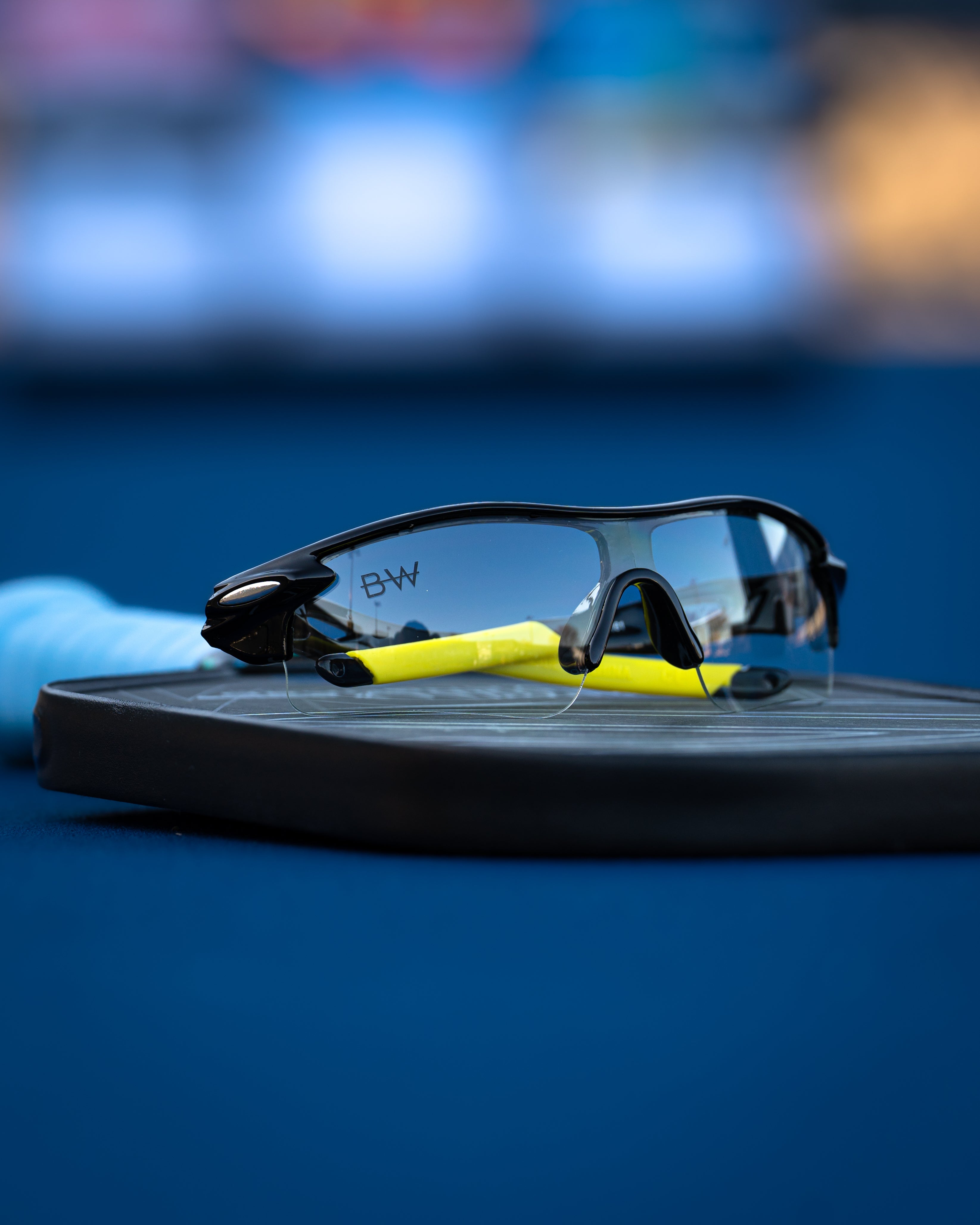
Blue Light Lenses for Indoor Pickleball Courts: Do They Really Help?
Share
Blue Light Lenses for Indoor Pickleball Courts: Do They Really Help?
Indoor pickleball puts players under artificial lighting for entire practices, leagues, and tournament sessions. That naturally raises a question for anyone shopping for court eyewear: do blue light lenses actually help on indoor pickleball courts?
The answer is more nuanced than simply calling blue light filtering a performance upgrade. Blue light is part of the visible-light spectrum, and artificial light sources such as LEDs can contain blue wavelengths. But that does not mean blue light from an indoor court automatically harms your depth perception, slows reaction time, or causes poor ball tracking.
For pickleball players, the more useful question is whether a clear blue-light-focused lens configuration fits your indoor environment and personal eyewear preferences—especially if you also spend significant time looking at phones, computers, scorekeeping screens, or video between sessions.
This guide separates what blue light lenses actually do from exaggerated sports claims, compares them with clear, tinted, and changing-light eyewear, and explains what to consider when choosing indoor pickleball glasses or prescription RX sports eyewear.
Start With Your Indoor Pickleball Eyewear
What Is Blue Light?
Blue light is part of the visible-light spectrum. It is present naturally in sunlight and can also be produced by artificial sources including some LED lighting, fluorescent lighting, phones, monitors, tablets, and other digital displays.
That makes the phrase “blue light” broader than it sometimes appears in eyewear marketing. Playing under artificial lights does not automatically mean your eyes are being exposed to something that requires special protection.
The older version of this guide described artificial blue light as causing fatigue, blurred vision, reduced visual acuity, glare, and slower eye tracking. :contentReference[oaicite:0]{index=0} Those claims go beyond what should be promised from an indoor pickleball lens, so the better approach is to evaluate blue light eyewear based on its actual lens characteristics and how you intend to use it.
Do LED Pickleball Court Lights Produce Blue Light?
LED lighting can contain blue wavelengths, but “LED” does not describe one universal lighting environment.
Indoor pickleball facilities can vary significantly in:
- Fixture type
- Brightness
- Color temperature
- Fixture placement
- Court and wall colors
- Ceiling height
- Natural light entering the building
- How evenly the court is illuminated
That means two facilities described as “LED-lit indoor courts” may look and feel noticeably different.
Instead of assuming every LED court requires the same specialized lens, evaluate the actual facility where you play.
So, Do Blue Light Lenses Really Help With Indoor Pickleball?
They can be a lens preference for some indoor players, but they should not be treated as a guaranteed pickleball performance enhancer.
A blue-light-focused lens may be worth considering if you prefer that type of lens for your indoor routine or want one pair that overlaps with screen-heavy activities outside the court.
What should not be promised is that filtering blue wavelengths automatically gives you:
- Faster reaction time
- Better depth perception
- Improved ball tracking
- Sharper spin recognition
- Better hand-eye coordination
- Faster decision-making
- More accurate paddle contact
- Greater endurance
Those are athletic outcomes influenced by many factors and should not automatically be attributed to a blue light lens.
What Do Blue Light Filtering Lenses Actually Do?
At the simplest level, a blue light filtering lens is designed to filter some portion of blue wavelengths.
The exact amount and range depend on the specific lens. You should not assume that every blue light product filters the same wavelengths or the same percentage of blue light.
This distinction matters because the original article claimed selective blocking across a specific 400–455 nm range and connected that directly with better contrast and faster decision-making. :contentReference[oaicite:1]{index=1} Those specifications and athletic outcomes should only be used when verified for the exact lens.
When comparing blue light pickleball glasses, focus on the current product information rather than assuming that the category name establishes an exact filtration percentage.
Blue Light Lenses vs. Clear Lenses for Indoor Pickleball
These categories can overlap, but they describe different things.
| Lens Description | What It Means |
|---|---|
| Clear Lens | No dark sunglass tint |
| Blue Light Lens | A lens designed to filter some blue wavelengths |
| Clear Blue Light Lens | A lens without dark sunglass tint that also incorporates blue light filtering |
| Tinted Sports Lens | A lens with visible tint; exact characteristics depend on the product |
| Changing-Light Lens | A lens configuration designed to change according to applicable lighting conditions; exact behavior depends on the lens |
If your main priority is simply avoiding a dark sunglass tint on an indoor court, clear lenses are the more fundamental category to investigate.
Explore the Blinded Wear Clear Lens Collection →.
Why Clear Lenses Make Sense to Compare for Indoor Pickleball
Clear lenses are straightforward: they do not have a dark sunglass tint.
That makes them relevant for:
- Indoor pickleball courts
- Evening play
- Lower-light playing environments
- Players who simply do not want dark sunglass tint indoors
This does not mean clear lenses automatically make a facility brighter, increase contrast, improve reaction speed, or help you track the ball.
It means they provide an eyewear option without the dark tint associated with sunglasses.
Blue Light Lenses vs. Dark Sunglass Tint Indoors
For indoor players, blue light filtering and sunglass tint should not be treated as the same decision.
A player may prefer a clear or mostly clear lens indoors because they do not want a dark sunglass tint in that environment. Whether that clear lens also incorporates blue light filtering is a separate consideration.
Think of the decision in this order:
- Do I want dark tint in this facility?
- Do I need prescription correction?
- Do I specifically want blue light filtering?
- Does the exact product offer the configuration I need?
This is more useful than assuming “blue light” is automatically the best indoor lens category.
Blue Light vs. Transition RX Lenses for Indoor Pickleball
Blue light filtering and changing-light lens technology solve different problems.
A blue light lens is defined around filtering portions of blue wavelengths. A Transition-style lens is selected around changing light environments.
If you play almost exclusively inside the same facility, you may prioritize an indoor-oriented configuration.
If your routine repeatedly moves between outdoor and indoor environments, a changing-light RX strategy may be worth comparing with dedicated indoor and outdoor pairs.
Learn more in Transition RX Lenses for Travel & Training →.
Blue Light Lenses vs. Gray-Tinted Lenses Indoors
Gray tint and blue light filtering should also be treated as separate characteristics.
A gray-tinted lens visibly reduces light transmission according to its particular configuration, while a blue light filtering lens is defined by filtering portions of the blue spectrum.
The old version of this guide stated that blue light lenses outperform gray or Transition lenses indoors and preserve faster reactions. :contentReference[oaicite:2]{index=2} There is no need to make that broad performance claim.
If you do not want a dark sunglass tint indoors, start by comparing clear options. Then determine whether blue light filtering is also something you want.
Do Blue Light Lenses Improve Reaction Time in Pickleball?
Blue light lenses should not be marketed as automatically improving pickleball reaction time.
A rally involves visual input, anticipation, positioning, experience, decision-making, movement, paddle preparation, and physical response. A lens feature alone should not be credited with producing a faster athletic reaction.
The previous article linked blue light exposure with visual latency and then concluded that filtering it could produce quicker volleys and more precise paddle contact. :contentReference[oaicite:3]{index=3} That is too large a jump from a general research discussion to a product-performance claim.
If reaction speed is your goal, treat eyewear as one part of your overall visual setup rather than a shortcut to faster play.
Do Blue Light Glasses Improve Depth Perception?
No automatic improvement in depth perception should be attributed to blue light filtering.
Depth perception is important in pickleball because players constantly judge spatial relationships involving the ball, net, opponents, partner, kitchen line, baseline, and other court references.
But the importance of depth perception does not establish that a blue light lens improves it.
If you require prescription correction, using the appropriate prescription is a much more fundamental part of your eyewear decision.
Do Blue Light Lenses Make the Pickleball Easier to Track?
There should not be a universal claim that blue light filtering makes a pickleball easier to track.
Ball visibility can be influenced by factors such as:
- Your vision and prescription needs
- Court lighting
- Background colors
- Ball color
- Movement
- Viewing angle
- Your position on the court
A blue light filter should not automatically be described as improving tracking, contrast, spin recognition, or shot reading unless a specific supported characteristic establishes that claim.
Do Blue Light Lenses Reduce Indoor Court Glare?
Do not assume that blue light filtering is the same thing as a verified anti-glare or anti-reflective treatment.
Indoor players can experience visually distracting lighting conditions, but “glare” can describe different visual experiences and can result from several factors.
If a specific lens has an anti-reflective or other glare-related treatment, that characteristic should be verified separately rather than inferred from the phrase “blue light.”
This is especially important because the older article repeatedly connected blue light filtering with reduced glare and listed anti-glare characteristics for individual products. Those features should only be used when currently verified. :contentReference[oaicite:4]{index=4}
Do Blue Light Lenses Prevent Eye Strain During Long Indoor Sessions?
It is better not to promise that blue light filtering will prevent eye strain during a long pickleball session.
Visual discomfort can have multiple contributors, and a general blue light filter should not be presented as a guaranteed solution.
If you experience recurring or significant visual symptoms during indoor play, that is different from choosing an eyewear feature based on preference and deserves appropriate professional evaluation.
For product selection, focus on your prescription needs, frame comfort, lens configuration, and the environment where you actually play.
Where Blue Light Lenses May Fit: Screen Time + Indoor Pickleball
One of the more practical reasons a player may investigate blue light RX eyewear is crossover use.
Modern pickleball players may spend parts of the same day:
- Working at a computer
- Using a phone
- Watching match footage
- Reviewing pickleball videos
- Checking tournament brackets
- Using digital scorekeeping systems
- Playing under artificial indoor lighting
If you already prefer blue light filtering during screen-heavy activities, a sports-oriented RX option may allow that lens preference to overlap with your indoor pickleball routine.
That is a more realistic reason to consider the category than expecting the lens to produce an automatic competitive advantage.
H Blue Shield RX: A Blue Light RX Option to Compare
The H Blue Shield RX is the most directly relevant Blinded Wear product to investigate if you are specifically shopping for a blue light RX pickleball eyewear option.
When comparing it with other prescription sports glasses, consider the same fundamentals that should guide any RX purchase:
- Your current prescription
- Your indoor playing environment
- Frame dimensions when available
- How those dimensions compare with glasses that already fit you
- The current lens configuration offered for the product
- Whether you want the pair primarily for pickleball, screen crossover, or both
Do not assume an exact filtration percentage, wavelength range, anti-glare coating, or athletic-performance effect unless it is specifically verified for the current product.
Blue Light RX vs. Regular Clear RX for Pickleball
If you need prescription correction indoors, you may eventually narrow your decision to blue light RX vs. regular clear RX sports glasses.
| Question | Blue Light RX | Clear RX |
|---|---|---|
| Provides prescription correction? | Yes, according to the prescribed configuration | Yes, according to the prescribed configuration |
| Can avoid dark sunglass tint? | Depending on the exact lens configuration | Yes, when configured as a clear lens |
| Blue light filtering? | Designed around blue light filtering | Not automatically |
| Automatically improves reaction time? | No | No |
| Automatically improves depth perception? | No | No |
| Automatically improves ball tracking? | No | No |
| Relevant for indoor play? | Potentially, depending on your preferences | Yes, particularly when you want no dark sunglass tint |
Prescription Correction Comes Before the Blue Light Feature
For an RX wearer, blue light filtering is a secondary lens characteristic. Your prescription correction remains the foundation of the eyewear.
That means the buying sequence should be:
- Start with your prescription needs
- Choose an appropriate sports frame
- Consider the environment where you play
- Then evaluate additional lens characteristics that fit your routine
A blue light feature should not distract from the primary reason you are buying RX sports glasses: obtaining the correction prescribed for you in eyewear suitable for your intended use.
High-Index Prescription Lenses at No Additional Cost
Blinded Wear includes high-index prescription lenses at no additional cost with RX eyewear.
The exact numerical lens index should not be assumed unless it is verified for the current order. The older article repeatedly specified 1.61 high-index lenses and attached universal claims about thinness, weight, and optical performance to them. :contentReference[oaicite:5]{index=5}
The cleaner, accurate benefit is that high-index prescription lenses are included without an additional lens upgrade charge.
Impact-Resistant Lenses for Active Indoor Play
Blinded Wear sports eyewear uses impact-resistant lenses, a relevant characteristic for eyewear intended around active pickleball use.
Impact-resistant does not mean:
- Shatterproof
- Unbreakable
- Indestructible
- Certified to a specific protective standard unless that certification is separately verified
Keeping the language precise helps players compare actual product characteristics without turning impact resistance into a guarantee against every possible hit or accident.
Why Blinded Wear Uses Non-Polarized Sports Lenses
Blinded Wear sports eyewear uses non-polarized lenses.
Non-polarized lenses do not add a polarization filter and preserve the visual information available without that filter. Some court players prefer non-polarized eyewear.
That does not mean non-polarized lenses inherently improve depth perception, reaction time, ball tracking, or spin recognition.
Who Should Consider Blue Light Pickleball Glasses?
The Indoor-Only Player
If nearly all of your pickleball happens inside, compare clear indoor options first and decide whether blue light filtering is an additional feature you specifically want.
The Screen-Heavy Player
If your day involves substantial computer or phone use before heading to an indoor court, you may be interested in a blue-light-focused pair that overlaps with both parts of your routine.
The Indoor League Player
If you play several evenings per week in the same facility, evaluate the eyewear in that actual environment rather than choosing solely from general lighting claims.
The Indoor Tournament Player
If you depend on prescription correction, prioritize the RX configuration and consider carrying another suitable corrective pair during longer events.
The Indoor + Outdoor Player
If you constantly switch environments, compare dedicated indoor/outdoor pairs with a changing-light RX strategy rather than assuming a blue light lens solves every environment.
How to Decide Whether Blue Light RX Fits Your Routine
Ask yourself these questions:
- Do I primarily play pickleball indoors?
- Do I prefer a lens without dark sunglass tint indoors?
- Do I need prescription correction?
- Do I already prefer blue light filtering for screen-heavy activities?
- Would I use the same pair away from the court?
- Am I buying because of verified lens characteristics rather than promises of faster reactions or better tracking?
- Does the exact frame offer the prescription and lens configuration I need?
If blue light filtering solves a real preference within that routine, it becomes a reasonable feature to compare. If not, a straightforward clear RX sports pair may be the simpler option.
Do a 5-Minute Indoor Court Audit Before Choosing Your Lenses
Instead of buying based only on the words “LED court,” look at the facility where you actually play.
| Check | Question to Ask |
|---|---|
| Lighting | What type of artificial lighting does the facility use? |
| Consistency | Does the lighting look even across the entire court? |
| Natural Light | Do windows or doors introduce changing daylight? |
| Background | What colors sit behind the ball during normal play? |
| Schedule | Do I always play here, or do I rotate among several facilities? |
| Prescription | What correction do I actually need while playing? |
| Lens Preference | Do I want clear, blue-light-focused, or another available configuration? |
This turns the buying decision into a response to your actual environment instead of a generic claim about indoor pickleball lighting.
8 Mistakes to Avoid When Buying Blue Light Glasses for Indoor Pickleball
1. Assuming All Indoor Lighting Is the Same
LED and fluorescent facilities can differ substantially in their lighting setup.
2. Assuming Blue Light Filtering Automatically Reduces Glare
Blue light filtering and anti-glare or anti-reflective characteristics should be evaluated separately.
3. Expecting Faster Reaction Time
A blue light lens should not be sold as an automatic reaction-time upgrade.
4. Expecting Better Depth Perception
Do not attribute universal depth-perception improvements to blue light filtering.
5. Expecting Better Ball Tracking
No automatic tracking advantage should be promised.
6. Ignoring Your Prescription
For RX players, correct prescription configuration is more fundamental than an additional blue light feature.
7. Assuming Every RX Frame Has the Same Blue Light Option
Confirm current availability for the exact frame and prescription.
8. Choosing a Lens From Marketing Claims Instead of Your Routine
Start with where you play, what correction you need, and how you actually intend to use the glasses.
Indoor Blue Light Pickleball Glasses Buying Checklist
- □ I know whether I need prescription or non-prescription eyewear
- □ I know whether I want clear lenses indoors
- □ I understand that clear and blue light filtering are not identical terms
- □ I know whether blue light filtering is a feature I actually want
- □ I have considered how much screen time is part of my daily routine
- □ I have checked the environment where I normally play
- □ I have compared available frame dimensions with eyewear that already fits me
- □ I have confirmed the current lens configuration for the exact product
- □ I am not expecting guaranteed reaction-time, tracking, or depth-perception improvements
- □ If ordering RX, I have a clear photo or picture of my eyeglass prescription ready to upload
FAQs About Blue Light Lenses for Indoor Pickleball
Are blue light glasses good for indoor pickleball?
They can be an option for players who specifically want blue light filtering in an indoor eyewear setup, but they should not be treated as a guaranteed performance upgrade.
Do you need blue light glasses for LED pickleball courts?
No universal requirement should be made based solely on the presence of LED lighting. Evaluate your prescription, lens preferences, and actual facility.
Are blue light lenses the same as clear lenses?
No. “Clear” means no dark sunglass tint, while “blue light” describes a filtering characteristic. A lens can potentially be both clear and blue-light-focused depending on its configuration.
Are blue light glasses better than clear glasses for indoor pickleball?
Not universally. If your priority is simply avoiding dark tint indoors, clear eyewear may meet that need. Blue light filtering is an additional characteristic to consider.
Do blue light lenses improve pickleball reaction time?
No automatic reaction-time improvement should be attributed to blue light filtering.
Do blue light glasses improve depth perception?
No universal depth-perception improvement should be promised from a blue light filter.
Do blue light glasses help you see a pickleball better?
Do not assume blue light filtering automatically increases ball visibility, contrast, or tracking.
Do blue light lenses reduce glare from LED lights?
Blue light filtering should not automatically be treated as a verified anti-glare or anti-reflective treatment. Check the exact lens specifications.
Can I use blue light glasses for both computer work and pickleball?
A crossover use case may be relevant if the exact eyewear configuration fits both your prescription needs and intended activities.
Should I wear dark sunglasses on an indoor pickleball court?
If you do not want dark sunglass tint indoors, compare clear-lens options. Your preference and the actual facility should guide the decision.
Are Blinded Wear RX lenses impact-resistant?
Yes. Blinded Wear sports eyewear uses impact-resistant lenses.
Are Blinded Wear sports lenses polarized?
No. Blinded Wear sports eyewear uses non-polarized lenses.
Are high-index prescription lenses included?
Yes. Blinded Wear includes high-index prescription lenses at no additional cost with RX eyewear.
How do I submit my prescription?
Upload a clear photo or picture of your eyeglass prescription before purchasing Blinded Wear RX eyewear.
Does Blinded Wear offer replacement support?
Blinded Wear offers 50% lifetime replacement support if glasses break, subject to current policy terms.
Blue Light vs. Other Lens Options for Indoor Pickleball
Blue light filtering is only one characteristic you may encounter while shopping for indoor pickleball glasses. Comparing it with other lens categories can make the decision much easier.
| Lens Option | Primary Characteristic | When to Compare It |
|---|---|---|
| Clear Lens | No dark sunglass tint | Indoor, evening, and lower-light environments where dark tint is not preferred |
| Blue Light Lens | Filters some portion of blue wavelengths according to the specific lens | When blue light filtering is a feature you specifically want |
| Clear Blue Light Lens | Combines a non-dark lens appearance with blue light filtering | When you want both characteristics in one available configuration |
| Tinted Lens | Uses visible lens tint | When that specific tint fits your environment and preferences |
| Changing-Light Lens | Designed to change according to applicable lighting conditions | When your routine regularly moves between substantially different environments |
| Prescription Lens | Provides prescribed vision correction | When you require RX correction while playing |
These categories are not always mutually exclusive. Depending on the product, a prescription lens may also be clear, blue-light-focused, changing-light, or another available configuration.
Not Every Indoor Pickleball Vision Problem Is a Blue Light Problem
If you dislike the way a particular indoor court looks, it can be tempting to blame blue light immediately. But indoor visual conditions are influenced by much more than one portion of the visible spectrum.
Consider whether the issue appears related to:
- Overall facility lighting
- Uneven illumination across the court
- Bright fixtures in your field of view
- Windows or open doors creating mixed lighting
- Background colors behind the ball
- Your prescription correction
- Your current eyewear
- Dark tint being used in an indoor environment
A blue light lens cannot reasonably be expected to solve every visual characteristic of an indoor facility.
Identifying what you actually dislike about the environment makes it easier to choose eyewear based on a real need rather than the broad label “indoor lighting.”
LED vs. Fluorescent Pickleball Courts: Do You Need Different Glasses?
Indoor facilities may use LED, fluorescent, or other artificial lighting systems. You do not automatically need a completely different pair of glasses simply because the fixture technology changes.
Instead, evaluate how the complete environment works for you.
| Facility Factor | Why to Notice It |
|---|---|
| Fixture Type | Different lighting technologies can produce different spectral and visual characteristics. |
| Fixture Placement | The position of lights can influence what appears in your field of view during play. |
| Color Temperature | Artificial lighting can appear warmer or cooler depending on the installation. |
| Court Background | Walls, curtains, ceilings, and neighboring courts contribute to the complete visual environment. |
| Natural Light | Windows can make an otherwise indoor environment change throughout the day. |
“LED pickleball glasses” can be a useful search phrase, but the actual buying decision should go deeper than the fixture label.
Clear vs. Tinted Glasses for Indoor Pickleball
For many indoor shoppers, this is a more fundamental comparison than blue light vs. no blue light.
Clear Indoor Pickleball Glasses
A clear lens has no dark sunglass tint. That makes clear eyewear a logical category to compare when you play inside or during evening and lower-light conditions where you do not want dark tint.
Tinted Pickleball Glasses
Tinted lenses visibly alter the amount and character of light reaching the wearer according to the specific tint. Different tints should not automatically be assigned performance benefits without verified support.
Which Should You Choose?
Start with your actual environment. If you consistently find dark sunglass tint unnecessary for your indoor facility, clear lenses provide a straightforward alternative.
Then decide whether additional characteristics such as blue light filtering are relevant to you.
Do You Need a Prescription to Use Blue Light Pickleball Glasses?
No. Blue light filtering and prescription correction are separate characteristics.
A player may shop for:
- Non-prescription clear sports eyewear
- Prescription clear sports eyewear
- Non-prescription blue-light-focused eyewear when available
- Prescription blue-light-focused eyewear when available
If you do not need prescription correction, there is no reason to turn an indoor eyewear purchase into an RX product simply because you want clear or blue-light-focused lenses.
If you do require prescription correction, start with the Blinded Wear RX Pickleball Collection →.
How to Shop for Blue Light RX Pickleball Glasses
For prescription players, use this order of operations:
Step 1: Start With Your Prescription
Know the correction you need before focusing on secondary lens features.
Step 2: Choose a Sports Frame
Compare available dimensions with eyewear that already fits you when possible.
Step 3: Identify Your Primary Environment
Decide whether the pair will be used mainly indoors or across several environments.
Step 4: Decide Whether You Want Clear Lenses
If you do not want dark sunglass tint indoors, clear options are directly relevant.
Step 5: Decide Whether Blue Light Filtering Matters to You
Treat it as an additional lens preference rather than an automatic athletic upgrade.
Step 6: Confirm the Exact Configuration
Do not assume every RX frame offers the same blue light, clear, changing-light, progressive, or other lens options.
Step 7: Upload Your Prescription
Blinded Wear RX customers upload a clear photo or picture of their eyeglass prescription before purchasing.
When H Blue Shield RX May Fit Your Routine
The H Blue Shield RX is worth investigating when your search specifically combines prescription pickleball eyewear and blue light filtering.
Potential use cases include players who:
- Need prescription correction
- Primarily play indoors
- Specifically want a blue-light-focused lens option
- Spend substantial time around digital screens in addition to playing pickleball
- Want a lightweight sports frame designed for pickleball
The reason to compare the product should be its fit with those needs—not a promise that blue light filtering will make you a faster or more accurate player.
Don't Ignore Frame Fit While Comparing Lens Technology
Lens terminology can dominate the shopping process, but the frame still matters.
A player could choose exactly the lens category they wanted and still end up dissatisfied if the frame itself is not a good match for them.
When current dimensions are available, compare:
- Overall frame width
- Lens width
- Lens height
- Bridge measurement
- Temple length
Use eyewear that already fits you as a reference point. Avoid assuming universal fit, non-slip performance, adjustable nose pads, or other product-specific characteristics unless they are verified for the exact frame.
What About Long Indoor Pickleball Sessions?
Playing several games or spending an entire tournament day indoors may make eyewear comfort more important simply because you are wearing the frame for longer.
Blinded Wear uses lightweight sports frames designed for pickleball players and designed for comfort during extended matches.
That is different from promising that a blue light filter itself will prevent fatigue, headaches, eye strain, or discomfort.
When preparing for longer sessions, evaluate the complete setup:
- Your prescription
- Frame fit
- Frame weight
- Lens configuration
- The facility where you play
- How long you normally keep the eyewear on
Blue Light RX Glasses for Indoor Pickleball Tournaments
An indoor tournament can involve more than active court time. Players may spend hours moving between matches, waiting for brackets, checking phones, watching other courts, and preparing for the next round.
If you already prefer blue light filtering and require prescription correction, a blue-light-focused sports pair may fit naturally into that routine.
But tournament preparation should extend beyond the lens feature.
Consider bringing:
- Your primary RX sports glasses
- Another suitable corrective pair if you depend heavily on prescription correction
- Appropriate eyewear storage
- Any alternate configuration genuinely needed for a different playing environment
If you travel frequently for competition, read When to Bring a Spare RX Pair →.
From Laptop to Pickleball Court: A Crossover Eyewear Routine
For some players, indoor pickleball is only one part of a screen-heavy day.
A typical routine might look like:
- Work on a computer during the day
- Check messages and league information on a phone
- Drive or travel to an indoor pickleball facility
- Play several games under artificial lighting
- Review scores, videos, or messages afterward
If you already prefer blue light filtering for parts of that routine, an available sports-oriented blue light RX configuration may reduce the need to treat your screen eyewear and indoor sports eyewear as completely separate categories.
That crossover convenience is a more grounded consideration than claiming that the filter itself produces better pickleball performance.
Can Progressive RX and Blue Light Filtering Be Combined?
Progressive and blue light describe two different lens characteristics.
Progressive refers to a multifocal prescription structure containing multiple prescribed powers across different areas of the lens.
Blue light filtering refers to filtering some portion of blue wavelengths.
Whether those characteristics can be combined depends on the exact lens and product configuration currently available.
Do not assume that every Blinded Wear RX frame supports progressive prescriptions or every additional lens option.
If you wear multifocal correction, compare the current options and read the Progressive RX Glasses for Pickleball Guide →.
What If You Play 50% Indoors and 50% Outdoors?
Players who divide their schedule between indoor and outdoor courts should think beyond one isolated lens feature.
You have several strategies to compare:
| Strategy | How It Works |
|---|---|
| Dedicated Indoor + Outdoor Pairs | Each pair is selected around a more specific environment. |
| Primary Indoor Pair + Outdoor Alternative | Useful when most of your play happens indoors but outdoor sessions still occur. |
| Changing-Light RX Strategy | Worth comparing when one available prescription configuration needs to cover changing environments. |
| Clear Sports RX + Separate Sunglasses | Keeps prescription sports correction and outdoor sunglass use as separate jobs when appropriate. |
The best system depends on how often you actually change environments and which configurations are available for your prescription.
Are Blue Light Glasses Useful for Evening Pickleball?
If your evening court does not call for dark sunglass tint, clear eyewear is a relevant category to consider.
Whether that clear lens should also include blue light filtering depends on your preferences and the exact environment.
Do not assume that blue light filtering makes an evening court brighter, improves contrast, or helps you react faster.
For evening and lower-light play, begin with the basic question: what lens configuration do I want when dark sunglass tint is not preferred?
What About Pickleball Coaches Who Spend Hours Indoors?
Coaches may spend considerably more time inside a facility than players who arrive for a single match.
Their eyewear may need to serve:
- Demonstrations
- Watching players across the court
- Phone or tablet use
- Scheduling
- Video review
- Personal play
If a coach requires prescription correction and already wants blue light filtering for screen-related parts of the day, an available sports-oriented RX configuration may provide useful crossover.
Again, the practical value comes from matching several parts of the routine—not from claiming the filter improves coaching ability or visual performance.
Blue Light Pickleball Glasses: Myth vs. Reality
| Common Claim | Better Explanation |
|---|---|
| “LED court lights damage your performance.” | Indoor lighting environments vary, and an LED fixture alone does not establish an athletic-performance problem. |
| “Blue light glasses make reactions faster.” | No automatic reaction-time improvement should be attributed to blue light filtering. |
| “Blue light glasses improve depth perception.” | No universal depth-perception advantage should be promised. |
| “Blue light lenses make the ball easier to track.” | Blue light filtering does not automatically establish improved ball tracking. |
| “Blue light lenses reduce all indoor glare.” | Blue light filtering should not automatically be treated as anti-glare or anti-reflective technology. |
| “Clear lenses and blue light lenses are the same.” | Clear describes the absence of dark sunglass tint; blue light describes a filtering characteristic. |
| “Transition lenses are useless indoors.” | Changing-light lens behavior depends on the specific lens and environment; avoid universal claims. |
| “Every indoor player needs blue light glasses.” | Blue light filtering is an optional characteristic to compare based on the individual player's needs and preferences. |
What Should You Look for Instead of Performance Promises?
When comparing indoor pickleball eyewear, prioritize information that actually helps you make a purchase decision.
- RX or non-RX: Does the product provide the correction you need?
- Clear or tinted: Do you want dark sunglass tint in your playing environment?
- Blue light filtering: Is this a lens characteristic you specifically want?
- Impact resistance: Does the eyewear use impact-resistant lenses?
- Polarization: Is a polarization filter present?
- Frame weight: Is the frame designed around lightweight sports use?
- Fit: How do the available dimensions compare with eyewear that already fits you?
- Replacement support: What happens if the eyewear breaks?
Those questions are more useful than relying on phrases such as “faster vision,” “instant tracking,” or “competitive edge.”
What If Your Indoor Pickleball Glasses Break?
Blinded Wear offers 50% lifetime replacement support if glasses break, subject to current policy terms.
This should not be described as unlimited “no questions asked” protection for every scratch, loss, or type of damage.
If replacement support matters to your buying decision, review the current Protection Plan & Returns Information →.
Players who depend heavily on prescription correction may also want another suitable corrective pair available during tournaments or travel rather than relying solely on future replacement support.
3 Simple Indoor Pickleball Eyewear Paths
Path 1: I Don't Need a Prescription
Start with clear non-prescription sports eyewear if your main goal is active indoor eyewear without dark sunglass tint. Then compare any additional verified lens characteristics you want.
Path 2: I Need Prescription Correction
Start with RX sports eyewear, confirm your prescription configuration, and then decide whether clear or blue-light-focused options fit your indoor routine.
Path 3: I Play Everywhere
If your schedule includes indoor, outdoor, daytime, and evening pickleball, compare whether multiple specialized pairs or a broader changing-light strategy makes more sense.
The 30-Second Indoor Lens Selector
Do You Need RX Correction?
Yes: Start with prescription sports eyewear.
No: Start with non-prescription sports eyewear.
Do You Want Dark Sunglass Tint Indoors?
No: Compare clear-lens options.
Yes: Evaluate the specific tint you prefer and its current product characteristics.
Do You Specifically Want Blue Light Filtering?
Yes: Compare an available blue-light-focused lens configuration.
No: A regular clear sports lens may be the simpler option.
Do You Constantly Switch Between Indoor and Outdoor Courts?
Yes: Compare dedicated pairs with an available changing-light strategy.
No: Optimize your eyewear around the environment where you actually play most often.
More Questions About Blue Light and Indoor Pickleball Glasses
Does indoor pickleball expose you to blue light?
Artificial lighting such as some LEDs can contain blue wavelengths. The amount and spectral characteristics vary by lighting system.
Does blue light from an indoor court damage your eyes?
Do not assume that ordinary exposure to an indoor pickleball facility establishes eye damage simply because the facility uses artificial lighting.
Does blue light cause blurry vision during pickleball?
Blurred vision should not automatically be attributed to blue light exposure. If you experience persistent visual symptoms, that is different from choosing a lens feature based on preference.
Does blue light slow eye tracking?
No universal claim should be made that normal indoor blue light exposure slows eye tracking during pickleball.
Do blue light glasses make the ball sharper?
No automatic improvement in sharpness or ball visibility should be promised from blue light filtering.
Do blue light lenses improve contrast?
Do not assume an improvement in contrast unless that characteristic is supported for the exact lens configuration.
Can blue light glasses help with fluorescent gym lighting?
They may be a lens preference for some players, but fluorescent lighting alone does not establish that blue light filtering is necessary or that it will solve every visual issue in the facility.
Are blue light glasses only for computer screens?
No. Blue light filtering can be incorporated into eyewear used in different settings. Whether it is useful for your routine depends on the product and your preferences.
Can I wear blue light glasses all day?
That depends on the exact lens, prescription, frame, and how you intend to use the eyewear. Do not assume every sports-oriented pair is intended for every activity.
Can I use H Blue Shield RX for indoor pickleball?
H Blue Shield RX is a relevant Blinded Wear product to compare when you need prescription pickleball eyewear and specifically want a blue-light-focused option. Review the current product configuration before purchasing.
Is Frost RX a blue light model?
Do not assume blue light filtration, anti-glare coatings, or other specialized lens characteristics for Frost RX unless those features are currently verified on the product.
Is Silver Line RX designed for indoor and outdoor use?
Review the current Silver Line RX product configuration rather than assuming a “hybrid” lens technology based on older marketing copy.
Do Blinded Wear glasses prevent eye strain?
No universal prevention of eye strain should be promised from the eyewear or from blue light filtering.
Do Blinded Wear blue light lenses protect long-term retinal health?
Do not make a general long-term retinal-health protection claim unless it is specifically supported for the lens and intended use.
Are Blinded Wear sports lenses impact-resistant?
Yes. Blinded Wear sports eyewear uses impact-resistant lenses. Impact-resistant should not be interpreted as shatterproof or indestructible.
Are Blinded Wear sports lenses non-polarized?
Yes. Blinded Wear sports eyewear uses non-polarized lenses.
Do Blinded Wear RX glasses include high-index lenses?
Yes. High-index prescription lenses are included at no additional cost with Blinded Wear RX eyewear.
Does Blinded Wear offer replacement support?
Yes. Blinded Wear offers 50% lifetime replacement support if glasses break, subject to current policy terms.
Think “Indoor Eyewear System,” Not Just “Blue Light Glasses”
The most useful indoor pickleball setup starts with a few simple questions: Do you need prescription correction? Do you want a clear lens? Do you specifically want blue light filtering? And will the eyewear stay indoors or move across several environments?
Once those questions are answered, blue light filtering becomes what it should be: one characteristic within a larger eyewear decision.
For some players, that characteristic may fit naturally into a screen-heavy, indoor-focused routine. For others, straightforward clear sports eyewear may already address what they actually wanted from an indoor pair.
That distinction helps you choose eyewear around your real playing environment instead of buying a lens because of exaggerated promises about reaction time, tracking, or competitive performance.
Which Indoor Pickleball Lens Setup Fits You Best?
There is no single lens configuration that every indoor pickleball player needs. Your best starting point depends on your prescription, playing environment, screen habits, and whether the glasses need to work anywhere beyond the indoor court.
| If This Sounds Like You... | Start by Comparing... |
|---|---|
| I play indoors and simply do not want dark sunglass tint. | Clear sports eyewear |
| I need prescription correction indoors. | Clear RX sports glasses |
| I need RX correction and specifically want blue light filtering. | H Blue Shield RX and other currently available blue-light-focused RX options |
| I work on screens all day and play indoors afterward. | Blue-light-focused crossover eyewear if the configuration fits both uses |
| I play indoors and outdoors equally. | Dedicated environment-specific pairs vs. an available changing-light RX strategy |
| I wear progressive prescriptions. | Confirm progressive availability and compare it with a dedicated sports RX strategy |
| I only need non-prescription indoor eyewear. | Clear non-RX sports eyewear |
How to Compare Indoor Pickleball Glasses Without Getting Lost in Lens Claims
When you open two product pages, compare them in the same order every time.
1. RX or Non-RX?
Determine whether you need prescription correction before comparing secondary lens features.
2. Clear or Tinted?
Decide whether you want dark sunglass tint in the facility where you normally play.
3. Blue Light Filtering?
If this is specifically important to you, confirm that it is part of the current lens configuration rather than assuming it from the appearance of the lens.
4. Impact Resistance?
Blinded Wear sports eyewear uses impact-resistant lenses, a relevant characteristic for active pickleball use.
5. Polarized or Non-Polarized?
Blinded Wear sports eyewear uses non-polarized lenses.
6. Frame Fit?
Compare current dimensions with glasses that already fit you whenever measurements are available.
7. Replacement Support?
Blinded Wear offers 50% lifetime replacement support if glasses break, subject to current policy terms.
This framework keeps verified characteristics at the center of the purchase instead of relying on promises about faster reactions or better ball tracking.
Where to Start Shopping for Indoor Pickleball Glasses
| What You Need | Where to Start |
|---|---|
| Blue-Light-Focused Prescription Pickleball Eyewear | H Blue Shield RX → |
| Clear Pickleball Glasses | Clear Lens Collection → |
| Prescription Pickleball Glasses | RX Pickleball Collection → |
| Non-Prescription Pickleball Sunglasses | Non-RX Pickleball Eyewear → |
| Help Choosing a Category | Take the Pickleball Glasses Quiz → |
| Full 2026 Eyewear Comparison | Best Pickleball Glasses 2026 → |
Build Your Indoor Pickleball Eyewear Around Your Weekly Routine
The amount of time you spend indoors can help determine how specialized your eyewear needs to be.
Occasional Indoor Player
If most of your pickleball happens outdoors and you occasionally move inside, determine whether you need a dedicated indoor pair at all. A clear option may be useful if you do not want to use dark sunglass tint indoors.
Weekly Indoor League Player
If you play in the same indoor facility every week, optimize around that actual environment rather than trying to build one pair around every possible court.
Indoor-Only Player
If nearly all of your play happens indoors, clear sports eyewear becomes especially relevant. Blue light filtering can then be evaluated as an additional preference.
Indoor Tournament Player
If you spend long days at indoor events, consider the entire system: prescription correction, lightweight frame, lens configuration, storage, and corrective backup if needed.
Coach or Instructor
If you move between court instruction, tablets, phones, and video review, a blue-light-focused configuration may have crossover appeal if it fits your prescription and eyewear preferences.
Indoor + Outdoor Competitor
If your schedule regularly crosses environments, compare the simplicity of a changing-light strategy with the specialization of separate indoor and outdoor pairs.
Are Blue Light Pickleball Glasses Worth It?
The answer depends on what you expect them to do.
If you expect blue light lenses to automatically make you react faster, recognize spin earlier, improve depth perception, increase contrast, or track the ball better, those expectations go beyond what should be promised.
If instead you:
- Play primarily indoors
- Want an eyewear configuration without dark sunglass tint
- Specifically prefer blue light filtering
- Spend substantial time using digital screens
- Need prescription correction and want a sports-oriented frame
then a blue-light-focused RX option may fit naturally into your overall eyewear setup.
That distinction matters. A product can be useful without needing to be marketed as a secret performance advantage.
What to Confirm Before Buying Blue Light RX Glasses
Before ordering, review the current product information for the exact pair you are considering.
- □ Prescription configuration
- □ Current blue light lens availability
- □ Whether the lens is clear or visibly tinted
- □ Current frame dimensions when available
- □ Any additional lens options you want
- □ Whether progressive correction is available if needed
- □ Current ordering information
- □ Current replacement-support terms
Do not assume an exact blue light filtration percentage, wavelength range, coating, tint behavior, or additional lens technology unless it is currently listed for the exact product.
How to Order Indoor RX Pickleball Glasses From Blinded Wear
- Choose an RX sports frame. Start with your preferred frame and intended playing environment.
- Review the current lens options. Confirm that the configuration you want is available.
- Compare fit information. Use current dimensions when available and compare them with eyewear that already fits you.
- Prepare your prescription. Have a clear photo or picture of your eyeglass prescription ready.
- Upload your prescription before purchasing. This provides the prescription information needed for your RX order.
High-index prescription lenses are included at no additional cost with Blinded Wear RX eyewear.
What to Do With New Indoor Pickleball Glasses Before Competition
If you purchase a new pair for league or tournament play, use it before the event rather than making competition your first real test.
Session 1: Learn the Frame
Wear the eyewear during a lower-pressure practice and become familiar with the frame and prescription configuration.
Session 2: Use Your Normal Facility
Try the eyewear under the artificial lighting where you actually play most often.
Session 3: Use It for a Normal-Length Session
Determine whether the overall setup fits your routine when worn for the amount of time you typically spend on court.
Judge the glasses based on your actual experience with the prescription, frame, and environment—not on whether you can detect an advertised performance boost.
Before You Buy: 10 Blue Light Claims to Question
| Claim | What to Know |
|---|---|
| “Blue light lenses improve reaction time.” | Do not assume an automatic reaction-time benefit. |
| “Blue light lenses improve depth perception.” | No universal depth-perception improvement should be promised. |
| “Blue light lenses make the ball easier to track.” | Do not automatically attribute improved tracking to blue light filtering. |
| “Blue light lenses improve spin recognition.” | No automatic spin-recognition advantage should be claimed. |
| “Blue light lenses reduce all glare.” | Blue light filtering is not automatically the same as verified anti-glare technology. |
| “Blue light lenses prevent eye strain.” | Do not promise universal prevention of eye strain. |
| “Blue light lenses protect retinal health.” | Do not make a broad long-term retinal-health protection claim based solely on the category. |
| “Clear blue light lenses increase available light.” | Clear means no dark sunglass tint; it does not mean the lens creates additional available light. |
| “Every LED court requires blue light glasses.” | Artificial-lighting environments vary, and blue light eyewear is not a universal requirement. |
| “More blue light filtering means better pickleball performance.” | Do not convert filtration strength into an automatic athletic-performance ranking. |
More FAQs: Blue Light Glasses for Indoor Pickleball Courts
What color lenses are best for indoor pickleball?
If you do not want dark sunglass tint indoors, clear lenses are a straightforward category to compare. Do not assume a particular tint automatically improves contrast, tracking, or performance.
What are the best glasses for indoor pickleball?
Start with whether you need RX correction, whether you want clear or tinted lenses, frame fit, verified lens characteristics, and your actual playing environment. There is no single pair that is automatically best for every player.
Should indoor pickleball glasses be clear?
Clear lenses are relevant for players who prefer no dark sunglass tint indoors. Whether clear is your preferred configuration depends on the facility and your individual preferences.
Do blue light glasses help under LED gym lights?
Blue light filtering may be a feature some players prefer, but it should not be presented as necessary for every LED-lit facility or as a guaranteed performance improvement.
Do blue light glasses help under fluorescent lights?
They may fit some players' preferences, but fluorescent lighting alone does not establish that a blue light filter is necessary.
Are clear pickleball glasses better for indoor courts?
Clear eyewear can make sense when you do not want dark sunglass tint indoors. “Better” depends on the player's prescription, preferences, and environment.
Do I need special glasses for indoor pickleball?
Not every player requires specialized indoor eyewear. Determine whether you need prescription correction and what lens configuration fits the facility where you play.
Can I wear regular prescription glasses for indoor pickleball?
Your prescription needs are individual. Sports-oriented RX eyewear is designed around active use, but whether a particular pair is appropriate depends on your prescription and intended activity.
What is the difference between blue light glasses and sports glasses?
“Blue light” describes a lens-filtering characteristic. “Sports glasses” describes eyewear intended around active use. A product may potentially fall into both categories.
Can blue light lenses be prescription?
Yes, depending on the product and available lens configuration. H Blue Shield RX is a Blinded Wear option to investigate when you specifically want prescription sports eyewear with a blue-light focus.
Can blue light lenses be non-prescription?
Blue light filtering does not inherently require prescription correction. Availability depends on the specific product.
Are blue light lenses polarized?
Blue light filtering and polarization are separate characteristics. Blinded Wear sports eyewear uses non-polarized lenses.
Are blue light lenses impact-resistant?
Blue light filtering and impact resistance are separate characteristics. Blinded Wear sports eyewear uses impact-resistant lenses.
Can blue light lenses be clear?
Yes. Blue light filtering does not inherently require a dark sunglass tint, although the appearance and characteristics depend on the exact lens.
Are blue light glasses useful for nighttime pickleball?
If you play in an environment where you do not want dark sunglass tint, clear eyewear is relevant. Whether you also want blue light filtering is a separate preference.
Can I use indoor pickleball glasses outside?
That depends on the exact lens configuration and your preferences. A pair selected specifically around indoor use should not automatically be assumed to serve every outdoor environment.
What if I play both indoor and outdoor pickleball?
Compare dedicated environment-specific pairs with an available changing-light strategy. The right system depends on how frequently you move between environments.
Do blue light lenses change colors?
Do not assume color neutrality or a particular color shift without checking the exact lens characteristics.
Do blue light lenses block 100% of blue light?
Do not assume complete blue light blocking or an exact filtration percentage unless it is verified for the specific lens.
What wavelength does H Blue Shield RX filter?
Use the current product specifications for any exact wavelength or filtration claim rather than assuming a numerical range.
Do blue light lenses make you a better pickleball player?
No eyewear feature should be treated as an automatic substitute for positioning, anticipation, technique, decision-making, practice, or other elements of pickleball performance.
Continue Building Your Indoor Pickleball Eyewear Setup
Blue Light Lenses for Indoor Pickleball: The Bottom Line
Blue light lenses can be a legitimate eyewear preference for indoor pickleball, but they do not need exaggerated athletic claims to be useful.
Indoor facilities commonly use artificial lighting, and some players specifically want blue light filtering as part of their eyewear setup. That may be particularly relevant for prescription players whose daily routine also includes computers, phones, tablets, video review, or other screen-heavy activities.
But blue light filtering should not automatically be credited with faster reaction time, better depth perception, improved ball tracking, greater contrast, reduced glare, better spin recognition, or protection from every source of visual discomfort.
If your main concern is playing indoors without dark sunglass tint, start with clear pickleball glasses. If you also specifically want blue light filtering, compare a blue-light-focused configuration such as H Blue Shield RX when it matches your prescription needs.
For RX players, prescription correction remains the foundation. Blinded Wear RX eyewear also includes high-index prescription lenses at no additional cost, while Blinded Wear sports eyewear uses lightweight sports frames, impact-resistant lenses, and non-polarized lenses.
The best indoor setup is ultimately the one built around your prescription, your facility, your frame fit, and the lens characteristics you actually want—not promises that one filter will transform your game.