
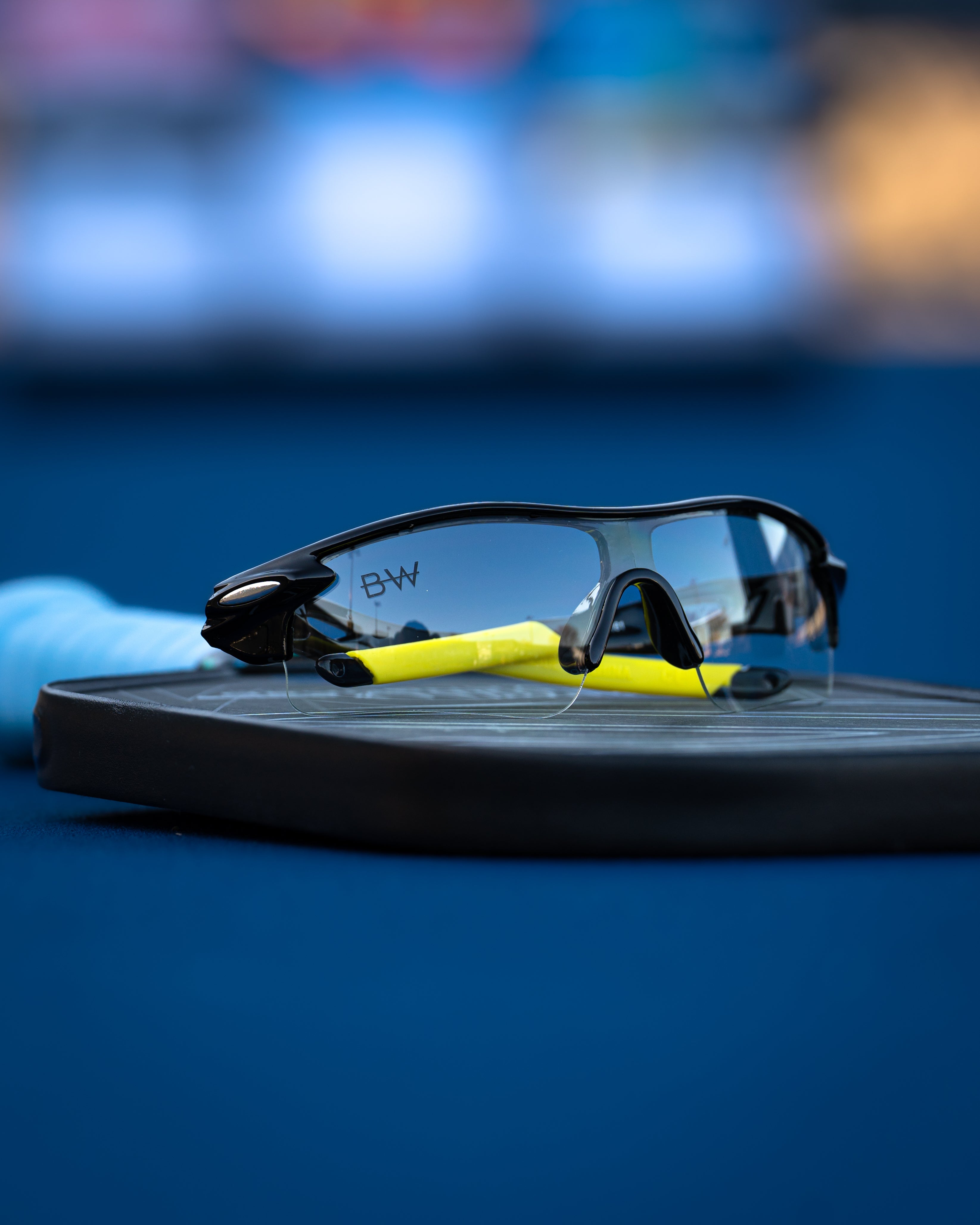
Blue Shield RX Glasses: Night Training Protection for Modern Athletes
Share
Blue Shield RX Glasses: Night Training Protection for Modern Athletes
Night training creates a different eyewear problem than a bright afternoon on the pickleball court. Athletes may move between indoor courts, evening practices, artificial lighting, phones, tablets, laptops, video review, and other digital training tools while still needing reliable prescription correction.
That makes Blue Shield RX glasses an interesting category for modern athletes—but it is important to separate prescription eyewear, blue-light filtering, sports-lens design, and actual athletic performance. Blue-light filtering should not automatically be credited with better reaction time, improved depth perception, faster recovery, reduced dryness, or better ball tracking.
For Blinded Wear customers, the practical question is simpler: does a Blue Shield RX setup fit the way you train after dark, use screens, and play pickleball under artificial or lower-light conditions?
Start With Your Night-Training Eyewear Setup
What Are Blue Shield RX Glasses?
Blue Shield RX eyewear combines prescription correction with a blue-light-focused lens configuration. The concept is aimed at athletes whose visual routine extends beyond the court and into digital environments such as video review, training apps, laptops, tablets, and phones.
The original version of this guide described Blue Shield RX as blocking a specific percentage of digital glare and improving contrast, motion tracking, sleep recovery, and other outcomes. Those claims require specific product testing and should not be assumed from the term “Blue Shield” alone. :contentReference[oaicite:0]{index=0}
A better way to evaluate Blue Shield RX is by separating four different needs:
| Need | What to Evaluate |
|---|---|
| Prescription Correction | Whether the RX configuration matches your current corrective needs |
| Blue-Light Filtering | The verified characteristics of the specific lens option being offered |
| Night / Indoor Sports Use | Whether the lens configuration is appropriate for the environment where you train |
| Sports Eyewear | Frame fit, comfort, lens characteristics, and suitability for your intended activity |
Why Night Training Changes Your Eyewear Priorities
An athlete training at 8 PM may encounter a completely different environment from someone playing outdoors at noon.
Your night-training routine could include:
- Indoor pickleball courts
- Outdoor evening practices
- Artificial court lighting
- Gym lighting
- Phones used for scoring or training apps
- Tablets used for statistics
- Laptops used for video review
- Televisions or monitors used for match analysis
- Travel between training facilities
In many of these situations, a dark sunglass tint may not be what you want. That is why night-training eyewear should be evaluated differently from dedicated daytime sunglasses.
Blue Shield RX for Athletes Who Train With Screens
Modern sports training does not end when the final rally ends. Players increasingly use digital tools before and after practices.
Video Review
You might watch previous matches, review positioning, study technique, or analyze tactical decisions on a laptop, tablet, or television.
Statistics and Training Apps
Phones and tablets can be part of tracking practice sessions, tournament schedules, scores, workouts, or other performance information.
Remote Coaching
Some athletes communicate with coaches or training partners through digital platforms, adding more screen use to an already active day.
Travel
Flights, hotels, tournament registration, navigation, and scheduling can create additional device time around competition.
If you already need prescription correction during these activities, a Blue Shield RX configuration may allow your corrective eyewear to remain part of the same digital-heavy routine.
Do Blue-Light Glasses Improve Athletic Performance?
Blue-light filtering should not automatically be treated as a sports-performance technology.
| Reasonable Product Role | Do Not Automatically Claim |
|---|---|
| Prescription correction | Faster reaction time |
| A blue-light-focused lens configuration | Improved depth perception |
| Use during screen-heavy routines if the configuration suits the wearer | Better ball tracking |
| Use as part of an indoor or night-training eyewear setup when appropriate | Improved spin recognition |
| One RX option for athletes comparing different lens configurations | Faster neural recovery |
| Prescription sports eyewear | Guaranteed reduction in digital eye strain |
This distinction makes the buying decision more useful. Choose Blue Shield RX because its verified lens characteristics, prescription correction, frame, and intended environment fit your routine—not because of an unsupported promise that a lens filter will make you a faster athlete.
Are Blue Shield RX Glasses Good for Night Pickleball?
For night pickleball, start with the environment rather than the product name.
Ask:
- Is the court indoors or outdoors?
- How much ambient light is available?
- Is the court illuminated primarily by artificial lighting?
- Do you want an untinted lens?
- Do you need prescription correction throughout the session?
- Will you also use the eyewear before or after play?
- Will screens be part of your training routine?
If your main priority is simply having no dark sunglass tint for indoor, evening, or lower-light pickleball, you should also compare the Clear Lens Pickleball Glasses Collection →.
Blue Shield RX and clear-lens eyewear should not automatically be treated as the same thing. One describes a blue-light-focused lens configuration, while “clear” primarily describes the absence of a dark sunglass tint.
Blue Shield RX vs. Clear RX for Night Training
| Question | Blue Shield RX | Clear RX |
|---|---|---|
| Primary Shopping Intent | Prescription correction with a blue-light-focused lens configuration | Prescription correction without a dark sunglass tint |
| Potential Environment | Compare for screen-heavy, indoor, or night-training routines according to the current configuration | Indoor, evening, or lower-light situations where dark tint is not preferred |
| Does It Automatically Improve Sports Performance? | No | No |
| Does It Automatically Reduce Eye Fatigue? | No universal claim should be assumed | No |
| Best Buying Question | Do I specifically want the verified characteristics of this blue-light-focused RX configuration? | Do I primarily need an untinted RX sports setup? |
Blue Shield RX vs. Transition RX: Which Problem Are You Solving?
Blue Shield and transition RX eyewear address different shopping intents.
Transition RX is primarily about adaptive tint. Photochromic lenses change tint according to their response to light exposure, which can be useful when moving between different environments.
Blue Shield RX is primarily about a blue-light-focused prescription lens configuration.
| Your Priority | Category to Compare |
|---|---|
| Moving between indoor and outdoor environments | Transition RX |
| Screen-heavy RX routine | Blue Shield RX |
| Consistently untinted night-training eyewear | Clear RX |
| One pair for changing light environments | Transition RX |
| Blue-light-focused prescription configuration | Blue Shield RX |
If your schedule constantly changes between environments, read Transition RX Lenses for Travel & Training → and compare the two approaches.
H Blue Shield RX: The Blinded Wear Option to Compare
The H Blue Shield RX is the Blinded Wear prescription product to review if you are specifically shopping for the Blue Shield RX concept.
Before ordering, evaluate the current product page for:
- Current lens configuration
- Available dimensions
- Frame design
- Your prescription needs
- Your primary playing environment
- Whether you would use the pair outside competition
- How the eyewear fits into your existing RX setup
Do not assume features such as progressive prescriptions, transition technology, exact blue-light filtration percentages, scratch resistance, or other specialized coatings unless they are currently verified for the product configuration you are purchasing.
High-Index Prescription Lenses Are Included
Blinded Wear RX eyewear includes high-index prescription lenses at no additional cost.
That should be considered when comparing the overall value of an RX sports setup because prescription eyewear involves both the frame and the corrective lenses.
No exact numerical lens index should be assumed unless it is verified for the order.
Impact-Resistant Lenses for an Active RX Setup
Blinded Wear sports eyewear uses impact-resistant lenses, which is relevant for active use and sports environments.
Impact-resistant does not mean:
- Shatterproof
- Unbreakable
- Impact-proof
- Impossible to damage
- A substitute for every form of certified protective eyewear
For pickleball players, the useful distinction is straightforward: impact resistance is a verified lens characteristic, but it should not be exaggerated into a guarantee that the eyewear can survive every possible impact.
Are Blue Shield RX Sports Lenses Polarized?
Blinded Wear sports eyewear uses non-polarized lenses.
A non-polarized lens does not add a polarization filter and preserves the visual information available without that filter. Some court players prefer non-polarized eyewear.
This should not be converted into a claim that non-polarized lenses inherently improve depth perception, reaction time, ball tracking, spin recognition, or another aspect of athletic performance.
Who Should Compare Blue Shield RX Glasses?
Rather than saying every athlete needs blue-light glasses, look for a routine where the product category actually makes sense.
The Screen-Heavy Competitor
You regularly review match footage, statistics, schedules, or training information on digital devices and already need prescription correction.
The Indoor Pickleball Player
You spend much of your playing time under artificial indoor lighting and want to compare different prescription lens configurations for that environment.
The Night Trainer
You frequently practice after work or school and want RX sports eyewear that you can evaluate specifically around your evening routine.
The Traveling Athlete
Your tournament routine includes airports, hotels, devices, digital scheduling, video analysis, and competition, creating a broader use case for prescription eyewear outside the match itself.
The Athlete Building a Multi-Pair RX System
You already own an outdoor RX configuration and want a second pair with a different role for indoor, screen-heavy, or evening use.
Who May Not Need a Dedicated Blue Shield RX Pair?
A specialized lens configuration should solve a real problem rather than simply add another pair to your bag.
You may want to compare other options first if:
- You rarely use screens around training
- Your primary need is simply untinted prescription eyewear
- You almost exclusively play outdoors during the day
- You primarily need adaptive tint between indoor and outdoor environments
- You already own RX eyewear that adequately covers your intended environment
In those situations, clear RX, fixed-tint RX, or transition RX may deserve comparison depending on your actual routine.
Build a Day + Night RX Pickleball Eyewear System
Some athletes may get more value from assigning different jobs to different pairs rather than expecting one lens configuration to cover everything.
| Environment | RX Setup to Compare |
|---|---|
| Indoor Training | Blue Shield RX or clear RX depending on your priorities |
| Screen / Video Review | Blue Shield RX if its verified configuration matches what you want |
| Outdoor Daytime Pickleball | Compare an appropriate outdoor RX configuration |
| Changing Indoor + Outdoor Environments | Compare transition RX |
| Backup Correction | Another suitable corrective pair |
The goal is not to own as many pairs as possible. It is to give each pair a clear reason to exist.
Pairing Night-Training RX With an Outdoor RX Option
If Blue Shield RX fills an indoor, evening, or screen-focused role in your eyewear system, you may still want a separate RX configuration for outdoor daytime play.
Blinded Wear prescription frames to compare include:
| RX Frame | How to Evaluate It |
|---|---|
| Lava Rock RX | Review its current lens configuration, available dimensions, design, and intended environment |
| Phantom II RX | Compare the current product configuration with the role you need it to fill |
| Crystal Wave II RX | Evaluate its current configuration as a potential alternate RX sports option |
| Havana Melt RX | Compare dimensions, current options, appearance, and your intended use |
These products should be compared based on their current product details rather than assumptions that a particular frame automatically provides UV protection, transition behavior, enhanced contrast, or another unverified lens feature.
What Belongs in a Night-Training Eyewear Bag?
A simple night-training setup can be more useful than carrying several pairs with overlapping roles.
- Primary RX sports eyewear: the pair intended for that training environment
- Suitable corrective backup: another option if your primary becomes unavailable
- Appropriate eyewear storage: for whichever pair is not being worn
- Prescription information: accessible if you choose to keep it with your travel information
If you regularly compete away from home, see When to Bring a Spare RX Pair in Your Bag →.
How to Order H Blue Shield RX Glasses
If the H Blue Shield RX configuration fits your training routine, use a straightforward prescription ordering process.
- Open the H Blue Shield RX product page.
- Review the current product and lens options.
- Check available dimensions against eyewear that already fits you well.
- Have your eyeglass prescription ready.
- Take a clear photo or picture of the prescription.
- Upload your prescription before purchasing.
- Review your selected configuration before completing the order.
Blinded Wear includes high-index prescription lenses at no additional cost with RX eyewear.
The 60-Second Blue Shield RX Selection Test
Answer yes or no:
- □ I need prescription correction during training
- □ I frequently train indoors or at night
- □ Screens are regularly part of my training or post-training routine
- □ I specifically want to compare a blue-light-focused RX lens configuration
- □ I have checked the current product features rather than assuming a filtration percentage
- □ I have compared Blue Shield RX with clear RX
- □ I have compared it with transition RX if my environments regularly change
- □ I understand that blue-light filtering does not automatically improve athletic performance
- □ I have checked available frame dimensions
- □ I know what corrective eyewear I would use if this pair became unavailable
If the first four describe your actual routine, H Blue Shield RX has a defined role worth comparing. If your main priority is simply clear prescription correction for lower-light play, compare clear RX before choosing a more specialized configuration.
Blue Shield RX Myths Athletes Should Avoid
Myth: Blue-light filtering automatically reduces digital eye strain.
Reality: Do not assume a guaranteed reduction in eye fatigue, dryness, headaches, or other symptoms from a product category alone.
Myth: Blue Shield RX improves reaction time.
Reality: Blue-light filtering should not automatically be credited with faster athletic reactions.
Myth: Blue Shield RX improves depth perception.
Reality: No automatic depth-perception advantage should be assumed.
Myth: Blue-light lenses make it easier to track the pickleball.
Reality: Better ball tracking should not be claimed without product-specific evidence.
Myth: Blue-light filtering guarantees better sleep.
Reality: Do not promise improved sleep or preserved melatonin levels based solely on the eyewear.
Myth: Blue Shield RX is automatically the best night lens.
Reality: The right configuration depends on your prescription, environment, current product options, and preferences.
Myth: Every Blue Shield RX product automatically includes transition lenses.
Reality: Verify the current product configuration rather than assuming photochromic technology is included.
Myth: Impact-resistant means unbreakable.
Reality: Impact resistance does not mean shatterproof or indestructible.
FAQ: Blue Shield RX Glasses for Night Training
What are Blue Shield RX glasses?
They are prescription eyewear built around a blue-light-focused lens configuration. Review the current product details for the exact features offered.
Are Blue Shield RX glasses prescription?
Yes. H Blue Shield RX is a prescription product.
Are Blue Shield RX glasses good for pickleball?
They can be considered as part of an RX sports setup for players whose prescription needs and training environment fit the current product configuration.
Can I use Blue Shield RX glasses for night pickleball?
Compare the current lens configuration with the lighting environment where you play. If your main requirement is simply no dark sunglass tint, also compare clear RX options.
Are Blue Shield RX glasses good for indoor pickleball?
They may be worth comparing for indoor use if their current configuration matches your needs. They should not automatically be assumed superior to clear RX eyewear.
Do Blue Shield RX glasses block 40% of blue light?
Do not assume a specific filtration percentage unless that figure is verified for the exact lens configuration being sold.
Do blue-light glasses reduce eye strain?
A universal reduction in digital eye strain should not be promised from the lens category alone.
Do blue-light glasses prevent dry eyes?
Do not assume blue-light filtering itself prevents dryness.
Do Blue Shield RX glasses improve sleep?
Improved sleep should not be guaranteed based solely on wearing blue-light-focused eyewear.
Do they preserve melatonin?
A specific melatonin benefit should not be claimed without evidence for the actual product and use conditions.
Do Blue Shield RX glasses improve reaction time?
No automatic reaction-time improvement should be attributed to the lens configuration.
Do they improve depth perception?
No automatic depth-perception benefit should be assumed.
Do they improve ball tracking?
Blue-light filtering should not automatically be described as improving ball tracking.
Are Blue Shield RX lenses polarized?
Blinded Wear sports eyewear uses non-polarized lenses.
Are the lenses impact-resistant?
Blinded Wear sports eyewear uses impact-resistant lenses. Impact-resistant does not mean shatterproof or indestructible.
Are high-index lenses included?
Yes. Blinded Wear includes high-index prescription lenses at no additional cost with RX eyewear.
Does Blinded Wear use 1.61 high-index lenses?
No specific numerical index should be assumed unless it is verified for the current order.
Can I get progressive H Blue Shield RX lenses?
Do not assume progressive availability unless it is currently verified for the product configuration.
Are transition lenses available with H Blue Shield RX?
Check the current product options rather than assuming photochromic lenses are available.
How do I submit my prescription?
Upload a clear photo or picture of your eyeglass prescription before purchasing.
Does Blinded Wear offer replacement support?
Yes. Blinded Wear offers 50% lifetime replacement support if glasses break, subject to current policy terms.
Should Blue Shield RX be my only prescription pair?
That depends on your environments. Athletes who rely heavily on prescription correction may also want another suitable corrective option for backup.
Part 2: Build a Complete Night-Training RX System
Part 2 will go deeper into screen-heavy training routines, Blue Shield RX versus clear and transition RX, indoor and outdoor evening scenarios, artificial-light training, day-to-night eyewear systems, prescription backup planning, frame fit, cost per use, tournament travel, storage, ordering, and a practical decision matrix for determining whether H Blue Shield RX deserves a specific role in your pickleball eyewear setup.
Build Your RX Eyewear Around Your Actual Night-Training Routine
The easiest way to decide whether Blue Shield RX belongs in your setup is to stop thinking about “night athletes” as one category. Two players can both practice after dark while having completely different eyewear needs.
One player may spend two hours on an indoor pickleball court and go home. Another may work on a laptop, drive to practice, play under artificial court lighting, review video afterward, and use a phone or tablet throughout the evening.
Map the environments you actually encounter:
| Part of Your Routine | Main Eyewear Question |
|---|---|
| Pre-Practice Screen Time | Do you need prescription correction while using digital devices? |
| Indoor Pickleball | Do you want an untinted or Blue Shield-focused RX configuration? |
| Outdoor Evening Pickleball | What lens configuration fits the actual available light? |
| Video Review | Would you continue wearing the same RX pair while reviewing footage? |
| Daytime Outdoor Play | Would another RX configuration make more sense for this environment? |
| Tournament Travel | Does one pair cover enough of your routine, and what is your corrective backup? |
The strongest eyewear system is not necessarily the one with the most specialized lenses. It is the one where every pair has a defined job.
From Screen to Court: Where Blue Shield RX Can Fit
A modern training session can begin before you ever pick up a paddle.
Before Practice
You might check a tournament bracket, watch instructional footage, review match clips, or communicate with a coach on a phone or laptop.
During Practice
You need prescription correction that works with the environment where you are actually playing. If the court is indoors or you are training later in the day, your priorities may differ from those of a player using dark sunglasses in bright daytime conditions.
After Practice
You may return to digital devices for statistics, video review, messages, scheduling, or other training-related tasks.
If the same prescription frame fits all three stages, it can become more useful than eyewear that only makes sense during the match itself.
That is a practical way to evaluate H Blue Shield RX: not as a guaranteed performance enhancer, but as a potential RX configuration for athletes whose routines move between screens and sport.
What About Pickleball Under LED and Artificial Court Lighting?
Indoor gyms and outdoor courts illuminated after dark rely on artificial lighting, but that fact alone does not prove that a blue-light-focused lens will improve athletic performance.
Artificial-light environments can differ substantially in:
- Overall brightness
- Fixture placement
- Court layout
- Background colors
- Reflections within the facility
- Available ambient light
- Distance between lights and the playing surface
That is why a claim such as “Blue Shield improves motion tracking under LEDs” should not be assumed without evidence for the actual product and conditions.
Instead, determine whether the current H Blue Shield RX lens configuration fits your prescription needs and the environments where you expect to use it.
Night Pickleball vs. Indoor Pickleball: They Are Not the Same Environment
“Night training” can refer to two very different situations.
Indoor Night Training
The environment is primarily controlled by the facility's artificial lighting. If you do not want a dark sunglass tint, compare Blue Shield RX with a clear RX configuration.
Outdoor Night Training
Outdoor courts after sunset can vary considerably depending on court lighting and surrounding ambient light. Again, the correct lens decision should come from the actual environment rather than assuming one night-specific lens is universally best.
| Environment | First RX Options to Compare |
|---|---|
| Bright Indoor Facility | Blue Shield RX vs. clear RX |
| Standard Indoor Pickleball | Blue Shield RX vs. clear RX |
| Outdoor Court After Sunset | Evaluate an appropriate untinted or night-use RX configuration based on the actual conditions |
| Outdoor Late Afternoon Into Evening | Compare dedicated configurations with transition RX if conditions change substantially |
| Screen Review After Play | Blue Shield RX may have a more clearly defined role if you specifically want its verified lens characteristics |
Blue Shield RX or Clear RX? Use This Decision Test
These two categories can overlap in intended environments, so the decision should begin with why you are shopping.
Start With Clear RX If:
- Your main priority is prescription correction without a dark sunglass tint
- You primarily play indoors
- You frequently play in evening or lower-light environments
- You do not specifically need a blue-light-focused configuration
- You want the simplest lens setup for your environment
Compare Blue Shield RX If:
- You need prescription correction
- You specifically want to compare a blue-light-focused lens configuration
- Digital devices are a meaningful part of your training routine
- You expect to use the eyewear beyond the court
- The current H Blue Shield RX configuration fits your intended environment
If the only reason you are considering Blue Shield RX is because you play after sunset, do not automatically assume it is superior to clear RX.
Blue Shield RX or Transition RX? Follow the Environment
Transition RX becomes more relevant when changing environments are the primary problem.
Imagine two athletes:
Athlete A: The Night Specialist
They train indoors at 7 PM three nights per week, use prescription correction, and spend additional time reviewing footage on a laptop.
Blue Shield RX and clear RX are logical categories to compare.
Athlete B: The All-Day Tournament Player
They begin indoors, warm up outdoors, compete through the afternoon, return inside between matches, and finish later in the day.
Adaptive tint may have a much more clearly defined role for this athlete.
| Primary Problem | Category to Compare |
|---|---|
| Need untinted RX eyewear | Clear RX |
| Want a blue-light-focused RX configuration | Blue Shield RX |
| Frequently change between indoor and outdoor environments | Transition RX |
| Want a consistent outdoor tint | Fixed-tint RX |
| Need redundancy | Another suitable corrective pair |
When a Two-Pair RX System Makes More Sense
A specialized night-training pair does not have to replace every other pair you own.
For an athlete who regularly plays in dramatically different environments, a two-pair system can give each pair a clearer role.
Pair 1: Indoor / Evening RX
This could be H Blue Shield RX or a clear RX configuration depending on your priorities and the current product options.
Pair 2: Outdoor Daytime RX
This pair can be selected specifically for the outdoor environments where you normally play.
The advantage is specialization. You do not need the night-training pair to double as your preferred daytime sunglass configuration.
The tradeoff is simple: you have another pair to purchase, carry, store, and remember.
3 Ways to Build Your Prescription Pickleball Eyewear System
System 1: One Primary RX Pair
Best suited for: players whose training environments are relatively consistent.
If almost all of your pickleball occurs indoors at similar times, you may not need multiple specialized pairs.
System 2: Night RX + Outdoor RX
Best suited for: players who frequently train indoors or at night but also play outdoors during the day.
Each pair gets a defined environment rather than forcing one configuration to cover everything.
System 3: Primary RX + Dedicated Corrective Backup
Best suited for: frequent competitors and travelers who depend heavily on prescription correction.
Your backup solves a different problem from your lens technology: it keeps another corrective option available if the primary pair becomes lost, damaged, or otherwise unavailable.
A Full Night-Training Routine With RX Eyewear
| Time | Activity | RX Question |
|---|---|---|
| 5:30 PM | Review practice plan on laptop | Do you need prescription correction and specifically want a Blue Shield-focused configuration? |
| 6:15 PM | Travel to court | Is the same frame appropriate for your travel routine? |
| 7:00 PM | Warmup | Does the lens configuration suit the actual court environment? |
| 7:30 PM | Match or drills | Is the frame comfortable for extended active use? |
| 9:00 PM | Post-session statistics | Would you continue wearing the same prescription pair? |
| 9:30 PM | Video review | Does the Blue Shield configuration have a useful role in your screen-heavy routine? |
This illustrates the real potential value of a versatile night-training RX pair: it may remain relevant before, during, and after the actual sports session.
Blue Shield RX for Pickleball Video Analysis
Video review can help athletes study technique, court positioning, shot selection, and tactical decisions. But the value comes from the analysis itself—not from claiming that blue-light filtering makes your brain process the footage faster.
If you already require prescription correction while viewing a screen, Blue Shield RX may be compared as one lens configuration for that task.
Examples of screen-based pickleball analysis include:
- Reviewing serve mechanics
- Studying return positioning
- Watching third-shot decisions
- Reviewing transition-zone movement
- Studying doubles positioning
- Rewatching unforced errors
- Comparing practice footage over time
- Reviewing tournament matches
Blue-light filtering should not automatically be credited with making those tasks more accurate or effective. The useful product question remains whether you want the verified lens configuration while performing them.
Can Blue Shield RX Prevent Digital Eye Strain?
Avoid treating blue-light filtering as a guaranteed solution for every symptom associated with long screen sessions.
Digital-device discomfort can involve multiple factors beyond the lens configuration you wear. For product-copy purposes, that means Blue Shield RX should not promise to eliminate:
- Eye fatigue
- Dryness
- Headaches
- Blurred vision
- Sleep disruption
- Difficulty focusing
Instead, H Blue Shield RX can be accurately positioned as prescription sports eyewear with a blue-light-focused configuration for shoppers specifically looking for that lens category.
Should Athletes Buy Blue-Light Glasses for Sleep and Recovery?
Sports marketing often connects blue-light eyewear with sleep, melatonin, recovery, and next-day performance. Those claims can quickly become stronger than the verified characteristics of an individual product.
For H Blue Shield RX, avoid promising:
- Higher melatonin levels
- Faster recovery
- Better sleep quality
- More restorative sleep
- Improved next-day reaction time
- Better cognitive recovery
If you are shopping specifically because you want blue-light-focused prescription eyewear, evaluate that feature directly rather than treating it as a guaranteed recovery tool.
Frame Fit Matters More When You Wear One Pair for Hours
An RX pair used only for a one-hour practice has a different job from eyewear you might wear before training, throughout a match, and again during post-session screen use.
If H Blue Shield RX is intended to cover a larger portion of your evening, compare available dimensions with a pair of glasses that already fits you well.
Ask Yourself:
- Would I comfortably wear this frame through a full practice?
- Would I keep wearing it during video review afterward?
- Does the available sizing compare well with eyewear that already fits me?
- Is this realistically a frame I would use regularly?
Do not assume features such as adjustable nose pads, non-slip components, a particular frame material, or specific ergonomic construction unless those details are verified for the product.
Test New H Blue Shield RX Glasses Before an Important Match
Whenever possible, become familiar with new prescription sports eyewear during ordinary practice rather than making tournament night its first extended use.
- Wear the glasses during normal indoor activity
- Use them during your typical screen routine
- Wear them at the facility where you normally train
- Warm up normally
- Hit controlled dinks
- Move through the kitchen and transition zone
- Hit from the baseline
- Play normal points
- Continue through a typical practice session
- Evaluate the frame and lens configuration based on your own experience
This should be a normal-use evaluation—not an intentional impact or durability test.
Is a Dedicated Night-Training RX Pair Worth It? Use Cost Per Wear
If you are considering another prescription pair, estimate how often it would actually leave the case.
| Night-Training Frequency | Approximate Annual Sessions | What It Means |
|---|---|---|
| 2 Times Per Month | About 24 | A specialized second pair may receive relatively limited sports use |
| 1 Time Per Week | About 52 | The pair begins serving a regular role |
| 2 Times Per Week | About 104 | Night-training eyewear can become frequently used equipment |
| 3 Times Per Week | About 156 | Small differences in convenience and fit are experienced repeatedly |
| 4 Times Per Week | About 208 | A dedicated evening RX setup may become one of your most-used pairs |
Then add non-court use.
If you also wear the same RX glasses during work, travel, video review, or other evening activities, their actual use may be substantially broader than your pickleball schedule alone.
Is H Blue Shield RX Worth Adding to Your Setup?
Give yourself one point for each statement that accurately describes your routine:
- □ I need prescription correction while playing
- □ I train indoors regularly
- □ I frequently play after dark
- □ I use screens around my training routine
- □ I specifically want a blue-light-focused RX configuration
- □ I would use this pair outside the actual match
- □ My current RX setup does not already fill this role
- □ I have checked the current H Blue Shield RX product configuration
0–2 Points
You may not have a clearly defined need for a dedicated Blue Shield RX pair. Compare simpler RX configurations first.
3–5 Points
You have several reasons to compare H Blue Shield RX with clear RX and your existing prescription eyewear.
6–8 Points
Blue Shield RX has a clearly defined potential role in your routine. The next step is evaluating the current product configuration, dimensions, prescription requirements, and how it fits into your overall eyewear system.
Should Night Athletes Carry Backup Prescription Glasses?
If you depend heavily on prescription correction, your backup strategy should be considered separately from your Blue Shield lens choice.
Your primary pair could become unavailable because it is:
- Left at home
- Misplaced while traveling
- Damaged
- Stored in another bag
- Otherwise unavailable when you need it
A second suitable corrective pair provides physical redundancy.
Your backup does not necessarily need to duplicate every characteristic of H Blue Shield RX. Its first job is to provide another suitable corrective option.
Blue Shield RX for Night Tournaments and Travel
A tournament can make a specialized RX pair more useful because your eyewear may be needed beyond the court.
A travel day could involve:
- Using a phone or computer before departure
- Traveling to another city
- Checking into a hotel
- Reviewing brackets or schedules digitally
- Traveling to the venue
- Competing under artificial or evening lighting
- Reviewing results afterward
- Returning to the hotel
If H Blue Shield RX is suitable for several of those environments, it can potentially serve a broader role than a pair used exclusively during competition.
However, a traveler whose trip includes significant daytime outdoor activity may still want another configuration or may want to compare Transition RX Lenses for Travel & Training →.
Night Tournament RX Packing Checklist
- □ H Blue Shield RX or your intended primary RX pair
- □ Suitable corrective backup
- □ Appropriate eyewear storage
- □ Current prescription information if needed
- □ Indoor conditions checked
- □ Outdoor conditions checked
- □ Match times checked
- □ Daytime portions of the trip considered
- □ Primary pair inspected
- □ Backup pair inspected
- □ Both pairs assigned a known storage location
A checklist becomes particularly useful when your trip includes multiple prescription pairs with different roles.
Day-to-Night RX Eyewear Decision Matrix
| Your Routine | First Setup to Compare |
|---|---|
| Indoor Pickleball Only | Clear RX vs. Blue Shield RX |
| Outdoor Daytime Only | Appropriate outdoor RX configuration |
| Indoor + Screen-Heavy Evening Routine | Blue Shield RX vs. clear RX |
| Outdoor Day + Indoor Night | Two dedicated RX configurations or transition RX depending on preferences |
| Constant Indoor / Outdoor Changes | Transition RX deserves comparison |
| Frequent Night Competitor | Dedicated night-use RX + corrective backup |
| Frequent Traveler With Mixed Environments | Versatile primary RX + suitable corrective backup |
| Main Goal Is No Dark Tint | Clear RX |
| Main Goal Is Blue-Light-Focused RX | H Blue Shield RX |
High-Index RX Lenses: Compare the Complete Prescription Package
Blinded Wear includes high-index prescription lenses at no additional cost with RX eyewear.
This is relevant when comparing prescription sports glasses because the value of an RX product is not limited to the frame itself.
Do not assume a specific numerical lens index such as 1.61 unless it is verified for the current order.
Impact Resistance and Night-Training Sports Eyewear
Blinded Wear sports eyewear uses impact-resistant lenses.
For an active pair that may travel between your home, vehicle, gym, court, sports bag, and tournament venues, durability-related lens characteristics are relevant.
But impact resistance should not be expanded into claims that the eyewear is:
- Shatterproof
- Ball-proof
- Unbreakable
- Guaranteed to survive direct impact
- Certified to a particular protective standard unless that certification is specifically verified
How to Store Your RX Glasses Between Night Sessions
If you own several RX configurations, storage becomes part of keeping the system usable.
| Common Habit | More Organized Approach |
|---|---|
| Leaving eyewear loose in a sports bag | Use appropriate eyewear storage |
| Moving pairs between bags constantly | Give each pair a predictable location |
| Keeping the backup somewhere inaccessible | Store it where it can actually serve as a backup |
| Forgetting which pair is intended for which environment | Give each RX pair a clearly defined role |
| Packing for tournaments without checking eyewear | Add RX glasses to your pre-departure checklist |
Blinded Wear RX Frames to Compare With H Blue Shield RX
If you are building a multi-pair prescription system, compare each frame according to its current product configuration, dimensions, design, and intended role.
| RX Option | Potential Role in Your Comparison |
|---|---|
| H Blue Shield RX | Blue-light-focused prescription configuration to evaluate for night, indoor, or screen-heavy routines |
| Lava Rock RX | Another RX sports frame to compare for a primary or secondary role |
| Phantom II RX | Alternative RX frame for comparison according to its current configuration |
| Crystal Wave II RX | Another prescription option to evaluate for your overall sports-eyewear system |
| Havana Melt RX | Alternative frame to compare by current configuration, dimensions, design, and use case |
H Blue Shield RX Ordering Workflow
-
Define the role.
Decide whether H Blue Shield RX will be your primary night-training pair, an indoor RX pair, a screen-heavy secondary pair, or another part of your eyewear system.
-
Review the current product page.
Check the currently available configuration instead of relying on old blog claims.
-
Compare dimensions.
Use eyewear that already fits you well as a reference where possible.
-
Prepare your prescription.
Have a current eyeglass prescription available.
-
Take a clear photo.
Make sure the prescription information can be read.
-
Upload the prescription before purchasing.
RX customers provide a clear photo or picture of their eyeglass prescription before purchase.
-
Review the selected configuration.
Confirm the frame and current options before placing the order.
-
Test the eyewear during ordinary practice.
Become familiar with the frame and lens configuration before relying on it for an important competition.
Common Mistakes When Shopping for Night-Training RX Glasses
Choosing by the Product Name Alone
“Blue Shield” does not tell you everything about the exact configuration. Review the current product details.
Assuming Blue-Light Filtering Equals Better Pickleball Performance
Do not automatically connect the lens category with reaction time, depth perception, ball tracking, or spin recognition.
Ignoring Clear RX
If your main priority is simply prescription correction without dark tint, clear RX may be the more direct category to compare.
Ignoring Your Daytime Routine
A night-focused setup may not eliminate the need for another configuration if you frequently compete outdoors during the day.
Buying a Second Pair Without Giving It a Job
A specialized pair creates more value when you can clearly identify when and why you would use it.
Assuming Specialized Features That Are Not Verified
Do not assume exact filtration percentages, progressive availability, transition technology, scratch resistance, anti-reflective coatings, anti-fog coatings, or specific certifications unless currently verified.
Forgetting Backup Correction
A specialized lens feature cannot replace the physical redundancy of another suitable corrective pair.
More Questions About Blue Shield RX and Night Training
Are Blue Shield RX glasses only for night use?
Evaluate them according to the current product configuration and your actual routine rather than treating “night” as an absolute restriction.
Can I wear H Blue Shield RX while using a computer?
If the current configuration is suitable for your needs and you require prescription correction, it can be evaluated as part of a screen-heavy RX routine.
Can I wear H Blue Shield RX while reviewing pickleball footage?
Yes, if the prescription and current configuration are appropriate for you. Do not assume the lens itself makes video analysis more effective.
Do Blue Shield RX glasses help me recognize spin on video?
Improved spin recognition should not automatically be attributed to blue-light filtering.
Will they make video footage sharper?
Do not assume enhanced sharpness or contrast unless those characteristics are verified for the specific lens configuration.
Are they better than normal prescription glasses for screens?
That depends on what you specifically want from the lens configuration. Blue Shield RX should not automatically be declared superior for every screen user.
Are Blue Shield RX glasses better than clear RX for indoor pickleball?
Not universally. If your main requirement is untinted prescription eyewear, compare both configurations and choose according to your actual needs.
Are Blue Shield RX glasses better than transition RX?
They solve different problems. Blue Shield RX focuses on a blue-light-related lens configuration, while transition RX focuses on adaptive tint for changing environments.
Can Blue Shield RX replace my outdoor prescription sunglasses?
Do not assume so. Compare the actual lens configuration with the outdoor environment where you expect to use it.
Should I own both Blue Shield RX and outdoor RX sunglasses?
That can make sense if you frequently use both environments and each pair has a clearly defined role. It is not necessary for every player.
Should I wear Blue Shield RX for late-night pickleball?
Compare the current lens configuration with the actual lighting conditions of the court and your prescription needs.
Are blue-light lenses good under LED court lights?
The presence of LED lighting alone does not establish that blue-light filtering will improve sports performance or comfort.
Do Blue Shield RX glasses prevent headaches?
A guaranteed headache-prevention claim should not be made based on the lens category alone.
Do Blue Shield RX glasses stop eye fatigue?
Do not promise that the eyewear eliminates eye fatigue.
Do Blue Shield RX glasses help athletes recover faster?
Faster recovery should not automatically be attributed to blue-light filtering.
Do Blue Shield RX glasses improve sleep after training?
Improved sleep should not be guaranteed based solely on the eyewear.
Are H Blue Shield RX lenses scratch-resistant?
Do not assume scratch resistance unless it is currently verified for the product.
Are H Blue Shield RX glasses anti-fog?
Do not assume an anti-fog coating or performance unless it is currently verified.
Are H Blue Shield RX lenses impact-resistant?
Blinded Wear sports eyewear uses impact-resistant lenses. Impact-resistant does not mean shatterproof or indestructible.
Are H Blue Shield RX lenses non-polarized?
Blinded Wear sports eyewear uses non-polarized lenses.
Does Blinded Wear include high-index RX lenses?
Yes. High-index prescription lenses are included at no additional cost.
How do I submit my prescription for H Blue Shield RX?
Upload a clear photo or picture of your eyeglass prescription before purchasing.
What happens if my H Blue Shield RX glasses break?
Blinded Wear offers 50% lifetime replacement support if glasses break, subject to current policy terms.
Should I bring a second pair to night tournaments?
If you rely heavily on prescription correction, another suitable corrective pair can provide redundancy if your primary eyewear becomes unavailable.
How do I know if H Blue Shield RX is worth buying?
Ask whether its current lens configuration solves a recurring problem in your real training routine. If you can clearly identify when you would use the pair and why, it has a defined role to evaluate.
Part 3: Complete Your Night-Training RX Setup
Part 3 will finish the guide with a 60-second final selector, Blue Shield RX versus clear and transition RX comparison, primary-and-backup systems, tournament emergency planning, pre-match inspection, first-week testing plan, additional RX frame options, replacement support, final buying checklist, high-intent FAQs, and a complete framework for deciding whether H Blue Shield RX belongs in your night-training routine.
60-Second Final Selector: Is H Blue Shield RX Right for Your Training Routine?
By this point, the decision should come down to the problem you actually need your prescription eyewear to solve. Use this final selector before adding another pair to your setup.
-
Do you need prescription correction during training?
If no, you do not need an RX-specific product. Compare non-prescription pickleball eyewear instead.
-
Is most of your training indoors, at night, or connected to a screen-heavy routine?
If yes, H Blue Shield RX and clear RX are relevant categories to compare.
-
Is your main goal simply having no dark sunglass tint?
If yes, start by comparing clear RX. You may not need a more specialized lens configuration.
-
Do you specifically want a blue-light-focused prescription configuration?
If yes, H Blue Shield RX has a clearly defined role to evaluate.
-
Do you frequently move between indoor and outdoor environments?
If yes, compare transition RX as well. Adaptive tint solves a different problem from a Blue Shield-focused lens configuration.
-
Do you frequently play outdoors during bright daytime conditions?
If yes, determine whether you want a separate outdoor RX configuration rather than expecting your night-training pair to perform every job.
-
Would losing your primary RX pair prevent you from using your normal correction?
If yes, add another suitable corrective pair to your system as backup.
Blue Shield RX vs. Clear RX vs. Transition RX vs. Outdoor RX
These lens categories should not compete for one universal “best” title. Each can solve a different prescription-eyewear problem.
| RX Category | Primary Shopping Intent | Environment to Consider | Key Question |
|---|---|---|---|
| Blue Shield RX | Prescription correction with a blue-light-focused configuration | Indoor, night, screen-heavy routines depending on the current configuration | Do I specifically want the verified characteristics of this lens configuration? |
| Clear RX | Prescription correction without a dark sunglass tint | Indoor, evening, and lower-light environments | Is an untinted RX sports setup my main priority? |
| Transition RX | Prescription correction with adaptive tint | Routines that regularly move between different light environments | Would adaptive tint reduce how often I switch eyewear? |
| Fixed-Tint Outdoor RX | Prescription correction with a consistent sunglass tint | Outdoor environments where that configuration fits your preferences | Do I prefer a predictable fixed tint? |
For some players, H Blue Shield RX may be the primary pair. For others, it may become the indoor or night component of a larger prescription system.
Do You Need One, Two, or Three RX Sports Configurations?
One-Pair System
A one-pair system can make sense when your environment is highly consistent. If almost every session occurs indoors or at night and the H Blue Shield RX configuration fits your needs, you may have little reason to add another specialized sports pair immediately.
You can still keep suitable everyday prescription eyewear available for corrective redundancy.
Two-Pair System
This can be the practical middle ground for athletes who train in distinctly different environments.
For example:
- Pair 1: H Blue Shield RX or clear RX for indoor/night use
- Pair 2: An appropriate outdoor RX configuration
Each pair has a defined role instead of forcing one configuration to cover every situation.
Three-Pair System
A frequent competitor could eventually own a primary night/indoor pair, an outdoor pair, and another suitable corrective backup.
That does not mean every athlete should immediately buy three pairs. Build the system around recurring needs rather than collecting configurations that rarely get used.
Don't Overbuild Your Prescription Eyewear System
Specialized eyewear becomes useful when specialization solves an actual problem.
You probably do not need Blue Shield RX, clear RX, transition RX, fixed-tint RX, and several backups simply because each category exists.
Instead, build your setup in stages:
- Cover your most common playing environment first.
- Make sure you have suitable prescription correction.
- Identify the environment your primary pair does not cover well for your preferences.
- Add a second specialized configuration only if that environment occurs often enough to justify it.
- Maintain another suitable corrective option if losing your primary correction would create a problem.
This creates a more intentional system than buying several pairs whose roles overlap.
Pre-Match Inspection for Night-Training RX Glasses
If H Blue Shield RX becomes your primary competition pair, give it a quick inspection before an important session.
Check the Lenses
- □ Look for obvious damage
- □ Confirm each lens is positioned normally
- □ Make sure nothing appears loose
- □ Confirm the eyewear is suitable for use before taking the court
Check the Frame
- □ Look for visible frame damage
- □ Confirm the frame sits normally
- □ Check for obviously loose or damaged components
- □ Compare the fit with what you normally experience
Check Your Backup
- □ Make sure it is actually in your bag
- □ Confirm its prescription remains suitable for your needs
- □ Inspect it for obvious damage
- □ Keep it appropriately stored
- □ Put it somewhere you can access quickly
Night Tournament Workflow: From Arrival to Final Match
A night tournament creates a useful test of whether your eyewear system is organized around the entire competition rather than only the moment you step onto the court.
| Stage | Eyewear Action |
|---|---|
| Before Leaving | Inspect primary RX eyewear and pack your suitable corrective backup |
| Arrival | Evaluate the actual court environment rather than relying only on the scheduled start time |
| Warmup | Use your intended competition eyewear during normal movement and hitting |
| Before Match | Confirm the pair feels and sits as expected |
| Between Matches | Store any unused eyewear appropriately and keep track of your backup |
| After Final Match | Account for both primary and backup pairs before leaving the venue |
| Back Home / Hotel | Inspect and appropriately store your eyewear for the next session |
What If Your RX Glasses Break During Night Training?
A lens configuration cannot solve equipment failure. That is why frequent prescription-dependent competitors should think about redundancy separately.
-
Stop and inspect the eyewear.
If the glasses experience an impact or something appears wrong, evaluate them rather than automatically continuing to use them.
-
Look for obvious problems.
Visible lens damage, frame damage, loose components, or a lens no longer sitting normally can indicate that the pair needs attention.
-
Use your suitable corrective backup when necessary.
The backup should be accessible enough to perform its actual job.
-
Store the affected pair.
Keep track of it so the replacement issue can be addressed afterward.
-
Review replacement support.
Blinded Wear offers 50% lifetime replacement support if glasses break, subject to current policy terms.
Your First Week With H Blue Shield RX
If you are buying H Blue Shield RX for league or tournament competition, become familiar with the eyewear before making an important match its first extended use.
Day 1: Review the Eyewear
Confirm you received the intended product and configuration and look over the frame and lenses.
Day 2: Normal Indoor Use
Wear the glasses during ordinary indoor activity and evaluate the frame based on your normal preferences.
Day 3: Screen Routine
If digital-device use is one reason you selected the configuration, wear the glasses through a normal computer, tablet, or phone session.
Day 4: Visit Your Training Environment
Wear the pair under the actual lighting where you normally practice.
Day 5: Controlled Pickleball Practice
Warm up, dink, serve, return, move through the transition zone, and hit from the baseline.
Day 6: Full Practice
Use the eyewear through a normal session rather than evaluating it only for a few minutes.
Day 7: Finalize Its Role
Decide whether H Blue Shield RX will be your primary night pair, an indoor-specific pair, a screen-heavy secondary pair, or another part of your prescription system.
How to Evaluate H Blue Shield RX Frame Fit Before Ordering
Lens technology gets most of the attention, but a specialized RX pair provides limited value if you do not want to wear the frame.
Before ordering:
- Find a pair of glasses you already consider comfortable
- Review any available dimensions for that pair
- Review the dimensions currently provided for H Blue Shield RX
- Compare the measurements rather than relying only on product photos
- Consider how long you expect to wear the frame at one time
If exact fit characteristics are not specified, do not assume the frame has adjustable nose pads, non-slip components, a particular temple design, or other fit technology.
Which Athletes Have the Clearest Use Case for H Blue Shield RX?
| Athlete | Routine | What to Compare |
|---|---|---|
| Indoor League Player | Consistent indoor evening sessions | H Blue Shield RX vs. clear RX |
| Screen-Heavy Competitor | Digital work or video review surrounding training | H Blue Shield RX and its current verified configuration |
| Night Pickleball Regular | Outdoor or indoor play after dark | Blue Shield RX vs. clear RX based on actual court conditions |
| Day + Night Competitor | Bright daytime matches plus evening play | Dedicated day/night pairs vs. another versatile RX system |
| All-Day Tournament Player | Constantly changing environments | Transition RX deserves comparison |
| Occasional Recreational Player | Infrequent sessions in one environment | Determine whether a specialized second configuration is necessary |
| Frequent Traveler | Hotels, screens, transportation, multiple venues, competition | Primary RX role plus suitable corrective backup |
RX Frames to Compare When Building Your Day + Night System
H Blue Shield RX can be evaluated alongside other Blinded Wear prescription frames when you are deciding whether to build a one-pair or multi-pair sports eyewear setup.
| RX Frame | Potential Role | What to Verify |
|---|---|---|
| H Blue Shield RX | Blue-light-focused RX option | Current lens configuration, dimensions, design, and intended use |
| Lava Rock RX | Primary or secondary RX sports option | Current configuration, dimensions, appearance, and environment |
| Phantom II RX | Alternative prescription sports frame | Current product options, dimensions, and role |
| Crystal Wave II RX | Alternative RX configuration | Current lens options, dimensions, design, and intended environment |
| Havana Melt RX | Another primary or secondary RX option | Current configuration, sizing, design, and intended role |
Do not assume every RX frame offers the same lens technology. Verify the current product configuration before assigning a frame a specific role in your system.
What Can You Reliably Expect From Blinded Wear RX Sports Eyewear?
When comparing products, separate verified Blinded Wear characteristics from assumptions about specialized lens technology.
- Designed for pickleball players
- Lightweight sports frames
- Impact-resistant lenses
- Non-polarized lenses
- Comfortable for extended matches
- Suitable for recreational and competitive players
- Performance-first design
- High-index prescription lenses included at no additional cost
- 50% lifetime replacement support if glasses break, subject to current policy terms
Features such as exact blue-light filtration percentages, anti-fog coatings, anti-reflective coatings, scratch resistance, transition technology, progressive RX availability, UV ratings, or specific certifications should only be attributed to a product when currently verified for that configuration.
Final H Blue Shield RX Ordering Checklist
- □ I have a current eyeglass prescription
- □ I can take a clear picture of the prescription
- □ I know the role H Blue Shield RX will perform
- □ I reviewed the current product configuration
- □ I did not assume an exact blue-light filtration percentage
- □ I compared the available dimensions with eyewear that fits me
- □ I considered whether clear RX better matches my needs
- □ I considered transition RX if my environments change frequently
- □ I considered another outdoor RX configuration if I play in bright daytime conditions
- □ I know what corrective eyewear I will use as backup
- □ I understand that blue-light filtering does not automatically improve sports performance
- □ I am prepared to upload my prescription before purchasing
If those questions are answered, you are choosing the product according to a real use case rather than a broad marketing claim.
Blue Shield RX Myth vs. Reality
| Claim | Reality |
|---|---|
| Blue Shield RX automatically improves reaction time | No automatic reaction-time benefit should be claimed |
| Blue Shield RX automatically improves ball tracking | No automatic ball-tracking benefit should be claimed |
| Blue Shield RX automatically improves depth perception | No automatic depth-perception advantage should be assumed |
| Blue-light filtering guarantees less eye strain | A universal reduction in digital eye strain should not be promised |
| Blue-light filtering guarantees better sleep | Improved sleep should not be guaranteed from the eyewear alone |
| Every night athlete needs Blue Shield RX | The configuration should solve a real prescription and environment-specific need |
| Blue Shield RX and clear RX are identical | They represent different shopping intents and should be compared separately |
| Blue Shield RX and transition RX are identical | Transition RX focuses on adaptive tint; Blue Shield RX focuses on a blue-light-related configuration |
| Impact-resistant means unbreakable | Impact resistance does not mean shatterproof or indestructible |
| A specialized primary pair eliminates the need for backup correction | Lens technology cannot provide physical redundancy |
Final FAQ: Blue Shield RX Glasses for Modern Athletes
What are H Blue Shield RX glasses designed for?
H Blue Shield RX is a Blinded Wear prescription sports-eyewear option with a blue-light-focused configuration. Review the current product page for the exact configuration available.
Are H Blue Shield RX glasses specifically made for pickleball?
Blinded Wear sports eyewear is designed for pickleball players and can be used by recreational and competitive players according to their individual needs.
Are Blue Shield RX glasses good for night pickleball?
They are worth comparing when their current configuration matches your prescription needs and night-training environment. Clear RX should also be considered if your primary goal is simply avoiding dark tint.
Are Blue Shield RX glasses good for indoor pickleball?
They can be compared for indoor use, particularly if you specifically want the current Blue Shield-focused configuration. They should not automatically be considered superior to clear RX.
What is the difference between Blue Shield RX and clear RX?
Clear RX primarily describes prescription eyewear without a dark sunglass tint. Blue Shield RX adds a blue-light-focused shopping intent. Verify the actual product configuration for specific characteristics.
What is the difference between Blue Shield RX and transition RX?
Transition RX uses adaptive tint behavior for changing light environments. Blue Shield RX is centered on a blue-light-focused prescription configuration.
Which is better for indoor and outdoor pickleball?
If frequent environment changes are your primary concern, transition RX deserves comparison. If you want separate dedicated configurations, an indoor/night pair and an outdoor pair may make more sense.
Can I use Blue Shield RX during the day?
Review the current lens configuration and compare it with your daytime environment rather than assuming it replaces every outdoor RX option.
Can Blue Shield RX replace prescription sunglasses?
Not automatically. A dedicated prescription sunglass configuration may still have a distinct role for daytime outdoor play.
Do Blue Shield RX lenses improve contrast?
Do not assume enhanced contrast unless that characteristic is specifically verified for the lens configuration.
Do Blue Shield RX lenses improve motion tracking?
No automatic motion-tracking improvement should be attributed to blue-light filtering.
Do Blue Shield RX lenses improve reaction time?
No automatic reaction-time improvement should be claimed.
Do Blue Shield RX lenses improve depth perception?
No automatic depth-perception advantage should be assumed.
Do Blue Shield RX lenses make the pickleball easier to see?
Improved ball visibility should not automatically be attributed to the Blue Shield configuration.
Do Blue Shield RX glasses prevent digital eye strain?
A guaranteed reduction in digital eye strain should not be promised based on the lens category alone.
Do Blue Shield RX glasses help with dry eyes?
Do not assume blue-light filtering itself prevents or eliminates eye dryness.
Do Blue Shield RX glasses improve sleep after late training?
Improved sleep should not be guaranteed from wearing the eyewear.
Do Blue Shield RX glasses improve athletic recovery?
Faster or better recovery should not automatically be attributed to blue-light filtering.
Are H Blue Shield RX lenses polarized?
Blinded Wear sports eyewear uses non-polarized lenses.
Why does Blinded Wear use non-polarized sports lenses?
Non-polarized lenses do not add a polarization filter and preserve the visual information available without that filter. Some court players prefer non-polarized eyewear, but this should not be converted into unsupported performance claims.
Are H Blue Shield RX lenses impact-resistant?
Blinded Wear sports eyewear uses impact-resistant lenses. Impact-resistant does not mean shatterproof, unbreakable, or indestructible.
Are H Blue Shield RX lenses anti-fog?
Do not assume anti-fog technology unless it is currently verified for the product.
Are H Blue Shield RX lenses scratch-resistant?
Do not assume scratch resistance unless it is currently verified.
Do H Blue Shield RX glasses have anti-reflective coatings?
Do not assume a specialized anti-reflective coating unless it is currently verified for the configuration being ordered.
Does H Blue Shield RX include high-index prescription lenses?
Blinded Wear includes high-index prescription lenses at no additional cost with RX eyewear.
What numerical high-index lens does Blinded Wear use?
Do not assume a specific numerical index unless it is verified for the current order.
Can I order progressive H Blue Shield RX glasses?
Progressive prescription availability should not be assumed unless it is currently verified for the product.
How do I send Blinded Wear my prescription?
Upload a clear photo or picture of your eyeglass prescription before purchasing your RX eyewear.
Should I have backup RX glasses?
If you depend heavily on prescription correction, another suitable corrective pair can provide redundancy if your primary eyewear becomes unavailable.
Does my backup need to be another H Blue Shield RX pair?
No. A backup does not necessarily need to duplicate every feature of your primary pair. It should provide suitable correction for the role you expect it to perform.
What happens if my Blinded Wear glasses break?
Blinded Wear offers 50% lifetime replacement support if glasses break, subject to current policy terms.
How do I know whether H Blue Shield RX is worth it?
Identify exactly when you would use it. If prescription correction, indoor or night training, and a blue-light-focused lens configuration are recurring parts of your routine, the product has a defined role worth evaluating.
Choose Your Prescription Pickleball Eyewear Path
Are Blue Shield RX Glasses Worth It for Night Training?
H Blue Shield RX has the clearest use case for prescription-dependent athletes who specifically want a blue-light-focused RX configuration and whose routine regularly includes indoor or night training, screens, video review, or other digital activities.
Its value should come from that defined role—not from promises that blue-light filtering will automatically improve reaction time, depth perception, ball tracking, recovery, sleep, or competitive performance.
If your only requirement is prescription correction without a dark sunglass tint, compare clear RX. If your biggest problem is constantly moving between indoor and outdoor environments, compare transition RX. If you regularly compete outdoors during the day, consider whether a dedicated outdoor RX configuration deserves its own role.
For athletes who train at night but also live a screen-heavy lifestyle, H Blue Shield RX can become more than a pair used for one match. It may fit into the larger routine surrounding competition—from pre-practice digital work to indoor or evening training and post-session video review.
The final buying question is therefore not simply, “Are blue-light glasses good for athletes?”
It is:
“Does H Blue Shield RX solve a recurring prescription-eyewear need in the way I actually train?”
If the answer is yes, the product has a clear reason to exist in your setup.