
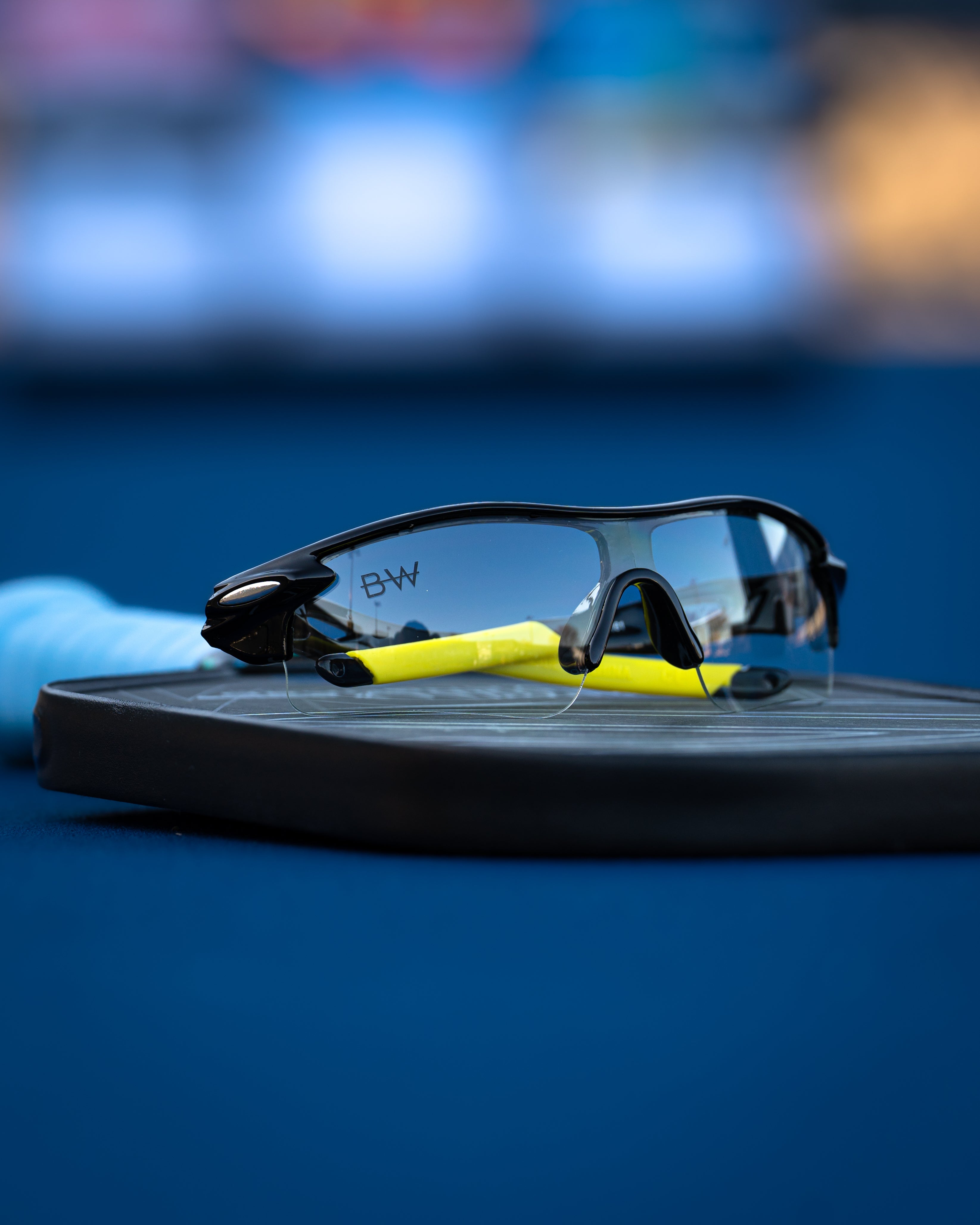
The Science of Reaction Time: How Prescription Glasses Give You an Edge
Share
Find Your Prescription Pickleball Glasses
Vision is part of how you perceive and respond to a fast-moving pickleball, but prescription glasses should not be marketed as a shortcut to faster reflexes. The right RX eyewear starts with accurate vision correction, an appropriate frame, and a lens configuration suited to your playing environment.
Reaction Time, Vision and Prescription Pickleball Glasses
Pickleball can demand rapid responses, particularly during exchanges near the kitchen line, quick volleys, drives, and changes in ball direction.
Vision is part of that process. Your visual system receives information about the ball, court, opponents, and surrounding environment before your nervous system and muscles produce a physical response.
But that does not mean prescription glasses inherently make your brain process information faster or automatically improve your reaction time.
A more accurate way to think about RX sports eyewear is this: if you need prescription correction, properly prescribed eyewear can provide that correction while you play. Reaction time itself depends on many additional visual, neurological, physical, environmental, and sport-specific factors.
What Is Reaction Time in Sports?
Reaction time generally refers to the interval between the presentation or detection of a stimulus and the beginning of a response.
In pickleball, that stimulus might involve seeing:
- An opponent contact the ball
- A volley change direction
- A ball travel toward your body
- A lob move over your position
- A shot move toward a particular part of the court
Your eventual response can involve visual perception, attention, decision-making, movement planning, and muscular action.
Because several processes are involved, it is too simplistic to say that one pair of glasses will reduce a player's reaction time by a specific number of milliseconds.
How Vision Fits Into the Reaction Process
A simplified visual-response sequence can be described as:
- Visual information reaches the eyes. Light from the environment enters the eyes and forms retinal images.
- Visual signals are transmitted. Information from the retina travels through the visual system for processing.
- The brain interprets relevant information. This can include the ball, court, opponents, direction, and movement.
- A response is selected. The player determines an appropriate action based on the situation.
- Movement begins. The nervous system coordinates the muscles involved in the response.
This is a simplified explanation of a much more complex process, but it illustrates an important point: vision is one component of reaction, not the entire reaction system.
Do Prescription Glasses Improve Reaction Time?
Prescription glasses should not be claimed to directly or universally improve reaction time.
If you have refractive error and require vision correction, properly prescribed glasses can provide the correction prescribed for your eyes. That can be relevant when you need to see the court and other visual information while playing.
However, wearing prescription glasses does not establish that you will:
- React a specific number of milliseconds faster
- Develop faster reflexes
- Track every ball more accurately
- Improve hand-eye coordination
- Increase athletic performance
- Win more points or matches
Those outcomes involve many variables beyond prescription correction.
Prescription Correction vs. Performance Enhancement
This distinction is important when shopping for sports eyewear.
Prescription correction is designed around an individual's refractive needs.
Athletic performance enhancement is a much broader claim involving physical and cognitive performance.
Providing appropriate prescription correction does not automatically establish that the eyewear enhances reaction speed, decision-making, depth perception, ball tracking, or athletic skill.
For Blinded Wear RX eyewear, the more defensible benefit is straightforward: players who need vision correction can incorporate their prescription into sports-focused eyewear.
What Can Affect Reaction Time in Pickleball?
Reaction time is influenced by more than eyesight alone. Depending on the situation and individual, relevant factors can include:
- Attention
- Anticipation
- Experience
- Decision-making
- Movement preparation
- Positioning
- Fatigue
- Practice and familiarity
- Individual visual function
- Environmental conditions
- The complexity of the situation
For example, an experienced player may recognize patterns in an opponent's positioning or shot preparation. That is different from prescription lenses physically accelerating the nervous system.
Why Clear Vision and Faster Reflexes Are Not the Same Thing
The terms visual clarity and reaction time describe different concepts.
A prescription is intended to correct particular refractive needs. Reaction time describes how quickly a person begins responding after a stimulus.
Those processes can interact within a larger visual-motor system, but it is inaccurate to convert that relationship into a simple marketing equation such as:
"Sharper prescription lenses = faster reaction time."
The human visual and motor systems are considerably more complicated.
Does Blurry Vision Slow Reaction Time?
The answer depends on the person, visual task, degree and type of blur, and testing conditions.
Rather than claiming that all blur directly slows athletic reaction time, the more useful point for someone who requires prescription correction is that playing without the correction they need can change the visual information available to them.
If you have questions about your prescription or visual function, those are best addressed through an appropriate eye-care professional rather than relying on a sports-eyewear marketing claim.
Can RX Pickleball Glasses Help You See the Court?
If you require prescription correction, RX pickleball glasses can incorporate individualized vision correction into eyewear designed for active use.
Depending on the Blinded Wear model, this can be provided through:
- Direct RX: prescription correction incorporated into the primary prescription lenses.
- RX Clip: prescription correction incorporated into a separate inner RX insert within the eyewear system.
Neither configuration should be marketed as inherently producing faster reflexes. The purpose is to provide prescription correction in a sports-eyewear format.
Does Lens Tint Improve Reaction Time?
No lens color should automatically be claimed to improve reaction time.
Players may prefer different lens appearances depending on brightness, environment, and personal preference, but statements such as "amber makes you react faster" or "blue lenses improve ball tracking" require evidence that cannot be inferred simply from lens color.
Lens color, prescription correction, contrast perception, and reaction time are related to different characteristics and should not be treated as interchangeable.
For a deeper look at choosing lens colors without performance hype, read the Pickleball Performance Lens Guide.
Do Amber or Brown Lenses Improve Pickleball Reaction Time?
It is too broad to say that amber or brown lenses make pickleball players react faster.
Tinted lenses alter the light reaching the eyes in ways that depend on their actual spectral transmission characteristics. The visible color name alone does not establish a specific improvement in reaction time, depth perception, ball recognition, or athletic performance.
Choose a tint based on verified product characteristics, your environment, and personal preference rather than expecting a guaranteed performance advantage.
Do Gray Lenses Improve Reaction Time?
Gray lenses should not be marketed as speeding visual processing or reaction time simply because they use a gray tint.
If you prefer gray-tinted eyewear for outdoor play, that can be a legitimate personal preference. It does not need to be justified with an unsupported claim about neurological or athletic performance.
Does Polarization Affect Reaction Time?
Polarization is designed to reduce certain reflected light. It does not provide a universal reaction-time advantage or disadvantage.
Likewise, choosing non-polarized lenses does not automatically improve depth perception, ball tracking, visual processing speed, or reaction time.
Some players may prefer non-polarized eyewear for court sports, while others may prefer polarized eyewear in certain outdoor environments. Individual preference and conditions matter.
Clear vs. Tinted RX Lenses for Fast Pickleball
Whether you choose clear or tinted RX eyewear should generally depend more on your playing environment than on claims about reaction speed.
Clear RX Lenses
A clear-lens configuration may appeal to players who do not want a dark sunglass tint during indoor, evening, or other lower-light conditions.
Tinted RX Lenses
Tinted eyewear may appeal to players who prefer a sunglass configuration for outdoor or brighter environments.
Neither should automatically be described as making the wearer react faster.
Explore clear-lens sports eyewear or compare additional options in the Pickleball Performance Lens Guide.
Do Photochromic Lenses Improve Reaction Time?
Photochromic technology and reaction time are separate subjects.
Photochromic lenses are designed to change their tint in response to certain light conditions. That characteristic should not automatically be translated into claims of faster reactions, improved focus, or better athletic performance.
If a particular Blinded Wear product offers a photochromic option, evaluate that feature based on its verified specifications and whether changing tint suits your normal playing environment.
Does Anti-Fog Technology Improve Reaction Time?
Anti-fog performance and reaction time should also be separated.
A verified anti-fog treatment may be designed to address lens condensation. That does not mean the treatment directly accelerates visual processing or neurological response.
Additionally, don't assume every Blinded Wear RX model includes an anti-fog coating unless that feature is explicitly verified for the individual product.
Does Peripheral Vision Determine Reaction Time?
Peripheral visual information can contribute to awareness of the surrounding environment, but the relationship between peripheral vision and athletic response is more complex than saying a particular frame "boosts peripheral reaction time."
Frame geometry, lens dimensions, prescription, head and eye movements, visual attention, and individual visual function can all matter.
Claims that a wraparound frame automatically expands peripheral vision enough to make an athlete react faster should therefore be avoided unless supported by product-specific evidence.
Does Depth Perception Affect Pickleball?
Depth perception is part of spatial vision, but no standard lens tint, polarization choice, or Blinded Wear frame should automatically be claimed to improve it.
Your visual system uses multiple cues to interpret spatial relationships. Individual prescription and visual function can also vary significantly.
If you have concerns about depth perception or another aspect of your vision, an eye-care professional can evaluate your individual visual needs.
Prescription Pickleball Glasses vs. Contacts for Reaction Time
Neither prescription glasses nor contact lenses should be declared universally faster for reaction time.
Both can provide vision correction when appropriately prescribed, but they use different methods:
| Option | How Vision Correction Is Worn | Sports Consideration |
|---|---|---|
| RX Sports Glasses | Prescription correction incorporated into eyewear | Combines prescription correction with a sports-frame configuration |
| Contact Lenses | Prescription lenses worn directly on the eyes | Can be paired with separate Non-RX sports eyewear if desired |
The appropriate choice depends on your prescription, eye-care needs, comfort, preferences, and playing setup—not a universal reaction-time advantage.
What Actually Makes Good RX Pickleball Eyewear?
Instead of looking for glasses promising "faster reflexes," focus on characteristics that can actually be evaluated.
- Appropriate prescription correction: Start with your individual vision needs.
- Sports-focused frame design: Consider a frame intended for active use.
- Frame fit: Dimensions and shape should work with the individual wearer.
- Frame weight: Decide whether you prefer lightweight eyewear for extended sessions.
- Lens configuration: Compare direct RX and RX Clip options where available.
- Playing environment: Consider indoor, outdoor, evening, and other conditions.
- Clear or tinted lenses: Choose based on environment and preference.
- Verified impact characteristics: Don't confuse impact-resistant with shatterproof or certified protective eyewear.
Blinded Wear RX Pickleball Glasses
Blinded Wear offers prescription pickleball glasses for players who need individualized vision correction in a sports-focused eyewear format.
Across applicable models, the collection includes:
- Direct RX options
- RX Clip options
- High-index prescription lenses included at no additional cost
- Lightweight sports-frame designs
- Non-polarized options
- Impact-resistant lens options
- Clear and tinted styles
- Different frame and lens aesthetics
Individual specifications vary by model, so review the actual product details rather than assuming every RX frame has identical features.
How to Choose RX Glasses for Fast-Paced Pickleball
- Start with your prescription. Your individual vision correction should come first.
- Choose direct RX or RX Clip. Compare the available prescription configurations.
- Consider your court environment. Think about where and when you normally play.
- Choose clear or tinted eyewear. Base this on lighting and personal preference rather than promises of faster reactions.
- Review frame fit and dimensions. Consider how the eyewear is likely to fit your face.
- Compare verified product features. Avoid making decisions based on unsupported performance claims.
For additional help, take the Pickleball Sunglasses Quiz or browse the 2026 Pickleball Glasses Guide.
Reaction Time vs. Anticipation in Pickleball
Reaction time is only part of what can make a player appear quick on the court. Anticipation can also play an important role.
An experienced pickleball player may use information such as an opponent's positioning, paddle preparation, previous shot patterns, and court geometry to prepare for what might happen next.
This is different from prescription glasses making the nervous system operate faster.
Prescription eyewear can provide the vision correction prescribed for the wearer, while anticipation develops through factors such as experience, practice, attention, and familiarity with the game.
Why Experienced Players Can Seem to React Faster
A player who has seen a particular court situation hundreds of times may recognize it earlier than a beginner.
For example, experience can influence:
- Where a player positions themselves
- What visual information they pay attention to
- Which shot possibilities they anticipate
- How quickly they choose between possible responses
- How prepared their body is to move
That can make an experienced player look exceptionally quick without implying that their eyewear physically increased neurological processing speed.
Can You Train Reaction Time for Pickleball?
Players can practice skills related to responding to fast court situations, but reaction and performance involve more than eyesight.
Pickleball practice may expose players to repeated patterns involving:
- Volleys
- Drives
- Dinks
- Speed-ups
- Lobs
- Resets
- Changes in ball direction
Repeated experience can help a player become more familiar with these situations. Prescription eyewear serves a different role: providing individualized vision correction when needed.
Good RX eyewear and good training can therefore be parts of the same playing setup without claiming that the glasses themselves train or accelerate reaction time.
Why Your Prescription Matters in Sports Eyewear
If you require vision correction, your individual prescription should be the starting point when choosing RX sports glasses.
Prescription eyewear is not simply a tinted sports lens with an added performance feature. It is individualized optical correction incorporated into an eyewear system.
Your prescription may include different types and amounts of correction, which is why broad claims such as "these lenses make everyone see faster" do not accurately describe prescription eyewear.
For questions about your individual prescription or changes in your vision, consult an appropriate eye-care professional.
High-Index RX Lenses and Reaction Time
Blinded Wear RX products include high-index prescription lenses at no additional cost.
High-index refers to a category of prescription lens material commonly considered when managing lens thickness, particularly as prescription strength increases.
It should not be interpreted as a reaction-time technology.
High-index lenses do not inherently establish:
- Faster reflexes
- Faster visual processing
- Better hand-eye coordination
- Improved ball tracking
- Better depth perception
- Higher athletic performance
Their relevance is primarily to the prescription-lens configuration rather than neurological speed.
Direct RX vs. RX Clip for Fast-Paced Pickleball
Blinded Wear prescription eyewear can use different RX configurations depending on the model.
Direct RX Pickleball Glasses
Direct RX models incorporate individualized prescription correction into the primary prescription lenses.
RX Clip Pickleball Glasses
RX Clip models use a separate inner prescription insert within the eyewear system. The individualized prescription correction is incorporated into that RX insert rather than directly into the primary outer sports lens.
Neither configuration should automatically be described as providing faster reaction time.
Choose between them based on your prescription, available model, frame preferences, lens configuration, and individual needs.
For a more detailed comparison, visit the RX vs. Non-RX Pickleball Glasses Guide.
Can Prescription Sports Glasses Reduce Distractions?
It's better to be specific about what a pair of glasses actually does rather than claiming it eliminates distractions.
If you require prescription correction, wearing appropriate RX eyewear means your prescribed correction is incorporated into the eyewear you're using during play.
However, concentration and distraction can also be influenced by:
- Noise
- Fatigue
- Weather
- Opponents
- Court activity
- Physical comfort
- Attention
- Experience
No sports frame should be marketed as automatically producing greater concentration or focus.
Can Eye Strain Slow Your Reaction Time?
Eye strain and reaction time should not be linked with a universal cause-and-effect claim.
Visual discomfort can have many causes, and reaction performance is influenced by numerous variables. The presence of eye strain does not allow a specific reaction-time change to be predicted.
If you regularly experience eye strain, headaches, blurred vision, double vision, or other visual symptoms, consider discussing them with an eye-care professional rather than treating sports eyewear as a medical solution.
Can RX Glasses Improve Hand-Eye Coordination?
Prescription glasses should not be marketed as automatically improving hand-eye coordination.
Hand-eye coordination involves visual information, movement planning, timing, learned motor skills, and physical execution.
If you require prescription correction, appropriate eyewear can provide that correction while you participate in the activity. That is different from the glasses themselves training or upgrading coordination.
Can RX Glasses Improve Ball Tracking?
Ball tracking is another area where careful wording matters.
Your visual system can use information about a moving ball while you play, but it would be too broad to promise that a particular prescription frame, tint, or lens material inherently makes everyone better at tracking the ball.
Ball tracking can involve:
- Individual visual function
- Attention
- Head and eye movement
- Experience
- Anticipation
- Ball speed and trajectory
- Lighting and background conditions
Prescription correction can be part of the visual setup for a player who needs it without being marketed as a guaranteed ball-tracking enhancement.
Can Prescription Glasses Improve Depth Perception?
Depth perception is complex and varies between individuals. It should not be reduced to a claim that a particular sports frame or lens tint automatically improves it.
Appropriate prescription correction may be important to an individual's overall visual function, but depth perception can involve binocular vision and multiple visual cues.
If depth perception is a specific concern, an eye-care professional can evaluate your individual vision.
Can Sports Glasses Give You a Competitive Edge?
The phrase "competitive edge" is often used in sports marketing, but it can imply a performance advantage that has not actually been established.
A more accurate reason to choose prescription sports glasses is that they can combine your individualized vision correction with eyewear intended for active use.
For a pickleball player who needs prescription correction, that can be a practical reason to choose RX sports eyewear without promising:
- Faster reactions
- More wins
- Better shot accuracy
- Improved coordination
- Better depth perception
- Superior ball tracking
Reaction Time Myths About Sports Eyewear
Myth: Sharper Lenses Automatically Mean Faster Reflexes
Reality: Prescription correction and neurological reaction speed are different concepts.
Myth: Amber Lenses Make You React Faster
Reality: Lens color alone does not establish an improvement in reaction time.
Myth: Non-Polarized Lenses Improve Depth Perception
Reality: Polarization choice alone does not determine depth perception.
Myth: Wraparound Glasses Automatically Improve Peripheral Reaction Time
Reality: Frame shape alone does not establish faster peripheral visual processing.
Myth: High-Index Lenses Process Visual Information Faster
Reality: High-index describes an optical material property, not brain-processing speed.
Myth: Photochromic Lenses Improve Reaction Speed
Reality: Photochromic technology changes lens tint under certain light conditions; it should not automatically be described as accelerating reactions.
RX Pickleball Glasses: What to Compare Instead of Reaction-Time Claims
| Feature | What It Actually Helps You Compare |
|---|---|
| Your Prescription | The individualized vision correction you require |
| Direct RX vs. RX Clip | How prescription correction is incorporated into the eyewear |
| High-Index Lens Material | A prescription-lens material consideration that can help manage thickness in appropriate prescriptions |
| Frame Fit | How the dimensions and design work with the individual wearer |
| Frame Weight | How much eyewear weight you prefer during extended wear |
| Clear vs. Tinted | Which lens configuration fits your playing environment and preference |
| Polarization | Whether a polarization filter is part of the lens configuration |
| Impact Resistance | A physical characteristic of applicable lenses or eyewear |
These characteristics provide a more useful basis for comparing prescription pickleball eyewear than an unsupported promise of faster reflexes.
RX Pickleball Glasses for Indoor Play
Indoor pickleball players who require prescription correction may prefer eyewear without a dark sunglass tint depending on the facility and personal preference.
Blinded Wear offers clear-lens sports eyewear for players who want a clear configuration.
Clear lenses should not be described as inherently increasing available light, speeding reactions, improving contrast, or making the ball easier to track.
The primary distinction is straightforward: they do not use a dark sunglass tint.
RX Pickleball Glasses for Outdoor Play
Outdoor pickleball can involve changing brightness, weather, time of day, and court surroundings.
Players may prefer different tinted lens appearances based on those conditions and their individual preferences.
When comparing outdoor RX glasses, consider:
- Your prescription
- Lens darkness
- Lens color
- Polarization preference
- Frame fit
- Frame weight
- Time of day
- Typical playing environment
For more information, read the Best Pickleball Sunglasses for Outdoor Play guide.
How to Order Blinded Wear Prescription Pickleball Glasses
- Select your preferred RX model and available options.
- Have your current eyeglass prescription ready.
- Upload a clear photo or picture of your eyeglass prescription on the product page before adding the eyewear to your cart.
- Your prescription information will be associated with your custom RX order.
Blinded Wear RX products include high-index prescription lenses at no additional cost.
For the complete process, visit How to Order Your Prescription Pickleball Glasses.
Reaction Time and Prescription Eyewear FAQs
Can prescription glasses make my reaction time faster?
Prescription glasses should not be described as directly making your nervous system react faster. If you require vision correction, properly prescribed eyewear can provide that correction while you play. Reaction time also depends on attention, anticipation, experience, decision-making, movement, fatigue, and other individual factors.
Will RX pickleball glasses help me see the ball?
RX pickleball glasses can provide individualized prescription correction for players who require it. They should not, however, be marketed as guaranteeing better ball tracking or athletic performance.
Do better lenses mean faster visual processing?
Not automatically. Lens characteristics and neurological processing speed are different concepts. A prescription lens is designed to provide the prescribed optical correction rather than accelerate the brain.
Can blurry vision affect playing pickleball?
If you require prescription correction, playing without the correction you need can change the visual information available to you. The specific effect varies by person, prescription, task, and playing conditions.
Do high-index lenses improve reaction time?
No inherent reaction-time advantage should be attributed to high-index material. High-index is a prescription-lens material category commonly considered when managing lens thickness, particularly as prescription strength increases.
Do non-polarized glasses improve reaction time?
Non-polarized lenses should not automatically be described as improving reaction time, depth perception, contrast, or ball tracking. Polarization and reaction speed are separate characteristics.
Are tinted lenses faster for sports than clear lenses?
No universal reaction-time advantage should be assigned to clear or tinted lenses. Choose between them based on the playing environment, verified lens characteristics, and personal preference.
Which lens color gives you the fastest reaction time?
There is no single lens color that should be marketed as universally producing the fastest reaction time. Lens color alone does not establish faster neurological processing.
Do prescription glasses improve hand-eye coordination?
Prescription correction and hand-eye coordination are different concepts. Coordination also involves learned motor skills, timing, movement planning, visual information, and physical execution.
Can RX glasses improve depth perception?
Depth perception is complex and varies between individuals. A particular sports frame, lens tint, or polarization choice should not automatically be claimed to improve it.
Are prescription glasses better than contacts for reaction time?
Neither should be declared universally faster. Both can provide prescription correction when appropriately prescribed, but they use different methods and may suit different individual preferences.
Can I use RX pickleball glasses for both indoor and outdoor play?
Depending on the individual model and lens configuration, prescription sports eyewear can be selected around different playing environments. Consider your prescription, lens darkness, frame, and typical playing conditions.
How to Evaluate Claims About "Performance" Sports Glasses
Sports-eyewear marketing often combines legitimate product characteristics with claims about what those characteristics supposedly make an athlete do.
Those are not always the same thing.
| Product Characteristic | Reasonable Description | Claim to Avoid Without Evidence |
|---|---|---|
| Prescription Lenses | Provide individualized prescription correction | "Makes you react faster" |
| High-Index Lenses | Can help manage lens thickness in appropriate prescriptions | "Speeds up visual processing" |
| Non-Polarized Lenses | Do not use an added polarization filter | "Improves depth perception" |
| Tinted Lenses | Provide a particular lens tint or appearance | "Makes the ball easier to track" |
| Clear Lenses | Provide eyewear without a dark sunglass tint | "Increases reaction speed" |
| Lightweight Frame | Reduces the amount of frame weight being worn | "Makes you move faster" |
| Impact-Resistant Lens | Provides an impact-resistant lens characteristic | "Shatterproof" or "guaranteed protection" |
Separating the actual specification from the claimed athletic outcome makes it easier to compare eyewear accurately.
Impact Resistance and Fast-Paced Pickleball
Reaction-time claims should also remain separate from physical lens characteristics.
Applicable Blinded Wear models use impact-resistant lens options. This describes a physical characteristic of the lens rather than a promise of faster visual processing.
Impact-resistant does not mean shatterproof and does not establish a particular protective-eyewear certification or safety rating.
If you require eyewear meeting a specific protective standard, verify the certification of the complete product for your intended use.
Why Fit Still Matters in RX Sports Eyewear
Even though frame fit does not directly determine neurological reaction speed, it remains an important practical consideration when choosing prescription sports glasses.
Consider:
- Frame dimensions
- Bridge fit
- Temple fit
- Overall frame weight
- Your face and head shape
- Whether you wear a hat or visor
- Your individual comfort preferences
A frame should not be described as universally secure or "non-slip" unless that characteristic has been specifically established. Fit varies between individual wearers.
Choosing RX Pickleball Glasses Without the Performance Hype
You don't need exaggerated reaction-time claims to make a useful prescription-eyewear decision.
Use this process instead:
- Determine your prescription needs. Start with the vision correction prescribed for you.
- Choose an RX configuration. Compare direct RX and RX Clip models where available.
- Consider your playing environment. Indoor, outdoor, daytime, and evening conditions can influence your lens preference.
- Choose clear or tinted eyewear. Select based on the environment and your preferences rather than a promised reaction-time advantage.
- Review frame dimensions and weight. Consider how the design fits your individual needs.
- Review verified lens characteristics. Separate actual specifications from unsupported performance claims.
- Compare styles. Choose an appearance you actually want to wear on the court.
Prescription Pickleball Glasses and Vision: Key Takeaways
If you remember only a few things from this guide, make them these:
- Vision is one component of a larger visual-motor reaction process.
- Prescription correction does not automatically mean faster reaction time.
- High-index lenses do not inherently increase processing speed.
- Lens color alone does not establish better ball tracking or faster reactions.
- Polarization alone does not determine depth perception or reaction time.
- Clear lenses do not inherently increase reaction speed.
- Direct RX and RX Clip are different prescription configurations, not different levels of reflex enhancement.
- Training, anticipation, experience, attention, and movement can all contribute to how quickly a player responds.
Explore More Prescription Pickleball Eyewear Resources
Continue your research with these Blinded Wear guides:
- Best Pickleball Glasses 2026 — compare prescription and non-prescription options for different playing environments.
- Pickleball Performance Lens Guide — learn about lens colors, clear lenses, polarization, and RX configurations.
- RX vs. Non-RX Pickleball Glasses — compare prescription and non-prescription eyewear.
- How to Order Prescription Pickleball Glasses — understand the Blinded Wear RX ordering process.
- Pickleball Sunglasses Quiz — narrow your eyewear options based on your preferences.
50% Lifetime Replacement Support
Blinded Wear offers 50% lifetime replacement support if eligible glasses break, subject to current policy terms.
For eligible replacement claims, damaged eyewear must be returned. Once the claim and returned eyewear meet the applicable policy requirements, the customer can receive 50% credit toward a replacement pair.
This is not a guarantee that eyewear cannot break, and it should not be described as unlimited free replacement coverage.
Review the Blinded Wear Protection Plan, Replacement & Returns information for current eligibility and policy details.
Final Takeaway: Good Vision Correction Is Not a Shortcut to Faster Reflexes
The science of reaction time is more complicated than the idea that "sharper glasses make you react faster."
During pickleball, visual information is part of a larger process involving perception, attention, anticipation, decision-making, nervous-system activity, movement, experience, and physical execution.
If you require prescription correction, the role of RX sports eyewear is straightforward and valuable without exaggeration: it allows your individualized prescription to be incorporated into eyewear intended for active use.
Blinded Wear offers direct RX and RX Clip options, high-index prescription lenses at no additional cost, lightweight sports-frame designs, and a range of clear and tinted styles. Individual specifications vary by model.
Choose your eyewear based on your prescription, playing environment, frame preferences, and verified product characteristics—not a promise that a particular tint, lens material, or frame will magically make your reflexes faster.
Shop Blinded Wear Prescription Pickleball Glasses or take the Pickleball Sunglasses Quiz to explore your options.