
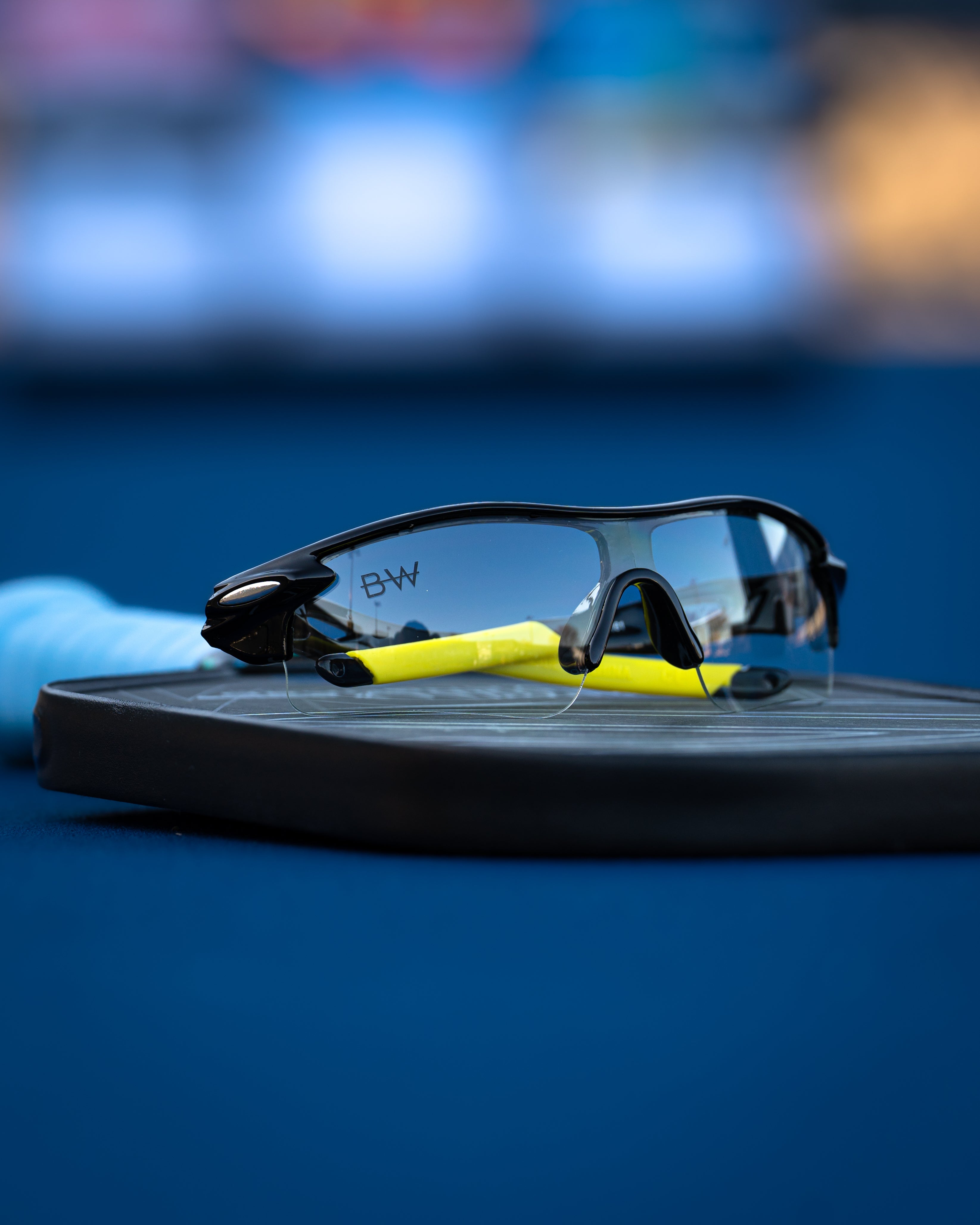
How to Keep Your RX Glasses Clean Without Damaging Them
Share
Find Your Prescription Pickleball Glasses
Keeping prescription eyewear clean starts with knowing what is on the lens, what can safely touch it, and which cleaning habits can introduce unnecessary abrasion. Use this guide for everyday RX eyewear care, then explore Blinded Wear's current prescription and non-prescription pickleball eyewear resources.
How to Clean Prescription Glasses Without Damaging Them
Prescription sports glasses can collect fingerprints, skin oils, dust, dried droplets, and other residue during everyday wear and time on the pickleball court. Cleaning that material away is simple, but the technique matters.
The main goal is to remove loose particles before wiping aggressively across the lens. Rubbing a dirty lens with an uncontrolled material can move debris across its surface rather than safely removing it.
A good cleaning routine also avoids making assumptions about lens features. Prescription power, high-index material, tint, polarization, impact resistance, scratch resistance, anti-reflective treatments, and other coatings are separate characteristics. Do not assume a particular coating is present unless it is specified for your exact lenses.
Why Should You Keep RX Glasses Clean?
A dirty lens can interfere with the view through otherwise appropriate prescription eyewear. Common contaminants include:
- Fingerprints
- Skin oils
- Dust
- Dirt
- Dried water droplets
- Sweat residue
- Other surface debris
Removing that material restores the lens surface to a cleaner condition. It does not change the prescription or create a stronger optical correction.
Keeping the distinction between lens cleanliness and prescription accuracy is important when troubleshooting blurry or hazy vision.
Dirty Lenses vs. the Wrong Prescription
If your vision through RX glasses suddenly seems hazy, do not immediately assume your prescription has changed.
Start by checking the physical lens surface. Fingerprints, oil, residue, water spots, or temporary fog can affect what you see through the lens without changing its SPH, CYL, AXIS, ADD, or prism values.
If appropriate cleaning resolves the problem, the lens surface was contributing to the issue. If unexpected blur remains after the lenses are clean, other factors may need to be considered.
Can Cleaning Change Your Prescription?
Normal appropriate cleaning does not change the prescription power manufactured into your lenses.
Prescription values and surface cleanliness are separate. A dirty lens does not become a weaker prescription, and a freshly cleaned lens does not become a stronger one.
Physical damage is another issue. A scratched, cracked, chipped, or otherwise damaged lens should be evaluated as damaged eyewear rather than treated as something that simply needs more cleaning.
What Is the Best Way to Clean Prescription Glasses?
A conservative cleaning process focuses on removing loose contamination before applying unnecessary friction.
- Inspect the glasses first. Check whether you are dealing with ordinary dirt or actual physical damage.
- Remove loose debris carefully. Avoid immediately grinding visible grit across a dry lens.
- Use an appropriate eyewear-cleaning method. Follow any cleaning instructions supplied for the specific lenses and frame.
- Use clean hands and clean materials. A dirty cleaning cloth can put oils or particles back onto the lens.
- Use gentle pressure. Cleaning should not require aggressive scrubbing.
- Inspect the lenses afterward. Determine whether the residue is gone before repeatedly wiping the same area.
If the manufacturer or lens provider gives specific care instructions for your exact eyewear, those instructions should take priority over a generic cleaning routine.
Should You Rinse Prescription Glasses Before Wiping Them?
When compatible with the eyewear's care instructions, rinsing can help remove loose particles before they are moved across the lens with a cloth.
This is especially relevant when visible dust or grit is present.
The important principle is not that every lens must always be rinsed before any contact. It is that visible abrasive debris should not be aggressively rubbed across a dry lens.
Should You Use Hot or Cold Water on Prescription Glasses?
Avoid unnecessarily exposing prescription eyewear to extreme temperatures during routine cleaning.
If water is appropriate for your eyewear, moderate water temperature is a more conservative choice than very hot water.
Exact material and coating tolerances can vary, so avoid making universal claims that every RX frame and lens responds identically to heat.
Can You Use Soap to Clean Prescription Glasses?
Some eyewear-care instructions allow a small amount of mild cleaning solution or mild soap, while compatibility can vary by lens, coating, and product.
If you use a cleaning product, choose one that is appropriate for the exact eyewear rather than assuming any household soap is safe.
Avoid products that leave heavy residues on the lens, and rinse away permitted cleaning solution thoroughly when the applicable care instructions call for rinsing.
Can You Use Dish Soap on RX Glasses?
Dish soap is frequently discussed as an eyeglass-cleaning option, but formulas differ. Fragrances, moisturizers, additives, and other ingredients can vary between products.
Rather than treating every dish soap as universally compatible with every prescription lens and coating, follow the care instructions for your eyewear or use a cleaner specifically intended for compatible optical lenses.
Can You Use Hand Soap on Prescription Glasses?
Do not assume that a product is lens-safe simply because it is safe for your hands. Hand soaps can contain moisturizers, fragrances, oils, or other ingredients that may leave residue.
Use a cleaning method appropriate for optical lenses instead of choosing a household product based solely on convenience.
Can You Use Eyeglass Cleaning Spray?
A cleaning solution specifically intended for compatible optical lenses can be useful when water is unavailable or when the product's instructions recommend it.
Check compatibility with your exact eyewear, especially if the lenses have specified surface treatments.
“Lens cleaner” should not be interpreted as permission to use every glass-cleaning chemical on prescription eyewear.
Should You Use Window Cleaner on Prescription Glasses?
Household window cleaners are formulated for household surfaces, not necessarily for the materials and treatments used in prescription eyewear.
Unless the exact product is specifically approved for your lenses, use an appropriate optical-lens cleaning method instead.
Should You Use Ammonia-Based Cleaner on RX Lenses?
Do not assume an ammonia-based household cleaner is compatible with prescription lenses or their surface treatments.
Use products intended for the applicable eyewear and follow the lens-care instructions supplied for your lenses.
Can You Clean Prescription Glasses With Rubbing Alcohol?
Alcohol compatibility can depend on the lens, surface treatments, frame materials, and the cleaning product's formulation.
For that reason, avoid a universal rule that rubbing alcohol is safe for every pair of RX glasses. Use a cleaner approved for the applicable eyewear rather than experimenting with strong household cleaning products.
Can You Clean Prescription Glasses With Vinegar?
DIY household mixtures are unnecessary when appropriate optical-lens cleaning methods are available.
Do not assume vinegar is compatible with every lens material, coating, frame, or finish. Follow applicable eyewear-care instructions instead.
Should You Use Toothpaste on Prescription Lenses?
No. Toothpaste should not be used as a DIY lens-polishing treatment.
Attempting to abrade or polish a prescription lens can create additional surface damage or affect surface treatments. A scratch is physical damage, not dirt that needs to be scrubbed away.
Should You Use Baking Soda to Remove Lens Scratches?
Avoid abrasive DIY scratch-removal methods such as rubbing prescription lenses with baking soda.
Removing material from a lens is fundamentally different from cleaning contamination off its surface. Do not attempt to grind away a scratch until it becomes less visible.
Can Car Wax Fill Scratches in RX Glasses?
Do not apply car wax or similar surface products to prescription lenses in an attempt to hide scratches.
Such products are not a substitute for professional lens evaluation or replacement when physical damage meaningfully affects the eyewear.
Can You Clean Prescription Glasses With Your Shirt?
Your shirt may be convenient, but convenience does not make it a controlled lens-cleaning material.
Clothing can contain skin oils, dust, dirt, detergent residue, or particles picked up throughout the day. Rubbing a visibly dirty lens with whatever fabric happens to be available can move those contaminants across the lens.
A clean material intended for appropriate lens care gives you greater control over what contacts the surface.
Can You Use Paper Towels on Prescription Glasses?
Avoid relying on disposable household paper products as your default prescription-lens cleaning material when an appropriate clean lens cloth is available.
The broader issue is that uncontrolled cleaning materials can contain debris or have surface characteristics that are not intended for optical-lens care.
Use the cleaning material recommended for your eyewear rather than assuming every soft-feeling household material is equivalent.
Can You Use Tissues to Clean RX Glasses?
Tissues vary in formulation and can contain lotions or other additives. They are not automatically equivalent to a clean optical cleaning cloth.
If you need to clean prescription eyewear regularly, keeping an appropriate clean lens cloth available is a better routine than improvising with whatever material is nearby.
How to Use a Microfiber Cloth on RX Glasses
A clean microfiber cloth intended for optical-lens care can be useful for removing appropriate residue after loose debris has been addressed.
The word clean matters. A cloth that has accumulated oils, dust, or particles can redistribute contamination instead of removing it.
Do not assume that microfiber makes aggressive dry rubbing harmless. Visible grit should still be removed carefully rather than pressed across the lens.
Can a Dirty Microfiber Cloth Damage Glasses?
A contaminated cloth can hold particles and oils. That makes regular cloth care part of lens care.
If a cloth falls on a dirty floor, sits loose in a dusty bag, or becomes heavily oily, clean it appropriately before continuing to use it on prescription lenses.
How Should You Wash an Eyeglass Cleaning Cloth?
Follow the care instructions supplied with the cloth. The goal is to remove oils and debris without leaving behind substances that can transfer back to the lens.
Keep the cleaned cloth somewhere protected from loose dirt rather than immediately placing it into a contaminated pocket or bag.
Is It Bad to Wipe Prescription Glasses While They Are Dry?
The main concern is what may be sitting between the cloth and lens.
Lightly removing a simple fingerprint with an appropriate clean cloth is different from aggressively rubbing a lens covered in dust or grit.
If visible particles are present, address the loose debris first rather than increasing pressure.
How Hard Should You Press While Cleaning Glasses?
Routine lens cleaning should not require heavy pressure.
If a mark does not come away with an appropriate cleaning method, repeatedly pressing harder is not necessarily the solution. Determine whether you are dealing with residue, a scratch, coating damage, or another physical issue.
How Should You Hold RX Glasses While Cleaning Them?
Handle the eyewear carefully and avoid unnecessarily twisting or flexing the frame while cleaning.
Lens cleaning is not a frame-strength test. Use controlled handling rather than gripping one distant part of the frame while aggressively scrubbing another.
How to Clean RX Glasses After Pickleball
After a pickleball session, first determine what is actually on the eyewear. A post-match pair may have skin oils, fingerprints, dust, or dried perspiration residue.
A practical routine is:
- Inspect the lenses and frame.
- Remove loose debris without grinding it across the lens.
- Use an appropriate lens-cleaning method.
- Clean both sides of the lenses.
- Pay attention to residue near frame edges without forcing the lens or frame.
- Use a clean lens-care material for final drying or wiping when appropriate.
- Store the eyewear in a protected location after it is clean and dry.
Can Sweat Damage Prescription Glasses?
Perspiration can leave residue on lenses and frames, but the exact effect on materials and finishes depends on the eyewear.
Do not describe every Blinded Wear RX frame as “sweat-proof” or universally resistant to every form of prolonged exposure unless that specification is verified.
A sensible routine is to clean accumulated residue according to the eyewear's applicable care instructions rather than allowing contamination to build up indefinitely.
What Is the Residue Left on Glasses After Sweating?
Perspiration can dry and leave visible residue on the eyewear. That residue is a surface-cleanliness issue and should not be confused with a change in prescription power.
If dried residue is present, avoid trying to remove it by immediately applying maximum pressure with a dry shirt or towel.
How Do You Remove Fingerprints From RX Lenses?
Fingerprints usually involve oils transferred from the skin to the lens surface.
Use an appropriate lens-cleaning method and clean material rather than repeatedly spreading the oil around with a dirty cloth.
If fingerprints appear frequently, handling the eyewear by the frame rather than touching the lens surfaces can reduce how often they need to be cleaned.
How Do You Remove Water Spots From Prescription Glasses?
Dried droplets can leave visible residue. Use an appropriate lens-cleaning method rather than attempting to scrape the deposits away.
If a mark remains after appropriate cleaning, inspect it carefully before assuming more pressure is required.
How Do You Remove Dust Without Scratching RX Lenses?
Loose dust should be treated differently from an oily fingerprint.
When visible particles are present, remove or rinse away loose contamination using a method appropriate for the eyewear before wiping aggressively.
This reduces the chance that cleaning turns loose debris into something being dragged across the lens surface.
What If Sand or Grit Gets on Prescription Glasses?
Do not immediately rub visible grit with your shirt, fingers, or a dry cloth.
Loose granular debris can be abrasive. Remove it carefully using an appropriate method before normal wiping.
If the lens has already been scratched, additional cleaning will not reverse the physical damage.
Is the Lens Dirty or Just Fogged?
Fogging and contamination are different problems.
Fog is temporary condensation on the lens surface. Dirt, oils, and dried residue remain until removed. A scratch is physical surface damage.
Before repeatedly wiping a cloudy lens, identify which of these you are dealing with.
Does Cleaning Prevent RX Glasses From Fogging?
Keeping lenses free of oils and residue is good general care, but routine cleaning should not be marketed as a guarantee that prescription eyewear will never fog.
Fogging can depend on temperature, humidity, airflow, face coverage, and other environmental conditions.
Do not assume an anti-fog treatment is present unless it is verified for the exact lens configuration.
Can You Use Anti-Fog Products on Prescription Lenses?
Use only products that are compatible with the applicable lens material and surface treatments.
An anti-fog product should not be assumed safe for every prescription lens simply because it is marketed for another transparent surface.
Check the product instructions and applicable eyewear-care guidance before use.
How Can You Tell a Scratch From a Smudge?
A smudge is surface contamination that can potentially be removed through appropriate cleaning. A scratch is physical damage to the lens surface.
If a mark remains in the same location after the lens has been cleaned appropriately, do not keep increasing cleaning pressure indefinitely.
Inspect the lens under normal lighting and consider professional evaluation if you cannot determine whether the mark is surface residue or physical damage.
Can Cleaning Remove a Scratch From Prescription Glasses?
No ordinary cleaning method should be expected to remove physical lens material damage.
Cleaning can remove dirt surrounding a scratch and make the lens easier to inspect, but it does not restore the damaged surface.
Avoid abrasive polishing methods that attempt to grind the surrounding lens down to the depth of the scratch.
Are Blinded Wear RX Lenses Scratch-Resistant?
Do not assume scratch resistance unless that feature is specified for the exact lens configuration being purchased.
More broadly, even when a lens is described as scratch-resistant, scratch-resistant does not mean scratchproof. Appropriate handling and cleaning remain important.
Do High-Index RX Lenses Need Special Cleaning?
Blinded Wear custom RX eyewear includes high-index prescription lenses at no additional cost.
High-index describes a category of prescription lens material. It does not automatically establish scratch resistance, anti-reflective treatment, anti-fog treatment, polarization, UV specifications, or another surface feature.
Use the cleaning instructions appropriate for the complete lens rather than assuming refractive index alone determines the cleaning method.
Are High-Index Lenses More Scratch-Resistant?
Refractive index should not be treated as a scratch-resistance rating.
A lens being high-index tells you something about how the material refracts light. It does not by itself establish how resistant the finished surface is to abrasion.
Does Impact Resistance Make a Lens Harder to Scratch?
Impact resistance and scratch resistance describe different characteristics.
A lens can have impact-resistant characteristics without being scratchproof. Do not use impact resistance as a reason to clean the surface aggressively.
Do Tinted RX Lenses Need a Different Cleaning Method?
Tint changes the visible-light characteristics of the lens but does not automatically determine its cleaning requirements.
Use the care method appropriate for the exact lens and any specified surface treatments.
Do not assume that a dark lens is more durable or can tolerate stronger household chemicals.
Do Polarized Prescription Lenses Need Special Cleaning?
Polarization and cleaning compatibility are separate considerations. If a prescription lens is polarized, follow the care instructions for that specific finished lens.
Polarization does not make the lens scratchproof, and cleaning cannot add or restore polarization.
How Do You Clean Photochromic Prescription Lenses?
When photochromic technology is present, follow the care guidance for the exact lens.
Photochromic behavior and cleaning are separate characteristics. Avoid assuming that a generic chemical is safe merely because the lens changes tint under particular conditions.
What About Coated Prescription Lenses?
Prescription lenses can be offered with different treatments depending on the exact product and configuration. Examples in the broader eyewear market can include anti-reflective or other surface treatments.
That does not establish that every Blinded Wear RX lens includes those treatments.
If a particular coating is specified, follow cleaning instructions compatible with that coating instead of using harsh chemicals or abrasive DIY methods.
How Do You Clean Anti-Reflective Lenses?
If your exact prescription lenses are verified to have an anti-reflective treatment, use cleaning products and methods compatible with that treatment.
Do not assume anti-reflective treatment is present on every prescription lens, and do not use the presence of reflections as a DIY test for whether a particular coating exists.
Do Blue-Light Lenses Need Different Cleaning?
A claimed blue-light filtering feature and surface-cleaning compatibility are separate issues.
Do not assume a product includes blue-light filtering based on its color or name, and do not assume that a particular cleaner is required unless the exact lens-care instructions specify it.
Does Stronger RX Power Change How You Clean the Lens?
A stronger prescription does not mean the lens should be scrubbed harder, cleaned more frequently, or treated with stronger chemicals.
Prescription power and surface cleaning solve different problems.
Handle stronger prescription lenses carefully just as you would other optical lenses and follow the appropriate care instructions for the finished product.
How Often Should You Clean Prescription Glasses?
There is no universal requirement to clean RX glasses a fixed number of times per day.
Clean them when contamination meaningfully accumulates, while avoiding unnecessary aggressive handling simply to meet a schedule.
A player who touches the lenses frequently or finishes a dusty outdoor session may need to clean them more often than someone wearing them in a cleaner environment.
Can You Clean Prescription Glasses Too Often?
Cleaning frequency alone is not the most useful measure. Technique and lens condition matter.
Repeatedly rubbing a dirty lens with uncontrolled materials is different from using an appropriate gentle method when cleaning is needed.
The goal is not to avoid cleaning. It is to avoid unnecessary abrasion, harsh products, and excessive handling.
How to Clean RX Glasses Between Pickleball Games
During a match day, first identify whether the lens has a fingerprint, sweat residue, dust, or temporary condensation.
If loose debris is present, avoid immediately rubbing it across the lens. If the issue is a simple smudge and you have an appropriate clean lens cloth, address the smudge gently.
A small, controlled cleaning routine is preferable to repeatedly wiping the lenses with a sweaty shirt between rallies.
What Should You Keep Courtside for RX Lens Care?
The simplest useful preparation is access to an appropriate clean lens-care material and a protected place for the eyewear when it is not being worn.
Do not assume that Blinded Wear automatically includes a particular case, microfiber cloth, cleaning spray, or accessory with every RX order unless the current product listing specifically states that it does.
How Should You Store Prescription Sports Glasses?
When eyewear is not being worn, protect the lenses from unnecessary contact with abrasive or hard surfaces.
A suitable protective storage solution can reduce the chance that the lenses are placed face-down, crushed beneath other equipment, or left loose among objects that may contact them.
Use an appropriate case if you have one, but do not assume a hard case is included with every Blinded Wear RX purchase unless the exact order specifies it.
Should You Put Prescription Glasses Lens-Down?
Avoid deliberately placing prescription eyewear with lens surfaces directly against uncontrolled hard or abrasive surfaces.
When setting the glasses down temporarily, choose a position and surface that minimizes direct lens contact and the chance of the eyewear being knocked or crushed.
Should You Keep RX Glasses Loose in a Pocket?
A loose pocket can contain keys, grit, coins, or other objects that may contact the lenses or frame.
Protected storage is preferable when the eyewear is not being worn.
How to Store RX Glasses in a Pickleball Bag
A sports bag can contain paddles, balls, bottles, clothing, keys, and other equipment. Avoid leaving prescription eyewear loose where those items can press against the frame or lenses.
Keep the eyewear in a protected area or appropriate case so that normal bag movement does not repeatedly expose the lenses to hard objects and debris.
Should You Leave Prescription Glasses in a Hot Car?
Avoid unnecessary prolonged exposure to extreme heat when storing prescription eyewear.
Materials, finishes, adhesives, and lens treatments can vary, so there is no need to make an exact universal temperature claim to recommend sensible storage.
When practical, keep RX glasses in a moderate environment rather than leaving them in an extremely hot vehicle for extended periods.
Does Direct Sunlight Damage Prescription Glasses?
Wearing appropriate eyewear outdoors and storing eyewear for prolonged periods in extreme heat are different situations.
Avoid making universal claims that ordinary sunlight immediately damages RX glasses. Instead, follow the product's care instructions and avoid unnecessary extreme-temperature storage.
Should You Wear RX Glasses in the Shower?
A shower can expose eyewear to soaps, shampoos, conditioners, heat, and mineral-containing water. There is usually little reason to use it as a cleaning environment for sports eyewear.
Clean the glasses intentionally with an appropriate method instead.
Can Prescription Glasses Go in the Dishwasher?
Do not use a dishwasher as a routine eyewear-cleaning method.
Dishwashers can involve heat, detergents, water pressure, and mechanical conditions that are unnecessary for cleaning prescription sports glasses.
What If RX Glasses Go Through the Washing Machine?
If prescription eyewear accidentally goes through a washing machine, inspect it for physical damage before assuming it is fine because the lenses look cleaner.
Do not intentionally use a washing machine as an eyewear-cleaning method.
Can You Use an Ultrasonic Cleaner on RX Glasses?
Do not assume every frame, lens, coating, adhesive, or assembly is compatible with every ultrasonic cleaning device.
If you are considering specialized cleaning equipment, confirm compatibility with the exact eyewear rather than applying a universal rule.
Can You Use Compressed Air to Clean Prescription Glasses?
Do not assume every compressed-air product is appropriate for eyewear. Some products may contain propellants or other substances, and high-pressure handling can be unnecessary.
Use established lens-care methods rather than experimenting with products designed for unrelated equipment.
Should You Use Saliva to Clean RX Lenses?
Saliva is not an ideal substitute for an appropriate lens-cleaning method. It can leave additional residue and does not solve the problem of abrasive particles already sitting on the lens.
Use a controlled cleaning method when possible.
Should You Breathe on Glasses and Wipe Them?
Breathing on a lens can create temporary moisture, but it does not remove loose abrasive debris before wiping.
For a minor fingerprint on an otherwise clean lens, users may be tempted to do this, but it should not replace appropriate cleaning when the lens is visibly dusty or dirty.
How Do You Clean Around the Nose Area of Sports Glasses?
Areas that contact the face can collect skin oils and residue. Clean accessible areas gently using a method compatible with the frame and its components.
Do not force, bend, remove, or disassemble components simply to clean them unless the product is specifically designed for user removal.
How Do You Clean the Temples of RX Glasses?
Frame temples can collect oils and residue from contact with skin and hair.
Use a cleaning method appropriate for the frame material and finish. Avoid assuming that a chemical safe for one lens or frame material is automatically safe for every other part of the eyewear.
How Do You Clean Around Eyeglass Hinges?
Hinges and small frame spaces can accumulate debris. Clean accessible areas carefully without forcing the mechanism or introducing unnecessary liquids into areas where the product's care instructions advise against them.
Cleaning is not a substitute for repair when a hinge is loose, bent, or physically damaged.
What If the Frame Feels Loose After Cleaning?
Do not assume cleaning changed the prescription. Inspect whether the frame or hardware has become physically loose or misaligned.
If the eyewear requires adjustment or repair, address the frame issue separately from the prescription lenses.
Can Aggressive Cleaning Affect Frame Position?
Unnecessary twisting, bending, or heavy pressure can put stress on eyewear while it is being cleaned.
Support and handle the frame carefully rather than treating lens cleaning as a durability test.
If the frame becomes visibly bent or sits differently afterward, that is a physical fit issue rather than a change in the prescription values.
Common RX Glasses Cleaning Myths
Myth: Prescription lenses are too delicate to clean regularly.
Prescription eyewear should be cleaned when needed. The important factors are appropriate technique, clean materials, and compatible products.
Myth: If a cloth feels soft, it cannot scratch a lens.
The cloth itself is only part of the equation. Dirt or grit trapped between a cloth and lens can matter.
Myth: High-index lenses are automatically scratchproof.
High-index describes refractive index, not scratch immunity.
Myth: Impact-resistant lenses cannot be scratched.
Impact and abrasion are different forms of physical stress.
Myth: Dark lenses are more durable than clear lenses.
Tint darkness does not establish surface durability.
Myth: Stronger household cleaner produces cleaner lenses.
A harsher chemical is not automatically more appropriate for optical materials and treatments.
Myth: Toothpaste can safely erase prescription-lens scratches.
Abrasive polishing is not routine lens cleaning and can create additional surface problems.
Myth: A scratch means your prescription changed.
A scratch is physical surface damage. It does not rewrite the prescribed SPH, CYL, AXIS, ADD, or prism values.
Myth: Cleaning glasses improves reaction time.
Removing contamination can provide a cleaner lens surface, but cleaning should not be marketed as a neurological reaction-time enhancement.
Myth: If vision remains blurry, scrub harder.
Persistent blur after appropriate cleaning may have a cause unrelated to surface contamination.
How to Choose an RX Lens Cleaning Product
Before applying a cleaning product, ask:
- Is it intended for optical lenses?
- Is it compatible with the lens material?
- Is it compatible with any specified lens treatments?
- Is it appropriate for the frame material?
- Do the instructions require rinsing?
- Does the eyewear provider give more specific care instructions?
Using an appropriate product is more important than choosing the strongest cleaner available.
Cleaning Prescription Glasses While Traveling
Travel often makes improvised cleaning tempting. Hotel towels, clothing, napkins, and other nearby materials may not be ideal for optical-lens care.
If you rely on prescription eyewear, planning for basic lens care can reduce the need to improvise when the lenses become dirty away from home.
Do not assume a specific cleaning accessory is included with your Blinded Wear order unless the current product listing states that it is.
RX Lens Care During Pickleball Tournaments
Long match days can mean repeated handling of eyewear. Instead of wiping the lenses automatically after every rally, clean them when necessary and identify the type of contamination first.
For example:
- A fingerprint may need an appropriate clean cloth.
- Loose dust or grit should be removed before aggressive wiping.
- Temporary fog may clear without being scrubbed.
- Dried residue may need an appropriate cleaning method rather than dry friction.
- A scratch will not disappear through additional cleaning.
Pre-Match RX Glasses Cleaning Checklist
- Inspect both lens surfaces.
- Remove visible loose debris carefully.
- Clean fingerprints and oils using an appropriate method.
- Check for persistent marks that may actually be scratches.
- Inspect the frame for obvious physical damage.
- Make sure the frame sits normally.
- Keep an appropriate clean lens-care material available if needed later.
Post-Match RX Glasses Care Checklist
- Check for accumulated sweat residue, dust, and fingerprints.
- Remove loose particles before rubbing the lenses.
- Clean using products compatible with the eyewear.
- Allow the eyewear to become appropriately dry before protected storage.
- Do not place dirty lenses face-down.
- Keep the cleaning cloth itself clean.
- Inspect any damage rather than trying to polish it away.
Cleaning Zebra II RX
Zebra II RX is one of Blinded Wear's current prescription eyewear options.
Clean the finished eyewear according to its applicable care requirements. Do not infer scratch resistance, anti-fog treatment, anti-reflective treatment, or another coating solely from its sports-oriented design.
Cleaning Crystal Wave II RX
Crystal Wave II RX is another current Blinded Wear RX option.
The same basic principle applies: remove loose contamination carefully, use compatible cleaning methods, and avoid assuming unverified lens treatments based on the product's appearance.
Cleaning Frost RX
Frost RX provides another direct RX option for pickleball players.
Keep the lens surfaces clean without treating the product name, frame color, or lens appearance as evidence of a particular coating or cleaning requirement.
Cleaning Steel Ice RX
Steel Ice RX can be cared for using cleaning practices appropriate to its exact finished configuration.
Do not use the product name as evidence that the lens has a particular scratch, anti-fog, UV, polarization, or surface-treatment specification.
Cleaning Gray Wash RX
Gray Wash RX is a current prescription option.
Lens color does not make aggressive cleaning safer. Tint and surface durability are separate characteristics.
Cleaning Blue Shield RX
Blue Shield RX is another current Blinded Wear prescription style.
Do not interpret the product name as proof of a particular blue-light coating or cleaning requirement unless that feature is specified for the exact configuration.
More Current Blinded Wear RX Options
Players comparing prescription pickleball eyewear can also explore:
Cleaning recommendations should be based on the actual finished lens and frame rather than assuming that every RX product has identical coatings or surface technologies.
What Should You Do If Cleaning Reveals Lens Damage?
Cleaning can sometimes make existing damage easier to see. If a mark remains after appropriate cleaning, determine whether it may be a scratch, chip, crack, or other physical damage rather than repeatedly trying to scrub it away.
Physical damage and contamination require different responses.
For damaged Blinded Wear RX eyewear, contact blindedwearco@gmail.com before returning the pair.
Does Blinded Wear Cover Damaged RX Glasses?
Blinded Wear offers 50% lifetime replacement support if eligible glasses break, subject to current policy terms.
Eligible claims require the damaged eyewear to be returned, and qualifying customers can receive 50% credit toward a replacement pair once the applicable policy requirements are met.
This should not be described as an unlimited free warranty or a “no questions asked” replacement program.
Review the Blinded Wear Protection Plan, Replacement & Returns information for current eligibility and policy details.
Does the Replacement Policy Cover Every Scratch?
Do not assume that every cosmetic scratch automatically qualifies for replacement support.
Eligibility depends on the current policy and the specific situation. The 50% lifetime replacement support should not be expanded into an unverified universal scratch warranty.
RX Glasses Are Customized Products
Customized Blinded Wear RX eyewear is final sale and excluded from the standard 30-day return policy.
That policy is separate from applicable 50% lifetime replacement support for eligible broken eyewear.
Cleaning damage, accidental damage, prescription changes, ordinary returns, and eligible broken-eyewear replacement should not automatically be treated as the same type of claim.
RX Glasses Cleaning FAQ
What is the safest way to clean prescription glasses?
Use a method compatible with the exact eyewear, remove loose debris before aggressive wiping, use clean lens-care materials, and avoid unnecessary pressure or harsh household chemicals.
Can I wash my prescription glasses with water?
If water is compatible with the eyewear's care instructions, it can help remove loose contamination before wiping. Avoid unnecessary temperature extremes.
Can I use dish soap on prescription lenses?
Formulas vary. Follow the care guidance for your exact eyewear or use an optical-lens cleaner known to be compatible with the lenses.
Can I use my shirt to clean my glasses?
It is better to use a controlled, clean lens-care material. Clothing can carry oils, dust, dirt, or other debris.
Can I use paper towels?
Avoid making household paper products your default lens-cleaning material when an appropriate clean optical cloth is available.
Can I use rubbing alcohol?
Do not assume alcohol is compatible with every lens, coating, or frame. Follow applicable care instructions.
Can I use window cleaner?
Household window cleaners are not automatically appropriate for prescription eyewear.
Can toothpaste remove scratches?
Do not use toothpaste as a DIY lens-polishing method. Scratches are physical damage, not contamination.
Does cleaning fix a scratched lens?
Cleaning can remove residue but cannot restore material physically damaged by a scratch.
Are high-index lenses scratchproof?
No. Refractive index does not establish scratch immunity.
Can dirty lenses make vision seem blurry?
Surface contamination can interfere with the view through the lens, but persistent blur after appropriate cleaning may require a different explanation.
Does cleaning improve my prescription?
No. Cleaning removes contamination; it does not change prescription power.
Should I clean my glasses after every pickleball match?
Clean them when needed rather than following an arbitrary schedule. The amount of residue and debris can vary from one session to another.
Should I store RX glasses in a case?
Protected storage can help reduce unnecessary contact with hard or abrasive objects. Do not assume a specific case is included with every Blinded Wear RX order unless the current product listing says so.
What should I do if my Blinded Wear RX glasses are damaged?
Contact blindedwearco@gmail.com before returning damaged RX eyewear and review the current replacement-policy terms.
Quick Checklist: Clean RX Glasses Without Damaging Them
- Inspect the lens before wiping.
- Identify dust, grit, fingerprints, residue, fog, or actual damage.
- Remove loose abrasive debris first.
- Use products appropriate for optical lenses.
- Follow specific lens and frame care instructions when available.
- Keep cleaning materials clean.
- Use gentle pressure.
- Avoid abrasive DIY scratch-removal methods.
- Avoid assuming every household cleaner is lens-safe.
- Do not confuse a scratch with a smudge.
- Do not confuse dirt with a prescription change.
- Do not infer coatings from product names or lens color.
- Protect eyewear when storing it.
- Inspect physical damage instead of scrubbing harder.
More Blinded Wear RX Resources
- Prescription Pickleball Glasses — browse current Blinded Wear custom RX options.
- How to Order RX Glasses — review the current prescription-ordering process.
- Pickleball Performance Lens Guide — learn about RX and lens characteristics without confusing them with cleaning or durability.
- 2026 Pickleball Glasses Guide — explore RX and non-RX pickleball eyewear.
- Protection Plan, Replacement & Returns — review current policy information for eligible damaged eyewear.
The Most Important Rule for Cleaning RX Glasses
Do not turn ordinary cleaning into unnecessary abrasion.
Identify what is on the lens, remove loose debris carefully, use clean materials and compatible cleaning products, and avoid trying to polish away physical damage with household abrasives.
Just as importantly, keep the categories separate: dirt is not a prescription change, high-index is not scratch resistance, impact resistance is not scratch resistance, tint is not a cleaning specification, and a sports frame is not automatically immune to damage.
A simple, controlled care routine is usually more useful than aggressive cleaning or unverified DIY fixes.
Why Do RX Glasses Get Smudged Again So Quickly?
Freshly cleaned prescription lenses can develop new smudges quickly because eyewear is handled and worn close to the skin throughout the day.
Common sources of recurring residue include:
- Touching the lenses while putting the glasses on or taking them off
- Skin oils
- Hair contacting the lenses
- Perspiration during activity
- Dust settling on the lens surface
- Residue transferred from a dirty cleaning cloth
- Storing eyewear where the lenses contact other objects
If smudges return immediately after cleaning, check the cleaning cloth and your handling routine before assuming there is something wrong with the lenses.
Why Do My Glasses Look Streaky After Cleaning?
Streaks can remain when oils or cleaning residue are moved around instead of fully removed.
If the lenses look streaky after cleaning, consider whether:
- The cleaning cloth itself is oily or dirty
- Too much cleaning solution was used
- The cleaning product left residue
- The lenses were not fully cleaned before drying
- A persistent mark is actually physical surface damage rather than a streak
Repeatedly polishing harder is not always the answer. If an appropriate cleaning method does not remove the mark, inspect the lens before continuing.
Why Do Prescription Glasses Look Cloudy?
A cloudy appearance can have more than one explanation. Surface oils, residue, condensation, fine scratches, or damage to a specified surface treatment can produce different visual appearances.
Start with appropriate cleaning. If the cloudiness disappears, surface contamination was contributing to the problem.
If it remains after the lens has been properly cleaned, do not automatically diagnose the cause or try increasingly abrasive cleaning methods.
What If Haze Will Not Come Off the Lens?
Persistent haze should be distinguished from removable dirt.
If appropriate cleaning does not remove it, possibilities can include physical surface damage or another lens issue that cannot be identified reliably from appearance alone.
Do not attempt to strip, polish, or chemically remove an unknown surface layer. An optical professional can inspect the finished lens when the cause is unclear.
Is It a Scratch or Damaged Lens Coating?
Surface-treatment damage and physical scratches are not necessarily the same thing, and consumers should avoid diagnosing a specific coating failure from appearance alone.
If your exact lenses have a verified surface treatment and you notice persistent spots, lines, peeling-looking areas, haze, or other changes that remain after appropriate cleaning, further inspection may be useful.
Do not assume that every persistent mark is a scratch or that every unusual reflection proves a coating is damaged.
What Is Lens Crazing?
The term crazing is commonly used in eyewear discussions to describe a network-like pattern of fine surface defects associated with certain lens or coating problems.
However, a wearer should not diagnose crazing solely because a lens looks hazy or has fine lines. Scratches, residue, reflections, and other surface conditions can appear similar without proper inspection.
If a persistent pattern remains after appropriate cleaning, avoid abrasive DIY fixes and consider having the lens inspected.
Can a Lens Coating Peel or Delaminate?
Some finished lenses can include surface treatments, but the exact construction varies. If a verified coating appears physically damaged, ordinary cleaning may not restore it.
Do not scrape or aggressively polish an affected area. Also avoid assuming that Blinded Wear provides a coating-reapplication service unless that service is specifically offered for the product.
What If a Chemical Gets on Your Prescription Glasses?
If an unknown household, cosmetic, automotive, or other chemical contacts prescription eyewear, do not automatically add another strong chemical in an attempt to neutralize it.
Follow applicable care instructions for the eyewear. If you are uncertain about material compatibility or visible changes remain afterward, seek product-specific guidance.
The effect of a chemical can depend on the lens, surface treatments, frame material, concentration, and exposure.
How Do You Clean Sunscreen Off RX Glasses?
Sunscreen can transfer from the face or hands onto eyewear and leave oily residue.
Use an appropriate lens-cleaning method that removes the residue without relying on aggressive rubbing. Handle the glasses by the frame when possible after applying sunscreen to reduce repeated lens contact.
Do not assume a stronger household solvent is necessary simply because the residue is oily.
How Do You Remove Makeup From Prescription Glasses?
Cosmetic products can transfer to lenses and frame contact points. Remove them using cleaning products and methods compatible with the eyewear.
If a cosmetic leaves stubborn residue, avoid scraping it from the lens or using an unverified solvent.
Can Hair Products Get on Prescription Lenses?
Hair sprays, styling products, and oils can reach eyewear and leave residue. When practical, avoid spraying products directly toward prescription glasses.
If residue reaches the lenses, clean them appropriately rather than allowing the material to build up and repeatedly dry on the surface.
What About Bug Spray Around RX Glasses?
Outdoor players may use insect repellents near the face. Avoid deliberately spraying unknown chemical formulations directly onto prescription eyewear.
If a product contacts the lenses or frame, follow the eyewear's applicable care instructions rather than assuming every lens material and frame finish reacts the same way.
How to Clean Dusty RX Glasses After Outdoor Pickleball
Outdoor courts can expose eyewear to airborne dust and small particles. When the lenses are visibly dusty, the priority is to avoid turning those particles into abrasive material during cleaning.
- Inspect both lens surfaces.
- Avoid immediately rubbing visible debris with clothing.
- Remove loose particles using an appropriate method.
- Then address remaining oils or residue.
- Use a clean lens-care material for final wiping when appropriate.
This sequence separates particle removal from smudge removal.
Do Indoor Pickleball Glasses Still Need Cleaning?
Yes. Indoor play may reduce exposure to some outdoor debris, but eyewear can still collect fingerprints, skin oils, dust, and perspiration residue.
Cleaning frequency should be based on actual contamination rather than whether the match was played indoors or outdoors.
What Should You Do If RX Glasses Get Wet in the Rain?
Water on the lens does not automatically mean the eyewear is damaged. After exposure, clean or dry the glasses using a method appropriate for the finished eyewear.
If droplets dry and leave visible residue, remove that residue appropriately rather than scraping it from the surface.
Do not infer that prescription sports eyewear is universally waterproof simply because it can encounter ordinary outdoor conditions.
What If Pool Water Gets on Prescription Glasses?
If prescription eyewear is exposed to pool water, follow the applicable cleaning guidance afterward rather than allowing unknown residue to remain indefinitely.
Do not assume that sports eyewear is designed for swimming or that every lens treatment and frame material has identical chemical resistance.
What If Saltwater Gets on RX Glasses?
If eyewear is exposed to saltwater, clean it according to its applicable care instructions and remove dried residue carefully.
Do not aggressively rub visible salt or other particles across a dry lens.
Can Hard Water Leave Spots on Prescription Glasses?
Water can leave visible mineral residue depending on its composition. If spots remain after water dries, use an appropriate lens-cleaning process rather than scraping the deposits.
If persistent marks remain after appropriate cleaning, do not automatically assume they are mineral deposits. Inspect the lens further.
Can You Rinse RX Glasses With Tap Water?
Water characteristics vary by location. When rinsing is compatible with the eyewear, water can help remove loose debris, but dried water may sometimes leave residue.
Use the care method appropriate for the lenses and avoid treating any one water source as universally ideal for every finished lens.
Should RX Glasses Be Completely Dry Before Storage?
Do not intentionally put heavily wet eyewear into enclosed storage for long periods when it can be appropriately dried first.
After cleaning, remove remaining moisture according to the product's care instructions and store the glasses in a clean, protected environment.
Should You Clean the Frame and Lenses the Same Way?
Not necessarily. Frames and lenses can use different materials, finishes, hardware, and surface treatments.
A product that is appropriate for an optical lens is not automatically appropriate for every decorative frame finish, and the reverse is also true.
When exact care requirements are provided, follow them for the relevant component.
Why Frame Material Matters During Cleaning
Different eyewear frames can use different materials and finishes. Avoid broad claims that every frame tolerates the same chemicals, temperatures, or cleaning processes.
The safest approach is to use gentle, product-compatible care instead of assuming that a frame's sports styling makes it chemically or thermally indestructible.
Should You Soak Prescription Glasses?
Routine lens cleaning generally does not require prolonged soaking of the entire eyewear assembly.
Because frames can contain hinges, hardware, finishes, and other components, do not assume that extended immersion is appropriate unless the product's care instructions specifically support it.
How Do You Clean Dirt Around the Edges of RX Lenses?
Residue can collect where the lens and frame meet. Clean accessible areas carefully without forcing the lens out of the frame or inserting sharp objects between components.
If contamination cannot be safely reached without disassembly, professional cleaning may be preferable to forcing the frame apart.
Can You Use Cotton Swabs Around an Eyeglass Frame?
A small cleaning tool may seem convenient for narrow spaces, but avoid pushing fibers, debris, or excessive liquid into frame components.
Never use a cotton swab or similar object as an abrasive polishing tool on the optical viewing area of the lens.
Should You Remove RX Lenses From the Frame to Clean Them?
Do not remove prescription lenses from a frame solely for routine cleaning unless the product is specifically designed for user removal and the instructions support doing so.
Forcing lenses out of a frame can create a new problem while attempting to solve a simple cleaning issue.
Are Blinded Wear RX Lenses Interchangeable?
Do not assume that Blinded Wear prescription lenses are user-swappable or interchangeable between frames unless that capability is specifically verified for the exact product.
Routine cleaning does not require treating custom RX lenses as removable accessories.
How Do You Clean an RX Clip System?
A compatible RX clip system includes a separate prescription insert within the eyewear configuration. This can create more than one optical surface that may collect fingerprints or residue.
Clean the prescription insert and outer eyewear according to the care instructions for the exact system. Avoid forcing the insert, bending attachment points, or assuming every clip system disassembles in the same way.
The prescription correction in an RX clip configuration is provided by the inner prescription insert rather than automatically by the primary outer sports lens.
Why RX Clips Can Have More Surfaces to Keep Clean
When a prescription insert sits behind an outer lens, there can be multiple front and rear surfaces where fingerprints, dust, or residue become noticeable.
If the view looks hazy, identify which surface is dirty before repeatedly cleaning the entire system.
Do not interpret ordinary contamination between components as proof that the prescription itself is inaccurate.
Cleaning Direct RX Sports Glasses
In a direct prescription configuration, the prescription correction is incorporated into the applicable prescription lens rather than a separate inner RX insert.
The absence of a separate clip does not make the lens maintenance-free. Fingerprints, dust, and residue can still accumulate and should be removed appropriately.
Is Direct RX Easier to Clean Than an RX Clip?
The physical configurations differ, but avoid turning that difference into a universal ranking.
An RX clip system may introduce additional surfaces, while the exact ease of cleaning also depends on frame geometry, accessibility, lens design, and individual handling.
Choose the RX configuration based on the complete product and your needs rather than assuming one format is universally superior because of cleaning alone.
How Do You Clean Clear Lenses?
Clear appearance does not change the basic need for appropriate lens care. Remove loose debris before aggressive wiping and use products compatible with the exact lens.
Also remember that a visually clear lens should not automatically be assumed to have or lack UV protection, impact resistance, scratch resistance, anti-reflective treatment, or another feature.
For non-prescription options, explore the Blinded Wear Clear Lens Collection.
How Do You Clean Grey RX Lenses?
Grey tint does not require aggressive or fundamentally different cleaning simply because the lens looks darker.
Grey tint and surface durability are separate characteristics. A darker appearance does not prove that a lens is more scratch-resistant, chemically resistant, polarized, or protected by a particular coating.
How Should Mirrored-Looking Lenses Be Cleaned?
If an exact lens has a verified mirror treatment or finish, follow the care guidance for that specific lens.
Do not infer a mirror coating solely from reflections in a product photograph, and do not assume that mirrored appearance establishes polarization, UV specifications, VLT, or scratch resistance.
Tint, Polarization, and Cleaning Are Different Features
| Characteristic | What It Describes | What It Does Not Automatically Establish |
|---|---|---|
| Prescription | Refractive correction prescribed for the wearer | Scratch resistance or cleaning method |
| Tint | Visible-light and spectral characteristics of a lens | Polarization or surface durability |
| Polarization | Technology designed to reduce certain reflected light | Scratchproof construction |
| High-index material | Lens material with a higher refractive index | A specific coating package |
| Impact resistance | Physical behavior under applicable impact conditions | Scratch resistance |
| Scratch resistance | Resistance to certain surface abrasion | Scratchproof performance |
| Anti-reflective treatment | Management of certain surface reflections when present | Anti-fog performance |
| Photochromic technology | Technology designed to change tint under applicable conditions | Automatic scratch resistance |
Does Cleaning Affect UV Protection?
Do not assume that ordinary dirt automatically removes a lens's UV properties or that cleaning adds UV protection.
UV performance depends on the actual lens construction and verified specifications rather than how shiny or clean the surface looks.
If a lens is physically damaged and you have questions about a specified protective characteristic, seek information about that exact lens rather than guessing from appearance.
Does a Cleaner or Darker Lens Provide More UV Protection?
Lens cleanliness, tint darkness, and UV protection are separate concepts.
A darker lens is not automatically evidence of greater UV protection, and polishing a lens until it looks clearer does not create additional UV protection.
Can Cleaning Damage an Impact-Resistant Lens?
Impact resistance does not mean a lens is immune to surface damage, chemicals, or inappropriate care.
Continue to clean impact-resistant eyewear appropriately and avoid describing any lens as shatterproof unless an exact verified specification supports that language.
Does Cleaning Affect Sports Safety Certification?
A sports appearance, prescription configuration, or impact-resistant material does not automatically establish compliance with a particular safety standard.
Likewise, cleaning a lens does not create a safety certification.
If certified protective eyewear is required for a particular activity, verify the exact applicable standard and product rather than relying on general sports-eyewear terminology.
Can Dirty Glasses Make Your RX Seem Wrong?
Surface contamination can make the view through a lens less clear, which can make a wearer wonder whether the prescription is incorrect.
Cleaning is therefore a useful first troubleshooting step, but it is not a prescription test.
If the lenses are clean and unexpected blur remains, consider other possibilities rather than continuing to scrub the surface.
What If Vision Changes When You Reposition the Glasses?
If the view changes noticeably when you move the frame on your face, do not automatically interpret that as dirt.
Prescription power, optical positioning, frame fit, lens geometry, and the wearer's visual needs are separate from surface cleanliness.
If a persistent visual issue depends on frame position, appropriate optical evaluation may be more useful than repeated cleaning.
Can Cleaning Affect Pupillary Distance?
No. Pupillary distance is a measurement used in positioning prescription lenses relative to the wearer's eyes. Cleaning does not change your anatomical PD.
Likewise, removing fingerprints does not change SPH, CYL, AXIS, ADD, or prism.
Can a Dirty Lens Move the Optical Center?
Surface dirt does not physically relocate the optical characteristics manufactured into a prescription lens.
Frame position can change how eyewear sits relative to the eyes, but that is different from contamination changing the prescription or moving the lens's optical design.
Can Dirty Glasses Cause Eye Strain?
Dirty lenses can make the visual experience less clear or more distracting, but do not use lens contamination to diagnose eye strain.
Eye discomfort and fatigue can have multiple possible causes. If symptoms are persistent, significant, new, or unexplained after the lenses are clean, an eye-care professional can evaluate your vision and eye health.
Can Dirty Prescription Glasses Cause Headaches?
Do not assume a headache is caused by dirty eyewear simply because the two occur at the same time.
Cleaning visibly contaminated lenses is reasonable, but persistent or concerning headaches should not be diagnosed as a lens-cleanliness problem through an online article.
Can Smudged RX Lenses Make You Dizzy?
A smudged lens can interfere with the view, but dizziness has many possible causes. Do not automatically attribute persistent dizziness to dirty glasses.
If significant symptoms persist after obvious surface contamination has been addressed, seek appropriate evaluation rather than repeatedly changing your cleaning method.
What If You Have Double Vision Even After Cleaning Your Glasses?
Cleaning is not a treatment for persistent double vision.
If you experience new or persistent double vision, an eye-care professional can evaluate the symptom and determine what further assessment is appropriate.
What If Your Vision Suddenly Seems Different?
First determine whether a lens is simply dirty, fogged, scratched, or physically damaged. If cleaning appropriate contamination does not resolve a meaningful new visual change, do not assume the eyewear is the only possible cause.
New or persistent vision changes deserve appropriate professional evaluation.
What If Only One Lens Seems Blurry?
Clean both sides of the affected lens and check for fingerprints, residue, scratches, or physical damage.
If the lens is clean and unexplained blur remains in one eye, do not alter the prescription yourself. Right and left eyes can require different correction, and the cause cannot be determined from cleaning alone.
Clean Lenses and Sports Performance: Keep the Claims Accurate
Players naturally want an unobstructed view through their prescription eyewear, but lens cleaning should not be marketed as a direct performance-enhancement technology.
Cleaning the lens can remove contamination. It does not independently:
- Increase reaction speed
- Improve biological depth perception
- Train ball tracking
- Increase court awareness
- Improve decision-making speed
- Guarantee better shot accuracy
- Create greater athletic confidence
The accurate benefit is simpler: a clean lens removes avoidable surface contamination from the wearer's view.
Do Clean RX Lenses Improve Ball Tracking?
Removing fingerprints or residue can eliminate an unnecessary obstruction, but ball tracking is not a cleaning-product feature.
Following a moving pickleball involves eye movements, visual attention, the player's vision, the environment, anticipation, and other factors.
A clean prescription lens should not be marketed as a guarantee of improved tracking ability.
Do Clean Prescription Glasses Improve Reaction Time?
No specific reaction-time improvement should be promised from cleaning prescription eyewear.
Reaction involves detecting information, processing it, selecting a response, and physically executing that response. Cleaning simply removes avoidable contamination from the lens surface.
Can Smudges Reduce Depth Perception?
Do not convert a dirty lens into a universal claim about measurable depth-perception loss.
Depth perception involves multiple visual cues and binocular processes. A visibly contaminated lens can be distracting or obstructive, but its exact effect cannot be reduced to a simple universal performance claim.
What Does “Clear Lens” Mean in a Cleaning Guide?
The word clear can have multiple meanings in eyewear content.
A clean lens is one that is free of removable contamination. A clear lens can also describe a lens without a dark sunglass tint. Neither term automatically means:
- 100% visible-light transmission
- Perfect optical performance
- UV protection
- Impact certification
- Scratch resistance
- Anti-reflective treatment
- Anti-fog treatment
Use the terms carefully so shoppers understand which characteristic is actually being discussed.
Clean the Lens Before Deciding It Is Damaged
Some fingerprints, dried droplets, and residue can resemble surface damage at first glance.
Use an appropriate cleaning method before concluding that a removable mark is a permanent scratch.
Once the lens is clean, inspect any mark that remains without aggressively polishing it.
Should You Clean RX Glasses After Dropping Them?
If prescription glasses fall onto the ground, inspect them before wiping them.
A dropped lens may have picked up grit or other debris that should not immediately be rubbed across the surface.
Also check for:
- Cracks
- Chips
- Visible scratches
- A bent frame
- Loose hardware
- A lens that appears displaced
Cleaning cannot repair structural damage from a drop.
Should You Keep Cleaning a Cracked Prescription Lens?
A crack is structural physical damage rather than ordinary contamination.
Do not treat a cracked lens as a stubborn cleaning problem or attempt to polish the crack away. Damaged eyewear should be evaluated separately from routine cleaning.
What If the Edge of an RX Lens Is Chipped?
A chip is physical damage. Cleaning may remove debris around the area, but it does not restore missing lens material.
Avoid repeatedly pressing or scraping the damaged area. If Blinded Wear RX eyewear is damaged, contact blindedwearco@gmail.com and review the current replacement policy.
What If a Scratch Is Directly in Your Viewing Area?
The significance of a scratch depends on its location, depth, size, the lens, and the wearer's experience. There is no universal scratch-size threshold that determines whether every lens must be replaced.
If damage is noticeably interfering with your view, professional inspection or replacement may be more appropriate than attempting a DIY polishing repair.
Do Tiny Scratches Mean RX Lenses Must Be Replaced?
Not every small cosmetic mark automatically requires replacement, and there is no universal rule based on one scratch measurement.
Consider the location and severity of the damage, whether it affects your view, the condition of the rest of the eyewear, and available provider options.
Do Scratches Keep Spreading Across a Prescription Lens?
A surface scratch should not automatically be described as something that will continue propagating across the lens.
A scratch and a structural crack are different types of damage. If a lens is cracked, chipped, or structurally compromised, treat that separately from superficial surface abrasion.
Can Scratched RX Glasses Damage Your Eyes?
Do not claim that an ordinary lens scratch automatically injures the eyes.
Surface damage can be distracting or interfere with the view depending on its severity and location, but that is different from saying the scratch physically damages the eye.
If you experience persistent visual symptoms or have concerns about your vision, consult an eye-care professional.
Does a Scratch Change Your Prescription?
A scratch does not rewrite the prescription values manufactured into the lens.
The surface damage can affect the experience of looking through the lens, but SPH, CYL, AXIS, ADD, and prism values do not become different numbers because the surface was scratched.
Can an Optician Polish Scratches Out of RX Lenses?
Do not assume that every prescription-lens scratch can or should be polished out.
Available options depend on the lens, damage, surface treatments, and provider. Removing lens material is not equivalent to cleaning the surface.
Ask an appropriate optical professional about the specific damaged lens rather than relying on a universal DIY repair method.
Can Blinded Wear Replace Only a Scratched Lens?
Do not assume a lens-only replacement service is available unless Blinded Wear specifically confirms that option for the order.
For questions about damaged custom RX eyewear, contact blindedwearco@gmail.com and review the current Protection Plan, Replacement & Returns information.
Can Blinded Wear Reapply a Damaged Lens Coating?
Do not assume coating reapplication is offered as a repair service unless that service is specifically confirmed.
If a verified lens treatment appears damaged, contact the provider about the actual options rather than attempting to strip and replace the treatment at home.
When Does Replacement Make More Sense Than More Cleaning?
Cleaning is appropriate for removable contamination. Replacement becomes a separate consideration when physical damage is involved.
Factors that may matter include:
- Whether the lens is cracked or chipped
- Scratch severity
- Scratch location
- Whether damage noticeably interferes with the view
- Frame condition
- Whether the current prescription remains appropriate
- Available repair or replacement options
- Applicable provider policies
There is no reason to keep applying stronger cleaning methods when the underlying problem is permanent physical damage.
Before Replacing Damaged RX Glasses, Check the Prescription
If an older prescription pair becomes damaged and replacement is being considered, it can be useful to confirm that the prescription you plan to order is still appropriate for your current visual needs.
A physically damaged lens and an outdated prescription are separate issues.
If your vision has changed or you are unsure whether the prescription remains appropriate, an eye-care professional can evaluate your current vision.
How Blinded Wear's 50% Lifetime Replacement Support Works
Blinded Wear offers 50% lifetime replacement support for eligible broken eyewear, subject to current policy terms.
This means it should not be described as:
- A free unlimited replacement warranty
- An automatic replacement for every scratch
- A no-questions-asked program
- A guarantee covering lost glasses
- An automatic replacement whenever a prescription changes
Eligible damaged eyewear must be returned as required by the current policy. Once the applicable claim requirements are met, qualifying customers can receive 50% credit toward a replacement pair.
Review the current Protection Plan, Replacement & Returns information for eligibility details.
Cleaning Problems vs. the RX Final-Sale Policy
Customized Blinded Wear RX eyewear is final sale and excluded from the standard 30-day return policy.
That does not mean every type of product-support situation is identical. A standard return, eligible broken-eyewear replacement, prescription change, cosmetic scratch, and question about a specific order can involve different considerations.
If you have a problem with a particular custom RX order, contact Blinded Wear rather than assuming a general return or replacement rule applies.
Start With the Correct RX Before Worrying About Lens Care
Good cleaning habits preserve the physical condition of eyewear, but they cannot correct an inappropriate prescription.
Blinded Wear's current custom RX ordering process requires customers to upload a clear picture of their eyeglass prescription on the applicable product page before adding the customized eyewear to the cart and purchasing.
Review the How to Order RX Glasses guide before placing your custom order.
Cleaning Cannot Fix the Wrong Type of Prescription
A contact lens prescription and an eyeglass prescription are not interchangeable.
If the wrong prescription information was submitted for eyewear, cleaning the lenses will not correct the order. Do not attempt to convert contact lens values into spectacle values yourself.
Blinded Wear High-Index RX Lenses and Cleaning
Blinded Wear includes high-index prescription lenses at no additional cost with custom RX eyewear.
High-index material can help manage lens thickness, particularly as prescription strength increases, although final thickness depends on the individual prescription, lens dimensions, frame geometry, and other optical requirements.
For cleaning purposes, remember that high-index does not independently establish:
- Scratch resistance
- Anti-reflective treatment
- Anti-fog treatment
- Hydrophobic treatment
- Oleophobic treatment
- Polarization
- UV specifications
- Impact certification
Care for the complete finished lens according to its actual specifications.
Do All Blinded Wear RX Glasses Use 1.61 Lenses?
Do not assume one exact refractive index applies universally to every current Blinded Wear prescription configuration unless that specification is confirmed for the exact product.
The verified current statement is that Blinded Wear custom RX eyewear includes high-index prescription lenses at no additional cost.
Does One Blinded Wear RX Frame Require More Cleaning?
There is no verified basis for ranking Zebra II RX, Crystal Wave II RX, Frost RX, Steel Ice RX, Gray Wash RX, or another current model by how frequently every wearer will need to clean it.
Cleaning frequency depends heavily on handling, environment, skin contact, dust exposure, and individual use.
Choose a frame based on the complete RX configuration and your needs rather than an invented cleanliness ranking.
Explore Current Prescription Pickleball Glasses
If you are shopping for custom prescription eyewear, browse the current Blinded Wear RX Pickleball Glasses Collection.
Current options include:
- Zebra II RX
- Crystal Wave II RX
- Frost RX
- Steel Ice RX
- Blue Shield RX
- Gray Wash RX
- Rippled X RX
- Lava Rock RX
- Havana Melt RX
Exact lens features should be confirmed for the specific product and configuration instead of inferred from frame names or photographs.
What You Should Not Assume About RX Lens Care
Avoid treating unrelated eyewear characteristics as though they automatically determine cleaning or durability.
| If the Lens Has... | Do Not Automatically Assume... |
|---|---|
| A prescription | It has a particular coating |
| High-index material | It is scratchproof |
| A dark tint | It is more durable |
| Impact resistance | It cannot scratch |
| Polarization | It tolerates every cleaner |
| Photochromic technology | It has anti-fog treatment |
| A sports frame | It is indestructible |
| A blue appearance | It has blue-light filtering |
| A mirror-like appearance | It is polarized |
| A clear appearance | It has no UV protection |
A Simple Daily RX Glasses Care Routine
You do not need an elaborate maintenance program. A repeatable routine can be simple:
- Morning: Check the lenses before putting the glasses on.
- Before play: Remove contamination that meaningfully affects the lens surface.
- During play: Avoid repeatedly touching the lenses with sweaty or dirty fingers.
- Between games: Clean only as needed using an appropriate method.
- After play: Inspect for accumulated residue and loose debris.
- After cleaning: Store the eyewear somewhere protected.
The goal is consistent care, not constant polishing.
What Should You Inspect Beyond Routine Cleaning?
Occasionally look at the entire pair rather than focusing only on fingerprints.
Check for:
- Persistent scratches
- Cracks or chips
- Loose hardware
- A visibly bent frame
- A lens that appears displaced
- Persistent haze after appropriate cleaning
- A cleaning cloth that has become heavily contaminated
This is a practical inspection, not a substitute for professional optical evaluation when one is needed.
What Belongs in a Practical RX Glasses Care Kit?
A basic care setup does not need to be complicated. Depending on the instructions for your exact eyewear, useful items may include:
- An appropriate clean optical-lens cloth
- A compatible optical-lens cleaning solution when needed
- Protected eyewear storage
- A clean place to keep lens-care materials away from loose dirt
These are general care suggestions, not a statement that these accessories are included with every Blinded Wear purchase.
Is It Worth Keeping a Separate Clean Lens Cloth?
For players who regularly clean eyewear away from home, having access to a clean lens-care material can reduce the temptation to use a sweaty shirt, dusty towel, or random paper product.
Keep the cloth protected so it does not become another source of contamination.
Should Tournament Players Have a Spare Pair of RX Glasses?
A backup pair can be a personal convenience for someone who relies heavily on prescription eyewear, particularly if damage would otherwise leave them without usable correction.
That does not mean every player needs two pairs or that Blinded Wear includes a spare pair with an RX order.
If using a backup prescription pair, make sure its prescription remains appropriate for your current needs.
RX Glasses Travel Checklist
- Inspect the glasses before leaving.
- Bring an appropriate clean lens-care material.
- Keep the eyewear protected from keys and hard objects.
- Avoid leaving it loose in luggage.
- Avoid prolonged extreme-heat storage when practical.
- Do not rely on hotel towels or clothing as your primary cleaning method.
- Inspect the lenses if the eyewear is dropped.
- Keep provider contact information available if traveling with customized RX eyewear you depend on.
RX Glasses Tournament-Day Care Checklist
- Start with clean lenses.
- Inspect for existing damage before play.
- Handle the glasses by the frame when practical.
- Identify dust before wiping.
- Do not grind court debris across a dry lens.
- Use appropriate cleaning materials.
- Keep cleaning materials themselves clean.
- Protect the eyewear when it is off your face.
- Do not try to polish out a scratch between matches.
- Investigate meaningful unresolved visual problems instead of assuming more cleaning will fix them.
10 Common Prescription Glasses Cleaning Mistakes
- Wiping visible grit immediately. Remove loose abrasive debris first.
- Using a dirty shirt. Clothing can carry oils and particles.
- Using a contaminated microfiber cloth. A lens cloth must also be kept clean.
- Applying more pressure when a mark remains. The mark may be damage rather than dirt.
- Using toothpaste on scratches. Cleaning and abrasive polishing are different processes.
- Assuming household glass cleaner is eyewear cleaner. Material compatibility matters.
- Assuming high-index means scratchproof. Refractive index is not an abrasion rating.
- Twisting the frame while cleaning. Handle the complete eyewear carefully.
- Putting clean glasses into a dirty storage area. Protected storage is part of care.
- Trying to clean away physical damage. Cracks, chips, and scratches require a different decision.
RX Glasses Cleaning Troubleshooting Guide
| What You Notice | First Step | What Not to Assume |
|---|---|---|
| Fingerprint | Use an appropriate clean lens-care method | The prescription changed |
| Visible dust | Remove loose particles before aggressive wiping | More pressure is better |
| Dried sweat residue | Clean using a compatible method | The lens is permanently damaged |
| Temporary fog | Identify condensation before repeatedly wiping | The lens is dirty |
| Persistent line after cleaning | Inspect for physical damage | It can be polished away safely |
| Persistent haze | Confirm the lens is actually clean and inspect further | It is definitely a specific coating failure |
| Crack | Treat as physical damage | Cleaning will repair it |
| Chip | Treat as physical damage | More cleaning will restore missing material |
| Blur after cleaning | Consider factors beyond surface contamination | The lens simply needs stronger cleaner |
| Vision changes with frame position | Consider fit and optical positioning | The lens surface must be dirty |
More Questions About Cleaning Prescription Sports Glasses
Why are my glasses still greasy after cleaning?
The cleaning material or solution may be redistributing oils or leaving residue. Make sure the cloth itself is clean and use a compatible lens-cleaning method.
Why are my glasses cloudy after I wash them?
Residual cleaning product or water deposits can contribute to haze, but persistent cloudiness can have other causes. Avoid diagnosing the lens from appearance alone.
Can I use hand sanitizer to clean my glasses?
Do not assume hand sanitizer is appropriate for optical lenses. Formulations can contain alcohol and other ingredients, and compatibility depends on the finished eyewear.
Can I use baby wipes on RX glasses?
Do not assume general-purpose wipes are appropriate for optical lenses. Use a product intended and confirmed for compatible eyewear.
Can I use disinfecting wipes?
Household disinfecting products are not automatically compatible with prescription lenses, coatings, or frame finishes.
Can I clean my glasses with hot water?
Avoid unnecessary temperature extremes. Use the cleaning temperature and method appropriate for your eyewear.
Can I put prescription glasses in an ultrasonic cleaner?
Only if compatibility with the exact eyewear is established. Do not assume every frame, lens, coating, and assembly is suitable.
Can I clean a scratch off my RX lens?
No. A physical scratch is not removable contamination.
Can I polish a scratch until it disappears?
Avoid DIY abrasive polishing. Removing lens material is different from cleaning and can create additional problems.
What if a scratch does not bother me?
Not every cosmetic scratch automatically requires replacement. Consider its severity, location, the condition of the lens, and whether it interferes with your view.
Will a small scratch spread?
Do not assume a superficial scratch behaves like a structural crack. Cracks and scratches are different forms of damage.
Can scratches hurt my eyes?
An ordinary scratch does not automatically physically injure the eyes, although damage can be distracting or affect the view depending on its location and severity.
Does Blinded Wear replace scratched lenses for free?
Do not assume every scratch qualifies for free replacement. Blinded Wear's verified program is 50% lifetime replacement support for eligible broken eyewear subject to current policy terms.
Does Blinded Wear include a hard case?
Do not assume a specific case is included with every RX order unless the current product listing explicitly states that it is included.
Does Blinded Wear include a microfiber cloth?
Do not assume a particular cleaning accessory is included unless it is specified with the exact purchase.
Are Blinded Wear RX lenses anti-fog?
Do not assume anti-fog treatment unless it is verified for the exact lens configuration.
Are Blinded Wear RX lenses scratch-resistant?
Do not make a universal scratch-resistance claim unless that specification is verified for the exact lenses.
Are all Blinded Wear RX lenses anti-reflective?
Do not assume anti-reflective treatment applies to every current RX configuration unless it is specified.
Can I clean my RX glasses after every game?
Yes, when cleaning is actually needed and the appropriate method is used. There is no requirement to clean them after every game if the lenses are already clean.
What should I do if cleaning does not fix blurry vision?
Stop treating the issue as simple surface contamination. Check for damage and fit issues, and seek appropriate optical or eye-care evaluation if unexplained blur persists.
Clean the Contamination—Do Not Try to Clean Away the Lens
The line between cleaning and damaging prescription eyewear is straightforward: cleaning removes material sitting on the lens, while abrasive polishing can remove or alter the lens surface itself.
For pickleball players, the most practical routine is to identify the problem first. Dust, fingerprints, dried perspiration, temporary fog, scratches, cracks, frame movement, and prescription concerns are not interchangeable.
Use compatible products, keep cleaning materials clean, remove loose debris before aggressive wiping, protect the glasses when they are not being worn, and stop escalating the cleaning process when a mark is actually physical damage.
That approach protects the eyewear without inventing unsupported claims about scratchproof lenses, special coatings, performance gains, or universal durability.
RX Glasses Cleaning Decision Tree
Before reaching for a cloth or cleaner, identify what you are actually trying to remove or fix.
- Do you see loose dust, sand, or grit? Remove the loose particles carefully before wiping the lens.
- Do you see fingerprints, oil, or ordinary residue? Use an appropriate optical-lens cleaning method and clean materials.
- Is the lens temporarily fogged? Recognize condensation as different from dirt before repeatedly rubbing the surface.
- Does a mark remain after appropriate cleaning? Inspect it for possible physical damage rather than applying more pressure.
- Is the lens scratched? Do not use abrasive DIY polishing methods.
- Is the lens cracked or chipped? Treat it as damaged eyewear rather than a cleaning problem.
- Is the lens clean but vision still seems unexpectedly blurry? Consider prescription, fit, optical positioning, or other visual factors instead of continuing to clean it.
- Are you experiencing persistent visual symptoms? An eye-care professional can evaluate your vision and eye health.
This approach prevents a simple cleaning routine from becoming an unnecessary attempt to repair problems that cleaning cannot solve.
Should You Clean RX Glasses Before Every Pickleball Match?
There is no need to clean prescription glasses simply because another match is starting. Inspect them first.
If the lenses are already clean, repeated polishing adds no useful benefit. If fingerprints, dust, dried residue, or other contamination is present, clean it using an appropriate method before play.
A useful pre-match habit is therefore inspect first, clean when needed.
What If Your RX Glasses Get Dirty During a Match?
What you should do depends on the contamination.
A simple fingerprint is different from a lens covered in loose court dust. Avoid automatically grabbing the bottom of your shirt and rubbing the lens without checking what is on the surface.
If the contamination is significantly interfering with your view, address it at an appropriate break using a suitable cleaning method rather than attempting an aggressive cleaning while actively playing.
Should You Wipe Pickleball Glasses With a Sweaty Shirt?
A sweaty shirt is not a controlled optical-lens cleaning material. It may contain perspiration, skin oils, dust, or other particles.
Using an appropriate clean lens-care material gives you more control over what contacts the surface.
This does not mean every accidental shirt wipe instantly scratches a lens. The practical point is that a clean, appropriate material is the better routine when available.
Can You Use a Sports Towel to Clean RX Glasses?
A sports towel can collect perspiration, dirt, skin oils, and court debris during play. Softness alone does not establish that a used towel is an appropriate optical-lens cleaning material.
Keep a separate clean lens-care material available if you regularly need to clean prescription eyewear during long playing sessions.
Keep Lens-Care Supplies Separate From Dirty Gear
A clean lens cloth can quickly become less useful if it is stored loose beside dirty shoes, used towels, loose court debris, or other equipment.
Keep lens-care materials in a clean, protected location within your pickleball bag.
The goal is simple: avoid transferring contamination from your equipment back onto freshly cleaned lenses.
How to Reduce Fingerprints on Prescription Glasses
One of the easiest ways to reduce cleaning frequency is to touch the lens surfaces less often.
When practical:
- Handle the glasses by the frame.
- Avoid pressing fingers directly against the lenses when putting them on.
- Use both hands carefully when removing the glasses if appropriate for the frame.
- Do not repeatedly push the glasses into position by pressing on the lens surface.
- Keep oily fingers away from both sides of the lenses.
These habits do not eliminate the need for cleaning, but they can reduce unnecessary fingerprints.
Why Do the Inside Surfaces of RX Lenses Get Dirty?
The rear surfaces of prescription lenses sit closer to the face and can collect fingerprints, skin oils, perspiration residue, and other contamination.
When cleaning eyewear, inspect both sides of each lens instead of cleaning only the outward-facing surface.
What If Your Eyelashes Keep Touching the Lenses?
If eyelashes repeatedly contact the rear lens surface, cleaning can remove the resulting marks but does not address why the contact is occurring.
Frame fit, lens position, facial anatomy, and the specific eyewear configuration can all matter. If persistent contact is bothersome, consider whether the fit should be evaluated rather than simply cleaning the same marks repeatedly.
Can Poor Frame Fit Create More Cleaning Problems?
How eyewear sits on an individual face can affect where skin, hair, eyelashes, and perspiration contact it.
Cleaning removes the resulting contamination, but it does not change frame geometry or facial fit.
If the glasses consistently sit in a way that creates unwanted contact or discomfort, fit and cleaning should be treated as separate issues.
Should You Bend Your RX Frames While Cleaning Them?
No routine cleaning process should require intentionally bending or reshaping prescription eyewear.
If a frame needs adjustment, treat that as a fit or repair issue. Do not repeatedly bend the frame at home simply because it became dirty or because you want easier access to the lens edges.
What If You Notice Loose Hardware While Cleaning?
Cleaning is a useful opportunity to notice the overall physical condition of your eyewear.
If you discover loose hardware, a visibly damaged hinge, a displaced lens, or another structural problem, do not assume that cleaning will resolve it.
Address the physical issue separately and avoid continuing to stress damaged components.
What If the Frame Looks Bent?
A bent frame can change how prescription eyewear sits relative to the face. That is different from dirt on the lens.
Do not attempt to solve a positioning problem by repeatedly cleaning the lenses. If the frame is visibly distorted or no longer fits normally, appropriate adjustment or replacement may be needed.
What If an RX Lens Comes Out of the Frame?
A prescription lens that has become displaced from its intended mounting is a physical eyewear issue, not a cleaning problem.
Avoid forcing a custom prescription lens back into place unless the product is specifically designed for user installation and its instructions explain how to do so.
Contact the eyewear provider when appropriate rather than risking additional damage.
Should You Clean Brand-New Prescription Glasses Before Wearing Them?
Inspect new eyewear when it arrives. If the lenses have removable fingerprints or ordinary handling residue, use an appropriate cleaning method.
If they are already clean, there is no need to aggressively polish them simply because they are new.
This is also a useful time to inspect the frame and lenses for anything unexpected before regular use.
Cleaning vs. Adjusting to a New Prescription
New prescription eyewear can feel different from a previous pair even when the lenses are clean.
Cleaning should not be presented as a solution for every new-RX visual experience. Prescription strength, lens design, frame position, optical measurements, and individual adaptation can all matter.
If a new pair produces persistent or concerning visual symptoms, confirm that the lenses are clean and then seek appropriate optical guidance rather than continuously polishing them.
Why an Old Pair and New Pair May Feel Different
If two pairs have different prescriptions, lens designs, frame dimensions, positioning, or physical condition, they may not provide identical visual experiences.
Do not assume the new pair is dirty simply because it feels different from an older pair.
Likewise, an older scratched pair should not be treated as an optical reference solely because it feels familiar.
Cleaning Does Not Verify Prescription Accuracy
A clean lens can still contain the wrong prescription for a particular wearer, just as an appropriately manufactured prescription lens can become dirty.
Lens cleanliness and prescription accuracy should therefore be evaluated separately.
If you suspect an RX issue, do not try to solve it by changing the cleaning process or altering prescription values yourself.
Do Not Change RX Numbers Because Vision Seems Blurry
Prescription values such as SPH, CYL, AXIS, ADD, and prism should not be guessed, rounded, or changed because a pair of glasses seems blurry.
First eliminate obvious surface contamination. If unexplained visual problems remain, an eye-care professional can determine whether the prescription itself requires evaluation.
Cleaning and Pupillary Distance Are Separate
Pupillary distance is used in the optical positioning of prescription lenses. Cleaning the lens does not alter the wearer's PD.
If you suspect a positioning or measurement issue, additional polishing will not change the underlying measurements used to produce the eyewear.
Clean Lenses Still Need Appropriate Optical Positioning
Prescription eyewear involves more than keeping the lens surface free of fingerprints.
The prescribed correction, applicable measurements, lens design, frame geometry, and how the eyewear sits can all contribute to the wearer's visual experience.
This is why a perfectly clean lens should not automatically be interpreted as proof that every aspect of an RX order is correct.
What If Vision Seems Different When You Move Your Head?
Do not automatically blame a dirty lens when the visual experience changes during movement.
Frame position, prescription, lens geometry, individual vision, the viewed object, and other factors can matter. Cleaning only addresses contamination on the lens surface.
If unusual visual symptoms persist with clean lenses, consider appropriate optical evaluation.
What If the Center Looks Clear but the Lens Edges Look Different?
Prescription lenses can have different optical characteristics across the lens depending on prescription, design, geometry, and viewing direction.
Do not automatically diagnose edge blur as dirt or attempt to polish the edges aggressively.
If an unexpected visual issue is persistent or significant, an optical professional can evaluate the specific eyewear and prescription.
What About Cleaning Progressive Prescription Lenses?
If your specific eyewear uses progressive lenses, the physical cleaning principles remain focused on appropriate surface care.
Cleaning does not alter the progressive lens design or the location of its viewing zones.
Do not assume every Blinded Wear RX product is available with progressive lenses unless that configuration is specifically verified for the product being ordered.
What About Single-Vision RX Lenses?
Single-vision describes an optical prescription configuration, not a cleaning technology.
Use appropriate care for the finished lens and do not infer scratch resistance, coatings, impact certification, or other properties from the prescription design alone.
Availability of a particular prescription configuration should be confirmed for the exact product rather than assumed across the entire collection.
Cleaning High-Power Prescription Glasses
Higher prescription power does not justify stronger cleaning chemicals or greater wiping pressure.
High-power lenses should still be handled carefully, with loose debris removed before aggressive contact and cleaning products chosen according to the finished lens.
Lens power and lens cleanliness remain separate characteristics.
How Do You Clean Around Thicker Lens Edges?
Depending on the prescription, frame, lens geometry, and material, some finished lenses may have more noticeable edge thickness than others.
If residue collects near an exposed edge, clean accessible areas gently. Do not use sharp objects to scrape around the lens or force the lens out of its mounting.
High-Index RX Lens Cleaning Myths
Myth: High-index means the lens has a special anti-scratch surface.
Refractive index and scratch resistance are separate characteristics.
Myth: High-index lenses cannot be rinsed.
Cleaning compatibility depends on the complete finished lens and applicable care instructions, not the words “high-index” alone.
Myth: High-index means the lens is shatterproof.
Refractive index does not establish shatterproof construction or a safety certification.
Myth: High-index lenses require stronger cleaner.
Prescription power and refractive index do not create a need for harsher cleaning chemicals.
Tinted RX Lens Cleaning Myths
Myth: Dark lenses hide scratches, so scratches do not matter.
Lens tint does not determine whether physical surface damage is relevant to the wearer.
Myth: Darker lenses can handle stronger cleaners.
Tint darkness does not establish chemical resistance.
Myth: Cleaning can make a tint lighter.
Ordinary appropriate cleaning removes surface contamination; it is not intended to alter the manufactured tint of a lens.
Myth: A dark tint proves UV protection.
Tint darkness and UV specifications are separate characteristics.
Photochromic RX Lens Cleaning Myths
Myth: Cleaning makes photochromic lenses transition faster.
Cleaning removes surface contamination. It does not modify the underlying photochromic technology.
Myth: Photochromic lenses are automatically scratch-resistant.
Photochromic behavior and abrasion resistance are separate characteristics.
Myth: Every Blinded Wear RX product has a photochromic option.
Do not assume universal availability. Confirm the exact configuration offered for the product you are considering.
Polarized RX Lens Cleaning Myths
Myth: Polarized lenses need to be polished more often.
Cleaning frequency depends on contamination and use, not polarization alone.
Myth: Polarization makes a lens scratchproof.
Polarization and scratch resistance are separate characteristics.
Myth: Cleaning can restore damaged polarization.
Routine cleaning removes contamination; it is not a repair process for damaged lens construction.
Myth: Every sports lens is polarized.
Do not infer polarization from a sports design, dark tint, mirror-like appearance, or product photograph.
Anti-Reflective Lens Cleaning Myths
Myth: Every prescription lens has anti-reflective treatment.
Do not assume a treatment is present unless it is specified for the exact lens.
Myth: Reflections prove the treatment is damaged.
Lens appearance alone is not enough to diagnose a particular coating failure.
Myth: Household polish can restore an anti-reflective treatment.
Avoid attempting DIY coating restoration with abrasive or unrelated household products.
Anti-Fog and Cleaning Myths
Myth: Clean lenses never fog.
Fogging can depend on temperature, humidity, airflow, eyewear position, and other conditions.
Myth: All sports glasses have anti-fog treatment.
Do not assume anti-fog technology is present unless it is verified.
Myth: Any anti-fog product is safe on every RX lens.
Check compatibility with the exact lens and any specified surface treatments before applying a product.
Heat and Prescription Glasses Care
Avoid unnecessary exposure to extreme heat during cleaning or storage.
There is no need to use boiling or extremely hot water to clean prescription lenses. Likewise, avoid intentionally leaving eyewear in unusually hot environments for prolonged periods when a moderate storage environment is available.
Exact temperature tolerances depend on the materials and finished product, so avoid universal temperature thresholds unless the manufacturer specifies them.
What About Very Cold Prescription Glasses?
Cold outdoor conditions can create a large temperature difference when eyewear is brought into a warmer, humid environment, which may contribute to temporary condensation.
Recognize that temporary fogging is different from dirt. There is no need to aggressively scrub a lens simply because condensation appears after a temperature change.
Cleaning Glasses After a Temperature Change
If a lens fogs after moving between environments, allow yourself to distinguish condensation from persistent contamination before wiping repeatedly.
If residue remains after the condensation clears, then use an appropriate cleaning method as needed.
RX Glasses Care in Dry, Dusty Conditions
Dry environments can increase the importance of checking for loose dust before wiping.
If particles are visible, avoid turning routine cleaning into dry abrasion. Remove loose debris appropriately before addressing fingerprints or oils.
RX Glasses Care in Humid Conditions
Humidity can contribute to condensation under some circumstances, particularly when temperature differences are involved.
Do not confuse temporary fog with permanent lens haze or automatically assume an anti-fog treatment is present.
Clean actual residue when needed and handle condensation as a separate issue.
How to Clean RX Glasses After Exercise
The same basic care principles apply after pickleball, running, basketball, or another activity:
- Inspect the lenses and frame.
- Identify loose debris before wiping.
- Remove accumulated residue appropriately.
- Use clean lens-care materials.
- Check for physical damage if the eyewear was dropped or struck.
- Store it somewhere protected after cleaning.
Sports use does not require aggressive cleaning. It requires consistent, appropriate care.
Do Different Sports Require Different RX Cleaning Methods?
The environment can change what gets onto the eyewear, but there is no universal sport-specific chemical cleaning method.
A dusty outdoor activity may expose lenses to different debris than an indoor session, while heavy perspiration can create different residue from ordinary daily wear.
Identify the contamination and use a cleaning method appropriate for the exact eyewear.
How to Clean Prescription Sunglasses
Prescription sunglasses combine refractive correction with a lens that has sunglass characteristics, such as a tint.
That combination does not fundamentally change the core cleaning principle: remove loose debris carefully, use compatible products and clean materials, and avoid abrasive DIY polishing.
Do not assume a prescription sunglass is polarized, scratch-resistant, anti-reflective, or equipped with another feature unless that specification is verified.
Cleaning RX Sunglasses for Outdoor Pickleball
Outdoor pickleball eyewear can encounter fingerprints, dust, dried droplets, and perspiration residue over the course of a session.
Keeping the lens surface clean removes avoidable contamination, but do not turn that simple benefit into claims that cleaning improves reaction time, depth perception, ball tracking, or athletic performance.
The purpose of cleaning is to maintain a clean viewing surface.
Cleaning RX Glasses for Indoor Pickleball
Indoor eyewear can still collect oils, dust, fingerprints, and residue. Inspect the lens and clean it as needed using the same conservative approach.
If you are comparing eyewear for different environments, remember that cleaning requirements and visible-light transmission are separate topics.
Are Clear RX Lenses Easier to Keep Clean Than Tinted RX Lenses?
There is no universal reason to rank clear and tinted prescription lenses by cleaning difficulty solely because of their color.
Some contamination may be more visually noticeable under particular lighting or against a particular lens appearance, but cleaning requirements depend on the complete finished lens.
Choose clear or tinted eyewear based on the relevant lens characteristics and intended conditions rather than an invented durability advantage.
Does Lens Color Affect How Often You Need to Clean RX Glasses?
Lens color does not establish a required cleaning schedule.
Clean prescription lenses when contamination accumulates rather than assigning different cleaning frequencies to grey, blue-looking, clear, or other lens appearances.
Clean Before Storage or Clean Before Wearing?
Either can be reasonable depending on the condition of the eyewear, but storing heavily contaminated glasses can leave residue sitting on the product until the next use.
A practical routine after a dirty or sweaty session is to inspect and appropriately clean the eyewear before protected storage.
If the glasses are already clean, additional polishing is unnecessary.
How to Store RX Glasses You Do Not Wear Every Day
For longer periods between uses:
- Store the eyewear in a clean, protected location.
- Avoid placing objects against the lenses.
- Avoid prolonged extreme-heat storage when practical.
- Keep the eyewear away from loose grit and debris.
- Inspect and clean it appropriately before the next use if dust has accumulated.
Do not assume a particular storage accessory is included with the purchase unless the product listing says so.
How to Store a Backup Pair of Prescription Sports Glasses
If you keep backup RX eyewear in a pickleball bag, car, locker, or travel bag, protected storage becomes particularly important because the glasses may spend long periods surrounded by other equipment.
Keep them away from loose hard objects and avoid unnecessary extreme-temperature storage.
Before relying on an older backup pair, make sure its prescription remains appropriate for your current needs.
When Should You Stop Cleaning and Seek Professional Help?
Routine cleaning is appropriate for removable contamination. Consider professional optical or eye-care guidance when the problem extends beyond that.
Examples include:
- Persistent unexplained blur after the lenses are clean
- New or persistent double vision
- A significant new visual change
- A frame that no longer sits normally
- A lens that appears displaced
- Uncertain physical lens damage
- Persistent haze that appropriate cleaning does not remove
- Questions about whether the current prescription remains appropriate
The appropriate professional depends on the problem. Eye-care professionals evaluate vision and eye health, while eyewear providers or optical professionals can help evaluate the physical glasses and applicable product options.
Do Not Treat New Vision Symptoms as a Cleaning Problem
If you develop a meaningful new visual symptom, do not keep cleaning the lenses indefinitely in the hope that it will resolve a problem unrelated to surface contamination.
Cleaning can eliminate fingerprints and residue as obvious variables. It cannot diagnose or treat an eye-health condition.
Persistent or concerning vision changes should receive appropriate professional evaluation.
How Blinded Wear RX Ordering Works
Lens care begins after the correct prescription eyewear has been ordered.
For current Blinded Wear custom RX eyewear, customers upload a clear picture of their eyeglass prescription on the applicable product page before adding the customized eyewear to the cart and purchasing.
Do not substitute a contact lens prescription for an eyeglass prescription or alter prescription numbers yourself.
For a step-by-step overview, visit How to Order RX Glasses.
Shop Prescription Pickleball Glasses
Browse the Blinded Wear Prescription Pickleball Glasses Collection to compare current custom RX options.
Blinded Wear custom RX eyewear includes high-index prescription lenses at no additional cost. Exact lens technologies, colors, treatments, and available prescription configurations should be confirmed for the specific product rather than assumed across the entire collection.
Questions to Ask About RX Lenses Before Ordering
Knowing the actual lens configuration can also make future care easier. Depending on what matters to you, consider confirming:
- What prescription configuration is available?
- What lens material or index category is being used?
- Is the lens tinted or clear?
- Is polarization included, if that matters to you?
- Is photochromic technology available, if desired?
- Are any specific surface treatments included?
- What cleaning instructions apply to the finished lenses?
- What frame-care instructions apply?
- What is the current replacement policy for eligible damage?
Do not infer these answers from lens color, product photography, or a frame's name.
Current Blinded Wear RX Styles to Explore
- Zebra II RX
- Crystal Wave II RX
- Frost RX
- Steel Ice RX
- Blue Shield RX
- Gray Wash RX
- Rippled X RX
- Lava Rock RX
- Havana Melt RX
Product names and photographs should not be used to infer unlisted coatings, polarization, anti-fog properties, scratch resistance, UV specifications, or safety certifications.
Choose RX Eyewear for the Right Reasons
Cleaning convenience can matter, but it should not replace more fundamental considerations when choosing prescription sports eyewear.
Start with the appropriate prescription and a frame configuration that works for your needs. Then consider verified lens characteristics, intended playing conditions, fit, care requirements, and applicable support policies.
No pair becomes the universally “best” RX sports glasses simply because it needs less frequent cleaning for one wearer.
Blinded Wear RX Returns and Replacement Support
Customized RX eyewear is final sale and excluded from Blinded Wear's standard 30-day return policy.
Separately, Blinded Wear offers 50% lifetime replacement support for eligible broken eyewear, subject to current policy terms. Eligible damaged eyewear must be returned as required by the policy, and qualifying customers can receive 50% credit toward a replacement pair after applicable requirements are met.
This is not an unlimited free warranty and should not be presented as automatic coverage for every scratch, lost pair, prescription change, or cosmetic issue.
For damaged RX eyewear, contact blindedwearco@gmail.com before returning the pair.
Review the Blinded Wear Protection Plan, Replacement & Returns information for current terms and eligibility.
Prescription Glasses Cleaning FAQ
What is the best way to clean prescription sports glasses?
Remove loose abrasive debris before wiping, use clean materials and products compatible with the finished eyewear, use gentle pressure, and follow product-specific care instructions when available.
Should I rinse my RX glasses before wiping them?
When rinsing is compatible with the eyewear, it can help remove loose dust or grit before wiping. The key principle is to avoid grinding visible debris across a dry lens.
Can I clean my glasses with my shirt?
A clean material intended for optical-lens care is preferable because clothing can contain oils, dirt, perspiration, or other particles.
Can I use paper towels on prescription glasses?
Use an appropriate optical cleaning material instead of making household paper products your default lens-care method.
Can I use dish soap?
Formulas differ. Follow the care instructions for your exact eyewear or use a cleaning product known to be compatible with optical lenses.
Can I use window cleaner?
Do not assume household glass cleaner is compatible with prescription lenses or their surface treatments.
Can I use alcohol?
Compatibility depends on the finished lens, treatments, frame, and formulation. Do not assume rubbing alcohol is universally safe for all prescription eyewear.
Can I use toothpaste to remove scratches?
No. Avoid abrasive DIY polishing methods. A scratch is physical damage rather than removable dirt.
Can baking soda remove lens scratches?
Avoid abrasive scratch-removal methods. Removing material from a prescription lens is not ordinary cleaning.
Can I use vinegar?
Do not assume household DIY mixtures are compatible with every lens and frame. Use an appropriate optical-lens cleaning method.
Can I wash my glasses with hot water?
Avoid unnecessary temperature extremes and follow the care instructions for the exact eyewear.
How often should RX glasses be cleaned?
Clean them when needed. There is no universal requirement for a specific number of cleanings per day.
Should I clean them after every pickleball session?
Inspect them after play and clean accumulated contamination when needed. If the lenses are already clean, additional polishing is unnecessary.
Why are my glasses still blurry after cleaning?
If surface contamination has been removed, blur may involve something other than cleanliness. Check for physical damage or fit issues and seek appropriate optical or eye-care evaluation if unexplained blur persists.
Why do my glasses look cloudy?
Oil, residue, condensation, physical surface damage, or other lens issues can appear cloudy. Start with appropriate cleaning but avoid diagnosing persistent haze solely from appearance.
Can cleaning remove scratches?
No. Cleaning removes contamination; it does not restore physically damaged lens material.
Does a scratch change my prescription?
No. A scratch does not change the written prescription values, although physical damage can affect the experience of looking through the lens.
Are high-index lenses scratchproof?
No. High-index refers to refractive index and does not establish scratch immunity.
Are impact-resistant lenses scratchproof?
No. Impact resistance and scratch resistance describe different characteristics.
Do darker lenses resist scratches better?
Tint darkness does not establish scratch resistance.
Do clean lenses improve reaction time?
No specific reaction-time improvement should be promised from cleaning. Cleaning removes avoidable surface contamination.
Do clean lenses improve ball tracking?
Cleaning removes obstructions such as fingerprints and residue, but it should not be marketed as a ball-tracking enhancement.
Can dirty lenses cause headaches?
Do not diagnose headaches based solely on dirty eyewear. Persistent or concerning symptoms should receive appropriate professional evaluation.
What if I suddenly have double vision?
Cleaning is not a treatment for persistent double vision. New or persistent double vision should receive appropriate eye-care evaluation.
Can I leave prescription glasses in a hot car?
Avoid unnecessary prolonged exposure to extreme heat when practical. Exact material tolerances vary by product.
Can I put RX glasses in a dishwasher?
No routine eyewear-cleaning process requires a dishwasher. Use an appropriate optical-lens cleaning method instead.
Can I use an ultrasonic cleaner?
Only when compatibility with the exact finished eyewear is established. Do not assume every lens, coating, frame, or assembly is suitable.
Does Blinded Wear include a hard case with every RX order?
Do not assume a specific case or accessory is included unless the current product listing explicitly states that it is.
Does Blinded Wear include a microfiber cloth?
Do not assume a cleaning cloth is included with every purchase unless the exact product listing confirms it.
Are all Blinded Wear RX lenses scratch-resistant?
Do not make a universal scratch-resistance claim unless it is verified for the exact lens configuration.
Are all Blinded Wear RX lenses anti-reflective?
Do not assume an anti-reflective treatment is included across every RX product unless that specification is confirmed.
Are all Blinded Wear RX glasses anti-fog?
Do not assume anti-fog treatment is included unless it is verified for the exact configuration.
What if my Blinded Wear RX glasses break?
Blinded Wear offers 50% lifetime replacement support for eligible broken eyewear, subject to current policy terms. For damaged RX eyewear, contact blindedwearco@gmail.com before returning the pair.
Are custom RX glasses returnable?
Customized Blinded Wear RX eyewear is final sale and excluded from the standard 30-day return policy. Applicable replacement support for eligible broken eyewear is a separate policy.
Complete RX Glasses Cleaning Checklist
- Inspect before cleaning.
- Check both sides of every lens.
- Identify loose dust and grit before wiping.
- Remove loose abrasive debris first.
- Use clean hands.
- Use appropriate optical-lens cleaning materials.
- Keep reusable cleaning cloths clean.
- Use gentle pressure.
- Do not scrub harder simply because a mark remains.
- Avoid unverified household cleaning chemicals.
- Avoid abrasive toothpaste or baking-soda scratch fixes.
- Do not use car wax to hide scratches.
- Do not scrape dried residue from the lens.
- Do not force lenses out of the frame for routine cleaning.
- Avoid unnecessary frame twisting while cleaning.
- Recognize fog as different from dirt.
- Recognize scratches as different from smudges.
- Recognize cracks and chips as structural damage.
- Do not assume high-index means scratchproof.
- Do not assume impact resistance means scratch resistance.
- Do not assume tint establishes durability.
- Do not assume polarization establishes cleaning requirements.
- Do not assume sports styling establishes anti-fog technology.
- Do not infer coatings from lens color or product names.
- Protect the eyewear when it is not being worn.
- Keep lenses away from loose keys and hard objects.
- Avoid prolonged extreme-heat storage when practical.
- Inspect eyewear after a drop.
- Stop cleaning when the issue is clearly physical damage.
- Seek appropriate evaluation for persistent unexplained visual problems.
Prescription Eyewear Resources
- Shop Prescription Pickleball Glasses — explore current custom RX eyewear.
- How to Order RX Glasses — review the current Blinded Wear prescription-ordering process.
- Pickleball Performance Lens Guide — understand lens characteristics and RX options.
- 2026 Pickleball Glasses Guide — compare current RX and non-RX eyewear resources.
- Shop Non-RX Pickleball Sunglasses — browse current non-prescription options.
- Explore Clear Lenses — browse current non-RX clear-lens eyewear.
- Protection Plan, Replacement & Returns — review current eligibility and policy terms.
How Do You Keep RX Glasses Clean Without Damaging Them?
The safest routine is built around one principle: remove contamination without unnecessarily abrading the lens or stressing the frame.
Inspect the lenses before touching them. If loose dust, sand, or grit is present, remove it appropriately before wiping. Use clean lens-care materials and products compatible with the finished eyewear. Apply gentle pressure, keep reusable cleaning materials clean, and protect the glasses when they are not being worn.
Avoid turning physical damage into a cleaning project. Toothpaste, baking soda, household polish, and increasingly aggressive scrubbing do not convert a scratched, cracked, or chipped prescription lens back into an undamaged one.
Also keep eyewear features separate. High-index does not mean scratchproof. Impact resistance does not mean scratch resistance. Tint does not establish UV protection or durability. Polarization does not establish a cleaning method. A sports frame does not automatically have anti-fog or special surface treatments.
When the lenses are clean but an unexpected visual problem remains, stop treating cleanliness as the only possible explanation. Prescription accuracy, lens design, frame position, physical damage, and the wearer's vision can all be separate considerations.
Good RX lens care is not complicated: inspect, remove loose debris, clean gently with compatible materials, protect the eyewear, and recognize when the problem is no longer something cleaning can fix.
Explore Blinded Wear Prescription Pickleball Eyewear
Ready to compare prescription options for the court? Browse the Blinded Wear Prescription Pickleball Glasses Collection or use the RX ordering guide to understand the current ordering process before purchasing.
Blinded Wear custom RX eyewear includes high-index prescription lenses at no additional cost. Upload a clear picture of your eyeglass prescription on the applicable RX product page before adding your customized eyewear to the cart.
Once your glasses arrive, keep the care routine simple: clean them when needed, handle them carefully, and protect the lenses from avoidable abrasion.