
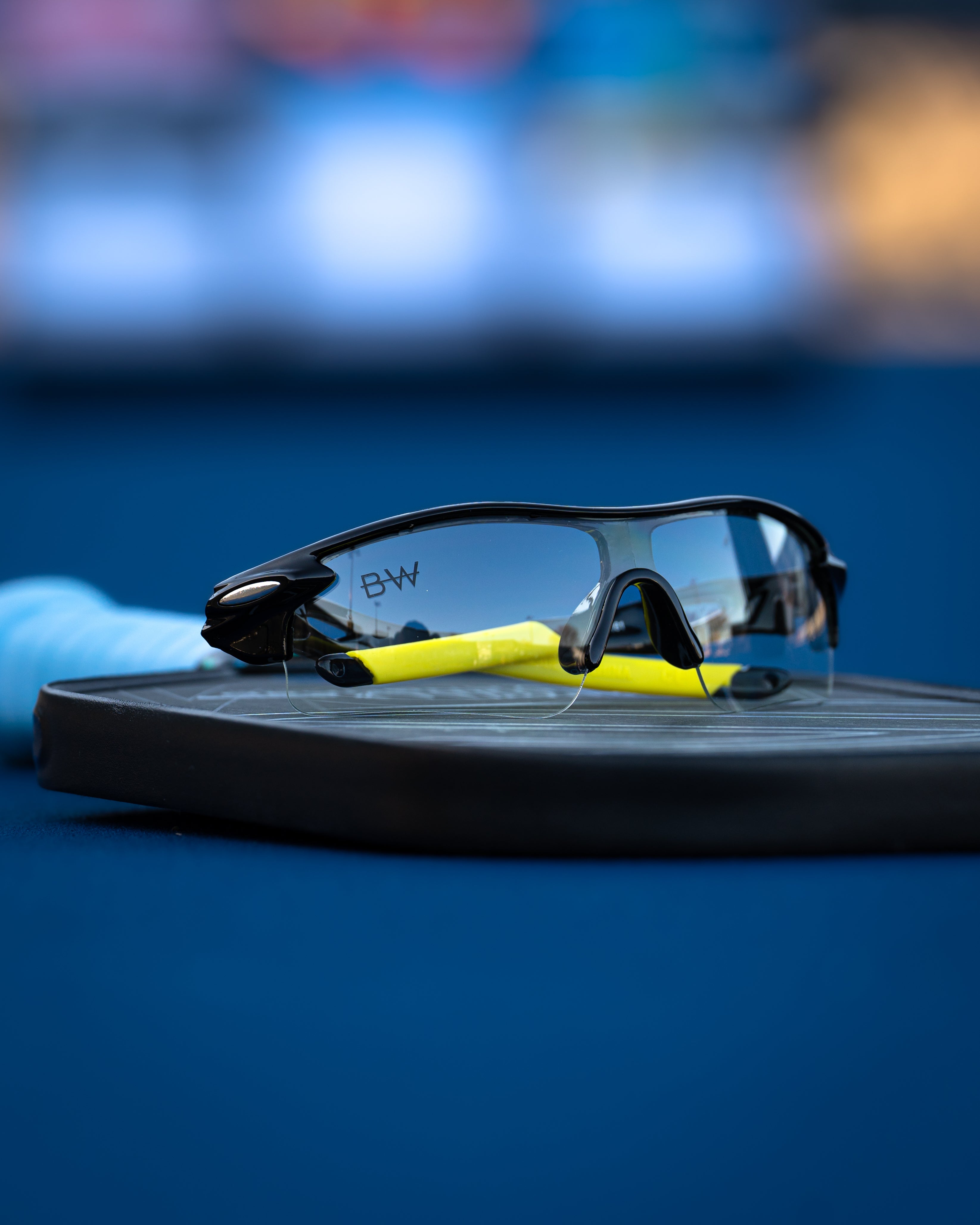
Clear vs. Gray vs. Transition Lenses for Pickleball: Which Wins?
Share
Clear vs. Gray vs. Transition Lenses for Pickleball: Which Wins?
Clear, gray, and transition lenses can all make sense for pickleball—but they solve different problems. A player competing indoors at night has different eyewear needs from someone playing outdoors at midday, while a player constantly moving between environments may prioritize versatility.
So which lens wins? There is no universal winner. The better choice depends on where you play, when you play, how often your lighting conditions change, whether you need prescription correction, and the exact lens configuration available for your eyewear.
This guide compares clear vs. gray vs. transition lenses for pickleball without assuming that a particular tint automatically improves depth perception, reaction time, contrast, or ball tracking.
Find Pickleball Eyewear for Your Playing Environment
Clear vs. Gray vs. Transition Lenses: The Quick Answer
| Lens Type | Good Starting Point For | Main Advantage | Main Limitation to Consider |
|---|---|---|---|
| Clear | Indoor, evening, and lower-light play where a dark tint is not preferred | No dark sunglass tint | Does not provide the same darkened viewing experience as a sunglass tint |
| Gray | Bright outdoor conditions when an appropriate gray-tinted configuration is preferred | Tinted option for outdoor use | A darker configuration may be less appropriate indoors or as available light decreases |
| Transition / Photochromic | Players frequently moving between different lighting environments | Light-responsive versatility | Exact activation, darkness, and transition behavior depend on the specific lens |
Simple rule: choose around your actual environment instead of asking which lens color is universally “best” for pickleball.
First: What Do Clear, Gray, and Transition Actually Mean?
These terms describe different lens characteristics, and understanding that distinction makes the comparison much easier.
Clear Lenses
Clear lenses do not have a dark sunglass tint. They can therefore be relevant when a darker lens is not preferred, including many indoor, evening, and lower-light situations.
Gray Lenses
Gray describes a lens tint. Depending on the exact configuration, gray-tinted eyewear may be considered by players seeking a sunglass setup for outdoor conditions.
Transition / Photochromic Lenses
Transition or photochromic lenses are designed to respond to environmental light or UV conditions by changing tint. Exact behavior varies by lens technology and environment, so do not assume every photochromic lens performs identically.
1. Clear Lenses for Pickleball
Clear lenses are one of the simplest options to understand: they provide a non-dark lens configuration for players who do not want a sunglass tint in their current environment.
That makes them particularly relevant to players searching for:
- Clear pickleball glasses
- Indoor pickleball glasses
- Sports eyewear for evening sessions
- Sports eyewear for lower-light conditions
- A non-dark lens configuration
When Do Clear Lenses Make the Most Sense?
Clear lenses are worth considering whenever a dark sunglass tint would be unnecessary or undesirable for your environment.
| Environment | Clear Lens Consideration |
|---|---|
| Indoor Court | Useful starting point when a dark sunglass tint is not preferred |
| Night Pickleball | Useful when you do not want to add a dark tint |
| Evening Session | Can remain relevant as available light decreases |
| Lower-Light Environment | Worth comparing when darker sunglass configurations feel inappropriate |
| Bright Midday Outdoor Court | A player specifically seeking a sunglass experience may prefer to compare tinted alternatives |
What Clear Lenses Do—and Don't—Automatically Do
Clear lenses are sometimes described with exaggerated performance language. Their usefulness does not require those claims.
| Claim | What to Know |
|---|---|
| No dark sunglass tint | Yes |
| Useful when a dark tint isn't preferred | Yes |
| Automatically increases available light | No |
| Automatically improves contrast | No |
| Automatically improves ball tracking | No |
| Automatically improves reaction time | No |
| Automatically improves depth perception | No |
The practical reason to consider clear eyewear is straightforward: you want sports eyewear without a dark sunglass tint for the environment where you are playing.
Are Clear Lenses Best for Indoor Pickleball?
Clear lenses are a strong option to compare for indoor pickleball because many indoor players do not want a dark sunglass tint.
But even indoors, there is no universal lens winner. Consider:
- The lighting in your facility
- Your prescription requirements
- The exact lens configuration
- Whether you move between indoor and outdoor courts
- Your individual visual preferences
Clear should therefore be understood as a logical starting point for many indoor players, not a guarantee of better pickleball performance.
2. Gray Lenses for Pickleball
Gray lenses are worth comparing when you are specifically looking for a tinted sunglass configuration for outdoor pickleball.
The original appeal is easy to understand: when you play outside in brighter conditions, you may prefer a tinted lens rather than the non-dark appearance of a clear lens.
However, gray should not automatically be described as improving:
- Depth perception
- Reaction time
- Ball tracking
- Athletic performance
- Visual processing speed
The stronger buying question is simply: does the exact gray lens configuration make sense for the outdoor conditions where you play?
When Should You Consider Gray Lenses?
| Environment | Gray Lens Consideration |
|---|---|
| Bright Outdoor Court | Worth comparing when you want a tinted sunglass configuration |
| Daytime Tournament | May fit a primarily outdoor schedule when the exact configuration is appropriate |
| Morning Outdoor Session | Consider how bright your actual playing conditions are |
| Evening Session | Consider whether a darker tint remains appropriate as available light decreases |
| Indoor Court | A dark sunglass configuration may not be preferred |
Players whose schedules vary substantially should think beyond the question of which lens looks best at midday.
Gray Hound RX: A Prescription Sunglass Option to Compare
Gray Hound RX is one Blinded Wear prescription sunglass option worth comparing if your primary use is outdoor pickleball.
Evaluate it based on:
- Your prescription compatibility
- The exact available lens configuration
- Frame dimensions
- Individual fit
- Your normal playing environment
- Your preferred style
Do not choose it based on an assumption that gray automatically produces “elite-level contrast,” improves depth tracking, or creates a competitive advantage.
Do Gray Lenses Preserve Color Better?
Gray tints are often discussed as a relatively neutral sunglass tint, but shoppers should still evaluate the exact lens rather than treating every gray product as optically identical.
More importantly for sports shoppers, color neutrality should not be converted into a claim that gray lenses automatically preserve depth perception or improve pickleball performance.
A lens can be appropriate for your outdoor environment without needing to provide a measurable athletic advantage.
3. Transition Lenses for Pickleball
Transition lenses—also called photochromic lenses—are designed to change tint in response to environmental conditions.
That makes them particularly interesting for players who regularly move between:
- Indoor and outdoor courts
- Morning and afternoon sessions
- Sun and shade
- Training and everyday environments
- Different venues during tournament or travel days
The main appeal is versatility, not an automatic improvement in athletic performance.
Not All Transition Lenses Behave the Same Way
“Transition” or “photochromic” describes a category of lens technology, not one universal performance specification.
Exact behavior can vary, including:
- How quickly the lens changes
- How dark it becomes
- How clear it becomes
- How it responds in different environments
- How temperature affects the exact lens technology
- How it behaves behind glass that filters portions of UV light
For that reason, avoid assuming every transition lens:
- Changes “in seconds”
- Becomes completely clear indoors
- Becomes extremely dark outdoors
- Works identically behind a vehicle windshield
- Provides identical performance in every temperature
- Eliminates the need for separate eyewear for every athlete
Verify the specifications of the exact photochromic configuration you are considering.
Who Should Consider Transition Lenses for Pickleball?
Transition lenses may be worth comparing if your playing schedule changes enough that carrying separate clear and tinted eyewear becomes inconvenient.
| Player | Why Transition Lenses May Be Worth Comparing |
|---|---|
| Indoor + Outdoor Player | Frequently changes playing environments |
| Tournament Player | May encounter multiple environments during a long event |
| Traveling Player | May value carrying fewer specialized configurations |
| Morning-to-Afternoon Player | Playing conditions can change over the course of a session |
| Mostly Indoor Player | May not need the additional versatility if a clear configuration already meets the need |
| Mostly Bright-Outdoor Player | May prefer a dedicated sunglass configuration instead |
For a deeper look at this category, read Transition RX Lenses for Travel & Training →.
Clear vs. Gray vs. Transition: Side-by-Side Comparison
| Factor | Clear | Gray | Transition |
|---|---|---|---|
| Indoor Play | Strong option to compare when a dark tint isn't preferred | A dark configuration may be less suitable | Potentially useful depending on exact indoor behavior |
| Bright Outdoor Play | No dark sunglass tint | Outdoor tinted option to compare | Potentially useful depending on exact outdoor activation |
| Evening / Lower Light | Useful when a dark tint isn't preferred | Consider whether the tint is too dark for conditions | Depends on exact lens response |
| Changing Environments | Fixed clear configuration | Fixed tinted configuration | Designed to respond to environmental conditions |
| Simplicity | Very simple fixed configuration | Very simple fixed configuration | More variable behavior |
| One-Pair Versatility | Depends on your environments | Depends on your environments | Primary reason many players consider photochromic lenses |
| Automatically Improves Performance? | No | No | No |
So Which Lens Wins for Pickleball?
No lens type wins every environment.
A better way to frame the decision is:
- Mostly indoor, evening, or lower-light play? Start by comparing clear or another appropriate non-dark configuration.
- Mostly bright outdoor play? Compare an appropriate tinted sunglass configuration such as gray.
- Constantly switching environments? Compare compatible transition/photochromic options against the cost and convenience of owning separate pairs.
The “winner” is the configuration that best matches your actual schedule.
What Changes If You Need Prescription Lenses?
If you need prescription correction, the comparison should begin with your prescription—not the tint.
Before deciding between clear, gray, or transition:
- Have your current eyeglass prescription available.
- Choose an RX frame you are considering.
- Verify compatibility with your prescription.
- Confirm which lens configurations are available for that frame.
- Compare frame dimensions when available.
- Choose the lens setup that fits your primary playing environment.
Blinded Wear RX customers should have a clear photo or picture of their eyeglass prescription ready to upload before purchasing.
High-Index RX Lenses Are Included With Blinded Wear Prescription Eyewear
When comparing RX pickleball glasses, consider the total prescription setup rather than looking only at the advertised frame price.
Blinded Wear includes high-index prescription lenses at no additional cost with RX eyewear.
High-index describes a category of prescription lens material. Do not assume an exact numerical index such as 1.61 or 1.67 unless it has been verified for the specific configuration.
What About Polarized vs. Non-Polarized Pickleball Lenses?
Blinded Wear sports eyewear uses non-polarized lenses, meaning a polarization filter is not added.
Some court players prefer non-polarized eyewear. However, it is not accurate to claim that polarized lenses universally damage depth perception or that non-polarized lenses automatically improve court performance.
| Statement | Accurate? |
|---|---|
| Blinded Wear sports lenses are non-polarized | Yes |
| Non-polarized means no polarization filter is added | Yes |
| Some court players prefer non-polarized lenses | Yes |
| Polarized lenses universally distort depth perception | No |
| Non-polarized lenses automatically improve depth perception | No |
| Non-polarized lenses automatically improve ball tracking | No |
| Non-polarized lenses automatically improve reaction time | No |
Clear vs. Gray vs. Transition Pickleball Lenses: FAQ
Are clear lenses good for pickleball?
Yes, clear sports eyewear can be worth comparing when you do not want a dark sunglass tint, including many indoor, evening, and lower-light situations. Clear lenses should not automatically be credited with better tracking, contrast, depth perception, or reaction time.
Are gray lenses good for pickleball?
Gray-tinted eyewear can be worth comparing for outdoor players seeking a sunglass configuration. Evaluate the exact lens and your playing conditions rather than assuming gray automatically improves performance.
Are transition lenses good for pickleball?
They can be useful for players who frequently change environments. Exact photochromic behavior varies, so verify the specific configuration instead of assuming every transition lens responds identically.
Which lens is best for indoor pickleball?
A clear or otherwise non-dark configuration is a logical starting point when a sunglass tint is not preferred. Your prescription needs, facility lighting, and individual preferences still matter.
Which lens is best for outdoor pickleball?
Players seeking a sunglass setup for bright outdoor conditions may want to compare an appropriate tinted configuration such as gray. There is no universal tint that is automatically best for every player.
Which lens is best if I play indoors and outdoors?
Compare a compatible transition/photochromic configuration with the alternative of maintaining separate indoor and outdoor pairs. The better setup depends on your schedule, prescription, and preferences.
Do gray lenses improve depth perception?
Do not assume that gray tint automatically improves or preserves depth perception. Depth perception depends on multiple visual cues and should not be reduced to a single lens-color claim.
Do clear lenses let in 100% of visible light?
Do not assume an exact visible-light-transmission percentage from the word “clear.” Exact transmission depends on the specific lens and should be verified from product specifications when needed.
Which Lens Fits Different Pickleball Lighting Conditions?
Instead of choosing a lens by popularity, start with the lighting conditions you encounter most often. The same player may prefer different configurations depending on the court, time of day, and whether play moves between environments.
| Playing Situation | Clear | Gray | Transition / Photochromic |
|---|---|---|---|
| Indoor Court | Strong option when a dark tint is not preferred | A darker sunglass tint may be unnecessary | Potentially useful depending on the exact lens behavior indoors |
| Bright Outdoor Court | No dark sunglass tint | Worth comparing for players seeking a tinted outdoor setup | Potentially useful depending on how the exact lens activates outdoors |
| Evening Play | Useful when a dark tint is not preferred | Consider whether the tint remains appropriate as light decreases | Potentially useful if the exact lens becomes sufficiently light for the conditions |
| Indoor-to-Outdoor Tournament | May require switching eyewear for brighter outdoor conditions | May require switching eyewear when moving indoors | Versatility is the main reason to compare this option |
| Outdoor-Only Tournament | May not provide the sunglass experience some players want | Logical option to compare | Can still be considered, but adaptability may be less important |
| Travel With Unknown Conditions | Useful non-dark option | Useful outdoor tinted option | Potentially attractive when reducing the number of specialized configurations matters |
One Versatile Pair or Separate Clear and Gray Glasses?
For players who regularly encounter different lighting environments, one of the most useful comparisons is not simply clear vs. gray vs. transition. It is one adaptable pair vs. multiple dedicated pairs.
Separate Clear and Tinted Pairs May Make Sense If:
- You regularly play both indoors and in bright outdoor conditions.
- You prefer a fixed lens configuration for each environment.
- You do not mind carrying another pair.
- You want a backup pair available during tournaments or travel.
- Your prescription and preferred frames are available in both configurations.
A Transition / Photochromic Pair May Make Sense If:
- You frequently move between different lighting environments.
- You value the convenience of one light-responsive configuration.
- You want to reduce how often you manually change eyewear.
- The exact photochromic behavior works for the environments where you play.
Neither strategy is automatically better. A two-pair setup prioritizes dedicated configurations and redundancy, while a photochromic setup may prioritize convenience and versatility.
Clear vs. Gray vs. Transition Lenses for Tournament Pickleball
Tournament play can make lens selection more complicated because a single event may last for hours and include changing conditions.
Before tournament day, ask:
- Will the event be indoors, outdoors, or both?
- What time does my first match begin?
- Could I still be playing near sunset or under different lighting later?
- Am I comfortable switching between multiple pairs?
- Does my prescription make backup correction especially important?
- Have I already practiced in the eyewear I plan to use?
If every match takes place on the same indoor court, a fixed non-dark configuration may be perfectly practical. If every match takes place outdoors during bright daytime conditions, a suitable tinted configuration may be simpler.
A player moving between indoor and outdoor courts has a stronger reason to compare transition/photochromic lenses or carry separate configurations.
What About Sun, Clouds, Shade, and Changing Weather?
Outdoor pickleball is rarely played under perfectly identical conditions every session. Cloud cover, court orientation, surrounding structures, time of day, and shade can all change the environment.
That does not mean you need a different lens every time a cloud appears.
Instead, think about the broader pattern of your play:
- Consistently bright outdoor sessions: a dedicated tinted configuration may be straightforward.
- Frequently changing environments: a compatible photochromic option may deserve more consideration.
- Late-day sessions: consider whether a fixed dark tint remains appropriate as conditions change.
- Mostly indoor sessions: you may have little need for a dark outdoor configuration during play.
Choose for the conditions you encounter repeatedly rather than trying to optimize for every possible moment.
Your Prescription Still Comes Before Your Lens Preference
For RX players, it is easy to start shopping by asking, “Should I get clear, gray, or transition?” But lens type is only one part of the prescription-eyewear decision.
A stronger order of operations is:
- Start with your current prescription.
- Identify compatible RX frames.
- Compare available frame dimensions.
- Confirm the lens configurations available for the exact frame.
- Match the configuration to your primary environment.
- Evaluate the finished eyewear during realistic movement.
Do not assume that every frame supports every prescription or every lens option.
Lens Type Doesn't Replace the Need for Proper Fit
The ideal lens configuration is much less useful if the frame itself does not work well for you.
When comparing prescription or non-prescription pickleball eyewear, evaluate:
- Available frame dimensions
- How those dimensions compare with eyewear that already fits you
- Comfort during normal wear
- What happens when you turn your head
- How the frame feels during lateral movement
- How it behaves during your normal pickleball warmup
- Whether it remains appropriate throughout a realistic practice session
A clear, gray, or transition lens does not automatically create a secure or universally comfortable fit.
Lens Color Is Different From Impact Resistance
Another important distinction is that tint and impact resistance describe different characteristics.
Blinded Wear sports eyewear uses impact-resistant lenses, but a clear lens is not inherently more impact-resistant because it is clear, and a gray or photochromic lens is not inherently more protective because of its tint technology.
| Characteristic | What It Describes |
|---|---|
| Clear | A lens without a dark sunglass tint |
| Gray | A lens tint/color |
| Transition / Photochromic | A lens designed to change tint in response to environmental conditions |
| Impact-Resistant | A separate lens characteristic related to resistance to impact |
| Certified Protective Eyewear | Requires verification of the applicable protective standard or certification |
Impact-resistant should also not automatically be interpreted as shatterproof, indestructible, or certified protective eyewear.
Does Lens Color Improve Ball Tracking, Contrast, or Reaction Time?
Be careful with broad claims that one lens color automatically makes you a better pickleball player.
Your ability to respond during a rally involves far more than lens color, including visual correction, anticipation, attention, positioning, experience, and decision-making.
For that reason, avoid treating the following statements as universal facts:
- “Clear lenses make you track the ball faster.”
- “Gray lenses improve depth perception.”
- “Transition lenses improve reaction time.”
- “One tint gives every player better contrast.”
- “A certain lens color creates a competitive advantage.”
A more defensible approach is to choose a lens configuration that is appropriate for your environment and prescription needs, then evaluate how you personally experience it during play.
For more on the underlying visual concept, read Depth Perception & Pickleball →.
Does Polarization Change the Clear vs. Gray vs. Transition Decision?
Lens tint and polarization are separate characteristics.
A lens can be tinted without automatically being polarized. Likewise, the terms gray and transition do not by themselves tell you whether a polarization filter is present.
Blinded Wear sports lenses are non-polarized.
This means a polarization filter is not added. It does not mean non-polarized lenses automatically provide better depth perception, faster reactions, or superior ball tracking.
It is also inaccurate to say polarized lenses are universally bad for pickleball. Some players simply prefer a non-polarized approach for court sports.
10 Mistakes to Avoid When Choosing Pickleball Lens Types
- Choosing a lens because an article calls it the universal winner.
- Buying a dark outdoor configuration when you primarily play indoors.
- Choosing clear lenses for bright outdoor play without considering whether you actually want a sunglass tint.
- Assuming gray automatically improves contrast, tracking, or depth perception.
- Assuming clear lenses transmit an exact percentage of visible light without checking specifications.
- Assuming every transition lens changes at the same speed or reaches the same darkness.
- Assuming photochromic lenses behave identically in every environment.
- Confusing lens tint with impact resistance or protective certification.
- Ignoring prescription and frame compatibility while focusing on lens color.
- Using brand-new eyewear for the first time during an important tournament.
Clear, Gray, or Transition? Use This Decision Guide
Question 1: Where Do You Play Most?
Mostly indoors?
Start by comparing clear or another appropriate non-dark configuration.
Mostly outdoors in brighter daytime conditions?
Compare an appropriate tinted configuration such as gray.
Regularly indoors and outdoors?
Continue to Question 2.
Question 2: Are You Comfortable Carrying Multiple Pairs?
Yes.
A dedicated clear/non-dark pair plus an outdoor tinted pair may give you straightforward fixed configurations and a built-in backup.
No.
A compatible transition/photochromic configuration may deserve stronger consideration.
Question 3: Do You Need Prescription Correction?
Yes.
Verify your prescription compatibility before deciding on the final lens configuration.
No.
Compare the available non-prescription configurations around your environment and fit.
Question 4: Do You Compete or Travel?
If prescription correction is essential for you to continue playing, consider whether relying on only one pair leaves you without an appropriate backup if that pair becomes unavailable.
Which Lens Type Fits These Common Pickleball Players?
| Player Profile | Starting Point to Compare | Why |
|---|---|---|
| Indoor League Player | Clear | A dark sunglass tint may not be preferred indoors |
| Outdoor Daytime Player | Gray / appropriate tinted configuration | Player is specifically seeking an outdoor sunglass setup |
| Indoor + Outdoor Player | Transition or separate pairs | Environment changes regularly |
| Evening Player | Clear / appropriate non-dark configuration | Dark tint may become less appropriate as available light decreases |
| Traveling Tournament Player | Transition or multiple pairs | Different venues and conditions may be encountered |
| Prescription-Dependent Competitor | Environment-appropriate RX configuration plus backup correction | Maintaining access to prescription correction may matter more than minimizing the number of pairs |
These are decision starting points, not universal prescriptions. Individual preferences and exact product configurations still matter.
Why Backup Eyewear Matters More Than Finding a “Winner”
For a prescription-dependent player, the difference between clear and gray may matter less during an emergency than simply having another usable form of correction available.
Consider backup correction when you:
- Play tournaments
- Travel for pickleball
- Participate in multi-day events
- Depend heavily on your prescription while playing
- Would be unable to continue comfortably if your primary pair became unavailable
A transition pair can reduce the need to change eyewear as lighting changes, but it does not replace the role of a true backup if the primary pair is lost, damaged, or otherwise unavailable.
How to Test a New Lens Configuration Before Competition
Whether you choose clear, gray, or transition lenses, avoid making an important match your first meaningful test.
- Wear the glasses in a controlled environment. Evaluate the basic prescription experience and fit.
- Test them in their intended lighting. Indoor eyewear should be evaluated indoors; outdoor configurations should be tested outdoors.
- Add normal movement. Walk, turn your head, and look in different directions.
- Complete a pickleball warmup. Introduce realistic court movement.
- Play a practice session. Determine whether the configuration makes sense over a normal playing period.
- Test changing conditions if relevant. If versatility is the reason you chose photochromic lenses, evaluate them across the environments you actually expect to encounter.
- Only then use the pair for competition.
What Happens If Your Pickleball Glasses Break?
Lens selection is only one part of long-term eyewear ownership.
Blinded Wear provides 50% lifetime replacement support if glasses break, subject to current policy terms.
This should not be interpreted as:
- Free unlimited replacement eyewear
- Automatic coverage for every type of damage
- Automatic coverage for scratches
- Automatic coverage for loss or theft
- Automatic replacement because your prescription changed
Review the current terms before relying on any replacement benefit.
Lens Comparison Checklist
Use this checklist when comparing actual eyewear configurations rather than deciding from lens names alone.
| Question | Clear | Gray | Transition |
|---|---|---|---|
| Appropriate for my primary environment? | ☐ | ☐ | ☐ |
| Available with my prescription? | ☐ | ☐ | ☐ |
| Works with my preferred frame? | ☐ | ☐ | ☐ |
| Exact lens specifications reviewed? | ☐ | ☐ | ☐ |
| Frame dimensions compared? | ☐ | ☐ | ☐ |
| Tested during realistic movement? | ☐ | ☐ | ☐ |
| Tested in intended lighting? | ☐ | ☐ | ☐ |
| Backup correction considered? | ☐ | ☐ | ☐ |
More Questions About Clear, Gray, and Transition Pickleball Lenses
Are clear lenses better than gray lenses for pickleball?
Neither is universally better. Clear lenses are useful when a dark tint is not preferred, while gray-tinted configurations may be worth comparing when you want an outdoor sunglass setup.
Are transition lenses better than clear lenses?
Not automatically. If you primarily play indoors or in conditions where a dark tint is unnecessary, a fixed clear configuration may be simpler. Transition lenses become more relevant when lighting environments regularly change.
Are transition lenses better than gray lenses?
It depends on your routine. A dedicated gray-tinted configuration may make sense for consistent outdoor use, while a compatible photochromic option may offer more versatility for changing environments.
Should I own both clear and gray pickleball glasses?
Players who frequently switch between indoor and outdoor conditions may find separate pairs useful. Others may prefer a compatible transition/photochromic configuration. There is no requirement to own both.
Are transition lenses good for pickleball tournaments?
They can be worth considering when tournament conditions change substantially. Players should verify the exact lens behavior and practice in the configuration before competition.
Do transition lenses work indoors?
Photochromic lenses are designed to respond to environmental conditions, but exact indoor appearance and behavior depend on the specific lens. Do not assume every transition lens becomes completely clear indoors.
Do transition lenses work behind a car windshield?
Behavior can differ because vehicle glass can filter portions of the light or UV that some photochromic technologies use to activate. Check the specifications of the exact lens rather than assuming universal performance.
Are gray lenses polarized?
Gray describes a tint, not whether a polarization filter is present. Blinded Wear sports lenses are non-polarized.
Are clear lenses polarized?
Clear describes the absence of a dark tint and does not by itself determine polarization. Blinded Wear sports lenses are non-polarized.
Does darker mean better for outdoor pickleball?
No. The darkest available lens is not automatically the best option. Choose an appropriate configuration for your conditions and preferences.
Pickleball Lens Claims to Verify Before You Buy
Lens marketing can make relatively simple characteristics sound like guaranteed performance advantages. When comparing clear, gray, and transition lenses, separate the verified specification from the benefit being promised.
| Claim You May See | What to Verify |
|---|---|
| “100% Light Transmission” | Check the exact visible light transmission specification. Do not infer a percentage simply because a lens is clear. |
| “UV400” or Specific UV Protection | Verify the exact product specification rather than assuming all tinted or clear lenses have the same rating. |
| “Anti-Glare” | Determine what coating or lens characteristic supports the claim for that exact configuration. |
| “Contrast Enhancing” | Look for product-specific support rather than assuming a lens color automatically improves contrast. |
| “Better Ball Tracking” | Do not assume a tint automatically produces better tracking performance. |
| “Improved Depth Perception” | Do not attribute improved depth perception to clear, gray, transition, polarized, or non-polarized lenses without appropriate evidence. |
| “Anti-Fog” | Verify that the exact lens has an anti-fog feature or treatment. |
| “Scratch-Resistant” | Verify the exact lens treatment rather than assuming all sports lenses include it. |
| “Changes in Seconds” | For photochromic lenses, verify the exact product's activation characteristics. |
| “Works in Every Lighting Condition” | No configuration should automatically be treated as ideal for every player and environment. |
A lens does not need an exaggerated performance promise to be useful. Matching an appropriate configuration to your actual playing environment is already a meaningful reason to choose it.
What to Verify Before Ordering Clear, Gray, or Transition Pickleball Glasses
Once you have chosen a general lens category, verify the details of the actual product before checkout.
- Prescription compatibility: If you need RX correction, confirm that your prescription works with the selected frame and configuration.
- Current lens options: Do not assume every frame is available with clear, gray, and transition lenses.
- Frame dimensions: Compare available measurements with eyewear that already fits you well.
- Polarization status: Blinded Wear sports lenses are non-polarized.
- Impact resistance: Blinded Wear sports eyewear uses impact-resistant lenses.
- High-index RX lenses: Blinded Wear includes high-index prescription lenses at no additional cost with RX eyewear.
- Photochromic specifications: If choosing transition lenses, verify the exact behavior of the available configuration.
- Additional coatings or features: Do not assume anti-fog, hydrophobic, anti-reflective, scratch-resistant, or other treatments unless listed for the exact product.
- Replacement terms: Review current policy terms before relying on replacement support.
Your First-Week Test for New Pickleball Lenses
Choosing the lens is only the first step. Your actual playing experience can tell you whether you selected the right configuration for your routine.
Test 1: Your Primary Environment
Use the eyewear where you expect to wear it most. If you bought clear lenses for indoor pickleball, test them indoors. If you selected a gray-tinted configuration for outdoor play, evaluate it outside under conditions similar to your normal sessions.
Test 2: Normal Court Movement
Complete your normal warmup, lateral movement, serves, returns, and other familiar movements. Evaluate the entire eyewear setup rather than focusing only on the lens color.
Test 3: A Full Practice Session
A few minutes of wear may not represent a normal playing session. Use the eyewear through realistic practice before depending on it during competition.
Test 4: Changing Conditions
If you purchased transition/photochromic lenses specifically for versatility, test them across the types of environments you actually encounter.
Test 5: Tournament Simulation
If you compete, wear the eyewear during a longer practice or match day before relying on it in an important event.
The purpose is not to prove that one lens technology improves your performance. It is to determine whether the configuration fits your prescription needs, environment, comfort preferences, and playing routine.
When Should You Reconsider Your Pickleball Lens Setup?
Your preferred configuration can change as your playing routine changes.
It may be worth reevaluating when:
- You move from outdoor to indoor pickleball
- You begin playing more frequently at night
- You start playing primarily during daytime outdoor hours
- You begin switching between indoor and outdoor facilities regularly
- You start traveling for tournaments
- Your prescription changes
- Your current lens configuration no longer matches your normal environment
- You decide carrying multiple pairs is inconvenient
- You decide one adaptable pair does not provide the dedicated configurations you prefer
The fact that one lens worked for your old schedule does not automatically make it the best configuration for your new one.
Clear vs. Gray vs. Transition Lenses: More Common Questions
What color lenses are best for pickleball?
There is no universal best lens color for pickleball. Choose according to your playing environment, prescription needs, exact available configuration, and personal preference rather than assuming a particular color automatically improves performance.
What lenses should I use for indoor pickleball?
Clear or another appropriate non-dark configuration is a logical starting point when you do not want a sunglass tint indoors.
What lenses should I use for outdoor pickleball?
If you want a sunglass configuration for brighter outdoor conditions, compare an appropriate tinted option such as gray. Verify the specifications of the exact lens rather than choosing solely by color.
What lenses should I use for night pickleball?
A clear or otherwise non-dark configuration is worth comparing when a dark sunglass tint is not appropriate for the available light.
Can I wear gray pickleball glasses indoors?
You can physically wear tinted eyewear indoors, but a darker sunglass configuration may not be preferred in an indoor environment. Evaluate the exact tint and conditions.
Can I wear clear pickleball glasses outdoors?
Yes. Clear sports eyewear can be worn outdoors, but it does not provide the same darkened viewing experience as a sunglass tint. Players specifically seeking tinted eyewear for bright conditions may prefer another configuration.
Are photochromic and transition lenses the same thing?
“Photochromic” is the general term for lenses designed to change tint in response to environmental conditions. “Transition” is commonly used when discussing this type of light-responsive eyewear. Always evaluate the exact lens technology and specifications being offered.
Do transition lenses change instantly?
Do not assume instant changes. Activation and fading characteristics depend on the specific photochromic lens and environmental conditions.
Do transition lenses get dark enough for outdoor pickleball?
The degree of darkening depends on the exact lens and conditions. Verify the specifications of the configuration you are considering rather than assuming all photochromic lenses reach the same darkness.
Do transition lenses stay dark indoors?
Photochromic lenses are designed to respond to environmental conditions, but exact fading and indoor appearance vary by lens technology. Check the specifications of the exact product.
Are non-polarized lenses better for pickleball?
Some court players prefer non-polarized eyewear, and Blinded Wear sports lenses are non-polarized. That does not establish that non-polarized lenses universally improve depth perception, reaction time, or ball tracking.
Can lens tint make me react faster?
Do not assume a particular tint automatically improves reaction time. Reaction during pickleball involves multiple visual, physical, and decision-making factors.
Does a darker lens provide more eye protection?
Lens darkness alone should not be used to infer a particular protective specification. Verify the exact characteristics of the lens you are considering.
Do I need prescription pickleball glasses if I already wear glasses?
Not necessarily. Evaluate whether your existing prescription eyewear meets your needs during play. Dedicated RX sports eyewear becomes more relevant when you want a separate sports-oriented setup or your existing pair is not appropriate for your athletic routine.
What Blinded Wear Sports Eyewear Includes
Whichever lens category you consider, focus on characteristics that can be stated accurately.
| Feature | Blinded Wear |
|---|---|
| Prescription Sports Eyewear | Available across the RX collection |
| Non-Prescription Sports Eyewear | Available across the non-RX collection |
| Clear Lens Sports Eyewear | Available in the clear lens collection |
| High-Index Prescription Lenses | Included at no additional cost with RX eyewear |
| Impact-Resistant Sports Lenses | Yes |
| Non-Polarized Sports Lenses | Yes |
| Lightweight Sports-Frame Options | Yes |
| Pickleball-Focused Options | Yes |
| Lifetime Replacement Support | 50% replacement support if glasses break, subject to current policy terms |
For transition/photochromic, tint, coating, or other lens-specific features, verify the configuration available for the exact product you are considering.
Related Pickleball Eyewear Guides
Key Takeaways: Clear vs. Gray vs. Transition Pickleball Lenses
- There is no universal lens winner for every pickleball player.
- Clear lenses are a logical option when you do not want a dark sunglass tint, including many indoor, evening, and lower-light situations.
- Gray lenses are worth comparing when you want a tinted sunglass configuration for outdoor play.
- Transition/photochromic lenses are worth comparing when you regularly move between different environments and value light-responsive versatility.
- Clear does not automatically mean an exact visible-light-transmission percentage.
- Gray does not automatically improve contrast, depth perception, or ball tracking.
- Transition lenses do not all activate, darken, or fade identically.
- Lens color does not determine impact resistance.
- Lens color does not establish a protective certification.
- Blinded Wear sports eyewear uses impact-resistant lenses.
- Blinded Wear sports lenses are non-polarized.
- Non-polarized does not automatically mean improved depth perception, tracking, or reaction time.
- Blinded Wear RX eyewear includes high-index prescription lenses at no additional cost.
- Prescription players should verify compatibility before choosing their preferred lens configuration.
- Players who rely heavily on prescription correction should consider backup eyewear for tournaments and travel.
Find the Pickleball Lens Setup That Matches Your Court
The best pickleball lens is not determined by whichever option has the boldest performance claims. Start with your environment.
If you primarily play indoors or in lower-light conditions, compare clear or another appropriate non-dark configuration. If you primarily play outdoors and want a sunglass tint, compare an appropriate tinted option such as gray. If your routine regularly moves between different environments, investigate compatible transition/photochromic options.
Then layer in the other factors that matter: prescription compatibility, frame dimensions, individual fit, impact resistance, exact lens specifications, and how the finished eyewear performs for your needs during realistic play.
Bottom Line: The Court Conditions Decide the Comparison
Clear vs. gray vs. transition is not a competition with one permanent winner. Each configuration addresses a different type of eyewear need.
Clear lenses provide a non-dark option that can make sense for indoor, evening, and lower-light play. Gray-tinted configurations give outdoor players a sunglass option to compare. Transition/photochromic lenses introduce adaptability for players whose environments change regularly.
The strongest setup is therefore the one that matches the conditions you encounter most often while also satisfying your prescription, frame, fit, and individual preferences.
If you regularly play in multiple environments, you do not have to force one lens to do everything. Compare the convenience of a compatible transition/photochromic setup against the simplicity and redundancy of owning separate clear and outdoor pairs.
And regardless of lens type, avoid buying based on promises that a particular tint will automatically improve your depth perception, reaction time, contrast, or ball tracking. Choose the configuration for the environment first, then evaluate it during real play.