
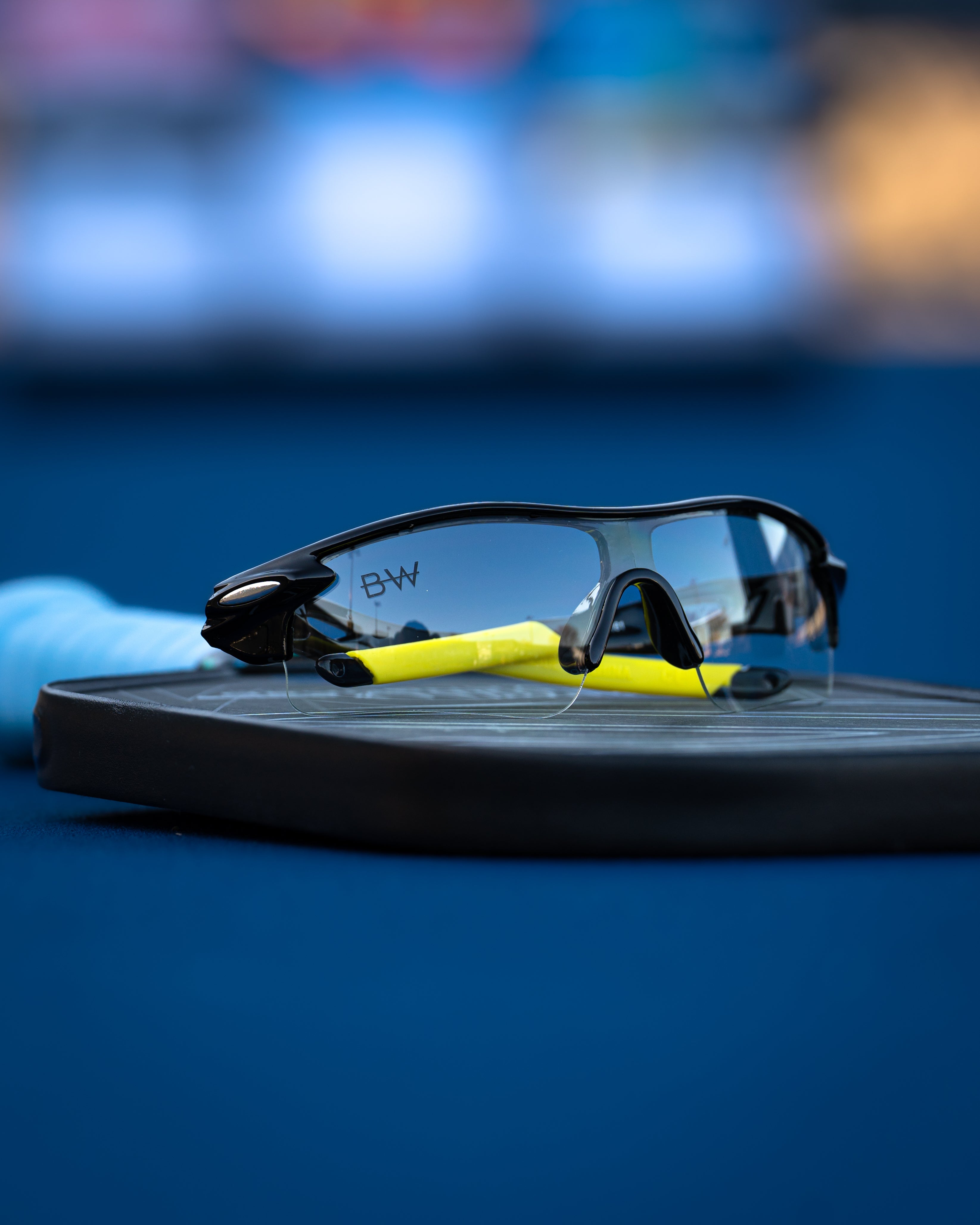
Cognitive Vision — How the Right RX Glasses Boost Brain-Body Sync in Pickleball
Share
Cognitive Vision in Pickleball: How the Right RX Glasses Support Eye-Body Coordination
Pickleball happens quickly. During a single rally, you may be watching the ball, reading an opponent's positioning, deciding where to move, preparing your paddle, judging the developing shot, and recovering for the next exchange—all within seconds.
That interaction between visual information, attention, decision-making, and physical movement is one reason vision matters in fast-paced sports. But prescription sports glasses should not be described as directly upgrading your brain, accelerating neural signals, or automatically synchronizing your eyes and muscles.
For players who require corrective vision, the role of RX pickleball glasses is more straightforward: provide the prescription correction you need in sports-oriented eyewear while you play. Your brain and body then use the visual information available to perform the skills you have developed through experience and practice.
Find Your Pickleball Eyewear
What Is Cognitive Vision in Pickleball?
In practical sports terms, cognitive vision can describe how visual information interacts with processes such as attention, recognition, anticipation, decision-making, and movement.
Imagine defending a fast exchange at the kitchen. You are not simply “seeing” the pickleball. You may also be:
- Directing attention toward the developing shot
- Recognizing your opponent's position
- Using previous experience to anticipate possibilities
- Deciding whether to block, counter, reset, or move
- Coordinating your body and paddle around that decision
- Recovering for the next ball
These processes happen together during play, which can make vision feel inseparable from athletic performance. Prescription eyewear contributes by addressing the corrective vision needs of players who require it.
How Your Eyes, Brain & Body Work Together During Pickleball
A useful way to understand cognitive vision is to separate a rally into stages.
| Stage | What's Happening | Role of RX Eyewear |
|---|---|---|
| Visual Input | You receive information about the ball, court, and players | Provides your required prescription correction |
| Attention | You direct attention toward relevant information | Does not automatically control attention |
| Interpretation | Your brain processes available information | Does not automatically accelerate neural processing |
| Decision | You determine an appropriate response | Does not choose the shot |
| Movement | Your body moves into position | Does not automatically improve movement or balance |
| Execution | You coordinate the paddle with your intended shot | Does not automatically improve technique |
| Recovery | You prepare for the next exchange | Continues providing your corrective prescription |
Do RX Glasses Improve Brain-Body Sync?
The phrase “brain-body sync” is a useful way to describe how perception, decisions, and movement come together during sport. It should not, however, be interpreted as a specific technology built into ordinary prescription lenses.
Appropriate RX eyewear can address the prescription correction you require while your visual and motor systems perform their normal roles.
That is different from claiming the glasses themselves:
- Strengthen neural signals
- Increase neurological processing speed
- Reduce cognitive latency
- Synchronize muscles with the visual cortex
- Automatically improve coordination
- Increase reaction time by a fixed percentage
Those are separate physiological or performance outcomes that should not be promised simply because a player is wearing prescription sports glasses.
Can the Right Prescription Improve Pickleball Reaction Time?
If you require corrective vision, wearing your appropriate prescription addresses that optical need. But it does not follow that the prescription itself makes your nervous system react faster.
A pickleball response involves much more than eyesight:
- Visual information becomes available.
- You direct attention toward relevant cues.
- You interpret what is happening.
- You select a response.
- Your nervous system coordinates movement.
- Your body executes the movement.
A player can become more effective during fast exchanges through better anticipation, positioning, preparation, technique, and repetition without any change to raw neurological reaction speed.
Reaction vs. Anticipation: Why Great Players Can Look So Fast
Some of the fastest-looking pickleball responses begin before the ball is already on top of the player.
Experienced players can learn to recognize useful information such as:
- Opponent positioning
- Paddle preparation
- Likely shot patterns
- Available court space
- The previous ball in the rally
- Their partner's position
- Their own court position
That information can help a player prepare for likely possibilities. This is one reason anticipation and reaction time should not be treated as the same thing.
Prescription eyewear can provide the correction you require while gathering that information. Experience teaches you what to do with it.
Does Clearer Corrected Vision Mean Faster Brain Processing?
Not automatically.
Corrective lenses are designed to address refractive correction. The brain then processes the visual information available to it, but it is too broad to claim that a particular RX frame creates “faster neural feedback” or removes neurological latency.
A more accurate relationship is:
Required prescription correction → usable corrected vision → normal perception, decision-making, and movement processes.
This distinction allows prescription sports eyewear to be valuable without turning an optical correction into an unsupported neurological-performance claim.
RX Glasses, Depth Perception & Distance Judgment
Distance judgment matters throughout pickleball. Players repeatedly decide whether to move forward, retreat, volley, let a ball bounce, attack, reset, or leave a shot alone.
If you require corrective vision, using the appropriate prescription addresses your corrective needs during those situations. But prescription sports eyewear should not automatically be described as:
- Creating enhanced depth mapping
- Making distance calculations faster
- Improving depth perception by a fixed amount
- Increasing paddle-response speed
- Locking onto ball distance
The prescription handles correction. Distance judgment during dynamic play remains part of a broader visual and athletic process.
Do High-Index RX Lenses Improve Cognitive Performance?
High-index refers to a prescription lens-material category. It should not be confused with a neurological or cognitive-performance technology.
Blinded Wear includes high-index prescription lenses at no additional cost with RX eyewear.
That value can be communicated without claiming high-index lenses automatically:
- Reduce cognitive lag
- Increase reaction speed
- Improve depth perception
- Strengthen brain-body communication
- Increase hand-eye coordination
What About Hand-Eye Coordination?
Hand-eye coordination is clearly relevant to pickleball. You continuously use visual information while coordinating your hand, arm, body, and paddle.
Examples include:
- Making contact on a serve
- Returning a deep ball
- Controlling a third-shot drop
- Dinking at the kitchen
- Blocking a fast drive
- Countering a volley
- Resetting from the transition zone
- Preparing for an overhead
RX eyewear can provide the corrective vision you require during these tasks. Coordination itself develops through the interaction of your visual system, nervous system, movement, technique, and practice.
Visual-Motor Coordination: Where RX Eyewear Actually Fits
| Ability | Does RX Eyewear Replace It? | What RX Eyewear Can Do |
|---|---|---|
| Anticipation | No | Provide required corrective vision while you read the developing rally |
| Hand-Eye Coordination | No | Provide correction during hand-eye tasks |
| Decision-Making | No | Provide correction while you gather visual information |
| Footwork | No | Provide correction while you move around the court |
| Shot Technique | No | Provide correction while you execute the shot |
| Pattern Recognition | No | Provide correction while you observe opponents and rally development |
Can RX Pickleball Glasses Improve Ball Tracking?
Players visually follow the developing ball during play, but a specific improvement in ball-tracking ability should not automatically be attributed to prescription sports glasses.
When shopping for RX eyewear, distinguish between:
“I require prescription correction while tracking the ball.”
and
“This lens has been proven to improve my ball-tracking ability.”
The first describes the practical role of corrective eyewear. The second is a performance claim that requires separate evidence.
Can RX Glasses Help Your Brain Read Pickleball Spin?
Players can use available visual information to interpret developing shots. With experience, they may pay attention to factors such as opponent movement, paddle preparation, contact, ball behavior, and familiar patterns.
Prescription correction can be part of your visual setup while doing this. But RX eyewear should not automatically be described as enhancing neural spin recognition or allowing your brain to predict spin before your body reacts.
Spin recognition remains a combination of available visual information, attention, experience, and anticipation.
Do RX Glasses Reduce Cognitive Fatigue?
Long pickleball sessions can be demanding, but fatigue is influenced by many factors. Playing duration, physical exertion, hydration, sleep, environmental conditions, visual demands, and other variables may all contribute.
Because of that, a prescription frame or lens should not automatically be claimed to:
- Prevent cognitive burnout
- Preserve neural processing speed
- Eliminate visual fatigue
- Maintain reaction time throughout a tournament
- Increase mental endurance
Instead, evaluate whether your RX eyewear provides the correction and practical configuration you need for the sessions you actually play.
Blue-Light RX Lenses and Cognitive Focus
Blue-light filtering is a lens characteristic, not a cognitive-performance system.
If you specifically want blue-light filtering, you can compare a current RX configuration that offers it. However, blue-light filtering should not automatically be described as improving:
- Reaction time
- Neural processing
- Decision-making speed
- Hand-eye coordination
- Pickleball concentration
Clear RX Glasses for Indoor Cognitive Demands
Indoor pickleball still requires attention, decision-making, anticipation, and movement, but that does not mean indoor players require a special “cognitive” lens.
If you require prescription correction and do not want dark sunglass tint, clear RX is a straightforward category to compare for:
- Indoor pickleball
- Evening sessions
- Night play
- Other lower-light environments where dark tint is not preferred
Clear lenses should not be credited with increasing available light, boosting reaction speed, or automatically improving mental focus.
Transition RX Lenses and Changing Court Conditions
Players who move between different lighting environments may want to compare a photochromic RX configuration.
Photochromic lenses are designed to change tint as lighting conditions change. Their useful role is changing-light flexibility, not neurological optimization.
They should not automatically be described as:
- Improving cognitive processing
- Increasing brain-body synchronization
- Training visual attention
- Increasing reaction speed
- Predicting environmental changes
Single-Vision vs. Progressive RX for Pickleball
The prescription design you need should be determined by your individual corrective requirements rather than a claim that one design creates better cognitive performance.
| Lens Type | What It Means | What Not to Assume |
|---|---|---|
| Single Vision | Provides one prescription correction across the lens | Automatically creates faster reactions or better depth perception |
| Progressive | Uses multiple prescription powers across different portions of the lens | Automatically improves court awareness or cognitive flexibility |
Do not assume that every Blinded Wear RX model supports progressive prescriptions unless that option is explicitly listed in the current product information.
Blinded Wear RX Pickleball Glasses to Compare
Instead of assigning different “neural” advantages to individual frames, compare RX models around their current product configurations, frame designs, available dimensions, and your playing environment.
| RX Model | Why Explore It | Shop |
|---|---|---|
| Frost RX | Lightweight prescription sports-frame option | Frost RX |
| Ocean Wave RX | Prescription sports-frame option with a distinct design | Ocean Wave RX |
| H Blue Shield RX | RX option to compare when blue-light filtering is specifically desired | H Blue Shield RX |
| Rocket Fire RX | Prescription sports-frame option for players who prefer the Rocket Fire design | Rocket Fire RX |
| Phantom II RX | Prescription sports-frame option for players who prefer the Phantom II design | Phantom II RX |
| Red Shine RX | Prescription sunglass option with a bold frame design | Red Shine RX |
7 Cognitive Vision Myths About RX Pickleball Glasses
Myth 1: RX Glasses Make Neural Signals Travel Faster
Reality: Prescription lenses provide optical correction. They should not automatically be described as accelerating neural transmission.
Myth 2: High-Index Lenses Reduce Cognitive Lag
Reality: High-index describes a prescription lens-material category, not a neurological-performance technology.
Myth 3: RX Glasses Automatically Improve Hand-Eye Coordination
Reality: RX eyewear can provide correction during hand-eye tasks, while coordination involves a broader interaction between vision and movement.
Myth 4: Better Glasses Automatically Mean Faster Reactions
Reality: Reaction involves perception, decisions, movement, anticipation, technique, and other factors.
Myth 5: Blue-Light Lenses Increase Mental Focus
Reality: Blue-light filtering should not automatically be credited with improved athletic concentration or neural processing.
Myth 6: Progressive RX Improves Court Awareness
Reality: Progressive lenses address specific corrective needs. Improved court awareness should not be assumed from the lens design alone.
Myth 7: The Best RX Glasses Are the Ones With the Most Performance Claims
Reality: Prescription, environment, lens configuration, frame preference, and verified product characteristics provide a stronger buying framework.
FAQs About Cognitive Vision & RX Pickleball Glasses
What is cognitive vision in pickleball?
In practical terms, cognitive vision describes how visual information interacts with processes such as attention, recognition, anticipation, decision-making, and movement during play.
Do RX glasses improve brain-body synchronization?
RX glasses can provide required prescription correction while your visual and motor systems work together, but they should not be described as directly synchronizing your brain and muscles.
Do prescription glasses make your brain process the ball faster?
No fixed improvement in brain-processing speed should be assumed from prescription eyewear.
Can RX glasses improve reaction time?
Appropriate RX eyewear addresses corrective vision needs. A specific improvement in athletic reaction time should not automatically be attributed to the glasses.
Can RX glasses improve hand-eye coordination?
They can provide prescription correction during hand-eye tasks, but coordination itself depends on broader visual, neurological, movement, and learned processes.
Can RX glasses improve depth perception?
A universal improvement in depth perception should not be promised from prescription sports eyewear alone.
Can RX glasses reduce cognitive fatigue?
No universal reduction in cognitive fatigue should be promised from a prescription lens or frame.
Can blue-light RX lenses improve focus?
Blue-light filtering is a lens characteristic and should not automatically be credited with improved athletic focus.
Are clear RX glasses useful indoors?
Clear RX is a logical category to compare when prescription correction is required and dark sunglass tint is not preferred.
Are Blinded Wear RX lenses impact-resistant?
Yes. Blinded Wear sports eyewear uses impact-resistant lenses.
Are Blinded Wear RX lenses polarized?
No. Blinded Wear sports eyewear uses non-polarized lenses.
Are high-index prescription lenses included?
Yes. Blinded Wear includes high-index prescription lenses at no additional cost with RX eyewear.
How do I submit my prescription?
Upload a clear photo or picture of your eyeglass prescription before purchasing Blinded Wear RX eyewear.
How Cognitive Vision Demands Change Across the Pickleball Court
The visual and decision-making demands of pickleball are not identical from every position. A baseline return, transition-zone reset, and kitchen volley can present very different situations.
Your prescription does not need to change from one court zone to another. Instead, the challenge comes from how quickly you must gather information, make a decision, position your body, and execute the appropriate shot.
| Court Position | Common Visual Task | Player Skill Involved | Role of RX Eyewear |
|---|---|---|---|
| Baseline | Following serves, returns, drives, and developing ball paths | Timing, positioning, shot selection | Provides required prescription correction |
| Transition Zone | Managing developing shots while moving toward or away from the kitchen | Movement, resets, decision-making | Provides correction while the player moves and responds |
| Kitchen Line | Following dinks, volleys, counters, and faster exchanges | Preparation, anticipation, coordination | Provides correction during close-range exchanges |
This is why “cognitive vision” is better understood as part of the player's complete visual-motor process rather than a special mode activated by a pair of glasses.
What Your Visual System Is Doing During Different Pickleball Shots
Different shots create different combinations of visual attention, anticipation, movement, and execution.
| Pickleball Situation | Visual-Motor Challenge | What Practice Develops |
|---|---|---|
| Serve | Coordinating preparation, ball position, and contact | Repeatable setup and technique |
| Return | Following the developing serve and preparing movement | Timing, positioning, and recovery |
| Third-Shot Drop | Using available information while coordinating a controlled shot | Touch, positioning, and repetition |
| Dink | Managing repeated close-range exchanges | Control, patience, anticipation, and placement |
| Fast Volley | Responding during a short exchange window | Ready position, preparation, and efficient movement |
| Reset | Processing the developing rally while under pressure | Control, decision-making, and positioning |
| Overhead | Following the developing ball while preparing body and paddle position | Movement, preparation, and technique |
If you require prescription correction, your RX eyewear provides that correction throughout these different visual-motor tasks.
Cognitive Vision in Doubles Pickleball
Doubles adds another player to each side of the court, increasing the amount of information that may be relevant during a rally.
A doubles player may need to remain aware of:
- The ball
- Both opponents
- Their partner's position
- Open court space
- Potential middle balls
- Opponent movement
- Likely attack opportunities
- The need to recover after each shot
Experienced doubles players can develop better recognition of common patterns and positioning through repeated play. Prescription correction can support the visual component for players who need it, but the glasses themselves do not create doubles awareness or tactical intelligence.
Cognitive Vision in Singles Pickleball
Singles removes your partner but dramatically increases the amount of court you are personally responsible for covering.
That can place greater emphasis on:
- Opponent positioning
- Available court space
- Movement and recovery
- Shot selection
- Anticipating possible responses
- Transitioning between offense and defense
Again, RX eyewear handles the corrective component when prescription vision is required. Court coverage, anticipation, movement, and strategy remain player skills.
Visual Attention: Seeing the Court Without Trying to Watch Everything
Cognitive performance is not simply about receiving as much visual information as possible. Players also have to direct attention toward information that is useful at a particular moment.
During a rally, that can mean shifting attention among the developing ball, opponent positioning, available space, and your own recovery needs.
This distinction matters because visual clarity and visual attention are not the same thing.
Prescription correction addresses an optical need. Attention involves how you allocate mental resources while playing. A lens should not automatically be described as increasing concentration simply because it provides correction.
Decision-Making: The Missing Link Between Seeing and Moving
Even when two players receive similar visual information, they may choose completely different shots.
One player may attack. Another may reset. Another may let the ball bounce. An experienced player may recognize a pattern that a newer player has not encountered enough times to identify.
That illustrates why brain-body coordination is not simply:
See ball → move paddle.
A more complete sequence is:
Gather information → direct attention → interpret the situation → choose a response → move → execute → recover.
RX eyewear can provide required correction during that sequence, but decision-making develops through pickleball experience, tactical understanding, and repetition.
Pattern Recognition Can Make Your Reactions Look Faster
Pickleball contains recurring situations. The more often you experience them, the more familiar they can become.
Examples include:
- A predictable crosscourt dink exchange
- An opponent preparing to speed up a ball
- A return that creates an opportunity to approach the kitchen
- A defensive ball that calls for a reset
- A middle ball requiring partner communication
- An opponent repeatedly targeting the same area
Recognizing patterns can help a player prepare earlier. That can create the appearance of extremely fast reaction even when anticipation and experience are playing major roles.
This is a trainable pickleball skill—not a feature that should be assigned to a prescription lens.
Why Ready Position Matters to Brain-Body Coordination
Imagine two players who both see the same incoming volley through appropriate prescription correction.
Player A is balanced and prepared with the paddle ready. Player B has just finished the previous shot, has the paddle down, and has not recovered position.
The visual information may be similar, but their ability to respond can be very different.
That is why equipment should be viewed as one component of performance rather than the entire performance system.
RX eyewear can address corrective vision. Preparation determines how ready you are to use the information you see.
How to Train Eye-Body Coordination for Pickleball
You do not need a lens that promises “neural optimization” to practice the visual-motor demands of pickleball. Sport-specific drills repeatedly expose you to the same perception, decision, and movement cycle used during competition.
1. Crosscourt Dinking
Practice controlled exchanges while paying attention to positioning, ball development, and recovery after each shot.
2. Serve + Return Repetition
Build familiarity with the visual and movement sequence involved in starting a point.
3. Transition-Zone Resets
Practice controlling the ball while moving and making decisions under pressure.
4. Kitchen Exchanges
Use normal volley and counter drills to practice ready position, paddle preparation, and repeated responses.
5. Pattern-Based Drills
Repeat common rally situations so you become more familiar with how they develop.
6. Full Games
Apply visual attention, anticipation, positioning, decision-making, and technique in an unpredictable environment.
If you require corrective vision during competition, practicing in your intended RX eyewear can keep your equipment consistent while you develop these skills.
Vision Training vs. RX Eyewear: Know the Difference
| Goal | RX Eyewear | Practice / Training |
|---|---|---|
| Provide Prescription Correction | Yes | No |
| Practice Anticipation | No | Yes |
| Develop Pickleball Technique | No | Yes |
| Practice Hand-Eye Tasks | Provides correction during the task | Yes |
| Develop Pattern Recognition | No | Yes |
| Practice Court Positioning | No | Yes |
| Build Equipment Familiarity | Provides the equipment | Repeated use builds familiarity |
Getting Used to New RX Pickleball Glasses
If you have a new prescription or a new sports frame, give yourself opportunities to use the complete setup before an important match.
A simple progression can look like this:
Session 1: Controlled Practice
Start with familiar serves, returns, dinks, and basic movement.
Session 2: Recreational Games
Wear the glasses throughout full games and experience normal changes in pace and court position.
Session 3: Faster Exchanges
Use the eyewear during normal kitchen drills, volleys, and quicker rally situations.
Session 4: Longer Session
Wear the frame for a session closer to the duration you normally play.
Session 5: Competition Simulation
Use your intended setup from warm-up through several games under conditions similar to your league or tournament environment.
Your Brain Doesn't Play in a Vacuum—Match RX Eyewear to the Environment
The visual demands of pickleball can occur indoors, outdoors, during daytime, at night, or across multiple environments in the same week.
Instead of looking for a “cognitive performance” lens, first identify the environment where you actually need your prescription eyewear.
| Playing Environment | RX Category to Compare | Primary Reason |
|---|---|---|
| Indoor | Clear RX | Prescription correction without dark sunglass tint |
| Evening / Night | Clear RX | Useful when dark tint is not preferred |
| Outdoor Daytime | Current outdoor RX configurations | Match the configuration to your outdoor use |
| Indoor + Outdoor | Photochromic RX or separate pairs | Compare changing-light flexibility with dedicated configurations |
| Tournament Travel | Primary RX + backup correction | Prepare for different venues and prescription redundancy |
Primary + Backup RX: A Smarter Tournament Strategy
If you depend heavily on prescription correction, one of the most practical ways to improve your tournament preparation is simply having another suitable corrective option available.
A backup can become useful if your primary eyewear is:
- Lost during travel
- Misplaced at the venue
- Damaged
- Unavailable when you need it
The backup does not need a different “cognitive profile.” Its purpose is to help prevent one eyewear problem from becoming a prescription problem on competition day.
Choose RX Pickleball Glasses by Real Needs
Instead of assigning a different neurological advantage to each frame, use your environment and preferences to narrow the Blinded Wear RX collection.
| Model | Reason to Compare | Explore |
|---|---|---|
| Frost RX | You prefer the Frost lightweight sports-frame design | View Frost RX |
| Ocean Wave RX | You prefer the Ocean Wave prescription sports-frame design | View Ocean Wave RX |
| H Blue Shield RX | Blue-light filtering is a lens characteristic you specifically want to compare | View H Blue Shield RX |
| Rocket Fire RX | You prefer the Rocket Fire prescription sports-frame design | View Rocket Fire RX |
| Phantom II RX | You prefer the Phantom II prescription sports-frame design | View Phantom II RX |
| Red Shine RX | You want to compare a bold prescription sunglass design | View Red Shine RX |
7 Mistakes to Avoid When Shopping for “Cognitive” RX Sports Glasses
1. Choosing a Frame Based on a Reaction-Time Percentage
A fixed improvement should not be assumed without evidence for the exact product and measured outcome.
2. Treating Prescription Correction as Brain Training
Prescription eyewear addresses corrective vision. Training develops athletic skills.
3. Assuming High-Index Means Better Athletic Processing
High-index describes a prescription lens-material category, not a measure of cognitive performance.
4. Assuming Every Lens Coating Improves Pickleball
Evaluate a lens feature based on what it actually does rather than assigning unrelated performance outcomes to it.
5. Ignoring Your Playing Environment
An indoor player, daytime outdoor player, and mixed-environment tournament player may have different lens priorities.
6. Ignoring Frame Dimensions
If fit is important, compare available measurements with eyewear that already fits you well.
7. Waiting Until Tournament Day to Try New RX Eyewear
Use your intended setup during practice so the frame and prescription are familiar before competition.
How to Evaluate Brain-Performance Claims About Sports Eyewear
Terms such as “neural clarity,” “cognitive optimization,” “visual processing boost,” and “brain-body synchronization” can sound scientific without clearly explaining what was measured.
When you encounter a claim like that, ask:
- What exact product feature creates the claimed effect?
- What athletic or neurological outcome was measured?
- Was the exact commercial product tested?
- Who participated in the testing?
- What was the comparison group?
- How large was the measured difference?
- Was the result replicated?
- Does the result apply to pickleball players?
General research about vision and sport does not automatically validate a specific performance claim about a particular pair of glasses.
What to Prioritize Instead of “Neural Optimization”
| Priority | Question to Ask |
|---|---|
| Prescription | Does this setup provide the correction I require? |
| Environment | Where will I actually wear these glasses? |
| Lens Configuration | What does the selected lens configuration actually do? |
| Frame | Do the available dimensions and design match my preferences? |
| Sports Use | Are the verified frame and lens characteristics appropriate for how I intend to use the eyewear? |
| Familiarity | Have I practiced in the eyewear before competition? |
What Blinded Wear RX Eyewear Actually Offers
You do not need unsupported brain-performance promises to build a strong RX pickleball setup.
Blinded Wear RX eyewear can be compared around practical characteristics including:
- Prescription correction integrated into sports eyewear
- Designed for pickleball players
- Lightweight sports frames
- Impact-resistant lenses
- Non-polarized lenses
- Performance-first design
- Comfort for extended matches
- Options for recreational and competitive players
- High-index prescription lenses included at no additional cost
- 50% lifetime replacement support if glasses break, subject to current policy terms
How to Order RX Pickleball Glasses
Once you have narrowed down your preferred frame and lens configuration, the prescription process is straightforward.
- Browse the RX collection. Compare current prescription pickleball frames.
- Choose your frame. Review the current product information and available dimensions.
- Select the appropriate configuration. Base the decision on your prescription needs and playing environment.
- Prepare your prescription. Have a clear photo or picture of your eyeglass prescription available.
- Upload your prescription before purchasing.
Blinded Wear includes high-index prescription lenses at no additional cost with RX eyewear.
More FAQs About Cognitive Vision & Pickleball
Why does vision matter in pickleball?
Players continuously use visual information while positioning, making decisions, coordinating movement, and executing shots.
What is visual-motor coordination?
Visual-motor coordination broadly describes how visual information and physical movement work together.
What is the difference between reaction and anticipation?
Reaction describes responding to a developing event, while anticipation involves using available information and experience to prepare for what may happen next.
Why do experienced pickleball players seem to react so quickly?
Experience can help players recognize familiar situations and prepare earlier. Positioning, paddle preparation, anticipation, technique, and movement can all influence how quickly a response appears.
Can prescription glasses train visual attention?
Prescription eyewear provides corrective vision. Visual attention is a separate process and should not automatically be described as being trained by the lenses.
Can RX glasses improve decision-making?
No specific improvement in decision-making should be attributed to RX eyewear alone. Decision-making develops through experience, strategy, attention, and practice.
Do RX glasses increase neural feedback?
Prescription lenses should not automatically be described as increasing the speed or strength of neural feedback.
Do high-index lenses improve reaction time?
High-index describes a prescription lens-material category. It does not establish an improvement in athletic reaction time.
Can RX glasses improve pickleball accuracy?
Prescription correction addresses corrective vision needs, but a specific improvement in shot accuracy should not automatically be credited to the eyewear.
Can RX glasses make dinking easier?
RX eyewear can provide required corrective vision while dinking. Dink control also depends on technique, touch, positioning, decision-making, and practice.
Can RX glasses help during fast kitchen exchanges?
If you require corrective vision, appropriate RX eyewear provides that correction during fast exchanges. It should not be interpreted as a guarantee of faster neurological reactions.
Should I practice in my prescription pickleball glasses?
Practicing in the eyewear you intend to use can help make the complete equipment setup familiar before league or tournament play.
Should I carry backup RX glasses?
If you depend heavily on prescription correction, another suitable corrective option can provide useful redundancy during tournaments and travel.
Can I wear contacts with non-RX pickleball glasses?
If your contacts provide the correction you require and you comfortably use them during sports, non-prescription pickleball eyewear is another option.
How do I choose between clear and outdoor RX glasses?
Start with where you play. Clear RX is a logical category when dark sunglass tint is not preferred, while outdoor players should compare current outdoor configurations based on their normal conditions.
What if I play both indoors and outdoors?
Compare an available photochromic RX configuration with owning dedicated eyewear for different environments.
Are Blinded Wear RX lenses impact-resistant?
Yes. Blinded Wear sports eyewear uses impact-resistant lenses.
Are Blinded Wear RX lenses non-polarized?
Yes. Blinded Wear sports eyewear uses non-polarized lenses.
Does Blinded Wear include high-index RX lenses?
Yes. High-index prescription lenses are included at no additional cost with Blinded Wear RX eyewear.
Build Your RX Pickleball Setup Around the Complete Player
Cognitive vision becomes easier to understand when you stop looking for one lens feature that supposedly controls everything.
Your performance on the court comes from multiple systems working together:
| Component | Primary Role |
|---|---|
| Prescription Correction | Addresses the corrective vision you require |
| Visual Attention | Helps you direct attention toward relevant information |
| Anticipation | Uses available information and experience to prepare for possibilities |
| Decision-Making | Determines how you respond to the developing rally |
| Positioning | Places your body where it needs to be |
| Hand-Eye Coordination | Connects visual information with physical execution |
| Technique | Controls how you execute the selected shot |
| Experience | Builds familiarity with opponents, patterns, and situations |
For players who require corrective vision, RX sports eyewear handles an important part of that system. The rest develops through playing, practicing, learning, and repetition.
Choose Your RX Pickleball Setup in 30 Seconds
I mostly play indoors.
Start by comparing clear RX options if you require prescription correction without dark sunglass tint.
I mostly play outdoors.
Compare the current outdoor RX configurations available in the frames you prefer.
I play indoors and outdoors every week.
Compare an available photochromic RX configuration with using dedicated pairs for different environments.
I specifically want blue-light filtering.
Review the current configuration of H Blue Shield RX →.
I already wear contacts while playing.
If your contacts provide the correction you require, explore Non-RX Pickleball Glasses →.
I travel for tournaments.
Consider a familiar primary RX setup plus another suitable corrective option when prescription redundancy is important.
I still don't know where to start.
Take the Pickleball Glasses Quiz →
From Warm-Up to Match Point: Your RX Game-Day Strategy
Before You Arrive
- Know whether the courts are indoor or outdoor
- Choose your intended RX configuration
- Pack another corrective option when appropriate
- Bring protective storage and a lens-cleaning cloth
During Warm-Up
- Use the same RX eyewear you intend to compete in
- Move through normal serves, returns, dinks, and volleys
- Make sure the complete setup feels familiar
During the Match
- Focus on positioning and preparation
- Use opponent and ball information as the rally develops
- Recover after each shot
- Trust the skills you developed during practice
Between Games
- Store eyewear appropriately when removed
- Clean lenses when necessary
- Keep your backup corrective option accessible
When a Two-Pair RX System Makes Sense
Some players can cover nearly all of their pickleball with one prescription pair. Others may benefit from dedicated configurations for different environments.
| Schedule | Potential Setup |
|---|---|
| Mostly Indoor | Primary clear RX pair |
| Mostly Outdoor | Primary outdoor RX configuration |
| Frequent Indoor + Outdoor | Photochromic RX or dedicated indoor/outdoor pairs |
| Day + Night Play | Outdoor configuration plus clear RX when appropriate |
| Tournament Travel | Primary competition RX plus backup corrective option |
The purpose of a second pair is not to create a different “brain mode.” It can simply give you another practical configuration or backup when your environment changes.
6 Things to Prioritize When Choosing RX Pickleball Glasses
- Your prescription. Corrective vision requirements come first.
- Your playing environment. Indoor, outdoor, evening, and mixed schedules can influence your lens choice.
- The actual lens configuration. Understand what the lens does rather than relying on performance buzzwords.
- Frame dimensions and preference. Compare current measurements with eyewear that already fits you well.
- Sports-oriented construction. Consider verified characteristics relevant to active use.
- Equipment familiarity. Practice in the eyewear you plan to use during important matches.
Compare Blinded Wear RX Pickleball Glasses
There is no single frame that automatically creates better brain-body coordination. Compare the Blinded Wear RX lineup based on your prescription needs, playing environment, available configurations, dimensions, and preferred design.
| RX Model | Starting Point | Explore |
|---|---|---|
| Frost RX | Compare if you prefer the Frost lightweight sports-frame design | Frost RX |
| Ocean Wave RX | Compare if you prefer the Ocean Wave prescription sports-frame design | Ocean Wave RX |
| Rocket Fire RX | Compare if you prefer the Rocket Fire prescription sports-frame design | Rocket Fire RX |
| H Blue Shield RX | Compare when blue-light filtering is specifically part of your lens preferences | H Blue Shield RX |
| Phantom II RX | Compare if you prefer the Phantom II prescription sports-frame design | Phantom II RX |
| Silver Line RX | Compare if you prefer the Silver Line prescription sunglass design | Silver Line RX |
| Red Shine RX | Compare if you prefer a bold prescription sunglass design | Red Shine RX |
RX Pickleball Glasses Pre-Order Checklist
- □ I know the prescription correction I require
- □ I have a clear photo or picture of my eyeglass prescription
- □ I know where I play most often
- □ I reviewed the current lens configuration
- □ I compared available frame dimensions
- □ I understand what any additional lens features actually do
- □ I am choosing based on my needs rather than a promised reaction-time percentage
- □ I have considered whether I need a second or backup corrective option
- □ I plan to practice in my new eyewear before important competition
Replacement Support for Active RX Eyewear
Pickleball eyewear can travel from practice to leagues, recreational games, tournaments, and everyday transportation. Blinded Wear offers 50% lifetime replacement support if glasses break, subject to current policy terms.
Final FAQs About Brain-Body Coordination & RX Pickleball Glasses
What is brain-body coordination in pickleball?
It broadly describes the interaction between perception, attention, decision-making, nervous-system activity, and physical movement during play.
Does vision affect movement in pickleball?
Visual information is one of the inputs players use while deciding, positioning, and moving during a rally.
Do RX glasses synchronize your eyes and muscles?
Prescription glasses provide corrective vision. They should not be described as directly synchronizing your eyes and muscles.
Can better prescription correction make me a better pickleball player?
Appropriate prescription correction addresses your corrective vision needs while playing. Overall pickleball performance also depends on technique, positioning, anticipation, movement, strategy, experience, and practice.
Can RX glasses make my reactions faster?
No fixed improvement in reaction time should be guaranteed from prescription sports eyewear alone.
How can I respond earlier during fast rallies?
Ready position, paddle preparation, positioning, experience, pattern recognition, and anticipation can all influence how prepared you are for the developing shot.
Can practice improve eye-body coordination?
Sport-specific repetition gives you repeated opportunities to coordinate visual information, decisions, and movement during realistic pickleball situations.
Should I train in the same RX glasses I compete in?
Using your intended competition eyewear during practice can help make the equipment setup familiar before important matches.
Which RX glasses are best for indoor pickleball?
If you require prescription correction and do not want dark sunglass tint, clear RX is a straightforward category to compare. Frame choice can then depend on current dimensions, configuration, and personal preference.
Which RX glasses are best for outdoor pickleball?
Compare current outdoor RX configurations based on your prescription needs, normal conditions, frame preferences, and available product information.
What if I play indoors and outdoors?
You can compare a photochromic RX configuration with dedicated pairs for different environments.
Do photochromic lenses improve cognitive performance?
Photochromic technology provides changing-light functionality. It should not automatically be described as improving cognitive performance.
Do blue-light lenses improve brain-body coordination?
Blue-light filtering is a lens characteristic and should not automatically be credited with improved athletic coordination.
Does non-polarized eyewear improve reaction time?
Non-polarized lenses do not add a polarization filter, but that characteristic alone does not establish an improvement in reaction time.
Are Blinded Wear RX lenses impact-resistant?
Yes. Blinded Wear sports eyewear uses impact-resistant lenses.
Are high-index prescription lenses included?
Yes. Blinded Wear includes high-index prescription lenses at no additional cost with RX eyewear.
What happens if my Blinded Wear glasses break?
Blinded Wear offers 50% lifetime replacement support if glasses break, subject to current policy terms.
Continue Building Your Pickleball Vision Setup
Cognitive Vision in Pickleball: The 30-Second Summary
Your prescription: Addresses the corrective vision you require.
Your eyes: Gather visual information.
Your attention: Helps prioritize relevant information.
Your experience: Helps you recognize patterns and anticipate possibilities.
Your brain: Processes information and contributes to decision-making.
Your body: Executes movement.
Your technique: Determines how you execute the selected shot.
Your practice: Repeatedly brings those components together in pickleball-specific situations.
Build a Better RX Pickleball Setup
The connection between vision and movement is one of the most interesting parts of fast-paced sport. Pickleball constantly asks you to gather information, anticipate possibilities, make decisions, move efficiently, and coordinate the paddle with the developing rally.
For players who require corrective vision, prescription sports eyewear provides the correction you need while that entire process unfolds.
Blinded Wear RX eyewear combines lightweight sports frames, impact-resistant non-polarized lenses, performance-first design, and comfort for extended matches. High-index prescription lenses are included at no additional cost.
The Bottom Line: Correct the Vision, Train the Connection
Your eyes, attention, brain, nervous system, and body work together throughout every pickleball rally. That interaction is real—but it does not mean prescription glasses need to “boost neural performance” to play an important role.
If you require corrective vision, the right RX setup provides that correction in eyewear suited to active play. From there, anticipation, positioning, decision-making, hand-eye coordination, movement, and technique develop through experience and practice.
Choose your RX pickleball glasses around the factors you can actually use: your prescription, playing environment, lens configuration, frame preferences, verified sports characteristics, and familiarity with the eyewear.
See with the correction you need. Read the rally. Prepare early. Train the movement. Let your game connect the rest.