
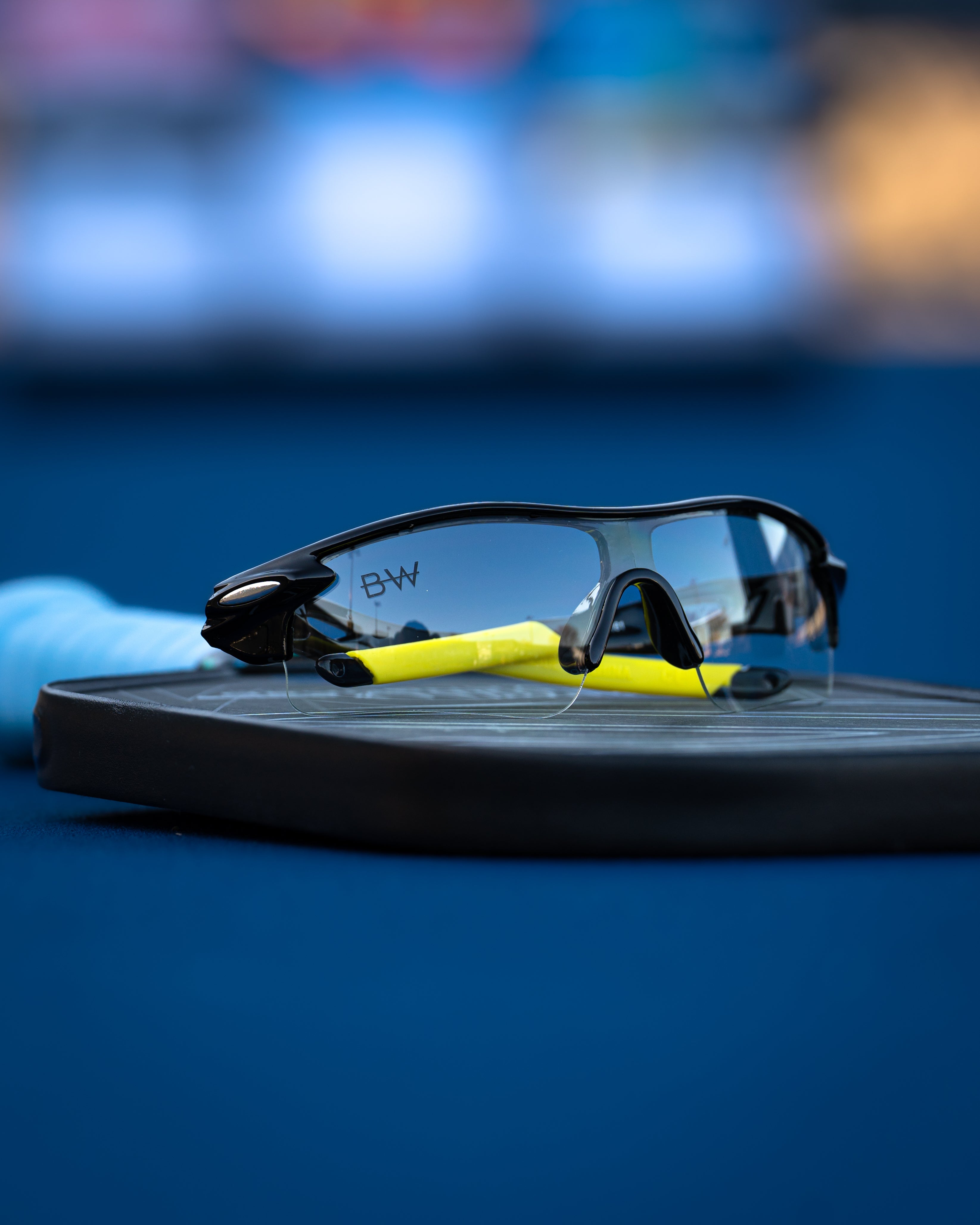
Rx Sunglasses That Stay Comfortable During Long Tournaments
Share
Find Prescription Pickleball Glasses for Long Tournament Days
Long tournaments can mean hours of matches, warmups, breaks, changing weather, and repeated movement. Comfortable RX sports eyewear starts with the right prescription, frame fit, weight, lens configuration, and playing environment—not unsupported claims about a universally perfect tournament frame.
RX Sunglasses That Stay Comfortable During Long Tournaments
A tournament day can be very different from a quick recreational match. You may wear your prescription sports glasses through warmups, multiple games, breaks, changing temperatures, and several hours at the venue.
That makes comfort an important part of choosing RX pickleball glasses—but comfort is highly individual.
Instead of looking for a frame that promises "all-day comfort" for everyone, compare characteristics that can actually affect your experience:
- Frame weight
- Frame dimensions
- Bridge fit
- Temple fit
- Your individual prescription
- Direct RX versus RX Clip configuration
- Clear versus tinted lenses
- Heat, humidity, and sweat
- Whether you wear a hat, visor, or other equipment
The goal is prescription eyewear that works with your vision needs and remains comfortable for you throughout the conditions you expect to encounter.
Why Comfort Matters During a Long Pickleball Tournament
Minor fit issues can become more noticeable when eyewear is worn for several hours. A frame that feels fine during a short fitting may interact differently with your face after repeated matches, sweat, movement, and extended wear.
Comfort can be influenced by several factors working together rather than one special feature.
Frame Weight
Some players prefer lightweight sports frames during extended sessions. Weight is worth comparing, but lighter does not automatically mean more comfortable or more secure for every wearer.
Bridge Fit
The way a frame interacts with your nose and bridge can influence how it feels over time. Individual face shape matters, so no bridge design should be described as universally comfortable.
Temple Fit
Temples that interact poorly with your head, ears, hat, or visor can become distracting over an extended day. Frame dimensions and individual head shape are relevant considerations.
Prescription Correction
Your eyewear should provide the individualized prescription correction you require. If your prescription no longer meets your vision needs, switching frame styles alone may not address the issue.
Does Lightweight Eyewear Matter for Tournament Play?
Frame weight can matter when eyewear is worn for long periods, which is why lightweight construction is a useful characteristic to compare.
However, weight should not be evaluated in isolation.
A very light frame that does not fit your face appropriately may be less comfortable than a slightly heavier frame that works better with your dimensions and preferences.
Consider weight alongside:
- Frame width
- Bridge dimensions
- Temple dimensions
- Lens configuration
- Your prescription
- Individual face and head shape
Can Tight Sports Glasses Become Uncomfortable?
A secure-feeling frame and an excessively tight frame are not the same thing.
More pressure does not automatically create better sports performance or a better fit. A frame that feels too tight around the temples, ears, or bridge can be distracting during extended wear.
At the same time, eyewear that feels too loose may move more than you prefer.
The useful goal is an individual fit that feels appropriate during the movements and conditions involved in your sport—not simply choosing the tightest frame available.
Do RX Sports Glasses Prevent Eye Fatigue?
It is better not to promise that a particular pair of prescription sports glasses will prevent eye fatigue.
Visual fatigue and discomfort can have multiple potential contributors, including:
- Individual prescription needs
- Extended visual tasks
- Dryness
- Environmental conditions
- Lighting
- General fatigue
- Other individual factors
Prescription eyewear provides individualized vision correction. That should be distinguished from claims that a frame or lens automatically eliminates fatigue or improves athletic performance.
If you repeatedly experience headaches, blurred vision, significant eye strain, or other visual symptoms, consider discussing them with an eye-care professional.
Prescription Accuracy Matters More Than Tournament Marketing
A sports frame cannot compensate for prescription correction that no longer meets your individual vision needs.
If you require RX eyewear, start with an appropriate current prescription and then evaluate the sports frame and lens configuration around it.
Do not choose prescription sports sunglasses based on claims that they automatically improve:
- Reaction time
- Depth perception
- Ball tracking
- Accuracy
- Hand-eye coordination
- Tournament performance
The purpose of your prescription is individualized vision correction—not guaranteed athletic enhancement.
Direct RX vs. RX Clip for Long Tournament Days
Blinded Wear prescription eyewear can use different RX configurations depending on the model.
Direct RX
Direct RX models incorporate individualized prescription correction into the primary prescription lenses.
RX Clip
RX Clip models use a separate inner prescription insert within the eyewear system. Your prescription correction is located in the RX insert rather than directly in the primary outer sports lens.
| Consideration | Direct RX | RX Clip |
|---|---|---|
| Prescription Location | Primary prescription lenses | Separate inner prescription insert |
| Overall Configuration | Prescription incorporated directly into the main RX lens system | Prescription correction separated from the primary outer sports lens |
| Comfort | Depends on the individual frame, prescription, and wearer | Depends on the individual frame, insert, prescription, and wearer |
| Best for Tournaments | Depends on your individual needs | Depends on your individual needs |
Neither configuration should automatically be declared more comfortable for every tournament player.
High-Index RX Lenses for Tournament Players
Blinded Wear RX products include high-index prescription lenses at no additional cost.
High-index refers to a category of prescription lens material commonly used to help manage lens thickness, particularly as prescription strength increases.
Finished lens thickness can depend on:
- Your prescription
- Frame size and shape
- Lens dimensions
- Prescription configuration
- Other optical requirements
High-index should not automatically be interpreted as lighter, stronger, more impact resistant, or more comfortable than every alternative. Refractive index is not a durability or comfort rating.
Does Lens Thickness Affect Comfort?
Lens configuration can contribute to the overall characteristics of prescription eyewear, but thickness alone does not determine comfort.
Higher-index materials can help manage lens thickness in appropriate prescriptions. However, final eyewear weight and feel can also depend on frame construction, lens dimensions, prescription, material, and overall design.
That means thinner does not automatically mean lighter or more comfortable.
Clear vs. Tinted RX Glasses for Long Tournaments
Tournament schedules can extend across different environments and times of day, making lens configuration an important practical consideration.
Clear RX Eyewear
Clear prescription eyewear may appeal to players who need vision correction but do not want a dark sunglass tint in their playing environment.
Tinted RX Eyewear
Tinted prescription eyewear may appeal to players who prefer a sunglass configuration during brighter outdoor conditions.
Neither clear nor tinted lenses should automatically be described as improving reaction time, reducing fatigue, increasing contrast, or helping you track the ball better.
Choose according to your playing environment, verified lens characteristics, and personal preference.
What If a Tournament Starts in Daylight and Ends in the Evening?
Long tournament schedules can create substantially different lighting environments between your first and final match.
Depending on your preferences and available lens options, you might consider:
- A fixed tint suited to the conditions in which you play most often
- Clear eyewear when a dark tint is not desired
- Separate eyewear configurations for substantially different conditions
- Photochromic technology when it is verified and available for your selected product
No lens configuration should automatically be described as perfect for every hour of a tournament.
Are Transition Lenses Good for Long Tournaments?
Photochromic lenses are designed to change tint under certain light conditions and may appeal to athletes who experience changing environments during a long tournament day.
The potential advantage is adaptability and convenience—not guaranteed improvements in focus, reaction speed, eye fatigue, or athletic performance.
Photochromic behavior can vary according to the specific technology, temperature, light conditions, and environment. Transition speed and final tint should be evaluated for the actual lens.
Do not assume every Blinded Wear RX model includes or supports photochromic technology. Availability should be verified for the specific product and prescription configuration.
Polarized vs. Non-Polarized RX Sunglasses for Tournaments
Polarized lenses are designed to reduce certain reflected light. Non-polarized lenses do not use that added polarization filter.
Some outdoor athletes may prefer polarized eyewear in certain environments, while some court-sport players may prefer non-polarized lenses.
Polarization alone does not determine:
- Comfort
- Depth perception
- Reaction time
- Ball tracking
- Contrast
- Overall tournament performance
Polarization, tint, prescription correction, and UV protection should be evaluated as separate characteristics.
How Heat and Humidity Affect Tournament Eyewear
Outdoor tournaments can involve hours of heat, humidity, and physical activity. Those conditions can affect how eyewear feels without necessarily indicating a problem with the frame itself.
Factors to consider include:
- Sweat around the bridge and temples
- Moisture on the lenses
- Frame movement
- Changes in temperature
- Humidity
- Headwear
- Individual face and head shape
No sports frame should be described as universally sweat-proof or guaranteed never to move.
Why Sports Glasses Can Fog During Tournaments
Fogging is related to condensation and can be influenced by humidity, temperature, airflow, body heat, lens position, and frame configuration.
It should not automatically be blamed on the wearer, prescription, or frame.
Likewise, do not assume every prescription sports frame includes anti-fog technology. If a dedicated anti-fog feature is important to you, verify whether it is actually included with the specific product.
Do Anti-Slip Nose Pads Make Glasses More Comfortable?
Avoid assuming that every sports frame includes specialized anti-slip nose pads or adjustable components.
Frame security can depend on:
- Bridge dimensions
- Temple dimensions
- Face shape
- Head shape
- Movement
- Sweat and moisture
- Headwear
When evaluating a particular model, use its verified construction and dimensions rather than assuming generic "sports fit" technology.
Do Wraparound RX Glasses Stay More Comfortable?
A wraparound or higher-coverage frame shape should not automatically be described as more comfortable than another frame design.
Frame geometry can influence coverage and how eyewear sits around the face, but individual fit remains important.
Wraparound styling also does not inherently establish better peripheral vision, faster reaction time, improved ball tracking, or greater athletic performance.
Comfortable Blinded Wear RX Options to Consider
Rather than ranking prescription glasses by an unverified "comfort score," compare available models according to their verified characteristics, style, prescription configuration, and your individual preferences.
Frost RX
Frost RX is a direct prescription option with a white frame and bright blue lens appearance. It can be considered by players who want a lightweight sports-frame design with a distinctive tournament look.
Steel Ice RX
Steel Ice RX provides another prescription sports-eyewear option for players comparing lightweight frame designs and different aesthetics for court use.
Zebra II RX
Zebra II RX offers a distinctive zebra-inspired aesthetic for players who want prescription sports eyewear with a more expressive frame-and-lens style.
Crystal Wave II RX
Crystal Wave II RX is another prescription sports-eyewear option for players comparing Blinded Wear frame designs and RX configurations.
These models should not be ranked as universally more comfortable than one another without comparative fit testing. Individual comfort depends on the wearer.
How to Compare RX Sunglasses for Tournament Comfort
| Characteristic | What It Helps You Evaluate | What It Does Not Guarantee |
|---|---|---|
| Frame Weight | How much frame weight you prefer for extended wear | Universal comfort |
| Frame Dimensions | Whether the size may work with your face | Perfect fit |
| Direct RX / RX Clip | How prescription correction is incorporated | One configuration being more comfortable for everyone |
| Clear / Tinted | Whether the lens appearance fits your environment | Better athletic performance |
| High-Index | Prescription lens-thickness management | Greater durability or universal comfort |
| Impact Resistance | A physical lens characteristic | Shatterproof or safety-certified eyewear |
How to Choose RX Sunglasses Before a Tournament
- Start with your prescription. Make sure your individualized vision correction is appropriate for your needs.
- Check the RX configuration. Determine whether the model uses direct RX or an RX Clip.
- Review frame dimensions. Compare them with eyewear that already fits you comfortably when possible.
- Consider frame weight. Think about your preferences during extended wear.
- Plan for the environment. Consider whether your matches are indoors, outdoors, or both.
- Choose clear or tinted eyewear. Base the decision on actual conditions and preferences.
- Consider heat and sweat. Remember that fit can feel different during physical activity.
- Check verified specifications. Do not assume anti-fog, anti-slip, photochromic, or other features are included unless stated for the specific product.
How Sweat Can Change the Way RX Glasses Feel
During a long tournament, sweat can change how eyewear interacts with your face. Moisture around the bridge, temples, and ears may make a frame feel different from how it felt before play began.
This does not mean that one particular frame material or design is universally better for sweaty conditions. The experience can depend on:
- Individual face shape
- Bridge fit
- Temple fit
- Frame dimensions
- How much you sweat
- Heat and humidity
- Movement during play
- Hats, visors, or headbands
If sweat is one of your biggest concerns, prioritize appropriate fit and verified product characteristics rather than relying on generic claims such as "sweat-proof" or "non-slip."
Slipping and Comfort Are Not the Same Problem
Eyewear movement and physical discomfort are related but separate issues.
A frame can feel comfortable while moving more than you prefer, while another frame may stay relatively stable but create pressure in an area that becomes noticeable during extended wear.
When evaluating prescription tournament glasses, consider both questions:
- Does the frame feel comfortable during extended wear?
- Does the amount of movement feel appropriate during my sport?
No frame should be promised to remain perfectly stationary for every athlete during intense movement.
Can a Hat or Visor Affect RX Sunglasses Comfort?
Yes. Headwear can change how the temples of your glasses interact with your head and ears.
If you regularly wear a hat, visor, sweatband, or other equipment during tournaments, evaluate your eyewear with that equipment in mind.
A frame that feels comfortable by itself may feel different when its temples share space with headwear for several hours.
For tournament players, evaluating the complete setup you actually use can be more useful than judging the glasses in isolation.
Should You Test New RX Glasses Before a Tournament?
It can be useful to become familiar with new prescription sports eyewear before relying on it for an extended tournament day.
A practice session can help you evaluate practical factors such as:
- Overall frame comfort
- Bridge pressure
- Temple pressure
- Movement during normal play
- Interaction with a hat or visor
- How the lens configuration fits your usual environment
- How the eyewear feels after extended use
This does not require a formal testing protocol. The purpose is simply to learn how your eyewear works for you before a longer competitive day.
Should You Bring Backup Glasses to a Tournament?
A backup pair is not mandatory, but some players prefer having another eyewear option available during long or multi-day events.
Reasons may include:
- Changing from outdoor to indoor courts
- Moving from daytime to evening play
- Damage to a primary pair
- Wanting clear eyewear instead of a dark tint later in the day
- Simply preferring redundancy during travel
If you require prescription correction, remember that a Non-RX backup does not replace the individualized vision correction provided by your RX eyewear.
RX vs. Non-RX Backup Glasses
The appropriate backup depends on whether you need prescription correction while playing.
| Backup Option | Potential Use | Important Consideration |
|---|---|---|
| Second RX Pair | Backup while maintaining prescription correction | Must be appropriate for your individual prescription needs |
| Non-RX Sunglasses | Players who do not require prescription correction in the eyewear | Does not provide your individualized RX correction |
| Clear Sports Glasses | Situations where a dark sunglass tint is not desired | Verify whether the specific pair is RX or Non-RX |
Browse the Non-RX Pickleball Sunglasses Collection or Clear-Lens Sports Glasses Collection to compare additional options.
Can Switching Between RX and Non-RX Glasses Reduce Eye Fatigue?
There is no general reason to assume that alternating between prescription and non-prescription eyewear will reduce eye fatigue.
If you require prescription correction for your activity, removing that correction simply to "rest" your eyes may not meet your visual needs.
Choose eyewear according to your prescription and environment rather than rotating between RX and Non-RX products based on an unsupported fatigue claim.
How to Clean RX Sports Glasses During a Tournament
Long tournament days can leave lenses exposed to sweat, fingerprints, dust, and other debris.
Follow the applicable care instructions for your particular eyewear and lens configuration. Avoid assuming that every lens has the same coatings or cleaning requirements.
When cleaning your glasses:
- Handle the frame and lenses carefully
- Avoid aggressively rubbing visible debris across a lens
- Use cleaning methods appropriate for your particular lenses
- Inspect the eyewear for visible damage
- Store the eyewear appropriately when it is not being worn
Do not assume a microfiber pouch, case, cloth, or other accessory is included with a product unless it is specifically listed.
Should You Take Your Glasses Off Between Matches?
There is no universal requirement to remove prescription glasses between matches.
If your RX eyewear remains comfortable and you need the prescription correction outside of play, you may prefer to continue wearing it. Other players may choose to remove or store their sports eyewear during longer breaks.
The important consideration is handling and storing the eyewear appropriately when it is not being worn.
Can Wearing RX Sunglasses All Day Cause Headaches?
Headaches during a tournament should not automatically be attributed to your glasses—or dismissed as a normal consequence of wearing prescription eyewear.
There can be many possible contributors to headaches or visual discomfort. If you repeatedly experience headaches, blurred vision, significant eye strain, or other concerning symptoms while wearing prescription eyewear, consider discussing them with an eye-care professional.
Do not rely on changing frame styles alone to address persistent visual symptoms.
How Frame Dimensions Affect Long-Wear Comfort
Frame dimensions can be more useful than generic labels such as "small," "medium," or "universal fit."
Depending on the product, useful measurements can include:
- Overall frame width
- Lens width
- Lens height
- Bridge width
- Temple length
If you already own glasses that fit comfortably, comparing their dimensions with a new frame can provide additional context before ordering.
Measurements still cannot guarantee fit because frame geometry and individual face shape also matter.
Does Frame Style Matter During a Tournament?
Style is primarily a matter of personal preference, but feeling comfortable with the eyewear you choose can still matter when you plan to wear it for hours.
Blinded Wear offers RX sports eyewear in multiple frame and lens aesthetics, allowing players to compare prescription configurations without treating every tournament player as if they should wear the same design.
Explore the Prescription Pickleball Glasses Collection to compare available RX models.
Prescription Sunglasses for Outdoor Tournaments
Outdoor tournaments introduce additional considerations beyond prescription correction and frame comfort.
Depending on the event and environment, you may want to evaluate:
- Lens tint
- Verified UV specifications
- Polarization or non-polarization
- Changing daylight conditions
- Heat and humidity
- Frame coverage
- Impact characteristics
Do not infer UV protection from how dark a lens appears. Tint darkness, polarization, and UV protection are separate characteristics.
Prescription Glasses for Indoor Tournaments
Indoor tournament players may have different lens preferences from athletes competing outside.
If you do not want a dark sunglass tint indoors, a clear prescription configuration may be worth considering when available.
Clear lenses should not automatically be described as increasing available light, improving contrast, or helping you react faster. They simply provide an option without a dark sunglass tint.
What About Tournaments With Indoor and Outdoor Matches?
Mixed-environment tournaments create a practical lens-choice problem because the conditions can change significantly throughout the day.
Possible approaches include:
- Choosing the configuration that fits the environment where you play most often
- Bringing separate clear and tinted eyewear when appropriate
- Considering photochromic technology when it is available and suitable for your prescription
Photochromic technology can reduce manual eyewear changes for some athletes, but it requires time to change tint and should not be assumed to behave identically across every environment.
Does Lens Color Determine Tournament Comfort?
Lens color should not be treated as a direct measurement of physical comfort.
Visible tint can affect how a lens looks and how much visible light it transmits, but a particular color does not automatically mean:
- Less eye fatigue
- Better contrast
- Faster reaction time
- Better depth perception
- Improved ball tracking
- Greater physical frame comfort
Choose lens color according to verified specifications, playing conditions, and personal preference.
Are Impact-Resistant RX Lenses Better for Tournament Play?
Impact resistance can be a relevant characteristic when comparing sports eyewear, particularly for activities involving a moving ball and other potential impacts.
However, impact-resistant does not mean shatterproof and does not establish that the complete eyewear system meets a particular protective-eyewear certification or safety standard.
If your activity requires a specific protective standard, verify the certification of the complete product rather than relying only on an impact-resistant lens description.
Comfort vs. Eye Protection: Don't Confuse the Two
A comfortable pair of glasses is not automatically protective eyewear, and protective characteristics do not automatically guarantee comfort.
These should be evaluated separately:
| Comfort Considerations | Protection Considerations |
|---|---|
| Frame weight | Verified impact characteristics |
| Bridge fit | Applicable safety certification |
| Temple fit | Frame-and-lens construction |
| Frame dimensions | Coverage appropriate to the intended activity |
| Individual preference | Verified product specifications |
How to Prepare Your RX Eyewear for a Multi-Day Tournament
Multi-day events make preparation particularly useful because your prescription eyewear may be part of your equipment for several consecutive days.
- Inspect your glasses before traveling. Look for visible damage or fit issues.
- Confirm the lens configuration fits the expected environment. Consider indoor, outdoor, daytime, and evening matches.
- Practice in the eyewear beforehand. Become familiar with how it feels during actual movement.
- Plan how you will clean and store it. Use methods appropriate for your specific lenses.
- Consider whether you want a backup. This can be especially useful when traveling away from home.
- Keep your prescription information accessible. Having your current prescription information available can be useful if you need it while traveling.
Common Mistakes When Choosing RX Tournament Glasses
- Choosing only by appearance: Style matters, but prescription needs, dimensions, and environment matter too.
- Assuming tighter means better: Excessive pressure is not a requirement for sports eyewear.
- Assuming lightweight guarantees comfort: Fit and frame geometry also matter.
- Ignoring your playing environment: Indoor and outdoor conditions can create different lens preferences.
- Assuming every sports frame is anti-slip: Verify actual product features.
- Assuming every lens is anti-fog: Photochromic, tint, polarization, and anti-fog technology are separate characteristics.
- Confusing impact resistance with certification: Impact-resistant does not automatically mean safety-certified.
- Buying immediately before competition: Becoming familiar with new eyewear before a long event can help you evaluate its fit and configuration.
How to Order Blinded Wear RX Glasses for Tournament Play
Once you have chosen a Blinded Wear RX model, complete the prescription information directly through the product page.
- Select your preferred RX model and available options.
- Have your current eyeglass prescription ready.
- Upload a clear photo or picture of your eyeglass prescription on the product page before adding the eyewear to your cart.
- Your prescription information will be associated with your custom RX order.
Blinded Wear RX products include high-index prescription lenses at no additional cost.
For more information, read How to Order Your Prescription Pickleball Glasses.
Tournament RX Glasses Checklist
Before choosing prescription eyewear for extended competition, ask:
- Does this configuration support my prescription needs?
- Is it direct RX or an RX Clip?
- Have I reviewed the frame dimensions?
- Does the frame weight match my preferences?
- Will I primarily play indoors, outdoors, or both?
- Do I prefer clear or tinted lenses?
- Have I verified polarization if it matters to me?
- Have I verified UV specifications if they matter for my intended use?
- Have I checked actual impact or protective specifications?
- Will I wear a hat, visor, or headband with the glasses?
- Have I tried the eyewear during normal sports movement?
- Do I want backup eyewear for a long or multi-day event?
Answering these questions can provide a more useful basis for choosing RX tournament glasses than relying on generic claims about "all-day comfort."
Common Myths About Comfortable RX Tournament Glasses
Myth: The Lightest Frame Is Always the Most Comfortable
Reality: Frame weight is only one part of comfort. Dimensions, bridge fit, temple fit, prescription configuration, face shape, and personal preference can all influence how eyewear feels after several hours.
Myth: Tighter Glasses Are Better for Sports
Reality: Excessive pressure is not required for sports eyewear. The goal is a fit that feels appropriate for your face and activity without assuming that tighter automatically means more secure or comfortable.
Myth: Sports Frames Never Slip
Reality: Movement can depend on fit, face shape, sweat, humidity, headwear, and activity. No ordinary sports frame should be promised to remain perfectly stationary for every athlete.
Myth: RX Glasses Automatically Prevent Eye Fatigue
Reality: Prescription lenses provide individualized vision correction. Eye fatigue can have multiple causes, and no pair of RX sports glasses should be described as universally eliminating it.
Myth: Wraparound Frames Are Always More Comfortable
Reality: Frame geometry can influence coverage and fit, but a wraparound shape does not establish universal comfort.
Myth: High-Index Means Stronger
Reality: Refractive index is not a durability rating. High-index lens materials are commonly used to help manage prescription lens thickness, particularly as prescription strength increases.
Myth: Clear Lenses Improve Reaction Time Indoors
Reality: Clear lenses provide an option without a dark sunglass tint. That characteristic alone does not establish faster reaction time, better ball tracking, or improved athletic performance.
Myth: Prescription Sunglasses Make You a Better Player
Reality: Appropriate RX eyewear provides the individualized vision correction prescribed for you. It should not be marketed as automatically improving accuracy, reaction time, depth perception, or competitive results.
FAQ: RX Sunglasses for Long Pickleball Tournaments
What should I look for in comfortable prescription pickleball glasses?
Consider your prescription, frame dimensions, frame weight, bridge fit, temple fit, direct RX versus RX Clip configuration, lens tint, playing environment, and personal preferences. Comfort is individual, so no single frame characteristic guarantees the best fit.
Can I wear prescription sports glasses all day?
How long eyewear remains comfortable varies by wearer, frame, prescription, environment, and activity. A practice session can help you understand how a particular pair feels during extended use before relying on it for a tournament.
Are lightweight RX glasses better for long tournaments?
Some players prefer lightweight frames during extended wear, but lighter does not automatically mean more comfortable. Frame geometry and individual fit matter as well.
How tight should pickleball glasses be?
Your eyewear should fit appropriately for your individual face and activity without relying on excessive pressure as a substitute for proper fit. A frame that feels uncomfortably tight may not become more suitable simply because it is intended for sports.
How do I keep prescription glasses from slipping during a tournament?
Start by evaluating frame dimensions and fit. Sweat, humidity, face shape, movement, and headwear can also influence how eyewear behaves. Do not assume a frame includes specialized anti-slip components unless those features are verified.
Do prescription pickleball glasses reduce eye strain?
Prescription eyewear provides individualized vision correction, but it should not be described as universally preventing eye strain. Persistent headaches, blurred vision, significant eye strain, or other visual symptoms are worth discussing with an eye-care professional.
Are wraparound prescription glasses better for pickleball?
A wraparound or higher-coverage design may appeal to some players, but the shape alone does not establish better comfort, peripheral vision, ball tracking, depth perception, or reaction time.
Should I choose clear or tinted RX glasses for a tournament?
Consider where and when you will play. Clear eyewear can be useful when you do not want a dark sunglass tint, while tinted RX eyewear may be preferred for certain brighter outdoor environments. Neither is universally better.
Are transition lenses useful for all-day tournaments?
Photochromic lenses may be convenient when lighting conditions change because they are designed to change tint under applicable conditions. Transition behavior varies by technology and environment, so availability and specifications should be verified for the specific lens.
Are polarized prescription sunglasses better for tournaments?
Polarized lenses are designed to reduce certain reflected light, while non-polarized lenses do not use that added polarization filter. Some athletes prefer one configuration over the other. Polarization alone does not establish better reaction time, depth perception, contrast, or ball tracking.
Are Blinded Wear RX lenses high-index?
Blinded Wear RX products include high-index prescription lenses at no additional cost. High-index can help manage lens thickness in appropriate prescriptions, but finished thickness depends on the individual prescription, lens dimensions, frame, and other optical requirements.
Is high-index the same as 1.61?
High-index is a broader category of prescription lens materials. Do not assume every high-index lens has the same refractive index unless the exact lens specification is provided for that product.
Are impact-resistant RX glasses shatterproof?
No. Impact-resistant does not mean shatterproof and does not establish a particular protective-eyewear certification or safety rating.
Should I bring backup glasses to a pickleball tournament?
Some players choose to bring a backup pair for changing environments, travel, or unexpected damage. If you require prescription correction while playing, remember that a Non-RX backup does not provide your individualized prescription.
Should I wear new prescription sports glasses for the first time at a tournament?
Becoming familiar with new eyewear during normal practice can help you evaluate its fit, lens configuration, interaction with headwear, and overall feel before an extended event.
What if my tournament lasts from morning until evening?
Consider how lighting conditions may change throughout the day. Depending on available options and your preferences, you might use tinted eyewear, clear eyewear, separate configurations, or compatible photochromic technology.
What if I play both indoor and outdoor matches?
Mixed-environment events may require more planning because a lens configuration you prefer outdoors may not be the one you prefer indoors. Compare clear, tinted, and compatible photochromic options according to your prescription and actual tournament conditions.
RX Tournament Eyewear: What Matters Most?
| Factor | Why to Consider It |
|---|---|
| Prescription | Provides the individualized vision correction you require |
| Frame Dimensions | Help you compare the physical size of different frames |
| Frame Weight | Can influence individual preference during extended wear |
| Bridge & Temple Fit | Influence how the frame interacts with your face and head |
| Direct RX vs. RX Clip | Determines how prescription correction is incorporated into the eyewear system |
| Clear vs. Tinted | Helps match the lens configuration to your environment and preferences |
| Polarization | Determines whether an added polarization filter is present |
| Photochromic Technology | May provide an adaptable tint when verified and available |
| Impact Characteristics | Relevant when evaluating eyewear for active environments |
| Playing Environment | Helps determine whether your lens configuration fits indoor, outdoor, or mixed play |
How to Narrow Down Your Blinded Wear RX Options
If several prescription frames interest you, narrow the collection by answering a few practical questions rather than searching for a universal "most comfortable" model.
- Do I want direct RX or an RX Clip configuration?
- What frame dimensions work best with eyewear I already find comfortable?
- Do I prefer a clear or tinted lens configuration?
- Will I primarily compete indoors, outdoors, or in both environments?
- Do I prefer a subtle or distinctive frame-and-lens aesthetic?
- Which product specifications are actually verified for the model?
Browse the complete Blinded Wear Prescription Pickleball Glasses Collection to compare current RX options.
Related Guides for Prescription Pickleball Players
- Best Pickleball Glasses 2026 — compare RX, Non-RX, clear-lens, and other pickleball eyewear options.
- Pickleball Performance Lens Guide — understand clear and tinted lenses, lens colors, polarization, and RX options.
- How to Order Prescription Pickleball Glasses — follow the Blinded Wear RX ordering process.
- The Ultimate Guide to Travel-Friendly Prescription Sports Eyewear — prepare RX eyewear for tournaments and travel.
- 5 Mistakes Athletes Make When Choosing Prescription Sports Glasses — avoid common RX selection mistakes.
- Pickleball Sunglasses Quiz — narrow your eyewear options based on your preferences.
50% Lifetime Replacement Support for Eligible Glasses
Long tournament schedules and frequent travel can put sports equipment through regular use. Blinded Wear offers 50% lifetime replacement support if eligible glasses break, subject to current policy terms.
For eligible replacement claims, damaged eyewear must be returned. Once the claim and returned eyewear meet the applicable policy requirements, the customer can receive 50% credit toward a replacement pair.
This is not a free full-replacement guarantee and should not be interpreted as a promise that the eyewear cannot break.
Customized prescription eyewear is final sale and excluded from the standard 30-day return policy. That final-sale status does not eliminate applicable 50% lifetime replacement support for eligible broken glasses.
Review the Blinded Wear Protection Plan, Replacement & Returns information for current eligibility and policy details.
Final Takeaway: Tournament Comfort Starts With the Right Fit for You
The best prescription sunglasses for a long tournament are not necessarily the lightest frame, tightest frame, darkest lens, or model with the most aggressive sports styling.
Long-wear comfort comes from the complete eyewear setup: your prescription, frame dimensions, frame weight, bridge and temple fit, lens configuration, playing environment, and individual preferences.
For a tournament that lasts several hours or multiple days, consider how the eyewear feels during actual movement, how it interacts with sweat and headwear, and whether the lens configuration matches the conditions in which you will play.
Blinded Wear offers lightweight prescription sports-frame designs with high-index prescription lenses included at no additional cost, direct RX and RX Clip options across the collection, and impact-resistant lens options. Individual product specifications vary by model.
Rather than relying on promises of fatigue-free wear, zero slipping, enhanced ball tracking, or better tournament performance, compare the characteristics that can actually be verified and choose the configuration that fits your needs.
Explore Blinded Wear RX Pickleball Glasses or take the Pickleball Sunglasses Quiz to narrow your options.