Elite Pickleball Player Sunglasses 2026
Share
Find Your Pickleball Glasses for 2026
Competitive players need eyewear that matches their prescription needs, playing environment, comfort preferences, and court routine. Use Blinded Wear's dedicated 2026 resources to compare RX and non-RX pickleball eyewear without relying on unsupported claims about what professional players wear.
Elite Pickleball Player Sunglasses 2026: What Competitive Players Should Look For
What makes a pair of sunglasses suitable for a serious pickleball player?
The answer is more nuanced than choosing whatever eyewear is marketed as “pro,” “elite,” or “tournament-ready.” Your playing level does not automatically determine the right lens or frame.
Instead, competitive players should evaluate the characteristics that can actually be compared:
- Prescription requirements
- Frame comfort and active fit
- Lens tint and configuration
- Visible Light Transmission when verified
- Polarized or non-polarized construction
- Impact characteristics
- Any specific protective certification you require
- The lighting environments in which you play
- Return and replacement support
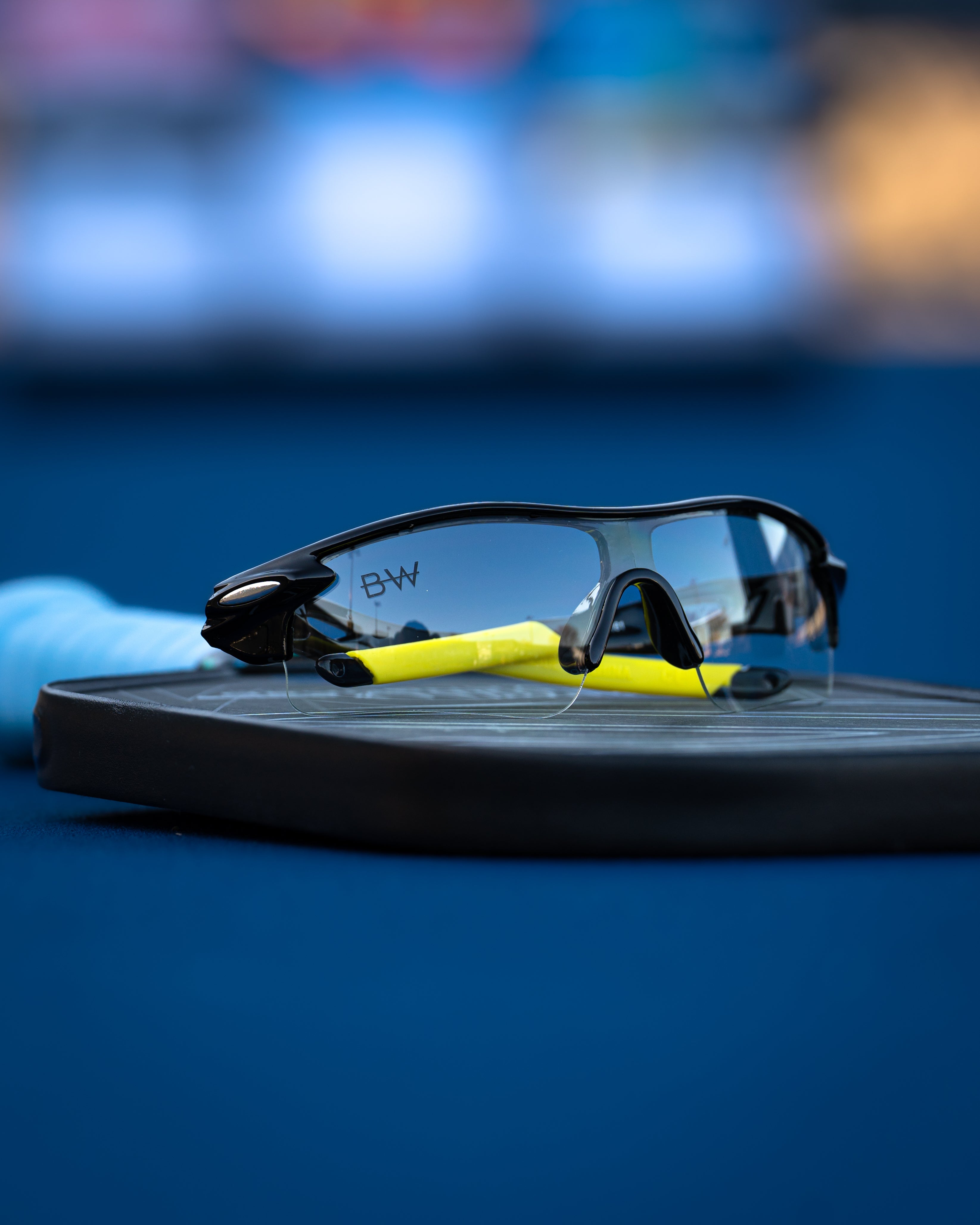
Blinded Wear Co. builds its eyewear catalog around pickleball players, with dedicated prescription and non-prescription collections that make these factors easier to compare.
What Do Elite Pickleball Players Need From Sunglasses?
A high-level player can spend significant time practicing, competing, warming up, and moving between different court environments. That makes practical eyewear considerations important even without claiming that the glasses themselves create elite performance.
Useful characteristics can include:
- A lightweight sports-oriented frame
- Comfort during extended wear
- An active fit that works for the individual player
- The appropriate prescription correction when needed
- A lens configuration suited to the player's typical environment
- Impact-resistant lens options
- A backup-eyewear strategy for competition or travel
The best sunglasses for an elite pickleball player are therefore not necessarily the darkest, tightest, most expensive, or most aggressively marketed pair. They are the pair whose verified characteristics best match that player's needs.
What Sunglasses Do Professional Pickleball Players Wear?
Professional and elite players can wear many different brands, frames, lens types, and configurations. Sponsorships can also change over time.
That means there is no responsible basis for claiming that one particular pair is universally “what the pros wear” without current evidence tied to specific athletes or teams.
More importantly, copying a professional player's eyewear does not guarantee that the same pair is ideal for you.
Two players can differ in:
- Prescription
- Face shape and frame fit
- Lighting preferences
- Indoor versus outdoor playing schedule
- Tint preference
- Polarization preference
- Comfort preferences
- Protective requirements
Use elite players as inspiration if you want, but choose eyewear based on your own requirements.
You Don't Need a Sponsorship to Shop for Serious Pickleball Eyewear
“Elite” should describe the demands you place on your equipment—not imply that you need to be a professional athlete or sponsored player to purchase it.
A recreational player who competes several times per week may care about many of the same practical characteristics as a tournament player:
- Comfort
- Fit
- Prescription correction
- Lens selection
- Impact resistance
- Long-term ownership support
Blinded Wear's pickleball collections are available directly to players regardless of competitive level.
Can Sunglasses Actually Make You an Elite Pickleball Player?
No pair of sunglasses can substitute for training, positioning, anticipation, technique, athletic ability, decision-making, or match experience.
Eyewear should therefore not be promised to automatically:
- Increase reaction speed
- Improve anticipation
- Improve depth perception
- Make you track the ball faster
- Increase shot accuracy
- Improve court awareness
- Create a competitive advantage
For players who need prescription correction, appropriate RX lenses can correct the refractive error for which they were prescribed. That is meaningful, but it should not be turned into a claim that prescription eyewear makes the brain react faster or makes someone a better pickleball player.
Vision Matters in Pickleball—But Keep the Claims Accurate
Pickleball requires players to use visual information while making rapid physical and tactical decisions.
During a point, a player may be attending to:
- The ball
- The opponent's position
- The partner's position in doubles
- The net
- Court boundaries
- Available court space
- The developing pattern of play
But seeing the court and deciding what to do with that information are different processes.
Experience, attention, anticipation, positioning, strategy, physical response, and vision all contribute. Sunglasses should not be credited with controlling all of them.
Key Features to Compare in Elite Pickleball Sunglasses
| Feature | What Competitive Players Should Consider |
|---|---|
| Prescription correction | Use appropriate RX correction if you require it |
| Frame weight | Consider comfort during extended wear |
| Active fit | Evaluate how the frame behaves during your normal court movement |
| Lens tint | Match the configuration to your typical environment and preferences |
| VLT | Use exact Visible Light Transmission information when verified for the lens |
| Polarization | Choose according to verified configuration and personal preference |
| Impact resistance | Consider the actual verified impact characteristics |
| Protective certification | Verify a specific standard if one is required for your use |
| Replacement support | Consider what happens if the eyewear eventually breaks |
Why Lightweight Frames Appeal to Competitive Players
A lightweight sports frame can be attractive to players who expect to wear eyewear through long practice sessions, league play, tournaments, or multiple matches in one day.
Weight, however, is only one part of comfort.
A lightweight frame can still be uncomfortable if it:
- Creates excessive temple pressure
- Sits poorly on the bridge
- Does not fit the individual player's face
- Requires repeated repositioning
Likewise, lightweight does not mean indestructible or automatically more durable.
Evaluate the complete frame rather than treating one specification as the entire buying decision.
Active Fit Matters More Than “No-Slip” Marketing
Competitive pickleball involves lateral movement, rotation, acceleration, deceleration, reaching, serving, volleying, and repeated changes in body position.
That makes frame fit important.
But claims such as “zero slip,” “locked in during every rally,” or “never moves even when sweating” are too absolute for a product worn on different faces.
A better standard is an active fit that works for you.
Look for eyewear that:
- Feels comfortable at the bridge
- Does not create excessive temple pressure
- Feels appropriate around the ears
- Maintains a useful wearing position during realistic movement
- Does not require constant repositioning
Elite Fit Does Not Mean the Tightest Frame Possible
Some players assume tighter automatically means better for competition.
That can lead to a frame that creates unnecessary pressure during extended sessions.
Secure and comfortable are not opposites.
A useful sports fit should balance stability with comfort rather than relying on excessive clamping force.
Test New Sunglasses Before Tournament Day
A competitive event is not the ideal time to discover that a new frame becomes uncomfortable after extended wear.
Before relying on new eyewear during competition:
- Wear it during a normal practice session.
- Test normal lateral movement.
- Serve and return while wearing it.
- Practice volleys and groundstrokes.
- Wear it long enough to identify pressure points.
- Notice whether substantial repositioning is repeatedly necessary.
- Evaluate the lens configuration in the environment where you expect to use it.
Realistic practice is more useful than an exaggerated head-shake test.
Prescription Sunglasses for Competitive Pickleball Players
If you normally require prescription correction, that requirement does not disappear when you step onto a pickleball court.
Blinded Wear offers a dedicated Prescription Pickleball Eyewear Collection for players who want RX correction incorporated into their court eyewear.
Appropriate prescription lenses correct the refractive error for which they are prescribed.
They should not be marketed as automatically improving:
- Reaction time
- Ball tracking
- Depth perception beyond the effect of appropriate refractive correction
- Anticipation
- Strategy
- Decision speed
How to Order Blinded Wear RX Pickleball Eyewear
For applicable Blinded Wear RX products, upload a clear image of your eyeglass prescription on the product page before adding the eyewear to your cart and purchasing.
Do not substitute a contact-lens prescription or guess unclear values.
Common eyeglass-prescription information can include:
- OD and OS
- SPH
- CYL when applicable
- AXIS when applicable
- ADD when prescribed
- Prism when prescribed
If your prescription is unclear or your vision has meaningfully changed, seek appropriate professional guidance rather than modifying the prescription yourself.
Visit How to Order RX Glasses for additional ordering information.
High-Index RX Lenses Included at No Additional Cost
Blinded Wear includes high-index prescription lenses at no additional cost with RX eyewear.
High-index refers to a category of prescription lens material with a higher refractive index than conventional lens materials. It is commonly used to help manage finished lens thickness, particularly as prescription strength increases.
Final thickness can also depend on:
- Prescription strength
- Lens dimensions
- Frame dimensions
- Decentration and positioning
- Lens design
- Other optical requirements
High-index does not automatically mean more impact resistant, more scratch resistant, more accurate, anti-fog, polarized, or safety certified.
Direct RX vs. Prescription Inserts for Competitive Play
Prescription sports eyewear can use different configurations.
A direct RX configuration incorporates the applicable prescription correction into the primary prescription lenses.
A prescription insert configuration uses a separate inner prescription component within compatible eyewear.
Neither format should universally be called faster, clearer, more accurate, or better for elite competition.
Instead, compare:
- Prescription compatibility
- Frame fit
- Lens configuration
- Comfort
- Verified product specifications
- Your individual preferences
Non-RX Sunglasses for Competitive Pickleball
Players who do not need prescription correction can browse the Blinded Wear Non-RX Pickleball Sunglasses Collection.
Current Blinded Wear non-RX pickleball sunglasses are $149.99.
When comparing non-prescription options, focus on the same fundamentals that matter with RX eyewear:
- Comfort
- Active fit
- Lens configuration
- Playing environment
- Verified specifications
- Impact characteristics
- Long-term ownership support
Are Non-Polarized Sunglasses Better for Elite Pickleball?
Blinded Wear offers non-polarized lens options, but polarization should not be turned into an unsupported performance claim.
It is too broad to say polarized lenses inherently distort depth perception during pickleball.
It is equally inaccurate to claim that non-polarized lenses automatically improve:
- Depth perception
- Ball tracking
- Reaction time
- Shot accuracy
- Court awareness
Polarization is one characteristic of a lens. Choose according to the exact product, environment, and your preference rather than assuming it determines competitive performance.
Which Lens Tint Is Best for Elite Pickleball?
There is no universal lens tint that is best for every competitive player.
Your choice can depend on:
- Indoor versus outdoor play
- Brightness
- Shade
- Cloud cover
- Time of day
- Personal preference
- The exact characteristics of the lens
A tint can change how a scene appears through the lens, but color alone should not be promised to improve reaction time, depth perception, anticipation, or ball tracking.
VLT: A Useful Specification for Serious Players
Visible Light Transmission (VLT) describes the percentage of visible light transmitted through a lens.
In simple terms:
- Higher VLT means more visible light is transmitted.
- Lower VLT means less visible light is transmitted.
VLT can help describe lens darkness more precisely than appearance alone, but it is not a complete measure of lens quality.
VLT does not independently establish:
- UV protection
- Polarization
- Impact resistance
- Scratch resistance
- Anti-fog characteristics
- Prescription accuracy
- Safety certification
Only rely on an exact VLT percentage when it is verified for the exact lens configuration.
Competitive Pickleball in Bright Outdoor Conditions
Players who spend most of their time on bright outdoor courts may prefer a tinted configuration that suits those conditions.
Instead of assuming the darkest lens is automatically best, compare:
- Verified VLT when available
- Visible tint
- Polarization status
- Your own visual preference
- Whether your sessions frequently extend into lower-light conditions
A lower VLT means less visible light transmission. It does not automatically mean greater UV protection or better athletic performance.
What About Tournaments With Changing Light?
A long competition day may expose a player to different lighting conditions from warm-up through later rounds.
A fixed tint remains substantially fixed while the environment changes.
Players dealing with substantial changes can consider several strategies:
- Select a fixed tint around the conditions encountered most often.
- Use different pairs for substantially different environments.
- Consider an available photochromic configuration if its characteristics suit your needs.
- Keep a backup configuration available when practical.
There is no requirement that a serious player use only one pair for every environment.
Are Photochromic Lenses Good for Tournament Pickleball?
Photochromic lenses change tint according to the particular technology and environmental conditions involved.
They can appeal to players interested in one-pair convenience across changing environments.
However, do not assume every photochromic lens:
- Changes instantly
- Becomes completely clear indoors
- Reaches the same darkness outdoors
- Responds identically at every temperature
- Behaves identically behind glass
Photochromic availability and specifications should be verified for the exact product configuration being considered.
Elite Indoor Pickleball Eyewear
Indoor competitive players may prefer a configuration that does not introduce more visible darkness than they want in their normal environment.
Blinded Wear offers a dedicated Clear Lens Collection for shoppers interested in eyewear without a dark sunglass tint.
Clear should not automatically be interpreted as:
- 100% VLT
- UV400
- Anti-fog
- Scratchproof
- Impact certified
- Guaranteed to improve tracking
Those characteristics must be verified separately.
Impact Resistance Is Relevant at Every Playing Level
Blinded Wear offers impact-resistant lens options, a relevant consideration in an active court sport where eyewear can potentially encounter physical contact.
But terminology matters.
Impact resistant does not automatically mean:
- Shatterproof
- Indestructible
- Crushproof
- Ballistic
- Certified to every protective standard
- Guaranteed to prevent every eye injury
If you require compliance with a specific protective standard, verify that standard for the exact finished eyewear.
Sports Sunglasses vs. Certified Protective Eyewear
“Sports eyewear” is not automatically synonymous with eyewear certified to a specific protective standard.
Likewise, words such as:
- Elite
- Pro
- Performance
- Tournament
- Impact resistant
should not be treated as substitutes for an actual certification.
If a defined protective standard matters to you, look for evidence that the exact finished product meets that standard.
Do Elite Pickleball Sunglasses Need UV Protection?
Outdoor shoppers may want to evaluate verified UV characteristics, but UV protection cannot be determined from lens darkness alone.
A dark-looking lens does not prove a specific UV rating.
Likewise, a clear-looking lens should not automatically be assumed to have no UV protection.
Keep UV characteristics separate from:
- Visible tint
- VLT
- Polarization
- Impact resistance
- Prescription correction
If a particular UV specification matters to you, verify it for the exact lens.
What About “Anti-Glare” Pickleball Sunglasses?
“Anti-glare” can be used broadly in eyewear marketing, so competitive players should ask what specific lens characteristic or treatment supports the claim.
Tint, polarization, anti-reflective treatments, and perceived visual comfort are related to different optical concepts and should not be treated as interchangeable.
Do not assume every tinted or non-polarized sports lens automatically contains a special anti-glare technology.
Fog During Competitive Pickleball
Condensation on a lens can interfere with the viewing surface, particularly when environmental conditions encourage fog formation.
Humidity, temperature, perspiration, airflow, lens treatments, and eyewear design can all be relevant.
However, an athletic-looking frame should not automatically be called fog-proof or anti-fog.
If anti-fog technology matters to you, verify whether it is actually present on the exact product.
Scratch Resistance and Competitive Eyewear
Competitive players may handle eyewear frequently during practice, travel, warm-ups, matches, and storage.
That makes good lens care important.
But impact resistance and scratch resistance are separate characteristics.
Likewise:
- High-index does not automatically mean scratch resistant.
- Tint does not automatically mean scratch resistant.
- Polarization does not automatically mean scratch resistant.
- A sports frame does not make a lens scratchproof.
Verify any specific scratch-resistance treatment rather than assuming it is present.
How Serious Players Should Care for Their Eyewear
A simple routine can reduce avoidable contamination and abrasive handling.
- Inspect the lens before wiping it.
- Remove loose grit appropriately rather than grinding it across the surface.
- Use clean, lens-compatible cleaning materials.
- Avoid abrasive DIY polishing compounds.
- Inspect the frame periodically for physical damage.
- Store eyewear away from loose hard objects.
- Avoid unnecessary prolonged exposure to extreme heat.
Cleaning can remove appropriate surface contamination. It cannot reverse physical lens damage.
Traveling to Tournaments With Pickleball Eyewear
Travel can expose eyewear to different stresses than normal court use, including compression, abrasion, drops, heat, and careless handling inside luggage.
When traveling:
- Use appropriate protective storage.
- Avoid placing eyewear loose beside hard objects.
- Keep prescription eyewear accessible when practical.
- Consider a backup pair if you depend on RX correction.
- Inspect eyewear after a meaningful drop or compression event.
Impact resistance should not be confused with crush resistance. No ordinary sports frame should be assumed to survive unlimited pressure inside luggage.
Why Competitive Players May Want a Backup Pair
A backup pair does not improve your skill, but it can improve preparation.
A second pair can be useful if your primary eyewear is:
- Damaged
- Misplaced
- Left somewhere else
- Unsuitable for a substantially different lighting environment
This can be particularly relevant for prescription players who depend on corrective eyewear.
When practical, avoid storing every pair in the same vulnerable location during travel.
Pre-Match Eyewear Check for Competitive Players
Before an important match, a quick equipment check can identify simple problems before play begins.
- Inspect the lenses for significant contamination or damage.
- Check that the frame appears normally aligned.
- Confirm that the lenses remain properly seated.
- Put the eyewear on and assess normal fit.
- Clean the viewing surfaces appropriately if needed.
- Confirm you have the lens configuration you intended to use.
- Keep backup eyewear accessible if you brought it.
This is basic equipment preparation, not a substitute for professional inspection when there is meaningful damage or an optical concern.
What if Your Sunglasses Take a Hard Hit?
After meaningful ball contact, paddle contact, a hard drop, or compression, inspect the eyewear.
Look for:
- Cracks
- Significant chips
- Lens displacement
- Frame deformation
- Damage around the temples or hinges
- A sudden change in how the frame fits
Do not deliberately perform destructive home impact tests to determine whether eyewear is still usable.
Competitive Pickleball in Rain or Humidity
Moisture on a lens can interfere with the viewing surface, while environmental conditions can contribute to condensation.
Keep these concepts separate:
- Rainwater is not the same as fog.
- Fog is not the same as a scratch.
- A scratch is not the same as a crack.
- Moisture does not change your prescription.
- A wet frame shifting position does not change the prescription manufactured into the lens.
Do not assume ordinary sports sunglasses are waterproof, sealed, hydrophobic, or fog-proof unless those exact characteristics are verified.
How to Compare Elite Pickleball Sunglasses
| Question | Why Ask It? |
|---|---|
| Do I require RX correction? | Prescription requirements should be addressed first |
| Where do I play most often? | Lighting environments can influence lens preference |
| What is the verified VLT? | It describes visible-light transmission when provided for the exact lens |
| Polarized or non-polarized? | Know the actual lens configuration |
| What impact claim is supported? | Avoid confusing impact resistance with indestructibility or certification |
| Does it meet a specific safety standard? | Important when certification is a requirement |
| How does the frame fit me? | Fit is individual |
| What happens if it breaks? | Replacement support affects long-term ownership |
Elite Pickleball Sunglasses: Marketing Claims to Question
Competitive players should be especially careful with claims that make ordinary eyewear sound like a shortcut to athletic performance.
Be cautious with phrases such as:
- “Improves reaction time”
- “Makes you see the ball sooner”
- “Enhances depth perception”
- “Boosts shot accuracy”
- “Eliminates visual distortion”
- “Never slips”
- “Fog-proof”
- “Shatterproof”
- “Indestructible”
- “Proven competitive advantage”
Look for specific, supportable product characteristics instead.
Does a Professional Endorsement Prove Sunglasses Are Better?
No. Athlete partnerships and sponsorships can be useful brand signals, but they do not establish that a product is objectively best for every player.
An elite athlete's equipment choice may involve personal preference, fit, sponsorship relationships, availability, and individual requirements.
Your buying decision should still come back to:
- Your prescription
- Your face and fit
- Your playing environment
- Your preferred lens configuration
- Verified specifications
- Your budget
Do You Need to Be an Elite Player to Buy Performance Eyewear?
No. The same practical considerations can matter to beginners, recreational players, league players, tournament competitors, and advanced athletes.
A beginner can care about comfortable sports eyewear just as much as a high-level player.
An advanced player can still prefer a simple configuration.
Your skill rating does not prescribe your sunglasses.
RX Pickleball Glasses vs. Contact Lenses for Competitive Players
Players who require vision correction may use prescription glasses, contact lenses, or another professionally appropriate solution.
Neither RX sports glasses nor contacts are universally superior for every athlete.
Consider:
- Your prescribed correction
- Your comfort preferences
- Your normal vision-care routine
- Your playing environment
- Your eyewear preferences
- Guidance from an appropriate eye-care professional when needed
Do not assume contacts inherently cause problems for every player or that RX sports glasses automatically produce better athletic performance.
Comfort Matters During Long Competition Days
Multiple matches can mean extended eyewear time, making comfort worth evaluating before an event.
Potential comfort considerations include:
- Overall frame weight
- Bridge pressure
- Temple pressure
- Fit around the ears
- Repeated slippage
- How the frame feels after prolonged wear
Comfort is personal. A frame that works extremely well for one competitive player may not be the best fit for another.
Elite Pickleball Sunglasses 2026 Buying Checklist
Before purchasing, ask yourself:
- Do I need prescription or non-prescription eyewear?
- What lighting conditions do I encounter most often?
- Do I want a clear, fixed-tint, or available changing-tint configuration?
- Do I have a polarization preference?
- Is exact VLT information available and relevant to me?
- What impact characteristics are actually verified?
- Do I require a specific protective certification?
- Is the frame appropriate for extended wear?
- How will I evaluate active fit?
- Do I need a backup pair?
- What is the return policy?
- What replacement support is available?
Why Consider Blinded Wear for Competitive Pickleball?
Blinded Wear focuses its eyewear catalog on pickleball rather than asking players to sort through a general sunglass collection.
Current shopping considerations include:
- Dedicated prescription pickleball eyewear
- Dedicated non-prescription pickleball sunglasses
- Clear-lens options
- Lightweight sports frames
- Impact-resistant lens options
- Non-polarized options
- High-index RX lenses included at no additional cost
- Multiple frame styles
- 50% lifetime replacement support for eligible broken eyewear
These are concrete reasons to consider the brand without needing to claim that every professional player wears Blinded Wear or that the eyewear itself creates elite performance.
Know the Return Policy Before Ordering
Eligible standard Blinded Wear purchases have a 30-day return policy.
Customized RX eyewear is final sale and excluded from the standard 30-day return policy.
Prescription shoppers should therefore verify their order information carefully before purchasing.
RX final-sale status does not eliminate applicable 50% lifetime replacement support for eligible broken prescription eyewear.
50% Lifetime Replacement Support
Blinded Wear offers 50% lifetime replacement support if eligible glasses break, subject to current policy terms.
For an eligible claim:
- The damaged eyewear must be returned.
- The applicable policy requirements must be satisfied.
- The customer can receive 50% credit toward a replacement pair.
This is not a free full replacement program and should not be described as an unlimited lifetime warranty.
For damaged prescription eyewear, contact blindedwearco@gmail.com before returning the pair.
Review the Blinded Wear Protection Plan, Replacement & Returns information for current eligibility and policy details.
Not Sure Which Pickleball Sunglasses Fit Your Needs?
Use the Blinded Wear Pickleball Sunglasses Quiz to help narrow your shopping options.
The quiz is a shopping tool. It does not determine your prescription, diagnose visual conditions, or establish which protective certification you personally require.
Compare Pickleball Lens Options
For more information about lens colors, clarity considerations, and prescription options, visit the Pickleball Performance Lens Guide.
Use the guide to understand available choices rather than expecting a particular lens color to automatically produce faster reactions, better tracking, or superior match performance.
Elite Pickleball Sunglasses in 2026: Start With What You Can Verify
The best eyewear for a competitive pickleball player is not determined by a “pro” label, sponsorship claim, or promise of better reaction time.
Start with what actually matters to your individual use:
- Your prescription needs
- Your playing environment
- Your preferred lens configuration
- Comfort
- Active fit
- Verified lens specifications
- Impact characteristics
- Any protective certification you require
- Return and replacement support
Blinded Wear gives competitive and recreational players dedicated RX and non-RX pickleball collections without requiring unsupported claims that the eyewear itself creates elite performance.
Part 2 will go deeper into bright-sun, shade, indoor, outdoor, and mixed-light tournament setups; VLT and tint selection; polarization; prescription positioning; direct RX versus inserts; fit troubleshooting; sweat, fog, rain, scratches, and impact; tournament packing; backup eyewear; and how serious players can build a practical match-day eyewear setup for 2026.
Build Your Pickleball Eyewear Around the Courts You Actually Play
Competitive players can encounter dramatically different lighting environments throughout a week—or even during a single tournament day.
A player practicing outdoors at noon may have different preferences from someone competing indoors under artificial lighting. A late-afternoon match can also feel different from the conditions present during morning warm-ups.
Instead of looking for one universally “elite” lens, start by identifying your normal environments:
- Bright outdoor courts
- Outdoor courts with substantial shade
- Overcast conditions
- Early-morning or late-day play
- Indoor facilities
- Events that transition between substantially different lighting conditions
Once you know where you play most often, lens configuration becomes easier to evaluate.
Bright-Sun Pickleball Sunglasses
For outdoor players, visible-light transmission is one useful specification when comparing tinted lenses.
Visible Light Transmission (VLT) describes the percentage of visible light transmitted through a lens.
- Higher VLT means more visible light is transmitted.
- Lower VLT means less visible light is transmitted.
That does not mean the lowest VLT is automatically the best choice for bright pickleball courts.
Individual preference still matters, and VLT alone does not tell you everything about a lens.
It does not independently establish:
- UV protection
- Polarization
- Impact resistance
- Scratch resistance
- Anti-fog characteristics
- Protective certification
- Prescription accuracy
Shade and Mixed-Light Pickleball Courts
Some outdoor courts move between direct sunlight and shade because of trees, buildings, court orientation, or changing conditions.
This can make lens selection more complicated than simply choosing a dark sunglass lens.
Players who regularly encounter mixed lighting can consider:
- A fixed tint selected around the conditions encountered most often
- A less-dark configuration if preferred
- An available photochromic configuration
- Separate eyewear for substantially different environments
There is no universal lens that automatically optimizes vision every time a player moves between sunlight and shade.
What About Overcast Tournament Conditions?
Cloud cover can substantially change the amount and character of available light compared with a bright sunny court.
A player who normally prefers a particular outdoor tint may decide that a different configuration is more comfortable under different conditions.
Avoid universal rules such as “yellow is always best for clouds” or “clear is always best when overcast.”
The appropriate choice depends on the exact lens characteristics, available light, and individual preference.
Indoor Tournament Pickleball Eyewear
Indoor facilities create a different shopping problem because players may not want the visible darkness associated with their outdoor sunglasses.
Players who do not want a dark tint can explore the Blinded Wear Clear Lens Collection.
However, the word “clear” should not be treated as a technical specification for every other characteristic.
A clear lens is not automatically:
- 100% VLT
- Anti-fog
- Scratch resistant
- Polarized or non-polarized
- Certified protective eyewear
- Guaranteed to improve ball tracking
Verify characteristics that matter for the exact product.
Should Competitive Players Use One Pair or Multiple Pairs?
There is no requirement that a serious pickleball player use the same eyewear configuration for every court.
A one-pair approach can be convenient. Multiple pairs can provide more control over substantially different environments.
| Approach | Potential Advantage | Consideration |
|---|---|---|
| One fixed-tint pair | Simple equipment setup | The tint remains substantially fixed while lighting changes |
| One clear pair | No dark sunglass tint | May not match every player's preference in bright outdoor conditions |
| Available photochromic configuration | Tint can change according to technology and conditions | Behavior varies by exact technology and environment |
| Multiple pairs | Allows separate configurations for different environments | Requires carrying and managing additional eyewear |
Photochromic Lenses for Changing Tournament Conditions
Photochromic lenses change tint in response to applicable activating and environmental conditions.
For some players, that can make them an appealing one-pair option when lighting changes throughout the day.
But photochromic technology should not be described as an instant electronic light-control system.
Exact behavior can depend on:
- The particular photochromic technology
- Environmental conditions
- Temperature
- Exposure conditions
- The exact product configuration
Do not assume every photochromic lens becomes completely clear indoors or reaches one universal darkness outdoors.
Verify availability and specifications for the exact Blinded Wear product you are considering.
Why Some Competitive Players May Prefer a Fixed Tint
A fixed tint provides a relatively predictable lens configuration because the tint remains substantially fixed while the environment changes.
This can appeal to players whose matches and practices occur under relatively consistent conditions.
The tradeoff is straightforward: the environment can change even though the tint does not.
When comparing fixed tints, consider:
- Verified VLT when available
- Your normal playing environment
- Visible tint preference
- Whether you frequently transition between substantially different lighting conditions
Does Lens Color Help Elite Pickleball Players See the Ball Better?
Lens tint can change the appearance of the scene through the lens, but broad performance claims should not be attached to color alone.
Without evidence for the exact lens and outcome, avoid assuming a tint automatically:
- Enhances ball tracking
- Improves depth perception
- Increases reaction speed
- Makes spin easier to read
- Improves shot accuracy
- Creates better anticipation
Use lens color as one characteristic in the buying decision rather than treating it as a shortcut to better performance.
Should Ball Color Determine Your Sunglass Tint?
Pickleball balls can appear in different colors, and court backgrounds vary considerably.
That does not create a universal formula in which one ball color requires one specific sunglass tint.
Perceived visibility can involve the complete visual environment, including:
- Lighting
- Background
- Ball appearance
- Lens characteristics
- Individual vision
Players can have different preferences even on the same court.
Polarized vs. Non-Polarized Pickleball Sunglasses
Polarization is often discussed as though it automatically determines whether eyewear is good or bad for pickleball.
The reality is more nuanced.
Polarization alone does not determine:
- Depth perception
- Ball tracking
- Reaction time
- Shot accuracy
- Visual processing speed
- Court awareness
Likewise, a non-polarized lens should not automatically be promised to improve those abilities.
Blinded Wear offers non-polarized options for players who prefer that configuration.
Glare and Outdoor Competitive Play
Bright environments and reflective surfaces can affect visual comfort, but “glare reduction” can refer to different lens characteristics depending on the product.
Do not assume every dark lens, non-polarized lens, or sports frame contains a special anti-glare treatment.
If glare management is an important buying consideration, determine what characteristic of the exact lens supports the claim rather than relying on marketing terminology alone.
Prescription Positioning Matters Independently of Skill Level
A competitive player with prescription eyewear still needs appropriate optical positioning.
This is more nuanced than simply placing one universal “optical center” directly over each pupil.
Depending on the prescription and lens design, relevant factors can include:
- Pupillary-distance information
- Horizontal positioning
- Vertical positioning or fitting height when applicable
- Frame geometry
- Wearing position
- Lens design
- Prescription complexity
These optical considerations are separate from whether the frame is marketed for pickleball.
What Is PD in Prescription Pickleball Glasses?
PD stands for pupillary distance and is used as part of optical positioning.
PD should not be confused with prescription power.
It does not determine:
- SPH
- CYL
- AXIS
- Tint
- Polarization
- Impact resistance
Binocular and monocular PD measurements are also not the same thing, and a binocular value should not automatically be divided equally between the two eyes.
If required optical information is unclear, do not guess.
Why the Same Prescription Can Feel Different in Different Frames
Two pairs can contain the same prescribed refractive values and still feel different when worn.
Potential factors include:
- Frame geometry
- Lens dimensions
- Wearing position
- Prescription design
- Optical positioning
- Fit
- How familiar you are with the eyewear
This does not mean the prescription itself changes when you move from one frame to another.
Can Players With Stronger Prescriptions Play Competitive Pickleball?
A stronger prescription does not determine a player's skill level or ability to compete.
It can, however, make thoughtful frame and lens selection especially relevant.
High-index materials are commonly used to help manage lens thickness, but final thickness depends on more than prescription strength alone.
It can also depend on:
- Frame and lens dimensions
- Optical positioning
- Decentration
- Lens design
- Other optical requirements
Blinded Wear includes high-index prescription lenses at no additional cost with RX eyewear.
High-Index Is Not a Performance-Enhancement Technology
High-index describes an optical material property. It should not be converted into claims about athletic performance.
High-index lenses do not automatically:
- Improve reaction time
- Improve ball tracking
- Increase depth perception
- Improve peripheral vision
- Increase prescription accuracy
- Increase impact resistance
- Prevent scratches
Its primary relevance in this context is prescription lens thickness management.
Direct RX vs. Prescription Insert for Tournament Play
Both direct prescription configurations and compatible prescription inserts can provide corrective eyewear solutions.
| Configuration | General Description |
|---|---|
| Direct RX | The applicable prescription correction is incorporated into the primary prescription lenses |
| RX insert | A separate inner prescription component provides the corrective portion within compatible eyewear |
Neither architecture should universally be described as having faster optics, less visual delay, better tracking, or superior competitive performance.
Compare the actual product and your individual prescription requirements.
Prescription Sports Glasses vs. Contacts for Elite Players
Some competitive players prefer prescription sports eyewear. Others prefer contact lenses with non-prescription sports sunglasses. Some may use different approaches in different circumstances.
There is no universal winner.
Consider:
- Your prescription
- Your eye-care professional's guidance when relevant
- Your comfort preferences
- Your existing contact-lens routine if applicable
- Your preferred sports-eyewear configuration
Do not assume contacts inherently worsen performance or that prescription sports glasses automatically improve it.
Do Elite Pickleball Sunglasses Improve Reaction Time?
No responsible eyewear recommendation should promise faster neurological reaction time simply because a player changes sunglasses.
Reaction in pickleball involves multiple stages:
- Visual information is available.
- The player attends to relevant information.
- The situation is interpreted.
- A response is selected.
- The physical movement is executed.
Eyewear does not control all of those processes.
Appropriate prescription correction can address the refractive error for which it was prescribed, but that is different from making the nervous system react faster.
Elite Pickleball Is More Than Simple Reaction Speed
A pickleball player rarely responds to only one predetermined stimulus.
A player may need to decide whether to:
- Volley
- Reset
- Drive
- Dink
- Leave a ball
- Move laterally
- Cover the middle
- Adjust to an opponent's position
This type of decision-making involves experience, attention, strategy, anticipation, positioning, and physical execution.
Sunglasses should not be marketed as a substitute for those skills.
Do Better Sunglasses Automatically Improve Ball Tracking?
No single frame, tint, VLT, or polarization configuration should be promised to improve ball tracking for every player.
Ball tracking involves a visual and attentional task that occurs within a broader athletic environment.
Players should distinguish between having eyewear that meets their optical needs and making a claim that the eyewear itself increases tracking ability.
Pickleball Sunglasses and Depth Perception
Depth perception is another area where eyewear marketing can become overly simplistic.
Do not assume that:
- Non-polarized lenses automatically improve depth perception
- Polarized lenses automatically harm depth perception
- High-index lenses automatically improve depth perception
- One tint automatically improves depth perception
If you have a meaningful concern about your vision or depth perception, an appropriate eye-care professional is a better resource than a marketing claim.
Do Sports Frames Improve Peripheral Vision?
A frame can affect what is physically present within portions of your field of view, but a wider-looking frame should not be described as biologically increasing your peripheral vision.
Frame geometry, lens size, and personal fit can influence the experience of wearing the eyewear.
That is different from claiming a frame expands the underlying visual field of the wearer.
Competitive Pickleball Fit Test
Before using new eyewear in an important event, perform a realistic fit check during practice.
| Test | What to Notice |
|---|---|
| Normal standing position | Bridge and temple comfort |
| Natural head turns | Whether substantial repositioning occurs |
| Lateral movement | Whether the frame remains comfortably positioned |
| Serve motion | Overall comfort and position |
| Volley practice | Whether the frame becomes distracting |
| Extended wear | Pressure points or discomfort that develops over time |
What if Your Sunglasses Slip During a Match?
Repeated substantial slippage is primarily a fit and wearing-position issue.
Check:
- Whether the frame is appropriately sized for you
- Whether perspiration changes how it sits
- Whether the frame has been bent or damaged
- Whether professional adjustment is appropriate for the particular frame
A compatible retainer can help some players, but it should not be treated as a universal solution to fundamentally poor fit.
Avoid aggressively heating or bending unfamiliar eyewear yourself.
Sweat, Fit, and Competitive Pickleball
A frame that feels secure while dry can feel different after an extended practice or match.
That is why active-fit testing should include realistic court use rather than only trying the eyewear on in front of a mirror.
Do not assume a sports frame is automatically “sweat-proof” or guaranteed never to move.
If substantial movement occurs repeatedly, evaluate fit rather than simply tightening the eyewear as much as possible.
What to Do if Your Lenses Fog During a Match
Fog is condensation on the viewing surface. It is different from a prescription problem, scratch, or crack.
If fog occurs:
- Recognize that the prescription itself has not changed.
- Use appropriate lens-care practices.
- Avoid abrasive wiping when debris is present.
- Do not assume an unverified aftermarket treatment is compatible with every lens or coating.
If anti-fog performance is a priority when shopping, verify whether the exact product has an appropriate anti-fog feature rather than assuming it from the frame's appearance.
Rain During a Pickleball Tournament
Water droplets on a lens can interfere with the viewing surface, but rain does not rewrite a prescription.
If eyewear becomes wet:
- Avoid grinding visible grit across the lens.
- Use appropriate lens-compatible cleaning materials.
- Inspect the eyewear if it was dropped or struck.
- Do not use extreme heat to dry it.
Wet-court safety and event rules should take priority over continuing play simply because the eyewear itself remains usable.
What if You Scratch a Lens During Competition?
A scratch is physical surface damage. It is different from dirt, residue, condensation, or a crack.
A scratch does not change the prescription manufactured into the lens.
How noticeable it is can depend on its location and severity.
Avoid attempting DIY polishing with:
- Toothpaste
- Baking soda
- Automotive polish
- Wax
- Other abrasive compounds
If damage meaningfully interferes with use or you are uncertain about the condition of prescription eyewear, appropriate professional evaluation may be useful.
Scratch vs. Crack: Know the Difference
A surface scratch and a structural crack should not be treated as the same issue.
After a meaningful impact, inspect for:
- Cracks
- Chips
- Lens displacement
- Frame deformation
- Damage around hinges or temples
Do not deliberately impact the eyewear again to “test” whether it is still strong.
What Should an Elite Player Pack for Eyewear?
A practical tournament eyewear setup can be simple.
- Your primary pair
- A backup pair when practical
- Appropriate protective storage
- Clean lens-compatible cleaning material
- Your alternate lens configuration or second pair if you intentionally use different eyewear for different environments
Do not assume a hard case, microfiber cloth, or other accessory is included with a particular product unless the product listing confirms it.
Backup Eyewear Is Especially Useful for RX Players
A non-prescription player who damages sunglasses may be able to remove them and continue according to the conditions and their needs.
A player who depends on prescription correction can face a more significant practical problem if their only RX pair becomes unusable.
For that reason, a backup prescription pair can be particularly useful during:
- Tournaments
- Travel
- League events
- Multi-day competitions
A backup is preparation, not a performance enhancement.
Don't Store Every Pair in the Same Vulnerable Place
If you travel with multiple pairs, consider separating them when practical.
Putting your primary pair and backup in the same unprotected compartment can allow one compression, spill, or handling incident to affect both.
Protective storage reduces exposure to avoidable pressure, abrasion, and loose objects, although ordinary storage should never be considered completely crushproof.
Post-Match Eyewear Routine
After a long match or tournament day:
- Inspect the eyewear for visible damage.
- Check the lens surfaces for dirt, residue, or moisture.
- Remove loose debris appropriately.
- Clean using lens-compatible methods.
- Allow appropriate moisture to clear before storage.
- Store the eyewear away from abrasive or heavy objects.
This routine cannot make eyewear indestructible, but it can reduce avoidable handling problems.
Avoid Unnecessary Extreme Heat
Competitive players often leave equipment in vehicles between practices and matches.
As a general care principle, avoid unnecessary prolonged exposure of eyewear to extreme heat.
There is no need to invent one universal temperature at which every lens, frame, or treatment fails. Materials and configurations can differ.
Likewise, avoid using extreme heat sources to dry wet eyewear.
When Fit Suddenly Changes After an Impact
If eyewear suddenly sits differently after being dropped, compressed, or struck, inspect the physical frame and lens seating.
A bent frame can change the eyewear's wearing position without changing the prescription manufactured into the lenses.
Look for:
- Visible deformation
- Uneven temple position
- Lens displacement
- Cracks or chips
- Sudden asymmetry
Avoid forcing a damaged frame back into position if you are uncertain how it should be adjusted.
Know When Eyewear Shopping Becomes an Eye-Care Question
A sports-eyewear retailer can help you shop for eyewear, but it should not diagnose eye or vision problems.
Seek appropriate professional evaluation when you experience a meaningful new or persistent visual problem, especially when the issue cannot reasonably be explained by ordinary lens contamination or fit.
An eye-care professional can evaluate your vision, eye health, and prescription when appropriate.
A coach can help with pickleball technique and strategy. Those are different roles.
Don't Self-Update an Old Prescription for Tournament Eyewear
If an older prescription no longer seems appropriate, do not increase or decrease the numbers yourself.
A prescription can be manufactured accurately and still no longer represent your current vision needs.
Similarly, symptoms alone cannot tell you whether a problem comes from:
- The prescription
- Optical positioning
- Frame fit
- Lens contamination
- Physical damage
- A vision or eye-health issue
Professional evaluation is more appropriate than guessing.
Common Mistakes Competitive Players Make When Buying Sunglasses
- Buying solely because a professional athlete wears a particular style
- Assuming the darkest lens is automatically best
- Assuming non-polarized means better depth perception
- Assuming high-index means more impact resistant
- Assuming “sports” means safety certified
- Choosing the tightest frame instead of evaluating comfort
- Waiting until tournament day to test new eyewear
- Ignoring prescription requirements
- Guessing prescription information
- Assuming product photography reveals exact technical specifications
- Confusing impact resistance with indestructibility
- Ignoring return and replacement terms
Product Photos Cannot Prove Performance Specifications
Photography can help you compare visible characteristics such as frame shape, style, and apparent lens color.
A photo alone cannot establish:
- Exact VLT
- UV specifications
- Polarization
- Impact rating
- Protective certification
- Anti-fog technology
- Scratch resistance
- Prescription accuracy
Technical claims should come from actual product information rather than visual assumptions.
How Much Should Competitive Players Trust Reviews?
Customer reviews can provide useful subjective information about an individual's experience with style, comfort, or fit.
But a review does not establish universal performance.
If one player says a frame never moved for them, that does not mean the same frame will fit every face identically.
Likewise, subjective comments about visibility should not be converted into verified claims about reaction time, depth perception, or ball tracking.
Understand Returns Before Testing New Tournament Eyewear
Eligible standard Blinded Wear purchases have a 30-day return policy.
Customized RX eyewear is final sale and excluded from the standard 30-day return policy.
That makes careful prescription review particularly important before purchasing customized RX eyewear.
RX final-sale status does not eliminate applicable replacement support for eligible broken prescription eyewear.
50% Lifetime Replacement Support for Eligible Broken Eyewear
Blinded Wear offers 50% lifetime replacement support if eligible glasses break, subject to current policy terms.
For an eligible claim, the damaged eyewear must be returned and the applicable requirements must be satisfied. The customer can then receive 50% credit toward a replacement pair.
This should not be interpreted as:
- A free lifetime replacement
- An unlimited warranty
- Automatic coverage for lost eyewear
- Automatic replacement because your prescription changes
- Guaranteed coverage for every type of damage
For damaged RX eyewear, contact blindedwearco@gmail.com before returning it.
Review the Blinded Wear Protection Plan, Replacement & Returns information for current eligibility and policy details.
A Practical Match-Day Eyewear Setup
A serious player's setup does not need to be complicated.
A practical approach can look like this:
- Choose your primary pair based on your prescription needs and expected environment.
- Practice in the eyewear before competition.
- Confirm comfortable active fit.
- Clean and inspect it before the event.
- Bring a backup pair when practical.
- Carry an alternate configuration if you intentionally use different eyewear for substantially different conditions.
- Use appropriate protective storage.
- Inspect the eyewear after meaningful impact or compression.
Competitive Pickleball Lens Decision Matrix
| Situation | What to Evaluate |
|---|---|
| Mostly bright outdoor play | Tint preference, verified VLT, polarization status, exact product specifications |
| Mostly indoor play | Whether you prefer a clear or other suitable configuration for the available light |
| Mixed sun and shade | Fixed-tint preference, alternate pairs, or an available changing-tint configuration |
| Long tournament days | Comfort, changing environments, backup strategy |
| Prescription player | Current appropriate eyeglass prescription, optical requirements, frame and lens configuration |
| Frequent traveler | Protective storage, backup eyewear, inspection after travel |
This is a shopping framework rather than a universal prescription for which lens every player should use.
Part 2: Build an Elite Setup Around Your Actual Needs
Competitive pickleball eyewear should be chosen with the same discipline used for other equipment: separate measurable characteristics from marketing claims.
A serious 2026 eyewear setup starts with:
- The appropriate prescription correction when needed
- A comfortable active fit
- A lens configuration suited to your typical environment
- Verified VLT when that specification matters
- An informed polarization preference
- Verified impact characteristics
- Realistic care and storage
- Practice in new eyewear before competition
- A backup strategy when practical
No lens tint, frame, high-index material, polarization status, or “elite” label can replace training and skill.
The goal is simpler: choose eyewear whose actual characteristics make sense for how you play.
Part 3 will complete the 2026 guide with elite-player FAQs, tournament eyewear myths, a detailed RX and non-RX buying framework, pre-tournament and post-tournament checklists, advanced fit troubleshooting, replacement-policy guidance, comparisons between recreational and competitive needs, and the final step-by-step path for choosing Blinded Wear pickleball eyewear.
Elite Pickleball Sunglasses 2026: Frequently Asked Questions
What sunglasses do elite pickleball players wear?
Elite players may wear different eyewear brands, frames, and lens configurations according to their preferences, prescriptions, playing environments, and sponsorship arrangements. There is no single pair that every professional pickleball player wears.
What makes sunglasses suitable for competitive pickleball?
Important considerations include comfortable active fit, appropriate prescription correction when needed, lens configuration, verified specifications, impact characteristics, and suitability for the player's typical environment.
Are expensive sunglasses necessary for elite pickleball?
No. Price alone does not establish fit, optical quality, impact resistance, protective certification, or suitability for competitive play.
Do professional pickleball players need prescription sports sunglasses?
Players who require prescription correction should use an appropriate vision-correction solution. That may involve prescription sports eyewear, contact lenses, or another professionally appropriate option.
Are polarized sunglasses bad for pickleball?
Polarization should not automatically be described as harmful or beneficial for every pickleball player. It is one lens characteristic among several that may influence individual preferences.
Are non-polarized sunglasses better for ball tracking?
There is no basis for promising that non-polarized lenses automatically improve ball tracking. Prescription requirements, individual vision, lighting, attention, and other factors also contribute to the experience of playing.
Which sunglass tint is best for pickleball tournaments?
There is no universally best tint. Consider the exact lens characteristics, verified Visible Light Transmission when available, your playing environment, and personal preferences.
Should I use clear glasses for indoor pickleball?
Clear eyewear is worth considering when you do not want a dark sunglass tint. The appropriate configuration depends on the facility's lighting and your preferences.
Can I use one pair for indoor and outdoor pickleball?
Potentially. Some players prefer one configuration, while others use separate pairs for substantially different lighting environments. Availability and characteristics of changing-tint options should be verified for the exact product.
Do photochromic lenses change instantly?
No universal response time applies to every photochromic lens. Behavior depends on the particular technology and environmental conditions.
Do pickleball sunglasses improve reaction time?
Sunglasses should not be promised to increase neurological reaction speed. Appropriate prescription correction can address the refractive error for which it was prescribed, but reaction and decision-making involve many additional processes.
Do sunglasses improve depth perception?
No tint, frame, polarization status, or lens material should automatically be claimed to improve depth perception for every player. Consult an appropriate eye-care professional if you have concerns about your vision.
Are lightweight sunglasses automatically more comfortable?
No. Weight is one consideration, but comfort also depends on frame geometry, fit, bridge pressure, temple pressure, and individual preferences.
Should competitive sunglasses fit tightly?
They should fit appropriately without creating unnecessary discomfort. The tightest frame is not automatically the most suitable option.
Are sports sunglasses the same as protective sports eyewear?
Not necessarily. Sports styling, impact resistance, and compliance with a particular protective standard are different characteristics.
Are impact-resistant lenses unbreakable?
No. Impact resistance does not mean shatterproof, crushproof, indestructible, or guaranteed prevention of injury.
Does Blinded Wear offer prescription pickleball eyewear?
Yes. Browse the Blinded Wear Prescription Pickleball Eyewear Collection for current options.
Are high-index lenses included with Blinded Wear RX eyewear?
Yes. Blinded Wear includes high-index prescription lenses at no additional cost with RX eyewear. High-index can help manage lens thickness, but it does not automatically establish impact resistance, scratch resistance, or superior athletic performance.
How much are Blinded Wear non-RX pickleball sunglasses?
Current Blinded Wear non-RX pickleball sunglasses are $149.99. Browse the current collection to compare available styles.
Does Blinded Wear offer lifetime replacement support?
Blinded Wear offers 50% lifetime replacement support for eligible broken eyewear, subject to current policy terms. This is not a free lifetime replacement program.
10 Myths About Elite Pickleball Sunglasses
Myth 1: Professional Players All Wear the Same Type of Sunglasses
Fact: Individual players can have different prescriptions, preferences, equipment arrangements, and playing environments. There is no universally correct professional-player configuration.
Myth 2: The Darkest Lens Is Always Best for Outdoor Tournaments
Fact: Lens selection depends on available light, exact specifications, and individual preferences. Lower VLT means less visible light is transmitted, not automatically better performance.
Myth 3: Non-Polarized Sunglasses Automatically Improve Depth Perception
Fact: Polarization status alone does not determine depth perception.
Myth 4: High-Index Lenses Make Athletes React Faster
Fact: High-index describes an optical material property. It is commonly relevant to managing prescription lens thickness, not increasing neurological reaction speed.
Myth 5: A Frame Should Never Move Under Any Circumstances
Fact: Fit varies between individuals. The realistic goal is comfortable positioning during normal court activity, not an absolute guarantee of zero movement.
Myth 6: Lightweight Means Indestructible
Fact: Weight and durability are separate considerations. Lightweight construction does not establish resistance to every impact, scratch, or compression event.
Myth 7: Sports Sunglasses Are Automatically Safety Certified
Fact: A sports label does not establish compliance with a specific protective standard.
Myth 8: Clear Lenses Transmit 100% of Visible Light
Fact: Clear describes the absence of a dark visible tint. Exact VLT must be verified separately.
Myth 9: More Expensive Sunglasses Automatically Produce Better Results
Fact: Price alone cannot establish competitive performance, individual fit, or optical suitability.
Myth 10: Buying the Same Sunglasses as a Professional Will Improve Your Game
Fact: Training, technique, experience, positioning, decision-making, and physical execution remain essential regardless of eyewear choice.
RX vs. Non-RX: Which Should Competitive Players Choose?
The first question is whether you require prescription correction.
| Consideration | Prescription Eyewear | Non-Prescription Eyewear |
|---|---|---|
| Primary purpose | Provides the applicable prescribed refractive correction | Provides eyewear without prescription correction |
| Prescription required | Yes | No |
| Frame fit | Important | Important |
| Lens configuration | Depends on available RX product options | Depends on available non-RX product options |
| Playing environment | Relevant to selection | Relevant to selection |
| Impact characteristics | Verify the exact product | Verify the exact product |
Prescription correction is not an optional performance upgrade for someone who needs it. Conversely, someone who does not require prescription correction should not assume RX eyewear offers a competitive advantage.
Prescription Ordering Checklist for Competitive Players
For applicable Blinded Wear RX products, upload a clear image of your eyeglass prescription on the product page before adding the eyewear to your cart and purchasing.
Before submitting your order, confirm:
- You are using the appropriate eyeglass prescription rather than substituting a contact-lens prescription.
- OD and OS are clearly identifiable.
- Plus and minus signs are legible.
- SPH values are readable.
- Applicable CYL and AXIS information is readable.
- Any other prescribed information is visible.
- You have not guessed or changed prescription values.
- You have selected the intended frame and available lens configuration.
- You understand the applicable return policy.
If your prescription is unclear or your vision has meaningfully changed, seek appropriate professional guidance.
Read How to Order RX Glasses for additional information.
Prescription Mistakes to Avoid Before an Important Tournament
Do not wait until an important competition to discover that you ordered eyewear using incorrect or outdated information.
Common mistakes include:
- Using contact-lens values as though they were interchangeable with eyeglass values
- Reversing right-eye and left-eye information
- Guessing an unclear prescription value
- Changing a plus sign to a minus sign
- Rounding prescription values yourself
- Assuming an old prescription still represents your current vision needs
- Expecting a new frame to feel identical to every previous pair
Appropriate professional guidance is preferable to attempting to correct prescription information yourself.
Why Prescription Fit Deserves Extra Attention
For prescription players, frame fit and optical positioning are related but distinct considerations.
A frame can feel physically comfortable while an optical concern still requires attention.
Conversely, an appropriate prescription does not guarantee that every frame will feel comfortable on every face.
Potentially relevant factors include:
- Frame geometry
- Wearing position
- Prescription design
- Optical positioning
- Individual fit
Do not attempt to diagnose an optical problem solely from the way eyewear feels during a match.
Advanced Fit Troubleshooting for Competitive Players
| What You Notice | Possible Area to Evaluate | Practical Next Step |
|---|---|---|
| Repeated substantial slippage | Frame size, fit, wearing position, perspiration | Evaluate fit and consider appropriate professional adjustment |
| Persistent temple pressure | Frame comfort and individual fit | Reevaluate the frame rather than simply accepting discomfort |
| Bridge discomfort | How the frame rests on your face | Evaluate fit |
| Fog on the lens | Condensation | Use appropriate lens-care practices and verify any anti-fog options |
| Cloudy surface appearance | Residue, dirt, fog, or possible physical damage | Inspect and clean appropriately without abrasive methods |
| Sudden change after a hard drop | Physical frame or lens damage | Inspect before continued use |
| Persistent unexpected RX discomfort | Fit, optical positioning, prescription, or other vision-related factors | Seek appropriate professional evaluation |
This table is a troubleshooting framework, not a medical diagnosis.
Complete Pre-Tournament Eyewear Checklist
Preparing eyewear before competition can help prevent avoidable equipment problems during an event.
Several Days Before the Tournament
- Choose the pair you intend to use.
- Practice while wearing it.
- Evaluate comfort during extended use.
- Test fit during realistic movement.
- Consider the expected playing environment.
- Identify whether an alternate pair would be useful.
The Evening Before
- Inspect the frame and lenses.
- Clean the eyewear appropriately.
- Pack suitable protective storage.
- Pack backup eyewear if you use it.
- Check that your intended lens configuration is ready.
Before Your First Match
- Inspect the viewing surfaces.
- Check that the frame sits normally.
- Confirm the lenses appear properly seated.
- Evaluate comfort.
- Keep your backup accessible when practical.
Between Matches: Protect Your Eyewear
Between matches, avoid placing sunglasses where they can easily be dropped, scratched, compressed, or mixed with loose equipment.
Useful habits include:
- Using appropriate protective storage
- Keeping lenses away from loose grit
- Avoiding contact with keys and other hard objects
- Inspecting the lenses before cleaning
- Checking fit if the eyewear was accidentally knocked or dropped
A soft pouch may separate eyewear from other surfaces, but it should not be assumed to provide substantial compression protection.
Post-Tournament Eyewear Maintenance
After a long day of play, inspect your eyewear before storing it until your next session.
- Check the lenses for contamination and visible damage.
- Check the frame for deformation or other physical problems.
- Remove loose debris appropriately.
- Clean using lens-compatible materials.
- Address moisture appropriately before storage.
- Place the eyewear in suitable protective storage.
- Avoid unnecessary prolonged exposure to extreme heat.
Routine care can reduce avoidable handling damage, but it cannot guarantee a particular product lifespan.
What to Do if Your Pickleball Sunglasses Are Damaged
| Condition | What It Means | What to Consider |
|---|---|---|
| Loose dirt or residue | Surface contamination | Appropriate cleaning |
| Fog | Condensation | Environmental conditions and appropriate lens care |
| Visible scratch | Physical surface damage | Location, severity, and whether it interferes with use |
| Visible crack or significant chip | Physical lens damage | Do not treat the eyewear as undamaged |
| Lens displacement | Potential mounting or structural problem | Appropriate inspection |
| Bent frame | Changed frame geometry | Evaluate physical condition and fit |
A scratch, crack, or bent frame does not rewrite the prescription manufactured into an RX lens, although physical damage or altered wearing position can affect the experience of using the eyewear.
Elite vs. Recreational Pickleball Sunglasses: Is There Really a Difference?
Players at different competitive levels can benefit from considering many of the same practical eyewear characteristics.
| Consideration | Recreational Player | Competitive Player |
|---|---|---|
| Appropriate prescription correction | Important when needed | Important when needed |
| Comfortable fit | Relevant | Relevant |
| Lens configuration | Based on playing environment | Based on playing environment |
| Verified impact characteristics | Worth evaluating | Worth evaluating |
| Extended-wear comfort | Depends on playing routine | May be especially relevant during long events |
| Backup eyewear | Optional | Can be useful during tournaments and travel |
| Protective storage | Useful | Useful |
Skill level does not automatically require a particular tint, frame material, polarization status, or price.
When to Ask a Coach—and When to Ask an Eye-Care Professional
Different experts address different parts of competitive pickleball.
A pickleball coach can help with:
- Technique
- Positioning
- Shot selection
- Strategy
- Anticipation
- Practice routines
An appropriate eye-care professional can help with:
- Eye examinations
- Prescription determination
- Vision concerns
- Eye-health concerns
An optical professional may also be useful for appropriate frame-fitting or optical-positioning concerns.
Eyewear marketing should not blur these professional roles.
How to Evaluate the Value of Competitive Pickleball Eyewear
The best value is not automatically the lowest price or the product with the most aggressive performance claims.
Compare:
- Whether the eyewear meets your prescription needs
- Frame comfort and fit
- Available lens configurations
- Verified technical specifications
- Impact characteristics
- Any required protective certification
- Return eligibility
- Replacement support
- Overall purchase price
For RX shoppers, remember to compare what is included in the prescription-lens price rather than looking only at the frame price.
What Blinded Wear Offers Competitive Players
Blinded Wear provides dedicated pickleball-eyewear collections for players who want to compare sports-oriented options without relying solely on general sunglass catalogs.
Current considerations include:
- Dedicated prescription pickleball eyewear
- Dedicated non-prescription pickleball sunglasses
- Clear-lens options
- Lightweight sports frames
- Impact-resistant lens options
- Non-polarized options
- High-index prescription lenses included at no additional cost with RX eyewear
- Multiple frame styles
- 50% lifetime replacement support for eligible broken eyewear
These characteristics make Blinded Wear worth considering without claiming that the eyewear automatically improves competitive performance.
Returns and Replacement Support: What Competitive Players Should Know
Eligible standard Blinded Wear purchases have a 30-day return policy.
Customized prescription eyewear is final sale and excluded from the standard 30-day return policy.
Separately, Blinded Wear offers 50% lifetime replacement support for eligible broken eyewear, subject to current policy terms.
For an eligible replacement claim:
- The eyewear must satisfy applicable eligibility requirements.
- The damaged eyewear must be returned.
- The applicable claim requirements must be satisfied.
- The customer can receive 50% credit toward a replacement pair.
This is not a free full-replacement warranty. Do not assume it automatically covers lost eyewear, prescription changes, or every type of damage.
For damaged RX eyewear, contact blindedwearco@gmail.com before returning the pair.
Review the current Protection Plan, Replacement & Returns information for complete eligibility and policy details.
How to Choose Your Blinded Wear Pickleball Eyewear
Step 1: Identify Your Prescription Needs
If you need prescription correction, start with the Prescription Pickleball Eyewear Collection.
If you do not need RX correction, browse the Non-RX Pickleball Sunglasses Collection.
Step 2: Identify Your Playing Environment
Consider whether you primarily play on bright outdoor courts, indoors, in shade, or across substantially different lighting conditions.
Step 3: Decide Whether You Want a Dark Tint
If you prefer eyewear without a dark sunglass tint, explore the Clear Lens Collection.
Step 4: Compare Verified Specifications
Review relevant product information rather than assuming technical characteristics from lens appearance or marketing language.
Step 5: Consider Comfort and Fit
Choose a frame that appears appropriate for your preferences and evaluate its fit during realistic activity when available.
Step 6: Review the Policies
Understand standard return eligibility, RX final-sale status, and applicable replacement support before ordering.
Find a Starting Point With the Pickleball Sunglasses Quiz
Not sure which style or category to explore first?
Use the Blinded Wear Pickleball Sunglasses Quiz to help narrow your shopping options.
The quiz is a shopping resource. It does not determine your prescription, diagnose vision concerns, or establish whether a particular protective standard is required for you.
Explore the Pickleball Performance Lens Guide
If you want to understand lens colors, clarity considerations, and RX options before choosing eyewear, visit the Pickleball Performance Lens Guide.
Use the guide to make a more informed selection rather than expecting one tint or lens category to produce guaranteed improvements in reaction time, tracking, or depth perception.
Final 2026 Elite Pickleball Sunglasses Checklist
Before purchasing, confirm the following:
- I know whether I need prescription or non-prescription eyewear.
- If I need RX, I have the appropriate eyeglass prescription.
- I have identified my typical playing environments.
- I understand whether I prefer clear or tinted lenses.
- I have considered polarization as a product characteristic rather than a performance guarantee.
- I have verified VLT if that specification matters to me.
- I have verified UV information if it matters to my purchase.
- I understand the actual impact characteristics.
- I have verified any specific protective certification I require.
- I have considered frame comfort and fit.
- I know how I will clean and store the eyewear.
- I have considered whether a backup pair would be useful.
- I understand the applicable return policy.
- I understand the available replacement support.
- I am not relying on unsupported professional endorsements or performance guarantees.
Final Verdict: The Best Elite Pickleball Sunglasses Are the Ones That Match Your Needs
Elite pickleball is demanding, but that does not mean the best eyewear must carry the loudest performance claims.
The right buying decision starts with your individual requirements: appropriate prescription correction when needed, comfortable active fit, a suitable lens configuration, verified specifications, and an understanding of how you will use and maintain the eyewear.
A professional endorsement can introduce you to a brand. It cannot determine which frame fits your face, which prescription you require, or which lens configuration you prefer.
Blinded Wear offers dedicated RX and non-RX pickleball eyewear, clear-lens options, lightweight sports frames, impact-resistant lens options, and high-index prescription lenses included at no additional cost with RX eyewear.
Eligible broken eyewear also qualifies for 50% lifetime replacement support under the applicable policy terms.
Whether you are preparing for your first tournament or regularly competing at an advanced level, choose eyewear based on the product's actual characteristics—not a promise that sunglasses alone will improve your game.
Shop Blinded Wear Pickleball Eyewear for 2026
Explore the collections and resources below to find a configuration that matches your prescription needs, playing environment, and personal preferences.
- Shop Prescription Pickleball Eyewear
- Shop Non-RX Pickleball Sunglasses
- Explore Clear Lens Eyewear
- Take the Pickleball Sunglasses Quiz
- Read the Pickleball Performance Lens Guide
- Explore the Complete 2026 Pickleball Glasses Guide
- Review Protection, Replacement & Returns
Prepare like a competitive player: understand your requirements, verify the eyewear's characteristics, practice in your chosen pair, and arrive at the court with equipment you are comfortable using.