
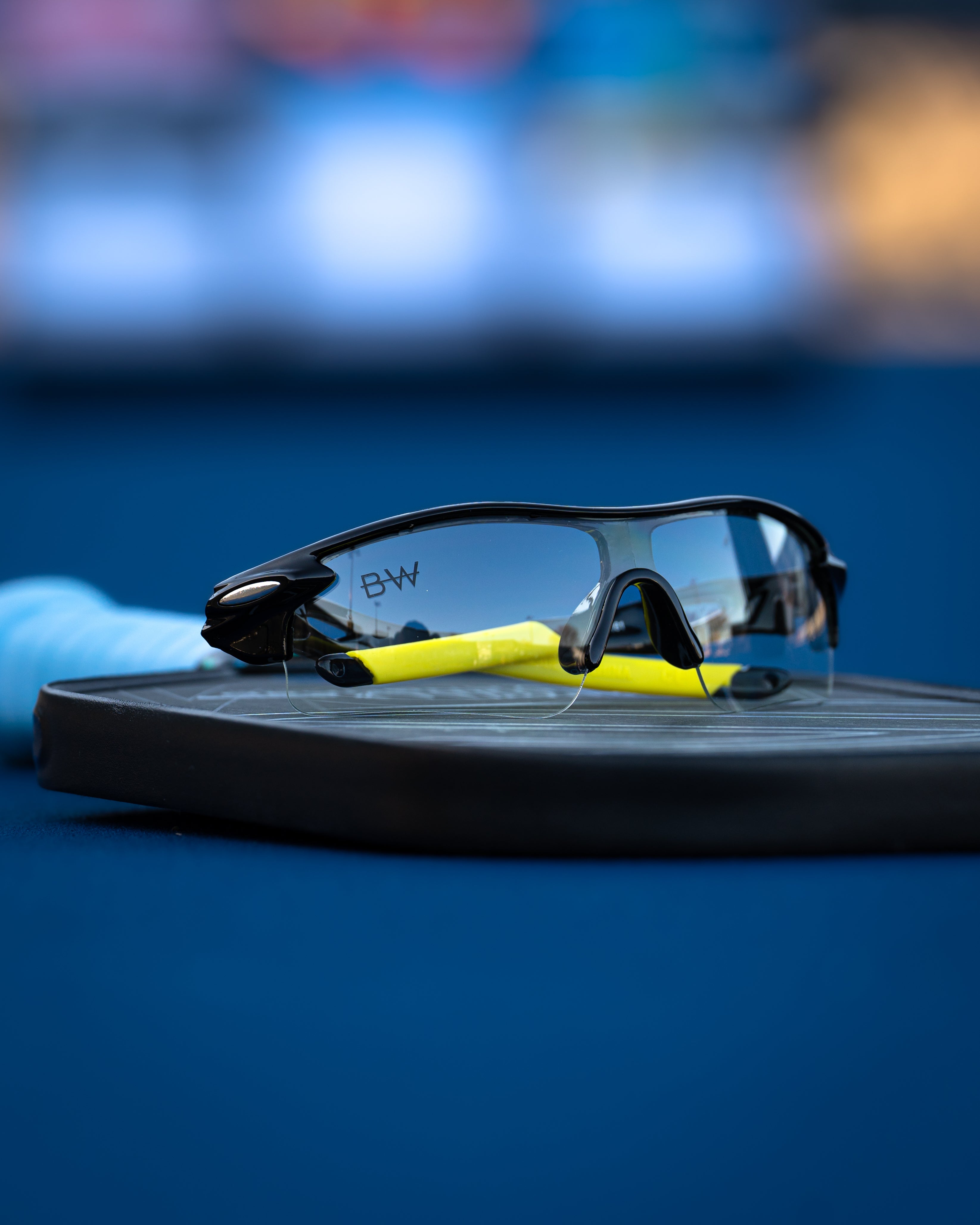
The Link Between Eye Strain and Sports Fatigue
Share
The Link Between Eye Strain and Sports Fatigue
You can have fresh legs and still feel mentally drained late in a pickleball session. Long periods of visual concentration, changing focus, bright or uncomfortable conditions, and uncorrected vision can all contribute to eye strain—and that discomfort can become one more source of fatigue during a long day on court.
Pickleball places continuous demands on your vision. You are watching the ball travel across different distances, reading opponents and partners, shifting attention around the court, and repeating that process point after point. When seeing comfortably becomes harder, staying visually engaged can feel harder too.
This guide breaks down the relationship between eye strain and sports fatigue, common signs to watch for, factors that can make visual discomfort worse, and how properly prescribed sports eyewear can fit into a more comfortable pickleball setup.
Looking for Pickleball Eyewear?
Explore prescription options now or use the Blinded Wear guides to narrow down your setup.
What Is Eye Strain?
Eye strain is a general term for uncomfortable visual symptoms that can appear after demanding or prolonged visual activity. It is often associated with symptoms such as tired or sore eyes, headaches, difficulty concentrating, blurred vision, or general visual discomfort.
For an athlete, the important distinction is that eye strain and whole-body physical fatigue are not the same thing. Your legs can become tired from repeated movement while your eyes can become uncomfortable from prolonged visual demands. During a long match or tournament, those experiences can overlap.
That is where the connection between eye strain and sports fatigue becomes relevant: visual discomfort can add another demand to an already demanding activity.
Why Pickleball Creates a Constant Visual Workload
A pickleball point requires much more than simply looking at the ball.
Your attention can move through a repeating sequence:
- Locate the server and ball.
- Watch preparation and contact.
- Follow the developing ball flight.
- Judge where the ball is traveling.
- Shift attention toward the next relevant court information.
- Reset for another shot.
During doubles, you may simultaneously be aware of your partner, two opponents, court positioning, and open space. During faster exchanges near the kitchen, those visual decisions happen repeatedly within a short period.
One rally may not feel visually demanding. Hundreds of these visual-attention cycles across a long session create a very different experience.
How Are Eye Strain and Sports Fatigue Connected?
Think of tournament fatigue as having several possible contributors rather than one single cause.
| Source of Fatigue | What You May Experience |
|---|---|
| Physical workload | Tired legs, reduced energy, muscle fatigue |
| Heat and environment | General discomfort and increasing physical demands |
| Mental concentration | Difficulty maintaining attention and decision-making consistency |
| Visual discomfort | Tired eyes, headaches, squinting, blurred vision, or difficulty concentrating |
| Long tournament schedule | Accumulated physical, mental, and visual demands |
This makes eye strain better understood as one potential contributor to how fatigued a player feels, rather than the sole explanation for late-match fatigue.
Signs of Eye Strain During Pickleball
Visual discomfort can present differently from player to player, but symptoms worth paying attention to include:
- Tired or uncomfortable eyes
- Headaches during or after extended visual activity
- Squinting more as a session continues
- Intermittent blurred vision
- Difficulty maintaining visual concentration
- Feeling like you need to rest your eyes
- Increasing visual discomfort later in a long playing session
A useful question is not simply, “Am I tired?” Instead ask, “What specifically feels tired?”
If your legs feel heavy after several matches, that points toward a different problem than repeatedly squinting, experiencing headaches, or struggling with visual comfort.
Eye Strain or Normal Match Fatigue? Use This Quick Check
| What You Notice | Possible Area to Examine |
|---|---|
| Heavy legs late in matches | Physical conditioning, workload, recovery |
| General energy drop | Overall match and tournament demands |
| Repeated squinting | Visual comfort and playing environment |
| Headaches associated with visual activity | Visual demands and prescription needs |
| Blurred vision | Vision correction and eye health |
| Difficulty concentrating after hours of play | Could involve several factors, including mental and visual fatigue |
Sometimes more than one factor is happening at once. A long tournament can be physically tiring, mentally demanding, and visually uncomfortable at the same time.
Where Your Prescription Fits Into the Picture
If you require vision correction, wearing an appropriate prescription helps provide the corrected vision you need while playing.
That matters in pickleball because the game continually asks you to use visual information at different locations around the court. Playing without the correction you need can leave you dealing with unnecessary blur or visual difficulty on top of everything else happening during a match.
Prescription sports eyewear gives players who need correction a way to combine their prescription with a frame designed for athletic use.
It does not need to promise superhuman reaction speed or automatic ball-tracking improvements to have a useful role. Providing the correction you need in eyewear designed with pickleball players in mind is already a meaningful function.
Why Constant Squinting Is Worth Paying Attention To
If you find yourself repeatedly squinting to see comfortably, especially as matches continue, pay attention to when and where it happens.
Ask yourself:
- Does it happen indoors, outdoors, or both?
- Does it start immediately or only after extended play?
- Are you wearing your current prescription?
- Does it happen during everyday activities too?
- Is the issue associated with a particular playing environment?
Those answers can tell you much more than simply assuming every late-match visual problem is caused by fatigue.
Lighting Conditions Can Change How Comfortable a Court Feels
Pickleball is played in a wide range of environments: outdoor courts in daylight, indoor facilities, evening sessions, covered courts, and venues with different artificial lighting.
Your eyewear preferences may change with those environments.
For example, players who do not want a dark sunglass tint indoors or during evening play may prefer a clear-lens option. Clear lenses provide an untinted alternative without needing to claim that they automatically enhance contrast or make the ball easier to track.
If that matches how you play, explore Clear Lens Pickleball Glasses →
How RX Sports Eyewear Fits Into a More Comfortable Setup
For pickleball players who require prescription correction, the goal is straightforward: see with the correction you need while wearing eyewear suited to active play.
Blinded Wear RX eyewear combines several characteristics relevant to that goal:
- Designed with pickleball players in mind
- Lightweight sports frames
- Impact-resistant lenses
- Non-polarized lenses
- Comfort for extended matches
- Performance-first frame designs
- High-index prescription lenses included at no additional cost
These features give players a useful basis for comparing RX sports eyewear without needing exaggerated claims about reaction time, visual processing, or athletic endurance.
Why Some Pickleball Players Prefer Non-Polarized Lenses
Blinded Wear uses non-polarized lenses.
A non-polarized lens does not add a polarization filter, preserving the visual information available without that filter. Some court players prefer this type of setup for pickleball.
Ultimately, lens preference is personal. The useful takeaway is that polarization status is another characteristic you can consider when choosing eyewear rather than treating one lens type as universally superior for every athlete.
High-Index Prescription Lenses for Pickleball
Blinded Wear includes high-index prescription lenses at no additional cost with RX eyewear.
High-index lenses are relevant to the construction of prescription eyewear, particularly for players who require corrective lenses and want a sports-oriented frame.
The exact prescription and lens requirements will vary from person to person, so your prescription remains the starting point when ordering.
RX Pickleball Glasses to Compare for Long Playing Sessions
If you're building a prescription setup for practices, leagues, tournaments, or other extended sessions, several Blinded Wear RX models are worth comparing.
Phantom II RX
Phantom II RX gives prescription players a lightweight sports-frame option designed with pickleball in mind. Compare its design and available measurements with eyewear that already fits you well.
Zebra II RX
Zebra II RX is another performance-first prescription frame for recreational and competitive pickleball players who want dedicated RX sports eyewear.
Blue Shield RX
Blue Shield RX adds another frame design to the Blinded Wear prescription lineup, giving players another option when comparing sports-frame shape, appearance, and fit preferences.
Crystal Wave II RX
Crystal Wave II RX can also be compared as a dedicated prescription pickleball frame for players building an on-court RX setup.
Gray Hound RX
Gray Hound RX rounds out this group with another prescription sports-frame design to compare based on your needs and preferences.
The 5-Question Post-Match Eye Strain Check
After your next long pickleball session, take 30 seconds and answer these questions:
- Were my eyes comfortable throughout the session?
- Did I start squinting more as play continued?
- Did I experience a headache or visual discomfort?
- Was my vision consistently clear with my current correction?
- Did a particular court or lighting environment seem noticeably less comfortable?
Do the same check across several sessions. Patterns are more useful than judging your entire eyewear setup from one unusually long or difficult day.
Simple Habits for a More Comfortable Day on Court
Eyewear is only one part of managing a long day of pickleball. A few basic habits can also help you understand and manage your visual experience.
- Use the vision correction you need. If you require prescription correction, make sure your sports setup accounts for it.
- Keep your lenses clean. Sweat, fingerprints, and debris can make lenses harder to see through comfortably.
- Use eyewear appropriate for the environment. Your preferred setup may differ between outdoor daylight and an indoor or evening session.
- Pay attention to recurring symptoms. Repeated headaches, blur, or visual discomfort are more informative than simply assuming you're having an off day.
- Give yourself breaks during long sessions when possible. Tournament and training fatigue can accumulate from several sources.
Could Your Prescription Be Part of the Problem?
If you rely on prescription correction and consistently struggle to see comfortably during pickleball, your eyewear setup deserves attention.
Persistent blur, headaches, double vision, significant eye discomfort, or noticeable changes in vision are good reasons to discuss your symptoms with an eye-care professional rather than trying to solve everything by changing sports frames.
For players with an appropriate prescription, dedicated RX sports eyewear can then provide a pickleball-focused way to wear that correction on court.
Quick Answers About Eye Strain and Pickleball
Can playing pickleball cause eye strain?
Long periods of visual concentration and demanding visual conditions can contribute to eye-strain symptoms in some people. Pickleball also involves repeated attention shifts across the court, making visual comfort relevant during longer sessions.
Can eye strain make you feel tired?
Eye strain can involve tired eyes, headaches, difficulty concentrating, and visual discomfort. During a long sports session, those symptoms can add to the overall feeling of fatigue.
Why do my eyes feel tired after pickleball?
Several factors may contribute, including prolonged visual concentration, your vision correction needs, environmental conditions, and the overall length of the session.
Can prescription glasses help with eye strain during sports?
If you require vision correction, wearing an appropriate prescription can address blur related to your refractive correction. Prescription sports eyewear provides a way to combine that correction with an athletic frame.
Are RX sports glasses only for competitive pickleball players?
No. Recreational players who require prescription correction can also use RX sports eyewear.
Are clear lenses useful for indoor pickleball?
Clear lenses provide an untinted option for indoor, evening, and lower-light environments where a player may not want dark sunglass tint.
What should I do if I regularly get headaches or blurred vision while playing?
Recurring headaches, persistent blur, double vision, significant discomfort, or changes in vision are worth discussing with an eye-care professional.
Visual Endurance Is More Than Just “Seeing the Ball”
Staying visually comfortable through a long pickleball session involves more than choosing a frame. Prescription correction, court environment, session length, visual habits, eyewear cleanliness, and overall fatigue can all influence how your eyes feel as the day progresses.
Part 2 will go deeper into visual fatigue during long rallies and tournaments, including an eye-strain troubleshooting system, indoor vs. outdoor scenarios, visual comfort between matches, common mistakes, an RX eyewear comparison, and a practical routine for players who notice their eyes feeling increasingly tired later in a session.
Why Your Eyes May Feel Different Late in a Long Pickleball Session
The first game of the day and the fifth game of the day can feel completely different. By the later stages of a long session, you're dealing with accumulated physical effort, sustained concentration, repeated visual attention, and potentially changing court conditions.
That makes it useful to think about visual endurance as part of the overall playing experience.
Visual endurance does not mean your eyes need special training to become athletic. It means being able to continue using the vision you rely on without increasing discomfort becoming a distraction.
For a pickleball player, that can involve:
- Consistently clear prescription correction
- Comfortable eyewear during extended wear
- Keeping lenses clean throughout the session
- Choosing eyewear that makes sense for the playing environment
- Recognizing when general fatigue and visual discomfort are happening at the same time
The Visual Fatigue Timeline: What Changes as You Keep Playing?
Instead of waiting until your eyes feel exhausted, pay attention to how your visual experience changes throughout a session.
| Stage | What to Pay Attention To |
|---|---|
| Warmup | Initial clarity, comfort, and whether you're squinting |
| Early games | Whether your vision feels consistent once match intensity increases |
| Mid-session | Headaches, eye discomfort, increasing squinting, or difficulty concentrating |
| Late session | Whether symptoms are primarily physical, visual, mental, or a combination |
| After play | Whether visual discomfort disappears quickly or continues after leaving the court |
Looking at the entire timeline can help you identify patterns that would be easy to miss if you only think about how you felt during the final few points.
The Pickleball Eye-Strain Troubleshooter
If your eyes start feeling tired during play, work through the problem instead of immediately blaming your conditioning or your eyewear.
1. Are Your Lenses Clean?
Sweat, fingerprints, dust, and other debris can accumulate during an active session. Start with the simplest variable: make sure you are looking through appropriately clean lenses.
2. Are You Wearing the Correction You Need?
If you rely on prescription correction, your on-court eyewear should account for those needs.
3. Are You Squinting?
Notice whether you're repeatedly narrowing your eyes to see comfortably. Also pay attention to when it happens—indoors, outdoors, later in the session, or throughout the entire day.
4. Is the Playing Environment Different?
Moving from outdoor daylight to an indoor facility, or continuing play later into the evening, can change your eyewear preferences.
5. Are You Simply Tired Overall?
After several games, your concentration and physical energy may also be declining. Visual discomfort can coexist with ordinary sports fatigue.
6. Does It Keep Happening?
If blur, headaches, double vision, or significant eye discomfort repeatedly appears during play, that pattern deserves more attention than a single difficult session.
Do Long Pickleball Rallies Cause Eye Strain?
A long rally requires sustained attention, but one extended point is usually only a small part of the visual workload of a full session.
The bigger demand comes from repetition.
Imagine the visual cycle across a competitive game:
- Watch the serve.
- Follow the return.
- Track player movement.
- Read the developing third shot.
- Transition toward the kitchen.
- Follow dink exchanges.
- Respond to a speedup.
- Reset for the next point.
Then repeat that process across multiple games.
That sustained attention is one reason visual comfort becomes increasingly relevant during leagues, drilling sessions, tournaments, and other extended periods of play.
Why Fast Kitchen Exchanges Feel So Visually Demanding
Fast exchanges near the non-volley zone compress a lot of information into a short period.
You may be paying attention to:
- The opponent contacting the ball
- The initial direction of the shot
- The ball approaching your side
- Your partner's position
- Open court space
- Your own paddle preparation
- What happens immediately after your response
The important point is not that special glasses make your nervous system react faster. It is that pickleball already gives your visual system plenty to pay attention to, making comfortable and appropriate vision correction especially relevant for players who need RX lenses.
Visual Fatigue vs. Reaction Time: Don't Confuse the Two
Players often describe themselves as “reacting slower” late in a session, but several different things may be happening.
| What Feels Slower | Possible Contributor |
|---|---|
| Getting to the ball | Physical fatigue or positioning |
| Choosing the right shot | Mental fatigue or decision-making |
| Seeing comfortably | Visual discomfort or correction needs |
| Recognizing what the opponent is doing | Attention, anticipation, experience, or fatigue |
| Executing the response | Technique, timing, physical fatigue, or preparation |
These can overlap. That is why solving every late-match mistake with a new pair of glasses—or solving every visual problem with more conditioning—misses the bigger picture.
Indoor Pickleball and Visual Comfort
Indoor facilities vary significantly. Court surfaces, wall colors, ceilings, artificial lighting, and the amount of natural light entering the facility can all change the visual environment.
If you do not want dark sunglass tint indoors, a clear-lens setup can provide an untinted alternative.
That can be particularly relevant for players who spend much of their time:
- At dedicated indoor pickleball facilities
- Playing evening leagues
- Training after work
- Competing in indoor tournaments
- Moving between daytime and evening sessions
Outdoor Pickleball and Long Playing Sessions
Outdoor players can encounter changing conditions over the course of a session. A morning game, midday tournament match, and late-afternoon session may not feel visually identical.
When choosing eyewear for outdoor play, think about the conditions you actually encounter most often rather than choosing entirely around a generic “outdoor” label.
Ask:
- What time of day do I usually play?
- How long are my normal sessions?
- Do I frequently move between indoor and outdoor courts?
- Do I require prescription correction?
- Which lens setup do I personally prefer in those conditions?
Those answers give you a more useful starting point for eyewear shopping.
Why Tournament Days Deserve Their Own Eye-Strain Strategy
Tournaments are different from a normal recreational session because the day may include warmups, matches, waiting periods, additional matches, and hours at the venue.
A simple tournament visual-comfort routine can look like this:
Before the First Match
Start with clean lenses and the prescription eyewear you intend to use.
Between Matches
Check your lenses, clean them appropriately when needed, and give yourself normal recovery time when the schedule allows.
Later in the Day
Pay attention to whether you're experiencing overall exhaustion or specific visual symptoms such as increasing squinting, headaches, blur, or eye discomfort.
After the Tournament
Notice whether those symptoms resolve after you finish playing or whether they regularly continue beyond the court.
This turns “my eyes always feel tired at tournaments” into something you can actually observe and understand.
Score Your Visual Comfort After Your Next Session
Use a simple 1-to-5 scale after several sessions. You are looking for patterns, not trying to diagnose yourself from one number.
| Category | 1 | 3 | 5 |
|---|---|---|---|
| Eye comfort | Very uncomfortable | Noticeable at times | Comfortable throughout |
| Visual clarity | Frequently unclear | Occasional difficulty | Consistently clear |
| Squinting | Frequent | Occasional | Rare or none |
| Headache symptoms | Significant | Mild | None |
| Late-session concentration | Very difficult | Some decline | Comfortable to maintain |
Write down the playing environment and approximate session length too. If one pattern repeatedly produces more visual discomfort than another, you now have useful information to work with.
Prescription Pickleball Glasses for Long Sessions: What Should You Compare?
If you need RX correction and you're choosing sports eyewear for longer sessions, keep the comparison practical.
| Factor | Why It Matters |
|---|---|
| Prescription correction | Your eyewear needs to provide the corrective vision for which it was ordered. |
| Frame dimensions | Available measurements can be compared with glasses that already fit you comfortably. |
| Frame weight | Lightweight sports frames can be appealing when eyewear stays on for extended matches. |
| Lens construction | Blinded Wear RX eyewear uses impact-resistant, non-polarized lenses. |
| Playing environment | Indoor, outdoor, evening, and mixed environments may influence your lens preferences. |
| Style | You are more likely to enjoy wearing a frame whose appearance suits you. |
5 Blinded Wear RX Frames to Explore
Phantom II RX
Phantom II RX is a lightweight prescription sports-frame option designed with pickleball players in mind. It can be considered by players looking for dedicated RX eyewear for regular practices, leagues, and longer playing sessions.
Zebra II RX
Zebra II RX provides another performance-first frame design for prescription pickleball players and can be compared based on fit preferences, appearance, and your individual prescription needs.
Blue Shield RX
Blue Shield RX gives players another prescription sports-frame option when building an on-court eyewear setup for recreational or competitive play.
Crystal Wave II RX
Crystal Wave II RX adds another frame shape and aesthetic to compare for players who need prescription correction on court.
Gray Hound RX
Gray Hound RX is another option for players comparing dedicated prescription sports eyewear for pickleball.
Comfort Is a Performance Consideration Without Being a Performance Claim
There is an important difference between saying comfortable eyewear is useful during sports and claiming a frame directly makes an athlete faster or more accurate.
If your glasses remain comfortable through a two-hour session, that matters because you are actually wearing them for two hours. If you need prescription correction, having eyewear you are comfortable keeping on can make your sports setup simpler.
That is especially relevant for:
- Long recreational sessions
- Multiple league games
- Drilling sessions
- Round robins
- Tournaments
- Players who spend several hours at a pickleball facility
Sometimes the most useful sports-eyewear benefits are also the simplest.
8 Mistakes That Can Make Your Pickleball Eyewear Setup Less Comfortable
-
Ignoring dirty lenses.
Check lens cleanliness before assuming your prescription or frame is the problem.
-
Playing without correction you normally rely on.
If you need prescription correction, account for it in your sports setup.
-
Ignoring recurring squinting.
Notice when it happens and whether the pattern changes by environment.
-
Assuming every late-match mistake comes from your eyes.
Physical and mental fatigue can affect play too.
-
Assuming every late-match mistake comes from conditioning.
Specific visual discomfort deserves attention when it repeatedly occurs.
-
Choosing eyewear solely from marketing terminology.
Your prescription needs, comfort preferences, frame dimensions, and playing environment are more useful buying criteria.
-
Never comparing frame measurements.
If exact fit is unknown, compare available dimensions with eyewear that already fits you.
-
Waiting until tournament day to think about your RX setup.
When possible, become familiar with the prescription eyewear you plan to use during competition.
A 3-Step Visual Comfort Routine for Pickleball
You do not need a complicated eye-training program. Start with three repeatable habits.
Before Play: Prepare
- Use your appropriate vision correction.
- Start with clean lenses.
- Choose eyewear suited to your playing environment and preferences.
During Play: Notice
- Are you beginning to squint?
- Are your eyes uncomfortable?
- Are your lenses dirty?
- Are you developing a headache?
- Are you physically exhausted rather than specifically visually uncomfortable?
After Play: Compare
- How long did you play?
- Where did you play?
- When did symptoms begin?
- Did they resolve after the session?
- Does the same pattern happen regularly?
Over several sessions, those answers can reveal much more than simply labeling everything “sports fatigue.”
More Questions About Eye Strain and Sports Fatigue
Can tired eyes affect concentration during sports?
Eye strain can include difficulty concentrating, so visual discomfort may become another distraction during an activity that already requires sustained attention.
Why do my eyes feel fine at the start of pickleball but tired later?
Longer periods of visual concentration can contribute to discomfort, while general physical and mental fatigue may also accumulate as the session continues.
Why do I squint more when I get tired?
If you notice increasing squinting, pay attention to your visual clarity, playing environment, and whether the pattern consistently appears after prolonged play.
Can dirty sports glasses make playing less comfortable?
Sweat, fingerprints, and debris can make lenses harder to see through comfortably, which is why carrying an appropriate cleaning cloth can be useful.
Should I use prescription glasses every time I play pickleball?
If you require prescription correction for the visual demands of play, your on-court setup should account for those corrective needs.
Are lightweight glasses better for long pickleball sessions?
Frame weight can be one consideration when choosing eyewear you expect to wear for an extended period. Overall comfort and fit remain individual.
Can eye strain cause headaches after pickleball?
Headaches can occur with eye strain, although headaches can have many causes. Recurring or significant symptoms deserve appropriate attention.
Can eye strain cause neck or shoulder discomfort?
Visual difficulties can sometimes influence how a person positions the head or body, but neck and shoulder discomfort during sports can have many causes and should not automatically be attributed to eyewear.
When should I get my vision checked?
If you're experiencing recurring blur, headaches, double vision, significant eye discomfort, or noticeable changes in vision, an eye-care professional can evaluate your vision and prescription needs.
What RX glasses are best for long pickleball sessions?
Look for prescription eyewear that meets your corrective needs and works with your preferences for frame dimensions, weight, playing environment, and extended wear. Blinded Wear offers multiple lightweight RX sports-frame options designed with pickleball players in mind.
Build an Eyewear Setup You Can Actually Wear for the Whole Session
Managing visual comfort is less about finding a lens that promises to eliminate fatigue and more about removing avoidable problems: uncorrected blur, dirty lenses, uncomfortable eyewear, an unsuitable setup for your environment, or ignoring recurring symptoms.
Part 3 will finish the guide with a late-match visual fatigue test, a session-by-session tracking system, an RX buying checklist for long-play comfort, final Phantom II RX vs. Zebra II RX vs. Blue Shield RX vs. Crystal Wave II RX vs. Gray Hound RX comparison, ordering guidance, expanded FAQ, shopping resources, lifetime replacement support, and a final plan for building a more comfortable pickleball eyewear setup.
The Late-Match Visual Fatigue Test
If your game starts feeling different after an hour or two, use a quick test to separate visual discomfort from general sports fatigue.
Between games, ask yourself:
- Can I still see comfortably? Notice blur, squinting, or difficulty keeping your vision comfortable.
- Do my eyes actually feel tired? Separate eye discomfort from heavy legs or overall exhaustion.
- Am I developing a headache? Pay attention to whether headaches consistently appear during longer sessions.
- Are my lenses clean? Sweat, fingerprints, and debris are easy variables to address.
- Has the environment changed? Indoor lighting, outdoor conditions, or the time of day may influence how comfortable your eyewear feels.
- Am I mentally tired? Long sessions also challenge concentration and decision-making.
The goal is not to diagnose every missed shot. It is to identify patterns. If your eyes consistently become uncomfortable around the same point in long sessions, that is useful information.
Track Eye Strain Across 5 Pickleball Sessions
One difficult day tells you very little. A repeated pattern across several sessions tells you much more.
Try this simple five-session tracking system:
| Session | Duration | Environment | Eye Comfort 1–5 | Squinting? | Headache? | Vision Clear? |
|---|---|---|---|---|---|---|
| 1 | _____ | Indoor / Outdoor | _____ | Yes / No | Yes / No | Yes / No |
| 2 | _____ | Indoor / Outdoor | _____ | Yes / No | Yes / No | Yes / No |
| 3 | _____ | Indoor / Outdoor | _____ | Yes / No | Yes / No | Yes / No |
| 4 | _____ | Indoor / Outdoor | _____ | Yes / No | Yes / No | Yes / No |
| 5 | _____ | Indoor / Outdoor | _____ | Yes / No | Yes / No | Yes / No |
Then look for trends. Maybe your eyes feel comfortable during shorter sessions but increasingly tired during three-hour round robins. Maybe you notice more squinting in one environment than another. Maybe your vision stays comfortable and your late-session decline is mostly physical.
That distinction helps you focus on the right problem.
Put Late-Match Fatigue Into 3 Buckets
When your game declines late in a session, sort what you're experiencing into three broad categories.
| Physical | Mental | Visual |
|---|---|---|
| Heavy legs | Difficulty concentrating | Tired or uncomfortable eyes |
| Slower court movement | Poor shot selection | Increasing squinting |
| General exhaustion | Losing track of score or strategy | Blurred vision |
| Reduced physical endurance | Mental frustration | Headache associated with visual activity |
You may experience symptoms from all three categories at once. The value of the system is simply recognizing that “I'm tired” can describe several different experiences.
What to Do Between Games When Your Eyes Feel Tired
If you notice visual discomfort between games, start with simple steps.
- Check your lenses. Clean them appropriately if sweat, fingerprints, or debris have accumulated.
- Take advantage of normal downtime. You do not need to spend every minute between games visually locked onto another match or screen.
- Check your eyewear comfort. Notice whether discomfort is coming from your eyes, the frame, or general fatigue.
- Pay attention to your environment. Your visual experience may change when moving between courts or playing later in the day.
- Notice whether symptoms improve. A short break can give you another useful data point about what you're experiencing.
These habits fit naturally into the same between-match routine you already use for hydration, equipment checks, and physical recovery.
Don't Forget About What You Do Between Matches
A tournament may involve more waiting than playing. That downtime is often spent checking messages, watching videos, scrolling social media, reviewing brackets, or staring at a phone until the next match is called.
If you're already noticing tired eyes during a long day, consider how much additional close-up visual attention you're adding between matches.
You do not need an elaborate tournament vision routine. Simply giving yourself some normal visual downtime can be a reasonable part of the break between games.
RX Buying Checklist for Long Pickleball Sessions
If you're shopping specifically because you spend hours on court, prioritize the fundamentals.
1. Start With Your Prescription
If you need corrective lenses, accurate prescription correction is the foundation of the setup.
2. Think About Extended-Wear Comfort
A frame that feels fine for five minutes still needs to work for the way you actually play. Blinded Wear uses lightweight sports frames designed to remain comfortable through extended matches.
3. Compare Frame Measurements
When measurements are available, compare them with eyewear that already fits you comfortably.
4. Consider Your Main Playing Environment
An outdoor daytime player may have different lens preferences than someone playing primarily indoors or at night.
5. Decide Whether You Want Tint
If you frequently play indoors, in the evening, or in lower-light environments and do not want dark sunglass tint, consider a clear lens option.
6. Choose a Frame You Actually Want to Wear
Sports eyewear still sits on your face for the entire session. Style and personal preference are valid parts of the buying decision.
Phantom II RX vs. Zebra II RX vs. Blue Shield RX vs. Crystal Wave II RX vs. Gray Hound RX
These five Blinded Wear prescription frames give pickleball players several designs to consider when building an RX sports-eyewear setup.
| RX Frame | Good Starting Point For | Core Features |
|---|---|---|
| Phantom II RX | Players comparing a lightweight RX sports-frame design | Prescription, lightweight sports frame, impact-resistant and non-polarized lenses |
| Zebra II RX | Players who prefer the Zebra II frame design | Prescription, lightweight sports frame, impact-resistant and non-polarized lenses |
| Blue Shield RX | Players comparing another performance-first RX frame style | Prescription, lightweight sports frame, impact-resistant and non-polarized lenses |
| Crystal Wave II RX | Players who prefer the Crystal Wave II frame design | Prescription, lightweight sports frame, impact-resistant and non-polarized lenses |
| Gray Hound RX | Players who prefer the Gray Hound frame design | Prescription, lightweight sports frame, impact-resistant and non-polarized lenses |
All five can serve the same fundamental purpose: providing prescription correction in a sports-oriented frame designed with pickleball players in mind. Your choice can then come down to frame design, available dimensions, playing environment, and personal preference.
Where High-Index RX Lenses Fit In
Blinded Wear includes high-index prescription lenses at no additional cost with RX eyewear.
High-index lenses are part of the prescription-lens construction rather than a shortcut to greater athletic endurance. They do not need to promise faster reactions or better ball tracking to be a useful part of an RX sports-eyewear setup.
Your prescription determines your corrective needs, while the sports frame gives you an eyewear format designed for active pickleball use.
Non-Polarized RX Lenses on the Pickleball Court
Blinded Wear RX eyewear uses non-polarized lenses. This means the lenses do not add a polarization filter and preserve the visual information available without that filter.
Some court players prefer non-polarized eyewear. As with frame shape and tint preference, it can simply be one of the characteristics you consider when choosing your setup.
5 Eye-Strain Myths Pickleball Players Should Know
Myth 1: If You're Tired Late in a Match, Your Eyes Must Be the Problem
Physical conditioning, heat, concentration, match duration, and visual comfort can all contribute to how you feel late in a session.
Myth 2: Sports Glasses Automatically Make Your Reactions Faster
Reaction time involves much more than eyewear. Prescription sports glasses provide corrective vision for players who need it in an athletic frame.
Myth 3: One Tint Is Best for Every Pickleball Court
Players compete across different environments and can have different lens preferences. There is no need for one universal tint recommendation.
Myth 4: Expensive-Looking Lens Technology Is More Important Than Your Prescription
If you require correction, your prescription is the foundation. Specialized terminology cannot substitute for the corrective vision you need.
Myth 5: Every Bad Late-Match Decision Is a Vision Problem
Technique, anticipation, positioning, concentration, physical fatigue, and experience all influence what happens during a rally.
When Eye Strain Keeps Happening
An occasional uncomfortable session and a repeating pattern are different.
Pay closer attention when you repeatedly experience:
- Blurred vision during play
- Headaches associated with visual activity
- Double vision
- Significant eye discomfort
- Noticeable changes in your vision
- Difficulty seeing clearly even with your normal correction
If those issues persist, an eye-care professional can evaluate your vision and prescription needs. Once you know the correction you need, prescription sports eyewear can give you a pickleball-focused way to wear it on court.
How to Order Blinded Wear RX Pickleball Glasses
Blinded Wear makes the prescription process straightforward.
- Browse the RX Pickleball Glasses Collection.
- Choose the frame that fits your preferences.
- Have your current eyeglass prescription ready.
- Take a clear photo or picture of the prescription.
- Upload your prescription before purchasing.
- Complete your order.
High-index prescription lenses are included at no additional cost, giving RX players a straightforward path to dedicated pickleball eyewear.
FAQ: Eye Strain, Sports Fatigue, and RX Pickleball Glasses
What does eye strain feel like during sports?
Eye strain can involve tired or uncomfortable eyes, headaches, blurred vision, squinting, or difficulty maintaining concentration during prolonged visual activity.
Can eye strain make sports feel more tiring?
Visual discomfort can become another source of discomfort during an activity that is already physically and mentally demanding, contributing to the overall experience of fatigue.
Why does my vision feel worse late in a pickleball session?
Several factors may be involved, including lens cleanliness, visual concentration, your corrective needs, the playing environment, and overall fatigue. Tracking when the problem occurs can help identify a pattern.
Can an outdated prescription contribute to visual discomfort?
If your vision is no longer appropriately corrected, you may notice blur or other visual difficulties. If you suspect your prescription has changed, an eye exam can determine your current corrective needs.
Can RX pickleball glasses prevent sports fatigue?
Sports fatigue has many contributors. RX sports eyewear is designed to provide the prescription correction you need in an athletic frame rather than eliminate physical or mental fatigue.
Can prescription sports glasses help me see clearly during pickleball?
If you require vision correction, prescription sports glasses can provide the corrective vision for which they are ordered while giving you a frame designed for active use.
Do prescription pickleball glasses improve reaction time?
Eyewear does not need to make neurological reaction time faster to be useful. Appropriate correction helps a player who needs RX lenses see with the correction prescribed for them.
Are clear lenses good for indoor pickleball?
Clear lenses provide an untinted option for indoor, evening, and lower-light environments where dark sunglass tint may not be preferred.
Should I have separate indoor and outdoor pickleball glasses?
Not necessarily. Some players prefer different setups for different environments, while others use the same eyewear across their normal playing conditions.
Should I clean my glasses between matches?
If sweat, fingerprints, or debris accumulate on your lenses, appropriate cleaning between matches can help maintain a clean viewing surface.
Are Blinded Wear RX glasses lightweight?
Yes. Blinded Wear uses lightweight sports frames designed with pickleball players in mind.
Are Blinded Wear lenses impact-resistant?
Yes. Blinded Wear uses impact-resistant lenses in its sports eyewear.
Are Blinded Wear RX lenses polarized?
No. Blinded Wear uses non-polarized lenses, which some court players prefer.
Are high-index prescription lenses extra?
No. Blinded Wear includes high-index prescription lenses at no additional cost.
What are the best RX pickleball glasses for long matches?
A useful starting point is prescription eyewear that meets your corrective needs while offering a lightweight sports frame you are comfortable wearing for extended play. Phantom II RX, Zebra II RX, Blue Shield RX, Crystal Wave II RX, and Gray Hound RX are several Blinded Wear options to compare.
Find Your Pickleball Eyewear Setup
Ready to build an eyewear setup around the way you actually play? Start with the resource that matches your needs.
Built for Players Who Keep Coming Back to the Court
Regular practices, league nights, drilling sessions, and tournaments can put plenty of use on sports eyewear over time.
Blinded Wear offers 50% lifetime replacement support if your glasses break, subject to current policy terms.
Learn more about Blinded Wear Replacement Support & Returns →
Performance Eyewear With a Bigger Purpose
Blinded Wear is focused on performance-first eyewear designed with pickleball players in mind, but the brand's mission extends beyond the court.
Learn more about the work behind the brand and its commitment to supporting children's vision on the Blinded Wear Mission page →
Your 5-Step Plan for More Comfortable Vision on the Pickleball Court
- Start with the correction you need. If you rely on prescription eyewear, make it part of your pickleball setup.
- Choose eyewear you can comfortably wear through your normal sessions.
- Keep your lenses clean.
- Pay attention to when visual discomfort appears. Track the environment, session length, squinting, headaches, and clarity.
- Look for patterns. Repeated symptoms tell you more than one difficult match.
Final Word: Your Eyes Are Part of the Endurance Equation
Pickleball fatigue is not just one thing. Your legs are working, your attention is working, and your visual system is continuously taking in information from the court.
That is why eye strain deserves a place in the conversation about long matches and tournament fatigue.
If you need prescription correction, a dedicated RX sports setup can help you bring that correction onto the pickleball court in lightweight eyewear designed for active play. Combine that with clean lenses, an environment that works with your eyewear preferences, and awareness of how your eyes feel as sessions get longer.
You do not need eyewear that promises to turn you into a faster athlete. You need eyewear that fits your vision needs and is comfortable enough to stay with you from warmup through the final game.
See comfortably. Stay focused on the point. Keep playing.