
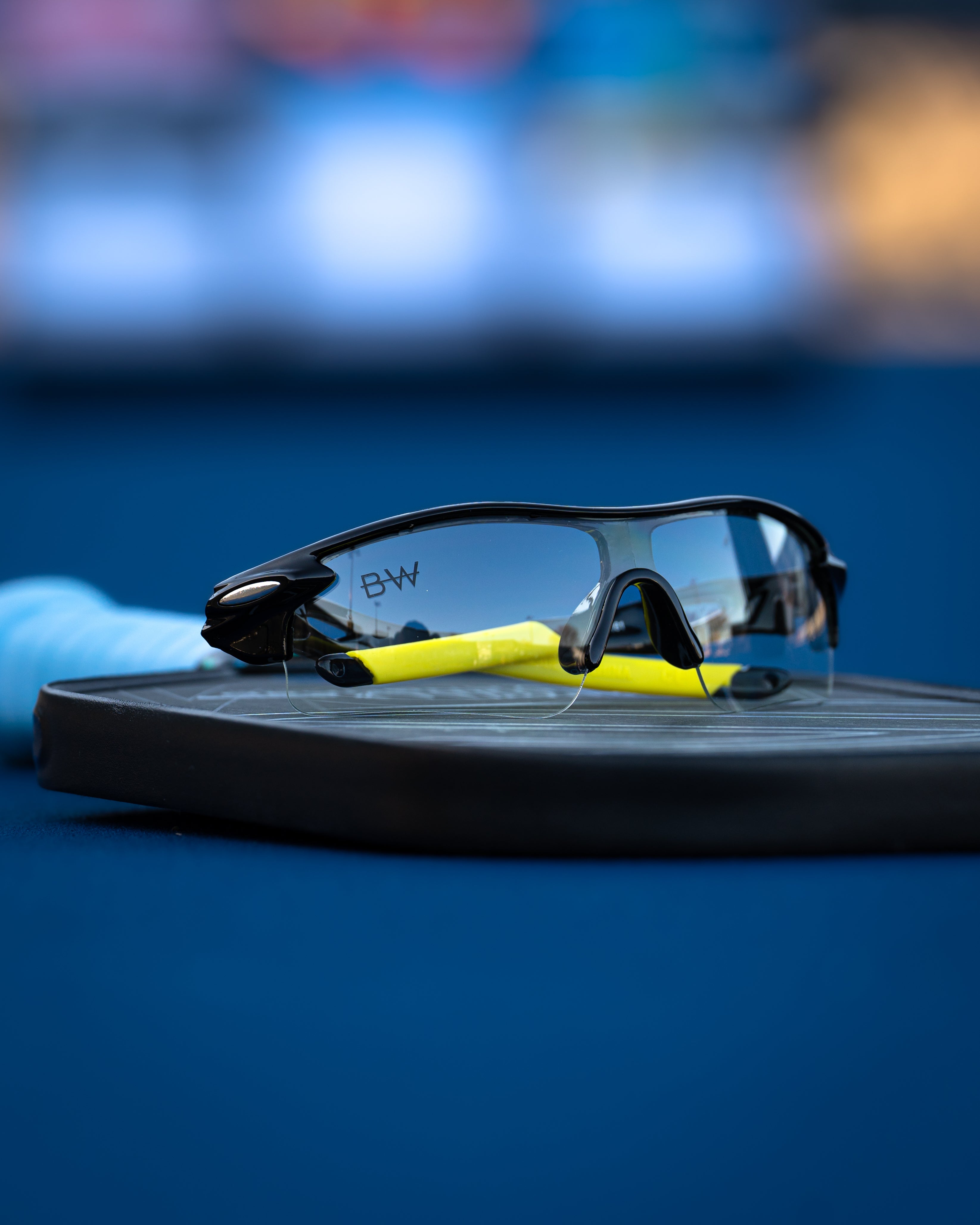
How the Brain Processes Vision Differently With Prescription Glasses
Share
Find Your Perfect Pickleball Glasses
Whether you need prescription (RX) or non-prescription glasses, our 2026 guide breaks down the top-performing models for clarity, comfort, and performance on every court.
Vision isn’t just about your eyes—it’s about how your brain interprets what your eyes see. For competitive pickleball players, this matters more than ever.
When you put on prescription sports eyewear, your brain doesn’t just receive clearer images—it has to recalibrate how it processes motion, speed, distance, and light.
In this post, we explore how prescription glasses change your brain’s visual input, how it impacts performance, and which RX lenses are built to complement that adaptation—especially under tournament pressure.
🧠 How the Brain "Sees": A Quick Breakdown
What you think of as "sight" is actually a neural computation that starts in your retina and ends in your visual cortex.
- 👁️ Light hits your retina and activates photoreceptors
- ⚡ Signals are sent via the optic nerve to your brain
- 🧩 Your brain builds a real-time map of motion, depth, and contrast
When you wear prescription glasses for the first time—or switch to new lenses—your brain adjusts the way it interprets distance, clarity, and peripheral motion.
🔁 Neural Adaptation: What Changes With RX Glasses?
According to recent studies in sports vision and neuro-optometry, the brain begins adapting to corrected input within hours—but full recalibration can take days or weeks, depending on the task.
Key Brain Adaptations With RX Glasses:
- 🎯 Faster target acquisition (ball, opponent, paddle)
- 🕶️ Improved depth perception and 3D motion tracking
- 🔄 Adjusted hand-eye coordination timing
- 🚀 Increased saccadic (micro-eye) movement control
This is why pickleball players wearing optimized prescription lenses often report feeling:
- “Snappier” on reaction shots
- More confident in ball placement
- Less visual fatigue late in matches
⚠️ Poor RX Input = Poor Brain Processing
If your prescription isn’t dialed in—or you’re relying on generic sunglasses with zero correction—the brain has to overcompensate.
This results in:
- 💢 Decision fatigue from overprocessing
- ⚡ Slower motor response to fast serves or dinks
- 👁️ Missed detail on spin or paddle angle
🎓 Neuroscience Insight: Studies show the brain devotes nearly 40% of its processing power to visual interpretation. Every millisecond matters on court.
🎓 Science of RX Lenses and Brain-Visual Optimization
Modern sports lenses are not just for clarity—they’re engineered to work in harmony with your brain.
How Blinded RX Lenses Support Brain Efficiency:
- 1.61 High-Index Lenses reduce distortion, especially in peripheral views
- Photochromic Transitions adjust light input to avoid visual overdrive
- Non-polarized tech preserves depth cues, helping the brain process space
🔗 Learn more about polarized vs. non-polarized in sports
🧠 Real Feedback From RX Athletes
“I noticed I was placing my paddle early. I wasn’t reacting faster—I was just seeing faster.”
– David W., TX (wearing Crystal Wave II RX)
“After a week in the Havana Melt RX, my resets started landing exactly where I wanted. It's like my eyes and brain were finally synced.”
– Lisa M., FL
“The mental fatigue used to hit me mid-tournament. With the Blue Shield RX, my brain stays fresh deep into Sunday.”
– Alex T., NV
👓 RX Glasses That Support Neuro-Visual Performance
Here are frames built to keep brain processing sharp—across lighting, match tempo, and pressure:
- Havana Melt RX – Transitional clarity + depth-preserving lenses
- Steel Ice RX – Stable comfort for multisets and fast reactions
- Crystal Wave II RX – Ideal for mixed lighting and visual consistency
- Blue Shield RX – Max visual clarity + fog resistance in extended rallies
📚 Related Reads on Vision and Brain Performance
- Transition Speed in RX Lenses: Why It Matters for Tournaments
- Dynamic Visual Acuity: The Secret Weapon in RX Glasses
- Does Prescription Eyewear Really Enhance Hand-Eye Coordination?
❓ FAQ: Brain and Vision With RX Eyewear
How long does it take the brain to adjust to new RX lenses?
Most players adapt within 1–3 matches. Some visual rewiring begins instantly and continues as you train in your RX pair.
Can prescription glasses actually help reaction time?
Yes. By delivering cleaner, more accurate visual input, the brain spends less time compensating—and more time responding.
Are Blinded RX lenses made for fast-paced play?
Yes. Every RX pair uses 1.61 high-index lenses with anti-fog, anti-scratch, and photochromic options. No visual lag, no compromise.
Do these glasses help with visual fatigue?
Absolutely. Many users report sharper focus, less squinting, and fewer headaches mid-tournament.
🎯 Ready to Sharpen Your On-Court Brainpower?
- Take the RX Quiz and Get 10% Off Your First Pair
- Browse the Full RX Collection
- View Warranty + Protection Plan Details
🏁 Final Takeaway
Wearing prescription glasses doesn’t just help you see better—it helps your brain think faster, move smarter, and react with confidence. On the court, where milliseconds matter, that can be the difference between going home early or staying in the winner’s bracket.
Don’t just correct your vision—optimize how your brain uses it.
Explore the RX frames trusted by elite and everyday players alike »