
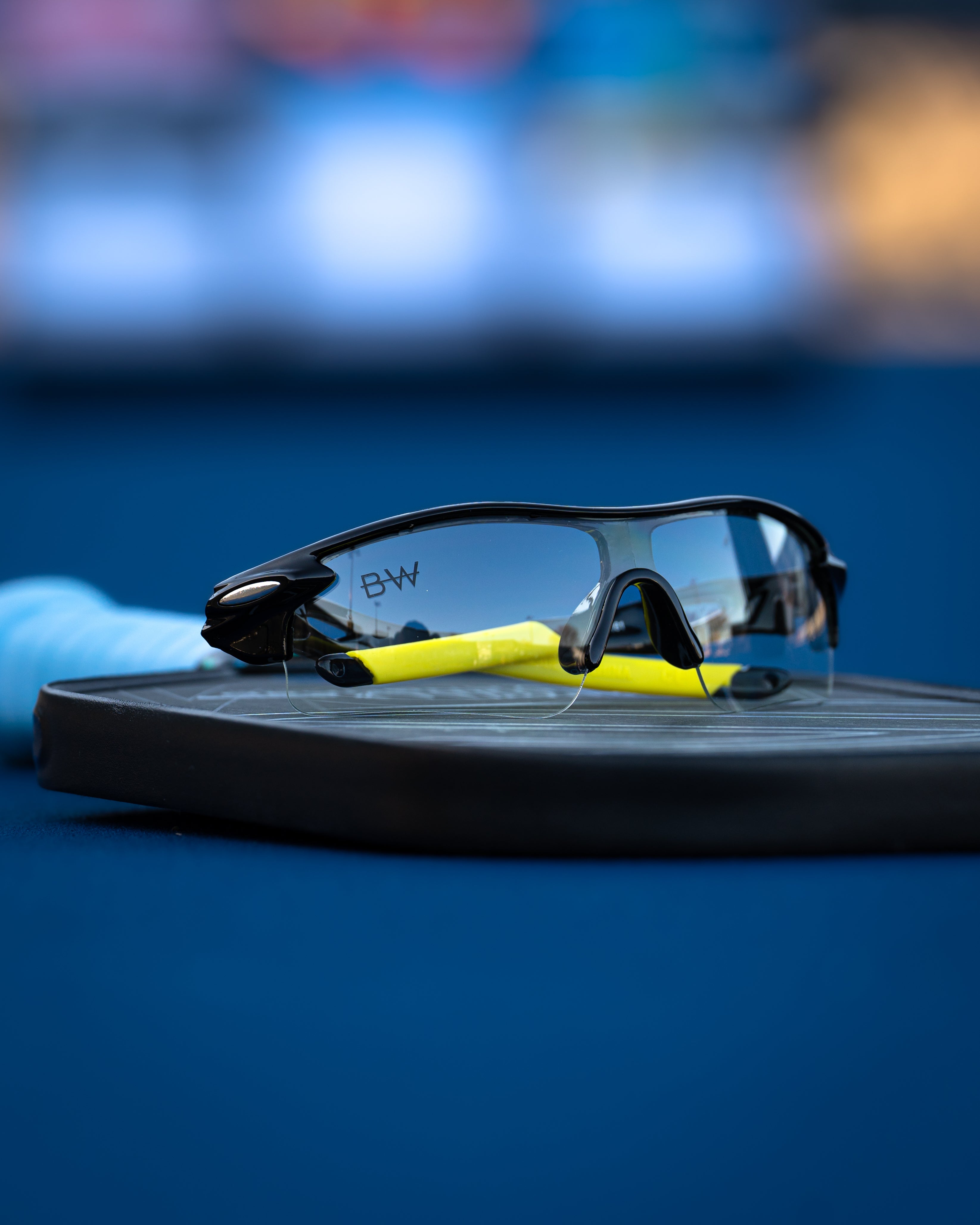
How These RX Glasses Keep Up With Your Active Lifestyle
Share
Find Your Perfect Pickleball Glasses
An active lifestyle can take you from pickleball practice to work, travel, errands, training, and another match in the same day. If you need prescription correction, the right RX eyewear should fit naturally into that routine without relying on exaggerated performance claims.
How These RX Glasses Keep Up With Your Active Lifestyle
Pickleball before work. A full afternoon away from home. An evening practice session. A weekend tournament. An active routine can put prescription eyewear through far more handling and movement than simply wearing glasses while sitting at a desk.
For players who need prescription correction, sports eyewear can provide a practical way to combine an appropriate RX with a frame intended for active use.
But “active lifestyle eyewear” should not mean making unsupported promises about zero slippage, fog-proof lenses, indestructible frames, faster reactions, or enhanced athletic performance.
Instead, the most useful questions are straightforward: Does the frame work with your prescription? Does it fit comfortably? Is it practical for your normal activities? Does the available lens configuration suit where you actually wear it?
What Should RX Glasses for an Active Lifestyle Actually Do?
Prescription sports eyewear has several practical jobs.
- Provide the refractive correction prescribed for the wearer
- Fit comfortably during normal activity
- Work with the wearer's prescription requirements
- Remain practical through everyday movement and pickleball
- Offer a lens configuration appropriate for the environments where it will be used
- Be manageable to clean, store, and transport
None of those benefits requires claiming that the eyewear makes the wearer a faster, more coordinated, or more skilled athlete.
Your Active Lifestyle Does Not Change Your Prescription
Your schedule may change throughout the day, but that does not automatically change your refractive prescription.
Moving between:
- Home and work
- Indoor and outdoor courts
- The gym and pickleball
- Morning and evening activities
- Travel and competition
does not create different SPH, CYL, AXIS, or prism values simply because the environment or activity changes.
Use the appropriate eyeglass prescription for your vision needs rather than intentionally strengthening or weakening it for sports.
Prescription Correction and Athletic Performance Are Different
An appropriate prescription is intended to correct refractive error. It should not be marketed as independently improving:
- Reaction time
- Ball tracking
- Depth perception
- Coordination
- Shot accuracy
- Strategic decision-making
- Visual processing speed
- Athletic endurance
Your eyewear can handle the vision-correction role. Training, technique, movement, decision-making, and physical conditioning remain the athlete's job.
Active Eyewear Starts With Fit
A frame that looks good but repeatedly becomes uncomfortable or moves substantially during normal activity may not be the best choice for that individual wearer.
When evaluating an RX sports frame, consider how it feels while:
- Walking
- Turning your head normally
- Moving laterally on court
- Serving and returning
- Dinking and volleying
- Perspiring
- Wearing it for an extended session
Fit is personal, so no sports frame should be promised to stay perfectly stationary on every face.
Do RX Sports Glasses Stay Put No Matter What?
No responsible frame description should promise zero movement in every activity and condition.
Frame stability can be influenced by:
- Individual facial anatomy
- Frame dimensions
- Overall fit
- Perspiration
- Sunscreen or skin products
- Movement intensity
- Frame condition
A comfortable active fit is a reasonable goal. “Locked in forever” is not.
The Tightest Frame Is Not Automatically the Best Active Frame
Trying to eliminate every millimeter of movement by choosing excessive pressure can create another problem: discomfort.
Active eyewear should balance stability with comfort rather than relying on maximum clamping force.
If a frame causes persistent pressure or discomfort, a tighter fit is unlikely to be the right solution.
What Happens When You Sweat?
Perspiration can affect how a frame feels or sits and can leave residue on the lenses or frame.
Sweat does not change:
- Your prescription
- Your SPH
- Your CYL
- Your AXIS
- Your anatomical PD
- The refractive index of the lens
If eyewear begins moving substantially after you perspire, treat that as a fit consideration rather than evidence that the prescription needs to change.
Do Blinded Wear RX Frames Have Special Anti-Slip Grips?
Do not assume that every Blinded Wear RX frame includes adjustable nose pads, silicone nose pieces, proprietary temple grips, or another specific anti-slip technology unless that feature is verified for the exact product.
Frame appearance alone is not enough to establish those specifications.
The better approach is to evaluate the fit and verified construction of the exact model you are considering.
Why Lightweight Sports Frames Can Appeal to Active Players
Blinded Wear offers lightweight sports-frame options designed with pickleball players in mind.
For someone wearing prescription eyewear through practices, matches, travel, and other daily activities, overall frame comfort can be an important buying consideration.
Lightweight should not, however, be confused with indestructible. Frame weight does not by itself establish crush resistance, impact performance, scratch resistance, or expected lifespan.
Where High-Index RX Lenses Fit Into an Active Setup
Blinded Wear includes high-index prescription lenses at no additional cost with RX eyewear.
High-index refers to a category of prescription lens material with a higher refractive index than conventional lens materials. Its practical role is commonly related to managing finished prescription-lens thickness, particularly as prescription strength increases.
Final lens thickness still depends on factors such as:
- Prescription strength
- SPH and CYL values
- Lens dimensions
- Frame dimensions
- Optical positioning
- Lens design
- Other prescription requirements
What High-Index Does Not Automatically Mean
High-index should not be treated as shorthand for every desirable sports-lens feature.
High-index alone does not establish:
- Impact resistance
- Scratch resistance
- Shatterproof construction
- Anti-fog performance
- Hydrophobic performance
- Anti-reflective treatment
- UV specifications
- Polarization
- Safety certification
- Improved reaction time
- Better ball tracking
- Improved depth perception
Those characteristics are separate and should be verified individually when relevant.
Impact Resistance Matters, but It Does Not Mean Indestructible
Blinded Wear offers impact-resistant lens options, which can be relevant when comparing eyewear intended for active use.
However, several terms should not be treated as interchangeable:
- Impact-resistant
- Shatterproof
- Crushproof
- Scratchproof
- Safety-certified
- Ballistic-rated
Impact resistance does not automatically establish the other characteristics on that list.
Any eyewear can potentially be damaged when subjected to sufficient force.
What Actually Influences Eyewear Durability?
Finished eyewear durability is more complicated than one material specification.
Relevant factors can include:
- Lens material
- Lens geometry
- Edge thickness
- Frame construction
- How the lenses are mounted or retained
- Physical impacts
- Compression
- Surface abrasion
- Heat exposure
- Handling and storage
This is why it is more accurate to discuss specific characteristics than to declare one frame “unbreakable.”
RX Frames to Explore for an Active Routine
There is no single Blinded Wear frame that is automatically best for every active player. Instead, compare current RX options based on prescription compatibility, frame preference, fit, and verified lens configuration.
Steel Ice RX
Steel Ice RX is one current prescription option to compare if you want a sports-oriented frame for pickleball and everyday use.
Choose it based on the actual frame, fit, prescription compatibility, and available configuration rather than assuming it has proprietary shock absorption or is specifically designed for aggressive players.
Blue Shield RX
Blue Shield RX provides another current RX style.
The name “Blue Shield” should not by itself be interpreted as proof of blue-light filtering, anti-glare treatment, UV specifications, or a particular protective certification.
Lava Rock RX
Lava Rock RX is another direct RX option that active players can compare.
Do not assume it has proprietary shock-absorbing construction, superior grip, or guaranteed anti-slip characteristics unless those features are specifically verified.
Crystal Wave II RX
Crystal Wave II RX provides another prescription style to consider.
Check the exact current product configuration rather than assuming a photochromic or transitional option is always included or available.
More RX Pickleball Frames to Compare
Active players can also explore additional current prescription options, including:
Browse the complete Prescription Pickleball Glasses Collection for current options.
How to Compare RX Frames for an Active Lifestyle
| Factor | What to Consider |
|---|---|
| Prescription compatibility | Whether the exact frame and configuration can accommodate your RX needs |
| Fit | How the frame sits during realistic everyday and pickleball movement |
| Comfort | How the eyewear feels during longer periods of wear |
| Frame dimensions | Whether the size and geometry work for your face and prescription |
| Lens configuration | Which verified options are actually available for the exact product |
| Playing environment | Whether you normally play indoors, outdoors, or across multiple environments |
| Care | How you will clean, store, and transport the eyewear |
| Backup needs | Whether losing access to the primary pair would significantly disrupt your routine |
What Does “All-Day Comfort” Really Mean?
Comfort is personal. No frame can guarantee identical comfort for every wearer from morning through night.
When evaluating eyewear for extended use, pay attention to:
- Temple pressure
- Nose contact
- Overall frame balance
- Repeated slippage
- How the frame feels after perspiration
- How it feels after extended wear
A frame that is comfortable for one player may fit another player differently.
Can You Wear the Same RX Pair From Work to the Pickleball Court?
Potentially, yes.
There is no requirement that a prescription wearer maintain one RX solely for ordinary daily use and another prescription solely for pickleball.
If a particular sports frame is comfortable and its configuration works for the environments where you use it, one pair may fit multiple parts of your routine.
Whether that is preferable to separate pairs is an individual decision.
Do You Need Different Prescriptions Indoors and Outdoors?
Not automatically.
The underlying refractive prescription does not change simply because you walk from an indoor gym onto an outdoor court.
The main difference may instead involve light management.
Depending on verified product availability and personal preference, a player might use:
- A clear or other higher-transmission configuration
- A fixed tinted configuration
- An available photochromic configuration
- Separate RX pairs for substantially different environments
Those are lens-configuration decisions, not reasons to invent a different refractive prescription.
Where Clear RX Lenses Can Fit
Clear prescription lenses provide refractive correction without a dark visible tint.
That can make a clear configuration practical when a dark tint is not desired, including some indoor, evening, or lower-light situations.
However, clear does not automatically mean:
- Exactly 100% VLT
- Anti-reflective
- Anti-fog
- Scratch-resistant
- Polarized
- Photochromic
- Impact-resistant
- UV-rated
- Safety-certified
Those specifications must be verified separately.
Where Fixed Tinted RX Lenses Can Fit
A fixed tint can reduce visible-light transmission relative to a lighter configuration, depending on the exact lens.
Its tint remains substantially fixed while the surrounding environment changes.
That can make a fixed tint straightforward for players who frequently use the eyewear under similar lighting conditions.
There is no universal tint or VLT that is best for every active pickleball player.
What About Photochromic RX Lenses?
When available for the exact product, photochromic lenses can provide one-pair convenience by changing tint in response to relevant environmental conditions.
Their exact behavior depends on the specific technology and environment.
Do not assume that photochromic lenses:
- Change instantly
- Always become completely clear indoors
- Always become maximally dark outdoors
- Respond identically behind every window
- Perform the same at every temperature
- Are available on every Blinded Wear RX frame
Check the exact product configuration before ordering.
Understanding VLT for an Active Schedule
VLT stands for Visible Light Transmission. It describes the percentage of visible light transmitted through a lens.
In general:
- Higher VLT means more visible light is transmitted.
- Lower VLT means less visible light is transmitted.
VLT is useful when comparing verified lens specifications, but it does not tell you everything about a lens.
VLT alone does not establish polarization, UV specifications, impact resistance, scratch resistance, prescription accuracy, or athletic performance.
Does an Active Player Need Polarized RX Lenses?
Polarization is a separate lens characteristic and should not be treated as a requirement for every active player.
It also does not independently determine:
- Depth perception
- Reaction time
- Ball tracking
- Prescription strength
- VLT
- UV specifications
- Impact resistance
Choose among verified options based on your actual environment and preferences rather than assuming polarization is universally better for sports.
Can Active RX Glasses Fog?
Yes. Fogging can occur when environmental conditions allow condensation to form on the lens surface.
Fog is not a change in prescription, and a sports-oriented frame should not automatically be described as fog-proof.
Do not assume that a frame has special anti-condensation vents or that its lens has an anti-fog coating unless those exact features are verified.
Foggy Lenses and Blurry Prescription Are Different Problems
If condensation temporarily covers a lens, the view through it may become hazy. That does not mean the prescription has suddenly become inaccurate.
Fog does not change:
- SPH
- CYL
- AXIS
- Prism
- PD
- Lens refractive index
Keep surface condensation separate from prescription concerns.
Are All Blinded Wear RX Lenses Hydrophobic?
Do not assume a hydrophobic or water-repellent coating is standard across every RX product unless that feature is specifically verified.
Likewise, a lens should not automatically be described as anti-smudge, oleophobic, anti-fog, or scratch-resistant based solely on its appearance.
Coatings are separate characteristics that should be supported by exact product specifications.
What If Your Active Day Includes Rain?
Rain droplets can interfere with the view through a lens, while wet conditions may also influence frame fit.
Rain does not change the prescription manufactured into the lenses.
Also remember:
- Water resistance is not the same as anti-fog performance.
- Hydrophobic treatment is not the same as waterproof construction.
- Impact resistance does not establish water resistance.
- High-index material does not automatically repel moisture.
If court conditions become unsafe because of lightning, poor traction, or severe weather, safety takes priority over continuing play.
Sweat, Sunscreen, and Dirt Can Affect the View Without Affecting the RX
An active day can leave fingerprints, perspiration, sunscreen, dust, or other residue on eyewear.
Surface contamination can interfere with the view through a lens, but it does not rewrite the prescription.
That distinction can prevent a simple cleaning issue from being mistaken for an optical-power problem.
How to Clean RX Glasses During an Active Day
Use lens-compatible cleaning methods and avoid unnecessarily abrasive contact.
Helpful principles include:
- Remove loose grit appropriately before rubbing the lens.
- Keep the material used for cleaning free of debris.
- Use products appropriate for the exact lens and coatings.
- Avoid abrasive DIY polishing methods.
- Avoid toothpaste, baking soda, automotive polish, or similar scratch-removal tricks.
- Do not assume every household cleaner is compatible with prescription eyewear.
Does a Scratch Change Your Prescription?
No. A scratch is physical surface damage rather than a change in the prescription power manufactured into the lens.
A scratch can be more or less noticeable depending on its location and severity, but there is no universal scratch-size rule that determines whether every wearer will notice it.
Scratch resistance, when present, should also not be confused with scratchproof construction.
A Scratch and a Crack Are Not the Same Thing
A scratch primarily affects the surface. A crack represents structural physical damage.
If a lens or frame experiences a meaningful impact, inspect the eyewear for:
- Cracks
- Chips
- Lens displacement
- Frame deformation
- A significant change in fit
Do not intentionally bend or strike damaged eyewear to test how much additional force it can tolerate.
RX Glasses for Players Who Travel
Active lifestyles often involve more than movement on the court. Eyewear may spend time in backpacks, luggage, cars, hotels, airports, gyms, and tournament bags.
Travel can expose glasses to several different types of stress:
- Compression
- Drops
- Abrasion
- Repeated handling
- Heat
- Moisture and residue
No single “durable” label guarantees resistance to every one of these stresses.
Protective Storage Matters When You Are Constantly Moving
When prescription glasses are not being worn, appropriate storage can reduce unnecessary exposure to pressure, abrasion, drops, and contamination.
A structured case can provide greater physical separation from surrounding objects than leaving glasses loose in a bag, although no case makes eyewear indestructible.
A soft pouch may help separate eyewear from some surfaces but generally offers less structural protection from external compression.
Do not assume that a hard case, sleeve, or microfiber accessory is included with every Blinded Wear RX product unless it is specifically listed.
Do Not Treat a Crowded Gym Bag Like a Protective Case
Tossing prescription eyewear loose among shoes, keys, bottles, paddles, chargers, and other hard objects can expose it to avoidable abrasion and compression.
Impact-resistant lenses are not automatically crushproof, and lightweight frames are not immune to deformation.
Protective storage is more reliable than expecting the eyewear to survive unnecessary pressure.
Be Careful With Prolonged Extreme Heat
Active schedules can make it tempting to leave eyewear in a vehicle between activities.
Avoid unnecessary prolonged exposure to extreme heat. The exact effect can depend on frame material, lens material, coatings, and construction, so there is no universal temperature threshold that applies to every pair.
Do not use a hair dryer, hot water, dashboard heat, or another extreme heat source as a DIY frame-adjustment method.
Traveling by Air With RX Pickleball Glasses
If prescription eyewear is important to your ability to function comfortably, keeping your primary pair and an appropriate backup accessible can be more practical than relying entirely on checked luggage.
This is a redundancy strategy, not a claim that the eyewear is specially tested for airline travel.
No ordinary sports frame should be described as airline-proof, TSA-proof, or crushproof without specific supporting evidence.
Why Active Players May Want a Backup RX Pair
A backup pair can be valuable when your schedule depends heavily on prescription correction.
The benefit is simple: if your primary pair becomes damaged or unavailable, you have another appropriate option.
A useful backup should ideally be:
- Appropriate for your current vision needs
- In functional physical condition
- Familiar enough that you know how it fits
- Stored appropriately
A backup pair does not need a deliberately weaker or stronger prescription for sports.
Is an Old Pair Good Enough as a Backup?
Possibly, but only if the prescription remains appropriate and the eyewear is still in usable condition.
Do not assume an outdated pair is automatically suitable because it is only intended for emergencies.
If your vision needs have changed, an older prescription does not become current simply because the glasses are kept in a tournament bag.
What If Your Glasses Shift While You Move?
If a frame slides or shifts, the prescription itself does not change.
Instead, the position of the lenses relative to your eyes changes.
This is an important distinction because persistent slippage is primarily a fit and wearing-position issue rather than a reason to alter the prescribed optical power.
Movement Does Not Change Your Pupillary Distance
Your anatomical pupillary distance does not become wider when running, narrower when playing pickleball, or different when a frame slides down your nose.
PD is used as part of prescription-lens positioning. It is not an adjustable sports-performance setting.
Why Wearing Position Still Matters
Prescription-lens positioning is more nuanced than simply placing the geometric center of every lens directly over the pupil.
Depending on the prescription and lens design, relevant considerations can include:
- PD information
- Horizontal positioning
- Vertical positioning when applicable
- Frame geometry
- Lens design
- Vertex distance
- Pantoscopic tilt
- Frame curvature
This is another reason fit can matter without claiming that a frame improves athletic performance.
What If an Active Day Leaves the Frame Bent?
A deformed frame can change how the lenses sit relative to your eyes without changing the optical power already manufactured into the lenses.
If the eyewear is visibly distorted after compression or impact, inspect it and avoid aggressive DIY bending or heating.
An optical professional may be able to evaluate whether a compatible adjustment is appropriate for the exact frame.
High-Index Does Not Make an RX More Accurate
Prescription accuracy and refractive index are separate concepts.
High-index material can help manage thickness in appropriate configurations, but it does not automatically create more accurate prescription power than another suitable lens material.
Likewise, tint, polarization, and frame style do not determine whether the prescribed values were produced accurately.
Why the Same RX Can Feel Different in Another Frame
Two pairs can be based on the same written prescription yet create different wearing experiences.
Differences can involve:
- Frame dimensions
- Lens dimensions
- Lens material
- Lens design
- Optical positioning
- Frame curvature
- Vertex distance
- Tilt
- Overall fit
A different feeling does not automatically prove that one prescription was manufactured incorrectly.
Give New RX Sports Glasses a Realistic Trial
If possible, use new prescription eyewear during ordinary activities and practice before relying on it for an important tournament.
This gives you an opportunity to evaluate:
- Comfort
- Fit
- Frame movement
- How the lens configuration feels in your usual environment
- Overall familiarity
- Whether unexpected visual symptoms persist
There is no universal adaptation period that applies to every prescription wearer.
When a Visual Problem Deserves More Than a Frame Adjustment
Do not diagnose every visual symptom as a sports-frame issue.
If you experience persistent unexpected blur, new or persistent double vision, significant new visual changes, eye pain, or another concerning visual symptom, appropriate professional evaluation is more useful than repeatedly changing the frame yourself.
How to Order Blinded Wear RX Glasses
For applicable Blinded Wear RX products, upload a clear photo of your eyeglass prescription on the product page before adding the eyewear to your cart.
When preparing the prescription information:
- Make sure the image is readable.
- Keep OD and OS values distinct.
- Preserve plus and minus signs.
- Do not guess unclear numbers.
- Do not round prescription values yourself.
- Do not alter CYL or AXIS for sports.
- Do not remove prescribed prism.
- Do not substitute a contact-lens prescription.
For additional guidance, visit How to Order RX Glasses.
Contact Lens Prescriptions Are Not Eyeglass Prescriptions
An active lifestyle does not make contact-lens and eyeglass prescriptions interchangeable.
Do not self-convert a contact prescription simply because the glasses will be used for pickleball, running, travel, or other activities.
Use the appropriate eyeglass prescription for prescription eyewear.
Does Prescription Strength Determine Which Activities You Can Do?
Prescription magnitude alone does not determine athletic ability or whether someone can live an active lifestyle.
Stronger or more complex prescriptions can create additional lens-design and frame considerations, but there is no universal prescription threshold at which sports eyewear becomes unsuitable.
Compatibility should be evaluated for the complete prescription and exact product.
Stronger Prescriptions Can Change Lens Geometry
Stronger minus prescriptions can generally produce more edge thickness, while stronger plus prescriptions can generally produce more center thickness.
Finished thickness depends on the complete prescription, lens dimensions, frame dimensions, design, positioning, and material.
This is where high-index material can be useful for thickness management without needing to claim a performance advantage.
Can You Use RX Sports Glasses for Running?
A player may choose to use the same prescription sports eyewear for multiple activities if the fit, prescription, and configuration are appropriate for those uses.
However, a frame marketed around pickleball should not automatically be claimed to be specially engineered or tested for running unless that has been verified.
Evaluate fit during the actual activities you plan to do.
What About Wearing RX Sports Glasses at the Gym?
The same principle applies to gym use.
If the eyewear is comfortable and practical for your activity, you may prefer wearing the same pair rather than constantly switching frames.
But specific gym, weight-training, or protective certifications should not be inferred from sports styling alone.
What About Cycling or Other Fast-Moving Activities?
Do not assume that pickleball eyewear is automatically specialized cycling, occupational, tactical, or high-speed protective eyewear.
Activities can have different coverage, impact, wind, and safety requirements.
If a specific protective standard is important for another sport or activity, verify the exact eyewear requirements rather than relying solely on its use for pickleball.
Sports Styling Is Not the Same as Safety Certification
A frame can look athletic without being certified to a particular protective standard.
Likewise, an impact-resistant lens option does not automatically establish occupational, industrial, or ballistic protection.
If a specific certification matters for an activity, verify that exact standard for the exact eyewear.
Can RX Pickleball Glasses Be Everyday Glasses?
Some players may enjoy wearing a sports-oriented RX frame beyond the pickleball court because they like the appearance, fit, or convenience of keeping one pair with them.
Others may prefer separate everyday and sports frames.
Neither approach is universally better. The decision depends on the wearer, prescription requirements, available configuration, style preference, and daily routine.
One RX Pair or Two?
| Approach | Potential Reason to Choose It |
|---|---|
| One primary RX pair | Simplicity when one configuration works well across the wearer's normal environments |
| Separate indoor and outdoor configurations | Greater control when lighting environments differ substantially |
| Primary plus backup RX pair | Redundancy if the primary pair becomes unavailable |
| Everyday pair plus sports pair | Different fit or style preferences for daily and active use |
The underlying refractive prescription should not be deliberately changed simply because two pairs serve different lifestyle roles.
Active RX Eyewear Myths vs. Reality
| Myth | More Accurate Explanation |
|---|---|
| Sports RX frames never slip. | Fit and movement vary by wearer, activity, perspiration, and conditions. |
| Sports glasses cannot fog. | Condensation can occur unless an exact verified technology addresses it. |
| High-index lenses are automatically tougher. | Refractive index is not a durability rating. |
| Thinner lenses are always lighter. | Finished weight depends on density, dimensions, design, and material volume. |
| Impact-resistant means shatterproof. | Impact resistance and shatterproof claims are not interchangeable. |
| Dark lenses automatically have better UV protection. | Visible tint darkness does not establish UV specifications. |
| Clear lenses are exactly 100% VLT. | Clear appearance does not establish an exact VLT value. |
| Active players need a stronger prescription. | Activity level does not determine refractive prescription power. |
| Sweat changes the prescription. | Sweat may affect fit or create residue but does not rewrite lens power. |
| A sports frame is automatically safety-certified. | Safety certification must be verified separately. |
Why Active Eyewear Does Not Need Performance Hype
The value of prescription sports eyewear can be explained without promising that it makes someone a better athlete.
For a pickleball player who needs refractive correction, meaningful benefits can center on:
- Access to prescription correction in a sports-oriented frame
- Lightweight frame options
- Impact-resistant lens options
- High-index prescription lenses included at no additional cost
- Multiple current frame styles to compare
- A setup that can fit into an active daily routine
Those are stronger claims because they describe the eyewear rather than inventing physiological outcomes.
Need Help Narrowing Down Your Options?
Use the Pickleball Sunglasses Quiz to explore eyewear based on your preferences.
The quiz can help organize your product search, but it does not determine your medical prescription or replace individualized vision care.
Compare Lens Options Before Choosing
If your schedule includes different playing environments, visit the Pickleball Performance Lens Guide to learn more about lens categories, clarity, and RX options.
Always verify the exact configuration available on the product you intend to purchase.
Remember: Customized RX Eyewear Is Final Sale
Customized prescription eyewear is excluded from Blinded Wear's standard 30-day return policy.
Before ordering, review:
- Your prescription information
- The selected frame
- Prescription compatibility
- The exact available lens configuration
- Current policy information
Final-sale status is separate from applicable replacement support for eligible broken eyewear.
What Happens If Your RX Glasses Break?
Blinded Wear offers 50% lifetime replacement support if eligible glasses break, subject to current policy terms.
Eligible damaged eyewear must be returned. Once applicable requirements are met, qualifying customers can receive 50% credit toward a replacement pair.
This is not the same as an unlimited free-replacement warranty.
Do not assume automatic coverage for:
- Loss
- Theft
- Prescription changes
- Every scratch
- Every cosmetic mark
For damaged RX eyewear, contact blindedwearco@gmail.com before returning it.
Review the Protection Plan, Replacement & Returns information for current eligibility and policy details.
Key Takeaways for Active RX Wearers
- An active lifestyle does not require a stronger prescription.
- Indoor and outdoor activities do not automatically require different refractive RX values.
- Fit and comfort are personal and should be evaluated during realistic movement.
- No sports frame should be promised to have zero slippage for every wearer.
- High-index lenses can help manage prescription-lens thickness but are not automatically more durable.
- Impact resistance does not mean indestructible, crushproof, or safety-certified.
- Fog, sweat, dirt, scratches, and cracks are different issues.
- Sweat and frame movement do not change your prescription or anatomical PD.
- Clear, fixed-tint, and photochromic configurations serve different light-management preferences when available.
- There is no universal best tint or VLT for every active player.
- Protective storage is useful when eyewear travels between activities.
- A current appropriate backup pair can provide useful redundancy.
- Customized Blinded Wear RX eyewear is final sale.
- Eligible broken eyewear may qualify for 50% lifetime replacement support under current policy terms.
What Makes RX Glasses Work for an Active Lifestyle?
The best active-lifestyle prescription eyewear is not the pair with the longest list of exaggerated promises.
It is the pair that makes sense for the individual wearer.
Start with the appropriate prescription. Compare compatible frames. Evaluate fit and comfort. Choose among verified lens configurations for the environments where you actually spend your time. Then protect and maintain the eyewear as you move between work, pickleball, travel, training, and everyday life.
That creates a practical RX setup without needing to promise fog-proof lenses, zero slippage, indestructible construction, or enhanced athletic performance.
Explore the Blinded Wear Prescription Pickleball Glasses Collection to compare current RX options.
Building an RX Setup Around Your Actual Daily Routine
The phrase “active lifestyle” can describe very different schedules. One player may commute to work before an evening recreational match. Another may train several times per week and travel for tournaments. Someone else may simply want one prescription frame that works for everyday errands and regular pickleball.
Instead of choosing eyewear based on an abstract idea of being active, map the decision to the situations where you will actually wear it.
| Part of Your Routine | Useful Question to Ask |
|---|---|
| Everyday wear | Is the frame comfortable for the amount of time I expect to wear it? |
| Pickleball | How does the frame fit during realistic court movement? |
| Indoor play | Does the available lens configuration make sense for the actual lighting? |
| Outdoor play | Which verified light-management option fits my typical conditions? |
| Travel | How will I protect the eyewear from compression, abrasion, and careless handling? |
| Long tournament days | Do I have an appropriate backup if my primary RX pair becomes unavailable? |
From Morning Practice to Evening Play
A player who wears prescription eyewear throughout the day may experience several very different lighting environments without experiencing any change in the refractive prescription itself.
For example, a single day could include:
- An early-morning outdoor session
- Indoor work or school
- A bright afternoon commute
- An indoor pickleball facility
- An evening outdoor match
The amount and character of available light can change considerably. Your prescription does not automatically change with it.
This distinction helps separate vision correction from light management.
Vision Correction vs. Light Management
| Vision Correction | Light Management |
|---|---|
| SPH | Visible-light transmission |
| CYL | Fixed tint |
| AXIS | Clear lens configuration |
| Prism when prescribed | Photochromic behavior when available |
| ADD when prescribed | Polarization when available |
These categories interact within finished eyewear, but they should not be confused with each other.
A darker lens does not create a stronger prescription, and a clear lens does not create a weaker one.
What If Your Lighting Changes Constantly?
Players who regularly move between substantially different environments have several possible approaches.
Depending on exact product availability and personal preference, you might:
- Use one RX configuration that works acceptably across your normal environments.
- Use separate prescription pairs for substantially different lighting conditions.
- Choose an available photochromic configuration for one-pair convenience.
There is no universal best approach for every active player.
The goal is not to chase a theoretically perfect lens for every minute of the day. It is to choose a practical configuration that suits how and where you actually use the eyewear.
Photochromic Lenses: Convenience Without the Hype
When available for a particular prescription product, photochromic technology can appeal to active wearers because the lens changes tint in response to relevant environmental conditions.
That may reduce how often some wearers feel the need to manually switch between separate clear and tinted pairs.
However, photochromic technology should not be described as instant electronic adaptation.
Its behavior can depend on:
- The exact photochromic technology
- Environmental exposure
- Temperature
- Whether the wearer is indoors or outdoors
- Whether windows or other barriers affect activating conditions
Exact response speed, darkness, VLT range, and indoor appearance should only be stated when verified for the exact lens.
Why Some Active Players May Prefer a Fixed Tint
A fixed tint remains substantially fixed as lighting changes. For someone who spends most of their playing time under similar outdoor conditions, that simplicity may be appealing.
The tradeoff is that the lens does not automatically become lighter simply because the wearer walks into a dimmer environment.
That does not make fixed tint inferior. It simply serves a different preference from photochromic or clear configurations.
Why Some Players Prefer Clear RX
Clear RX can be practical for players who frequently use their prescription eyewear indoors, in the evening, or in other conditions where they do not want a dark visible tint.
Clear should not be interpreted as a performance technology.
It does not automatically:
- Increase contrast
- Improve reaction speed
- Improve depth perception
- Make the ball easier to track
- Eliminate glare
- Prevent fog
- Filter blue light
Its basic distinction is that it does not have a dark visible tint.
Cloudy Does Not Always Mean Low Light
Active players should also avoid assuming that every overcast day requires the same lens choice.
Some cloudy conditions can still be relatively bright, while heavy cloud cover, fog, evening conditions, and indoor environments can provide very different amounts of visible light.
This is another reason there is no universal “cloudy-day VLT” or single lens configuration that works best for everyone.
What About Evening and Night Activities?
If a player needs prescription correction at night, the appropriate refractive prescription does not become weaker simply because the sun has gone down.
A non-dark configuration may be preferable when a dark tint would unnecessarily reduce visible-light transmission, depending on the exact environment and available lens options.
Do not intentionally reduce prescription strength for night play unless an eye-care professional has specifically prescribed something different for an appropriate reason.
Indoor Courts Can Have Very Different Lighting
“Indoor pickleball” does not describe one standardized lighting environment.
Facilities can differ in:
- Overall brightness
- Fixture placement
- Natural light entering the building
- Wall and ceiling colors
- Court surface colors
- Time of day
That variability makes individual experience more useful than declaring one universal indoor lens configuration.
Does Court or Ball Color Determine Your RX Lens?
No. Court and ball colors do not determine the refractive prescription your eyes require.
Different lens tints can have different visual characteristics, but a specific ball color should not be used to justify unsupported claims that a particular RX lens will automatically improve tracking, reaction time, or shot accuracy.
What If Your Day Includes Hours of Screen Use?
Some active players also spend significant portions of the day working at computers or using phones before heading to the court.
Do not assume that a sports frame's product name or lens appearance establishes blue-light filtering.
Blue-light filtering, anti-reflective treatment, tint, prescription correction, and high-index material are separate characteristics.
If a particular feature matters to you, verify that feature for the exact lens rather than inferring it from the frame name.
Does Blue Shield RX Automatically Mean Blue-Light Filtering?
No. Blue Shield RX is a product name and should not by itself be treated as proof of a specific blue-light-filtering technology.
Evaluate Blue Shield RX based on its current verified product specifications, prescription compatibility, fit, style, and available configuration.
Are Clear RX Lenses Automatically Anti-Reflective?
No. A lens can appear clear without having an anti-reflective treatment.
Likewise, anti-reflective treatment should not be assumed to provide:
- Anti-fog performance
- Scratchproof construction
- Impact resistance
- Polarization
- UV specifications
- Hydrophobic performance
Verify each characteristic independently when it matters to your purchase.
RX Sports Glasses Beyond the Pickleball Court
A sports-oriented prescription frame does not need to remain in your pickleball bag between matches.
If the frame works for your prescription, feels comfortable, and suits your preferences, you may choose to wear it during ordinary parts of an active day.
That can include:
- Walking
- Commuting
- Traveling
- Running errands
- Watching matches
- Spending time outdoors
Those uses do not mean the frame has been specially certified for every recreational or occupational activity.
Can One RX Sports Frame Be Used for Multiple Sports?
Potentially, but suitability should be evaluated for the requirements of each activity.
A pickleball frame should not automatically be described as specialized eyewear for cycling, baseball, industrial work, tactical use, or another activity simply because it has a sports-oriented appearance.
Different activities can involve different impact, coverage, wind, and certification requirements.
When Specialized Protective Eyewear Matters
If an activity involves a specific impact hazard or requires a particular safety standard, use eyewear appropriately designed and rated for that purpose.
Prescription sports styling is not a substitute for a verified safety certification.
Likewise, “impact-resistant” should not automatically be translated into “protective eyewear certified for every sport or workplace.”
Do Competitive Players Need Different RX Glasses?
Competitive status does not create a different refractive prescription.
A recreational player and an advanced tournament player with identical vision needs would not require different SPH, CYL, or AXIS values simply because one has a higher pickleball rating.
Competitive players may place greater practical importance on:
- Having a familiar frame
- Knowing how it fits during movement
- Choosing a suitable lens configuration
- Maintaining the eyewear properly
- Carrying a backup pair
Those are preparation decisions rather than a special competitive prescription.
Preparing RX Glasses for a Tournament
A simple eyewear check before competition can prevent avoidable distractions.
Before leaving for a tournament:
- Inspect the lenses for obvious cracks or chips.
- Check the frame for visible deformation.
- Clean significant residue from the lenses appropriately.
- Confirm that your primary pair still fits normally.
- Pack suitable protective storage.
- Bring an appropriate backup if losing your primary pair would significantly affect you.
- Keep prescription eyewear accessible during travel when practical.
Use Warm-Ups to Evaluate Fit and Familiarity
A tournament warm-up is a useful time to notice practical eyewear issues before match play.
Pay attention to whether:
- The frame is sitting normally.
- The lenses are clean enough for use.
- Substantial slippage occurs during ordinary movement.
- The frame creates uncomfortable pressure.
- Anything feels significantly different after travel.
Do not use a few missed warm-up shots as proof that the prescription or optical positioning is wrong. Technique, timing, movement, unfamiliar conditions, and ordinary performance variation can all influence play.
What to Do With RX Glasses Between Matches
If you remove your prescription glasses between matches, avoid leaving them exposed in places where they can easily be dropped, stepped on, scratched, or compressed.
Protective storage can be particularly useful around crowded tournament areas where bags, paddles, bottles, chairs, and other equipment are constantly being moved.
Do not place exposed lens surfaces directly against abrasive or dirty surfaces when it can reasonably be avoided.
Keep the Storage Area Clean Too
A clean lens placed repeatedly into a storage area containing sand, grit, or other debris can be exposed to unnecessary abrasion.
Periodically inspect whatever you use to store your eyewear and remove visible debris appropriately.
Protective storage works best when the storage environment itself is kept reasonably clean.
If You Carry Two RX Pairs, Protect Both
A backup pair only provides redundancy if it remains usable.
When practical, avoid placing both pairs in the same vulnerable situation where one compression event, lost bag, or other problem could affect both at once.
This does not require elaborate travel equipment. It simply means thinking about redundancy as part of your active setup.
Inspect Your Glasses After Rough Travel
If your eyewear has experienced a significant drop, compression event, or rough handling, inspect it before returning to play.
Look for:
- Visible frame deformation
- Cracks
- Chips
- Lens displacement
- A major change in fit
Do not deliberately perform destructive home testing to see how much additional force the glasses can tolerate.
Lens Displacement Is Different From a Prescription Change
If a lens becomes physically displaced from its intended position in the frame, that is a structural eyewear issue.
It does not mean the SPH, CYL, or AXIS values written into the prescription spontaneously changed.
Visible physical damage should be evaluated as physical damage rather than treated as a reason to alter the prescription.
Should You Adjust a Loose Frame Yourself?
Avoid aggressive DIY bending or heating, particularly when you do not know how the exact frame is designed to be adjusted.
Different frame constructions can respond differently to adjustment.
When appropriate, an optical professional can evaluate whether a compatible adjustment is possible.
A retainer may help some wearers in some activities, but it should not be treated as a universal solution for fundamentally poor frame fit.
Can a Retainer Help During Active Use?
A compatible eyewear retainer can be useful for some wearers who want additional retention during movement.
However, a retainer does not:
- Correct an inappropriate prescription
- Fix every poor-fitting frame
- Change PD
- Improve reaction time
- Make eyewear impact-proof
It is an accessory for physical retention, not an optical-performance technology.
Sudden Fit Changes Deserve Attention
If a frame suddenly sits differently after a drop, collision, compression event, or other physical force, inspect it rather than assuming your face or prescription changed.
A sudden fit change can indicate deformation or another physical issue with the eyewear.
Does Every Small Frame Movement Mean Something Is Wrong?
No. Eyewear does not need to be treated as defective because it moves slightly during ordinary activity.
The more useful question is whether movement is substantial, persistent, uncomfortable, or disruptive enough to indicate that the fit should be reevaluated.
Absolute zero-movement promises are unrealistic across different wearers and activities.
More Pressure Is Not Always More Performance
A frame that feels excessively tight can create discomfort even if it moves less.
Active fit should balance stability and comfort rather than maximizing pressure at the temples or nose.
If a frame becomes painful during extended wear, reevaluate the fit instead of assuming discomfort is necessary for sports.
Know What the Numbers on Your RX Mean
Active players do not need to become optical professionals, but understanding the basic prescription fields can help prevent ordering mistakes.
| Prescription Term | General Role |
|---|---|
| OD | Right eye |
| OS | Left eye |
| SPH | Spherical refractive correction |
| CYL | Astigmatism correction when prescribed |
| AXIS | Orientation associated with prescribed cylinder correction |
| ADD | Additional power when prescribed for certain multifocal needs |
| Prism | Intentional prismatic correction when prescribed |
| PD | Measurement used as part of positioning prescription lenses |
Do Not Lose the Plus or Minus Sign
A plus sign and a minus sign are not interchangeable details on an eyeglass prescription.
When submitting an RX, make sure the image is sufficiently clear that important values and signs can be read accurately.
Do not guess a sign because the prescription photo is blurry or cropped.
Do Not Average the Prescription Between Your Eyes
The right and left eyes can have different prescription requirements.
Do not average OD and OS values or copy one eye's prescription to the other in an attempt to simplify an active or sports prescription.
Use the prescription information as appropriately prescribed.
CYL and AXIS Should Not Be Simplified for Sports
If cylinder correction is prescribed, CYL and AXIS serve specific optical roles.
CYL is measured in diopters. AXIS represents orientation and is not itself measured in diopters.
Do not reduce CYL or alter AXIS because someone suggested that a “simpler” prescription would be easier for athletic movement.
Prism Is Not Something to Remove for Pickleball
If prism is part of your prescribed eyeglass correction, do not remove it simply to create what appears to be a simpler sports prescription.
Verify whether the exact product is compatible with the complete prescription rather than editing prescription values yourself.
PD Is More Nuanced Than Dividing One Number in Half
Pupillary distance can be represented in different ways, including binocular and monocular measurements.
Do not automatically assume that dividing a binocular PD exactly in half produces accurate monocular measurements for every wearer.
Not every written eyeglass prescription includes PD, either.
Optical Positioning Is More Than “Center the Lens Over the Pupil”
Prescription lens positioning can depend on the lens design, frame, prescription, and wearer.
The geometric center of a lens is not automatically the same thing as the relevant optical reference point.
Intentional decentration can also be appropriate in properly configured prescription eyewear.
Why Stronger or More Complex RX Can Make Frame Choice More Relevant
As prescription requirements become stronger or more complex, lens dimensions, frame geometry, optical positioning, and other design factors can become increasingly relevant to the finished eyewear.
That does not mean stronger prescriptions are incompatible with active lifestyles.
There is no universal prescription value at which someone becomes “too strong for sports glasses.”
Is a Smaller Frame Always Better for Strong RX?
No single frame-size rule works for every prescription.
Frame dimensions can influence finished lens geometry, but the appropriate choice depends on the complete prescription and eyewear configuration.
Avoid reducing the decision to “strong RX equals smallest possible frame.”
What About Wrapped Sports Frames?
Frame curvature can influence how prescription eyewear sits relative to the wearer and can introduce optical considerations in some designs.
A more wrapped appearance does not automatically mean:
- Better ball tracking
- Greater biological peripheral vision
- Faster reactions
- Improved depth perception
- Better prescription accuracy
Evaluate the complete prescription and frame configuration rather than treating wrap as a performance score.
Can a Sports Frame Increase Your Peripheral Vision?
A frame does not expand the biological visual field.
Different frame geometries can create different physical relationships between the eyewear and what the wearer sees, but that should not be turned into a guarantee of enhanced peripheral awareness.
Peripheral vision, frame obstruction, lens dimensions, and tactical court awareness are related concepts but are not interchangeable.
Can RX Sports Glasses Make Your Reactions Faster?
Do not market prescription eyewear as a direct reaction-time enhancer.
A pickleball response can involve:
- Seeing available visual information
- Attention
- Anticipation
- Decision-making
- Positioning
- Technique
- Physical movement
Prescription correction addresses refractive error. It does not turn a frame into a neurological speed upgrade.
What About Ball Tracking?
Appropriate prescription correction can address the refractive error for which it was prescribed, but a sports frame should not be promised to independently enhance the visual and neurological processes involved in tracking a moving pickleball.
Likewise, high-index material, polarization, tint, and frame width should not automatically be marketed as ball-tracking technologies.
Can the Right RX Frame Improve Depth Perception?
A frame should not be promised to independently improve depth perception.
Depth perception is more complex than frame style, lens index, or tint.
If a wearer has persistent concerns about depth perception or another aspect of vision, individualized professional evaluation is more appropriate than trying to solve the issue by selecting a particular frame color or lens material.
Comfort and Familiarity Are Not the Same as Guaranteed Performance
A player may personally prefer competing in familiar eyewear that feels comfortable and fits their routine.
That personal preference should not be converted into claims that a particular frame automatically increases confidence, consistency, aggression, or match performance.
Individual experience and guaranteed product outcomes are different things.
Direct RX vs. Prescription Insert
Some prescription sports-eyewear configurations incorporate correction directly into the primary prescription lenses, while compatible insert systems place the prescription correction in a separate inner insert.
Neither approach is universally superior for every active wearer.
| Configuration | Basic Structure |
|---|---|
| Direct RX | Prescription correction is incorporated into the primary prescription lenses. |
| RX insert | Prescription correction is provided by a separate inner insert within compatible eyewear. |
Compare exact product compatibility, fit, prescription requirements, and personal preference rather than assuming one configuration provides faster visual processing.
RX Sports Glasses vs. Contact Lenses
Prescription sports eyewear and contact lenses provide different approaches to refractive correction.
There is no universal answer that makes one approach better for every active pickleball player.
Individual vision needs, eye health, preferences, and the specific activity can all matter.
Remember that a contact-lens prescription should not be copied directly into an eyeglass order.
What If Your New RX Pair Does Not Feel Right?
Unexpected visual symptoms do not automatically identify their own cause.
Possible considerations can include:
- The underlying prescription
- Frame fit
- Wearing position
- Lens design
- Optical positioning
- Unfamiliarity with the new eyewear
- Surface contamination
- Physical damage
- Other vision-related factors
Do not diagnose a manufacturing error from symptoms alone.
How Can Finished Prescription Lenses Be Evaluated?
If there is a legitimate concern about the optical power in finished prescription eyewear, an optical professional can use appropriate equipment such as a lensmeter or focimeter to evaluate the lenses.
A selfie, product photograph, pickleball performance, or home phone app cannot fully verify the optical power manufactured into a lens.
Is There a Standard Adjustment Period for New RX Glasses?
No universal adaptation period applies to every person, prescription, frame, and lens design.
Some wearers may become comfortable quickly, while others may need more familiarity with a new configuration.
If significant or unexpected symptoms persist, do not assume that waiting a predetermined number of days will automatically solve the problem.
Do Not Ignore Significant New Visual Symptoms
Persistent unexpected blur, new or persistent double vision, significant visual changes, eye pain, or other concerning symptoms deserve appropriate professional evaluation rather than repeated DIY adjustments to sports eyewear.
Eyewear education should not substitute for individualized eye care when a genuine vision problem is present.
A Simple RX Eyewear Care Routine for Active Players
Active eyewear does not need a complicated maintenance ritual.
A practical routine can include:
- Inspecting the eyewear periodically for obvious physical damage
- Removing significant contamination using appropriate methods
- Avoiding abrasive wiping when visible grit is present
- Using suitable protective storage when the glasses are not being worn
- Avoiding unnecessary prolonged extreme heat
- Checking fit after significant impacts or compression
- Keeping a suitable backup accessible when prescription correction is essential
Skip DIY Scratch-Removal Tricks
Methods involving toothpaste, baking soda, abrasive polish, automotive compounds, or other improvised materials can remove or alter lens surfaces and coatings rather than restoring the original lens.
A scratch is physical surface damage. Cleaning can remove contamination, but it should not be represented as a way to erase lens material damage.
Be Careful With Improvised Cleaning
Rather than claiming that every paper product or piece of clothing will always scratch a lens, use a simpler principle: avoid rubbing potentially abrasive debris against the lens surface.
Clean lens-care material is preferable to whatever happens to be available after a dusty outdoor match.
Water, Moisture, and Cleaning Are Separate Issues
When compatible with the exact eyewear, appropriate rinsing can help remove loose debris before wiping. Avoid extreme water temperatures and follow care guidance appropriate for the lens and coatings.
Do not assume that because eyewear can be appropriately cleaned with water it is therefore waterproof or hydrophobic.
Be Careful With Unverified Anti-Fog Products
If fogging is a concern, use products and methods known to be compatible with the exact lens and any coatings.
Do not automatically apply household, automotive, or other surface treatments to prescription lenses.
Anti-fog compatibility can vary, and anti-fog treatment is separate from prescription correction.
Quick Damage Check Before Your Next Activity
If your eyewear has taken a significant hit or been compressed inside a bag, check:
- Does the frame appear symmetrical compared with its normal condition?
- Are the lenses still seated appropriately?
- Are there visible cracks or chips?
- Has the fit changed substantially?
- Is there obvious structural damage?
Do not continue stressing damaged eyewear simply to see whether it can survive.
Replacement Support Is Different From an Unlimited Warranty
Blinded Wear's current policy should not be described as a 10-year unlimited, no-questions-asked RX warranty.
Instead, Blinded Wear offers 50% lifetime replacement support if eligible glasses break, subject to current policy terms.
Eligible damaged eyewear must be returned. Once applicable requirements are met, qualifying customers can receive 50% credit toward a replacement pair.
What 50% Lifetime Replacement Support Does Not Automatically Mean
Do not interpret the policy as a promise of:
- Free full replacement eyewear
- Unlimited free claims
- Automatic coverage for lost glasses
- Automatic theft coverage
- Automatic replacement because your prescription changed
- Automatic replacement for every cosmetic scratch
- Lens-only replacement
- Frame-only replacement
- An identical model remaining available forever
For damaged RX eyewear, contact blindedwearco@gmail.com before returning it.
Review the current Protection Plan, Replacement & Returns information for eligibility and policy details.
RX Final Sale Makes Pre-Purchase Review Important
Customized Blinded Wear prescription eyewear is final sale and excluded from the standard 30-day return policy.
Before purchasing, carefully review:
- The selected product
- Your eyeglass prescription
- The exact available configuration
- Frame preferences
- Current policy information
Final-sale status does not eliminate applicable replacement support for eligible broken eyewear under the current policy.
Submitting Your Prescription
For applicable Blinded Wear RX products, upload a clear photo of your eyeglass prescription on the product page before adding the eyewear to your cart.
Make sure important information is readable. Do not guess values that are blurry, hidden by glare, or cropped from the image.
For more information, visit How to Order RX Glasses.
How to Shop Based on Your Active Routine
If You Mostly Play Indoors
Start with your appropriate prescription and consider whether an available non-dark configuration suits the lighting where you normally play.
If You Mostly Play Outdoors
Compare verified lens configurations based on your typical lighting rather than assuming the darkest option is automatically best.
If You Constantly Move Between Indoors and Outdoors
Consider whether one versatile configuration, an available photochromic option, or separate pairs better matches your preferences.
If You Travel Frequently
Prioritize practical storage, backup planning, and a frame you already know fits comfortably.
If You Wear RX Glasses All Day
Extended comfort and compatibility with your actual daily environments may matter more than selecting eyewear based on aggressive sports marketing.
Which Features Are Actually Separate?
| Feature | What It Does Not Automatically Prove |
|---|---|
| High-index | Impact resistance, scratch resistance, optical accuracy, anti-fog, or safety certification |
| Impact resistance | Shatterproof, crushproof, scratchproof, or ballistic protection |
| Dark tint | Better UV protection, polarization, or better athletic performance |
| Clear lens | 100% VLT, anti-reflective treatment, anti-fog, or blue-light filtering |
| Polarization | Improved depth perception, reaction time, or ball tracking |
| Photochromic | Instant tint changes or identical performance in every environment |
| Sports frame | Zero slippage or a specific safety certification |
| Lightweight construction | Indestructibility or guaranteed all-day comfort |
Active Player RX Checklist
Before making a final choice, ask yourself:
- Am I using an appropriate eyeglass prescription?
- Is the exact frame compatible with my complete prescription?
- Does the frame feel comfortable during realistic movement?
- Have I verified the exact lens configuration rather than assuming features?
- Where will I wear the glasses most often?
- Will I frequently move between very different lighting environments?
- How will I store the eyewear when I am not wearing it?
- Will I travel with it regularly?
- Would an appropriate backup pair be useful?
- Do I understand the RX final-sale policy?
- Have I reviewed current replacement-support terms?
Why Consider Blinded Wear for an Active RX Setup?
Blinded Wear focuses on eyewear for pickleball players and offers a growing collection of prescription sports-frame options.
Relevant reasons to explore the collection include:
- Sports-oriented frame choices
- Lightweight frame options
- Impact-resistant lens options
- High-index prescription lenses included at no additional cost
- Multiple RX styles to compare
- 50% lifetime replacement support for eligible broken eyewear, subject to current policy terms
These characteristics provide a useful foundation without promising that the glasses will increase reaction speed, improve ball tracking, or transform athletic performance.
Explore Prescription Pickleball Glasses
Browse the Blinded Wear Prescription Pickleball Glasses Collection to compare current RX options.
You can also explore individual styles including:
More Resources for Building Your RX Setup
- Pickleball Performance Lens Guide — Learn about lens colors, clarity, and RX considerations.
- How to Order RX Glasses — Review the prescription ordering process.
- Clear-Lens Pickleball Glasses — Explore clear-lens options.
- Pickleball Sunglasses Quiz — Narrow your search based on your preferences.
- 2026 Pickleball Glasses Hub — Explore additional pickleball-eyewear guidance.
- Protection Plan, Replacement & Returns — Review current policy details.
The Best Active RX Setup Is the One That Fits Your Real Life
Being active does not require a special stronger prescription, an indestructible frame, or a lens that claims to improve athletic ability.
A practical setup begins with appropriate prescription correction and then considers the things that actually change throughout an active day: frame fit, comfort, lighting, movement, storage, travel, and backup planning.
That approach makes it easier to choose RX eyewear for what it can genuinely provide rather than relying on promises of perfect stability, instant light adaptation, fog-proof performance, or enhanced reaction speed.
The result is simpler: prescription eyewear selected around your vision needs, your playing environments, and your routine.
Which RX Setup Fits Different Active Lifestyles?
There is no single definition of an active pickleball lifestyle. The most practical eyewear setup depends on how often you play, where you play, how much you travel, and how dependent you are on prescription correction throughout the rest of your day.
| Lifestyle | What to Prioritize | What to Consider |
|---|---|---|
| Recreational player | Prescription compatibility, comfort, and fit | One versatile RX pair may be sufficient if it works across your normal environments. |
| Frequent indoor player | Appropriate RX and a suitable available lens configuration | A non-dark configuration may be practical depending on facility lighting. |
| Frequent outdoor player | Prescription, fit, and verified light-management options | Compare actual lens specifications instead of assuming darker is always better. |
| Indoor-outdoor player | Flexibility across changing light | Compare one versatile pair, an available photochromic configuration, or separate pairs. |
| Tournament traveler | Familiarity, storage, and redundancy | Protect the primary pair and consider carrying an appropriate backup. |
| All-day RX wearer | Extended comfort and practical versatility | Consider how the frame works both on and away from the court. |
For the Local Pickleball Player
If most of your matches are close to home, your priorities may be relatively simple.
You may primarily need:
- An appropriate eyeglass prescription
- A frame you find comfortable
- A fit that works during realistic movement
- A lens configuration suited to your usual courts
- Appropriate storage between sessions
You do not need to build an elaborate tournament-travel setup if that does not reflect how you actually use your eyewear.
For the Player Who Is on Court Several Times a Week
Frequent use can make small practical details more important because you repeatedly wear, remove, clean, transport, and store the same eyewear.
For frequent players, it can be useful to pay particular attention to:
- Longer-session comfort
- Persistent slippage
- Cleaning habits
- How the frame handles your normal routine
- Storage between sessions
- Whether a backup pair would be useful
Frequent use does not mean the prescription itself needs to be stronger or more “athletic.”
For the Tournament Player
Tournament play can make preparation more important because replacing or troubleshooting essential prescription eyewear may be inconvenient once competition has started.
A practical tournament setup can include:
- Your familiar primary RX pair
- An appropriate backup pair when practical
- Protective storage
- Suitable lens-care materials
- A pre-event inspection for obvious damage
- A lens configuration appropriate for the expected environment
None of these steps guarantees better tournament results. They simply reduce avoidable eyewear problems.
For the Player Who Travels to Compete
Travel introduces risks that do not necessarily exist during an ordinary trip to a local court.
Eyewear can be exposed to:
- Overpacked luggage
- Repeated handling
- Drops
- Loose objects inside bags
- Heat
- Moisture and residue
- Temporary loss of access to luggage
If prescription eyewear is important to your daily functioning, keeping a usable pair accessible and protecting it appropriately can be more useful than relying on claims that a frame is “travel-proof.”
Road Trips With RX Pickleball Glasses
Road travel creates its own storage considerations.
Avoid leaving prescription eyewear loose where it can be sat on, stepped on, crushed by equipment, or slide around with hard objects.
Also avoid unnecessary prolonged exposure to extreme heat inside a parked vehicle.
There is no universal temperature at which every lens or frame will be damaged, so the practical approach is simply to avoid extreme heat when possible.
Flying With Prescription Pickleball Glasses
If you rely heavily on prescription correction, consider keeping essential eyewear accessible during air travel.
A backup pair can also be stored separately from the primary pair when practical so that one storage problem does not affect both.
This is ordinary travel planning rather than evidence that one frame is more “airport ready” than another.
Protecting RX Glasses at a Hotel
Hotel rooms can create surprisingly simple eyewear risks: glasses placed on bedding, left near the edge of a table, buried under clothing, or packed loosely with equipment.
When you remove the glasses, putting them in a consistent protected location can reduce the chance of accidental compression or drops.
Going Straight From the Gym to the Court
If your schedule takes you directly from another workout to pickleball, sweat, residue, and repeated handling may be more relevant than any specialized lens technology.
Before playing:
- Check that the lenses are reasonably clean.
- Make sure the frame still fits normally.
- Remove significant residue using appropriate care methods.
- Check for obvious damage if the glasses were loose inside a bag.
A simple inspection can be more useful than assuming active eyewear requires no maintenance.
Sunscreen and RX Eyewear
Sunscreen can transfer from skin to the frame or lenses during outdoor activity.
Residue can interfere with the view through the lens without changing the prescription itself.
If cleaning is necessary, use methods compatible with the exact lens and any coatings rather than aggressive household cleaners or abrasive materials.
Dust, Sand, and Outdoor Courts
Loose grit deserves extra care because rubbing abrasive particles across a lens can create unnecessary surface wear.
If visible particles are present, remove them appropriately before wiping rather than grinding them against the lens surface.
High-index material does not make a lens immune to abrasion.
Humidity and Prescription Sports Glasses
Humidity can contribute to condensation under the right conditions, particularly when moving between environments with substantial temperature or moisture differences.
That does not mean the prescription is changing or the high-index lens material is failing.
Fog is a surface-visibility issue and should be distinguished from refractive correction and physical lens damage.
After Playing in Wet Conditions
If eyewear becomes wet, handle and clean it appropriately for the exact lens and frame.
Avoid using extreme heat to speed drying.
Also remember that rainwater, condensation, physical damage, and prescription accuracy are separate issues.
What About Cold Weather?
Temperature changes can affect environmental conditions around eyewear, including the potential for condensation when moving between cold and warm spaces.
Avoid blanket claims that ordinary cold weather automatically makes a particular RX lens brittle or damages its prescription.
If the eyewear experiences visible physical damage, evaluate that damage directly rather than assuming temperature alone was responsible.
How to Build a Simple Backup Strategy
If losing access to your RX glasses would make it difficult to play, travel, drive, work, or complete other normal activities, a backup can be particularly valuable.
A simple strategy is:
- Keep your primary pair in good condition.
- Maintain an appropriate usable backup.
- Store each pair protectively.
- Separate them during important travel when practical.
- Know where both pairs are before leaving for an event.
Redundancy is often more useful than trying to find a supposedly indestructible frame.
Should Your Backup Have the Same Prescription?
The backup should use prescription correction appropriate for your vision needs.
Do not intentionally weaken the backup because it is “only for sports” or strengthen it because you want sharper athletic performance.
If you are uncertain whether an older prescription remains appropriate, consult an eye-care professional rather than guessing.
Does Your Backup Need the Same Lens Configuration?
Not necessarily.
A backup pair may use a different verified light-management configuration if that setup makes sense for your needs.
For example, someone might prefer one configuration for outdoor use and another for indoor use while both provide the appropriate refractive correction.
The distinction is between lens configuration and prescription power.
Hard Case vs. Soft Pouch for an Active Lifestyle
| Storage Type | Practical Consideration |
|---|---|
| Structured case | Provides greater physical separation from direct pressure and surrounding objects, but is not indestructible. |
| Soft pouch | Can separate eyewear from some surfaces but generally provides limited protection from compression. |
| Loose in a bag | Provides little separation from keys, grit, equipment, and pressure. |
| Exposed on a bench or table | Keeps the eyewear accessible but can increase exposure to drops, contamination, or accidental contact. |
Verify what accessories are actually included with a product rather than assuming a case or pouch is supplied.
Is a Pocket Good Storage for RX Glasses?
A pocket may be convenient, but it should not automatically be treated as protective storage.
Depending on the pocket and activity, eyewear can be exposed to compression, other objects, or accidental falls.
If the glasses are important prescription eyewear, more structured storage may be preferable when they are not being worn.
What About Putting Glasses on Your Head or Collar?
Temporarily placing glasses on your head or clothing may be convenient, but it is not the same as protected storage.
The eyewear remains exposed and may be more likely to fall or encounter other objects.
This does not mean briefly placing glasses there automatically damages them. It simply provides less protection than appropriate storage.
Is That Mark a Scratch or Just Residue?
Not every visible mark is permanent damage.
Fingerprints, sunscreen, dried moisture, dust, and other residue can create visible marks that may be removable with appropriate cleaning.
A scratch, by contrast, is physical surface damage.
Avoid trying to diagnose every mark by aggressively polishing the lens.
Can You Polish a Scratch Out of RX Lenses?
Do not rely on DIY polishing methods to remove scratches from prescription lenses.
Abrasive techniques can alter the lens surface or any existing coatings rather than restoring the lens to its original condition.
Cleaning removes contamination. It should not be confused with repairing physical lens damage.
Does a Scratch Change SPH, CYL, or AXIS?
A surface scratch does not rewrite the prescription values manufactured into the lens.
Depending on its location and severity, physical damage may still interfere with the wearer's experience through the lens.
There is no universal scratch-size threshold that determines when every wearer must replace a lens.
Does a Bent Frame Change the Prescription?
A bent frame does not rewrite the refractive power manufactured into the lens.
However, significant deformation can change how the lenses sit relative to the eyes.
That is why a visibly damaged frame should be evaluated as a fit and physical-positioning problem rather than treated as a new prescription.
High-Index Does Not Mean Heatproof
High-index describes an optical property of the prescription lens material. It should not be interpreted as a heat-resistance rating.
Likewise, a thinner finished lens is not automatically more resistant to high temperatures.
Avoid unnecessary prolonged extreme heat regardless of lens index.
High-Index Does Not Mean Waterproof
The refractive index of a lens does not establish whether finished eyewear is waterproof, water-repellent, hydrophobic, sealed, or fog-resistant.
Those are separate characteristics.
Do not infer moisture-related features simply because a prescription lens uses high-index material.
Does a Thinner Lens Mean a Tougher Lens?
No. Lens thickness and durability should not be treated as the same property.
Finished durability can depend on material, geometry, mounting, frame construction, coatings, handling, and the type of force applied.
High-index can be useful for thickness management without being marketed as a universal durability upgrade.
Does High-Index Always Mean Lighter Glasses?
Not automatically.
A thinner lens can use less material volume in some configurations, but finished weight also depends on material density, lens dimensions, prescription, frame design, and other factors.
It is more accurate to describe high-index primarily in terms of refractive index and potential thickness management than to guarantee a lighter finished pair.
Impact Resistance vs. Crush Resistance
These are different concepts.
A lens designed with impact resistance in mind should not automatically be expected to tolerate heavy compression from luggage, gym equipment, or someone sitting on the eyewear.
Protective storage remains important even when impact-resistant lens options are available.
Impact Resistance vs. Scratch Resistance
A lens characteristic related to impact does not automatically establish resistance to surface abrasion.
A lens can potentially resist one type of force while still being susceptible to another type of damage.
This is why terms such as impact-resistant, scratch-resistant, and crush-resistant should not be used interchangeably.
Impact Resistance vs. Safety Certification
Impact-resistant sports eyewear should not automatically be represented as certified protective eyewear.
Specific safety or occupational standards require specific verification.
If your activity requires rated protective eyewear, confirm the exact certification rather than relying on general sports or impact-resistance language.
How to Narrow Down Your Blinded Wear RX Choices
Instead of searching for a universally “best” active-lifestyle frame, narrow the collection using a few practical questions:
- Prescription: Is the exact product compatible with my prescription requirements?
- Fit: Does the frame size and shape make sense for me?
- Environment: Where will I actually wear it?
- Lens configuration: Which options are currently verified for this product?
- Routine: Will this be a court-only pair or something I wear throughout the day?
- Travel: How will I protect it?
- Backup: What happens if my primary pair becomes unavailable?
Steel Ice RX for an Active Routine
Steel Ice RX is one prescription sports-frame option worth comparing if its style, dimensions, prescription compatibility, and available configuration match your needs.
Choose it based on verified characteristics rather than assuming the frame has proprietary memory technology, guaranteed shock absorption, or zero-slip performance.
Blue Shield RX for an Active Routine
Blue Shield RX provides another current prescription option.
Remember that product naming alone does not establish blue-light filtering, UV specifications, polarization, anti-glare treatment, or protective certification.
Lava Rock RX for an Active Routine
Lava Rock RX gives players another RX frame to compare for pickleball and an active routine.
Evaluate the actual product rather than assuming “Lava Rock” means the frame is shockproof, heatproof, crushproof, or built with proprietary grip technology.
Crystal Wave II RX for an Active Routine
Crystal Wave II RX is another current RX option to explore.
If a specific light-management feature such as photochromic technology matters to you, verify its availability for the exact configuration rather than assuming it is included because of the product name or an older description.
Zebra II RX for an Active Routine
Zebra II RX provides another prescription frame option for players comparing styles.
Frame appearance should not be used to infer enhanced peripheral vision, anti-fog ventilation, special grip technology, or improved ball tracking unless those characteristics are specifically verified.
Frost RX for an Active Routine
Frost RX is a direct RX option with a white frame and bright blue lens appearance.
Color and appearance can be legitimate style preferences, but they should not be turned into unsupported claims about reaction time, depth perception, contrast enhancement, or visual processing.
Gray Wash RX for an Active Routine
Gray Wash RX is another current prescription option that can be compared based on fit, style, prescription compatibility, and verified lens configuration.
Do not infer an exact tint, VLT, polarization status, or performance benefit from the product name alone.
Rippled X RX for an Active Routine
Rippled X RX expands the range of current prescription styles available to compare.
As with every frame, focus on the actual configuration rather than treating sports styling as proof of a specific technical feature.
Havana Melt RX for an Active Routine
Havana Melt RX offers another visual style for prescription players.
Style can absolutely matter when choosing eyewear you expect to wear frequently. It simply remains separate from optical and athletic-performance claims.
Style Matters More Than Sports Marketing Sometimes Admits
If you plan to wear prescription sports glasses beyond the court, appearance can legitimately influence your decision.
You may be more likely to use one pair throughout the day if you genuinely like how it looks and feels.
Style does not need to be disguised as a performance claim. Frame color, shape, and overall appearance are valid preferences on their own.
Comfort Is Valuable Without Calling It a Performance Enhancement
A comfortable frame can make extended wear more practical.
That does not mean comfort automatically produces:
- More wins
- Better accuracy
- Faster reactions
- Better strategy
- Improved endurance
- Higher confidence
Comfort is useful because being comfortable is useful. It does not need an exaggerated athletic claim attached to it.
Frequently Asked Questions About RX Glasses for an Active Lifestyle
Can I wear prescription pickleball glasses every day?
Potentially. If the prescription is appropriate, the frame is comfortable, and the configuration suits your daily environments, you may choose to wear sports-oriented RX eyewear beyond the court.
Do I need a special prescription for pickleball?
Not automatically. Your refractive prescription should reflect your actual vision needs rather than your pickleball skill level or activity intensity.
Should my sports prescription be stronger than my everyday prescription?
Do not intentionally strengthen your prescription for sports unless an eye-care professional has prescribed something different for an appropriate reason.
Do I need separate RX glasses for indoor and outdoor pickleball?
Not necessarily. Your refractive prescription does not automatically change, although different lens configurations may be useful for substantially different lighting environments.
Are high-index lenses good for active players?
High-index lenses can be useful for managing finished lens thickness, particularly with stronger prescriptions. High-index itself is not an athletic-performance or durability rating.
Does Blinded Wear charge extra for high-index RX lenses?
Blinded Wear includes high-index prescription lenses at no additional cost with RX eyewear.
Are high-index lenses impact-resistant?
High-index and impact resistance are separate characteristics. Do not infer one from the other.
Are impact-resistant lenses shatterproof?
No. Impact resistance should not be treated as a guarantee that a lens cannot crack or break under sufficient force.
Are sports glasses scratchproof?
Do not assume so. Scratch resistance and impact resistance are separate, and scratch-resistant does not mean scratchproof.
Can sweat change my prescription?
No. Sweat may affect fit or leave residue, but it does not change SPH, CYL, AXIS, prism, or anatomical PD.
Can my prescription change when my glasses slide down my nose?
The prescription manufactured into the lens does not change. The wearing position of the lenses relative to your eyes changes.
Does PD change during exercise?
Your anatomical PD does not change because you are exercising or playing pickleball.
Can I use my contact-lens prescription to order RX glasses?
Do not treat contact-lens and eyeglass prescriptions as interchangeable. Use the appropriate eyeglass prescription when ordering prescription eyewear.
Do clear lenses have 100% VLT?
A clear appearance does not establish an exact 100% VLT specification. Exact VLT should be verified for the specific lens.
Are clear RX lenses automatically anti-fog?
No. Clear appearance and anti-fog performance are separate characteristics.
Are clear RX lenses automatically anti-reflective?
No. Anti-reflective treatment should be verified separately.
Are dark lenses automatically better outdoors?
No universal darkness level is best for every wearer and every outdoor condition.
Does a darker tint mean better UV protection?
Tint darkness and UV specifications are separate characteristics. One should not be inferred from the other.
Are polarized lenses automatically better for pickleball?
No. Polarization is a separate lens characteristic and does not automatically improve depth perception, reaction time, or ball tracking.
Are photochromic lenses good for an active lifestyle?
They can provide useful one-pair convenience for some wearers when available, but exact response behavior depends on the specific technology and environment.
Do photochromic lenses change instantly?
Do not assume instantaneous activation or clearing. Exact response behavior varies by technology and conditions.
Can RX glasses fog when moving between environments?
Yes. Condensation can occur under appropriate environmental conditions. Fog does not mean the prescription changed.
Can rain damage my prescription?
Rain does not rewrite the optical power manufactured into the lenses. Moisture, residue, physical damage, and prescription accuracy are separate issues.
Can I leave my RX glasses in a hot car?
Avoid unnecessary prolonged exposure to extreme heat. There is no universal temperature threshold that applies to every lens, frame, and coating combination.
Should I keep my RX glasses in a case?
Protective storage can reduce exposure to compression, abrasion, drops, and contamination when the eyewear is not being worn.
Is a soft pouch as protective as a structured case?
A soft pouch can separate eyewear from some surfaces, but a structured case generally provides greater separation from direct external pressure. Neither makes eyewear indestructible.
Should tournament players carry backup RX glasses?
A backup can be useful if losing access to the primary pair would significantly disrupt your ability to play or complete other activities.
Can I use an old prescription pair as my backup?
Only if the prescription remains appropriate for your needs and the eyewear is still in functional condition.
Does a scratch change my RX?
No. A scratch is physical surface damage and does not rewrite SPH, CYL, or AXIS values.
Can I polish scratches out with toothpaste?
Avoid abrasive DIY scratch-removal techniques. They can alter the lens surface or coatings rather than restoring the original lens.
Does a bent frame change my RX?
The optical power manufactured into the lenses remains the same, but frame deformation can change how the lenses sit relative to your eyes.
Can I heat and bend my sports glasses back into shape?
Avoid aggressive DIY heating and bending. Different frame constructions can respond differently, and an optical professional may be able to evaluate compatible adjustment.
Can RX sports glasses improve reaction time?
Prescription correction addresses refractive error. It should not be marketed as a direct reaction-time enhancement.
Can RX sports glasses improve ball tracking?
Do not promise that a frame or lens material independently improves ball tracking. Tracking involves vision along with attention, anticipation, movement, and other factors.
Can high-index lenses improve depth perception?
High-index refers to refractive index and should not be marketed as a depth-perception enhancement.
Can the same RX pair work for pickleball and everyday wear?
Potentially. It depends on prescription compatibility, fit, comfort, lens configuration, and individual preference.
How do I order Blinded Wear RX glasses?
For applicable RX products, upload a clear photo of your eyeglass prescription on the product page before adding the eyewear to your cart. Visit How to Order RX Glasses for additional guidance.
Can I return customized Blinded Wear RX glasses?
Customized RX eyewear is final sale and excluded from the standard 30-day return policy.
What happens if eligible Blinded Wear RX glasses break?
Blinded Wear offers 50% lifetime replacement support for eligible broken eyewear, subject to current policy terms. Eligible damaged eyewear must be returned, and qualifying customers can receive 50% credit toward a replacement pair.
Common Mistakes When Shopping for Active RX Eyewear
- Choosing based only on appearance: Style matters, but prescription compatibility and fit matter too.
- Assuming every sports feature is included: Verify exact coatings, lens technologies, and specifications.
- Confusing high-index with durability: Refractive index is not a toughness rating.
- Assuming impact-resistant means indestructible: Different types of physical stress require different considerations.
- Changing your prescription for sports: Do not alter prescribed values yourself.
- Using a contact RX for glasses: Contact and eyeglass prescriptions are not interchangeable.
- Ignoring fit: A technically compatible frame still needs to work for the wearer.
- Ignoring storage: Active eyewear can still be damaged when loose inside a crowded bag.
- Waiting until tournament day to try a new pair: Familiarity before an important event can reveal practical fit or comfort issues.
Before You Order RX Pickleball Glasses
Use this final pre-purchase checklist:
- Confirm that you have the appropriate eyeglass prescription.
- Make sure the prescription image is clear and complete.
- Do not substitute a contact-lens prescription.
- Compare frame styles and dimensions.
- Review the exact available lens configuration.
- Do not infer unlisted coatings or technologies.
- Consider where you will use the eyewear most often.
- Decide whether you need one pair or multiple configurations.
- Plan how you will protect the eyewear during storage and travel.
- Review the RX final-sale and current replacement-support policies.
Shop RX Pickleball Glasses for Your Routine
Blinded Wear offers prescription sports eyewear for pickleball players who want to combine their refractive correction with a sports-oriented frame.
Start with the RX Pickleball Glasses Collection and compare current products based on your prescription, fit preferences, playing environment, and daily routine.
If you do not need prescription correction, explore the Non-RX Pickleball Sunglasses Collection.
Final Take: RX Eyewear That Fits an Active Life
The best prescription eyewear for an active lifestyle does not need to promise that it will never fog, never move, survive every impact, or make you a better pickleball player.
What matters is much more practical.
Start with the appropriate prescription. Choose a compatible frame. Evaluate fit and comfort. Select a verified lens configuration for the environments where you actually spend your time. Protect the eyewear when it is not being worn. Keep a suitable backup when losing access to your primary pair would matter.
Blinded Wear's RX collection gives pickleball players multiple sports-oriented frame choices, with high-index prescription lenses included at no additional cost and impact-resistant lens options available.
From weekday pickleball to travel and tournament weekends, the goal is not eyewear that makes impossible promises. It is prescription eyewear that makes sense for the way you actually live and play.
Explore Blinded Wear RX Pickleball Glasses
For additional help comparing lens options, visit the Pickleball Performance Lens Guide or explore the 2026 Pickleball Glasses Hub.