
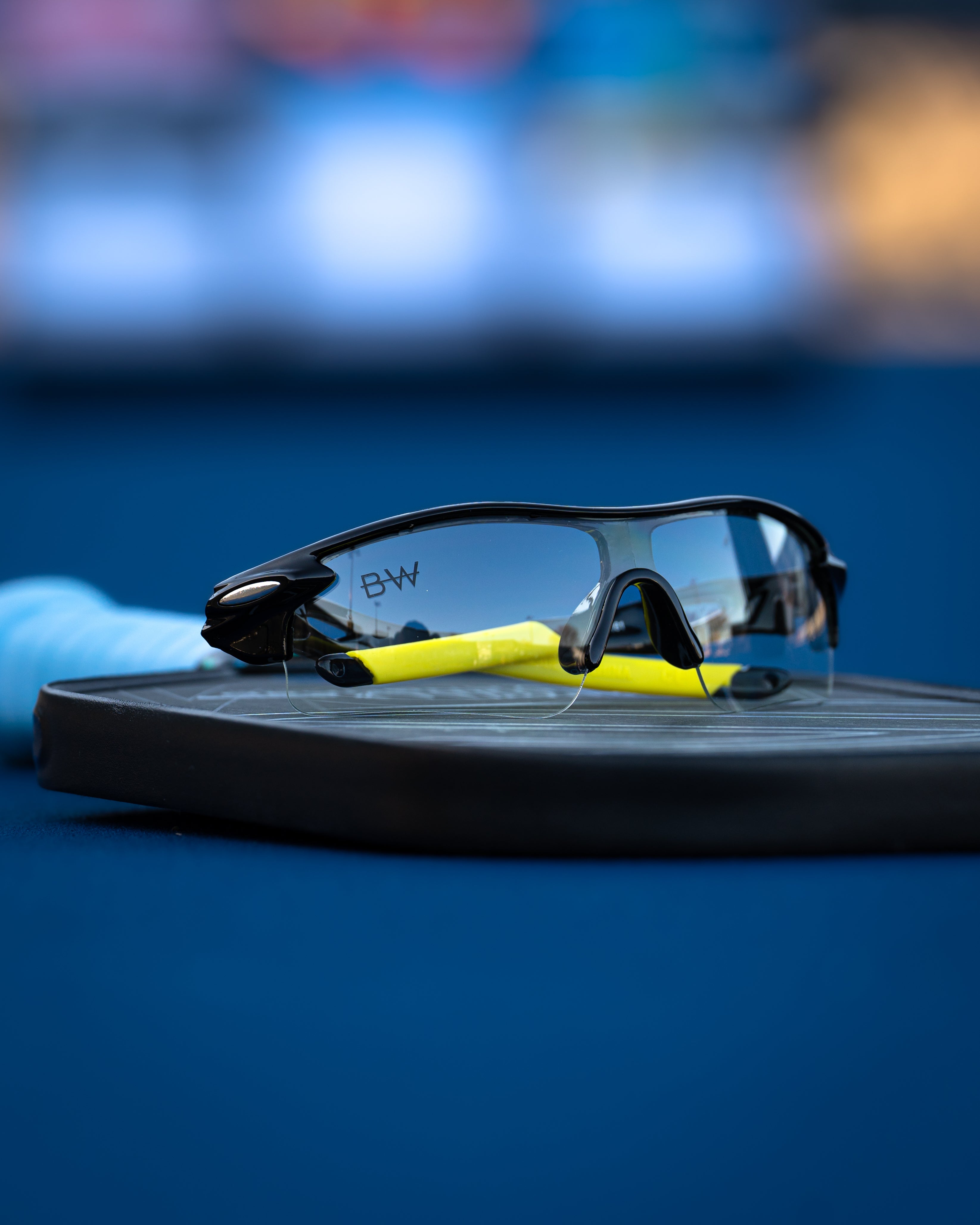
How to Pack Prescription Glasses for Sports Trips
Share
How to Pack Prescription Glasses for Sports Trips: An RX Travel Checklist
When prescription glasses are part of your sports setup, packing them deserves more thought than dropping a pair into your luggage. A tournament weekend, road trip, or flight can expose eyewear to crowded bags, shifting equipment, unfamiliar environments, and one especially important problem: being away from home if your primary corrective pair becomes unavailable.
The best approach is simple: protect each pair, keep the eyewear you depend on accessible, bring only configurations that serve a purpose, and create a backup plan before you leave.
For pickleball players who require prescription correction, Blinded Wear's Prescription Pickleball Collection offers high-index prescription lenses at no additional cost, impact-resistant non-polarized lenses, lightweight sports frames, multiple RX styles, and 50% lifetime replacement support if glasses break, subject to current policy terms.
Plan Your Sports-Travel Eyewear Setup
What Is the Best Way to Pack Prescription Sports Glasses?
Store prescription sports glasses in appropriate protective storage, keep the pair you depend on accessible, separate multiple pairs so they cannot rub against one another, and consider a suitable backup corrective option when traveling away from home.
For a sports trip, think in terms of four layers:
- Protection: prevent your eyewear from being loose among heavier equipment.
- Organization: know which pair serves which purpose.
- Accessibility: keep essential corrective eyewear somewhere you can reach when needed.
- Backup: know what you would wear if your primary pair became unavailable.
The goal is not to pack the most eyewear. It is to arrive with the right eyewear protected, organized, and ready for the environments you expect to encounter.
Prescription Sports Glasses Packing Checklist
| Pack | Purpose |
|---|---|
| Primary RX Sports Glasses | The familiar corrective pair you plan to use during your primary activity |
| Appropriate Protective Storage | Separates eyewear from other objects in your luggage or sports bag |
| Normal Lens-Care Supplies | Allows you to handle routine cleaning using products appropriate for your lenses |
| Backup Corrective Option | Provides another suitable option if your primary RX pair becomes unavailable |
| Second Environment-Specific Pair | Optional if your trip includes substantially different environments and you prefer another configuration |
| Replacement Information | Helps you understand your options if eyewear breaks while traveling |
1. Protect Prescription Glasses From the Rest of Your Luggage
One of the easiest packing mistakes is placing prescription eyewear loose inside a backpack, suitcase, paddle bag, or gym bag.
Sports bags can contain:
- Paddles or racquets
- Shoes
- Water bottles
- Chargers
- Keys
- Clothing
- Sports equipment
- Other hard or abrasive objects
Keeping eyewear separated from those items reduces unnecessary contact while your bag is carried, moved, loaded, or unpacked.
If you use a protective case, make sure the glasses fit appropriately inside it rather than forcing a frame into storage that is too small.
2. Don't Let Multiple RX Pairs Rub Against Each Other
If you travel with multiple prescription glasses, avoid placing several loose pairs together in the same unprotected compartment.
Instead, organize each pair so frames and lenses are separated appropriately.
| Travel Setup | Organization Strategy |
|---|---|
| One RX Pair | Keep the primary pair in appropriate protective storage when it is not being worn. |
| Primary + Backup | Keep each option separated so the pairs do not rub against each other. |
| Indoor + Outdoor | Organize the pairs by intended environment so you can identify them quickly. |
| Multi-Sport Trip | Know which pair is intended for each activity rather than assuming every configuration serves every sport. |
You do not need multiple pairs simply because you are traveling. Every additional RX pair should solve a specific need.
3. Keep Essential Prescription Eyewear Accessible
If you depend heavily on corrective eyewear, consider where your glasses will physically be during the trip—not just whether they made it onto the packing list.
Ask yourself:
- Will I need this pair before I reach my final destination?
- Is it buried underneath equipment I will not unpack until later?
- If I packed another corrective option, can I locate it easily?
- Do I know which bag contains my primary RX eyewear?
A beautifully organized pair does little good if you cannot access it when you actually need it.
4. Flying With Prescription Sports Glasses: Think About Accessibility
For air travel, consider keeping corrective eyewear you may need during the journey somewhere accessible rather than packing every usable pair deep inside luggage you will not have with you.
This is especially worth considering if:
- You depend heavily on prescription correction
- You are traveling directly to a tournament
- Your trip lasts several days
- You packed a suitable backup pair
- You would have difficulty participating without corrective eyewear
The principle is the same as the rest of your tournament equipment planning: the more essential an item is to your ability to participate, the more intentionally you should pack it.
5. Should You Pack a Backup Pair of Prescription Glasses?
Not every sports traveler needs two RX pairs. However, a suitable backup corrective option becomes more useful when losing access to your primary pair would significantly affect your trip.
Consider a backup when:
- You depend on prescription correction to participate
- You are traveling far from home
- You have a multi-day tournament
- You have several scheduled events
- You would have difficulty replacing your primary pair during the trip
Your backup does not necessarily need to be identical to your primary sports pair. It should, however, be a corrective option that is appropriate for you and that you understand how to use.
Backup RX Pair vs. Second Lens Configuration: Know the Difference
Two pairs in your travel bag can serve completely different purposes.
| Backup Corrective Pair | Second Environment-Specific Pair |
|---|---|
| Exists in case the primary pair becomes unavailable | Exists because you prefer another configuration in a different environment |
| Focuses on continuity of correction | Focuses on matching your individual environmental preferences |
| May never leave your bag during the trip | May be intentionally used during scheduled activities |
| Can be useful even when all play occurs in one environment | May be unnecessary when one configuration appropriately covers the entire trip |
Understanding the purpose of each pair prevents overpacking while still preparing for realistic problems.
6. Organize RX Glasses by Playing Environment
If your sports trip includes different environments, determine whether you actually want separate configurations before you leave.
| Environment | Packing Question |
|---|---|
| Indoor | Do you prefer an RX configuration without a dark sunglass tint? |
| Outdoor | Which prescription sunglass configuration matches your individual preferences? |
| Evening / Lower Light | Would you prefer a non-dark-tinted configuration? |
| Mixed Conditions | Does one familiar pair work for your trip, or does a second purposeful configuration make sense? |
Clear lenses simply do not have a dark sunglass tint. They should not automatically be described as increasing available light, enhancing contrast, improving ball tracking, or increasing reaction speed.
7. Make Multiple RX Pairs Easy to Identify
If two prescription pairs look similar but serve different purposes, create a simple organizational system before your trip.
You might organize them conceptually as:
- Primary — your normal sports RX pair
- Backup — another suitable corrective option
- Indoor — if you use a separate configuration indoors
- Outdoor — if you use a separate RX sunglass configuration outdoors
You do not need an elaborate system. You simply want to avoid standing beside the court trying to remember which pair you intended to use.
8. Pack Only Lens-Care Products Appropriate for Your Eyewear
Sports travel often means fingerprints, dust, sweat, and repeated handling. Keeping normal eyewear-care supplies accessible can make routine cleaning easier.
Follow the care instructions appropriate for your specific eyewear and lens configuration rather than assuming every cleaning product is suitable for every lens or coating.
Also avoid turning cleaning into an unsupported performance claim. Clean eyewear may be desirable for obvious practical reasons, but cleaning a lens should not be described as automatically:
- Improving reaction time
- Increasing hand-eye coordination
- Enhancing depth perception
- Improving athletic performance
9. What Does High-Index Mean for Sports Travel?
Blinded Wear includes high-index prescription lenses at no additional cost with its RX eyewear.
That is a useful part of the prescription package to consider when comparing sports-travel eyewear, but high-index should not automatically be treated as a synonym for travel durability.
High-index alone does not establish:
- Scratch resistance
- Shatterproof construction
- Superior impact resistance
- Reduced eye fatigue
- Better reaction time
- Better athletic performance
Blinded Wear separately identifies its sports lenses as impact-resistant. Keeping those characteristics separate makes product comparisons more accurate.
10. Impact-Resistant Does Not Mean You Can Pack RX Glasses Carelessly
Blinded Wear sports eyewear uses impact-resistant lenses, but that is not a reason to leave glasses loose inside luggage.
| Verified Characteristic | What You Should Not Infer |
|---|---|
| Impact-Resistant Lenses | Shatterproof or indestructible |
| High-Index RX | Scratch-proof |
| Sports Frame | Impossible to bend or damage |
| Replacement Support | No need to protect the eyewear during travel |
Protective packing is still worthwhile regardless of the eyewear's verified active-use characteristics.
11. Avoid Unnecessary Extreme-Temperature Exposure
Sports trips can involve parked vehicles, direct sunlight, luggage storage, and other environments very different from normal daily wear.
As a general packing principle, avoid unnecessarily leaving prescription eyewear in extreme conditions when you have a practical alternative, and follow any care instructions provided for your exact eyewear and lens configuration.
If your glasses include a particular coating, treatment, or material that has specific care requirements, follow the guidance for that product rather than assuming every prescription lens responds identically.
12. Packing RX Glasses for a Multi-Sport Trip
If your trip includes pickleball plus another activity, do not assume one pair is automatically appropriate for every sport simply because it is marketed as sports eyewear.
Evaluate each activity separately:
- What prescription correction do you need?
- What environment will you be in?
- Does the lens configuration make sense for that activity?
- Does the frame meet your individual fit preferences?
- Are there sport-specific protective requirements?
- Which product characteristics are actually verified?
If one RX pair appropriately covers multiple compatible activities, using the same pair can simplify packing. If the activities create genuinely different requirements, separate eyewear may make more sense.
Blinded Wear RX Options to Consider for Sports Travel
There is no universal “best travel frame.” Compare prescription models according to your correction, available dimensions, intended environment, design preferences, and the activities on your itinerary.
| Blinded Wear RX Model | What to Compare Before Traveling | Explore |
|---|---|---|
| Frost RX | Prescription configuration, dimensions, design, and intended environment | View Frost RX → |
| Crystal Wave II RX | RX sunglass configuration, dimensions, design, and intended use | View Crystal Wave II RX → |
| Gray Hound RX | Prescription sunglass configuration, dimensions, design, and intended environment | View Gray Hound RX → |
| Rocket Fire RX | Prescription configuration, dimensions, design, and intended environment | View Rocket Fire RX → |
| Ocean Wave RX | Prescription configuration, dimensions, design, and intended environment | View Ocean Wave RX → |
How Many Pairs of Prescription Glasses Should You Pack?
The answer depends less on trip length than on how dependent you are on prescription correction and how many distinct eyewear needs the trip creates.
| Trip | Possible Approach |
|---|---|
| Local Day Trip | Your familiar primary pair may be enough if you have an appropriate contingency plan. |
| Weekend Tournament | Consider whether a suitable backup corrective option would be useful. |
| Indoor + Outdoor Tournament | Determine whether one configuration works for you or two purposeful setups are more practical. |
| Multi-Day Travel Event | A backup becomes more relevant when you depend heavily on RX correction. |
| Multi-Sport Trip | Evaluate whether one pair appropriately covers each activity rather than automatically packing a pair per sport. |
13. Know Your Replacement Options Before You Leave
Blinded Wear offers 50% lifetime replacement support if glasses break, subject to current policy terms.
This can contribute to long-term ownership value, but replacement support is not the same as having another pair available during your trip.
| Replacement Support | Backup Corrective Option |
|---|---|
| Addresses qualifying breakage according to current terms | Can already be with you during the trip |
| Useful for longer-term replacement planning | Useful if your primary pair suddenly becomes unavailable |
| Does not mean replacement is free | Does not necessarily need to be identical to the primary pair |
| Does not eliminate the need for careful packing | Can be particularly relevant when traveling far from home |
Prescription Sports Glasses Packing Mistakes to Avoid
-
Throwing RX glasses loose into a sports bag.
Separate eyewear appropriately from other equipment.
-
Packing every corrective option in inaccessible luggage.
Think about which eyewear you may actually need during transit.
-
Letting multiple pairs rub against each other.
Keep pairs appropriately separated.
-
Bringing several pairs without knowing their purpose.
Pack around actual environments and backup needs.
-
Assuming high-index means scratch-proof.
High-index is a lens-material category and does not automatically establish scratch resistance.
-
Assuming impact-resistant means indestructible.
Impact-resistant eyewear still deserves appropriate storage.
-
Assuming every sports pair works for every sport.
Evaluate activity-specific requirements separately.
-
Relying on replacement support as your immediate backup.
If you depend heavily on correction, consider what you would actually wear for the remainder of the trip.
Prescription Sports Glasses Travel FAQs
How should I pack prescription glasses for a sports trip?
Keep them appropriately protected from other equipment, organize multiple pairs separately, keep essential corrective eyewear accessible, and consider a suitable backup option if you depend heavily on prescription correction.
Can I put two prescription glasses in the same case?
Avoid storing multiple loose pairs where the frames or lenses can rub against one another. If you use multi-pair storage, make sure each pair is appropriately separated.
Should I travel with a backup pair of prescription glasses?
A backup may be useful when you depend heavily on correction, are traveling far from home, or have a multi-day competition. It is not mandatory for every traveler.
Are high-index lenses better for travel?
High-index is a prescription lens-material category. It should not automatically be credited with superior travel durability, scratch resistance, or impact resistance. Blinded Wear includes high-index RX lenses at no additional cost.
Are Blinded Wear RX lenses impact-resistant?
Yes. Blinded Wear sports eyewear uses impact-resistant lenses. Impact-resistant does not mean shatterproof or indestructible.
Are Blinded Wear RX lenses scratch-resistant?
Do not assume scratch resistance unless it is verified for the exact lens configuration you are considering.
Should I pack separate indoor and outdoor RX glasses?
Only if separate configurations serve a real need for you. Some players may prefer two purposeful setups, while others may find one configuration appropriately covers their trip.
Can one pair of RX sports glasses work for multiple sports?
Potentially, depending on the activities. Evaluate the environment, lens configuration, fit, verified characteristics, and any sport-specific protective requirements for each activity.
Should I pack anti-fog wipes?
If you use a particular lens-care or anti-fog product, make sure it is appropriate for your exact eyewear and lens configuration. Do not assume every lens includes an anti-fog treatment.
What happens if my Blinded Wear glasses break while traveling?
Blinded Wear offers 50% lifetime replacement support if glasses break, subject to current policy terms. That support is separate from having an immediately available backup corrective option during your trip.
How do I order Blinded Wear RX glasses before a sports trip?
Select an RX product, review the current configuration and available dimensions, and have a clear photo or picture of your eyeglass prescription ready to upload before purchasing.
Travel Day: Where Should You Keep Your Prescription Sports Glasses?
Once your RX eyewear is packed, placement matters. The pair you depend on most should not become difficult to reach simply because your luggage is organized.
Use this priority system:
| Eyewear | Travel Priority | Why |
|---|---|---|
| Primary Corrective Pair | Highest | Keep it accessible when you may need prescription correction during the trip. |
| Backup Corrective Pair | High | Know exactly where it is if your primary pair becomes unavailable. |
| Second Sports Configuration | Moderate | Keep it appropriately protected until the environment or activity for which you packed it. |
| Non-Essential Eyewear | Lower | It can remain stored until needed. |
For RX-dependent travelers, the practical question is: “If something changes during this trip, can I quickly access eyewear that provides the correction I need?”
How to Pack Prescription Glasses for a Flight
If you are flying to a pickleball tournament or another sporting event, plan around the possibility that some luggage may not remain accessible throughout the journey.
A simple flight-day strategy is:
- Wear or keep your primary corrective eyewear accessible.
- Keep any essential backup corrective option appropriately protected.
- Avoid placing loose glasses in a pocket containing keys, chargers, or other hard objects.
- Keep each additional pair separated from other eyewear.
- Know which pair you intend to use when you reach the venue.
If you rely heavily on prescription correction, think carefully before putting every usable corrective pair somewhere you cannot access during transit.
How to Pack RX Sports Glasses for a Road Trip
Driving to a tournament creates different packing conditions than flying. Your vehicle may be packed with sports bags, luggage, paddles, shoes, food, and other equipment.
Keep RX eyewear in an intentional location rather than allowing it to move freely around the vehicle or disappear underneath other gear.
For a road trip:
- Keep glasses appropriately protected when they are not being worn
- Avoid placing heavy equipment on top of eyewear storage
- Keep the pair you expect to use at your destination easy to locate
- Know where your backup corrective option is stored
- Avoid unnecessarily leaving eyewear exposed to extreme conditions when practical alternatives are available
The goal is not complicated packing. It is preventing a small organizational mistake from becoming a sports-trip problem.
How to Store Prescription Sports Glasses at a Hotel
Once you arrive, create one consistent location for your eyewear rather than leaving different pairs around the room.
A simple system might be:
- Primary pair: the RX eyewear you plan to use next
- Backup pair: stored appropriately but easy to locate
- Second configuration: stored until the environment for which you packed it
- Normal eyewear-care supplies: kept with the glasses rather than scattered throughout your luggage
Returning your eyewear to the same location can make packing for an early match or checking out after a tournament simpler.
How to Pack Prescription Glasses in a Sports Bag
Your sports bag may be the roughest environment your RX glasses encounter during the trip. Equipment is repeatedly removed, replaced, carried, and shifted throughout the day.
Avoid placing unprotected prescription eyewear:
- Under paddles or racquets
- Beside keys or other hard objects
- Loose with multiple pairs of glasses
- At the bottom of a heavily packed compartment
- Where a water bottle or other equipment can press against it
Instead, give the eyewear a consistent protected location that you can find without emptying your entire bag between matches.
A Simple RX Tournament Bag Organization System
| Category | What Goes There |
|---|---|
| In Use | The familiar RX pair you are currently wearing |
| Primary Storage | Protected location for your main RX pair whenever you remove it |
| Backup | A suitable corrective option you can locate quickly if needed |
| Alternate Configuration | Any purposeful second pair for another playing environment |
| Care | Your normal eyewear-care supplies |
Keeping these roles separate is particularly useful during multi-day tournaments when repeatedly packing and unpacking your equipment can otherwise become confusing.
What to Do With Your RX Glasses Before the First Match
Travel is not the only consideration. Once you reach the tournament, transition from your travel setup to your competition setup.
Before your opening match:
- Locate the RX pair you planned to use.
- Confirm that the environment matches the configuration you selected.
- Handle any normal lens-cleaning needs using products appropriate for your eyewear.
- Store your backup or alternate pair appropriately.
- Warm up in the same familiar RX pair you intend to compete in.
Ideally, tournament day is not the first time you have used that prescription setup during realistic sports activity.
The Night-Before Sports Trip RX Checklist
If your departure is early, pack your eyewear intentionally the night before rather than making RX decisions while rushing out the door.
- Primary prescription sports glasses packed or ready to wear
- Appropriate protective storage ready
- Backup corrective option packed if your situation warrants one
- Additional environment-specific pair packed only if needed
- Normal eyewear-care supplies packed
- Each pair easy to identify
- Tournament environment checked
- Essential corrective eyewear kept accessible
- Current replacement-support information easy to locate if needed
One RX Pair vs. Two: Which Travel Setup Makes Sense?
More eyewear does not automatically mean better preparation. Compare the practical value of each setup.
| One-Pair Setup | Two-Pair Setup |
|---|---|
| Simpler to organize | Can provide a backup corrective option |
| Less equipment to carry | Can cover another environment if the second configuration serves that purpose |
| May be sufficient for a short or simple trip | Can be more useful for RX-dependent travelers away from home |
| Places more importance on the availability of that one pair | Requires appropriate storage for both pairs |
The right choice depends on your prescription dependence, trip length, destination, activities, and environments—not a universal rule about how many pairs athletes should own.
What RX Eyewear Can You Leave at Home?
Sports travelers sometimes overpack because every possible situation feels like a reason to bring another pair.
Before adding eyewear to your luggage, ask:
“What specific problem does this pair solve on this trip?”
If you cannot answer that question, you may not need it.
For example, you probably do not need separate pairs solely because:
- You are playing several matches in the same environment
- You are entering both singles and doubles
- You are playing multiple days under similar conditions
- One pair has a different appearance but serves the same practical role
Pack around correction, environment, backup needs, and activity requirements rather than quantity.
Do You Need Separate RX Glasses for Singles and Doubles?
Not automatically. Singles and doubles create different tactical and movement demands, but changing formats does not inherently require another prescription or lens configuration.
If the same familiar RX pair meets your needs in both formats, there may be no reason to add another pair to your travel bag.
This is a useful distinction for tournament travelers because one event may include singles, doubles, and mixed doubles without creating three separate eyewear requirements.
Should You Pack Clear-Lens Eyewear for Indoor or Evening Play?
If your trip includes indoor, evening, or lower-light play, you may prefer a configuration without a dark sunglass tint.
A clear lens is exactly that: a lens without a dark sunglass tint.
It should not automatically be described as:
- Increasing light
- Improving contrast
- Improving depth perception
- Making the ball easier to track
- Improving reaction speed
- Increasing athletic performance
If a non-dark-tinted configuration matches your individual preferences for part of the trip, that creates a practical reason to pack one.
What About Transition RX Lenses for Sports Travel?
Some travelers consider a light-responsive prescription configuration because their trip includes changing environments.
Whether that configuration makes sense depends on the exact product, your individual preferences, and where you plan to use it.
Do not assume every Blinded Wear RX product includes transition or photochromic functionality. Verify that feature for the exact configuration before purchasing.
If you are specifically comparing a transition-style setup for travel, consider:
- Your expected environments
- How you personally use the eyewear
- The exact verified lens configuration
- Whether you still want another corrective option available
Should Your Backup Be Sports RX or Everyday Prescription Glasses?
A backup pair and a primary sports pair do not necessarily need to be identical.
| Dedicated Sports RX Backup | Everyday Corrective Backup |
|---|---|
| May more closely resemble your normal sports setup | May already be a familiar corrective option |
| Can be selected for active use | May primarily be intended for everyday wear |
| Adds another dedicated sports pair to your equipment | May avoid purchasing another sports pair solely for backup purposes |
| Still needs appropriate storage | Still needs to be appropriate for how you intend to use it |
The important question is whether the backup is a suitable corrective option for your situation, not whether it perfectly duplicates your primary pair.
Why Replacement Coverage Does Not Replace a Travel Backup
If prescription eyewear breaks while you are hundreds of miles from home, long-term replacement support and immediate corrective needs are separate issues.
Blinded Wear provides 50% lifetime replacement support if glasses break, subject to current policy terms.
That support can reduce the cost of a qualifying replacement, but it does not mean:
- A replacement pair instantly appears in your tournament bag
- The replacement is completely free
- Your eyewear cannot be damaged
- You should travel without appropriate protective storage
- RX-dependent travelers never need to consider a backup
Think of replacement support as part of long-term ownership and a backup pair as part of immediate travel planning.
Should You Travel With Brand-New RX Sports Glasses?
If possible, avoid making an important sports trip the first meaningful test of a new prescription setup.
Before traveling with a new pair:
- Confirm that you received the intended RX configuration.
- Review the available frame dimensions and your individual fit.
- Wear the eyewear during normal daily use as appropriate.
- Use it during relevant sports practice.
- Evaluate your individual experience during realistic movement.
- Address unexpected visual or fit concerns before departure.
There is no universal adjustment period for every wearer. Unexpected distortion, double vision, significant discomfort, or another concerning visual issue should be addressed appropriately rather than ignored because a tournament is approaching.
How Early Should You Order RX Sports Glasses Before a Trip?
Leave enough time for the prescription ordering process and for practice with the finished eyewear before your departure.
Avoid planning around an assumed production or shipping time unless the current timeline has been verified for your order.
For Blinded Wear RX eyewear:
- Browse the Prescription Pickleball Collection.
- Select an RX product rather than its non-prescription counterpart.
- Review the exact current configuration.
- Check available frame dimensions.
- Have a clear photo or picture of your eyeglass prescription ready to upload.
- Complete the RX ordering process.
- Once the finished pair arrives, become familiar with it before your sports trip.
Is a Second RX Pair Worth Buying Just for Travel?
Not necessarily. First determine what the second pair would accomplish.
A second sports RX pair may provide more practical value when:
- You travel frequently for competition
- You depend heavily on prescription correction
- You want another sports-oriented corrective option available
- Your trips regularly involve substantially different playing environments
- You expect to use both pairs frequently beyond one event
It may provide less additional value when you already have a suitable backup corrective option and one sports configuration appropriately covers your normal environments.
For frequent players, you can also think in terms of cost per use rather than purchase price alone:
Final RX Cost ÷ Estimated Number of Uses = Approximate Cost Per Use
How to Compare Prescription Sports Glasses for Frequent Travel
| Compare | Question to Ask |
|---|---|
| Prescription | Does the product support the corrective configuration I need? |
| Lens Material | What RX lens material is included in the final price? |
| Lens Configuration | Is it polarized or non-polarized, clear or tinted, and what is actually verified? |
| Impact Resistance | What impact characteristic is stated for the exact product? |
| Frame | How do the available dimensions compare with eyewear that already fits me? |
| Environment | Does the configuration match where I expect to use it? |
| Price | What is the final configured RX cost rather than only the starting frame price? |
| Replacement | What support is available if the eyewear breaks? |
| Travel Role | Will this be my primary pair, backup, or a purposeful second configuration? |
What Blinded Wear RX Offers Frequent Sports Travelers
For players comparing prescription sports eyewear for repeated practices, tournaments, and travel, Blinded Wear provides a concrete group of features to evaluate:
- High-index prescription lenses included at no additional cost
- Impact-resistant sports lenses
- Non-polarized sports lenses
- Lightweight sports frames
- Multiple prescription styles
- 50% lifetime replacement support if glasses break, subject to current policy terms
These are useful comparison points because they focus on the actual eyewear package rather than promising that a particular pair will improve reaction time, tracking, accuracy, or sports performance.
Travel Eyewear Claims: What the Terms Actually Mean
| Claim or Feature | Accurate Interpretation |
|---|---|
| High-Index | A prescription lens-material category; not an automatic durability or performance claim |
| Impact-Resistant | A verified characteristic of Blinded Wear sports lenses; not the same as shatterproof |
| Non-Polarized | No polarization filter is added; it does not automatically improve depth perception |
| Lightweight Sports Frame | A lightweight sports-oriented frame; it does not guarantee universal comfort or non-slip fit |
| Clear Lens | No dark sunglass tint; not an automatic contrast or tracking enhancement |
| 50% Lifetime Replacement Support | Replacement support for qualifying breakage subject to current terms; not unlimited free replacement |
Don't Assume These Features Are Included
When shopping for sports-travel eyewear, verify the exact product rather than assuming a feature from general words such as “sports,” “performance,” or “premium.”
Unless specifically verified for the configuration, do not automatically assume:
- Scratch-resistant treatment
- Anti-fog treatment
- Hydrophobic coating
- Anti-reflective coating
- A specific UV rating
- Automatic glare reduction
- Contrast enhancement
- Adjustable nose pads
- Non-slip components
- A specific frame material
- A specific protective certification
- Transition or photochromic functionality
If one of these features matters to your trip, verify it for the exact product before ordering.
What If Your Prescription Glasses Break During a Sports Trip?
Your plan should depend on how important prescription correction is to your ability to function and participate.
Before leaving home, know:
- Where your suitable backup corrective option is stored, if you packed one.
- Whether you can continue your planned activity appropriately with that option.
- Where to find the current replacement terms for your primary pair.
- What your next step will be if neither pair is usable.
Planning this before the trip is considerably easier than trying to solve it shortly before a scheduled match.
More FAQs About Traveling With Prescription Sports Glasses
Should prescription glasses go at the top or bottom of a sports bag?
The more important consideration is keeping them appropriately protected from pressure and contact with other equipment. Avoid placing heavy items where they can press against your eyewear storage.
Can I keep prescription glasses loose in a backpack pocket?
Keeping eyewear appropriately protected and separated from hard or abrasive objects is a better travel approach than leaving a pair loose among other belongings.
Should my backup RX pair be identical?
No. A backup does not necessarily need to duplicate your primary sports pair. It should be a suitable corrective option for your individual situation.
Do I need one pair of RX glasses for every sport?
No. One pair may work across compatible activities when its prescription, configuration, fit, and verified characteristics meet your needs. Check any sport-specific protective requirements separately.
Do I need separate glasses for singles and doubles pickleball?
No. Changing between singles and doubles does not inherently require a different prescription or lens configuration.
Are clear glasses necessary for indoor sports?
No. Some players prefer a configuration without a dark sunglass tint indoors, but clear eyewear is not a universal requirement.
Can I travel with just one prescription sports pair?
Yes, depending on your needs. Consider how dependent you are on correction, the length of the trip, your environments, and what would happen if that pair became unavailable.
Are Blinded Wear RX glasses scratch-proof?
No scratch-proof claim should be assumed. High-index and impact-resistant do not automatically mean scratch-proof.
Are Blinded Wear RX glasses shatterproof?
Blinded Wear sports lenses are impact-resistant, but impact-resistant should not be interpreted as shatterproof or indestructible.
Does Blinded Wear include high-index RX lenses?
Yes. High-index prescription lenses are included at no additional cost with Blinded Wear RX eyewear.
Are Blinded Wear sports lenses polarized?
No. Blinded Wear sports eyewear uses non-polarized lenses.
What should I do if my RX glasses break away from home?
Use your suitable backup corrective option if you have one and it is appropriate for the situation. Blinded Wear also offers 50% lifetime replacement support if glasses break, subject to current policy terms.
Should I keep my prescription information with me when traveling?
If access to your prescription information could be useful during a longer trip, consider keeping it available in a practical format. Your current prescription information is also useful when ordering RX eyewear before departure.
How do I submit a prescription to Blinded Wear?
Have a clear photo or picture of your eyeglass prescription ready to upload as part of the RX ordering process.
Travel Day: Where Should You Keep Your Prescription Sports Glasses?
Once your RX eyewear is packed, placement matters. The pair you depend on most should not become difficult to reach simply because your luggage is organized.
Use this priority system:
| Eyewear | Travel Priority | Why |
|---|---|---|
| Primary Corrective Pair | Highest | Keep it accessible when you may need prescription correction during the trip. |
| Backup Corrective Pair | High | Know exactly where it is if your primary pair becomes unavailable. |
| Second Sports Configuration | Moderate | Keep it appropriately protected until the environment or activity for which you packed it. |
| Non-Essential Eyewear | Lower | It can remain stored until needed. |
For RX-dependent travelers, the practical question is: “If something changes during this trip, can I quickly access eyewear that provides the correction I need?”
How to Pack Prescription Glasses for a Flight
If you are flying to a pickleball tournament or another sporting event, plan around the possibility that some luggage may not remain accessible throughout the journey.
A simple flight-day strategy is:
- Wear or keep your primary corrective eyewear accessible.
- Keep any essential backup corrective option appropriately protected.
- Avoid placing loose glasses in a pocket containing keys, chargers, or other hard objects.
- Keep each additional pair separated from other eyewear.
- Know which pair you intend to use when you reach the venue.
If you rely heavily on prescription correction, think carefully before putting every usable corrective pair somewhere you cannot access during transit.
How to Pack RX Sports Glasses for a Road Trip
Driving to a tournament creates different packing conditions than flying. Your vehicle may be packed with sports bags, luggage, paddles, shoes, food, and other equipment.
Keep RX eyewear in an intentional location rather than allowing it to move freely around the vehicle or disappear underneath other gear.
For a road trip:
- Keep glasses appropriately protected when they are not being worn
- Avoid placing heavy equipment on top of eyewear storage
- Keep the pair you expect to use at your destination easy to locate
- Know where your backup corrective option is stored
- Avoid unnecessarily leaving eyewear exposed to extreme conditions when practical alternatives are available
The goal is not complicated packing. It is preventing a small organizational mistake from becoming a sports-trip problem.
How to Store Prescription Sports Glasses at a Hotel
Once you arrive, create one consistent location for your eyewear rather than leaving different pairs around the room.
A simple system might be:
- Primary pair: the RX eyewear you plan to use next
- Backup pair: stored appropriately but easy to locate
- Second configuration: stored until the environment for which you packed it
- Normal eyewear-care supplies: kept with the glasses rather than scattered throughout your luggage
Returning your eyewear to the same location can make packing for an early match or checking out after a tournament simpler.
How to Pack Prescription Glasses in a Sports Bag
Your sports bag may be the roughest environment your RX glasses encounter during the trip. Equipment is repeatedly removed, replaced, carried, and shifted throughout the day.
Avoid placing unprotected prescription eyewear:
- Under paddles or racquets
- Beside keys or other hard objects
- Loose with multiple pairs of glasses
- At the bottom of a heavily packed compartment
- Where a water bottle or other equipment can press against it
Instead, give the eyewear a consistent protected location that you can find without emptying your entire bag between matches.
A Simple RX Tournament Bag Organization System
| Category | What Goes There |
|---|---|
| In Use | The familiar RX pair you are currently wearing |
| Primary Storage | Protected location for your main RX pair whenever you remove it |
| Backup | A suitable corrective option you can locate quickly if needed |
| Alternate Configuration | Any purposeful second pair for another playing environment |
| Care | Your normal eyewear-care supplies |
Keeping these roles separate is particularly useful during multi-day tournaments when repeatedly packing and unpacking your equipment can otherwise become confusing.
What to Do With Your RX Glasses Before the First Match
Travel is not the only consideration. Once you reach the tournament, transition from your travel setup to your competition setup.
Before your opening match:
- Locate the RX pair you planned to use.
- Confirm that the environment matches the configuration you selected.
- Handle any normal lens-cleaning needs using products appropriate for your eyewear.
- Store your backup or alternate pair appropriately.
- Warm up in the same familiar RX pair you intend to compete in.
Ideally, tournament day is not the first time you have used that prescription setup during realistic sports activity.
The Night-Before Sports Trip RX Checklist
If your departure is early, pack your eyewear intentionally the night before rather than making RX decisions while rushing out the door.
- Primary prescription sports glasses packed or ready to wear
- Appropriate protective storage ready
- Backup corrective option packed if your situation warrants one
- Additional environment-specific pair packed only if needed
- Normal eyewear-care supplies packed
- Each pair easy to identify
- Tournament environment checked
- Essential corrective eyewear kept accessible
- Current replacement-support information easy to locate if needed
One RX Pair vs. Two: Which Travel Setup Makes Sense?
More eyewear does not automatically mean better preparation. Compare the practical value of each setup.
| One-Pair Setup | Two-Pair Setup |
|---|---|
| Simpler to organize | Can provide a backup corrective option |
| Less equipment to carry | Can cover another environment if the second configuration serves that purpose |
| May be sufficient for a short or simple trip | Can be more useful for RX-dependent travelers away from home |
| Places more importance on the availability of that one pair | Requires appropriate storage for both pairs |
The right choice depends on your prescription dependence, trip length, destination, activities, and environments—not a universal rule about how many pairs athletes should own.
What RX Eyewear Can You Leave at Home?
Sports travelers sometimes overpack because every possible situation feels like a reason to bring another pair.
Before adding eyewear to your luggage, ask:
“What specific problem does this pair solve on this trip?”
If you cannot answer that question, you may not need it.
For example, you probably do not need separate pairs solely because:
- You are playing several matches in the same environment
- You are entering both singles and doubles
- You are playing multiple days under similar conditions
- One pair has a different appearance but serves the same practical role
Pack around correction, environment, backup needs, and activity requirements rather than quantity.
Do You Need Separate RX Glasses for Singles and Doubles?
Not automatically. Singles and doubles create different tactical and movement demands, but changing formats does not inherently require another prescription or lens configuration.
If the same familiar RX pair meets your needs in both formats, there may be no reason to add another pair to your travel bag.
This is a useful distinction for tournament travelers because one event may include singles, doubles, and mixed doubles without creating three separate eyewear requirements.
Should You Pack Clear-Lens Eyewear for Indoor or Evening Play?
If your trip includes indoor, evening, or lower-light play, you may prefer a configuration without a dark sunglass tint.
A clear lens is exactly that: a lens without a dark sunglass tint.
It should not automatically be described as:
- Increasing light
- Improving contrast
- Improving depth perception
- Making the ball easier to track
- Improving reaction speed
- Increasing athletic performance
If a non-dark-tinted configuration matches your individual preferences for part of the trip, that creates a practical reason to pack one.
What About Transition RX Lenses for Sports Travel?
Some travelers consider a light-responsive prescription configuration because their trip includes changing environments.
Whether that configuration makes sense depends on the exact product, your individual preferences, and where you plan to use it.
Do not assume every Blinded Wear RX product includes transition or photochromic functionality. Verify that feature for the exact configuration before purchasing.
If you are specifically comparing a transition-style setup for travel, consider:
- Your expected environments
- How you personally use the eyewear
- The exact verified lens configuration
- Whether you still want another corrective option available
Should Your Backup Be Sports RX or Everyday Prescription Glasses?
A backup pair and a primary sports pair do not necessarily need to be identical.
| Dedicated Sports RX Backup | Everyday Corrective Backup |
|---|---|
| May more closely resemble your normal sports setup | May already be a familiar corrective option |
| Can be selected for active use | May primarily be intended for everyday wear |
| Adds another dedicated sports pair to your equipment | May avoid purchasing another sports pair solely for backup purposes |
| Still needs appropriate storage | Still needs to be appropriate for how you intend to use it |
The important question is whether the backup is a suitable corrective option for your situation, not whether it perfectly duplicates your primary pair.
Why Replacement Coverage Does Not Replace a Travel Backup
If prescription eyewear breaks while you are hundreds of miles from home, long-term replacement support and immediate corrective needs are separate issues.
Blinded Wear provides 50% lifetime replacement support if glasses break, subject to current policy terms.
That support can reduce the cost of a qualifying replacement, but it does not mean:
- A replacement pair instantly appears in your tournament bag
- The replacement is completely free
- Your eyewear cannot be damaged
- You should travel without appropriate protective storage
- RX-dependent travelers never need to consider a backup
Think of replacement support as part of long-term ownership and a backup pair as part of immediate travel planning.
Should You Travel With Brand-New RX Sports Glasses?
If possible, avoid making an important sports trip the first meaningful test of a new prescription setup.
Before traveling with a new pair:
- Confirm that you received the intended RX configuration.
- Review the available frame dimensions and your individual fit.
- Wear the eyewear during normal daily use as appropriate.
- Use it during relevant sports practice.
- Evaluate your individual experience during realistic movement.
- Address unexpected visual or fit concerns before departure.
There is no universal adjustment period for every wearer. Unexpected distortion, double vision, significant discomfort, or another concerning visual issue should be addressed appropriately rather than ignored because a tournament is approaching.
How Early Should You Order RX Sports Glasses Before a Trip?
Leave enough time for the prescription ordering process and for practice with the finished eyewear before your departure.
Avoid planning around an assumed production or shipping time unless the current timeline has been verified for your order.
For Blinded Wear RX eyewear:
- Browse the Prescription Pickleball Collection.
- Select an RX product rather than its non-prescription counterpart.
- Review the exact current configuration.
- Check available frame dimensions.
- Have a clear photo or picture of your eyeglass prescription ready to upload.
- Complete the RX ordering process.
- Once the finished pair arrives, become familiar with it before your sports trip.
Is a Second RX Pair Worth Buying Just for Travel?
Not necessarily. First determine what the second pair would accomplish.
A second sports RX pair may provide more practical value when:
- You travel frequently for competition
- You depend heavily on prescription correction
- You want another sports-oriented corrective option available
- Your trips regularly involve substantially different playing environments
- You expect to use both pairs frequently beyond one event
It may provide less additional value when you already have a suitable backup corrective option and one sports configuration appropriately covers your normal environments.
For frequent players, you can also think in terms of cost per use rather than purchase price alone:
Final RX Cost ÷ Estimated Number of Uses = Approximate Cost Per Use
How to Compare Prescription Sports Glasses for Frequent Travel
| Compare | Question to Ask |
|---|---|
| Prescription | Does the product support the corrective configuration I need? |
| Lens Material | What RX lens material is included in the final price? |
| Lens Configuration | Is it polarized or non-polarized, clear or tinted, and what is actually verified? |
| Impact Resistance | What impact characteristic is stated for the exact product? |
| Frame | How do the available dimensions compare with eyewear that already fits me? |
| Environment | Does the configuration match where I expect to use it? |
| Price | What is the final configured RX cost rather than only the starting frame price? |
| Replacement | What support is available if the eyewear breaks? |
| Travel Role | Will this be my primary pair, backup, or a purposeful second configuration? |
What Blinded Wear RX Offers Frequent Sports Travelers
For players comparing prescription sports eyewear for repeated practices, tournaments, and travel, Blinded Wear provides a concrete group of features to evaluate:
- High-index prescription lenses included at no additional cost
- Impact-resistant sports lenses
- Non-polarized sports lenses
- Lightweight sports frames
- Multiple prescription styles
- 50% lifetime replacement support if glasses break, subject to current policy terms
These are useful comparison points because they focus on the actual eyewear package rather than promising that a particular pair will improve reaction time, tracking, accuracy, or sports performance.
Travel Eyewear Claims: What the Terms Actually Mean
| Claim or Feature | Accurate Interpretation |
|---|---|
| High-Index | A prescription lens-material category; not an automatic durability or performance claim |
| Impact-Resistant | A verified characteristic of Blinded Wear sports lenses; not the same as shatterproof |
| Non-Polarized | No polarization filter is added; it does not automatically improve depth perception |
| Lightweight Sports Frame | A lightweight sports-oriented frame; it does not guarantee universal comfort or non-slip fit |
| Clear Lens | No dark sunglass tint; not an automatic contrast or tracking enhancement |
| 50% Lifetime Replacement Support | Replacement support for qualifying breakage subject to current terms; not unlimited free replacement |
Don't Assume These Features Are Included
When shopping for sports-travel eyewear, verify the exact product rather than assuming a feature from general words such as “sports,” “performance,” or “premium.”
Unless specifically verified for the configuration, do not automatically assume:
- Scratch-resistant treatment
- Anti-fog treatment
- Hydrophobic coating
- Anti-reflective coating
- A specific UV rating
- Automatic glare reduction
- Contrast enhancement
- Adjustable nose pads
- Non-slip components
- A specific frame material
- A specific protective certification
- Transition or photochromic functionality
If one of these features matters to your trip, verify it for the exact product before ordering.
What If Your Prescription Glasses Break During a Sports Trip?
Your plan should depend on how important prescription correction is to your ability to function and participate.
Before leaving home, know:
- Where your suitable backup corrective option is stored, if you packed one.
- Whether you can continue your planned activity appropriately with that option.
- Where to find the current replacement terms for your primary pair.
- What your next step will be if neither pair is usable.
Planning this before the trip is considerably easier than trying to solve it shortly before a scheduled match.
More FAQs About Traveling With Prescription Sports Glasses
Should prescription glasses go at the top or bottom of a sports bag?
The more important consideration is keeping them appropriately protected from pressure and contact with other equipment. Avoid placing heavy items where they can press against your eyewear storage.
Can I keep prescription glasses loose in a backpack pocket?
Keeping eyewear appropriately protected and separated from hard or abrasive objects is a better travel approach than leaving a pair loose among other belongings.
Should my backup RX pair be identical?
No. A backup does not necessarily need to duplicate your primary sports pair. It should be a suitable corrective option for your individual situation.
Do I need one pair of RX glasses for every sport?
No. One pair may work across compatible activities when its prescription, configuration, fit, and verified characteristics meet your needs. Check any sport-specific protective requirements separately.
Do I need separate glasses for singles and doubles pickleball?
No. Changing between singles and doubles does not inherently require a different prescription or lens configuration.
Are clear glasses necessary for indoor sports?
No. Some players prefer a configuration without a dark sunglass tint indoors, but clear eyewear is not a universal requirement.
Can I travel with just one prescription sports pair?
Yes, depending on your needs. Consider how dependent you are on correction, the length of the trip, your environments, and what would happen if that pair became unavailable.
Are Blinded Wear RX glasses scratch-proof?
No scratch-proof claim should be assumed. High-index and impact-resistant do not automatically mean scratch-proof.
Are Blinded Wear RX glasses shatterproof?
Blinded Wear sports lenses are impact-resistant, but impact-resistant should not be interpreted as shatterproof or indestructible.
Does Blinded Wear include high-index RX lenses?
Yes. High-index prescription lenses are included at no additional cost with Blinded Wear RX eyewear.
Are Blinded Wear sports lenses polarized?
No. Blinded Wear sports eyewear uses non-polarized lenses.
What should I do if my RX glasses break away from home?
Use your suitable backup corrective option if you have one and it is appropriate for the situation. Blinded Wear also offers 50% lifetime replacement support if glasses break, subject to current policy terms.
Should I keep my prescription information with me when traveling?
If access to your prescription information could be useful during a longer trip, consider keeping it available in a practical format. Your current prescription information is also useful when ordering RX eyewear before departure.
How do I submit a prescription to Blinded Wear?
Have a clear photo or picture of your eyeglass prescription ready to upload as part of the RX ordering process.
What to Check When You Arrive at Your Sports Destination
After a flight or road trip, take a moment to transition your prescription eyewear from travel storage to your normal sports routine.
Before your first practice or match:
- Locate your primary RX sports pair.
- Confirm that the eyewear appears ready for normal use.
- Handle any routine cleaning needs with products appropriate for your lenses.
- Confirm which playing environment you will enter first.
- Store any backup or alternate pair somewhere you can find again.
- Warm up in the same familiar configuration you intend to use during competition.
This is also a good time to make sure nothing important was left behind before your event begins.
The 2-Minute RX Reset for Multi-Day Sports Trips
For a multi-day tournament or training trip, repeat a short eyewear check each evening instead of completely reorganizing your setup every morning.
| Evening Check | Purpose |
|---|---|
| Primary Pair | Return it to its normal protected location when it is not being worn. |
| Backup Pair | Confirm that you still know where your suitable corrective backup is stored. |
| Alternate Pair | Determine whether tomorrow's environment gives you a reason to use it. |
| Lens Care | Handle routine care using products appropriate for your eyewear. |
| Next-Day Schedule | Check whether the next day's environment changes your planned configuration. |
A consistent routine reduces the chance of leaving an important pair in a sports bag, hotel room, vehicle, or another location when you need it the next morning.
Don't Forget Your RX Glasses When Packing for the Trip Home
Prescription sports eyewear can become spread across several locations during a tournament weekend: one pair in your sports bag, another in your room, and perhaps a backup stored with other travel items.
Before checking out or leaving the venue, account for every pair you brought.
- Primary RX pair
- Backup corrective option
- Indoor or non-dark-tinted configuration, if packed
- Outdoor RX sunglass configuration, if packed
- Normal eyewear-care supplies
- Any protective storage you brought
Using the same categories on the trip home that you used while packing can make it easier to notice if something is missing.
The Primary–Backup–Environment System for RX Sports Travel
If you travel frequently for pickleball or other sports, you can simplify your entire eyewear setup into three questions.
| Category | Question |
|---|---|
| Primary | Which familiar prescription pair am I planning to use most? |
| Backup | What suitable corrective option would I use if the primary pair became unavailable? |
| Environment | Does this trip create a genuine reason for another lens configuration? |
If you can answer those three questions, you can usually build an RX travel setup without packing eyewear for every imaginable scenario.
How to Pack RX Sports Glasses Without Overpacking
Minimal packing does not mean traveling without a plan. It means removing equipment that does not serve a clear purpose.
Before adding another pair, classify it:
- Primary? You expect to use it during your main activity.
- Backup? It provides a suitable corrective option if the primary becomes unavailable.
- Environment-specific? You intentionally use it in another expected environment.
- Activity-specific? Another sport creates a legitimate requirement that your primary pair does not meet.
- None of these? Consider whether you need to bring it.
This keeps your packing strategy focused on correction, protection, accessibility, and actual use.
Buying New RX Sports Glasses for Travel? Use This Checklist
If an upcoming trip is motivating you to purchase prescription sports eyewear, evaluate the complete setup rather than choosing solely from appearance or performance language.
- Confirm that you are selecting an RX product
- Confirm that the prescription configuration meets your needs
- Review the exact lens configuration
- Check whether the sports lenses are polarized or non-polarized
- Verify impact characteristics
- Check available frame dimensions
- Compare those dimensions with eyewear that already fits you
- Verify any coating, treatment, or certification you specifically need
- Review the final configured RX price
- Review current replacement terms
- Leave time to become familiar with the finished eyewear before traveling
- Decide whether the new pair will be your primary, backup, or environment-specific option
What Prescription Sports Glasses Can—and Cannot—Do on a Sports Trip
| RX Sports Eyewear Can | RX Sports Eyewear Does Not Automatically |
|---|---|
| Provide prescribed refractive correction | Improve reaction time |
| Be packed for a specific playing environment | Improve ball tracking |
| Use impact-resistant lenses | Become indestructible |
| Use a non-polarized lens configuration | Improve depth perception |
| Use high-index prescription lenses | Become scratch-proof |
| Become familiar through repeated use | Guarantee athletic performance |
| Serve as part of a prepared travel setup | Eliminate the need for careful packing |
Build a Blinded Wear RX Sports-Travel Setup
Blinded Wear offers multiple prescription models, allowing players to compare options rather than assuming one frame is universally best for travel.
Current RX options to explore include:
- Frost RX →
- Crystal Wave II RX →
- Gray Hound RX →
- Rocket Fire RX →
- Ocean Wave RX →
- H Blue Shield RX →
- Phantom II RX →
- Lava Rock RX →
Compare the exact current configuration, available dimensions, design, intended environment, and final RX price before choosing.
What Makes an RX Pair Worth Packing Again and Again?
For frequent sports travelers, the value of prescription eyewear is not determined by one tournament weekend. Consider how often the pair fits into your actual routine.
A useful travel pair is one that:
- Provides the prescription correction you need
- Matches an environment you regularly encounter
- Has verified characteristics relevant to your intended use
- Has dimensions that make sense for you
- Becomes familiar through repeated practice and competition
- Fits into your broader eyewear and backup strategy
A pair you regularly use for practice, local matches, league play, and tournament travel may have substantially more practical value than eyewear purchased for one isolated trip.
Quick Answers: Packing Prescription Glasses for Sports Travel
| Question | Quick Answer |
|---|---|
| Should RX glasses be loose in a sports bag? | No. Keep them appropriately protected from other equipment. |
| Do I need a backup? | Not always, but it can be useful when you depend heavily on prescription correction. |
| Do I need separate indoor and outdoor pairs? | Only if separate configurations serve a real need for you. |
| Should every pair have a purpose? | Yes. Primary, backup, environment-specific, or activity-specific are useful categories. |
| Is high-index scratch-proof? | No. High-index alone does not establish scratch resistance. |
| Is impact-resistant the same as shatterproof? | No. |
| Do I need separate singles and doubles eyewear? | Not simply because you switch pickleball formats. |
| Should I test new RX glasses before traveling? | Yes, becoming familiar with the finished pair before an important trip is practical. |
More Prescription Sports Glasses Travel FAQs
What is the safest way to pack prescription sports glasses?
Keep them appropriately protected and separated from hard, abrasive, or heavy equipment. If you carry multiple pairs, prevent the frames and lenses from rubbing against one another.
Where should I keep my prescription glasses while traveling?
Keep essential corrective eyewear somewhere accessible when you may need it, while keeping unused pairs appropriately protected.
Should I put all of my prescription glasses in the same bag?
That depends on your travel setup and how dependent you are on correction. The important point is understanding where your usable corrective options are and whether you can access them when needed.
How many prescription glasses should I pack for a tournament weekend?
There is no universal number. Start with your primary pair, then decide whether you need a backup corrective option or another configuration for a substantially different playing environment.
Should I pack different glasses for indoor and outdoor pickleball?
Only if you prefer different configurations for those environments. One appropriate setup may be sufficient for some players.
Can I use clear eyewear indoors?
A non-dark-tinted configuration may match the preferences of some indoor players. Clear lenses should not automatically be credited with enhanced contrast, tracking, or reaction speed.
Are non-polarized RX glasses good for sports trips?
Blinded Wear sports eyewear uses non-polarized lenses, and some court players prefer that configuration. Non-polarized lenses should not automatically be described as improving depth perception or athletic performance.
Are impact-resistant lenses enough protection for travel?
Impact-resistant lenses should still be packed appropriately. Impact resistance does not make eyewear shatterproof, indestructible, or immune to travel damage.
Do high-index lenses need special travel care?
Follow the care guidance appropriate for your exact eyewear and lens configuration. High-index alone should not be interpreted as scratch-proof or indestructible.
Should I bring lens cleaner when traveling for sports?
Bringing your normal eyewear-care supplies can be practical. Make sure any product you use is appropriate for your specific lenses and treatments.
Should I buy a second RX sports pair solely as a backup?
That depends on how dependent you are on correction, how frequently you travel, whether you already have another suitable corrective option, and how much use the second sports pair would receive.
What should I do with RX glasses in a hotel?
Give your eyewear a consistent protected location so you can easily account for your primary, backup, and any alternate pair before leaving for the venue or checking out.
What if I forget my prescription sports glasses?
If you require corrective eyewear, use another suitable corrective option available to you. Planning a backup before departure can be particularly useful when traveling away from home.
What if my Blinded Wear RX glasses break during the trip?
Use a suitable backup corrective option if you have one and it is appropriate for the situation. Blinded Wear also offers 50% lifetime replacement support if glasses break, subject to current policy terms.
Are high-index prescription lenses extra with Blinded Wear?
No. High-index prescription lenses are included at no additional cost with Blinded Wear RX eyewear.
How do I submit my prescription when ordering before a trip?
Have a clear photo or picture of your eyeglass prescription ready to upload during the Blinded Wear RX ordering process.
More RX Sports Travel Resources
Key Takeaways: How to Pack Prescription Glasses for Sports Trips
- Keep prescription sports glasses appropriately protected from the rest of your luggage and sports equipment.
- Do not let multiple loose pairs rub against one another.
- Keep essential corrective eyewear accessible when you may need it during travel.
- Know exactly where your primary and backup corrective options are stored.
- Pack additional pairs only when they solve a specific backup, environmental, or activity-related need.
- Consider a suitable backup corrective option when losing your primary pair would significantly affect your trip.
- A backup pair does not necessarily need to be identical to your primary sports eyewear.
- Replacement support and an immediately available backup serve different purposes.
- Become familiar with new RX sports glasses before an important trip or tournament.
- Clear lenses do not have a dark sunglass tint; they should not automatically be credited with improved tracking or contrast.
- Blinded Wear sports eyewear uses non-polarized lenses.
- Non-polarized lenses do not automatically improve depth perception or athletic performance.
- Blinded Wear sports eyewear uses impact-resistant lenses.
- Impact-resistant does not mean shatterproof or indestructible.
- Blinded Wear includes high-index prescription lenses at no additional cost with RX eyewear.
- High-index does not automatically mean scratch-resistant, more durable, or performance-enhancing.
- Blinded Wear offers 50% lifetime replacement support if glasses break, subject to current policy terms.
Build Your RX Sports-Travel Setup Before You Leave
Good prescription-eyewear packing is less about carrying everything and more about making sure the eyewear you actually need arrives protected, organized, accessible, and familiar.
Start with your primary corrective pair. Decide whether your trip creates a real reason for a backup or another environment-specific configuration. Keep each pair appropriately protected, and know where your essential corrective eyewear is throughout the journey.
Blinded Wear RX eyewear offers high-index prescription lenses included at no additional cost, impact-resistant non-polarized lenses, lightweight sports frames, multiple RX styles, and pickleball-focused options.
Blinded Wear also offers 50% lifetime replacement support if glasses break, subject to current policy terms.
The Bottom Line: Protect the Pair You Need and Plan for the Pair You Might Need
The best way to pack prescription glasses for a sports trip is to build the plan around protection, accessibility, purpose, and backup.
Your primary RX sports glasses should be appropriately protected and easy to locate. Additional eyewear should have a defined role. If you depend heavily on prescription correction, a suitable backup can become especially valuable when competition takes you far from home.
You do not need a suitcase full of glasses. You need a travel system that answers three questions:
What am I wearing? What else will I actually need? What will I do if my primary pair becomes unavailable?
Answer those before departure, and prescription eyewear becomes one less piece of equipment to figure out when you reach the court.