
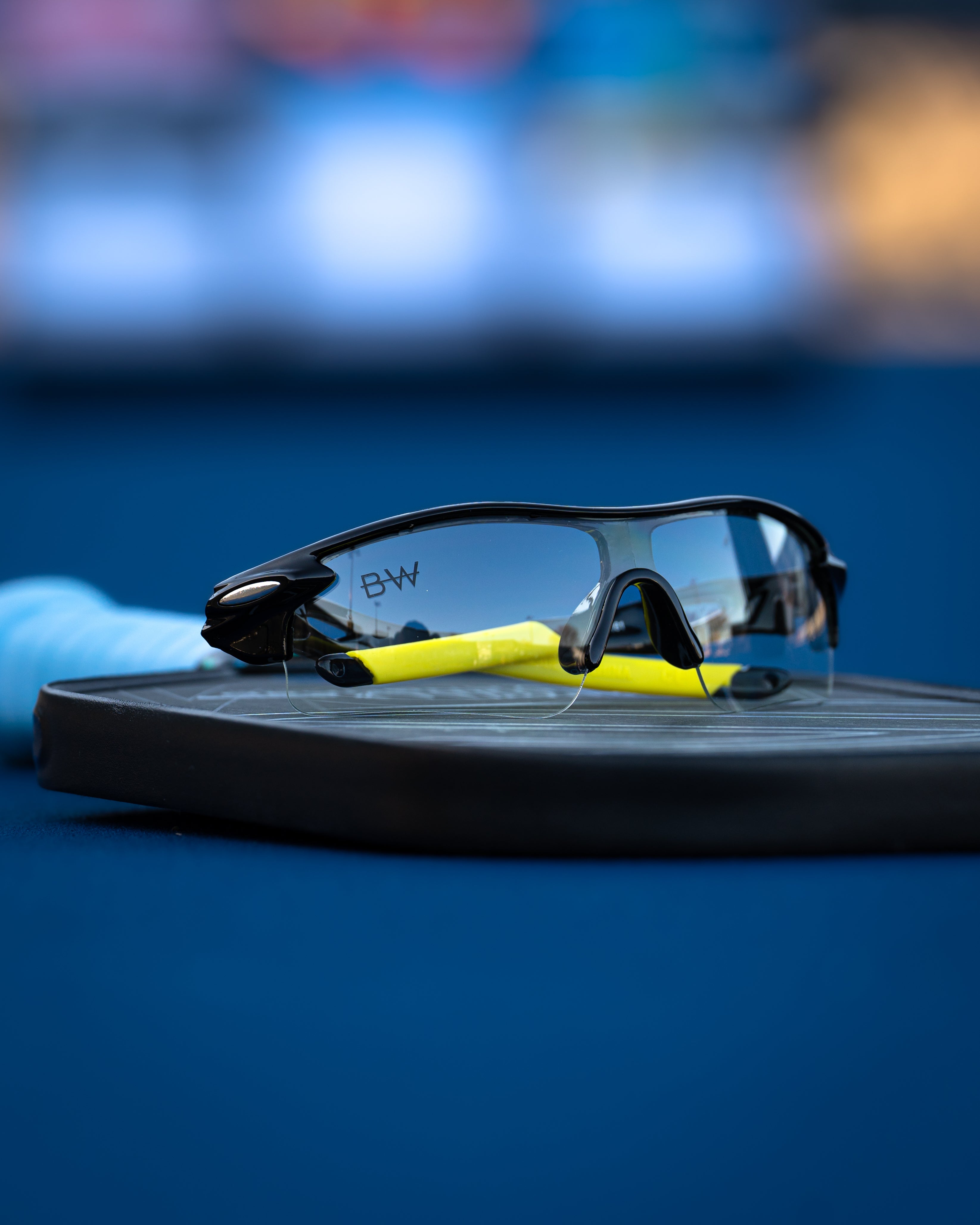
Test If Sunglasses Are Polarized: Simple DIY Trick
Share
Find Your Perfect Pickleball Glasses
Whether you need prescription (RX) or non-prescription glasses, explore our 2026 pickleball eyewear guide for options focused on clarity, comfort, fit, and performance on the court.
Test If Sunglasses Are Polarized: Simple DIY Trick
Wondering whether your sunglasses are actually polarized? You can test them at home in less than a minute using a phone, tablet, or another LCD screen.
Knowing whether your sunglasses are polarized can be useful when choosing eyewear for driving, outdoor activities, fishing, sports, and especially pickleball. Polarized lenses can reduce certain types of glare, but they are not automatically the best choice for every playing environment.
In this guide, we'll show you how to tell if sunglasses are polarized, explain what polarization actually does, and discuss why some pickleball players may prefer non-polarized lenses.
What Does “Polarized” Mean on Sunglasses?
Polarized sunglasses contain a specialized filter designed to reduce certain horizontally oriented light waves. This can significantly reduce glare reflected from surfaces such as water, roads, snow, and other relatively flat surfaces.
That makes polarized lenses particularly popular for activities where reflected glare is a major problem, including fishing, boating, driving, and general outdoor use.
However, polarization is a lens feature—not a guarantee that a pair of sunglasses will provide better vision in every situation.
For sports such as pickleball, factors including lens tint, contrast, optical clarity, lighting conditions, fit, and personal visual preference can all affect how comfortable and useful a pair of glasses feels on the court.
How to Tell If Sunglasses Are Polarized
The easiest way to test your sunglasses at home is to use an LCD screen.
What You’ll Need
- Your sunglasses
- A smartphone, tablet, laptop, or LCD monitor
- A few seconds
The Simple 90-Degree Rotation Test
- Turn on your phone, tablet, or LCD screen and display a bright image or mostly white screen.
- Hold your sunglasses in front of the screen with the lenses facing the display.
- Look through one lens at the screen.
- Slowly rotate the sunglasses approximately 90 degrees.
- Watch for a significant change in brightness as you rotate them.
If the lens becomes substantially darker at one orientation and lighter at another, that is a strong indication that the lens is polarized.
If the brightness stays relatively consistent as you rotate the glasses, the lenses are likely non-polarized.
Why does this work? An LCD screen emits light with a particular polarization. When a polarized sunglass lens is rotated relative to that light, the lens filter can block substantially more or less of the transmitted light.
Try the Test Again With Both Lenses
For a more reliable at-home check, repeat the test with each lens individually. Hold the sunglasses in front of the screen and rotate them slowly through approximately 90 degrees.
A pronounced change in brightness is the key observation—not simply whether the screen looks darker through the sunglasses.
Can You Test Polarization Without a Phone?
Yes. You can perform a similar test using another pair of sunglasses.
- Hold the two pairs of sunglasses directly in front of one another.
- Look through both lenses at a bright light source or screen.
- Slowly rotate one pair approximately 90 degrees.
- Watch for a dramatic reduction in transmitted light.
If the combination becomes extremely dark at a particular angle, that strongly suggests that both lenses contain polarizing filters.
Using an LCD screen is generally the simpler option, especially if you only need to test one pair of sunglasses.
Does Darker Mean Polarized?
No. A dark sunglass lens is not necessarily polarized.
Lens darkness and polarization are two different characteristics. A non-polarized lens can be very dark, while a polarized lens can be relatively light.
That's why simply looking at the color or darkness of your sunglasses isn't enough to determine whether they're polarized.
The same principle applies to sports eyewear. A darker lens does not automatically mean better glare control, better contrast, or better performance on a pickleball court.
Why Polarized Sunglasses May Not Be Ideal for Pickleball
Polarized sunglasses are popular because they can significantly reduce glare from reflective surfaces. That can be useful for activities such as fishing, boating, driving, and everyday outdoor wear.
Pickleball, however, presents a different visual environment. Players need to follow a small, fast-moving ball while constantly judging its trajectory against the court, net, background, and changing light conditions.
That does not mean polarization is automatically bad for every pickleball player. Rather, polarized lenses can change the way certain reflections and visual information appear, so players should consider their individual vision, lighting conditions, and preferences before choosing them.
What Polarization Actually Does
Light can travel in different orientations. Reflections from relatively flat surfaces can become strongly horizontally polarized, which is why polarized lenses are particularly effective at reducing certain types of glare.
A polarized lens contains a filter that selectively blocks light traveling in a particular orientation. The result can be a noticeably darker, more comfortable view when you're dealing with intense reflected light.
For a pickleball player, though, reducing glare is only one part of the equation. Ball visibility, contrast, brightness, color perception, and overall visual comfort all matter when you're trying to react quickly.
Can Polarization Affect Pickleball Visibility?
It can, depending on the environment and the individual player.
Polarization may reduce reflections that are useful visual cues in some situations. Certain players may also notice differences when looking at digital displays, court surfaces, or other reflective objects through polarized lenses.
That's why the best pickleball sunglasses aren't necessarily the ones with the most features. They are the ones that provide the visual characteristics that work best for your game.
For players who prefer a natural, unobstructed view without polarization, non-polarized pickleball sunglasses can be an excellent alternative—particularly when paired with appropriate UV protection, lens tint, and optical clarity.
How to Test Your Sunglasses for Polarization
If you're not sure whether your sunglasses are polarized, you don't need special equipment to perform a quick check. A digital display can provide a simple indication.
DIY Polarization Test Using Your Phone
- Open a bright image or mostly white screen on your smartphone.
- Hold your sunglasses in front of the display.
- Look through one lens at the screen.
- Slowly rotate the sunglasses approximately 90 degrees.
- Watch for a substantial change in brightness.
If the lens becomes significantly darker at one orientation, the lens is likely polarized.
If the brightness remains relatively consistent as you rotate the glasses, the lens is likely non-polarized.
Important: this is a quick household test, not a laboratory certification. The result can vary depending on the type and orientation of the display you're using, so don't use this test as proof of a product's safety rating or optical specifications.
Why Does the Screen Test Work?
Many LCD and similar digital displays emit light with a specific polarization orientation. When you place a second polarizing filter in front of that light and rotate it, the amount of light passing through can change dramatically.
That's why a polarized pair of sunglasses can appear to make your phone screen become extremely dark at a particular angle.
It's a simple example of how two polarization filters interact with one another—and a useful way to check your sunglasses at home.
Try the Crossed-Lenses Test
There's another simple method if you have access to a second pair of sunglasses that you know are polarized.
- Hold the two pairs of sunglasses in front of one another.
- Look through both lenses at a bright light source.
- Slowly rotate one pair of glasses.
- Pay attention to how much the combined view darkens.
When two polarizing filters are oriented approximately 90 degrees apart, they can block substantially more light. If the view becomes dramatically darker as one pair rotates, that is a strong indication that the tested lenses are polarized.
Again, this test is useful for identifying polarization, but it does not determine whether sunglasses provide adequate UV protection, impact resistance, or other safety characteristics.
Polarized vs. Non-Polarized: What Does It Mean for Pickleball?
| Feature | Polarized Lenses | Non-Polarized Lenses |
|---|---|---|
| Reduces certain reflected glare | Yes | No |
| Can be useful in intense outdoor glare | Yes | Sometimes |
| Can alter how some displays appear | Yes | Generally less likely |
| Provides UV protection automatically | No | No |
| Provides impact protection automatically | No | No |
| Best choice for every pickleball player | No | No |
The key takeaway is that polarization and UV protection are different things. A pair of sunglasses can be polarized without providing adequate UV protection, and a non-polarized pair can provide excellent UV protection.
When shopping for pickleball sunglasses, look at the complete lens specification rather than assuming one feature automatically means better eye protection or performance.
Why Blinded Wear Co. Uses Non-Polarized Pickleball Lenses
At Blinded Wear Co., we intentionally focus on non-polarized lenses for our pickleball eyewear because our priority is a consistent, natural view of the court and ball.
Rather than relying on polarization as a universal solution to glare, our approach focuses on the combination of lens tint, UV protection, optical clarity, fit, coverage, and comfort.
That approach gives players another option if they prefer not to use polarized lenses while playing pickleball.
- Non-polarized lens options for players who prefer an unobstructed view.
- UV protection for outdoor play.
- Sport-oriented designs intended for active movement.
- Secure fit to help keep eyewear positioned during rallies.
- Prescription options for players who need vision correction.
- Different lens options for varying playing environments.
Explore Blinded Wear Co. Pickleball Sunglasses →
Whether you play indoors, outdoors, recreationally, or competitively, the right lens is ultimately the one that gives you the visual experience you can perform best with.
Why Polarized Sunglasses May Not Be Ideal for Pickleball
Polarized sunglasses are popular because they can significantly reduce glare from reflective surfaces. That can be useful for activities such as fishing, boating, driving, and everyday outdoor wear.
Pickleball, however, presents a different visual environment. Players need to follow a small, fast-moving ball while constantly judging its trajectory against the court, net, background, and changing light conditions.
That does not mean polarization is automatically bad for every pickleball player. Rather, polarized lenses can change the way certain reflections and visual information appear, so players should consider their individual vision, lighting conditions, and preferences before choosing them.
What Polarization Actually Does
Light can travel in different orientations. Reflections from relatively flat surfaces can become strongly horizontally polarized, which is why polarized lenses are particularly effective at reducing certain types of glare.
A polarized lens contains a filter that selectively blocks light traveling in a particular orientation. The result can be a noticeably darker, more comfortable view when you're dealing with intense reflected light.
For a pickleball player, though, reducing glare is only one part of the equation. Ball visibility, contrast, brightness, color perception, and overall visual comfort all matter when you're trying to react quickly.
Can Polarization Affect Pickleball Visibility?
It can, depending on the environment and the individual player.
Polarization may reduce reflections that are useful visual cues in some situations. Certain players may also notice differences when looking at digital displays, court surfaces, or other reflective objects through polarized lenses.
That's why the best pickleball sunglasses aren't necessarily the ones with the most features. They are the ones that provide the visual characteristics that work best for your game.
For players who prefer a natural, unobstructed view without polarization, non-polarized pickleball sunglasses can be an excellent alternative—particularly when paired with appropriate UV protection, lens tint, and optical clarity.
How to Test Your Sunglasses for Polarization
If you're not sure whether your sunglasses are polarized, you don't need special equipment to perform a quick check. A digital display can provide a simple indication.
DIY Polarization Test Using Your Phone
- Open a bright image or mostly white screen on your smartphone.
- Hold your sunglasses in front of the display.
- Look through one lens at the screen.
- Slowly rotate the sunglasses approximately 90 degrees.
- Watch for a substantial change in brightness.
If the lens becomes significantly darker at one orientation, the lens is likely polarized.
If the brightness remains relatively consistent as you rotate the glasses, the lens is likely non-polarized.
Important: this is a quick household test, not a laboratory certification. The result can vary depending on the type and orientation of the display you're using, so don't use this test as proof of a product's safety rating or optical specifications.
Why Does the Screen Test Work?
Many LCD and similar digital displays emit light with a specific polarization orientation. When you place a second polarizing filter in front of that light and rotate it, the amount of light passing through can change dramatically.
That's why a polarized pair of sunglasses can appear to make your phone screen become extremely dark at a particular angle.
It's a simple example of how two polarization filters interact with one another—and a useful way to check your sunglasses at home.
Try the Crossed-Lenses Test
There's another simple method if you have access to a second pair of sunglasses that you know are polarized.
- Hold the two pairs of sunglasses in front of one another.
- Look through both lenses at a bright light source.
- Slowly rotate one pair of glasses.
- Pay attention to how much the combined view darkens.
When two polarizing filters are oriented approximately 90 degrees apart, they can block substantially more light. If the view becomes dramatically darker as one pair rotates, that is a strong indication that the tested lenses are polarized.
Again, this test is useful for identifying polarization, but it does not determine whether sunglasses provide adequate UV protection, impact resistance, or other safety characteristics.
Polarized vs. Non-Polarized: What Does It Mean for Pickleball?
| Feature | Polarized Lenses | Non-Polarized Lenses |
|---|---|---|
| Reduces certain reflected glare | Yes | No |
| Can be useful in intense outdoor glare | Yes | Sometimes |
| Can alter how some displays appear | Yes | Generally less likely |
| Provides UV protection automatically | No | No |
| Provides impact protection automatically | No | No |
| Best choice for every pickleball player | No | No |
The key takeaway is that polarization and UV protection are different things. A pair of sunglasses can be polarized without providing adequate UV protection, and a non-polarized pair can provide excellent UV protection.
When shopping for pickleball sunglasses, look at the complete lens specification rather than assuming one feature automatically means better eye protection or performance.
Why Blinded Wear Co. Uses Non-Polarized Pickleball Lenses
At Blinded Wear Co., we intentionally focus on non-polarized lenses for our pickleball eyewear because our priority is a consistent, natural view of the court and ball.
Rather than relying on polarization as a universal solution to glare, our approach focuses on the combination of lens tint, UV protection, optical clarity, fit, coverage, and comfort.
That approach gives players another option if they prefer not to use polarized lenses while playing pickleball.
- Non-polarized lens options for players who prefer an unobstructed view.
- UV protection for outdoor play.
- Sport-oriented designs intended for active movement.
- Secure fit to help keep eyewear positioned during rallies.
- Prescription options for players who need vision correction.
- Different lens options for varying playing environments.
Explore Blinded Wear Co. Pickleball Sunglasses →
Whether you play indoors, outdoors, recreationally, or competitively, the right lens is ultimately the one that gives you the visual experience you can perform best with.
What Should Pickleball Players Look for Instead of Polarization?
Whether your current sunglasses pass the polarization test or not, polarization is only one feature to consider when choosing pickleball eyewear.
For pickleball, the better question is: Does this eyewear give me the clarity, protection, comfort, and fit I need for the conditions where I actually play?
Before buying your next pair of pickleball sunglasses, consider these features:
- UV protection: Important for protecting your eyes during outdoor play.
- Clear optical performance: Your lenses should allow you to comfortably track the ball across different backgrounds.
- Appropriate lens tint: Match the tint to bright sun, variable light, overcast conditions, or indoor play.
- Secure sports fit: Eyewear should stay comfortably positioned while you sprint, turn, swing, and react.
- Lightweight construction: Less unnecessary weight can improve comfort during long matches.
- Impact-conscious construction: Sports eyewear should be selected with court hazards and eye coverage in mind.
- Scratch resistance: A durable lens surface can help maintain useful clarity over time.
- Prescription compatibility: Players who need vision correction should consider dedicated prescription pickleball glasses.
Polarized lenses can be useful in the right situation, but polarization alone does not tell you whether a pair of sunglasses is good for pickleball.
Best Pickleball Sunglasses for Players Who Prefer Non-Polarized Lenses
If you've tested your sunglasses and decided you prefer a non-polarized option for pickleball, Blinded Wear Co. offers eyewear designed around the needs of active players.
Our approach focuses on combining court-ready visibility, UV protection, comfortable fit, sport-oriented coverage, and different lens options rather than assuming polarization is necessary for every player.
Need vision correction? You don't have to rely on your everyday glasses while playing. Explore dedicated RX options designed for players who want prescription vision on the court.
Shop Prescription Pickleball Glasses →
Still comparing options? Use our complete guide to learn more about choosing eyewear based on your playing environment and visual needs.
Compare Pickleball Glasses in Our 2026 Guide →
Polarized vs. Non-Polarized Sunglasses for Outdoor Pickleball
Outdoor pickleball can expose players to bright sunlight, reflections, shadows, and rapidly changing backgrounds. That makes lens selection especially important.
Polarized sunglasses can be excellent at reducing certain reflected glare. A player competing on a particularly reflective outdoor court may appreciate that effect.
Non-polarized sunglasses, meanwhile, preserve those reflections rather than filtering them according to polarization orientation. Some pickleball players prefer this more natural visual presentation when tracking the ball and reading the court.
Neither option is universally superior for every player. Consider the conditions where you play most frequently and prioritize the combination of visibility, UV protection, comfort, and fit that works best for you.
What About Indoor Pickleball?
Indoor pickleball creates a different set of requirements because glare from direct sunlight is usually less important.
Instead of polarization, indoor players may benefit more from prioritizing light transmission, clarity, comfortable coverage, and an appropriate clear or lighter lens.
A heavily tinted outdoor sunglass lens may make an indoor court unnecessarily dark. If you regularly play both indoors and outdoors, consider whether separate lens options or eyewear designed for changing conditions makes more sense for your game.
Does Polarized Mean UV400?
No. Polarization and UV protection describe different lens characteristics.
Polarization is designed to reduce certain types of reflected glare. UV protection refers to how effectively a lens blocks ultraviolet radiation.
That means you should never assume sunglasses provide appropriate UV protection simply because they're labeled polarized.
When buying pickleball sunglasses for outdoor play, check the manufacturer's actual UV specifications in addition to considering tint, polarization, impact resistance, fit, and other performance features.
Frequently Asked Questions About Polarized Sunglasses
How can I tell if my sunglasses are polarized?
Hold your sunglasses in front of an LCD screen and slowly rotate them approximately 90 degrees. If the view through the lens becomes significantly darker at a particular orientation, the lens is likely polarized.
Can I test polarized sunglasses with my phone?
Yes. Many phone and tablet displays can be used for a quick polarization test. Look through the sunglasses at a bright screen and rotate the glasses. A dramatic brightness change can indicate polarization.
Why do polarized sunglasses turn black when rotated?
Many LCD screens emit polarized light. When the polarizing filter in your sunglasses is rotated relative to the screen's polarization orientation, substantially less light may pass through, causing the screen to appear very dark.
Does the polarization test work on every phone?
Not necessarily. Display technology and polarization orientation can vary, so results may differ between devices. If you don't notice an obvious change, try another LCD screen or compare the glasses with a pair you already know is polarized.
Are polarized sunglasses better than non-polarized sunglasses?
Neither is automatically better for every activity. Polarized sunglasses can be particularly useful for reducing reflected glare, while some users prefer non-polarized lenses in situations where they want a more natural view of reflections. Your ideal choice depends on the activity, lighting conditions, and personal preference.
Are polarized sunglasses good for pickleball?
They can work well for some players, especially in bright environments with significant reflected glare. Other players may prefer non-polarized lenses. For pickleball, consider the complete eyewear setup—including lens tint, UV protection, optical clarity, fit, coverage, and comfort—rather than choosing solely based on polarization.
Do non-polarized sunglasses still protect against UV rays?
They can. Polarization and UV protection are separate properties. A non-polarized lens can provide strong UV protection when it is manufactured to do so. Always verify the product's stated UV specifications.
Does polarized mean darker?
No. Lens tint and polarization are different features. Both polarized and non-polarized sunglasses can be manufactured in a range of lens darkness levels.
Can polarized lenses affect phone screens?
Yes. Because many displays use polarized light, polarized sunglasses can make certain screens appear unusually dark or change brightness as you rotate your head or the device.
Are polarized sunglasses safer for your eyes?
Polarization itself should not be confused with UV protection or impact protection. When eye protection is your priority, review the eyewear's actual UV, lens-material, construction, and safety specifications.
Quick Answer: How to Check If Sunglasses Are Polarized
- Turn on a phone, tablet, or LCD monitor.
- Set the display to a bright screen.
- Look at the screen through one sunglass lens.
- Rotate the sunglasses approximately 90 degrees.
- If the screen becomes dramatically darker, the lens is likely polarized.
It's one of the simplest ways to test polarized sunglasses at home without specialized equipment.
Final Takeaway: Test Your Sunglasses, Then Choose the Right Lens for Your Game
Testing whether your sunglasses are polarized takes only a few seconds. Hold them in front of an appropriate digital screen, rotate them approximately 90 degrees, and look for a significant change in brightness.
But knowing whether your sunglasses are polarized is only the beginning.
For pickleball players, the right eyewear should balance clear vision, UV protection, comfortable fit, appropriate lens tint, durability, coverage, and the visual characteristics you personally prefer on the court.
If you prefer non-polarized lenses, Blinded Wear Co. offers pickleball eyewear designed around active play, with prescription and non-prescription options available.
Ready to find your next pair?