
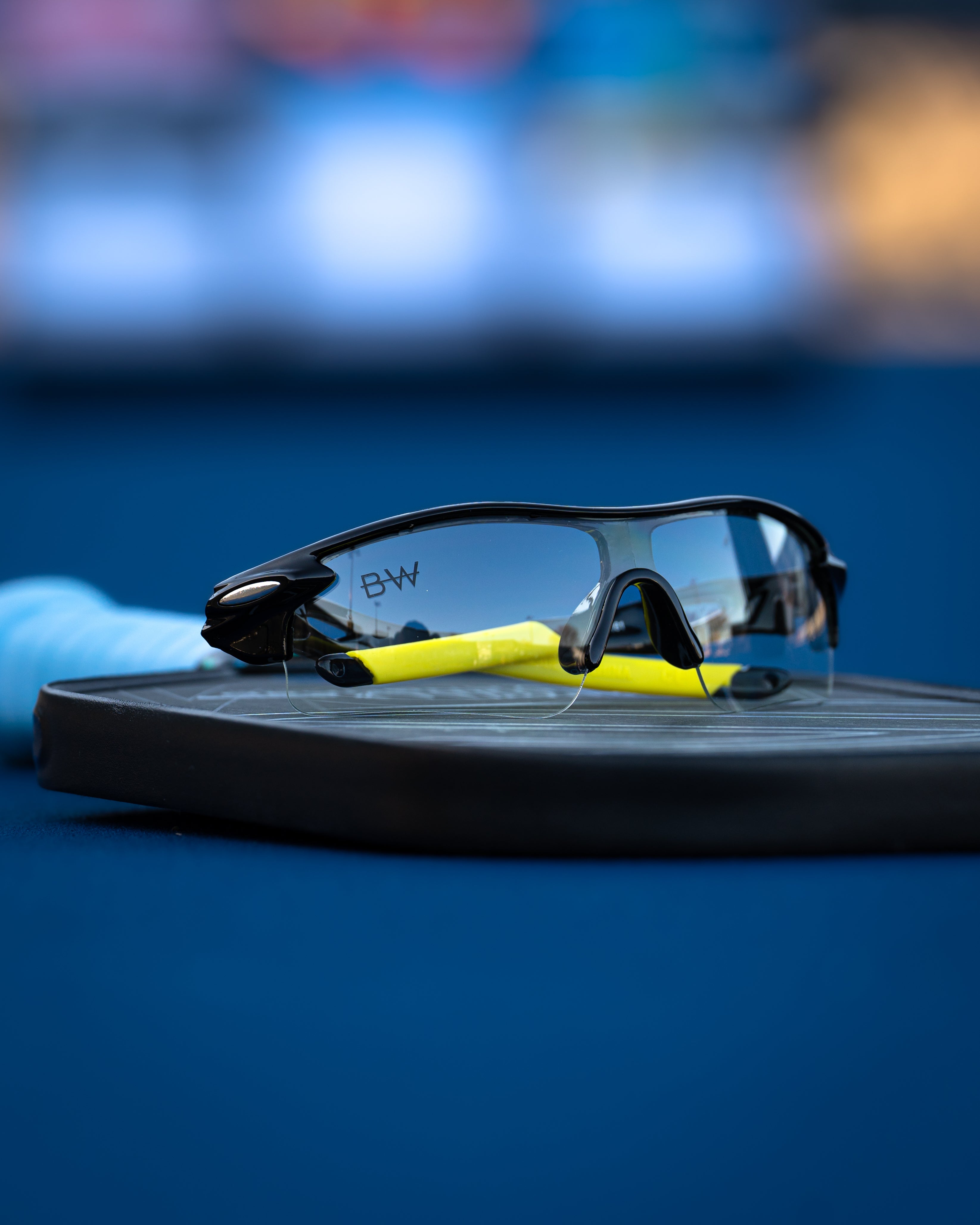
How Transitional RX Lenses Adapt on the Pickleball Court
Share
Find Your Pickleball Glasses
Prescription pickleball eyewear involves more than choosing a frame. Your prescription requirements, playing environment, lens configuration, and changing light conditions can all affect which option makes sense for you.
How Transitional RX Lenses Adapt on the Pickleball Court
Pickleball can put players in very different lighting environments. One match might be played outdoors in daylight, another under cloud cover, and another on an indoor court. Even during a single outdoor session, the amount of available light can change as weather, court orientation, and surrounding shade change.
Transitional RX lenses, more commonly described as photochromic prescription lenses, are designed to change tint in response to particular environmental conditions. That makes them an interesting option for prescription wearers who move between lighting environments and prefer a lens that can change rather than remain at one fixed tint.
There are important limitations, though. Photochromic lenses should not be described as changing instantly, maintaining one perfect brightness in every environment, improving reaction time, or automatically improving ball tracking, depth perception, or pickleball performance.
This guide explains what photochromic RX lenses actually do, what influences their behavior, and what pickleball players should consider before choosing them.
What Are Transitional or Photochromic RX Lenses?
Photochromic lenses contain technology designed to change the lens tint in response to particular environmental conditions. Depending on the specific lens technology, the lens can become darker under activating conditions and return toward a lighter state when those conditions change.
The terms transitional lenses and photochromic lenses are often used conversationally to describe this category, although exact technologies and product specifications can differ.
The important distinction is between a lens that can change tint and a conventional fixed-tint lens.
| Lens Type | General Behavior |
|---|---|
| Clear lens | Does not have a dark sunglass tint |
| Fixed-tint lens | Maintains its established tint rather than automatically changing with the environment |
| Photochromic lens | Designed to change tint in response to particular activating conditions |
That changing tint is the defining feature. Claims about polarization, impact resistance, UV specifications, coatings, or athletic performance must be evaluated separately.
How Do Photochromic Lenses Change?
Photochromic lens technology responds to environmental conditions that activate the photochromic process. As those conditions change, the lens can move between lighter and darker states.
The exact behavior depends on the specific photochromic technology rather than on the word “transitional” alone.
That means you should not assume every photochromic lens has the same:
- Light-state appearance
- Dark-state appearance
- Visible light transmission
- Activation behavior
- Fade-back behavior
- Temperature response
- Performance behind glass
- Tint color
Exact specifications should come from the specific lens configuration being considered.
Do Transitional RX Lenses Adapt Instantly?
No. “Adaptive” should not be interpreted as “instant.”
A photochromic lens changes through a physical process, and its response is not the same as an electronic display immediately changing brightness. Activation and fade-back behavior depend on the particular lens technology and surrounding conditions.
For that reason, claims such as “changes in seconds,” “instantly adjusts,” or “immediately matches every lighting shift” should only be used if an exact verified lens specification supports them.
For pickleball players, this distinction matters because some lighting changes can happen more quickly than a photochromic lens changes state.
How Photochromic RX Lenses Behave During Outdoor Pickleball
Outdoor pickleball is one environment where photochromic technology may be relevant because environmental conditions can vary over the course of a playing session.
A player may encounter:
- Bright daylight
- Cloud cover
- Partial shade
- Tree or building shadows
- Changing sun position
- Late-afternoon conditions
A photochromic lens is designed to respond to its activating conditions, but it should not be described as continuously producing a perfect tint for every one of these situations.
The player's subjective preference also matters. Some players prefer a fixed lens appearance, while others may value a lens that can change.
What Happens to Photochromic RX Lenses Indoors?
Do not reduce photochromic behavior to the claim that the lenses are always “perfectly clear indoors.” The exact light-state appearance and behavior depend on the particular lens technology.
Indoor environments can also vary substantially. A dedicated pickleball facility, multipurpose gym, covered court, and building with large exterior windows can expose eyewear to different conditions.
If indoor play is a major part of your routine, compare the exact photochromic configuration with other options rather than assuming that every adaptive lens behaves identically indoors.
What About Players Who Move Between Indoor and Outdoor Courts?
Moving between indoor and outdoor environments is one of the most obvious reasons a prescription wearer might consider photochromic technology.
Instead of carrying one clear RX pair and another fixed-tint RX pair, some players may prefer the convenience of a lens designed to change tint.
That does not automatically make photochromic lenses the best option for every hybrid player.
Consider:
- How often you actually change environments
- How long you remain in each environment
- How you feel about the lens changing gradually rather than instantly
- Whether you prefer a predictable fixed tint
- Your prescription requirements
- The exact photochromic technology available for the product
What About Covered Pickleball Courts?
Covered courts deserve separate consideration because they are not necessarily equivalent to either a fully indoor gym or a fully exposed outdoor court.
A roof may reduce direct exposure while open sides still allow substantial daylight into the playing area. The conditions experienced by the lens can therefore differ from both traditional indoor and outdoor environments.
Do not assume a photochromic lens will reach the same tint state on every covered court. The exact response depends on the lens technology and the conditions reaching the lens.
What Happens When You Move Into Shade?
Shade is another reason to avoid describing photochromic lenses as an instant brightness-control system.
A player can move from an exposed section of a facility to a shaded area very quickly. The lens, however, follows the behavior of its photochromic technology rather than instantly matching every small environmental change.
Players who frequently encounter strong boundaries between sun and shade should consider whether they prefer adaptive tint behavior or the predictability of a fixed lens.
Do Photochromic Lenses Still Change on Cloudy Days?
Cloudy conditions should not automatically be treated as equivalent to indoor conditions. Environmental activation can still differ from what the lens experiences indoors.
The degree of tint change depends on the specific technology and conditions, so avoid promising a particular darkness simply because the forecast says “cloudy.”
For players, the practical question is not whether a generic photochromic lens works on cloudy days, but whether the exact lens behavior fits their preferences across the conditions in which they actually play.
Can Temperature Affect Photochromic Lens Behavior?
Temperature can be relevant to the behavior of some photochromic technologies. That is another reason activation and fade-back should not be reduced to one universal number.
Two playing sessions with different environmental conditions may not produce identical lens behavior even if they occur on the same court.
When an exact photochromic lens is offered, product-specific specifications are more useful than a generic promise that every transitional lens always changes at the same speed or reaches the same darkness.
Photochromic Lenses and Visible Light Transmission
Visible Light Transmission, or VLT, is the percentage of visible light transmitted through a lens.
- Higher VLT: more visible light passes through the lens.
- Lower VLT: less visible light passes through the lens.
A photochromic lens can change its visible-light transmission as its tint state changes.
However, an exact VLT range should only be stated when it has been verified for the exact lens configuration. Do not assign generic VLT percentages to Blinded Wear photochromic lenses without verified specifications.
Why a Photochromic Lens Can Have More Than One VLT State
A conventional fixed-tint lens has a relatively fixed transmission characteristic under ordinary use. A photochromic lens is designed to change, so its visible-light transmission can also change with its state.
This is why describing a photochromic lens with one arbitrary VLT number can be misleading.
If an exact light-state and dark-state VLT range is available for a particular lens, those specifications can provide useful context. Without verified numbers, it is better to describe the lens as photochromic rather than invent percentages.
Does Lower VLT Mean Better Pickleball Performance?
No. Visible light transmission tells you how much visible light passes through a lens. It does not independently measure athletic performance.
Lower VLT does not automatically mean:
- Faster reactions
- Better ball tracking
- Improved depth perception
- Better contrast
- More accurate shots
- Improved court awareness
Likewise, higher VLT does not automatically produce those outcomes.
VLT is useful for understanding lens transmission, not for assigning a universal performance score.
Does the Tint Change Alter Your Prescription?
No. Prescription correction and photochromic tint behavior are separate characteristics.
Your prescription addresses the refractive correction determined for your vision. Photochromic technology changes the tint behavior of the lens.
The lens becoming lighter or darker should not be described as strengthening or weakening your prescription.
Do Transitional RX Lenses Improve Depth Perception?
Do not promise improved depth perception simply because a prescription lens is photochromic.
Depth perception is a visual function influenced by multiple factors. Photochromic technology primarily concerns how the lens changes tint under particular conditions.
A tint-changing mechanism should not be marketed as a direct depth-perception enhancement.
Do Photochromic Lenses Improve Ball Tracking?
Photochromic lenses should not be marketed as automatically improving ball tracking.
Following a pickleball involves multiple factors, including the player's vision, attention, head and eye movements, the ball's movement, lighting, background conditions, and other individual variables.
A photochromic lens changes tint. That does not establish a direct improvement in tracking a moving ball.
Do Transitional Lenses Improve Reaction Time?
No reaction-time improvement should be promised from photochromic technology alone.
Reaction during pickleball involves seeing relevant information, interpreting what is happening, selecting a response, and physically executing it. Experience, anticipation, positioning, attention, and movement all contribute.
A lens that changes tint should not be described as making the brain process information faster.
Can Transitional RX Lenses Help You Read Spin?
Do not claim that photochromic technology itself makes spin easier to read.
Reading spin involves visual information from the ball, opponent, paddle movement, trajectory, and the player's experience interpreting those cues.
A tint-changing lens does not independently create the ability to read spin or predict a shot.
Do Photochromic Lenses Reduce Eye Strain?
Be careful with universal eye-strain claims. Visual comfort is subjective and can be influenced by lighting, prescription correction, individual sensitivity, duration of play, environment, and other factors.
Some wearers may prefer a lens that changes tint rather than using one fixed tint across different environments. That preference should not be converted into a guarantee that photochromic lenses eliminate or medically treat eye strain.
Are Photochromic Lenses the Same as Anti-Glare Lenses?
No. Photochromic behavior and glare-management technologies should not automatically be treated as the same thing.
A photochromic lens changes tint in response to its activating conditions. That does not automatically establish that the lens is:
- Polarized
- Anti-reflective
- Equipped with a particular glare-reducing coating
- Designed to eliminate reflected glare
Those characteristics require separate verification.
Photochromic vs. Polarized Lenses
Photochromic and polarized describe different lens technologies.
| Photochromic | Polarized |
|---|---|
| Designed to change tint in response to particular conditions | Designed to reduce certain reflected light |
| Can move between lighter and darker states | Polarization itself does not mean the tint automatically changes |
| Does not automatically establish polarization | Does not automatically establish photochromic behavior |
Neither technology should automatically be described as improving depth perception, reaction time, ball tracking, or overall pickleball performance.
Does Non-Polarized Mean Better for Pickleball?
Some court-sport players may prefer non-polarized eyewear, while others may prefer different lens configurations depending on their environment and personal preferences.
Do not claim that non-polarized lenses automatically provide:
- Better depth perception
- Faster reactions
- More accurate ball tracking
- Less visual distortion
- Better court awareness
Polarization status is one lens characteristic, not a universal measure of sports performance.
Photochromic RX vs. Clear RX
A clear lens and a photochromic lens can serve different preferences.
A clear lens does not have a dark sunglass tint. A photochromic lens is designed to change tint in response to particular conditions.
| Consideration | Clear Lens | Photochromic Lens |
|---|---|---|
| Tint behavior | No dark sunglass tint | Designed to change tint |
| Predictability | Does not transition between sunglass tint states | State depends on lens technology and environment |
| Indoor use | Useful for players who do not want a dark tint | Exact indoor state depends on the lens technology |
| Changing environments | Remains clear rather than adapting tint | May appeal to players who prefer adaptive tint behavior |
Neither option is universally better. The decision depends on your environment, prescription needs, and lens preference.
Photochromic RX vs. Fixed-Tint Prescription Lenses
A fixed tint gives the wearer a more predictable tint state. A photochromic lens changes its tint in response to its activating conditions.
A player who spends an entire session in a relatively consistent environment may prefer the predictability of a fixed lens. A player frequently moving between different environments may value the changing behavior of photochromic technology.
Neither choice should be declared universally superior for pickleball.
Photochromic RX vs. Carrying Multiple Pairs
Some prescription players may consider photochromic lenses because they would rather use one adaptable configuration than switch between separate clear and tinted prescription eyewear.
Other players may prefer separate pairs because each pair can remain in a predictable configuration.
The tradeoff is primarily about convenience and personal lens preference, not a guaranteed difference in pickleball ability.
Do Photochromic Lenses Behave the Same Behind Glass?
Do not assume that every photochromic lens responds identically behind a vehicle windshield, facility window, or other glass barrier.
Photochromic technologies can differ in how they respond under those conditions. If behind-glass activation matters to you, verify that characteristic for the exact lens technology rather than relying on the generic term “transitional.”
Does Photochromic Tint Color Matter?
Lens color and tint can affect the appearance of the scene viewed through the lens, but color should not automatically be translated into a pickleball-performance claim.
Do not assume a particular photochromic color universally improves:
- Ball visibility
- Contrast sensitivity
- Depth perception
- Spin recognition
- Reaction speed
Some players may simply prefer the appearance or perceived brightness of one lens color over another.
Why Lens Color Is More Than a VLT Number
VLT summarizes the overall percentage of visible light transmitted through a lens, but it does not fully describe how that transmission is distributed across the visible spectrum.
Two lenses with similar overall VLT can still look different because their spectral transmission characteristics can differ.
That is why both tint appearance and verified transmission information can be useful when comparing lenses. VLT alone does not tell the entire story of how a lens will look to a particular wearer.
Photochromic Technology vs. High-Index Prescription Lenses
High-index and photochromic describe different aspects of a prescription lens.
High-index refers to a category of prescription lens material commonly used to help manage lens thickness, particularly as prescription strength increases.
Photochromic refers to tint-changing behavior.
Do not treat either term as a substitute for the other.
| Feature | Primary Meaning |
|---|---|
| High-index | Prescription lens material category related to refractive index and thickness management |
| Photochromic | Technology designed to change lens tint under particular conditions |
| Impact resistance | Physical lens characteristic that must be evaluated separately |
| Polarization | Technology designed to reduce certain reflected light |
| VLT | Percentage of visible light transmitted through the lens |
Does High-Index Make Photochromic Lenses Adapt Faster?
Do not assume that high-index material automatically makes a photochromic lens activate or fade faster.
Refractive index primarily concerns the optical material's refractive properties and can be relevant to prescription lens thickness. Photochromic response depends on the photochromic technology and environmental conditions.
These characteristics should be evaluated separately.
Does Photochromic Mean Impact-Resistant?
No. Photochromic behavior does not establish impact resistance.
Likewise, impact resistance does not establish that a lens is photochromic.
Blinded Wear offers impact-resistant lens options, but the exact characteristics of a specific RX configuration should be verified rather than inferred from the tint technology.
Does Photochromic Mean Safety-Rated?
No. The fact that a lens changes tint does not establish a particular safety certification.
Do not describe a photochromic sports lens as:
- Safety-certified
- Ballistic
- Shatterproof
- Protective against every impact
unless the exact product has the verified certification or specification necessary to support that statement.
Is Photochromic Behavior the Same as UV Protection?
No. Lens tint, visible light transmission, photochromic activation, and UV specifications are related concepts in some lens technologies but should not be treated as interchangeable claims.
A lens becoming darker does not, by itself, establish an exact UV specification.
Any UV claim should be based on verified specifications for the exact lens rather than inferred from how dark the lens appears.
Does Photochromic Automatically Mean Blue-Light Filtering?
No. Photochromic behavior should not automatically be described as blue-light filtering.
Likewise, do not promise that every Blinded Wear transitional RX configuration includes a separate blue-light feature unless that exact option has been verified.
Photochromic tint behavior and blue-light filtering are separate specifications.
What Coatings Come With Transitional RX Lenses?
Do not infer coatings from the fact that a lens is photochromic.
A photochromic lens is not automatically:
- Anti-fog
- Scratch-resistant
- Anti-reflective
- Hydrophobic
- Oleophobic
If a particular coating matters to you, verify that feature for the exact lens configuration before purchasing.
Do Transitional Lenses Prevent Fogging?
No. Tint-changing technology should not be confused with fog management.
Fogging involves moisture and environmental conditions at the lens surface. Photochromic technology concerns tint behavior.
A lens can be photochromic and still experience fogging. Do not describe transitional RX lenses as anti-fog unless that property is separately verified.
Are Photochromic Lenses Scratch-Proof?
No. Photochromic behavior does not make a lens scratch-proof.
Do not assume that an adaptive lens has a particular scratch-resistant coating unless that feature is verified for the exact configuration.
Lens care should follow the guidance appropriate for the actual product rather than an assumed coating.
Pickleball Lighting Scenarios to Consider
Instead of asking whether photochromic RX lenses are simply “good for pickleball,” consider the environments where you actually play.
| Playing Environment | Question to Consider |
|---|---|
| Outdoor daylight | Do you prefer a lens that can change tint or a predictable fixed sunglass tint? |
| Indoor club | What is the light-state behavior of the exact photochromic lens? |
| Covered outdoor court | How might the exact lens respond under partial exposure? |
| Mixed indoor/outdoor facility | Would adaptive tint reduce your need to switch between separate pairs? |
| Cloudy outdoor court | Are you comfortable with the lens responding according to environmental conditions rather than staying at one fixed tint? |
| Late-day play | Would you prefer adaptive behavior, a clear lens, or another verified configuration? |
Photochromic RX Lenses for Morning Pickleball
Morning lighting can vary by season, court orientation, weather, and surrounding structures. Do not assume that every morning starts with the same brightness or that one lens state is universally ideal.
Photochromic technology may appeal to players whose sessions continue as environmental conditions change, but the actual response depends on the specific lens and environment.
Photochromic RX Lenses for Midday Pickleball
Midday outdoor conditions can expose eyewear to substantially different light than an indoor or shaded environment.
A photochromic lens is designed to respond according to its technology, but the resulting tint should not be described with an exact darkness or VLT unless that specification is verified.
Players who strongly prefer a particular sunglass darkness may still prefer a fixed-tint option.
Photochromic RX Lenses for Evening Pickleball
As outdoor conditions change later in the day, a photochromic lens can move toward a lighter state according to its technology and environment.
Do not promise that the lens will become completely clear at the exact moment a player wants it to or that the change will perfectly match sunset.
Players who routinely play under artificial lights after daylight fades should evaluate the light-state behavior of the exact lens they are considering.
Are Photochromic RX Lenses Good for Long Tournament Days?
They may be convenient for some players, particularly when a day involves more than one lighting environment. Convenience, however, should not be confused with a performance guarantee.
Before using a new photochromic configuration for a tournament, consider testing it during ordinary play so you understand:
- How the lens looks in your usual outdoor environment
- How it behaves in shade
- How it appears indoors if you play inside
- Whether you like the transition behavior
- Whether the frame itself fits comfortably during play
Familiarity is more useful than discovering your lens preferences during an important event.
Test Transitional RX Lenses Before Competitive Play
If you are changing both your frame and your lens configuration, use the eyewear during normal practice before relying on it for an important match.
Pay attention to separate factors rather than labeling the entire experience simply “good” or “bad.”
- Prescription clarity
- Frame comfort
- Frame movement
- Lens tint state
- Lighting environment
- Fogging, if present
- Whether the lens transition behavior matches your preference
This helps distinguish a photochromic preference from a prescription, fit, or environmental issue.
If Your Vision Feels Different, Identify the Actual Cause
Not every visual issue experienced while wearing transitional RX eyewear is caused by the photochromic technology.
| What You Notice | Possible Area to Evaluate |
|---|---|
| Blur is present regardless of lighting | Prescription or optical configuration may need evaluation |
| The frame moves during play | Evaluate individual frame fit |
| Vision becomes obscured by moisture | Evaluate fogging rather than tint activation |
| The lens feels darker or lighter than preferred | Evaluate tint and photochromic behavior |
| The issue occurs only in one environment | Compare environmental lighting and lens state |
| A new prescription feels unfamiliar | Do not automatically blame photochromic tint behavior |
Photochromic Lenses Do Not Replace Proper Frame Fit
A sophisticated lens cannot compensate for a frame that does not fit the wearer appropriately.
When selecting prescription pickleball eyewear, evaluate the lens configuration and frame separately.
Frame fit can be influenced by individual facial dimensions, frame dimensions, movement patterns, and personal comfort preferences. Avoid universal claims such as “zero-slip,” “never moves,” or “locked in” unless an exact product can substantiate them.
Explore Current Blinded Wear RX Frames
If you are interested in prescription pickleball eyewear, start with the current RX collection and verify the available lens configuration for the exact product you are considering.
- Zebra II RX
- Crystal Wave II RX
- Frost RX
- Blue Shield RX
- Steel Ice RX
- Gray Wash RX
- Havana Melt RX
- Lava Rock RX
- Rippled X RX
Important: inclusion in this list does not mean that every product automatically has a photochromic option. Verify the exact lens choices available for the specific RX product before ordering.
Are Transitional Lenses Available in Every Blinded Wear RX Frame?
Do not assume that every RX product has the same lens configurations.
Product availability can vary, so the safest approach is to check the exact RX product you are considering rather than treating photochromic availability as universal across the entire collection.
Visit the Prescription Pickleball Glasses Collection to review current products.
How to Order Blinded Wear RX Eyewear
Photochromic preferences should come after the most important part of an RX order: submitting the appropriate prescription information.
- Choose a current RX product.
- Verify that the product is compatible with your prescription requirements.
- Review the lens configurations currently available for that product.
- Prepare a clear photo or picture of your eyeglass prescription.
- Upload the prescription directly on the RX product page.
- Complete the prescription upload before adding the eyewear to your cart and purchasing.
- Review the customized RX final-sale policy.
- Check your submitted information before completing the order.
For more information, visit How to Order RX Glasses.
High-Index Prescription Lenses at No Additional Cost
Blinded Wear includes high-index prescription lenses at no additional cost with custom RX eyewear.
High-index material can help manage lens thickness, particularly as prescription strength increases. The finished lens thickness still depends on the individual prescription, frame dimensions, lens geometry, and other optical requirements.
Do not interpret high-index as a guarantee of thinner lenses in every possible prescription or as proof of greater impact resistance, durability, or athletic performance.
Remember That Customized RX Eyewear Is Final Sale
Customized Blinded Wear RX eyewear is final sale and excluded from the standard 30-day return policy for eligible standard purchases.
That makes it particularly important to verify:
- Your prescription information
- Product compatibility
- The exact RX configuration
- Available lens options
- Whether the lens is actually photochromic
- The current product specifications
before completing the purchase.
What If Your RX Eyewear Later Breaks?
Final-sale status and broken-glasses replacement support are separate policies.
Blinded Wear offers 50% lifetime replacement support for eligible broken glasses, subject to current policy terms. The damaged eyewear must be returned as part of an eligible claim.
For damaged RX eyewear, contact blindedwearco@gmail.com before returning the pair.
Review the Blinded Wear Protection Plan, Replacement & Returns information for current eligibility and policy details.
Common Transitional RX Claims That Need More Context
| Overstated Claim | More Accurate Explanation |
|---|---|
| “Transitions instantly.” | Photochromic lenses change over time according to the specific technology and environmental conditions. |
| “Always perfectly clear indoors.” | Exact light-state appearance depends on the specific lens technology. |
| “Automatically eliminates glare.” | Photochromic behavior and glare-management technologies are separate characteristics. |
| “Improves reaction time.” | Photochromic tint behavior does not establish faster athletic reactions. |
| “Improves depth perception.” | Photochromic technology should not be marketed as a direct depth-perception enhancement. |
| “Makes the ball easier to track.” | Ball tracking depends on multiple visual, attentional, environmental, and physical factors. |
| “Automatically improves contrast.” | Do not promise a universal contrast improvement without evidence for the exact lens. |
| “Photochromic means polarized.” | Photochromic behavior and polarization are separate lens characteristics. |
| “Photochromic means impact-resistant.” | Impact resistance requires separate verification. |
| “All Blinded Wear RX frames have transitions.” | Verify photochromic availability for the exact RX product. |
Transitional RX Pickleball Checklist
- Understand that transitional and photochromic describe tint-changing lens technology.
- Do not expect instant tint changes.
- Verify the exact lens configuration rather than assuming universal behavior.
- Do not assume every Blinded Wear RX product offers a photochromic option.
- Keep VLT separate from athletic-performance claims.
- Keep photochromic behavior separate from polarization.
- Keep photochromic behavior separate from impact resistance.
- Keep photochromic behavior separate from UV specifications.
- Keep photochromic behavior separate from anti-fog or scratch-resistance claims.
- Compare adaptive tint with clear and fixed-tint options based on your actual playing environments.
- Test unfamiliar eyewear during ordinary play before an important event.
- Verify your prescription and product compatibility before ordering.
The Key to Photochromic RX Lenses Is Understanding What Actually Adapts
Photochromic prescription lenses can change tint as environmental conditions change. That can make them appealing to prescription pickleball players who move between different lighting environments or simply prefer an adaptive lens over a fixed tint.
But the technology should not be oversold. The tint does not change instantaneously, every photochromic lens does not behave identically, and adaptive tint alone does not guarantee better depth perception, reaction time, ball tracking, contrast, or pickleball performance.
The best starting point is to identify where you play, decide whether adaptive tint behavior fits your preferences, and then verify that the exact RX product offers the lens configuration you want.
Explore the Blinded Wear Prescription Pickleball Glasses Collection and use the Pickleball Performance Lens Guide to compare current options.
How the Court Environment Changes the Photochromic Experience
Photochromic RX lenses do not operate independently of the environment around you. The same pair can behave differently depending on where, when, and under what conditions you play.
For pickleball players, useful environmental questions include:
- Is the court fully outdoors, covered, or indoors?
- Are you exposed to direct daylight or primarily playing in shade?
- Does your session extend from daylight into artificial court lighting?
- Do you regularly move between indoor and outdoor courts?
- Are surrounding buildings or trees creating large shaded areas?
- Do you prefer a consistent fixed tint or a lens that changes state?
These questions are more useful than assuming that one photochromic configuration will behave identically on every pickleball court.
Does Court Orientation Matter?
Court orientation can affect the lighting a player experiences, but it does not change the fundamental purpose of photochromic technology.
Depending on the time of day and surrounding environment, players on different courts may encounter different amounts of direct light, shade, and background brightness.
Rather than promising that photochromic lenses “solve” court orientation, think of them as a tint-changing lens option whose behavior depends on the conditions reaching the lens.
What About Moving Between Sun and Shadow During a Rally?
A pickleball can travel between bright and shaded areas quickly, and a player may also move through changing light across the court.
Photochromic lenses should not be described as changing tint every time you cross a shadow line. Their tint changes according to the response characteristics of the lens technology rather than matching every moment-to-moment shift instantaneously.
This distinction matters when evaluating whether photochromic or fixed-tint prescription eyewear better matches your preferences.
Are Photochromic Lenses Designed for Split-Second Light Changes?
Photochromic lenses are adaptive, but “adaptive” does not mean they function as a split-second electronic brightness control.
If the ball moves from sun into shade during a rally, the lens does not need to and should not be expected to completely change tint for each individual ball movement.
The photochromic process occurs over time according to the specific technology and environmental conditions.
That is why claims that transitional lenses instantly compensate for every sun-to-shade change on a pickleball court should be avoided.
Background Brightness and Photochromic RX Eyewear
What a player sees on the court involves more than the lens tint alone. Backgrounds can include fencing, walls, trees, spectators, buildings, sky, flooring, and other surfaces.
A photochromic lens can change its tint state, but it should not be claimed to automatically optimize the appearance of every possible background.
Individual visual preferences and environmental conditions still matter.
Do Transitional RX Lenses Make a Pickleball Color Easier to See?
Do not make a universal claim that photochromic lenses make yellow, green, orange, or another pickleball color easier to see.
Ball visibility can be influenced by multiple factors, including:
- Lighting
- Background
- Distance
- Individual vision
- Prescription correction
- Lens tint and transmission characteristics
- Ball movement
Photochromic technology primarily describes the ability of the lens to change tint. It does not guarantee enhanced visibility of a particular pickleball color.
Do Photochromic Lenses Improve Contrast?
Do not assume that photochromic behavior itself guarantees increased contrast.
Contrast perception involves the relationship between objects and their backgrounds as well as the wearer's visual system and environmental conditions. Exact lens spectral characteristics can also matter.
A lens changing from a lighter to a darker state does not, by itself, prove that it improves contrast for every player or every court.
Do Photochromic Lenses Improve Visual Acuity?
Photochromic tint technology and prescription correction should be treated as separate parts of the lens.
An appropriate prescription can correct the refractive error it was prescribed to address. Photochromic technology changes lens tint behavior.
Do not claim that the photochromic mechanism itself makes a prescription stronger, increases visual acuity beyond the applicable correction, or creates sharper vision than an otherwise appropriate prescription simply because the lens can change tint.
Prescription Accuracy Comes Before Adaptive Tint
For an RX player, the first priority is not whether the lens changes tint. It is whether the prescription eyewear is appropriate for the wearer's corrective requirements.
A useful order of priorities is:
- Prescription: use the appropriate eyeglass prescription.
- Compatibility: make sure the exact product can accommodate your prescription requirements.
- Fit: evaluate how the frame fits your face during realistic movement.
- Lens configuration: compare the verified lens options available for that product.
- Tint preference: decide whether clear, fixed tint, or photochromic behavior fits your playing environment.
A sophisticated tint technology cannot compensate for inaccurate prescription information.
Can You Use a Contact Lens Prescription for Photochromic RX Glasses?
Do not treat a contact lens prescription and an eyeglass prescription as interchangeable.
If you are ordering custom photochromic prescription eyewear, use the appropriate eyeglass prescription required for the order rather than attempting to convert contact lens values yourself.
Do not guess, round, transpose, or independently alter prescription values.
Can You Order Transitional RX Lenses With an Old Prescription?
The fact that a lens is photochromic does not change the importance of using appropriate prescription information.
If your prescription information is old, unclear, incomplete, or your vision has noticeably changed since it was issued, contact an appropriate eye-care professional before ordering rather than guessing whether the previous correction is still suitable.
There is no reason to invest in a preferred tint technology while ignoring uncertainty about the prescription itself.
Do Photochromic Lenses Change SPH, CYL, or AXIS?
No. Tint behavior should not be confused with the values used for prescription correction.
Common terms that can appear on an eyeglass prescription include:
- OD: right eye
- OS: left eye
- SPH: sphere
- CYL: cylinder
- AXIS: axis
- ADD: additional power that may appear on certain prescriptions
- Prism: may appear when prescribed
Photochromic technology does not independently change these prescribed values when the lens becomes lighter or darker.
Does Photochromic Technology Change Pupillary Distance Requirements?
No. Pupillary distance, commonly abbreviated as PD, relates to positioning prescription lenses appropriately relative to the wearer's eyes. Photochromic behavior concerns changing lens tint.
Do not treat one as a substitute for the other, and do not assume that every written prescription contains exactly the same measurements or information.
Can Players With Astigmatism Use Photochromic RX Eyewear?
Astigmatism and photochromic tint behavior address different parts of an eyewear configuration.
If your eyeglass prescription contains cylinder and axis values, compatibility depends on the prescription capabilities of the exact RX product and lens configuration.
Do not assume that photochromic availability automatically means every prescription can be accommodated. Verify the exact product before ordering.
What About Stronger Prescriptions?
As prescription requirements increase, lens thickness and product compatibility can become more important considerations.
Blinded Wear includes high-index prescription lenses at no additional cost with custom RX eyewear. High-index material can help manage lens thickness, particularly as prescription strength increases.
However, finished thickness depends on factors including:
- Individual prescription
- Frame dimensions
- Lens dimensions
- Lens geometry
- Other optical requirements
Photochromic behavior does not remove those prescription-specific considerations.
Can Progressive Prescriptions Use Photochromic Lenses?
Do not assume progressive availability across every Blinded Wear RX product.
Progressive design and photochromic technology are separate characteristics. A lens can potentially involve multiple technologies, but the exact configuration must be available and compatible with the specific product and prescription.
If progressive correction is required, verify the current product's RX capabilities before purchasing.
What If Your Prescription Includes Prism?
If your prescription includes prism or another requirement beyond a straightforward prescription, do not assume compatibility simply because an RX product is offered.
Confirm the capabilities of the exact product and lens configuration before placing a custom order.
The same principle applies to photochromic availability: one available feature does not establish support for every other prescription requirement.
Photochromic Technology in Direct RX Eyewear
With a direct RX configuration, prescription correction is incorporated into the prescription lens configuration of the eyewear.
If photochromic technology is available for a particular direct RX product, the tint-changing behavior belongs to that specific lens configuration.
Do not assume that every direct RX product automatically offers photochromic lenses or that every available photochromic configuration has identical specifications.
What About Photochromic Lenses and an RX Clip?
An RX Clip uses a separate inner prescription insert within a compatible eyewear system. The prescription correction is located in that inner RX component rather than automatically being part of the primary outer sports lens.
This makes it especially important to distinguish which component has which characteristic.
Do not assume that:
- The outer lens is photochromic because the inner insert is prescription
- The prescription insert changes tint because the outer lens is tinted
- The inner and outer lenses have the same VLT
- The inner and outer lenses have the same polarization status
- Every RX Clip system offers the same lens combinations
Review the exact product configuration rather than treating an RX Clip as identical to direct RX eyewear.
Direct RX vs. RX Clip for Changing Light
Neither direct RX nor an RX Clip should automatically be ranked as better for changing light.
| Configuration | What to Verify |
|---|---|
| Direct RX | Prescription compatibility and the exact tint or photochromic options available in the prescription lens configuration |
| RX Clip | Prescription insert compatibility plus the characteristics of the separate outer sports lens |
The best configuration depends on the exact product, your prescription requirements, and your preferences rather than a universal performance advantage.
Myth: A Photochromic Lens Always Finds the “Perfect” Tint
A photochromic lens does not know what a particular player personally considers the perfect brightness.
It responds according to its technology and the environmental conditions acting on it.
Two players using the same lens in the same environment can still have different preferences. One may prefer the adaptive state while another may prefer a lighter or darker fixed tint.
That is why photochromic technology should be described as adaptive, not as automatically optimal.
Myth: Transitional Lenses Are Automatically the Best Tournament Lens
There is no universal tournament lens for every pickleball player.
A tournament can involve:
- One consistent outdoor environment
- Changing weather
- Covered courts
- Indoor facilities
- Daylight and artificial lighting
- Different courts throughout the event
A player who values adaptive tint may prefer photochromic technology. Another may prefer a fixed tint with predictable transmission. Another may prefer separate eyewear for different environments.
Those are product and preference differences, not evidence that one configuration universally produces better tournament performance.
Myth: One Photochromic Pair Replaces Every Other Lens
Photochromic technology can reduce the need to manually change eyewear for some users, but it should not be marketed as a perfect replacement for every lens in every environment.
A player may still prefer:
- A clear lens for a particular indoor environment
- A fixed tint for consistent outdoor conditions
- A particular non-polarized configuration
- A different frame for fit reasons
- Separate prescription and non-prescription options
The benefit is potential versatility, not universal replacement of every other lens choice.
Myth: Darker Always Means Better Sun Protection
The visible darkness of a lens and its UV specifications should not be treated as the same measurement.
A darker appearance indicates less visible light may be passing through compared with a lighter state, but it does not independently establish a specific UV specification.
Likewise, a lighter-looking lens should not automatically be assumed to provide less UV protection.
Use verified product specifications for UV claims rather than judging by appearance.
Myth: VLT Tells You Everything About a Pickleball Lens
VLT is useful, but it answers one primary question: how much visible light is transmitted through the lens.
It does not independently tell you:
- Whether the lens is polarized
- Whether the lens is photochromic
- Its exact UV specifications
- Whether it is impact-resistant
- Whether it has an anti-fog treatment
- Whether it has a scratch-resistant coating
- Whether it is appropriate for your prescription
- Whether you will personally prefer its tint
Evaluate VLT as one specification rather than a complete lens-performance score.
Myth: Photochromic and Polarized Mean the Same Thing
They do not.
Photochromic describes tint-changing behavior. Polarized describes a technology designed to reduce certain reflected light.
A lens can potentially have one characteristic without the other. Never infer polarization from photochromic behavior or photochromic behavior from polarization.
Myth: Adaptive Tint Makes the Prescription More Accurate
The accuracy and appropriateness of a prescription should not be judged by whether the lens changes tint.
Photochromic technology does not:
- Correct an inaccurate prescription
- Update an old prescription
- Automatically compensate for changed vision
- Convert a contact lens prescription into an eyeglass prescription
- Change prescription values as lighting changes
Prescription correction and tint behavior remain separate.
Can Photochromic RX Lenses Be More Convenient?
Convenience is one of the more reasonable reasons a player may consider photochromic RX lenses.
A prescription wearer who regularly moves between environments may prefer not to switch manually between separate clear and tinted prescription pairs.
That can be described as a potential convenience benefit without claiming that adaptive tint improves reaction time, shot selection, or competitive performance.
Do You Still Need a Backup Pair?
That is a personal decision rather than a requirement created by photochromic technology.
Some players may prefer carrying only their primary RX eyewear. Others, particularly during longer events or travel, may personally prefer having another suitable pair available.
Photochromic technology does not guarantee that one pair can never be damaged, lost, or unsuitable for a particular environment.
How to Test a New Photochromic RX Pair for Pickleball
When possible, evaluate new eyewear during ordinary play before relying on it for an important event.
- Start in a familiar environment. This makes it easier to compare the new eyewear with what you normally use.
- Evaluate prescription clarity separately. Do not immediately attribute every visual difference to the tint.
- Check frame comfort. Notice pressure points or unwanted movement during realistic play.
- Observe the tint. Pay attention to how the lens appears under the actual conditions where you play.
- Change environments if relevant. If you routinely play indoors and outdoors, evaluate both.
- Notice transition behavior. Decide whether the changing tint matches your personal preference.
- Avoid turning one practice session into a performance experiment. Shot results can vary for many reasons unrelated to eyewear.
Test Frame Stability Separately From Tint Behavior
If eyewear moves during serves, volleys, overheads, or lateral movement, that is primarily a frame-fit question rather than evidence that photochromic technology is not working.
Use realistic pickleball movement to evaluate the fit:
- Turn your head naturally from side to side.
- Look upward as you would when following a lob.
- Move laterally at a controlled pace.
- Perform normal serving and return movements.
- Evaluate the fit again after you have been active for a while.
Do not require exaggerated head shaking or unsafe movement to test sports eyewear.
Does Sweat Change Photochromic Activation?
Do not describe photochromic eyewear as sweat-responsive unless the exact technology supports that claim.
Perspiration can affect how eyewear feels on the face and can contribute to moisture on or around lenses, but photochromic activation is a separate lens process.
Likewise, do not describe a frame as sweat-proof or a lens as anti-fog unless those characteristics are verified.
Fogging vs. Photochromic Transition: Know the Difference
A player may notice that the view through the lens changes during a match, but not every change is caused by the photochromic process.
Photochromic transition changes the tint state of the lens.
Fogging involves moisture interfering with the view through the lens.
Frame movement changes the position of the eyewear relative to the eyes.
Prescription issues can affect clarity regardless of tint.
Identifying the correct cause is more useful than assuming every visual change comes from the adaptive lens.
Dirty Lenses Can Also Affect What You See
Smudges, fingerprints, moisture, and debris can interfere with the view through eyewear regardless of whether the lens is clear, fixed tint, or photochromic.
If vision suddenly seems different, check the physical condition and cleanliness of the lens before concluding that the photochromic technology or prescription has changed.
Follow care guidance appropriate for the exact lens rather than assuming the presence of unverified scratch-resistant, hydrophobic, oleophobic, or other coatings.
What If the Prescription Is New Too?
If you change your prescription, frame, and tint technology at the same time, several variables are changing together.
If something feels unfamiliar, try to separate:
- The new prescription
- The new frame position
- The frame fit
- The photochromic tint state
- The playing environment
Do not assume photochromic technology is responsible for every difference you notice.
If you experience persistent visual problems or have concerns about a new prescription, contact an appropriate eye-care professional.
Do Not Use Lens Tint to Explain New Vision Symptoms
If you experience persistent or concerning changes in your vision, do not assume the issue is simply the transitional lens becoming lighter or darker.
Photochromic eyewear is a product feature, not a diagnostic tool. Questions about new or persistent vision symptoms should be addressed with an appropriate eye-care professional.
Who Might Prefer Photochromic RX Lenses?
Without claiming that photochromic lenses are universally better, certain preferences can make the technology worth considering.
You may be interested in photochromic RX eyewear if:
- You regularly move between different lighting environments.
- You prefer a lens that can change tint rather than remain fixed.
- You want to reduce how often you manually switch between clear and tinted prescription eyewear.
- You understand that the tint change is not instantaneous.
- You are comfortable with the exact light and dark states of the lens technology offered.
- Your prescription is compatible with the exact product and lens configuration.
Who Might Prefer a Fixed Tint Instead?
A fixed-tint prescription lens may make more sense for a player who values a predictable tint state over adaptive behavior.
You may prefer a fixed tint if:
- You primarily play in one consistent outdoor environment.
- You already know the tint level you prefer.
- You do not want the lens state changing with environmental conditions.
- You prefer separate eyewear for indoor and outdoor use.
- The exact photochromic option available does not match your preferences.
This is not evidence that fixed tint performs better. It is a different approach to lens selection.
Who Might Prefer Clear RX Lenses?
A clear prescription lens may appeal to players who do not want a dark sunglass tint, particularly when they primarily play in indoor, evening, or other environments where a dark tint is not desired.
Clear should not be interpreted as:
- Automatically 100% VLT
- Automatically anti-reflective
- Automatically blue-light filtering
- Automatically impact-resistant
- Automatically UV-rated to a particular specification
- Automatically better for reaction time
Verify the exact specifications of the lens configuration being considered.
Clear, Fixed Tint, or Photochromic RX: A Decision Framework
| If You Prioritize... | Option Worth Evaluating |
|---|---|
| No dark sunglass tint | Clear RX |
| A predictable tint state | Fixed-tint RX |
| A lens designed to change tint | Photochromic RX |
| Moving between different environments | Compare photochromic RX with separate clear and tinted options |
| One specific outdoor condition | Compare fixed tint with photochromic behavior |
| Prescription thickness management | Evaluate high-index independently of tint technology |
This framework is designed to narrow the decision without pretending one lens type wins every category.
Questions to Ask Before Choosing Transitional RX Pickleball Glasses
- Is photochromic technology actually available for this exact RX product?
- What does the lens look like in its lighter state?
- What does it look like in its darker state?
- Are verified VLT specifications available for the exact lens?
- How does the specific technology respond in the environments where I play?
- Do I spend most of my time indoors, outdoors, or in both environments?
- Would I prefer a predictable fixed tint?
- Is the product compatible with my prescription requirements?
- Am I ordering direct RX or an RX Clip configuration?
- Which characteristics belong to the prescription lens and which belong to an outer lens?
- Have I verified any polarization, impact, coating, or UV claims separately?
- Do I understand the customized RX final-sale policy?
Check the Exact Product Page Before Ordering
Collection-level descriptions are useful for discovery, but prescription lens availability should ultimately be verified for the exact product being purchased.
Before checkout, confirm:
- The product name
- The RX configuration
- Current lens options
- Photochromic availability, if desired
- Your prescription compatibility
- The current price
- Current ordering requirements
- Final-sale terms for customized RX eyewear
Do not assume that a lens option available for one Blinded Wear RX frame is automatically available for every other frame.
Browse Prescription Pickleball Eyewear
The Blinded Wear Prescription Pickleball Glasses Collection is the best starting point for reviewing current RX products.
Current options to explore include:
- Zebra II RX
- Steel Ice RX
- Blue Shield RX
- Frost RX
- Ocean Wave RX
- Gray Wash RX
- Crystal Wave II RX
- Lava Rock RX
- Havana Melt RX
- Rippled X RX
These links identify current RX products to explore. They do not mean that photochromic lenses are available for every listed product. Verify the exact configuration before ordering.
RX and Non-RX Pickleball Eyewear Are Different Shopping Paths
If you do not require prescription correction, the Non-Prescription Pickleball Sunglasses Collection provides a separate path for evaluating pickleball eyewear.
If you need prescription correction, start with the RX collection rather than assuming that a non-prescription product can automatically be converted into the exact prescription configuration you need.
Do Not Confuse the Clear Lens Collection With RX Photochromic Eyewear
The Blinded Wear Clear Lens Collection is a non-prescription collection.
A clear non-RX lens is not the same thing as a prescription photochromic lens in its lighter state.
Keep these categories separate when shopping:
- Non-prescription clear eyewear
- Non-prescription tinted eyewear
- Prescription eyewear
- Photochromic prescription configurations when available
Upload Your Eyeglass Prescription Before Adding RX Eyewear to Cart
For a Blinded Wear RX order, prepare a clear photo or picture of your eyeglass prescription and upload it directly on the RX product page.
The prescription upload should be completed before adding the eyewear to your cart and before purchasing.
Do not rely on an old ordering process that says to wait until after checkout, reply to an order confirmation, or assume that a prescription can simply be added later.
For the current process, review How to Order RX Glasses.
Prescription Upload Mistakes to Avoid
A photochromic lens choice cannot compensate for incomplete or inaccurate prescription information.
Before submitting your order, avoid:
- A blurry prescription photo
- Heavy glare covering prescription values
- Cropping out important information
- Submitting the wrong prescription type
- Guessing unreadable values
- Changing plus or minus signs
- Rounding prescription numbers
- Transposing right-eye and left-eye information
- Attempting to convert a contact lens prescription yourself
If the prescription document is unclear, resolve that uncertainty before placing the custom order.
Why Lens Verification Matters Before an RX Purchase
Customized Blinded Wear RX eyewear is final sale, so verify the product and lens configuration before purchasing.
In particular, do not order a product assuming it includes transitional lenses simply because another RX frame offers that option.
Confirm the current configuration first, then submit the appropriate prescription information.
Lifetime Replacement Support for Eligible Broken Eyewear
Customized RX final-sale terms should not be confused with Blinded Wear's long-term replacement support.
Blinded Wear offers 50% lifetime replacement support if eligible glasses break, subject to current policy terms.
The damaged eyewear must be returned for an eligible replacement claim. For damaged RX eyewear, contact blindedwearco@gmail.com before returning it.
Review the Blinded Wear Protection Plan, Replacement & Returns information for current eligibility and policy details.
What If Your Prescription Changes Later?
A future prescription change and an eligible broken-glasses replacement claim are separate situations.
Do not assume that changing prescription needs alone qualify for the 50% lifetime replacement benefit.
If eligible eyewear breaks and your prescription has also changed, determine replacement eligibility under the current policy and separately make sure the new custom RX order uses appropriate prescription information.
Transitional RX Pickleball Glasses FAQ
Are transitional and photochromic lenses the same thing?
“Transitional” is commonly used to describe lenses that change tint, while photochromic is the broader technical category. Exact technologies and specifications can differ.
Do photochromic lenses turn dark instantly?
No. Do not expect an instantaneous change. Activation behavior depends on the specific lens technology and environmental conditions.
Do they instantly become clear when you walk indoors?
No. Fade-back behavior occurs over time and depends on the exact technology and conditions.
Are photochromic lenses always completely clear indoors?
Do not assume an identical perfectly clear state across every photochromic technology. Verify the exact lens configuration if light-state appearance is important to you.
Will photochromic lenses change when a cloud passes over the court?
The lens responds according to its technology and environmental conditions, but it should not be expected to instantly match every short-term change in brightness.
Will the lens change every time I run into a shadow?
Do not expect the lens to instantly change state for every shadow encountered during a rally.
Are photochromic lenses good for indoor and outdoor pickleball?
They may appeal to players who move between environments, but exact behavior and personal preference matter. They should not automatically be declared the best indoor/outdoor option for every player.
Are photochromic lenses good for covered courts?
They can be considered for covered courts, but exact behavior depends on the conditions reaching the lens and the particular photochromic technology.
Do transitional lenses improve reaction time?
No reaction-time improvement should be promised from photochromic tint technology.
Do transitional lenses improve depth perception?
Photochromic behavior should not be marketed as a direct depth-perception enhancement.
Do they improve ball tracking?
Do not claim that adaptive tint alone improves ball tracking. Tracking involves multiple visual, attentional, environmental, and physical factors.
Do they help you read spin?
Do not promise that photochromic technology improves spin recognition.
Do they automatically improve contrast?
No. A tint-changing mechanism does not by itself establish a universal contrast improvement.
Are photochromic lenses polarized?
Not necessarily. Photochromic and polarized describe different lens characteristics. Verify polarization separately for the exact lens.
Are photochromic lenses impact-resistant?
Photochromic behavior does not establish impact resistance. Verify the exact product configuration.
Are they anti-fog?
Not automatically. Photochromic technology and anti-fog characteristics are separate.
Are they scratch-resistant?
Do not assume a particular scratch-resistant coating simply because a lens is photochromic.
Do they include blue-light filtering?
Do not assume blue-light filtering is included. Verify that feature separately if it matters to you.
Does a darker photochromic state mean more UV protection?
Do not use visible darkness as a substitute for a verified UV specification.
Does photochromic technology change my prescription?
No. Prescription correction and photochromic tint behavior are separate.
Can I use my contact lens prescription?
Do not treat a contact lens prescription as interchangeable with an eyeglass prescription.
Does Blinded Wear offer photochromic lenses on every RX frame?
Do not assume universal availability. Check the exact current RX product and lens options before ordering.
Are high-index prescription lenses included?
Blinded Wear includes high-index prescription lenses at no additional cost with custom RX eyewear. High-index relates primarily to prescription lens material and thickness management, not photochromic speed or athletic performance.
Part Two Checklist: Before Choosing Photochromic RX Eyewear
- Start with the appropriate eyeglass prescription.
- Verify compatibility with the exact RX product.
- Do not use a contact lens prescription as an eyeglass prescription.
- Do not guess or alter prescription values.
- Determine whether photochromic technology is actually available for the exact product.
- Do not assume every photochromic lens behaves identically.
- Do not expect instant activation or fade-back.
- Consider where you actually play most often.
- Compare adaptive tint with fixed-tint and clear alternatives.
- Keep VLT, polarization, UV specifications, impact resistance, and coatings separate.
- Do not interpret photochromic tint as a performance enhancement.
- Test unfamiliar eyewear during normal play before an important event.
- Evaluate frame fit separately from lens tint.
- Upload a clear image of your eyeglass prescription on the RX product page before adding the eyewear to your cart.
- Remember that customized RX eyewear is final sale.
- Review current replacement-support terms before purchase.
Part Two Takeaway: Adaptive Tint Is One Part of an RX System
Photochromic technology can be useful for prescription players who value a lens that changes tint across different environments. But it is only one part of the eyewear system.
Your prescription, product compatibility, frame fit, lens configuration, playing environment, and personal preferences remain separate considerations.
The strongest way to choose transitional RX pickleball glasses is not to ask whether adaptive lenses universally “perform better.” Instead, ask whether the exact photochromic configuration matches the conditions where you play and the way you prefer your prescription eyewear to behave.
Review current options in the Prescription Pickleball Glasses Collection and compare lens concepts with the Pickleball Performance Lens Guide.
How to Choose Transitional RX Lenses for Your Actual Pickleball Routine
The most useful way to evaluate photochromic prescription eyewear is to start with your real playing routine rather than with a broad claim that one lens type is “best.”
Think about where your weekly court time actually occurs:
- Mostly indoor courts
- Mostly outdoor courts
- Covered outdoor courts
- A combination of indoor and outdoor facilities
- Morning sessions that continue into brighter daylight
- Afternoon sessions that continue toward evening
- Facilities with substantial areas of shade
Then decide whether you value a lens that can change tint or would rather have the predictability of a clear or fixed-tint configuration.
Photochromic technology is most accurately evaluated as a lens-behavior preference, not as an automatic pickleball-performance upgrade.
Scenario: You Play Almost Entirely Indoors
If nearly all of your pickleball is played indoors, consider whether adaptive tint behavior provides meaningful value for your routine.
Questions to ask include:
- What is the lighter state of the exact photochromic lens?
- How does that state compare with a clear prescription option?
- Does the facility receive substantial daylight through windows or open areas?
- Do you also wear the same eyewear outdoors before or after playing?
- Would you rather use a clear RX configuration?
Do not assume that photochromic technology is necessary simply because it is available. For a primarily indoor player, the light-state behavior of the exact lens can be particularly important.
Scenario: You Play Almost Entirely Outdoors
A primarily outdoor player has a different decision to make.
If your sessions occur under relatively consistent conditions, you may want to compare the adaptive behavior of photochromic RX lenses with the predictable tint of a fixed-tint prescription lens.
If your outdoor conditions vary significantly because of weather, time of day, or shade, the changing behavior of a photochromic lens may be more appealing.
Neither option should automatically be called better. The important question is whether you prefer a lens that responds to environmental conditions or one that remains at a more consistent tint state.
Scenario: You Regularly Play Indoors and Outdoors
Players who frequently move between indoor and outdoor facilities have one of the clearest reasons to investigate photochromic RX technology.
The potential benefit is convenience: a changing lens may reduce how often some prescription wearers want to switch between separate clear and tinted pairs.
Before choosing that approach, verify:
- The exact photochromic option is available for your RX product.
- Your prescription is compatible with the configuration.
- You understand that the tint change is not instantaneous.
- You are comfortable with the lighter and darker states of the lens.
- You understand that exact behavior depends on environmental conditions.
Convenience is a legitimate reason to consider adaptive lenses without claiming that they improve your competitive ability.
Scenario: Your Pickleball Session Runs From Daylight Into Evening
Outdoor sessions sometimes begin in daylight and continue as available light changes later in the day.
A photochromic lens is designed to change its tint state as its activating conditions change. However, do not interpret this as a guarantee that the lens will perfectly match every stage of sunset or immediately reach its lightest state when court lights turn on.
If day-to-evening play is common for you, the exact fade-back behavior of the lens may matter as much as its ability to darken.
Scenario: Your Courts Have Heavy Shade
Trees, buildings, roofs, and court orientation can create environments where one portion of a facility receives different exposure from another.
Photochromic lenses respond according to their technology and the conditions reaching the lens. They should not be described as instantly adjusting each time the player moves through a shaded patch.
If you regularly play in heavily shaded environments, compare how the exact photochromic configuration behaves with the fixed-tint or clear options available to you.
Scenario: You Play at Different Facilities
Playing at unfamiliar facilities can expose you to lighting environments different from your regular home court.
A photochromic configuration may appeal to someone who values adaptable tint behavior across different environments, but it does not guarantee that every new facility will look identical through the lens.
Indoor lighting, daylight exposure, court surroundings, weather, and the lens technology itself can all vary.
If you already own the eyewear, becoming familiar with its behavior in several environments before an important event can help you understand your own preferences.
Understanding VLT in a Changing Lens
Visible Light Transmission becomes especially relevant when discussing photochromic lenses because the lens is designed to move between different tint states.
Remember the basic relationship:
- Higher VLT means more visible light is transmitted.
- Lower VLT means less visible light is transmitted.
If a verified photochromic product provides light-state and dark-state VLT specifications, those numbers can help describe its transmission range.
If those numbers have not been verified for the exact Blinded Wear configuration, do not invent a range or borrow specifications from another lens.
Why VLT Alone Cannot Tell You Which Lens You Will Prefer
Two lenses can have similar overall visible-light transmission while still appearing different to the wearer.
VLT is a useful measurement, but it does not fully describe:
- Spectral transmission
- Tint appearance
- Photochromic activation behavior
- Photochromic fade-back behavior
- Polarization
- Prescription compatibility
- Impact characteristics
- Coatings
- Individual visual preference
This is why a single VLT percentage should not be treated as a complete score for a pickleball lens.
How Dark Should a Photochromic Pickleball Lens Get?
There is no universal darkness that is ideal for every pickleball player.
Preference can vary based on:
- Playing environment
- Available light
- Personal sensitivity and comfort
- Whether you frequently move between environments
- The appearance of the specific tint
- Whether you prefer adaptive or fixed behavior
Rather than assigning one ideal VLT or darkness to all players, compare verified specifications for the exact lens with your own playing conditions.
Light State and Dark State Are Not Separate Prescriptions
When a photochromic RX lens changes tint, the changing appearance should not be confused with a changing prescription.
The lens does not need one prescription for its lighter state and another for its darker state. Photochromic behavior concerns tint, while the prescription provides the applicable refractive correction.
If your vision seems persistently blurry regardless of tint state, do not assume the solution is simply waiting for the lens to become lighter or darker.
Lens Transition and Getting Used to New RX Eyewear Are Different
The word “adapt” can describe two different ideas in discussions about prescription eyewear.
Photochromic adaptation refers to the lens changing tint in response to particular environmental conditions.
Becoming familiar with new eyewear refers to the wearer's experience with a new prescription, frame, or lens configuration.
Do not confuse the two or assign a universal adjustment timeline to a new prescription.
If you have persistent concerns about vision through new prescription eyewear, contact an appropriate eye-care professional.
Do Adaptive RX Lenses Make Your Brain Process the Ball Faster?
No. Photochromic tint technology should not be described as directly accelerating visual processing.
During pickleball, a player must perceive relevant visual information, interpret the developing rally, select a response, and physically execute that response.
Those processes involve far more than lens tint.
Photochromic lenses can change their tint state. That does not establish that the brain processes a serve, drive, dink, volley, or lob faster.
Do Photochromic Lenses Improve Court Awareness?
Do not claim that adaptive tint directly improves court awareness.
Court awareness can involve attention to:
- The ball
- Your partner
- Your opponents
- Court boundaries
- Open space
- Positioning
- The developing rally
Photochromic technology changes lens tint. It does not independently create awareness of these elements.
Do Transitional RX Lenses Make Players More Confident?
Confidence is personal and should not be promised as a direct product outcome.
A player may personally prefer the convenience of an adaptive lens, just as another player may feel more comfortable using a familiar fixed tint.
Those subjective preferences are different from claiming that a lens technology universally creates confidence, aggression, consistency, or better match results.
Do Photochromic Lenses Prevent Visual Fatigue?
Do not promise that photochromic RX lenses prevent or eliminate visual fatigue.
Comfort during a long playing session can be influenced by multiple factors, including:
- Prescription correction
- Frame comfort
- Lighting environment
- Individual visual needs
- Duration of play
- General fatigue
- Personal lens preferences
A player may prefer adaptive tint, but that preference should not be converted into a medical or performance guarantee.
Does Rapid Head Movement Affect Photochromic Tint?
Turning your head quickly does not mean a photochromic lens should instantly change tint.
Photochromic activation is based on the lens technology and environmental conditions, not on how rapidly the wearer turns their head.
If the view feels different during rapid movement, consider separate factors such as:
- Frame movement
- Prescription configuration
- Ball movement
- Eye and head movement
- Environmental lighting
- Lens cleanliness
Do not automatically attribute movement-related visual experiences to photochromic activation.
Does a Larger Frame Make Photochromic Technology Work Better?
Do not assume that a larger frame makes photochromic chemistry activate faster or perform better.
Frame dimensions can affect fit, prescription lens design, and the physical size of the lens, but photochromic behavior is a separate characteristic of the lens technology.
Choose a frame based on appropriate fit and prescription compatibility rather than assuming that more lens area automatically creates better adaptive performance.
A Secure Fit Does Not Mean Choosing the Tightest Frame
Sports eyewear should be evaluated for individual fit and comfort rather than by searching for the tightest possible frame.
A frame that feels secure to one player may fit another person differently.
Photochromic technology cannot correct a poor frame fit, and a tight frame does not make the tint change faster.
How Should You Care for Photochromic RX Eyewear?
Care instructions should match the exact product and lens configuration rather than relying on unsupported assumptions about coatings or accessories.
Useful general principles include:
- Handle prescription eyewear carefully.
- Avoid deliberately testing the lens against impacts.
- Keep the lens reasonably clean so dirt and smudges do not interfere with your view.
- Follow care guidance appropriate for the exact lens.
- Do not assume the lens is scratch-proof.
- Do not assume it has an anti-fog coating.
- Do not assume it has hydrophobic or oleophobic treatments.
- Do not assume a particular case or accessory is included unless verified for the product.
Should You Make Specific Heat Claims About Photochromic Lenses?
Avoid inventing a universal temperature limit or claiming that a particular amount of heat will necessarily warp, destroy, or permanently damage every photochromic RX lens.
Photochromic behavior can be influenced by environmental conditions, including temperature for some technologies, but exact care limits should come from verified information for the specific lens.
Product-specific guidance is more reliable than an arbitrary temperature rule applied to every photochromic lens.
Cleaning Photochromic RX Lenses
Cleaning should preserve a clear viewing surface without relying on invented claims about lens coatings.
If a product includes specific care instructions, follow those instructions. Avoid assuming that every cleaning chemical is appropriate for every lens material or coating configuration.
Most importantly, do not market ordinary cleaning advice as evidence that the lens is scratch-proof, anti-fog, hydrophobic, or otherwise specially coated unless those features are verified.
What to Verify Before Ordering Transitional RX Pickleball Glasses
Because customized RX eyewear is final sale, verify the important details before purchasing.
- Confirm that you are viewing an RX product.
- Confirm that your prescription requirements are compatible with the product.
- Verify that a photochromic option is currently available for that exact product.
- Review any verified information about its lighter and darker states.
- Review verified VLT information if available.
- Do not infer polarization from photochromic behavior.
- Do not infer impact resistance from photochromic behavior.
- Do not infer coatings or UV specifications from lens darkness.
- Prepare a clear image of the appropriate eyeglass prescription.
- Upload the prescription directly on the RX product page before adding the eyewear to your cart.
- Review the final-sale policy for customized RX eyewear.
What to Check When Your New RX Eyewear Arrives
When you begin using new prescription eyewear, evaluate the product systematically rather than judging everything through one first impression.
Consider:
- Whether the product matches the configuration you ordered
- How the frame feels on your face
- Whether your view remains consistently clear in ordinary use
- How the tint behaves in environments relevant to you
- Whether the lens state matches your personal preference
- Whether any issue appears related to tint, frame fit, fogging, cleanliness, or prescription vision
If you have persistent concerns about your prescription vision, contact an appropriate eye-care professional rather than attempting to alter prescription values yourself.
Before Your First Match in New Transitional RX Glasses
A new prescription frame does not need to debut during your most important match.
If possible, wear the eyewear in a familiar environment first. This gives you an opportunity to understand the frame fit, prescription experience, and photochromic behavior without trying to evaluate everything during competition.
If you regularly play in more than one lighting environment, test the eyewear under those relevant conditions as well.
What to Notice During Pickleball Play
During normal play, evaluate practical characteristics without turning every won or lost rally into evidence about the eyewear.
Notice:
- Whether the frame remains comfortable
- Whether you are frequently adjusting it
- Whether moisture or fogging affects the view
- Whether the lens tint feels appropriate for your environment
- How the tint behaves when conditions change
- Whether you personally prefer the adaptive behavior
Your match score is not a controlled optical test. Performance can change for many reasons unrelated to eyewear.
Evaluate the Lens After the Session
After playing, ask specific questions rather than simply deciding whether the eyewear “made you play better.”
- Did I like the tint in the conditions I encountered?
- Did I notice the transition behavior?
- Did I wish the lens had remained lighter or darker?
- Was the frame comfortable?
- Did the frame move more than I prefer?
- Was any visual issue actually caused by fogging or dirt?
- Did my prescription vision feel appropriate?
This produces more useful feedback than attributing wins, errors, reaction speed, or shot quality directly to the lens.
Common Mistakes When Shopping for Photochromic RX Pickleball Glasses
- Assuming “transitional” means instantaneous.
- Assuming every photochromic technology behaves identically.
- Assuming every Blinded Wear RX frame offers a photochromic option.
- Assuming a darker lens automatically has a particular UV specification.
- Assuming photochromic means polarized.
- Assuming photochromic means impact-resistant.
- Assuming photochromic means anti-fog.
- Assuming photochromic means scratch-resistant.
- Assuming adaptive tint improves reaction time.
- Assuming adaptive tint improves depth perception.
- Assuming adaptive tint improves ball tracking.
- Assuming adaptive tint improves contrast for every player.
- Using a contact lens prescription as an eyeglass prescription.
- Guessing prescription values.
- Choosing tint technology before confirming prescription compatibility.
- Ignoring the customized RX final-sale policy.
Which Questions Belong With an Eye-Care Professional?
An eye-care professional is the appropriate resource for clinical questions about your vision and prescription.
Examples include:
- Whether your current prescription remains appropriate
- New or persistent changes in vision
- Questions about the corrective values prescribed for your eyes
- Concerns about how you see through a new prescription
- Eye-health symptoms or concerns
Do not use a lens-selection article as a substitute for professional evaluation of vision or eye health.
Which Questions Belong With the Eyewear Provider?
Product and ordering questions are separate from clinical eye-care questions.
Examples include:
- Whether a particular RX product is currently available
- Which lens configurations are offered for that product
- Whether photochromic technology is available for the exact frame
- How to upload your prescription
- Current order requirements
- Current replacement-support terms
This distinction helps keep prescription care and product selection in their appropriate roles.
Photochromic RX Pickleball Glasses: Frequently Asked Questions
What does photochromic mean?
Photochromic describes lens technology designed to change tint in response to particular environmental conditions.
Are transitional lenses photochromic?
“Transitional” is commonly used to describe tint-changing lenses. Exact photochromic technologies and specifications can differ.
Do photochromic lenses change instantly?
No. Activation and fade-back occur over time according to the specific lens technology and environmental conditions.
Do transitional lenses immediately clear when I walk indoors?
No. Do not expect an instantaneous fade-back.
Are photochromic lenses always completely clear indoors?
Exact light-state appearance depends on the specific technology. Do not assume every photochromic lens has an identical indoor appearance.
Do transitional lenses work on cloudy days?
Cloudy outdoor conditions are not necessarily equivalent to indoor conditions. Exact response depends on the specific lens technology and environment.
What happens on a covered pickleball court?
Covered courts can create different exposure conditions from both fully indoor and fully outdoor courts. Exact photochromic behavior depends on the technology and environment.
Will they adjust every time I move through shade?
Do not expect the lens to instantly change tint for every brief movement between sun and shadow.
Are photochromic lenses best for outdoor pickleball?
There is no universal best lens type. Some players may prefer adaptive tint while others may prefer a predictable fixed tint.
Are photochromic lenses best for indoor pickleball?
Not universally. Primarily indoor players should consider the exact light-state appearance and compare it with clear RX options.
Are they useful for players who play both indoors and outdoors?
They may offer convenience for players who prefer one tint-changing configuration, but exact behavior and personal preference still matter.
Do transitional lenses improve pickleball reaction time?
No reaction-time improvement should be promised from photochromic technology.
Do they improve depth perception?
Do not market photochromic tint as a direct depth-perception enhancement.
Do they help track the pickleball?
Adaptive tint alone does not establish improved ball tracking.
Do they help read spin?
Photochromic technology should not be claimed to improve spin recognition.
Do they improve court awareness?
No. Court awareness involves attention, experience, positioning, and other factors beyond tint technology.
Does photochromic mean polarized?
No. Polarization and photochromic behavior are separate lens characteristics.
Does non-polarized mean better depth perception?
Do not claim that non-polarized lenses automatically improve depth perception, reaction time, or ball tracking.
Does photochromic mean impact-resistant?
No. Impact resistance must be evaluated separately.
Does photochromic mean UV protection?
Do not infer an exact UV specification solely from photochromic behavior or lens darkness.
Does photochromic mean anti-fog?
No. Photochromic and anti-fog characteristics are separate.
Does photochromic mean scratch-resistant?
No. Verify any scratch-resistant treatment separately for the exact lens.
Does photochromic mean blue-light filtering?
No. Do not assume blue-light filtering unless that feature is verified for the exact configuration.
What is VLT?
VLT stands for Visible Light Transmission. It describes the percentage of visible light transmitted through a lens.
Does a lower VLT mean a better sports lens?
No. Lower VLT means less visible light passes through the lens. It does not independently measure athletic performance.
Can a photochromic lens have different VLT states?
Yes. Because the tint can change, visible-light transmission can also change with the lens state. Use exact VLT ranges only when verified for the specific lens.
Are high-index and photochromic the same thing?
No. High-index refers to a category of prescription lens material commonly used to help manage lens thickness. Photochromic describes tint-changing behavior.
Are high-index prescription lenses included with Blinded Wear RX eyewear?
Yes. Blinded Wear includes high-index prescription lenses at no additional cost with custom RX eyewear.
Does high-index make a photochromic lens transition faster?
Do not assume that it does. Refractive index and photochromic response are separate characteristics.
Can I use a contact lens prescription to order RX glasses?
Do not treat a contact lens prescription as interchangeable with an eyeglass prescription.
Can I guess a missing prescription value?
No. Do not guess, round, transpose, or alter prescription values.
What if my prescription is old?
If your prescription is old, unclear, or your vision has changed, contact an appropriate eye-care professional rather than guessing whether the previous correction remains suitable.
Are photochromic lenses available on every Blinded Wear RX frame?
Do not assume universal availability. Verify the exact lens options on the specific current RX product.
Are customized RX glasses returnable?
Customized Blinded Wear RX eyewear is final sale and excluded from the standard 30-day return policy for eligible standard purchases.
What happens if eligible RX glasses break?
Blinded Wear offers 50% lifetime replacement support for eligible broken glasses, subject to current policy terms. The damaged eyewear must be returned as part of an eligible claim.
Complete Transitional RX Ordering Checklist
- Use the appropriate eyeglass prescription.
- Do not substitute a contact lens prescription.
- Do not guess or alter prescription values.
- Choose a current RX product.
- Verify compatibility with your prescription requirements.
- Confirm that photochromic technology is actually available for that product.
- Review verified light-state and dark-state information when available.
- Review verified VLT information when available.
- Do not assume photochromic means polarized.
- Do not assume photochromic means impact-resistant.
- Do not infer UV specifications from tint darkness.
- Do not assume anti-fog, scratch-resistant, anti-reflective, hydrophobic, or oleophobic coatings.
- Compare photochromic behavior with clear and fixed-tint alternatives.
- Consider where you actually play most often.
- Consider whether you frequently move between environments.
- Upload a clear image of your eyeglass prescription directly on the RX product page.
- Complete the prescription upload before adding the eyewear to your cart and purchasing.
- Review the customized RX final-sale policy.
- Review current lifetime replacement-support terms.
Explore More Pickleball Eyewear Resources
- Prescription Pickleball Glasses – Browse current Blinded Wear RX eyewear.
- Non-Prescription Pickleball Sunglasses – Explore current non-RX options.
- Clear Lens Collection – Browse non-prescription clear-lens eyewear.
- Pickleball Performance Lens Guide – Compare lens colors, clarity concepts, and RX options.
- How to Order RX Glasses – Review the current prescription ordering process.
- 2026 Pickleball Glasses Guide – Explore the main Blinded Wear pickleball eyewear hub.
- Pickleball Sunglasses Quiz – Explore eyewear options based on your preferences.
- Protection Plan, Replacement & Returns – Review current purchase and replacement-support information.
Photochromic vs. Clear vs. Fixed Tint: Final Comparison
| Consideration | Photochromic RX | Clear RX | Fixed-Tint RX |
|---|---|---|---|
| Tint behavior | Designed to change with particular environmental conditions | No dark sunglass tint | Maintains its established tint rather than automatically adapting |
| Changing environments | May appeal to players who value adaptive tint | Remains clear | Remains at its established tint |
| Transition time | Not instantaneous | No photochromic transition | No photochromic transition |
| Predictability of tint | State varies according to technology and environment | Does not transition to a dark sunglass tint | More consistent tint state |
| Best for every player? | No | No | No |
| Reaction-time advantage? | Not established by tint type | Not established by tint type | Not established by tint type |
| Depth-perception advantage? | Not established by tint type | Not established by tint type | Not established by tint type |
| Ball-tracking advantage? | Not established by tint type | Not established by tint type | Not established by tint type |
Final Takeaway: Choose Transitional RX Lenses for Their Adaptive Tint, Not for Unsupported Performance Promises
Photochromic RX lenses have a straightforward purpose: they are designed to change tint in response to particular environmental conditions.
For pickleball players, that can be useful when court environments change or when a prescription wearer prefers adaptive tint over manually switching between separate clear and tinted eyewear.
The technology does have limits. Photochromic lenses do not change instantaneously, every photochromic lens does not behave identically, and tint behavior can depend on the specific technology and environment.
Most importantly, adaptive tint should not be confused with an athletic-performance enhancement. Photochromic technology alone does not establish better reaction time, depth perception, ball tracking, spin recognition, court awareness, decision-making speed, or competitive results.
Prescription correction, frame fit, tint behavior, VLT, polarization, impact resistance, and lens coatings are also separate characteristics. Evaluate each based on verified information rather than assuming one feature establishes another.
For an RX player, the strongest buying process is simple: start with the appropriate eyeglass prescription, choose a compatible frame, verify the exact lens options available, compare adaptive tint with clear and fixed-tint alternatives, and choose the configuration that fits the environments where you actually play.
Explore Your Prescription Pickleball Eyewear Options
Start with the Blinded Wear Prescription Pickleball Glasses Collection to compare current RX frames and available configurations.
Before ordering, use the Pickleball Performance Lens Guide to learn more about lens choices and review How to Order RX Glasses for the current ordering process.
If photochromic lenses are available for the exact RX product you choose, evaluate them for what they actually provide: a prescription lens configuration designed to change tint as environmental conditions change.
Upload a clear image of your eyeglass prescription directly on the RX product page before adding the eyewear to your cart and purchasing. Because customized RX eyewear is final sale, verify your prescription information, product compatibility, and exact lens configuration before completing the order.
For long-term support, Blinded Wear offers 50% lifetime replacement support for eligible broken glasses, subject to current policy terms. Review the Protection Plan, Replacement & Returns information for current details.