
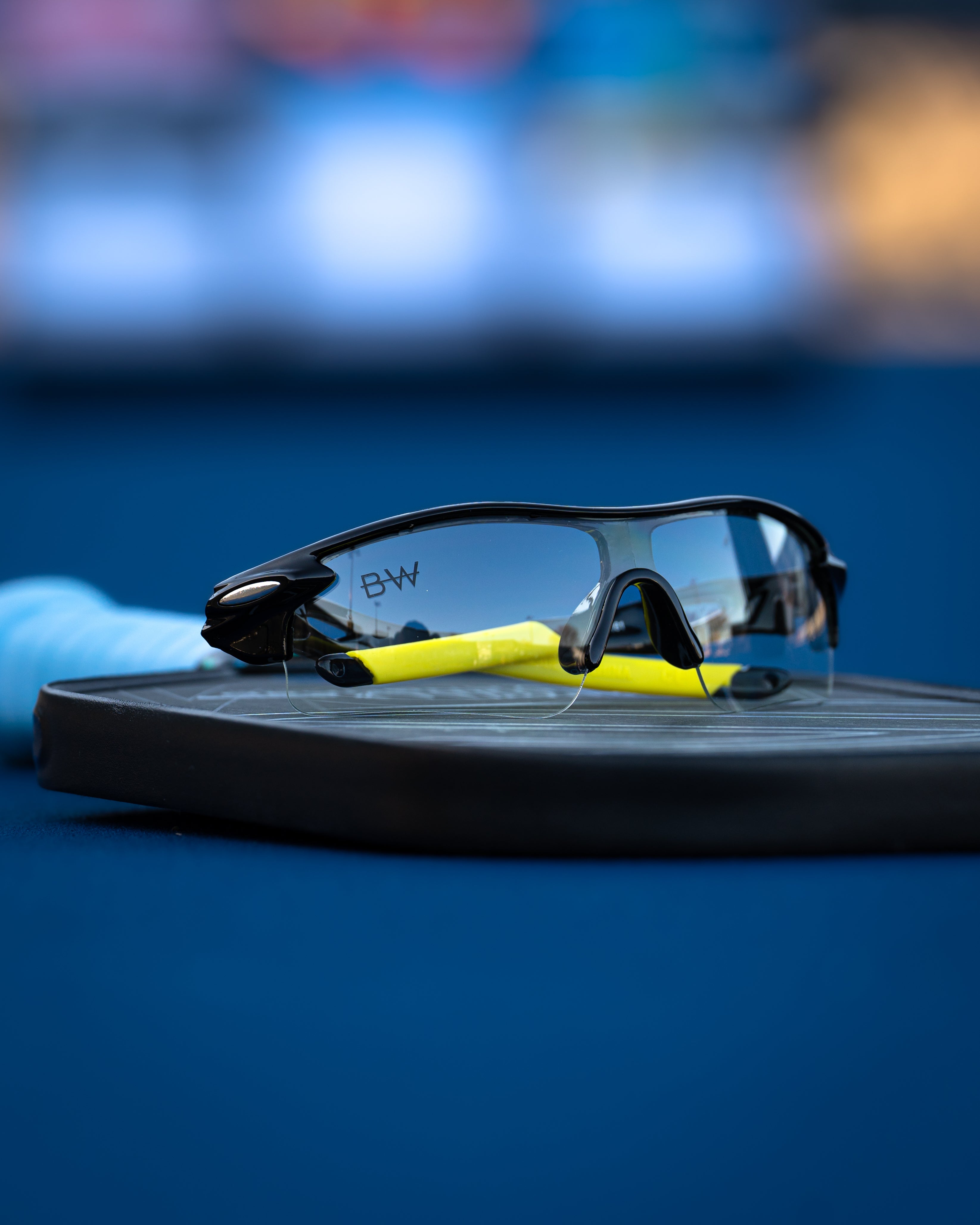
I Didn’t Realize My Vision Was the Problem Until These RX Glasses
Share
Could Your Vision Setup Be Worth Reconsidering for Pickleball?
When something feels off on the pickleball court, it is easy to focus entirely on technique, timing, positioning, or equipment. But players who require corrective vision have another factor worth considering: the prescription eyewear setup they are actually using while they play.
That does not mean every missed shot is a vision problem. It also does not mean prescription sports glasses automatically improve reaction time, ball tracking, depth perception, or pickleball performance.
But if you require corrective vision, it makes sense to ask whether your current setup appropriately addresses that need during play.
This guide explains:
- Why players can overlook their corrective-vision setup
- Signs that it may be worth reviewing your current prescription eyewear
- Why blurry vision should not simply be accepted as part of pickleball
- RX sports glasses versus everyday prescription glasses
- Direct RX versus RX clip systems
- Contacts plus Non-RX sports eyewear
- What high-index prescription lenses actually mean
- How tint, polarization, fit, and prescription address different parts of the eyewear decision
- How to order Blinded Wear RX pickleball glasses
First: Not Every Pickleball Problem Is a Vision Problem
Pickleball combines movement, positioning, anticipation, technique, decision-making, coordination, and vision. Missing a ball or reacting late does not tell you which factor caused the mistake.
That distinction matters.
It would be misleading to tell a player:
- "You missed that shot because your glasses are wrong."
- "A new prescription will make you react faster."
- "RX sports glasses will make the ball easier to track."
- "Your skill plateau is actually a vision problem."
- "A certain lens color will fix your court vision."
Instead, players who already require corrective vision can ask a narrower and more useful question: Is my current vision correction appropriate for me, and is my eyewear setup suitable for the way I use it on the court?
Why Can Players Overlook Their Vision Correction?
Vision can be easy to take for granted because players experience the world through their own eyes every day. A person may become accustomed to their current eyewear without regularly thinking about whether their prescription or setup still meets their needs.
Some players may:
- Continue using an older pair of prescription glasses
- Use the same everyday frames for work, driving, recreation, and pickleball
- Assume minor blur or visual discomfort is simply normal
- Have changed prescriptions without updating their sports eyewear
- Wear a frame that requires frequent repositioning during activity
- Use a dark tint in conditions where they personally prefer something different
- Assume all prescription sports eyewear works the same way
- Never compare direct RX, RX clip, and contact-lens configurations
None of these observations proves that vision is causing a particular pickleball mistake. They are reasons to evaluate the eyewear setup separately from technique and training.
Signs It May Be Time to Reevaluate Your Pickleball Eyewear
A sports-eyewear article cannot diagnose a prescription problem, but certain experiences can justify taking a closer look at your current setup.
| What You Notice | What to Consider |
|---|---|
| Your vision seems blurry | Do not assume blur is simply part of fast play. If you have vision concerns, an appropriate eye-care evaluation can help determine the cause. |
| Your prescription is old | Do not assume an older prescription remains appropriate indefinitely. |
| Your glasses repeatedly move | Review frame dimensions, fit, and whether another frame configuration better matches your preferences. |
| Your everyday glasses feel inconvenient during sports | Consider whether a dedicated sports-oriented prescription pair would better suit how you use eyewear. |
| Your tint feels too dark or too light | Consider the visible-light environment and your personal tint preference. |
| New RX eyewear feels persistently visually unusual | Do not automatically blame sports-frame styling. Prescription, lens design, positioning, frame geometry, fit, and other factors may need evaluation. |
What If the Pickleball Looks Blurry?
If the ball or court consistently appears blurry, do not assume that a new sports frame alone will solve the issue.
Blur can have different causes, and determining the cause is an eye-care question rather than something that can be diagnosed from an online article.
If you already require corrective vision, make sure you are using an appropriate current prescription. If you experience persistent or unexplained changes in vision, seek appropriate professional evaluation.
Once your corrective-vision needs are established, you can then decide how you want that prescription incorporated into your pickleball eyewear.
Can an Outdated Prescription Affect What You See on the Court?
If your corrective-vision needs have changed, an older prescription may no longer appropriately address them.
That does not mean every player needs a new prescription simply because they play pickleball. It means players who require corrective vision should avoid assuming an old prescription remains appropriate forever.
Blinded Wear custom RX eyewear should be ordered using your current eyeglass prescription.
How Often Should Pickleball Players Update Their Prescription?
There is no pickleball-specific schedule that determines when every player needs a new prescription.
Prescription needs are individual. Follow appropriate eye-care guidance for your circumstances rather than replacing lenses according to a sports-marketing schedule.
If your prescription changes, remember that your existing custom RX sports eyewear does not automatically update with it.
Can You Have Good Everyday Vision but Still Want Different Eyewear for Pickleball?
Yes. A player can be satisfied with their everyday prescription correction while still preferring a different frame or eyewear configuration for sports.
The distinction is between vision correction and how the eyewear is configured for use.
You may like your everyday prescription but prefer a dedicated pickleball pair because you want:
- A sports-oriented frame
- A separate pair that stays with your pickleball equipment
- A different frame shape
- Different physical lens coverage
- An available tinted RX configuration for outdoor use
- A direct RX or RX clip sports-eyewear system
RX Pickleball Glasses vs. Everyday Prescription Glasses
Both can provide corrective vision. The difference is not that everyday glasses are automatically "bad" for pickleball or that sports RX eyewear automatically makes someone play better.
| Consideration | Everyday Prescription Glasses | RX Sports Eyewear |
|---|---|---|
| Prescription Correction | Yes | Yes |
| Primary Use | General everyday wear | Sports-oriented use |
| Frame Design | Varies widely | Sports-oriented options available |
| Tinted Options | Depends on eyewear | Depends on exact RX product and available configuration |
| Physical Coverage | Depends on frame | Depends on sports frame and lens geometry |
| Impact Characteristics | Must be verified for exact product | Must be verified for exact product |
| Protective Certification | Do not assume | Do not assume |
Are Regular Prescription Glasses Bad for Pickleball?
No blanket statement like that is necessary.
Some players use everyday prescription glasses on the court and are satisfied with them. Others prefer dedicated sports eyewear because they want a separate frame or a different configuration for active use.
The actual frame, fit, prescription, lens configuration, and verified characteristics matter more than simply labeling eyewear "regular" or "sports."
What Are RX Pickleball Glasses?
RX pickleball glasses are prescription eyewear configurations that allow players who require corrective vision to incorporate that correction into a sports-oriented eyewear system.
Depending on the product, prescription correction may be provided through:
- Direct RX eyewear
- A compatible inner RX clip or prescription insert
Players who appropriately use contact lenses can also consider contacts combined with Non-RX sports eyewear.
Direct RX vs. RX Clip: What Is the Difference?
Direct RX
With direct RX eyewear, prescription correction is incorporated into the RX lens configuration.
RX Clip
An RX clip uses a separate inner prescription insert within compatible eyewear. The prescription correction is provided by the inner RX component rather than the primary outer sports lens.
RX clips are not universal inserts for arbitrary sunglasses. They are part of compatible eyewear systems.
Which Is Better for Pickleball: Direct RX or an RX Clip?
Neither configuration is universally better.
Compare:
- Your individual prescription requirements
- Compatibility with the specific product
- Frame dimensions
- Overall fit
- Available lens configurations
- Your preference for direct versus insert-based prescription correction
The appropriate choice is the configuration that works with your prescription and preferred eyewear system.
RX Pickleball Glasses vs. Contacts and Non-RX Sunglasses
Players who appropriately use contacts have another way to separate prescription correction from their outer sports eyewear.
| Setup | Source of Vision Correction | What to Consider |
|---|---|---|
| Direct RX | RX lens configuration | Prescription compatibility, frame, fit, and available options |
| RX Clip | Inner prescription insert | Compatibility, prescription requirements, frame, and outer sports lens |
| Contacts + Non-RX Eyewear | Contact lenses | Individual contact-lens suitability and preferred outer eyewear |
There is no reason to declare one setup universally superior for every pickleball player.
Do RX Pickleball Glasses Improve Ball Tracking?
Prescription correction should not be marketed as a guaranteed ball-tracking enhancement.
If you require corrective vision, an appropriate prescription addresses that requirement. What you see during pickleball can also depend on lighting, individual vision, the complete eyewear configuration, and the visual demands of the moment.
RX eyewear does not need a promise of improved ball tracking to have value for someone who already needs corrective vision.
Can Prescription Glasses Improve Reaction Time?
No pair of prescription glasses should be promised to automatically make a pickleball player react faster.
Reaction time involves multiple processes, including:
- Visual information
- Attention
- Anticipation
- Decision-making
- Positioning
- Movement
- Training and experience
Appropriate prescription correction serves an important purpose without needing to be presented as a reaction-time enhancement.
Can RX Glasses Improve Depth Perception?
Do not promise that a particular prescription sports frame will universally improve depth perception.
If a player requires corrective vision, the goal is to appropriately address that individual's prescription. Frame style, lens tint, and polarization status should not automatically be credited with creating better depth perception.
Can Better Vision Correction Make You a Better Pickleball Player?
It is more accurate to separate vision correction from athletic performance.
If you require corrective vision, appropriate correction addresses that need. Pickleball performance still depends on many other factors, including:
- Technique
- Footwork
- Positioning
- Decision-making
- Anticipation
- Consistency
- Fitness
- Practice
- Opponent skill
RX eyewear should therefore be evaluated as part of a player's vision setup rather than sold as a shortcut to a higher skill level.
Does Blurry Vision Mean Your Prescription Is Wrong?
Not necessarily. An online article cannot determine why an individual is experiencing blur.
If you experience persistent blur, unexpected visual changes, or other vision concerns, seek appropriate professional evaluation instead of assuming the cause is your sports frame, tint, or prescription strength.
Should You Get a Stronger Prescription for Pickleball?
Do not increase prescription strength simply because pickleball involves a moving ball.
Your prescription should reflect your individual corrective-vision needs. Pickleball marketing should not be used to determine prescription strength.
What Does High-Index Mean for RX Pickleball Glasses?
High-index refers to a category of prescription lens material commonly used to help manage lens thickness, particularly as prescription strength increases.
Blinded Wear custom RX eyewear includes high-index prescription lenses at no additional cost.
Finished lens thickness can depend on:
- Your individual prescription
- Frame dimensions
- Prescription lens or insert dimensions
- Lens geometry
- Optical design
- Other prescription requirements
Does High-Index Mean Sharper Vision?
High-index should not automatically be marketed as producing sharper vision than another appropriate prescription lens material.
Refractive index primarily describes an optical property of the lens material. It is commonly relevant to managing prescription lens thickness, particularly as prescription strength increases.
Are High-Index Lenses Better for Pickleball?
High-index is not a pickleball-performance rating.
It should not automatically be associated with:
- Better ball tracking
- Faster reactions
- Improved depth perception
- Greater impact resistance
- Shatterproof construction
- Protective certification
Its primary relevance is to prescription-lens design rather than athletic performance.
Does High-Index Mean Lighter RX Glasses?
Not automatically.
Higher refractive-index materials can help manage lens thickness in comparable prescriptions, but finished eyewear weight depends on more than lens thickness alone.
The frame, lens dimensions, material, prescription, and complete construction all contribute to finished weight.
Does High-Index Mean More Impact-Resistant?
No. Refractive index and impact resistance are separate characteristics.
Do not use high-index as a synonym for stronger, safer, shatterproof, or more impact-resistant sports eyewear.
Prescription Correction, Tint, Polarization, and Impact Resistance Are Different
| Characteristic | What It Describes | What It Does Not Automatically Establish |
|---|---|---|
| Prescription | Corrective vision requirements | Sports performance or protective certification |
| Tint | Visible-light transmission and color appearance | Better ball tracking or more UV protection |
| Polarization | Reduction of certain reflected light | Better depth perception or reaction time |
| High-Index | Prescription lens material category | Greater impact resistance |
| Impact Resistance | An impact-related characteristic | Shatterproof construction or automatic safety certification |
| Protective Certification | Compliance with a specified standard when documented | Something that can be inferred from sports styling |
What Lens Tint Is Best for RX Pickleball Glasses?
There is no universal best lens tint for every pickleball player.
Different tints can change visible-light transmission and color appearance. Individual players may prefer different lens colors and brightness levels depending on their environment and subjective visual preferences.
Do not assume that one tint automatically improves:
- Ball visibility
- Contrast
- Reaction time
- Depth perception
- Shot recognition
Learn more in the Pickleball Performance Lens Guide.
Do Darker RX Lenses Mean Better Outdoor Vision?
A darker tint generally means greater visible-light reduction than a lighter tint when comparing applicable lens configurations. That does not make the darker option universally better.
Players can prefer different brightness levels under the same outdoor conditions.
Darker tint also does not automatically establish greater UV protection, greater impact resistance, or better pickleball performance.
Are Clear RX Lenses Better for Indoor Pickleball?
A clear lens avoids dark sunglass tint, which can make it an option to consider when a player does not want dark tint in an indoor or lower-light environment.
Clear lenses should not be described as creating more environmental light or automatically improving contrast, depth perception, reaction time, or ball tracking.
Polarized vs. Non-Polarized RX Pickleball Glasses
Polarized lenses are designed to reduce certain reflected light. Some pickleball and court-sport players may prefer non-polarized eyewear.
Neither configuration should be declared universally better.
Polarization status alone does not determine:
- Depth perception
- Contrast
- Reaction time
- Ball tracking
- Prescription accuracy
- Impact resistance
Your prescription, individual vision, lighting conditions, playing environment, and overall eyewear configuration also contribute to what you see on the court.
Can Polarized Lenses Make Screens Look Different?
Polarized lenses can interact with some digital displays depending on the display technology, viewing angle, and orientation.
This can be worth considering if you frequently check a phone, watch, scoreboard, or other digital display while wearing sports sunglasses.
Does a Sports Frame Improve Your Vision?
A sports-oriented frame should not be credited with changing your prescription or automatically improving visual performance.
The frame influences how the eyewear fits, sits, and positions the lens system. Prescription correction comes from the appropriate RX configuration.
Why Frame Fit Still Matters
Even though frame fit should not be turned into a performance claim, it remains an important part of choosing eyewear you intend to wear during active movement.
Consider:
- Frame width
- Bridge fit
- Temple fit
- Overall frame shape
- Finished eyewear weight
- Whether you repeatedly reposition the eyewear
- How the frame feels during normal pickleball movement
No frame should be universally promised to "never slip" because individual fit varies.
Can the Wrong Frame Fit Affect Your Experience?
A frame that feels uncomfortable or requires repeated adjustment can be distracting, but that should not be confused with a diagnosis of poor vision or a guaranteed effect on pickleball performance.
Choose a frame according to your individual dimensions and preferences rather than assuming every sports frame fits every player the same way.
Are RX Sports Glasses Automatically Protective Eyewear?
No. Prescription correction, sports styling, impact resistance, and protective certification are separate characteristics.
If a particular safety or protective standard matters for your situation, verify that standard for the exact product rather than assuming a sports-oriented RX frame automatically qualifies.
Does Impact-Resistant Mean Shatterproof?
No. Impact-resistant should not be rewritten as "shatterproof," "impact-proof," or "unbreakable."
Blinded Wear offers impact-resistant lens options, but any eyewear can potentially be damaged under sufficient force or unfavorable conditions.
How to Choose RX Pickleball Glasses Based on Your Actual Needs
-
Start with your corrective-vision requirements.
If you require prescription correction, use your current eyeglass prescription.
-
Choose direct RX or a compatible RX clip system.
Compare how each configuration works with the product and your preferences.
-
Review frame dimensions.
Sports styling does not guarantee that a frame will fit every face.
-
Consider where you normally play.
Your indoor, outdoor, daytime, and evening routine can influence your tint preferences.
-
Review the options actually available for the product.
Do not assume every RX frame is offered with every lens type or tint.
-
Verify important specifications.
UV, impact, anti-fog, scratch, polarization, and protective-certification characteristics should not be inferred from appearance.
-
Choose based on your needs rather than performance promises.
RX eyewear does not need claims of faster reactions or guaranteed ball tracking to be useful.
How to Order Blinded Wear RX Pickleball Glasses
- Select the product and available options.
- Have your current eyeglass prescription ready.
- Upload a clear photo or picture of your eyeglass prescription on the product page before adding the eyewear to your cart.
- Your prescription information will be associated with your custom RX order.
Visit How to Order RX Glasses for additional ordering information.
Where to Start With Blinded Wear RX Eyewear
| If You Want To... | Start Here |
|---|---|
| Browse prescription pickleball eyewear | RX Pickleball Glasses |
| Understand how RX ordering works | How to Order RX Glasses |
| Compare lens concepts and options | Pickleball Performance Lens Guide |
| Browse without built-in prescription correction | Non-RX Pickleball Sunglasses |
| Narrow your eyewear preferences | Pickleball Sunglasses Quiz |
| Explore the broader eyewear guide | 2026 Pickleball Glasses Hub |
What Can Change When You Start Using Dedicated RX Sports Eyewear?
The biggest practical difference is not that prescription sports glasses suddenly create better athletic ability. It is that a player who requires corrective vision can use an eyewear configuration chosen specifically around that prescription and active court use.
Depending on what you were using before, that can mean moving from:
- An older prescription to eyewear made using your current prescription
- Everyday glasses to a dedicated sports-oriented frame
- Contacts and Non-RX eyewear to an integrated RX configuration
- A general-purpose frame to one selected with court use in mind
- One eyewear setup for every environment to configurations selected around different playing conditions
Those changes can be useful without claiming that the eyewear itself gives you faster reactions, better anticipation, or an athletic advantage.
Why Can the Difference Feel Significant to Some RX Wearers?
If someone has spent a long time using an older prescription, an inconvenient frame, or another setup they do not prefer for sports, switching to an appropriate current prescription in a sports-oriented configuration can feel meaningfully different.
That experience should still be described carefully.
A player saying that new eyewear feels clearer or more comfortable is different from claiming that the eyewear:
- Added an extra second of reaction time
- Made the pickleball move more slowly
- Automatically improved ball tracking
- Fixed depth perception
- Eliminated every source of glare
- Guaranteed better match results
Prescription eyewear has a legitimate purpose without attaching unsupported performance promises to it.
Why "I Thought I Was Just Playing Bad" Is Not Enough to Diagnose a Vision Problem
Pickleball mistakes can have many causes. A late contact point, missed return, poor reset, or mistimed volley does not reveal whether the underlying issue was vision, positioning, technique, anticipation, decision-making, or something else.
That is why players should avoid self-diagnosing a prescription problem solely from their match results.
If you experience actual visual concerns, evaluate those concerns as vision issues. If you are struggling with pickleball technique, evaluate the technical side separately.
Can You Get Used to Blurry Vision Without Realizing It?
A person can become accustomed to how they normally see, which is one reason routine attention to corrective-vision needs can matter.
However, this article cannot determine whether an individual player's vision is blurry, whether their prescription has changed, or whether a visual symptom has a particular cause.
If you notice persistent blur or a meaningful change in your vision, seek appropriate eye-care evaluation rather than assuming that buying a different sports frame will solve it.
Can an Old Pair of Prescription Glasses Still Be Used for Pickleball?
The age of a frame alone does not determine whether the prescription is appropriate. What matters is whether the corrective-vision setup continues to meet your individual needs and whether the eyewear remains in suitable condition.
If your prescription has changed since the glasses were made, an older pair will not automatically reflect that newer prescription.
When ordering custom Blinded Wear RX eyewear, use your current eyeglass prescription.
Should You Have Different Glasses for Pickleball and Everyday Life?
You do not have to. Some players are satisfied using one prescription pair across many activities.
Other players prefer dedicated sports eyewear because it allows them to keep a separate pair with their pickleball equipment and choose a frame specifically for active use.
A separate sports pair can also be practical if you do not want your primary everyday glasses to be the pair you repeatedly take to practices, leagues, tournaments, and outdoor courts.
Who Is Most Likely to Consider Dedicated RX Pickleball Glasses?
RX sports eyewear may be particularly relevant if several of these statements describe you:
- You require prescription correction while playing.
- You play pickleball regularly.
- You currently play in everyday prescription glasses.
- You want a separate pair specifically for sports.
- You want to compare direct RX and RX clip systems.
- You want a sports-oriented frame.
- You play outdoors and want to evaluate available tinted RX configurations.
- You play in multiple environments and want to think more deliberately about your eyewear setup.
If you do not require corrective vision, there is no reason to add prescription power simply because you play pickleball.
Can a Mild Prescription Still Matter?
The significance of an individual's prescription should not be determined from its numbers alone in a pickleball buying guide.
If you require corrective vision, use the prescription appropriate for you. If you are unsure whether you need correction, that question belongs with an appropriate eye-care professional rather than a sports-eyewear retailer.
Do not order prescription lenses simply because you think a small amount of correction might make you a better player.
Can Astigmatism Be Corrected in RX Pickleball Glasses?
Astigmatism can be part of an eyeglass prescription, but compatibility should be determined from the individual's complete prescription and the specific RX product rather than a blanket promise that every frame supports every prescription.
If your prescription contains additional parameters or you are unsure whether a particular RX configuration is compatible, verify the requirements for the exact product before ordering.
Can Strong Prescriptions Work in Sports Frames?
Potentially, but there is no universal prescription range that should be assumed to work with every sports frame.
Compatibility can depend on:
- Prescription strength
- Prescription parameters
- Frame dimensions
- Lens shape
- Lens geometry
- Direct RX versus insert-based construction
- Other optical requirements
This is one reason it is better to evaluate an individual prescription and product than to advertise a frame as suitable for "every prescription."
Will a Strong Prescription Make Sports Glasses Heavy?
Not necessarily. Finished eyewear weight depends on several factors rather than prescription strength alone.
These can include:
- Frame construction
- Lens material
- Prescription strength
- Lens dimensions
- Lens geometry
- Direct RX versus insert configuration
Likewise, a thinner finished lens is not automatically a lighter lens in every comparison.
Why Blinded Wear Includes High-Index Prescription Lenses
High-index prescription material is commonly used to help manage lens thickness, particularly as prescription strength increases.
Blinded Wear includes high-index prescription lenses at no additional cost with custom RX eyewear.
That should not be confused with a promise that every finished RX lens will be extremely thin. Final thickness depends on the complete prescription and eyewear configuration.
High-Index vs. Polycarbonate: What Pickleball Players Should Understand
These terms should not be reduced to a simple "better versus worse" comparison.
High-index material is commonly discussed in relation to prescription lens thickness management. Polycarbonate is widely associated with lightweight construction and impact resistance.
Neither material name alone tells you everything about the finished eyewear.
| Question | What to Know |
|---|---|
| Which is thinner? | Higher refractive-index material can help manage thickness in comparable prescriptions, but final thickness depends on the complete configuration. |
| Which is lighter? | Do not determine finished weight from refractive index alone. |
| Which is more impact-resistant? | Impact characteristics should be evaluated separately from refractive index. |
| Which improves pickleball performance? | Lens material should not be promised to improve reaction time, ball tracking, or athletic performance. |
| Which is safety-certified? | Certification must be verified for the exact eyewear and applicable standard. |
What About Progressive RX Lenses for Pickleball?
Players who use progressive lenses should not assume that every sports frame or RX product is available in a progressive configuration.
Progressive-lens suitability and product availability depend on the individual's prescription and the specific eyewear configuration.
Verify availability for the exact product rather than assuming all Blinded Wear RX frames support the same prescription lens designs.
Does Prescription Accuracy Matter More Than Lens Color?
Prescription and tint solve different problems, so they should not be treated as competing versions of the same feature.
If you require corrective vision, the prescription addresses that corrective need. Tint changes visible-light transmission and color appearance.
A particular tint cannot substitute for an appropriate prescription.
Should Outdoor RX Pickleball Glasses Be Dark?
Outdoor conditions vary considerably, and players can prefer different amounts of visible-light reduction.
Instead of assuming the darkest lens is automatically best, consider:
- How bright your normal courts are
- Whether you play in direct sun or shade
- Whether your matches extend toward evening
- Your personal brightness preference
- The lens configurations actually available for the RX product
Remember that tint darkness does not automatically indicate UV protection, polarization, impact resistance, or protective certification.
RX Pickleball Glasses for Indoor Courts
Indoor players may prefer an eyewear configuration without dark sunglass tint, depending on the environment and their individual preference.
Do not assume that an indoor lens must be yellow, amber, blue-light filtering, anti-reflective, or otherwise treated unless those characteristics are specifically established for the product.
Likewise, a clear appearance does not automatically establish UV specifications, impact characteristics, anti-fog treatment, scratch resistance, or protective certification.
RX Pickleball Glasses for Evening and Night Play
A tint that feels appropriate in bright daytime conditions may not be the configuration a player prefers after available light decreases.
If you regularly move from afternoon into evening play, consider how much visible-light reduction you personally want throughout the session.
Do not assume that a particular colored lens creates additional environmental light or automatically improves night vision.
RX Pickleball Glasses for Mixed Indoor and Outdoor Play
Players who regularly move between very different environments have several possible approaches.
- Choose an available configuration that suits the environment where you play most often.
- Use different appropriate eyewear configurations for substantially different environments.
- Use contacts with different Non-RX outer eyewear if that is appropriate for you.
- Review whether an available RX product offers a configuration that matches your needs.
Do not assume photochromic or transitional options are available across every RX product. Verify current product options before ordering.
Can Lens Tint Fix a Pickleball Vision Problem?
Tint should not be used as a substitute for appropriate corrective vision.
A tinted lens changes visible-light transmission and color appearance. It should not automatically be credited with correcting blur, improving depth perception, increasing reaction speed, or solving a prescription problem.
Can a Certain Lens Color Make the Pickleball Stand Out More?
Different lens colors can change color appearance, and individual players can have subjective preferences for different tints in different environments.
That is different from promising that one color universally increases pickleball contrast or makes every player track the ball better.
Use the Pickleball Performance Lens Guide to learn more about lens concepts without treating tint as a guaranteed performance upgrade.
Can Polarized Lenses Cause Visual Distortion on the Pickleball Court?
Polarization alone should not be blamed for visual distortion, poor depth perception, slower reaction time, or worse ball tracking.
Polarized lenses are designed to reduce certain reflected light. Some court-sport players prefer non-polarized lenses, but that preference should not be converted into a claim that non-polarized eyewear improves athletic vision.
What if New RX Glasses Feel Different at First?
New prescription eyewear can feel different from an older pair for several possible reasons, including changes in prescription, lens design, frame geometry, positioning, or fit.
That does not mean every unusual sensation is normal or should be ignored.
If you experience significant or persistent visual difficulty, seek appropriate optical evaluation rather than trying to diagnose the issue from a pickleball article.
Should You Practice in New RX Glasses Before a Tournament?
It is practical to become familiar with new prescription eyewear during normal use and practice before relying on it during an important tournament.
During practice, consider:
- Whether the frame feels comfortable
- Whether you repeatedly adjust its position
- Whether the chosen tint suits the playing environment
- Whether the eyewear feels appropriate during normal court movement
- Whether you experience persistent unexpected visual difficulty
Practice is useful for evaluating your experience with the eyewear, not for proving that the glasses improved your athletic performance.
How Should RX Pickleball Glasses Fit?
The goal is an individual fit that you find comfortable and appropriate during movement. There is no single frame measurement or shape that fits every pickleball player.
Evaluate:
- Overall frame width
- Bridge fit
- Temple fit
- Frame shape
- Finished eyewear weight
- How frequently you need to reposition the eyewear
- How the frame feels during extended wear
Does a Snug Fit Mean Better Pickleball Performance?
No. Appropriate fit can make eyewear more practical to wear during activity, but a snug frame should not be marketed as improving reaction time, accuracy, ball tracking, or match results.
A frame can also be too tight for an individual. Comfort and fit should be evaluated together rather than assuming tighter is always better.
Do Lightweight RX Frames Prevent Fatigue?
Blinded Wear offers lightweight sports frames, but it is too broad to promise that a particular frame weight will prevent fatigue for every wearer.
Comfort is individual and can depend on overall weight, weight distribution, frame dimensions, bridge fit, temples, prescription configuration, and duration of wear.
Do RX Pickleball Glasses Need Anti-Fog Coating?
Fogging can occur depending on moisture, temperature, perspiration, airflow, and the complete eyewear configuration.
Anti-fog treatment should not be assumed across Blinded Wear RX products unless it is verified for the exact product.
If fogging is a concern, use lens-care methods and products that are appropriate for the specific eyewear rather than assuming any generic chemical treatment is safe for every prescription lens.
Do RX Pickleball Glasses Need Anti-Reflective Coating?
Anti-reflective treatment is a separate lens characteristic and should not be assumed simply because eyewear is prescription or designed for sports.
Verify the exact product and lens configuration if a particular coating matters to you.
Do RX Pickleball Glasses Need Blue-Light Filtering?
Blue-light filtering should not be treated as a standard requirement for pickleball eyewear.
It is a separate lens characteristic and should only be advertised when it is actually available and verified for the specific product.
Do not assume a blue-colored lens or blue mirrored appearance means the lens has blue-light filtering.
How to Clean Prescription Pickleball Glasses
Good lens care helps avoid unnecessary contamination and abrasion during normal use.
- Remove loose dust, sand, or debris before rubbing the lens surface.
- Use cleaning materials appropriate for the exact eyewear.
- Use a clean microfiber cloth intended for eyewear.
- Avoid dirty or abrasive fabrics.
- Handle the frame without unnecessarily touching the lens surfaces.
- Store the eyewear in a protective case when it is not being worn.
Can You Clean RX Glasses With Your Shirt?
A clean microfiber cloth intended for eyewear is a better routine choice than wiping prescription lenses with clothing, particularly when the fabric may contain dust, dirt, sand, or other debris.
Remove loose particles before wiping the lens surface.
Can You Use Anti-Fog Spray on Prescription Sports Glasses?
Do not assume every anti-fog spray, wipe, or cleaner is compatible with every prescription lens or lens treatment.
If you use an additional lens-care product, confirm that it is appropriate for the exact eyewear.
How Should You Store RX Pickleball Glasses?
Store prescription sports eyewear in a protective case when it is not being worn.
Avoid leaving the glasses loose in a pickleball bag where paddles, balls, bottles, shoes, keys, or other equipment can contact the lenses or place pressure on the frame.
Can Heat Affect RX Sports Glasses?
Excessive heat can potentially affect eyewear components depending on their materials and construction.
Avoid routinely storing prescription eyewear on a hot dashboard, near strong heat sources, or in an excessively hot parked vehicle for extended periods.
What Should You Do if a Pickleball Hits Your RX Glasses?
Inspect the eyewear after a meaningful impact rather than assuming everything is fine because no damage is immediately obvious.
Look for:
- Cracks
- Chips
- Loose components
- Frame deformation
- Changes in how the eyewear sits
- Other visible damage
Do not continue relying on obviously damaged eyewear as though it were unchanged.
Impact-Resistant Does Not Mean Impact-Proof
Blinded Wear offers impact-resistant lens options, but impact resistance should not be converted into a promise that eyewear cannot break.
Likewise, terms such as "shatterproof," "unbreakable," and "impact-proof" should not be substituted for impact-resistant unless the exact product documentation supports those separate claims.
Should Pickleball Players Wear Protective Eyewear?
Players who want eye protection should distinguish ordinary prescription eyewear, sports-oriented RX eyewear, impact-resistant eyewear, and eyewear certified to a specific protective standard.
These categories can overlap, but they are not automatically interchangeable.
If you specifically require certified protective eyewear, verify the applicable standard and documentation for the exact product rather than assuming an RX sports frame qualifies because of its appearance.
What Should Tournament Players Pack if They Depend on RX Eyewear?
If prescription correction is important to your everyday vision, treat your eyewear as essential equipment when traveling to a pickleball tournament.
A practical packing list can include:
- Your primary RX sports eyewear
- A protective case
- Appropriate cleaning materials
- Suitable backup corrective eyewear
- Accessible prescription information when useful for travel
A backup can be particularly useful if your primary pair is damaged, lost, or otherwise unavailable during a trip.
Should You Own More Than One Pair of RX Pickleball Glasses?
There is no universal number of pairs a player needs.
Some frequent players may value a backup or different configurations for substantially different environments. Others may be completely satisfied with one appropriate pair.
The decision should be based on your prescription dependence, playing schedule, environments, travel habits, and budget rather than a rule that every player needs multiple pairs.
Blinded Wear RX Styles to Explore
There is no universal "best" RX frame for every pickleball player. Start with your prescription requirements, preferred configuration, frame dimensions, available lens options, and personal style.
- Crystal Wave II RX
- Zebra II RX
- Steel Ice RX
- Blue Shield RX
- Frost RX
- Ocean Wave RX
- Gray Wash RX
- Lava Rock RX
- Havana Melt RX
Browse the complete Blinded Wear RX Pickleball Glasses Collection for current products and available configurations.
How to Compare RX Pickleball Glasses Without Falling for Marketing Claims
| Compare | Useful Question |
|---|---|
| Prescription | Does this configuration appropriately support my current prescription? |
| RX System | Is it direct RX or an RX clip? |
| Frame | Do the dimensions and shape make sense for my fit preferences? |
| Lens Configuration | Which options are actually available for this exact product? |
| Tint | How much visible-light reduction do I prefer in my normal environment? |
| Impact Characteristics | What is actually established for this exact eyewear? |
| Protective Certification | Is a specific standard documented if I require one? |
| Performance Claims | Is the claim supported, or is it promising better reactions, tracking, or results without evidence? |
RX Pickleball Eyewear Checklist
- I know whether I actually require corrective vision.
- I have my current eyeglass prescription.
- I understand direct RX versus RX clip systems.
- I have checked the frame dimensions.
- I have considered my primary playing environment.
- I have reviewed the current lens options for the exact product.
- I understand that tint and prescription are separate.
- I understand that polarization does not determine depth perception or reaction time.
- I understand that high-index is not a durability rating.
- I understand that impact-resistant does not mean shatterproof.
- I have verified any UV specification important to me.
- I have verified any protective certification I specifically require.
- I am choosing eyewear based on my needs rather than promises of instant performance improvement.
The Better Question: Is Your Current Vision Setup Right for You?
The useful takeaway is not that every missed pickleball shot secretly comes from poor vision.
Instead, players who require corrective vision should make sure that part of their equipment setup is not being ignored.
Your prescription, frame, fit, RX configuration, lens characteristics, playing environment, and personal preferences are all worth evaluating separately.
If your current setup works well for you, there is no reason to manufacture a problem. If it does not, dedicated RX sports eyewear gives you another option to explore.
RX Pickleball Glasses Frequently Asked Questions
How do I know if I need RX glasses for pickleball?
If you require corrective vision, you should use an appropriate corrective-vision solution while playing. Whether that means dedicated RX sports eyewear, an RX clip system, contacts with Non-RX eyewear, or another appropriate setup depends on your individual needs.
Do not determine whether you need a prescription based on missed shots or pickleball performance alone.
Can poor vision cause me to miss the pickleball?
A missed ball does not identify its cause. Vision is one part of playing pickleball, but timing, positioning, anticipation, technique, attention, movement, and opponent play can also influence what happens during a point.
If you have actual concerns about your vision, evaluate those concerns separately rather than diagnosing them from your match results.
Can an outdated prescription make things look blurry?
If your corrective-vision needs have changed, an older prescription may no longer appropriately address them. Persistent blur or unexpected changes in vision should be appropriately evaluated rather than attributed automatically to sports or eyewear.
Should I use my current prescription for pickleball glasses?
Yes. Blinded Wear custom RX eyewear should be ordered using your current eyeglass prescription rather than assuming an older prescription remains appropriate.
Do I need a special pickleball prescription?
Do not alter prescription strength simply because the eyewear will be used for pickleball. Your prescription should reflect your individual corrective-vision requirements.
Can I wear my normal prescription glasses for pickleball?
Some players do. Dedicated RX sports eyewear is another option for players who want a separate sports-oriented frame or prescription configuration for court use.
Are prescription pickleball glasses worth it?
They can be worth considering if you require corrective vision and regularly play pickleball. Their value depends on your current eyewear, prescription needs, playing frequency, frame preferences, available configurations, and budget.
Will RX pickleball glasses make me a better player?
Prescription eyewear should not be promised to improve your rating, technique, reaction time, shot accuracy, or match results. Its primary role is to address your corrective-vision requirements within the chosen eyewear configuration.
Will RX glasses make the pickleball easier to track?
Do not assume prescription sports eyewear automatically improves ball tracking. Appropriate prescription correction addresses an individual's corrective-vision needs, while tracking a moving ball involves additional visual, cognitive, and athletic factors.
Can prescription glasses improve reaction time?
No pair of RX glasses should be marketed as automatically making an athlete react faster. Reaction time involves visual information, anticipation, attention, decision-making, movement, training, and experience.
Can RX glasses improve depth perception?
A particular RX sports frame should not be promised to universally improve depth perception. Prescription needs and individual vision should be evaluated appropriately rather than inferred from frame style, tint, or polarization.
Can I wear contacts instead of RX pickleball glasses?
Players who appropriately use contact lenses can consider contacts with Non-RX sports eyewear. Contact-lens suitability is an individual eye-care consideration.
What is an RX clip?
An RX clip is a separate inner prescription insert used within a compatible eyewear system. The prescription correction is provided by the inner insert rather than the primary outer sports lens.
Is an RX clip the same as direct RX?
No. Direct RX incorporates prescription correction into the RX lens configuration, while an RX clip uses a separate inner prescription insert.
Is direct RX better than an RX clip?
Neither is universally better. Compare prescription compatibility, frame design, fit, available options, and your preference for direct versus insert-based correction.
Can every prescription work in sports glasses?
Do not assume every prescription is compatible with every frame. Prescription strength, additional prescription parameters, frame dimensions, lens geometry, and RX construction can all affect compatibility.
What are high-index prescription lenses?
High-index refers to a category of prescription lens material commonly used to help manage lens thickness, particularly as prescription strength increases.
Does Blinded Wear include high-index RX lenses?
Yes. Blinded Wear includes high-index prescription lenses at no additional cost with custom RX eyewear.
Does high-index mean shatterproof?
No. Refractive index is not a shatterproof, impact-resistance, or protective-certification rating.
Are thinner lenses always lighter?
No. Finished lens weight depends on material, prescription, dimensions, geometry, and other factors. Thinner does not automatically mean lighter in every comparison.
What lens color is best for RX pickleball glasses?
There is no universal best color. Different tints change visible-light transmission and color appearance, while individual players can prefer different configurations under the same conditions.
Do darker RX lenses provide more UV protection?
Not automatically. Tint darkness and UV specifications are separate characteristics. Verify the UV characteristics of the exact lens rather than estimating them from appearance.
Are clear lenses good for indoor pickleball?
A clear lens avoids dark sunglass tint, making it an option to consider for players who do not want dark tint indoors or in lower-light environments. Clear appearance alone does not establish other lens specifications.
Are polarized RX glasses better for pickleball?
Polarized lenses are designed to reduce certain reflected light, while some court-sport players prefer non-polarized eyewear. Neither should be described as universally better for pickleball.
Do non-polarized lenses improve depth perception?
Polarization status alone does not determine depth perception, reaction time, contrast, or ball tracking.
Are RX sports glasses safety glasses?
Not automatically. Prescription correction, sports styling, impact resistance, and protective certification are separate characteristics. Verify any specific protective standard you require for the exact product.
Does impact-resistant mean shatterproof?
No. Blinded Wear offers impact-resistant lens options, but impact-resistant should not be rewritten as shatterproof, impact-proof, or indestructible.
Do RX pickleball glasses prevent eye injuries?
No eyewear should be promised to prevent every eye injury. If protection against impact is a priority, evaluate the exact product's documented characteristics and any protective certification required for your use case.
Do prescription sports glasses fog?
Fogging can occur depending on temperature, moisture, perspiration, airflow, and the complete eyewear configuration. Do not assume every RX product includes an anti-fog treatment.
How should RX pickleball glasses fit?
Look for a frame that works with your individual facial dimensions and remains comfortable during normal movement. No sports frame should be universally promised to never slip or fit every player.
Vision Symptoms Should Not Be Diagnosed From a Pickleball Article
There is an important difference between choosing sports eyewear and diagnosing a vision problem.
If you experience persistent blur, double vision, significant visual discomfort, unexplained changes in vision, or other concerning visual symptoms, do not assume that a new pair of pickleball glasses is the solution.
Seek appropriate professional evaluation when needed.
Once your corrective-vision requirements are established, sports eyewear becomes a separate buying decision: how do you want that prescription incorporated into eyewear you can use on the court?
What to Do Before Blaming Your Pickleball Game on Your Eyes
If you are struggling on court and wondering whether vision plays a role, separate the questions instead of treating them as one problem.
- Ask whether you have an actual vision concern. Blur or meaningful visual changes deserve separate attention from ordinary pickleball mistakes.
- Check whether your prescription is current. Do not assume an older prescription remains appropriate.
- Evaluate your current eyewear. Consider frame fit, condition, lens configuration, and how you use it during sports.
- Evaluate your pickleball technique separately. Positioning, footwork, timing, paddle preparation, anticipation, and shot selection still matter.
- Avoid buying eyewear based on promises of instant improvement. Choose RX eyewear because it appropriately addresses your corrective-vision needs.
What to Check When Your New RX Pickleball Glasses Arrive
Before making a new pair your primary tournament eyewear, take time to inspect and become familiar with it.
- Inspect the lenses and frame for visible damage.
- Check how the frame sits on your face.
- Wear the glasses during normal use.
- Try them during practice before an important competition.
- Evaluate whether the chosen tint matches the environment where you intend to use it.
- Notice whether you repeatedly need to reposition the frame.
- Do not ignore significant or persistent unexpected visual difficulty.
A 60-Second Pre-Match RX Eyewear Check
Before stepping onto the court, a quick check can help you catch obvious eyewear issues.
- Make sure the lenses are reasonably clean.
- Check for cracks, chips, or obvious damage.
- Confirm that the frame is not visibly deformed.
- Make sure the lenses or RX insert appear properly seated.
- Put the eyewear on and check how it feels before play begins.
- Confirm that you brought appropriate backup corrective eyewear when necessary.
When Should You Stop Using Damaged RX Sports Glasses?
Do not continue treating visibly damaged eyewear as though nothing changed.
Evaluate replacement or appropriate professional inspection if you notice issues such as:
- A cracked lens
- A chipped lens
- A displaced lens or prescription insert
- Significant frame deformation
- Broken components
- A substantial change in how the frame sits
- Damage that interferes with normal vision through the eyewear
Avoid attempting uncontrolled heat or aggressive bending to reshape damaged prescription eyewear.
When Should RX Pickleball Glasses Be Replaced?
There is no universal replacement interval that applies to every pair.
Reasons to evaluate replacement can include:
- Your prescription has changed and the existing lenses no longer reflect it.
- The frame or lenses are significantly damaged.
- The eyewear no longer fits appropriately for you.
- A lens or RX insert is damaged or displaced.
- The eyewear can no longer be used as intended.
Do not replace prescription sports eyewear according to an arbitrary marketing schedule if the prescription, condition, and configuration remain appropriate for you.
What Should RX Players Pack for a Pickleball Tournament?
If you depend on corrective vision, your eyewear deserves a place on the tournament checklist alongside your paddle and other essential equipment.
- Primary RX sports eyewear
- Protective eyewear case
- Clean microfiber cloth
- Appropriate lens-cleaning supplies
- Suitable backup corrective eyewear
- Accessible prescription information when useful for travel
- A second appropriate eyewear configuration if you intentionally use different setups for substantially different conditions
Should You Keep Backup Prescription Eyewear?
If you depend on prescription correction, backup eyewear can be especially useful during tournaments and travel.
A damaged or unavailable primary pair can become more than an inconvenience when you rely on corrective vision outside the pickleball court as well.
Your backup does not necessarily need to be identical to your primary sports pair, but it should appropriately address your corrective-vision needs.
How to Choose Between RX, Non-RX, and Clear-Lens Eyewear
| Your Situation | Collection to Explore | Key Consideration |
|---|---|---|
| You require prescription correction in the eyewear system | RX Pickleball Glasses | Use your current prescription and review compatibility. |
| You do not need prescription correction in the eyewear | Non-RX Pickleball Sunglasses | Compare frame and available lens configurations. |
| You want Non-RX eyewear without dark sunglass tint | Clear Lens Eyewear | Clear describes the absence of dark sunglass tint and should not be treated as an RX category. |
Blinded Wear RX Pickleball Glasses to Compare
Instead of calling one frame the universal best, compare RX options according to your prescription, preferred frame, dimensions, available configurations, and style.
- Zebra II RX
- Steel Ice RX
- Blue Shield RX
- Frost RX
- Ocean Wave RX
- Gray Wash RX
- Crystal Wave II RX
- Lava Rock RX
- Havana Melt RX
Browse the complete Blinded Wear RX Pickleball Glasses Collection to compare current options.
How to Order Blinded Wear RX Pickleball Glasses
- Select the product and available options.
- Have your current eyeglass prescription ready.
- Upload a clear photo or picture of your eyeglass prescription on the product page before adding the eyewear to your cart.
- Your prescription information will be associated with your custom RX order.
For additional information, visit How to Order RX Glasses.
Are Custom RX Pickleball Glasses Returnable?
Blinded Wear offers a 30-day return policy for eligible standard purchases. Customized RX eyewear is final sale and excluded from the standard 30-day return policy.
Because custom prescription eyewear is made according to submitted prescription information, review your order information carefully before purchasing.
RX final-sale status is separate from applicable replacement support for eligible broken glasses.
What Happens if Blinded Wear RX Glasses Break?
Blinded Wear offers 50% lifetime replacement support if eligible glasses break, subject to current policy terms.
Eligible claims require the damaged eyewear to be returned. Once the applicable claim and return requirements are satisfied, the customer can receive 50% credit toward a replacement pair.
This should not be described as a free lifetime replacement. It also should not automatically be interpreted as coverage for lost eyewear, routine prescription changes, or every possible situation.
For damaged RX eyewear, contact blindedwearco@gmail.com before returning the pair.
Review the Blinded Wear Protection Plan, Replacement & Returns information for current eligibility and policy details.
Does the Replacement Program Cover a New Prescription?
Do not assume that a routine prescription change qualifies as broken-eyewear replacement coverage.
The 50% lifetime replacement support applies to eligible broken glasses subject to current policy terms. Prescription changes and physical breakage should be treated as separate situations unless the current policy states otherwise.
Does Replacement Support Cover Lost RX Glasses?
Do not assume lost eyewear qualifies for the same support as eligible broken glasses.
Eligible broken-eyewear claims require the damaged pair to be returned, so review the current policy for specific eligibility questions.
RX Pickleball Glasses Buying Checklist
- I actually require corrective vision.
- I have my current eyeglass prescription.
- I understand that missed shots alone do not diagnose a vision problem.
- I understand direct RX versus an RX clip.
- I have checked prescription compatibility when necessary.
- I have reviewed the frame dimensions.
- I have considered whether I primarily play indoors, outdoors, or both.
- I have reviewed the lens configurations currently available for my chosen product.
- I understand that tint does not replace prescription correction.
- I understand that one lens color is not universally best for ball tracking.
- I understand that polarization alone does not determine depth perception.
- I understand that high-index is not a durability or safety rating.
- I understand that impact-resistant does not mean shatterproof.
- I have verified any UV specification important to me.
- I have verified any protective certification I specifically require.
- I understand the custom RX final-sale policy.
- I understand the 50% lifetime replacement support for eligible broken eyewear.
- I know how to upload my prescription before purchasing.
Why This Is Really About the Right Vision Setup, Not a Miracle Pair of Glasses
The useful lesson behind "I didn't realize my vision was the problem" is not that every player struggling on the court secretly needs new glasses.
It is that players who already require corrective vision should not completely ignore their vision setup while analyzing every other part of their game.
If you need prescription correction, make sure that need is appropriately addressed. Then evaluate the sports-eyewear configuration around it: frame, fit, direct RX versus RX clip, available lens options, playing environment, and verified product characteristics.
That approach is more useful than promising that one pair of glasses will suddenly improve reaction time, depth perception, ball tracking, shot accuracy, or competitive results.
Good RX sports eyewear does not need a miracle claim. It needs to appropriately address the wearer's prescription and fit the way they intend to use it.
Explore Blinded Wear Prescription Pickleball Eyewear
If you require corrective vision and want to compare dedicated sports-eyewear options, start with your current prescription and the type of RX configuration you prefer.
- Shop RX Pickleball Glasses
- Learn How to Order RX Glasses
- Explore the Pickleball Performance Lens Guide
- Take the Pickleball Sunglasses Quiz
- Explore the 2026 Pickleball Glasses Hub
- Review Replacement & Returns Information
Choose prescription pickleball eyewear because it matches your corrective-vision needs and intended use—not because a pair of glasses promises to transform your game overnight.