
Indoor Pickleball and Fluorescent Lighting: RX Lens Advice for Clear, Comfortable Vision
Share
Indoor Pickleball and Fluorescent Lighting: RX Lens Advice for Clear, Comfortable Vision
Indoor pickleball removes wind, rain, and changing weather from the equation, but it introduces a different challenge: playing for hours under artificial overhead lighting. Fluorescent fixtures, LEDs, bright ceilings, reflective floors, court colors, and uneven illumination can all influence how comfortable an indoor facility feels.
For players who need prescription correction, the goal is straightforward: arrive with the RX correction you need and choose an eyewear setup that makes sense for indoor play. That often means reconsidering the dark sunglass tint you might prefer outdoors.
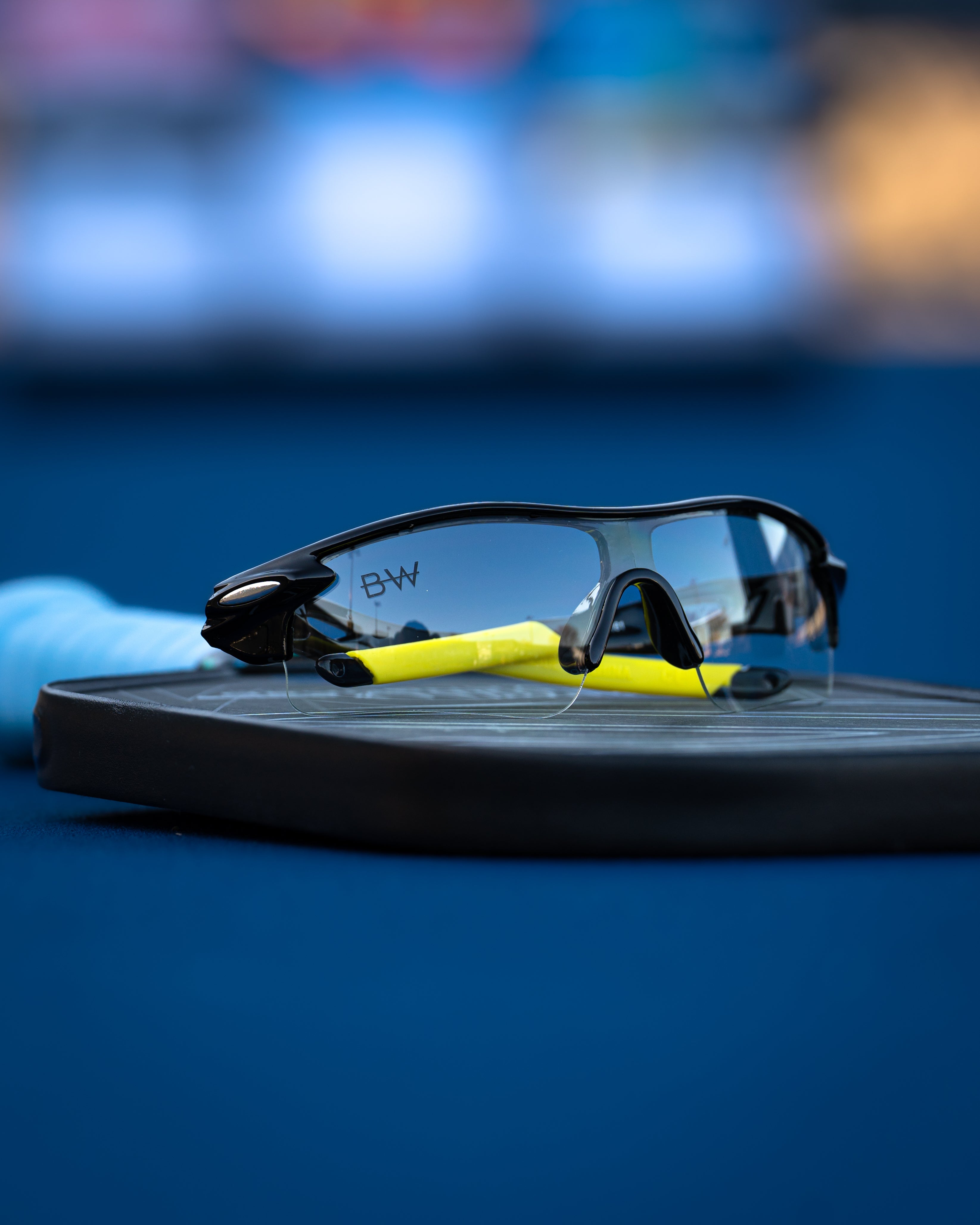
Clear prescription lenses are especially relevant indoors because they provide an untinted option when dark sunglass lenses are not preferred. Your prescription, frame comfort, court environment, and personal lens preferences can then determine the rest of your setup.
Looking for Indoor Pickleball Glasses?
Why Indoor Pickleball Lighting Feels Different
An indoor court creates a very different visual environment from an outdoor court.
Instead of sunlight coming from the sky, artificial fixtures are positioned throughout the facility. Depending on the venue, you may also have bright ceilings, dark walls, polished surfaces, multiple courts, windows, and fixtures that enter your field of view when you look upward.
That becomes particularly noticeable during shots such as:
- Lobs
- Overheads
- High defensive resets
- Deep serves and returns
- Any ball that moves across the ceiling or overhead fixtures in your field of view
The experience can also vary substantially from facility to facility. One indoor court may feel comfortable immediately while another takes more adjustment.
What Does Fluorescent Lighting Change on an Indoor Pickleball Court?
Fluorescent lighting is one type of artificial illumination you may encounter indoors, although many modern pickleball facilities also use LED systems.
From a player's perspective, the useful question is less about the technical name of the fixture and more about how the entire court environment feels to you.
| Indoor Variable | What You May Notice |
|---|---|
| Overhead fixtures | Bright lights entering your field of view on high balls |
| Court brightness | Some facilities feel considerably brighter than others |
| Court and wall colors | The ball may appear against very different backgrounds from venue to venue |
| Reflective surfaces | Additional bright areas may appear around the facility |
| Uneven illumination | Different areas of a large facility may not feel visually identical |
| Long sessions | Visual discomfort or tired eyes may become more noticeable over time for some players |
This is why indoor eyewear decisions are better made around your actual playing environment instead of assuming every indoor facility creates the same visual conditions.
Can Fluorescent Lighting Contribute to Eye Strain?
Some people experience visual discomfort under artificial lighting. Eye-strain symptoms can include tired or uncomfortable eyes, headaches, squinting, blurred vision, or difficulty maintaining concentration during prolonged visual activity.
If you notice symptoms during indoor pickleball, look for a pattern:
- Does it happen at one facility or several?
- Does it begin immediately or after multiple games?
- Do you notice the same symptoms outside pickleball?
- Are you wearing the prescription correction you need?
- Do symptoms change when you move to another court?
- Are your lenses clean?
Those observations can help separate a recurring indoor-lighting issue from general fatigue after a long playing session.
Clear RX Lenses: A Natural Starting Point for Indoor Pickleball
For prescription players who do not want dark sunglass tint indoors, clear RX lenses provide a simple untinted option.
That makes clear lenses particularly relevant for:
- Indoor pickleball facilities
- Evening league play
- Nighttime recreational games
- Covered environments where dark tint is not preferred
- Players who primarily compete indoors
Clear lenses do not need exaggerated performance promises to make sense indoors. Their practical advantage is straightforward: they do not add a dark sunglass tint to your view.
For a player who requires prescription correction, a clear RX setup can combine that untinted view with the correction needed to see comfortably.
What Clear Lenses Do—and What Your Eyes Still Have to Do
Clear lenses are easy to understand when you separate their basic function from the skills involved in playing pickleball.
| Clear RX Lenses | Your Visual & Pickleball Skills |
|---|---|
| Provide prescription correction when ordered as RX | Recognize shot direction |
| Provide an untinted lens option | Read opponent preparation |
| Can be worn in indoor environments | Judge trajectory and bounce |
| Can be paired with a sports-oriented frame | Anticipate patterns |
| Allow players to avoid dark sunglass tint indoors | Choose and execute the appropriate response |
Your eyewear provides the visual correction and lens setup. Your anticipation, positioning, technique, experience, and decision-making still determine what you do with the information you see.
Can You Wear Tinted Prescription Lenses Indoors?
Yes. Indoor does not automatically mean every player must wear clear lenses.
Some players may prefer a tint even inside a bright facility, while others strongly prefer an untinted lens. The useful question is whether the lens setup feels appropriate for the court where you actually play.
Consider:
- How bright is the facility?
- Do you play primarily during the day or evening?
- Are there windows or significant natural-light areas?
- Do you move between indoor and outdoor courts?
- Do you personally prefer an untinted or tinted view?
Your answer may be different from another player's—even if you play at the same facility.
Fluorescent vs. LED Pickleball Courts: Focus on the Environment
You may hear players describe virtually any bright indoor fixture as “fluorescent,” but indoor facilities can use different lighting technologies.
For eyewear selection, you do not necessarily need to become a lighting expert.
Instead, evaluate the court:
- Look around during warmup. Notice the overall brightness and background behind the ball.
- Look upward during a few controlled lobs. Notice where fixtures appear in your field of view.
- Pay attention after several games. Determine whether your eyes remain comfortable.
- Compare courts if possible. Some areas of a large facility may feel different.
- Remember what worked. Use that experience when choosing eyewear for future indoor sessions.
Indoor Lighting and Depth Perception: What Actually Matters?
Depth perception is not controlled by one special sports-lens feature. Your visual system uses multiple cues to judge distance and spatial relationships.
During pickleball, you are also learning from:
- Ball trajectory
- Ball size as it approaches
- Opponent positioning
- Court lines
- Previous shots
- Ball speed
- Bounce behavior
- Your own movement and position
If you require prescription correction, having the correction you need is an important part of seeing the court appropriately. From there, experience and anticipation help you interpret what is happening.
A clear lens should therefore be chosen because an untinted setup makes sense for you indoors—not because the lens itself is expected to create superior depth perception.
Why the Ball Can Feel Harder to Follow at Some Indoor Facilities
Sometimes players immediately notice that a particular indoor court feels harder to read.
The cause may not be one thing.
Consider the entire visual scene:
- What color is the ball?
- What color are the walls?
- What is behind your opponent?
- Are multiple courts visible behind the ball?
- Are bright fixtures entering your field of view?
- Are people moving behind adjacent courts?
- Are your lenses clean?
- Are you wearing the correction you need?
Indoor pickleball can create visually busy backgrounds. Learning which environments you find most comfortable can be just as useful as comparing lens colors.
The Overhead-Light Test: Try This During Warmup
High balls are one of the easiest ways to notice how a facility's lighting interacts with your line of sight.
During warmup, have a partner send several controlled lobs while you pay attention to three stages:
Stage 1: Ball Rising
Notice the background behind the ball as it moves upward.
Stage 2: Ball Near the Ceiling
Notice whether overhead fixtures enter the same area of your field of view.
Stage 3: Ball Descending
Pay attention to how comfortably you follow the ball back toward the court.
This is not a test of which lens produces better athletic performance. It is simply a practical way to learn how comfortable your current eyewear feels in the venue where you're about to compete.
Why Your Prescription Matters Indoors
Indoor lighting gets a lot of attention, but prescription correction remains the foundation for players who need RX eyewear.
If you normally require corrective lenses to see clearly at the distances involved in pickleball, your sports setup should account for that correction.
Dedicated prescription sports eyewear allows you to combine your RX needs with a lightweight athletic frame designed with pickleball players in mind.
That is a much more useful starting point than searching for a lens that promises to make the ball slower, increase reaction speed, or automatically improve shot recognition.
High-Index Prescription Lenses for Indoor Pickleball
Blinded Wear includes high-index prescription lenses at no additional cost with RX eyewear.
High-index construction is part of your prescription-lens setup. For indoor players, your primary buying considerations can remain straightforward: prescription needs, frame preference, comfort, available dimensions, and whether you prefer clear or tinted eyewear for the facility.
Non-Polarized Lenses for Indoor Pickleball
Blinded Wear uses non-polarized lenses. A non-polarized lens does not add a polarization filter, preserving the visual information available without that filter.
Some court players prefer non-polarized eyewear. Indoors, it is simply another characteristic of your lens setup alongside your prescription and tint preference.
Which RX Lens Setup Makes Sense for Your Indoor Game?
Use this quick decision path before overcomplicating the choice.
Do You Need Prescription Correction?
Yes: Start with RX Pickleball Glasses.
No: You can compare the Non-RX Pickleball Collection.
Do You Want Dark Sunglass Tint Indoors?
No: A clear lens is the logical category to explore.
Maybe: Consider the brightness of your normal facility and your personal preference before choosing.
Do You Play Indoors Almost Exclusively?
A dedicated indoor setup may make sense if you play most of your pickleball inside.
Do You Constantly Switch Between Environments?
Think about whether you prefer one versatile setup or separate eyewear for your indoor and outdoor sessions.
7 Things to Look for in Indoor RX Pickleball Glasses
-
Your prescription needs.
Start with the correction you need rather than choosing around marketing terminology.
-
Clear vs. tinted lenses.
Decide whether you want an untinted view for your indoor environment.
-
Frame weight.
Lightweight sports frames can be appealing when you're wearing eyewear through extended matches.
-
Available measurements.
Compare dimensions with eyewear that already fits you comfortably.
-
Your normal facility.
Think about the courts where you actually spend most of your playing time.
-
Extended-session comfort.
League nights, round robins, and tournaments can keep eyewear on your face for hours.
-
Style.
Pickleball eyewear is still something you wear regularly, so choosing a frame you like matters.
The 30-Second Indoor Court Vision Check
After your next indoor session, answer these six questions:
| Question | Your Answer |
|---|---|
| Was my vision consistently clear? | Yes / No |
| Did I repeatedly squint? | Yes / No |
| Did my eyes remain comfortable? | Yes / No |
| Did I develop a headache? | Yes / No |
| Did overhead lights bother me on high balls? | Yes / No |
| Would I prefer an untinted lens next time? | Yes / No |
Repeat the check at another facility. If your answers change dramatically, the environment itself may be an important part of your eyewear preference.
Quick Answers About Indoor Pickleball and RX Lenses
What color lenses are good for indoor pickleball?
Players who do not want dark sunglass tint indoors can start by considering clear lenses. Other tint preferences depend on the individual and the facility.
Are clear prescription glasses good for indoor pickleball?
Clear RX lenses combine prescription correction with an untinted lens, making them a practical option for players who prefer not to use dark sunglass tint indoors.
Can I wear sunglasses indoors for pickleball?
You can wear tinted eyewear if you prefer it, but many indoor players may find an untinted setup more appropriate for their environment.
Are clear lenses useful under fluorescent lights?
Clear lenses provide an untinted viewing option under fluorescent, LED, and other indoor lighting environments.
Do clear lenses make a pickleball easier to track?
Clear lenses should be viewed primarily as an untinted lens option. Ball tracking also involves your vision, attention, anticipation, positioning, and experience.
Can prescription pickleball glasses help indoors?
If you require prescription correction, RX sports eyewear gives you a way to wear that correction in a sports-oriented frame during indoor play.
Why do my eyes feel tired after indoor pickleball?
Long periods of visual concentration, your corrective needs, the playing environment, general fatigue, and other factors can contribute to how your eyes feel after extended play.
Your Indoor Eyewear Setup Should Match the Court You Actually Play On
There is no reason to build your indoor pickleball setup around a generic idea of what every gym looks like. The better approach is to understand your own facility, your prescription needs, and how your eyes feel across an entire session.
Part 2 will go deeper into fluorescent-lighting scenarios, clear vs. tinted RX decision-making, indoor visual fatigue, overhead-light troubleshooting, multi-court distractions, long-session comfort, and a practical system for choosing prescription eyewear for leagues, open play, and indoor tournaments.
4 Indoor Lighting Scenarios—and How to Think About Your RX Setup
“Indoor pickleball” describes a huge range of playing environments. A dedicated pickleball facility with bright overhead LEDs can feel completely different from a community gym, converted warehouse, recreation center, or multi-sport complex.
Instead of choosing eyewear based on the word indoor, identify which environment sounds most like the courts where you actually play.
Scenario 1: Bright Dedicated Pickleball Facility
You have consistent overhead lighting, dedicated courts, and relatively predictable conditions from one session to the next.
If you require prescription correction and prefer an untinted view indoors, clear RX lenses are a logical starting point. You get your prescription correction without adding dark sunglass tint to an already illuminated facility.
Scenario 2: Older Gym With Fluorescent Fixtures
Older recreation centers and gyms may have fluorescent fixtures positioned directly over or around the playing area. The ceiling, fixture placement, wall colors, and condition of the facility can all influence how comfortable the court feels.
Pay particular attention when following lobs and other high balls because that is when overhead fixtures are most likely to enter your field of view.
Scenario 3: Indoor Facility With Windows
Some indoor venues combine artificial lighting with large windows or open entrances. That can create a court where the visual environment changes depending on your position, the time of day, and which direction you're facing.
Use warmup to determine how your eyewear feels throughout the entire court rather than judging the environment from one baseline.
Scenario 4: Evening Indoor League
If you arrive after sunset and play entirely under artificial lighting, you may have little reason to use the dark tint you prefer for daytime outdoor pickleball.
This is one of the clearest use cases for considering a dedicated clear or otherwise untinted RX sports-eyewear setup.
Clear vs. Tinted RX Lenses for Indoor Pickleball
Clear and tinted lenses are not competing to be universally “better.” They create different viewing experiences, and your environment and preferences determine which makes more sense.
| Factor | Clear RX Lenses | Tinted RX Lenses |
|---|---|---|
| Dark sunglass tint | No | Yes, depending on lens |
| Indoor use | Practical untinted option | May suit players who personally prefer tint in a bright facility |
| Evening play | Relevant when dark tint is not preferred | Depends on environment and preference |
| Prescription correction | Available with RX options | Available with RX options |
| Best choice | Depends on your prescription needs, environment, and personal preference | |
If you're unsure, ask yourself one simple question: Do I actually want dark sunglass tint on this court?
If the answer is no, start your search with Clear Lens Pickleball Glasses →
Why Your Eyes May Feel Fine for Game 1 but Tired by Game 6
An indoor session may involve hours of sustained visual attention. You're repeatedly following the ball, shifting attention around the court, watching opponents, recognizing developing shots, and resetting for the next rally.
At the same time, your body and concentration are getting tired too.
That means late-session discomfort can have several contributors:
- General physical fatigue
- Mental fatigue after prolonged concentration
- Visual discomfort
- Dirty or smudged lenses
- Prescription correction needs
- Frame discomfort after extended wear
- The indoor environment itself
If your eyes repeatedly become uncomfortable after longer indoor sessions, track when symptoms begin rather than assuming the overhead lights are automatically responsible.
Track Your Vision Through an Entire Indoor Session
Use your next league night or open-play session as a simple test.
| Stage | What to Notice |
|---|---|
| Arrival | Overall brightness and how the facility initially feels |
| Warmup | Clarity, eyewear comfort, high balls, and overhead fixtures |
| Games 1–2 | Whether your vision remains comfortable once play speeds up |
| Mid-session | Squinting, tired eyes, headaches, blur, or frame discomfort |
| Late session | Whether visual discomfort is increasing alongside physical fatigue |
| After play | Whether symptoms quickly settle or continue after leaving |
Repeat this at several facilities if you regularly play in more than one location. You may discover that your experience changes much more by venue than you expected.
Overhead Lights Bothering You? Use This Troubleshooting Sequence
If fluorescent or LED fixtures become distracting during indoor play, work through the problem systematically.
Step 1: Identify When It Happens
Is the issue constant, or do you mainly notice the lights when looking upward?
Step 2: Identify Where It Happens
Does the problem occur across the entire facility or only on one court?
Step 3: Check Your Lenses
Clean lenses appropriately. Sweat, fingerprints, and debris can accumulate quickly during sports.
Step 4: Check Your Correction
If you require prescription correction, make sure your indoor sports setup accounts for it.
Step 5: Consider Your Tint Preference
If you're wearing dark outdoor sunglasses inside and finding the setup uncomfortable, an untinted option may better match your preferences.
Step 6: Compare Another Session
If possible, see whether the same issue occurs at another indoor facility. That comparison can help you understand whether the environment is a major factor.
Why Multi-Court Facilities Can Feel Visually Busy
Dedicated indoor pickleball centers often place many courts in one large open space. That is great for leagues and open play, but it can create a visually active background.
Behind the ball you may see:
- Players on adjacent courts
- Other pickleballs moving in the background
- Bright signs or scoreboards
- Netting or court dividers
- Doors and windows
- Different wall colors
- Overhead fixtures
- Spectators walking around the facility
This does not necessarily mean something is wrong with your eyewear. It means the ball is moving through a more visually complex environment than it would on an isolated court.
Experience helps too. As you become familiar with a facility, its background can become a more normal part of the playing environment.
Ball Color Matters More Than Players Sometimes Realize
Indoor pickleballs come in highly visible colors, but visibility is influenced by the relationship between the ball and everything behind it.
A ball that stands out clearly against one wall may look different when it moves across another background.
During warmup, notice:
- The ball color
- The court surface
- The wall behind each baseline
- Curtains or dividers between courts
- Windows or doors behind players
- Other balls moving on adjacent courts
This helps explain why a player can love one indoor facility and find another visually challenging even while wearing the same prescription eyewear.
The Indoor Lob-to-Overhead Vision Sequence
Lobs provide a useful example of how indoor lighting, prescription correction, and actual pickleball skill interact.
- Recognize the lob. Read the opponent's shot and begin repositioning.
- Locate the rising ball. Your eyes follow it toward the upper part of the facility.
- Maintain awareness of your movement. Footwork and positioning remain essential.
- Follow the ball across the ceiling background. Overhead fixtures may enter your field of view.
- Judge the descending ball. Use the visual information available along with experience and anticipation.
- Prepare your response. Technique determines what happens next.
Your RX eyewear handles the prescription correction it was made to provide. The rest of that sequence depends on your vision, positioning, anticipation, movement, and technique working together.
Comfort Matters When Your Indoor Session Lasts 2–3 Hours
A pair of glasses can feel comfortable when you first put them on and different after several games.
For players who spend hours at indoor facilities, consider the entire session when evaluating a frame.
Ask yourself:
- Would I want this frame on for several consecutive games?
- Does the overall size feel appropriate for me?
- How does it compare with eyewear I already wear comfortably?
- Am I constantly thinking about the frame while playing?
- Do I enjoy the style enough to wear it regularly?
Blinded Wear uses lightweight sports frames designed for extended pickleball play, making frame comfort a practical part of the RX buying decision.
Build an RX Setup for Indoor League Night
If most of your pickleball happens in the same indoor league each week, your eyewear setup can stay simple.
Before Leaving
- Bring your prescription sports eyewear.
- Bring a protective case.
- Bring a suitable cleaning cloth.
- Use a clear-lens setup if that matches your indoor preference.
During Warmup
- Check visual comfort.
- Follow several high balls.
- Notice the lighting behind each baseline.
- Make sure your lenses are clean.
Between Games
- Clean lenses when needed.
- Notice whether your eyes are becoming uncomfortable.
- Separate visual discomfort from normal physical fatigue.
After League
If something repeatedly bothered you, make a quick mental note. The same court next week gives you another opportunity to compare.
Indoor Open Play Creates a Different Eyewear Challenge
Open play can involve moving between several courts over a long period. That makes it useful for testing whether your visual experience changes around the facility.
If Court 2 feels comfortable but Court 8 consistently bothers you, look at the environment before assuming your prescription suddenly changed.
Compare:
- Fixture placement
- Wall and curtain colors
- Windows
- Background activity
- Court orientation
- Overall brightness
Those observations can make your next eyewear decision more informed.
Indoor Tournament RX Strategy
An indoor tournament may keep you at the same facility for several hours, making both vision correction and extended-wear comfort important.
A simple tournament setup can include:
- Primary RX sports eyewear for competition
- Backup corrective eyewear in case your primary pair becomes unavailable
- Protective storage for unused eyewear
- Suitable lens-cleaning supplies
If you already know you prefer clear lenses at that venue, an untinted RX sports setup can become your primary indoor pair.
7 Common Indoor Pickleball Eyewear Mistakes
-
Assuming every indoor court has the same lighting.
Facility design can change the visual environment considerably.
-
Wearing dark outdoor sunglasses indoors just because they're your usual pair.
Consider whether you actually want that tint in the indoor environment.
-
Ignoring your prescription needs.
If you need correction for play, account for it in your sports setup.
-
Blaming every missed overhead on the lights.
Positioning, footwork, anticipation, and technique still matter.
-
Ignoring dirty lenses.
Check the easiest variable first.
-
Choosing a frame only because of lens marketing.
Prescription correction, comfort, dimensions, and your actual environment deserve more attention.
-
Never testing your setup before a tournament.
When possible, play in the eyewear you intend to use before competition day.
How to Compare Indoor RX Pickleball Glasses
When several frames look appealing, score each one using criteria that actually affect your buying decision.
| Category | Question to Ask |
|---|---|
| Prescription | Does this give me the RX correction I need? |
| Lens preference | Do I want clear or tinted lenses indoors? |
| Frame | Do I like the shape and appearance? |
| Measurements | How does it compare with eyewear that already fits me? |
| Weight | Would I want to wear it through a long session? |
| Environment | Does this setup make sense for where I normally play? |
| Frequency | Will this be an occasional indoor pair or my main pickleball eyewear? |
Prescription Players: Keep the Ordering Process Simple
If you decide to build a dedicated indoor RX setup, start with your eyeglass prescription and the frame you want.
Blinded Wear RX customers upload a clear photo or picture of their eyeglass prescription before purchasing. High-index prescription lenses are included at no additional cost.
From there, your indoor buying decision can focus on what matters most to you: frame design, available dimensions, comfort, and whether you want a clear or tinted setup.
More Indoor Pickleball RX Questions
Should I wear clear lenses under fluorescent lights?
Clear lenses are a practical choice if you want prescription correction without adding dark sunglass tint to your indoor view.
Are clear lenses only for indoor pickleball?
No. Clear lenses can also be relevant for evening and other lower-light environments where dark tint may not be preferred.
Do fluorescent lights affect everyone the same way?
No. Players can have different comfort levels and preferences under the same artificial lighting environment.
Why do overhead lights bother me mostly on lobs?
Following a high ball can bring ceiling fixtures directly into your field of view, making their placement much more noticeable than during lower shots.
Why is one indoor pickleball facility easier for me to see in than another?
Lighting, walls, court colors, ball color, windows, fixture placement, and background activity can all differ between facilities.
Should I use gray lenses indoors?
Some players may personally prefer a tint in a bright indoor facility, while others prefer clear lenses. Choose based on your own environment and preferences.
Can I use the same RX pickleball glasses indoors and outdoors?
You can if the lens setup works for your preferences in both environments. Other players may prefer separate indoor and outdoor eyewear.
Are transition lenses necessary if I play indoors and outdoors?
No. Some players prefer separate pairs, while others prefer one setup. Transition technology is not required simply because you play in both environments.
Can indoor lighting change my depth perception?
Your perception of a court can feel different when backgrounds and lighting change. Depth perception itself relies on multiple visual cues rather than one particular sports-lens feature.
Can clear lenses improve my reaction time?
Clear lenses provide an untinted viewing option. Reaction time also depends on recognition, anticipation, decision-making, movement, and technique.
Can prescription glasses help me see better indoors?
If you require vision correction, appropriately prescribed RX eyewear provides the corrective vision for which it was ordered during indoor play.
What should I prioritize in indoor RX pickleball glasses?
Start with your prescription needs, then consider clear versus tinted lenses, frame comfort, available dimensions, weight, style, and the environment where you normally play.
Turn Your Indoor Court Into Your Eyewear Testing Ground
The best indoor RX setup is not built around the most complicated lens terminology. It starts with the prescription correction you need, a frame you can comfortably wear, and a lens setup that fits the facility where you spend your time.
Part 3 will finish the guide with a facility-by-facility lighting scorecard, clear-lens decision test, indoor eyewear bag checklist, late-session troubleshooting matrix, final RX buying system, expanded FAQ, ordering guidance, shopping resources, lifetime replacement support, and a complete indoor pickleball vision checklist.
Score Your Indoor Pickleball Facility Before Changing Your Eyewear
Before buying a new RX setup because one indoor court feels uncomfortable, evaluate the facility itself. Indoor pickleball environments vary enough that the same eyewear can feel completely different from one venue to another.
Use this scorecard after a normal playing session:
| Indoor Court Factor | Comfortable | Sometimes Noticeable | Frequently Distracting |
|---|---|---|---|
| Overall brightness | □ | □ | □ |
| Overhead fixtures on high balls | □ | □ | □ |
| Background behind opponents | □ | □ | □ |
| Windows or bright entrances | □ | □ | □ |
| Adjacent-court activity | □ | □ | □ |
| Eye comfort after several games | □ | □ | □ |
Repeat the scorecard at another facility. If your experience changes substantially while your eyewear stays the same, you have learned something useful about the role the environment plays.
Should You Choose Clear RX Lenses for Indoor Pickleball?
Clear lenses are one of the easiest indoor options to understand because their purpose is simple: they provide an untinted lens setup.
Run through these questions:
- Do you need prescription correction while playing?
- Do you primarily play indoors?
- Do you prefer not to wear dark sunglass tint inside?
- Do you frequently play evening or nighttime pickleball?
- Would you use the same clear pair for several indoor sessions each week?
If you answered yes to several of those questions, clear RX sports eyewear deserves a place on your shortlist.
3 Types of Indoor Players—and the Eyewear Setup Each Should Consider
The Indoor-Only Player
You play at a dedicated facility several times per week and rarely take your games outside.
A dedicated indoor RX pair can make sense because the eyewear is being selected specifically around the environment where you spend most of your court time. If you do not want dark sunglass tint, clear lenses are a natural category to explore.
The Indoor/Outdoor Player
You may play league matches indoors during the week and outdoor games on weekends.
You have two straightforward options: find one eyewear setup you personally like across both environments or maintain separate indoor and outdoor pairs.
There is nothing wrong with choosing separate eyewear when your preferences change substantially between environments.
The Tournament Traveler
You play wherever the tournament schedule takes you.
Your tournament bag may benefit from more flexibility because unfamiliar venues can have different lighting, court colors, backgrounds, and fixture placement. Prescription players should also consider carrying appropriate backup corrective eyewear.
What Should Be in an Indoor Pickleball Eyewear Bag?
You do not need a complicated collection of lens accessories for a normal indoor session.
A practical setup can be:
- Primary prescription sports eyewear
- Backup corrective eyewear for longer events or tournaments
- Protective eyewear case
- Suitable lens-cleaning cloth
- Eyewear-appropriate cleaner if desired
If you frequently move between indoor and outdoor play, you may also choose to carry a separate pair for the second environment.
Late-Session Indoor Vision Troubleshooting Matrix
If something starts feeling different after several games, identify the specific problem before changing your entire setup.
| What You Notice | What to Check First | Next Step |
|---|---|---|
| Vision seems less clear | Lens cleanliness | Clean lenses appropriately and reassess |
| Increasing squinting | When and where it occurs | Compare the pattern across courts and sessions |
| Overhead fixtures feel distracting | Fixture location and court orientation | Notice whether the issue occurs primarily on high balls |
| Frame feels uncomfortable | Extended-wear comfort | Consider fit and available frame dimensions |
| Eyes feel tired | Session length and overall fatigue | Compare visual discomfort with your physical and mental fatigue |
| One court feels harder visually | Background and lighting differences | Compare it with another court at the same facility |
| Recurring blur with correction | Your prescription needs | Consider whether your current vision correction needs attention |
The 5-Minute Indoor Eyewear Test Before Your First Game
Your warmup is the easiest time to evaluate an unfamiliar indoor facility.
Minute 1: Look Around the Court
Notice the overall brightness, walls, windows, curtains, and backgrounds behind each baseline.
Minute 2: Follow Routine Groundstrokes
Get accustomed to seeing the ball move through the normal court background.
Minute 3: Move to the Kitchen
Play several controlled volleys and dinks while getting comfortable with the facility.
Minute 4: Test High Balls
Follow several controlled lobs so you know where ceiling fixtures enter your field of view.
Minute 5: Check Your Eyewear
Make sure the lenses are clean, the frame feels comfortable, and you're ready to use the setup through the upcoming session.
Five minutes of awareness during warmup can tell you more about a facility than trying to judge indoor eyewear from product terminology alone.
Indoor Pickleball Lighting Myths Worth Clearing Up
Myth: Fluorescent Lighting Automatically Ruins Depth Perception
Depth perception relies on multiple visual cues. Indoor environments can look and feel different from outdoor courts, but one type of overhead fixture should not be treated as the sole controller of depth perception.
Myth: Clear Lenses Automatically Increase Reaction Time
Clear lenses provide an untinted viewing option. Reaction time involves recognition, anticipation, decision-making, movement, and execution.
Myth: Every Indoor Player Should Wear the Same Lens
Players have different prescriptions, preferences, facilities, schedules, and comfort levels. One indoor lens setup does not need to fit everyone.
Myth: Darker Lenses Are Always Better for Bright Indoor Courts
Brightness alone does not determine what every player should wear. Some players prefer tint while others prefer clear lenses indoors.
Myth: If You Lose the Ball Indoors, Your Glasses Are the Problem
Ball color, backgrounds, adjacent courts, player movement, positioning, attention, and familiarity with the venue can all influence how a particular indoor court feels.
The Indoor RX Buying System: Prescription → Lens → Frame → Court
If you're ready to buy prescription pickleball glasses for indoor play, keep the process in this order.
Step 1: Prescription
Start with the vision correction you need. Everything else is built around that foundation.
Step 2: Lens Preference
Decide whether you want an untinted clear lens or prefer a tinted option for your normal indoor environment.
Step 3: Frame
Compare sports-frame designs, weight, appearance, and available dimensions.
Step 4: Court
Think about where the glasses will actually be used. A player spending four nights per week at the same indoor facility can make a more specialized decision than someone constantly moving between indoor and outdoor courts.
Step 5: Frequency
Consider how often you'll wear the pair. If indoor pickleball is your primary form of play, a dedicated indoor RX setup may get substantial use.
What Blinded Wear RX Pickleball Glasses Bring to Indoor Play
Blinded Wear RX eyewear is built around a straightforward group of sports-eyewear features:
- Designed with pickleball players in mind
- Lightweight sports frames
- Impact-resistant lenses
- Non-polarized lenses
- Comfort for extended matches
- Performance-first design
- Options for recreational and competitive players
- High-index prescription lenses included at no additional cost
For an indoor player, combine those characteristics with the lens setup that fits how and where you play.
Clear RX vs. Tinted RX: Final Indoor Decision
| Choose Clear RX When... | Consider Tinted RX When... |
|---|---|
| You prefer an untinted view indoors | You personally prefer tint in your indoor environment |
| You primarily play indoor pickleball | Your facility feels particularly bright to you |
| You regularly play evening sessions | You have already played comfortably indoors with that tint |
| You do not want to use your dark outdoor sunglasses inside | You prefer the available tinted setup |
| You want a dedicated indoor/evening pair | You want a setup you personally use across multiple environments |
Neither column is universally correct. The purpose of the comparison is to identify which setup better matches your own playing environment.
How to Order Prescription Pickleball Glasses for Indoor Play
Once you've decided on an indoor RX setup, the ordering process is straightforward.
- Browse the RX Pickleball Glasses Collection.
- Choose your preferred frame.
- Have your eyeglass prescription ready.
- Take a clear photo or picture of your prescription.
- Upload your prescription before purchasing.
- Complete your order.
Blinded Wear includes high-index prescription lenses at no additional cost with RX eyewear.
FAQ: Fluorescent Lighting, Clear Lenses, and Indoor RX Pickleball Glasses
What are the best prescription lenses for indoor pickleball?
If you require prescription correction and prefer not to wear dark sunglass tint indoors, clear RX lenses are a practical starting point. Your prescription, frame preferences, facility, and personal comfort should guide the final choice.
Should pickleball glasses be clear indoors?
They do not have to be. Clear lenses are useful for players who prefer an untinted view, while some players may prefer a tinted setup even indoors.
Are clear lenses good for fluorescent lighting?
Clear lenses provide an untinted option under fluorescent and other artificial lighting environments.
Are clear lenses good for LED pickleball courts?
Yes, clear lenses can also be used under LED lighting when an untinted setup matches the player's preference.
Why do fluorescent lights bother my eyes?
Some people experience visual discomfort under artificial lighting. If a particular environment repeatedly causes symptoms, tracking where and when they occur can help you better understand the pattern.
Can fluorescent lighting cause headaches?
Some people report headaches or visual discomfort in certain lighting environments. Recurring or significant symptoms are worth discussing with an appropriate eye-care professional.
Why do I lose sight of the pickleball when it goes near the ceiling?
High balls can move across ceiling backgrounds and overhead fixtures that are not present in your normal line of sight during lower shots. Facility design, ball color, background, attention, and familiarity with the court can all contribute.
Do clear lenses increase the amount of light available to my eyes?
The useful distinction for pickleball is that clear lenses do not add a dark sunglass tint. They should not be marketed as a way to automatically improve athletic performance.
Do clear lenses increase pickleball contrast?
Clear lenses should not automatically be credited with contrast enhancement. Their primary role here is providing an untinted lens option.
Can clear RX glasses help me track the pickleball?
RX glasses provide the prescription correction for which they are ordered. Ball tracking also involves attention, anticipation, positioning, and experience.
Can clear pickleball glasses improve reaction time?
Clear lenses do not inherently make neurological reaction time faster. Their role is much simpler: providing an untinted viewing option.
Do non-polarized lenses work indoors?
Yes. Blinded Wear uses non-polarized lenses, which do not add a polarization filter. Some court players prefer this type of lens setup.
Do I need different RX glasses for indoor and outdoor pickleball?
No. Some players prefer one pair across multiple environments, while others prefer separate indoor and outdoor setups.
Are clear lenses only useful at night?
No. Clear lenses can be used indoors during the day as well as during evening and lower-light play when dark sunglass tint is not preferred.
What should I look for in indoor prescription pickleball glasses?
Prioritize your prescription correction, clear-versus-tinted preference, frame comfort, available measurements, weight, style, and the facility where you normally play.
Are lightweight frames useful for indoor pickleball?
Lightweight sports frames can be appealing for players who expect to keep their eyewear on through long league sessions, open play, or tournaments.
Are Blinded Wear RX lenses impact-resistant?
Yes. Blinded Wear RX eyewear uses impact-resistant lenses.
Does Blinded Wear include high-index RX lenses?
Yes. High-index prescription lenses are included at no additional cost.
How do I send my prescription to Blinded Wear?
RX customers upload a clear photo or picture of their eyeglass prescription before purchasing.
Find the Right Eyewear for Your Indoor Game
Choose the path that matches your vision needs and playing environment.
Keep Your Indoor Pair in the Rotation
If indoor pickleball is part of your weekly routine, your eyewear may see a lot of court time across leagues, drilling sessions, open play, and tournaments.
Blinded Wear offers 50% lifetime replacement support if your glasses break, subject to current policy terms.
Review the Replacement Support & Returns →
Eyewear for the Court—and a Mission Beyond It
Blinded Wear creates performance-first eyewear designed with pickleball players in mind, including prescription, non-prescription, and clear lens options for different playing environments.
The brand also supports a broader mission connected to children's vision.
Your Indoor Pickleball Vision Checklist
Before your next indoor session, keep the setup simple:
- □ Use the prescription correction you need
- □ Decide whether you prefer clear or tinted lenses indoors
- □ Start with clean lenses
- □ Compare frame dimensions with eyewear that fits you comfortably
- □ Pay attention to overhead fixtures during warmup
- □ Notice the backgrounds behind each baseline
- □ Check how your eyes feel after several games
- □ Separate visual discomfort from normal physical fatigue
- □ Keep appropriate backup corrective eyewear for longer tournaments if desired
- □ Compare your experience across facilities when possible
Final Word: Build Your RX Setup Around Your Indoor Court
The best indoor pickleball eyewear strategy does not need to be complicated.
If you require prescription correction, start there. Then decide whether you want an untinted clear lens or a tinted setup. Choose a lightweight sports frame you can comfortably wear through your normal sessions, and pay attention to the actual facility where you spend your time.
Fluorescent fixtures, LEDs, windows, wall colors, ceiling backgrounds, adjacent courts, and ball colors can make indoor venues feel very different from one another. Your eyewear is one part of that larger visual environment.
For players who do not want dark sunglass tint indoors, clear RX pickleball glasses provide a straightforward combination: your prescription correction in an untinted sports-eyewear setup.
That can be useful for a Tuesday-night league, three-hour open-play session, indoor tournament, or simply a player who spends most of the year on indoor courts.
Choose the correction you need. Choose the lens setup you prefer. Get comfortable with it before competition.
Then stop thinking about your glasses and start thinking about the next point.