The Role of Lens Curvature in Preventing Glare and Fog: What Every Pickleball Player Should Know
Share
The Role of Lens Curvature in Glare and Fog: What Every Pickleball Player Should Know
Lens curvature is easy to notice in sports eyewear. Some pickleball glasses have a relatively flat profile, while others curve farther around the face. That difference can affect coverage, fit, prescription compatibility, airflow around the eyewear, and how light can reach the eyes from different directions.
But lens curvature is often given more credit than the evidence supports. A curved lens does not automatically prevent fog, eliminate glare, improve peripheral vision, increase reaction time, or make eyewear better for pickleball.
For both prescription and non-prescription players, the better question is: how does lens and frame geometry interact with your prescription, fit, playing environment, and lens configuration?
This guide explains what pickleball players should actually know about curved sports eyewear—and separates useful design considerations from exaggerated performance claims.
Find Pickleball Eyewear for Your Playing Conditions
What Is Lens Curvature in Sports Glasses?
Lens curvature describes the physical curve of a lens or eyewear configuration rather than a special lens treatment.
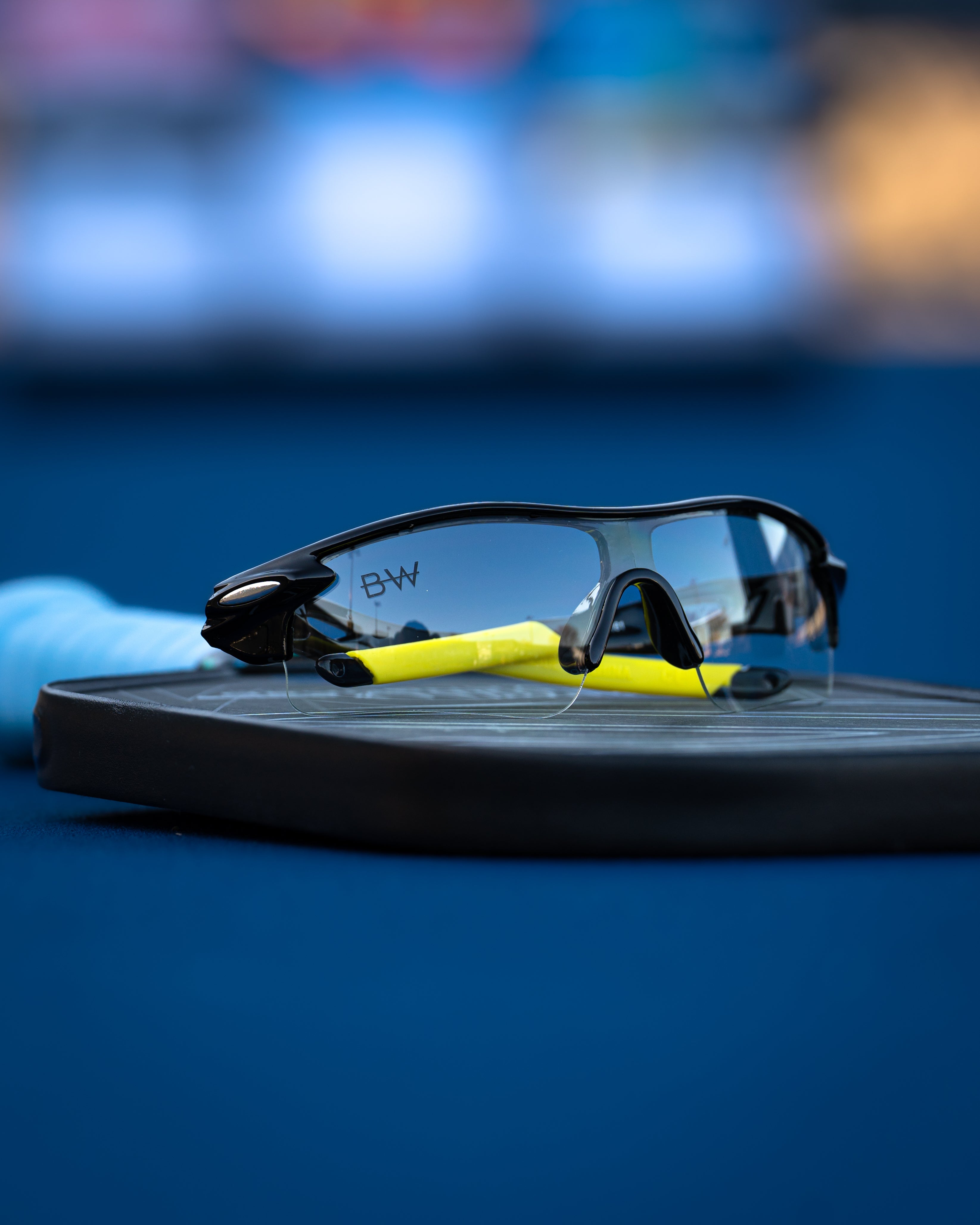
In practical terms, compare a traditional flatter-looking eyeglass frame with a sportier frame that follows more of the contour around the face. The second design has a more curved or wrapped appearance.
That geometry can influence several characteristics of the finished eyewear:
- How much of the area around the eyes is physically covered
- How the frame sits relative to the face
- How light can approach from different directions
- Air space and airflow around the lenses
- Prescription lens compatibility
- The overall fit and feel of the frame
None of those characteristics should automatically be translated into better athletic performance.
Curved vs. Flatter Pickleball Glasses: What's the Difference?
| Characteristic | More Curved / Wrapped Design | Flatter Design |
|---|---|---|
| Shape | Follows farther around the sides of the face | Sits more toward the front of the face |
| Side Coverage | Can provide greater physical coverage depending on the exact design | May provide less lateral physical coverage depending on the frame |
| Prescription Considerations | More curvature can make RX compatibility and optical configuration especially important | May present different RX requirements depending on the frame and prescription |
| Fogging | Cannot be predicted from curvature alone | Cannot be predicted from curvature alone |
| Glare | Geometry may influence exposure to light from the sides, but does not eliminate glare | Geometry may leave different amounts of lateral exposure depending on the design |
| Performance | Curvature alone does not prove a performance advantage | Flatness alone does not prove a disadvantage |
Can Curved Pickleball Glasses Provide More Side Coverage?
They can, depending on the exact frame design.
A frame that physically extends farther around the sides of the face can provide greater lateral coverage than a frame that ends farther forward.
This is a geometric difference—not proof that the glasses automatically improve peripheral vision.
Your peripheral visual field is part of your visual system. A frame's shape can affect how much of the area around the eyes is physically covered and whether portions of the frame enter your field of view, but it should not be claimed to create new peripheral vision.
When comparing sports frames, ask:
- How far does the frame extend around the face?
- How does that geometry interact with my individual fit?
- Does any part of the frame feel visually distracting to me?
- Is the configuration compatible with my prescription if I need RX lenses?
Does Lens Curvature Reduce Glare in Pickleball?
This needs an important distinction.
A more wrapped frame can change how much stray light reaches the area around your eyes from the sides because the eyewear physically extends farther laterally. But curvature itself is not an anti-glare treatment, and it does not guarantee glare elimination.
What you experience as glare can depend on multiple variables, including:
- Direction and intensity of the light source
- Indoor vs. outdoor conditions
- Lens tint or configuration
- Lens surface reflections
- Frame and lens geometry
- Individual fit
- The position of the sun or artificial lighting
Therefore, the accurate claim is not “curved lenses prevent glare.”
A better way to think about it is: frame and lens geometry can influence how exposed your eyes are to light arriving from different directions.
Why Side Light Matters on an Outdoor Pickleball Court
Outdoor lighting is rarely perfectly centered in front of a player. The sun can sit above you, behind you, or off to one side of the court.
Because a more wrapped frame extends farther laterally, its geometry can change how much direct environmental light reaches the eye area from the side compared with a more open frame.
But several limits matter:
- More curvature does not block light from every angle.
- Frame shape and individual fit affect actual coverage.
- Curvature is not the same thing as polarization.
- Curvature is not the same thing as a lens tint.
- Curvature is not the same thing as an anti-reflective treatment.
- No frame shape should automatically be described as “glare-free.”
This makes curvature one variable within an outdoor eyewear setup rather than a complete solution by itself.
Lens Curvature vs. Polarization: Don't Confuse the Two
Lens shape and polarization describe completely different characteristics.
| Feature | What It Describes |
|---|---|
| Lens Curvature | The physical geometry or curve of the lens |
| Polarization | A polarization filter incorporated into the lens |
| Lens Tint | The visible coloration or darkness of the lens |
| Anti-Reflective Treatment | A separate lens treatment when included in a specific configuration |
Blinded Wear sports lenses are non-polarized, meaning a polarization filter is not added.
Some court players prefer non-polarized eyewear, but that preference should not be turned into unsupported claims that non-polarized lenses automatically improve depth perception, reaction time, spin recognition, or ball tracking.
Does Lens Curvature Prevent Fogging?
Not by itself.
Fogging occurs when moisture condenses on a lens surface. The conditions around the lens—including temperature, humidity, moisture, and airflow—can influence whether condensation develops.
Lens and frame geometry can affect the space and airflow around your face, but the relationship is more complicated than saying:
“Curved lenses create natural ventilation and prevent fog.”
That statement is too broad.
A highly wrapped configuration that sits close to a person's face could behave differently from another curved design with different spacing or ventilation. Likewise, a less-curved frame is not automatically more prone to fogging.
Curvature alone cannot tell you whether a pair of pickleball glasses will fog.
Why Pickleball Glasses Fog
Fog is fundamentally a moisture and temperature problem rather than simply a frame-shape problem.
During pickleball, conditions can change quickly as you:
- Generate body heat
- Perspire
- Move between environments
- Play in humid conditions
- Encounter temperature differences between the lens and surrounding air
When conditions allow moisture to condense on the lens surface, visibility can become temporarily obscured.
The likelihood of fogging can involve several interacting variables:
| Variable | Why It Matters |
|---|---|
| Temperature | Temperature differences can contribute to conditions where condensation develops. |
| Humidity | More moisture in the surrounding air can affect condensation conditions. |
| Perspiration | Activity introduces additional heat and moisture around the face. |
| Airflow | Air movement around the eyewear can influence the local environment near the lens. |
| Frame Geometry | How the frame sits relative to the face can influence airflow and spacing. |
| Lens Treatments | Specific anti-fog treatments may influence fog behavior when actually included and used as intended. |
How Does Frame Geometry Affect Airflow?
Frame geometry can influence how air moves around the eyewear, but there is no universal rule that more curvature equals more airflow.
Consider two hypothetical frames:
- A strongly wrapped frame that sits relatively close to the face
- A less-wrapped frame with more open space between portions of the eyewear and face
It would be inaccurate to determine which one manages fog better based solely on curvature.
Other characteristics can affect the local environment around the lens, including:
- How closely the eyewear sits to the face
- Open space around the frame
- Frame geometry
- Any actual ventilation features
- The wearer's individual facial fit
- Movement and environmental conditions
This is why product-specific testing and verified specifications are more useful than assuming every wraparound design is naturally anti-fog.
Are Curved Lenses the Same as Anti-Fog Lenses?
No. These terms describe different things.
Curved describes lens geometry.
Anti-fog describes a separate property or treatment that should only be claimed when verified for the exact product.
Do not assume that a sports-looking wraparound frame automatically includes:
- Anti-fog coating
- Permanent fog resistance
- Ventilation technology
- Hydrophobic treatment
- Anti-reflective coating
Those are separate features and should be verified individually.
Why Lens Curvature Matters More When You Need Prescription Sports Glasses
Prescription sports eyewear adds another layer to the curvature decision: the lens must provide your required vision correction within the selected frame and lens configuration.
That means you should not choose the most aggressively curved-looking frame first and assume every prescription can simply be placed into it.
For RX players, consider:
- Your prescription
- Frame compatibility
- Lens material
- Frame and lens geometry
- Available lens configurations
- Optical measurements required for the finished eyewear
The appropriate configuration depends on the individual prescription and frame.
Do Curved Prescription Lenses Cause Distortion?
This question cannot be answered accurately with a universal yes or no.
Prescription optics and frame geometry need to work together. More wrapped sports configurations can introduce additional optical considerations, which is why prescription compatibility should be evaluated for the exact frame and correction.
Avoid assuming that:
- Every curved frame works with every prescription
- Every wrapped RX lens provides identical optics
- Curvature automatically causes noticeable distortion
- Curvature automatically eliminates peripheral distortion
- Any specific digital-surfacing process is used unless verified
The goal is an appropriate prescription configuration for the selected frame, not simply maximum curvature.
How High-Index RX Lenses Fit Into the Curvature Decision
Lens curvature and lens index are also separate characteristics.
High-index refers to a prescription lens-material category. Curvature describes lens geometry.
Blinded Wear includes high-index prescription lenses at no additional cost with RX eyewear.
However, high-index lenses should not automatically be claimed to:
- Prevent fog
- Reduce glare
- Improve ball tracking
- Improve reaction time
- Improve depth perception
- Make every prescription compatible with every curved frame
Your prescription, frame, lens material, and complete configuration need to be considered together.
Do Indoor Pickleball Players Need Curved Lenses?
No particular degree of curvature is universally required for indoor pickleball.
Indoor players should consider:
- Individual fit
- Prescription requirements if applicable
- Frame geometry
- Comfort preferences
- Indoor lighting
- Whether a dark sunglass tint is appropriate for the environment
- How the eyewear behaves during actual play
For players who do not want a dark sunglass tint indoors, a clear or another appropriate non-dark lens configuration may be worth considering.
Clear lenses should not automatically be credited with better contrast, tracking, reaction time, or depth perception.
Do Outdoor Pickleball Players Benefit From More Curved Glasses?
A more wrapped design may appeal to outdoor players who want greater physical coverage around the sides of the eyes. The geometry can also influence exposure to light coming from lateral directions.
But outdoor performance depends on more than curvature.
Compare:
- Lens configuration
- Frame geometry
- Individual fit
- Prescription compatibility if needed
- Physical coverage
- The actual lighting conditions where you play
Do not assume that the most curved frame automatically provides the least glare or the best outdoor experience.
Do Older Pickleball Players Need a Different Lens Curvature?
Age alone does not determine an ideal lens curve.
An older player may have different prescription requirements, fit preferences, or lens needs than a younger player, but there is no universal rule such as “seniors should use moderate-curvature lenses.”
Instead, evaluate:
- Current prescription
- Prescription compatibility with the frame
- Frame dimensions
- Individual fit
- Playing environment
- Lens configuration
- Any additional vision requirements identified by an eye-care professional
Choose curvature based on the complete eyewear setup rather than age alone.
Lens Curvature Myths Pickleball Players Should Avoid
| Claim | More Accurate Explanation |
|---|---|
| “Curved lenses prevent fog.” | Curvature alone cannot determine fogging. |
| “Curved lenses eliminate glare.” | Geometry can affect lateral coverage, but glare depends on multiple factors. |
| “More wrap means better peripheral vision.” | Frame geometry can change physical coverage; it does not create new peripheral vision. |
| “More curvature means better airflow.” | Airflow depends on the complete frame geometry, fit, spacing, and environment. |
| “Wraparound glasses are automatically anti-fog.” | Anti-fog is a separate property or treatment that should be verified. |
| “Curved lenses improve reaction time.” | Curvature alone does not establish faster reactions. |
| “Curved lenses improve ball tracking.” | Curvature alone does not establish improved tracking. |
| “Every RX works in every curved frame.” | Prescription compatibility should be evaluated for the exact frame and configuration. |
What to Check Before Buying Curved Pickleball Glasses
Instead of searching for the “most curved” pickleball glasses, use a broader buying checklist.
- Decide whether you need RX or non-RX eyewear.
- If you need RX, start with prescription compatibility.
- Consider your playing environment. Indoor, outdoor, and evening conditions can create different lens needs.
- Evaluate frame geometry. Decide how much side coverage you prefer.
- Compare available dimensions. Curvature does not replace proper fit.
- Consider airflow without assuming it from appearance.
- Verify anti-fog claims. Do not infer them from curvature.
- Verify glare-related treatments or features. Do not infer them from frame shape.
- Check any required protective certification. Sports styling is not a certification.
- Test the finished eyewear during actual movement.
Lens Curvature and Pickleball FAQ
Are curved lenses better for pickleball?
Not universally. More curved designs can provide different physical coverage and frame geometry, but the best configuration depends on prescription requirements, fit, playing environment, lens configuration, and personal preferences.
Do curved lenses stop glare?
No. A more wrapped design can influence lateral coverage and how much environmental light reaches the eye area from certain directions, but curvature does not eliminate glare.
Do curved sports glasses prevent fogging?
Not automatically. Fogging depends on moisture, temperature, humidity, airflow, frame geometry, fit, and other factors. Curvature alone cannot determine whether eyewear will fog.
Do wraparound glasses have better airflow?
Not necessarily. Airflow depends on the complete frame design, spacing relative to the face, individual fit, and environment—not simply how curved the lens looks.
Are curved lenses anti-fog?
Curvature and anti-fog properties are separate characteristics. Verify any anti-fog treatment for the exact product rather than assuming a curved lens includes it.
Can prescription lenses be curved?
Prescription sports eyewear can use curved configurations, but compatibility depends on the prescription, frame, lens material, and complete optical setup.
Can highly curved prescription glasses cause distortion?
More wrapped RX configurations introduce optical considerations that should be handled for the specific prescription and frame. It is inaccurate to say every curved RX lens causes distortion or that every curved RX configuration eliminates it.
Are curved lenses better for peripheral vision?
A more wrapped frame can provide different physical coverage and may position frame elements differently relative to your field of view, but curvature itself does not create better peripheral vision.
Lens Curvature, Face Shape, and Frame-to-Face Spacing
Two players can wear the same curved sports frame and have different experiences because the frame may sit differently on each face.
This matters because the relationship between the eyewear and the wearer can influence:
- How much physical coverage the frame provides
- How close the lenses sit to the face
- Open space around the eyewear
- How air moves around the lens area
- Whether parts of the frame are noticeable within the wearer's field of view
- Overall comfort and fit
This is another reason not to evaluate curvature in isolation. The same lens curve does not guarantee the same fit, airflow, coverage, or fogging experience for every player.
Is a Closer-Fitting Curved Frame Better?
Not automatically.
A closer-fitting sports frame may provide the type of physical coverage some players prefer, but the distance between the eyewear and face can also affect the environment around the lenses.
Instead of assuming closer is always better, evaluate:
- Whether the frame fits your face appropriately
- Whether you are comfortable during extended wear
- Whether the eyewear behaves appropriately during movement
- Whether you experience recurring fogging in your normal conditions
- Whether the frame provides the amount of physical coverage you want
Maximum wrap and minimum frame-to-face distance should not be treated as universal goals.
Not All “Glare” Is the Same
When players say their glasses have too much glare, they may be describing several different visual experiences. Identifying the source matters before deciding that a more curved frame will solve the problem.
| What the Player Notices | Possible Consideration |
|---|---|
| Bright light entering from the side | Frame geometry and lateral physical coverage may be relevant. |
| Bright outdoor conditions overall | Lens configuration and tint may be relevant in addition to frame geometry. |
| Reflections visible on a lens surface | This is not automatically solved by increasing curvature. |
| Distracting indoor lighting | Light position, lens configuration, frame geometry, and the environment can all matter. |
| General difficulty seeing | Do not automatically diagnose the issue as glare; prescription and other vision factors may need evaluation. |
A player experiencing side light and a player experiencing lens-surface reflections may both use the word “glare,” even though they are describing different problems.
Lens Curvature vs. Lens Tint for Outdoor Pickleball
Curvature and tint can both affect the experience of wearing sports eyewear outdoors, but they do different jobs.
Curvature describes the geometry of the eyewear.
Tint describes the coloration or darkness of the lens.
A more wrapped frame does not eliminate the need to choose a lens configuration appropriate for the conditions where you play. Likewise, choosing a darker tint does not automatically create more side coverage.
When shopping for outdoor pickleball glasses, evaluate both independently:
- Do I want greater lateral physical coverage?
- What lens configuration is appropriate for my outdoor conditions?
- Does the frame fit me appropriately?
- Do I need prescription correction?
- Is the exact RX configuration compatible with this frame?
Avoid assuming that a particular tint automatically increases contrast, improves ball tracking, or makes you react faster.
Can Clear Pickleball Glasses Still Be Curved?
Yes. Lens curvature and lens tint are separate characteristics, so a sports frame can use a clear lens configuration while still having a curved or sport-oriented shape.
This can be useful to understand for players who prefer a non-dark configuration for indoor, evening, or other lower-light conditions but still want a sports-frame design.
The important distinction is that clear does not mean flat, and curved does not mean tinted.
What About Curved Frames With Transition or Photochromic RX Lenses?
Some players who move between environments may consider a compatible transition or photochromic RX configuration.
But do not assume that every curved sports frame supports every lens option.
Before ordering, verify:
- Whether the exact frame supports the desired prescription
- Whether the desired transition/photochromic option is available for that configuration
- Whether the resulting lens configuration matches how and where you plan to use it
Transition/photochromic behavior and lens curvature are separate characteristics. Curvature itself does not make a lens change darkness.
Should RX Players Choose the Most Curved Frame Available?
No. Maximum curvature is not the objective.
The better goal is an appropriate combination of prescription, frame geometry, lens material, fit, and intended use.
For an RX player, choosing solely by appearance can create the wrong order of priorities.
A better process is:
- Start with your current prescription.
- Identify compatible sports-frame options.
- Compare frame dimensions and geometry.
- Consider the environments where you play.
- Choose an appropriate lens configuration.
- Compare aesthetics among the suitable options.
- Test the finished eyewear during actual activity.
This approach is more useful than assuming the frame with the strongest wrap is automatically the most advanced.
How to Compare Curved RX Pickleball Frames
Blinded Wear offers multiple prescription sports-frame styles. Rather than assigning one universal winner, compare frames based on your prescription, available dimensions, intended environment, and preferred frame geometry.
| RX Option | How to Evaluate It |
|---|---|
| Phantom II RX | Compare its frame style and geometry with your prescription, fit preferences, and intended use. |
| Crystal Wave II RX | Consider this RX style alongside other options when comparing sports-frame shapes and aesthetics. |
| Lava Rock RX | Compare its styling and configuration with your current prescription and preferred fit. |
| Frost RX | Another RX option to evaluate based on frame geometry, prescription compatibility, and style preferences. |
| Ocean Wave RX | A color-forward RX option to compare if you want a different aesthetic within your sports-eyewear setup. |
Do not infer exact curvature, base curve, anti-fog properties, coatings, or prescription compatibility solely from a product photo. Verify specifications that are important to your order.
What Is a Lens Base Curve?
When researching sports eyewear, you may encounter the term base curve. It relates to lens curvature, but consumers should be careful about turning one technical number into a universal ranking system.
In general, different lens and frame geometries can produce flatter or more wrapped eyewear configurations.
However:
- A larger-looking curve is not automatically better.
- One base curve is not universally ideal for pickleball.
- A base-curve number alone does not determine fog resistance.
- A base-curve number alone does not determine glare reduction.
- A base-curve number alone does not determine RX compatibility.
- A base-curve number alone does not determine comfort.
If an exact base curve matters for your prescription or eyewear configuration, verify it for the specific product rather than estimating it from appearance.
Does Prescription Strength Affect Curved Sports Eyewear?
Prescription requirements can affect which frame and lens configurations are appropriate, so RX players should avoid assuming that every sports frame works equally well with every prescription.
The finished configuration can depend on factors such as:
- Prescription strength
- Prescription type
- Lens material
- Frame dimensions
- Frame and lens geometry
- Required optical measurements
This is especially important when shopping online. The fact that a frame is offered in an RX collection does not mean every conceivable prescription or lens option should be assumed compatible without verification.
What About Progressive Lenses in Curved Sports Frames?
Progressive compatibility should be verified for the exact frame and prescription configuration.
Do not assume that every sports frame supports progressives simply because prescription lenses are available.
Likewise, avoid claims that a curved frame automatically allows progressive lenses to function “perfectly” across every prescription.
If you need progressive correction, confirm:
- Whether the exact frame supports your required configuration
- What measurements are required
- Whether the selected lens option is available
- Whether the finished setup is appropriate for your intended use
Your Pickleball Glasses Keep Fogging—What Should You Check?
If fog is your primary problem, do not immediately buy a more curved frame. Troubleshoot the problem systematically.
- Consider the environment. Is the problem mainly occurring in humid conditions, temperature changes, or particularly intense sessions?
- Consider frame-to-face spacing. Notice how the eyewear sits on your individual face.
- Consider airflow. Do not assume airflow from curvature alone.
- Check the exact product features. Verify whether an anti-fog treatment or actual ventilation feature exists rather than assuming one does.
- Follow appropriate cleaning and care instructions. Avoid applying random products that may not be appropriate for your lenses.
- Compare when the problem occurs. If fogging only appears under certain conditions, the environment may be an important part of the explanation.
The goal is to identify the cause rather than treating lens curvature as an automatic cure.
Glare Is Distracting You—What Should You Check?
Use the same approach for glare. First identify what you are actually experiencing.
- Where is the light coming from? Front, side, above, or reflections from another surface?
- When does it happen? Outdoor daylight, evening sun, indoor lighting, or another condition?
- What lens configuration are you using?
- How much lateral coverage does the frame provide?
- Does the frame fit you appropriately?
- Are you assuming a coating or treatment that the lens may not actually have?
If light entering around the side of a relatively open frame is the issue, a different frame geometry may be worth comparing. If the problem is something else, simply increasing curvature may not solve it.
Glare and Fog Are Separate Problems
Because both can interfere with comfortable viewing, glare and fog are often discussed together. But they have different causes and should not be treated as one technical problem.
| Problem | Primary Concept | Can Curvature Matter? | Does Curvature Solve It Automatically? |
|---|---|---|---|
| Side Light | Light entering around the eyewear | Frame geometry can affect lateral coverage | No |
| General Brightness | Amount and intensity of environmental light | Not the only relevant factor | No |
| Lens-Surface Reflections | Light interacting with lens surfaces | Geometry may affect the situation, but curvature is not an anti-reflective treatment | No |
| Fog | Moisture condensation | Frame geometry can influence the environment around the lens | No |
Understanding this distinction can help you shop for the feature that addresses your actual problem instead of relying on broad sports-eyewear marketing language.
Does More Lens Curvature Mean More Eye Protection?
More physical coverage and certified protective performance are not the same thing.
A curved sports frame may extend farther around the eye area than another frame, but that does not automatically establish a specific level of impact protection or certification.
Blinded Wear sports eyewear uses impact-resistant lenses.
Impact-resistant does not automatically mean:
- Shatterproof
- Indestructible
- ANSI-certified
- ASTM F803-certified
- Guaranteed to prevent an eye injury
If your activity requires eyewear meeting a specific protective standard, verify the exact certification for the exact product.
Does a Curved Sports Frame Fit More Securely?
Not automatically.
A frame's geometry is one component of fit, but individual facial dimensions and the complete eyewear design determine how the frame sits on a particular wearer.
A more wrapped appearance does not guarantee:
- No slipping
- No bouncing
- No pressure points
- A secure fit for every face
- Greater comfort
Compare available dimensions when possible and test the finished eyewear during realistic movement.
How to Test Curved Pickleball Glasses on Court
Once you have a compatible pair, evaluate it under the conditions where you actually intend to use it.
- Check the initial fit. Notice how the eyewear sits without intense movement.
- Look in multiple directions. Pay attention to the frame and your experience through the lenses.
- Add lateral movement. Shuffle as you would during a rally.
- Practice normal shots. Include serves, returns, dinks, volleys, and groundstrokes.
- Continue through a realistic session. Evaluate extended wear rather than a few seconds of use.
- Pay attention to lighting. Notice when and where distracting light occurs.
- Watch for fogging conditions. Identify whether condensation develops and under what circumstances.
This gives you far more useful information than judging a frame only by how curved it looks in a product photo.
Choosing Lens Curvature by Pickleball Scenario
| Player Scenario | What to Consider |
|---|---|
| Indoor Player | Prescription needs, frame geometry, individual fit, airflow experience, and an appropriate non-dark lens configuration if preferred |
| Outdoor Player | Physical side coverage, lens configuration, lighting direction, fit, and prescription compatibility if applicable |
| Player Frequently Dealing With Fog | Humidity, temperature, perspiration, frame-to-face spacing, airflow, fit, and verified anti-fog features |
| Player Bothered by Side Light | Frame geometry and lateral coverage may be worth comparing |
| Strong RX Wearer | Prescription compatibility, frame geometry, lens material, dimensions, and complete optical configuration |
| Indoor + Outdoor Player | Consider both frame geometry and whether one or multiple lens configurations best match your environments |
| Multi-Sport Athlete | Verify suitability separately for each activity rather than choosing solely by curvature |
10 Mistakes to Avoid When Buying Curved Pickleball Glasses
- Assuming more curvature automatically means less glare.
- Assuming wraparound glasses cannot fog.
- Confusing lens curvature with polarization.
- Confusing curvature with an anti-reflective treatment.
- Assuming every curved frame works with every prescription.
- Choosing maximum wrap without considering individual fit.
- Assuming a sports-looking frame is certified protective eyewear.
- Assuming curvature automatically improves peripheral vision.
- Assuming curvature improves reaction time or ball tracking.
- Ignoring the playing environment and focusing on frame shape alone.
More Questions About Lens Curvature, Fog, and Glare
What lens curvature is best for pickleball?
There is no universal ideal curvature. The appropriate frame and lens geometry depends on prescription compatibility, fit, desired physical coverage, playing environment, and personal preferences.
Is more lens curvature always better?
No. Greater curvature changes the geometry of the eyewear but does not automatically improve comfort, fog resistance, glare control, optical performance, or athletic performance.
Why do my wraparound glasses still fog?
Wraparound geometry does not eliminate condensation. Temperature, humidity, perspiration, airflow, frame-to-face spacing, individual fit, and other factors can contribute to fogging.
Can a curved frame make fogging worse?
Fogging cannot be predicted from curvature alone. How the complete frame sits relative to the wearer's face and how air moves around the lenses are also relevant.
Do wraparound glasses block side glare?
A more wrapped frame can provide greater physical lateral coverage depending on its design and fit, which can influence exposure to light coming from the sides. It should not be described as eliminating glare.
Do curved pickleball glasses need anti-fog coating?
Curvature does not automatically create anti-fog properties. If an anti-fog treatment is important to you, verify whether it is included in the exact product configuration.
Are high-index lenses compatible with curved sports frames?
Compatibility depends on the prescription, frame, lens material, and complete configuration. Blinded Wear includes high-index prescription lenses at no additional cost with RX eyewear, but exact compatibility should be determined for the selected setup.
Are curved glasses better for outdoor pickleball?
Some outdoor players may prefer greater lateral physical coverage, but curvature is only one factor. Lens configuration, prescription requirements, fit, and actual lighting conditions also matter.
Are flatter glasses better for indoor pickleball?
Not universally. Indoor players should choose according to fit, prescription needs, lens configuration, frame geometry, and their actual playing environment rather than assuming flatter is automatically better.
Do curved lenses improve depth perception?
Curvature alone should not be claimed to improve depth perception. Prescription correction and the complete optical configuration should be considered separately from frame shape.
Do curved lenses help you see the pickleball sooner?
There is no basis for assuming curvature alone makes a player detect the ball sooner. Frame geometry can influence physical coverage and how the frame sits relative to the visual field, but it should not be converted into an automatic reaction or tracking claim.
Are curved lenses more aerodynamic?
A sports-oriented shape may have different aerodynamic characteristics than another design, but an appearance alone does not establish a meaningful pickleball performance advantage. Avoid using “aerodynamic” as a performance claim unless it is specifically supported.
How to Choose the Right Lens Curvature for Your Pickleball Glasses
There is no single curvature level that every pickleball player should buy. The better approach is to narrow the decision using your actual vision needs, playing conditions, and fit preferences.
- Start with RX vs. non-RX. Prescription players should prioritize compatibility with their current prescription.
- Identify where you play most. Indoor, outdoor, evening, and mixed environments can create different eyewear needs.
- Decide how much physical side coverage you prefer. More wrapped frames can extend farther around the eye area.
- Consider your experience with fog. Evaluate the complete frame geometry and fit rather than assuming more curvature will solve it.
- Identify the source of distracting light. Side light, overall brightness, and lens-surface reflections are not necessarily the same problem.
- Compare frame dimensions. A sports-oriented shape still needs to fit the individual wearer.
- Verify technical features. Do not infer anti-fog, anti-reflective, UV, or protective specifications from appearance.
- Test the finished eyewear. Real court use is more informative than curvature alone.
Quick Decision Guide: Do You Need More Curved Pickleball Glasses?
| What You're Trying to Solve | Is Curvature Relevant? | What Else Should You Consider? |
|---|---|---|
| Light entering around the sides | Potentially. Greater lateral frame coverage may be relevant. | Individual fit, lens configuration, and direction of the light |
| Overall outdoor brightness | Curvature is only one consideration. | Appropriate outdoor lens configuration and actual lighting conditions |
| Fogging | Frame geometry can influence the environment around the lens, but curvature alone cannot predict fogging. | Humidity, temperature, perspiration, airflow, spacing, fit, and verified anti-fog features |
| Lens-surface reflections | Curvature alone is not a complete solution. | Exact lens configuration and verified treatments |
| Prescription compatibility | Yes. Geometry can be an important RX consideration. | Prescription, lens material, frame dimensions, and complete optical configuration |
| Glasses moving during play | Frame geometry may be relevant, but more wrap does not guarantee stability. | Individual fit, dimensions, finished eyewear, and frame condition |
| Wanting better reaction time | Curvature alone does not establish this benefit. | Do not choose eyewear based on an unsupported reaction-time claim. |
| Wanting more eye protection | Physical coverage may change, but curvature does not establish protective certification. | Impact resistance and any specifically required protective standard |
What to Verify Before Buying Curved Sports Eyewear
Sports-eyewear marketing often combines several different features into a single performance claim. Separate them before you buy.
| Claim or Feature | Should You Assume It From Curvature? |
|---|---|
| Greater Physical Side Coverage | No. Inspect the actual frame geometry and fit. |
| Anti-Fog Treatment | No. Verify the exact lens feature. |
| Scratch-Resistant Treatment | No. Verify the exact lens specification. |
| Anti-Reflective Treatment | No. Verify the exact configuration. |
| Hydrophobic Treatment | No. Verify the exact configuration. |
| UV400 / Exact UV Specification | No. Verify the specific product specification. |
| Transition / Photochromic Availability | No. Verify compatibility with the exact RX configuration. |
| Progressive Compatibility | No. Verify it for the exact frame and prescription. |
| Shatterproof Construction | No. Do not substitute general impact resistance for a shatterproof claim. |
| ANSI / ASTM Certification | No. Verify the exact standard for the exact product. |
| No-Slip Fit | No. Fit remains individual. |
| Improved Ball Tracking | No. Curvature alone does not establish this performance benefit. |
| Faster Reaction Time | No. Curvature alone does not establish this performance benefit. |
Your First-Week Test for New Pickleball Glasses
If you switch to a differently curved frame, evaluate the complete eyewear rather than deciding whether you like it from one short try-on.
Test 1: Normal Wear
Wear the glasses before playing. Pay attention to general fit, pressure, and how the frame sits relative to your face.
Test 2: Court Movement
Use normal pickleball footwork and head movement. Notice whether the frame remains comfortable and whether any part of the design becomes distracting.
Test 3: Your Actual Lighting
Test the glasses where you intend to use them. If side light is your concern, pay attention specifically to the conditions that previously caused the problem.
Test 4: Higher-Intensity Play
Evaluate the eyewear once you are warm and perspiring rather than judging fog behavior only while standing still.
Test 5: Extended Wear
A frame that feels comfortable for five minutes may feel different during a longer session. Evaluate the complete experience over realistic use.
Test 6: RX Experience
If the glasses are prescription, pay attention to your experience through the finished lenses and address concerns rather than assuming unusual visual symptoms are simply part of adapting to a curved sports frame.
When More Lens Curvature Probably Isn't the Whole Solution
If your main complaint is one of the following, buying the most wrapped frame available may not address the underlying issue:
- Your prescription is outdated. Frame geometry cannot correct an inappropriate prescription.
- Your lenses are damaged. More curvature does not repair scratches or cracks.
- Your current frame is the wrong size. Fit should be addressed directly.
- Your lens configuration is too dark for your environment. Frame shape and lens darkness are separate variables.
- You experience fog only under specific environmental conditions. Investigate temperature, humidity, moisture, airflow, and fit.
- You need certified protective eyewear. Curvature and sports styling do not establish certification.
- You want better ball tracking or faster reactions. Do not rely on curvature as a shortcut to athletic performance.
What Blinded Wear Sports Eyewear Can Verify
When choosing sports eyewear, verified characteristics are more useful than assumptions based on how aggressive or technical a frame looks.
| Characteristic | Blinded Wear Sports Eyewear |
|---|---|
| Prescription Pickleball Options | Yes |
| Non-RX Pickleball Options | Yes |
| Clear Lens Sports Options | Yes |
| High-Index Prescription Lenses | Included at no additional cost with RX eyewear |
| Impact-Resistant Sports Lenses | Yes |
| Non-Polarized Sports Lenses | Yes |
| Lightweight Sports-Frame Options | Yes |
| Prescription Upload | Upload a clear photo or picture of your eyeglass prescription when ordering RX eyewear |
| Lifetime Replacement Support | 50% replacement support if glasses break, subject to current policy terms |
Exact curvature, base curve, anti-fog treatments, anti-reflective coatings, scratch-resistant treatments, hydrophobic coatings, transition/photochromic availability, progressive compatibility, UV specifications, or protective certifications should be verified for the exact product and configuration when those details matter to your purchase.
What If Your Sports Glasses Break?
Lens curvature does not determine how long a pair of sports glasses will last, and no sports frame should be treated as indestructible.
Blinded Wear provides 50% lifetime replacement support if glasses break, subject to the current policy terms.
This should not be interpreted as:
- Free unlimited replacement glasses
- A guarantee that eyewear cannot break
- Automatic coverage for every form of wear or damage
- A guarantee of a particular protective rating
- A guarantee against sports-related eye injury
People Also Ask About Curved Pickleball Glasses
What is the purpose of curved lenses in sports glasses?
Curved lens and frame geometry can allow eyewear to extend farther around the sides of the face, changing physical coverage, fit, and the relationship between the eyewear and surrounding environment. Curvature alone does not establish a performance advantage.
Do curved glasses reduce sunlight from the sides?
A frame that extends farther around the sides of the face can provide more lateral physical coverage depending on its design and individual fit. This can influence exposure to light arriving from certain side angles, but it does not guarantee glare elimination.
Why do my pickleball glasses fog when I sweat?
Fogging involves moisture condensation and can be influenced by perspiration, humidity, temperature, airflow, frame geometry, and how the eyewear sits relative to your face.
What shape of glasses is best to prevent fog?
There is no universal frame shape that guarantees fog prevention. Evaluate the complete design, fit, spacing, airflow, environmental conditions, and any verified anti-fog features.
Does a wraparound frame reduce fog?
Not automatically. Wraparound geometry can influence the environment around the lenses, but it does not guarantee greater airflow or fog prevention.
Can curved prescription sports glasses be high-index?
High-index refers to lens material rather than curvature. Compatibility depends on the prescription and complete frame-and-lens configuration. Blinded Wear includes high-index prescription lenses at no additional cost with RX eyewear.
Can I use curved pickleball glasses indoors?
Yes, provided the frame, prescription if applicable, fit, and lens configuration are appropriate for indoor use. Curvature itself does not make eyewear exclusively indoor or outdoor.
Can I use curved pickleball glasses outdoors?
Yes. Some outdoor players may prefer greater lateral coverage, but the appropriate lens configuration, fit, and prescription requirements remain important.
Are curved lenses safer than flat lenses?
Curvature alone does not establish safety or protective certification. More physical coverage should not be confused with a verified impact standard.
Does lens curvature affect prescription accuracy?
Frame and lens geometry are relevant considerations in prescription sports eyewear, which is why RX compatibility should be evaluated for the exact prescription and configuration rather than assuming every prescription works in every frame.
What is the best lens base curve for pickleball?
There is no universal base curve that is best for every pickleball player. Prescription, frame design, fit, desired coverage, and intended use all matter.
Do professional pickleball players need wraparound glasses?
There is no universal requirement that competitive players use a particular degree of curvature. Eyewear should be selected according to the player's actual vision, fit, environment, and protection requirements.
Continue Building Your Pickleball Eyewear Setup
Final Checklist for Choosing Curved Pickleball Glasses
- ☐ I know whether I need prescription or non-prescription eyewear.
- ☐ If I need RX, I am starting with prescription compatibility rather than maximum curvature.
- ☐ I know whether I primarily play indoors, outdoors, or in mixed conditions.
- ☐ I have considered how much physical side coverage I prefer.
- ☐ I understand that more curvature does not automatically mean less glare.
- ☐ I understand that more curvature does not automatically mean less fog.
- ☐ I understand that frame geometry and anti-fog treatment are different features.
- ☐ I understand that curvature and polarization are different features.
- ☐ I understand that curvature and lens tint are different features.
- ☐ I have compared available frame dimensions and individual fit.
- ☐ I will verify exact coatings or treatments that matter to me.
- ☐ I will verify progressive or transition/photochromic compatibility if needed.
- ☐ I will verify any required protective certification rather than assuming it from sports styling.
- ☐ I understand that impact-resistant does not automatically mean shatterproof.
- ☐ I will test the finished eyewear in the environment where I actually play.
Key Takeaways: Lens Curvature, Glare, and Fog in Pickleball
- Lens curvature describes geometry—not a special anti-glare or anti-fog technology.
- A more wrapped frame can provide greater lateral physical coverage depending on its design and fit.
- Greater lateral coverage can influence exposure to light arriving from certain side angles.
- Curvature does not eliminate glare.
- Glare can have different sources, so identify the actual problem before changing frames.
- Fogging involves moisture condensation and is influenced by environmental and eyewear variables.
- More curvature does not automatically create more airflow.
- A wraparound frame is not automatically anti-fog.
- Curvature, polarization, tint, and anti-reflective treatments are separate characteristics.
- Prescription players need to consider RX compatibility alongside frame geometry.
- High-index and curvature describe different lens characteristics.
- Blinded Wear includes high-index prescription lenses at no additional cost with RX eyewear.
- Curvature alone does not improve reaction time, depth perception, or ball tracking.
- More physical coverage does not automatically establish protective certification.
- The best sports-eyewear geometry is the one that appropriately fits your prescription, face, playing environment, and intended use.
Find Pickleball Glasses That Match Your Vision and Playing Conditions
Curved sports eyewear can be useful for players who prefer a frame that extends farther around the sides of the face, but more curvature is not automatically better.
Start with your prescription needs, playing environment, desired physical coverage, frame dimensions, and fit. Then compare the sports-frame geometries that satisfy those requirements.
Blinded Wear offers prescription and non-prescription pickleball eyewear, including lightweight sports-frame options, impact-resistant sports lenses, non-polarized sports lenses, clear lens options, and high-index prescription lenses at no additional cost with RX eyewear.
Bottom Line: Curvature Is One Part of the Eyewear System
Lens curvature matters in sports eyewear because geometry influences how the frame and lenses sit around your face. A more wrapped design can change physical side coverage, frame-to-face relationships, and the way the eyewear interacts with the surrounding environment.
What curvature cannot do by itself is guarantee glare elimination, fog prevention, better airflow, improved peripheral vision, faster reactions, better ball tracking, or superior protection.
For pickleball players, the better strategy is to evaluate the complete system: prescription, lens configuration, frame geometry, fit, physical coverage, environment, and verified product features.
Don't shop for the most curved lens. Shop for the eyewear configuration that best matches how, where, and why you play.