
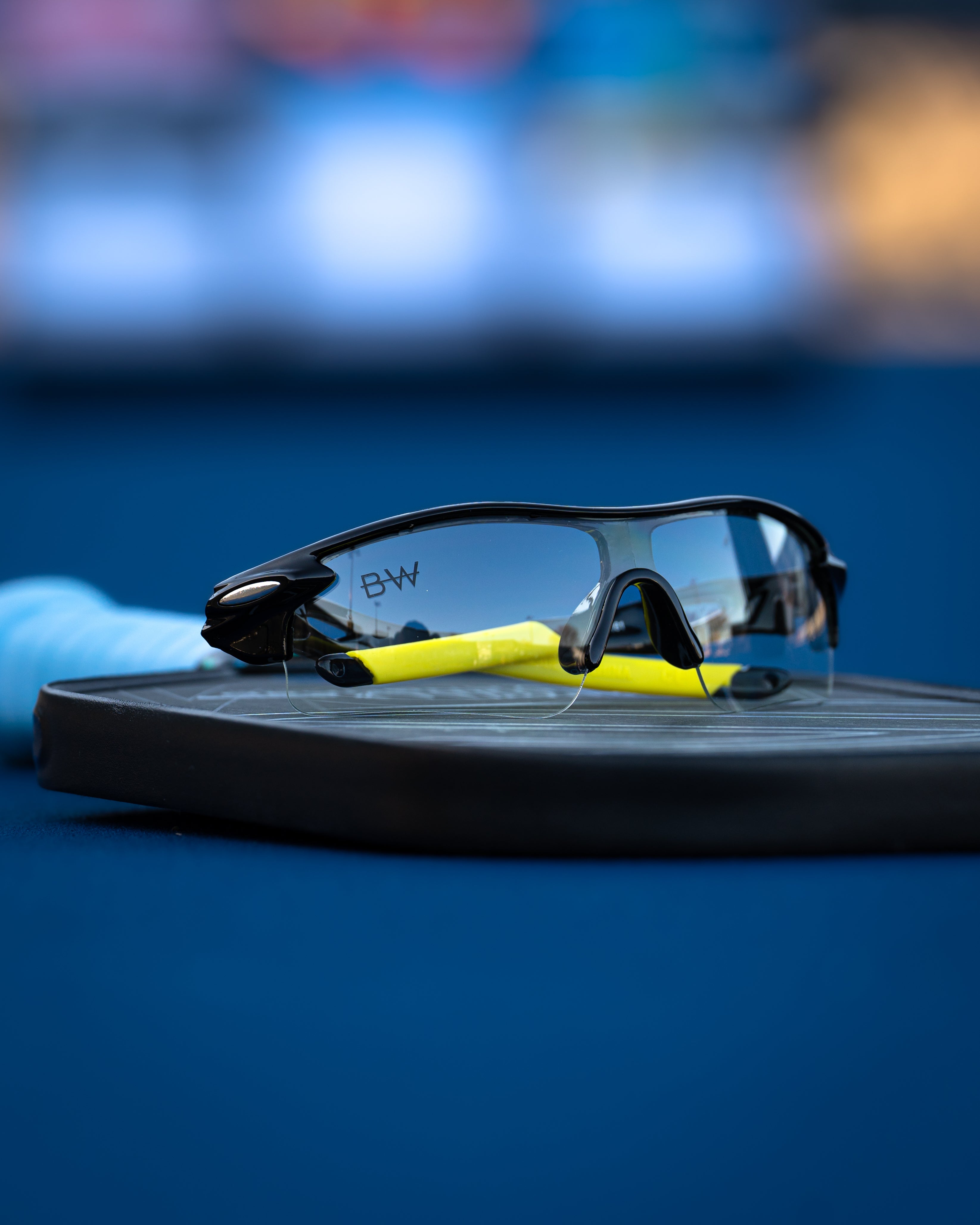
Explore Clear, Gray & Transitional Lens Options for Pickleball
Share
Explore Clear, Gray & Transitional Lens Options for Pickleball
Clear, gray, and transitional lenses can each make sense for pickleball, but the best choice depends primarily on where and when you play. Clear lenses are a practical option for indoor and nighttime courts, gray lenses can be useful for bright outdoor play, and transitional lenses may provide more versatility when outdoor lighting changes.
The goal is not to find one lens that is universally “best.” It is to choose a lens configuration that matches your court environment, prescription needs, comfort preferences, and typical playing schedule.
Blinded Wear offers prescription and non-prescription pickleball eyewear built around a performance-first approach, including lightweight sports frames, impact-resistant lenses, non-polarized configurations, and high-index prescription lenses at no additional cost for RX customers.
Compare Pickleball Glasses by Your Playing Needs
Start with the type of eyewear you need, then match the lens configuration to your normal court conditions.
Why Does Lens Choice Matter for Pickleball?
Pickleball can be played under very different lighting conditions. One player may spend every session inside a dedicated facility, while another plays on outdoor courts in bright afternoon sun. Tournament players may even encounter multiple lighting environments in the same day.
That means lens selection should be based on practical questions such as:
- Do you usually play indoors or outdoors?
- Do you frequently play at night?
- Are your outdoor sessions usually in bright daytime conditions?
- Does the light change significantly during your normal playing window?
- Do you need prescription correction?
- Would you rather use one versatile pair or dedicated pairs for different environments?
A lens that works well for one situation can be inconvenient in another. For example, a darker sunglass tint that feels appropriate in bright outdoor conditions may not be the setup you want for an indoor evening session.
Clear vs. Gray vs. Transitional Lenses: Quick Comparison
| Lens Type | When to Consider It | Main Limitation to Remember |
|---|---|---|
| Clear | Indoor, nighttime, and lower-light play | Does not provide the darker tint some players prefer in bright outdoor conditions |
| Gray | Bright outdoor daytime play | May be too dark for indoor or nighttime courts |
| Transitional | Changing outdoor light or players seeking a more versatile setup | Tint changes are not instantaneous and behavior depends on lens technology and environmental conditions |
Clear Lenses for Pickleball: Best for Indoor and Night Play?
Clear lenses are a practical starting point for indoor and nighttime pickleball. They provide vision without intentionally adding a dark sunglass tint, which can make them useful when the court already has limited or artificial lighting.
Clear lenses may be worth considering if you primarily play:
- At indoor pickleball facilities
- In evening leagues
- On outdoor courts after sunset
- Under artificial court lighting
- In conditions where a darker tint would be unnecessary
Prescription players can use clear RX lenses when they need vision correction without a dark outdoor tint, while players who do not need a prescription can consider clear non-RX eyewear depending on their preferences.
Explore available options in the Clear Lens Collection →.
When Might Clear Lenses Not Be the Best Choice?
Clear lenses are not automatically the ideal option for every court. Players spending most of their time outdoors in bright daytime conditions may prefer a tinted lens instead.
Before choosing clear lenses as your only pair, ask:
- How often do I play in direct daytime brightness?
- Do I regularly move between indoor and outdoor courts?
- Would I prefer a separate outdoor pair?
- Would a transitional configuration better match my schedule?
The answer depends on your actual playing routine rather than on one universal lens recommendation.
Gray Lenses for Pickleball: When Do They Make Sense?
Gray-tinted lenses are commonly considered for bright outdoor conditions. If most of your pickleball is played during the daytime, a tinted lens can be more appropriate than using a clear setup designed around indoor or nighttime conditions.
Gray lenses may be worth considering for:
- Outdoor daytime pickleball
- Bright, open courts
- Long outdoor sessions
- Players who prefer a darker sunglass-style lens outdoors
The important distinction is that a gray tint should be selected because it suits your lighting environment—not because the lens color is assumed to make you react faster, track the ball better, or automatically improve your game.
Do Gray Lenses Improve Color or Contrast for Pickleball?
Lens colors are often marketed with claims about enhanced contrast, sharper ball tracking, or better performance. Those claims should be evaluated carefully rather than treated as automatic benefits.
A gray lens primarily gives players a tinted option for bright conditions. It should not be assumed to:
- Increase reaction speed
- Improve depth perception
- Guarantee better ball tracking
- Increase shot accuracy
- Reduce unforced errors
Your visual performance depends on much more than lens color, including prescription correction when needed, individual vision, lighting, experience, positioning, and athletic skill.
Clear vs. Gray Lenses for Pickleball
| Factor | Clear Lenses | Gray Lenses |
|---|---|---|
| Indoor play | Practical option | Often darker than needed |
| Night play | Practical option | Generally not the first choice |
| Bright daytime outdoor play | May not provide the tint a player wants | Worth considering |
| Prescription availability | Can be used in RX configurations | Can be used in RX configurations when available |
| Best for every environment? | No | No |
What Are Transitional Lenses for Pickleball?
Transitional, or photochromic, lenses are designed to change tint in response to environmental conditions depending on the particular lens technology.
For pickleball players, the main appeal is versatility. Instead of carrying separate eyewear for every change in outdoor brightness, some players may prefer a lens that can adjust its tint under changing conditions.
Transitional lenses may be worth considering if you:
- Play outdoors as lighting changes
- Start sessions earlier in the day and continue into brighter conditions
- Frequently experience variable outdoor light
- Prefer minimizing the number of prescription pairs you carry
However, transitional lenses should not be described as changing instantly or responding identically in every environment. Activation, darkness, and transition behavior depend on the specific lens technology and environmental conditions.
What Should Pickleball Players Know Before Choosing Transitional Lenses?
Transitional lenses can offer convenience, but they are not automatically the best option for every player.
Keep these limitations in mind:
- Tint changes are not instantaneous.
- Different transition lens technologies can behave differently.
- Environmental conditions can affect lens behavior.
- A transitional pair may not replace every dedicated tint for every player.
- Players who consistently use the same court and lighting may prefer a dedicated clear or tinted setup.
If you are choosing transitional prescription lenses, think about how often your actual playing conditions change enough to justify a more versatile configuration.
Which Pickleball Lens Should You Choose?
Use your normal playing environment as the starting point.
| Your Typical Play | Lens Type to Consider |
|---|---|
| Almost always indoors | Clear |
| Mostly at night | Clear |
| Mostly bright outdoor daytime | Gray or another appropriate tinted lens |
| Outdoor light regularly changes | Transitional |
| Regular indoor + outdoor play | Separate clear and tinted pairs or another versatile configuration |
| Tournament schedule spanning different conditions | Consider multiple setups or a transition option depending on your needs |
Clear, Gray & Transitional Prescription Lenses for Pickleball
Prescription players have an additional priority: the lens must first provide the correction appropriate for their vision.
When comparing RX pickleball eyewear, consider:
- Your prescription requirements
- The lens configuration available for the frame
- Your primary playing environment
- Frame fit and comfort
- How often your lighting conditions change
- The total prescription price
If your vision has changed or you are unsure whether your current prescription is appropriate, consult an eye-care professional before assuming a new tint will solve the issue.
Do High-Index Lenses Cost More With Blinded Wear?
No. Blinded Wear includes high-index prescription lenses at no additional cost. There is no separate high-index upcharge.
Depending on prescription and lens design, high-index materials can allow thinner lenses than some lower-index alternatives. When comparing RX sports eyewear, it is worth looking at the complete prescription price rather than only the advertised frame price.
Are Blinded Wear Pickleball Lenses Polarized?
Blinded Wear uses a non-polarized, performance-first approach for pickleball eyewear.
Polarized lenses can reduce certain reflected glare, but polarization is not universally better for court sports. Blinded Wear's non-polarized approach is intended to preserve natural visual information and avoid potential depth-perception concerns associated with polarization during fast court play.
That does not mean polarized lenses universally cause depth-perception problems. The better lens choice depends on the activity, your playing conditions, and your individual visual preferences.
What About Impact Resistance?
Lens color and tint are only part of a sports-eyewear decision. Blinded Wear also offers impact-resistant lenses for active use.
Impact-resistant does not mean impact-proof and does not automatically indicate a particular protective-eyewear certification. If a specific safety certification is important to you, verify that certification separately.
Blinded Wear RX Frames to Compare
Lens availability can vary by product and configuration, so confirm the current options on the individual product page before ordering. These verified Blinded Wear RX models can serve as starting points when comparing prescription sports eyewear.
Runway RX
Runway RX provides a sports-oriented prescription frame to compare according to your RX requirements, fit preferences, playing environment, and available lens configuration.
Sea Sand RX
Sea Sand RX gives prescription players another frame option to evaluate according to individual fit, style, and current lens choices.
H Blue Shield RX
H Blue Shield RX adds another dedicated prescription pickleball frame to compare for fit, RX compatibility, and available lens configuration.
Crystal Wave II RX
Crystal Wave II RX provides another prescription sports option to evaluate based on your playing conditions, preferred frame style, and currently available lens choices.
Match Your Lens to Your Court
The simplest way to choose between clear, gray, and transitional pickleball lenses is to start with the environment where you play most often.
Clear for indoor and night play. Gray or another suitable tint for bright outdoor conditions. Transitional lenses for players who want more versatility across changing outdoor light.
Compare RX Pickleball Glasses →
Need help narrowing the options?
Which Lens Type Fits Your Pickleball Schedule?
Instead of choosing a lens based only on color or appearance, think about a typical week of pickleball. The player who practices indoors three nights a week has different needs from someone who plays almost exclusively on outdoor courts at midday.
| Player Type | Lens Setup to Consider | Why |
|---|---|---|
| Indoor league player | Clear | Avoids adding an unnecessarily dark tint indoors |
| Nighttime outdoor player | Clear | Practical when playing under artificial court lighting |
| Daytime outdoor player | Gray or another suitable tint | Provides a tinted option for bright outdoor conditions |
| Early-to-late outdoor player | Transitional or multiple lens setups | Worth considering when outdoor brightness changes during play |
| Indoor and outdoor player | Clear + tinted pairs or another versatile setup | Allows eyewear to be matched to substantially different environments |
| Frequent tournament player | Primary setup plus a backup option | Provides another vision-correction option if conditions or equipment needs change |
What Lens Color Is Best for Indoor Pickleball?
Clear lenses are a practical choice for many indoor pickleball players. Indoor courts already rely on artificial lighting, so adding a dark sunglass tint may be unnecessary.
For prescription players, clear RX lenses can combine the correction they need with a lens that does not intentionally darken the court environment.
However, “clear” should not be interpreted as a guarantee of better ball tracking, faster reactions, or enhanced contrast. The primary benefit is simpler: you can wear appropriate sports eyewear without adding a dark outdoor tint.
Are Clear Lenses Good for Night Pickleball?
Clear lenses can also be a practical option for nighttime pickleball. When you are already relying on court lighting, a darker daytime tint may reduce the amount of visible light reaching your eyes unnecessarily.
Players who regularly move from late-afternoon daylight into nighttime conditions have another decision to make: use separate daytime and nighttime eyewear, or consider whether a transitional configuration fits their changing outdoor environment.
The right choice depends on how frequently your sessions cross those lighting conditions and how much equipment you want to carry.
What Lens Color Is Best for Outdoor Pickleball?
There is no single tint that every outdoor pickleball player needs. For bright daytime conditions, gray or another suitable tinted lens can be worth considering.
When comparing outdoor lenses, focus on practical factors:
- How bright your normal courts are
- What time of day you usually play
- Whether courts move between direct sun and shade
- How dark you personally prefer your outdoor eyewear
- Whether you need prescription correction
- Whether you also need the same glasses for indoor or nighttime play
A tint that works well during a bright afternoon session may not be the right setup for a 7 p.m. indoor league. Your schedule matters more than choosing a lens because it is marketed as a “performance color.”
What Are Gray Lenses Used for in Pickleball?
Gray lenses provide a darker sunglass-style option that can be useful for players who spend significant time on bright outdoor courts.
They can be particularly relevant when your main alternative is a completely clear lens that you find unsuitable for bright daytime conditions.
But keep the benefit in perspective. Gray lenses should not be assumed to create:
- Faster visual processing
- Superior depth perception
- Automatic contrast enhancement
- Better pickleball rankings
- More accurate shots
Choose gray because the tint fits your environment and visual preferences—not because the color itself promises a competitive advantage.
Are Gray Lenses the Same as Polarized Lenses?
No. Tint color and polarization are different lens characteristics. A lens can have a gray appearance without being polarized.
Polarization can reduce certain reflected glare, while a gray tint refers to the color of the lens. One does not automatically imply the other.
Blinded Wear uses a non-polarized, performance-first approach intended to preserve natural visual information and avoid potential depth-perception concerns associated with polarization during court play.
This does not mean polarization universally causes depth-perception problems or that every player must avoid polarized eyewear. It means polarization should not be confused with tint color or assumed to be necessary simply because you play outdoors.
Transitional Lenses vs. Separate Clear and Gray Lenses
For players who regularly experience different lighting conditions, one of the biggest decisions is whether to prioritize convenience or dedicated lens setups.
| Setup | Potential Advantage | What to Consider |
|---|---|---|
| Transitional lenses | One pair may provide more versatility across changing outdoor light | Tint changes are not instantaneous and behavior varies with lens technology and conditions |
| Separate clear + gray/tinted pairs | Dedicated setup for different lighting environments | Requires carrying and managing more than one pair |
| Clear only | Simple setup for indoor and nighttime players | May not provide the tint preferred in bright daytime conditions |
| Gray/tinted only | Simple setup for primarily bright outdoor play | May be inappropriate when lighting becomes substantially darker |
Neither approach is universally better. A player who almost always plays indoors may have little need for transition lenses, while someone whose outdoor sessions span changing light may value their versatility.
Can Transitional Lenses Be Used for Indoor and Outdoor Pickleball?
Transitional lenses are often considered by players looking for versatility, but their behavior should not be oversimplified.
How light or dark a photochromic lens becomes can depend on the particular technology and environmental conditions. Because of that, do not assume every transitional lens will behave identically across every indoor facility, shaded court, or outdoor environment.
If indoor play is a major part of your schedule, compare the actual lens configuration you are considering with a dedicated clear option before deciding that one transitional pair can replace every other setup.
Do Transitional Pickleball Lenses Change Tint Instantly?
No. Transitional lenses should not be expected to change from clear to dark or dark to clear instantly.
The amount and speed of change depend on the specific photochromic technology and environmental conditions. That distinction is especially important in pickleball because players may move between different lighting environments over a relatively short period.
Think of transitional lenses as a potential versatility option rather than an instantaneous electronic light-control system.
Do You Need One Pair or Two Pairs of Pickleball Glasses?
One pair can be enough if your playing conditions are relatively consistent.
One Pair May Be Enough If:
- You almost always play indoors
- You almost always play at night
- You primarily play outdoors at a similar time of day
- You find a lens configuration that works for your normal environment
Two Pairs May Be Worth Considering If:
- You regularly switch between indoor and bright outdoor courts
- You want dedicated clear and tinted setups
- You play tournaments spanning significantly different conditions
- You want a backup prescription pair available during competition
Transitional lenses offer another option for players who would rather explore a more versatile configuration than immediately purchase multiple prescription pairs.
Do You Need Prescription or Non-Prescription Pickleball Lenses?
If you require prescription correction while playing, RX sports eyewear can combine that correction with a sports-oriented frame and your selected lens configuration.
Players who do not require prescription correction can shop non-RX pickleball eyewear. Players who comfortably use contact lenses may also consider contacts with non-prescription sports eyewear.
| Vision Setup | Option to Consider |
|---|---|
| Need prescription correction | RX pickleball glasses |
| Do not need correction | Non-RX pickleball glasses |
| Wear contacts during sports | Contacts + non-RX pickleball eyewear |
| Need prescription correction indoors | Clear RX configuration |
| Need prescription correction outdoors | Appropriate tinted or other available RX configuration |
Lens Color Is Only Part of Choosing Pickleball Glasses
A good lens configuration does not compensate for a frame that does not work for you.
After deciding between clear, tinted, and transitional options, evaluate:
- Prescription: Does the eyewear provide the correction you require?
- Fit: Does the frame work with your face during movement?
- Comfort: Can you comfortably wear it through an extended session?
- Weight: Do you prefer a lightweight sports frame?
- Lens construction: Are impact-resistant lenses important to your active-use needs?
- Lighting: Does the lens configuration actually match where you play?
- Value: What is included in the complete prescription price?
Blinded Wear offers lightweight sports frames and impact-resistant lenses, while high-index prescription lenses are included at no additional cost.
How to Test New Pickleball Lenses Before a Tournament
Do not wait until an important match to determine whether a new lens configuration works for you.
During practice, test your eyewear under conditions similar to those you expect in competition. Pay attention while you:
- Serve and return
- Dink at the kitchen
- Move laterally
- Transition forward and backward
- Track overhead balls
- Play through a longer session
- Experience changes in court lighting
The objective is not to prove that a particular lens makes you perform better. It is to confirm that your prescription, tint, frame fit, and comfort work appropriately for your needs.
7 Mistakes to Avoid When Choosing Pickleball Lens Colors
-
Choosing a Dark Tint for Every Environment
A lens intended for bright outdoor conditions may not be the best choice for indoor or nighttime play.
-
Assuming Clear Lenses Are Only for Prescription Players
Clear sports eyewear can also be relevant to non-RX players depending on their needs.
-
Expecting Transitional Lenses to Change Instantly
Photochromic behavior depends on lens technology and environmental conditions.
-
Buying a Lens Color Because It Promises Better Performance
No tint should be assumed to automatically improve reaction time, depth perception, ball tracking, or shot accuracy.
-
Confusing Gray Tint With Polarization
Lens tint and polarization are separate characteristics.
-
Ignoring Your Prescription
If you require corrective vision, appropriate prescription correction should come before tint preferences.
-
Ignoring Frame Fit and Comfort
The right lens inside an uncomfortable or poorly fitting frame may still be a poor overall setup for you.
Pickleball Lens Claims: Marketing vs. Reality
| Common Claim | More Accurate Approach |
|---|---|
| “Clear lenses improve precision” | Clear lenses provide a non-darkened option useful in certain lighting environments |
| “Gray lenses make you react faster” | A gray tint can suit bright conditions but does not guarantee faster reactions |
| “Gray automatically means polarized” | Tint color and polarization are separate lens characteristics |
| “Transition lenses instantly adapt” | Photochromic changes take time and depend on lens technology and conditions |
| “One transition pair works perfectly everywhere” | Some players may still prefer dedicated lens setups for different environments |
| “A special tint improves depth perception” | No lens color should be assumed to universally enhance depth perception |
| “Impact-resistant means impact-proof” | Impact resistance does not automatically indicate impact-proof protection or a specific certification |
Compare the Complete Cost of RX Pickleball Lenses
If you need prescription pickleball glasses, lens pricing matters alongside tint and frame style.
Blinded Wear includes high-index prescription lenses at no additional cost. There is no separate high-index upcharge.
Blinded Wear also offers a 50% lifetime replacement warranty if your glasses break.
Review current coverage details before ordering:
Clear, Gray or Transitional? Use This Buying Scorecard
| Question | If Yes, Consider |
|---|---|
| Do I mostly play indoors? | Clear lenses |
| Do I mostly play at night? | Clear lenses |
| Do I mostly play in bright outdoor conditions? | Gray or another suitable tint |
| Does outdoor lighting regularly change during my sessions? | Transitional lenses |
| Do I regularly switch between very different environments? | Multiple lens setups or another versatile configuration |
| Do I require prescription correction? | Start with RX compatibility before choosing tint |
| Do I already use contacts comfortably? | Contacts with non-RX sports eyewear may be another option |
| Am I buying for tournaments? | Test your primary setup and consider a backup option |
Choose Your Lens Based on Where You Actually Play
You do not need the lens with the biggest list of performance claims. You need the configuration that makes sense for your prescription, court environment, and playing schedule.
Mostly indoors or at night? Start with clear lenses. Mostly outdoors in bright daytime conditions? Compare gray or other tinted options. Regularly dealing with changing outdoor light? Consider whether a transitional configuration fits your routine.
FAQs About Clear, Gray & Transitional Pickleball Lenses
What lens color is best for pickleball?
There is no single best lens color for every player. Clear lenses are a practical choice for indoor and nighttime play, gray or other suitable tints can make sense for bright outdoor conditions, and transitional lenses may be useful when outdoor lighting changes.
Are clear lenses good for indoor pickleball?
Yes. Clear lenses are often a practical option indoors because they provide vision without adding a dark sunglass tint. Prescription players can also use clear RX lenses when they need corrective vision on indoor courts.
Are clear lenses good for night pickleball?
Clear lenses can be a practical choice at night because they avoid intentionally darkening the court. Players who regularly play under artificial court lighting may prefer clear lenses over a darker daytime tint.
Are gray lenses good for outdoor pickleball?
Gray lenses can be worth considering for bright outdoor daytime conditions. They should be chosen because the tint suits your environment and preferences, not because gray lenses are assumed to improve reaction time, depth perception, or shot accuracy.
Do gray lenses improve ball tracking?
Not automatically. A gray tint can change how bright the environment feels, but it should not be assumed to improve ball-tracking ability. Ball tracking also depends on prescription correction when needed, individual vision, experience, anticipation, positioning, and practice.
Are gray lenses polarized?
Not necessarily. Gray describes the lens tint, while polarization is a separate lens characteristic. A lens can be gray without being polarized.
Are polarized lenses better for pickleball?
Not automatically. Polarized lenses can reduce certain reflected glare, but Blinded Wear uses a non-polarized, performance-first approach intended to preserve natural visual information and avoid potential depth-perception concerns associated with polarization during court play. Polarization does not universally cause depth-perception problems.
Are transitional lenses good for pickleball?
They can be useful for players who regularly experience changing outdoor light and prefer a more versatile setup. Their behavior depends on the specific lens technology and environmental conditions, so they should not be expected to perform identically in every environment.
Do transitional lenses change instantly?
No. Transitional lenses should not be expected to change from clear to dark or dark to clear instantly. The speed and degree of change depend on the specific photochromic technology and environmental conditions.
Can transitional lenses replace clear and tinted glasses?
For some players, they may reduce the need to carry multiple pairs. Others may still prefer dedicated clear and tinted setups for very different lighting environments. It depends on your schedule, lens technology, and personal preferences.
What lenses should I use if I play both indoors and outdoors?
You can consider separate clear and tinted pairs, or evaluate whether a transitional configuration provides enough versatility for your needs. Players who frequently move between very different lighting conditions may prefer dedicated setups.
Do I need prescription pickleball glasses?
If you require corrective vision while playing, prescription sports eyewear can combine your correction with a sports-oriented frame. Players who do not need correction can shop non-RX options, while comfortable contact-lens users may consider contacts with non-prescription sports eyewear.
Does Blinded Wear charge extra for high-index RX lenses?
No. Blinded Wear includes high-index prescription lenses at no additional cost. There is no separate high-index upcharge.
Are Blinded Wear lenses impact-resistant?
Yes. Blinded Wear offers impact-resistant lenses for active use. Impact-resistant does not mean impact-proof and does not automatically indicate a particular protective-eyewear certification.
Can a better lens tint improve my pickleball ranking?
No lens color can guarantee a higher ranking. The right lens can help make your eyewear better suited to your environment, but rankings depend on actual match performance, skill, consistency, strategy, movement, and decision-making.
How to Choose Between Clear, Gray & Transitional Lenses in 3 Steps
Step 1: Identify Where You Play Most
Your primary court environment should drive the decision.
- Mostly indoor: Start with clear lenses.
- Mostly nighttime: Clear lenses are a practical starting point.
- Mostly bright outdoor daytime: Compare gray or another suitable tinted option.
- Frequently changing outdoor light: Consider a transitional setup.
Step 2: Account for Your Prescription Needs
If you need corrective vision, start with the prescription configuration appropriate for you before choosing tint. Lens color cannot compensate for an outdated or inappropriate prescription.
Step 3: Decide Whether You Want Versatility or Dedicated Pairs
One versatile pair may be convenient, while dedicated clear and tinted glasses can make sense for players who regularly use very different environments. Choose based on your actual routine rather than the assumption that more technology is always better.
Best Lens Setup by Pickleball Scenario
| Scenario | Lens Setup to Consider |
|---|---|
| Indoor open play | Clear lenses |
| Indoor league at night | Clear lenses |
| Outdoor morning session | Clear, tinted, or transitional depending on brightness and session length |
| Bright midday outdoor play | Gray or another suitable tint |
| Late-afternoon session extending toward evening | Transitional lenses or separate tinted and clear pairs |
| Indoor and outdoor tournament | Multiple dedicated setups or another versatile configuration |
| Player who dislikes carrying multiple RX pairs | Consider whether transitional lenses fit your routine |
| Player whose conditions rarely change | A dedicated clear or tinted pair may be simpler |
One Versatile Pair or Multiple Pickleball Glasses?
Both approaches can work. The better choice depends on how much your playing environment changes.
One-Pair Setup
A single pair can make sense when:
- You primarily play under one type of lighting
- You prefer minimizing the amount of equipment you carry
- Your selected lens configuration works for most of your sessions
- You are considering a transitional setup for changing outdoor light
Multiple-Pair Setup
Dedicated pairs may make more sense when:
- You regularly switch between bright outdoor and indoor courts
- You play both daytime and nighttime pickleball
- You want a clear pair and a separate tinted pair
- You compete in tournaments spanning different environments
- You want a backup prescription option available
Neither strategy is automatically better. The goal is to choose the simplest setup that reliably fits the conditions where you play.
How Tournament Players Should Plan Their Lens Setup
Tournament schedules can expose players to more lighting variation than a normal recreational session. You may start early, play through brighter midday conditions, move between courts, or continue into the evening.
Before competition, ask:
- Will matches be indoors, outdoors, or both?
- What time will play begin?
- Could matches continue into later lighting conditions?
- Will you have time to change eyewear between matches?
- Do you need prescription correction?
- Would a backup pair be useful?
Test your selected lens setup before tournament day. A familiar pair that works well for your vision and environment is more useful than an untested lens chosen because of a performance claim.
What Matters More Than Lens Color?
Lens color is only one part of a good pickleball eyewear setup.
Prioritize these factors alongside clear, gray, or transitional options:
- Appropriate prescription correction if you need RX lenses
- Frame fit during real movement
- Comfort over extended sessions
- Lens configuration for your court environment
- Lightweight construction if that matters to you
- Impact-resistant lenses for active use
- Total prescription cost
- Replacement coverage
- Personal style
A lens tint that fits the court but sits in a frame that is uncomfortable or inappropriate for your prescription is not a complete solution.
Final Checklist Before Choosing Pickleball Lens Options
- Identify whether you mainly play indoors, outdoors, or at night.
- Determine how much your lighting conditions change during a normal session.
- Start with your prescription requirements if you need corrective vision.
- Consider clear lenses for indoor and nighttime play.
- Consider gray or another suitable tint for bright daytime conditions.
- Consider transitional lenses if outdoor lighting frequently changes.
- Do not expect transitional lenses to change tint instantly.
- Do not confuse gray tint with polarization.
- Do not assume polarization is automatically better for pickleball.
- Do not buy a lens because it promises faster reactions or improved depth perception.
- Evaluate frame fit and comfort alongside lens color.
- Look for impact-resistant lenses without assuming impact-proof protection.
- Compare the complete prescription price rather than only the frame cost.
- Remember that Blinded Wear includes high-index prescription lenses at no additional cost.
- Test new eyewear under real playing conditions before a tournament.
Key Takeaways: Clear, Gray & Transitional Pickleball Lenses
- Clear lenses are a practical option for indoor and nighttime pickleball.
- Gray lenses can make sense for bright outdoor daytime play.
- Transitional lenses may provide versatility when outdoor lighting changes.
- No lens type is universally best for every player.
- Gray tint and polarization are different lens characteristics.
- Blinded Wear uses a non-polarized, performance-first approach.
- Transitional lenses do not change tint instantly.
- Photochromic behavior depends on lens technology and environmental conditions.
- No lens tint can guarantee faster reactions, better depth perception, improved ball tracking, or a higher pickleball ranking.
- Prescription correction, fit, comfort, and court environment should come before performance marketing claims.
- Blinded Wear offers lightweight sports frames and impact-resistant lenses.
- Blinded Wear includes high-index prescription lenses at no additional cost.
- Blinded Wear offers a 50% lifetime replacement warranty if glasses break.
Explore More Pickleball Eyewear Options
Final Verdict: Clear, Gray or Transitional Lenses for Pickleball?
Choose based on the court, not the marketing.
If you mostly play indoors or at night, clear lenses are a practical starting point. If your game is primarily outdoors in bright daytime conditions, gray or another suitable tint may make more sense. If your outdoor lighting changes frequently and you value versatility, transitional lenses are worth considering.
No lens color can create pickleball skill by itself. The better setup is the one that gives you the prescription correction you need, works comfortably with your frame, and matches the lighting conditions where you actually play.
For RX players, Blinded Wear combines prescription sports eyewear with high-index lenses included at no additional cost, lightweight sports frames, impact-resistant lenses, non-polarized configurations, and a 50% lifetime replacement warranty if your glasses break.
Find the Right Pickleball Lens Setup for Your Court
Start with your playing environment, then compare prescription needs, fit, lens configuration, and overall value.
Shop Non-RX Pickleball Glasses →
Still deciding between clear, tinted, and transitional options?
Take the Pickleball Glasses Quiz →
Or compare the broader collection in the 2026 Pickleball Glasses Guide →.