
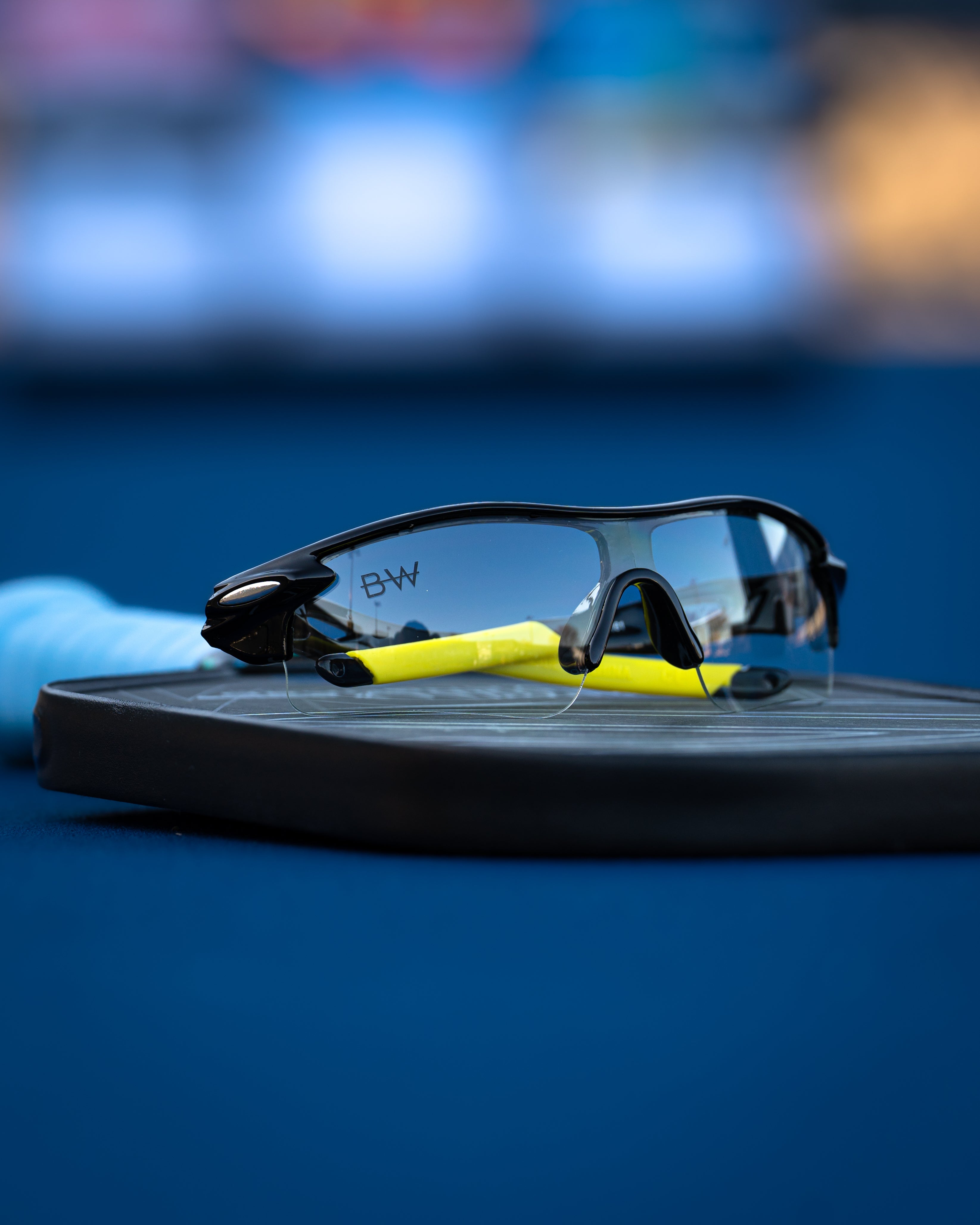
The Lens Shape That Improves Your Court Anticipation
Share
The Lens Shape That Improves Your Court Anticipation
Can the shape of your prescription glasses actually make you anticipate pickleball shots earlier? Lens and frame shape can influence how eyewear fits, looks, and sits within your normal field of view—but a particular shape should not automatically be credited with faster reactions, better peripheral vision, improved depth perception, or earlier shot recognition.
Court anticipation is primarily a player skill. Reading paddle preparation, recognizing familiar patterns, watching opponent positioning, understanding available angles, and learning what tends to happen next all contribute to anticipating a shot.
That does not make lens shape irrelevant. If you require prescription correction, frame and lens dimensions are still important parts of choosing RX pickleball glasses. The key is understanding what shape can reasonably help you choose—and what still has to be developed on court.
Ready to Compare RX Pickleball Frames?
If you already know you need prescription court eyewear, start with the RX collection. If you're still comparing frame styles, use this guide to understand lens shape before choosing.
How Court Anticipation Actually Works in Pickleball
The original version of this guide connected lens shape directly to better peripheral awareness and faster reactions. It even claimed that improvements in lens geometry could shave tenths of a second from reaction time. :contentReference[oaicite:0]{index=0}
That gives eyewear too much responsibility.
A more useful way to understand anticipation is as a sequence:
- Observe: Gather information about the developing rally.
- Recognize: Connect what you're seeing with patterns you've experienced before.
- Predict: Narrow the opponent's likely options.
- Decide: Choose your response.
- Move: Execute that decision.
Your prescription eyewear handles a different task: providing the corrective vision associated with your prescription.
It should not be marketed as performing the recognition, prediction, decision, or movement stages for you.
5 Clues That Help Players Anticipate the Next Shot
If you want to become earlier rather than faster, these are more useful areas to study than searching for a lens shape that promises improved anticipation.
1. Opponent Position
Where is the opponent when contact is approaching? Their position can influence which shots are practical and which areas of the court are available.
2. Paddle Preparation
Instead of waiting exclusively for the ball to leave the paddle, become familiar with how different players prepare for different shots.
3. Your Own Shot
Your previous shot influences what happens next. A ball that pressures an opponent can create a different set of possibilities from a ball that gives them time and options.
4. Court Geometry
Positioning changes available angles. Learning common patterns can help you make more informed decisions before the opponent's shot reaches you.
5. Player Tendencies
As a match develops, look for repetition. Does an opponent favor a particular response under pressure? Do they attack certain balls? Do they repeatedly choose the same target?
Anticipation improves when players learn to recognize useful information—not because a frame predicts the next shot.
So What Does Lens Shape Actually Change?
Lens shape remains relevant when comparing prescription sports eyewear. It simply needs to be discussed without attaching unsupported athletic outcomes to it.
Depending on the specific frame, visible differences can include:
- Overall lens dimensions
- Lens outline and appearance
- How much of the face the frame visually covers
- The overall frame silhouette
- How the glasses compare dimensionally with eyewear you already own
- Style preferences
These characteristics can help you decide which pair you prefer. They do not establish that one frame gives every wearer superior functional peripheral vision or court anticipation.
Does a Wider Lens Automatically Give You Better Peripheral Vision?
No automatic performance advantage should be assumed from width alone.
The old article described wider and wraparound lenses as increasing usable side vision, reducing missed peripheral cues, and allowing players to recognize angled shots sooner. :contentReference[oaicite:1]{index=1}
That sounds intuitive, but a product page needs to distinguish the physical appearance of a frame from a demonstrated improvement in human visual performance.
A lens that appears wide does not by itself prove that the wearer will:
- Notice opponents earlier
- See more usable peripheral information
- React faster
- Recognize dinks sooner
- Cover sidelines more effectively
- Turn their head less
When comparing wide-looking frames, treat the shape as a design and fit characteristic unless a specific optical performance claim has been independently established.
Are Wraparound RX Glasses Better for Pickleball?
Wraparound styling is common in sports eyewear, and some players may simply prefer that appearance.
What should be avoided is turning "wraparound" into shorthand for guaranteed athletic advantages.
The previous version of this article claimed wraparound lenses expanded lateral vision, reduced edge blur, improved angled-shot anticipation, and allowed players to maximize awareness without turning their head. :contentReference[oaicite:2]{index=2}
Without evidence for the specific product, those claims should not determine the recommendation.
A better buying question is:
“Do I prefer this frame shape, and do its available measurements and prescription options match what I'm looking for?”
That gives shoppers something concrete to evaluate without promising that frame geometry will transform their court awareness.
What About Oversized RX Lenses for Pickleball?
A larger lens shape can create a noticeably different appearance from a smaller everyday-style frame.
But "larger" should not automatically become:
- Better court scanning
- More peripheral awareness
- Fewer missed visual cues
- Less head movement
- Faster opponent recognition
If you like a larger lens profile, compare the frame according to your prescription requirements, available dimensions, frame weight, playing environment, and style preferences.
There does not need to be a performance claim attached to every design choice.
Does Lens Curvature Improve Depth Perception?
The original guide made another major leap by claiming optimized curvature could preserve spatial relationships, maintain correct depth cues, reduce edge distortion, and provide more accurate depth perception during rapid movement. :contentReference[oaicite:3]{index=3}
Those specific optical-performance outcomes should not be promised without appropriate verification.
Prescription lens design can involve technical considerations, particularly when frame geometry and prescription requirements interact. But shoppers should not assume that a visibly curved sports frame automatically gives them:
- Better depth perception
- More accurate distance judgment
- Better trajectory recognition
- Faster ball tracking
- Reduced visual-processing time
If you have individual questions about how a particular frame style relates to your prescription or vision needs, consult an eye-care professional.
Can Lens Shape Improve Your Pickleball Reaction Time?
Blinded Wear should not claim that changing lens shape inherently makes your nervous system react faster.
The old article went as far as suggesting that lens geometry could save approximately 100–200 milliseconds and measurably improve positioning and volley timing. :contentReference[oaicite:4]{index=4}
That numerical performance claim should be removed.
Reaction on court involves more than simply receiving visual information. A player still has to recognize what is happening, choose an appropriate response, and physically execute it.
One of the most useful ways to become effectively "faster" is therefore to work on anticipation and decision-making rather than expecting eyewear to reduce biological reaction time.
Anticipation vs. Reaction: Why the Difference Matters
| Reaction | Anticipation |
|---|---|
| Responding after something happens | Using available information to prepare for what may happen next |
| Includes physical response time | Relies heavily on recognition and prediction |
| Cannot simply be assigned to lens shape | Can be developed through experience and pattern recognition |
| Still important in fast exchanges | Can help reduce how often you're completely surprised |
Strong players can appear incredibly fast because they are not always starting their decision after the ball is struck. Experience can help them recognize likely patterns earlier.
That is a much more useful court skill to develop than searching for glasses promising "faster vision."
Try This Pickleball Anticipation Drill
You can train the skill this article originally tried to attribute to lens geometry.
Step 1: Start With Predictable Patterns
Have a partner alternate between a small number of predetermined shot choices.
Step 2: Watch the Player, Not Just the Ball
Pay attention to positioning and preparation as the shot develops.
Step 3: Call Your Read
When practical, identify the likely direction or type of response before you see the entire outcome.
Step 4: Add Uncertainty
Once the pattern becomes easy to recognize, allow your partner more options.
Step 5: Review Your Mistakes
Ask why you guessed incorrectly. Did you overlook useful information, commit too early, or assume a pattern that was not actually there?
The objective is not to become perfect at predicting shots. It is to become more deliberate about the information you use before making a decision.
Where Do Prescription Pickleball Glasses Fit Into the Equation?
If you require corrective lenses, your RX eyewear has an important but narrower role than the original article suggested.
Blinded Wear RX eyewear provides prescription players with:
- Prescription correction based on the prescription information supplied for the order
- High-index prescription lenses at no additional cost
- Lightweight sports frames
- Impact-resistant lenses
- Non-polarized lenses
- Comfort for extended matches
- Performance-first designs
- Eyewear designed with pickleball players in mind
- Options suitable for recreational and competitive players
Those are meaningful characteristics without claiming the glasses improve anticipation, depth perception, reaction time, or peripheral awareness.
Do Non-Polarized Lenses Improve Court Awareness?
Blinded Wear uses non-polarized lenses. That means the lenses do not add a polarization filter.
Some court players prefer non-polarized eyewear, making it a relevant characteristic for shoppers comparing pickleball glasses.
However, non-polarized construction should not automatically be claimed to:
- Improve depth perception
- Expand peripheral vision
- Improve ball tracking
- Increase reaction speed
- Improve anticipation
It is a lens characteristic and preference—not a universal performance advantage.
Ocean Wave RX, Zebra II RX, or Frost RX: Does Shape Decide the Winner?
The original article positioned three RX frames according to specific lens-shape advantages:
- Ocean Wave RX was credited with maximum peripheral awareness through a wraparound design.
- Zebra II RX was described as using oversized lenses and dynamic curvature for indoor contrast and motion tracking.
- Frost RX was described as having a hybrid shape optimized for indoor and outdoor tournament play.
Those product-specific performance claims were central to the old recommendations. :contentReference[oaicite:5]{index=5}
In Part 2, we'll rebuild the comparison without assuming any of those advantages.
Instead, we'll compare Ocean Wave RX, Zebra II RX, and Frost RX according to verified Blinded Wear characteristics, prescription needs, available measurements, frame style, playing environment, and the role lens shape should realistically have in your buying decision.
We'll also build a Shape vs. Skill decision system so players can separate what their eyewear changes from what practice and experience develop.
Shape vs. Skill: What Your RX Frames Change—and What They Don't
Before comparing Ocean Wave RX, Zebra II RX, and Frost RX, separate the eyewear decision from the pickleball skill you're trying to improve.
| Factor | Eyewear or Player? | What to Know |
|---|---|---|
| Prescription correction | Eyewear | Your RX lenses provide the prescription correction ordered for you. |
| Lens and frame shape | Eyewear | Different frames can have visibly different shapes and dimensions. |
| Frame weight | Eyewear | Blinded Wear uses lightweight sports frames. |
| Impact resistance | Eyewear | Blinded Wear uses impact-resistant lenses. |
| Recognizing opponent tendencies | Player | Developed through observation and experience. |
| Predicting likely shots | Player | Depends on positioning, patterns, experience, and decision-making. |
| Reaction time | Player | Should not be claimed to become faster because of lens shape. |
| Court positioning | Player | Developed through strategy, movement, and experience. |
| Doubles communication | Player | Built with your partner, not into the frame. |
This framework makes it easier to choose prescription sports eyewear without expecting the glasses to perform the anticipation process for you.
Ocean Wave RX: A Sports-Frame Option to Compare
Ocean Wave RX was previously positioned as the frame for players seeking maximum peripheral awareness. The old article connected its shape directly to expanded lateral vision and earlier recognition of angled shots.
Those outcomes should not be assumed from the frame shape alone.
Instead, consider Ocean Wave RX as one of Blinded Wear's prescription sports-eyewear options and evaluate it according to your individual requirements.
Verified Blinded Wear RX characteristics include:
- Prescription correction
- High-index prescription lenses included at no additional cost
- Lightweight sports construction
- Impact-resistant lenses
- Non-polarized lenses
- Comfort for extended matches
- Performance-first design
- Design focused on pickleball players
- Suitability for recreational and competitive players
Ocean Wave RX does not need to promise maximum peripheral vision, faster reactions, improved depth perception, or better court anticipation to be considered as a dedicated RX pickleball option.
Zebra II RX: A Different Lens Profile Without the “Motion Tracking” Claims
Zebra II RX was previously described as having slightly oversized lenses with dynamic curvature, along with claims about indoor contrast, outdoor motion tracking, a wider visual field, and reduced edge blur.
Those performance characteristics should not be assumed without verification.
A larger-looking or differently shaped lens can still be a meaningful design difference. It simply should not automatically become a claim about how much usable visual information reaches the player.
When comparing Zebra II RX, focus on:
- Your prescription requirements
- Available frame measurements
- Lightweight sports construction
- Impact-resistant lenses
- Non-polarized construction
- Comfort preferences
- Playing environment
- The frame's appearance
If Zebra II RX has the style and dimensions you prefer, that is a legitimate reason to choose it. It does not need an unsupported motion-tracking advantage.
Frost RX: Another RX Frame Shape for Pickleball Players
Frost RX was previously labeled a hybrid lens shape optimized for indoor and outdoor tournament play.
Without verification of a specialized optical advantage, "optimized" goes too far.
Frost RX can instead be evaluated as another lightweight prescription sports frame designed with pickleball players in mind.
- Prescription correction
- High-index prescription lenses at no additional cost
- Lightweight sports frame
- Impact-resistant lenses
- Non-polarized lenses
- Comfort for extended matches
- Performance-first design
- Suitable for recreational and competitive players
Players should choose Frost RX because the actual frame and its current product information fit their needs—not because its shape supposedly increases anticipation.
Ocean Wave RX vs. Zebra II RX vs. Frost RX
The best comparison is not “Which lens shape makes me react fastest?” It is “Which RX frame best matches the characteristics I actually need?”
| What to Compare | Ocean Wave RX | Zebra II RX | Frost RX |
|---|---|---|---|
| Prescription option | Yes | Yes | Yes |
| High-index RX included | Yes, no additional high-index cost | Yes, no additional high-index cost | Yes, no additional high-index cost |
| Lightweight sports frame | Yes | Yes | Yes |
| Impact-resistant lenses | Yes | Yes | Yes |
| Non-polarized lenses | Yes | Yes | Yes |
| Comfortable for extended matches | Yes | Yes | Yes |
| Designed for pickleball | Yes | Yes | Yes |
| Guaranteed peripheral-vision improvement | No | No | No |
| Guaranteed reaction-time improvement | No | No | No |
| Guaranteed anticipation improvement | No | No | No |
Once the verified shared characteristics are established, compare current product information, available dimensions, and style to narrow the three options.
Which Lens Shape Should You Choose for Pickleball?
Use this five-question decision process instead of trying to identify a universally superior lens geometry.
1. Do You Need Prescription Correction?
If yes, begin with the RX Prescription Pickleball Glasses Collection.
2. What Frames Already Fit You Well?
Look at eyewear you already wear comfortably. When measurements are available, use them as a reference point when comparing a new frame.
3. Do You Prefer a Larger or Smaller Visual Profile?
This can be a style and fit preference without needing to be a performance decision.
4. Where Will You Play?
Consider whether you primarily play indoors, outdoors during daylight, in the evening, or across several environments.
5. Which Shape Do You Actually Like?
Once prescription requirements and practical considerations are covered, choose the design you prefer wearing.
Frame Measurements Matter More Than “Performance Shape” Labels
Terms such as wraparound, oversized, hybrid, aerodynamic, court-tuned, optimized curvature, and performance geometry can sound impressive.
But if you're trying to determine whether a frame makes sense for you, available measurements are generally more concrete than a marketing label.
When dimensions are provided, compare them with glasses that already fit you comfortably.
Useful comparisons can include available information about overall frame or lens dimensions rather than assuming:
- Wide-looking means better peripheral vision
- Curved means better depth perception
- Large means better court awareness
- Sports styling means a guaranteed secure fit
- Smaller means restricted functional vision
A frame can look dramatically different from another frame without automatically changing your athletic ability.
Should Your Face Shape Determine Your RX Pickleball Glasses?
The old version of this guide gave specific prescriptions for narrow faces, wide faces, and high cheekbones, including recommendations based on unverified wraparound benefits and adjustable nose pads.
A safer and more useful approach is to avoid assuming that everyone with a particular face shape needs the same frame.
Instead:
- Find eyewear you currently wear comfortably.
- Check its available measurements if you have them.
- Compare those dimensions with the RX frames you're considering.
- Consider the overall frame shape and style you prefer.
- Do not assume an adjustable feature unless it is verified for the specific product.
Two people who would both describe their faces as "wide" may still prefer very different eyewear.
Does Lens Shape Matter More With a Strong Prescription?
Prescription strength can make lens selection more nuanced, but it still does not justify promising that one sports-frame shape will provide superior pickleball performance.
Blinded Wear includes high-index prescription lenses at no additional cost with RX products.
High-index refers to a category of prescription lens materials that can help manage lens thickness and weight, particularly as prescription strength increases.
Final lens thickness can depend on several factors, including:
- Prescription strength
- Lens dimensions
- Frame characteristics
- Other optical requirements
Because of those variables, an exact finished lens thickness should not be promised based solely on the shape of the frame.
A specific numerical lens index should also not be assumed unless explicitly verified for the applicable order.
Lens Shape vs. Lens Tint: Don't Confuse Two Different Decisions
Players often shop for sports glasses by looking at the entire lens at once, but shape and tint answer different buying questions.
| Lens Shape | Lens Tint |
|---|---|
| Changes the physical appearance and dimensions of the lens/frame design | Determines whether the lens has dark sunglass tint or is clear/untinted |
| Can influence which frame style you prefer | Can influence which lens category you prefer for a playing environment |
| Does not automatically improve anticipation | Does not automatically improve anticipation |
| Does not automatically improve peripheral vision | Does not automatically improve ball tracking |
| Does not automatically improve reaction time | Does not automatically improve reaction time |
Do Clear Lenses Help You Anticipate Shots Indoors?
Clear lenses do not contain a dark sunglass tint, making them a natural category to consider for indoor pickleball, evening play, and lower-light environments where dark tint may not be preferred.
That does not mean clear lenses inherently:
- Increase available light
- Enhance contrast
- Improve opponent recognition
- Improve ball tracking
- Increase reaction speed
- Improve court anticipation
If your primary concern is finding untinted eyewear for indoor or evening play, browse the Clear Lens Pickleball Glasses Collection.
Build a “Pattern Library” Instead of Chasing Faster Lenses
One reason experienced pickleball players can seem early to everything is that they have encountered many of the same situations before.
Over time, you can build your own mental library of common patterns.
When an Opponent Is Under Pressure
Observe what that particular opponent tends to do when rushed or moved away from a preferred position.
When You Leave an Opening
Pay attention to whether opponents repeatedly target the same available area.
During Repeated Crosscourt Exchanges
Notice when players tend to stay with the pattern and when they prefer changing direction.
During Faster Exchanges
Look for tendencies in where opponents direct the ball when they have less decision time.
When a Player Gets an Attackable Ball
Track their preferred targets rather than assuming every player attacks the same way.
The more situations you recognize, the less every rally feels completely new.
That is court anticipation developed through experience rather than an athletic benefit assigned to lens geometry.
A 3-Level Court Anticipation Training System
If anticipation is your real goal, progress from predictable situations to increasingly uncertain ones.
Level 1: Recognize
Use a drill where your partner has only two possible shot choices. Your job is to observe what information appears before each outcome.
Don't focus only on winning the rally. Focus on recognizing the differences.
Level 2: Predict
Add another possible shot. Before the outcome becomes obvious, make a controlled prediction based on what you observed.
Track which clues were useful and which caused you to guess incorrectly.
Level 3: Apply
Move into normal points without predetermined choices. Instead of consciously calling every shot, begin looking for the patterns you practiced recognizing.
The goal is not to guess constantly. Overcommitting to an incorrect prediction can be worse than reacting normally.
The goal is to become better at identifying situations where useful information is actually available.
5 Anticipation Mistakes Eyewear Can't Fix
-
Watching only the ball.
The developing rally can contain useful information beyond the ball itself.
-
Guessing instead of recognizing patterns.
Anticipation should not become random prediction.
-
Committing too early.
Acting on incomplete information can leave you vulnerable when the opponent chooses something different.
-
Ignoring your own previous shot.
Your shot influences the situation your opponent receives.
-
Expecting equipment to replace experience.
Prescription sports eyewear can meet your corrective needs. It cannot build your pattern recognition for you.
Ordering RX Glasses After Choosing Your Frame Shape
Once you've compared the frame options, move from shape to prescription.
-
Choose your RX frame.
Review current product information, available measurements, and style.
-
Prepare your eyeglass prescription.
Use the prescription information you intend to submit for the order.
-
Take a clear photo.
Make sure the prescription information can be read.
-
Upload it before purchasing.
Blinded Wear RX customers upload a clear photo or picture of their eyeglass prescription before purchase.
-
Review your order.
Confirm your frame and applicable order information before completing your purchase.
If you have questions about your individual prescription or how a particular frame relates to your vision needs, consult an eye-care professional.
Quick Answers About Lens Shape and Pickleball Vision
What lens shape is best for pickleball?
There is no verified universal lens shape that automatically makes someone a better pickleball player. Compare prescription requirements, available frame measurements, frame weight, playing environment, and personal style preferences.
Are wraparound glasses better for pickleball?
Some players prefer wraparound sports styling, but the shape should not automatically be credited with better peripheral awareness, reaction time, or anticipation.
Do bigger lenses give you better peripheral vision?
A larger-looking lens does not by itself establish improved functional peripheral vision.
Do curved lenses improve depth perception?
Blinded Wear does not claim that visible lens curvature inherently improves depth perception.
Can lens shape make me react faster?
No inherent neurological reaction-time improvement should be attributed to a particular frame or lens shape.
Can RX glasses help me anticipate pickleball shots?
RX glasses provide prescription correction. Court anticipation develops through observation, experience, positioning, pattern recognition, and decision-making.
Does a sports frame improve ball tracking?
A sports-oriented frame should not automatically be claimed to improve ball tracking.
Should I choose glasses based on my face shape?
Face shape can be one consideration, but avoid assuming everyone within a broad face-shape category needs the same frame. Comparing available dimensions with eyewear that already fits comfortably is more individualized.
Choose the Shape for You—Then Train the Anticipation
The main lesson is becoming clear: frame shape belongs in the eyewear decision, while anticipation belongs in player development.
Ocean Wave RX, Zebra II RX, and Frost RX can all be compared as prescription sports-eyewear options without declaring one the winner for peripheral vision or reaction speed.
In Part 3, we'll finish with a Court Awareness Audit, singles-versus-doubles anticipation scenarios, a shot-pattern checklist, advanced PAA questions, common RX lens-shape buying mistakes, a final Ocean Wave RX vs. Zebra II RX vs. Frost RX selector, Blinded Wear shopping resources, current replacement support, and the final answer to whether lens shape can actually improve your court anticipation.
The Court Awareness Audit: What Are You Actually Missing?
Before blaming your lens shape for late reactions, identify where the breakdown is happening.
After your next session, ask yourself:
- Was I surprised by where opponents hit the ball?
- Was I watching only the ball instead of the developing point?
- Did I recognize repeated opponent tendencies?
- Did I understand which areas of the court I was leaving available?
- Was I reacting after contact when useful information was available earlier?
- Did I guess too aggressively and move before I had enough information?
- Was my prescription eyewear providing the corrective vision I expected?
- Was I comfortable wearing the frame throughout the session?
The first six questions are primarily about pickleball awareness and decision-making. The final two concern your eyewear.
Separating them prevents a common equipment mistake: trying to purchase a solution to a skill-development problem.
Can You Read These 6 Pickleball Situations Earlier?
Court anticipation becomes easier to understand when you stop thinking about “faster vision” and start thinking about situations.
Scenario 1: Your Opponent Is Pulled Wide
Instead of waiting passively for the next shot, recognize that court positioning has changed. Consider which areas are available while remaining prepared for the opponent to choose something unexpected.
Scenario 2: You're in a Repeated Crosscourt Pattern
Repeated exchanges can establish tendencies. Pay attention to whether an opponent continues the pattern or has shown a preference for changing direction.
Scenario 3: You Give an Opponent an Attackable Ball
Recognizing the quality of your own previous shot can help you prepare for the possibilities that follow.
Scenario 4: Your Opponent Is Under Pressure
Players can develop tendencies when rushed. Observe what this particular opponent does rather than assuming every player responds identically.
Scenario 5: You're Defending a Faster Exchange
There may be less time for conscious analysis. Familiarity with recurring situations can become increasingly valuable.
Scenario 6: Your Opponent Changes a Pattern
Anticipation is not fortune-telling. If you become too committed to what you expect, a change in pattern can punish the guess.
Good anticipation narrows possibilities without pretending you know exactly what will happen.
Singles vs. Doubles: Does Court Anticipation Change?
The basic principle remains the same: observe the developing rally, recognize useful information, and prepare without overcommitting.
Anticipation in Singles
Singles gives one player responsibility for more court space. Your own position, your opponent's position, and the shot you just played all influence what happens next.
Rather than expecting a wider lens to create better court coverage, work on understanding the relationship between positioning and available space.
Anticipation in Doubles
Doubles adds another layer because four players influence the point.
Useful information can include:
- Your partner's position
- Your opponents' positions
- Which player is receiving the ball
- Where open space is developing
- Patterns that have repeated during the match
Communication and coordinated positioning with a partner are player skills. They are not features created by RX lens geometry.
The Pickleball Shot-Pattern Checklist
If your goal is to anticipate earlier, start looking for patterns deliberately.
| Watch For | Question to Ask |
|---|---|
| Return tendencies | Where does this opponent usually return from each side? |
| Pressure responses | What does the player tend to do when rushed? |
| Direction changes | When do they leave a repeated crosscourt pattern? |
| Attack preferences | Which targets do they prefer when given an attackable ball? |
| Defensive habits | What response appears repeatedly when they are defending? |
| Positioning | What areas become available as players move? |
| Your previous shot | What options did my shot give the opponent? |
You do not need to consciously process every question during every rally. The purpose is to become more familiar with the types of information that can matter.
7 Mistakes to Avoid When Choosing an RX Lens Shape for Pickleball
-
Buying the widest-looking frame because you expect better peripheral vision.
A wider appearance does not automatically establish improved functional peripheral awareness.
-
Assuming wraparound means faster reactions.
Frame shape should not be credited with inherently reducing neurological reaction time.
-
Choosing curvature because you expect better depth perception.
Visible curvature alone does not establish improved depth judgment.
-
Ignoring actual frame measurements.
When dimensions are available, compare them with eyewear that already fits you comfortably.
-
Assuming every sports frame fits securely.
Individual facial dimensions and fit vary. A universal non-slip result should not be promised.
-
Choosing tint based on unsupported performance claims.
Clear or tinted eyewear can match different preferences and environments without automatically improving tracking, contrast, anticipation, or reaction time.
-
Expecting eyewear to replace court experience.
Your RX glasses provide prescription correction. Pattern recognition and anticipation still have to be developed by the player.
Frequently Asked Questions About Lens Shape for Pickleball
What is the best lens shape for pickleball glasses?
There is no single verified lens shape that automatically improves pickleball performance. Compare your prescription requirements, available frame dimensions, lightweight construction, comfort preferences, playing environment, and style.
Are wide lenses better for pickleball?
Some players prefer the appearance of wider sports frames. Width alone should not be interpreted as proof of better peripheral vision, court awareness, or reaction time.
Are wraparound prescription glasses good for pickleball?
Wraparound styling can be considered if you prefer that type of sports frame and it works with your prescription requirements. The shape should not automatically be credited with improved anticipation or peripheral vision.
Do wraparound lenses help you see the pickleball sooner?
No universal earlier-detection benefit should be promised based solely on a wraparound design.
Do larger lenses help with peripheral vision?
A physically larger lens does not by itself establish improved functional peripheral vision.
Do curved lenses reduce distortion?
Specific distortion-reduction claims should not be made for a frame or lens unless they have been established for that product and prescription setup.
Do curved sports glasses improve depth perception?
Blinded Wear does not claim that visible lens curvature inherently improves depth perception.
Can pickleball glasses improve reaction time?
Eyewear should not be claimed to make your nervous system inherently react faster. Reaction involves perception, decision-making, and physical response.
Can prescription glasses improve court anticipation?
Prescription eyewear provides corrective vision according to the prescription supplied for the order. Anticipation develops through observation, experience, positioning, pattern recognition, and decision-making.
Can better vision still matter in pickleball?
If you require prescription correction, using the appropriate prescription addresses your corrective vision needs while you play. That is different from claiming the glasses create better pickleball skills.
Do non-polarized lenses improve depth perception?
No. Blinded Wear uses non-polarized lenses, and some court players prefer non-polarized eyewear. Non-polarized construction should not inherently be credited with improved depth perception.
Are clear lenses good for indoor pickleball?
Clear lenses are a natural option to consider when you do not want dark sunglass tint indoors or in evening and lower-light environments.
Do clear lenses improve reaction time indoors?
No inherent reaction-time improvement should be attributed to clear lenses.
Are bigger RX lenses heavier?
Final eyewear weight can depend on the frame, prescription, lens dimensions, lens material, and other characteristics. Size alone should not be used to promise a particular finished weight.
Does a stronger prescription change which frame I should choose?
Prescription requirements can influence eyewear decisions. If you have questions about how a particular frame relates to your individual prescription, consult an eye-care professional.
Does Blinded Wear charge extra for high-index RX lenses?
No. High-index prescription lenses are included at no additional cost with Blinded Wear RX products.
Are Blinded Wear RX lenses impact-resistant?
Yes. Blinded Wear uses impact-resistant lenses. Impact-resistant does not automatically mean shatterproof or establish an unspecified protective-eyewear certification.
Can I use normal prescription glasses for pickleball?
Yes. Dedicated sports eyewear is optional. Blinded Wear RX eyewear is an alternative for players who want a lightweight, performance-first prescription setup designed with pickleball players in mind.
Ocean Wave RX vs. Zebra II RX vs. Frost RX: Final Selector
None of these frames needs to be declared the winner for court anticipation. Instead, decide which product best matches your actual eyewear requirements.
Ocean Wave RX
Consider Ocean Wave RX if its current frame appearance, available measurements, and product details align with the type of prescription sports eyewear you want.
Do not choose it solely because you expect: maximum peripheral awareness, faster reactions, reduced edge blur, or earlier recognition of angled shots.
Zebra II RX
Consider Zebra II RX if you prefer its current design and its available product information matches your prescription, fit, and style requirements.
Do not choose it solely because you expect: improved motion tracking, enhanced indoor contrast, better peripheral vision, or faster court scanning.
Frost RX
Consider Frost RX according to its current dimensions, appearance, prescription compatibility, and product information.
Do not choose it solely because you expect: an indoor/outdoor performance advantage, better anticipation, or specialized tournament vision from its shape.
If these three do not match what you're looking for, compare more options in the Blinded Wear RX Pickleball Glasses Collection.
The 60-Second RX Frame Shape Scorecard
Instead of scoring frames according to supposed performance gains, give each option one point for every question you can answer “yes” to:
- Does this frame work for the prescription option I'm shopping for?
- Do its available measurements make sense compared with eyewear I already like?
- Do I like the overall lens and frame shape?
- Do I prefer lightweight sports eyewear?
- Does the current product information match where I expect to use it?
- Would I actually want to wear this design regularly?
The frame with the highest score may deserve a closer look.
Notice that there is no point for “makes me react 200 milliseconds faster” or “guarantees better peripheral vision.” Those were exactly the kinds of unsupported promises that needed to be removed from the original guide.
Found Your Frame? Prepare Your Prescription
Once you've chosen the shape and frame you prefer, the next step is providing your prescription information.
Blinded Wear RX customers upload a clear photo or picture of their eyeglass prescription before purchasing.
Before submitting it:
- Make sure the prescription is clearly visible.
- Make sure the information is readable in the photo.
- Review your frame choice and applicable order information.
- Ask an eye-care professional if you have questions about your individual prescription or vision needs.
Blinded Wear includes high-index prescription lenses at no additional cost, although a specific numerical index should not be assumed unless explicitly verified for the applicable order.
Find Your Pickleball Eyewear
Once you understand what lens shape can—and cannot—tell you, use the path that matches what you're shopping for.
Lifetime Replacement Support for Your Pickleball Eyewear
Lens shape is only one consideration when choosing eyewear you'll use regularly. Post-purchase support matters too.
Blinded Wear offers 50% lifetime replacement support if your glasses break, subject to current policy terms.
This should not be confused with an unrestricted lifetime warranty covering every circumstance.
Review the current Protection Plan, Replacement Support & Returns for applicable terms.
Performance-First Eyewear With a Bigger Mission
Blinded Wear designs performance-first eyewear with pickleball players in mind, including prescription, non-prescription, and clear lens options for different player needs and playing environments.
The brand also supports a broader mission connected to children's vision.
Learn more about the Blinded Wear mission.
Final Verdict: Does Lens Shape Improve Your Court Anticipation?
Not automatically.
A different lens or frame shape can change the physical design, dimensions, and appearance of your prescription eyewear. Those differences can matter when you're deciding which frame you prefer.
But Blinded Wear should not promise that a wider, larger, curved, wraparound, or sports-oriented lens inherently gives you:
- Better peripheral vision
- Improved depth perception
- Faster reaction time
- Better ball tracking
- Earlier paddle-angle recognition
- More accurate trajectory reads
- Faster court scanning
- Better pickleball anticipation
If you require prescription correction, choose RX eyewear according to what it can legitimately provide: your prescription correction, a lightweight sports frame, impact-resistant lenses, non-polarized construction, extended-match comfort, and a performance-first design created with pickleball players in mind.
Then develop anticipation where it is actually built: on the court.
Study positioning. Learn opponent tendencies. Recognize patterns. Understand what your own shot makes possible. Practice making decisions without guessing too early.
Eventually, you may start feeling like you have more time—not because your lenses made the game slower, but because you're getting better at recognizing what is likely to happen next.
Choose your lens shape for your prescription, fit preferences, and style. Build your court anticipation through experience.