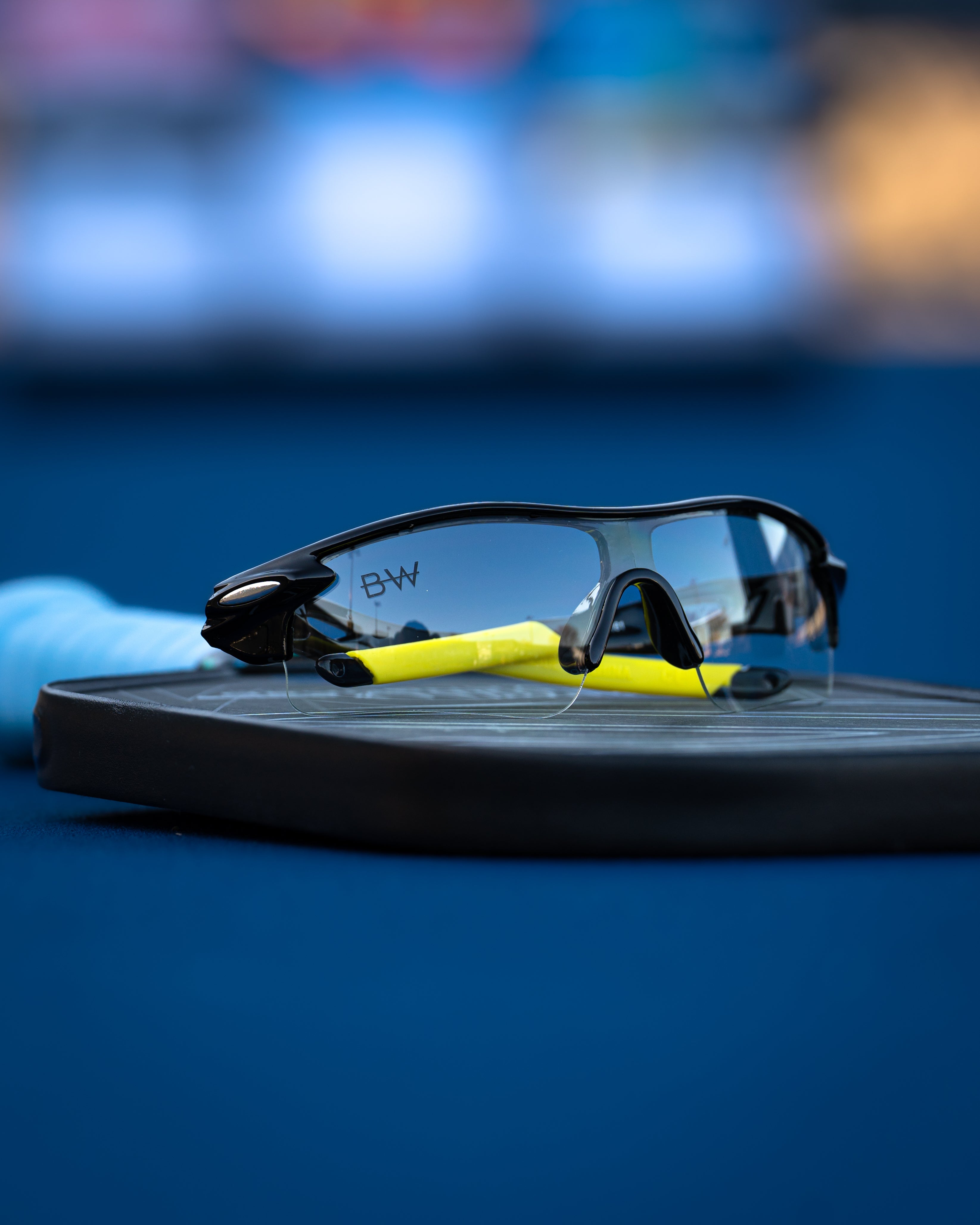
From Match Point to City Streets—This RX Frame Travels Right
Share
RX Pickleball Glasses From Match Point to Everyday Life
Your prescription eyewear does not stop mattering when the match ends. A typical pickleball day might take you from the court to lunch, errands, a coffee shop, a hotel, an airport, or an evening around the city.
If you rely on prescription correction, that creates a practical question: can the same RX sports eyewear work for both pickleball and parts of your everyday routine?
Potentially. The answer depends on more than whether a frame looks sporty or casual. Prescription compatibility, frame dimensions, lens configuration, lighting, individual fit, comfort, and personal style all matter.
This guide explains how to compare Blinded Wear RX pickleball glasses when you want a pair that makes sense on the court without ignoring what happens after the final point.
Explore Pickleball Eyewear
Start with the collection that matches how you use vision correction, then compare individual products and lens configurations.
What Does "Court-to-City" RX Eyewear Actually Mean?
"Court-to-city" is not a technical eyewear category or performance certification. In this guide, it describes prescription sports eyewear that a player may also choose to wear during parts of everyday life.
That could mean wearing the same RX pair while:
- Playing or practicing pickleball
- Walking to and from the venue
- Getting food after a match
- Running errands
- Spending time outdoors
- Traveling to another venue
- Moving through an airport or hotel
- Meeting friends after playing
Whether one pair suits all of those environments depends on the exact eyewear and your preferences.
Why Players May Want One RX Pair for More Than Pickleball
Prescription wearers may already need to keep track of sports equipment, keys, a phone, a paddle, balls, water, and other gear. Carrying additional eyewear can add another item to manage.
A player may therefore prefer an RX frame they are comfortable continuing to wear after leaving the court.
That does not mean everyone needs one universal pair. It simply makes versatility a reasonable shopping consideration alongside prescription compatibility and sports use.
One Pair for Everything? Understand the Tradeoffs
The idea sounds simple: put on one prescription pair in the morning, play pickleball, leave the venue, and continue wearing it throughout the day.
The challenge is that the environments can be very different.
| Environment | What Changes | What to Consider |
|---|---|---|
| Bright Outdoor Court | High visible brightness and changing sun angles | Exact sunglass lens configuration and personal preference |
| Shaded Court | Lower brightness than direct sun | Whether your lens configuration remains comfortable for you |
| Indoor Venue | Artificial lighting and substantially lower brightness | Whether you want dark sunglass tint indoors |
| City Streets | Sun, shade, buildings, traffic, and changing surroundings | Prescription correction, lens configuration, comfort, and personal style |
| Restaurant or Coffee Shop | Indoor lighting | Whether the exact lens configuration suits indoor use |
| Evening | Reduced ambient light | Whether a sunglass tint remains appropriate |
The frame can remain the same while the environment changes dramatically. That is why lens configuration deserves as much attention as styling.
Sports Style vs. Everyday Style Is Personal
Some players like an unmistakably athletic frame away from the court. Others prefer a more understated appearance. Neither preference is objectively better.
Instead of claiming one design is universally stylish, ask yourself:
- Would I actually wear this frame after playing?
- Does the frame work with the clothes I normally wear?
- Do I prefer bold sports styling or a more understated appearance?
- Would I be comfortable wearing this while traveling?
- Do I want one recognizable sports pair or separate everyday eyewear?
Style is subjective, so product photography and frame dimensions can be more useful than generic claims that a frame is perfect for every casual or professional environment.
Are Traditional Sports Glasses Too Bulky for Everyday Wear?
Not necessarily. Sports eyewear comes in many shapes and designs, and whether a frame feels too athletic, bold, or bulky for everyday use is largely a matter of individual preference.
Rather than assuming all sports frames sacrifice style, compare the exact frame you are considering.
Blinded Wear RX Frames to Compare for Court and Everyday Use
If your goal is prescription eyewear that you may continue wearing after pickleball, start with current direct RX options and compare them according to prescription compatibility, dimensions, lens configuration, fit, and appearance.
| RX Style | Configuration | What to Compare |
|---|---|---|
| Crystal Wave II RX | Direct RX | Prescription compatibility, current lens configuration, frame dimensions, fit, and personal style |
| Frost RX | Direct RX | White frame and bright blue lens appearance, prescription compatibility, dimensions, and individual fit |
| Zebra II RX | Direct RX | Prescription compatibility, dimensions, exact lens configuration, fit, and styling preference |
| Steel Ice RX | Direct RX | Prescription compatibility, current configuration, dimensions, and individual fit |
| Gray Wash RX | Direct RX | Prescription compatibility, lens characteristics, dimensions, fit, and appearance |
| Lava Rock RX | Direct RX | Prescription compatibility, current lens configuration, dimensions, fit, and personal style |
Crystal Wave II RX: What to Compare
Crystal Wave II RX is a direct RX option that can be included in a court-to-everyday shortlist.
The older version of this guide described Crystal Wave II RX as having panoramic views, premium materials, resistance to scratching and bending, and a universally comfortable fit. Those characteristics should not be treated as verified specifications unless documented for the current product configuration.
Instead, compare:
- Your prescription requirements
- Current frame dimensions
- The exact available lens configuration
- Individual fit
- Your preference for its appearance on and off court
Frost RX: A Distinctive Court-to-Street Look
Frost RX is a direct RX option with a white frame and bright blue lens appearance.
That makes its aesthetic easy to evaluate: if you like a visibly sporty, distinctive look beyond the court, Frost RX may belong on your shortlist. If you prefer eyewear that visually blends into a traditional everyday wardrobe, your preference may be different.
The bright blue lens appearance does not automatically establish blue-light filtering, polarization, UV specifications, anti-reflective treatment, anti-fog treatment, or any particular visible-light-transmission value.
The older article also described Frost RX as having textured grips and anti-fog ventilation. Those characteristics should not be treated as current specifications unless documented for the exact product.
Zebra II RX: Compare the Actual Frame, Not a Style Label
Zebra II RX is another direct RX option for players comparing prescription sports eyewear.
The older article characterized Zebra II RX as providing superior wraparound coverage while still looking fashionable downtown. "Fashionable" is subjective, while "superior coverage" requires a meaningful comparison.
A better approach is to review Zebra II RX based on its current product presentation, prescription compatibility, frame dimensions, exact lens configuration, individual fit, and your own style preference.
What About Sea Sand RX and Other Older Recommendations?
The previous version of this guide also recommended Sea Sand RX and Smoked Shadow RX while attributing glare reduction, variable-light performance, and other lens characteristics to those styles.
Do not transfer older specifications or marketing language to a current product without verifying the exact configuration.
For current shopping, start with the RX Pickleball Glasses Collection and review the current product information for the exact style you are considering.
What Actually Makes an RX Frame Versatile?
There is no single feature that makes prescription sports eyewear appropriate for every court and everyday environment.
A more useful comparison considers several factors together:
- Prescription compatibility: Can the exact product accommodate your corrective requirements?
- Frame dimensions: How does the size compare with eyewear that already fits you?
- Lens configuration: Is the lens appropriate for the environments where you plan to wear it?
- Fit: How does the complete finished eyewear interact with your facial dimensions?
- Comfort: Does the eyewear remain comfortable for the amount of time you intend to wear it?
- Style: Do you personally like the appearance outside a sports setting?
- Practicality: Are you comfortable using and caring for the pair throughout your day?
Does Lightweight Automatically Mean Comfortable All Day?
No. Blinded Wear designs lightweight sports frames, but weight is only one part of the wearing experience.
Extended comfort can also depend on:
- Overall frame dimensions
- Bridge geometry
- Temple geometry
- Facial dimensions
- The finished prescription configuration
- How pressure is distributed
- How long the eyewear is worn
Terms such as "pressure-free" or "perfect all-day comfort" should not be treated as universal guarantees.
Do All Blinded Wear RX Frames Have Adjustable Nose Pads?
Do not assume that they do. The older version of this guide referred broadly to adjustable nose pads, flexible hinges, and ergonomic temple grips across the RX collection.
Those characteristics should be verified for the exact product rather than presented as collection-wide features.
Can One Frame Stay Secure on Court and Still Be Comfortable Off Court?
An appropriate fit can matter in both situations, but no frame should be universally guaranteed to stay completely motionless during intense play.
Movement and comfort can depend on:
- Frame dimensions
- Bridge fit
- Temple fit
- Facial geometry
- Prescription configuration
- Perspiration
- Movement
- Individual preference
Evaluate the finished eyewear during ordinary practice rather than relying on a universal "stay-put" claim.
Lens Technology Matters More Than the "Court-to-City" Label
A frame can look appropriate in multiple settings while its lens configuration may be better suited to one lighting environment than another.
Keep these lens characteristics separate:
| Lens Characteristic | What It Describes | What It Does Not Automatically Establish |
|---|---|---|
| Tint | Visible-light and color characteristics | UV specifications, polarization, impact resistance, or safety certification |
| Polarization | Designed to reduce certain reflected light | Depth perception, reaction time, ball tracking, or universal superiority for pickleball |
| Photochromic Behavior | Lens tint changes in response to certain light conditions | Instant transitions, polarization, or universal suitability for every environment |
| High-Index | A prescription lens-material category relevant to refractive index and thickness management | Impact rating, sun protection, tint, polarization, or safety certification |
| Impact Resistance | Resistance to impact according to the characteristics of the exact lens | Shatterproof, unbreakable, or formal safety certification |
Clear Lenses and Everyday Indoor Use
A clear lens has no dark sunglass tint. That can make clear eyewear relevant for indoor, evening, or lower-light situations when a dark sunglass lens is not desired.
However, clear appearance alone does not tell you whether a lens has:
- A particular UV specification
- Polarization
- Impact resistance
- Formal safety certification
- Anti-reflective treatment
- Anti-fog treatment
- Scratch resistance
- Blue-light filtering
Remember that the Blinded Wear Clear Lens Collection is non-prescription. Do not confuse it with the RX collection.
Contacts Plus Non-RX Eyewear: Another Court-to-City Setup
If you already use appropriately prescribed contact lenses, you may prefer to separate prescription correction from your sports eyewear.
In that setup, the contacts provide the prescription correction while compatible non-prescription eyewear is worn over them.
Depending on the environment, you can explore:
Can Dark RX Sunglasses Really Be an All-Day Pair?
They can be useful in bright outdoor conditions, but whether you want to continue wearing a dark tint indoors is a separate question.
If your typical day looks like:
outdoor match → restaurant → shopping → indoor venue → evening
then consider the entire lighting range before choosing a lens solely around the brightest part of the day.
A dark lens is not automatically the most versatile lens simply because it works for your preferred outdoor environment.
What About Photochromic Lenses for Court-to-City Use?
Photochromic lenses are designed to change tint in response to certain light conditions. If a photochromic configuration is currently available for the exact RX product, it may be relevant when your day involves changing environments.
Do not assume:
- Every Blinded Wear RX product offers photochromic lenses
- Photochromic lenses change instantly
- They behave identically in every environment
- They are automatically polarized
- They automatically establish a particular UV specification
- They improve ball tracking, reaction time, or depth perception
Verify the exact current product configuration before ordering.
Polarized vs. Non-Polarized for Court and Everyday Use
Polarized lenses are designed to reduce certain reflected light. Some people prefer polarization for particular outdoor environments, while others may prefer non-polarized sports eyewear.
Polarization alone does not determine:
- Depth perception
- Contrast
- Reaction time
- Ball tracking
- Prescription quality
- Overall pickleball performance
One everyday consideration is that polarized lenses can interact with some digital displays depending on display technology, viewing angle, and orientation.
Do All Blinded Wear RX Lenses Reduce Glare?
Do not make a collection-wide glare-reduction claim unless it is supported by the exact lens configuration.
The older version of this article broadly attributed glare-reducing coatings to Blinded Wear RX lenses. That should not be carried forward as a universal specification.
Polarization, tint, anti-reflective treatment, and other lens characteristics are separate concepts and should be described accurately when documented.
Do RX Lenses Automatically Have Anti-Reflective Coating?
No coating should be assumed solely because eyewear is prescription or designed for sports.
If anti-reflective treatment is important to you, verify whether it is included or available for the exact prescription lens configuration.
Are Blinded Wear RX Glasses Anti-Fog?
Do not assume a collection-wide anti-fog coating, anti-fog technology, specialized ventilation system, or fog-proof guarantee.
Fogging can depend on temperature differences, humidity, perspiration, airflow, moisture, eyewear position, and the complete frame and lens configuration.
Are Blinded Wear RX Lenses Scratch-Resistant?
Do not assume a collection-wide scratch-resistant coating unless that feature is documented for the exact lens configuration.
Regardless of lens type, appropriate storage and cleaning habits can help reduce unnecessary contact with abrasive objects.
Impact Resistance Is Different From Everyday Durability
Blinded Wear offers impact-resistant lens options for sports use.
That does not mean the complete eyewear should be described as:
- Shatterproof
- Unbreakable
- Scratch-proof
- Bend-proof
- Crush-proof
- Indestructible
- Automatically certified to a particular protective standard
Impact resistance, scratch resistance, frame durability, and formal safety certification are separate characteristics.
High-Index Prescription Lenses Are Included at No Additional Cost
Blinded Wear includes high-index prescription lenses at no additional cost with custom RX eyewear.
High-index refers to a category of prescription lens material commonly used to help manage lens thickness, particularly as prescription strength increases.
Final lens thickness depends on factors such as:
- Your individual prescription
- Lens dimensions
- Frame dimensions
- Lens geometry
- Optical design
- Other prescription requirements
Do not assume an exact refractive index such as 1.61 unless that specification is documented for the current configuration.
What About Strong or More Complex Prescriptions?
Do not assume every prescription can be placed into every sports frame.
Compatibility can depend on the complete prescription, the dimensions and geometry of the eyewear, and other optical requirements.
The older article claimed Blinded Wear accommodated a wide range of prescriptions and worked with experienced opticians to ensure lenses fit perfectly. Rather than making a universal compatibility or "perfect fit" promise, evaluate the exact prescription and product configuration.
How to Order Blinded Wear RX Pickleball Glasses
- Select the product and available options.
- Have your current eyeglass prescription ready.
- Upload a clear photo or picture of your eyeglass prescription on the product page before adding the eyewear to your cart.
- Your prescription information will be associated with your custom RX order.
For additional information, read the How to Order RX Glasses guide.
Direct RX vs. RX Clip for Court-to-City Eyewear
Blinded Wear prescription eyewear can use different approaches to prescription correction depending on the product. If you want eyewear that moves between pickleball, travel, and everyday activities, it helps to understand the difference.
Direct RX
Direct RX incorporates prescription correction into the direct prescription lens setup.
RX Clip
An RX Clip uses a separate inner prescription insert within a compatible eyewear system. The prescription correction comes from the inner RX clip rather than the primary outer sports lens.
| Consideration | Direct RX | RX Clip |
|---|---|---|
| Prescription Correction | Integrated into the direct RX setup | Provided by a separate inner prescription insert |
| Outer Sports Lens | Part of the direct prescription configuration | Separate from the inner prescription correction |
| Everyday Versatility | Depends on the exact lens configuration, frame, fit, and your preferences | Depends on the compatible system, outer lens, inner RX insert, fit, and your preferences |
| High-Index RX Lenses | Included at no additional cost | Included at no additional cost in the custom RX clip |
| Universally Better? | No. Choose according to prescription compatibility, lens configuration, fit, environment, and how you intend to use the eyewear. | |
Can You Put an RX Clip Into Any Sunglasses?
No. An RX Clip is designed for a compatible eyewear system. It should not be treated as a universal prescription insert that can be placed into arbitrary sunglasses.
Verify compatibility with the exact Blinded Wear product you are considering.
Can You Wear RX Pickleball Glasses From the Court to Work?
Potentially, but there are two separate questions to consider: does the frame fit your personal style, and is the lens configuration appropriate for your work environment?
A frame you enjoy wearing casually may still have a dark sunglass lens that you do not want indoors. Likewise, a lens configuration appropriate for indoor use may not be the configuration you prefer for a bright outdoor match.
There is no universal frame that should be described as perfect for every workplace or professional setting. Dress expectations, lighting, personal style, and job requirements vary.
From Pickleball to a Coffee Shop or Restaurant
If your routine involves going directly from an outdoor match to an indoor location, think about how the lens—not just the frame—fits that transition.
Ask yourself:
- Am I comfortable wearing this tint indoors?
- Do I plan to remove the eyewear once inside?
- Do I have backup corrective eyewear if I remove my sports pair?
- Does the exact lens configuration make sense for both environments?
- Do I personally like the frame as everyday eyewear?
RX Pickleball Glasses for Errands After a Match
If you depend on prescription correction, continuing to wear your RX sports eyewear after pickleball may be convenient when the configuration remains appropriate for what you are doing.
The important distinction is that convenience is not the same as universal suitability. Lighting, fit, comfort, personal style, and the activity itself can change after you leave the court.
From the Pickleball Court to Travel
A tournament or recreational pickleball day may end with a drive, airport trip, hotel check-in, or time exploring another city.
If you plan to keep the same RX pair on throughout the day, evaluate:
- How long you expect to wear the frame
- Whether the lens configuration remains appropriate as lighting changes
- Whether the frame interacts comfortably with hats or headphones
- How you will store the eyewear if you remove it
- Whether you have backup corrective eyewear
All-Day Wear Is More Than a Lightweight Frame
Lightweight sports frames can be useful for extended wear, but frame weight alone does not determine comfort.
An all-day wearing experience can also depend on:
- Bridge fit
- Temple fit
- Overall frame dimensions
- Facial dimensions
- The finished prescription configuration
- Pressure distribution
- Perspiration
- Interaction with headwear or headphones
- Duration of wear
Avoid interpreting "lightweight" as a guarantee of pressure-free or universally comfortable all-day wear.
Fit Matters on the Court and on the Street
During pickleball, you may notice fit while moving, turning your head, reaching, or looking upward. During everyday wear, you may notice fit because the frame stays on for several hours.
That makes a balanced fit more useful than simply choosing the tightest possible frame.
Repeated slipping, unwanted pressure, or constant adjustment can be reasons to reassess whether the frame dimensions and geometry are appropriate for you.
Test New RX Sports Eyewear Before an Important Match
If you are ordering a new prescription sports pair, become familiar with the finished eyewear during ordinary practice before relying on it for an important tournament.
During practice, notice how the frame feels while:
- Walking
- Running
- Turning your head
- Moving laterally
- Reaching low
- Looking upward during normal play
- Preparing for overheads
- Perspiring
The goal is to evaluate individual fit and comfort, not to prove that the frame can never move.
Use Frame Dimensions to Narrow Your Fit
Style descriptions and face-shape labels can be useful for aesthetics, but actual dimensions provide more concrete information.
When available, compare:
- Lens width
- Bridge width
- Temple length
- Overall frame width
Compare those measurements with eyewear that already fits you appropriately when possible. Measurements can help narrow your search, but they still do not guarantee identical fit.
How to Choose a Frame You'll Actually Wear Off Court
Style is subjective, so there is no objective formula for the best court-to-city frame. A better question is whether the frame fits your own wardrobe and preferences.
Consider:
- Frame color: Do you prefer neutral or bold?
- Lens appearance: Do you want a traditional sunglass look or something more distinctive?
- Sports aesthetic: Do you like an athletic appearance away from the court?
- Wardrobe: Would you wear the frame with what you normally wear after playing?
- Frequency: Will this primarily be sports eyewear or something you expect to wear throughout the day?
Style Does Not Determine Sports Performance
A more athletic-looking frame is not automatically better for pickleball, and a more understated frame is not automatically less capable.
Likewise, an aggressive wraparound appearance does not by itself establish:
- Impact resistance
- Safety certification
- UV specifications
- Polarization
- Anti-fog treatment
- Scratch resistance
- Improved ball tracking
- Improved reaction time
Evaluate documented product characteristics separately from appearance.
Does a Wraparound Look Mean Better Protection?
Frame shape and coverage can influence how eyewear sits around the face, but a wraparound appearance alone does not establish a particular protective rating or safety certification.
If a specific protective standard matters to you, verify documented certification for the exact eyewear configuration.
Impact-Resistant Lens Options for Sports Use
Blinded Wear offers impact-resistant lens options for sports use.
Impact-resistant should not be interpreted as:
- Impact-proof
- Shatterproof
- Unbreakable
- Indestructible
- Scratch-proof
- Automatically certified to a specific safety standard
Impact resistance, frame coverage, durability, and formal safety certification are separate concepts.
Lens Color: Style and Visible-Light Characteristics
Lens color can be part of the style of your eyewear, but tint can also affect visible-light transmission and color appearance.
Do not assume a particular color universally improves:
- Ball tracking
- Contrast
- Reaction time
- Depth perception
- Shot accuracy
- Overall performance
Some players may prefer certain colors or brightness levels in particular environments. Those preferences can be individual rather than universal performance effects.
Does a Blue Lens Mean Blue-Light Filtering?
No. A blue lens appearance does not establish blue-light-filtering technology.
Likewise, blue appearance does not automatically establish:
- Polarization
- UV specifications
- Anti-reflective treatment
- Impact resistance
- Visible-light-transmission percentage
- Safety certification
What About Gray-Tinted Lenses?
Gray is a common sunglass tint category. As with other tint colors, its appearance should not be used to infer technical characteristics that have not been documented.
A gray tint does not automatically establish a particular UV specification, polarization status, impact rating, or performance benefit.
Does a Darker Lens Mean More Protection?
Not automatically. Tint darkness, UV specifications, impact resistance, polarization, and formal safety certification are separate characteristics.
A darker lens changes visible-light characteristics, but you should verify other technical specifications independently.
UV Specifications and Tint Are Separate
Do not infer a particular UV specification from lens darkness, color, or mirrored appearance.
If UV characteristics are important to your purchasing decision, verify the documented specification for the exact lens configuration rather than assuming that a dark sunglass lens automatically provides a particular level of UV protection.
Does a Mirrored Lens Mean Polarized?
No. Mirror appearance and polarization are separate lens characteristics.
A mirrored appearance also does not automatically establish:
- A particular UV specification
- Impact resistance
- Safety certification
- Photochromic behavior
- Anti-reflective treatment
Does Polarization Affect Depth Perception?
Polarization alone does not determine depth perception.
Your prescription, individual vision, lighting conditions, playing environment, and complete eyewear configuration also contribute to what you see on the court.
Likewise, non-polarized lenses should not be promised to improve depth perception, reaction time, contrast, or ball tracking.
Can You Wear RX Sports Sunglasses Indoors?
Whether you want to wear a sunglass lens indoors depends on the exact tint and your preferences. A configuration selected for bright outdoor conditions may feel different in a lower-light indoor environment.
Do not assume every RX lens automatically adjusts between indoor and outdoor conditions unless the exact product uses a documented technology designed to change tint.
Photochromic Does Not Mean Instant Indoor-to-Outdoor Adjustment
Photochromic lenses are designed to change tint in response to certain light conditions, but exact behavior depends on the specific lens technology and environment.
Do not promise that a photochromic lens will become completely clear or dark within a specific number of seconds unless that performance is documented for the exact lens.
From Hot Court to Air Conditioning: Why Glasses May Fog
Moving between different temperatures and humidity levels can create conditions where condensation becomes noticeable on eyewear.
Fogging can depend on:
- Temperature differences
- Humidity
- Moisture
- Perspiration
- Airflow
- Eyewear position
- The complete frame and lens configuration
Do not assume Blinded Wear RX eyewear is fog-proof or uses collection-wide anti-fog technology.
Sweat on a Lens Is Not the Same as Fog
After pickleball, the viewing surface can become affected by several different things.
| Issue | What It Means |
|---|---|
| Condensation | Moisture has condensed on the lens surface. |
| Sweat | Perspiration has reached the lens. |
| Fingerprints | Oil or residue has transferred to the lens. |
| Dust or Debris | Material has accumulated on the lens surface. |
They can all interfere with a clean viewing surface, but they are not the same technical problem.
Clean Your Lenses Before Heading From Court to the Rest of Your Day
Sports eyewear can collect sweat, fingerprints, dust, and other debris during play. Basic lens care can make the transition from the court to everyday activities more practical.
- Remove loose debris before rubbing the lens surface.
- Use a cleaning method appropriate for the exact lenses.
- Use a clean microfiber cloth intended for eyewear.
- Avoid repeatedly wiping lenses with dirty or sweaty clothing.
- Inspect the eyewear if it experienced a meaningful impact during play.
Everyday Use Makes Proper Storage Important
If you wear your sports eyewear throughout the day, it may spend more time around keys, bags, tables, clothing, and other everyday objects.
Do not rely on an unsupported scratch-proof or scratch-resistant claim. Instead:
- Keep abrasive objects away from the lenses.
- Avoid placing the lenses face-down on rough surfaces.
- Store the eyewear appropriately when you remove it.
- Use appropriate lens-cleaning materials.
Inspect RX Eyewear After a Meaningful Court Impact
If your eyewear is hit, dropped, or otherwise experiences a meaningful impact, inspect it before continuing to rely on it for the rest of the day.
Look for:
- Visible cracks
- Chips
- Lens displacement
- Frame deformation
- Loose components
- An unexpected change in fit
Impact-resistant eyewear should still be inspected after a significant impact.
Prescription Correction Comes Before Court-to-City Style
Style and versatility matter, but custom RX eyewear first needs to be appropriate for your corrective requirements.
Prescription compatibility can depend on the complete prescription and the exact eyewear configuration. Do not assume every prescription can be made in every frame.
High-Index Does Not Mean High-Impact
Blinded Wear includes high-index prescription lenses at no additional cost with custom RX eyewear.
High-index refers to refractive index and is commonly relevant to managing prescription lens thickness. It should not be confused with impact resistance.
High-index also does not automatically establish:
- UV specifications
- Polarization
- Scratch resistance
- Anti-fog treatment
- Anti-reflective treatment
- Tint darkness
- Safety certification
Does an RX Clip Change the Court-to-City Experience?
An RX Clip places prescription correction in a separate inner insert within a compatible eyewear system. Whether you prefer that approach or direct RX is an individual decision.
Consider:
- The appearance of the complete system
- The exact outer lens configuration
- Prescription compatibility
- Individual fit
- The environments in which you plan to wear it
Neither direct RX nor RX Clip should be labeled universally more stylish, more comfortable, or better for pickleball.
Does Court-to-City RX Eyewear Improve Ball Tracking?
No frame should be promised to improve ball tracking simply because it is designed for pickleball or sports use.
Your individual vision, prescription correction when needed, attention, lighting, experience, and surrounding visual environment all contribute to what you see during play.
Can RX Pickleball Glasses Improve Reaction Time?
Do not promise that a frame, tint, or lens configuration makes a player react faster.
Reaction time involves multiple visual, cognitive, and physical factors. Eyewear selection should focus on prescription correction, fit, comfort, documented lens characteristics, and the environment where it will be used.
Can a Sports Frame Improve Depth Perception?
Do not attribute improved depth perception to the frame itself, a particular tint, or polarization status.
If you require prescription correction, appropriately prescribed lenses can provide the correction represented in your prescription. That is different from promising enhanced depth perception as a sports-performance feature.
What Does "Clear Vision" Mean for RX Eyewear?
Marketing phrases such as "crystal-clear vision" can imply a universal visual outcome. A more accurate approach is to describe prescription eyewear as providing the correction represented by the prescription and configuration for which it is made.
Individual visual experience can still depend on the prescription, lens design, fit, environment, and other factors.
What About Phones and Other Screens After a Match?
If you continue wearing sports eyewear while checking a phone, tablet, or other digital display, remember that some polarized lenses can interact with certain screens depending on display technology, viewing angle, and orientation.
Lens color alone does not establish whether a lens is polarized or whether it filters blue light.
Are RX Sports Frames Appropriate for Professional Settings?
That is primarily a style and workplace question rather than a technical eyewear specification.
Some people are comfortable wearing visibly athletic eyewear in everyday professional settings, while others prefer a more traditional frame. Workplace expectations also vary.
Rather than describing every Blinded Wear RX frame as universally appropriate for professional environments, choose according to your own workplace and style preferences.
Can Sports RX Glasses Work for Casual Social Settings?
If you like the appearance and the lens configuration is appropriate for the environment, you may choose to continue wearing the same prescription sports eyewear after playing.
There is no technical requirement that sports eyewear must be removed when you leave the court. The decision comes down to correction needs, lighting, comfort, and personal style.
Even a One-Pair Lifestyle Benefits From Backup Correction
If you depend on prescription correction, suitable backup corrective eyewear can still be useful even if your goal is to wear one primary pair throughout the day.
A backup provides another corrective option if your primary RX sports eyewear becomes:
- Damaged
- Misplaced
- Unexpectedly uncomfortable
- Unsuitable for a major change in lighting
- Otherwise unavailable
One Versatile Pair vs. Separate Court and Everyday Glasses
| Approach | Potential Advantage | Consideration |
|---|---|---|
| One Primary RX Pair | Fewer glasses to manage during the day | The lens configuration and style need to suit the environments where you plan to wear it |
| Sports RX + Everyday RX | Each pair can be selected around a different use | Requires carrying or storing another pair |
| Contacts + Non-RX Sports Eyewear | Separates prescription correction from the sports frame | Only relevant if you already use appropriately prescribed contact lenses |
| Primary RX + Backup Corrective Pair | Provides another corrective option if the primary pair is unavailable | Still requires carrying a second pair |
There is no universally correct setup. Choose around your prescription, daily routine, playing environment, and preferences.
Use the Pickleball Sunglasses Quiz to Explore Your Options
The Pickleball Sunglasses Quiz can help you explore eyewear based on your preferences.
The quiz should be treated as a discovery tool rather than a guaranteed prescription assessment, medical recommendation, or perfect-fit determination.
How to Build a Court-to-City RX Shortlist
Instead of trying to identify one universal winner, narrow your options in a logical order.
- Start with prescription compatibility. The frame needs to work with your corrective requirements.
- Compare frame dimensions. Use eyewear that already fits you as a reference when possible.
- Review the exact lens configuration. Consider the lighting environments in which you plan to wear it.
- Consider your playing environment. Indoor and outdoor pickleball can create different needs.
- Consider your post-match routine. Think about where you actually go after playing.
- Choose the style you prefer. Decide whether you want bold sports styling or a more understated appearance.
- Test the finished eyewear during practice. Become familiar with fit and comfort before an important match.
Current Direct RX Styles to Compare
- Crystal Wave II RX — compare prescription compatibility, current lens configuration, dimensions, fit, and appearance.
- Frost RX — white frame with a bright blue lens appearance; compare the exact current configuration and fit.
- Zebra II RX — direct RX option to compare around prescription requirements, dimensions, configuration, and personal style.
- Steel Ice RX — another direct RX style for your court-to-everyday shortlist.
- Gray Wash RX — compare prescription compatibility, current lens characteristics, dimensions, and fit.
- Lava Rock RX — direct RX option to evaluate according to current configuration, fit, and your style preference.
What to Verify Before Ordering Court-to-City RX Eyewear
- Your complete current eyeglass prescription
- Compatibility between your prescription and the exact product
- Whether the product uses direct RX or a compatible RX Clip system
- Current frame dimensions
- The exact available lens configuration
- Tint characteristics when applicable
- Polarization status when relevant
- Documented UV specifications when relevant
- Impact-resistant characteristics when relevant
- Any documented coatings or treatments
- The lighting environments where you expect to wear the pair
- Your personal preference for the frame's off-court appearance
- How the eyewear fits with your normal hats, visors, or headphones
- Your backup corrective-eyewear plan
FAQ: RX Pickleball Glasses for Court-to-City Wear
Can prescription pickleball glasses be worn off the court?
Yes, you may choose to continue wearing prescription sports eyewear after pickleball when the prescription correction, lens configuration, fit, comfort, and appearance suit the environment you are entering.
What are the best RX pickleball glasses for court-to-city use?
There is no single frame that is universally best for both pickleball and everyday wear. Start with prescription compatibility, then compare frame dimensions, current lens configuration, individual fit, comfort, and your preference for how the frame looks away from the court.
Can I wear the same RX glasses all day?
Potentially. The important question is whether the exact eyewear remains appropriate as your activities and lighting conditions change. A pair you prefer on a bright outdoor court may not be the lens configuration you prefer inside a restaurant, office, hotel, or other lower-light environment.
Are sports glasses only for playing pickleball?
No. You may choose to wear sports eyewear during other parts of your day. Whether you want to do so depends on your corrective needs, the exact lens configuration, comfort, fit, and personal style.
Do sports glasses look normal enough for everyday wear?
That is subjective. Some players prefer visibly athletic eyewear away from the court, while others prefer more traditional everyday styling. Review the actual product images and dimensions rather than relying on a universal style label.
Can I wear RX pickleball glasses to a restaurant or coffee shop?
Potentially. Consider whether the lens configuration is appropriate for the indoor lighting and whether you personally want to continue wearing the frame in that setting.
Can I wear RX sports glasses while running errands?
Yes, if the prescription correction, lens configuration, comfort, and fit remain appropriate for what you are doing.
Can I wear RX pickleball glasses while traveling?
Potentially. If you plan to use one pair across a court, airport, hotel, outdoor environment, and other destinations, consider how the exact lens configuration works across those different lighting conditions.
Are RX sports glasses appropriate for work?
That depends on the workplace, dress expectations, lighting, exact lens configuration, and your style preference. Sports styling should not be described as universally appropriate or inappropriate for professional settings.
FAQ: Sports Style and Everyday Appearance
Do pickleball glasses have to look extremely sporty?
No. Sports eyewear comes in different shapes, colors, and visual styles. Choose according to the exact frame rather than assuming every pickleball frame has the same aesthetic.
Is a less sporty-looking frame better for everyday wear?
Not objectively. A more understated appearance may fit one person's wardrobe while another person may prefer bold sports styling away from the court.
Does a more aggressive sports design mean better performance?
No. Appearance alone does not establish prescription quality, impact resistance, polarization, UV specifications, safety certification, ball-tracking ability, reaction time, or other performance characteristics.
Is Frost RX suitable for everyday wear?
Frost RX is a direct RX style with a white frame and bright blue lens appearance. Whether that distinctive aesthetic suits your everyday wardrobe is a personal preference.
What if I want one pair that looks good both on and off the court?
Compare current product images and consider what you normally wear after playing. Style is subjective, so the strongest choice is a frame you personally want to wear rather than one marketed as universally fashionable.
FAQ: Fit and Comfort From Pickleball to Everyday Wear
Should pickleball glasses fit tightly?
A tighter frame is not automatically a better frame. Excessive pressure can become uncomfortable during longer wear. Look for an appropriate individual fit rather than maximum tightness.
Can Blinded Wear guarantee that RX glasses will never move?
No. Movement can depend on frame dimensions, facial geometry, bridge and temple fit, prescription configuration, perspiration, and activity.
Are lightweight sports glasses automatically comfortable all day?
No. Blinded Wear designs lightweight sports frames, but comfort also depends on frame dimensions, bridge and temple geometry, facial dimensions, prescription configuration, pressure distribution, and duration of wear.
Do all Blinded Wear RX frames have adjustable nose pads?
Do not assume adjustable nose pads are a collection-wide feature. Verify the construction of the exact frame you are considering.
Do all Blinded Wear RX frames have non-slip grips?
Do not assume collection-wide grip technology unless it is documented for the exact product.
Can I wear a hat or visor with RX pickleball glasses?
Potentially. Compatibility depends on the exact frame, headwear, facial dimensions, and individual fit. Test the combination you actually plan to use.
Can I wear headphones with RX sports glasses?
Potentially. Comfort can depend on the frame temples, headphones, clamping force, facial dimensions, and duration of wear.
How can I estimate whether an RX frame will fit?
When available, compare lens width, bridge width, temple length, and overall frame width with eyewear that already fits you appropriately. Measurements can help narrow your options but cannot guarantee identical fit.
FAQ: Lens Options for Court and Everyday Environments
What lens is best for both outdoor pickleball and everyday use?
There is no universal best lens configuration. Consider the brightness of your playing environment, how much time you spend indoors, whether you play later in the day, and the exact lens options currently available for the product.
Are darker lenses better for outdoor pickleball?
A darker tint changes visible-light characteristics, but darker is not automatically better for every player or environment.
Does a darker lens provide more UV protection?
Not automatically. Tint darkness and UV specifications are separate characteristics. Verify documented UV information for the exact lens rather than inferring it from appearance.
Does lens color improve ball tracking?
Do not promise that a particular lens color improves ball tracking. Tint can affect visible-light transmission and color appearance, while individual preferences can vary.
Does lens color improve contrast?
Do not make a universal performance claim based solely on tint color. What a player prefers can depend on lighting, environment, individual vision, and the complete lens configuration.
Do blue lenses filter blue light?
Not necessarily. A blue lens appearance does not establish blue-light-filtering technology.
Are gray lenses automatically polarized?
No. Tint color and polarization are separate characteristics.
Does a mirrored lens mean it is polarized?
No. Mirror appearance does not establish polarization.
Can clear lenses be used indoors?
A clear lens has no dark sunglass tint, making clear eyewear relevant when a dark tint is not desired. The Blinded Wear Clear Lens Collection is non-prescription.
Does a clear lens automatically have UV protection?
No technical specification should be inferred solely from clear appearance. Verify documented characteristics for the exact lens.
FAQ: Polarized and Non-Polarized Eyewear
Are polarized lenses better for pickleball?
Not universally. Polarized lenses are designed to reduce certain reflected light, and some people may prefer them in particular outdoor environments. Others may prefer non-polarized sports eyewear.
Do polarized lenses hurt depth perception?
Polarization alone does not determine depth perception. Prescription correction, individual vision, lighting conditions, playing environment, and the complete eyewear configuration also contribute to what you see.
Do non-polarized lenses improve depth perception?
Do not promise improved depth perception based solely on non-polarized construction.
Do non-polarized lenses improve reaction time or ball tracking?
No. Polarization status alone does not determine reaction time or ball-tracking ability.
Can polarized lenses affect phone screens?
Polarized lenses can interact with some digital displays depending on display technology, viewing angle, and orientation.
FAQ: Photochromic Lenses for Changing Environments
What are photochromic lenses?
Photochromic lenses are designed to change tint in response to certain light conditions.
Are photochromic lenses useful for going from court to city?
If a photochromic configuration is currently available for the exact RX product, it may be worth considering when your routine involves changing environments. Suitability still depends on the exact lens and your preferences.
Do photochromic lenses change instantly?
Do not promise an exact transition time unless it is documented for the exact lens technology.
Are photochromic lenses always clear indoors?
Do not make an absolute claim about exact indoor or outdoor appearance without specifications for the exact lens. Photochromic behavior can depend on lens technology and environmental conditions.
Are photochromic lenses polarized?
Photochromic behavior and polarization are separate characteristics. One should not be inferred from the other.
Does every Blinded Wear RX frame offer photochromic lenses?
Do not assume collection-wide availability. Verify the current options on the exact product page before ordering.
FAQ: Prescription Compatibility and High-Index Lenses
Can every prescription be made in every Blinded Wear RX frame?
Do not assume universal compatibility. Prescription compatibility can depend on the complete prescription, frame and lens dimensions, geometry, and other optical requirements.
Can Blinded Wear accommodate astigmatism?
Compatibility depends on the complete prescription, including relevant cylinder and axis requirements, as well as the exact eyewear configuration. Do not assume every prescription can be produced in every frame.
What if my right and left eyes have different prescriptions?
Your complete prescription should be evaluated as provided. Differences between the eyes are part of the prescription information associated with your custom RX order.
Does Blinded Wear include high-index prescription lenses?
Yes. Blinded Wear includes high-index prescription lenses at no additional cost with custom RX eyewear.
Does high-index mean 1.61?
Do not assume an exact refractive index such as 1.61 unless that specification is documented for the current configuration.
What does high-index mean?
High-index refers to a category of prescription lens material commonly used to help manage lens thickness, particularly as prescription strength increases.
Does high-index always mean thinner lenses?
Higher refractive-index material can help manage lens thickness in comparable prescriptions, but final thickness depends on the prescription, frame and lens dimensions, geometry, optical design, and other requirements.
Does high-index automatically mean lighter lenses?
No. Finished lens weight depends on more than refractive index.
Does high-index mean the lens is more impact-resistant?
No. Refractive index is not an impact-resistance rating.
FAQ: Impact Resistance, Protection, and Durability
Does Blinded Wear offer impact-resistant lens options?
Yes. Blinded Wear offers impact-resistant lens options for sports use.
Does impact-resistant mean shatterproof?
No. Impact-resistant should not be translated into shatterproof, unbreakable, or indestructible.
Are Blinded Wear RX glasses safety glasses?
Do not infer formal safety certification from sports styling or impact-resistant characteristics. If a particular protective standard is required, verify documented certification for the exact product and configuration.
Does wraparound styling mean more impact protection?
Frame shape and coverage are separate from a documented impact rating or safety certification. Do not infer a protective standard from appearance alone.
Are Blinded Wear RX lenses scratch-proof?
No collection-wide scratch-proof claim should be made. Scratch resistance should be verified for the exact lens configuration if documented.
Are Blinded Wear RX glasses bend-proof?
No. Sports eyewear should not be described as bend-proof, crush-proof, or indestructible unless an exact documented specification supports that claim.
FAQ: Fogging, Sweat, and Everyday Lens Care
Are Blinded Wear RX glasses anti-fog?
Do not assume a collection-wide anti-fog coating, treatment, ventilation technology, or fog-proof guarantee.
Why might glasses fog after leaving the court?
Temperature changes, humidity, moisture, perspiration, airflow, eyewear position, and the complete frame and lens configuration can contribute to condensation.
Is sweat on the lens the same as fog?
No. Sweat is liquid reaching the lens surface, while fogging generally refers to condensation. Fingerprints and debris can also affect the viewing surface without being fog.
How should I clean RX sports glasses after playing?
Remove loose debris before rubbing the lenses, use a cleaning method appropriate for the exact lens, and use a clean microfiber cloth intended for eyewear. Avoid repeatedly wiping the lenses with dirty or sweaty clothing.
Do RX lenses automatically have anti-reflective coating?
No. Anti-reflective treatment should be verified for the exact prescription lens configuration.
Do RX lenses automatically have scratch-resistant coating?
No collection-wide scratch-resistant coating should be assumed unless documented for the exact configuration.
FAQ: Direct RX vs. RX Clip
What is direct RX eyewear?
Direct RX incorporates prescription correction into the direct prescription lens setup.
What is an RX Clip?
An RX Clip uses a separate inner prescription insert within a compatible eyewear system. Prescription correction comes from that inner insert rather than the primary outer sports lens.
Can an RX Clip fit any sunglasses?
No. An RX Clip is designed for a compatible eyewear system rather than arbitrary sunglasses.
Is direct RX better for everyday wear?
Not universally. Compare prescription compatibility, appearance, fit, lens configuration, and the environments where you plan to wear the eyewear.
Is an RX Clip better for pickleball?
Neither system should be labeled universally better. The appropriate choice depends on the exact product, prescription requirements, fit, lens configuration, and personal preference.
Are high-index prescription lenses included with an RX Clip?
Yes. High-index prescription lenses are included at no additional cost in the custom RX clip.
FAQ: RX Eyewear and Pickleball Performance
Do RX pickleball glasses improve reaction time?
No frame, tint, or polarization status should be promised to make a player react faster. Reaction time involves multiple visual, cognitive, and physical factors.
Do RX pickleball glasses improve ball tracking?
Do not promise improved ball tracking from a particular frame or lens color. Prescription correction, individual vision, attention, lighting, experience, and the surrounding environment can all contribute to what you see.
Do RX sports glasses improve depth perception?
Do not promise improved depth perception from a frame, tint, or polarization status. Appropriately prescribed lenses can provide the correction represented by your prescription.
Do sports glasses improve shot accuracy?
No particular frame should be promised to improve shot accuracy. Athletic performance depends on many factors beyond eyewear.
Do RX glasses give pickleball players a competitive edge?
Prescription sports eyewear should not be marketed as guaranteeing a competitive advantage. Evaluate it around prescription correction, documented product characteristics, fit, comfort, and your playing environment.
Common Myths About Court-to-City RX Pickleball Glasses
| Myth | More Accurate Explanation |
|---|---|
| "Sports glasses are only useful on the court." | You may choose to continue wearing them elsewhere when the correction, lens configuration, fit, comfort, and style suit the environment. |
| "The most casual-looking frame is the best everyday frame." | Style is subjective, and prescription compatibility and lens configuration remain important. |
| "The sportiest frame performs the best." | Appearance alone does not establish sports performance or technical specifications. |
| "Lightweight means guaranteed all-day comfort." | Comfort also depends on dimensions, geometry, prescription configuration, pressure distribution, and individual fit. |
| "A tighter frame is always more secure." | Excessive tightness can create unwanted pressure. Appropriate fit is individual. |
| "Wraparound means safety-certified." | Frame shape does not establish a formal protective certification. |
| "Impact-resistant means shatterproof." | Impact resistance does not mean unbreakable or indestructible. |
| "Dark lenses automatically provide more UV protection." | Tint darkness and UV specifications are separate characteristics. |
| "Mirrored means polarized." | Mirror appearance and polarization are separate characteristics. |
| "Blue lenses automatically filter blue light." | Lens appearance does not establish blue-light-filtering technology. |
| "Polarized lenses hurt depth perception." | Polarization alone does not determine depth perception. |
| "Non-polarized lenses improve ball tracking." | Polarization status alone does not determine ball-tracking ability. |
| "High-index means high-impact." | Refractive index and impact resistance describe different characteristics. |
| "All sports glasses are anti-fog." | Anti-fog characteristics should be verified for the exact configuration. |
Common Mistakes When Shopping for Court-to-City RX Glasses
1. Choosing Style Before Prescription Compatibility
A frame can look ideal and still need to work with your actual corrective requirements.
2. Choosing a Lens Only for the Brightest Part of the Day
If you expect to wear the same pair after pickleball, consider the other lighting environments you regularly enter.
3. Assuming Darker Means More Protective
Tint darkness should not be used to infer UV specifications, impact resistance, polarization, or safety certification.
4. Ignoring Frame Dimensions
Product photos do not tell you exactly how a frame will fit your face. Compare available dimensions when possible.
5. Assuming Sports Styling Guarantees Stability
Individual fit depends on more than appearance.
6. Assuming Lightweight Guarantees Comfort
Weight is only one part of the complete wearing experience.
7. Assuming Every Lens Feature Applies Across the RX Collection
Verify polarization, tint, coatings, UV specifications, impact characteristics, and other technical features for the exact configuration.
8. Buying New RX Sports Eyewear Immediately Before a Tournament
Become familiar with the finished eyewear during ordinary practice before relying on it for an important event.
9. Forgetting About Indoor Use
A court-to-city routine can involve restaurants, stores, offices, airports, hotels, and other lower-light environments.
10. Treating Performance Claims as Specifications
Claims about improved reaction time, depth perception, ball tracking, or competitive advantage should not replace documented product information.
Test Your RX Eyewear Before Making It Your All-Day Pair
Once your custom RX eyewear arrives, become familiar with it before an important tournament or long day away from home.
- Wear it during normal practice. Notice fit during ordinary pickleball movement.
- Wear it for an extended period. Notice whether unwanted pressure develops.
- Move through realistic lighting. Consider the environments where you actually intend to wear the lens configuration.
- Test your normal equipment. Check compatibility with hats, visors, or headphones when relevant.
- Practice normal lens care. Learn how you will clean and store the eyewear during the day.
- Keep backup correction available. Have another corrective option when practical.
Can You Return Custom RX Pickleball Glasses?
Blinded Wear offers a 30-day return policy for eligible standard purchases. Customized RX eyewear is final sale and excluded from the standard 30-day return policy.
Because RX eyewear is customized, review your prescription, product configuration, frame dimensions, lens options, and current policy information carefully before ordering.
Custom RX final-sale status does not eliminate applicable 50% lifetime replacement support for eligible broken eyewear under current policy terms.
What if Your RX Glasses Break?
Blinded Wear offers 50% lifetime replacement support if eligible glasses break, subject to current policy terms.
The damaged eyewear must be returned. Once the applicable claim and return requirements are satisfied, qualifying customers can receive 50% credit toward a replacement pair.
This is not a free full replacement.
For damaged RX eyewear, contact blindedwearco@gmail.com before returning the pair.
Review the Blinded Wear Protection Plan, Replacement & Returns information for current eligibility and policy details.
Does Replacement Support Cover Lost RX Glasses?
Do not assume loss qualifies for the same support as eligible broken eyewear. Eligible broken-eyewear claims require the damaged pair to be returned.
If you depend on prescription correction, this is another reason to consider keeping suitable backup corrective eyewear available.
Does a New Prescription Qualify for Replacement Support?
Do not assume a prescription change qualifies solely because replacement support exists for eligible broken eyewear. Prescription changes and eligible physical breakage are separate situations unless current policy terms specifically state otherwise.
How to Order Blinded Wear RX Pickleball Glasses
- Select the product and available options.
- Have your current eyeglass prescription ready.
- Upload a clear photo or picture of your eyeglass prescription on the product page before adding the eyewear to your cart.
- Your prescription information will be associated with your custom RX order.
For additional information, read the How to Order RX Glasses guide.
Final Checklist Before Ordering Court-to-City RX Eyewear
- Prescription: Do you have your current eyeglass prescription?
- Compatibility: Is the exact product compatible with your prescription requirements?
- RX design: Do you understand whether the product uses direct RX or a compatible RX Clip?
- Dimensions: Have you compared the frame measurements with eyewear that already fits you?
- Lens configuration: Have you verified the exact current options?
- Lighting: Where will you wear the pair before, during, and after pickleball?
- Tint: Is the lens configuration appropriate for those environments?
- Polarization: If it matters to you, have you verified it rather than inferring it from appearance?
- Technical specifications: Have you verified any UV, coating, impact, or other characteristics important to you?
- Style: Do you personally want to wear the frame away from the court?
- Comfort: Have you considered longer wear rather than only a short match?
- Practice: Will you become familiar with the finished eyewear before an important event?
- Backup: Will you have another corrective option if your primary pair becomes unavailable?
- Policy: Do you understand that customized RX eyewear is final sale?
More Pickleball Eyewear Resources
- RX Pickleball Glasses — Browse current prescription eyewear.
- How to Order RX Glasses — Review the custom RX ordering process.
- Pickleball Performance Lens Guide — Learn about lens terminology, colors, clarity, and RX options.
- Pickleball Sunglasses Quiz — Explore eyewear according to your preferences.
- Best Pickleball Glasses 2026 — Visit the main pickleball eyewear hub.
- Best Pickleball Sunglasses 2026 — Explore the broader sunglasses guide.
- Non-RX Pickleball Sunglasses — Browse current non-prescription sports eyewear.
- Non-RX Clear Lens Glasses — Explore eyewear without dark sunglass tint.
- Protection Plan, Replacement & Returns — Review current policy information.
Final Takeaway: Choose RX Eyewear for the Court and the Life Around It
A pickleball match may last a few hours, but prescription eyewear can remain part of your day long after match point. That makes it reasonable to consider what happens when you leave the court and head to lunch, run errands, travel, meet friends, or spend the rest of the day around town.
The strongest court-to-city setup is not determined by one marketing phrase or a promise that a frame is perfect everywhere. Start with prescription compatibility, then compare frame dimensions, the exact lens configuration, individual fit, extended comfort, expected lighting, and your personal style.
Keep technical characteristics separate. Lightweight does not guarantee all-day comfort. Darker does not automatically mean more UV protection. Mirrored does not mean polarized. Blue does not mean blue-light filtering. High-index does not mean high-impact. Impact-resistant does not mean indestructible. Sports styling does not establish safety certification. And a frame, tint, or polarization status should not be promised to improve reaction time, depth perception, ball tracking, or overall pickleball performance.
If your goal is one prescription pair that can move through more of your day, compare current direct RX options such as Crystal Wave II RX, Frost RX, Zebra II RX, Steel Ice RX, Gray Wash RX, and Lava Rock RX.
Explore Blinded Wear RX Pickleball Glasses and compare current options around your prescription, playing environment, everyday routine, lens preferences, fit, and personal style.