
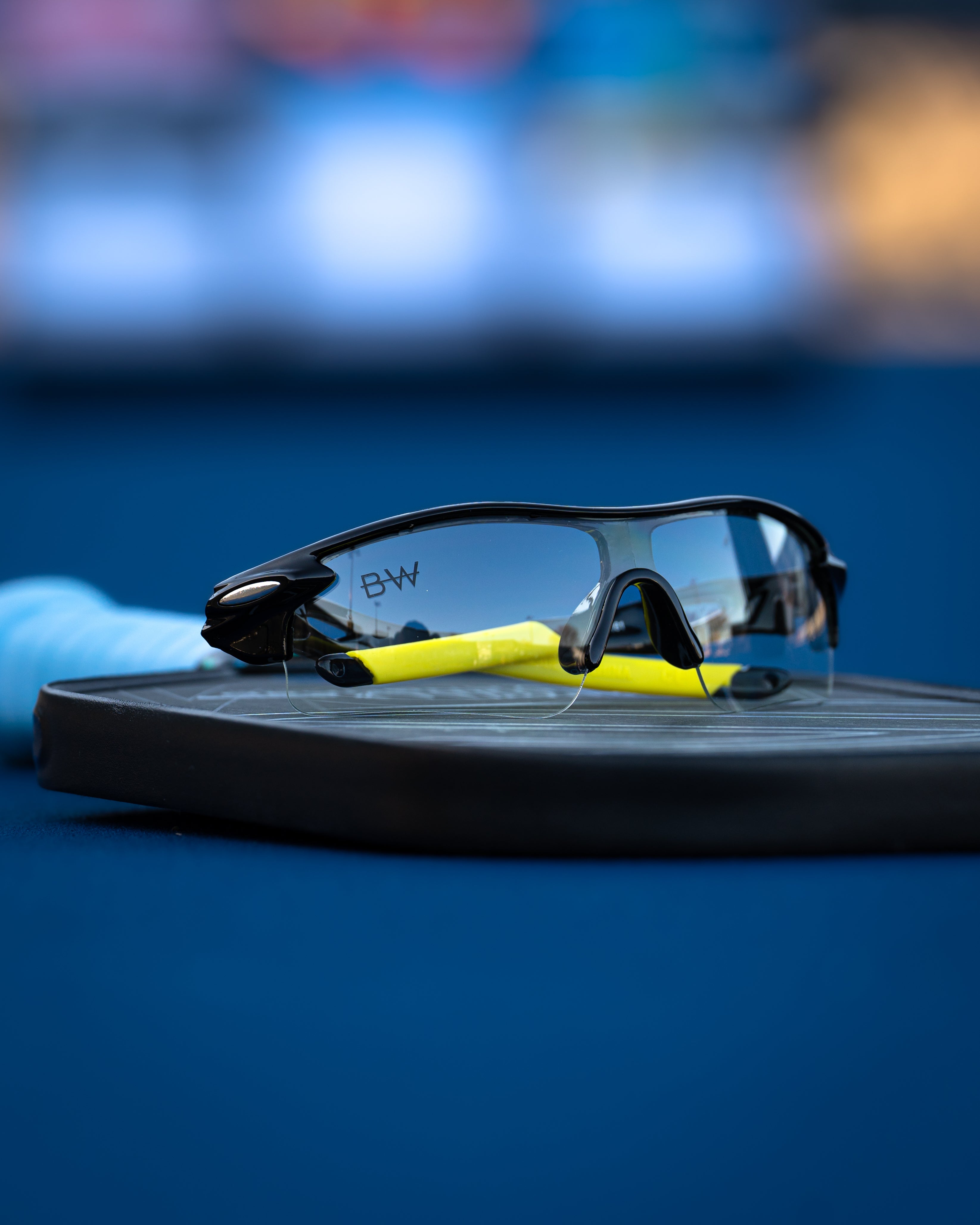
The Neuroscience of Focused Vision in Pickleball — How RX Lenses Sharpen Your Reflexes
Share
The Neuroscience of Focused Vision in Pickleball: How RX Lenses Support Fast, Accurate Play
A fast pickleball exchange can feel almost instantaneous. The ball leaves an opponent's paddle, the rally changes direction, you choose a response, reposition your body, prepare your paddle, and make contact—all while the next decision is already developing.
Vision is part of that process, but seeing, interpreting, deciding, and moving are not the same thing. Your eyes provide visual information. Your brain processes relevant information. Experience helps you recognize patterns. Your body ultimately executes the response.
So where do prescription pickleball glasses fit?
If you require corrective vision, RX lenses provide the prescription correction you need while those visual, cognitive, and motor processes happen. They should not automatically be described as making neurons fire faster, increasing reflex speed, enhancing depth perception beyond appropriate correction, or turning ordinary vision into a neurological performance advantage.
This guide breaks down the neuroscience of focused vision without the hype—and explains how RX eyewear, attention, anticipation, reaction time, and pickleball-specific practice actually fit together.
Find Your Pickleball Eyewear
What Happens Between Seeing a Pickleball and Hitting It?
A return is not produced by one isolated “reflex.” Instead, multiple processes contribute to what eventually becomes a shot.
- Visual information becomes available. The developing ball, opponent, court, and other cues create visual input.
- Attention is directed. Not every piece of information receives equal priority.
- The situation is interpreted. Previous experience and the current rally provide context.
- A response is selected. The player decides what to do.
- Movement begins. Positioning, footwork, and paddle preparation turn the decision into action.
- Contact occurs. Technique determines how the paddle ultimately interacts with the ball.
- Recovery begins. The player prepares for the next developing situation.
Prescription lenses can address corrective vision within this chain. They do not independently control the entire chain.
Do RX Lenses Sharpen Your Reflexes?
RX lenses should not automatically be described as reflex-enhancing technology.
If you require prescription correction, wearing appropriate RX eyewear addresses that corrective need. Reaction performance, however, can involve perception, attention, anticipation, decision-making, movement, technique, and the specific task being performed.
| Component | Primary Role | Does an RX Lens Train It? |
|---|---|---|
| Prescription Correction | Addresses refractive correction needs | RX eyewear provides it |
| Visual Attention | Directs attention toward relevant information | No |
| Anticipation | Uses available information and experience to prepare | No |
| Decision-Making | Selects an appropriate response | No |
| Movement | Positions the body for the response | No |
| Technique | Executes the selected shot | No |
A better way to think about prescription sports eyewear is simple: correct the vision you need corrected, then train the athletic skills around it.
Reaction Time in Pickleball Is More Than Raw Reflex Speed
When someone appears exceptionally fast at the kitchen, it is easy to assume that person simply has better reflexes.
Sometimes the explanation is more complicated.
A player may already be:
- In a better court position
- Balanced before the opponent makes contact
- Holding the paddle in a useful ready position
- Expecting a possible speed-up
- Recognizing a familiar rally pattern
- Moving efficiently
- Preparing earlier
These factors can reduce how much work remains after the shot begins to develop.
That is why anticipation and preparation can make an athlete look extraordinarily reactive.
Focused Vision Doesn't Mean Staring at One Spot
“Focus” can sound like the goal is to lock your eyes onto one object and ignore everything else. Competitive pickleball requires something more flexible.
Relevant information can change throughout a point.
Depending on the situation, attention may involve:
- The developing ball
- Opponent paddle preparation
- Opponent positioning
- Your partner's position
- Available court space
- Your own position
- The previous shot
- The likely next phase of the rally
The ability to use this information effectively develops through experience and sport-specific practice—not through a lens automatically expanding awareness.
Selective Attention: Why Your Brain Can't Treat Everything Equally
A pickleball court contains more information than a player needs to consciously analyze at every instant.
Selective attention helps prioritize what is relevant to the current task.
For example, during a serve return, your immediate priorities differ from those during a four-player kitchen exchange. Once the rally develops, the information that deserves attention changes again.
Experienced players can become more familiar with these situations and the cues that matter within them.
Prescription correction can support the visual foundation when required, but RX lenses do not decide where attention should go.
Anticipation: The Skill That Can Look Like Faster Reflexes
Consider two players facing the same attacking shot.
One waits until the ball is clearly traveling toward a target before preparing. The other has already recognized that an attack is possible and is physically prepared for several likely outcomes.
The second player may appear to have dramatically faster reflexes even though the advantage began before the final ball path was obvious.
Potential anticipatory information can include:
- Opponent court position
- Paddle preparation
- Whether the opponent is balanced or reaching
- Open court space
- The quality of the previous shot
- Repeated tendencies from earlier points
No individual cue perfectly predicts the next shot. Their value comes from helping a player prepare for possibilities.
How Pattern Recognition Changes What Experienced Players See
With repeated play, certain situations become familiar.
A player may recognize that:
- An opponent repeatedly attacks a particular type of high dink
- A return pattern keeps producing the same third-shot opportunity
- A player favors one direction under pressure
- A specific kitchen exchange repeatedly creates an opening
- An opponent tends to speed up from a familiar position
This does not require a special neurological lens. It reflects experience, attention, memory, and repeated exposure to the sport.
Pattern recognition is one reason simply measuring raw reaction time cannot fully explain high-level pickleball performance.
How Does Depth Perception Fit Into Pickleball?
Players constantly deal with distance: a deep serve, a short dink, a transition-zone reset, a lob, an overhead, or an opponent moving toward the kitchen.
Depth perception involves multiple visual cues and processes. If you require prescription correction, appropriate RX eyewear can address your corrective vision needs while you judge these situations.
However, an RX sports lens should not automatically be described as:
- Creating enhanced 3D vision
- Eliminating “spatial lag”
- Increasing depth perception beyond appropriate correction
- Making distance calculations neurologically faster
- Guaranteeing more accurate returns
Players also develop familiarity with distance through thousands of sport-specific repetitions.
Motion Perception, Ball Tracking & RX Correction
Pickleball involves visual information that changes rapidly as the ball and players move around the court.
If you require corrective vision, RX eyewear provides the prescription correction you need while viewing those situations.
That is different from saying the lens itself:
- Predicts ball trajectory
- Enhances motion-processing speed
- Improves ball tracking automatically
- Identifies spin earlier
- Reduces neural reaction latency
The distinction matters because optical correction and neurological processing are related to the same overall task without being interchangeable concepts.
Do High-Index RX Lenses Process Visual Information Faster?
No. High-index lens material should not be described as eliminating “refraction lag,” “visual drag,” or neurological processing delay.
High-index refers to a prescription lens-material category. It does not mean the lens sends information to your brain faster than another lens simply because of its refractive index.
Blinded Wear includes high-index prescription lenses at no additional cost with RX eyewear.
That is a meaningful part of the RX offer without needing to attach an unsupported reflex-speed claim to it.
Is “Lens Lag” Slowing Down Your Pickleball Reactions?
“Lens lag” can sound like a prescription lens is introducing a measurable delay between the real world and your brain, similar to latency on a screen. That is not a useful general description of how ordinary prescription lenses work.
If your prescription vision does not feel right, treat that as a corrective-vision concern rather than assuming your glasses are adding milliseconds of electronic-style latency.
And if your pickleball responses feel late, examine the entire chain:
- Were you in position?
- Were you balanced?
- Was your paddle prepared?
- Did you recognize the developing situation?
- Did you choose an appropriate response?
- Was your movement efficient?
- Was the technique executed successfully?
RX Glasses & Hand-Eye Coordination: What Is the Connection?
Hand-eye coordination broadly involves using visual information to guide physical action.
Pickleball provides constant opportunities to practice that relationship through serves, returns, dinks, volleys, drives, resets, lobs, and overheads.
If you require corrective vision, wearing your RX sports eyewear during those activities provides the prescription correction you need.
The RX lenses correct your vision. The pickleball activity trains the visual-motor skill.
This distinction is more useful than promising that a frame or lens automatically increases coordination speed.
The “Brain-Eye Connection” in Pickleball—Without the Marketing Hype
The phrase “brain-eye connection” is often used to describe the relationship between visual information and the way the brain interprets and responds to it.
That relationship is real in a broad sense, but it does not mean a prescription lens is a neurological enhancement device.
| Claim | Better Interpretation |
|---|---|
| “RX lenses make the brain react faster” | RX lenses provide prescription correction when required |
| “High-index eliminates neural lag” | High-index describes a prescription lens-material category |
| “Sports lenses train hand-eye coordination” | Sports-specific practice trains coordination while RX eyewear can provide correction |
| “Contrast lenses improve motion prediction” | Do not assume a neurological performance effect without evidence for the exact lens |
| “RX glasses sharpen reflexes” | Reaction performance involves multiple visual, cognitive, and motor factors |
Focused Vision for Indoor Pickleball
If you require prescription correction and play primarily indoors, clear RX eyewear can be a straightforward category to compare when dark sunglass tint is not preferred.
Clear RX lenses can provide your prescription correction without dark tint.
They should not automatically be described as:
- Increasing available light
- Enhancing contrast
- Reducing glare
- Preventing eye fatigue
- Improving reflexes
- Increasing neurological focus
Do Blue-Light RX Lenses Improve Pickleball Focus?
Blue-light filtering and neurological focus should be treated as separate concepts.
If blue-light filtering is a feature you specifically want, compare the current configuration of an RX product that offers it. Do not assume that blue-light filtering automatically improves concentration, reaction time, ball tracking, or competitive endurance.
What About Photochromic RX Lenses for Changing Light?
Photochromic lenses provide changing-light functionality. They should not be confused with lenses that neurologically “recalibrate” your focus.
Players who move between different environments can compare:
- An available photochromic RX configuration
- Dedicated eyewear for substantially different environments
The right approach depends on your prescription needs, where you play, and the current configuration available for the product you are considering.
Why Some Pickleball Players Compare Non-Polarized Eyewear
Blinded Wear sports eyewear uses non-polarized lenses. Non-polarized lenses do not add a polarization filter and preserve the visual information available without that filter.
Some court players prefer non-polarized eyewear.
However, non-polarized should not automatically be translated into claims of:
- Better depth perception
- Faster reaction time
- Improved spin recognition
- Better ball tracking
- Enhanced neurological processing
Blinded Wear RX Pickleball Glasses to Explore
You do not need a frame marketed as a “reflex lens.” Start with your prescription, playing environment, preferred design, available dimensions, and current lens configuration.
| RX Model | Why Compare It | Explore |
|---|---|---|
| Rocket Fire RX | Compare if you prefer the Rocket Fire prescription sports-frame design | Rocket Fire RX |
| Ocean Wave RX | Compare if you prefer the Ocean Wave prescription sports-frame design | Ocean Wave RX |
| Frost RX | Compare if you prefer the Frost lightweight sports-frame design | Frost RX |
| Phantom II RX | Compare if you prefer the Phantom II prescription sports-frame design | Phantom II RX |
| H Blue Shield RX | Compare when blue-light filtering is specifically part of your preferences | H Blue Shield RX |
| Red Shine RX | Compare if you prefer the Red Shine prescription sunglass design | Red Shine RX |
What Blinded Wear RX Eyewear Actually Offers
Prescription sports eyewear does not need exaggerated neuroscience claims to have a useful role on the pickleball court.
Blinded Wear RX eyewear can be evaluated around verified characteristics including:
- Designed for pickleball players
- Prescription correction
- Lightweight sports frames
- Impact-resistant lenses
- Non-polarized lenses
- Performance-first design
- Comfort for extended matches
- Options for recreational and competitive players
- High-index prescription lenses included at no additional cost
- 50% lifetime replacement support if glasses break, subject to current policy terms
Focused Vision Myths: 10 Claims Pickleball Players Should Question
1. “High-Index Lenses Eliminate Visual Lag”
High-index describes a lens-material category, not a neurological speed technology.
2. “RX Glasses Make You React 15% Faster”
A universal reaction-time improvement should not be assigned to prescription eyewear without evidence for the exact product and measured outcome.
3. “RX Lenses Enhance Depth Perception”
Appropriate correction can address corrective vision needs, but enhancement beyond that should not be assumed.
4. “Lens Curvature Improves the Brain's Motion Prediction”
A neurological performance effect should not be attributed to lens curvature without appropriate evidence for the specific design.
5. “Blue-Light Lenses Improve Indoor Focus”
Blue-light filtering should not automatically be credited with improved athletic concentration.
6. “RX Glasses Synchronize Your Brain and Body”
Visual-motor coordination involves the athlete. Prescription eyewear provides corrective vision when required.
7. “The Right Tint Makes Your Reflexes Faster”
Do not translate a lens tint directly into a reflex-speed claim.
8. “Clear Lenses Automatically Improve Tracking”
Clear means the lens does not have dark sunglass tint. Additional performance benefits should not be assumed.
9. “If You Feel Late, Your Optics Are the Problem”
Late responses can involve positioning, anticipation, preparation, movement, decision-making, technique, and other factors.
10. “Sports Glasses Replace Visual-Motor Training”
Equipment and training serve different purposes.
FAQs About RX Lenses, Focus & Pickleball Reflexes
Do prescription glasses improve reaction time in pickleball?
Prescription eyewear provides corrective vision. Reaction performance also involves attention, anticipation, decision-making, movement, preparation, and technique, so a universal reaction-time improvement should not be assumed.
Can RX lenses make my reflexes faster?
RX lenses should not automatically be described as reflex-enhancing technology. Their primary role is prescription correction.
How does vision affect pickleball performance?
Visual information contributes to the overall process of recognizing situations, making decisions, coordinating movement, and executing shots.
Does clearer corrected vision make the brain process information faster?
Prescription correction and neurological processing speed are different concepts. Corrective lenses should not automatically be credited with increasing neural-processing speed.
Do high-index lenses react faster than standard lenses?
High-index refers to a lens-material category and should not be interpreted as faster visual-processing technology.
Is there a delay caused by prescription lenses?
Ordinary prescription lenses should not generally be described as adding electronic-style “lens lag.” If your prescription vision feels incorrect, address the corrective-vision concern directly.
Can RX glasses improve depth perception?
Appropriate prescription correction can address your corrective vision needs, but an additional depth-perception enhancement should not automatically be assumed.
Can RX glasses help with hand-eye coordination?
RX eyewear can provide prescription correction while you perform hand-eye tasks. Coordination itself develops through activity and practice.
Can RX glasses help me anticipate shots?
Anticipation develops through information, experience, pattern recognition, positioning, and practice rather than being created by the prescription lens.
Why do advanced pickleball players appear to react so quickly?
Raw reaction speed may be only part of the explanation. Preparation, positioning, anticipation, experience, movement, and pattern recognition can contribute.
Are non-polarized lenses better for reaction time?
Some court players prefer non-polarized eyewear, but non-polarized lenses should not automatically be credited with faster reaction time.
Are clear RX glasses useful indoors?
Clear RX is a practical category to compare when you require prescription correction without dark sunglass tint.
Are high-index lenses included with Blinded Wear RX glasses?
Yes. High-index prescription lenses are included at no additional cost with Blinded Wear RX eyewear.
How do I submit my prescription?
Upload a clear photo or picture of your eyeglass prescription before purchasing RX eyewear.
Focused Vision Starts Before the Ball Reaches You
One of the most important differences between beginner and experienced pickleball is what happens before the player makes a visible reaction.
Instead of waiting until the incoming ball path is completely obvious, experienced players can use information that develops throughout the rally.
That information may include:
- Where an opponent is positioned
- How the opponent is preparing the paddle
- Whether the opponent is balanced, moving, or reaching
- Where open court space exists
- Where your partner is positioned
- What happened on the previous shot
- Patterns established during earlier rallies
No single cue guarantees where the next ball will go. But repeated exposure can help players become more familiar with situations and prepare for likely possibilities earlier.
The Pickleball Reaction Chain: Where Can You Actually Get Faster?
If your goal is to become faster on court, it helps to break the response into pieces rather than treating everything as one neurological reflex.
| Stage | What Happens | Training Emphasis |
|---|---|---|
| 1. Preparation | You establish position before the next shot develops | Ready position and court awareness |
| 2. Recognition | Relevant information becomes available | Repeated exposure to realistic situations |
| 3. Anticipation | You prepare for possible outcomes | Pattern recognition and opponent awareness |
| 4. Decision | You select a response | Variable drills and tactical practice |
| 5. Movement | Your body begins executing the response | Footwork and efficient positioning |
| 6. Paddle Preparation | The paddle moves into position | Technique and ready position |
| 7. Contact | You execute the shot | Timing and stroke mechanics |
| 8. Recovery | You prepare for what happens next | Balance and recovery habits |
Improving several parts of this chain can make your overall response more efficient without needing to claim that a lens makes your neurons fire faster.
Why Kitchen Reflexes Are Really a Preparation Problem Too
Fast exchanges at the non-volley zone are one of the clearest examples of why “reaction time” does not tell the whole story.
Imagine waiting for an opponent's speed-up with:
- Your paddle low
- Your weight moving in the wrong direction
- Poor balance
- An unnecessarily large backswing
Now compare that with being balanced and physically prepared for an attack.
Even if the two players had similar raw reaction ability, the second player begins from a much better position.
Efficient preparation can reduce how much movement you need after recognizing the developing attack.
Kitchen Reaction Drill: Train Recognition + Preparation Together
Instead of using only isolated reaction exercises, practice the situation where fast responses actually occur.
- Position two players at the kitchen line.
- Begin with controlled dink exchanges.
- Allow either player to speed up when an appropriate opportunity develops.
- Keep the receiving player focused on balanced preparation and efficient response.
- Continue the rally normally after the speed-up.
This drill combines visual information, anticipation, decision-making, paddle preparation, and execution in a pickleball-specific environment.
The Neuroscience of Focused Vision in Doubles Pickleball
Doubles creates a complicated attention problem because the player is operating inside a dynamic four-person environment.
Relevant information may include:
- The developing ball
- The opponent making contact
- The second opponent
- Your partner
- The middle of the court
- Open spaces
- Your own position
- The tactical situation created by the previous shot
Trying to consciously analyze everything at once would be inefficient. Experience helps players become increasingly familiar with what deserves attention in different situations.
RX eyewear can provide prescription correction throughout the rally when required. It does not automatically create peripheral awareness or tactical attention.
Focused Vision in Singles Pickleball
Singles changes the visual-motor problem. With no partner covering part of the court, your own positioning and recovery become especially important.
During singles, players may repeatedly evaluate:
- Opponent position
- Available court space
- Possible passing lanes
- Movement toward or away from the kitchen
- Recovery position after each shot
- Whether to attack, defend, or reset the point
Seeing the situation is only one part of the process. You still need the movement and technique required to take advantage of it.
Near, Mid-Court & Deep: Why Pickleball Keeps Changing the Visual Task
One rally can move through several different distances within seconds.
| Court Situation | Typical Visual-Motor Challenge |
|---|---|
| Baseline | Returns, drives, positioning, and movement toward the next court position |
| Transition Zone | Responding while your own position is changing |
| Kitchen | Close-range dinks, volleys, counters, and rapid tactical changes |
| Lob / Overhead | Repositioning while preparing for a different ball path |
Players become familiar with these situations through practice. The prescription lens does not need to “recalibrate the brain” every time the rally changes distance.
Should You Do a Near-to-Far “Vision Warm-Up” Before Pickleball?
You do not need to claim that switching your gaze between distances neurologically recalibrates your reflexes.
A more practical warm-up is to use the same types of visual-motor situations you are about to encounter on court.
For example:
- Begin with controlled kitchen dinks.
- Move into transition-zone resets.
- Practice serves and deep returns.
- Add volleys and faster exchanges.
- Finish with several open points.
This exposes you to different pickleball situations while also warming up the movements and decisions required for play.
Why Pickleball-Specific Vision Training Matters
General reaction drills can be interesting, but pickleball performance requires more than responding to a random visual signal.
Real rallies involve:
- Sport-specific movement
- Paddle preparation
- Shot selection
- Opponent positioning
- Ball flight
- Strategic patterns
- Recovery
- Scoring pressure
That is why a useful training progression eventually moves toward the actual sport.
The closer a drill becomes to real pickleball, the more of the complete perception-decision-movement sequence it can require.
A 5-Step Focused-Vision Training Progression
Step 1: Predictable Repetition
Practice a known shot repeatedly so technique and movement remain the primary challenge.
Step 2: Two Possible Outcomes
Allow a partner to choose between two predetermined options so you must recognize which situation is developing.
Step 3: Pattern + Open Rally
Begin with a known sequence, then allow the rally to become unpredictable.
Step 4: Competitive Points
Remove most restrictions and play normal points.
Step 5: Match Simulation
Add scoring, pressure, strategy, and repeated games.
This progression moves from knowing what will happen toward interpreting and responding to what actually happens.
Variable Practice: Stop Knowing Exactly Where the Ball Is Going
If every drill sends the ball to exactly the same location, the athlete can begin preparing before any meaningful decision is required.
That can be useful when learning technique, but it does not reproduce the uncertainty of competition.
Once control is established, introduce choices:
- Forehand or backhand
- Crosscourt or middle
- Dink or speed-up
- Drive or drop
- Stay back or move forward
The purpose is to make the player identify the developing situation before completing the response.
Pattern Recognition Drill for Competitive Pickleball
You can deliberately train familiarity with common rally structures.
For example:
- Begin with all four players at the kitchen.
- Require the first three shots to remain crosscourt dinks.
- After the third exchange, open the point completely.
- Repeat from both sides of the court.
- Discuss what information made an attack or direction change appear available.
The objective is not to memorize one guaranteed sequence. It is to repeatedly encounter a familiar structure and learn how different outcomes can emerge from it.
Transition-Zone Vision: Making Decisions While Moving
The transition zone adds another challenge: your own body is moving while you interpret the developing rally.
Useful practice can combine:
- Forward movement
- Stops and balance
- Resets
- Volleys
- Decision-making
- Recovery
A partner can feed different playable balls while you move from the baseline toward the kitchen. Rather than sprinting forward automatically, respond to the developing situation and progress when the rally allows it.
Why Tournament Pressure Changes the Focus Problem
Training becomes more representative of competition when decisions have consequences.
During a tournament, attention may be challenged by:
- The score
- Previous mistakes
- An unfamiliar opponent
- Noise and activity around the court
- Waiting between matches
- Strategic adjustments
- Physical fatigue
RX lenses do not eliminate these demands. Competitive focus develops through routines, experience, practice, and learning how to return attention to the next task.
A Simple Between-Point Focus Routine
Instead of trying to consciously analyze your entire nervous system between rallies, keep your process practical.
- Finish the previous point. Recognize what happened without remaining stuck on it.
- Reset your position. Prepare physically for the next rally.
- Identify the immediate task. Serve, return, or prepare for the developing point.
- Play the next ball. Return attention to the current rally.
A repeatable routine can give attention somewhere useful to go without claiming that eyewear creates psychological composure.
New RX Prescription? Give It Court Time Before Competition
If you change your prescription or begin using a different sports frame, introduce the setup during practice rather than waiting for an important tournament.
| Session | Use |
|---|---|
| 1 | Basic serves, returns, dinks, and normal movement |
| 2 | Transition-zone drills and controlled volleys |
| 3 | Open recreational games |
| 4 | Longer play across normal rally situations |
| 5 | Competitive match simulation |
If your prescription vision feels incorrect, treat that separately as a corrective-vision concern rather than trying to force yourself to “adapt” through repeated pickleball play.
Equipment Familiarity vs. a “Neurological Advantage”
There is a useful reason to practice in the eyewear you intend to compete in, but it does not require exaggerated neuroscience.
Using familiar equipment means you have already experienced that frame and RX setup during:
- Serving
- Returning
- Running
- Dinking
- Volley exchanges
- Transition play
- Longer sessions
When tournament day arrives, the eyewear is already part of your normal setup instead of another unfamiliar variable.
What RX Glasses Can Do vs. What Training Must Do
| Need | RX Eyewear | Practice / Experience |
|---|---|---|
| Prescription Correction | Yes | No |
| Learn Opponent Patterns | No | Yes |
| Practice Anticipation | No | Yes |
| Develop Positioning | No | Yes |
| Improve Shot Technique | No | Yes |
| Practice Decision-Making | No | Yes |
| Build Equipment Familiarity | Equipment being used | Yes |
Match Your RX Configuration to Where You Actually Play
The playing environment is a more useful shopping consideration than searching for a lens marketed around “faster brain processing.”
Primarily Indoor Player
Compare clear RX when you require prescription correction without dark sunglass tint.
Primarily Outdoor Player
Compare the current outdoor RX configurations available in the frames you prefer.
Indoor + Outdoor Player
Compare an available photochromic RX configuration with dedicated eyewear for substantially different environments.
Contact Lens Player
If contacts provide the correction you require during sports, non-RX pickleball eyewear is another category to compare.
One RX Pair or Multiple Pickleball Eyewear Setups?
Competitive players who use prescription correction can build their eyewear setup in different ways.
| Strategy | Why Compare It |
|---|---|
| One RX Pair | Simple setup when one configuration fits your normal playing environment |
| Photochromic RX | Changing-light functionality in one available configuration |
| Clear RX + Outdoor RX | Dedicated configurations for substantially different environments |
| Primary RX + Backup RX | Redundancy when losing your primary correction would significantly affect your ability to play |
How to Shop for RX Pickleball Glasses Without Falling for Neuroscience Hype
When comparing prescription sports eyewear, start with questions that produce useful answers.
- Does this eyewear provide the prescription correction I require?
- What is the current lens configuration?
- Is that configuration appropriate for where I normally play?
- What are the current frame dimensions?
- What verified sports-use characteristics does the product have?
- Which claims describe actual optical features?
- Which claims are promising neurological or athletic outcomes?
- Is there product-specific evidence for those performance claims?
Terms such as “neural optimization,” “refraction lag,” “brain-lens synchronization,” “motion prediction enhancement,” and “reflex sharpening” can sound technical without establishing that a commercial product produces the claimed athletic effect.
Sports Vision Research vs. RX Product Claims
Research about vision, perception, attention, or athletic training can help explain how complex sports performance is. But research on a broad topic does not automatically prove that a particular pair of commercial glasses improves athletic performance.
Before connecting a study to a product claim, ask:
- Was the exact commercial product tested?
- Were the exact lenses tested?
- What outcome was measured?
- Was the outcome relevant to pickleball?
- Who participated in the study?
- Was there an appropriate comparison?
- Does the evidence support the size of the claimed effect?
This is especially important when marketing gives an exact percentage such as “15% faster reactions.” A precise number should have evidence directly supporting what it claims to measure.
How to Evaluate Your Own Pickleball Responses
If you frequently feel late during rallies, avoid immediately assuming your reflexes—or your glasses—are the entire problem.
After a session, ask:
- Was I consistently in an appropriate court position?
- Was I balanced before opponents attacked?
- Was my paddle prepared?
- Did I recognize common patterns?
- Did I anticipate possibilities or wait until the final ball path was obvious?
- Was I choosing an appropriate response?
- Was my movement efficient?
- Did I recover after my own shots?
- Was my prescription correction appropriate for my needs?
This turns “my reactions are slow” into specific areas that can actually be examined.
How to Order Blinded Wear RX Pickleball Glasses
- Explore the RX collection. Compare current prescription frame options.
- Choose your preferred frame. Review current product information and available dimensions.
- Choose the appropriate configuration. Consider your prescription needs and normal playing environment.
- Prepare your prescription. Have a clear photo or picture of your eyeglass prescription available.
- Upload your prescription before purchasing.
Blinded Wear includes high-index prescription lenses at no additional cost with RX eyewear.
More FAQs About Focused Vision & Pickleball
Can you train visual focus for pickleball?
You can practice pickleball tasks involving visual attention, recognition, decisions, movement, and execution. That is different from claiming a prescription lens directly trains neurological focus.
Can anticipation make your reactions faster?
Anticipation can allow earlier preparation for possible outcomes, which can make the overall response more efficient.
Can pickleball experience improve pattern recognition?
Repeated exposure can help players become increasingly familiar with common rally situations and opponent tendencies.
What should I look at when an opponent hits the ball?
Relevant information can include the developing ball, opponent positioning, paddle preparation, court space, and the context created by previous shots. No single cue perfectly predicts every outcome.
Does staring harder at the ball improve reaction time?
Competitive visual attention is more complex than simply staring at one object. Positioning, anticipation, decision-making, and movement also contribute to the response.
How do I get faster during kitchen exchanges?
Practice realistic exchanges while working on ready position, balance, paddle preparation, efficient movement, anticipation, and recovery.
Can RX lenses improve motion perception?
RX lenses provide prescription correction. An additional enhancement to neurological motion processing should not automatically be assumed.
Can RX lenses improve spin recognition?
Do not automatically attribute improved spin recognition to prescription eyewear beyond the role of appropriate corrective vision.
Do contrast-enhancing lenses make the brain predict trajectories better?
A specific neurological performance effect should not be assumed without evidence for the exact lens and measured outcome.
Do anti-glare coatings make reactions faster?
A reaction-time improvement should not automatically be attributed to a lens coating. Evaluate the actual verified function of the specific coating or configuration.
Do progressive RX lenses improve near-to-far reaction speed?
Do not assume progressive lenses improve athletic reaction speed. Progressive prescriptions also involve different optical zones, so suitability for sport should be considered based on the individual's vision needs.
Should I warm up my vision before a pickleball match?
A normal pickleball warm-up can expose you to the visual-motor tasks you are about to perform through dinks, volleys, serves, returns, movement, and open rallies.
Should I practice in my tournament RX glasses?
If the configuration is appropriate for practice conditions, using your intended competition eyewear beforehand can keep the equipment familiar.
What if I depend heavily on prescription correction?
Consider carrying another suitable corrective option during tournaments or travel in case your primary pair becomes unavailable.
Does Blinded Wear offer replacement support?
Blinded Wear offers 50% lifetime replacement support if glasses break, subject to current policy terms.
Where can I compare Blinded Wear RX glasses?
Browse the complete RX Pickleball Glasses Collection.
A Practical Focused-Vision Training Framework for Pickleball
If faster court responses are the goal, build training around the complete sequence that produces those responses rather than trying to isolate the eyes from the rest of the athlete.
A useful progression is:
See the developing situation → recognize relevant information → anticipate possibilities → decide → move → execute → recover.
If you require prescription correction, your RX eyewear provides that correction throughout the process. The training comes from repeatedly performing the task.
4-Week Pickleball Focus & Reaction Training Plan
| Week | Primary Goal | Training Examples |
|---|---|---|
| Week 1 | Preparation | Ready position, controlled volleys, serves, returns, recovery |
| Week 2 | Recognition | Two-option feeds, directional changes, dink patterns |
| Week 3 | Decision-Making | Open rallies, speed-up recognition, transition-zone decisions |
| Week 4 | Competition | Scored games, unfamiliar opponents, match simulations |
As the training progresses, the athlete receives less advance knowledge about what will happen next. That makes recognition and decision-making increasingly important.
Week 1: Make Preparation More Efficient
Before trying to become “faster,” examine how prepared you are when the opponent makes contact.
Practice:
- Balanced ready position
- Appropriate paddle preparation
- Recovery after every shot
- Efficient movement toward the next position
- Controlled kitchen exchanges
- Serve-and-return sequences
A player who starts from a useful position has less corrective movement to make after the next shot develops.
Week 2: Train Recognition Instead of Memorizing the Feed
Introduce uncertainty by giving the player multiple possible outcomes.
A partner might alternate between:
- Forehand and backhand feeds
- Crosscourt and middle
- Short and deeper balls
- Dink and attackable-ball situations
The player should not know the exact destination before the feed begins.
This forces the drill to include recognition and response selection instead of only rehearsing a predetermined movement.
Week 3: Connect Vision to Real Decisions
Now move beyond feeds and into rally structures.
Start with a predictable sequence, then remove the restriction.
For example:
- Begin with three crosscourt dinks.
- After the third exchange, either player may change direction.
- Allow attacks when an appropriate opportunity develops.
- Continue until the point ends.
The player must transition from a known pattern into an unpredictable competitive situation.
Week 4: Test Focus Under Competitive Pressure
Finish with normal scoring and competitive games.
Match play adds factors that controlled drills cannot fully reproduce:
- Unpredictable opponents
- Changing strategies
- Score pressure
- Consequences for mistakes
- Longer rallies
- Fatigue across multiple games
- The need to adjust after previous points
At this stage, focused vision is integrated into the complete competitive task rather than practiced as an isolated concept.
10-Minute Pickleball Focus & Reflex Warm-Up
Minutes 1–2: Controlled Dinks
Establish rhythm, positioning, and recovery with predictable exchanges.
Minutes 3–4: Direction Changes
Introduce crosscourt and straight-ahead shots so the visual-motor task becomes less predictable.
Minutes 5–6: Volleys
Use controlled exchanges while emphasizing balanced preparation and efficient paddle movement.
Minutes 7–8: Transition Resets
Respond to playable feeds while moving through the transition zone.
Minutes 9–10: Open Points
Finish with normal rallies requiring recognition, decisions, movement, and execution.
If you require prescription correction, warm up in the RX eyewear you plan to use during play when the configuration is appropriate for the environment.
How to Measure Progress Without Claiming “Faster Brain Processing”
You can evaluate whether your court responses are becoming more effective without assigning unsupported neurological percentages to the improvement.
After several sessions, ask:
- Am I reaching ready position earlier?
- Am I recognizing familiar patterns sooner?
- Am I preparing for attacks instead of being surprised by them?
- Am I making fewer unnecessary movements?
- Am I recovering more consistently after contact?
- Am I choosing appropriate responses more quickly?
- Can I maintain these habits during scored games?
- Am I comfortable competing in my RX setup?
These observations are more actionable than trying to determine whether a pair of glasses made your brain a specific percentage faster.
7 Reasons You May Feel “Late” That Aren't Your Eyes
1. Your Paddle Starts Too Far From Ready Position
Extra movement takes time during fast exchanges.
2. You're Still Moving When the Opponent Attacks
Positioning and balance affect how prepared you are to respond.
3. You Recognize the Situation Late
Repeated exposure can help make common rally patterns more familiar.
4. You Wait Until the Ball Path Is Completely Obvious
Experienced players can use developing information to prepare for possible outcomes earlier.
5. Your Recovery Is Slow
The previous shot is not finished from a positioning standpoint until you are preparing for the next one.
6. Your Decision Is Late
Seeing the developing situation and choosing what to do are separate parts of the response.
7. Your Technique Requires Too Much Movement
Large or inefficient movements can make fast exchanges more difficult even when the developing ball is recognized.
When the Problem Really Could Be Your Vision
Not every late response is a tactical or technical issue. If you require corrective vision and your current prescription does not provide the correction you need, that is worth addressing separately.
If you notice a persistent vision concern, especially outside pickleball as well as during play, treat it as a vision-care question rather than assuming additional drills will solve it.
Training can improve skills. It should not be used as a substitute for addressing a corrective-vision concern.
RX Pickleball Tournament Checklist
For players who depend on prescription correction, preparation can prevent an eyewear issue from becoming an unnecessary tournament distraction.
- Primary RX pickleball eyewear
- Another suitable corrective option when appropriate
- Appropriate storage for the eyewear
- Lens configuration suited to the expected environment
- A setup you have already used during normal pickleball play
Find Your RX Pickleball Setup in 30 Seconds
I mainly play indoors.
Compare clear RX when you need prescription correction without dark sunglass tint.
I mainly play outdoors.
Compare the current outdoor RX configurations available in the frames you prefer.
I move between different lighting environments.
Compare an available photochromic RX configuration with dedicated eyewear for substantially different environments.
I specifically want blue-light filtering.
Compare the current configuration of H Blue Shield RX →
I wear contacts for sports.
If your contacts provide the correction you require, explore Non-RX Pickleball Glasses →
I'm still unsure.
Take the Pickleball Glasses Quiz →
RX Pickleball Glasses Buying Checklist
Before ordering, separate the things you can verify from performance claims that require additional evidence.
| Question | Why It Matters |
|---|---|
| Do I require prescription correction? | Determines whether RX eyewear is appropriate |
| Where do I normally play? | Helps narrow the lens configuration |
| What does this lens feature actually do? | Separates optical function from marketing language |
| What are the frame dimensions? | Lets you compare them with eyewear that already fits |
| Is the lens impact-resistant? | Relevant verified characteristic for sports eyewear |
| Is it polarized or non-polarized? | Lets you choose based on your lens preference |
| Have I used the setup before competition? | Keeps tournament equipment familiar |
| Do I need a backup? | Important if you depend heavily on prescription correction |
Final FAQs: Neuroscience, RX Lenses & Pickleball Reflexes
What part of the brain controls pickleball reflexes?
A competitive response should not be reduced to one brain area or one isolated reflex. Visual processing, attention, decision-making, motor planning, movement, and learned skills contribute to the complete response.
Can you train your brain to react faster in pickleball?
Players can practice situations requiring recognition, decisions, anticipation, movement, and execution. Improvements should be understood in the context of the task being trained rather than automatically described as universally faster neural processing.
Does better vision equal better reflexes?
Vision contributes information to the response, but reflex performance also depends on preparation, anticipation, decision-making, positioning, movement, and technique.
Can RX lenses improve visual processing speed?
Prescription lenses provide corrective vision. They should not automatically be credited with increasing neurological processing speed.
Can high-index lenses reduce reaction delay?
High-index describes a prescription lens-material category and should not be treated as reaction-time technology.
Can prescription sports glasses improve ball tracking?
RX eyewear can provide the correction you require while tracking a moving ball, but improved ball-tracking performance should not automatically be attributed to the eyewear beyond appropriate correction.
Can RX lenses help me read a pickleball serve?
Prescription correction can address your corrective vision needs. Reading a serve also involves attention, experience, preparation, and interpretation of the developing shot.
Can glasses improve my pickleball anticipation?
Anticipation develops through experience, available visual information, pattern recognition, positioning, and practice rather than being created by a prescription lens.
Do non-polarized lenses improve depth perception?
Some court players prefer non-polarized eyewear, but improved depth perception should not automatically be attributed to the absence of a polarization filter.
Are Blinded Wear lenses polarized?
Blinded Wear sports eyewear uses non-polarized lenses.
Are Blinded Wear RX lenses impact-resistant?
Yes. Blinded Wear sports eyewear uses impact-resistant lenses.
Are Blinded Wear RX frames lightweight?
Yes. Blinded Wear offers lightweight sports frames designed for pickleball players.
Are high-index prescription lenses included?
Yes. High-index prescription lenses are included at no additional cost with Blinded Wear RX eyewear.
Does Blinded Wear offer replacement support?
Blinded Wear offers 50% lifetime replacement support if glasses break, subject to current policy terms.
How do I submit my prescription?
Upload a clear photo or picture of your eyeglass prescription before purchasing RX eyewear.
Explore More Pickleball Vision & RX Resources
The Neuroscience of Pickleball Vision in 30 Seconds
| Performance Component | What It Contributes |
|---|---|
| RX Correction | Provides the prescription correction you require |
| Visual Information | Provides information about the developing rally |
| Attention | Prioritizes relevant information |
| Experience | Builds familiarity with common situations and patterns |
| Anticipation | Helps prepare for possible outcomes |
| Decision-Making | Selects a response |
| Movement | Positions the athlete to execute it |
| Technique | Turns the response into a shot |
Build Your Vision Setup Around What Actually Matters
Pickleball vision is fascinating precisely because it is not one simple reflex. A successful response can combine prescription correction, attention, anticipation, pattern recognition, decisions, movement, positioning, and technique in a fraction of a rally.
If you require corrective vision, choose RX sports eyewear around the role it can genuinely perform: providing your prescription correction in a performance-first pickleball setup.
Blinded Wear RX eyewear features lightweight sports frames, impact-resistant non-polarized lenses, comfort for extended matches, and high-index prescription lenses included at no additional cost.
The Bottom Line: Correct Your Vision, Then Train Your Reactions
RX lenses can be an important part of a competitive pickleball setup when you require prescription correction. But the neuroscience of fast play extends far beyond the lenses sitting in front of your eyes.
Focused vision involves seeing the developing situation, directing attention, recognizing patterns, anticipating possibilities, making a decision, moving efficiently, executing the shot, and recovering for the next one.
Prescription eyewear handles the corrective-vision part of that system. Practice, experience, positioning, technique, and decision-making develop the player.
Instead of searching for eyewear that promises to make your brain react faster, build a setup that gives you the correction you need—and then put that setup through the situations that actually make pickleball difficult.
See the situation. Read the pattern. Prepare early. Move efficiently. Play the ball.