
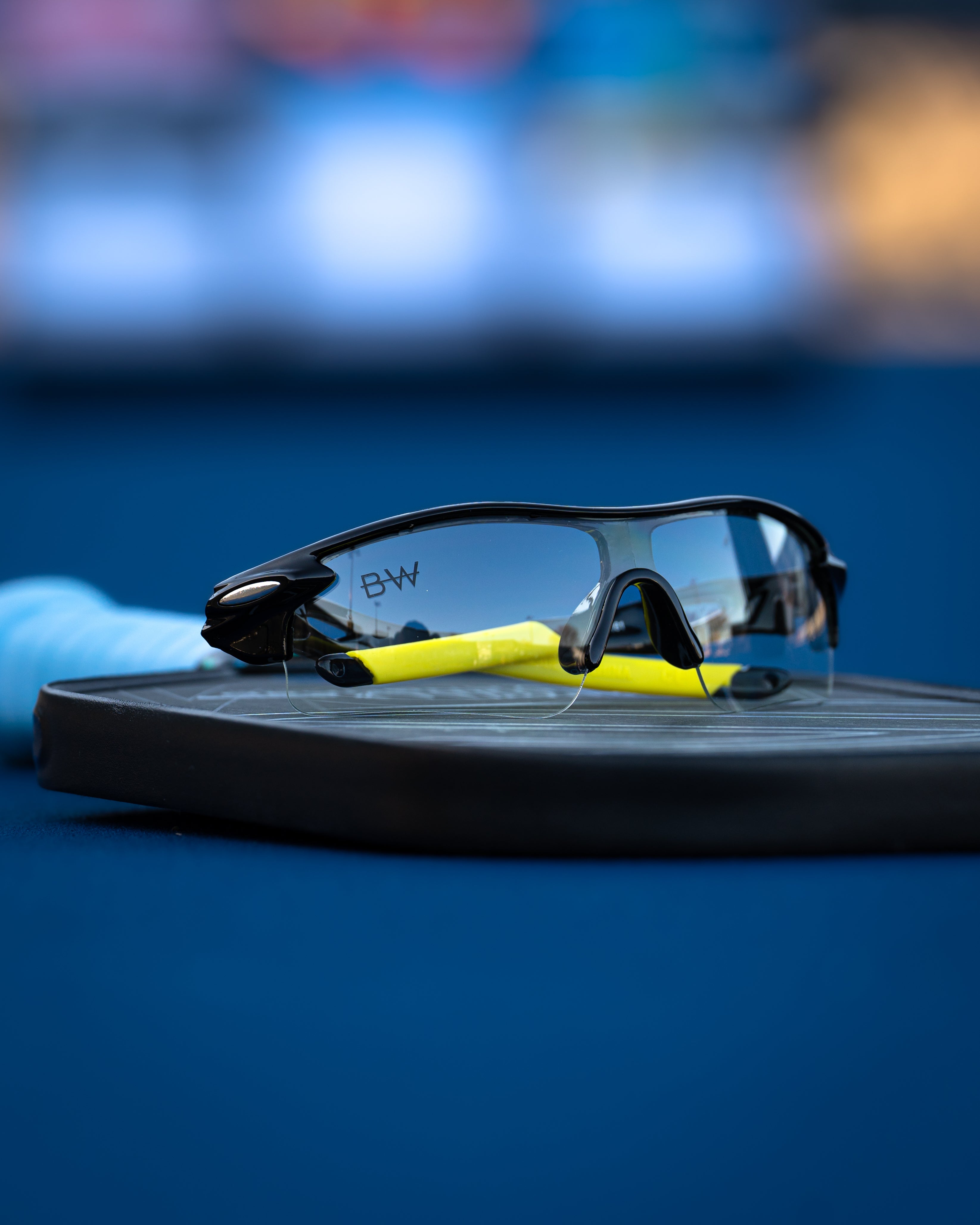
Optical Centering in RX Glasses: Why It’s Critical in Sports
Share
Find Your Perfect Pickleball Glasses
Whether you need prescription (RX) or non-prescription eyewear, our 2026 guide can help you compare frame styles, lens options, prescription considerations, and playing environments.
Optical Centering in RX Sports Glasses
Prescription sports eyewear has to do more than contain the correct prescription numbers. The prescription lenses also need to be produced and positioned appropriately for the wearer and the selected frame.
This is where optical centering becomes important. The term generally refers to how the optical reference points of prescription lenses are positioned relative to the wearer's eyes and the intended lens design.
For a pickleball player, this matters because prescription correction is being used while looking across the court, following the ball, checking boundaries, seeing a partner or opponent, and moving the head and body. However, optical centering should not be described as a technology that directly improves reaction time, depth perception, coordination, or athletic performance.
The more accurate goal is simpler: the prescription should be appropriately produced and positioned so the eyewear provides the correction it was prescribed to provide.
What Is Optical Centering in Prescription Glasses?
Every prescription lens has optical characteristics determined by its prescription and lens design. Producing prescription eyewear involves positioning the lens appropriately within the selected frame in relation to the wearer's measurements.
The phrase “optical center” is often used when explaining this concept, but prescription-lens positioning can be more nuanced than simply placing one point directly in front of the center of each pupil.
The relevant reference points and measurements can depend on factors such as:
- The prescription
- The lens design
- The selected frame
- The position of the frame on the wearer
- Pupillary-distance information
- Vertical positioning when applicable
- Other measurements required for the particular lens configuration
That is why “perfectly line the optical center up with the pupil” is an oversimplification rather than a complete description of prescription-lens fitting.
Does the Optical Center Always Sit Directly in Front of the Pupil?
Not necessarily in the simplistic way that statement is often presented online.
Prescription lens designs can use different reference points, and the appropriate finished positioning depends on the lens and prescription requirements. It is therefore more accurate to discuss appropriate lens centration and positioning than to promise that every lens's optical center must always sit at one exact point directly in front of the pupil.
This distinction becomes especially important when discussing more complex prescriptions or lens designs.
Is Optical Centering the Same as Pupillary Distance?
No. They are related concepts, but they are not interchangeable.
Pupillary distance, or PD, is a measurement describing the distance between the pupils or related monocular measurements for each eye. PD information can be used when positioning prescription lenses.
Optical centering is the broader lens-positioning concept. It involves how the relevant optical reference points of the finished lenses relate to the wearer's eyes and the selected eyewear configuration.
PD can therefore contribute to lens centration without being a complete definition of optical centering.
Binocular PD vs. Monocular PD
PD can be represented in different ways.
A binocular PD expresses an overall distance between the pupils. Monocular PD measurements describe the positioning of each eye separately relative to the center of the face or fitting reference used.
These should not be guessed or converted casually. The measurements needed for a particular prescription order depend on the lens and ordering requirements.
Do not assume that every prescription document automatically includes PD simply because it contains the prescription powers.
PD Is Not Your Prescription Strength
PD should also be kept separate from prescription power.
Common prescription terms can include:
- OD — right eye
- OS — left eye
- SPH — sphere
- CYL — cylinder
- AXIS — orientation associated with cylinder correction
- ADD — additional power when prescribed
- Prism — when prescribed
PD is measurement information used for lens positioning. It does not change the prescribed sphere, cylinder, axis, ADD, or prism values.
Why Does Optical Centering Matter?
Prescription lenses are designed to provide particular optical correction. Appropriate positioning helps the finished eyewear deliver that correction as intended.
If a pair of prescription glasses does not feel visually appropriate, possible contributors can include the prescription itself, lens production, measurements, lens positioning, frame position, adaptation to new eyewear, or other visual factors.
That does not mean every symptom experienced in prescription glasses is automatically caused by incorrect optical centering.
Why Lens Decentration Can Matter Optically
Looking through a powered lens away from the intended optical reference position can introduce prismatic effects. How significant those effects are depends on factors including lens power and the amount and direction of decentration.
This is one reason prescription-lens positioning should not be treated casually, particularly as prescriptions become more complex.
However, a consumer should not attempt to diagnose or calculate a supposed centration error from symptoms alone. Professional measurements and inspection are more appropriate when a finished prescription pair seems incorrect.
What Is a Prismatic Effect?
In prescription optics, prism changes the apparent direction of light passing through the lens. Prism can be intentionally prescribed, but unwanted prismatic effects can also become relevant when viewing through a powered lens away from its intended reference position.
The magnitude of that effect depends on the optical power and amount of displacement, which is why the statement “even a fraction of a millimeter ruins your vision” is not accurate as a universal rule.
Different prescriptions can have different tolerances and optical consequences.
Does Being Off by a Fraction of a Millimeter Ruin RX Glasses?
No universal claim like that should be made.
The optical significance of a positioning difference depends on the prescription, lens design, direction and amount of displacement, and other fitting factors.
A tiny numerical difference should not automatically be described as causing blurred vision, headaches, reduced depth perception, or poor sports performance.
Does Optical Centering Matter More With Stronger Prescriptions?
Lens power is relevant when considering the optical effect of looking through a powered lens away from its intended reference position. As a result, accurate measurements and appropriate lens positioning can become particularly important in higher or more complex prescriptions.
That does not mean people with lower prescriptions can ignore proper measurements. It means the optical consequences of decentration are not identical across every prescription.
Optical Centering and Astigmatism Prescriptions
An astigmatism prescription can include cylinder and axis values in addition to sphere.
These prescription components should be reproduced as prescribed. Do not round, transpose, remove, or otherwise change them in an attempt to make an online eyewear order easier.
If your prescription contains cylinder and axis values that you do not understand, use the prescription as written and seek clarification when necessary rather than guessing.
What If Your Prescription Includes Prism?
Prescribed prism is an additional optical requirement and should not be confused with unwanted prismatic effects associated with lens positioning.
If prism appears on your eyeglass prescription, do not omit it or attempt to convert it yourself. Whether a particular RX product can accommodate a prescription containing prism depends on the specific product and lens-ordering capabilities.
Confirm compatibility rather than assuming every prescription frame supports every prism prescription.
Optical Centering and Progressive Lenses
Progressive lenses have different optical zones within the lens, making fitting and positioning more complex than the simplified idea of putting one optical center in front of the pupil.
Measurements beyond a basic overall PD can be relevant depending on the progressive design and fitting process.
Do not assume every Blinded Wear RX product supports progressive lenses unless that option is verified for the exact product and configuration.
Optical Centering in Single-Vision Lenses
Single-vision lenses use one prescribed power purpose across the lens design rather than the multiple viewing zones associated with progressive lenses.
Appropriate measurements and positioning still matter. “Single vision” does not mean that lens placement can be arbitrary.
Exact compatibility should be confirmed for the prescription eyewear being ordered.
Why Discuss Optical Centering in Sports RX Eyewear?
Sports place the wearer in more varied viewing situations than sitting still and looking straight ahead. A pickleball player may alternate between the ball, court, partner, opponent, net, and surrounding environment while the head and body are moving.
That makes properly made prescription eyewear important, but it does not change the underlying purpose of optical centering.
Optical centering is about appropriate prescription-lens positioning. It should not be transformed into a promise of faster reactions or superior athletic ability.
Does Optical Centering Improve Reaction Time?
It is not accurate to promise that optical centering directly increases reaction speed.
Reaction time involves visual input along with attention, anticipation, neurological processing, decision-making, and physical response.
Appropriately produced prescription eyewear is intended to provide the optical correction prescribed for the wearer. That is different from making the nervous system react faster.
Does Optical Centering Improve Ball Tracking?
Do not describe optical centering as a ball-tracking enhancement technology.
Following a pickleball visually involves the wearer's vision, eye and head movements, attention, prediction, experience, lighting, prescription correction when required, and other factors.
Correctly made prescription eyewear can provide the correction it was designed to provide without needing an unsupported claim that it improves tracking ability.
Does Optical Centering Improve Depth Perception?
Depth perception is a broader visual function and should not be reduced to one eyewear measurement.
Prescription errors or inappropriate optical effects can affect a wearer's visual experience, but it is not accurate to promise that optical centering itself enhances depth perception beyond the individual's normal corrected visual function.
Does Optical Centering Improve Hand-Eye Coordination?
No direct improvement should be promised.
Hand-eye coordination involves perception, motor planning, timing, experience, and physical execution. Appropriate prescription correction can be important for someone who needs it, but the glasses should not be marketed as creating better coordination.
Does Precise Lens Positioning Increase Confidence?
Confidence is subjective and should not be guaranteed as an outcome of lens centration.
A player may personally feel more comfortable when wearing familiar prescription eyewear that works well for them, but that experience should not be turned into a universal product claim.
What Happens to Optical Centering During Rapid Head Movement?
The prescription lenses are mounted within the frame, so their relationship to the eyes depends partly on how the frame sits on the wearer's face.
Normal movement does not mean the optical centers are repeatedly becoming incorrectly manufactured. Frame position and lens centration are related but distinct concepts.
If a frame repeatedly moves enough to interfere with your visual experience or comfort, that is a fit issue worth evaluating rather than evidence that rapid movement inherently defeats optical centering.
Frame Fit and Optical Centering Are Related but Different
Optical centering concerns how the prescription lenses are produced and positioned for the wearer. Frame fit concerns how the finished eyewear sits on the face.
A well-produced lens in a frame that sits differently than expected can create a different wearing position. Conversely, a stable-feeling frame does not prove that every optical measurement was produced correctly.
Both matter, but they should not be treated as the same specification.
Can a Frame Shift Change the Wearing Position?
Yes. If a frame moves on the face, the wearer's eyes and the lenses are no longer in exactly the same relative position they were before the movement.
That does not mean every small movement causes clinically significant optical error. The effect depends on the prescription, amount and direction of movement, lens design, and individual wearer.
Avoid absolute claims that any frame shift instantly causes visual distortion or delayed reactions.
Does Sports Eyewear Need Zero Movement?
No realistic sports frame should be assumed to remain mathematically motionless on every face during every movement.
Fit varies with head shape, face shape, frame dimensions, movement, and individual preference.
The more useful goal is a comfortable active fit that the wearer finds appropriately stable during realistic play.
A Tighter Frame Is Not Automatically More Optically Accurate
Making eyewear excessively tight is not a substitute for proper lens measurements.
A frame that creates uncomfortable temple or nose pressure is not necessarily better simply because it feels harder to move.
Prescription accuracy, lens positioning, frame selection, and wearable comfort should be considered together.
Can Adjusting the Frame Change the Wearing Position?
Frame adjustments can change how eyewear sits on the face. Depending on the adjustment, this may alter factors such as height, tilt, or distance from the eyes.
That is one reason significant frame adjustments should be approached thoughtfully with prescription eyewear rather than assuming fit and optics are completely independent.
If a pair needs substantial adjustment or feels visually different after being altered, an optician or appropriate eyewear professional can inspect the finished pair.
What If Prescription Glasses Sit Crooked?
A visibly uneven frame can result from fit, frame condition, adjustment, or other factors. Do not automatically conclude that the prescription lenses themselves were manufactured incorrectly.
If the eyewear sits noticeably unevenly or no longer fits as intended, having the frame evaluated can help distinguish a frame-position issue from a lens-production concern.
Can Frame Damage Affect Lens Position?
Physical damage to a frame can change how the eyewear sits or holds its lenses.
If prescription sports glasses have been significantly bent, cracked, or damaged after an impact, inspect the complete pair rather than focusing only on whether the lenses are scratched.
Do not assume a damaged frame continues holding the lenses in exactly the same position as before the incident.
What If an RX Lens Comes Out of the Frame?
If a prescription lens comes out of its frame, avoid forcing it back into place in a way that could damage the lens or frame.
Appropriate next steps depend on the frame construction and damage. An eyewear professional or the provider can help determine whether the lens and frame can be appropriately restored or whether replacement is needed.
What Can Incorrect Prescription Eyewear Feel Like?
People sometimes associate symptoms such as blur, visual discomfort, or headaches with incorrect lens centration. Those symptoms can occur for many reasons, so they cannot diagnose a centering problem by themselves.
Possible contributors to an uncomfortable visual experience can include:
- An inappropriate or changed prescription
- Prescription-lens production issues
- Measurement or positioning issues
- Frame position
- An unfamiliar new prescription
- Dirty or damaged lenses
- Fogging
- Lighting conditions
- Dryness or other eye-related factors
If symptoms are persistent, significant, new, or unexplained, appropriate professional evaluation is more useful than assuming one specific cause.
Can Incorrect Optical Centering Cause Headaches?
Prescription-lens issues can contribute to visual discomfort in some circumstances, but a headache alone does not establish that optical centering is incorrect.
Headaches have many possible causes. Persistent or concerning headaches should not be self-diagnosed through eyewear measurements.
Does Optical Centering Prevent Eye Strain?
Appropriate prescription-lens positioning is important, but no eyewear should be guaranteed to prevent eye strain.
Eye strain and visual discomfort can have multiple contributors. If symptoms continue despite clean, intact, appropriately prescribed eyewear, seek appropriate professional guidance.
Does Blur Mean the Optical Center Is Wrong?
No. Blur alone cannot identify the cause.
Before assuming a manufacturing problem, consider whether the lens is dirty, fogged, scratched, or whether the frame has shifted. An outdated or incorrect prescription and changes in vision can also contribute.
If blur persists, professional inspection or eye-care evaluation may be appropriate depending on the circumstances.
Does Peripheral Blur Prove Bad Optical Centering?
No. Lens optics can vary across the lens depending on prescription and design, and peripheral visual experience can be influenced by multiple factors.
A statement such as “blur at the edge means your PD is wrong” is too simplistic.
If the finished eyewear produces persistent or concerning visual effects, have the prescription eyewear evaluated rather than diagnosing the cause from the location of blur alone.
What About Double Vision?
New or persistent double vision should not simply be attributed to sports glasses or optical centering without evaluation.
If you experience persistent double vision or another significant new visual symptom, contact an appropriate eye-care professional.
New Prescription Adaptation vs. a Centering Problem
A new prescription or different eyewear configuration can feel unfamiliar at first, but there is no universal adaptation period that proves a pair is correct or incorrect.
Likewise, persistent discomfort should not automatically be dismissed with “you just need to get used to it.”
If something continues to feel visually wrong, the appropriate prescription, lens production, measurements, and frame fit can be reviewed.
Can You Test Optical Centering Yourself?
You can notice whether your eyewear feels visually comfortable and whether something appears obviously wrong, but a home test is not a substitute for professional lens measurement and inspection.
A mirror, ruler, phone camera, or online tool should not be treated as definitive proof that a finished prescription lens was produced correctly or incorrectly.
What About PD Apps and Online Measurement Tools?
Online tools can use different measurement methods and technologies. Their accuracy and suitability can vary.
Do not assume that every phone-based measurement is equivalent to a professional measurement or that one number is sufficient for every lens design.
Follow the measurement requirements for the specific prescription eyewear being ordered.
Should You Guess PD With a Ruler?
Do not guess a PD value simply to complete an RX order.
If reliable measurement information is unavailable or you are uncertain about the value needed, obtain clarification rather than entering an estimate.
Small numerical differences do not have identical consequences for every prescription, but deliberately guessing measurement information is still poor practice for customized eyewear.
Is PD Always Written on an Eyeglass Prescription?
No. PD may not appear on every written prescription.
The prescription powers and the measurements used to position the finished lenses are related parts of producing prescription eyewear, but they are not necessarily supplied in the same document.
Do not invent a PD because it is absent from the prescription.
Can a Contact Lens Prescription Be Used for RX Sports Glasses?
No. A contact lens prescription and an eyeglass prescription are not interchangeable.
Do not copy contact lens values into an eyeglass order or attempt to convert them yourself. Use the appropriate eyeglass prescription for prescription eyewear.
Start With an Accurate Eyeglass Prescription
Before thinking about frame style, tint, or sports use, make sure the prescription information being submitted is appropriate for eyeglasses.
Blinded Wear's current RX ordering process requires customers to upload a clear photo or picture of their eyeglass prescription on the applicable product page before adding the custom RX eyewear to the cart and purchasing.
Do not intentionally round, alter, or omit prescription information because a value seems unusual.
What Does Blinded Wear Require for Optical Centering?
The previous version of this guide stated that Blinded Wear “carefully measures” each customer's PD during the order and uses specific advanced surfacing technology. Those statements should not be treated as established features unless they are explicitly confirmed by the current ordering process and product information.
The verified current process is that customers upload a clear image of their eyeglass prescription on the RX product page before adding the eyewear to the cart and purchasing.
If additional measurement information is required for a particular order, follow the instructions provided for that exact RX configuration rather than assuming one universal measurement process across every product.
Why We Avoid Saying “Perfect Optical Centering”
“Perfect” is an absolute manufacturing claim. Prescription eyewear is more accurately discussed in terms of appropriate measurements, lens production, positioning, and applicable tolerances.
Likewise, Blinded Wear should not promise that its frames keep the lenses “perfectly aligned” during every movement. Frame fit varies by wearer, and normal sports movement does not require an unrealistic zero-movement standard.
Does Optical Centering Guarantee Clear Vision?
No single measurement can guarantee a particular visual outcome.
The wearer's prescription, lens design, lens production, frame, fitting position, eye health, and other factors can contribute to the finished visual experience.
Appropriate lens positioning is important without needing to describe it as a guarantee of perfect clarity.
Does High-Index Change the Need for Optical Centering?
No. High-index describes a category of prescription lens material based on refractive index. It does not eliminate the need for appropriate lens positioning.
Blinded Wear includes high-index prescription lenses at no additional cost with custom RX eyewear.
High-index material can help manage lens thickness, particularly as prescription strength increases, but it should not be marketed as automatically improving optical centering, visual clarity, reaction time, or sports performance.
Does a Higher Lens Index Mean More Accurate Centering?
No. Refractive index and lens centration are separate characteristics.
A higher index does not prove that a lens was measured or positioned more accurately, just as a lower index does not prove poor centering.
The index describes an optical property of the lens material, while centration concerns how the finished lens is positioned for the wearer.
Does Lens Thickness Determine the Optical Center?
Lens thickness and optical positioning should not be treated as the same thing.
Finished thickness can depend on prescription strength, lens material, frame dimensions, geometry, and lens design. Optical positioning involves the prescription and fitting requirements of the finished eyewear.
A visually thinner lens is not automatically more accurately centered.
Does Lens Tint Affect Optical Centering?
Tint and optical centering are separate characteristics.
A grey, clear, or other verified lens tint does not change the wearer's PD or correct an incorrectly positioned prescription lens.
Likewise, optical centering does not determine how dark a lens appears.
Does Polarization Affect Optical Centering?
Polarization is a separate lens technology designed to reduce certain reflected light. It does not replace prescription measurements or establish lens centration.
A polarized lens still needs to be produced appropriately for the prescription and eyewear configuration.
Do Photochromic Lenses Change Optical Centering?
Photochromic technology is designed to change tint under particular environmental conditions. It does not intentionally move the prescription's optical reference position as the tint changes.
Photochromic behavior, prescription positioning, high-index material, and polarization should all be treated as separate characteristics.
Does Anti-Reflective Treatment Fix Centering Problems?
No. An anti-reflective treatment, when present, is a surface-treatment characteristic. It does not correct inaccurate prescription values or inappropriate lens positioning.
Do not use coating terminology as a substitute for prescription accuracy.
Does Impact Resistance Tell You Anything About Optical Centering?
No. Impact resistance describes a physical lens characteristic, while optical centering concerns prescription-lens positioning.
An impact-resistant lens is not automatically perfectly centered, and an appropriately centered lens is not automatically impact-certified.
Keep Prescription Lens Features Separate
| Feature | Primary Relevance | Does Not Automatically Establish |
|---|---|---|
| Prescription | Optical correction | Fit, tint, polarization, impact certification |
| PD and fitting measurements | Prescription-lens positioning | Prescription power or sports performance |
| High-index material | Refractive index and thickness management | Perfect centering, impact certification, scratch resistance |
| Tint | Visible-light transmission characteristics | Optical centering or polarization |
| Polarization | Reduction of certain reflected light | Prescription accuracy or depth-perception improvement |
| Photochromic technology | Variable tint under particular conditions | Prescription accuracy or centering |
| Impact resistance | Physical impact characteristic | Optical centering or formal certification |
| Frame fit | How eyewear sits on the wearer | Proof that the lenses were manufactured correctly |
Choosing an RX Sports Frame With Optical Positioning in Mind
Frame choice can matter because the frame establishes the shape, dimensions, and wearing position in which the prescription lenses will be used.
When comparing prescription sports frames, consider:
- Whether the frame can accommodate your prescription
- How the frame fits your face
- Whether the frame remains reasonably comfortable during movement
- Frame dimensions
- The available prescription lens configuration
- Whether you are comfortable with the finished wearing position
Do not assume that the most curved, tightest, or most aggressive-looking sports frame is automatically the best optical choice for every prescription.
Do Wraparound Frames Change RX Considerations?
Frame curvature and lens geometry can be relevant to prescription-lens design and fitting. A strongly curved sports appearance should therefore not be assumed to accommodate every prescription identically.
Verify prescription compatibility for the exact frame rather than choosing solely on appearance.
Do Larger RX Frames Need Different Consideration?
Frame dimensions can influence the finished prescription lens, including the amount of lens material required and aspects of lens geometry.
That does not make large frames inherently inaccurate. It simply means the frame and prescription should be considered together rather than treating the lens as independent of the frame.
Are Smaller Frames Always Better for Strong Prescriptions?
No. Smaller lens dimensions can sometimes be relevant when managing finished lens thickness, but there is no universal rule that the smallest possible frame is automatically the best choice.
Fit, prescription compatibility, lens design, field of view, comfort, and personal preference all matter.
Zebra II RX and Prescription Fit
Zebra II RX is one current Blinded Wear prescription option to compare when shopping for pickleball eyewear.
Rather than claiming that Zebra II RX maintains “perfect optical alignment” during aggressive movement, evaluate it based on verified prescription compatibility, available lens configuration, frame style, and how the frame fits you.
Crystal Wave II RX and Prescription Fit
Crystal Wave II RX is another current prescription style available from Blinded Wear.
Its inclusion in the RX collection does not establish zero movement, universal prescription compatibility, or a unique optical-centering technology. Check the current product configuration and evaluate fit based on your own prescription and preferences.
Other Blinded Wear RX Frames to Compare
Additional current prescription styles include:
- Rippled X RX
- Steel Ice RX
- Blue Shield RX
- Frost RX
- Ocean Wave RX
- Gray Wash RX
- Lava Rock RX
- Havana Melt RX
Do not infer identical lens designs, prescription ranges, measurements, tint options, polarization, coatings, or safety specifications simply because these products appear within the same RX collection.
Optical Centering Checklist Before Ordering RX Sports Glasses
- Use an appropriate eyeglass prescription.
- Do not substitute a contact lens prescription.
- Make sure the prescription image is readable.
- Do not round or change prescription values.
- Do not guess missing measurement information.
- Confirm that the selected frame can accommodate your prescription.
- Remember that PD and prescription power are different.
- Do not assume every lens design uses identical fitting requirements.
- Evaluate frame fit separately from lens production.
- Do not choose a frame solely because it promises an aggressive sports shape.
- Review the custom RX policy before purchasing.
Common Optical Centering Myths
Myth: The optical center always has to sit exactly over the center of the pupil.
Prescription lens positioning can be more nuanced and depends on the lens design and fitting requirements.
Myth: Being off by any fraction of a millimeter ruins sports vision.
The significance of a positioning difference depends on prescription power, amount and direction of displacement, lens design, and other factors.
Myth: Perfect centering improves reaction time.
Prescription-lens positioning does not directly increase neurological reaction speed.
Myth: Optical centering improves depth perception.
It should not be marketed as a depth-perception enhancement technology.
Myth: Optical centering makes ball tracking faster.
Ball tracking involves many visual, attentional, and motor factors.
Myth: A stable frame proves the lenses are centered correctly.
Frame fit and lens centration are related but separate.
Myth: High-index lenses are automatically centered more accurately.
Refractive index and centration are different characteristics.
Myth: Every RX order only needs one PD number.
Measurement requirements can depend on the lens design and prescription configuration.
Optical Centering in RX Glasses: FAQ
What is optical centering?
It broadly describes appropriate positioning of prescription-lens optical reference points relative to the wearer's eyes and the finished eyewear configuration.
Is optical centering the same as PD?
No. PD can contribute to lens positioning, but it is not a complete definition of optical centering.
Is PD part of the prescription?
PD is measurement information used for lens positioning and may not appear on every written eyeglass prescription.
Can I guess my PD?
Do not guess measurement information for customized prescription eyewear. Obtain appropriate information when it is required.
Does optical centering improve reaction time?
No direct reaction-time improvement should be promised.
Does optical centering improve ball tracking?
It should not be described as a ball-tracking enhancement. Appropriate lens positioning helps prescription eyewear provide its intended optical correction.
Does optical centering improve depth perception?
It should not be marketed as a technology that enhances depth perception beyond the wearer's appropriately corrected visual function.
Can bad optical centering cause headaches?
Prescription-lens issues can contribute to visual discomfort in some circumstances, but headaches have many potential causes and cannot diagnose a centering problem by themselves.
Does blur mean my PD is wrong?
No. Blur can have multiple causes, including prescription, lens production, frame position, dirt, fogging, damage, or changes in vision.
Can I use my contact lens prescription?
No. Contact lens and eyeglass prescriptions are not interchangeable.
Does a sports frame keep optical centers perfectly aligned?
No universal zero-movement or perfect-alignment claim should be made. Fit varies by wearer and frame.
Does Blinded Wear include high-index RX lenses?
Yes. High-index prescription lenses are included at no additional cost with custom Blinded Wear RX eyewear.
RX Resources for Prescription Pickleball Players
- Prescription Pickleball Glasses — Explore current Blinded Wear RX frames.
- How to Order RX Glasses — Review the current prescription ordering process.
- Pickleball Performance Lens Guide — Learn about lens colors, clarity considerations, and RX options.
- Best Pickleball Glasses 2026 Guide — Compare broader eyewear considerations.
- Protection Plan, Replacement & Returns — Review current policy information.
Part One Takeaway: Prescription Accuracy Is More Than the Numbers
Optical centering matters because prescription lenses need to be appropriately positioned for the wearer and the finished eyewear configuration. PD can be part of that process, but optical centering is more nuanced than simply placing one point directly over each pupil.
For sports eyewear, the goal remains the same as it does for other prescription glasses: provide the prescribed optical correction in an appropriately produced and fitted pair of eyewear.
That does not require exaggerated claims. Optical centering does not directly make an athlete react faster, track a pickleball better, improve hand-eye coordination, or create superior depth perception.
The strongest approach is to start with the appropriate eyeglass prescription, use accurate required measurements, choose a compatible frame, and evaluate the finished eyewear based on prescription accuracy, fit, comfort, and the actual visual experience.
Optical Centering Can Involve More Than PD
Pupillary distance is one of the most familiar measurements associated with prescription eyewear, but it should not be treated as the only factor that can matter when positioning prescription lenses.
Depending on the lens design and prescription configuration, the finished eyewear may involve consideration of:
- Horizontal positioning
- Vertical positioning
- Frame dimensions
- How the frame sits on the wearer
- Lens shape and geometry
- Prescription power
- Lens design
- Any additional fitting requirements associated with the selected lens
The exact measurements required are configuration-dependent. A consumer should not assume that every pair of prescription glasses is produced from the same measurement set.
Horizontal Lens Positioning
Horizontal positioning concerns where the relevant prescription-lens reference points sit from side to side relative to the wearer's eyes.
PD information is commonly associated with this part of prescription-lens positioning, but the exact production process depends on the lens design and prescription.
Horizontal positioning should not be reduced to a sports-performance claim. Its purpose is appropriate prescription-lens placement, not faster reactions or better court awareness.
Why Vertical Position Can Matter Too
Prescription-lens positioning is not necessarily only a horizontal measurement problem. Depending on the lens design and fitting requirements, vertical position can also be relevant.
This is especially important when discussing more complex lens designs because a single horizontal PD number does not describe where every optical reference point should sit vertically within the frame.
Do not guess a vertical fitting measurement or assume one universal value works for every frame.
What Is Fitting Height?
Fitting height generally refers to a vertical measurement used when positioning particular prescription lens designs within a selected frame.
Its exact use depends on the lens and fitting system. It should not be confused with prescription power, PD, frame height, or the physical height of the wearer.
Not every RX order should be assumed to require the same fitting-height information.
The Frame's Wearing Position Is Part of the Bigger Picture
Prescription lenses are worn inside a physical frame rather than floating independently in front of the eyes. How that frame sits can therefore be relevant to the finished optical configuration.
Factors that can describe a frame's wearing position include its height on the face, tilt, curvature, and distance from the eyes. The importance of these factors varies with prescription and lens design.
This does not mean a wearer needs to calculate these variables independently. It means optical centering is more sophisticated than simply copying a PD number onto an order.
What Is Pantoscopic Tilt?
Pantoscopic tilt is a term used to describe the vertical angle at which an eyeglass frame and its lenses sit relative to the wearer.
It is one aspect of the wearing position that can be relevant in prescription eyewear. The appropriate amount is not a universal sports number, and consumers should not attempt to maximize or minimize it based on a generic pickleball recommendation.
It is also inaccurate to claim that a particular tilt automatically improves ball tracking, peripheral vision, or depth perception.
What Is Vertex Distance?
Vertex distance describes the distance between the back surface of the spectacle lens and the eye, commonly referenced relative to the cornea.
This can become optically relevant, particularly with stronger prescriptions, because changing the position of a powered lens relative to the eye can affect the effective optical experience.
Vertex distance should not be confused with PD. One concerns front-to-back lens position, while the other concerns horizontal eye-position measurements.
What Does Frame Wrap Mean?
Frame wrap generally describes how the eyewear curves around the face horizontally.
Sports frames can have different amounts of curvature, but more wrap should not automatically be described as optically superior. Prescription compatibility can become more complicated as frame and lens geometry change.
A wraparound appearance also does not prove that a frame provides better peripheral vision, eliminates side glare, or maintains perfect optical alignment during movement.
Why Wraparound RX Frames Need Appropriate Prescription Compatibility
A frame that curves around the face can position the prescription lenses differently from a flatter frame.
That does not make wraparound RX eyewear inherently problematic. It means the frame, prescription, and lens design need to be compatible rather than assuming any prescription can be placed into any curved sports frame without additional consideration.
For higher or more complex prescriptions, verify compatibility with the exact RX frame before ordering.
Does Frame Width Affect Optical Centering?
Frame width does not change the wearer's PD, but frame dimensions can affect how the lenses must be positioned within the selected eyewear.
A frame that is wider or narrower than another may require different lens decentration to place the relevant prescription reference points appropriately.
This is another reason a prescription lens cannot be evaluated independently from the frame in which it will be mounted.
Lens Width and Prescription Positioning
The horizontal size of the lens opening can influence the relationship between the frame's geometric dimensions and the wearer's required optical positioning.
This does not mean there is one universally ideal lens width for pickleball. Prescription, face fit, frame design, and individual preference all contribute to frame selection.
Does Bridge Width Matter?
Bridge dimensions contribute to the overall geometry of an eyeglass frame and can influence how the frame sits on a particular face.
Bridge width alone does not determine optical centering, but it is one of several frame dimensions that can affect the relationship between the frame and the wearer's eyes.
A bridge that looks appropriate in a product photo is not a guarantee of identical fit across different wearers.
What Is Frame PD?
In eyewear calculations, the geometric relationship between the two lens openings can sometimes be described using the frame's lens width and bridge dimensions.
This should not be confused with the wearer's pupillary distance.
The frame has its own geometry, while the wearer has individual measurements. Prescription-lens production brings those pieces together.
What Does Lens Decentration Mean?
Decentration describes displacement between a lens's relevant optical reference position and another reference such as the geometric center of the lens shape.
Decentration is not automatically an error. Prescription lenses are often intentionally positioned according to the wearer's measurements rather than simply placing every optical reference point at the geometric center of each frame opening.
Therefore, seeing that an optical reference point is not geometrically centered in the frame does not by itself prove that the glasses were made incorrectly.
Optical Center vs. Geometric Center
The geometric center describes the center of the physical lens shape or frame opening. An optical reference point relates to the optical design of the prescription lens.
Those locations do not necessarily need to be identical.
This distinction is especially important when discussing prescription eyewear online because “the lens looks off-center” is not enough information to determine whether the prescription was positioned incorrectly.
Why Lens Power and Decentration Are Connected
In ophthalmic optics, the prismatic effect encountered away from an optical center is related to both lens power and the distance from that optical center. This relationship is commonly discussed through Prentice's rule.
The practical lesson for an RX eyewear shopper is not that you need to calculate prism yourself. It is that the same amount of displacement does not have identical optical consequences across every prescription.
A stronger powered lens can produce a different prismatic effect from a lower-powered lens at the same amount of displacement.
Do You Need to Calculate Prentice's Rule Yourself?
No. Understanding the concept can explain why accurate prescription-lens positioning matters, but consumers do not need to calculate their own acceptable lens tolerances.
Attempting to diagnose a finished pair using an online formula can overlook lens design, prescribed prism, measurement methods, fitting requirements, and other relevant information.
If you believe prescription eyewear was produced incorrectly, professional verification is more useful than trying to reverse-engineer the pair at home.
Optical Positioning With Higher Minus Prescriptions
Higher minus prescriptions can make lens geometry and frame selection increasingly relevant to the finished eyewear.
Appropriate optical positioning remains important, but there is no universal prescription value at which sports glasses suddenly require a completely different centering principle.
Frame dimensions, lens material, prescription components, and lens design should be considered together.
Optical Positioning With Higher Plus Prescriptions
Higher plus prescriptions also deserve careful lens and frame consideration, although their thickness profile differs from typical minus lenses.
Do not use advice written specifically about minus-lens edge thickness as if it applies identically to plus prescriptions.
In both cases, appropriate prescription measurements and compatible frame selection remain important.
Does Cylinder Power Affect RX Lens Considerations?
Cylinder is used when astigmatism correction is prescribed. Its optical effect is orientation-dependent, which is why the associated axis value matters.
Do not change cylinder or axis values when ordering prescription sports eyewear, and do not assume a high cylinder prescription can be evaluated solely from the sphere value.
Compatibility should be considered using the complete prescription.
Why the Axis Value Should Not Be Rounded
Axis specifies the orientation associated with cylinder correction. It is not a general measurement of prescription strength and should not be casually rounded to make an order simpler.
If an axis value is difficult to read on the prescription image, obtain clarification instead of guessing.
Prescribed Prism Requires Separate Attention
If your prescription contains prism, that is an intentional part of the prescription rather than evidence that something is wrong with the glasses.
Prism values and any associated base direction should not be omitted or changed by the wearer.
Because prescription capabilities vary, confirm that the selected RX configuration can accommodate the complete prescription before ordering.
What If the Two Eyes Have Very Different Prescriptions?
Some people have substantially different prescription powers between their two eyes. That can make the finished optical experience more complex than simply looking at the stronger of the two numbers.
Do not assume that identical frame measurements have identical optical consequences for both lenses when their powers differ.
If you have a complex prescription or have previously had difficulty adapting to prescription eyewear, discussing the order with an appropriate eye-care or eyewear professional can be useful.
Why the Eyes Should Not Always Be Assumed Symmetrical
A single binocular PD does not mean each pupil is necessarily located exactly half that distance from the facial midline.
That is one reason monocular measurements can be relevant in some fitting situations.
Do not automatically divide a binocular PD in half and assume the result is the appropriate monocular measurement for every wearer and every lens configuration.
Why Progressive Lens Fitting Is More Complex
Progressive lenses contain multiple functional viewing regions rather than one uniform prescription purpose across the entire lens.
As a result, their fitting process can involve measurements and design considerations beyond a simplified optical-center explanation.
Progressive compatibility should be verified for the exact Blinded Wear product rather than assumed across the entire RX collection.
What About Bifocal Lens Positioning?
Bifocal designs include a designated near-vision segment in addition to distance correction. Positioning that segment appropriately involves considerations beyond a basic overall PD measurement.
Do not assume that every Blinded Wear RX product supports bifocal configurations unless the option is specifically available for the product being ordered.
Does an ADD Value Change Optical Centering?
An ADD value indicates additional near power when prescribed. It should not be confused with PD or fitting height.
If ADD appears on your prescription, do not remove it simply because you primarily intend to use the eyewear for sports. The appropriate lens design and use of the prescription should be determined through the relevant ordering and eye-care process.
Distance Vision and Sports RX Eyewear
Pickleball involves substantial distance and intermediate visual demands, but that does not mean every player should independently modify a prescription to create a “sports distance RX.”
Use the appropriate eyeglass prescription and confirm the available lens configuration rather than deleting prescription components based on assumptions about court distance.
What Should Be Verified on a Prescription Before Ordering?
Before ordering customized RX eyewear, make sure the prescription image is legible and that the information has not been altered.
Depending on the prescription, information can include:
- Right and left eye identification
- Sphere values
- Cylinder values when prescribed
- Axis values when prescribed
- ADD when prescribed
- Prism information when prescribed
- Other information supplied by the prescriber
Not every prescription contains every field. Missing information should not be invented.
Why Plus and Minus Signs Matter
A plus or minus sign is part of the prescription value, not optional punctuation.
Changing the sign changes the optical prescription. Never assume an unclear sign can be inferred from whether you are nearsighted or farsighted.
If the uploaded prescription is difficult to read, obtain a clearer copy rather than guessing.
Should You Transpose Your Own Prescription?
No. Do not independently convert or transpose prescription notation to make it look more familiar.
Use the prescription information as appropriately provided for the ordering process. If a different format is required, that should be handled through an appropriate optical process rather than improvised by the wearer.
Can Perfect Centering Fix an Outdated Prescription?
No. Appropriate lens positioning cannot make an outdated or inappropriate prescription correct again.
If your vision has meaningfully changed or the prescription is no longer appropriate, accurately positioning the old prescription does not solve the underlying issue.
An eye-care professional can determine whether a new prescription is needed.
Can a New Prescription Feel Different Even When Properly Made?
Yes. A change in prescription, frame, lens material, lens design, or wearing position can create a different visual experience.
That does not prove the new glasses are incorrect. At the same time, persistent significant problems should not automatically be dismissed as adaptation.
If something continues to feel wrong, the prescription and finished eyewear can be evaluated.
How Long Should RX Glasses Take to Feel Normal?
There is no universal number of hours or days that proves a new prescription is correct.
Adaptation can vary with the individual, magnitude and type of prescription change, lens design, and previous eyewear.
Avoid rigid claims such as “everyone adjusts within 48 hours” or “wait exactly two weeks before asking questions.”
Why Can the Same Prescription Feel Different in a New Frame?
Two pairs containing nominally the same prescription can differ in frame dimensions, lens shape, lens material, lens design, and wearing position.
That does not automatically mean one pair is wrong. It demonstrates why prescription numbers alone do not describe the entire finished-eyewear experience.
What If Your RX Glasses Slide Down During Play?
If a frame repeatedly slides lower on the face, its wearing position changes.
Whether that produces a noticeable optical effect depends on the prescription, lens design, amount of movement, and wearer. It should not automatically be described as causing visual distortion or slower reactions.
If repeated movement is uncomfortable or distracting, evaluate the fit rather than simply tightening the frame as much as possible.
What If You Find Yourself Looking Over the Top of the Frame?
Frequently looking outside the intended lens area can indicate that the frame position, lens dimensions, or individual wearing preference deserves attention.
It does not prove the optical center was manufactured incorrectly.
Frame fit and lens positioning should be evaluated as related but distinct factors.
Is Looking Through the Edge of an RX Lens the Same as Looking Through the Center?
Not necessarily. Powered lenses can have different optical effects away from their intended reference positions, and some lens designs intentionally vary across the lens.
That does not mean athletes must keep their eyes completely motionless and always look through one exact point.
Normal vision involves eye and head movements. Prescription eyewear should be appropriately designed and fitted for its intended use rather than marketed around an unrealistic “always look through the exact center” rule.
Your Eyes Naturally Move Behind the Lenses
Optical centering does not mean the pupils remain permanently aligned with one lens point during every glance.
During pickleball, the eyes move as the wearer looks at different parts of the scene. That is normal.
The purpose of appropriate prescription-lens positioning is not to eliminate eye movement. It is to produce the lens appropriately for the intended wearing configuration.
Should You Turn Your Head Instead of Moving Your Eyes?
There is no universal sports rule requiring prescription wearers to turn their entire head rather than use normal eye movements.
Different lens designs can produce different experiences away from central viewing regions, but movement strategies should not be prescribed through a generic blog article.
Optical Centering vs. Peripheral Vision
Peripheral vision is a visual function and should not be confused with the physical dimensions of an eyeglass lens or the location of its optical reference points.
A wider-looking sports frame does not biologically increase a person's peripheral visual field simply because it covers more area.
Likewise, optical centering should not be marketed as expanding peripheral vision.
Does a Bigger Lens Create a Bigger Field of Vision?
A larger lens can physically cover a larger area in front of the eye, but that should not be translated into a claim that it increases biological peripheral vision.
Frame edges, lens design, prescription, fit, and how the wearer looks through the eyewear can all affect the practical viewing experience.
Sports Movement Does Not Change Your Prescription
Running, turning, reaching, or moving laterally does not change the prescribed SPH, CYL, AXIS, ADD, or prism values.
What can change during movement is the position of the frame relative to the face. Those are different concepts.
This distinction helps avoid the misleading idea that sports require a constantly changing optical prescription.
Does Sweat Affect Optical Centering?
Sweat does not change the prescription or physically relocate the optical reference points within a properly mounted lens.
However, perspiration can influence comfort, create residue on the lenses, or contribute to a frame moving on some wearers.
Those issues should be described as fit or lens-surface considerations rather than changes to the manufactured optical centering.
Fogging Is Not an Optical-Centering Problem
If the lenses become fogged, the view can become hazy even when the prescription and lens positioning are correct.
Fogging concerns moisture on the lens surface. Optical centering concerns prescription-lens positioning.
Do not diagnose a sudden hazy view during play as a PD or centering error without first distinguishing surface fog from optical issues.
Dirty Lenses Can Mimic a Clarity Problem
Fingerprints, sweat residue, dust, and other debris can interfere with the view through prescription lenses.
Before concluding that a lens was centered incorrectly, make sure the optical surface is appropriately clean and free from obvious contamination.
Use lens-care methods suitable for the eyewear rather than abrasive improvised cleaning.
Scratches vs. Optical Centering
A scratch is physical surface damage. It does not move the prescription's optical reference points or change the prescribed values.
Depending on severity and location, a scratch may be noticeable during use, but that is a different issue from incorrect lens centration.
Do not try to fix a suspected centering problem by polishing the lenses.
A Cracked Lens Is a Different Problem
A crack or chip represents physical lens damage and should not be treated as a simple centering concern.
If an RX sports lens or frame experiences significant physical damage, evaluate the condition of the complete eyewear rather than continuing to use it solely because the prescription numbers remain unchanged.
A Bent Frame Can Change the Wearing Position
A bent frame may sit differently on the face than it did when the prescription eyewear was originally produced.
That does not necessarily mean the lenses themselves need to be remade, but significant frame deformation can change the wearing configuration and should be evaluated appropriately.
Avoid repeatedly bending prescription sports eyewear back and forth as a DIY fitting strategy.
Can a Loose or Damaged Frame Affect Fit?
Yes. A loose or damaged frame can change how consistently the eyewear sits on the wearer.
This is primarily a frame-condition issue rather than proof that the prescription lenses were incorrectly centered during manufacturing.
If the frame no longer maintains a usable fit, repair or replacement options can be considered according to the product and damage.
Can the Same RX Lenses Be Put Into a Different Frame?
Do not assume prescription lenses made for one frame can simply be transferred into another frame.
The lenses are produced to a particular shape, size, and configuration. A different frame can have different dimensions and fitting requirements.
Whether lens reuse is possible is configuration-dependent and should be evaluated by an appropriate eyewear provider.
Can One Prescription Lens Be Remade?
Lens-only or single-lens service availability depends on the eyewear provider, lens system, frame condition, prescription, and other factors.
Do not assume Blinded Wear offers a single-lens remake or lens-only replacement unless that service is specifically confirmed for the order.
When Might an RX Remake Be Considered?
If professional inspection determines that prescription eyewear was produced incorrectly or does not meet applicable order specifications, the appropriate resolution depends on the provider and circumstances.
A remake should not be self-diagnosed solely because a new pair feels different from an old pair.
Prescription verification, lens measurements, frame condition, and fit can all be relevant to determining what happened.
How Can an Optician Check Finished RX Glasses?
An optician or appropriate optical professional can inspect finished prescription eyewear using relevant measurements and optical equipment rather than relying only on how the lenses look from the outside.
Depending on the situation, evaluation can involve checking prescription powers, lens positioning, frame fit, and other applicable characteristics.
This is more reliable than trying to determine optical accuracy from a selfie or product photograph.
What Is a Lensmeter Used For?
A lensmeter, also called a focimeter in some contexts, is an optical instrument used to evaluate characteristics of prescription lenses.
It can be useful when verifying finished prescription eyewear, but consumers do not need to own or operate one to order sports glasses.
The existence of professional measurement equipment is another reason symptoms alone should not be used to diagnose a supposed centering error.
Can a Photo Prove That RX Lenses Are Centered Correctly?
Not reliably by itself.
Camera angle, head position, frame position, perspective, and the lens design can all complicate visual judgments from a photograph.
A photo may help document how a frame sits, but it should not be treated as a complete optical verification method.
Do Visible Lens Markings Mean Something Is Wrong?
Some prescription lens designs can use temporary or permanent reference markings associated with manufacturing, verification, or identification.
The presence of a marking does not automatically indicate damage or poor optical centering.
If you notice an unfamiliar marking on a new prescription lens, ask the provider rather than attempting to remove or alter it aggressively.
Does Tint Change How Prescription Lenses Are Centered?
Adding a verified tint option does not eliminate the need for appropriate prescription-lens positioning.
Clear, grey, or another available tint describes visible-light characteristics. Prescription centration remains an optical positioning issue.
A darker lens is not more accurately centered, and a clear lens is not easier to center simply because it lacks a dark tint.
Non-Polarized Lenses and Optical Centering
Non-polarized describes the absence of a particular polarization technology. It does not describe prescription-lens positioning.
A non-polarized RX lens still requires appropriate prescription production and positioning, and it should not be claimed to improve depth perception, reaction time, or optical centering.
Polarized RX Lenses Still Need Appropriate Positioning
If polarization is available in a particular RX configuration, it remains separate from prescription centration.
Polarization is designed to reduce certain reflected light. It does not correct inaccurate PD information or compensate for an inappropriate prescription.
Photochromic RX Lenses Still Follow Prescription Requirements
A photochromic lens, when available, changes tint under particular environmental conditions according to its technology.
That variable tint does not replace the prescription or eliminate the need for appropriate lens positioning.
Do not assume photochromic technology is available on every Blinded Wear RX frame.
Clear RX Lenses Need the Same Prescription Attention
A lens does not become less optically important because it has no dark sunglass tint.
Clear appearance, prescription correction, lens positioning, impact characteristics, UV specifications, and coatings are separate considerations.
High-Index RX and Optical Positioning
Blinded Wear includes high-index prescription lenses at no additional cost with custom RX eyewear.
High-index refers to the refractive properties of the prescription lens material and can help manage thickness, particularly as prescription strength increases.
It does not eliminate the need for appropriate optical positioning, and it should not be interpreted as a guarantee of lighter weight, better clarity, greater impact resistance, or more precise centering.
Do You Need a Specific Index for Accurate Optical Centering?
No universal refractive-index number is required simply to achieve accurate prescription-lens positioning.
Lens-material selection depends on the prescription and available lens configuration. Refractive index and centration address different aspects of the finished eyewear.
Do not choose a higher index solely because you believe it will center the prescription more precisely.
Does Frame Material Determine Optical Accuracy?
Frame material alone does not establish prescription-lens accuracy.
A frame still needs to be compatible with the prescription lenses and fit the wearer appropriately. Claims about optical centering should not be inferred from whether a frame is plastic, metal, or another material.
Durability and Optical Centering Are Separate
A durable frame can help maintain its physical condition during ordinary use, but durability should not be treated as proof of perfect optical alignment.
Likewise, correctly positioned prescription lenses do not make a frame indestructible.
Optical accuracy, fit, impact characteristics, and durability should each be evaluated on their own terms.
What If RX Sports Glasses Take an Impact?
After a meaningful impact, consider the condition of both the lenses and the frame.
Check for obvious cracks, chips, deformation, loose components, or a noticeably changed fit. A frame that now sits differently may change the wearing position even if the prescription lenses themselves remain intact.
Do not assume impact-resistant means the eyewear cannot be damaged.
Optical Centering Does Not Establish Safety Certification
Prescription accuracy and physical protection are separate issues.
A lens can be appropriately positioned without necessarily meeting a particular protective-eyewear standard. Likewise, a lens with verified impact characteristics still needs appropriate prescription production when used as corrective eyewear.
Do not describe RX sports eyewear as formally safety-certified unless the exact product has verified certification supporting that claim.
Optical Centering Matters Differently in RX and Non-RX Eyewear
Prescription eyewear contains corrective optical power prescribed for the wearer. That makes prescription measurements and lens positioning relevant to the finished correction.
Non-prescription eyewear does not contain the same individualized refractive prescription, although its lens quality, fit, physical characteristics, and other specifications still matter.
This is one reason prescription ordering requires information that is not needed for ordinary non-RX sunglasses.
What About Prescription Clip Systems?
In a compatible RX clip system, the prescription correction is provided by a separate inner prescription insert rather than the primary outer sports lens.
The prescription insert still needs to be produced appropriately for the wearer and the compatible eyewear system.
Do not assume that an RX clip can be inserted into arbitrary sunglasses or that every Blinded Wear frame uses an interchangeable prescription insert.
Direct RX vs. RX Clip: Optical Positioning Still Matters
Direct RX and RX clip configurations place prescription correction into different physical systems, but neither eliminates the need for appropriate prescription-lens production.
| Configuration | Where Prescription Correction Is Located | Key Consideration |
|---|---|---|
| Direct RX | Prescription lenses are part of the primary eyewear configuration | Prescription and frame compatibility |
| RX clip | Prescription correction is in a compatible inner insert | Prescription insert and outer-frame system compatibility |
Neither configuration should be universally described as providing faster vision, better reaction time, or superior optical centering.
Do Pickleball Players Need a Special Pickleball Prescription?
There is no general rule that pickleball players require a separate biological prescription simply because they play the sport.
An eye-care professional determines the appropriate prescription based on the individual's vision needs. The wearer can then select compatible sports eyewear for the intended activity.
Do not independently alter prescription values to create a supposed “pickleball RX.”
Should You Change Your RX Based on Court Distance?
Do not independently modify prescription values based on the dimensions of a pickleball court.
The visual demands of a sport do not give a consumer enough information to rewrite an eyeglass prescription.
If you have a specific vision concern related to sports, discuss it with an eye-care professional rather than changing prescription values yourself.
Does Eye Dominance Change Optical Centering?
Eye dominance should not be used as a reason to intentionally miscenter one prescription lens or change the prescribed values.
The appropriate prescription and lens-positioning process should be followed for each eye rather than trying to create a sports advantage by altering one side.
Why “Faster Vision” Is the Wrong Way to Describe Centering
Appropriately positioned prescription lenses do not make light travel to the brain faster or directly accelerate visual processing.
They are intended to provide the prescribed optical correction in the appropriate finished configuration.
Terms such as “faster vision,” “instant tracking,” and “quicker visual processing” turn an optical-fitting concept into an unsupported neurological performance claim.
Optical Centering vs. Visual Processing
Visual processing occurs within the visual and nervous systems. Optical centering concerns the physical and optical positioning of prescription lenses.
The two should not be treated as interchangeable.
Appropriate prescription eyewear can provide corrected optical input without proving that the wearer's brain processes information faster.
Does Optical Centering Improve Decision-Making?
No direct improvement should be promised.
Pickleball decisions depend on factors such as experience, anticipation, attention, strategy, positioning, visual information, and physical response.
Prescription eyewear addresses optical correction. It should not be marketed as a cognitive decision-making aid.
Optical Centering and Depth Cues
Human depth perception uses multiple visual cues. It is not created by a single eyeglass measurement.
Prescription correction can be important to an individual's visual function, but appropriate lens centration should not be advertised as increasing depth perception beyond the wearer's corrected visual capabilities.
Does Optical Centering Increase Contrast?
Optical centering should not be described as a contrast-enhancement feature.
Contrast sensitivity, lens tint, lighting, prescription correction, ocular factors, and other variables are separate considerations.
Likewise, a properly centered lens does not automatically contain a special contrast-enhancing tint or coating.
Does Optical Centering Reduce Glare?
No. Lens positioning and glare-management characteristics are separate.
Tint can reduce visible-light transmission, polarization can reduce certain reflected light when present, and other verified lens treatments can have their own functions. None of those should be inferred solely from accurate optical centering.
Do Properly Centered RX Lenses Prevent Mid-Match Fatigue?
No universal fatigue-prevention claim should be made.
Appropriate prescription production matters, but physical fatigue and visual discomfort can have many possible contributors. Correct lens positioning does not make an athlete immune to fatigue during a long match.
Optical Accuracy Is Valuable Without a Performance Promise
Prescription sports eyewear does not need exaggerated claims to have value.
If a player requires corrective lenses, having the appropriate prescription produced and positioned in compatible eyewear is already important. That value stands on its own without promising more wins, fewer errors, faster hands, or improved athletic ability.
Common RX Ordering Mistakes to Avoid
- Uploading a contact lens prescription instead of an eyeglass prescription
- Submitting a blurry prescription image
- Guessing an unreadable plus or minus sign
- Rounding prescription values
- Changing cylinder or axis
- Omitting prescribed prism
- Assuming PD is identical to prescription power
- Guessing missing measurement information
- Assuming every frame supports every prescription
- Assuming every RX frame supports every lens design
- Choosing a frame only from appearance without considering prescription compatibility
Before Ordering Blinded Wear RX Eyewear
- Use the correct eyeglass prescription. Do not substitute contact lens information.
- Make sure the prescription is readable. An unclear image increases the risk of misunderstanding important values.
- Preserve the prescription exactly. Do not intentionally round or modify values.
- Choose a current RX product. Start with the Blinded Wear Prescription Pickleball Glasses collection.
- Review the exact configuration. Prescription and lens options can vary by product.
- Upload the prescription. The current process requires a clear prescription image on the applicable RX product page before adding the custom eyewear to the cart.
- Do not invent missing information. Seek clarification when something required is unclear.
- Review custom-RX policies. Understand final-sale and replacement-support terms before purchasing.
How to Order Blinded Wear RX Glasses
For a complete overview of the current ordering process, visit How to Order RX Glasses.
The current RX process requires a clear photo or picture of the eyeglass prescription to be uploaded on the applicable product page before the custom RX eyewear is added to the cart and purchased.
This should not be rewritten as a claim that Blinded Wear personally measures every customer's PD during checkout unless that process is specifically established.
Remember That Customized RX Eyewear Is Final Sale
Customized Blinded Wear RX eyewear is final sale and is excluded from the standard 30-day return policy.
That makes prescription accuracy and careful product selection especially important before the order is completed.
Final-sale status is separate from applicable replacement support for eligible broken eyewear.
Replacement Support Is Not an Optical-Accuracy Guarantee
Blinded Wear offers 50% lifetime replacement support for eligible broken eyewear, subject to current policy terms.
This policy should not be described as an unlimited lifetime warranty that automatically covers every prescription, measurement, alignment, fit, loss, or lens issue.
For eligible damaged eyewear, the damaged pair must be returned as part of the applicable claim process.
What to Do If Blinded Wear RX Eyewear Is Damaged
For damaged prescription eyewear, contact blindedwearco@gmail.com before returning the pair.
Review the Blinded Wear Protection Plan, Replacement & Returns information for current eligibility and policy details.
Do not assume every optical concern qualifies as physical breakage under replacement support.
More Optical Centering Myths
Myth: The geometric center and optical center must always be identical.
No. Prescription lenses can be intentionally decentered according to the wearer's measurements and lens requirements.
Myth: Divide binocular PD by two and you always have perfect monocular PD.
The eyes should not automatically be assumed to be perfectly symmetrical around the facial midline.
Myth: A stronger prescription requires a tighter sports frame.
Prescription strength and frame tightness are separate considerations.
Myth: Wraparound frames are automatically better for sports prescriptions.
More curvature is not universally better and can introduce additional prescription-design considerations.
Myth: A larger lens automatically improves peripheral vision.
Physical lens coverage and biological peripheral vision are not the same thing.
Myth: If the frame moves at all, the prescription stops working.
Normal small movements do not automatically create a clinically meaningful optical problem.
Myth: Sweat changes optical centering.
Sweat does not relocate the optical reference points inside a mounted lens, although it can affect frame position or lens cleanliness.
Myth: Fogging means the prescription is misaligned.
Fogging is a lens-surface issue, not proof of a centering error.
Myth: A scratch moves the optical center.
A scratch is physical surface damage and does not change the prescribed lens values or move the manufactured reference points.
Myth: High-index lenses require less accurate measurements.
High-index material does not eliminate the need for appropriate prescription-lens positioning.
Myth: Optical centering eliminates glare.
Lens positioning and glare-management technologies are separate.
Myth: Perfect centering means zero eye strain.
No prescription eyewear can guarantee the absence of eye strain or visual discomfort.
Optical Centering in Sports RX Glasses: More FAQs
Is optical centering more important for strong prescriptions?
Lens power affects the optical consequences of decentration, so accurate positioning can become particularly important with higher or more complex prescriptions. Proper measurements still matter across prescription strengths.
Does frame size affect RX lens positioning?
Frame dimensions can affect how prescription lenses must be positioned within the selected eyewear, although they do not change the wearer's actual PD.
What is lens decentration?
It describes displacement between an optical reference position and another reference such as the geometric center of the lens shape. Decentration can be intentional and appropriate.
Is decentration always bad?
No. Prescription lenses are often intentionally positioned according to wearer measurements rather than placing the optical reference point at the geometric center of the frame opening.
What is vertex distance?
It describes the front-to-back distance between the spectacle lens and the eye, commonly referenced relative to the cornea.
What is pantoscopic tilt?
It describes a vertical angular aspect of how the frame and lenses sit relative to the wearer.
Does frame wrap matter for RX lenses?
Frame curvature can be relevant to prescription-lens design and compatibility. More wrap is not automatically better.
Can the same prescription feel different in two frames?
Yes. Frame dimensions, lens shape, material, design, and wearing position can differ even when the prescription values are nominally the same.
Does sliding down the nose mean the optical center is wrong?
No. Sliding is primarily a frame-fit issue. It can change the wearing position, but it does not prove the lenses were originally produced incorrectly.
Can an optician verify finished RX lenses?
An optician or appropriate optical professional can use relevant measurements and equipment to inspect prescription eyewear rather than relying on symptoms alone.
Can a phone photo verify optical centering?
A photograph alone is not a complete optical verification method because perspective, camera angle, head position, and lens design can affect what appears in the image.
Does tint affect optical centering?
No. Tint and prescription-lens positioning are separate characteristics.
Does polarization affect optical centering?
No. Polarization is a separate lens technology.
Does high-index improve centering?
No. High-index material and optical positioning are separate characteristics.
Does optical centering make sports vision faster?
No. It should not be described as accelerating neurological processing or reaction time.
Does optical centering improve contrast?
It is not a contrast-enhancement technology.
Does optical centering reduce glare?
It is not a glare-reduction technology. Tint, polarization, and other verified lens characteristics address different optical properties.
Can optical centering fix an old prescription?
No. Appropriate positioning cannot make an outdated or inappropriate prescription correct.
Can I alter my prescription for pickleball?
Do not independently change prescription values for sports use. An eye-care professional determines the appropriate prescription.
Part Two Optical Accuracy Checklist
- Think of optical centering as a lens-positioning concept, not a sports-performance feature.
- Remember that PD is only one part of the broader fitting picture.
- Do not assume one binocular PD describes every possible lens-fitting requirement.
- Do not automatically divide binocular PD in half to create monocular values.
- Do not confuse the geometric center of a frame with an optical reference point.
- Remember that intentional decentration can be appropriate.
- Consider frame geometry together with the prescription.
- Verify compatibility before selecting a strongly curved sports frame.
- Use the complete prescription, including cylinder, axis, ADD, or prism when prescribed.
- Never guess unclear plus or minus signs.
- Do not transpose or rewrite the prescription yourself.
- Do not interpret fog, dirt, or scratches as proof of incorrect centering.
- Have significantly bent or damaged prescription frames evaluated.
- Do not assume high-index, tint, polarization, or impact resistance determines centration.
- Seek professional verification when persistent visual concerns cannot be explained.
Part Two Takeaway: The Frame, Prescription, and Lens Work as a System
Optical centering is more than placing the middle of a lens directly in front of a pupil. Prescription-lens positioning can involve horizontal measurements, vertical positioning, frame geometry, wearing position, lens design, and the complete prescription.
The geometric center of a frame opening is not necessarily the same as the appropriate optical reference position. Intentional lens decentration can be part of correctly producing prescription eyewear.
Sports do not change these optical fundamentals. Pickleball movement, sweat, frame fit, tint, polarization, high-index material, and impact resistance can all matter for different reasons, but none should be confused with optical centering itself.
The goal remains straightforward: use the appropriate eyeglass prescription, provide accurate required information, select a compatible frame and lens configuration, and have persistent concerns with the finished eyewear evaluated rather than trying to diagnose optical accuracy from symptoms or appearance alone.
How to Troubleshoot RX Glasses That Do Not Feel Right
If a new pair of prescription sports glasses does not feel visually comfortable, avoid immediately assuming that optical centering is the cause. Several different issues can create a similar experience.
A useful troubleshooting process is to separate the possibilities rather than trying to diagnose the glasses from one symptom.
- Clean the lenses appropriately. Smudges, residue, dust, and fog can interfere with the view.
- Inspect for physical damage. Look for scratches, cracks, chips, or a visibly bent frame.
- Check how the frame sits. Notice whether it is unusually crooked, sliding, or sitting substantially differently from your normal eyewear.
- Confirm the prescription source. Make sure an appropriate eyeglass prescription was used rather than a contact lens prescription.
- Compare the prescription information. Do not alter values yourself, but confirm that the submitted document is the intended prescription.
- Consider whether the prescription recently changed. A different prescription can create a different visual experience without proving the new lenses are incorrectly centered.
- Seek appropriate evaluation if the problem persists. Professional inspection can distinguish issues that cannot be identified reliably at home.
RX Vision Problem Decision Guide
| What You Notice | Possible Category to Check | Useful Next Step |
|---|---|---|
| View improves after cleaning | Lens-surface contamination | Continue appropriate lens care |
| Temporary haze during temperature or humidity changes | Fogging or moisture | Distinguish surface fog from prescription issues |
| Visible scratch in the viewing area | Physical lens damage | Inspect damage rather than assuming a centering problem |
| Frame suddenly sits crooked after impact | Frame damage or changed fit | Have the frame and complete eyewear evaluated |
| New prescription feels different from old glasses | Prescription, lens design, frame, or wearing-position difference | Monitor the experience and seek evaluation if significant problems persist |
| Persistent blur that does not improve after cleaning | Multiple possible optical or vision-related causes | Professional evaluation may be appropriate |
| Persistent new double vision | Not appropriate for self-diagnosis | Contact an eye-care professional |
This table is a troubleshooting framework, not a diagnostic tool. Similar symptoms can have different causes.
What If Only One Eye Looks Blurry Through New RX Glasses?
Blur affecting one eye should not automatically be blamed on PD or optical centering.
Possible factors can involve the prescription, lens production, lens condition, frame position, or the wearer's vision. The relevant cause cannot be established from the symptom alone.
Do not compensate by changing prescription values yourself. If persistent blur remains after obvious surface issues are ruled out, have the eyewear and, when appropriate, your vision evaluated.
What If Both Eyes Look Blurry?
Blur through both lenses is equally nonspecific. Dirty lenses, fogging, an unfamiliar prescription, lens-production issues, or changes in vision can produce different forms of visual difficulty.
Appropriate optical centering is important, but it is only one part of the complete prescription-eyewear system.
What If Distance Vision Is Blurry?
If distant objects remain blurry through prescription eyewear, do not assume that changing PD or moving the frame will solve the problem.
The prescription itself, lens production, frame position, lens condition, and the wearer's current vision can all be relevant.
Persistent distance blur should be evaluated rather than corrected through DIY prescription changes.
What If Near Vision Is the Problem?
Near vision can involve different prescription requirements from distance vision, particularly when ADD power or multifocal lens designs are involved.
A near-vision problem therefore cannot automatically be reduced to incorrect optical centering.
If your prescription includes near correction, use the lens configuration prescribed and supported for the eyewear rather than independently modifying it for sports.
What If the Court Looks Distorted Through New RX Glasses?
A new or different prescription configuration can sometimes produce an unfamiliar visual experience, but “distortion” is too broad a description to identify the cause.
Prescription strength, astigmatism correction, lens design, frame geometry, wearing position, and other factors can contribute to how new eyewear feels.
Persistent or significant distortion deserves evaluation rather than an assumption that all sports RX glasses should feel identical immediately.
What If the Ground or Court Surface Looks Different?
Changes in prescription or lens design can alter a wearer's subjective visual experience. However, a court surface appearing unusual does not identify which optical factor is responsible.
Be cautious during movement if new eyewear produces significant unfamiliar visual effects. Persistent problems should be evaluated rather than dismissed or self-corrected.
Can New RX Glasses Make You Feel Dizzy?
Some people report dizziness or disorientation with changes in prescription eyewear, but dizziness has many possible causes and should not automatically be attributed to optical centering.
If symptoms are persistent, severe, or concerning, stop treating the issue as a simple frame-adjustment problem and seek appropriate professional guidance.
What If You Develop Headaches With New RX Glasses?
A headache does not prove that the PD, prescription, or optical centering is wrong.
If headaches repeatedly occur with the eyewear and remain unexplained, the finished glasses and prescription can be reviewed. Persistent or concerning headaches may also warrant appropriate medical or eye-care evaluation.
Persistent Double Vision Deserves Professional Evaluation
Double vision should not be diagnosed through an online eyewear guide.
If you experience new or persistent double vision, particularly if it occurs outside the new eyewear as well, contact an appropriate eye-care professional rather than repeatedly changing frame position or attempting to modify the lenses.
Do Not Assume Every New Vision Change Comes From the Glasses
The timing of a symptom can make new eyewear seem like the obvious cause, but the glasses are not the only possible explanation for a new visual change.
Persistent new blur, double vision, or other meaningful visual changes deserve appropriate evaluation rather than being attributed automatically to PD, high-index material, frame wrap, or lens centration.
Should You Compare New RX Glasses With Your Old Pair?
An old pair can provide useful context, but it is not a perfect reference standard.
Your previous glasses may contain a different prescription, frame geometry, lens material, lens design, or wearing position. They may also have changed physically through extended use.
If the old pair feels different, that observation can be useful information without proving that the new pair is incorrect.
Switching Between Multiple RX Pairs
Different prescription frames can feel different even when they were produced from the same prescription document.
Differences in lens shape, frame dimensions, material, and wearing position can affect the subjective experience.
If you regularly switch between sports and everyday eyewear, compare comfort and visual experience without assuming that any noticeable difference automatically indicates an error.
Why the Same RX Can Feel Different in Two Frames
The written prescription is only one part of the finished eyewear.
Two frames can differ in:
- Lens dimensions
- Lens shape
- Frame curvature
- Bridge geometry
- How high or low they sit
- Distance between the lenses and eyes
- Overall wearing position
- Lens material and design
These differences help explain why “same prescription” does not always mean “identical wearing experience.”
Can Prescription Sports Glasses Be Ordered Online?
Prescription eyewear can be ordered through online systems when the provider supports the required prescription and ordering process.
The important point is to supply accurate information rather than assuming that online ordering eliminates the need for prescription accuracy or appropriate measurements.
Blinded Wear's current custom RX process requires customers to upload a clear image of their eyeglass prescription on the applicable RX product page before adding the eyewear to the cart and purchasing.
Online vs. In-Person RX Ordering
The ordering channel does not by itself determine whether prescription eyewear will be appropriate.
Online and in-person processes can use different measurement and fulfillment systems. What matters is that the required prescription and fitting information is appropriately obtained and used for the specific lens configuration.
Avoid blanket claims that online RX glasses are inherently less accurate or that in-person ordering guarantees perfect optical centering.
Why Accurate Information Matters More Than Guessing
Customized prescription eyewear is produced around individualized optical information. Entering an estimated value simply to complete an order undermines the purpose of that customization.
If a required measurement is unknown, clarification is preferable to guessing.
This is especially relevant for higher or more complex prescriptions, where differences in lens power can change the optical significance of positioning.
High Prescriptions and Optical Centering
Higher prescription powers can make lens material, frame dimensions, finished thickness, and optical positioning particularly important considerations.
However, there is no single prescription-strength threshold at which one Blinded Wear frame becomes universally “best.”
Prescription compatibility should be confirmed for the exact frame and lens configuration rather than ranking frames solely by prescription strength.
High-Index Lenses and Thickness Management
Blinded Wear includes high-index prescription lenses at no additional cost with custom RX eyewear.
High-index material can help manage lens thickness, particularly as prescription strength increases. Final thickness still depends on factors such as:
- Sphere power
- Cylinder power when prescribed
- Lens dimensions
- Frame shape
- Lens geometry
- Optical positioning
- The specific lens material and design
High-index should not be interpreted as a guarantee that every prescription will produce an extremely thin or lightweight finished lens.
Why Lens Edge Thickness Can Vary
Minus-powered lenses commonly become thicker toward the edge, while plus-powered lenses have a different thickness profile. The finished result depends on more than the prescription's sphere number alone.
Frame dimensions and the position of the required lens area can influence how much lens material is needed.
This is one reason frame selection can matter for higher prescriptions without making one frame shape universally correct.
Center Thickness Is Not an Optical-Centering Measurement
The physical thickness at the center of a lens and the location of its optical reference points describe different characteristics.
A lens can be physically thin without being appropriately positioned, and a thicker prescription lens can still be correctly produced.
Do not judge prescription accuracy from thickness alone.
Frame Size and Strong Prescriptions
Frame dimensions can influence finished lens thickness and geometry, which is why people with stronger prescriptions may benefit from considering frame size alongside style and fit.
However, “always choose the smallest frame” is too absolute. The frame still needs to fit appropriately and support the available prescription configuration.
Strong Prescriptions and Highly Curved Frames
Highly curved sports frames can introduce additional lens-design considerations. That does not mean people with strong prescriptions cannot use sports-style eyewear.
It means prescription compatibility should be confirmed rather than assuming that every prescription can be placed into every frame geometry.
Do All RX Frames Support Every Prescription Strength?
Do not assume universal prescription compatibility across an RX collection.
The prescription range that can be accommodated can depend on the frame, lens design, lens dimensions, prescription components, and available manufacturing configuration.
If your prescription is high or complex, confirm compatibility for the exact product before purchasing.
Comparing Blinded Wear RX Frames
Blinded Wear offers multiple prescription styles, allowing players to compare frame appearance, dimensions, available configurations, and fit preferences.
Current RX options include:
- Zebra II RX
- Crystal Wave II RX
- Rippled X RX
- Steel Ice RX
- Blue Shield RX
- Frost RX
- Ocean Wave RX
- Gray Wash RX
- Lava Rock RX
- Havana Melt RX
Presence in the RX collection does not mean every product supports identical prescription ranges, lens designs, tints, polarization, coatings, or other lens technologies.
Which RX Frame Is Best for Optical Centering?
There is no universal Blinded Wear frame that can be called the “best-centered” frame for every prescription.
Optical centering is individualized to the prescription and required measurements. It is not a fixed performance score attached to a particular frame model.
A more useful question is whether the frame is compatible with your prescription and whether the finished eyewear fits appropriately for your face and intended use.
Does Frame Style Determine Prescription Accuracy?
No. A frame can have a sport-oriented appearance without being inherently more optically accurate than another compatible frame.
Likewise, a lifestyle-oriented appearance does not mean a frame cannot hold appropriately produced prescription lenses.
Evaluate the actual RX configuration rather than judging optical accuracy from styling.
How to Evaluate the Fit of Finished RX Sports Glasses
Once you receive prescription sports eyewear, evaluate the fit during ordinary, controlled movement before relying on it in demanding play.
Consider:
- Whether the frame sits comfortably
- Whether it repeatedly slides enough to become distracting
- Whether one side appears substantially higher than the other
- Whether the frame creates uncomfortable pressure
- Whether your eyelashes or face interfere with the lenses
- Whether the frame position changes substantially during normal movement
- Whether the visual experience remains comfortable
These observations help evaluate fit. They do not replace professional verification of prescription-lens measurements.
Test Active Fit With Realistic Movement
A sports frame can be evaluated with controlled movements similar to those you normally make while playing.
For example, you can turn your head, look side to side, bend slightly, and move naturally while paying attention to comfort and frame position.
There is no need for exaggerated shaking or unsafe movement. The goal is to understand how the eyewear fits during realistic use, not to prove that it can never move.
Before Playing a Full Match in New RX Glasses
If the prescription, frame, or lens design is new to you, become familiar with the eyewear before relying on it in competitive play.
Check that:
- The lenses are clean
- The frame is intact
- The prescription view feels usable
- The frame feels comfortable
- You are not experiencing persistent unexplained blur
- You are not experiencing significant new visual symptoms
This is a practical familiarity check, not a guarantee of sports performance.
Optical Centering and Tournament Eyewear
A tournament is not an ideal time to discover that unfamiliar prescription eyewear feels significantly different from your usual pair.
When possible, become familiar with new prescription eyewear during ordinary use and practice before relying on it for an important match.
This does not mean a specific adaptation period is required. It simply gives you an opportunity to identify fit or visual concerns before competition.
Should You Carry a Spare RX Pair?
A spare pair can be useful for players who depend on prescription correction, particularly during tournaments or travel, but it is a personal preparedness choice rather than a requirement.
If you carry multiple prescription pairs, protect them from unnecessary contact and confirm that each pair contains an appropriate prescription for its intended use.
Traveling With Prescription Sports Glasses
Travel does not change optical centering, but physical damage to the frame can change how the eyewear sits.
Store prescription eyewear in a protective manner that reduces unnecessary pressure, abrasion, or crushing. Do not place heavy objects directly on the frame or lenses.
Blinded Wear should not claim that a specific case or travel accessory is included unless that accessory is verified for the product.
Maintaining the Wearing Position of RX Glasses
Routine care can help you notice changes in the physical condition of prescription eyewear.
Periodically look for:
- Obvious frame deformation
- Loose or damaged components
- A lens that no longer appears properly seated
- Cracks or chips
- A substantially changed fit
- Persistent sliding that was not present before
Do not repeatedly bend the frame yourself in an attempt to restore a remembered position if you are unsure how the adjustment should be performed.
Cleaning Does Not Change Optical Centering
Appropriate cleaning removes contaminants from the lens surface. It does not change the prescription or intentionally reposition the optical reference points.
If vision improves after cleaning, the problem was at least partly related to the lens surface rather than a change in the prescription values.
Avoid abrasive DIY polishing methods that can damage prescription lenses or their surface treatments.
Should You Adjust RX Sports Frames Yourself?
Minor everyday handling is different from intentionally bending or reshaping a prescription frame.
Significant adjustments can change how the eyewear sits and may risk damaging the frame or lenses. If the fit requires meaningful alteration, professional adjustment or provider guidance can be more appropriate.
Nose Pressure Does Not Prove Better Optical Stability
A frame pressing firmly against the nose is not automatically better positioned.
Comfort and appropriate fit matter. Excessive pressure should not be accepted simply because the wearer believes tighter eyewear must preserve optical centering better.
Temple Pressure Is Not a Measure of Optical Accuracy
Similarly, strong pressure at the temples does not prove that prescription lenses are more accurately positioned.
Fit should be evaluated based on the complete wearing experience rather than using tightness as a substitute for prescription accuracy.
Do Nose Pads Guarantee Better Centering?
No. Nose-pad design can influence how certain frames fit, but the presence of nose pads does not establish optical accuracy.
Do not assume every Blinded Wear RX frame uses adjustable nose pads unless that feature is specifically verified for the product.
Do Grippy Temples Guarantee Optical Stability?
No. Temple design can affect fit, but there is no universal zero-slip frame technology that guarantees one exact wearing position for every athlete.
Face shape, head dimensions, movement, perspiration, and individual fit all contribute to how eyewear behaves during activity.
Does a Retainer or Strap Fix Optical Centering?
A compatible eyewear retainer can affect how a frame is held on the wearer, but it does not correct prescription-production errors.
Do not assume a retainer is included with Blinded Wear eyewear unless the specific product information confirms it.
Can a Hat or Other Gear Change Frame Position?
Anything that physically contacts the frame can potentially affect how it sits. For pickleball, a hat or visor may interact with some eyewear depending on fit and design.
If you regularly wear other gear with your RX glasses, evaluate the combination together rather than assuming each item fits identically in isolation.
Optical Centering in Prescription Sunglasses
Prescription sunglasses still contain individualized corrective power, so tint does not eliminate the need for appropriate prescription-lens positioning.
Prescription accuracy, tint, visible-light transmission, polarization when available, frame fit, and physical lens characteristics should be considered separately.
Do Grey RX Lenses Need Different Centering?
A grey tint does not create a separate optical-centering rule.
If grey RX lenses are available in a particular configuration, they still need to be produced according to the applicable prescription and fitting requirements.
Grey tint should not be described as improving prescription accuracy, depth perception, or reaction speed.
Clear vs. Tinted RX: Is Centering Different?
The fundamental need for appropriate prescription positioning remains whether the lens is clear or tinted.
Tint changes visible-light transmission characteristics. It does not change the wearer's PD or replace fitting measurements.
Separate Lens Color From Prescription Positioning
When comparing lens colors and RX options, use the Blinded Wear Pickleball Performance Lens Guide.
Lens color, prescription correction, optical positioning, polarization, photochromic behavior, high-index material, and impact characteristics are separate features. Avoid assuming one establishes another.
When Should You Contact an Eye-Care Professional?
An eye-care professional is the appropriate resource for questions about your prescription, changes in vision, eye health, and unexplained visual symptoms.
Consider professional evaluation when you experience issues such as:
- Persistent unexplained blur
- New or persistent double vision
- A meaningful change in vision
- Persistent visual discomfort that is not explained by an obvious lens-surface issue
- Questions about whether your current prescription remains appropriate
- Other concerning eye or vision symptoms
An eyewear retailer should not replace an eye-care professional for diagnosis or prescription determination.
When Should You Contact the Eyewear Provider?
An eyewear provider can be relevant when the question concerns the product or finished glasses rather than diagnosis of your eyes.
Examples include:
- A damaged frame
- A lens that has come out of the frame
- A question about an RX product configuration
- A question about prescription compatibility before ordering
- A question about the provider's ordering process
- A question about replacement or return policy
Separating clinical questions from product questions helps direct the issue to the appropriate resource.
Questions About a Blinded Wear RX Order?
For the current ordering process, start with the How to Order RX Glasses guide and the product page for the exact RX frame you are considering.
For damaged Blinded Wear prescription eyewear, contact blindedwearco@gmail.com before returning the pair.
Prescription questions involving your actual vision or whether a prescription should be changed should be directed to an appropriate eye-care professional.
Understand the RX Return Policy Before Ordering
Customized Blinded Wear prescription eyewear is final sale and is excluded from the standard 30-day return policy.
Because RX eyewear is customized, review your prescription information and the selected product carefully before completing the order.
Final sale should not be confused with the separate replacement support that may apply to eligible broken eyewear.
How Blinded Wear Lifetime Replacement Support Works
Blinded Wear offers 50% lifetime replacement support if eligible glasses break, subject to current policy terms.
This means eligible customers can receive 50% credit toward a replacement pair after the applicable claim requirements are satisfied. Damaged eyewear must be returned for an eligible claim.
This is not an unlimited free lifetime warranty and should not be described as automatically covering every optical-centering concern, prescription change, lost pair, or product issue.
Review the Blinded Wear Protection Plan, Replacement & Returns information for current eligibility and policy details.
Does a Prescription Change Qualify for Lifetime Replacement?
Do not assume that a change in prescription qualifies as broken-eyewear replacement coverage.
A prescription changing over time is different from physical damage to the eyewear. Review current policy terms rather than treating replacement support as a prescription-update program.
What If the RX Glasses Are Lost?
Loss is different from returning eligible damaged eyewear. Do not assume the 50% lifetime replacement support applies to a lost pair unless current policy specifically establishes eligibility.
Review the current protection and replacement information for the applicable terms.
Questions to Ask Before Buying RX Sports Glasses
- Is this exact frame compatible with my complete prescription?
- What prescription information is required for this configuration?
- Are additional measurements needed?
- What lens material is included?
- What lens options are actually available on this product?
- Is the configuration direct RX or an RX insert system?
- Does my prescription include cylinder, axis, ADD, or prism that affects compatibility?
- How does the frame fit my face?
- What happens if the finished eyewear is physically damaged?
- What is the policy for customized RX eyewear?
These questions are more useful than choosing a pair based on unsupported promises such as “perfect alignment,” “zero distortion,” or “faster reaction time.”
What to Check on an RX Product Page
Before purchasing, review the exact product rather than assuming every feature of another Blinded Wear RX frame carries over.
Check for:
- Current RX availability
- Available lens configuration
- Product-specific lens options
- Prescription compatibility information
- Frame appearance and dimensions when provided
- Prescription upload instructions
- Current pricing
- Applicable custom-order terms
Do not infer polarization, photochromic technology, scratch resistance, anti-reflective treatment, anti-fog treatment, safety certification, or other features unless they are verified for the exact product.
Final Optical Centering Myths to Avoid
Myth: Optical centering is a special sports technology.
It is a fundamental prescription-lens positioning concept, not a proprietary athletic-performance feature.
Myth: Better centering makes your brain process the ball faster.
Lens positioning does not directly accelerate neurological processing.
Myth: A wrap frame automatically has better optical stability.
Frame curvature and prescription compatibility must be considered together.
Myth: The tightest frame gives the best centering.
Excessive tightness is not a substitute for appropriate measurements and prescription production.
Myth: If glasses slide once, the prescription is unusable.
The optical significance of frame movement depends on the prescription, lens design, amount of movement, and individual wearer.
Myth: High-index lenses eliminate optical distortion.
High-index describes refractive index and does not guarantee a particular subjective optical experience.
Myth: High-index means perfect centering.
Lens material and lens positioning are separate characteristics.
Myth: Tint improves optical centering.
Tint changes visible-light transmission characteristics, not prescription positioning.
Myth: Polarization improves optical centering.
Polarization and prescription positioning are separate.
Myth: Impact resistance guarantees prescription accuracy.
Physical impact characteristics and optical production are separate.
Myth: A clear lens is easier to center than a tinted lens.
Lens tint does not determine the prescription-positioning requirement.
Myth: A headache proves your PD is wrong.
Headaches have many possible causes and cannot diagnose a PD or centering problem by themselves.
Myth: Peripheral blur always means bad centering.
Peripheral visual experience can depend on prescription, lens design, frame geometry, and other factors.
Myth: An old pair feeling better proves the new pair is wrong.
The pairs may differ in prescription, frame, lens design, material, or wearing position.
Myth: You can fix centering by polishing the lenses.
Polishing does not reposition a prescription lens and can damage the lens surface.
Myth: Every RX frame works for every prescription.
Prescription compatibility can vary by frame and lens configuration.
Optical Centering in RX Sports Glasses: Final FAQ
Why is optical centering important?
Prescription lenses need to be appropriately positioned within the finished eyewear so they can provide the optical correction for which they were produced.
Is PD the same thing as optical centering?
No. PD can contribute to lens positioning, but optical centering is a broader concept involving the prescription, lens design, frame, measurements, and wearing configuration.
Can optical centering make me react faster in pickleball?
No direct reaction-time improvement should be promised. Reaction involves visual input, attention, anticipation, neurological processing, decisions, and physical response.
Will perfect centering improve my depth perception?
Optical centering should not be marketed as a technology that increases depth perception beyond the wearer's appropriately corrected visual function.
Does optical centering improve ball tracking?
It is not a ball-tracking enhancement. Appropriate prescription eyewear provides optical correction rather than directly improving tracking ability.
Does optical centering eliminate distortion?
No universal zero-distortion claim should be made. Prescription power, lens design, frame geometry, wearing position, and other factors can influence the visual experience.
Does a stronger prescription make centering more important?
Lens power affects the optical consequences of decentration, making accurate measurements and appropriate positioning particularly relevant in higher or more complex prescriptions.
Is the geometric center of the lens the same as its optical center?
Not necessarily. Prescription lenses can be intentionally decentered according to the wearer's measurements and lens requirements.
Can I measure optical centering from a selfie?
A selfie alone cannot provide complete optical verification. Camera perspective, frame position, head position, and lens design can affect what appears in the image.
Can I guess my PD if it is not on my prescription?
Do not guess required measurement information for customized prescription eyewear. Obtain appropriate information when needed.
Can I divide my binocular PD by two?
Do not assume the eyes are perfectly symmetrical or that dividing one measurement by two is appropriate for every configuration.
Can I use my contact lens prescription for Blinded Wear RX glasses?
No. Contact lens and eyeglass prescriptions are not interchangeable.
Does high-index change optical centering?
High-index describes the refractive properties of the lens material. It does not eliminate or replace appropriate prescription-lens positioning.
Does Blinded Wear include high-index RX lenses?
Yes. Blinded Wear includes high-index prescription lenses at no additional cost with custom RX eyewear.
Are Blinded Wear RX lenses guaranteed to stay perfectly aligned during sports?
No zero-movement or perfect-alignment guarantee should be assumed. Frame fit and movement vary among wearers.
Are all Blinded Wear RX frames compatible with high prescriptions?
Do not assume universal prescription compatibility. Confirm the exact frame and RX configuration for higher or more complex prescriptions.
What if my new RX glasses feel blurry?
First distinguish obvious surface issues such as dirt or fog from persistent optical concerns. If unexplained blur continues, professional evaluation may be appropriate.
What if I have persistent double vision?
New or persistent double vision should be evaluated by an appropriate eye-care professional rather than self-diagnosed as a frame or centering issue.
Can a bent frame affect how the lenses sit?
Yes. Significant frame deformation can change the wearing position even when the prescription values within the lenses have not changed.
Does Blinded Wear provide a free lifetime warranty?
Blinded Wear offers 50% lifetime replacement support for eligible broken eyewear subject to current policy terms. It should not be described as unlimited free replacement.
Can I return customized RX glasses under the standard 30-day return policy?
Customized RX eyewear is final sale and is excluded from the standard 30-day return policy.
Complete Optical Centering Checklist for RX Pickleball Glasses
- Start with an appropriate current eyeglass prescription.
- Do not substitute a contact lens prescription.
- Upload a clear, readable prescription image.
- Preserve plus and minus signs exactly.
- Do not round SPH, CYL, AXIS, ADD, or prism values.
- Do not invent missing prescription information.
- Do not guess required fitting measurements.
- Remember that PD and prescription strength are different.
- Remember that binocular and monocular PD are not automatically interchangeable.
- Understand that optical and geometric centers can differ.
- Recognize that intentional decentration can be appropriate.
- Consider frame geometry with the prescription.
- Verify compatibility for higher or more complex prescriptions.
- Do not assume the most curved frame is universally best.
- Do not assume the tightest frame is most optically accurate.
- Evaluate active fit with realistic movement.
- Separate fog, dirt, scratches, and frame movement from prescription issues.
- Inspect eyewear after meaningful physical damage.
- Do not bend or polish RX eyewear to fix a suspected optical problem.
- Seek professional evaluation for persistent unexplained visual symptoms.
- Review custom RX final-sale terms before purchasing.
- Review replacement-support terms separately from the return policy.
Choose Your Prescription Pickleball Eyewear
If you are ready to compare prescription options, browse the Blinded Wear Prescription Pickleball Glasses collection.
For ordering guidance, review How to Order RX Glasses. For lens-related education, visit the Pickleball Performance Lens Guide.
If you are still comparing prescription and non-prescription eyewear, the 2026 Pickleball Glasses Guide provides a broader starting point.
Final Takeaway: Optical Centering Is About Prescription Accuracy, Not a Performance Shortcut
Optical centering matters because prescription eyewear is an individualized optical system. The prescription, required measurements, lens design, frame geometry, and wearing position work together to determine the finished configuration.
PD is an important concept, but it is not the whole story. The geometric center of a frame is not necessarily the correct optical reference position, intentional decentration can be appropriate, and stronger or more complex prescriptions can make accurate positioning especially relevant.
At the same time, optical centering should not be turned into an exaggerated sports claim. It does not directly make the brain process information faster, improve reaction time, increase depth perception, enhance ball tracking, eliminate fatigue, or guarantee better pickleball performance.
For RX pickleball eyewear, focus on the fundamentals: use the appropriate eyeglass prescription, provide accurate required information, choose a compatible frame and lens configuration, evaluate fit during realistic movement, and seek appropriate professional help when persistent visual concerns cannot be explained by simple issues such as dirty lenses, fogging, or physical frame damage.
Explore Blinded Wear RX pickleball glasses and compare current prescription frame options for your vision needs, fit preferences, and playing environment.