
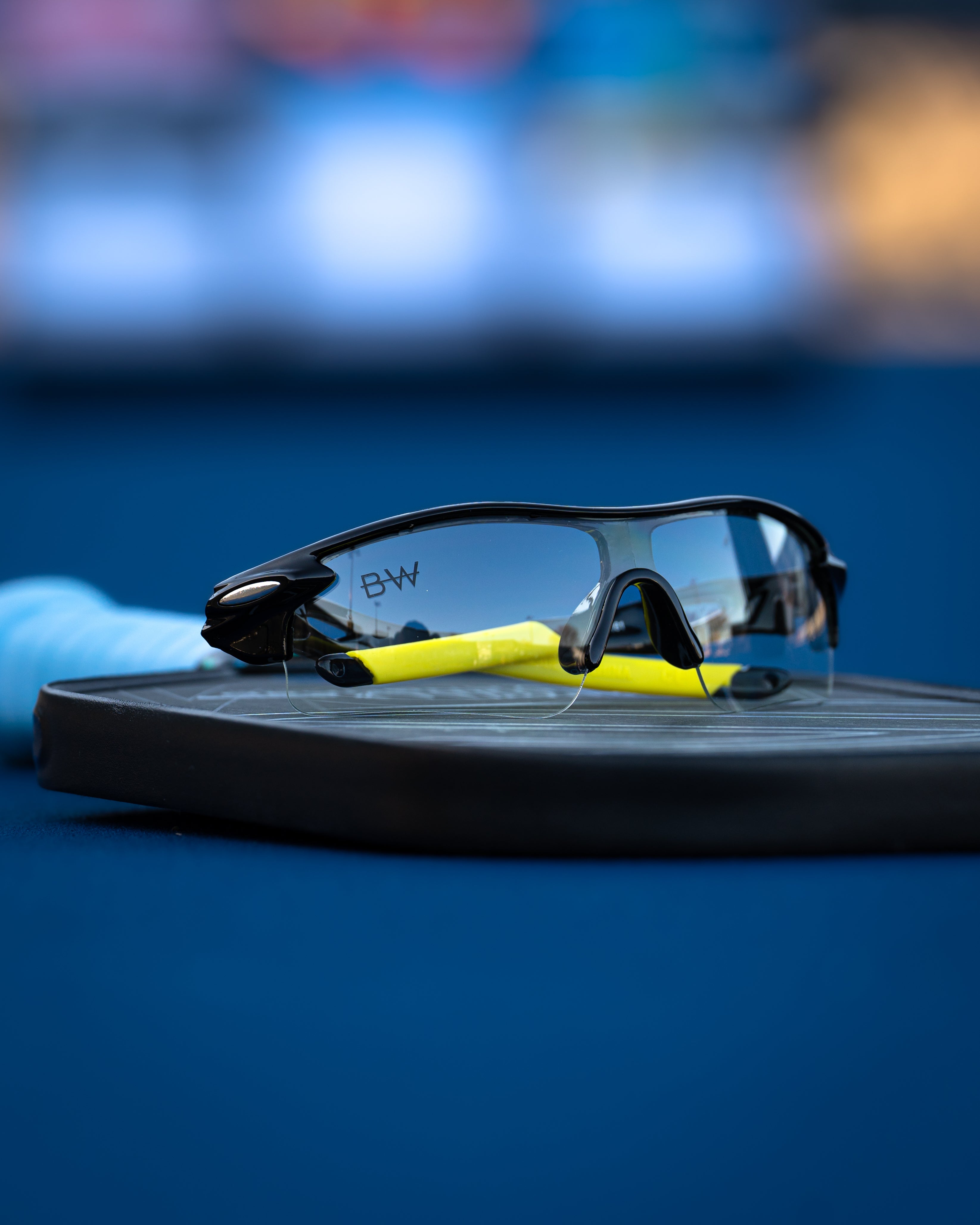
Partner Training While Adjusting to New Prescription Eyewear
Share
Partner Training While Adjusting to New Prescription Eyewear
A new pair of prescription pickleball glasses can feel different the first time you step onto the court. Maybe your prescription changed. Maybe you switched from everyday glasses to dedicated sports eyewear. Or maybe the frame and lens shape simply give you a viewing experience that is different from what you are used to.
Instead of making your first test a competitive doubles match, use a familiar partner and controlled pickleball drills to learn how your new RX eyewear feels during real court movement. Start slowly, progress through different distances and shot types, and increase the pace only when you feel comfortable.
Your partner is useful because they can repeatedly send predictable balls while you concentrate on your new setup. The goal is not to “train your eyes” into accepting an incorrect prescription. It is to become familiar with properly prescribed eyewear while gradually returning to normal pickleball movement, positioning, and pace.
Building a New RX Pickleball Setup?
Why Can New Prescription Glasses Feel Different at First?
There is no universal adjustment experience. Some players put on new prescription eyewear and feel comfortable immediately. Others notice that the new pair feels different from their previous glasses.
Several things may have changed at once:
- Your prescription
- The frame shape
- The size of the lenses
- How the eyewear sits relative to your eyes
- Your viewing habits
- The difference between everyday eyewear and sports-oriented frames
Pickleball can make those differences noticeable because you are not sitting still and looking straight ahead. Your eyes, head, and body are constantly moving while the ball travels through different distances and areas of your visual field.
Why Use a Partner When Trying New RX Pickleball Glasses?
A familiar practice partner gives you something a match cannot: control over the next ball.
Instead of immediately dealing with unpredictable serves, speedups, lobs, poaches, and opponents, you can ask your partner to repeat one shot until you feel comfortable and then gradually increase the difficulty.
| Partner Training Gives You | Why It's Useful With New Eyewear |
|---|---|
| Predictable feeds | You know approximately where the next ball is going |
| Adjustable pace | You can start slowly and increase speed gradually |
| Repeated distances | You can practice at the kitchen, transition zone, and baseline |
| Immediate feedback | Your partner can tell you whether your positioning or timing has changed |
| Lower-pressure environment | You can stop and reassess without worrying about a match score |
That makes partner practice a useful bridge between putting on new eyewear and returning to normal competitive play.
The Goal Is Familiarity—not Forcing an “Adjustment”
It is important to separate normal familiarity with new eyewear from trying to play through a vision problem.
A practice session can help you become accustomed to how a new frame and properly prescribed lenses feel while moving around the court. It should not be used to convince yourself that persistent blur, major distortion, significant discomfort, or other concerning visual symptoms are normal.
Think of the process as testing and familiarization rather than forcing your eyes to adapt at all costs.
The 5-Stage Partner Training Progression for New Prescription Glasses
Instead of starting at full doubles speed, move through five increasingly game-like stages.
| Stage | Drill | Primary Goal |
|---|---|---|
| 1 | Stationary dinking | Get comfortable seeing and contacting a slower ball |
| 2 | Moving dinks | Add lateral movement |
| 3 | Baseline exchanges | Work across a longer court distance |
| 4 | Transition-zone drills | Combine movement with changing ball distance |
| 5 | Controlled game-speed points | Test the setup in more realistic play |
You do not need to complete every stage in one session. Move forward when the current stage feels comfortable.
Drill 1: Start With Stationary Crosscourt Dinks
Begin at the kitchen line with your regular practice partner. Keep the drill deliberately simple.
- Stand in your normal kitchen position.
- Exchange controlled dinks.
- Keep the first several balls comfortably paced.
- Focus on normal technique rather than constantly thinking about the glasses.
- Continue only while the eyewear feels comfortable.
After several minutes, switch between straight-ahead and crosscourt dinks so the ball travels through different areas of your visual field.
This gives you an easy first test before adding aggressive movement or faster shots.
Drill 2: Add Lateral Movement
Once stationary dinking feels normal, ask your partner to move you gradually from side to side.
Do not turn it into a winner-hitting drill. The objective is controlled movement.
- Start near the middle
- Receive a ball slightly to your forehand side
- Recover
- Receive one slightly to your backhand side
- Repeat while maintaining normal footwork
Now your new eyewear is being tested while your eyes, head, and body move together instead of while you remain stationary.
Drill 3: Use a Distance Ladder
Pickleball constantly changes the distance between you and the ball. A simple distance ladder lets you introduce that change gradually.
Round 1: Kitchen
Exchange controlled dinks.
Round 2: Transition Zone
Move backward and exchange controlled balls from midcourt.
Round 3: Baseline
Move to the baseline and exchange comfortable groundstrokes.
Round 4: Move Forward Again
Work your way from the baseline toward the kitchen with controlled shots.
This progression lets you experience your new prescription setup across several normal pickleball distances without immediately adding competitive pressure.
Drill 4: Controlled Block-and-Reset Practice
When slower drills feel comfortable, begin introducing more pace.
Have your partner send controlled drives while you practice blocks and resets. Start below full match speed and increase pace gradually.
Use this drill to evaluate:
- Whether the eyewear remains comfortable as the ball moves faster
- How you feel following shorter-distance exchanges
- Whether normal head movement feels natural
- Whether you are thinking less about the glasses as repetitions continue
The goal is not to prove that your new lenses increase reaction speed. It is to make the practice environment increasingly similar to the situations you normally encounter in a match.
Drill 5: Baseline-to-Kitchen Transition
Now combine distance changes with movement.
- Begin near the baseline.
- Have your partner send a controlled ball.
- Play the shot and move forward appropriately.
- Continue through the transition area.
- Finish the sequence near the kitchen.
- Reset and repeat.
This is a more realistic test because you are no longer viewing the ball from one stationary distance.
Keep the drill controlled at first. Once the new eyewear is no longer occupying much of your attention, increase the pace toward your normal practice intensity.
Drill 6: Don't Forget High Balls and Lobs
Most introductory drills keep the ball relatively low. Before deciding your new RX setup is match-ready, include high balls too.
Ask your partner to send several controlled lobs. Follow the ball upward, reposition, and play the appropriate response without turning the exercise into an all-out overhead competition.
This adds another viewing angle and is particularly useful if you have only tested your new eyewear while looking mostly forward and downward.
Use the Green-Yellow-Red System During Your First Sessions
You do not need to analyze every rally. Use three categories to decide whether to increase the difficulty.
| Status | What You're Experiencing | Training Decision |
|---|---|---|
| Green | Vision and eyewear feel comfortable | Continue or gradually increase pace |
| Yellow | The setup feels noticeably different or you need more time | Stay at the current drill intensity |
| Red | Persistent significant blur, distortion, dizziness, or substantial discomfort | Stop trying to progress the drill and reassess the eyewear |
This keeps the decision focused on how you are actually seeing and feeling rather than following an arbitrary adjustment timeline.
Where Clear RX Lenses Fit Into Partner Training
Clear prescription lenses can be useful when you need corrective eyewear but do not want dark sunglass tint.
That makes clear RX eyewear particularly relevant for partner sessions held:
- Indoors
- In the evening
- Under lower-light conditions
- In environments where you simply prefer an untinted view
A clear lens does not eliminate the possibility that new prescription eyewear may feel different. It simply gives you prescription correction without adding a dark sunglass tint.
Tell Your Doubles Partner You're Testing New Eyewear
Your partner does not need a long explanation. Just tell them you're trying a new prescription setup and want the first few drills to stay controlled.
That makes it easier to:
- Request predictable feeds
- Slow the drill down when necessary
- Repeat a particular shot
- Progress toward game speed gradually
- Stop and check the eyewear without interrupting a competitive match
If you regularly play with the same doubles partner, they may also notice whether your positioning or timing looks different from normal.
Ask Your Partner These 5 Questions
Your partner cannot tell you whether your prescription is correct, but they can observe your pickleball behavior.
- Am I contacting the ball in roughly my normal position?
- Do I look hesitant on balls I normally attack?
- Am I moving differently than usual?
- Am I late on one particular type of shot?
- Do I look more comfortable as the session continues?
Use that feedback as information about your practice—not as a substitute for professional evaluation of your prescription.
New Prescription, New Frame—or Both?
When new sports eyewear feels different, remember that you may have changed more than the prescription.
| What Changed? | What You're Learning During Practice |
|---|---|
| Prescription only | How the updated correction feels during pickleball |
| Frame only | How the new frame feels during movement and extended wear |
| Prescription + frame | How the entire new eyewear setup feels on court |
| Everyday glasses → sports glasses | How a dedicated sports-oriented setup compares with your previous eyewear |
This is another reason controlled partner practice is useful: you can evaluate the complete setup before adding match pressure.
RX Frames to Compare for Your New Pickleball Setup
If you are moving into dedicated prescription pickleball eyewear, Blinded Wear offers multiple frame styles to compare.
Crystal Wave II RX
Crystal Wave II RX gives prescription players another sports-oriented frame option to compare based on its design, available dimensions, and the lens setup offered for the model.
Steel Ice RX
Steel Ice RX is another performance-first frame to consider when moving from everyday glasses into dedicated pickleball eyewear.
Gray Wash RX
Gray Wash RX provides a different aesthetic for players comparing prescription sports frames.
Lava Rock RX
Lava Rock RX gives players another dedicated RX sports-eyewear design to consider.
Blue Shield RX
Blue Shield RX rounds out the comparison with another frame style built around prescription pickleball use.
High-Index Prescription Lenses: What Blinded Wear Includes
Blinded Wear includes high-index prescription lenses at no additional cost with RX eyewear.
You do not need to choose a specific lens index simply because you play pickleball. Your prescription needs come first, while the frame and lens setup determine the sports eyewear you will actually wear on court.
Blinded Wear RX Lenses Are Non-Polarized
Blinded Wear uses non-polarized lenses. These lenses do not add a polarization filter, preserving the visual information available without that filter.
Some court players prefer non-polarized eyewear. It is one characteristic of your new RX setup alongside your prescription, frame choice, and tint preference.
Your First Practice in New RX Pickleball Glasses
Keep the first session structured but simple:
- □ Start with clean lenses
- □ Use a familiar practice partner
- □ Begin with stationary dinks
- □ Add lateral movement
- □ Practice from several court distances
- □ Introduce faster balls gradually
- □ Include baseline-to-kitchen movement
- □ Test several controlled high balls
- □ Pay attention to frame comfort
- □ Progress only when the current pace feels comfortable
Quick Answers About Adjusting to New Prescription Pickleball Glasses
Do new prescription glasses take time to get used to?
Experiences vary. Some people feel comfortable with new eyewear immediately, while others notice that a changed prescription, frame, or complete eyewear setup feels different initially.
Should I play a match immediately in new prescription glasses?
You can first test them in a controlled practice setting if you want to learn how they feel during pickleball before using them in competition.
Why practice with a partner?
A partner can repeatedly send predictable balls while allowing you to control pace, distance, and drill difficulty.
Can partner drills make my prescription correct?
No. Practice helps you become familiar with properly prescribed eyewear; it does not correct an inappropriate prescription.
Should I start with fast volleys?
You can begin with slower, predictable drills and gradually add pace once you feel comfortable.
What is a good first drill with new RX glasses?
Controlled dinking is a simple starting point because you can keep the ball speed and movement predictable before progressing to more game-like situations.
Should I practice lobs in new prescription glasses?
Including controlled high balls can help you experience the eyewear across another normal pickleball viewing angle before competitive play.
Are clear RX lenses good for pickleball practice?
Clear RX lenses provide prescription correction without dark sunglass tint, making them relevant for indoor, evening, and other environments where an untinted setup is preferred.
Do clear lenses improve reaction time?
Clear lenses should not automatically be credited with faster reaction time. Their primary role is providing an untinted lens option.
Does Blinded Wear use 1.61 lenses?
Blinded Wear includes high-index prescription lenses at no additional cost. A specific lens index should not be assumed unless it is verified for the individual order or product.
What if my new glasses remain significantly blurry or uncomfortable?
If substantial blur, distortion, dizziness, or other concerning visual symptoms persist, do not use pickleball drills simply to force yourself through the problem.
From Controlled Dinks to Normal Doubles
The first session is about learning the new setup, not proving how quickly you can reach full match intensity. A familiar partner gives you control over ball speed, distance, movement, and repetition while you determine how your new prescription eyewear feels during actual pickleball.
Part 2 will build this into a multi-session RX adjustment plan, kitchen-to-baseline progression, partner feeding patterns, movement tests, doubles communication drills, match-readiness checklist, common adjustment mistakes, and a practical system for deciding when your new prescription eyewear has become something you can stop thinking about and simply play in.
A 3-Session Partner Plan for New Prescription Pickleball Glasses
You do not need to follow a rigid number of days before using new RX eyewear normally. A better approach is to progress based on what actually feels comfortable during pickleball.
Use three practice sessions as checkpoints rather than mandatory stages. If everything feels natural sooner, you may progress sooner. If the eyewear continues to feel noticeably different, keep the drills controlled until you are comfortable.
| Session | Primary Focus | Typical Drills | Progress When... |
|---|---|---|---|
| Session 1 | Familiarity | Dinks, controlled groundstrokes, basic movement | The eyewear feels comfortable during predictable shots |
| Session 2 | Movement + pace | Resets, transitions, lateral movement, controlled drives | You can move and follow faster balls without focusing heavily on the glasses |
| Session 3 | Game-like play | Random feeds, doubles patterns, controlled points | Your attention has shifted back toward normal pickleball decisions |
The most useful sign of progress is often simple: you start thinking more about the rally than about the fact that you're wearing new glasses.
Session 1: Learn the New RX Setup Without Chasing Winners
Your first partner session should answer one question: how does the complete eyewear setup feel during ordinary pickleball movement?
Start with approximately 10 to 15 minutes of controlled work rather than jumping directly into competitive points.
Phase 1: Stationary Dinks
Exchange comfortable dinks from the kitchen. Mix forehand and backhand contacts while keeping the ball predictable.
Phase 2: Side-to-Side Dinks
Have your partner gradually widen the feed. Move laterally, recover toward your normal position, and repeat.
Phase 3: Baseline Groundstrokes
Back up and exchange controlled drives from longer distance. The objective is not power. You are simply adding another common viewing distance.
Phase 4: High Balls
Finish with several controlled lobs or higher balls so your first test is not limited to shots traveling directly in front of you.
If everything feels comfortable, that is useful information. You do not need to manufacture an adjustment period that you are not actually experiencing.
The Kitchen-to-Baseline Vision Ladder
One of the easiest ways to structure partner training is to change only one variable at a time: your position on the court.
- Kitchen: exchange 20 controlled dinks.
- One step behind the kitchen: exchange another 20 balls.
- Transition zone: work controlled resets and neutral balls.
- Near the baseline: exchange comfortable groundstrokes.
- Baseline: complete another controlled rally.
- Reverse the sequence: gradually work your way forward again.
This gives you repeated exposure to several normal pickleball distances without introducing every match variable at once.
Give Your Partner a Feed Map
Random balls are useful later. Early in the process, predictable feeds make it easier to isolate how the new eyewear feels.
| Feed | Partner Sends... | You Practice... |
|---|---|---|
| A | Comfortable ball to forehand | Normal contact and recovery |
| B | Comfortable ball to backhand | Normal contact and recovery |
| C | Slightly wider forehand | Lateral movement |
| D | Slightly wider backhand | Lateral movement |
| E | Shorter ball | Forward movement |
| F | Deeper ball | Backward adjustment |
| G | Controlled high ball | Looking upward and repositioning |
Run each feed several times before mixing them together. Predictability first, randomness later.
Session 2: Add Movement and Ball Speed
Once controlled shots feel comfortable, the second session can look more like normal pickleball.
Your partner can begin varying:
- Ball speed
- Forehand and backhand placement
- Short and deep feeds
- Your position on the court
- Height of the ball
- Time available before contact
Do not change all six simultaneously. Add one or two variables, establish comfort, and then continue.
The 4-Level Block-and-Reset Progression
Short-distance exchanges are an important step between slow dinking and unrestricted doubles play.
Level 1: Predictable Forehand Feed
Your partner sends a controlled drive toward the same general location. Block or reset it.
Level 2: Predictable Backhand Feed
Repeat on the other side.
Level 3: Forehand or Backhand
Your partner chooses between the two, requiring you to recognize the incoming direction rather than knowing it in advance.
Level 4: Variable Controlled Drive
Your partner can vary location and pace while remaining below an all-out speedup drill.
When that progression feels normal, you have moved considerably closer to the visual demands of an actual doubles exchange.
The Transition-Zone Gauntlet
The transition zone is useful because you are moving while the distance between you, your partner, and the ball continues to change.
Try this sequence:
- Begin at the baseline.
- Your partner feeds a controlled ball.
- Play the shot and move forward.
- Partner sends the next ball toward your transition position.
- Reset or play a controlled response.
- Continue moving forward when appropriate.
- Finish at the kitchen.
- Return to the baseline and repeat.
Run several repetitions through the forehand side, several through the backhand side, and then let your partner vary the feeds.
Test More Than Straight-Ahead Vision
Pickleball does not keep your head locked in one position. A useful practice session should include the normal directions you look during play.
| Viewing Situation | Simple Partner Drill |
|---|---|
| Straight ahead | Controlled baseline rally |
| Side to side | Alternating forehand/backhand feeds |
| Upward | Controlled lobs |
| Forward movement | Baseline-to-kitchen progression |
| Backward movement | Controlled deeper feed or lob with appropriate repositioning |
| Rapid short-distance exchanges | Progressive block-and-reset drill |
This gives you a more complete test of the eyewear than simply hitting 100 balls from one stationary position.
Are You Adjusting to the Prescription—or Simply Noticing a New Frame?
Sometimes what feels “new” is not the prescription itself.
You may be noticing:
- A different frame shape
- A different lens size
- A different frame weight
- The position of the frame in your visual field
- How the eyewear feels during head movement
- A sports frame replacing the everyday glasses you normally wear
During your second session, periodically ask yourself whether you are actually having difficulty seeing or whether you are simply still aware that a different piece of eyewear is on your face.
Those are not necessarily the same problem.
Stop Checking Your Glasses After Every Shot
There is a point where constantly evaluating your eyewear can become distracting.
Instead of asking, “How do these lenses feel?” after every rally, establish scheduled checkpoints:
- Before warmup
- After the first drill
- After adding movement
- After adding faster balls
- At the end of the session
Between those checkpoints, play.
If you can complete several minutes of practice and realize you barely thought about the glasses, that itself is useful feedback.
Add Doubles Communication Before You Add Full Competition
New eyewear should eventually be tested while your attention is divided between the ball, your partner, opponents, court positioning, and shot selection.
You can begin introducing that complexity without playing a full match.
Middle-Ball Drill
Have a third player or feeder send balls toward the middle while you and your partner practice making clear calls.
Switch Drill
Practice a few controlled sequences where one partner moves and the other responds to the open space.
Leave/Take Drill
Have your partner alternate between balls you should play and balls they will take, forcing you to process both the ball and your teammate's position.
The objective is to return your attention to doubles decision-making rather than making the eyewear the center of every repetition.
Session 3: Make the Ball Less Predictable
By the third stage, your partner should stop telling you exactly where every ball is going.
Try a random-feed sequence:
- Begin at the kitchen.
- Your partner chooses a dink to either side.
- After several balls, they may send a deeper controlled ball.
- Reset the rally and continue.
- Add an occasional higher ball.
- Gradually increase the pace.
Now you are reacting to the rally instead of following a predetermined script.
If your eyewear remains comfortable while the practice itself becomes the focus, you are moving toward a much more realistic test.
The Controlled 11-Point Test
Before jumping into serious competition, play a practice game with your regular partner or training group.
Keep normal scoring, but treat the first game as an equipment test rather than a must-win match.
During the game, notice whether you can comfortably handle:
- Serves
- Returns
- Third shots
- Dinks
- Volleys
- Speedups
- Lobs
- Transitions
- Side-to-side movement
- Doubles communication
At the end of the game, evaluate the session as a whole rather than judging the eyewear based on one missed ball.
Was That Missed Ball Actually Your New Prescription?
Putting on new glasses can make it tempting to blame every mistake on the eyewear.
Use a pattern-based approach instead.
| What Happened? | Better Question |
|---|---|
| One mistimed dink | Was this simply a normal pickleball error? |
| One late volley | Was I positioned correctly and ready? |
| Several similar problems | Is there a repeatable pattern worth investigating? |
| Persistent blur | Does the vision itself continue to seem unclear? |
| Significant distortion or dizziness | Should I stop trying to progress the practice? |
One missed shot tells you very little. Repeated visual difficulty is much more useful information.
When Are Your New RX Glasses Ready for Normal Doubles?
There is no mandatory number of practice hours. Use functional checkpoints instead.
- □ Controlled dinking feels comfortable
- □ Baseline exchanges feel comfortable
- □ You can move laterally without focusing on the eyewear
- □ Transition-zone movement feels normal
- □ You have tested higher balls
- □ Faster exchanges feel manageable
- □ You can communicate with your partner while following the rally
- □ You are no longer constantly checking the glasses
- □ The frame remains comfortable through a normal session
- □ Your attention is primarily back on pickleball
If those statements describe your practice, the eyewear is becoming part of your normal equipment rather than the subject of the session.
8 Mistakes to Avoid When Training in New Prescription Eyewear
-
Starting with the fastest drill you know.
Controlled repetitions give you a cleaner first test.
-
Changing several variables simultaneously.
Add movement, speed, distance, and randomness progressively.
-
Blaming every mistake on the glasses.
Look for repeated patterns rather than isolated misses.
-
Forcing yourself through significant discomfort.
Training is for familiarization, not proving that you can ignore persistent visual problems.
-
Only practicing from one court position.
Test the eyewear at the kitchen, transition zone, baseline, and on higher balls.
-
Testing new glasses for the first time during an important match.
A controlled practice gives you a lower-pressure opportunity to learn the setup.
-
Constantly thinking about the eyewear.
Use periodic checkpoints and spend the rest of the session actually playing.
-
Assuming every player needs the same adjustment period.
Some players may feel comfortable quickly, while others may want additional time.
Clear RX or Tinted RX for Your Practice Sessions?
The answer depends largely on where and when you train.
| Training Environment | Lens Setup to Consider |
|---|---|
| Indoor court | Clear RX if you prefer an untinted setup |
| Evening practice | Clear RX can provide an untinted option |
| Lower-light outdoor session | Consider whether you prefer clear or your current tint |
| Bright outdoor daytime practice | Use the outdoor lens setup you personally prefer |
| Mixed indoor/outdoor training | Some players may prefer separate lens setups |
Clear lenses do not automatically increase available light, improve contrast, or make reactions faster. They simply give prescription players an option without dark sunglass tint.
Compare RX Frames Before Making One Your Regular Training Pair
If you're moving from ordinary glasses into dedicated pickleball eyewear, choose the frame based on more than a single practice session.
| RX Frame | What to Compare |
|---|---|
| Crystal Wave II RX | Design, available dimensions, prescription needs, and lens setup |
| Steel Ice RX | Design, available dimensions, prescription needs, and lens setup |
| Gray Wash RX | Design, available dimensions, prescription needs, and lens setup |
| Lava Rock RX | Design, available dimensions, prescription needs, and lens setup |
| Blue Shield RX | Design, available dimensions, prescription needs, and lens setup |
When exact fit information is available, compare the frame measurements with eyewear you already know fits you comfortably.
Use a Simple Training Log Instead of Guessing
If the new prescription setup feels noticeably different, record a few observations after each session.
| Session | Drills Completed | Comfort 1–5 | Any Repeatable Issue? | Ready for More Pace? |
|---|---|---|---|---|
| 1 | __________ | _____ | __________ | Yes / Not Yet |
| 2 | __________ | _____ | __________ | Yes / Not Yet |
| 3 | __________ | _____ | __________ | Yes / Not Yet |
You are looking for trends. If the eyewear becomes less noticeable while normal pickleball feels increasingly natural, that is more informative than trying to decide how well the glasses work after the first five minutes.
Starting With Your First Pair of RX Pickleball Glasses?
Blinded Wear RX eyewear is designed with pickleball players in mind and combines lightweight sports frames with impact-resistant, non-polarized lenses.
High-index prescription lenses are included at no additional cost.
To order:
- Browse the RX Pickleball Glasses Collection.
- Choose the frame you prefer.
- Compare available dimensions when provided.
- Have your eyeglass prescription ready.
- Upload a clear photo or picture of your prescription before purchasing.
- Complete your order.
More Questions About Training in New Prescription Pickleball Glasses
How long should I practice in new prescription glasses before playing a match?
There is no universal number of sessions. Some players may feel comfortable quickly, while others may prefer controlled practice before returning to full match intensity.
How do I get used to new prescription glasses for pickleball?
Start with predictable shots and gradually add distance, movement, ball speed, and randomness. A familiar practice partner makes those variables easier to control.
Can I practice pickleball the same day I get new glasses?
If the eyewear feels comfortable and you can see appropriately through it, a controlled practice can be a useful way to experience the new setup on court. You do not need to force full-intensity play immediately.
Why does the pickleball look different through new glasses?
A changed prescription, frame, lens size, or complete eyewear setup may create a different viewing experience from the glasses you previously wore.
Should I dink first when trying new RX sports glasses?
Controlled dinking is a useful starting drill because it keeps the ball relatively predictable while you become familiar with the eyewear.
When should I add faster volleys?
Add pace after controlled exchanges and normal movement feel comfortable. You can increase speed gradually instead of jumping immediately into maximum-intensity hand battles.
Should my partner feed the same shot repeatedly?
Predictable repetition can be useful early. Later, your partner can randomize direction, depth, height, and pace to make the practice more game-like.
How do I know whether a miss came from my glasses?
A single missed ball does not establish much. Look for repeatable visual difficulties or patterns rather than attributing every normal pickleball error to new eyewear.
Can new prescription glasses affect how the court looks?
A new prescription or different frame and lens configuration can feel different from your previous eyewear. Controlled practice lets you evaluate that experience across normal court positions.
Are high-index lenses included with Blinded Wear RX glasses?
Yes. Blinded Wear includes high-index prescription lenses at no additional cost with RX eyewear.
Are Blinded Wear RX lenses polarized?
No. Blinded Wear uses non-polarized lenses.
Are Blinded Wear lenses impact-resistant?
Yes. Blinded Wear sports eyewear uses impact-resistant lenses.
Should I train indoors with clear prescription lenses?
If you require prescription correction and prefer not to wear dark sunglass tint indoors, clear RX eyewear is one option to consider.
What if my new prescription still feels significantly wrong after practice?
Practice is not intended to correct an inappropriate prescription. Persistent significant blur, distortion, dizziness, or substantial discomfort should not simply be treated as a pickleball training problem.
Next Step: Stop Testing the Glasses and Start Playing Pickleball
The progression has now moved from predictable dinks to movement, transitions, faster exchanges, random feeds, doubles communication, and controlled game play. At that point, the goal changes.
You do not want every future practice to remain an eyewear test. You want the new RX pair to become normal equipment.
Part 3 will finish the guide with a match-readiness test, first competitive-session plan, partner feedback scorecard, tournament transition strategy, RX troubleshooting matrix, final buying checklist, expanded FAQ, Blinded Wear shopping resources, replacement support, and a final step-by-step plan for making new prescription eyewear part of your regular pickleball routine.
The Final Match-Readiness Test for New RX Pickleball Glasses
Before making your first competitive session the final experiment, run one practice that combines everything you have tested so far.
Your eyewear does not need to feel invisible in a literal sense. The goal is for it to stop demanding your attention while you serve, move, communicate, make decisions, and play points.
| Match Skill | Ready? | What You're Looking For |
|---|---|---|
| Serving | □ | Normal setup and contact |
| Returning | □ | Comfort following the incoming serve |
| Baseline exchanges | □ | Comfort at longer court distances |
| Transition movement | □ | Normal movement toward the kitchen |
| Dinking | □ | Comfort during controlled short-court exchanges |
| Fast volleys | □ | Comfort as ball speed increases |
| Lobs and high balls | □ | Comfort following the ball upward |
| Lateral movement | □ | Normal side-to-side court movement |
| Partner communication | □ | Your attention can include your teammate and court positioning |
| Full points | □ | You are thinking primarily about pickleball rather than the eyewear |
If most of these situations feel normal, there may be little reason to keep treating every session as an adjustment drill.
Your First Competitive Session in New Prescription Eyewear
Your first competitive session does not need a completely different routine. Use the same progression you already established during partner practice.
Before Warmup
- Start with clean lenses
- Make sure the frame feels comfortable
- Use the prescription setup you practiced in
- Bring backup corrective eyewear when appropriate
During Warmup
Do not spend the entire warmup analyzing your glasses. Hit several familiar shots from different court positions and confirm that the setup feels consistent with practice.
During the Match
Play pickleball.
Focus on serves, returns, positioning, communication, shot selection, and the score instead of checking your eyewear after every missed ball.
Between Games
If something genuinely feels different, use the break to reassess. Otherwise, continue with your normal routine.
After the Session
Evaluate the entire experience rather than one rally. Ask whether there was a repeatable issue or whether the new eyewear simply became part of your equipment.
The Partner Feedback Scorecard
Your doubles partner cannot evaluate your prescription, but someone who regularly plays with you may notice changes in your normal court behavior.
After a practice session, ask them to score these areas based on what they observed:
| Observation | Normal | Slightly Different | Noticeably Different |
|---|---|---|---|
| Kitchen positioning | □ | □ | □ |
| Timing on volleys | □ | □ | □ |
| Lateral movement | □ | □ | □ |
| Transition movement | □ | □ | □ |
| Communication | □ | □ | □ |
| Confidence attacking normal balls | □ | □ | □ |
| Overall movement | □ | □ | □ |
One unusual shot is not particularly informative. Repeated changes across several drills or sessions are more useful to notice.
What Your Partner Can—and Cannot—Tell You
| Your Partner Can Observe... | Your Partner Cannot Determine... |
|---|---|
| Whether you seem hesitant | Whether your prescription is clinically correct |
| Whether your positioning looks different | The cause of persistent visual symptoms |
| Whether you are late on repeated balls | Whether an eye-care issue is present |
| Whether your normal movement has changed | Whether you simply need a different prescription |
| Whether you seem increasingly comfortable | How your vision actually looks through the lenses |
Use your partner as a source of pickleball feedback—not as a replacement for appropriate vision care.
New RX Glasses Before a Tournament? Build Familiarity Before Competition
If possible, give yourself an opportunity to use new prescription sports eyewear during normal practice before making an important tournament its first major court test.
A simple tournament preparation sequence can look like this:
- Controlled partner practice: dinks, groundstrokes, transitions, and high balls.
- Higher-speed practice: drives, blocks, resets, and faster exchanges.
- Randomized practice: let your partner vary placement and shot type.
- Practice game: play normal points and scoring.
- Normal doubles session: use the eyewear without making it the focus.
- Tournament: arrive already familiar with the setup.
You do not need to follow an arbitrary number of days between each stage. The point is simply to avoid making high-pressure competition your only opportunity to learn how the eyewear feels during pickleball.
Bring Backup Corrective Eyewear on Tournament Day
If you rely on prescription correction to play, consider bringing another source of corrective vision to longer events.
Your backup can be especially useful during:
- All-day tournaments
- Multi-day events
- Travel competitions
- Indoor/outdoor events
- Sessions that extend from daytime into evening
The backup pair does not need to be identical to your primary sports eyewear. Its role is redundancy if your primary pair becomes unavailable.
New Prescription Pickleball Glasses Troubleshooting Matrix
If something feels wrong, identify the pattern instead of simply deciding that you “aren't adjusted yet.”
| What You Notice | First Thing to Check | Next Move |
|---|---|---|
| Lens looks smeared | Lens cleanliness | Clean the lenses appropriately and reassess |
| Frame feels unfamiliar | Whether vision itself is actually unclear | Continue controlled familiarization if otherwise comfortable |
| One type of shot feels awkward | Whether the issue repeats | Use predictable partner feeds to test that specific situation |
| Fast exchanges feel difficult | Whether slower drills feel comfortable | Reduce pace and progress gradually |
| High balls feel different | Whether you have practiced that viewing angle | Add controlled lobs and overhead situations |
| Persistent significant blur | Whether it occurs outside pickleball too | Do not rely on more drills to force the problem away |
| Significant distortion or dizziness | Your visual experience through the eyewear | Stop increasing training intensity and reassess the eyewear |
| Everything feels normal | Nothing | Stop testing and play |
Use Repetition to Investigate One Specific Problem
If one shot repeatedly feels unusual, partner training becomes particularly useful because you can recreate it.
Having Trouble With Dinks?
Have your partner repeatedly send controlled balls into the same kitchen area.
Having Trouble With Drives?
Move to the baseline and exchange predictable groundstrokes before randomizing placement.
Having Trouble With Fast Volleys?
Begin with controlled drives and increase the pace gradually.
Having Trouble With Lobs?
Ask for controlled high feeds and repeat the movement.
Having Trouble During Transitions?
Run the same baseline-to-kitchen sequence several times.
If a difficulty is repeatable, structured practice gives you better information than trying to diagnose it from random points during a match.
Test the Glasses Where You Actually Play
A pair of prescription sports glasses should eventually be tested in your normal pickleball environment.
If your schedule includes multiple environments, consider trying the eyewear across them:
| Environment | What You're Evaluating |
|---|---|
| Indoor facility | How the complete RX setup feels during indoor play |
| Outdoor daytime | Your preferred lens setup in daytime conditions |
| Overcast outdoor court | Whether your tint preference changes |
| Evening play | Whether you prefer an untinted option |
| Tournament session | Extended-wear comfort across multiple matches |
A player who only practices indoors may have different eyewear preferences from someone who plays almost exclusively outside during the day.
Clear RX Lenses for Indoor and Evening Partner Training
If you require prescription correction but do not want dark sunglass tint during indoor or evening practice, clear RX lenses provide a straightforward alternative.
Clear lenses can fit naturally into:
- Indoor drilling sessions
- Evening partner practice
- Lower-light court environments
- Indoor leagues
- Players who simply prefer an untinted lens
The benefit does not need to be exaggerated. Clear lenses provide an untinted prescription option; your training, anticipation, technique, positioning, and decision-making remain your job.
Buying Your First Dedicated RX Pickleball Glasses? Use This Checklist
- □ Start with your prescription needs
- □ Decide where you play most often
- □ Decide whether you prefer clear or tinted lenses in that environment
- □ Compare sports-frame designs
- □ Review available frame dimensions
- □ Compare those measurements with eyewear that already fits you
- □ Consider frame weight for extended sessions
- □ Plan a controlled first practice
- □ Use a familiar partner for predictable feeds
- □ Progress from slower shots toward normal game speed
What Blinded Wear RX Pickleball Eyewear Includes
Blinded Wear prescription sports eyewear is built around a straightforward set of features for pickleball players:
- Designed with pickleball players in mind
- Lightweight sports frames
- Impact-resistant lenses
- Non-polarized lenses
- Comfort for extended matches
- Performance-first design
- Options for recreational and competitive players
- High-index prescription lenses included at no additional cost
These features give you the eyewear foundation. Partner training then gives you a controlled environment for becoming familiar with your particular frame and prescription setup.
How to Order Your Blinded Wear RX Pickleball Glasses
Once you've chosen your frame, the prescription process is simple.
- Choose your preferred RX frame.
- Review available product information and dimensions.
- Have your current eyeglass prescription ready.
- Take a clear photo or picture of the prescription.
- Upload it before purchasing.
- Complete your order.
High-index prescription lenses are included at no additional cost with Blinded Wear RX eyewear.
FAQ: New Prescription Glasses, Pickleball Training, and Partner Drills
How long does it take to adjust to new prescription pickleball glasses?
There is no universal timeline. Some players may feel comfortable quickly, while others may want additional time to become familiar with a changed prescription, frame, or complete eyewear setup.
Do I need to wait before playing pickleball in new prescription glasses?
There is no arbitrary pickleball waiting period. A controlled practice can help you determine how the new eyewear feels before using it in more competitive situations.
What is the best first drill for new RX glasses?
Controlled dinking is a practical starting point because your partner can keep the ball speed and placement predictable.
Why is partner practice useful with new prescription eyewear?
A partner allows you to control repetition, speed, distance, direction, and drill difficulty while gradually making practice more game-like.
Can partner drills help me adjust faster?
Partner drills provide a structured way to become familiar with new eyewear during pickleball. They should not be treated as a guaranteed method for accelerating visual adaptation.
Can practice fix an incorrect prescription?
No. Training can help you become familiar with appropriately prescribed eyewear, but it cannot make an incorrect prescription correct.
Should I start with dinks or drives?
Dinks provide an easy controlled starting point. Drives can be added later as you increase distance and pace.
When should I practice fast hands?
Once slower short-distance exchanges feel comfortable, gradually increase the pace through blocks, resets, and controlled volley drills.
Should I practice lobs with new glasses?
Controlled lobs are useful for testing another normal pickleball viewing angle before returning to unrestricted play.
How do I know when I'm ready for a match?
Look for functional signs: different court distances feel comfortable, movement feels normal, faster exchanges are manageable, and your attention has returned primarily to playing pickleball.
Why do my new glasses feel different when I move my head?
A changed prescription, frame design, lens size, and the way the complete eyewear setup sits relative to your eyes can make new glasses feel different from a previous pair.
What if only one type of pickleball shot feels unusual?
Use your partner to repeat that specific situation under controlled conditions and determine whether there is a consistent pattern.
Should I blame a missed ball on my new prescription?
One missed ball provides very little information. Normal pickleball errors happen. Repeated visual difficulties are more useful to notice.
Are clear RX lenses good for indoor pickleball practice?
Yes. Clear RX lenses provide prescription correction without dark sunglass tint for players who prefer an untinted setup indoors.
Can clear prescription lenses improve my reaction time?
Clear lenses should not automatically be credited with faster reaction time. Reaction involves recognition, anticipation, decision-making, movement, and execution.
Do non-polarized lenses improve depth perception?
Non-polarized lenses do not inherently improve depth perception. They simply do not add a polarization filter, and some court players prefer that setup.
Are Blinded Wear RX lenses impact-resistant?
Yes. Blinded Wear sports eyewear uses impact-resistant lenses.
Does impact-resistant mean shatterproof?
No. Impact-resistant should not be interpreted as a claim that the eyewear is shatterproof or certified protective equipment.
Does Blinded Wear include high-index prescription lenses?
Yes. High-index prescription lenses are included at no additional cost with Blinded Wear RX eyewear.
Do I need a specific high-index number for pickleball?
A specific lens index should not automatically be selected simply because you play pickleball. Blinded Wear includes high-index prescription lenses, while your individual prescription requirements remain the starting point.
What should I do if my new glasses remain significantly blurry or distorted?
Do not keep increasing practice intensity simply to force yourself through persistent significant blur, distortion, dizziness, or substantial discomfort. Training is intended for familiarization with appropriately prescribed eyewear.
Find Your Next Pickleball Eyewear Setup
Replacement Support for Your Regular Training Pair
Once your new RX eyewear becomes your regular pickleball pair, it may see substantial use across drills, open play, leagues, and tournaments.
Blinded Wear offers 50% lifetime replacement support if your glasses break, subject to current policy terms.
Train With Purpose On and Off the Court
Blinded Wear designs performance-first eyewear with pickleball players in mind, including prescription, non-prescription, and clear-lens options for different players and environments.
The brand also supports a broader mission connected to children's vision.
The Complete New-RX Pickleball Training Plan
If you want one sequence to remember, use this:
- Put on your new prescription eyewear and start with clean lenses.
- Train with a familiar partner.
- Begin with predictable dinks.
- Add forehand and backhand movement.
- Move from the kitchen toward the baseline.
- Add transition-zone repetitions.
- Practice controlled high balls and lobs.
- Increase ball speed gradually.
- Let your partner randomize the feeds.
- Add doubles communication and positioning.
- Play controlled points.
- Play a normal practice game.
- Look for patterns rather than blaming individual mistakes on the glasses.
- Once everything feels comfortable, stop testing the eyewear and return your attention to pickleball.
Final Word: Your Partner Helps Make New RX Eyewear Feel Like Normal Equipment
The purpose of partner training is not to magically recalibrate your vision or guarantee that you will adapt to any pair of glasses. Its value is much more practical.
A familiar partner lets you control the court.
You can start with a slow dink. Repeat the same ball. Move laterally. Back up toward the baseline. Work through the transition zone. Follow a lob. Add a faster drive. Randomize the feed. Communicate through a doubles sequence. Then play a point.
Each step removes a little more predictability until you are eventually playing normal pickleball again.
If your new prescription eyewear feels comfortable throughout that progression, there is no reason to keep making the glasses the center of your attention.
The end goal of adjusting to new RX pickleball glasses is simple: stop thinking about the eyewear and start thinking about the next ball.