
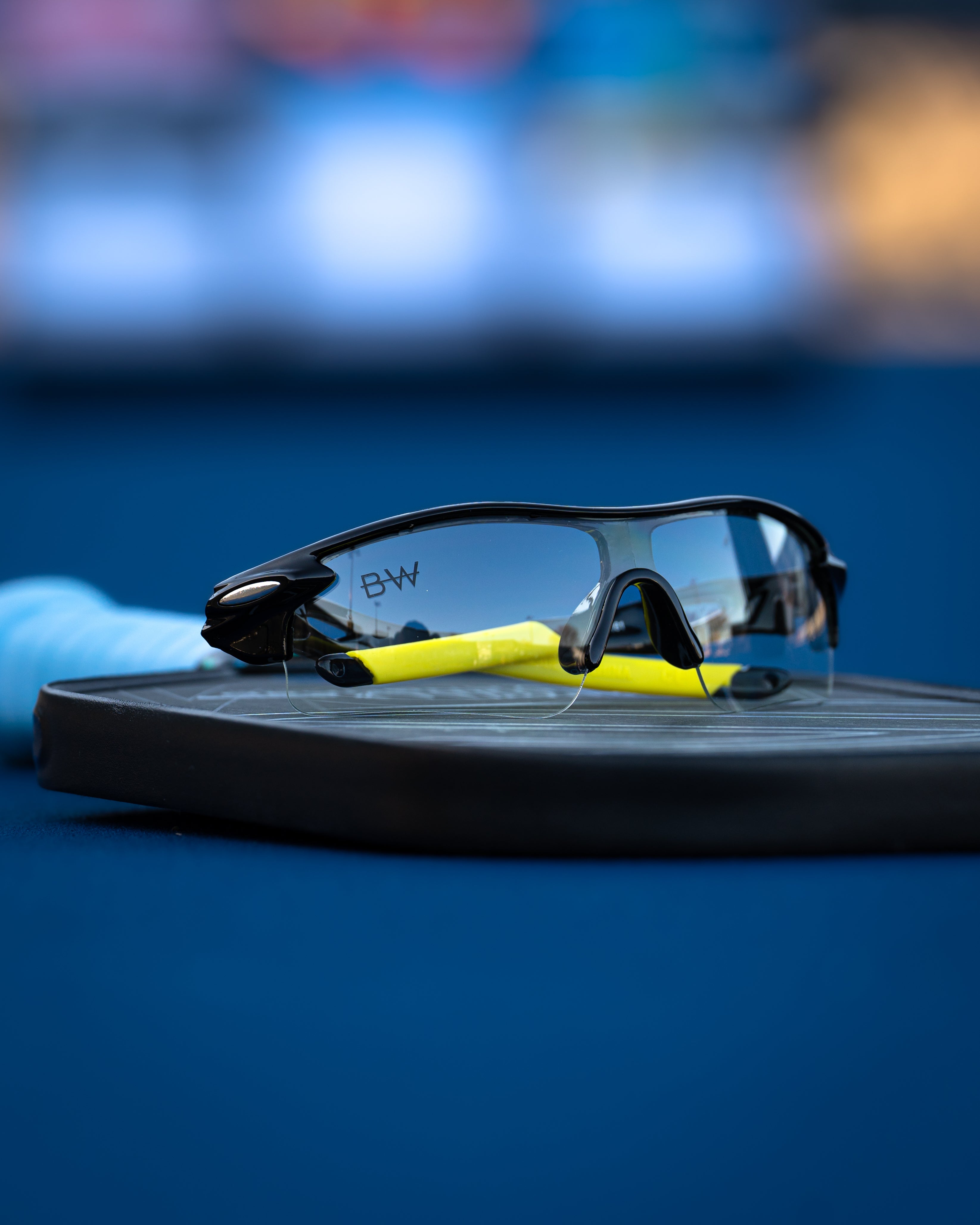
Playing Pickleball at Dusk? RX Glasses That Adapt
Share
Playing Pickleball at Dusk? RX Glasses That Adapt
Playing pickleball at dusk creates a specific eyewear problem: the lighting can change significantly during the same match. You may start while the court is still bright, move through sunset and shadows, and finish under artificial court lights.
For players who need vision correction, that makes choosing the right prescription pickleball glasses for dusk especially important. Your eyewear needs to provide your prescription while also matching the amount of available light.
This guide compares clear, gray, and transition RX lenses for evening pickleball, explains what matters when choosing prescription sports eyewear for changing light, and helps you decide which option makes the most sense for the conditions you actually play in.
Looking for RX Pickleball Glasses?
If you already know you need prescription eyewear, start by comparing Blinded Wear's RX options or use the pickleball eyewear guide to narrow your choices.
Why Pickleball at Dusk Creates a Different Eyewear Challenge
Midday outdoor pickleball and evening pickleball do not present identical lighting conditions. During a dusk session, the amount and direction of available light can change while you are still on the court.
That matters because pickleball requires you to continually follow a relatively small, fast-moving ball across different backgrounds and distances. Your prescription still needs to provide the correction you require, but your lens tint also needs to make sense for the available light.
Changing Light Levels
A match that begins before sunset may continue after the sun drops below surrounding buildings or trees. Courts may then rely increasingly on overhead lighting.
A dark sunglass lens that was comfortable earlier in the session can therefore become less practical as natural light decreases.
Shadows Across the Court
Low-angle sunlight can create uneven lighting, with portions of the court receiving direct light while other areas fall into shadow. This is one reason players who regularly play around sunset should think beyond simply choosing the darkest available sunglass tint.
Outdoor Light Can Become Artificial Light
Evening sessions may eventually transition almost completely to court lighting. If you frequently play from late afternoon through nighttime, your lens choice should account for the entire session rather than only the conditions present when you first arrive.
What Are the Best RX Lenses for Pickleball at Dusk?
There is no single lens type that is automatically best for every player. The right choice depends on when you begin playing, how quickly conditions change, whether your court has artificial lighting, and how much tint you prefer.
For dusk pickleball, three options are particularly relevant: clear prescription lenses, gray prescription lenses, and transition prescription lenses.
| RX Lens Option | Best Suited For | Main Advantage | Consider Before Choosing |
|---|---|---|---|
| Clear RX | Low light, nighttime and indoor play | Does not intentionally darken your view | Does not provide sunglass tint in bright outdoor conditions |
| Gray RX | Brighter outdoor portions of evening play | Provides a neutral sunglass tint | Fixed tint remains as natural light decreases |
| Transition RX | Sessions that move through changing outdoor light | Changes tint in response to light conditions | Performance depends on the specific lens and environment |
Clear RX Lenses for Evening Pickleball
Clear prescription lenses are a straightforward choice when most of your pickleball happens after sunset, at night, or indoors.
Because a clear lens does not intentionally add a dark sunglass tint, it can make more sense once available natural light becomes limited.
Who Should Consider Clear RX Pickleball Glasses?
- Players who usually begin playing around or after sunset
- Players who primarily use illuminated outdoor courts at night
- Indoor pickleball players who also want to use the same RX sports eyewear
- Players who do not need a dark tint during their normal playing conditions
The tradeoff is simple: if your match begins while the sun is still bright, clear lenses do not provide the same tinted experience as sunglasses.
Gray RX Lenses for Late-Afternoon Pickleball
Gray prescription sunglass lenses may make sense when most of your session still takes place in relatively bright outdoor conditions.
Unlike a transition lens, a standard gray tint remains tinted as conditions change. That simplicity can work well when the lighting during your normal playing window stays fairly consistent.
When Gray RX Lenses Make Sense
- You usually finish playing before it becomes genuinely dark
- Your court remains relatively bright throughout the match
- You prefer a consistent sunglass tint
- Your primary use is still daytime or late-afternoon outdoor pickleball
If your matches regularly continue well beyond sunset, however, consider whether you want to keep wearing the same fixed tint as ambient light decreases.
Are Transition RX Lenses Good for Pickleball at Dusk?
Transition prescription lenses can be particularly appealing for pickleball sessions that begin in brighter outdoor conditions and continue as natural light decreases.
Instead of maintaining one fixed tint, photochromic or transition lenses change tint in response to light conditions. That makes them worth considering for players who do not want to carry separate prescription sunglasses and clear prescription sports glasses for different portions of an evening session.
Why Transition RX Lenses Can Be Convenient
- One RX pair can cover a broader range of outdoor lighting conditions
- The tint can change as the environment changes
- You do not have to manually swap between separate clear and tinted RX pairs simply because sunset is approaching
- They can be convenient for long outdoor sessions that begin before dusk
What Should You Know Before Buying Transition Lenses?
Transition performance is not identical in every environment. How dark a photochromic lens becomes and how quickly it changes can depend on the specific lens technology, UV exposure, temperature, and surrounding conditions.
That is why it is better to choose transition lenses for their ability to respond to changing conditions rather than expecting an exact universal transition time.
What About Polarized vs. Non-Polarized RX Lenses?
Polarization and tint are separate decisions. A lens can be dark without being polarized, and polarization is not automatically necessary simply because you are playing outdoors.
Blinded Wear takes a non-polarized, performance-first approach to pickleball eyewear. For players prioritizing ball tracking and natural visual information on the court, non-polarized lenses avoid adding a polarization filter to the viewing experience.
If you are comparing the two technologies, choose based on your actual playing environment rather than assuming that a polarized lens is automatically the more premium or better-performing sports option.
Your Prescription Still Comes First
Lens tint gets much of the attention in discussions about evening eyewear, but prescription accuracy remains the foundation of RX pickleball glasses.
Your prescription, pupillary distance, frame choice, and lens construction all contribute to the finished eyewear. If your prescription is outdated or the measurements supplied with an order are inaccurate, changing from gray to clear or transition lenses does not solve the underlying vision-correction issue.
Check Your Prescription Before Ordering
Use a current prescription and consult an eye-care professional when you need an updated eye examination or have questions about which prescription lens configuration is appropriate for you.
Make Sure Your PD Is Accurate
Pupillary distance, commonly called PD, is the distance used to help position the optical centers of prescription lenses appropriately for your eyes.
If you are unfamiliar with the measurement, read What “PD” Means in Your RX Order before ordering.
Do You Need High-Index Lenses for Dusk Pickleball?
High-index lenses and dusk performance should not be treated as the same thing. High-index refers to the lens material and its refractive properties; it is not a special low-light tint.
High-index materials can allow certain prescriptions to be produced with thinner lenses than lower-index alternatives. Actual finished thickness depends on factors including your prescription, frame dimensions, lens shape, and lens design.
Blinded Wear includes high-index prescription lenses at no additional cost with its RX eyewear, eliminating a separate high-index upcharge when you order eligible prescription pickleball glasses.
For a deeper explanation, read the High-Index Lenses in Sports Frames Guide.
What to Look for in RX Pickleball Glasses for Dusk
When comparing prescription pickleball glasses for evening play, use your actual playing conditions as the buying criteria.
- Correct prescription: Start with the vision correction prescribed for you.
- Appropriate lens tint: Decide whether clear, gray, or transition lenses fit your normal playing window.
- Lightweight construction: Comfort matters during extended matches and tournament sessions.
- Sports-oriented fit: Choose a frame intended for active use rather than selecting solely by appearance.
- Impact-resistant lenses: Lens construction is an important consideration around an active pickleball court.
- Useful coverage: Consider the frame and lens shape in relation to your preferred field of view.
- Prescription lens value: Compare the total finished RX cost, including any lens-material upgrades.
- Long-term protection: Consider what happens if your sports eyewear eventually breaks.
Why Consider Blinded Wear RX Glasses for Evening Pickleball?
Blinded Wear focuses on prescription sports eyewear for pickleball players, including players who need their eyewear to work across different court environments.
- Prescription options available
- High-index RX lenses included at no additional cost
- No separate high-index upcharge
- Non-polarized, performance-first lens approach
- Lightweight sports frames
- Impact-resistant lenses
- Designed with extended pickleball sessions in mind
- Options for recreational and competitive players
- 50% lifetime replacement warranty if the glasses break
Those features make it easier to compare Blinded Wear on the complete RX package rather than looking only at the advertised price of a frame.
Clear vs. Gray vs. Transition RX Lenses for Dusk Pickleball
If your main goal is finding the best prescription pickleball glasses for changing light, the decision usually comes down to when your sessions begin and how late you continue playing.
| Lens Type | Bright Afternoon | Dusk | Night / Indoor | Best For |
|---|---|---|---|---|
| Clear RX | Limited sun-tint benefit | Useful as available light decreases | Strong option when you do not want a dark tint | Players primarily playing after sunset or indoors |
| Gray RX | Useful for bright outdoor conditions | Fixed tint remains as light decreases | May be darker than some players prefer | Late-afternoon sessions that usually end before dark |
| Transition RX | Responds to outdoor light conditions | Changes as surrounding conditions change | Behavior depends on the specific photochromic lens and environment | Players moving through changing outdoor light |
Quick recommendation: clear RX lenses are worth considering if most of your play occurs after sunset; gray RX lenses make more sense when your sessions remain relatively bright; and transition RX lenses can be convenient when your matches regularly move from daylight toward dusk.
RX Pickleball Glasses to Consider for Evening Play
The lens configuration matters, but so does the frame. For evening pickleball, look for a prescription-compatible sports frame that is lightweight enough for extended play and appropriate for your individual RX needs.
Here are Blinded Wear RX options to consider while comparing your setup.
Frost RX Prescription Pickleball Glasses
Best for: Players looking for prescription correction in a sports-oriented pickleball frame.
- Prescription available
- High-index RX lenses included at no additional cost
- No separate high-index upcharge
- Non-polarized performance-first lens approach
- Impact-resistant lenses
- Lightweight sports-frame construction
When configuring Frost RX for evening play, choose the lens option based on when you normally step onto the court and how much the lighting changes during your session.
Heatseek RX Prescription Pickleball Glasses
Best for: Players comparing another performance-focused RX frame for pickleball and active court use.
- Prescription available
- High-index RX lenses included at no additional cost
- Non-polarized lens approach
- Impact-resistant lenses
- Lightweight sports-oriented design
For dusk play, the important decision is not simply Frost RX versus Heatseek RX. Compare the frame fit you prefer and then select a prescription lens configuration appropriate for your normal lighting conditions.
Compare More RX Pickleball Frames
If neither frame is the right match, browse the complete Prescription Pickleball Glasses Collection to compare additional RX options.
Which RX Lens Is Better for the Time You Play?
If You Start Playing Before Sunset and Finish Before Dark
A fixed gray RX sunglass lens may be worth considering if the majority of your match remains in relatively bright outdoor conditions. You get a consistent tint without needing the lens to change throughout the session.
The main question is whether that fixed tint remains comfortable during the lowest-light portion of your normal playing window.
If You Start in Daylight and Finish Around Dusk
This is where transition RX pickleball glasses become particularly relevant. The lighting can change substantially without requiring you to stop playing and change eyewear.
A photochromic lens provides a single-pair approach by responding to changing outdoor light. Exact behavior varies by lens technology and environment, so it is better to think of transitions as an adaptive option rather than expecting identical performance under every condition.
If You Start Around Sunset
If very little of your session occurs in bright daylight, clear prescription lenses may be more practical than beginning the match with a dark fixed tint.
Consider how much sunlight you realistically encounter rather than choosing traditional sunglasses simply because the court is outdoors.
If You Mostly Play at Night Under Court Lights
Clear RX sports lenses are a logical starting point when your sessions take place primarily after dark. The goal is to maintain your prescription correction without intentionally reducing the already-limited available light with a dark sunglass tint.
If You Play Both Indoors and Outdoors
Players moving between indoor and outdoor pickleball should think about versatility. Clear lenses are straightforward for indoor and nighttime use, while transition lenses may offer additional flexibility for players who also spend significant time outdoors.
Best RX Lens by Pickleball Playing Schedule
| Typical Playing Schedule | Lens to Consider First | Why |
|---|---|---|
| 2 PM–5 PM | Gray RX | Most of the session remains in daytime outdoor conditions |
| 4 PM–7 PM | Gray or Transition RX | Choice depends on season, location, and how much the light changes |
| 5 PM–8 PM | Transition RX | Useful to consider when the session moves from daylight toward lower light |
| Around sunset | Transition or Clear RX | Consider how much bright daylight remains during your actual session |
| After dark | Clear RX | Avoids intentionally adding a dark sunglass tint to nighttime conditions |
| Mostly indoor play | Clear RX | Useful when you want prescription correction without a dark outdoor tint |
These are starting points rather than medical or vision prescriptions. Sunset timing, court lighting, weather, surrounding structures, and individual preferences can all change which option feels best.
Why Dusk Players Should Think About Depth Perception and Ball Tracking
Pickleball requires repeated judgments about distance, trajectory, speed, and where the ball is moving relative to you and the court. Those demands do not disappear when the sun begins to set.
Blinded Wear uses non-polarized lenses for its performance-first pickleball eyewear. The goal is to preserve natural visual information used for depth perception and ball tracking rather than introducing a polarization filter into the viewing experience.
This does not mean polarization is inherently bad eyewear technology. Polarized lenses can be useful for reducing certain reflected glare. The relevant question is whether that feature matches your specific sports environment and priorities.
For pickleball, Blinded Wear's approach prioritizes non-polarized sports lenses, prescription clarity, and a lens tint appropriate for the conditions in which you actually play.
Don't Ignore Frame Fit and Comfort
It is easy to focus entirely on lens tint when shopping for dusk pickleball glasses, but your frame still needs to work during active play.
A useful prescription sports frame should feel comfortable enough that you are not constantly thinking about or adjusting your eyewear during a match.
Look for Lightweight Construction
Frame weight becomes increasingly noticeable during long sessions. Blinded Wear uses lightweight sports frames intended for extended pickleball use.
Consider Your Preferred Coverage
Different players prefer different frame and lens shapes. Compare how much coverage you want without assuming that the largest possible frame is automatically the best choice.
Think Beyond the First 10 Minutes
A frame can feel comfortable when first put on but become distracting during a long session. Consider pressure around the bridge, temples, and ears when comparing RX sports glasses.
Choose for Active Use
Pickleball involves rapid head and body movement. Sports-oriented eyewear should be chosen with movement in mind rather than purely as a fashion accessory.
Impact-Resistant RX Lenses Matter on the Pickleball Court
Low-light performance is only one part of choosing sports eyewear. Pickleball is an active environment involving paddles, balls, partners, opponents, and fast exchanges around the net.
Blinded Wear uses impact-resistant lenses in its performance-focused eyewear. When comparing prescription pickleball glasses, lens construction deserves consideration alongside prescription accuracy, tint, frame comfort, and price.
Do not assume that the phrase "impact resistant" means a product carries a certification that has not been specifically stated. Blinded Wear does not make unsupported certification claims.
Common Mistakes When Buying RX Glasses for Dusk Pickleball
Choosing the Darkest Lens Available
Darker is not automatically better. A dark tint may feel comfortable while the sun is bright but become less useful as ambient light falls. Choose according to the entire playing session.
Assuming Transition Lenses Change Instantly
Photochromic lenses respond to environmental conditions, but the exact behavior varies. Avoid choosing them based on promises of a universal number of seconds for every situation.
Assuming High-Index Means Better Low-Light Vision
High-index describes a lens material's refractive properties. It can help certain prescriptions achieve thinner lenses, but high-index is not a low-light enhancement technology.
Ignoring Your Prescription
Changing tint cannot compensate for inaccurate vision correction. Start with a current prescription and appropriate measurements.
Buying for Appearance Instead of Your Court
A lens may look attractive in a product photo without being the best choice for the time of day you normally play. Start with the playing environment and then choose the appearance you prefer within those requirements.
Assuming Polarized Is Automatically Better
Polarization is a feature with specific uses, not a universal measure of lens quality. Blinded Wear uses non-polarized lenses for its performance-first pickleball approach.
Forgetting About Warranty Coverage
Prescription sports eyewear can represent a meaningful purchase. Compare what happens after the sale as well as what you receive on day one.
Blinded Wear provides a 50% lifetime replacement warranty if the glasses break.
Clear, Gray and Transition RX Lenses: Pros and Cons
Clear RX Lenses
Pros:
- Useful for low-light and nighttime conditions
- No intentionally dark sunglass tint
- Practical for indoor pickleball
- Simple, consistent lens appearance
Considerations:
- No dark sunglass tint for bright daylight
- May not be your preferred single-pair solution if you frequently begin in strong sun
Gray RX Lenses
Pros:
- Consistent tint
- Useful to consider for brighter outdoor play
- Straightforward option for sessions with relatively stable lighting
Considerations:
- Tint remains as natural light decreases
- May be less versatile for sessions extending well after sunset
Transition RX Lenses
Pros:
- Respond to changing outdoor light
- Can reduce the need to swap between separate clear and tinted RX pairs
- Useful to consider for sessions spanning daylight and dusk
Considerations:
- Exact performance varies with the specific lens and environment
- Transition behavior should not be assumed to be identical in every condition
Compare the Total Cost of RX Pickleball Glasses
When comparing prescription sports eyewear, do not stop at the advertised frame price. The more useful comparison is the finished cost of the prescription glasses you actually want to wear.
Consider:
- Frame price
- Prescription lens cost
- Lens material
- High-index upgrade charges
- Selected lens configuration
- Sports-oriented construction
- Warranty or replacement coverage
Blinded Wear includes high-index prescription lenses at no additional cost, meaning there is no separate high-index upcharge on its RX eyewear.
Blinded Wear also provides a 50% lifetime replacement warranty if the glasses break, adding another factor to consider when comparing long-term value rather than initial price alone.
Who Should Consider RX Pickleball Glasses for Dusk?
Prescription sports eyewear configured for evening play may be particularly useful for:
- Players who require corrective lenses during pickleball
- Players whose matches regularly begin before sunset and finish later
- League players with evening schedules
- Players who use illuminated outdoor courts
- Players who alternate between indoor and outdoor pickleball
- Players who want prescription correction integrated directly into their sports eyewear
- Recreational and competitive players who regularly encounter changing light
Who May Not Need RX Pickleball Glasses?
If you do not require prescription correction, RX eyewear is unnecessary. Instead, compare the Blinded Wear Non-RX Pickleball Glasses Collection.
If you do need prescription correction but almost exclusively play in one consistent lighting environment, you may not need the most adaptable lens setup. Choose according to your actual use rather than paying attention to features you are unlikely to need.
Find the Right RX Pickleball Glasses for Your Playing Time
If you already know your prescription and typical playing conditions, compare Blinded Wear RX frames and select your eyewear around the environment where you spend the most time on court.
Still deciding? Use the Pickleball Glasses Quiz or visit the Best Pickleball Glasses 2026 Guide.
Frequently Asked Questions About RX Glasses for Dusk Pickleball
What are the best prescription glasses for playing pickleball at dusk?
The best prescription pickleball glasses for dusk depend on when you start playing and how much the lighting changes during your session. Clear RX lenses are worth considering for primarily nighttime or indoor play, gray RX lenses can work well when most of your session remains bright, and transition RX lenses can be convenient when you regularly move from daylight into dusk.
Are transition prescription lenses good for pickleball?
Transition or photochromic RX lenses can be useful for pickleball players whose outdoor sessions span changing light conditions. They respond to surrounding light rather than maintaining one fixed tint, which can make them convenient for matches that begin before sunset and continue toward dusk. Exact transition behavior varies by the specific lens technology and environment.
Should I wear clear lenses for pickleball at night?
Clear prescription lenses are a logical option when you primarily play after dark or under artificial court lighting because they provide prescription correction without intentionally adding a dark sunglass tint. Your individual vision needs and court conditions should still guide the final choice.
Are gray RX lenses too dark for dusk pickleball?
Not necessarily. Gray RX lenses can work well when your session remains relatively bright, but because the tint is fixed, it remains as natural light decreases. Players whose matches regularly continue after sunset may prefer to compare clear or transition RX options.
What is the difference between transition and gray RX pickleball lenses?
A gray RX lens maintains a fixed tint, while a transition lens changes tint in response to surrounding light conditions. Gray can be a straightforward choice for consistently bright outdoor sessions, while transitions may offer more versatility when your playing conditions change significantly.
Do transition lenses become completely clear at night?
The behavior of photochromic lenses depends on the specific lens technology and environment. Players should review the specifications of the particular lens option they are considering rather than assuming every transition lens behaves identically.
Should pickleball glasses be polarized at dusk?
Polarization is not automatically required for dusk pickleball. Blinded Wear uses a non-polarized, performance-first approach for pickleball eyewear, with the goal of preserving natural visual information used for depth perception and ball tracking rather than adding a polarization filter.
Do I need high-index lenses for evening pickleball?
High-index is related to prescription lens material rather than whether a lens is designed for evening conditions. High-index materials can allow some prescriptions to be produced with thinner lenses than lower-index alternatives. Blinded Wear includes high-index prescription lenses at no additional cost with its RX eyewear.
Can I use the same RX pickleball glasses indoors and outdoors?
Potentially. Clear prescription lenses are straightforward for indoor use, while transition lenses can provide additional versatility for players who also spend significant time outdoors. The right setup depends on your prescription, the lens options available, and your normal playing conditions.
What if I only need a mild prescription?
If you require vision correction while playing, prescription sports eyewear may still be worth considering even when your correction is relatively mild. Whether you should wear prescription lenses during sports is an individual vision question, so consult your eye-care professional when necessary.
Where can I buy prescription pickleball glasses?
You can compare Blinded Wear's Prescription Pickleball Glasses Collection, including RX sports-frame options for recreational and competitive players.
Quick Decision Guide: Which RX Lens Should You Choose?
| If This Sounds Like You | Start by Considering |
|---|---|
| I mostly play in bright daylight | Gray RX lenses |
| I start during daylight and finish around sunset | Transition RX lenses |
| My matches frequently continue from daylight into lower light | Transition RX lenses |
| I mostly play after sunset | Clear RX lenses |
| I play primarily indoors | Clear RX lenses |
| I regularly switch between indoor and outdoor courts | Clear or transition RX lenses depending on your outdoor use |
| I want one RX pair for changing outdoor light | Transition RX lenses |
This comparison is intended as a practical starting point. Your prescription, sensitivity to light, local sunset time, weather, court lighting, and individual preferences can affect which option is right for you.
How to Choose RX Pickleball Glasses for Dusk
Before ordering, work through these questions:
- What time do you normally start playing? A 4 p.m. match can require a different lens strategy from an 8 p.m. match.
- What time do you normally finish? Consider the darkest conditions you regularly encounter, not only the conditions at the beginning of play.
- Does your court have artificial lighting? Evening court lights can become your primary light source after sunset.
- Do you also play indoors? If so, consider whether you want the same prescription eyewear to cover both environments.
- Do you want a fixed or adaptive tint? Gray provides a consistent tint, while transition lenses respond to changing outdoor conditions.
- Is your prescription current? Start with accurate vision correction before comparing secondary lens features.
- What frame feels best for extended play? Lightweight construction and sports-oriented fit matter during longer sessions.
- What is included in the finished RX price? Compare prescription lens costs and potential high-index upcharges rather than frame prices alone.
- What happens if the glasses break? Include warranty coverage in your long-term value comparison.
Our Recommendation for Evening Pickleball Players
Do not choose dusk eyewear based on the word sunglasses alone. Instead, choose the lens around the actual amount of light available during the majority of your match.
If nearly all of your session takes place after sunset, start by comparing clear RX lenses. If most of your play remains in bright outdoor conditions, a gray RX tint may be appropriate. If your matches frequently begin in daylight and continue toward dusk, transition RX lenses deserve consideration because they are designed to respond to changing outdoor light.
For players requiring prescription correction, keep the order of priorities simple: prescription first, lighting conditions second, fit and comfort third, then additional lens preferences.
Continue Your RX Pickleball Eyewear Research
Choosing the right prescription sports eyewear involves more than tint alone. Use these Blinded Wear guides to compare the other factors that can affect your purchase.
Key Takeaways: Prescription Pickleball Glasses for Dusk
- Dusk creates changing light conditions. Choose eyewear for the entire session rather than only the conditions when your match begins.
- Clear RX lenses are worth considering for nighttime and indoor pickleball. They provide prescription correction without intentionally adding a dark sunglass tint.
- Gray RX lenses can work well in brighter conditions. Remember that the fixed tint remains as available light decreases.
- Transition RX lenses offer an adaptive option. They can be convenient for outdoor sessions that move from daylight toward dusk.
- Prescription accuracy comes first. Tint cannot compensate for incorrect vision correction.
- High-index does not mean low-light. High-index refers to lens material and can allow certain prescriptions to be produced with thinner lenses.
- Blinded Wear includes high-index RX lenses at no additional cost. There is no separate high-index upcharge.
- Blinded Wear takes a non-polarized, performance-first approach. The goal is to preserve natural visual information used for depth perception and ball tracking.
- Sports-frame construction matters. Look beyond tint to lightweight comfort, active-use fit, and impact-resistant lenses.
- Consider long-term value. Blinded Wear provides a 50% lifetime replacement warranty if the glasses break.
Final Verdict: What RX Glasses Are Best for Pickleball at Dusk?
For most players, there is no universal best RX lens for dusk pickleball. The best choice depends on how your particular session moves through changing light.
Choose clear RX lenses if you primarily play after sunset or indoors. Consider gray RX lenses when your matches remain relatively bright and you prefer a consistent tint. Consider transition RX lenses when you regularly start in daylight and continue playing as natural light changes.
Then evaluate the rest of the prescription sports-eyewear package: accurate RX correction, appropriate lens material, comfortable frame fit, lightweight construction, impact-resistant lenses, and long-term replacement coverage.
For Blinded Wear customers, high-index prescription lenses are included at no additional cost, and RX options are built around a non-polarized, performance-first approach for pickleball.
Shop RX Pickleball Glasses for Daylight, Dusk and Evening Play
If you are ready to compare prescription options, browse Blinded Wear's RX pickleball eyewear and choose your frame and lens configuration around the conditions where you actually play.
Shop Prescription Pickleball Glasses →
Not sure where to begin? Take the Pickleball Glasses Quiz →
Or compare the broader lineup in the Best Pickleball Glasses 2026 Buying Guide →
Don't Need a Prescription?
If you do not require vision correction, you do not need to pay for RX eyewear simply to get sports-oriented pickleball glasses.
Browse the Non-RX Pickleball Glasses Collection → instead.
If you are still deciding between prescription and non-prescription options, the 2026 Pickleball Glasses Guide provides a broader starting point.
See the Court Clearly as the Light Changes
Your evening match should not require guessing whether the eyewear that worked at the beginning of the session will still make sense as the sun goes down.
Start with your prescription. Consider when you normally play. Then choose between clear, gray, and transition RX lenses based on the lighting conditions you actually encounter.