Warnings About Pickleball Eye Injuries—and How to Protect Yourself
Share
Pickleball Eye Injuries: What Players Should Know in 2026
Pickleball is fast, social, and played at relatively close range. Those same characteristics can also put the face and eyes near a moving ball, paddle, partner, opponent, or other unexpected contact.
Eye injuries have become part of the broader conversation around pickleball safety. Reports have described injuries ranging from surface trauma to more serious damage involving structures inside or around the eye. The older version of this guide highlighted corneal abrasions, retinal damage, orbital fractures, and temporary or permanent vision loss as possible concerns associated with pickleball-related eye trauma. :chatgpt-content-reference{index="0"}
That does not mean every pickleball player is likely to suffer a serious eye injury. It does mean that eye protection deserves the same thoughtful consideration players give footwear, court conditions, warm-ups, and other parts of sports safety.
This guide explains how pickleball eye injuries can happen, what different types of eyewear can and cannot do, how to evaluate protective claims, and when an eye injury requires professional medical attention.
Find Pickleball Eyewear for Your Needs
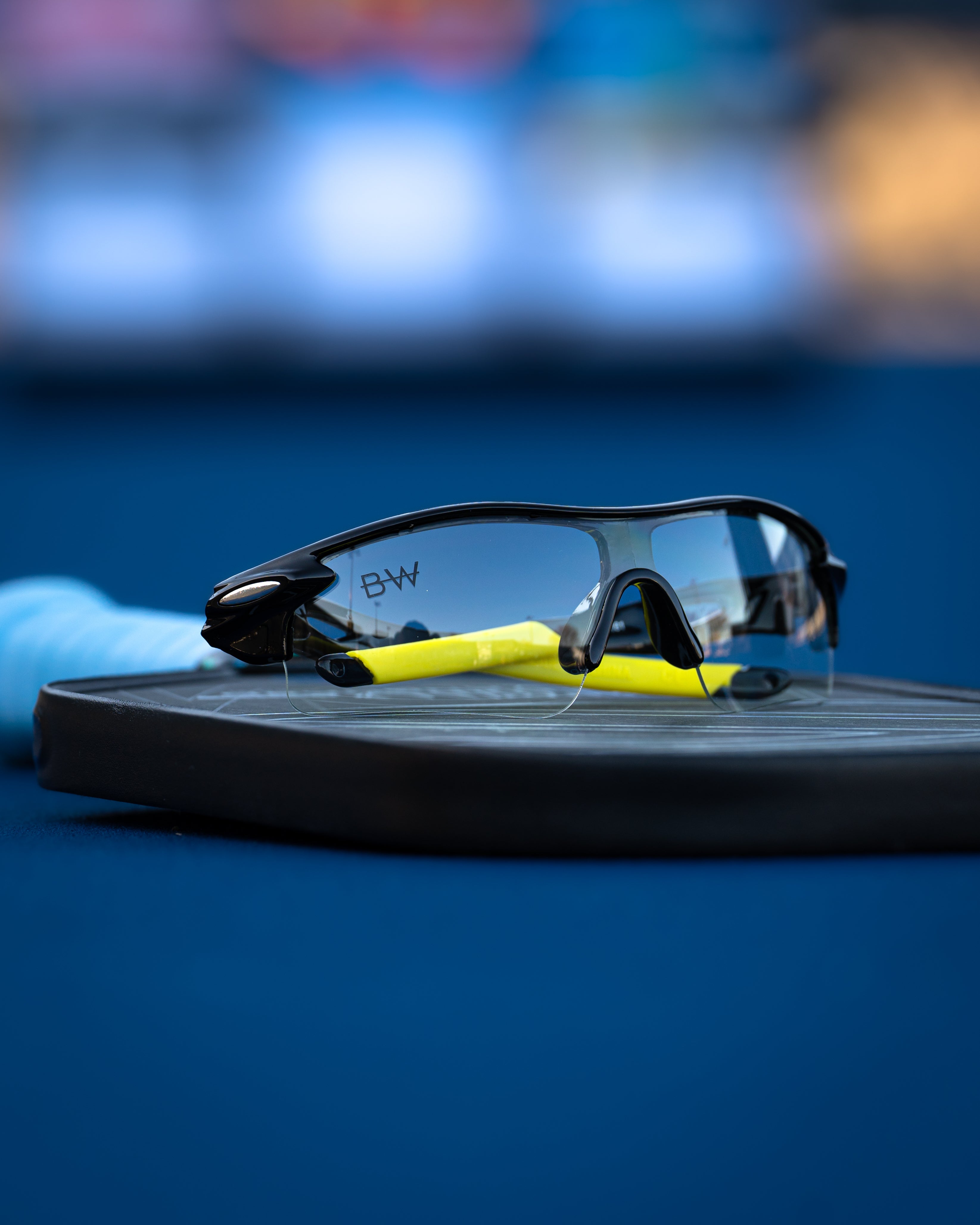
Blinded Wear offers prescription and non-prescription eyewear for pickleball players. Start with the collection that matches your vision needs, or use the 2026 eyewear hub for a broader comparison.
Why Can Eye Injuries Happen in Pickleball?
Pickleball puts several players within a relatively compact playing area. At the kitchen line, opponents can be separated by only a short distance while exchanging volleys and reacting to deflections.
Potential eye-injury situations can include:
- A pickleball striking the face or eye area
- Accidental paddle contact
- A partner's paddle entering another player's space
- A deflected ball taking an unexpected path
- A ricochet occurring at close range
- A fall or collision involving the face
The severity of any injury depends on the circumstances. A ball strike that causes temporary discomfort is not automatically equivalent to a serious internal eye injury, and symptoms alone should not be used to diagnose the exact damage.
Can a Pickleball Actually Injure an Eye?
Yes. A pickleball may be lightweight, but lightweight does not mean incapable of causing injury.
When an object strikes the eye or surrounding structures, the outcome depends on factors such as impact location, speed, angle, distance, individual anatomy, and whether eyewear is being worn.
The important safety point is not to assign one universal injury threshold. It is to recognize that a direct strike to the eye should be taken seriously, particularly when symptoms persist or are significant.
Pickleball Paddles Can Also Create Eye-Injury Risk
The ball is not the only object to consider. Accidental paddle contact can occur during doubles play, particularly when partners reach for the same ball or move into overlapping spaces.
Good partner communication and court awareness can reduce some avoidable collisions, but no strategy can guarantee that accidental contact will never occur.
Players should therefore think about eye safety as a combination of appropriate equipment, responsible play, awareness, and knowing what to do after an injury.
What Types of Eye Injuries Can Occur in Pickleball?
Eye trauma is a broad category. Injuries involving the eye or surrounding area can vary substantially in location and severity.
Corneal Injury
The cornea is the clear front surface of the eye. Trauma or foreign material can injure this surface. Eye pain, tearing, light sensitivity, or a persistent foreign-body sensation after an incident deserves appropriate evaluation.
Injury Around the Eye
Impact can affect the eyelids, skin, and bony structures surrounding the eye. Swelling or bruising does not reveal by itself whether deeper structures are unaffected.
Internal Eye Trauma
A significant impact can potentially involve structures inside the eye. This is one reason a player should not judge an injury solely by how the outside of the eye looks.
Retinal Injury
The retina is the light-sensitive tissue at the back of the eye. Retinal involvement is potentially serious and requires professional assessment rather than home diagnosis.
Vision Changes After Trauma
Blurred vision, double vision, a new area of missing vision, flashes, new floaters, or another meaningful visual change after an impact should not simply be attributed to being shaken up during the rally.
A Minor-Looking Eye Injury Is Not Always a Minor Injury
The appearance of an eye after impact does not necessarily establish the severity of the injury.
Conversely, pain or redness does not automatically prove that severe internal damage occurred.
This is why diagnosing an eye injury from a mirror, photograph, or description can be unreliable. When symptoms after trauma are significant, new, worsening, or persistent, appropriate medical evaluation matters more than trying to identify the exact injury yourself.
Warning Signs After a Pickleball Hits Your Eye
Seek prompt professional medical attention for concerning symptoms after an eye impact, especially when there is a meaningful change from your normal vision or eye function.
Warning signs can include:
- Loss or reduction of vision
- New blurred vision that does not quickly resolve
- New double vision
- Severe or worsening eye pain
- Blood visible in or around the eye
- A visibly abnormal or irregular pupil
- New flashes of light
- A sudden increase in floaters
- A shadow, curtain, or missing area in the field of vision
- Significant swelling after trauma
- Difficulty moving the eye normally
- Marked light sensitivity after an injury
- Persistent symptoms after a significant impact
This list is not a substitute for medical evaluation and does not include every possible sign of eye injury.
What Should You Do After Being Hit in the Eye During Pickleball?
If a ball, paddle, or another object strikes your eye, stop playing long enough to assess what happened rather than immediately returning to the next rally.
- Do not continue playing through a significant visual change.
- Avoid rubbing or pressing on an injured eye.
- Do not attempt to diagnose internal eye damage yourself.
- Pay attention to new or worsening visual symptoms.
- Seek appropriate medical care when the injury or symptoms are concerning.
If you believe the injury may be an emergency, seek emergency medical care rather than relying on eyewear advice or online troubleshooting.
How Can You Protect Your Eyes While Playing Pickleball?
The most direct equipment-related strategy is to consider eyewear appropriate for your intended level of protection and playing environment.
However, the phrase “pickleball glasses” does not establish one universal level of protection.
Different products may be designed primarily as sunglasses, prescription sports eyewear, general sports eyewear, or eyewear tested to a particular protective standard. Those categories should not be treated as interchangeable.
Sports Eyewear vs. Certified Protective Eyewear
This distinction is important when discussing pickleball eye safety.
| Term | What It Tells You | What It Does Not Automatically Prove |
|---|---|---|
| Sports eyewear | Eyewear intended or marketed for sports use | Compliance with a specific protective standard |
| Impact-resistant lens | The lens has an applicable level of resistance to impact | That the complete eyewear is shatterproof or certified to a particular safety standard |
| Safety or protective certification | The product has been evaluated against an identified applicable standard | Protection against every possible injury or impact |
| Sports sunglasses | Sunglasses configured for active use | Certified eye protection |
If you specifically need certified protective eyewear, verify the exact standard and the exact product rather than assuming sports styling or impact-resistant material is equivalent to certification.
Impact Resistant Does Not Mean Shatterproof
“Impact resistant” and “shatterproof” should not be used as interchangeable terms.
Impact resistance describes resistance to an applicable type or amount of impact. It does not establish that a lens can never crack, chip, break, become displaced, or otherwise fail under sufficient force.
Absolute terms such as indestructible, unbreakable, and shatterproof require a much stronger basis than a general impact-resistance claim.
Eye Protection Is About More Than the Lens Material
The complete eyewear configuration matters.
Factors that can be relevant to physical protection include:
- Lens material and construction
- Lens dimensions
- Lens retention
- Frame construction
- How the eyewear fits the wearer
- Coverage around the eye area
- The specific protective standard, if one applies
A technically impact-resistant lens does not by itself establish the performance of every other component in the finished eyewear.
Do Regular Prescription Glasses Protect Your Eyes in Pickleball?
Ordinary prescription glasses can place a physical lens and frame in front of the eyes, but that fact alone does not establish a specific level of sports-impact protection.
If impact protection is your priority, evaluate the actual construction and verified protective characteristics of the complete eyewear rather than assuming everyday glasses are equivalent to purpose-selected protective sports eyewear.
Are Regular Sunglasses Enough for Pickleball?
The answer depends on what you mean by “enough.”
Regular sunglasses may address brightness or other verified sun-related specifications, but those characteristics do not automatically establish impact protection.
Likewise, a dark tint does not prove that a lens is impact resistant, and impact resistance does not prove a particular UV specification.
Evaluate each characteristic independently.
Why Fit Matters for Pickleball Eyewear
Eyewear cannot provide its intended coverage if it fits so poorly that the player continually removes or repositions it.
An active fit should feel secure enough for ordinary pickleball movement without requiring excessive pressure.
Before relying on a new pair during competition, test normal movements such as:
- Looking quickly left and right
- Looking down and back toward the court
- Moving into a ready position
- Controlled lateral movement
- Serving
- Normal volleys and groundstrokes
No responsible fit claim should promise that a frame can never move, slip, or require adjustment on every wearer.
The Tightest Glasses Are Not Automatically the Safest
A secure fit should not be confused with excessive tightness.
Eyewear that creates persistent pressure or pain around the temples, nose, or ears may simply be a poor fit for that wearer.
The goal is stable, comfortable positioning rather than forcing the frame against the head as tightly as possible.
Can an Eyewear Retainer Help?
A compatible retainer may provide additional physical retention for some players, but it does not transform ordinary eyewear into certified protective equipment.
A retainer also cannot compensate for every fundamentally poor frame fit.
If you use one, verify that it is compatible with the exact eyewear.
Does More Lens Coverage Mean More Protection?
Frame and lens coverage can be relevant when evaluating sports eyewear, but appearance alone does not establish a protective rating.
A large or wrap-style lens should not automatically be described as impact certified, sealed, windproof, dustproof, or capable of preventing every object from reaching the eye.
If a particular level of protection matters, verify the appropriate specifications rather than relying solely on lens size.
What About Impacts From the Side?
Not every ball or object approaches directly from the front. Deflections, doubles play, and movement can create impacts from different angles.
This is another reason to evaluate the complete eyewear design rather than focusing only on the center of the lens.
However, a curved or wraparound appearance does not automatically mean the eyewear provides certified side-impact protection.
What if You Need Prescription Pickleball Eyewear?
Players who require refractive correction should not have to choose between seeing appropriately and wearing sports-oriented eyewear.
Blinded Wear offers a dedicated Prescription Pickleball Eyewear Collection for players who need RX correction.
The prescription and the protective characteristics of eyewear remain separate topics. An accurate prescription does not automatically make a lens impact resistant, while impact resistance does not establish prescription accuracy.
Does High-Index RX Material Provide Better Eye Protection?
High-index describes an optical material category, not a safety rating.
High-index prescription lenses are commonly used to help manage finished lens thickness, particularly as prescription strength increases. Final thickness still depends on the prescription, lens dimensions, frame, positioning, and other optical requirements.
High-index alone does not establish:
- Impact resistance
- Shatter resistance
- Scratch resistance
- Safety certification
- UV specifications
- Anti-fog performance
- Polarization
Blinded Wear includes high-index prescription lenses at no additional cost with its RX eyewear, but high-index should still be understood as an optical characteristic rather than a blanket safety claim.
Do Not Change Your Prescription for Sports Protection
A stronger or weaker prescription does not make eyewear more protective.
Use the appropriate eyeglass prescription provided for you rather than modifying SPH, CYL, AXIS, ADD, prism, or other values because the glasses will be used for pickleball.
Players should also avoid substituting a contact-lens prescription for an eyeglass prescription without appropriate guidance.
Can Clear Lenses Be Used for Pickleball?
Clear lenses can be useful when a player does not want a dark sunglass tint, such as during indoor or lower-light play.
Clear, however, describes the absence of a dark visible tint. It does not independently establish impact performance, safety certification, UV specifications, anti-fog technology, or any other protective feature.
Players looking for non-dark options can explore Blinded Wear's Clear Lens Eyewear Collection.
Does a Darker Lens Make Pickleball Eyewear Safer?
No. Lens darkness primarily concerns visible-light transmission rather than establishing physical impact protection.
A darker lens does not automatically mean:
- Greater impact resistance
- Better eye protection from a ball
- Higher UV protection
- Safety certification
- Better ball tracking
Choose tint according to the applicable lens specifications, lighting environment, and personal preference rather than using darkness as a general safety rating.
What Does VLT Have to Do With Eye Protection?
Visible Light Transmission (VLT) is the percentage of visible light transmitted through a lens.
A lower VLT allows less visible light through, while a higher VLT allows more.
VLT can help describe how light or dark a lens configuration is, but it does not independently establish:
- Impact resistance
- UV protection
- Polarization
- Scratch resistance
- Anti-fog performance
- Protective certification
Use verified specifications for the exact lens rather than estimating VLT from a photograph.
UV Protection and Impact Protection Are Different
Outdoor players may consider both sun-related lens characteristics and physical impact protection, but the two should not be merged into one claim.
A lens can have a verified UV specification without that specification establishing impact performance. Likewise, impact resistance does not automatically establish a particular UV rating.
This distinction matters because an older version of this article described UV400 protection as universal across the eyewear lineup. That type of blanket claim should only be made when it has been verified for every product to which it applies.
Should You Avoid Polarized Lenses for Pickleball Safety?
No universal safety rule requires pickleball players to avoid polarized lenses.
Polarization is a lens characteristic associated with filtering certain reflected light. It should not automatically be described as harming depth perception, slowing reactions, or interfering with ball tracking.
Likewise, non-polarized lenses should not be promised to improve depth perception, tracking, or reaction time.
If you prefer non-polarized sports eyewear, evaluate that preference separately from physical eye-protection claims.
Can Better Ball Tracking Prevent an Eye Injury?
Players naturally want to see the ball clearly, but eyewear should not be marketed with the promise that improved tracking will prevent them from being hit.
A close-range deflection can happen quickly and unexpectedly. Vision is only one part of the response.
Attention, court position, anticipation, partner communication, reaction, movement, and the trajectory of the ball all contribute to what happens during a rally.
Do Sports Glasses Make You React Fast Enough to Avoid a Ball?
No eyewear should be promised to make the nervous system react fast enough to avoid every incoming pickleball.
Appropriate prescription lenses can correct the refractive error for which they were prescribed, but that is different from increasing neurological reaction speed.
Physical protection should therefore not depend on a claim that the player will always see and avoid an incoming ball in time.
Can Fogged Lenses Create a Problem During Pickleball?
Condensation on a lens can interfere with the viewing surface. If your glasses become significantly fogged, address the visibility issue rather than continuing to play while you cannot see comfortably.
However, do not assume every sports frame is inherently fog-proof.
Anti-fog treatments, ventilation characteristics, and other related features should be verified for the exact product before making specific claims.
Sports Eyewear Is Not Automatically Anti-Fog
The older version of this article described Blinded Wear eyewear as having universal “fog-free tech” and anti-fog coatings. Those characteristics should not be extended across a product line without exact verification.
Frame shape, sports styling, impact resistance, high-index material, tint, and polarization do not independently prove anti-fog performance.
What About Sweat During Pickleball?
Sweat can create discomfort or residue and may influence how a frame sits during active play. It does not change the prescription manufactured into an RX lens.
If eyewear begins sliding substantially after perspiration builds up, reassess the fit rather than assuming a visual or prescription problem.
Dust and Debris Are Different From Impact Injuries
Dust, dirt, and other particles can irritate the eye, but they represent a different hazard from a direct ball or paddle impact.
Ordinary sports glasses should not automatically be described as sealed against airborne particles.
If your activity requires protection from a particular environmental hazard, choose eyewear designed and appropriately rated for that hazard rather than assuming a wrap-style frame creates a complete seal.
Do Scratched Lenses Stop Protecting Your Eyes?
A scratch is surface damage, and its implications depend on the specific lens and severity of the damage.
A scratch does not automatically mean that:
- The prescription changed
- UV protection disappeared
- The lens will immediately break
- The eyewear has become completely unusable
At the same time, meaningful damage should not simply be ignored. Inspect damaged eyewear and seek appropriate guidance when you are uncertain about continued use.
Should You Keep Playing With a Cracked Lens or Frame?
Visible cracking, significant chipping, lens displacement, or meaningful frame deformation deserves attention before the eyewear is relied on again.
Do not intentionally strike, flex, or otherwise stress damaged eyewear to test whether it can survive another impact.
If eligible Blinded Wear eyewear breaks, review the current replacement policy before returning it.
Inspect Your Eyewear After a Significant Impact
If your eyewear is struck by a ball, paddle, or another object, inspect the complete pair.
Look for:
- Cracks
- Chips
- Lens displacement
- Frame deformation
- Loose or damaged hinges
- A sudden change in fit
- New surface damage
The absence of obvious damage is useful information, but it should not be converted into a guarantee that the eyewear can withstand every future impact.
Pre-Game Pickleball Eyewear Safety Check
A quick inspection before playing can identify obvious problems before the first rally.
- Check the lenses for cracks or significant damage.
- Inspect the frame for deformation.
- Make sure the lenses appear properly seated.
- Check that the temples and hinges function normally.
- Put the eyewear on and assess the fit.
- Clean away residue that interferes with the viewing surface.
- Confirm that the lens configuration is appropriate for the current lighting.
Doubles Pickleball Adds Another Safety Consideration
Doubles places two players on the same side of a relatively small court. That creates situations where both partners may attempt to play the same ball.
Communication can help reduce avoidable paddle collisions.
Simple habits include:
- Communicating clearly on balls that could be played by either partner
- Remaining aware of your partner's position
- Avoiding uncontrolled swings when a partner is immediately beside you
- Giving appropriate space during overheads and other large swings
No communication system eliminates all risk, but responsible partner awareness is part of court safety.
Eye Safety at the Kitchen Line
The non-volley zone line is where many rapid exchanges occur at relatively short distances.
A deflection during a fast exchange may provide little time for a player to consciously evaluate what is happening before the ball reaches the upper body or face.
This is one reason eye protection should not depend solely on the assumption that a player will always have enough time to move out of the way.
Overheads, Deflections, and Unexpected Ball Paths
Not every dangerous ball follows a predictable trajectory.
A ball can contact:
- A paddle edge
- The net
- Another player's paddle
- The court surface
- Another object near the playing area
A deflection can change direction quickly. Protective decisions should therefore account for unexpected contact rather than only clean, predictable shots.
Should Beginners Wear Eye Protection for Pickleball?
Eye safety is not limited to advanced players.
Beginners may experience mishits, unpredictable paddle contact, and inconsistent ball trajectories just as experienced players can encounter fast exchanges and hard-driven shots.
A player's skill rating does not make the eye physically immune to impact.
What About Competitive Pickleball Players?
Competitive players can apply the same core safety principles while also considering long tournament days, repeated matches, travel, equipment inspection, and backup eyewear.
Competition does not change the fundamental distinction between sports eyewear and eyewear verified to meet a particular protective standard.
Eye Protection for Younger Pickleball Players
Parents and guardians choosing sports eyewear for a child should pay particular attention to appropriate fit, product specifications, and the intended level of protection.
Adult eyewear should not automatically be assumed to fit a younger player correctly simply because it can physically remain on the face.
For individual medical, prescription, or eye-health questions, consult an appropriate eye-care professional.
Common Pickleball Eye-Protection Myths
Myth: A pickleball is plastic, so it cannot seriously injure an eye.
Material alone does not determine whether an impact can cause injury.
Myth: Any sunglasses protect against pickleball impacts.
A sunglass tint does not establish impact performance.
Myth: Impact resistant means shatterproof.
Impact resistance is not a guarantee that a lens can never break.
Myth: A sports frame is automatically safety certified.
Sports styling and certification are different concepts.
Myth: The darkest lens offers the most protection.
Visible-light transmission does not establish physical impact resistance.
Myth: Polarized lenses make players react too slowly.
Polarization does not create a meaningful visual delay in the way this claim implies.
Myth: Non-polarized lenses guarantee better depth perception.
Depth perception is not determined solely by polarization.
Myth: Prescription lenses automatically provide sports-impact protection.
Prescription correction and impact performance must be evaluated separately.
How to Compare Pickleball Eyewear for Eye Protection
| Question | Why It Matters |
|---|---|
| Is a specific protective standard listed? | Identifies whether a particular certification or test claim is actually being made |
| What is stated about impact resistance? | Separates verified impact characteristics from vague sports language |
| Does the frame fit properly? | Poor fit can affect wearing position and comfort |
| What coverage does the design physically provide? | Helps evaluate the complete eyewear configuration |
| Do you require prescription correction? | Determines whether an RX solution is needed |
| What lighting do you normally play in? | Helps guide clear versus tinted lens preferences |
| What UV specification is actually verified? | Sun-related characteristics should be checked independently |
| Is anti-fog performance verified? | Sports styling alone does not prove it |
| What happens if the eyewear breaks? | Return and replacement policies affect long-term ownership |
Protective Eyewear Claims Worth Examining Carefully
When shopping for pickleball glasses, be cautious with absolute marketing language such as:
- “Shatterproof”
- “Indestructible”
- “Impossible to break”
- “Maximum protection”
- “Prevents eye injuries”
- “Stops every impact”
- “Fog-proof”
- “Scratchproof”
- “Guaranteed not to slip”
- “Improves reaction time so you won't get hit”
Specific, verifiable product characteristics are more useful than absolute safety promises.
Eye Protection and Pickleball Performance Are Separate Questions
Players often want one pair of eyewear to solve every concern at once. It helps to separate the different functions.
| Characteristic | Primary Question |
|---|---|
| Prescription | Does the eyewear provide the appropriate refractive correction? |
| Impact resistance | What physical impact characteristics are verified? |
| Safety certification | Does the complete eyewear meet an identified protective standard? |
| VLT | How much visible light is transmitted? |
| Tint | How does the lens alter visible light and appearance? |
| Polarization | Does the exact lens use a polarizing filter? |
| Photochromic technology | Does tint change according to applicable environmental conditions? |
| Fit | How does the eyewear sit on the individual wearer during activity? |
No single row in this table proves all of the others.
Blinded Wear Pickleball Eyewear
Blinded Wear designs performance eyewear for pickleball players, with both prescription and non-prescription options.
Depending on the exact product and configuration, shoppers can explore:
- Lightweight sports frames
- Impact-resistant lens options
- Non-polarized lens options
- Prescription pickleball eyewear
- High-index prescription lenses included at no additional cost with RX eyewear
- Clear-lens options
These characteristics should not be expanded into unverified claims that every Blinded Wear product is safety certified, shatterproof, fog-proof, scratchproof, UV400, or capable of preventing an eye injury.
Review the exact product information before choosing eyewear for a specific protective requirement.
Prescription Options for Pickleball Players
If you need refractive correction, browse the Blinded Wear RX Pickleball Collection.
Current styles to explore include:
- Rippled X RX
- Zebra II RX
- Steel Ice RX
- Blue Shield RX
- Frost RX
- Gray Wash RX
- Crystal Wave II RX
- Lava Rock RX
- Havana Melt RX
Check the exact product page for current specifications rather than assuming every RX model has identical features.
How to Order Blinded Wear Prescription Pickleball Eyewear
For applicable RX products, upload a clear image of your eyeglass prescription on the product page before adding the eyewear to your cart and purchasing.
Do not guess unclear prescription values or substitute a contact-lens prescription.
For a complete walkthrough, visit How to Order RX Glasses.
Pickleball Eye-Safety Shopping Checklist
Before purchasing eyewear with eye protection in mind, ask:
- What exact impact characteristics are verified?
- Is a specific safety standard identified?
- Am I looking for sports eyewear or certified protective eyewear?
- Does the frame fit me appropriately?
- Does the design provide the coverage I want?
- Do I require prescription correction?
- What lens configuration works for my normal lighting?
- Which UV, polarization, anti-fog, or other characteristics are actually verified?
- What is the current return policy?
- What replacement support is available if the eyewear breaks?
Practical Pickleball Eye-Safety Checklist
Eye safety extends beyond buying a pair of glasses.
- Consider eyewear appropriate for your desired level of protection.
- Verify protective claims rather than assuming them from appearance.
- Use appropriate prescription correction if you need it.
- Inspect eyewear for meaningful damage.
- Address a poor or unstable fit.
- Communicate with your doubles partner.
- Remain aware of nearby paddles during shared-ball situations.
- Stop playing after a significant eye impact long enough to assess symptoms.
- Do not rub or press an injured eye.
- Seek appropriate medical care for concerning symptoms.
The Most Important Pickleball Eye-Protection Lesson
Pickleball eye safety should be based on verified protection and sensible habits rather than fear or exaggerated marketing.
A pickleball-related eye injury can potentially be serious, but that does not justify claiming that every sports sunglass is certified protective equipment or that any pair can guarantee prevention of injury.
The better approach is to understand the hazard, choose eyewear according to the level of protection you actually need, verify product specifications, maintain and inspect your equipment, and take eye trauma seriously when it occurs.
In Part 2, we'll go deeper into protective standards, impact resistance, prescription considerations, lens materials, court scenarios, eyewear inspection, and exactly how to evaluate whether a pair of pickleball glasses matches your safety priorities.
Understanding Protective Eyewear Standards for Pickleball
One of the most important distinctions in pickleball eye safety is the difference between eyewear that looks appropriate for sports and eyewear that has actually been evaluated against a specific protective standard.
Terms such as sports glasses, performance eyewear, impact resistant, and protective eyewear should not automatically be treated as equivalent.
If a particular safety rating matters to you, look for the exact standard identified by the manufacturer for the exact model or configuration you are considering.
What Does “Impact Rated” Actually Mean?
An impact claim is most useful when it identifies what was evaluated and under which standard or test method.
A vague statement such as “built for impact” provides less information than a specific, verifiable specification.
When comparing pickleball eyewear, ask:
- Is the claim about the lens material or the complete eyewear?
- Is a specific test or standard identified?
- Does the specification apply to the exact model being purchased?
- Does it apply to the exact prescription configuration, if applicable?
- Are there limitations to the stated protection?
Do not assume that a rating from one product automatically applies to another product from the same brand.
Lens Impact Resistance vs. Complete Eyewear Protection
A lens is only one component of a pair of glasses.
The complete eyewear system also includes the frame, lens-retention method, hinges, temples, bridge, and the way the eyewear sits on the wearer.
| Component | Why It Can Matter |
|---|---|
| Lens | Receives or transmits forces during some impacts |
| Lens retention | Influences how the lens remains positioned within the frame |
| Frame | Supports the lenses and surrounds part of the eye area |
| Bridge | Influences positioning across the nose |
| Temples | Help maintain the eyewear's wearing position |
| Hinges | Connect moving frame components and can be affected by force |
| Overall fit | Determines how the complete eyewear sits on the individual wearer |
This is why a statement about an impact-resistant lens should not automatically be converted into a claim that the entire pair is certified protective eyewear.
Common Impact Scenarios on a Pickleball Court
Eye-safety decisions become easier to understand when you consider how impacts can actually occur during play.
Direct Ball Impact
A ball can travel toward the face after a drive, volley, overhead, speed-up, or other shot.
Deflected Ball
A ball can change direction after contacting a paddle edge, another paddle, the net, or another object.
Partner Paddle Contact
In doubles, both partners may attempt to play the same ball, creating the possibility of accidental paddle contact.
Opponent Paddle or Body Contact
Although players are normally separated by the net, unusual movement or incidents can still create unexpected contact.
Falls and Collisions
Not every eye-area injury comes from the ball itself. Falls and collisions can also involve the face or eyewear.
No eyewear can guarantee protection from every possible scenario, which is why protective specifications and responsible play should be considered together.
Why Close-Range Pickleball Impacts Deserve Attention
Many pickleball exchanges occur relatively close to the net. During a fast volley exchange, the distance between players can be short and the ball's direction can change rapidly.
The relevant safety issue is not whether every close-range shot is dangerous. Most rallies occur without an eye injury.
Instead, close proximity means players should not rely exclusively on their ability to move their face away from every unexpected ball.
Appropriate equipment can be one part of a broader risk-management approach.
Protective Eyewear Cannot Guarantee You Will Never Be Injured
Even appropriately rated protective equipment has limitations.
Protective eyewear should therefore be described in terms of the protection it is designed, tested, or rated to provide rather than as a guarantee against injury.
A responsible safety claim does not promise:
- Zero chance of eye injury
- Protection from every impact direction
- Protection against unlimited force
- Protection from every paddle strike
- Protection from every fall or collision
- Protection against hazards outside the product's intended use
The objective is risk reduction according to verified product characteristics, not the elimination of all possible risk.
Does Lens Material Determine Pickleball Eye Protection?
Lens material can be relevant to impact behavior, but material name alone does not tell you everything about the finished eyewear.
Finished performance can also depend on lens geometry, thickness, mounting, retention, frame construction, product design, and the particular test or standard being considered.
This means shoppers should avoid reducing eye protection to a simple statement such as:
- “This material can never break.”
- “Thicker always means safer.”
- “Thinner always means weaker.”
- “High-index means stronger.”
- “Sports lenses are automatically impact rated.”
Verify the finished product's applicable specifications whenever protection is the priority.
High-Index and Impact Resistance Are Separate Specifications
This distinction is especially important for prescription pickleball players.
High-index describes an optical material category commonly used to help manage prescription lens thickness. Impact resistance concerns how a material or product responds to applicable impact.
Neither term automatically establishes the other.
| Feature | What It Primarily Describes |
|---|---|
| High-index | Optical refractive characteristics and potential thickness management |
| Impact resistance | Resistance to applicable physical impact |
| Scratch resistance | Resistance to applicable surface abrasion |
| Safety certification | Compliance with an identified protective standard |
| VLT | Visible-light transmission |
| Polarization | A particular light-filtering characteristic |
Blinded Wear includes high-index prescription lenses at no additional cost with RX eyewear. That benefit should not be rewritten as a universal safety certification or durability guarantee.
Prescription Players Need to Consider Both Vision Correction and Protection
For a player who needs refractive correction, there are two separate questions:
- Does the eyewear provide the appropriate prescription correction?
- Does the complete eyewear provide the physical protection I want?
One does not automatically answer the other.
An appropriate prescription does not prove impact resistance. An impact-resistant lens does not prove that a prescription was manufactured or positioned correctly.
Players who require RX correction can explore the Blinded Wear Prescription Pickleball Eyewear Collection.
Direct RX vs. Prescription Inserts for Pickleball
Prescription sports eyewear can use different configurations.
A direct RX configuration incorporates the applicable prescription into the primary prescription lenses. A prescription insert places the refractive correction in a separate inner lens component within compatible eyewear.
Neither configuration should automatically be described as safer, clearer, faster, or better for ball tracking without evidence for the exact products being compared.
When protection is the concern, evaluate the complete eyewear configuration and its verified specifications rather than assuming the prescription architecture establishes the safety level.
How to Test Pickleball Eyewear Fit Before a Match
A simple active-fit check can reveal whether a frame requires constant adjustment during ordinary movement.
With the eyewear properly positioned:
- Stand in your normal ready position.
- Look naturally from side to side.
- Look down and return your gaze forward.
- Perform controlled lateral movement.
- Practice several serves.
- Practice ordinary groundstrokes and volleys.
- Notice pressure around the nose, temples, and ears.
- Notice whether the eyewear repeatedly requires repositioning.
The purpose is not to perform an exaggerated “shake test.” It is to determine how the eyewear behaves during realistic activity.
What if Your Pickleball Glasses Keep Slipping?
Repeated slippage is primarily a fit and wearing-position issue.
It does not mean that your prescription values or anatomical PD are changing.
If eyewear moves substantially during normal play, consider whether:
- The frame is fundamentally the wrong fit
- The eyewear has been bent or damaged
- Perspiration is influencing stability
- A compatible retention accessory could help
- An appropriate professional adjustment is possible
Avoid aggressively heating or bending an unfamiliar frame yourself.
What if Protective Eyewear Feels Too Tight?
Tighter does not automatically mean more protective.
Persistent pressure at the temples, bridge, behind the ears, or elsewhere can indicate a fit problem.
A frame should be evaluated as a complete fit rather than tightened until it becomes uncomfortable simply to reduce movement.
When Should Pickleball Eyewear Be Inspected?
Regular visual inspection is especially useful after an unusual event.
Check the eyewear after:
- A direct ball strike
- A paddle strike
- A hard drop
- Being stepped on
- Significant compression in a bag
- A collision
- A sudden unexplained change in fit
You do not need to destructively test the eyewear. Look for visible signs that something has changed.
Signs Your Pickleball Eyewear May Be Damaged
Potential physical warning signs include:
- A visible crack
- A chipped lens edge
- A lens that no longer appears properly seated
- A noticeably bent frame
- A damaged temple
- A hinge that suddenly behaves differently
- A frame that sits significantly differently after impact
Do not intentionally hit or bend the eyewear to determine whether damage is “serious enough.”
Scratch vs. Crack: Why the Difference Matters
A scratch is surface damage. A crack involves a fracture in the lens or another component.
They should not automatically be treated as the same condition.
A scratch does not rewrite the prescription. It also does not automatically mean that every other lens specification has disappeared.
A visible crack, significant chip, or lens displacement is a different physical condition and deserves attention before the eyewear is relied upon again.
Clean Your Pickleball Eyewear Without Creating Avoidable Damage
Dust, sweat, sunscreen, fingerprints, and other residue can accumulate during play.
When cleaning:
- Avoid grinding visible grit across the lens surface.
- Use lens-care methods compatible with the exact eyewear.
- Keep cleaning materials themselves clean.
- Avoid abrasive DIY polishing methods.
- Do not use toothpaste, baking soda, automotive polish, or similar abrasive remedies to remove scratches.
Cleaning can remove contamination. It cannot restore material that has been physically scratched away.
Store Pickleball Eyewear With Physical Protection in Mind
Eyewear can be damaged away from the court as well as during play.
Loose storage in a sports bag can expose glasses to:
- Compression
- Drops
- Abrasion
- Keys and other hard objects
- Dirt or grit
- Unnecessary heat
Protective storage can help separate eyewear from these hazards.
A structured case can provide more separation from direct pressure than leaving glasses loose in a bag, although no ordinary storage case should be assumed to be indestructible.
Do Not Treat Sports Eyewear as Heat-Proof
Impact resistance does not establish resistance to every environmental stress.
Avoid unnecessary prolonged exposure to extreme heat, such as leaving eyewear in an excessively hot environment for extended periods.
There is no single universal temperature threshold that applies to every frame, lens, coating, and finished product, so avoid inventing one.
What if You Play Pickleball in Rain or Damp Conditions?
Water on a lens can interfere with the viewing surface, while a wet frame may feel different on the face.
However, ordinary sports eyewear should not automatically be described as:
- Waterproof
- Hydrophobic
- Fog-proof
- Sealed
- Moisture-proof
Those characteristics require separate verification.
Weather-related court hazards such as slippery surfaces or unsafe conditions can also become more important than the eyewear itself.
Indoor vs. Outdoor Pickleball Eye Protection
The physical possibility of a ball or paddle impact does not disappear when a match moves indoors.
What often changes is the lighting environment.
| Environment | Lens Consideration | Protection Consideration |
|---|---|---|
| Bright outdoor court | A suitable tint and VLT may be preferred | Verify impact characteristics separately |
| Overcast outdoor court | A lighter configuration may be preferred by some players | Impact considerations remain separate |
| Indoor court | Players may prefer a clear or non-dark configuration | Indoor play can still involve ball and paddle impacts |
| Changing light | Compare fixed tint, multiple pairs, or available photochromic options | Changing tint does not create an impact rating |
Clear Pickleball Glasses Can Still Be Relevant to Eye Safety
Physical eye protection and sunglass darkness are separate issues.
A player does not necessarily need a dark tint simply because the eyewear is being used for sports.
For indoor play or other environments where a dark lens is unwanted, a clear configuration may be more practical.
However, clear appearance alone does not establish a safety rating. Verify the exact protective characteristics just as you would with a tinted lens.
Browse Blinded Wear Clear Lens Eyewear for current non-dark options.
Are Photochromic Lenses Protective Pickleball Lenses?
Photochromic technology describes a lens that changes tint according to the applicable technology and environmental conditions.
It does not establish physical impact protection.
A photochromic lens may also have other characteristics, but those must be verified independently.
Do not automatically assume that photochromic means:
- Impact rated
- Safety certified
- Polarized
- Scratchproof
- Anti-fog
- Hydrophobic
- Instantly changing
Polarization Does Not Determine Impact Protection
Whether a lens is polarized or non-polarized does not by itself establish how it will respond to physical impact.
Likewise, polarization should not be used as a shortcut for judging:
- Depth perception
- Reaction speed
- Ball tracking
- Impact resistance
- UV specifications
- Safety certification
Evaluate each property independently.
UV Protection vs. Impact Protection
These two forms of protection address different hazards.
| Specification | Primary Concern |
|---|---|
| Verified UV protection | Applicable ultraviolet radiation |
| Impact resistance | Physical impact |
| Protective certification | Requirements of an identified standard |
| Visible-light transmission | Amount of visible light transmitted |
A single lens may have several of these characteristics, but one does not prove the others.
What Should You Do if Your Glasses Fog During a Rally?
If condensation substantially interferes with your ability to see, address it before continuing play.
Fogging is a surface-visibility issue. It does not mean the prescription has changed, nor does it prove that the lens has been structurally damaged.
Likewise, anti-fog capability should not be assumed unless it is verified for the exact product or treatment.
Partner Communication Is Part of Doubles Safety
Eyewear is only one element of risk management.
Doubles partners can also reduce some avoidable paddle-contact situations through communication and awareness.
Useful habits include:
- Calling balls when responsibility is unclear
- Knowing where your partner is before making a large swing
- Avoiding uncontrolled paddle movement near a partner's face
- Communicating before overheads when both players could attempt the shot
These habits cannot eliminate every accident, but they address a different part of the risk than eyewear does.
Extra Awareness During Fast Net Exchanges
Rapid exchanges near the non-volley zone can produce unexpected deflections.
During these situations:
- Maintain normal court awareness.
- Avoid unnecessary uncontrolled swings around other players.
- Communicate with your partner.
- Use equipment appropriate for the level of eye protection you want.
Do not rely on a promise that a particular tint, polarization choice, or prescription will make you react fast enough to avoid every close-range ball.
What Not to Do After a Significant Eye Impact
If you sustain meaningful eye trauma, avoid actions that could complicate the situation.
- Do not rub or press forcefully on the injured eye.
- Do not continue playing through significant vision changes.
- Do not diagnose the injury solely from its appearance.
- Do not assume lack of visible bleeding means there is no meaningful injury.
- Do not rely on sports eyewear marketing as medical guidance.
Concerning symptoms following trauma warrant appropriate professional medical assessment.
When an Eye-Care Professional Should Be Involved
Eyewear companies can provide product information, but they do not replace eye-care professionals.
| Question | Appropriate Source |
|---|---|
| What is my prescription? | Appropriate eye-care professional |
| Did an impact injure my eye? | Appropriate medical or eye-care professional |
| Why did my vision suddenly change? | Appropriate medical or eye-care professional |
| What specifications does this eyewear have? | Verified product information |
| What is the current return or replacement policy? | Current retailer or manufacturer policy |
| How should I position myself during a rally? | Qualified pickleball instruction or coaching |
When to Seek Medical Attention After a Pickleball Eye Injury
Eye trauma should be evaluated based on the actual injury and symptoms rather than a generic online checklist alone.
Prompt professional evaluation is particularly important when an impact is followed by concerning symptoms such as:
- Meaningful loss or reduction of vision
- Persistent or significant blurred vision
- New double vision
- Severe or worsening pain
- Visible blood in the eye
- An abnormal-looking pupil
- New flashes or a sudden increase in floaters
- A shadow, curtain, or missing portion of the visual field
- Difficulty moving the eye normally
- Significant trauma with persistent symptoms
When an injury appears severe or vision is meaningfully affected, seek urgent medical care rather than attempting to finish the match first.
When Can You Play Again After an Eye Injury?
There is no universal return-to-play timeline for an eye injury.
The appropriate decision depends on what was injured, severity, symptoms, treatment, and professional medical guidance.
Do not use a generic number of hours or days as a substitute for individual evaluation after meaningful eye trauma.
Should Tournament Players Carry Backup Eyewear?
A backup pair can be practical, particularly for players who depend on prescription correction.
If your primary pair is damaged, lost, or becomes unusable during an event, a backup can prevent an equipment problem from becoming an immediate vision-correction problem.
When possible, store the backup separately enough that one compression or baggage incident does not damage both pairs simultaneously.
Protecting Pickleball Eyewear During Travel
Travel introduces stresses that are different from a ball impact.
Eyewear may encounter:
- Compression inside luggage
- Drops
- Abrasion from other objects
- Dirt or grit
- Heat
- Frequent handling
Impact resistance on the court does not automatically mean crush resistance inside a packed bag.
Protective storage and a backup pair can be useful for players traveling to tournaments or recreational events.
When Should You Consider Replacing Pickleball Eyewear?
There is no universal replacement schedule that applies to every pair of sports glasses.
Instead, pay attention to condition.
Replacement or professional evaluation may be appropriate when you identify:
- A significant crack
- Lens displacement
- Meaningful frame deformation
- A broken component
- Damage that affects normal fit
- Damage that raises questions about continued use
Do not assume that every cosmetic mark requires immediate replacement, but do not ignore meaningful structural damage.
Blinded Wear 50% Lifetime Replacement Support
Blinded Wear offers 50% lifetime replacement support if eligible glasses break, subject to the current policy terms.
The damaged eyewear must be returned as part of an eligible claim. Once the applicable requirements are satisfied, the customer can receive 50% credit toward a replacement pair.
This is not a free full replacement.
For damaged prescription eyewear, contact blindedwearco@gmail.com before returning the pair.
Review the Blinded Wear Protection Plan, Replacement & Returns information for current eligibility and policy details.
How to Shop for Pickleball Eyewear With Eye Safety in Mind
Instead of searching for one vague label such as “the safest pickleball glasses,” compare products systematically.
- Determine whether you need prescription correction.
- Decide what level of physical protection you are seeking.
- Look for specific, verifiable impact information.
- Verify any applicable protective certification.
- Evaluate frame fit and coverage.
- Choose a lens configuration appropriate for your lighting.
- Verify UV specifications separately when relevant.
- Do not infer anti-fog, scratch, polarization, or other features.
- Review return and replacement policies.
- Inspect and practice in the eyewear before an important event.
How to Compare Two Pairs of Pickleball Glasses
| Comparison Point | Pair A | Pair B |
|---|---|---|
| Prescription compatible? | Verify | Verify |
| Impact characteristics? | Verify exact claim | Verify exact claim |
| Protective standard? | Verify exact standard | Verify exact standard |
| Fit during movement? | Evaluate personally | Evaluate personally |
| Coverage? | Compare design | Compare design |
| Lens tint/VLT? | Verify | Verify |
| Polarized? | Verify | Verify |
| UV specification? | Verify | Verify |
| Anti-fog feature? | Verify rather than assume | Verify rather than assume |
| Replacement support? | Review policy | Review policy |
This approach is more reliable than choosing solely by appearance, price, lens color, or broad marketing language.
Explore Blinded Wear Pickleball Eyewear
Blinded Wear focuses on performance eyewear for pickleball players and offers both prescription and non-prescription options.
Start with the category that matches your needs:
- Prescription Pickleball Eyewear — for players who require RX correction.
- Non-RX Pickleball Sunglasses — browse current non-prescription sports eyewear.
- Clear Lens Eyewear — explore options without a dark sunglass tint.
Because specifications can differ by product and configuration, review the exact product information before relying on any particular feature.
Separate Lens Choice From Physical Eye Protection
Choosing the right lens for your playing environment and choosing the desired level of physical protection are related shopping decisions, but they are not identical.
A lens can be comfortable in bright sun without necessarily meeting a particular impact standard. A protective lens can have a visible-light configuration that does not suit every environment.
For more help understanding lens characteristics, visit the Pickleball Performance Lens Guide.
Need Help Narrowing Your Pickleball Eyewear Options?
The Blinded Wear Pickleball Sunglasses Quiz can help narrow shopping options according to your preferences.
The quiz is a shopping tool. It is not a medical assessment, prescription determination, or substitute for verifying a required protective standard.
Part 2: The Key Eye-Protection Takeaways
Pickleball eye protection becomes much easier to evaluate when different eyewear characteristics are kept separate.
- Sports eyewear is not automatically certified protective eyewear.
- Impact resistant does not mean shatterproof.
- Lens impact resistance does not automatically describe the complete frame.
- High-index is an optical characteristic, not a safety rating.
- Prescription correction and physical protection are separate considerations.
- Dark tint and low VLT do not prove impact protection.
- UV protection and impact protection address different hazards.
- Polarization does not determine physical protection, reaction speed, or depth perception.
- Fit matters, but excessively tight eyewear is not automatically safer.
- Inspect eyewear after significant impacts, drops, or compression.
- Eye trauma with concerning symptoms deserves appropriate medical attention.
The goal is not to make pickleball sound dangerous. It is to make eye-safety decisions based on verified specifications, appropriate equipment, responsible court habits, and appropriate medical care when an injury occurs.
Part 3 will answer the most common pickleball eye-injury and protective-eyewear questions, provide a final decision framework, cover Blinded Wear return and replacement policies, and give players a complete pre-match eye-safety checklist.
Pickleball Eye Injury and Protective Eyewear FAQ
Questions about pickleball eye protection often mix together several different subjects: impact resistance, safety certification, prescription correction, lens tint, UV specifications, fit, and medical care after an injury. The answers below separate those issues so players can make more informed decisions.
Can pickleball cause an eye injury?
Yes. A ball, paddle, fall, collision, or unexpected deflection can potentially injure the eye or surrounding structures. The severity of an injury depends on the circumstances, and not every impact produces the same outcome.
Is a pickleball too light to seriously injure an eye?
No. An object's low weight does not make eye injury impossible. Impact location, speed, angle, distance, and individual circumstances can all matter.
What are the warning signs after getting hit in the eye?
Concerning symptoms can include meaningful vision loss or reduction, persistent blurred vision, new double vision, severe or worsening pain, visible blood in the eye, an abnormal-looking pupil, new flashes, a sudden increase in floaters, a shadow or curtain in the visual field, or difficulty moving the eye normally.
Should I keep playing after being hit in the eye?
Do not continue playing through a significant visual change or concerning symptoms. Stop and assess the situation. Significant or persistent symptoms after eye trauma warrant appropriate medical evaluation.
Should I rub my eye after it gets hit?
Avoid rubbing or pressing forcefully on an injured eye. If the injury appears significant or produces concerning symptoms, seek appropriate medical care.
Can I tell how serious an eye injury is by looking in a mirror?
Not reliably. External appearance alone does not establish whether deeper structures are unaffected. Conversely, redness or discomfort alone does not identify the exact injury.
Can a pickleball cause a retinal injury?
Eye trauma can potentially involve structures inside the eye, including the retina. A retinal injury cannot be reliably diagnosed from appearance alone and requires appropriate professional evaluation.
What if I see flashes or new floaters after being hit?
New flashes, a sudden increase in floaters, or a new shadow or curtain in the visual field after trauma deserve prompt professional evaluation.
Can a pickleball paddle injure an eye?
Yes. Accidental paddle contact is another potential source of eye or facial injury, particularly when doubles partners reach for the same ball or occupy overlapping space.
Are eye injuries only a concern for advanced pickleball players?
No. Beginners can encounter mishits and unpredictable ball paths, while experienced players can encounter rapid exchanges and hard-driven shots. Skill level does not eliminate the possibility of accidental impact.
Are eye injuries only a concern during singles?
No. Doubles introduces additional considerations because two partners share the same side of the court and can occasionally attempt to play the same ball.
Are sports sunglasses the same as protective eyewear?
Not automatically. Sports sunglasses may be designed for active use, but sports styling does not establish compliance with a particular protective standard.
Are all pickleball glasses impact rated?
No. The phrase “pickleball glasses” does not establish a universal impact specification. Verify the exact product's stated characteristics.
Does an impact-resistant lens mean the glasses are shatterproof?
No. Impact resistance should not be rewritten as shatterproof. Sufficient force can potentially damage a lens, frame, or complete eyewear system.
Does impact resistance mean the glasses are safety certified?
Not necessarily. A general impact-resistance claim and compliance with a particular protective standard are different claims.
How do I know whether eyewear meets a safety standard?
Look for the exact standard or certification identified for the exact product and configuration. Do not infer certification from appearance, frame shape, lens thickness, or general sports marketing.
Does a wraparound frame automatically provide certified side protection?
No. Wraparound appearance can affect physical coverage, but appearance alone does not establish compliance with a side-impact or other protective standard.
Does a larger lens automatically provide better protection?
Lens dimensions and coverage can be relevant, but size alone does not establish impact performance or certification.
Are regular prescription glasses enough for pickleball?
Ordinary prescription glasses provide refractive correction and place a frame and lenses in front of the eyes, but those facts do not establish a specific level of sports-impact protection. If physical protection is a priority, evaluate verified product characteristics separately.
Can prescription pickleball glasses provide sports-oriented eyewear and vision correction?
Yes. Prescription sports eyewear can combine appropriate refractive correction with a frame intended for active use. Prescription accuracy and physical protection remain separate characteristics that should each be evaluated.
Does a stronger prescription provide more protection?
No. Prescription strength does not establish physical impact protection.
Should I change my prescription for pickleball?
Do not arbitrarily increase or decrease prescription power because eyewear will be used for sports. Use the appropriate eyeglass prescription provided for you.
Can I use my contact-lens prescription to order RX pickleball glasses?
Do not assume a contact-lens prescription can be copied directly into an eyeglass order. Contact-lens and eyeglass prescriptions can differ.
Does high-index mean impact resistant?
No. High-index refers to an optical material category commonly used to help manage prescription lens thickness. It does not independently establish impact resistance.
Does high-index mean shatterproof?
No. Refractive index is not a shatterproof rating.
Does high-index mean safety certified?
No. A protective certification must be established separately.
Why use high-index prescription lenses?
High-index materials are commonly considered to help manage finished lens thickness, particularly as prescription strength increases. Final thickness also depends on the prescription, lens dimensions, frame, positioning, and other optical requirements.
Does Blinded Wear charge extra for high-index RX lenses?
Blinded Wear includes high-index prescription lenses at no additional cost with its RX eyewear.
Are direct RX lenses safer than prescription inserts?
There is no universal rule that one prescription architecture is inherently safer. Compare the complete eyewear configurations and their verified specifications.
Do clear lenses protect less than dark lenses?
Visible darkness does not establish impact resistance. A clear lens and a dark lens must each be evaluated according to their actual physical specifications.
Are clear glasses useful for indoor pickleball?
Players who do not want a dark sunglass tint may consider clear eyewear for indoor or lower-light environments. The exact physical protective characteristics still need to be verified independently.
Does a darker lens protect the eye better from a pickleball?
No. Visible-light transmission and physical impact resistance are different properties.
Does a darker lens automatically provide more UV protection?
No. Lens darkness does not independently establish UV specifications.
What is VLT?
Visible Light Transmission, or VLT, is the percentage of visible light transmitted through a lens. Lower VLT means less visible light is transmitted, while higher VLT means more visible light is transmitted.
Does VLT tell me how impact resistant a lens is?
No. VLT describes visible-light transmission, not impact performance.
Do polarized lenses provide better impact protection?
Polarization does not independently establish physical impact resistance.
Are non-polarized lenses safer for pickleball?
Non-polarized construction does not by itself establish a higher level of physical protection.
Do polarized lenses hurt depth perception?
Polarization alone should not be described as universally damaging depth perception or creating visual delay.
Do non-polarized lenses improve ball tracking?
Non-polarized lenses should not automatically be credited with improving tracking, depth perception, or reaction speed.
Do photochromic lenses provide impact protection?
Photochromic technology describes tint-changing behavior under applicable conditions. It does not independently establish impact resistance or protective certification.
Are sports glasses automatically anti-fog?
No. Sports styling does not prove anti-fog performance. Verify any anti-fog feature for the exact product.
Does fogging mean my prescription changed?
No. Fog is condensation on a lens surface. It does not alter the prescription manufactured into the lens.
Can sweat damage my prescription?
Sweat does not rewrite prescription values. It can leave residue and may affect how eyewear feels or sits during activity.
What if sunscreen makes my lenses look cloudy?
Surface residue can interfere with the viewing surface. Clean the eyewear using an appropriate lens-care method before assuming there is a prescription problem.
Does a scratch mean my glasses are no longer protective?
Not automatically. A scratch is surface damage, and its significance depends on the exact damage and eyewear. A scratch should not automatically be treated as equivalent to a crack, lens displacement, or structural failure.
Can I remove a scratch with toothpaste?
Avoid abrasive DIY polishing methods such as toothpaste, baking soda, or automotive polish. Cleaning can remove residue but cannot restore material that has physically been scratched away.
What if my lens is cracked?
A visible crack, significant chip, or lens displacement deserves attention before the eyewear is relied upon again. Do not intentionally stress damaged eyewear to test it.
Should I inspect my glasses after they get hit?
Yes. After a meaningful impact, inspect for cracks, chips, lens displacement, frame deformation, hinge problems, or a sudden change in fit.
Should I replace pickleball glasses every year?
There is no universal replacement interval for every pair. Condition, damage, product guidance, and applicable protective requirements are more informative than an arbitrary calendar schedule.
Can a retainer make my glasses safer?
A compatible retainer may help some players maintain the eyewear's position, but it does not transform ordinary eyewear into certified protective equipment.
Should pickleball glasses be extremely tight?
No. Secure fit should not be confused with excessive pressure. Persistent discomfort can indicate that the frame is not an appropriate fit.
Can eyewear guarantee I will never get hit in the eye?
No. Eyewear should not be marketed as eliminating all possibility of eye injury.
Which Pickleball Eye-Protection Approach Fits Your Situation?
| Your Situation | What to Evaluate |
|---|---|
| You mainly want sports sunglasses | Fit, comfort, lighting needs, and verified product specifications |
| Impact protection is a major priority | Verified impact characteristics and any applicable protective standard |
| You require prescription correction | Appropriate RX correction plus the physical characteristics of the complete eyewear |
| You play primarily indoors | A suitable non-dark lens configuration plus your desired level of physical protection |
| You play primarily outdoors | Tint and VLT preferences plus separately verified protective characteristics |
| You frequently play in changing light | Fixed tint, multiple pairs, or available photochromic options while evaluating protection separately |
| You play competitive doubles | Fit, appropriate protection, partner awareness, inspection, and backup planning |
| You have already experienced an eye injury | Appropriate professional medical guidance regarding injury and return to play |
Verify These Features Separately
Many eyewear terms sound related but describe different characteristics. Before purchasing, confirm each feature that matters to you instead of assuming one specification proves another.
| Feature | What to Verify |
|---|---|
| Impact resistance | The exact impact claim for the product or configuration |
| Protective certification | The exact applicable standard, if one is claimed |
| Prescription | The appropriate eyeglass correction for the wearer |
| High-index | Whether high-index material is part of the RX configuration |
| UV characteristics | The exact verified UV specification |
| VLT | The exact visible-light transmission when provided |
| Polarization | Whether the exact lens is polarized or non-polarized |
| Photochromic technology | Whether the exact configuration actually offers it |
| Anti-fog | Whether a specific anti-fog treatment or characteristic is verified |
| Scratch resistance | Whether a specific scratch-resistance characteristic is stated |
| Fit | How the complete frame fits the individual wearer during normal activity |
Eye-Protection Marketing Claims to Question
Protective eyewear deserves precise language. Be cautious when a product is promoted with absolute claims that are not accompanied by meaningful specifications.
- “100% injury-proof” — no eyewear can guarantee that every possible injury will be prevented.
- “Shatterproof” — impact resistance is not automatically equivalent to an absolute inability to break.
- “Indestructible” — sports eyewear still has physical limits.
- “Safety glasses” — look for the exact applicable protective standard rather than relying on the label alone.
- “Maximum protection” — ask what specific characteristic supports the claim.
- “Never slips” — fit varies by wearer and conditions.
- “Fog-proof” — verify the exact technology or treatment.
- “Scratchproof” — absolute resistance to scratching should not be assumed.
- “Improves reaction time” — eyewear should not be promised to increase neurological reaction speed.
- “Better ball tracking prevents injuries” — seeing the ball is only one part of a rapidly changing sports situation.
Pre-Match Pickleball Eye-Safety Checklist
A quick check before playing can catch obvious equipment problems and reinforce safer habits.
- Inspect the lenses. Look for cracks, chips, significant damage, or displacement.
- Inspect the frame. Look for deformation or damaged components.
- Check the fit. Make sure the eyewear sits comfortably during ordinary movement.
- Clean the viewing surface. Remove appropriate residue without grinding dirt or grit across the lens.
- Consider the lighting. Make sure the lens configuration is usable in the current environment.
- Confirm your backup plan. Prescription players may benefit from having another usable pair available.
- Communicate with your partner. Avoid unnecessary paddle collisions during shared-ball situations.
- Know what you will do after an impact. Do not continue through significant visual symptoms simply to finish a game.
Eye-Safety Habits During a Pickleball Match
Protective eyewear works alongside responsible court behavior.
- Maintain awareness of your doubles partner during large swings.
- Communicate on balls that could reasonably be played by either partner.
- Avoid unnecessary uncontrolled paddle movement near another player's face.
- Address substantial lens fogging or contamination before continuing.
- Reposition eyewear safely if it has moved substantially.
- Stop after a meaningful eye impact to assess symptoms.
No list of court habits can eliminate every accidental impact, but avoidable risks should not be ignored simply because eyewear is being worn.
After a Ball or Paddle Hits Your Eye Area
Use a simple response framework instead of immediately returning to play.
- Stop. Give yourself an opportunity to assess what happened.
- Check your vision. Pay attention to meaningful new visual changes.
- Do not rub or press the injured eye.
- Inspect the eyewear. Look for obvious physical damage when it is safe to do so.
- Monitor symptoms. New or worsening symptoms deserve attention.
- Seek appropriate care when needed. Significant eye trauma or concerning symptoms should not be diagnosed from the sideline.
Eye-Injury Symptoms You Should Not Ignore
Seek prompt medical evaluation when an eye injury is accompanied by significant or concerning symptoms such as:
- Meaningful vision loss or reduction
- Persistent significant blurred vision
- New double vision
- Severe or worsening pain
- Visible blood in the eye
- An abnormal-looking pupil
- New flashes of light
- A sudden increase in floaters
- A shadow, curtain, or missing area in the visual field
- Difficulty moving the eye normally
- Significant trauma with persistent symptoms
This is not an exhaustive diagnostic checklist. If an injury appears severe or you are experiencing a meaningful vision change, seek appropriate urgent medical care.
Why You Should Not Self-Diagnose an Eye Injury
Different eye injuries can produce overlapping symptoms, and external appearance does not reveal every structure inside the eye.
A photograph, mirror inspection, or description of pain cannot reliably rule out every significant injury.
Likewise, symptoms such as redness, tearing, or discomfort do not identify one specific diagnosis by themselves.
When trauma produces significant or persistent symptoms, determining the cause belongs with an appropriate medical or eye-care professional.
Returning to Pickleball After an Eye Injury
There is no universal number of hours or days that makes every eye injury safe for return to play.
Return depends on factors including:
- The type of injury
- Severity
- Current symptoms
- Vision
- Treatment
- Healing
- Professional medical guidance when applicable
Do not use a generic return-to-play timeline as a substitute for individual medical advice following a meaningful eye injury.
Eye Protection for Prescription Pickleball Players
Players who need prescription correction have an additional requirement: the eyewear must address their refractive needs as well as whatever physical-protection priorities they have.
Keep these questions separate:
- Is my eyeglass prescription appropriate?
- Is the prescription incorporated into the eyewear correctly?
- Does the frame fit me appropriately?
- What impact characteristics are verified?
- Is a specific protective standard identified?
- What lens configuration works for my playing environment?
Do not alter a prescription to make eyewear “more athletic” or “more protective.” Prescription values are not safety ratings.
Blinded Wear Prescription Pickleball Eyewear
Blinded Wear offers a dedicated Prescription Pickleball Eyewear Collection for players who require refractive correction.
Blinded Wear RX eyewear includes high-index prescription lenses at no additional cost. High-index can help manage finished lens thickness, particularly as prescription strength increases, but it should not be confused with a protective certification.
Players should review the exact product page for current impact, lens, and frame specifications rather than assuming every RX model has identical characteristics.
How to Order Blinded Wear RX Eyewear
For applicable prescription products, upload a clear image of your eyeglass prescription on the product page before adding the eyewear to your cart and purchasing.
Do not guess unclear prescription values or substitute a contact-lens prescription.
Visit How to Order RX Glasses for additional ordering information.
Non-Prescription Pickleball Eyewear
Players who do not require prescription correction can browse the Blinded Wear Non-RX Pickleball Sunglasses Collection.
Current non-RX pickleball sunglasses are available at $149.99. Review the exact product information for the individual frame and lens configuration before relying on a particular technical characteristic.
Players who want eyewear without a dark sunglass tint can also explore the Clear Lens Collection.
Does More Expensive Eyewear Automatically Mean Better Eye Protection?
No. Price alone does not establish a safety rating.
A more expensive pair may differ in design, prescription configuration, materials, branding, lens characteristics, or other features, but the level of physical protection should be evaluated through actual product specifications.
Likewise, a low price does not by itself prove that eyewear is unsafe.
When protection matters, compare evidence rather than using price as a substitute for specifications.
What Matters Most When Choosing Pickleball Eye Protection?
A useful buying hierarchy is:
- Determine your protection requirement. Decide whether you are seeking general sports eyewear or eyewear meeting a particular protective standard.
- Verify the product. Look for specific impact information rather than broad marketing language.
- Address prescription needs. Use appropriate RX correction if required.
- Evaluate fit. The frame should work comfortably during realistic movement.
- Choose the lens for the environment. Consider clear, fixed-tint, or available photochromic configurations according to your conditions.
- Verify additional features independently. UV characteristics, polarization, anti-fog, scratch resistance, and other features should not be inferred.
- Understand the ownership policy. Know what happens if the eyewear is damaged or needs to be returned.
Protection, Vision Correction, and Performance Are Three Different Topics
These concepts are frequently combined in sports-eyewear marketing even though they answer different questions.
| Category | Core Question |
|---|---|
| Eye protection | What physical protective characteristics does the eyewear have? |
| Prescription correction | Does the eyewear provide the refractive correction prescribed for the wearer? |
| Sports performance | How well does the player execute the physical, technical, strategic, and decision-making demands of pickleball? |
Appropriate prescription correction can address refractive error. Protective eyewear can provide the protection for which it is designed and verified. Neither should be converted into a guarantee of faster reactions, better depth perception, improved ball tracking, or superior pickleball performance.
10 Common Pickleball Eye-Protection Mistakes
- Assuming every sports frame is safety certified.
- Treating impact resistant and shatterproof as synonyms.
- Choosing protection based solely on lens darkness.
- Assuming high-index means stronger or safer.
- Ignoring fit because the frame looks athletic.
- Assuming wraparound styling establishes side-impact certification.
- Continuing to use visibly damaged eyewear without inspecting it.
- Trying to polish scratches with abrasive household products.
- Continuing a match through significant vision changes after an impact.
- Believing eyewear can eliminate every possibility of injury.
Tournament-Day Eye-Protection Checklist
Before leaving for a tournament, consider packing and checking:
- Your primary pickleball eyewear
- A backup pair when practical
- Your prescription backup if you depend on RX correction
- Appropriate protective storage
- Clean lens-care materials compatible with your eyewear
- The lens configuration you expect to need for the venue
Before the first match, inspect your primary eyewear and confirm that it still fits normally.
If you bring multiple pairs, storing them separately when practical can reduce the chance that one baggage or compression incident affects every pair at once.
After Playing: Inspect, Clean, and Store Your Eyewear
After a session or tournament:
- Check for obvious physical damage.
- Remove sweat, sunscreen, dirt, and other residue appropriately.
- Avoid abrasive wiping when grit is present.
- Allow the eyewear to be stored appropriately rather than leaving it loose with hard objects.
- Avoid unnecessary prolonged extreme heat.
- Address cracks, significant deformation, or lens displacement before relying on the eyewear again.
Routine care cannot make eyewear indestructible, but it can reduce avoidable damage from storage, contamination, and handling.
Blinded Wear Returns and Replacement Support
Eligible standard Blinded Wear purchases are covered by the current 30-day return policy.
Customized prescription eyewear is final sale and is excluded from the standard 30-day return policy.
Final-sale status for RX eyewear does not eliminate applicable replacement support for eligible broken glasses.
Blinded Wear offers 50% lifetime replacement support if eligible glasses break, subject to current policy terms.
For an eligible replacement claim:
- The damaged eyewear must be returned.
- The applicable policy requirements must be satisfied.
- The customer can receive 50% credit toward a replacement pair.
This is not a free full replacement.
For damaged prescription eyewear, contact blindedwearco@gmail.com before returning the pair.
Do not assume the replacement policy automatically covers lost eyewear, prescription changes, or every possible form of damage.
Review the Blinded Wear Protection Plan, Replacement & Returns information for current eligibility and policy details.
Continue Your Pickleball Eyewear Research
Use these Blinded Wear resources to compare prescription needs, lens preferences, and current eyewear options:
- Prescription Pickleball Eyewear — browse current RX options.
- Non-RX Pickleball Sunglasses — explore current non-prescription eyewear.
- Clear Lens Eyewear — explore non-dark lens options.
- Pickleball Performance Lens Guide — understand lens colors, clarity, and RX considerations.
- Pickleball Sunglasses Quiz — narrow shopping options according to your preferences.
- 2026 Pickleball Glasses Hub — compare broader pickleball eyewear resources.
Final Verdict: Take Pickleball Eye Safety Seriously Without the Hype
Pickleball is enjoyed safely by a huge range of recreational and competitive players, but a fast-moving ball, accidental paddle contact, deflection, fall, or collision can potentially involve the eye.
The answer is not fear. It is informed risk management.
Choose eyewear based on verified specifications rather than appearance. Sports styling does not establish a protective certification, and an impact-resistant lens should not automatically be called shatterproof.
Keep protection and lens technology separate. Tint, VLT, polarization, photochromic behavior, UV specifications, high-index material, prescription correction, and impact resistance describe different characteristics.
Pay attention to fit. Eyewear should work comfortably during realistic pickleball movement without relying on unrealistic promises that it can never shift.
Inspect your equipment. A significant impact, hard drop, compression event, crack, chip, lens displacement, or sudden change in frame shape deserves attention.
Use appropriate prescription correction if you need it. Do not alter your RX for sports or assume a contact-lens prescription can simply replace an eyeglass prescription.
Most importantly, take actual eye trauma seriously. Significant vision changes, severe or worsening pain, new double vision, flashes, sudden new floaters, a visual-field shadow or curtain, visible blood in the eye, or other concerning symptoms after trauma warrant appropriate medical attention.
No pair of pickleball glasses can promise that an eye injury will never happen. The more useful goal is to reduce avoidable risk through appropriate eyewear, verified protection, proper fit, responsible court habits, equipment inspection, and appropriate medical care when an injury occurs.
Ready to explore your options? Visit the Blinded Wear 2026 Pickleball Glasses Hub, browse RX Pickleball Eyewear, or shop Non-RX Pickleball Sunglasses.