
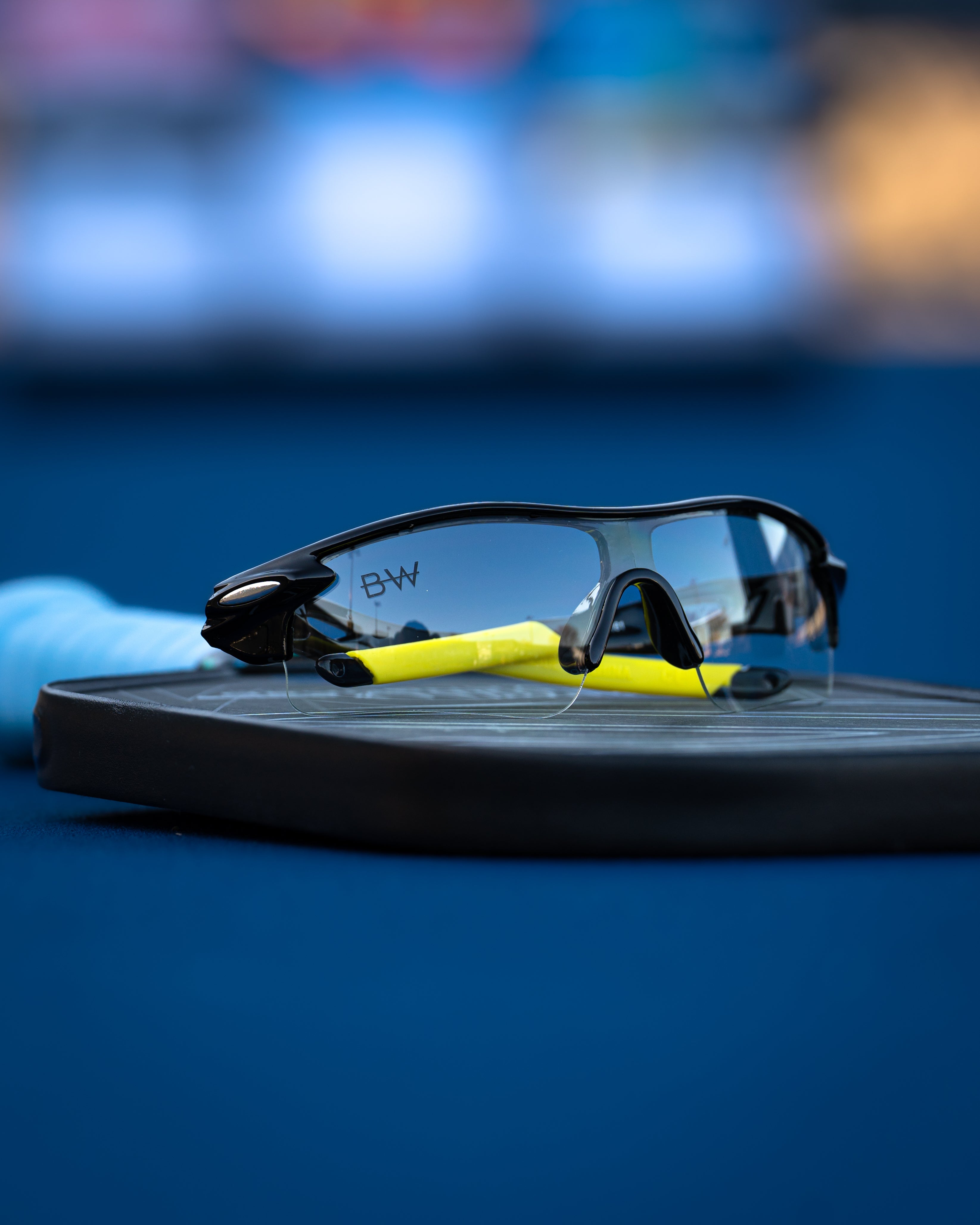
Pickleball Sunglasses for Women: Best Styles for Clarity, Fit & Performance (2026 Guide)
Share
Pickleball Sunglasses for Women: Best Styles for Clarity, Fit & Performance (2026 Guide)
The best pickleball sunglasses for women aren't defined by one frame color, lens tint, or “women-specific” shape. What matters most is finding eyewear that fits your face comfortably, works for your playing environment, and has the lens characteristics you actually want.
For some women, that means a narrower or smaller frame. Others prefer wider coverage or a more pronounced sports shape. There isn't one universal female face shape—and claims that all women need a particular bridge, temple, or frame geometry oversimplify fit.
This 2026 guide explains how to compare fit, frame dimensions, lens tint, impact resistance, clear vs. tinted lenses, prescription options, and style without relying on exaggerated performance claims.
Find Your Pickleball Glasses
What Should Women Look for in Pickleball Sunglasses?
Start with the individual rather than assuming women's pickleball sunglasses require an entirely different type of eyewear.
The most useful factors to compare are:
| Feature | What to Evaluate |
|---|---|
| Frame dimensions | Whether the width, bridge, lens dimensions, and temples suit your face |
| Comfort | How the frame feels during extended wear and movement |
| Lens tint | Whether the lens configuration makes sense for your playing environment |
| Impact resistance | Whether impact-related characteristics are documented |
| Prescription compatibility | Whether you require RX correction and the frame supports your prescription |
| Polarization | Whether you prefer a polarization filter |
| Style | Whether you actually like wearing the frame on and potentially off court |
| Special lens features | Verify UV, anti-fog, photochromic, scratch-resistant, or other specifications for the exact product |
Do Women Need Different Pickleball Sunglasses?
Not necessarily. Some women may prefer smaller or narrower eyewear, but gender alone isn't enough to determine frame fit.
Statements such as “women have narrower bridges” or “women need frames designed around higher cheekbones” shouldn't be applied universally. Facial dimensions vary significantly between individuals.
A better approach is to compare actual frame measurements and how a frame sits on your face.
Pay Attention to These Fit Areas
- Overall width: A frame that's substantially wider or narrower than your face may not feel right.
- Bridge area: Consider how the frame rests around your nose.
- Temple length: Temple dimensions can influence how the frame sits around your ears.
- Lens position: Check where the lenses sit relative to your eyes and cheeks.
- Movement: Consider how the frame feels when looking down, turning your head, and moving around the court.
Fit is personal. A frame marketed as unisex may fit one woman extremely well and another poorly, just as a smaller frame isn't automatically the best choice for every woman.
Are Lightweight Pickleball Sunglasses Better?
Weight can matter during long playing sessions because some players prefer less mass sitting on the nose and ears. But “lightweight” shouldn't be confused with automatically being more comfortable or secure.
Frame geometry, dimensions, contact points, and individual fit can be just as important as weight.
When comparing lightweight sports sunglasses, avoid assuming that a lighter frame automatically:
- Won't slip
- Won't bounce
- Fits smaller faces
- Provides greater impact protection
- Feels comfortable for every player
Instead, use weight as one factor in the overall fit decision.
Best Lens Colors for Women's Pickleball Sunglasses
There isn't a special lens color that women need for pickleball. Tint selection should be based primarily on lighting conditions, personal preference, and the documented characteristics of the exact lens.
| Lens Category | When to Consider It |
|---|---|
| Clear | When you don't want a dark sunglass tint, such as many indoor, evening, or lower-light situations |
| Gray / neutral tint | Common outdoor sunglass option for players who prefer a darker lens |
| Brown / amber-style tint | An alternative outdoor tint for players who prefer its visual appearance |
| Rose / colored tint | Another option when the exact lens characteristics and light transmission suit your environment |
| Photochromic | Potential option for changing light conditions when available in the exact product configuration |
Tint should not be marketed as automatically improving ball tracking, reaction time, accuracy, or depth perception.
If you play primarily indoors or after sunset, explore clear lens sports eyewear.
Clear Pickleball Glasses for Women
Clear sports eyewear can make sense when you want eyewear without a dark sunglass tint.
This can be particularly relevant for:
- Indoor pickleball
- Evening matches
- Lower-light environments
- Players who simply don't want tinted lenses
Clear doesn't mean that a lens increases available light, improves contrast, or makes the ball easier to track. It simply means you're not looking through a dark sunglass tint.
Impact characteristics, prescription status, fit, and protective certifications should still be evaluated separately.
Polarized vs. Non-Polarized Pickleball Sunglasses for Women
Blinded Wear sports eyewear uses non-polarized lenses.
A non-polarized lens does not have an added polarization filter. Some court players prefer this configuration, but it shouldn't be claimed that non-polarized lenses inherently improve depth perception or ball tracking.
| Lens Type | What It Means |
|---|---|
| Non-polarized | No polarization filter is added |
| Polarized | Uses a filter designed to reduce certain reflected glare |
Choose based on your playing environment and preference rather than treating either configuration as universally superior for pickleball.
Impact Resistance: What Women Players Should Know
Pickleball eyewear isn't only about appearance and tint. Impact characteristics can also be an important part of comparing sports eyewear.
Blinded Wear sports eyewear uses impact-resistant lenses. However, impact-resistant does not automatically mean:
- Shatterproof
- Indestructible
- ANSI Z87.1-certified
- ASTM F803-certified
- Guaranteed to prevent an eye injury
If you require a specific protective standard, verify certification for the exact product before purchasing.
For more information, read Why Impact Resistance Matters in Sports Eyewear.
What About UV Protection for Outdoor Pickleball?
UV specifications are relevant when evaluating outdoor sunglasses, but they should be verified for the exact lens rather than assumed because a lens is dark, mirrored, or marketed for sports.
A darker tint does not, by itself, establish a particular UV specification.
When comparing outdoor pickleball sunglasses, look for documented information about the exact lens configuration you're purchasing rather than assuming every frame or tint across a collection has identical specifications.
Prescription Pickleball Glasses for Women
If you need vision correction, you don't need to choose eyewear solely because it is labeled “women's.” The more important questions are whether the frame fits you and whether it is compatible with your prescription.
Blinded Wear's RX Pickleball Collection includes multiple frame styles and provides:
- Prescription correction built into the eyewear
- High-index prescription lenses at no additional cost
- Impact-resistant sports lenses
- Non-polarized sports lenses
- Multiple frame designs and aesthetics
- Prescription submission using a clear photo of your eyeglass prescription
Prescription compatibility can vary, so don't assume that every frame supports every prescription.
Pickleball Sunglasses Can Be Functional and Stylish
Performance considerations don't require everyone to wear the same aggressive wraparound frame.
Some players prefer a distinctly athletic shield or sports shape. Others want eyewear that looks closer to conventional sunglasses and can transition more naturally from the court to other activities.
Neither style is inherently better. The goal is to find a frame that:
- Fits your face appropriately
- Works for your playing environment
- Has the lens characteristics you want
- Meets your prescription requirements, if applicable
- Has documented impact characteristics that meet your needs
- Matches your personal style well enough that you'll actually want to wear it
For more options, browse Blinded Wear's non-prescription pickleball eyewear or use the Pickleball Sunglasses Quiz to narrow your choices.
What Style of Pickleball Sunglasses Is Best for Women?
There isn't one best frame style for every woman. The right choice depends on your face dimensions, preferred coverage, playing environment, and personal style.
| Frame Style | Why You Might Choose It |
|---|---|
| Sport shield | For players who prefer a distinctly athletic look and larger lens area |
| Wrap-style sports frame | For players who like a frame that follows the contours of the face more closely |
| Traditional two-lens sports frame | For players who prefer a more familiar sunglass appearance |
| Smaller-profile frame | Worth considering if many standard sports frames feel too wide |
| Larger-profile frame | Worth considering if smaller frames feel restrictive or undersized |
| Clear sports frame | Useful when you don't want a dark sunglass tint |
| RX sports frame | For players who require prescription correction while playing |
The category name matters less than how the exact frame fits you. Two sunglasses that look similar online can have noticeably different widths, bridges, lens shapes, and temple dimensions.
Pickleball Sunglasses for Women With Smaller Faces
If sports sunglasses frequently feel oversized, focus on actual measurements rather than shopping exclusively by gender.
Useful dimensions to compare include:
- Overall frame width
- Individual lens width
- Bridge width
- Lens height
- Temple length
If you already own sunglasses that fit well, their measurements can provide a useful reference point when comparing new frames.
A smaller frame isn't automatically more secure, however. A frame still needs to suit your individual nose, ears, face shape, and preferred fit.
What If You Need a Wider Women's Sports Frame?
Women's eyewear shouldn't automatically be equated with small eyewear. Some women need or simply prefer wider frames.
If conventional “women's” sunglasses feel tight around your temples, compare wider unisex and sports frames instead of forcing yourself into a smaller design.
This is one reason shopping by measurements and fit preferences is generally more useful than relying entirely on men's and women's labels.
Best Pickleball Sunglasses for Women Who Play Outdoors
Outdoor players should evaluate more than frame appearance. The exact lens configuration becomes especially important.
Before choosing an outdoor pair, compare:
- Lens tint
- Documented UV specifications
- Impact characteristics
- Polarized vs. non-polarized configuration
- Frame dimensions
- Prescription compatibility when needed
- Comfort during extended wear
Don't assume a mirrored, dark, amber, rose, or gray lens automatically provides a particular level of UV protection or improves your ability to see the pickleball. Those characteristics should be evaluated separately.
Best Pickleball Glasses for Women Who Play Indoors
Indoor players often have different priorities because a dark sunglass tint may not be desirable inside a gym or indoor pickleball facility.
A clear sports lens is one option when you want eyewear without dark tint.
When comparing indoor eyewear, consider:
- Fit and comfort
- Impact-resistant lens construction
- Prescription needs
- Frame dimensions
- Any documented lens treatments that matter to you
Clear lenses shouldn't be described as automatically increasing contrast or improving ball tracking. Their primary distinction is the absence of a dark sunglass tint.
Choosing Comfortable Pickleball Sunglasses for Long Matches
If you play for several hours at a time, comfort becomes particularly important. But comfort can't be determined from a product photo alone.
Look at the interaction between:
- Frame weight
- Frame width
- Bridge fit
- Temple dimensions
- Lens size
- How the frame contacts your face
A lightweight frame can still feel uncomfortable if its dimensions don't suit you, while a slightly heavier frame may feel perfectly comfortable if the fit is right.
The goal isn't simply to find the lightest sunglasses. It's to find a pair you can comfortably keep on throughout your playing session.
How Do You Keep Pickleball Sunglasses From Slipping?
No responsible eyewear guide can promise that a particular pair will “never slip.” Sweat, sunscreen, frame dimensions, head shape, movement, and individual fit can all affect how eyewear behaves during play.
If slipping has been a problem with previous sunglasses, pay particular attention to:
- Whether the frame is too wide for your face
- How the bridge sits on your nose
- Temple length and position
- Whether the frame shifts when you turn or lower your head
- Product-specific fit characteristics documented for the exact model
A good fit can reduce the need to repeatedly adjust your eyewear, but “zero slip” shouldn't be treated as a universal guarantee.
What About Fogging During Hot or Humid Pickleball?
Fogging can occur when temperature, moisture, airflow, perspiration, and environmental conditions interact with the lens surface.
Don't assume sports sunglasses are automatically anti-fog simply because they're intended for athletic use.
Likewise, frame openings or an athletic-looking shape shouldn't automatically be described as an engineered ventilation system unless that feature is documented for the exact model.
If anti-fog performance is a priority, verify whether the specific eyewear and lens configuration includes a documented anti-fog treatment.
Are Pickleball Sunglasses Scratch-Resistant?
Scratch resistance is another specification that should be checked for the exact lens. Impact resistance does not automatically establish scratch resistance, and the two terms shouldn't be used interchangeably.
Regardless of the lens, appropriate storage and cleaning can help reduce avoidable wear. Keep your eyewear away from abrasive surfaces and use cleaning methods suitable for the specific lens.
For travel and storage tips, see How to Store and Protect Glasses on the Go.
RX vs. Non-RX Pickleball Sunglasses for Women
The decision is straightforward at the highest level: if you require prescription correction while playing and prefer glasses rather than contacts, explore prescription sports eyewear. If you don't need an RX through the eyewear, shop non-prescription options.
| Player | Where to Start |
|---|---|
| Needs prescription correction while playing | RX Pickleball Glasses |
| Doesn't require prescription correction | Non-RX Pickleball Sunglasses |
| Wears contacts for correction | Consider non-RX sports eyewear over contacts |
| Plays indoors or in lower light | Clear Lens Sports Eyewear |
Not every non-RX product necessarily has an identical RX version, and prescription compatibility can vary by frame. Check the exact product rather than assuming an RX option exists for every style.
Women's Pickleball Sunglasses Shopping Checklist
Before buying, use this checklist to separate useful product information from marketing language:
- Measure your current eyewear. Use a comfortable pair as a starting reference.
- Decide where you'll play. Indoor, outdoor, evening, or mixed environments can lead to different lens choices.
- Choose clear or tinted lenses. Don't select tint solely because of performance claims.
- Check prescription requirements. If you need an RX, verify compatibility with the exact frame.
- Review impact characteristics. Know the difference between impact resistance and certified protective eyewear.
- Verify UV specifications. Don't infer them from lens darkness or color.
- Verify special treatments. Anti-fog and scratch-resistant properties should be documented if they're important to you.
- Compare frame dimensions. Don't assume every women's or unisex frame will fit similarly.
- Choose a style you like. Practical eyewear is more useful when you actually want to wear it.
- Review replacement terms. Understand what support is available if the eyewear eventually breaks.
Blinded Wear's 50% Lifetime Replacement Support
Blinded Wear provides 50% lifetime replacement support for eligible eyewear that breaks, subject to the current policy terms.
That can add practical value to sports eyewear that is regularly transported and used during active play.
It should not, however, be interpreted as a free lifetime replacement guarantee or automatic coverage for every fit, cosmetic, or wear-related issue.
Review the current Protection Plan & Returns for complete eligibility and terms.
Common Mistakes When Shopping for Women's Pickleball Sunglasses
- Assuming all women need small frames: Fit should be based on your measurements.
- Choosing entirely by appearance: Consider lens configuration, dimensions, and playing environment too.
- Assuming dark lenses equal UV protection: Verify the actual UV specification.
- Assuming a certain tint improves performance: Tint alone doesn't guarantee better tracking or reactions.
- Confusing impact resistance with certification: They're not interchangeable.
- Assuming sports eyewear can't fog: Verify product-specific treatments instead.
- Assuming every model is RX-ready: Check prescription compatibility for the exact frame.
- Buying solely from a “women's” label: A well-fitting unisex sports frame may be the better choice.
How to Narrow Down Your Best Pickleball Sunglasses
Start with your actual needs rather than searching for a universal “best women's pickleball sunglass.”
If you need prescription correction, begin with the RX collection. If you don't need an RX, browse non-prescription pickleball sunglasses. If you primarily play without wanting dark tint, explore clear lens options.
You can also use the Pickleball Sunglasses Quiz to narrow down your options before comparing individual frames.
What Style of Pickleball Sunglasses Is Best for Women?
There isn't one best frame style for every woman. The right choice depends on your face dimensions, preferred coverage, playing environment, and personal style.
| Frame Style | Why You Might Choose It |
|---|---|
| Sport shield | For players who prefer a distinctly athletic look and larger lens area |
| Wrap-style sports frame | For players who like a frame that follows the contours of the face more closely |
| Traditional two-lens sports frame | For players who prefer a more familiar sunglass appearance |
| Smaller-profile frame | Worth considering if many standard sports frames feel too wide |
| Larger-profile frame | Worth considering if smaller frames feel restrictive or undersized |
| Clear sports frame | Useful when you don't want a dark sunglass tint |
| RX sports frame | For players who require prescription correction while playing |
The category name matters less than how the exact frame fits you. Two sunglasses that look similar online can have noticeably different widths, bridges, lens shapes, and temple dimensions.
Pickleball Sunglasses for Women With Smaller Faces
If sports sunglasses frequently feel oversized, focus on actual measurements rather than shopping exclusively by gender.
Useful dimensions to compare include:
- Overall frame width
- Individual lens width
- Bridge width
- Lens height
- Temple length
If you already own sunglasses that fit well, their measurements can provide a useful reference point when comparing new frames.
A smaller frame isn't automatically more secure, however. A frame still needs to suit your individual nose, ears, face shape, and preferred fit.
What If You Need a Wider Women's Sports Frame?
Women's eyewear shouldn't automatically be equated with small eyewear. Some women need or simply prefer wider frames.
If conventional “women's” sunglasses feel tight around your temples, compare wider unisex and sports frames instead of forcing yourself into a smaller design.
This is one reason shopping by measurements and fit preferences is generally more useful than relying entirely on men's and women's labels.
Best Pickleball Sunglasses for Women Who Play Outdoors
Outdoor players should evaluate more than frame appearance. The exact lens configuration becomes especially important.
Before choosing an outdoor pair, compare:
- Lens tint
- Documented UV specifications
- Impact characteristics
- Polarized vs. non-polarized configuration
- Frame dimensions
- Prescription compatibility when needed
- Comfort during extended wear
Don't assume a mirrored, dark, amber, rose, or gray lens automatically provides a particular level of UV protection or improves your ability to see the pickleball. Those characteristics should be evaluated separately.
Best Pickleball Glasses for Women Who Play Indoors
Indoor players often have different priorities because a dark sunglass tint may not be desirable inside a gym or indoor pickleball facility.
A clear sports lens is one option when you want eyewear without dark tint.
When comparing indoor eyewear, consider:
- Fit and comfort
- Impact-resistant lens construction
- Prescription needs
- Frame dimensions
- Any documented lens treatments that matter to you
Clear lenses shouldn't be described as automatically increasing contrast or improving ball tracking. Their primary distinction is the absence of a dark sunglass tint.
Choosing Comfortable Pickleball Sunglasses for Long Matches
If you play for several hours at a time, comfort becomes particularly important. But comfort can't be determined from a product photo alone.
Look at the interaction between:
- Frame weight
- Frame width
- Bridge fit
- Temple dimensions
- Lens size
- How the frame contacts your face
A lightweight frame can still feel uncomfortable if its dimensions don't suit you, while a slightly heavier frame may feel perfectly comfortable if the fit is right.
The goal isn't simply to find the lightest sunglasses. It's to find a pair you can comfortably keep on throughout your playing session.
How Do You Keep Pickleball Sunglasses From Slipping?
No responsible eyewear guide can promise that a particular pair will “never slip.” Sweat, sunscreen, frame dimensions, head shape, movement, and individual fit can all affect how eyewear behaves during play.
If slipping has been a problem with previous sunglasses, pay particular attention to:
- Whether the frame is too wide for your face
- How the bridge sits on your nose
- Temple length and position
- Whether the frame shifts when you turn or lower your head
- Product-specific fit characteristics documented for the exact model
A good fit can reduce the need to repeatedly adjust your eyewear, but “zero slip” shouldn't be treated as a universal guarantee.
What About Fogging During Hot or Humid Pickleball?
Fogging can occur when temperature, moisture, airflow, perspiration, and environmental conditions interact with the lens surface.
Don't assume sports sunglasses are automatically anti-fog simply because they're intended for athletic use.
Likewise, frame openings or an athletic-looking shape shouldn't automatically be described as an engineered ventilation system unless that feature is documented for the exact model.
If anti-fog performance is a priority, verify whether the specific eyewear and lens configuration includes a documented anti-fog treatment.
Are Pickleball Sunglasses Scratch-Resistant?
Scratch resistance is another specification that should be checked for the exact lens. Impact resistance does not automatically establish scratch resistance, and the two terms shouldn't be used interchangeably.
Regardless of the lens, appropriate storage and cleaning can help reduce avoidable wear. Keep your eyewear away from abrasive surfaces and use cleaning methods suitable for the specific lens.
For travel and storage tips, see How to Store and Protect Glasses on the Go.
RX vs. Non-RX Pickleball Sunglasses for Women
The decision is straightforward at the highest level: if you require prescription correction while playing and prefer glasses rather than contacts, explore prescription sports eyewear. If you don't need an RX through the eyewear, shop non-prescription options.
| Player | Where to Start |
|---|---|
| Needs prescription correction while playing | RX Pickleball Glasses |
| Doesn't require prescription correction | Non-RX Pickleball Sunglasses |
| Wears contacts for correction | Consider non-RX sports eyewear over contacts |
| Plays indoors or in lower light | Clear Lens Sports Eyewear |
Not every non-RX product necessarily has an identical RX version, and prescription compatibility can vary by frame. Check the exact product rather than assuming an RX option exists for every style.
Women's Pickleball Sunglasses Shopping Checklist
Before buying, use this checklist to separate useful product information from marketing language:
- Measure your current eyewear. Use a comfortable pair as a starting reference.
- Decide where you'll play. Indoor, outdoor, evening, or mixed environments can lead to different lens choices.
- Choose clear or tinted lenses. Don't select tint solely because of performance claims.
- Check prescription requirements. If you need an RX, verify compatibility with the exact frame.
- Review impact characteristics. Know the difference between impact resistance and certified protective eyewear.
- Verify UV specifications. Don't infer them from lens darkness or color.
- Verify special treatments. Anti-fog and scratch-resistant properties should be documented if they're important to you.
- Compare frame dimensions. Don't assume every women's or unisex frame will fit similarly.
- Choose a style you like. Practical eyewear is more useful when you actually want to wear it.
- Review replacement terms. Understand what support is available if the eyewear eventually breaks.
Blinded Wear's 50% Lifetime Replacement Support
Blinded Wear provides 50% lifetime replacement support for eligible eyewear that breaks, subject to the current policy terms.
That can add practical value to sports eyewear that is regularly transported and used during active play.
It should not, however, be interpreted as a free lifetime replacement guarantee or automatic coverage for every fit, cosmetic, or wear-related issue.
Review the current Protection Plan & Returns for complete eligibility and terms.
Common Mistakes When Shopping for Women's Pickleball Sunglasses
- Assuming all women need small frames: Fit should be based on your measurements.
- Choosing entirely by appearance: Consider lens configuration, dimensions, and playing environment too.
- Assuming dark lenses equal UV protection: Verify the actual UV specification.
- Assuming a certain tint improves performance: Tint alone doesn't guarantee better tracking or reactions.
- Confusing impact resistance with certification: They're not interchangeable.
- Assuming sports eyewear can't fog: Verify product-specific treatments instead.
- Assuming every model is RX-ready: Check prescription compatibility for the exact frame.
- Buying solely from a “women's” label: A well-fitting unisex sports frame may be the better choice.
How to Narrow Down Your Best Pickleball Sunglasses
Start with your actual needs rather than searching for a universal “best women's pickleball sunglass.”
If you need prescription correction, begin with the RX collection. If you don't need an RX, browse non-prescription pickleball sunglasses. If you primarily play without wanting dark tint, explore clear lens options.
You can also use the Pickleball Sunglasses Quiz to narrow down your options before comparing individual frames.
Frequently Asked Questions About Pickleball Sunglasses for Women
What are the best pickleball sunglasses for women?
The best pair depends on your face dimensions, playing environment, prescription needs, preferred lens configuration, and style. Rather than choosing one universal “best” model, compare the exact measurements and documented characteristics of individual frames.
Do women need smaller pickleball sunglasses?
Not necessarily. Some women prefer narrower frames, while others need medium or wider eyewear. Gender alone doesn't determine ideal frame size. Comparing measurements from a pair you already find comfortable is a better starting point.
Should pickleball sunglasses fit tightly?
They should fit comfortably enough for active use without creating unwanted pressure. An excessively tight frame isn't automatically more secure, and a loose frame may move more than you prefer. Individual fit matters.
What color lens is best for women's pickleball sunglasses?
There isn't a women-specific best lens color. Choose based on your playing environment, personal preference, and the documented characteristics of the exact lens. Tint color alone doesn't guarantee improved contrast, tracking, reactions, or depth perception.
Are clear glasses good for indoor pickleball?
Clear lenses can be a practical choice when you don't want a dark sunglass tint, including many indoor, evening, and lower-light situations. Clear lenses shouldn't automatically be described as increasing light, contrast, or athletic performance.
Are non-polarized sunglasses good for pickleball?
Some players prefer non-polarized eyewear for court sports. Blinded Wear sports eyewear uses non-polarized lenses. This means a polarization filter isn't added; it doesn't inherently guarantee better depth perception or ball tracking.
Do pickleball sunglasses protect against ball impacts?
Impact characteristics depend on the exact eyewear. Blinded Wear sports eyewear uses impact-resistant lenses, but impact-resistant doesn't mean shatterproof, indestructible, or automatically certified to a specific protective standard.
Are pickleball sunglasses the same as protective sports goggles?
No. Sports sunglasses and eyewear certified to a particular protective standard shouldn't automatically be treated as interchangeable. If you require a specific certification, verify it for the exact product.
Do women's pickleball sunglasses prevent fogging?
No pair should be assumed to be fog-free simply because it's designed for sports. Temperature, humidity, perspiration, airflow, frame position, and lens treatments can all influence fogging. Verify any anti-fog treatment for the exact product.
Can women get prescription pickleball sunglasses?
Yes. Blinded Wear offers a dedicated RX Pickleball Eyewear Collection. High-index prescription lenses are included at no additional cost, although compatibility should still be confirmed for your prescription and chosen frame.
Can I wear contacts with non-prescription pickleball sunglasses?
Players who use contact lenses for their vision correction can consider wearing non-prescription sports eyewear over them. Whether contacts or dedicated RX sports glasses are preferable is an individual decision.
Can I wear pickleball sunglasses away from the court?
Potentially. Whether a particular pair works for other activities depends on its tint, styling, prescription configuration, and the requirements of the activity. Don't assume every sports lens is appropriate for every use.
Women's Pickleball Sunglasses: Quick Comparison Guide
| If You Want... | Look For... |
|---|---|
| Outdoor sunglasses | An appropriate tint plus verified lens specifications for the exact product |
| Indoor pickleball eyewear | Clear or another configuration appropriate for the lighting environment |
| Prescription correction | An RX-compatible sports frame |
| A smaller fit | Narrower frame measurements rather than simply a “women's” label |
| A wider fit | Medium or larger frame measurements |
| Impact resistance | Documented impact-resistant lens characteristics |
| A particular safety standard | Documentation showing the exact certification required |
| Anti-fog treatment | Explicit documentation for the exact lens configuration |
| Non-polarized lenses | A lens without an added polarization filter |
| A fashionable court look | A frame design and finish that match your personal style |
Women's Pickleball Eyewear: Performance Claims to Treat Carefully
Sports eyewear marketing often connects a particular frame or lens with major improvements in athletic performance. Those claims deserve scrutiny.
| Claim | Better Way to Evaluate It |
|---|---|
| “Makes the ball easier to track” | Evaluate tint and lens characteristics without assuming a guaranteed tracking benefit |
| “Improves reaction time” | Don't assume eyewear alone changes reaction speed |
| “Improves depth perception” | Don't attribute automatic depth-perception improvement to polarization status or tint |
| “Never slips” | Evaluate dimensions and individual fit |
| “Never fogs” | Check for documented treatments and consider environmental conditions |
| “Shatterproof” | Look for documented impact characteristics and certifications instead |
| “Perfect for every woman” | Compare measurements to your individual face and current eyewear |
Good pickleball eyewear doesn't need exaggerated claims to be useful. Appropriate fit, suitable lens configuration, impact resistance, prescription correction when required, and comfortable wear are meaningful characteristics on their own.
For more on separating eyewear claims from evidence, read Pickleball Vision Myths Debunked.
5 Questions to Ask Before Buying Pickleball Sunglasses
- Where will I use them? Outdoor daytime play, indoor courts, and evening pickleball can call for different lens choices.
- What size fits me? Compare frame dimensions with eyewear you already wear comfortably.
- Do I need prescription correction? If yes, confirm compatibility before choosing a frame.
- Which features are actually documented? Verify UV specifications, special coatings, certifications, and other lens features rather than assuming them.
- Do I like the frame enough to wear it consistently? Style is a legitimate consideration when the functional requirements are also met.
What If You Need Women's Prescription Pickleball Glasses?
If you normally wear prescription glasses, a dedicated RX sports pair can combine your required vision correction with eyewear selected for active use.
Blinded Wear RX eyewear includes high-index prescription lenses at no additional cost. Customers provide a clear photo of their eyeglass prescription before purchasing.
However, prescription eyewear shouldn't be marketed as automatically improving reaction time, accuracy, depth perception, or ball tracking. Its primary purpose is providing the vision correction prescribed for you.
For a deeper buying guide, see Prescription Glasses for Fast-Paced Sports or browse Prescription Pickleball Glasses.
What Happens If Your Pickleball Sunglasses Break?
Sports eyewear can be dropped, packed into gear bags, or damaged during regular use. Replacement support is therefore worth considering alongside the initial purchase price.
Blinded Wear provides 50% lifetime replacement support for eligible eyewear that breaks, subject to the current policy terms.
This isn't the same as saying the eyewear is indestructible or that every type of wear, fit issue, or cosmetic damage automatically qualifies.
Review the current Protection Plan & Returns policy for details.
More Pickleball Eyewear Guides
Final Verdict: How to Find the Best Pickleball Sunglasses for Women
The best pickleball sunglasses for women aren't necessarily the smallest, lightest, darkest, or most aggressively styled sports frames. They're the ones that match your face, vision needs, playing environment, and preferences.
Start with fit. Compare actual frame measurements rather than assuming every women's frame will suit you. Then determine whether you need clear or tinted lenses, prescription or non-prescription eyewear, and which documented lens characteristics matter for where you play.
Finally, choose a style you genuinely like. Pickleball eyewear can be functional without looking identical from player to player.
Most importantly, separate useful product characteristics from promises that sunglasses will automatically make you faster, improve your depth perception, or transform your ball tracking. Good sports eyewear doesn't need those claims to have value.