
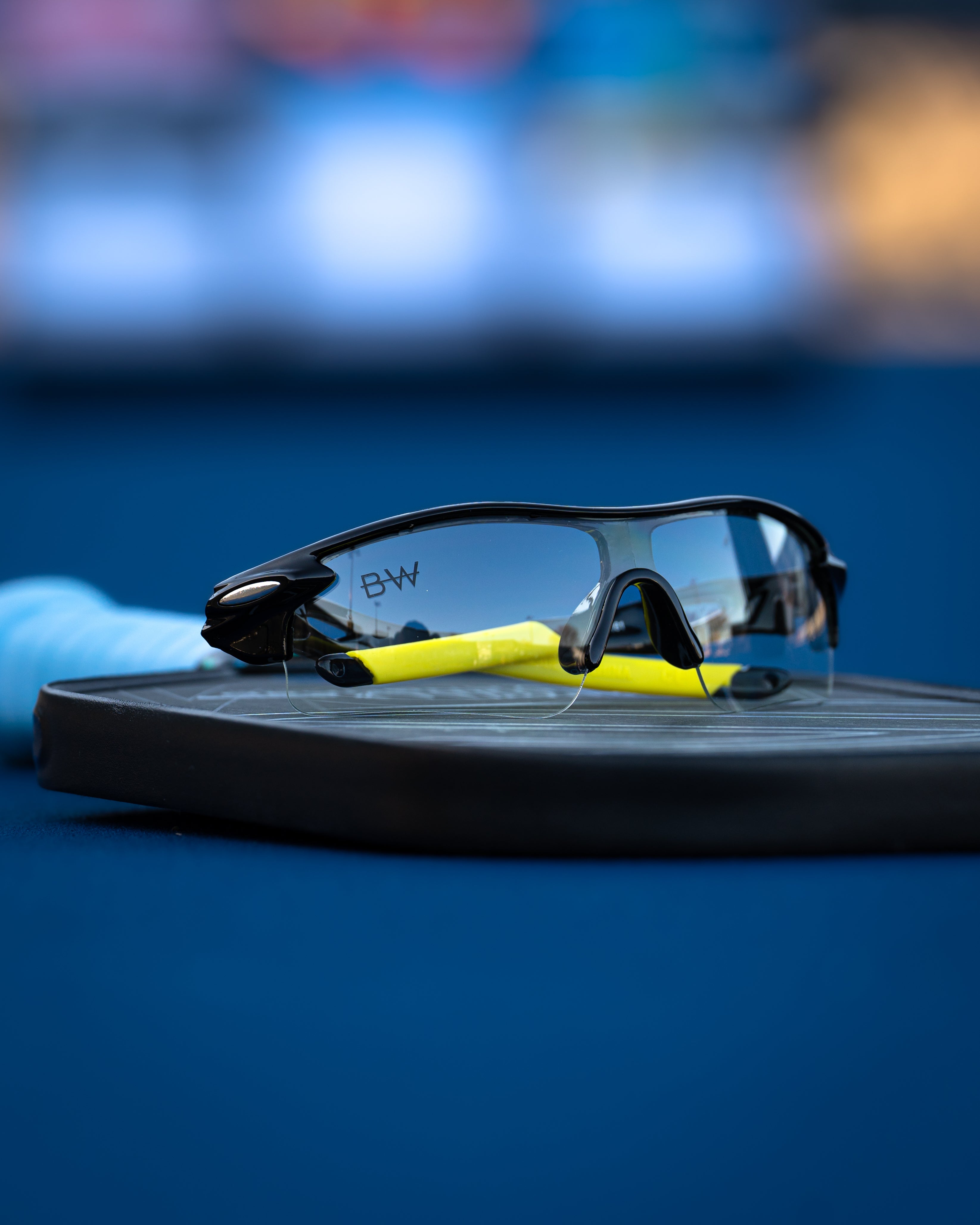
The Vision Advantage: Why RX Glasses Are the Secret Weapon of Elite Pickleball Players
Share
The Vision Advantage: Why RX Glasses Matter for Elite Pickleball Players
Elite pickleball is built on small margins. Players read developing patterns, move into position, control paddle preparation, judge changing ball paths, and make decisions while opponents are trying to take time away from them.
For athletes who require prescription correction, there is another fundamental piece of that system: seeing the court with the correction they need.
That makes prescription sports eyewear valuable equipment—but not a secret shortcut to elite performance. RX glasses do not automatically create faster reactions, better depth perception, improved ball tracking, or more accurate shots. Instead, they address the player's corrective vision needs while the athlete develops those abilities through training and experience.
This guide breaks down the real vision advantage in competitive pickleball: what RX glasses can provide, what belongs to the athlete, and how serious players can build a prescription eyewear setup around the demands of their game.
Find Your Pickleball Glasses
Do RX Glasses Give Pickleball Players a Competitive Advantage?
If a player requires prescription correction, wearing appropriate RX eyewear addresses that corrective need during competition. That can make prescription eyewear an important part of the player's equipment setup.
But the advantage should be described accurately.
| RX Glasses Can Provide | RX Glasses Do Not Automatically Provide |
|---|---|
| Required prescription correction | Elite-level performance |
| A sports-oriented frame | Faster neurological reactions |
| Impact-resistant lenses | Better anticipation |
| Non-polarized lenses | Improved biological depth perception |
| High-index prescription lenses | Automatic ball-tracking improvement |
| A consistent corrective setup for practice and matches | More accurate shots |
The eyewear handles correction. The athlete develops performance.
What Do Elite Pickleball Players Actually Need to See?
Competitive pickleball involves much more than identifying the ball.
During a point, players may gather information about:
- The developing ball path
- Opponent positioning
- Partner positioning in doubles
- Open court space
- Opponent paddle preparation
- Ball height
- Distance to the kitchen line and net
- Movement into and out of the transition zone
- Previous patterns from the same opponent
The athlete then has to interpret that information and act.
A prescription lens can provide required correction while this happens. It does not make those decisions for the player.
The Real Pickleball Vision-to-Performance Chain
Instead of treating eyesight as a single performance variable, think about competitive play as a chain:
visual information → recognition → interpretation → decision → movement → preparation → contact → recovery
RX correction belongs near the beginning of that process when a player needs it.
What happens afterward involves the athlete.
| Stage | Primary Role |
|---|---|
| Prescription Correction | RX eyewear |
| Recognition | Attention and experience |
| Interpretation | Pattern recognition and court awareness |
| Decision | Tactical skill |
| Movement | Positioning and physical execution |
| Contact | Technique and paddle control |
| Recovery | Training, positioning, and habits |
Why Prescription Correction Still Matters at Higher Levels
Becoming a stronger pickleball player does not make a prescription requirement disappear.
As rallies become faster and opponents become more skilled, players still perform while:
- The ball changes speed and direction
- Opponents disguise intentions
- Available court space changes
- The athlete moves forward, backward, and laterally
- Decisions must be made repeatedly
If you require prescription correction, using an appropriate RX setup allows you to compete with that correction rather than treating your normal visual needs as separate from your sports equipment.
Do RX Glasses Improve Reaction Time in Pickleball?
Prescription glasses should not automatically be marketed as increasing neurological reaction speed.
What players call “reaction time” on court can involve several separate stages:
- Relevant information becomes available
- The player recognizes what is happening
- The player selects a response
- Movement begins
- The response is executed
An experienced athlete may appear to have faster reactions because they recognize a familiar situation earlier, maintain a more useful ready position, or require less movement to complete the response.
Those advantages should not automatically be credited to the prescription lens.
Elite Pickleball Vision Is Often About Anticipation, Not Superhuman Reflexes
High-level players build experience with recurring situations.
Over time, they may become better at recognizing information such as:
- Where an opponent is positioned
- Which shots are available from that position
- How the opponent prepared for similar shots earlier
- Where open space exists
- What patterns have already appeared during the match
This can allow preparation to begin earlier.
Earlier recognition can look like faster reaction. That does not mean eyewear accelerated the athlete's nervous system.
Do Prescription Glasses Improve Depth Perception?
Depth perception should not be reduced to a product feature.
Players interpret changing spatial relationships between themselves, the ball, net, court, partner, and opponents. Binocular visual information can contribute to that process, along with movement, trajectory information, relative size, positioning, and experience.
If a player requires prescription correction, appropriate RX eyewear addresses that correction while depth judgment occurs.
That is different from claiming that a particular sports frame automatically “boosts” or “optimizes” biological depth perception.
Where Depth Judgment Appears During a Pickleball Match
| Situation | Spatial Challenge |
|---|---|
| Dink Rally | Responding to changing ball depth around the kitchen |
| Third-Shot Drop | Reading the developing path while positioning for the next phase |
| Drive | Responding to a faster developing trajectory |
| Lob | Judging a ball moving through changing height and distance |
| Transition Zone | Interpreting the ball while the player's own position is changing |
| Speed-Up | Responding to a developing ball with reduced available time |
RX correction can remain part of the player's visual setup in each situation, while court-specific depth judgment develops through experience and repetition.
Do RX Glasses Improve Ball Tracking?
If you require correction, RX lenses provide that correction while you follow a moving pickleball.
But ball tracking itself can involve:
- Attention
- Eye and head movement
- Recognition of the developing trajectory
- Positioning
- Movement
- Experience with different shots
Therefore, it is more accurate to say that prescription eyewear supports the player's corrective needs during ball tracking rather than claiming that the glasses automatically create superior tracking ability.
Can RX Glasses Help Elite Players Read Spin?
Prescription correction and spin recognition are different concepts.
Players may use information from:
- Opponent paddle movement
- Contact
- The developing ball path
- The bounce
- Previous experience with similar shots
RX glasses provide required correction while the player observes the rally. They should not automatically be described as revealing spin earlier or making spin easier to recognize.
Does Better-Corrected Vision Create More Confidence?
A player may prefer competing in a familiar corrective setup, but confidence is not an automatic lens feature.
Competitive confidence can develop through:
- Preparation
- Repeated practice
- Equipment familiarity
- Technical skill
- Experience under pressure
- Tactical understanding
- Recovery after mistakes
RX eyewear can become one familiar part of that system when the player requires prescription correction.
Corrected Vision vs. Pickleball Skill: Know the Difference
| Corrective / Equipment Factor | Player Skill |
|---|---|
| Prescription correction | Shot selection |
| Lens configuration | Anticipation |
| Frame selection | Positioning |
| Impact-resistant lens | Paddle control |
| Non-polarized configuration | Pattern recognition |
| Equipment familiarity | Movement and recovery |
The strongest competitive setup respects both sides instead of pretending equipment can replace skill development.
What Do High-Index RX Lenses Actually Do?
Blinded Wear includes high-index prescription lenses at no additional cost with RX eyewear.
High-index refers to a prescription lens-material category. It should not automatically be described as:
- Improving reaction time
- Eliminating edge distortion
- Improving depth perception
- Increasing shot accuracy
- Making ball tracking faster
The useful purchasing fact is simpler: high-index prescription lenses are included without an additional high-index charge.
Why Use Non-Polarized Lenses for Pickleball?
Blinded Wear sports eyewear uses non-polarized lenses.
A non-polarized lens does not add a polarization filter and preserves the visual information available without that filter. Some court players prefer non-polarized sports eyewear.
This should not be expanded into a universal claim that non-polarized lenses improve depth perception, reaction time, ball tracking, or spin recognition.
Impact-Resistant RX Lenses for Active Play
Blinded Wear sports eyewear uses impact-resistant lenses.
That is a meaningful physical characteristic for eyewear intended for active environments, but accurate terminology matters.
Impact-resistant does not automatically mean:
- Shatterproof
- Unbreakable
- Guaranteed against every impact
- Certified to a specific protective standard
Players should evaluate verified product characteristics rather than assuming every sports-related term means the same thing.
Blinded Wear RX Glasses to Compare for Competitive Pickleball
There is no responsible reason to rank one RX frame as creating the “fastest reactions” or “best depth perception.” Instead, compare current products according to your prescription, playing environment, frame preferences, and available specifications.
| RX Model | What to Compare | Explore |
|---|---|---|
| Rocket Fire RX | Current RX configuration, frame design, dimensions, and playing environment | Rocket Fire RX |
| Ocean Wave RX | Current prescription configuration, frame design, dimensions, and environment | Ocean Wave RX |
| Frost RX | Current RX configuration, frame design, dimensions, and aesthetic preference | Frost RX |
| Silver Line RX | Prescription sunglass configuration, outdoor routine, frame design, and dimensions | Silver Line RX |
| Phantom II RX | Current lens configuration, frame design, prescription requirements, and dimensions | Phantom II RX |
| H Blue Shield RX | Blue-light filtering when that verified characteristic fits the shopper's intended use | H Blue Shield RX |
What Blinded Wear RX Eyewear Actually Offers
Competitive eyewear can be marketed effectively without promising an “unfair advantage.” Focus on the characteristics players can actually evaluate.
- Designed for pickleball players
- Lightweight sports frames
- Impact-resistant lenses
- Non-polarized lenses
- Comfortable for extended matches
- Suitable for recreational and competitive players
- Performance-first design
- High-index prescription lenses included at no additional cost
- 50% lifetime replacement support if glasses break, subject to current policy terms
The Elite Player's RX Eyewear Framework
Rather than asking, “Which glasses will make me better?” use a more practical six-step framework.
- Correct: Start with the prescription correction you require.
- Match: Choose a lens configuration appropriate for where you play.
- Compare: Review verified frame and lens characteristics.
- Practice: Use the finished RX setup during normal training.
- Compete: Enter matches already familiar with the equipment.
- Prepare: Consider another suitable corrective option for important tournaments and travel.
This turns RX eyewear into a deliberate piece of the player's equipment system without expecting it to substitute for skill.
Match Your RX Glasses to Where You Play
Elite and competitive players often train in more than one environment. Lens selection should begin with those real conditions.
| Playing Routine | RX Category to Compare |
|---|---|
| Primarily indoor | Clear RX and other current non-dark-tint options |
| Primarily outdoor | Current RX sunglass configurations |
| Changing outdoor conditions | Available adaptive/photochromic RX configurations |
| Indoor + outdoor schedule | Compare versatile RX options with separate environment-specific pairs |
| Tournament travel | Familiar primary RX setup plus another suitable corrective option |
What Should Competitive Indoor Players Look For?
Players who require prescription correction but do not want dark sunglass tint indoors can compare clear RX configurations.
Clear lenses can provide prescription correction without a dark tint. They should not automatically be described as:
- Increasing available light
- Improving contrast
- Reducing eye fatigue
- Improving reaction speed
- Making the ball easier to track
Frame Fit Still Matters for Serious Players
A prescription can be correct while the player still prefers one frame shape or size over another.
When product measurements are available, compare:
- Overall frame width
- Lens dimensions
- Bridge measurements
- Temple length
- General frame shape
Compare those measurements with eyewear that already fits you well whenever possible.
Avoid assuming every sports frame has an anti-slip, adjustable, aerodynamic, or universally secure fit unless those characteristics are verified for the specific product.
7 Myths About the “Vision Advantage” in Pickleball
1. “Elite Players See Faster Because of Their Glasses”
Fast performance can reflect recognition, anticipation, positioning, decisions, efficient movement, and experience.
2. “RX Glasses Automatically Improve Reaction Time”
Prescription correction should not automatically be described as increasing neurological reaction speed.
3. “Better Correction Guarantees Better Shot Accuracy”
Accuracy also involves movement, contact, paddle control, target selection, and technique.
4. “Non-Polarized Lenses Automatically Improve Depth Perception”
Some court players prefer non-polarized eyewear, but an inherent biological depth-perception improvement should not be assumed.
5. “High-Index Lenses Are Performance-Enhancing Lenses”
High-index describes a prescription lens-material category.
6. “Impact-Resistant Means the Glasses Cannot Break”
Impact resistance should not be converted into a shatterproof or unbreakable claim.
7. “The Right Glasses Can Replace Vision and Court Training”
RX correction is equipment. Recognition, anticipation, movement, decisions, and technique still require development.
FAQs About RX Glasses for Elite & Competitive Pickleball
Why do pickleball players wear prescription sports glasses?
Players who require prescription correction may choose sports-oriented RX eyewear so they can use their correction during training and competition.
Are RX glasses only for elite players?
No. Prescription pickleball eyewear can be used by recreational and competitive players who require correction.
Can RX glasses make me a better pickleball player?
They address prescription correction. Becoming a stronger player still involves practice, movement, technique, strategy, recognition, and experience.
Do prescription glasses improve reaction time?
No automatic neurological reaction-time improvement should be attributed to RX eyewear.
Do RX glasses improve depth perception?
Appropriate correction addresses the player's corrective needs, but a universal biological depth-perception improvement should not be promised.
Do prescription glasses improve ball tracking?
They provide required correction while you track a moving ball. Ball-tracking ability also involves attention, movement, positioning, and experience.
Do RX glasses help players read spin?
RX eyewear provides correction while the athlete observes the rally. Improved spin recognition should not automatically be attributed to the glasses.
Are Blinded Wear RX lenses polarized?
No. Blinded Wear sports eyewear uses non-polarized lenses.
Are Blinded Wear lenses impact-resistant?
Yes. Blinded Wear sports eyewear uses impact-resistant lenses. This does not automatically mean shatterproof, unbreakable, or certified to a particular protective standard.
Does Blinded Wear include high-index prescription lenses?
Yes. High-index prescription lenses are included at no additional cost with Blinded Wear RX eyewear.
How do I send my prescription?
Upload a clear photo or picture of your eyeglass prescription before purchasing RX eyewear.
What happens if my Blinded Wear glasses break?
Blinded Wear offers 50% lifetime replacement support if glasses break, subject to current policy terms.
Elite Vision Is More Than Visual Acuity
Being able to read an eye chart does not describe everything happening during a pickleball rally.
Competitive play requires athletes to continually gather and use changing information while they move. A player may need to recognize where the ball is traveling, where opponents are positioned, which areas of the court are open, and what response makes sense—all within the same point.
That creates an important distinction:
Prescription correction addresses a player's corrective needs. Pickleball-specific visual decision-making develops through experience and training.
| Component | What It Means on Court |
|---|---|
| Prescription Correction | Addressing the refractive correction the player requires |
| Attention | Directing attention toward useful information |
| Recognition | Identifying what is developing |
| Anticipation | Using available information and experience to prepare for likely outcomes |
| Decision-Making | Selecting an appropriate response |
| Execution | Turning that decision into movement and paddle contact |
What Visual Information Matters Before the Opponent Hits?
Players do not have to wait until the ball is halfway across the net before gathering useful information.
Before and around opponent contact, a competitive player can observe:
- Where the opponent is positioned
- Where their partner is positioned
- Available court space
- Ball height
- The opponent's preparation
- Previous patterns from similar situations
- The player's own positioning
None of these cues guarantees what will happen next. They provide context that an experienced player can learn to use.
That is one reason high-level athletes can sometimes appear to respond extraordinarily early: their response may begin with recognition before the incoming ball fully develops.
What Changes After the Opponent Contacts the Ball?
Once contact occurs, the available information changes.
The athlete can begin responding to the developing ball path while simultaneously organizing their body and paddle.
A simplified sequence becomes:
- Observe opponent and court context
- Recognize contact
- Interpret the developing ball path
- Select a response
- Position the body
- Prepare the paddle
- Make contact
- Recover for what happens next
RX correction can remain part of the visual setup throughout this sequence when required. It does not automatically accelerate every stage.
Court Awareness: The Vision Skill That Extends Beyond the Ball
Watching the pickleball matters, but competitive court awareness involves more than maintaining attention on one object.
Players also need an evolving understanding of:
- Opponent location
- Partner location
- Open court
- Kitchen-line positioning
- Transition-zone spacing
- Likely next-ball possibilities
This information helps provide context for the developing rally.
Prescription eyewear addresses the correction a player requires while court awareness itself develops through sport-specific experience.
Why Visual Awareness Becomes More Complex in Doubles
Doubles places four players around a relatively compact playing environment, creating a constantly changing spatial problem.
A player may need to respond to the ball while remaining aware of:
- The attacking opponent
- The second opponent
- Their partner
- The middle of the court
- Open angles
- Potential counters
- Who should take the next ball
This is one reason doubles awareness should not be reduced to “better peripheral vision” from a pair of glasses.
RX correction can provide the visual correction you require. Partner communication, positioning, recognition, and experience remain trainable parts of doubles performance.
Pattern Recognition: How Experienced Players Start Reading the Game
Repeated competition exposes players to similar tactical situations.
Over time, an athlete may recognize patterns such as:
- An opponent frequently attacking from a particular ball height
- A player favoring one direction during speed-ups
- A predictable response after a certain serve or return
- A tendency to attack specific court openings
- A repeated dink pattern before acceleration
Recognizing those tendencies can influence preparation.
This is learned information—not a feature built into an RX lens.
Seeing the Ball vs. Reading the Point
| Seeing the Ball | Reading the Point |
|---|---|
| Visual correction can be relevant | Requires tactical context |
| Ball is one source of information | Uses ball, opponents, partner, and court |
| Occurs throughout the rally | Changes as the rally develops |
| Can involve following a moving object | Involves recognition and decisions |
| RX eyewear can address corrective needs | Experience helps develop interpretation |
Elite pickleball players need both. Prescription eyewear can support the corrective side; practice develops the game-reading side.
Why the Transition Zone Is a Unique Visual-Movement Challenge
The transition zone can be difficult because the athlete is often interpreting the ball while their own body position is changing.
Instead of standing relatively still at the kitchen, the player may be:
- Moving forward
- Stopping
- Changing balance
- Responding to a ball near the feet
- Deciding whether to continue forward
- Recovering after contact
That means a poor transition-zone result should not automatically be attributed to vision.
Movement, balance, spacing, recognition, paddle preparation, and decision-making can all contribute.
What Makes Kitchen Exchanges So Demanding?
At the non-volley zone, opponents can be relatively close and available response time can shrink quickly when a rally accelerates.
Useful skills include:
- Appropriate ready position
- Recognizing an attack
- Compact paddle preparation
- Choosing between block, counter, or avoidance
- Maintaining spacing
- Recovering immediately after contact
RX correction can support the player's corrective needs during the exchange, while these high-speed skills are developed through repetition.
Why Lobs and Overheads Create a Different Visual Problem
A lob changes the ball's height, distance, and trajectory while often forcing the player to move.
The athlete must organize several tasks:
- Recognize the lob
- Determine whether it is playable
- Move appropriately
- Maintain awareness of court position
- Prepare for contact
- Recover after the shot
This is another example of why competitive vision should not be reduced to a single concept such as clarity or reaction speed.
Vision During the Serve and Return
The serve and return begin from more structured situations than a chaotic hands battle, but visual information still matters.
A returner can use information about:
- Ball trajectory
- Depth
- Developing bounce
- Opponent position
- Available target space
- The returner's own movement
The RX lens provides prescription correction when needed. Return quality still depends on positioning, timing, movement, contact, and tactical choice.
How Can Competitive Players Train Visual Decision-Making?
Instead of searching for a lens that promises to make the brain process pickleball faster, make practice progressively more representative of competition.
A useful progression is:
predictable → variable → random → decision-based → movement-based → opponent-based → live competition
| Training Stage | Example |
|---|---|
| Predictable | Known-direction feeds |
| Variable | Two possible directions |
| Random | Unscripted direction |
| Decision-Based | Block or counter based on the incoming ball |
| Movement-Based | Respond while transitioning or recovering |
| Opponent-Based | Observe a real player's preparation and tendencies |
| Competitive | Live scored points |
If you require RX correction, use your intended corrective setup as training becomes more representative of competition.
The Opponent-Cue Drill for Pickleball
This drill shifts attention from simply waiting for the ball toward recognizing the situation that produces it.
- Begin with a partner at the kitchen.
- Allow the partner to choose between several controlled shots.
- Observe their positioning and preparation.
- Respond to the actual ball rather than guessing in advance.
- After several repetitions, discuss which cues were useful and which were misleading.
- Gradually increase unpredictability.
The goal is not predicting every shot. It is learning to gather useful information before and around contact.
Why Two-Option Drills Can Be Better Than One Predictable Feed
If you know exactly where the ball will go, you can begin moving before any recognition or decision is required.
Giving the feeder two possible targets changes the task.
The player must:
- Wait for relevant information
- Recognize the direction
- Select the appropriate movement
- Execute the response
Once two options become manageable, increase the number of possible outcomes or progress toward live play.
Random Practice Builds a Different Skill Than Repetition
Repetition can help develop a movement pattern. Random practice requires the athlete to determine which response is appropriate.
| Predictable Practice | Random Practice |
|---|---|
| Response is known in advance | Response must be selected |
| Useful for technical repetition | Adds recognition and decisions |
| Lower uncertainty | Higher uncertainty |
| Can isolate movement | More closely resembles unscripted play |
Competitive training can use both rather than treating one format as universally superior.
Can RX Glasses Improve Peripheral Vision?
A prescription lens should not automatically be marketed as increasing biological peripheral vision.
Court awareness outside the player's central focus can involve visual field, attention, head and eye movement, positioning, and experience.
Frame design may also affect the physical viewing experience, but specific peripheral-vision benefits should not be invented without product-specific evidence.
If a player experiences a concerning change in their visual field, that is different from a pickleball-awareness problem and deserves appropriate professional evaluation.
Can RX Glasses Improve Focus?
The word focus can mean several different things.
Prescription lenses can provide the optical correction prescribed for the wearer. Mental concentration, however, involves attention and cognitive processes that should not automatically be credited to eyewear.
| Meaning of “Focus” | What It Refers To |
|---|---|
| Optical Correction | The corrective role of prescription lenses |
| Attention | Where the athlete directs mental resources |
| Concentration | Maintaining engagement with the competitive task |
| Game Awareness | Recognizing relevant court information |
Calling all four “better focus” can create an exaggerated product claim. Keeping them separate gives athletes a clearer picture of what RX eyewear actually does.
Why Vision Can Feel Different Under Competitive Pressure
A tournament point adds uncertainty and consequences that do not exist during a cooperative warm-up.
Under pressure, athletes still need to:
- Recognize the developing situation
- Select a shot
- Move appropriately
- Execute technique
- Recover from mistakes
- Prepare for the next rally
Equipment familiarity can remove one unnecessary variable. It does not guarantee better concentration or performance under pressure.
Why Elite Players Should Practice in Their Competition RX Setup
If you intend to compete in a specific prescription frame and lens configuration, use that setup during realistic practice first.
Test it during:
- Dinks
- Serves and returns
- Transition-zone movement
- Fast volleys
- Overheads
- Random drills
- Full games
- Longer sessions
The purpose is simple: make the equipment familiar before the match matters.
Competitive RX Eyewear Checklist
- ☐ Your prescription information is current for your intended order
- ☐ You chose a lens configuration appropriate for your playing environment
- ☐ You reviewed verified product characteristics
- ☐ You compared available frame dimensions
- ☐ You practiced in the finished RX setup
- ☐ You tested the eyewear during realistic movement
- ☐ You used it during full games before an important event
- ☐ You have another suitable corrective option when redundancy matters
Why Serious RX Players Should Consider a Backup Pair
If prescription correction is important to your normal play, losing access to your primary RX eyewear during a tournament can create an unnecessary problem.
A backup can be useful during:
- Multi-day tournaments
- Travel
- Long competition weekends
- Events away from home
- Situations where replacing eyewear immediately would be difficult
The backup does not need to provide a new competitive advantage. Its value is redundancy.
Do Elite Players Need Different RX Glasses Than Recreational Players?
Competitive intensity can change how demanding the playing environment feels, but that does not mean elite athletes require a magical category of prescription optics.
Both recreational and competitive RX players can evaluate:
- Prescription requirements
- Playing environment
- Lens configuration
- Frame dimensions
- Verified lens characteristics
- Comfort during their normal playing duration
- Replacement support
The competitive player's training and tactical demands may be greater, but product claims should remain grounded in what the eyewear actually provides.
How to Choose RX Glasses for Competitive Pickleball
- Start with correction. Identify the prescription requirement the eyewear needs to address.
- Define your environment. Indoor, outdoor, variable conditions, or a combination?
- Choose a lens category. Compare current clear, fixed-tint, adaptive, or other available configurations.
- Review verified features. Separate actual specifications from broad performance marketing.
- Compare the frame. Use available measurements and familiar eyewear as references.
- Practice before competing. Build equipment familiarity.
- Plan redundancy. Consider another suitable corrective option for important events.
“Elite Vision” Marketing Claims: What Should Players Question?
| Claim | What to Ask |
|---|---|
| “Improves reaction time” | Was actual reaction performance tested with this specific product? |
| “Optimizes depth perception” | What evidence supports a biological depth-perception improvement? |
| “Tracks the ball better” | Was ball-tracking performance actually measured? |
| “Reads spin faster” | Was spin recognition tested? |
| “Boosts focus” | Does this refer to prescription correction, attention, or another measurable feature? |
| “Maximum clarity” | What specific verified lens characteristic is being described? |
| “Anti-glare” | What verified lens feature supports the claim? |
| “Tournament safety standard” | Which specific certification or standard has been verified? |
| “Unfair advantage” | Which measurable product characteristic creates the claimed performance difference? |
Strong RX eyewear can stand on verified characteristics without promising athletic outcomes the product itself cannot guarantee.
Are Prescription Glasses Allowed in Pickleball Tournaments?
Do not confuse general eyewear use with a claim that every product meets a particular tournament safety certification or “anti-glare requirement.”
If a specific competition has equipment requirements relevant to eyewear, review the current rules for that event or governing organization.
Likewise, a product should only be described as meeting a named safety standard when that exact certification has been verified.
Can You Use Pickleball RX Glasses for Other Activities?
A sports-oriented frame may be useful beyond one activity depending on the specific product, prescription, fit, lens configuration, and demands of the activity.
However, suitability should not automatically be assumed for every sport. Different activities can have different environmental, impact, coverage, and equipment requirements.
Evaluate the actual characteristics of the eyewear against the activity rather than treating “sports glasses” as a universal certification.
How to Order Blinded Wear RX Pickleball Glasses
- Have your current eyeglass prescription available.
- Browse the Blinded Wear RX collection.
- Compare current frames and lens configurations.
- Review available frame dimensions when provided.
- Choose the configuration that fits your playing environment and preferences.
- Upload a clear photo or picture of your eyeglass prescription before purchasing.
Blinded Wear includes high-index prescription lenses at no additional cost with RX eyewear.
Replacement Support for Your RX Eyewear
Blinded Wear offers 50% lifetime replacement support if glasses break, subject to current policy terms.
This should not be interpreted as a free replacement guarantee, unlimited coverage for every type of damage, or proof that the eyewear cannot break.
More Questions About the Pickleball Vision Advantage
Is vision one of the most important skills in pickleball?
Visual information is part of pickleball performance, alongside movement, technique, tactics, anticipation, decision-making, physical ability, and experience.
Do elite pickleball players have better vision?
“Better vision” can refer to several different abilities. Competitive performance should not be reduced to eyesight alone, and elite status does not establish a specific visual characteristic.
Why do advanced players seem to see the game earlier?
Experience can help players recognize recurring patterns and useful information earlier, allowing them to prepare for likely outcomes without necessarily having faster biological vision.
Can you train court vision in pickleball?
You can train sport-specific recognition and decision-making by progressing from predictable drills toward variable, random, opponent-based, and live situations.
Can you train anticipation?
Repeated exposure to realistic situations can help players become more familiar with opponent cues and recurring patterns that inform anticipation.
How do I improve pickleball court awareness?
Practice in situations that require you to account for the ball, opponents, partner, open court, positioning, and the next likely phase of the rally.
Is peripheral vision important in doubles?
Awareness outside the player's central focus can contribute to understanding partner and opponent positioning, but doubles awareness also involves attention, head and eye movement, communication, positioning, and experience.
Do RX glasses increase peripheral vision?
A biological peripheral-vision improvement should not automatically be attributed to prescription eyewear.
Do RX glasses improve concentration?
Prescription lenses provide optical correction. Mental concentration and attention should not automatically be treated as lens effects.
Can RX glasses make me more confident?
A familiar corrective setup may be part of a player's preparation, while competitive confidence also depends on training, experience, technique, tactics, and other factors.
Should I train in the same RX glasses I compete in?
If you intend to compete in a particular corrective setup, practicing in it can build equipment familiarity before an important event.
Should competitive RX players carry spare glasses?
If prescription correction is important to your play, another suitable corrective option can provide useful redundancy during tournaments and travel.
Are Blinded Wear RX glasses only for professional players?
No. Blinded Wear RX eyewear is suitable for recreational and competitive pickleball players who require prescription correction.
Are Blinded Wear RX glasses impact-resistant?
Blinded Wear sports eyewear uses impact-resistant lenses. Impact-resistant does not automatically mean shatterproof, unbreakable, or certified to a particular protective standard.
Are Blinded Wear sports lenses polarized?
No. Blinded Wear sports eyewear uses non-polarized lenses.
Are high-index prescription lenses included?
Yes. High-index prescription lenses are included at no additional cost with Blinded Wear RX eyewear.
How does Blinded Wear's replacement support work?
Blinded Wear offers 50% lifetime replacement support if glasses break, subject to current policy terms.
The Competitive Player's Match-Day Vision System
RX eyewear works best as one familiar part of a larger competition routine.
Instead of putting on a new pair immediately before the first match, build a repeatable system:
- Prepare: Bring the RX setup you already use during practice.
- Check: Make sure the lenses are clean and the eyewear is ready before warm-up.
- Warm Up: Progress from controlled shots toward realistic pace and movement.
- Observe: Pay attention to the court, opponents, environment, and developing patterns.
- Compete: Let familiar equipment become part of your normal routine rather than a distraction.
- Recover: Reset between points instead of carrying one mistake into the next rally.
- Prepare for Problems: Keep another suitable corrective option available when appropriate.
A Pickleball Vision Warm-Up That Actually Transfers to Matches
A useful warm-up should gradually expose the player to more of the information and decisions that appear during competition.
| Stage | Activity | Purpose |
|---|---|---|
| 1 | Controlled dinks | Establish contact, spacing, and equipment familiarity |
| 2 | Serves and returns | Add depth, bounce, and movement |
| 3 | Transition exchanges | Process the ball while changing court position |
| 4 | Controlled volleys | Reduce available response time |
| 5 | Random speed-ups | Add uncertainty and decisions |
| 6 | Live points | Combine recognition, movement, decisions, and execution |
The goal is not to “activate” the eyes. It is to transition from simple movement toward the complexity of a real point.
Pressure-Test Your RX Setup Before Tournament Day
A competitive RX setup should be familiar during more than stationary practice.
Before an important event, use it during:
- Fast kitchen exchanges
- Forward and lateral movement
- Transition-zone resets
- Overheads and lobs
- Serves and returns
- Longer practice sessions
- Different opponents
- Live scored games
This does not prove the eyewear improves performance. It answers a simpler and more useful question: is this a familiar corrective setup for the way I actually play?
Missed the Ball? Don't Automatically Blame Your Vision
A missed pickleball shot can happen for many reasons. Identifying where the breakdown occurred produces a better training target.
| What Happened? | What to Investigate |
|---|---|
| Late against a speed-up | Recognition, anticipation, ready position, decision, or preparation |
| Ball jams the body | Spacing and positioning |
| Contact is late after moving | Balance, movement, and preparation |
| First volley is good, second is missed | Recovery after contact |
| Correct read, poor result | Execution and paddle control |
| Wrong shot selected | Decision-making and tactical recognition |
| Unexpected persistent blur | Potential corrective or visual concern |
Persistent or concerning changes in your normal corrected vision should be addressed appropriately rather than treated as a pickleball technique problem.
Use Match Video to Improve What You “See” on Court
Video review can reveal information that is difficult to recognize while the rally is happening.
When reviewing a point, ask:
- Where were both opponents before the shot?
- Where was my partner?
- When did I begin preparing?
- Was I reacting to the ball or recognizing the developing situation?
- Was my paddle in a useful position?
- Did I move before enough information was available?
- Did I recover after contact?
- Was there an opponent pattern I missed?
Repeated video review can help connect what you experienced during the point with what actually developed on court.
A 4-Week Pickleball Vision & Decision Training Progression
Week 1: Recognition
- Controlled two-direction feeds
- Opponent-cue observation
- Serve and return recognition
- Basic video review
Week 2: Decisions
- Block-or-counter drills
- Short-or-deep recognition
- Random direction feeds
- Two-shot combinations
Week 3: Movement
- Transition-zone feeds
- Movement before contact
- Recovery after the first response
- Randomized multi-ball drills
Week 4: Competition Transfer
- Live kitchen points
- Scored decision drills
- Different opponents
- Full games
- Post-match video review
If prescription correction is part of your normal play, use your intended competition RX setup during the later stages so the eyewear itself is familiar.
Primary RX Pair vs. Backup RX Pair
For a player who depends on prescription correction, a second suitable corrective option can be valuable equipment redundancy.
| Primary Pair | Backup Pair |
|---|---|
| Your familiar competition setup | Another suitable corrective option |
| Selected for your normal playing environment | Available if the primary pair becomes unusable |
| Used regularly during practice | Ideally tested before tournament day |
| Part of your normal match routine | Stored accessibly during important events |
The value of the backup is reliability—not a second “performance boost.”
Which RX Setup Fits Your Pickleball Routine?
| Player Profile | What to Compare |
|---|---|
| Indoor league player | Clear RX and other current non-dark-tint configurations |
| Outdoor competitor | Current prescription sunglass configurations |
| Morning-to-afternoon tournament player | Current RX options appropriate for changing outdoor conditions, including available adaptive configurations |
| Indoor + outdoor player | Versatile RX configurations or separate environment-specific setups |
| Frequent traveler | Familiar primary RX eyewear plus another suitable corrective option |
| New RX pickleball player | Prescription needs, environment, frame dimensions, and verified features before performance claims |
What Should You Actually Pay For in Pickleball RX Eyewear?
Instead of paying for vague promises of “elite vision,” evaluate features you can actually identify.
- Your prescription correction
- A sports-oriented frame
- Impact-resistant lenses
- Non-polarized lenses
- An appropriate lens configuration for your environment
- Frame dimensions that fit your preferences
- High-index prescription lenses without an additional high-index charge
- Replacement support you understand before purchasing
Then judge athletic performance where it belongs: on the court.
10 Questions to Ask Before Buying RX Pickleball Glasses
- Do I require prescription correction while playing?
- Where do I play most often?
- Do I want clear, tinted, or another currently available lens configuration?
- Are the product's performance claims actually supported?
- Are the lenses impact-resistant?
- Are the sports lenses polarized or non-polarized?
- Are frame measurements available?
- How do those measurements compare with glasses that already fit me?
- What replacement support is available?
- Can I practice in the finished setup before an important tournament?
The Pickleball RX Vision Advantage in 30 Seconds
| Question | Bottom Line |
|---|---|
| What is the main role of RX sports glasses? | Providing prescription correction in a sports-oriented eyewear setup |
| Do they automatically improve reaction time? | No |
| Do they automatically improve depth perception? | No universal improvement should be assumed |
| Do they automatically improve ball tracking? | No |
| Do they create better anticipation? | No; anticipation develops through recognition and experience |
| What does high-index mean? | A prescription lens-material category |
| Are Blinded Wear sports lenses polarized? | No, they are non-polarized |
| Are the lenses impact-resistant? | Yes |
| Should competitive players practice in their RX setup? | Yes, equipment familiarity is useful before competition |
| Should RX-dependent players consider a backup? | A suitable backup can provide useful redundancy |
Final FAQs: Prescription Glasses for Serious Pickleball Players
What are the best RX glasses for competitive pickleball?
The best starting point is the eyewear that addresses your prescription needs while fitting your playing environment, frame preferences, and desired verified features. No responsible product comparison should rank frames by unsupported claims such as “fastest reactions.”
Why are prescription sports glasses useful for pickleball?
They allow players who require prescription correction to use that correction in sports-oriented eyewear during training and competition.
Can prescription glasses help me see a pickleball clearly?
Prescription lenses provide the correction prescribed for the wearer. They should not be described as guaranteeing superior tracking, reaction speed, or shot execution.
Why do professional-level players seem to react earlier?
Experience, recognition of familiar situations, anticipation, positioning, preparation, and efficient movement can all contribute to earlier responses.
Can I develop better visual anticipation?
Realistic practice can expose you to recurring opponent cues, shot patterns, and tactical situations, helping you learn which information is useful before a shot fully develops.
What is the difference between anticipation and reaction?
Anticipation uses available information to prepare for a likely development. Reaction describes responding after relevant information or an event becomes available. Actual pickleball performance can involve both.
Does watching the ball improve court awareness?
The ball is important, but court awareness also involves understanding opponents, partner position, open space, and your own positioning as the rally changes.
Can eyewear improve pickleball IQ?
No. Tactical understanding develops through instruction, practice, competition, observation, and experience.
Does clearer corrected vision guarantee better accuracy?
No. Shot accuracy also depends on positioning, movement, paddle control, contact, target selection, and technique.
Are RX pickleball glasses worth it for recreational players?
They can be relevant to any player who requires prescription correction and prefers a sports-oriented eyewear setup. They are not limited to elite competitors.
Are RX pickleball glasses worth it for tournament players?
A player who requires correction may value having that correction integrated into eyewear intended for active pickleball use. The purchasing decision should still be based on prescription needs, environment, fit preferences, verified characteristics, and budget.
Should I buy one RX pair or two?
If prescription correction is important to your play and you compete or travel frequently, another suitable corrective option can provide useful redundancy.
Can I use clear RX lenses indoors?
Clear RX is one category to compare when you require prescription correction and do not want a dark sunglass tint indoors.
Can I use RX sunglasses outdoors?
Current prescription sunglass configurations can be compared for outdoor play based on your prescription, environment, frame preferences, and available lens options.
What if I play in changing outdoor light?
Compare current lens configurations designed for the conditions you encounter. Available adaptive/photochromic RX options may be worth considering when outdoor conditions change, without assuming they automatically improve athletic performance.
Does Blinded Wear use non-polarized lenses?
Yes. Blinded Wear sports eyewear uses non-polarized lenses.
Are Blinded Wear RX lenses impact-resistant?
Yes. Impact-resistant does not automatically mean shatterproof, unbreakable, or certified to a particular protective standard.
Does Blinded Wear charge extra for high-index RX lenses?
No. High-index prescription lenses are included at no additional cost with Blinded Wear RX eyewear.
How do I submit my prescription?
Upload a clear photo or picture of your eyeglass prescription before purchasing RX eyewear.
Does Blinded Wear offer lifetime replacement support?
Blinded Wear offers 50% lifetime replacement support if glasses break, subject to current policy terms.
Build Your Pickleball Vision Setup
Your Real Vision Advantage Starts With the Right Correction
Elite pickleball is not won by a pair of glasses.
It is played through a continuous sequence of observation, recognition, anticipation, decisions, movement, technique, contact, and recovery.
For players who require prescription correction, RX sports eyewear can provide an important foundation within that sequence: the correction they need in an eyewear setup designed for active pickleball use.
Blinded Wear RX eyewear combines prescription correction with lightweight sports frames, impact-resistant non-polarized lenses, comfort for extended matches, performance-first design, and high-index prescription lenses included at no additional cost.
Then the athlete builds the rest.
See with the correction you need. Read the developing court. Make the decision. Execute the shot. Recover for the next ball.
The Bottom Line: RX Glasses Are Equipment, Not a Shortcut
The strongest case for prescription pickleball eyewear does not require claims of instant reaction boosts, superior depth perception, automatic confidence, or an “unfair advantage.”
If you require prescription correction, the value begins with something more fundamental: having the correction you need while playing the sport.
From there, competitive performance follows a much larger system:
correction → recognition → anticipation → decision → positioning → movement → technique → contact → recovery.
Choose eyewear according to your prescription, environment, verified product characteristics, frame preferences, and actual playing routine. Practice in it until the equipment is familiar. Bring redundancy when competition makes it worthwhile.
Then develop the skills no pair of glasses can manufacture for you.
The RX provides the correction. Training develops the player. Experience teaches the game.