
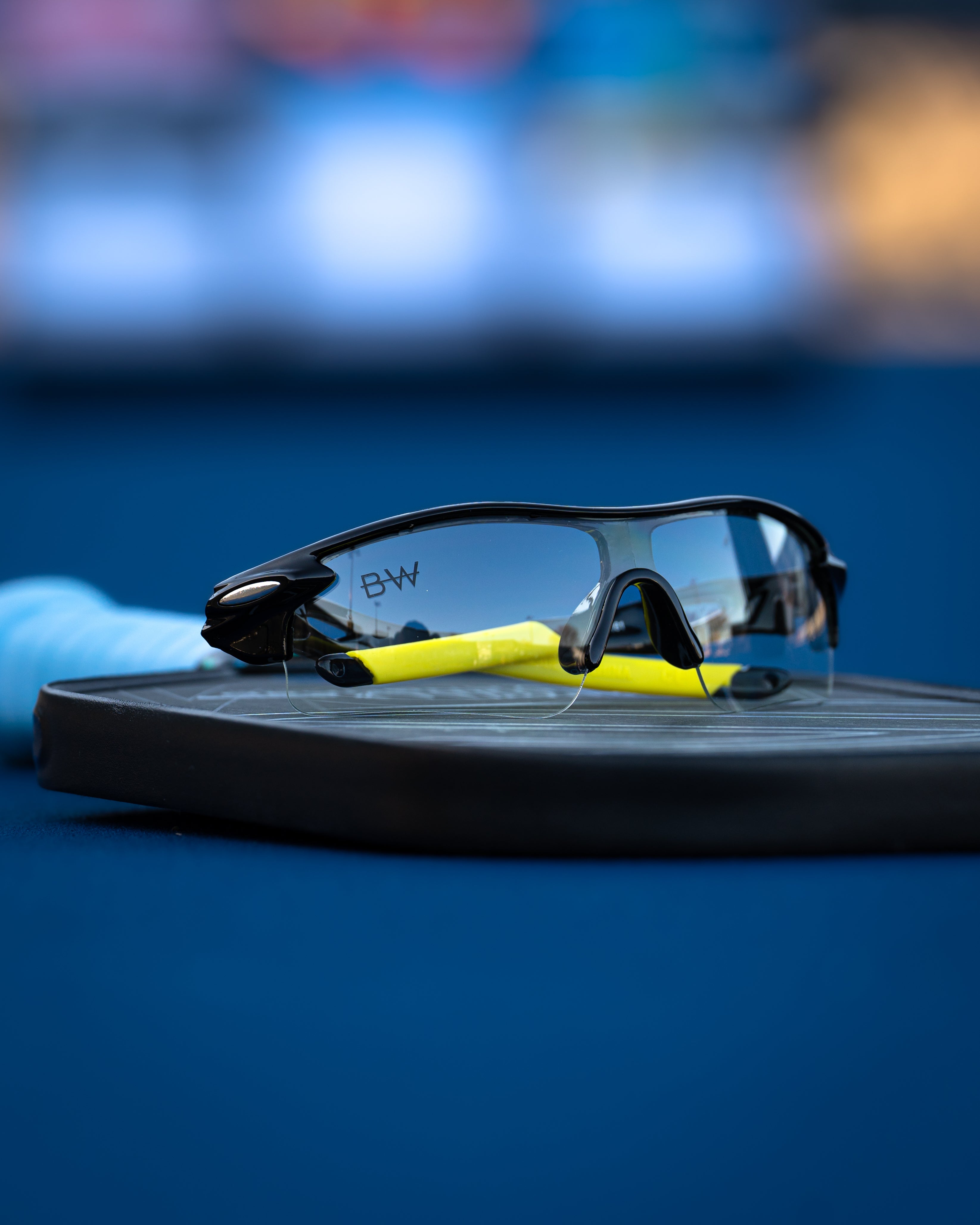
Playing Without These RX Glasses Is a Mistake
Share
Is Playing Pickleball Without Dedicated RX Glasses Really a Mistake?
If you need prescription correction, the eyewear you use on court deserves the same deliberate consideration as the rest of your pickleball setup. But that does not mean every player who uses contacts or everyday prescription glasses is automatically making a mistake.
The more useful question is this: are you using a vision-correction setup that actually works for your prescription, playing environment, movement, and personal preferences?
For some players, contacts may work well. Others may be comfortable using everyday prescription glasses. For players who want their prescription incorporated into dedicated sports-oriented eyewear, Blinded Wear offers RX pickleball glasses built around active use.
That distinction matters because prescription eyewear should not be marketed as a shortcut to faster reactions, fewer errors, better depth perception, or more wins.
This guide explains the situations in which overlooking dedicated RX pickleball eyewear could be a mistake for your particular setup, while separating legitimate product considerations from exaggerated performance promises.
Find the Right Pickleball Eyewear for Your Needs
Start with whether you need prescription correction, then compare frame dimensions, lens configurations, playing environments, and current product specifications.
Mistake #1: Ignoring a Prescription You Actually Need
If you have been prescribed corrective lenses, simply deciding that your vision is "good enough" for pickleball may not be the most useful way to evaluate your needs.
Your prescription exists to address your individual corrective requirements. Whether you choose glasses, contacts, or another appropriate corrective setup is personal.
What should be avoided is turning prescription correction into unsupported promises about athletic performance.
RX eyewear should not automatically be credited with:
- Faster reactions
- Better footwork
- Fewer unforced errors
- Improved shot timing
- Better depth perception
- Improved spin recognition
- More accurate shots
- More wins
Those outcomes involve far more than the frame or lens you are wearing.
Prescription Correction and Pickleball Performance Are Not the Same Thing
This distinction is especially important when shopping for sports eyewear.
Your prescription addresses your corrective vision requirements. Your pickleball performance involves technique, anticipation, positioning, decision-making, movement, paddle control, experience, practice, and other factors.
Dedicated RX pickleball glasses can incorporate your prescription into sports-oriented eyewear. They cannot replace those other parts of the game.
That makes a more accurate reason to consider RX eyewear surprisingly simple: you need prescription correction and want a dedicated eyewear configuration for active court use.
What if Your Prescription Is Mild?
A mild prescription does not automatically mean corrective eyewear will produce a dramatic change in your pickleball performance.
It also does not mean you should ignore a prescription simply because you play recreationally.
Prescription strength and pickleball skill are separate issues. If you want to use your prescribed correction while playing, explore compatible options based on your actual prescription rather than assuming that only stronger prescriptions justify dedicated RX sports eyewear.
Mistake #2: Assuming Contacts or Everyday Glasses Are Your Only Options
Contacts and everyday prescription glasses are not inherently wrong for pickleball.
Many players may be perfectly satisfied with one of those options.
The mistake is assuming that you have no alternative if you want your prescription incorporated into a separate sports-oriented frame.
Depending on your prescription and preferences, your corrective options can include:
- Everyday prescription glasses
- Contact lenses
- Direct RX sports eyewear
- A compatible RX Clip system
There is no universal winner. The goal is to determine which configuration makes the most sense for you.
Are Contacts Bad for Pickleball?
No. Contacts should not be portrayed as inherently unsuitable for pickleball simply to make RX glasses sound better.
Some players prefer contacts during exercise. Others prefer glasses. Some may alternate between the two.
Individual experiences with contact lenses can differ, but Blinded Wear RX eyewear should not be positioned as a medical solution for contact-lens dryness, irritation, or other eye symptoms.
If you experience persistent eye discomfort, address that separately from the decision to purchase sports eyewear.
Can You Play Pickleball in Everyday Prescription Glasses?
Everyday prescription glasses do not stop providing their intended correction because you step onto a pickleball court.
The reason to consider dedicated sports-oriented RX eyewear is different.
You may want a separate frame selected specifically around:
- Active use
- Your prescription
- Frame dimensions
- Your playing environment
- Lens configuration
- Extended sessions
- Your preferred style
That is a practical equipment decision rather than evidence that ordinary prescription glasses are automatically inadequate.
Mistake #3: Expecting RX Glasses to Transform Your Game
One of the biggest mistakes can happen in the opposite direction: expecting too much from the eyewear.
Prescription pickleball glasses should not be sold as a product that turns your reactions into instinct, makes your first step faster, sharpens your volleys, or immediately changes the way you play.
They are prescription eyewear.
That can still make them an important part of a player's equipment without assigning them abilities they cannot reasonably guarantee.
Does Clearer Corrective Vision Automatically Create a Mental Edge?
Confidence is subjective.
A player may feel more prepared when using equipment selected specifically for their needs. Another player may notice little psychological difference.
It is reasonable to value confidence in your equipment, but a frame should not be promised to create:
- More aggressive play
- Faster decision-making
- Greater competitive confidence
- Fewer mistakes
- Better anticipation
- More match wins
Those outcomes depend on the player and the situation.
Can RX Pickleball Glasses Help You See Spin?
No specific Blinded Wear frame or lens should be guaranteed to improve spin recognition.
Recognizing spin can involve visual information alongside experience, attention, anticipation, lighting, viewing conditions, and the player's familiarity with an opponent's mechanics.
Prescription correction can be incorporated into your court eyewear without claiming that the eyewear lets you see spin instead of guessing.
Do RX Lenses Enhance Ball Tracking?
Ball tracking should not be presented as an automatic lens enhancement.
What you perceive during a rally can depend on:
- Your individual prescription
- Your underlying vision
- Attention
- Anticipation
- Experience
- Lighting conditions
- Viewing distance
- The complete eyewear configuration
A product should not promise the same tracking improvement for every player.
What About Contrast and Glare Claims?
Do not assume every Blinded Wear RX lens automatically boosts contrast or reduces glare.
Lens characteristics need to be evaluated according to the specific product and configuration.
Different tints can change visible-light transmission and color appearance, while polarized lenses are designed to reduce certain reflected light. Those are more specific characteristics than a blanket promise of "better vision."
For a deeper breakdown, review the Pickleball Performance Lens Guide.
Mistake #4: Assuming Every Sports Frame Fits Every Player the Same Way
A sports-oriented frame can be designed around active use without fitting every face identically.
Fit can depend on:
- Frame dimensions
- Facial dimensions
- Bridge fit
- Temple fit
- Frame geometry
- Head movement
- Perspiration
- Individual preferences
That is why claims such as "anti-slip everything," "zero bounce," or "never moves" are too absolute when applied to every wearer.
Will Blinded Wear RX Glasses Slip When You Sweat?
No universal no-slip guarantee should be made.
Blinded Wear offers sports-oriented frames for active use, but the finished fit still depends on the individual wearer and the specific product.
Do not assume every RX frame includes specialized anti-slip components, adjustable nose pads, textured grip technology, or proprietary temple systems unless those features are documented for that exact model.
A better approach is to compare frame dimensions and evaluate the finished eyewear during realistic movement.
Will Dedicated RX Sports Glasses Eliminate Fog?
No.
No collection-wide fog-proof claim should be made. Fogging can be influenced by:
- Temperature
- Humidity
- Airflow
- Perspiration
- Surface conditions
- The complete eyewear configuration
Do not assume every RX lens has an anti-fog coating unless that treatment is documented for the exact configuration.
Mistake #5: Choosing an RX Frame Based on Marketing Claims Alone
Statements such as "built like a tank," "perfect for late-day matches," or "advanced light-filtering technology" may sound compelling, but your RX decision should be based on verified product information.
Start with:
- Your prescription requirements
- Compatibility with the exact product
- Frame dimensions
- Direct RX versus RX Clip configuration
- Current lens options
- Your normal playing environment
- Individual fit preferences
- Style
Current Blinded Wear RX Frames to Compare
There is no single RX frame that should automatically be recommended to every pickleball player. Instead, build a shortlist around your own requirements.
| RX Option | What to Evaluate |
|---|---|
| Frost RX | Prescription compatibility, dimensions, current lens configuration, fit, and its distinctive white-frame and bright-blue-lens appearance. |
| Lava Rock RX | Prescription compatibility, current specifications, frame dimensions, lens configuration, fit, and style. |
| Blue Shield RX | Prescription requirements, dimensions, current specifications, lens configuration, individual fit, and appearance. |
| Steel Ice RX | Prescription requirements, dimensions, current lens options, fit, and style. |
| Gray Wash RX | Prescription compatibility, dimensions, current lens configuration, fit, and appearance. |
| Havana Melt RX | Prescription requirements, dimensions, current specifications, fit, lens configuration, and style. |
| Zebra II RX | Prescription compatibility, current product specifications, dimensions, lens configuration, and fit. |
| Crystal Wave II RX | Prescription compatibility, current specifications, dimensions, lens configuration, fit, and style. |
Browse the full Blinded Wear RX Pickleball Glasses Collection for current options.
Frost RX: Evaluate the Frame Without the Hype
Frost RX is a direct RX option with a white frame and bright blue lens appearance.
Instead of assuming Frost RX will eliminate slippage, improve tracking, or transform your game, evaluate whether its current specifications, prescription compatibility, dimensions, lens configuration, and appearance work for you.
Lava Rock RX: Sports-Oriented Does Not Mean Indestructible
Lava Rock RX is another prescription option in the Blinded Wear lineup.
Descriptions such as "built like a tank" or "anti-slip everything" should not replace actual product specifications.
Compare Lava Rock RX according to your prescription, current lens configuration, frame dimensions, individual fit, and style rather than assuming it provides universal stability or a competitive advantage.
Blue Shield RX: Do Not Turn Lens Appearance Into a Performance Claim
Blue Shield RX gives prescription players another direct RX option to compare.
Do not assume its appearance means it prevents eye strain, improves late-day performance, filters a specific category of light, or makes the ball easier to track unless the exact product specifications support those claims.
Instead, evaluate the current configuration against your prescription and playing preferences.
Mistake #6: Not Understanding What High-Index Lenses Actually Do
Blinded Wear includes high-index prescription lenses at no additional cost with custom RX eyewear.
High-index refers to a category of prescription lens material commonly used to help manage lens thickness, particularly as prescription strength increases.
Finished lens thickness can depend on:
- Your individual prescription
- Lens dimensions
- Frame dimensions
- Lens geometry
- Optical design
- Other prescription requirements
High-index is a prescription-lens consideration. It is not a pickleball performance technology.
High-Index Is Not a Durability Rating
A higher refractive index should not automatically be interpreted as:
- More impact-resistant
- Shatterproof
- Unbreakable
- Scratch-proof
- Safety-certified
- Better for ball tracking
- Better for depth perception
- Faster for reaction time
Refractive index and those characteristics are separate.
Impact-Resistant Lens Options for Active Use
Blinded Wear offers impact-resistant lens options, which can be a relevant consideration when choosing eyewear for active use.
Impact-resistant does not automatically mean:
- Shatterproof
- Unbreakable
- Ballistic
- Scratch-proof
- Certified to a specific protective standard
If you require a specific safety certification, verify that certification for the exact product rather than assuming it from general impact-resistance language.
Mistake #7: Assuming Lens Color Automatically Improves Performance
Different lens tints can change visible-light transmission and color appearance.
Players may have different preferences depending on brightness, environment, and subjective visual experience.
However, no tint should universally be promised to:
- Increase reaction speed
- Improve depth perception
- Make spin easier to read
- Improve ball tracking
- Increase shot accuracy
- Reduce unforced errors
Choose a lens configuration according to verified characteristics and your environment rather than treating color as a guaranteed performance upgrade.
What About Clear Lenses for Indoor or Evening Play?
A clear lens has no dark sunglass tint, which may appeal to players who do not want a dark lens indoors, in the evening, or in lower-brightness environments.
Clear appearance alone does not establish:
- UV specifications
- Impact resistance
- Polarization
- Safety certification
- Anti-fog treatment
- Scratch resistance
- Anti-reflective treatment
- Blue-light filtering
For non-prescription clear eyewear, browse the Clear Lens Collection. If you require prescription correction, verify the current lens configurations offered with the exact RX product you are considering.
Mistake #8: Treating Polarization as Automatically Good or Bad for Pickleball
Polarized lenses are designed to reduce certain reflected light. Blinded Wear also offers non-polarized lens options.
Some pickleball players may prefer non-polarized eyewear for court use, but polarization status alone does not determine:
- Depth perception
- Contrast
- Reaction time
- Ball tracking
- Shot quality
- Overall performance
Your prescription, individual vision, lighting conditions, playing environment, and complete eyewear configuration also contribute to what you see.
Indoor vs. Outdoor RX Pickleball Eyewear
The same player may encounter very different visual environments throughout a season.
Indoor Play
Consider whether the available lens configuration suits the indoor environment and whether you want a dark sunglass tint at all.
Outdoor Play
Consider brightness, time of day, weather, court orientation, and your individual lens preferences.
Mixed Indoor and Outdoor Play
If you regularly move between environments, determine whether one available configuration suits most of your use or whether you prefer more than one eyewear option.
Do not assume every RX lens is photochromic or automatically adapts to changing light unless that feature is specifically documented.
Mistake #9: Waiting Until an Important Match to Test New RX Glasses
A new prescription sports setup should be evaluated before you depend on it during an important league match or tournament.
Start with a normal practice session and gradually test the eyewear through realistic movement.
- Wear the finished prescription away from competition.
- Use it during your normal warmup.
- Dink and volley at the kitchen.
- Practice serves and returns.
- Move laterally through realistic court patterns.
- Practice overheads and upward head movement.
- Play complete games.
- Evaluate it during a longer session.
Judge the Glasses by the Glasses, Not Your Score
Winning more games during your first session does not prove the eyewear improved your performance. Losing more games does not prove the eyewear failed.
Instead, evaluate:
- Prescription compatibility
- Bridge comfort
- Temple comfort
- Frame dimensions
- How the frame feels during movement
- Whether you repeatedly reposition it
- How it feels during extended wear
- Whether perspiration changes your fit experience
- Whether the lens configuration suits your environment
- Whether you actually like wearing the frame
Mistake #10: Ordering Custom RX Eyewear Without Checking the Details
Prescription eyewear is customized, so your prescription and product selection deserve careful review before purchase.
Do not assume:
- Every prescription works in every frame
- Every frame offers identical lens options
- Every RX model is a direct RX configuration
- Every RX model supports specialized prescriptions
- Every lens has the same treatments
- Every frame fits every face the same way
Verify the exact product rather than relying on collection-wide assumptions.
How to Order Blinded Wear RX Pickleball Glasses
- Browse the RX Pickleball Glasses Collection.
- Select the RX product you want to explore.
- Review its current specifications and available configuration.
- Confirm compatibility with your prescription requirements.
- Have your current eyeglass prescription available.
- Upload a clear photo or picture of your prescription on the product page before adding the eyewear to your cart.
- Review your custom RX selection carefully before completing the order.
For more guidance, visit How to Order RX Glasses.
So, When Is Playing Without Dedicated RX Eyewear Actually a Mistake?
The mistake is not simply stepping onto a pickleball court without a Blinded Wear frame.
The bigger mistake is failing to think critically about your vision-correction setup when you already require a prescription and want eyewear suited to your active routine.
Contacts may work for you. Everyday prescription glasses may work for you. Dedicated direct RX sports eyewear may be a better fit for your preferences. A compatible RX Clip system may also deserve consideration.
Blinded Wear gives prescription players additional sports-oriented options without needing to promise that a frame will make them faster, eliminate errors, reveal every spin, prevent fogging, or win more matches.
Part 2 will compare direct RX vs. RX Clip systems, stronger prescriptions, astigmatism, specialized prescriptions, high-index lenses, clear and tinted configurations, polarization, indoor and outdoor play, frame fit, extended sessions, and the most important mistakes to avoid when building your RX pickleball setup.
Direct RX vs. RX Clip: Know Which Prescription Setup You Are Buying
One mistake prescription players can make is treating every RX sports product as though the prescription is incorporated in exactly the same way.
Blinded Wear offers different prescription configurations, including direct RX products and compatible RX Clip systems.
Direct RX
With a direct RX configuration, prescription correction is incorporated into the direct prescription setup of the compatible product.
Current direct RX options include:
RX Clip
An RX Clip uses a separate inner prescription insert within a compatible eyewear system. The corrective prescription is contained in that inner insert rather than the primary outer sports lens.
An RX Clip should not be treated as a universal prescription insert that can be installed in arbitrary sunglasses. It must be used with a compatible eyewear system.
Blinded Wear includes high-index prescription lenses at no additional cost with custom RX Clip configurations.
Is Direct RX Better Than an RX Clip for Pickleball?
Neither configuration should automatically be declared better for every player.
| Consideration | Direct RX | RX Clip |
|---|---|---|
| Prescription location | Prescription correction is incorporated into the direct RX configuration. | Prescription correction is contained in a separate inner insert. |
| Prescription compatibility | Must be verified for the exact product. | Must be verified for the exact compatible system. |
| High-index RX lenses | Included at no additional cost with custom RX eyewear. | Included at no additional cost with custom RX Clip configurations. |
| Automatically more stable? | No. | No. |
| Automatically better optically? | No universal advantage should be assumed. | No universal advantage should be assumed. |
| Automatically better for pickleball? | No. | No. |
Compare the specific products rather than treating the words "direct RX" or "RX Clip" as performance ratings.
Mistake #11: Assuming a Strong Prescription Rules Out Sports Eyewear
A stronger prescription can make lens and frame compatibility especially important, but it does not mean you should automatically rule out dedicated RX pickleball eyewear.
Blinded Wear includes high-index prescription lenses at no additional cost with custom RX eyewear.
High-index materials are commonly used to help manage finished lens thickness, particularly as prescription strength increases.
However, high-index does not mean every prescription can be produced in every frame.
Compatibility and finished lens thickness can depend on factors including:
- Prescription strength
- Sphere values
- Cylinder and axis requirements
- Frame dimensions
- Lens dimensions
- Lens geometry
- Optical design
- Other individual prescription requirements
Verify your prescription against the exact RX product instead of assuming that high-index alone solves every compatibility question.
High-Index Lenses: What Pickleball Players Actually Need to Know
High-index is sometimes discussed as though it were a sports-performance technology. It is not.
The term refers to the refractive characteristics of the prescription lens material. In appropriate prescriptions, a higher-index material can help manage lens thickness compared with another lens material under comparable conditions.
Final lens thickness still varies according to the complete prescription and eyewear configuration.
High-Index Does Not Automatically Mean:
- More impact-resistant
- More durable
- Shatterproof
- Scratch-proof
- Safety-certified
- Always lighter
- Better ball tracking
- Better contrast
- Better depth perception
- Faster reactions
Refractive index should not be treated as a durability or pickleball-performance score.
Why Frame Dimensions Can Matter With Stronger Prescriptions
The finished prescription lens does not exist independently from the frame around it.
Prescription strength, lens dimensions, frame dimensions, lens geometry, and optical requirements can all influence the finished result.
This is one reason a shopper with a stronger prescription should not choose an RX frame solely because of its color or appearance.
Start with prescription compatibility. Then compare dimensions, configuration, lens options, fit preferences, and style.
Mistake #12: Treating Astigmatism Correction Like a Sports Feature
If your eyeglass prescription includes cylinder and axis values, those values are part of your individual corrective requirements.
They should not be removed, simplified, or changed simply because the eyewear will be used for pickleball.
Likewise, astigmatism correction should not be marketed as a technology that automatically improves:
- Ball tracking
- Spin recognition
- Reaction speed
- Depth perception
- Shot accuracy
Use your current prescription and verify compatibility with the exact RX product you are considering.
What if You Need Progressive, Multifocal, or Specialized Prescription Lenses?
Do not assume every Blinded Wear RX product supports every progressive, multifocal, or specialized prescription configuration.
If your prescription requires a specialized lens design, confirm compatibility with the exact product before ordering.
This step is particularly important because customized RX eyewear is final sale.
Mistake #13: Confusing High-Index With Impact Resistance
High-index and impact resistance describe different lens characteristics.
| Lens Term | What It Describes | What It Does Not Automatically Mean |
|---|---|---|
| High-index | A category of prescription lens material commonly used to help manage lens thickness. | Impact-proof, shatterproof, safety-certified, or performance-enhancing. |
| Impact-resistant | A lens characteristic relevant to resistance to impact. | Unbreakable, ballistic, scratch-proof, or certified to a specific safety standard. |
| Tinted | Changes visible-light transmission and color appearance. | Greater physical protection or better pickleball performance. |
| Polarized | Designed to reduce certain reflected light. | Automatically better depth perception, tracking, or reaction time. |
| Clear | No dark sunglass tint. | Automatic UV, impact, anti-fog, scratch, or safety properties. |
Blinded Wear offers impact-resistant lens options, but that characteristic should remain separate from claims about high-index prescription materials.
Mistake #14: Choosing an RX Lens by Color Alone
Lens color is visually obvious, which can make it tempting to treat color as the most important specification.
Different tints can change visible-light transmission and color appearance. Players may also prefer different lens appearances in different environments.
But lens color alone does not establish:
- UV specifications
- Impact resistance
- Polarization
- Safety certification
- Anti-fog treatment
- Scratch resistance
- Anti-reflective treatment
- Blue-light filtering
It also does not guarantee improved pickleball performance.
Can a Certain Lens Tint Make the Pickleball Easier to See?
Different lens colors can alter color appearance and visible-light transmission, and players can have different subjective preferences.
That is different from guaranteeing that a particular tint improves contrast, ball tracking, spin recognition, depth perception, or reaction speed for every player.
When comparing lens colors, consider the environment in which you actually play and the verified characteristics of the specific lens configuration.
For more information, review the Pickleball Performance Lens Guide.
Clear Lenses for Indoor and Lower-Brightness Environments
A clear lens has no dark sunglass tint.
That can make clear eyewear relevant to players who do not want a dark sunglass tint indoors, in the evening, or in other lower-brightness environments.
However, a clear lens does not create additional light, and clear appearance should not automatically be translated into better ball tracking, faster reactions, or improved contrast.
Clear appearance also does not prove UV specifications, polarization status, impact resistance, anti-fog treatment, scratch resistance, safety certification, or other lens characteristics.
For non-prescription options, browse the Clear Lens Collection. Prescription players should verify the current lens configurations available for the exact RX product they are considering.
Does a Darker Lens Mean Better Protection?
No.
Tint darkness and UV specifications are separate. Tint and impact resistance are separate. Tint and polarization are separate. Tint and safety certification are also separate.
Do not judge the protective characteristics of a lens by darkness alone.
Use verified specifications for the exact product and configuration.
Mistake #15: Assuming Polarized or Non-Polarized Is Universally Better
Polarized lenses are designed to reduce certain reflected light. Blinded Wear also offers non-polarized lens options.
Some pickleball players may prefer non-polarized eyewear for court use, while another player may have different preferences.
Polarization alone does not determine:
- Depth perception
- Contrast
- Reaction time
- Ball tracking
- Spin recognition
- Shot accuracy
- Overall pickleball performance
Your prescription, individual vision, lighting conditions, playing environment, and complete eyewear configuration also contribute to your visual experience.
Polarized Lenses and Digital Displays
One practical difference worth understanding is that polarized lenses can interact with some digital displays depending on display technology, viewing angle, and orientation.
This may matter if you regularly look at a phone, tablet, digital scoreboard, or another display while wearing your eyewear.
It does not mean polarized lenses are inherently unsuitable for pickleball.
Mistake #16: Using the Same Lens Assumptions for Every Court
Indoor and outdoor pickleball environments can be very different, so the same lens preference may not suit every player in every setting.
Indoor Pickleball
If you play indoors, consider the brightness of the facility and whether you want a dark sunglass tint at all.
A clear lens may appeal to someone who does not want dark tint indoors, but clear should not be described as amplifying available light or automatically improving visibility.
Outdoor Pickleball
Outdoor conditions can change with:
- Time of day
- Cloud cover
- Weather
- Court orientation
- Surrounding environment
- Season
Review the available lens configurations and select according to the conditions and visual preferences that matter to you.
What if You Play Indoors and Outdoors?
Players who regularly move between environments should consider how their eyewear setup works across those conditions.
Depending on your preferences and the products available, you may decide that one configuration suits most of your play or that you prefer more than one eyewear option.
Do not assume every RX product automatically adapts to changing light.
Do Blinded Wear RX Lenses Automatically Transition With Light?
No collection-wide claim should be made that every RX product includes photochromic or transition-style technology.
If that feature matters to you, verify whether it is currently available for the exact product and prescription configuration you are considering.
Mistake #17: Ignoring Frame Dimensions
A frame can look ideal in a product photo and still need to be evaluated against your own fit requirements.
Frame dimensions can be particularly useful if you already own glasses that fit you well.
Use a known pair as a reference and compare available measurements rather than relying only on labels such as "small," "medium," or "large."
Fit can involve:
- Overall frame width
- Lens dimensions
- Bridge relationship
- Temple relationship
- Frame geometry
- Your facial dimensions
- Your personal fit preferences
Should RX Sports Glasses Fit as Tight as Possible?
No.
Maximum tightness is not the same thing as an appropriate fit.
A frame that creates unnecessary pressure should not be considered superior simply because it feels extremely tight.
The objective is an individual fit that works for your intended use, not maximum clamping force.
What if Your Main Concern Is Frame Movement?
Evaluate the finished eyewear during the movements you actually perform on court.
For example:
- Dink at the kitchen
- Volley through faster exchanges
- Serve and return
- Move laterally
- Transition toward the kitchen
- Look upward for overheads
- Play complete games
Notice whether you repeatedly reposition the frame. That is more useful than assuming a product will have "zero bounce" because of a marketing description.
Sweat Is a Fit Test, Not a Reason to Promise "Anti-Slip Everything"
Perspiration can influence an individual's experience with eyewear.
During a realistic session, pay attention to whether:
- The frame position changes
- You repeatedly adjust the eyewear
- The bridge remains comfortable
- The temples remain comfortable
- Your fit experience changes later in the session
Do not assume specialized anti-slip technology is present unless it is documented for the exact frame.
Mistake #18: Assuming Sports RX Means Fog-Proof
No sports frame should be universally promised to remain fog-free.
Fogging can depend on:
- Temperature
- Humidity
- Airflow
- Perspiration
- Surface conditions
- The complete eyewear configuration
Likewise, do not assume an anti-fog coating is included unless that treatment is specifically documented for the exact lens configuration.
Lightweight RX Frames and Longer Pickleball Sessions
Blinded Wear offers lightweight sports-frame options and builds its sports eyewear around comfort for active use and extended matches.
Lightweight construction can be a useful characteristic to consider, but it should not be translated into a universal comfort guarantee.
During longer sessions, evaluate:
- Bridge comfort
- Temple comfort
- Overall frame fit
- Whether pressure develops over time
- Whether movement changes later in the session
- Whether perspiration affects your experience
A frame that feels fine for five minutes should still be evaluated during realistic play if you regularly spend hours on court.
Can Blinded Wear RX Glasses Prevent Eye Strain?
No collection-wide claim should promise that a frame prevents eye strain, headaches, dryness, squinting, or other symptoms.
Those experiences can have multiple causes and vary between individuals.
Likewise, a blue-looking lens should not automatically be described as having blue-light filtering technology unless that characteristic is documented for the exact product.
Mistake #19: Judging New RX Glasses After Five Minutes
A quick try-on can tell you something about initial fit, but it does not reproduce a complete pickleball session.
If you are new to dedicated RX sports eyewear, become familiar with the finished pair before depending on it during an important match.
- Wear the finished prescription away from competition. Become familiar with the setup.
- Use it during a normal warmup. Pay attention to how the frame feels.
- Practice at the kitchen. Include dinks and volleys.
- Serve and return. Include larger head and body movements.
- Move laterally. Evaluate the frame during realistic movement.
- Practice overheads. Include upward head movement.
- Play complete games. Give yourself more than a few minutes to evaluate the setup.
- Try a longer session. See whether your fit experience changes over time.
Do Not Judge RX Eyewear by Wins and Losses
If you win your first three games wearing new RX glasses, that does not prove the glasses caused the wins.
If you lose three games, that does not prove the glasses failed.
Judge the equipment according to factors the equipment can actually influence:
- Whether the prescription configuration meets your corrective needs
- Whether the frame dimensions suit you
- How the bridge feels
- How the temples feel
- How the frame feels during movement
- Whether you repeatedly reposition it
- How it feels during longer sessions
- Whether the selected lens configuration suits the environment
- Whether you like the appearance
Everyday Glasses vs. Contacts vs. Dedicated RX Pickleball Eyewear
| Vision-Correction Setup | What to Consider |
|---|---|
| Everyday prescription glasses | Do you already like using them during active play? How does the frame fit during your normal court movement? |
| Contact lenses | Do you prefer contacts during exercise and are they already part of your normal corrective routine? |
| Direct RX sports eyewear | Do you want your prescription incorporated into a dedicated sports-oriented RX configuration? |
| Compatible RX Clip system | Do you prefer a system in which your prescription correction is contained in a separate inner insert? |
The best setup is not determined by a universal rule. It depends on your corrective needs and preferences.
Should You Carry Backup Prescription Eyewear?
If you depend on corrective eyewear, having another usable corrective option available can be practical during tournaments, travel, leagues, or long sessions away from home.
A backup is not mandatory, and it does not necessarily need to be identical to your primary pair.
The purpose is simply to avoid having your entire vision-correction setup depend on one pair being available at all times.
Mistake #20: Making Tournament Day Your First Real RX Test
If you plan to use new RX eyewear during competition, become familiar with it beforehand.
A practical sequence is:
- Wear it casually.
- Use it during practice.
- Play several complete games.
- Use it during a longer open-play session.
- Evaluate the fit under realistic perspiration and movement.
- Only then decide whether you want that setup as your primary tournament eyewear.
This approach evaluates the equipment without pretending that the eyewear itself determines tournament performance.
Build Your RX Shortlist in the Right Order
If you are comparing several Blinded Wear RX options, use this order instead of choosing based on a headline or lens color.
- Prescription: Start with your actual corrective requirements.
- Compatibility: Verify that the exact RX product can accommodate those requirements.
- Configuration: Understand whether you are considering direct RX or a compatible RX Clip system.
- Dimensions: Compare frame measurements with eyewear you already know fits you when possible.
- Lens options: Review the current configurations available with that exact product.
- Environment: Consider indoor, outdoor, daytime, evening, and mixed use.
- Extended wear: Think about how long your normal sessions last.
- Style: Once the practical requirements are satisfied, choose the appearance you prefer.
RX Frames to Put on Your Comparison List
Instead of looking for one frame that is supposedly best for every pickleball player, compare multiple current options.
- Rippled X RX
- Crystal Wave II RX
- Frost RX
- Blue Shield RX
- Steel Ice RX
- Havana Melt RX
- Zebra II RX
- Lava Rock RX
- Gray Wash RX
Visit the RX Pickleball Glasses Collection to review current options.
Not Sure Which Pickleball Glasses to Explore?
Use the Pickleball Sunglasses Quiz as another way to narrow your preferences.
You can also compare broader eyewear categories through the 2026 Pickleball Glasses Hub.
The quiz can help narrow the field, but your actual prescription compatibility should still be verified for the exact RX product before ordering.
Mistake #21: Forgetting That Custom RX Requires Your Prescription
Blinded Wear's custom RX ordering process requires you to provide your eyeglass prescription.
- Choose the RX product you want to explore.
- Review its current specifications and configuration.
- Confirm compatibility with your prescription requirements.
- Have your current eyeglass prescription ready.
- Upload a clear photo or picture of your prescription on the product page before adding the eyewear to your cart.
- Review the custom RX selection carefully before purchasing.
For additional instructions, visit How to Order RX Glasses.
Mistake #22: Ordering Without Understanding the RX Return Policy
Blinded Wear offers a 30-day return policy for eligible standard purchases, but customized RX eyewear is final sale and excluded from the standard 30-day return policy.
That makes it especially important to review your prescription information, frame choice, dimensions, RX configuration, and current lens options before completing a custom order.
Custom RX final-sale status is separate from applicable replacement support for eligible broken eyewear.
Review the Blinded Wear Protection Plan, Replacement & Returns information for current policy details.
The Bigger Mistake Is Buying RX Eyewear Without Understanding It
Dedicated prescription pickleball eyewear can be a useful part of your setup without needing exaggerated claims about faster reactions, perfect tracking, zero fog, or instant improvement.
Understand direct RX versus RX Clip systems. Verify prescription compatibility. Know what high-index actually means. Keep high-index separate from impact resistance. Choose tint according to verified characteristics and your environment. Treat polarization as a lens characteristic rather than a performance score. Compare dimensions. Test fit during realistic movement.
Those decisions are more useful than choosing a pair because it promises to transform your game.
Part 3 will finish the guide with a comprehensive FAQ, myths versus facts, what RX eyewear can and cannot promise, final-sale and replacement-policy details, damaged-RX procedures, a final pre-purchase checklist, ordering resources, and a practical answer to when playing without dedicated RX eyewear may actually be the wrong choice for your setup.
RX Pickleball Glasses FAQ
If you are deciding whether dedicated prescription pickleball eyewear belongs in your setup, these are the questions worth answering before you order.
Do I need RX pickleball glasses to play pickleball?
No. Dedicated RX sports eyewear is an option for players who require prescription correction and want that correction incorporated into sports-oriented eyewear. Some players prefer contacts or their everyday prescription glasses.
Will RX pickleball glasses make me a better player?
No eyewear should guarantee better pickleball performance. Technique, positioning, anticipation, movement, decision-making, practice, and experience remain major parts of the game.
Can I play pickleball in my regular prescription glasses?
Yes. Everyday prescription glasses can still provide their intended corrective function. Dedicated sports-oriented RX eyewear gives you another option if you want a separate pair selected specifically around active use.
Can I play pickleball in contacts?
Yes. Contacts are a legitimate corrective option for many players. Whether you prefer contacts, everyday glasses, direct RX sports eyewear, or an RX Clip system is an individual decision.
What if I only have a mild prescription?
A mild prescription does not automatically mean dedicated RX sports eyewear will dramatically change your game. If you want to use your prescribed correction in sports-oriented eyewear, however, you can still explore compatible RX options.
Are Blinded Wear RX glasses only for tournament players?
No. Recreational, league, and competitive players can all consider prescription sports eyewear. Your need for vision correction is separate from your pickleball skill level.
Vision and Performance: What RX Glasses Can and Cannot Do
Will RX glasses improve my reaction time?
No. Prescription eyewear should not be marketed as increasing biological reaction speed.
Will RX glasses improve my depth perception?
No specific frame, tint, or polarization status should universally be promised to improve depth perception. Your individual vision and complete corrective setup matter.
Will RX glasses help me track the pickleball?
No frame should guarantee better ball tracking. Prescription correction, individual vision, attention, anticipation, experience, lighting, and other factors can contribute to what you perceive during a rally.
Will they make spin easier to see?
No universal spin-recognition improvement should be promised. Reading spin involves visual information alongside experience, attention, anticipation, playing conditions, and familiarity with an opponent's mechanics.
Will RX glasses reduce my unforced errors?
No. Unforced errors can involve timing, positioning, footwork, technique, paddle mechanics, concentration, and decision-making. Eyewear should not be credited with automatically eliminating those mistakes.
Can prescription eyewear improve confidence?
Confidence is subjective. A player may feel more prepared using equipment selected specifically for their needs, but a particular frame should not be guaranteed to create confidence or competitive success.
RX Pickleball Glasses Fit FAQ
Will Blinded Wear RX glasses stay completely still?
No universal zero-movement guarantee should be made. Frame stability depends partly on the relationship between the frame and the individual wearer.
What can affect how an RX frame fits?
Frame dimensions, facial dimensions, bridge fit, temple fit, frame geometry, head movement, perspiration, and individual preferences can all contribute to the fit experience.
Should pickleball glasses fit extremely tight?
No. Maximum tightness is not automatically better. An appropriate fit should work for your intended use without relying on excessive pressure.
Are Blinded Wear sports frames lightweight?
Blinded Wear offers lightweight sports-frame options designed around active use and comfort.
Does lightweight guarantee comfort?
No. Weight is only one part of comfort. Frame dimensions, bridge fit, temple fit, prescription configuration, facial dimensions, and individual preferences also matter.
Can I use RX glasses during long pickleball sessions?
Blinded Wear builds its sports eyewear around comfort for active use and extended matches, but individual comfort varies. Evaluate your finished pair during realistic sessions rather than assuming every wearer will have the same experience.
Sweat, Slippage, and Fogging FAQ
Will the glasses slip when I sweat?
No collection-wide no-slip guarantee should be made. Perspiration and individual fit can influence how eyewear behaves during active use.
Does every Blinded Wear frame have anti-slip technology?
Do not assume specialized anti-slip components, proprietary temple grips, or adjustable nose pads unless those features are documented for the exact product.
Are Blinded Wear RX glasses fog-proof?
No collection-wide fog-proof guarantee should be made.
What causes glasses to fog during pickleball?
Temperature, humidity, airflow, perspiration, surface conditions, and the complete eyewear configuration can all influence condensation.
Does every RX lens include anti-fog treatment?
Do not assume an anti-fog treatment is included unless it is documented for the exact product and lens configuration.
High-Index RX Lens FAQ
Does Blinded Wear include high-index prescription lenses?
Yes. Blinded Wear includes high-index prescription lenses at no additional cost with custom RX eyewear.
What does high-index mean?
High-index refers to a category of prescription lens material commonly used to help manage lens thickness, particularly as prescription strength increases.
Does high-index guarantee thin lenses?
No. Finished lens thickness depends on your individual prescription, lens dimensions, frame dimensions, lens geometry, optical design, and other requirements.
Are high-index lenses always lighter?
No. A thinner finished lens is not automatically a lighter finished lens.
Does a higher refractive index mean a stronger lens?
No. Refractive index is not a durability rating.
Are high-index lenses shatterproof?
No such universal claim should be made.
Does high-index improve pickleball performance?
No. High-index is relevant to prescription lens construction rather than reaction time, ball tracking, depth perception, or player skill.
Impact-Resistant Lens FAQ
Does Blinded Wear offer impact-resistant lens options?
Yes. Blinded Wear offers impact-resistant lens options for active use.
Does impact-resistant mean unbreakable?
No. Impact resistance does not mean that a lens cannot break.
Does impact-resistant mean shatterproof?
No. That stronger claim should not be assumed.
Does impact resistance mean scratch-resistant?
No. Impact resistance and scratch resistance are separate characteristics.
Does impact-resistant mean safety-certified?
Not automatically. A specific protective certification requires applicable product-specific documentation.
Does impact-resistant mean ballistic protection?
No. General impact resistance should not be interpreted as a ballistic-protection claim.
Clear, Tinted, and Polarized Lens FAQ
What does a clear lens mean?
A clear lens does not have a dark sunglass tint.
Are clear lenses useful for indoor pickleball?
Players who do not want a dark sunglass tint indoors or in lower-brightness environments may prefer clear options where available. Clear appearance itself does not guarantee improved performance.
Do clear lenses create more light?
No. A clear lens does not create or amplify available light.
Do darker lenses provide more UV protection?
Not automatically. Tint darkness and UV specifications are separate characteristics.
Can certain lens colors improve contrast?
Different tints can change visible-light transmission and color appearance, and players can have different visual preferences. A particular tint should not universally be promised to improve contrast.
Can tint improve ball tracking?
No universal improvement in ball tracking, spin recognition, depth perception, or reaction time should be promised solely because of lens color.
Does a mirrored-looking lens mean it is polarized?
No. Lens appearance alone does not establish polarization status.
Does Blinded Wear offer non-polarized lens options?
Yes. Blinded Wear offers non-polarized lens options.
Are non-polarized lenses automatically better for pickleball?
No. Some court players may prefer non-polarized eyewear, but polarization status alone does not determine depth perception, contrast, reaction time, or ball tracking.
Direct RX vs. RX Clip FAQ
What is direct RX?
With a direct RX configuration, prescription correction is incorporated into the direct prescription setup of a compatible product.
What is an RX Clip?
An RX Clip uses a separate inner prescription insert within a compatible eyewear system. The corrective prescription is contained in the inner insert rather than the primary outer sports lens.
Can an RX Clip be used with any sunglasses?
No. An RX Clip is designed for a compatible eyewear system and should not be treated as a universal insert for arbitrary sunglasses.
Does Blinded Wear include high-index lenses with custom RX Clips?
Yes. High-index prescription lenses are included at no additional cost with custom RX Clip configurations.
Is direct RX better than an RX Clip?
Neither configuration should be declared universally superior. Compare prescription compatibility, the specific eyewear system, frame preferences, current lens options, and your intended use.
Prescription Compatibility FAQ
Can every prescription be made in every Blinded Wear RX frame?
No universal compatibility claim should be made. Compatibility needs to be verified for the exact product and individual prescription.
Can players with stronger prescriptions consider RX sports eyewear?
Yes, but compatibility still needs to be confirmed. High-index materials can help manage lens thickness in appropriate prescriptions, but they do not make every prescription compatible with every frame.
What if my prescription includes cylinder and axis?
Those values are part of your individual corrective requirements. Use your current prescription and verify compatibility with the exact RX product.
Should I simplify my prescription because the glasses are for sports?
Do not alter your prescription values yourself simply because the eyewear will be used for pickleball.
Does every RX frame support progressive or multifocal prescriptions?
Do not assume that. Progressive, multifocal, and other specialized prescription configurations should be verified for the exact product.
RX Pickleball Glasses: Myths vs. Facts
| Myth | What to Know |
|---|---|
| "RX glasses make you react faster." | Prescription eyewear should not be marketed as increasing biological reaction speed. |
| "RX lenses let you see every spin." | No frame or lens should guarantee improved spin recognition. |
| "RX glasses automatically improve depth perception." | Depth perception cannot be reduced to one frame, tint, or polarization characteristic. |
| "Sports glasses never move." | Individual fit and frame movement vary. |
| "Every sports frame has anti-slip technology." | Specific components should only be claimed when documented for the exact product. |
| "Sports RX lenses cannot fog." | Fogging can depend on environment and the complete eyewear configuration. |
| "High-index means stronger." | Refractive index is not a durability rating. |
| "Impact-resistant means unbreakable." | Impact resistance does not mean a lens cannot break. |
| "A darker lens automatically provides more UV protection." | Tint darkness and UV specifications are separate characteristics. |
| "Non-polarized lenses improve depth perception." | Polarization status alone does not determine depth perception. |
| "A mild prescription does not matter on court." | Whether to use prescribed correction during play depends on the individual's corrective needs and preferences. |
| "Dedicated RX eyewear is only for advanced players." | Vision-correction needs are separate from pickleball skill level. |
What Blinded Wear RX Eyewear Can and Cannot Promise
| What You Can Evaluate | What Should Not Be Guaranteed |
|---|---|
| Prescription correction through a compatible custom RX configuration | Better pickleball skill |
| Sports-oriented frame options | Zero movement for every wearer |
| Lightweight sports-frame options | Perfect comfort for every face |
| High-index prescription lenses included at no additional cost | Faster reaction time |
| Impact-resistant lens options | Unbreakable or shatterproof construction |
| Non-polarized lens options | Better depth perception |
| Multiple RX products to compare | One universally best frame |
| 50% lifetime replacement support for eligible broken glasses under current policy terms | A free replacement in every situation |
When Could Playing Without Dedicated RX Eyewear Be the Wrong Choice for You?
The title of this guide makes a strong statement, but the useful answer is more specific.
Overlooking dedicated RX pickleball eyewear may be worth reconsidering if:
- You require prescription correction and want to use that correction while playing.
- You are dissatisfied with how your current eyewear setup works during active use.
- You want a separate sports-oriented pair instead of relying on your everyday glasses.
- You want an alternative to using contacts during pickleball.
- You want to compare direct RX and RX Clip configurations.
- You want lightweight sports-frame options.
- You want to compare impact-resistant lens options for active use.
- You want high-index prescription lenses without an additional high-index charge.
- You play frequently enough that a dedicated court pair makes practical sense for your routine.
None of these reasons requires claiming that the glasses will transform your athletic ability.
When Might You Not Need Dedicated RX Pickleball Glasses?
A useful buying guide should also acknowledge when a product may not be necessary.
You may decide your current setup already works if:
- You do not require prescription correction.
- You are satisfied using your everyday prescription glasses during pickleball.
- You prefer contact lenses for sports.
- You do not want a separate pair dedicated to court use.
- Your individual prescription is not compatible with the product you were considering.
The objective is not to convince every pickleball player that dedicated RX eyewear is mandatory. It is to help prescription players understand another equipment option.
Final RX Pickleball Glasses Pre-Purchase Checklist
Before ordering custom prescription eyewear, work through the details that actually matter.
- Use your current prescription. Start with the corrective requirements the eyewear needs to accommodate.
- Verify compatibility. Do not assume every prescription works with every RX frame.
- Understand the RX configuration. Know whether you are considering direct RX or a compatible RX Clip system.
- Compare frame dimensions. Use glasses that already fit you well as a reference when possible.
- Review current lens options. Verify what is actually offered with the exact product.
- Consider your environment. Think about indoor, outdoor, daytime, evening, and mixed-condition use.
- Separate tint from protection. Darker appearance does not automatically establish UV or impact characteristics.
- Separate high-index from impact resistance. They describe different lens characteristics.
- Do not assume anti-fog or anti-slip technology. Verify exact product specifications.
- Think about session length. Consider how long you normally wear your court eyewear.
- Review the RX policy. Customized RX eyewear is final sale.
- Prepare your prescription upload. Have a clear photo or picture of your eyeglass prescription ready.
What to Do When Your New RX Glasses Arrive
Do not make an important tournament the first meaningful test of a new prescription setup.
- Wear the finished prescription outside competition.
- Use it during a normal warmup.
- Practice dinks and volleys.
- Serve and return.
- Move laterally.
- Practice overheads.
- Play complete games.
- Wear it during a longer session.
During those sessions, pay attention to frame position, bridge comfort, temple comfort, repeated adjustments, extended-wear comfort, and whether the selected lens configuration suits your environment.
Evaluate the eyewear itself rather than using wins and losses as your test.
RX Tournament and Travel Checklist
If you depend on prescription correction, a little preparation can make your eyewear setup easier to manage during long pickleball days.
- Primary prescription eyewear
- A usable backup corrective option if you choose to carry one
- An appropriate way to store the eyewear when it is not being worn
- An appropriate lens-cleaning method
- Your preferred setup for the expected playing environment
- Any prescription information you personally want available while traveling
A backup can be especially practical if your ability to play comfortably depends on corrective eyewear, but it does not have to be identical to your primary pair.
Understand the 30-Day Return Policy Before Ordering RX
Blinded Wear offers a 30-day return policy for eligible standard purchases.
Customized RX eyewear is final sale and excluded from the standard 30-day return policy.
That makes it important to review your prescription information, product choice, frame dimensions, RX configuration, and current lens options carefully before placing a customized prescription order.
Custom RX final-sale status is separate from applicable replacement support for eligible broken eyewear.
Review the Blinded Wear Protection Plan, Replacement & Returns information for current eligibility and policy details.
50% Lifetime Replacement Support for Eligible Broken Glasses
Blinded Wear offers 50% lifetime replacement support if eligible glasses break, subject to current policy terms.
For an eligible claim, the damaged eyewear must be returned. Once the applicable claim and return requirements are satisfied, qualifying customers can receive 50% credit toward a replacement pair.
This is not a free full replacement.
For damaged RX eyewear, contact blindedwearco@gmail.com before returning the pair.
Review the Protection Plan, Replacement & Returns information for current eligibility and policy details.
RX Replacement Policy FAQ
What happens if eligible RX glasses break?
Applicable 50% lifetime replacement support may be available subject to the current policy terms.
Do I need to return the damaged glasses?
Yes. Eligible damaged eyewear must be returned as part of the applicable process.
What should I do before returning damaged RX eyewear?
Contact blindedwearco@gmail.com before returning damaged prescription eyewear.
Do I receive a completely free replacement?
No. Eligible replacement support provides 50% credit toward a replacement pair once applicable policy requirements are satisfied.
Does the replacement policy automatically cover lost glasses?
Do not assume coverage for loss based on the replacement support offered for eligible broken eyewear. Review the current policy for eligibility.
What if my prescription changes?
A prescription change by itself should not automatically be treated as an eligible broken-eyewear replacement claim. Review the current policy terms.
What if I simply want another frame?
The replacement policy should not be interpreted as a general discount for changing styles or configurations.
How to Order Blinded Wear RX Pickleball Glasses
- Browse the Blinded Wear RX Pickleball Glasses Collection.
- Choose the RX product you want to explore.
- Review the current product specifications, dimensions, and available configuration.
- Confirm compatibility with your prescription requirements.
- Have your current eyeglass prescription ready.
- Upload a clear photo or picture of your prescription on the product page before adding the eyewear to your cart.
- Review your customized RX selection carefully before purchasing.
For additional guidance, visit How to Order RX Glasses.
Compare Current Blinded Wear RX Pickleball Glasses
There is no universal best RX frame for every pickleball player. Build your shortlist around prescription compatibility, dimensions, lens configuration, environment, fit preferences, and style.
- Rippled X RX
- Crystal Wave II RX
- Frost RX
- Blue Shield RX
- Steel Ice RX
- Havana Melt RX
- Zebra II RX
- Lava Rock RX
- Gray Wash RX
Visit the full RX collection to review current options.
Before You Decide, Ask These Questions
| Question | What to Determine |
|---|---|
| Do I require prescription correction? | Start with your actual corrective requirements. |
| Does my current setup already work? | You may not need to replace a corrective setup you already prefer. |
| Do I want dedicated sports eyewear? | Decide whether a separate court-oriented pair has practical value for your routine. |
| Is my prescription compatible? | Verify compatibility with the exact product. |
| Direct RX or RX Clip? | Understand where the prescription correction is incorporated. |
| Do the frame dimensions make sense? | Compare available measurements with eyewear you already know fits well when possible. |
| Where will I play? | Consider indoor, outdoor, daytime, evening, and mixed environments. |
| Which lens configuration do I prefer? | Use verified characteristics rather than assumptions based on lens color or appearance. |
| Am I comfortable with custom RX being final sale? | Review the policy before placing your customized order. |
| Do I actually like the frame? | Once the practical requirements are satisfied, personal style still matters. |
More Pickleball Eyewear Resources
- RX Pickleball Glasses — Browse current prescription eyewear options.
- Non-RX Pickleball Sunglasses — Explore non-prescription court eyewear.
- Clear Lens Collection — Browse non-prescription clear-lens options.
- 2026 Pickleball Glasses Hub — Compare broader pickleball eyewear categories.
- Best Pickleball Sunglasses 2026 — Explore the broader sunglasses guide.
- Pickleball Performance Lens Guide — Learn more about lens colors, clarity, and RX options.
- Pickleball Sunglasses Quiz — Narrow your options according to your preferences.
- How to Order RX Glasses — Review the prescription ordering process.
- Protection Plan, Replacement & Returns — Review current policy information.
- The Blinded Wear Mission — Learn more about the brand's mission.
The Bottom Line: Is Playing Without These RX Glasses Really a Mistake?
Not for every player.
If you do not require prescription correction, dedicated RX eyewear obviously is not necessary. If contacts work well for you, you may prefer them. If your everyday prescription glasses already suit your court routine, you may decide to keep using them.
But if you require corrective vision and want a dedicated sports-oriented setup, dismissing RX pickleball eyewear without comparing your options can mean overlooking a category designed around exactly that use case.
Blinded Wear offers lightweight sports-frame options, high-index prescription lenses at no additional cost, impact-resistant lens options, non-polarized options, and multiple prescription configurations to compare.
Those are meaningful product characteristics without turning them into promises of faster reactions, perfect ball tracking, improved depth perception, zero fog, zero movement, fewer errors, or more wins.
The better question is not, "Will these glasses transform my game?"
It is:
"Does dedicated RX pickleball eyewear make more sense for my prescription, playing environment, fit preferences, and court routine than the setup I use now?"
Answer that question first. Then choose the frame.
Build an RX Pickleball Setup Around Your Actual Needs
Explore the Blinded Wear RX Pickleball Glasses Collection and compare current options according to prescription compatibility, frame dimensions, available lens configuration, playing environment, fit preferences, and style.
If you need help narrowing the field, use the Pickleball Sunglasses Quiz, visit the 2026 Pickleball Glasses Hub, or review the Pickleball Performance Lens Guide.
Choose prescription eyewear because it fits your corrective needs and the way you use it on court—not because a headline promises it will play the game for you.