
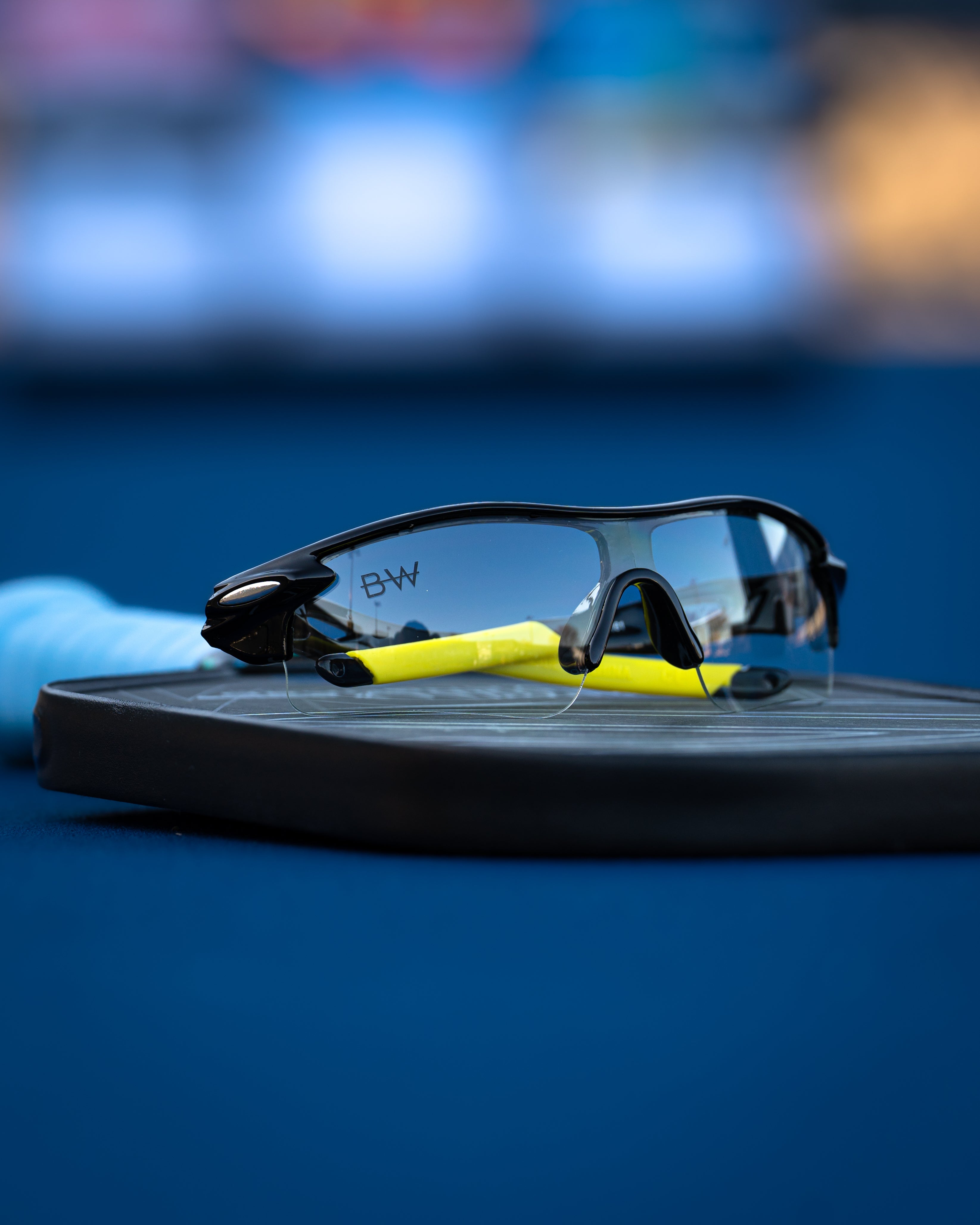
Precision Under Pressure — How RX Sports Glasses Build Confidence in Clutch Moments
Share
Precision Under Pressure — How RX Sports Glasses Build Confidence in Clutch Moments
Match point. A third-shot drop hangs slightly high. The next rally could decide the game. In moments like these, pickleball players do not need eyewear promising superhuman reactions—they need equipment they already know and trust.
For players who require vision correction, RX sports glasses can remove one avoidable source of uncertainty by providing the prescription correction they need while they compete. That does not mean prescription lenses automatically create confidence, eliminate nerves, or make the brain react faster. Confidence under pressure is built through preparation, repetition, experience, and familiarity with your equipment.
The real connection between RX eyewear and clutch performance is therefore more practical: correct your vision appropriately, choose eyewear that fits your playing environment, practice in it consistently, and arrive at important points without wondering whether your equipment is ready.
Build Your Pickleball Eyewear Setup
What Creates Confidence Under Pressure in Pickleball?
Confidence is not a feature manufactured into a lens.
Players typically build confidence by repeatedly experiencing situations in which their preparation holds up. That can include trusting:
- Their serve
- Their return
- Their footwork
- Their positioning
- Their shot selection
- Their partner
- Their physical preparation
- Their equipment
Prescription eyewear fits into that final category.
If you require corrective lenses, consistently practicing and competing with an appropriate RX setup can make the eyewear a familiar part of your game rather than another variable to think about when the score gets tight.
How Can RX Sports Glasses Support Confidence?
The most defensible connection is simple: appropriate RX eyewear provides the prescription correction you require during play.
That matters because there is an important difference between correcting vision and promising a psychological performance enhancement.
| RX Eyewear Can... | RX Eyewear Shouldn't Automatically Be Claimed to... |
|---|---|
| Provide prescribed vision correction | Eliminate performance anxiety |
| Become familiar through repeated use | Create a flow state |
| Be selected for your playing environment | Make your brain stay calm |
| Use impact-resistant lenses | Make reactions neurologically faster |
| Use a lightweight sports frame | Guarantee better timing |
| Become part of a consistent match routine | Guarantee confidence in clutch situations |
The Vision-Confidence Connection: What Should Players Actually Expect?
If your prescription correction is important to how you normally see, competing without the correction you require could introduce an unnecessary problem.
But it is a leap to turn that idea into claims that a particular pair of RX glasses directly reduces anxiety, controls stress, or creates mental toughness.
A better performance framework is:
Prescription correction → familiar equipment → quality preparation → greater trust in your routine.
The final step is psychological and individual. The lens itself is not manufacturing confidence.
Does Pressure Change What Your RX Lenses Do?
Your opponent reaching match point does not cause a conventional prescription lens to activate a special clutch mode.
The lens does not automatically:
- Increase corrective power
- Speed up focus
- Enhance contrast
- Increase depth perception
- Reduce neurological reaction time
- Filter distractions
- Make decisions for you
The pressure changes the competitive situation—not the fundamental role of your prescription eyewear.
That consistency can itself be useful from an equipment perspective: the same RX setup you practiced in is still performing its corrective role at 10–10.
What Actually Happens During a Clutch Pickleball Point?
A high-pressure rally can require several athlete-controlled processes at once.
| Demand | Primary Responsibility |
|---|---|
| Seeing With Required Correction | Appropriate RX eyewear |
| Reading the Rally | Athlete perception and experience |
| Anticipating | Pattern recognition and practice |
| Choosing a Shot | Decision-making |
| Executing the Shot | Technique and physical execution |
| Handling Pressure | Preparation, experience, and mental skills |
RX glasses support the first part when prescription correction is required. They should not receive credit for everything that happens afterward.
Do RX Sports Glasses Make You React Faster Under Pressure?
Prescription eyewear should not automatically be credited with faster reaction time.
Reaction involves detecting information, processing what is happening, deciding how to respond, and physically executing that response.
Providing the correction prescribed for your vision is not the same thing as accelerating those neurological and physical processes.
This is why precise claims such as “20% faster reactions” should not be applied broadly to RX pickleball glasses without evidence supporting the exact product, population, test, and claimed effect.
Can RX Glasses Improve Decision-Making?
RX glasses do not choose between a drive and a drop.
They do not decide when to speed up a dink, whether to let an out ball go, or where to place a third shot.
Those decisions come from the player.
Appropriate correction addresses the visual correction you require, while better pickleball decisions are developed through:
- Repetition
- Match experience
- Pattern recognition
- Coaching
- Situational practice
- Understanding percentages and positioning
The distinction matters most under pressure because confidence should be built around skills you have actually practiced rather than effects the eyewear cannot guarantee.
Can the Right RX Setup Reduce Equipment-Related Hesitation?
This is where eyewear planning becomes more practical.
Imagine reaching an important match while thinking:
- “I haven't played in these glasses before.”
- “I don't know whether I like this lens configuration indoors.”
- “These frames feel different from my normal pair.”
- “This is my first time competing in my new prescription.”
Those are avoidable equipment variables.
Using your intended competition eyewear during practice gives you experience with that setup before the pressure matters.
Familiarity is a more realistic confidence strategy than expecting a lens to eliminate hesitation automatically.
Build Familiarity Before Match Point
Do not save new RX sports glasses for tournament morning.
Introduce them through progressively more realistic pickleball situations:
- Wear them during a normal warm-up.
- Practice serves and returns.
- Use them during controlled dink exchanges.
- Add volleys and faster exchanges.
- Practice transition-zone movement.
- Play open recreational games.
- Use them during competitive practice.
- Then bring the familiar setup into tournament play.
The objective is not to “train” the lens. It is to make the equipment familiar to the athlete.
Train the Pressure, Not Just the Vision
If your goal is greater confidence in clutch moments, recreate decision pressure during practice instead of relying on eyewear to create it for you.
10–10 Games
Start practice games at a tight score so important points occur repeatedly.
Serve-Under-Pressure Drills
Create a scoring consequence for missed serves so the serve has a meaningful objective.
Third-Shot Decision Drills
Practice choosing between available shots based on the situation instead of repeating one predetermined stroke.
Kitchen Speed-Up Drills
Practice recognizing when to attack and when to remain patient.
Match Simulations
Use the same eyewear and equipment you plan to use in competition while playing realistic games.
These drills put pressure on the athlete's skills—the part of clutch performance that actually needs training.
Create a Repeatable Between-Point Reset
When rallies become important, a simple routine can help keep your attention on the next point rather than the previous one.
Your routine might be as basic as:
- Finish the previous point.
- Return to position.
- Take a controlled breath.
- Identify the score and situation.
- Choose the next tactical priority.
- Commit to the next point.
Your RX eyewear does not perform this reset. The benefit of familiar equipment is that it ideally does not need to become another decision inside the routine.
Do RX Sports Glasses Put You Into a Flow State?
No pair of prescription glasses can guarantee flow.
Players may describe moments when play feels automatic and attention is deeply absorbed in the game, but it is not accurate to promise that a specific lens creates that psychological state.
A better objective is to reduce avoidable equipment uncertainty before the match begins:
- Use the prescription you require.
- Choose an appropriate lens configuration.
- Know how your frame feels.
- Practice in your competition setup.
- Have another suitable corrective option available when needed.
Then focus on playing rather than thinking about your glasses.
Confidence Also Means Preparing for the Environment
Clutch points can happen on an indoor court, outside in daytime conditions, or during an event that moves between environments.
The correct preparation depends on where you play.
| Playing Situation | RX Strategy to Compare |
|---|---|
| Primarily Indoor | Clear RX without dark sunglass tint |
| Primarily Outdoor | Current outdoor RX configurations |
| Indoor + Outdoor | Photochromic RX or dedicated indoor/outdoor pairs |
| Changing Tournament Environments | Versatile primary RX plus another suitable corrective option |
| Specific Blue-Light-Filtering Preference | Available blue-light-filtering RX |
Planning for the environment before competition is more useful than expecting a lens to automatically optimize itself for every lighting condition.
Clear RX for Indoor Pressure Points
Players who require prescription correction but do not want dark sunglass tint indoors can compare clear RX eyewear.
Clear lenses should not automatically be described as increasing available light, improving contrast, accelerating reactions, or making the ball easier to track.
The straightforward benefit is simpler: prescription correction without a dark sunglass tint.
What If Tournament Conditions Keep Changing?
Some players compete in events where their environment changes throughout the day.
Two strategies are worth comparing:
One Versatile RX Pair
A photochromic RX configuration can provide changing-tint functionality under appropriate environmental conditions.
Dedicated RX Pairs
Another approach is keeping separate prescription eyewear for substantially different environments.
Neither strategy automatically improves confidence. The practical advantage comes from arriving with equipment that matches the conditions you expect to face.
What About Blue-Light RX for Indoor Competition?
Blue-light filtering is an optional lens characteristic, not a clutch-performance technology.
Do not assume blue-light-filtering RX automatically:
- Calms the brain
- Reduces competitive anxiety
- Improves focus
- Improves reaction time
- Improves contrast
- Eliminates glare
- Improves ball tracking
If blue-light filtering is specifically part of your preferences, you can compare H Blue Shield RX →
High-Index RX: What It Means and What It Doesn't
High-index describes a category of prescription lens material. It should not be converted into claims about mental confidence or athletic performance.
High-index does not automatically mean:
- Faster reactions
- Better timing
- Improved depth perception
- Reduced anxiety
- Enhanced contrast
- Distortion-free athletic performance
Blinded Wear includes high-index prescription lenses at no additional cost with RX eyewear.
Why Mention Non-Polarized Lenses?
Blinded Wear sports eyewear uses non-polarized lenses.
That means a polarization filter is not added, preserving the visual information available without that filter. Some court players prefer non-polarized eyewear.
It does not mean non-polarized lenses automatically improve depth perception, reaction time, confidence, spin recognition, or ball tracking.
Impact-Resistant Doesn't Mean Unbreakable
Blinded Wear sports eyewear uses impact-resistant lenses, an appropriate characteristic to consider when comparing eyewear for active use.
But impact-resistant should not be expanded into unsupported claims such as:
- Shatterproof
- Unbreakable
- Guaranteed not to crack
- Certified protective eyewear under a particular standard
Knowing exactly what your equipment does—and does not promise—is part of making a confident buying decision.
RX Pickleball Glasses to Compare for Your Match-Day Setup
| RX Frame | What to Compare | Explore |
|---|---|---|
| Rocket Fire RX | Current RX configuration, design, and dimensions | Rocket Fire RX |
| Silver Line RX | Current prescription sunglass configuration and design | Silver Line RX |
| Frost RX | Current RX configuration, frame design, and dimensions | Frost RX |
| Ocean Wave RX | Current RX configuration and sports-frame design | Ocean Wave RX |
| Phantom II RX | Current prescription options and frame design | Phantom II RX |
| H Blue Shield RX | Compare when blue-light filtering is specifically part of your preferences | H Blue Shield RX |
8 Myths About RX Glasses & Clutch Performance
1. “Clearer Vision Automatically Makes You Confident”
Prescription correction and psychological confidence are different things. Confidence is influenced by preparation, experience, skills, and many other factors.
2. “RX Glasses Make Your Reactions Faster”
Do not automatically attribute faster neurological reaction time to prescription eyewear.
3. “The Right Lens Eliminates Pressure”
No lens removes the competitive situation or guarantees a particular emotional response.
4. “RX Glasses Put You Into Flow”
Flow should not be promised as a lens effect.
5. “High-Index Lenses Improve Clutch Performance”
High-index is a lens-material category, not a mental-performance technology.
6. “Non-Polarized Lenses Automatically Improve Depth Perception”
Do not make that automatic performance claim. Some court players simply prefer eyewear without a polarization filter.
7. “Impact-Resistant Means the Glasses Can't Break”
Impact resistance does not mean unbreakable or shatterproof.
8. “Expensive Technology Replaces Match Preparation”
No eyewear feature replaces practice with the equipment you intend to use.
FAQs About RX Sports Glasses & Confidence
Can prescription sports glasses make me more confident?
RX eyewear provides prescribed correction rather than guaranteed psychological confidence. Familiar, appropriately selected equipment can become part of a well-prepared competition routine.
Can RX glasses reduce anxiety during pickleball?
Do not automatically attribute reduced anxiety to prescription eyewear. Competitive anxiety involves psychological factors beyond the lens.
Can RX glasses improve my reaction time?
Prescription correction should not automatically be described as accelerating neurological reaction time.
Can RX glasses improve my decision-making?
They provide corrective vision when required. Shot selection and tactical decisions are skills developed by the athlete.
Can RX glasses improve depth perception?
Appropriate prescription correction addresses the wearer's corrective vision needs, but RX sports glasses should not automatically be marketed as independently enhancing depth perception.
Can RX glasses improve ball tracking?
Do not automatically attribute improved ball tracking to the eyewear. Prescription correction and athletic tracking skills should be distinguished.
Do Blinded Wear RX glasses reduce glare?
Do not assume glare reduction unless that characteristic is verified for the exact lens configuration.
Do Blinded Wear RX glasses have anti-glare coatings?
Do not assume an anti-glare coating unless it is specifically verified for the product you are considering.
Do Blinded Wear RX glasses use high-index lenses?
Yes. High-index prescription lenses are included at no additional cost with Blinded Wear RX eyewear.
Are Blinded Wear sports lenses impact-resistant?
Yes. Blinded Wear sports eyewear uses impact-resistant lenses. This should not automatically be interpreted as shatterproof or certified protective eyewear.
Are Blinded Wear sports lenses polarized?
Blinded Wear sports eyewear uses non-polarized lenses.
What happens if my Blinded Wear glasses break?
Blinded Wear offers 50% lifetime replacement support if glasses break, subject to current policy terms.
How do I submit my prescription?
Upload a clear photo or picture of your eyeglass prescription before purchasing RX eyewear.
How do I choose an RX pair?
Start with your prescription, playing environment, preferred lens configuration, frame dimensions, and verified product characteristics. You can also use the Pickleball Glasses Quiz →
Pressure Looks Different in Doubles
Doubles creates a unique kind of pressure because every decision affects both you and your partner. A missed return, poorly timed speed-up, or uncertain middle ball can immediately change the point.
Prescription eyewear does not solve those tactical problems. Its role is to provide the corrective vision you require while you solve them.
At the Kitchen
Fast exchanges demand practiced positioning, paddle preparation, and decision-making. RX eyewear should not be credited with making counters faster or automatically helping you recognize attacks earlier.
On Middle Balls
Communication and established partner responsibilities matter. Glasses cannot decide which player should take the shot.
During Defensive Points
Resetting the ball requires technique and control. Prescription correction supports your visual needs, while the skill itself comes from training.
At Match Point
The objective remains the same: rely on the routines and equipment you have already practiced with rather than introducing something unfamiliar when the stakes are highest.
RX Confidence in Singles: Trust Your Vision, Then Trust Your Legs
Singles puts more court responsibility on one player. There is no partner covering an open area or taking the next ball.
That can increase the importance of:
- Court positioning
- Recovery
- Shot selection
- Movement
- Serve and return quality
- Recognizing open space
If you require prescription correction, your RX eyewear continues serving its corrective role while you move through those situations.
It does not automatically increase court awareness or anticipation. Those are skills developed through singles-specific experience and practice.
From Baseline to Kitchen: What Changes Under Pressure?
| Court Situation | Pressure Challenge | What Builds Confidence |
|---|---|---|
| Serving | Starting an important point cleanly | Repetition and a familiar pre-serve routine |
| Returning | Keeping an important return in play | Return practice, positioning, and preparation |
| Transition Zone | Making decisions while moving forward | Footwork, resets, and situational practice |
| Kitchen | Handling patience and fast exchanges | Dink, volley, counter, and decision training |
| Overhead | Executing an attacking opportunity | Technique and repetition |
| Match Point | Executing while the outcome feels more important | Experience, routine, and trusted equipment |
The RX prescription does not change from one court zone to another. The athlete's tactical and physical demands do.
Build a Match-Day Routine Around Familiarity
Confidence can become easier to access when fewer things feel uncertain. One way to accomplish that is to make your competition setup predictable.
The Night Before
- Confirm your primary RX eyewear is ready.
- Pack another suitable corrective option if appropriate.
- Know whether you expect indoor, outdoor, or changing environments.
- Pack the equipment you normally use.
Before Warm-Up
- Put on the eyewear you intend to compete in.
- Avoid making unnecessary last-minute equipment changes.
- Use warm-up to settle into your normal movement and shots.
During Warm-Up
- Serve
- Return
- Dink
- Volley
- Move through the transition zone
- Play faster exchanges
During the Match
Once the equipment is familiar, direct your attention toward the score, strategy, positioning, and next point rather than repeatedly evaluating your eyewear.
A Simple Pre-Point Routine for Clutch Moments
When the score gets tight, players can become increasingly focused on the consequences of the next rally.
A repeatable pre-point routine can redirect attention toward controllable actions.
- Know the score.
- Identify your position.
- Know your immediate tactical priority.
- Take a controlled breath if that is part of your normal routine.
- Commit to the point.
The purpose of RX eyewear in this routine is refreshingly boring: if you require correction, the glasses provide it. You should not need a special “clutch mode” from the lens.
What Should You Focus on After a Bad Point?
One mistake can easily become two when a player continues mentally replaying the previous rally.
After an error, consider a short reset:
- Acknowledge what happened.
- Identify whether a tactical adjustment is actually needed.
- Return to your position.
- Confirm the score.
- Shift attention to the next rally.
If your equipment is functioning normally, avoid turning a missed shot into evidence that something suddenly changed with your prescription eyewear.
A missed dink is not proof that your lenses stopped working. A late volley does not automatically mean your eyewear caused visual lag. Performance naturally varies from point to point.
Equipment Trust Comes From Testing, Not Marketing
You do not need to believe that your glasses provide a secret competitive advantage to trust them.
Equipment trust can be much simpler:
- You know the frame because you have practiced in it.
- You know the prescription because it is the correction you use.
- You selected the lens configuration for your intended environment.
- You understand the verified product characteristics.
- You know what you will do if your primary pair becomes unavailable.
That is a stronger foundation for confidence than relying on claims about “mental stability,” “instant focus,” or “pressure-proof optics.”
New Prescription Before a Tournament? Give Yourself Practice Time
If your prescription changes shortly before an important event, avoid assuming that competition should be your first extended sports session in the new setup.
Use the eyewear during appropriate normal activity and pickleball practice first.
You can gradually introduce:
- General movement
- Controlled drills
- Serves and returns
- Kitchen exchanges
- Transition work
- Open play
- Competitive practice
If the corrective vision itself seems persistently wrong, treat that as a prescription or vision-care question rather than trying to mentally push through it.
Don't Ignore Frame Fit When Building Match-Day Confidence
A lens can have the prescription you need while the frame itself still deserves consideration.
Before ordering, compare current product dimensions with eyewear that already fits you well.
Consider:
- Frame width
- Lens dimensions when provided
- Bridge dimensions when provided
- Temple dimensions when provided
- Overall frame design
- Your intended activity
Do not assume a particular Blinded Wear frame includes adjustable nose pads, non-slip components, reinforced hinges, specialized curvature, or another construction feature unless it is verified for that model.
One RX Pair or Two? Confidence Includes Having a Plan
A single RX sports pair may be enough for some players. Others may prefer more than one configuration.
| Setup | Potential Practical Advantage |
|---|---|
| One Primary RX Pair | Simple setup for a consistent environment |
| Photochromic RX | Changing-tint functionality for varying environments |
| Clear RX + Outdoor RX | Dedicated configurations for substantially different environments |
| Primary RX + Backup RX | Another corrective option if the primary pair becomes unavailable |
There is no universal winner. Match the strategy to how often you play, where you compete, and how dependent you are on corrective eyewear.
A Backup RX Pair Can Solve a Real Tournament Problem
If your primary RX glasses are essential to your corrective vision, losing access to them during an event can create a much bigger issue than missing an optional lens feature.
That is why another suitable corrective option can be part of a competition plan.
A backup may be especially worth considering when:
- You travel for tournaments.
- You play multi-day events.
- You depend heavily on prescription correction.
- You do not wear contact lenses as an alternative.
- You would have difficulty replacing eyewear during the event.
Replacement Support: Know the Policy Before You Need It
Confidence in a purchase can also come from understanding what happens if the eyewear eventually breaks.
Blinded Wear offers 50% lifetime replacement support if glasses break, subject to current policy terms.
This should not be confused with claiming the glasses are unbreakable or that every type of damage is covered without conditions.
Review the current policy before purchasing so you understand exactly how the support works.
The Clutch-Confidence Stack
Instead of looking for confidence inside the lens, build it layer by layer.
| Layer | What It Contributes |
|---|---|
| Appropriate Prescription | The corrective vision you require |
| Appropriate RX Sports Eyewear | Your prescription in an active-use setup |
| Environmental Preparation | A lens configuration chosen for where you play |
| Equipment Familiarity | Experience using the setup before competition |
| Technical Practice | Confidence in your shots |
| Situational Practice | Experience making decisions under simulated pressure |
| Match Experience | Repeated exposure to real competitive situations |
| Mental Routine | A repeatable process for returning attention to the next point |
No single layer guarantees clutch performance. Together, they create a much more realistic preparation strategy.
A 4-Week Plan for Building Trust in New RX Sports Glasses
Week 1: Familiarization
- Use the eyewear during appropriate normal activity.
- Wear it during basic pickleball warm-ups.
- Practice serves, returns, and controlled dinks.
Week 2: Movement
- Add transition-zone drills.
- Practice volleys and counters.
- Use the eyewear through longer sessions.
Week 3: Competitive Practice
- Play normal games.
- Start selected games at tight scores.
- Practice serving and returning during simulated pressure situations.
Week 4: Tournament Simulation
- Use your intended competition setup.
- Play full matches.
- Use your normal pre-point routine.
- Practice with the same general equipment setup you expect to use on game day.
This schedule is a practical training framework, not a required medical adaptation timeline. If you have concerns about a new prescription itself, follow the guidance of your eye-care professional.
The Match-Point Drill: Practice Clutch Situations on Purpose
Players often spend hours practicing strokes but relatively little time practicing the feeling of having only one or two points decide a game.
Try a simple competitive drill:
- Start each game at a tight late-game score agreed upon by the players.
- Use normal scoring from that point forward.
- Play the rally normally rather than forcing a predetermined shot.
- Use the same between-point routine each time.
- Repeat enough times to encounter different tactical situations.
The purpose is not to reproduce tournament pressure perfectly. It is to make important-point decision-making something you have practiced rather than something you only experience at tournaments.
7 Mistakes That Create Unnecessary Match-Day Uncertainty
1. Wearing New RX Glasses for the First Time at a Tournament
Use unfamiliar competition equipment during practice first.
2. Choosing Lens Features Based Only on Marketing Claims
Start with your prescription and environment.
3. Assuming More Lens Technology Means More Confidence
Only choose additional features that serve an actual need.
4. Blaming Every Miss on Vision
Pickleball errors can result from technique, positioning, decisions, movement, timing, and many other variables.
5. Changing Equipment After One Bad Game
Separate a genuine equipment issue from normal performance variation.
6. Having No Backup Plan
If you depend on RX eyewear, consider what you would do if the primary pair became unavailable.
7. Expecting Eyewear to Create Mental Toughness
Mental skills are developed through experience and deliberate practice rather than manufactured into a prescription lens.
More Questions About RX Eyewear Under Pressure
Should I wear my RX sports glasses during practice?
If they are the eyewear you intend to use during competition, practicing in them gives you experience with that setup before game day.
Should I change glasses during a tournament?
That depends on your prescription needs, playing environment, and eyewear configurations. Some players use one versatile pair, while others prefer dedicated setups.
Should I have backup prescription glasses?
If you depend heavily on corrective eyewear, another suitable corrective option can provide useful redundancy during tournaments or travel.
Can photochromic RX help when a tournament moves indoors and outdoors?
Photochromic RX provides changing-tint functionality under appropriate environmental conditions. It is one option to compare with separate indoor and outdoor RX pairs.
Do photochromic lenses adjust instantly?
Do not assume an instant or universal transition time. Response varies with the specific technology and environmental conditions.
Will RX glasses keep my vision “stable” under stress?
A conventional prescription lens continues providing its corrective optical function. Do not extend that into unsupported claims that the eyewear stabilizes the brain, emotions, or neurological processing under pressure.
Can RX glasses prevent choking under pressure?
No. Competitive performance under pressure involves psychological, technical, tactical, and physical factors beyond prescription eyewear.
Can better eyewear make me a clutch player?
Appropriate eyewear can address your corrective vision needs. Becoming more reliable in important points requires practice, experience, and skill development.
Does Blinded Wear offer RX glasses for competitive players?
Blinded Wear RX sports eyewear is designed for pickleball players and is suitable for recreational and competitive players.
How do I choose between the RX models?
Compare your prescription needs, intended environment, frame dimensions, current lens options, and verified product characteristics rather than choosing based on unsupported performance promises.
Run a Tournament Confidence Audit Before You Compete
One of the best ways to reduce avoidable uncertainty is to identify potential equipment questions before tournament day.
Ask yourself:
- Is my current eyeglass prescription the one I intend to compete with?
- Have I already practiced in these RX sports glasses?
- Have I used them during full games rather than only casual warm-ups?
- Does my lens configuration make sense for the environment where I will play?
- Do I know how the frame feels during longer sessions?
- Am I comfortable using this setup during serves, returns, dinks, volleys, and overheads?
- Will the event move between indoor and outdoor environments?
- Do I have another suitable corrective option if my primary pair becomes unavailable?
If those questions already have clear answers, your eyewear becomes one less variable to solve when competition begins.
Clutch Confidence Starts With Controllables
Pressure often increases when players focus on outcomes they cannot completely control: winning the game, avoiding every mistake, or predicting exactly what an opponent will do.
A more practical approach is to focus on controllable parts of the next point.
| Less Controllable | More Controllable |
|---|---|
| Whether your opponent hits a perfect shot | Your positioning before the rally |
| Whether you win every point | Your shot selection |
| Whether you feel nervous | Your pre-point routine |
| Every unpredictable bounce or exchange | Your preparation and movement |
| The final match result | Your commitment to the current point |
| Never making an error | How you respond after an error |
Your eyewear belongs on the preparation side of that equation. Choose it, practice in it, understand it, and then direct your attention back toward playing.
Prescription Correction and Confidence Are Connected—but Not the Same
For an athlete who requires corrective lenses, competing with appropriate prescription correction can be an important part of being prepared.
But three different concepts should remain separate:
| Concept | What It Means |
|---|---|
| Prescription Correction | Optical correction for the wearer's prescription |
| Equipment Trust | Familiarity with equipment developed through use and preparation |
| Competitive Confidence | An athlete's belief and trust in their ability to perform |
RX sports glasses directly address the first category. Consistent practice with your equipment can contribute to the second. The third is broader and cannot be guaranteed by eyewear.
The Confidence Hierarchy: Start With the Prescription
If you are choosing RX pickleball eyewear for competition, prioritize the decision in this order:
- Prescription: Start with the correction you actually require.
- Environment: Determine whether you primarily play indoors, outdoors, or across both.
- Lens configuration: Compare clear, photochromic, blue-light-filtering, progressive, or other currently available options when relevant.
- Frame: Compare dimensions, design, and verified characteristics.
- Practice: Use the eyewear before important competition.
- Redundancy: Consider another suitable corrective option if losing your primary pair would significantly affect your ability to play.
This hierarchy keeps useful fundamentals ahead of performance marketing.
Your Eyewear Warm-Up Should Look Like Your Match
A useful tournament warm-up does more than confirm that you can see through your lenses. It gives you time in the actual movement patterns you are about to use.
Consider including:
- Short dinks
- Crosscourt dinks
- Volleys
- Resets
- Transition-zone movement
- Drives
- Overheads
- Serves
- Returns
- A few faster exchanges
The goal is not to test whether the glasses create a performance advantage. It is to enter the match having already used your normal competition setup during representative movement and shots.
What If Your Vision Feels Wrong During Competition?
Not every visual concern should be treated as a confidence problem.
If you experience persistent unexpected blur, double vision, significant visual discomfort, dizziness associated with the correction, or another concerning change in vision, do not assume you simply need to become mentally tougher.
That may be a prescription or vision-care question rather than a sports-performance issue.
Similarly, do not attempt to solve a possible prescription problem by adding unrelated lens features such as tint, blue-light filtering, or another technology.
Corrective needs come first.
Which RX Pickleball Setup Matches Your Competition Routine?
| Your Situation | Starting Point |
|---|---|
| “I play mostly indoors.” | Compare clear RX options |
| “I play mostly outdoors.” | Compare current outdoor RX configurations |
| “My tournaments move between indoor and outdoor courts.” | Compare photochromic RX with dedicated indoor/outdoor pairs |
| “I specifically want blue-light filtering.” | Compare H Blue Shield RX |
| “I require multiple corrective powers.” | Review currently available progressive RX options appropriate to your prescription needs |
| “I wear contacts during competition.” | Compare non-RX pickleball eyewear |
| “I travel frequently for tournaments.” | Consider a primary RX setup plus another suitable corrective option |
Your 60-Second Clutch-Confidence Plan
Before the tournament: Practice in the RX eyewear you intend to use.
Before the match: Warm up in that same setup.
Before the point: Know the score, position, and tactical priority.
During the rally: Play the point instead of evaluating your equipment.
After an error: Reset and move attention to the next rally.
If conditions change: Use the lens strategy you planned before the event.
If your primary pair becomes unavailable: Use the suitable corrective backup you already prepared.
That is a more realistic confidence system than expecting any lens to make pressure disappear.
Final FAQs: Prescription Sports Glasses in Clutch Moments
Why do I feel less confident when I can't see as well as expected?
If you require corrective lenses, uncertainty about your vision can become another variable during competition. Appropriate prescription correction addresses the corrective component, while confidence itself involves broader psychological and performance factors.
Can RX sports glasses make me mentally tougher?
No. Mental toughness should not be marketed as a direct effect of prescription eyewear. It develops through broader experience, preparation, and mental skills.
Can clear vision guarantee better pickleball performance?
No. Pickleball performance depends on technique, movement, decision-making, positioning, experience, physical execution, competition, and other factors.
Can RX glasses help me stop second-guessing shots?
Prescription eyewear does not make tactical decisions. Shot confidence is developed through repetition and experience with those situations.
Do RX glasses improve focus during important points?
Do not automatically attribute improved mental focus to prescription eyewear. The lenses provide prescribed correction rather than controlling attention.
Do RX glasses prevent visual fatigue late in matches?
Do not assume a specific RX sports lens prevents visual or mental fatigue unless the exact claim is supported for that product and context.
Can RX glasses reduce visual distractions?
Prescription correction should not automatically be described as filtering distractions or controlling attention.
Do RX glasses preserve depth perception under pressure?
Do not claim that pressure-specific depth perception is preserved or enhanced by a particular RX lens without appropriate evidence. The eyewear's primary role is prescription correction.
Can prescription glasses prevent me from choking at match point?
No. Choking or performing well under pressure involves factors beyond eyewear.
Should I practice match point situations in my RX glasses?
If those are the glasses you intend to compete in, using them during realistic practice can help make the equipment familiar before tournament play.
Should my backup RX pair be identical to my primary pair?
Not necessarily. The important consideration is having another suitable corrective option for your needs and expected environment.
Are Blinded Wear RX glasses made for competitive pickleball?
Blinded Wear RX sports eyewear is designed for pickleball players and is suitable for recreational and competitive players.
Does Blinded Wear include high-index lenses?
Yes. High-index prescription lenses are included at no additional cost with Blinded Wear RX eyewear.
What happens if my glasses break?
Blinded Wear offers 50% lifetime replacement support if glasses break, subject to current policy terms.
Where should I start if I don't know which glasses to choose?
Start with your prescription and playing environment, then use the Pickleball Glasses Quiz → to help narrow your shopping options.
Build Your Complete Match-Day Eyewear Setup
RX Sports Glasses & Clutch Confidence in 30 Seconds
| Question | Bottom Line |
|---|---|
| What does RX eyewear directly provide? | The prescription correction required by the wearer |
| Does RX eyewear automatically create confidence? | No |
| Does it automatically improve reaction time? | No |
| Does it eliminate anxiety? | No |
| Can practicing in competition eyewear be useful? | Yes, it makes the equipment familiar before competition |
| Should environment influence lens choice? | Yes |
| Should frequent competitors consider a backup? | It can be practical when corrective eyewear is important to their ability to play |
| Where does clutch confidence really come from? | Preparation, repetition, experience, skill development, routines, and trust in familiar equipment |
Build Confidence Before the Score Gets Tight
The middle of a match is too late to wonder whether you chose the right prescription setup, whether you like playing in your new frames, or what you will do if your primary pair becomes unavailable.
Handle those decisions before competition.
Start with the prescription correction you require. Choose eyewear for your actual playing environment. Compare frame dimensions and verified features. Practice in the setup. Build pressure situations into training. Bring another suitable corrective option when reliability matters.
Blinded Wear RX eyewear combines prescription correction with lightweight sports frames, impact-resistant non-polarized lenses, comfort for extended matches, performance-first design, and high-index prescription lenses included at no additional cost.
The Bottom Line: Confidence Is Practiced, Not Built Into a Lens
RX sports glasses can play an important role for pickleball players who require prescription correction, but their role should remain clear.
The eyewear provides the correction. The athlete builds the confidence.
Confidence in clutch moments comes from having been there before—or preparing as closely as possible for it. It comes from practicing serves when the score feels important, making decisions during fast kitchen exchanges, recovering after errors, trusting your positioning, and repeatedly using the equipment you plan to compete in.
When match point arrives, your prescription glasses should not need to become your secret weapon.
They should already be familiar.
Your attention can then stay where it belongs: on the next ball, the next decision, and the next point.