
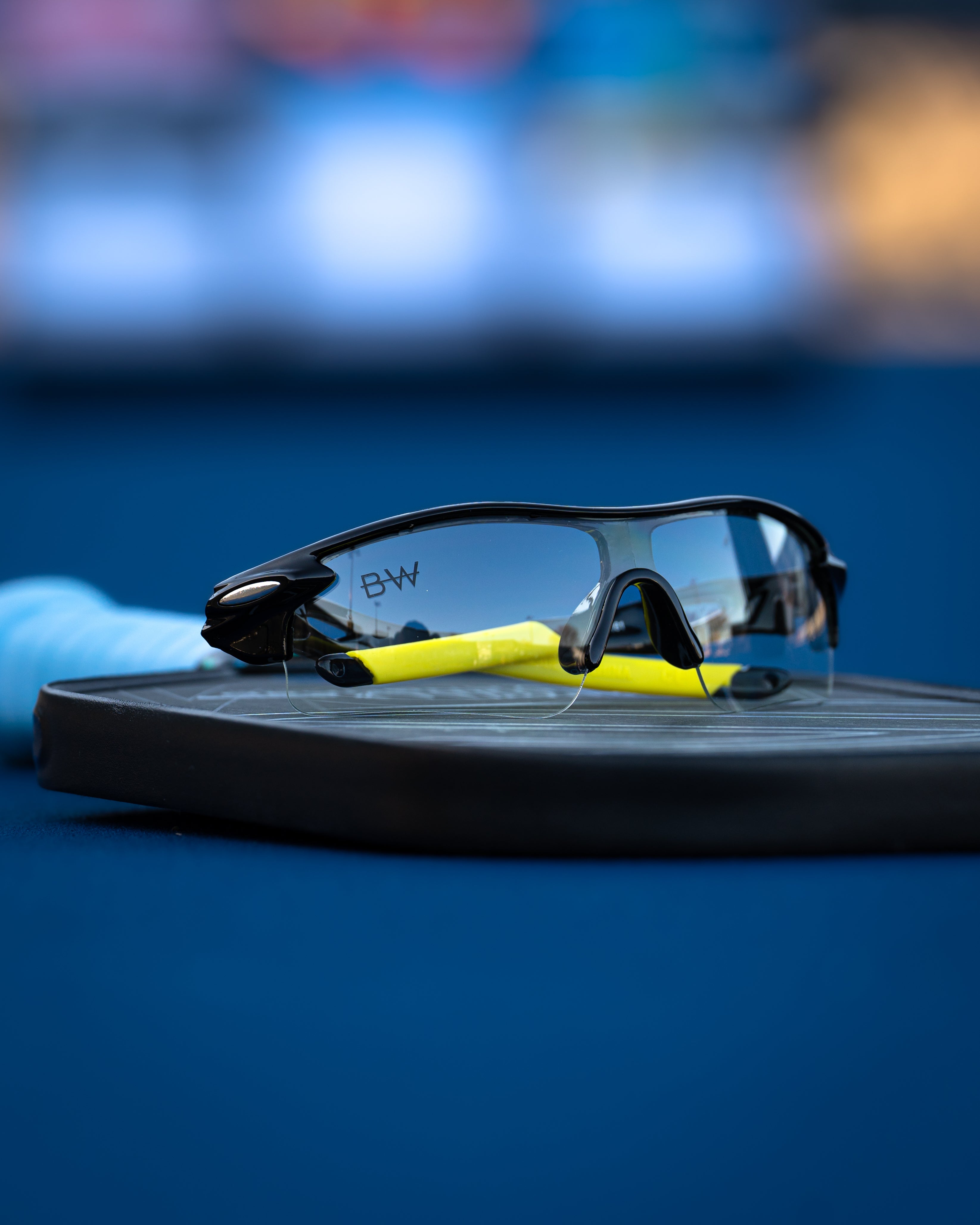
Prescription Pickleball Glasses: What Makes Them Different and Better
Share
Find the Right Prescription Pickleball Glasses
Prescription pickleball glasses combine the vision correction you need with sports-oriented eyewear designed around active use. The right setup depends on your prescription, frame fit, playing environment, lens configuration, and personal preferences.
What Are Prescription Pickleball Glasses?
Prescription pickleball glasses are sports-oriented eyewear that incorporates the wearer's prescription correction into an eyewear system intended for active use.
Depending on the product, prescription correction may be provided through:
- Direct RX lenses — prescription correction is incorporated into the primary prescription lenses.
- RX Clip or prescription insert — prescription correction is located in a separate inner insert within the eyewear system.
That distinction separates prescription pickleball eyewear from Non-RX sports glasses, where the outer eyewear itself does not provide prescription correction.
Prescription pickleball glasses can also differ from everyday eyeglasses in frame shape, physical coverage, fit, lens configuration, and overall sports-oriented design.
What Makes Prescription Pickleball Glasses Different?
Pickleball involves frequent movement, relatively close player positioning, indoor and outdoor playing environments, and matches that can extend across changing conditions.
For someone who requires prescription correction, that creates several eyewear considerations beyond simply choosing a frame that looks good.
Prescription pickleball eyewear can be evaluated around:
- Prescription compatibility
- Direct RX versus RX Clip construction
- Frame dimensions and fit
- Physical lens coverage
- Finished eyewear weight
- Weight distribution
- Available clear or tinted lens configurations
- Indoor versus outdoor use
- Comfort during extended wear
- Verified lens and frame characteristics
These characteristics make prescription sports eyewear worth comparing with conventional everyday glasses when pickleball is a regular part of your routine.
Are Prescription Pickleball Glasses Better Than Regular Glasses?
Not automatically.
"Better" depends on what you need the eyewear to do.
Everyday prescription glasses may provide perfectly appropriate vision correction. Prescription pickleball glasses add a sports-oriented frame and lens configuration that some players may prefer for active court use.
A more accurate comparison is:
| Consideration | Everyday Prescription Glasses | Prescription Pickleball Glasses |
|---|---|---|
| Prescription Correction | Yes | Yes |
| Primary Purpose | General everyday use | Sports-oriented active use |
| Frame Design | Varies widely | Sports-oriented designs may be available |
| Physical Coverage | Depends on frame | Can include larger or more sports-oriented coverage depending on model |
| Clear or Tinted Options | Depends on product | Depends on product and available configuration |
| Suitable for Pickleball | Potentially | Designed with active sports use in mind |
| Safety Certification | Must be verified | Must be verified |
The right choice depends on your prescription, fit, environment, and what you want from your sports eyewear.
Why Fit Matters in Prescription Pickleball Eyewear
Pickleball involves lateral movement, forward and backward movement, changes in body position, and repeated head movement.
That makes frame fit worth considering when choosing prescription eyewear for the court.
Evaluate:
- Frame width
- Bridge fit
- Temple fit
- Frame geometry
- Finished eyewear weight
- Weight distribution
- How the frame feels during movement
- How the frame feels after extended wear
No frame should automatically be described as "non-slip," "sweatproof," or guaranteed to remain perfectly positioned during every rally unless that performance has been specifically established.
Fit is individual. A sports frame that works well for one player's face may fit another player differently.
Prescription Correction Is the Starting Point
Sports styling does not replace appropriate prescription correction.
If you require corrective lenses, your current prescription should be the starting point when choosing pickleball eyewear.
The prescription addresses your refractive correction needs. The frame, lens configuration, tint, physical coverage, and other characteristics then determine how that correction is incorporated into the complete sports-eyewear setup.
This distinction is important because prescription pickleball glasses should not be marketed as automatically giving every player:
- Faster reaction time
- Better ball tracking
- Improved depth perception
- Greater accuracy
- Better anticipation
- Improved hand-eye coordination
Those aspects of athletic performance involve far more than the eyewear being worn.
Do Prescription Pickleball Glasses Help You See the Ball Better?
If you have refractive error, appropriate prescription correction addresses that refractive error. That is different from claiming that a particular pair of pickleball glasses universally enhances ball visibility.
Seeing and responding to a moving pickleball can involve:
- Your individual vision
- Prescription correction
- Environmental lighting
- Ball and background colors
- Attention
- Eye and head movement
- Experience
- Anticipation
Prescription correction can be an important part of your visual setup without being described as a performance-enhancing technology.
Do Prescription Pickleball Glasses Improve Reaction Time?
No prescription sports glasses should automatically be credited with increasing neurological reaction speed.
Reaction time involves multiple stages:
- Detecting visual information
- Processing what is happening
- Deciding how to respond
- Initiating movement
- Executing the physical response
Appropriate prescription correction addresses refractive error. It does not directly train or accelerate the neurological and physical processes involved in athletic reaction time.
Do Prescription Pickleball Glasses Improve Depth Perception?
Prescription eyewear should not automatically be described as improving depth perception beyond providing the correction prescribed for the wearer's refractive needs.
Depth perception involves binocular vision and multiple visual cues.
If you have questions about your individual depth perception or binocular vision, those questions extend beyond choosing a sports frame and are better addressed through appropriate eye-care guidance.
Sports Frame Shape and Physical Coverage
One visible difference between some sports frames and conventional eyeglasses is the amount and shape of physical lens coverage.
Sports-oriented frames may use:
- Larger lens shapes
- More curved frame geometry
- Greater physical side coverage
- Different frame proportions than conventional everyday eyewear
These are legitimate design characteristics, but greater physical coverage does not automatically improve peripheral vision, reaction time, depth perception, or ball tracking.
Do Wraparound Pickleball Glasses Improve Peripheral Vision?
Not automatically.
A wraparound frame curves farther around the sides of the face and can provide more physical side coverage than some flatter frames.
However, frame curvature does not biologically increase peripheral vision.
Prescription compatibility also matters because highly curved frame and lens designs can create different optical considerations than flatter eyewear.
Choose wraparound-style RX eyewear because the complete design suits your prescription, fit, coverage preferences, and intended use—not because it promises a larger biological field of vision.
Impact-Resistant Prescription Pickleball Lenses
Impact resistance can be a relevant characteristic when comparing sports eyewear.
However, terminology matters:
Impact-resistant does not mean shatterproof and does not establish a particular protective-eyewear certification or safety rating.
The appearance of a sports frame also does not establish that it meets a specific protective standard.
If you specifically need protective eyewear for pickleball, verify the certification and testing of the complete product rather than assuming protection from lens shape, frame coverage, or sports-oriented marketing.
Are Prescription Pickleball Glasses Safety Glasses?
Not necessarily.
"Prescription sports glasses" and "certified protective eyewear" should not be treated as interchangeable terms.
A prescription sports frame can be designed for active use without necessarily carrying a specific safety certification.
If certified protection is an important part of your purchase decision, verify the exact standard for the complete frame-and-lens system.
Can a Pickleball Break Prescription Lenses?
Any eyewear can potentially be damaged under sufficient force, and no prescription lens should be described as impossible to break.
The result of an impact can depend on:
- Lens material
- Lens geometry
- Lens thickness
- Frame construction
- How the lens is mounted
- Impact location
- Impact force
This is another reason to avoid terms such as "shatterproof" unless a specific claim is supported by appropriate testing.
High-Index Prescription Lenses for Pickleball
Blinded Wear RX products include high-index prescription lenses at no additional cost.
High-index refers to a category of prescription lens material commonly used to help manage lens thickness, particularly as prescription strength increases.
Finished lens thickness depends on factors including:
- Your individual prescription
- Frame dimensions
- Lens dimensions
- Lens shape
- Lens design
- Other optical requirements
High-index should not be interpreted as a sports-performance rating or an automatic indicator of impact resistance, durability, or finished eyewear weight.
High-Index vs. Polycarbonate for Pickleball
High-index and polycarbonate are different lens-material categories with different characteristics.
A higher refractive index describes how strongly a lens material bends light. It does not provide a durability score.
Polycarbonate is widely associated with impact resistance and relatively lightweight construction, while high-index materials are commonly considered when managing prescription lens thickness.
It would be inaccurate to say that high-index is universally tougher than polycarbonate—or that polycarbonate is automatically the correct choice for every pickleball player.
The appropriate lens material depends on the prescription, frame, optical requirements, intended use, and available product configuration.
Direct RX vs. RX Clip Pickleball Glasses
Prescription pickleball eyewear can use more than one construction method.
| RX Design | Where Prescription Correction Is Located | What to Consider |
|---|---|---|
| Direct RX | Primary prescription lenses | Prescription compatibility, frame geometry, available lens configuration, fit, and coverage |
| RX Clip | Separate inner prescription insert | Prescription insert, outer lens, complete frame fit, and overall configuration |
Neither system is automatically better for reaction time, ball tracking, depth perception, or pickleball performance.
The better choice is the configuration that appropriately works with your prescription and preferences.
What Is an RX Clip?
An RX Clip is a separate prescription insert positioned within a compatible sports-eyewear system.
The prescription correction is located in the inner insert rather than directly in the primary outer sports lens.
This should not be confused with a generic clip that automatically converts any existing pair of sunglasses into prescription eyewear.
RX Clip systems should be evaluated as complete eyewear configurations.
Direct RX Pickleball Glasses: What to Consider
Direct RX eyewear incorporates prescription correction into the primary prescription lenses.
This can appeal to players who want a dedicated prescription sports-eyewear setup without a separate inner prescription insert.
When comparing direct RX pickleball glasses, consider:
- Prescription compatibility
- Frame dimensions
- Lens geometry
- Available lens configuration
- Physical coverage
- Frame fit
- Extended-wear comfort
RX Clip Pickleball Glasses: What to Consider
With an RX Clip system, evaluate both the inner prescription insert and the outer sports-eyewear configuration.
Consider:
- Your prescription requirements
- The dimensions of the prescription insert
- The primary outer lens
- Frame geometry
- Complete eyewear fit
- Finished eyewear weight
- Your playing environment
For some athletes, the separate prescription-insert format may be appealing. Others may prefer direct RX construction.
Clear vs. Tinted Prescription Pickleball Glasses
Prescription correction and lens tint perform different functions.
Clear RX lenses provide prescription correction without a dark sunglass tint.
Tinted RX lenses provide prescription correction while also changing visible-light transmission according to the tint.
Clear RX eyewear may be worth considering for indoor, evening, nighttime, or other environments where dark tint is unnecessary.
An appropriate tinted RX configuration may be worth considering for brighter outdoor conditions.
Neither lens type automatically improves ball tracking, reaction time, depth perception, or accuracy.
For a detailed comparison, read Clear vs. Tinted RX Lenses for Multi-Sport Athletes.
Prescription Pickleball Glasses for Indoor Play
Indoor pickleball can involve substantially different available light than a bright outdoor court.
If you require prescription correction indoors, consider whether you actually need a dark sunglass tint in that environment.
Evaluate:
- Your prescription
- Available lens configuration
- Facility lighting
- Frame fit
- Physical coverage
- Comfort during extended play
Blinded Wear also offers a Clear Lens Collection for athletes seeking Non-RX clear-lens eyewear. The Clear Lens Collection is Non-RX and should not be confused with prescription eyewear.
Prescription Pickleball Glasses for Outdoor Play
Outdoor pickleball players may encounter bright daytime conditions, changing cloud cover, heat, wind, and matches extending across different times of day.
When comparing outdoor RX eyewear, consider:
- Your prescription
- Available sunglass-lens configuration
- Time of day
- Typical environmental brightness
- Frame fit
- Physical coverage
- How long you normally play
Do not assume that a dark-looking lens automatically provides polarization, a particular UV specification, better contrast, or improved ball tracking. Those characteristics must be evaluated separately.
Polarized vs. Non-Polarized Prescription Pickleball Glasses
Polarized lenses are designed to reduce certain reflected light. Non-polarized lenses do not contain that added polarization filter.
Some pickleball players may prefer non-polarized sports eyewear, while others may prefer polarization in particular environments.
Polarization alone does not determine:
- Depth perception
- Reaction time
- Contrast
- Ball tracking
- Overall athletic performance
Your prescription, individual vision, lighting conditions, playing environment, and complete eyewear configuration also contribute to what you see on the court.
Lens Color and Pickleball Performance
Sports lenses come in many colors, but lens color should not automatically be treated as a performance enhancement.
Different colors can alter how the environment appears through the lens. However, there is no single lens color that can be guaranteed to improve ball tracking, reaction time, depth perception, or contrast for every pickleball player.
Consider:
- The specific lens
- Environmental lighting
- Court and background colors
- Ball color
- Your individual vision
- Your personal preferences
For more detail, read the Pickleball Performance Lens Guide.
Do Prescription Pickleball Glasses Prevent Fogging?
Not automatically.
Fogging can be affected by temperature, humidity, perspiration, airflow, frame geometry, and other environmental conditions.
A sports-oriented frame should not automatically be described as anti-fog or fog-proof unless that feature is verified for the specific product or lens.
Do Prescription Pickleball Glasses Resist Scratches?
Scratch resistance should be treated as a product-specific characteristic rather than assumed from the fact that eyewear is designed for sports.
No lens should be treated as scratch-proof, and specialized coatings should only be claimed when verified for the specific product.
Proper storage and cleaning remain important for prescription sports eyewear.
Do Prescription Pickleball Glasses Provide UV Protection?
UV performance should be verified for the specific lens rather than inferred from sports styling, tint darkness, or lens color.
A dark lens does not automatically establish a particular UV specification, and a clear lens cannot be evaluated for UV characteristics solely from its appearance.
UV protection, tint, and polarization are separate lens characteristics.
Lightweight Prescription Pickleball Glasses
Some pickleball players prefer less eyewear mass, particularly during long playing sessions or tournaments.
Lower weight can be a legitimate comfort preference, but lightweight eyewear does not automatically improve reaction speed, reduce neurological fatigue, or enhance athletic performance.
Weight distribution can also matter. Two frames with similar total weight may feel different depending on their geometry and how they fit the wearer.
Comfort During Long Pickleball Matches
A frame that feels comfortable for several minutes may not necessarily feel identical after hours of play.
For longer matches and tournaments, consider:
- Bridge pressure
- Temple pressure
- Frame width
- Finished eyewear weight
- Weight distribution
- Frame stability
- Prescription configuration
- How the eyewear feels over your normal playing duration
Comfort is individual, which is why universal claims such as "you'll forget you're wearing them" should be avoided.
Prescription Pickleball Glasses vs. Contacts
Players who require vision correction do not necessarily need prescription sports glasses.
Another approach is to use appropriately prescribed contact lenses for correction and separate Non-RX sports eyewear as the outer frame and lens.
| Setup | Where Vision Correction Occurs |
|---|---|
| Direct RX Pickleball Glasses | Primary prescription lenses |
| RX Clip Pickleball Glasses | Inner prescription insert |
| Contacts + Non-RX Sports Glasses | Contact lenses |
Contacts are medical devices, so appropriate prescription, fit, hygiene, replacement schedule, and wear should follow eye-care guidance.
What Makes Prescription Pickleball Glasses Worth Considering?
The value of prescription pickleball eyewear is not that it turns glasses into a competitive shortcut.
Its practical value is bringing your required prescription correction into a sports-oriented eyewear configuration.
For a regular pickleball player who needs corrective lenses, that can mean evaluating an eyewear system around the actual demands of active use rather than selecting solely from conventional everyday frames.
The key is choosing based on verified characteristics—not promises that the glasses will make you faster, more accurate, or automatically better at pickleball.
How to Choose Prescription Pickleball Glasses
The best prescription pickleball eyewear for you should start with your vision-correction needs and then account for how, where, and how often you play.
Before choosing a frame, ask:
- Is my eyeglass prescription current?
- Is this frame compatible with my prescription?
- Do I prefer direct RX lenses or an RX Clip system?
- Do I primarily play indoors, outdoors, or both?
- Do I want clear or tinted eyewear?
- What lens configurations are actually available for this model?
- How much physical lens coverage do I prefer?
- Does the frame fit my face appropriately?
- How long do I normally play at one time?
- Am I looking for a particular verified safety certification?
Answering these questions can narrow the collection more effectively than choosing based on broad performance claims.
Prescription Compatibility Comes Before Frame Style
A sports frame can have the exact appearance you want and still be the wrong RX choice if it does not appropriately accommodate your prescription.
Prescription compatibility can depend on factors including:
- Prescription strength
- Sphere and cylinder requirements
- Frame dimensions
- Lens dimensions
- Lens shape
- Frame curvature
- Direct RX versus prescription-insert construction
- Other individual optical requirements
This is especially important with sports-oriented frames because frame and lens geometry can differ substantially from conventional everyday eyeglasses.
Prescription Pickleball Glasses for Stronger Prescriptions
A stronger prescription does not automatically prevent someone from using prescription sports eyewear, but it can make frame and lens selection more important.
As prescription requirements increase, finished lens thickness and other characteristics can become increasingly dependent on the relationship between the prescription and the chosen frame.
This is one reason high-index prescription lenses can be relevant. A higher refractive index can help manage lens thickness in comparable prescriptions, although final thickness still depends on the complete prescription and eyewear configuration.
Do not assume that the largest sports frame, most curved frame, or smallest frame will automatically be best for a stronger prescription.
Does a Smaller Frame Always Mean Thinner RX Lenses?
Frame and lens dimensions can influence finished prescription lens thickness, but the final result depends on more than frame size alone.
Factors include:
- Your prescription
- Lens material
- Lens dimensions
- Lens shape
- Frame dimensions
- Optical requirements
That is why prescription eyewear should be evaluated as a complete optical system rather than choosing a frame according to one dimension alone.
Are Prescription Pickleball Glasses Better for Competitive Players?
A competitive player does not automatically need different prescription correction from a recreational player.
However, someone who plays frequently may place greater importance on factors such as:
- Extended-wear comfort
- Frame fit during active movement
- Indoor and outdoor versatility
- Backup prescription correction
- Physical lens coverage
- Travel and tournament practicality
The distinction is about how often and under what conditions the eyewear is used—not a special lens that automatically increases competitive performance.
Prescription Pickleball Glasses for Recreational Players
Recreational players can benefit from the same basic selection process.
If you need prescription correction while playing, start with an appropriate prescription and then decide whether a sports-oriented frame better fits your preferences than your everyday eyewear.
You do not need to be a tournament player to consider RX sports eyewear, and you do not need the most complex setup simply because you play pickleball.
Prescription Pickleball Glasses for Beginners
New players do not need to overcomplicate their first sports-eyewear purchase.
Focus on:
- Your prescription requirements
- Frame compatibility
- Comfortable fit
- Your primary playing environment
- Clear versus tinted preferences
- Direct RX versus RX Clip construction
As you play more frequently, you can determine whether another lens configuration or secondary pair would solve a real need.
Prescription Pickleball Glasses for Players Over 40
Age alone does not determine which sports frame or lens configuration someone should use.
However, vision needs can change over time, and some adults may have different near, intermediate, and distance vision considerations than they had when they were younger.
For pickleball, your individual prescription and visual needs should determine the correction rather than choosing a lens solely because it is marketed toward a particular age group.
For a deeper discussion, read Prescription Glasses for Pickleball Players Over 40.
Do Pickleball Players Need Progressive Lenses?
Not simply because they play pickleball.
Progressive lenses provide multiple prescription powers across different portions of a lens and can be appropriate for some people's everyday vision needs.
Whether progressive lenses are appropriate for sports is an individual prescription and eyewear decision rather than a universal pickleball recommendation.
Do not assume that every Blinded Wear RX model is available with progressive lenses unless that option is specifically verified for the product.
Single-Vision vs. Progressive Sports Glasses
Single-vision and progressive lenses solve different prescription needs.
| Lens Design | General Description | What to Consider for Pickleball |
|---|---|---|
| Single Vision | One prescription power is provided for the intended correction. | Whether the correction matches your individual visual requirements. |
| Progressive | Multiple prescription powers are incorporated across different portions of the lens. | Your prescription needs, adaptation, frame compatibility, lens design, and intended use. |
Neither design should automatically be described as superior for pickleball performance.
Prescription Pickleball Glasses for Indoor and Outdoor Players
Players who regularly switch between indoor and outdoor courts may need to think beyond a single fixed lens tint.
Potential approaches include:
- A clear RX setup for environments where dark tint is unnecessary
- An appropriate tinted RX setup for brighter outdoor conditions
- Separate indoor and outdoor RX pairs
- A verified photochromic RX option when available
- Contacts with separate Non-RX sports eyewear when contacts are suitable for the individual
The right solution depends on how often your environment changes and which lens options are actually available for the product you are considering.
Do You Need Two Pairs of Prescription Pickleball Glasses?
Not necessarily.
A second pair becomes more useful when it solves a specific problem.
For example:
- Your primary RX sunglasses are too dark for indoor play.
- You regularly switch between indoor and outdoor courts.
- You want backup prescription correction during tournaments.
- You travel for pickleball and do not want to rely on one pair.
- Your matches frequently continue into substantially different lighting conditions.
If one RX setup appropriately handles your normal playing environment, there is no rule requiring a second pair.
Why Backup RX Eyewear Can Matter for Tournaments
For someone who depends on prescription correction, a damaged or unavailable primary pair can create a practical problem during a tournament.
A backup strategy might include:
- A second appropriate pair of prescription glasses
- Another RX sports setup
- Contact lenses you already use appropriately
The purpose of a backup is reliability—not a competitive performance advantage.
Prescription Pickleball Glasses for Tournament Travel
Travel introduces additional considerations because replacing custom prescription eyewear may not be as simple as replacing an ordinary accessory.
Before traveling for pickleball, consider:
- Your primary RX eyewear
- Backup prescription correction
- How your glasses will be stored during transportation
- Whether you will play indoors or outdoors
- Expected playing times
- Changing environmental conditions
- How you will clean and maintain your lenses during the trip
For a more detailed travel setup, read The Ultimate Guide to Travel-Friendly Prescription Sports Eyewear.
Can You Use Prescription Pickleball Glasses for Tennis?
Potentially.
Prescription sports eyewear does not necessarily become limited to one sport simply because it was selected with pickleball in mind.
If the eyewear appropriately accommodates your prescription, fits comfortably, and has a lens configuration suited to your tennis environment, the same pair may potentially work for both sports.
The sport name matters less than the practical requirements of the activity and environment.
Can You Use Prescription Pickleball Glasses for Other Sports?
Potentially, depending on the activity.
The same RX sports eyewear may be useful for multiple activities when:
- The prescription remains appropriate
- The frame fits appropriately
- The lens configuration suits the environment
- The physical coverage matches your preferences
- The activity does not require a specific protective certification that the eyewear lacks
If a sport requires specialized protective equipment, verify those requirements separately rather than assuming general sports eyewear qualifies.
Prescription Pickleball Glasses vs. Prescription Sunglasses
These categories can overlap.
A prescription pickleball frame configured with a sunglass lens can also be described as prescription sports sunglasses.
The term "pickleball glasses" generally emphasizes the intended sports use, while "prescription sunglasses" emphasizes prescription correction combined with a sunglass lens.
Neither label by itself establishes:
- Polarization
- UV specifications
- Safety certification
- Anti-fog technology
- Scratch-resistant coatings
- Photochromic technology
Those characteristics should be verified separately.
Prescription Pickleball Glasses vs. Regular Sports Sunglasses
The primary distinction is prescription correction.
Non-RX sports sunglasses do not correct refractive error. Prescription pickleball eyewear incorporates correction either into the primary lenses or a prescription insert.
| Feature | Prescription Pickleball Glasses | Non-RX Sports Sunglasses |
|---|---|---|
| Prescription Correction | Yes | No |
| Direct RX Possible | Yes, depending on model | No |
| RX Clip Possible | Yes, depending on model | Not part of standard Non-RX configuration |
| Sports-Oriented Frame | Can be | Can be |
| Tinted Lens | Depends on configuration | Depends on product |
If you do not require prescription correction, explore the Blinded Wear Non-RX Pickleball Sunglasses Collection.
Prescription Pickleball Glasses vs. Contacts + Non-RX Glasses
Both approaches can provide vision correction during sports, but they place that correction in different locations.
With prescription pickleball glasses, correction is incorporated into the eyewear system.
With contacts plus Non-RX glasses, the contact lenses provide correction and the outer eyewear is selected separately.
Consider:
- Your existing contact-lens routine
- Whether contacts are suitable for you
- Your preference for glasses versus contacts
- How often you switch outer sports eyewear
- Your playing environments
- Your backup correction strategy
For a deeper comparison, read Prescription Sunglasses vs. Contact Lenses for Athletes.
Do Prescription Pickleball Glasses Improve Accuracy?
They should not automatically be described as improving shot accuracy.
Pickleball accuracy involves technique, timing, positioning, coordination, decision-making, practice, and visual information.
If you require prescription correction, wearing appropriate correction can be an important part of your visual setup. That is different from claiming the eyewear itself makes your shots more accurate.
Do Prescription Pickleball Glasses Improve Focus?
There are two different meanings of "focus" that should not be confused.
Optical focus relates to how light is focused and how prescription correction addresses refractive error.
Mental focus relates to attention and concentration.
Prescription lenses can address refractive correction, but they should not be marketed as automatically increasing an athlete's concentration or mental focus during a match.
Do Prescription Pickleball Glasses Improve Confidence?
Confidence is subjective and varies by athlete.
A player may personally feel more comfortable or confident in eyewear they like and prefer, but that should not be converted into a universal product-performance claim.
Choose eyewear according to measurable needs such as prescription compatibility, fit, environment, and verified features rather than assuming a frame will automatically change your mental performance.
Can Prescription Pickleball Glasses Make You a Better Player?
Eyewear does not replace practice, coaching, technique, positioning, anticipation, fitness, or experience.
The practical role of prescription pickleball glasses is much narrower:
They provide your required prescription correction within a sports-oriented eyewear configuration.
That can make them a useful equipment choice for players who need vision correction, but it should not be confused with a guarantee of improved athletic performance.
What About Anti-Fog Prescription Pickleball Glasses?
Fogging can be frustrating during active sports, but "anti-fog" should only be used when a specific lens or product has a verified anti-fog feature.
Fogging can be affected by:
- Temperature differences
- Humidity
- Perspiration
- Airflow
- Frame geometry
- Environmental conditions
A vented or sports-oriented appearance alone does not establish that a product is fog-proof.
What About Scratch-Resistant RX Pickleball Lenses?
Scratch-resistant coatings are separate lens characteristics and should be verified for the specific lens configuration.
Even when a scratch-resistant feature is present, "scratch-resistant" should not be interpreted as "scratch-proof."
Proper cleaning and storage remain important.
How to Care for Prescription Pickleball Glasses
Good eyewear care can help reduce unnecessary wear during regular sports use.
General habits include:
- Store your eyewear securely when it is not being worn.
- Avoid placing lenses face-down on hard surfaces.
- Clean lenses using methods appropriate for the lens.
- Avoid unnecessary pressure on the frame or lenses.
- Inspect the eyewear if it experiences a significant impact.
- Keep your primary and backup eyewear protected during travel.
Follow any product-specific care instructions provided with your eyewear.
When Should You Replace Prescription Pickleball Glasses?
There is no universal rule that prescription sports glasses must be replaced every season or after a fixed number of months.
Reevaluate your eyewear when:
- Your prescription changes
- Your existing correction no longer meets your needs
- The frame becomes damaged
- The lenses become damaged
- The frame no longer fits appropriately
- Your primary playing environment changes
- Your current lens configuration no longer suits your needs
Replacing eyewear because your prescription or practical requirements have changed is different from replacing it simply because a newer model exists.
Featured Blinded Wear Prescription Pickleball Glasses
Blinded Wear offers direct RX and RX Clip sports-eyewear designs for players who need prescription correction.
Rather than ranking models according to unsupported performance claims, compare them according to your prescription, preferred RX construction, fit, available lens configuration, and design preferences.
Weathered White RX
Weathered White RX is an RX sports-eyewear option for players exploring Blinded Wear prescription designs.
Before ordering, verify the current product configuration and available options on the product page rather than assuming specific coatings, lens technologies, or fit features.
Zebra II RX
Zebra II RX is a direct RX sports-eyewear design with a distinctive aesthetic.
It can be compared with other direct RX models according to prescription compatibility, frame fit, available lens configuration, physical coverage, and your style preferences.
Browse the Full Prescription Pickleball Glasses Collection to compare additional RX options.
What Makes Blinded Wear Prescription Pickleball Glasses Different?
Blinded Wear focuses on performance-oriented eyewear for pickleball players and offers prescription options for customers who need corrective lenses.
Verified RX advantages include:
- Prescription sports-eyewear options designed around pickleball and active use
- Direct RX and RX Clip configurations across the RX catalog
- High-index prescription lenses included at no additional cost
- Multiple sports-oriented frame designs
- 50% lifetime replacement support for eligible broken glasses, subject to current policy terms
These are practical product and purchasing differences. They do not require exaggerated claims about faster reflexes, improved ball tracking, or guaranteed athletic performance.
What Blinded Wear Does Not Need to Promise
Good prescription sports eyewear does not need unrealistic performance claims to be useful.
Blinded Wear RX glasses should not automatically be described as:
- Making you react faster
- Making every pickleball easier to track
- Improving depth perception
- Improving shot accuracy
- Increasing peripheral vision
- Preventing all fogging
- Being scratch-proof
- Being shatterproof
- Guaranteeing a non-slip fit
- Providing a specific safety certification unless verified
The stronger value proposition is simpler: prescription correction combined with sports-oriented eyewear, multiple RX designs, high-index prescription lenses included at no additional cost, and replacement support for eligible broken glasses.
Prescription Pickleball Glasses Buying Checklist
Before purchasing, check each of the following:
- My eyeglass prescription is current.
- The frame is appropriate for my prescription requirements.
- I understand whether the product is direct RX or RX Clip.
- I have checked the currently available lens configuration.
- I know whether I primarily need indoor, outdoor, or mixed-use eyewear.
- The frame dimensions suit my fit preferences.
- The amount of physical coverage suits my preferences.
- I am not assuming tint automatically means polarization or a particular UV specification.
- I am not treating impact resistance as equivalent to shatterproof or safety-certified.
- I have considered extended-wear comfort.
- I have considered whether I need backup prescription correction.
- I understand the return and replacement terms for customized RX eyewear.
Frequently Asked Questions About Prescription Pickleball Glasses
What are prescription pickleball glasses?
Prescription pickleball glasses are sports-oriented eyewear that incorporates the wearer's prescription correction into an eyewear system intended for active use. Depending on the product, correction may be provided through direct RX lenses or a separate RX Clip prescription insert.
How are prescription pickleball glasses different from regular glasses?
Everyday glasses are generally designed for broad daily use, while prescription pickleball eyewear can use sports-oriented frame shapes, physical coverage, fit characteristics, and lens configurations. Both can provide prescription correction. The primary difference is how the complete eyewear system is designed and used.
Are prescription pickleball glasses better than regular glasses?
Not universally. A sports-oriented RX frame may better match the preferences of someone who regularly plays pickleball, while another player may be comfortable using conventional prescription eyewear. Prescription compatibility, frame fit, playing environment, lens configuration, and individual preferences should guide the choice.
Do I need prescription pickleball glasses if I already wear glasses?
Not necessarily. Prescription pickleball eyewear is an additional option for players who want their vision correction incorporated into a sports-oriented eyewear setup. Your everyday glasses, dedicated sports RX eyewear, an RX Clip system, or appropriately prescribed contacts with Non-RX sports eyewear are different approaches to consider.
Can I play pickleball in my normal prescription glasses?
Potentially. Whether your everyday glasses are appropriate depends on their fit, your prescription, your preferences, and your intended use. Conventional glasses should not automatically be described as unsuitable for pickleball simply because they were not marketed specifically for the sport.
What is direct RX pickleball eyewear?
With direct RX eyewear, prescription correction is incorporated into the primary prescription lenses rather than a separate inner prescription insert.
What is an RX Clip?
An RX Clip is a separate inner prescription insert used within a compatible eyewear system. The prescription correction is located in that insert rather than directly in the primary outer sports lens.
Is direct RX better than an RX Clip?
Neither is universally better. Compare prescription compatibility, frame geometry, available lens configuration, fit, physical coverage, finished eyewear weight, and your personal preferences.
Can an RX Clip attach to any sunglasses?
Do not assume so. An RX Clip should be treated as part of a compatible eyewear system rather than a universal insert that automatically converts arbitrary sunglasses into prescription eyewear.
Do prescription pickleball glasses improve reaction time?
No automatic improvement should be claimed. Reaction time involves visual detection, neurological processing, decision-making, and physical response. Prescription correction addresses refractive error rather than directly increasing neurological reaction speed.
Do prescription pickleball glasses improve ball tracking?
Prescription eyewear should not automatically be credited with improving ball tracking. Tracking a moving pickleball involves individual vision, attention, eye and head movement, anticipation, experience, environmental lighting, and other factors.
Do prescription pickleball glasses improve depth perception?
They should not automatically be described as improving depth perception beyond providing the correction prescribed for the wearer's refractive needs. Depth perception involves binocular vision and multiple visual cues.
Do prescription pickleball glasses make you more accurate?
No universal accuracy improvement should be promised. Shot accuracy involves technique, timing, coordination, positioning, decision-making, practice, and visual information.
Do wraparound pickleball glasses increase peripheral vision?
Not biologically. A wraparound frame can provide greater physical side coverage than some flatter frames, but frame curvature does not increase the wearer's biological peripheral vision.
Are prescription pickleball glasses shatterproof?
No prescription sports lens should automatically be described as shatterproof. Impact-resistant does not mean shatterproof and does not establish a particular protective-eyewear certification or safety rating.
Are prescription pickleball glasses safety glasses?
Not necessarily. Prescription sports eyewear and certified protective eyewear are not interchangeable categories. If you need a specific protective standard, verify the certification of the complete frame-and-lens system.
Do prescription pickleball glasses prevent fogging?
Not automatically. Fogging can depend on humidity, temperature, perspiration, airflow, frame geometry, and other environmental conditions. Anti-fog features should only be claimed when verified for the specific product or lens.
Are prescription pickleball glasses scratch-proof?
No. Scratch resistance is a separate lens characteristic and should be verified for the specific configuration. Even a verified scratch-resistant feature should not be interpreted as scratch-proof.
Do tinted prescription pickleball glasses automatically provide UV protection?
No. Tint darkness and UV characteristics are separate. UV specifications should be verified for the actual lens rather than inferred from its color or darkness.
Are tinted pickleball glasses automatically polarized?
No. Tint and polarization are separate characteristics. A tinted lens can be non-polarized.
Are non-polarized glasses better for pickleball?
Some pickleball players may prefer non-polarized eyewear, but non-polarized lenses are not automatically better for depth perception, reaction time, contrast, or ball tracking.
Should I use clear or tinted RX lenses for pickleball?
Clear RX lenses may be worth considering indoors, at night, or in other environments where dark tint is unnecessary. An appropriate tinted RX configuration may be worth considering in brighter outdoor conditions. Neither is universally better.
Can I use the same prescription pickleball glasses indoors and outdoors?
Potentially. The answer depends on the specific lens configuration and your playing environments. Players who regularly move between substantially different lighting conditions may prefer separate setups or another appropriate lens solution.
Can I use prescription pickleball glasses for tennis?
Potentially. If the prescription, frame fit, lens configuration, and other characteristics are appropriate for your tennis environment, sports eyewear does not necessarily need to be limited to one sport.
Can I use prescription pickleball glasses for running or other sports?
Potentially, as long as the eyewear appropriately serves the activity and no specialized protective standard is required that the product does not meet.
Does Blinded Wear include high-index prescription lenses?
Yes. Blinded Wear RX products include high-index prescription lenses at no additional cost.
Does high-index mean more impact-resistant?
No. Refractive index describes how strongly a lens material bends light; it is not a durability or impact-resistance rating.
Are high-index lenses always thinner and lighter?
High-index materials can help manage lens thickness in appropriate prescriptions, but final thickness and weight depend on the prescription, lens dimensions, frame, lens design, material, and other optical requirements.
Common Myths About Prescription Pickleball Glasses
Myth: Sports Glasses Automatically Make You Play Better
Prescription sports eyewear provides vision correction within a sports-oriented configuration. It does not replace practice, technique, anticipation, positioning, coaching, or physical ability.
Myth: Bigger Lenses Automatically Improve Peripheral Vision
Greater physical lens coverage does not biologically increase peripheral vision. Coverage and field of vision should not be treated as interchangeable concepts.
Myth: Every Sports Frame Is Safety-Certified
A sports-oriented appearance does not establish a protective-eyewear certification. Verify the complete product if a specific safety standard matters to you.
Myth: Darker Lenses Provide More UV Protection
Lens darkness does not establish UV performance. Tint and UV characteristics are separate.
Myth: Polarized Lenses Hurt Depth Perception
Polarization alone should not be described as determining depth perception. Individual vision, prescription, lighting, playing environment, and the complete eyewear configuration also matter.
Myth: Non-Polarized Lenses Improve Reaction Time
There is no basis for treating the absence of polarization as a direct neurological reaction-time enhancement.
Myth: Prescription Sports Glasses Cannot Break
No eyewear should be assumed to be indestructible. Impact outcome can depend on material, geometry, mounting, force, impact location, and other factors.
Myth: High-Index Means Stronger Than Polycarbonate
Refractive index is not a durability score. High-index and polycarbonate are different lens-material categories and should be compared according to the characteristics relevant to the actual prescription and intended use.
How to Order Blinded Wear Prescription Pickleball Glasses
Blinded Wear allows customers to submit their eyeglass prescription while ordering compatible RX eyewear.
- Browse the Prescription Pickleball Glasses Collection.
- Select your preferred product and currently available options.
- Have your current eyeglass prescription ready.
- Upload a clear photo or picture of your eyeglass prescription on the product page before adding the eyewear to your cart.
- Your prescription information will be associated with your custom RX order.
For an RX Clip product, your prescription information will be associated with the custom RX clip included with your order.
Blinded Wear RX products include high-index prescription lenses at no additional cost.
For additional ordering information, visit How to Order Your Prescription Pickleball Glasses.
What Should You Check Before Submitting Your RX Order?
Before ordering customized prescription sports eyewear, confirm:
- You are purchasing the intended RX product.
- Your prescription information is current.
- The prescription image you upload is clear and readable.
- You understand whether the product uses direct RX lenses or an RX Clip.
- You have reviewed the currently available product and lens options.
- You have reviewed the policy for customized RX eyewear.
Do not rely on a general blog article to determine that a particular frame has a specific tint, coating, polarization option, photochromic technology, or other lens feature. Verify the current individual product configuration before ordering.
Blinded Wear RX Returns and Replacement Support
Customized prescription eyewear is final sale and excluded from Blinded Wear's standard 30-day return policy.
RX final-sale status does not eliminate applicable 50% lifetime replacement support for eligible broken glasses.
For an eligible replacement claim, damaged eyewear must be returned. Once the claim and returned eyewear meet current policy requirements, the customer can receive 50% credit toward a replacement pair.
This should not be interpreted as a free lifetime warranty or a guarantee of free replacement.
Replacement support also should not automatically be interpreted as coverage for:
- Lost eyewear
- A prescription change by itself
- Updated lenses simply because your prescription changed
- Every possible form of damage
Contact Blinded Wear before returning damaged RX eyewear and review the Protection Plan, Replacement & Returns information for current eligibility and policy details.
Prescription Pickleball Glasses: Final Comparison
| Feature or Question | Prescription Pickleball Glasses | Everyday Prescription Glasses | Non-RX Pickleball Glasses |
|---|---|---|---|
| Provides Prescription Correction | Yes | Yes | No |
| Sports-Oriented Design | Yes, depending on frame | Depends on frame | Yes, depending on frame |
| Direct RX Available | Depending on model | Prescription lenses are incorporated into the eyewear | No |
| RX Clip Available | Depending on model | Not typical | Not part of the standard Non-RX configuration |
| Clear or Tinted | Depends on available configuration | Depends on configuration | Depends on product |
| Automatically Polarized | No | No | No |
| Automatically UV-Rated | No; verify the lens | No; verify the lens | No; verify the lens |
| Automatically Safety-Certified | No | No | No |
| Automatically Improves Reaction Time | No | No | No |
| Automatically Improves Ball Tracking | No | No | No |
Who Should Consider Prescription Pickleball Glasses?
Prescription pickleball eyewear may be worth considering if:
- You require prescription correction while playing.
- You regularly play pickleball and want a dedicated sports-oriented RX setup.
- You want to compare direct RX and RX Clip configurations.
- You want a frame designed around active use rather than relying solely on everyday eyewear.
- You play frequently enough that a dedicated pair would be useful.
- You want separate RX configurations for indoor and outdoor environments.
- You want backup prescription correction for tournaments or travel.
They are not mandatory simply because you play pickleball. The decision depends on your prescription needs, existing eyewear, playing frequency, environment, and preferences.
Who May Not Need Dedicated RX Pickleball Glasses?
A separate pair may be unnecessary if:
- Your current prescription eyewear appropriately meets your needs during play.
- You appropriately use contacts and prefer Non-RX sports eyewear over them.
- You play infrequently and do not see practical value in another RX setup.
- You need a specific certified protective product that the sports eyewear you are considering does not provide.
The goal is not to buy specialized eyewear simply because the category exists. It is to choose a setup that solves an actual vision, fit, environment, or practical need.
What Makes Prescription Pickleball Glasses Different?
The most meaningful difference is not a promise of better athletic performance.
It is the combination of prescription correction and sports-oriented eyewear design.
Compared with choosing eyewear solely for everyday use, a dedicated RX pickleball setup allows you to evaluate your glasses around:
- Your prescription
- Active-use frame design
- Direct RX or RX Clip construction
- Physical lens coverage
- Frame fit
- Finished eyewear weight
- Indoor and outdoor conditions
- Available clear or tinted configurations
- Extended-wear comfort
- Tournament and travel needs
Those practical differences are enough to make dedicated prescription sports eyewear worth considering without promising that a pair of glasses will transform someone's game.
Are Prescription Pickleball Glasses Worth It?
For a player who requires prescription correction and spends substantial time on the court, dedicated RX sports eyewear can be a practical investment.
The value becomes stronger when the eyewear solves a specific problem, such as:
- Wanting a dedicated sports-oriented frame instead of using everyday glasses
- Needing an RX setup for regular pickleball sessions
- Wanting separate indoor and outdoor eyewear configurations
- Wanting a backup prescription pair for tournaments
- Preferring direct RX or prescription-insert sports eyewear
For an occasional player whose current eyewear already meets their needs, dedicated RX pickleball glasses may be less important.
The answer depends on your actual use rather than the idea that specialized eyewear is automatically necessary for every player.
Related Prescription Pickleball Guides
Continue researching your RX setup with these Blinded Wear resources:
- Best Pickleball Glasses 2026 — start with the main Blinded Wear pickleball-eyewear hub.
- Pickleball Performance Lens Guide — learn how lens color, clarity considerations, and RX options differ.
- RX vs. Non-RX Pickleball Glasses — compare prescription and non-prescription approaches.
- How to Order RX Pickleball Glasses — follow the prescription ordering process.
- Prescription Pickleball Glasses for Players Over 40 — explore age-related prescription considerations without assuming one lens design fits everyone.
- Clear vs. Tinted RX Lenses — compare lens configurations for indoor, outdoor, and multi-sport environments.
- Prescription Sports Sunglasses vs. Contact Lenses — compare two approaches to sports vision correction.
- RX Eyewear Upgrades for Competitive Pickleball Players — build a practical prescription setup for frequent play.
- Travel-Friendly Prescription Sports Eyewear — prepare your primary and backup RX setup for tournaments and travel.
Final Takeaway: What Makes Prescription Pickleball Glasses Different and Better?
Prescription pickleball glasses are different because they bring prescription vision correction into a sports-oriented eyewear system.
For the right player, that can make them a better practical choice than relying solely on everyday eyeglasses.
But "better" should not mean exaggerated promises.
Prescription pickleball glasses do not automatically:
- Make your reactions faster
- Make the ball easier to track
- Improve depth perception
- Improve shot accuracy
- Increase peripheral vision
- Prevent fogging
- Prevent scratching
- Prevent breakage
- Make you a better pickleball player
The real advantages are more practical: appropriate prescription correction, sports-oriented frame options, different RX construction methods, high-index prescription lenses included at no additional cost through Blinded Wear, and the ability to choose an eyewear setup around how and where you play.
That is a stronger reason to choose prescription pickleball glasses than any promise of a competitive shortcut.
Explore Blinded Wear Prescription Pickleball Glasses
If you need corrective lenses on the court, compare Blinded Wear RX designs according to your prescription, preferred frame, direct RX or RX Clip construction, available lens configuration, fit, and playing environment.
- Shop Prescription Pickleball Glasses
- Explore the 2026 Pickleball Glasses Guide
- Compare Pickleball Lens Options
- Take the Pickleball Sunglasses Quiz
Choose the prescription sports eyewear that matches your vision needs and the way you actually play.