Prescription Sport Eyewear for Pickleball: Clarity That Keeps You in the Game
Share
Find Your Prescription Pickleball Eyewear
Prescription sport eyewear for pickleball combines individualized refractive correction with a frame and lens configuration intended for active use. The right choice depends on your prescription, fit, comfort preferences, playing environment, and the verified specifications of the exact eyewear you choose.
What Is Prescription Sport Eyewear for Pickleball?
Prescription sport eyewear for pickleball is eyewear that combines the refractive correction prescribed for the wearer with a frame and lens configuration suitable for active court use.
For players who normally wear glasses, this can provide a straightforward way to use their prescribed vision correction while playing without treating prescription eyewear as a shortcut to better athletic performance.
That distinction matters. An appropriate prescription can correct refractive error, but eyewear should not be promised to automatically improve reaction time, depth perception, ball tracking, anticipation, decision-making, or shot accuracy.
Pickleball performance still involves technique, experience, positioning, attention, strategy, physical response, and the ability to interpret rapidly changing information on the court.
Why Prescription Correction Matters on the Pickleball Court
If you require refractive correction in everyday life, playing without the appropriate correction does not create a special advantage simply because you are participating in a sport.
Depending on an individual's prescription, appropriate eyeglass correction may address refractive errors such as:
- Myopia
- Hyperopia
- Astigmatism
- Other prescribed refractive needs
The purpose of RX pickleball eyewear is therefore straightforward: provide the prescription correction the wearer needs in an eyewear configuration they can use for pickleball.
It is more accurate to say that prescription eyewear provides prescribed refractive correction than to claim that it makes the brain process the ball faster or directly improves athletic ability.
What Are You Actually Looking at During a Pickleball Rally?
Pickleball is visually busy. During a rally, a player may gather information from several parts of the court rather than simply staring at the ball.
That can include:
- The ball
- The opposing players
- A doubles partner
- The net
- Sidelines and baseline
- The kitchen line
- Open court space
- Opponent positioning
- Ball trajectory
Vision is one input into this process. What the player does with that information also depends on experience, anticipation, positioning, decision-making, technique, and physical execution.
This is why claims that a particular pair of glasses automatically creates faster reactions or better court awareness oversimplify what actually happens during a rally.
What Does “Clarity” Mean in Prescription Pickleball Eyewear?
In prescription eyewear, clarity should not be used as a vague promise of perfect sports vision.
The more useful question is whether the eyewear provides the appropriate refractive correction and whether the complete configuration works comfortably for the wearer.
Several different issues can affect what a player experiences through eyewear:
- The prescription itself
- Lens positioning
- Frame fit
- Lens tint
- Visible-light transmission
- Fog or condensation
- Fingerprints or sunscreen residue
- Water droplets
- Scratches or physical damage
- Changing lighting conditions
These factors should not all be grouped together as a single “clarity technology.” They are different variables that may require different solutions.
Regular Prescription Glasses vs. Prescription Pickleball Eyewear
Everyday prescription glasses and sports-oriented prescription eyewear can provide the same underlying purpose of refractive correction, but the frames may be selected for very different use cases.
| Consideration | Everyday Eyewear | Sports-Oriented RX Eyewear |
|---|---|---|
| Prescription correction | Can provide prescribed correction | Can provide prescribed correction |
| Primary use | General daily wear | Active use depending on product |
| Movement | May or may not suit vigorous activity | Fit can be evaluated specifically during movement |
| Extended court sessions | Comfort varies by frame and wearer | Comfort can be prioritized for active sessions |
| Impact characteristics | Must be verified for the exact product | Must still be verified for the exact product |
| Safety certification | Not automatic | Not automatic |
The word “sport” should not be interpreted as proof that eyewear is shatterproof, fog-proof, scratchproof, or certified protective eyewear.
Fit Is One of the Most Important Parts of Pickleball Eyewear
A prescription can be correct while the frame itself is uncomfortable or poorly suited to the wearer.
Pickleball involves serving, lateral movement, reaching, bending, quick changes of direction, and repeated head movement. That makes active fit worth evaluating separately from how a frame feels while standing still.
A practical fit assessment can include:
- Whether the frame feels comfortable at the temples
- Whether there is uncomfortable pressure around the nose
- Whether the eyewear repeatedly needs repositioning
- Whether normal court movement causes excessive shifting
- Whether perspiration noticeably changes the fit
- Whether the frame remains comfortable during a longer session
No frame can honestly be guaranteed to remain completely motionless on every face during every movement.
Secure Fit Does Not Mean the Tightest Possible Fit
A common mistake when choosing sports eyewear is assuming that tighter always means better.
Excessive pressure can make eyewear uncomfortable during extended use. The objective is an appropriate fit for the individual wearer, not maximum clamping force.
If a frame repeatedly slips or feels excessively tight, evaluate the fit rather than assuming discomfort is simply part of wearing sports glasses.
How to Test Prescription Pickleball Glasses for Active Fit
When trying a new pair, use realistic movements rather than an exaggerated stress test.
- Put the eyewear on normally.
- Look left and right.
- Look up and down.
- Make normal serving and ready-position movements.
- Move laterally as you would during ordinary play.
- Reassess the frame after perspiration when practical.
- Notice whether you repeatedly need to push the eyewear back into position.
Do not intentionally whip your head around, bend the frame, or otherwise abuse the eyewear to test whether it is “sports proof.”
Your Prescription Does Not Change Because You Are Playing Pickleball
There is no reason to arbitrarily strengthen, weaken, or otherwise modify an eyeglass prescription simply because the eyewear will be used on a pickleball court.
If you need different refractive correction, that determination belongs with an appropriate eye-care professional.
Do not:
- Add extra sphere power for sports
- Reduce sphere power because the ball is nearby
- Round cylinder values yourself
- Change the axis
- Remove prescribed prism
- Switch plus and minus signs
- Convert a contact-lens prescription yourself
Use the appropriate eyeglass prescription provided for you.
Can You Use a Contact Lens Prescription for Pickleball Glasses?
A contact-lens prescription and an eyeglass prescription should not be treated as interchangeable.
Contacts sit directly on the eye, while eyeglass lenses are positioned in front of the eyes. The prescriptions and required information can therefore differ.
If you are ordering RX pickleball glasses, use the appropriate eyeglass prescription rather than copying values from contact-lens packaging.
Understanding the Prescription Information Used for RX Eyewear
An eyeglass prescription can contain several fields depending on the individual prescription.
| Field | General Meaning |
|---|---|
| OD | Right eye |
| OS | Left eye |
| SPH | Spherical refractive power |
| CYL | Cylindrical correction when prescribed |
| AXIS | Orientation associated with cylindrical correction |
| ADD | Additional power when prescribed for applicable near or multifocal needs |
| Prism | Prismatic correction when prescribed |
Not every prescription contains every field. Do not invent values for fields that are unclear or missing.
SPH, CYL, and AXIS Are Not the Same Measurement
Sphere and cylinder powers are expressed in diopters. Axis is an angular value associated with cylindrical correction and should not be treated as another diopter measurement.
This distinction is important when reading a prescription because changing an axis value is not equivalent to making a small change in sphere or cylinder power.
What Is PD in Prescription Sports Eyewear?
PD, or pupillary distance, is used as part of positioning prescription lenses relative to the wearer.
PD should not be confused with the prescription power itself. It also does not determine whether a lens is polarized, tinted, impact resistant, photochromic, or high-index.
Some people have a binocular PD value, while optical dispensing can also involve monocular measurements. Do not automatically assume that dividing a binocular PD exactly in half produces the correct monocular values for every wearer.
Does Your PD Change if Your Pickleball Glasses Slip?
No. Your anatomical pupillary distance does not change because the frame moves.
What changes is the wearing position of the eyewear relative to your eyes.
This is one reason frame fit and prescription measurements should be treated as related but separate concepts.
Optical Positioning Is More Than Putting the Lens Center Over the Pupil
Prescription lens positioning can involve more than simply lining up the geometric center of a lens with a pupil.
Depending on the prescription, lens design, and frame, relevant factors can include:
- Pupillary distance
- Vertical positioning
- Frame dimensions
- Lens dimensions
- Decentration
- Vertex distance
- Frame wrap
- Pantoscopic tilt
Intentional decentration can be appropriate in prescription lens design. A phone selfie or visual inspection alone should not be treated as complete optical verification.
High-Index Prescription Lenses for Pickleball
Blinded Wear RX eyewear includes high-index prescription lenses at no additional cost.
High-index refers to a category of prescription lens material with a higher refractive index than conventional lens materials. Its primary relevance here is prescription lens thickness management.
As prescription strength increases, high-index material can often help manage finished lens thickness under comparable conditions.
Final lens thickness still depends on factors including:
- Individual prescription
- Lens dimensions
- Frame dimensions
- Decentration and positioning
- Lens design
- Other optical requirements
What High-Index Does Not Automatically Mean
High-index is frequently mixed together with unrelated lens characteristics. Refractive index alone does not establish any of the following:
- Impact resistance
- Shatterproof construction
- Safety certification
- Scratch resistance
- Anti-fog performance
- UV specifications
- Polarization
- Photochromic behavior
- Water resistance
- Better depth perception
- Faster reaction time
- Better ball tracking
These characteristics should be evaluated separately when they matter to your purchase.
Does High-Index Always Make Pickleball Glasses Lighter?
Not necessarily. High-index can help manage lens thickness, but finished lens weight depends on more than thickness alone.
Material density, lens volume, prescription, frame dimensions, and the complete eyewear construction can all influence finished weight.
It is therefore more accurate to describe high-index as a thickness-management option than as a universal guarantee of lighter eyewear.
Can Players With Stronger Prescriptions Use Sports Eyewear?
A stronger prescription does not automatically prevent someone from using sports-oriented eyewear. However, prescription complexity, lens dimensions, frame selection, and positioning can become increasingly relevant depending on the individual configuration.
There is no universal prescription threshold at which pickleball eyewear suddenly becomes inappropriate.
For questions about your individual refractive needs, consult an appropriate eye-care professional.
Why Frame Selection Matters With Prescription Lenses
Two frames using the same written prescription can produce different finished eyewear configurations.
Frame dimensions can affect:
- Lens dimensions
- Required decentration
- Finished lens thickness
- Overall eyewear weight
- How the frame sits relative to the wearer
This does not mean one frame automatically produces more accurate vision than another. It means the complete prescription eyewear system matters.
Direct RX vs. Prescription Insert Pickleball Eyewear
Prescription sports eyewear can use different configurations.
| Configuration | How It Works |
|---|---|
| Direct RX | The applicable prescription correction is incorporated into the prescription-lens configuration |
| RX insert | A separate inner prescription component provides refractive correction within compatible eyewear |
Neither design should automatically be described as producing faster visual processing, less visual delay, greater prescription accuracy, or better pickleball performance.
The useful comparison is whether the exact configuration meets your prescription needs, fits appropriately, and works for your intended environment.
RX Inserts and Outer Sports Lenses Perform Different Roles
In an RX-insert system, the prescription component and the outer sports lens are separate components.
A feature of the outer lens does not automatically describe the inner prescription lens, and vice versa.
For example, an outer lens color does not tell you:
- The refractive power of the RX insert
- The material of the prescription lens
- Whether the prescription component has a particular coating
- Whether the prescription component is polarized
Evaluate each characteristic according to the exact product configuration.
Impact-Resistant Prescription Pickleball Eyewear
Pickleball is an active sport in which eyewear may encounter accidental physical contact. Blinded Wear offers impact-resistant lens options for players looking for sports-oriented eyewear.
However, impact resistant does not mean shatterproof or indestructible.
Any lens can potentially be damaged when subjected to sufficient force.
Impact Resistance Is Not the Same as Safety Certification
Several terms that sound similar describe different things:
| Term | What It Establishes |
|---|---|
| Impact resistant | A product or material has resistance to certain impact forces |
| Shatterproof | An absolute-style claim that should not be substituted for impact resistance |
| Safety certified | Compliance with an identified applicable safety standard |
| Ballistic rated | A separate specialized protective classification |
If your activity requires certified protective eyewear, verify the exact applicable certification rather than relying on sports styling or a general impact-resistance claim.
Does Prescription Pickleball Eyewear Guarantee Eye Protection?
No ordinary pair of sports glasses should be described as providing absolute eye protection against every possible impact.
The appropriate level of protective eyewear depends on the hazard and applicable requirements.
Sports-oriented construction and impact-resistant options can be relevant considerations without converting the product into guaranteed or certified protective equipment.
Clear Prescription Pickleball Eyewear
Clear-lens eyewear can be useful for players who want prescription correction without a dark sunglass tint, including players considering indoor or lower-light environments.
“Clear” should not automatically be interpreted as:
- Exactly 100% VLT
- UV400
- Anti-reflective
- Anti-fog
- Scratchproof
- Impact certified
- Distortion-free
Those are separate characteristics that require their own verification.
Players looking for non-dark eyewear can also explore the Blinded Wear Clear Lens Collection.
Tinted Prescription Pickleball Sunglasses
Tinted RX eyewear combines prescription correction with a lens that transmits less visible light than a clear configuration.
The usefulness of a particular tint depends on the exact lens, lighting environment, and wearer preference.
A tint should not automatically be credited with:
- Improved ball tracking
- Better depth perception
- Faster reaction time
- Better shot accuracy
- UV protection solely because it appears dark
- Polarization solely because it reduces visible brightness
Understanding VLT in Prescription Pickleball Sunglasses
VLT stands for Visible Light Transmission. It describes the percentage of visible light transmitted through a lens.
- Higher VLT means more visible light is transmitted.
- Lower VLT means less visible light is transmitted.
There is no single VLT percentage that is universally best for every pickleball player.
Your preference can depend on whether you normally play in bright sun, partial shade, overcast conditions, indoors, or during changing evening light.
VLT and UV Protection Are Different
A dark lens is not automatically proof of greater UV protection.
VLT describes visible-light transmission. UV specifications concern a different portion of electromagnetic radiation.
Likewise, a clear-looking lens should not be assumed to have or lack a particular UV specification based on appearance alone.
Check verified product specifications rather than using darkness as a substitute for UV information.
Polarized vs. Non-Polarized Prescription Pickleball Eyewear
Polarization is a separate lens characteristic and should be evaluated according to the exact product and player's preference.
Polarization alone does not determine depth perception, contrast, reaction time, or ball tracking. Your prescription, individual vision, lighting conditions, playing environment, and overall eyewear configuration also contribute to what you see on the court.
Likewise, non-polarized eyewear should not automatically be described as producing superior tracking or depth perception.
Photochromic Prescription Eyewear for Pickleball
Photochromic technology changes tint according to the specific technology and environmental conditions. When available in a suitable configuration, this can offer one-pair convenience for players who encounter changing environments.
Photochromic lenses should not universally be described as:
- Instantly changing tint
- Always becoming completely clear indoors
- Always reaching the same darkness outdoors
- Responding identically at every temperature
- Responding identically behind every window
- Automatically polarized
- Automatically impact resistant
- Automatically anti-fog
Verify photochromic availability and characteristics for the exact product being considered.
Fixed Tint vs. Photochromic RX Pickleball Eyewear
| Feature | Fixed Tint | Photochromic |
|---|---|---|
| Tint behavior | Substantially fixed | Changes according to applicable conditions and technology |
| One-pair convenience across changing light | Depends on wearer's comfort with one tint | Can be a reason some wearers consider photochromic technology |
| Instant adaptation | Not applicable | Should not be assumed |
| Polarization | Verify separately | Verify separately |
| Impact resistance | Verify separately | Verify separately |
| UV specification | Verify separately | Verify separately |
Prescription Pickleball Glasses for Indoor Play
Indoor pickleball facilities vary considerably in lighting intensity, fixture placement, windows, court colors, walls, and background conditions.
Players who do not want a dark sunglass tint indoors may prefer a clear or other suitable lens configuration.
There is no universal indoor lens that guarantees better tracking, faster reactions, or improved shot placement.
Prescription Pickleball Sunglasses for Outdoor Courts
Outdoor pickleball can involve bright sun, clouds, shade, reflections, changing court orientation, and different times of day.
When selecting an outdoor RX configuration, consider:
- How bright your normal courts are
- Whether the court is exposed or shaded
- Whether you play during midday or evening
- Whether conditions frequently change during a session
- Your preferred amount of visible-light transmission
- Whether polarization is relevant to your preferences
A product photo alone cannot establish the exact VLT or technical characteristics of a lens.
Prescription Pickleball Eyewear for Mixed Light
A pickleball court may move between direct sun and shade during the same match. Clouds, trees, buildings, court orientation, and time of day can also change the visual environment.
Players generally have several possible approaches:
- Use one fixed tint they find comfortable across expected conditions
- Carry a second eyewear configuration
- Consider an available photochromic configuration
No approach is universally best. The practical choice depends on your environment and preferences.
Do You Need Two Pairs of Prescription Pickleball Glasses?
No. Two pairs are not a requirement.
Some prescription players may nevertheless find a second pair useful for:
- Different lighting environments
- Indoor and outdoor play
- Backup prescription correction
- Travel
- Tournaments
- Unexpected damage to a primary pair
Others may prefer one configuration that works for the conditions they encounter most often.
The decision is about convenience and redundancy rather than an automatic performance advantage.
Why a Backup RX Pair Can Be Useful
If you depend on prescription correction to play comfortably, a backup pair can reduce the inconvenience caused by accidental damage or another problem with your primary eyewear.
This becomes particularly relevant when traveling to a tournament or spending a full day away from home.
When practical, avoid storing both pairs together in the same vulnerable location.
Comfort Matters During Long Pickleball Sessions
Pickleball players may wear their eyewear through multiple games or an extended tournament day. Comfort therefore deserves attention alongside lens specifications.
Evaluate:
- Temple pressure
- Nose contact
- Frame weight
- Repeated need for repositioning
- Comfort after perspiration
- How the frame feels later in a session
Comfort does not directly create better athletic performance, but uncomfortable eyewear can be distracting or impractical to wear for long periods.
What if Prescription Pickleball Glasses Slip During a Rally?
Slippage is primarily a fit and wearing-position issue. It does not mean your prescription or PD suddenly changed.
Possible factors include:
- Individual face shape
- Frame dimensions
- How the frame was adjusted
- Perspiration
- Movement intensity
- Physical deformation after impact or compression
If substantial slippage persists, evaluate the fit rather than attempting aggressive DIY bending or heating of the frame.
What if Prescription Pickleball Glasses Fog?
Fog is condensation on the lens surface. It should not automatically be interpreted as a prescription problem.
Fogging can be influenced by environmental conditions, humidity, temperature differences, airflow, activity, perspiration, and how the eyewear sits relative to the face.
Unless an anti-fog feature is specifically verified for a product, do not assume that sports-oriented eyewear is fog-proof.
Sweat, Sunscreen, and Prescription Lens Residue
Pickleball players may transfer perspiration, skin oils, sunscreen, and other residue onto their lenses during outdoor play.
This can make a lens look hazy without meaning that:
- The prescription changed
- The lens is scratched
- The lens is cracked
- The optical positioning changed
Appropriate cleaning can help distinguish removable contamination from physical damage.
Does a Scratch Change Your Prescription?
No. A scratch is physical surface damage and does not rewrite the prescription values manufactured into a lens.
How noticeable a scratch is can depend on its location and severity.
A scratch should also be distinguished from:
- Dirt
- Residue
- Fog
- A chip
- A crack
How to Care for Prescription Pickleball Eyewear
Sports eyewear can accumulate sweat, dust, sunscreen, fingerprints, and other debris. Appropriate lens care helps keep the viewing surfaces clean without unnecessarily abrading them.
Useful habits include:
- Use clean, lens-compatible cleaning materials.
- Avoid grinding visible grit across the lens.
- Keep cleaning cloths themselves clean.
- Avoid abrasive DIY polishing methods.
- Store eyewear away from loose hard objects.
- Avoid extreme heat as a cleaning or drying method.
Prescription Sports Lens Cleaning Mistakes to Avoid
Avoid treating scratches with abrasive home remedies such as toothpaste, baking soda, automotive polish, or similar compounds.
Cleaning can remove material sitting on the surface. It cannot restore lens material that has physically been scratched away.
Likewise, do not assume every household cleaner is compatible with every lens or coating.
How to Store Prescription Pickleball Glasses
Protective storage can reduce exposure to abrasion, accidental drops, loose equipment, and compression.
When storing eyewear:
- Keep exposed lenses away from keys and hard objects.
- Keep the storage area free from grit.
- Avoid placing heavy equipment directly on the eyewear.
- Avoid unnecessary prolonged extreme heat.
- Inspect eyewear after significant compression or impact.
A structured case can provide more separation from direct pressure than a soft pouch, but no ordinary storage method makes eyewear indestructible.
Can You Leave Prescription Sports Glasses in a Hot Car?
Avoid unnecessary prolonged extreme heat when practical.
There is no useful universal temperature at which every prescription frame, lens, or coating will become damaged because materials, construction, exposure duration, and environmental conditions differ.
Normal outdoor play should not be confused with deliberately storing eyewear for extended periods in extreme heat.
Prescription Pickleball Eyewear in Rain or Wet Conditions
Water droplets on a lens can interfere with the viewing surface, while wet frames may feel different on the wearer.
Rain does not change your prescription or PD.
Likewise, do not assume that prescription sports glasses are waterproof, hydrophobic, sealed, or fog-proof unless those characteristics are specifically verified.
Wet-court traction, lightning, and other environmental hazards should take priority over eyewear considerations when deciding whether play should continue.
Inspect Prescription Eyewear After a Significant Impact
If your eyewear takes a meaningful hit during play, inspect it before assuming everything remains unchanged.
Look for:
- Cracks
- Chips
- Lens displacement
- Frame deformation
- Hinge problems
- A sudden change in fit
Do not deliberately bend, strike, or drop the eyewear to test its remaining durability.
Can a Bent Frame Affect How Prescription Glasses Feel?
A bent or deformed frame can alter the wearing position of the eyewear relative to the wearer even though the prescription values manufactured into the lenses remain unchanged.
If a pair suddenly feels substantially different after being dropped, hit, or compressed, inspect the physical eyewear rather than assuming your eyes or prescription suddenly changed.
Why New RX Pickleball Glasses Can Feel Different
Two pairs can use the same written prescription while differing in frame geometry, lens dimensions, tint, positioning, wrap, vertex distance, and overall fit.
That means a new frame can feel different without automatically indicating that the prescription was manufactured incorrectly.
There is no universal adaptation period that applies to every prescription and every wearer.
Try New Prescription Eyewear Before an Important Tournament
When practical, use new eyewear during ordinary practice before making it your only pair for an important tournament.
This gives you an opportunity to evaluate:
- General comfort
- Active fit
- Lens tint preference
- How the frame feels during perspiration
- How the eyewear works in your normal playing environment
This is equipment familiarization, not a claim that every player requires a specific adaptation period.
What if Your Vision Seems Wrong in New Pickleball Glasses?
Do not diagnose the cause from a missed shot or difficult game.
First distinguish between different possible issues:
| What You Notice | What to Check |
|---|---|
| Hazy viewing surface | Fog, fingerprints, sunscreen, water, or residue |
| Frame repeatedly moving | Fit and wearing position |
| Problem began after a hard hit | Physical frame and lens condition |
| Visible mark | Determine whether it is residue, scratch, chip, or crack |
| Persistent unexpected blur | Appropriate optical or eye-care evaluation |
| Persistent double vision | Appropriate professional evaluation |
How Can Prescription Lenses Be Objectively Checked?
A pickleball court is not an optical testing instrument. Athletic performance alone cannot establish whether finished lenses match prescribed refractive values.
When objective verification is appropriate, a qualified professional can use suitable optical equipment, such as a lensmeter or focimeter, to evaluate relevant lens properties.
A phone camera, selfie, or home vision app should not be treated as a complete substitute for professional optical evaluation.
When to Talk to an Eye-Care Professional
An eyewear company can explain products and ordering. A coach can help with pickleball strategy and technique. An eye-care professional has a different role.
Seek appropriate professional guidance when you have questions involving:
- Your individual prescription
- A meaningful change in vision
- Persistent unexpected blur
- New or persistent double vision
- Eye-health concerns
- Whether your current prescription remains appropriate
Sports eyewear should not be used to self-diagnose a visual or eye-health problem.
How to Order Blinded Wear Prescription Pickleball Eyewear
For applicable Blinded Wear RX products, upload a clear photo or image of your eyeglass prescription directly on the product page before adding the eyewear to your cart and purchasing.
- Choose an RX pickleball eyewear product.
- Review the available product configuration.
- Prepare a clear image of your eyeglass prescription.
- Upload the prescription through the product page before adding the eyewear to your cart.
- Review the information you submitted before purchasing.
Do not guess missing prescription values or substitute a contact-lens prescription.
For additional ordering information, visit How to Order RX Glasses.
Explore Blinded Wear Prescription Pickleball Glasses
Blinded Wear offers multiple RX eyewear styles for pickleball players. Current options include:
- Rippled X RX
- Zebra II RX
- Steel Ice RX
- Blue Shield RX
- Frost RX
- Gray Wash RX
- Crystal Wave II RX
- Lava Rock RX
- Havana Melt RX
Check the current product page for the exact characteristics of the model you are considering rather than assuming every RX product has identical tint, polarization, coatings, or lens technology.
Prescription Pickleball Eyewear Buying Checklist
Before purchasing RX sports eyewear, check the factors that actually matter to your use case.
- Do I have the appropriate eyeglass prescription?
- Is my prescription image readable?
- Does the frame suit my fit preferences?
- Will I primarily play indoors, outdoors, or both?
- What lighting conditions do I encounter most often?
- What exact lens tint or configuration am I ordering?
- Is polarization relevant, and is it actually specified?
- Are the impact characteristics clearly described?
- Am I assuming any coating or feature that is not actually listed?
- Do I understand the return and replacement policies for customized RX eyewear?
Prescription Pickleball Eyewear: What Matters Most
Prescription sport eyewear for pickleball does not need exaggerated promises to be useful.
For players who require refractive correction, the goal is to combine the appropriate prescription with a comfortable sports-oriented eyewear configuration that fits the individual and works in the environments where they actually play.
Start with your prescription. Then evaluate fit, comfort, frame configuration, lighting conditions, tint, verified lens characteristics, and impact considerations separately.
Blinded Wear RX eyewear includes high-index prescription lenses at no additional cost, and players can explore the complete Prescription Pickleball Eyewear Collection to compare current options.
For a broader overview of RX and non-RX choices, visit the Best Pickleball Glasses 2026 Hub.
Choosing Prescription Pickleball Eyewear for Different Lighting Conditions
Pickleball does not take place under one consistent lighting environment. A player might practice indoors during the week, play outdoors on the weekend, start a tournament in morning shade, and finish later under substantially brighter conditions.
Instead of searching for one universally “best” prescription lens, identify the conditions you encounter most often and compare the verified characteristics of the available lens configurations.
| Playing Environment | Questions to Consider |
|---|---|
| Bright outdoor courts | How much visible-light transmission do you prefer? What tint is available for the exact product? |
| Partially shaded courts | Will a fixed tint remain comfortable when moving between brighter and darker areas? |
| Overcast conditions | How bright are the actual conditions rather than simply whether clouds are present? |
| Indoor courts | Would you prefer a clear or another suitable non-dark configuration? |
| Morning or evening | Will the amount of available visible light change substantially during your session? |
| Mixed environments | Would one fixed configuration, an available photochromic option, or separate pairs better fit your routine? |
Prescription Pickleball Sunglasses for Bright Sun
Outdoor courts can become visually bright under direct sunlight. A tinted prescription lens can reduce the amount of visible light transmitted compared with a clear configuration, depending on the exact lens.
This does not mean the darkest available lens is automatically the best choice.
When comparing outdoor prescription pickleball sunglasses, consider:
- The exact tint
- Verified VLT when available
- Your personal brightness preference
- How much shade surrounds your normal courts
- The time of day you normally play
- Whether lighting changes significantly during your sessions
Do not estimate exact VLT, polarization, UV specifications, or other technical characteristics from the darkness of a product photo.
Prescription Pickleball Glasses for Shaded Courts
A heavily shaded court can provide a substantially different visual environment from an exposed court in direct sun.
A fixed-tint lens remains substantially fixed as the environment becomes darker. If you frequently play under trees, beside large buildings, or on partially covered courts, consider whether your preferred outdoor tint remains comfortable in those conditions.
There is no universal lens color or VLT that every pickleball player should use in shade.
What RX Pickleball Lenses Work for Overcast Conditions?
“Overcast” describes weather, not one exact amount of visible light. A cloudy afternoon can still be relatively bright, while another overcast session may have substantially lower ambient light.
For that reason, it is more useful to evaluate actual conditions and lens specifications than to assign one universal lens color to every cloudy day.
Clear, lighter, fixed-tint, or available photochromic configurations may appeal to different players depending on the exact environment and individual preference.
Prescription Pickleball Eyewear for Morning and Evening Play
Morning and evening sessions can involve rapidly changing ambient light. A fixed dark tint does not automatically become lighter as daylight decreases.
If you frequently begin playing in daylight and finish closer to sunset, consider whether you prefer:
- One fixed configuration that remains comfortable throughout the session
- A second pair for lower-light conditions
- Clear prescription eyewear later in the session
- An available photochromic configuration
No configuration should be described as universally perfect for sunrise or sunset pickleball.
Do You Need Different RX Glasses for Indoor and Outdoor Pickleball?
Not necessarily.
The prescription correction itself does not need to become different simply because you move from an indoor facility to an outdoor court. The more relevant difference may be the lens configuration and lighting environment.
Some players prefer separate indoor and outdoor pairs because it gives them distinct lens configurations. Others prefer one pair that works acceptably across their usual environments.
A third option may be an available photochromic configuration, depending on the exact product and the wearer's preferences.
Can One Pair of Prescription Pickleball Glasses Handle Everything?
One pair may be enough for a player whose environments and preferences are relatively consistent. Another player may prefer multiple configurations because they regularly move between bright outdoor courts, indoor facilities, shade, and evening play.
The decision does not need to be framed as “one pair is bad and two pairs are better.” Instead, consider:
- How often your lighting environment changes
- How dependent you are on prescription correction
- Whether you travel for pickleball
- Whether you want redundancy if one pair is damaged
- Whether you strongly prefer different tints for different environments
Does Lens Color Matter for Prescription Pickleball Sunglasses?
Lens color can change the visual appearance of the environment, but it should not be turned into an unsupported guarantee of improved athletic performance.
There is no universal color that automatically provides:
- Better pickleball tracking
- Faster reactions
- More accurate depth perception
- Better anticipation
- Cleaner dinks
- More accurate serves
- Better line calls
If exact spectral or transmission characteristics are available for a particular lens, those specifications provide more useful information than a generic color label alone.
Should Your RX Lens Match the Color of a Pickleball?
Choosing prescription sports eyewear solely around the color of the ball oversimplifies the visual environment of pickleball.
During a rally, the ball may appear against:
- A blue or green court
- The sky
- Fencing
- Buildings
- Trees
- Opponent clothing
- Shadows
- Spectators
- Indoor walls
The background continually changes. No lens color should therefore be promised to universally make a particular pickleball color easier to track in every environment.
Prescription Pickleball Sunglasses and Glare
Players often use “glare” as a broad term for uncomfortable brightness, reflections, direct sunlight, bright sky, or illuminated surfaces.
These are not necessarily identical optical situations.
When glare is a concern, determine what characteristic of the exact lens is relevant rather than assuming every tinted prescription sports lens is automatically “anti-glare.”
Potential characteristics such as tint, polarization, visible-light transmission, and specific coatings should be evaluated separately.
Do Polarized RX Pickleball Sunglasses Affect Depth Perception?
Polarization alone does not determine depth perception.
It is therefore too broad to claim that polarized lenses inherently flatten the court, ruin depth perception, or create a delay in what a player sees.
It is equally inaccurate to claim that non-polarized lenses automatically improve depth perception.
Prescription correction, individual vision, lighting, viewing conditions, and the complete eyewear configuration all contribute to the visual experience.
Do Prescription Pickleball Glasses Improve Contrast?
Do not assume that every sports tint automatically creates meaningful contrast enhancement.
The way a lens changes the appearance of colors and backgrounds depends on the exact lens and its transmission characteristics.
If contrast enhancement is claimed for a particular lens, evaluate the evidence and specification for that exact product rather than extending the claim to every tinted prescription lens.
Can Prescription Pickleball Glasses Improve Reaction Time?
Appropriate prescription eyewear can correct the refractive error for which it was prescribed. That does not establish that the glasses independently make the nervous system react faster.
A pickleball response can involve:
- Receiving visual information
- Directing attention
- Interpreting ball and player movement
- Selecting a response
- Initiating movement
- Executing the shot
Eyewear is part of the visual setup, but it does not independently control this entire process.
Can RX Pickleball Eyewear Improve Ball Tracking?
Prescription correction and ball tracking should not be treated as identical concepts.
If a player has refractive error, appropriate RX eyewear can provide the correction prescribed for that refractive error. Tracking a moving pickleball involves additional visual, attentional, cognitive, and motor processes.
For that reason, Blinded Wear prescription eyewear should not be described as guaranteeing better tracking or fewer missed balls.
Can Prescription Glasses Fix Depth Perception for Pickleball?
Depth perception is more complex than a single eyewear feature. Prescription correction should not be marketed as a universal treatment for sports-related depth-perception difficulty.
If a player experiences persistent or meaningful concerns involving depth perception, double vision, or another visual issue, an appropriate eye-care professional can evaluate the individual situation.
Prescription Pickleball Eyewear and Peripheral Vision
Frame shape and lens dimensions can influence what physical portions of an eyewear frame are present within or around the wearer's field of view.
That should not be converted into a claim that a particular frame biologically increases peripheral vision.
When comparing frames, consider the actual frame geometry and your individual experience rather than assuming a larger or more curved sports frame automatically improves court awareness.
Seeing the Court Is Not the Same as Reading the Court
A player may visually detect opponents, a partner, the ball, and open court space while still needing experience and strategy to interpret what those cues mean.
For example, deciding whether to attack a ball can depend on:
- Ball height
- Ball speed
- Spin
- Your court position
- Your partner's position
- Opponent positioning
- Score
- Strategy
- Experience
Prescription eyewear can provide prescribed refractive correction without independently creating tactical awareness.
Can Prescription Pickleball Glasses Help You Make Better Line Calls?
Eyewear cannot guarantee correct line calls.
A close call may involve ball speed, viewing angle, distance, court markings, attention, obstruction, and the short amount of time available to observe where the ball lands.
No prescription, tint, or frame should be marketed as guaranteeing accurate calls on close balls.
Do Prescription Pickleball Glasses Eliminate Motion Blur?
“Motion blur” can describe different visual experiences, and it should not automatically be attributed to an incorrect prescription or solved by a particular sports frame.
Seeing a moving object involves the eyes, visual system, attention, object speed, viewing conditions, and other factors.
Prescription eyewear should therefore not be promised to eliminate motion blur during fast rallies.
What Does “Visual Speed” Mean in Pickleball?
Marketing language sometimes suggests that certain eyewear makes vision itself faster. That description can be misleading.
A prescription lens does not make light reach the brain meaningfully faster in a way that provides a sports advantage. Appropriate RX lenses provide refractive correction according to the prescription.
Reaction and decision speed involve much more than the lens material or frame being worn.
Simple Reaction vs. Pickleball Decision-Making
Pickleball rarely requires only a simple response to one predictable signal. During a rally, players often face multiple possible responses.
A player might need to decide whether to:
- Dink
- Reset
- Drive
- Volley
- Let a ball travel out
- Move laterally
- Cover the middle
- Leave a ball for a partner
That makes pickleball a useful example of why athletic decision-making cannot be reduced to a claim that glasses “improve reaction time.”
RX Pickleball Glasses vs. Contact Lenses
Players who require refractive correction may have more than one possible approach. Some use prescription sports eyewear, while others use professionally prescribed contact lenses with non-prescription eyewear.
| Consideration | RX Sports Eyewear | Contacts + Non-RX Eyewear |
|---|---|---|
| Refractive correction | Provided through applicable RX lens configuration | Provided by prescribed contact lenses |
| Sports frame | Can be integrated with prescription configuration | Can be non-prescription |
| Individual suitability | Depends on prescription, frame, fit, and wearer | Depends on contact-lens suitability, prescription, comfort, and wearer |
| Universal winner? | No | No |
Contact-lens suitability, eye health, and individual prescription questions belong with an appropriate eye-care professional.
Prescription Glasses Are Not Automatically Better Than Contacts for Every Player
There is no need to make broad claims that contacts always dry out, always trap debris, or always perform worse during pickleball.
Individual experiences with contact lenses vary. Likewise, not every player prefers prescription sports glasses.
The better option is the one that appropriately addresses the individual's vision needs and is suitable for their circumstances.
Does Frame Movement Create “Visual Lag”?
Frame movement changes the position of the eyewear relative to the wearer. It should not automatically be described as creating a measurable visual delay or “lag.”
Substantial or repeated movement can still be a practical fit issue, especially if the player continually needs to reposition the eyewear.
The correct response is to evaluate fit rather than invent a neurological performance effect.
Can an Eyewear Retainer Help With Pickleball?
A compatible eyewear retainer can provide an additional point of physical retention for some players.
It should not be expected to:
- Fix a fundamentally poor frame fit
- Change prescription power
- Change PD
- Improve lens optics
- Make eyewear impact-proof
- Improve reaction time
Check compatibility with the exact frame before adding an accessory.
What if Your RX Pickleball Glasses Hurt After an Hour?
Pressure or discomfort during extended wear can indicate that the frame fit deserves another look.
Common areas to evaluate include:
- Temples
- Bridge and nose contact
- Behind the ears
- Overall frame position
Do not assume that painful pressure is necessary to keep sports eyewear secure. A secure fit and an excessively tight fit are not the same thing.
What if Your Pickleball Glasses Suddenly Fit Differently?
If a frame suddenly begins sitting differently after a fall, impact, or compression event, inspect the physical eyewear.
Check for:
- Visible frame deformation
- Uneven temple position
- Lens displacement
- Cracks or chips
- Hinge problems
A sudden fit change after physical stress should not automatically be attributed to your prescription.
Should You Bend Prescription Sports Frames Yourself?
Avoid aggressive DIY reshaping, heating, or forcing of a frame unless you know that the adjustment method is appropriate for that exact product.
Improper adjustment can create additional problems rather than solving the original fit issue.
When professional adjustment is appropriate and available, an optician may be able to evaluate the frame and wearing position.
Does Sweat Damage Prescription Pickleball Glasses?
Perspiration can leave residue and may influence how a frame feels during activity, but it should not automatically be described as changing prescription power or immediately damaging the eyewear.
After a long session, inspect and clean the eyewear using appropriate lens-care methods rather than allowing heavy residue to accumulate indefinitely.
Fog, Dirt, Scratches, and Prescription Problems Are Different
| Issue | What It Is | Does It Change the Written RX? |
|---|---|---|
| Fog | Condensation on the viewing surface | No |
| Dirt or residue | Material sitting on the lens surface | No |
| Scratch | Physical surface damage | No |
| Crack | Structural physical damage | No |
| Frame shift | Change in wearing position | No |
| Prescription change | Change in the wearer's refractive needs as determined appropriately | Requires a new applicable prescription rather than cleaning or repositioning |
Are Prescription Pickleball Glasses Anti-Fog?
Do not assume anti-fog performance simply because eyewear is marketed for sports.
An anti-fog treatment or technology should be verified for the exact product before relying on that feature.
Likewise, ventilation, frame shape, polarization, high-index material, or impact resistance should not automatically be interpreted as anti-fog technology.
Can You Put Anti-Fog Products on RX Sports Lenses?
Compatibility matters. Do not assume every aftermarket anti-fog solution is appropriate for every prescription lens or coating.
Before applying an additional treatment, verify that it is compatible with the exact eyewear rather than using unrelated automotive or household products.
How to Handle Wet Prescription Pickleball Glasses
If eyewear becomes wet, be especially mindful of dirt or grit that may also be present on the lens surface.
Avoid aggressively rubbing abrasive debris across the lens.
Use appropriate lens-compatible care and avoid extreme heat as a drying method.
Water droplets, condensation, and physical lens damage are different issues and should not be treated as interchangeable.
Are Prescription Sports Lenses Scratchproof?
Do not describe a prescription sports lens as scratchproof unless such an absolute claim is specifically established.
Scratch resistance, when verified, still does not mean that a lens cannot be scratched under sufficient abrasive contact.
Impact resistance and scratch resistance are also separate characteristics.
Can You Remove a Scratch From an RX Pickleball Lens?
Cleaning can remove contamination but does not restore lens material that has been physically scratched away.
Avoid abrasive home remedies intended to polish scratches out of prescription lenses. These methods can alter the lens surface or applicable treatments.
If damage meaningfully affects your use of the eyewear, review appropriate replacement options rather than attempting aggressive DIY resurfacing.
What Should You Do With a Cracked Prescription Sports Lens?
A crack is structural damage and should not be treated like ordinary dirt or a removable mark.
If your Blinded Wear RX eyewear is damaged, contact blindedwearco@gmail.com before returning the pair and review the current replacement policy.
Do not intentionally flex or strike a damaged lens to see whether the crack grows.
Impact Resistance Does Not Mean Scratch Resistance
A lens can be designed with impact resistance in mind without being immune to abrasion.
Likewise, a scratch-resistant treatment does not establish that a lens is shatterproof, safety certified, or resistant to every impact.
Evaluate each property independently.
Impact Resistance Does Not Mean Crushproof
A pickleball strike and sustained compression inside a packed equipment bag are different physical events.
Do not assume that impact-resistant sports eyewear can safely support heavy objects or survive arbitrary compression.
Protective storage remains useful even when a product includes impact-resistant lens options.
Traveling With Prescription Pickleball Eyewear
Tournament travel can expose eyewear to more handling than an ordinary trip to a local court.
Potential stresses include:
- Compression inside luggage
- Drops
- Abrasion from loose objects
- Heat
- Moisture and residue
- Repeated handling
No sports frame should be assumed to be crushproof, luggage-proof, or immune to travel damage.
How to Pack RX Pickleball Glasses for a Tournament
- Inspect your primary pair before leaving.
- Clean the lenses appropriately.
- Use protective storage.
- Keep loose hard objects away from exposed lenses.
- Avoid placing heavy equipment directly on the eyewear.
- Keep essential RX eyewear accessible when practical.
- Consider bringing a backup prescription pair.
If you carry two pairs, separating them when practical can prevent one accident from affecting both.
Prescription Eyewear Checklist for Tournament Day
Before your first match:
- Inspect the frame.
- Check the lenses for cracks or chips.
- Clean away fingerprints or residue.
- Confirm that the frame fits normally.
- Consider the expected lighting conditions.
- Keep a backup accessible if you rely heavily on RX correction.
Between matches, reassess the eyewear if it experiences an impact, becomes heavily contaminated, or suddenly fits differently.
After-Tournament RX Eyewear Care
After a long day of pickleball:
- Inspect the frame and lenses.
- Remove sweat, sunscreen, and other residue appropriately.
- Check for damage if the eyewear was hit or dropped.
- Allow wet eyewear to dry without extreme heat.
- Keep storage clean and free from grit.
- Store the pair away from unnecessary compression.
Is a Backup Prescription Pair Worth Bringing to a Tournament?
For a player who depends on prescription correction, a backup can be a practical form of redundancy.
A backup pair may be particularly useful when:
- You are traveling far from home
- You are playing multiple matches
- You do not have an easy alternative for refractive correction
- Your primary pair is essential to comfortable participation
This recommendation does not depend on claiming that the backup improves performance. It simply reduces dependence on one physical pair of eyewear.
What Determines RX Lens Thickness for Pickleball Glasses?
Prescription strength matters, but it is not the only variable.
Finished lens thickness can depend on:
- Sphere power
- Cylinder power
- Lens dimensions
- Frame dimensions
- Lens positioning
- Decentration
- Lens design
- Material refractive index
- Other optical requirements
This is why two people with different prescriptions—or even the same person choosing different frames—can receive lenses with different finished geometry.
Does a Thinner Prescription Lens Mean a Stronger Sports Lens?
No. Thickness management and impact performance are separate topics.
A thinner finished lens should not automatically be described as:
- Tougher
- More impact resistant
- More scratch resistant
- More heat resistant
- Safer
- Shatterproof
Likewise, a thicker lens should not automatically be assumed to be stronger.
High-Index vs. Impact Resistance in Pickleball Eyewear
These terms answer different questions.
| Characteristic | Primary Meaning |
|---|---|
| High-index | Optical material category relevant to refractive index and thickness management |
| Impact resistance | Resistance to applicable physical impact forces |
| Scratch resistance | Resistance to applicable surface abrasion |
| Safety certification | Compliance with an identified applicable protective standard |
One should never be used as proof of another.
Does High-Index Make a Prescription More Accurate?
No. Refractive index alone does not determine whether finished prescription eyewear matches the prescribed values.
Prescription accuracy, lens material, lens thickness, tint, polarization, impact resistance, and coatings are separate concepts.
When objective verification of finished prescription lenses is needed, appropriate optical measurement is more useful than assumptions based on material type.
Why the Same Prescription Can Feel Different in Another Sports Frame
Changing frames can change the complete wearing configuration even when the written prescription remains identical.
Potential differences include:
- Lens size
- Frame width
- Frame wrap
- Vertex distance
- Vertical position
- Overall weight
- Temple position
- How securely the frame sits
A different sensation does not by itself prove that either pair was manufactured incorrectly.
Should You Use an Old Prescription for New Pickleball Glasses?
An older prescription can theoretically be reproduced accurately while no longer representing your current refractive needs.
If your vision has meaningfully changed, the prescription is unclear, or you are unsure whether it remains appropriate, consult an eye-care professional rather than guessing updated values.
Do not assume that a sports-eyewear company can determine a new prescription from symptoms or a product-selection quiz.
What Can the Blinded Wear Pickleball Sunglasses Quiz Do?
The Blinded Wear Pickleball Sunglasses Quiz can help shoppers narrow eyewear options according to product preferences.
It does not determine:
- Your eyeglass prescription
- Your eye health
- Whether your prescription has changed
- Your required PD
- Whether persistent visual symptoms need professional evaluation
Use it as a shopping tool rather than an eye examination.
What Can Product Photos Tell You About RX Pickleball Glasses?
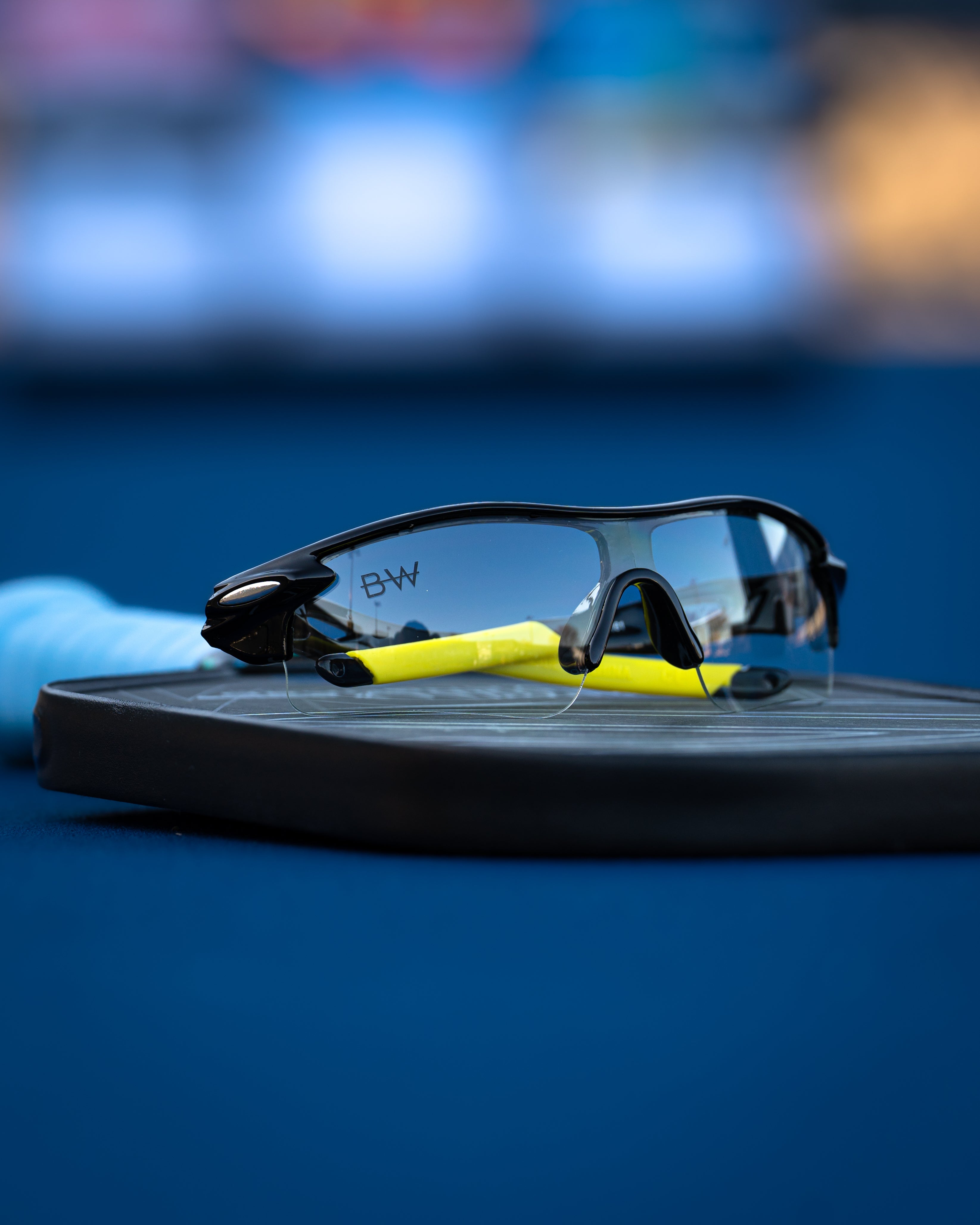
Product photography is useful for evaluating appearance, frame shape, and visible color. It cannot establish every technical specification.
A photograph alone cannot reliably prove:
- Exact VLT
- UV specifications
- Impact performance
- Polarization
- Anti-fog properties
- Scratch resistance
- Prescription accuracy
- Safety certification
Use written, verified specifications for technical comparisons.
How Should You Compare the Value of Prescription Pickleball Eyewear?
Price alone does not establish optical quality, durability, fit, or sports performance.
When comparing RX pickleball eyewear, consider the complete package:
- Prescription configuration
- Lens material
- Whether high-index carries an additional charge
- Frame design
- Fit and comfort
- Verified lens characteristics
- Impact-resistant options
- Return policy
- Replacement support
Blinded Wear includes high-index prescription lenses at no additional cost with RX eyewear, making that part of the value comparison straightforward.
Understand the Return Policy Before Ordering Custom RX Eyewear
Eligible standard Blinded Wear purchases are subject to the current 30-day return policy. Customized RX eyewear is final sale and excluded from the standard 30-day return policy.
Because prescription eyewear is customized, carefully review your prescription submission and selected product before completing the purchase.
Final-sale status is separate from applicable replacement support if eligible eyewear later breaks.
Blinded Wear 50% Lifetime Replacement Support
Blinded Wear offers 50% lifetime replacement support if eligible glasses break, subject to current policy terms.
For an eligible claim:
- The claim must meet the current policy requirements.
- The damaged eyewear must be returned.
- Once the applicable requirements are satisfied, the customer can receive 50% credit toward a replacement pair.
This is not a free full replacement.
For damaged RX eyewear, contact blindedwearco@gmail.com before returning the pair.
Review the Blinded Wear Protection Plan, Replacement & Returns information for current eligibility and policy details.
What Should You Not Assume the Replacement Policy Covers?
Do not automatically assume that replacement support applies to:
- Lost eyewear
- A prescription change
- Every cosmetic issue
- Every possible form of damage
- Lens-only replacement
- Frame-only replacement
- A free replacement
- An identical model if availability changes
Current policy terms determine eligibility.
Who Should Consider Prescription Pickleball Eyewear?
RX pickleball eyewear can be considered by recreational or competitive players who require eyeglass correction and want an eyewear configuration suitable for active court use.
That can include:
- Players who normally wear prescription glasses
- Players who prefer glasses rather than contacts for pickleball
- Players seeking a sports-oriented RX frame
- Players who participate in long practice sessions
- Players who travel for pickleball
- Players who want a dedicated RX pair for court use
No particular skill level is required to benefit from having the appropriate refractive correction.
Do Beginner Pickleball Players Need Prescription Sports Glasses?
A beginner who requires prescription correction can consider RX sports eyewear just as an experienced player can.
Prescription needs do not begin only after reaching a particular rating or tournament level.
At the same time, beginners do not need to buy every available lens technology. Start with the fundamentals: appropriate prescription correction, fit, comfort, and a lens configuration suitable for the environment where you actually play.
Prescription Eyewear for Competitive Pickleball Players
Competitive players can use the same basic selection framework while placing additional emphasis on equipment familiarity, extended comfort, travel, changing tournament conditions, and backup planning.
Competitive status does not create a universal requirement for:
- One particular tint
- Polarization
- Non-polarization
- Photochromic lenses
- A particular frame color
- A specific VLT
The appropriate configuration remains individual.
Do Professional Pickleball Players Prove Which RX Glasses Are Best?
No athlete's personal choice establishes a universal best prescription frame or lens configuration.
Professional and competitive athletes can have different prescriptions, face shapes, lighting preferences, sponsorship relationships, and equipment preferences.
Choose prescription eyewear according to your own needs rather than assuming professional adoption proves an automatic performance advantage.
Your Coach and Eye-Care Professional Have Different Jobs
A pickleball coach can help with:
- Technique
- Positioning
- Strategy
- Shot selection
- Movement
- Practice structure
An eye-care professional can address individual vision, prescription, and eye-health questions.
An eyewear seller can explain product configurations and ordering.
Keeping these roles separate helps prevent sports advice from being mistaken for prescription advice.
How to Compare Two Prescription Pickleball Glasses
| Feature | Pair A | Pair B |
|---|---|---|
| RX configuration | Verify | Verify |
| Frame dimensions and fit | Compare | Compare |
| Lens tint | Verify exact configuration | Verify exact configuration |
| VLT | Use verified value if available | Use verified value if available |
| Polarization | Verify | Verify |
| Photochromic technology | Verify | Verify |
| Impact resistance | Verify | Verify |
| Anti-fog feature | Verify | Verify |
| UV specification | Verify | Verify |
| High-index RX lenses | Check material/configuration and cost | Check material/configuration and cost |
| Return policy | Review | Review |
| Replacement support | Review | Review |
This framework is more useful than comparing products solely by appearance or marketing superlatives.
Verify Prescription Sports Eyewear Features Separately
Many eyewear characteristics are independent. One verified feature should not be used as proof of several others.
| If the Eyewear Has... | Do Not Automatically Assume... |
|---|---|
| High-index RX lenses | Impact resistance, polarization, UV specifications, or anti-fog |
| A dark tint | UV400 or polarization |
| Impact resistance | Shatterproof, scratchproof, crushproof, or safety-certified construction |
| Sports styling | Certified protective eyewear |
| Polarization | Improved depth perception or tracking |
| Non-polarized lenses | Improved reaction time or court awareness |
| Photochromic technology | Instant tint changes or polarization |
| Prescription correction | Improved athletic skill |
Prescription Sports Eyewear Claims to Evaluate Carefully
Be cautious when prescription sports eyewear is described with absolute promises such as:
- “Never slips”
- “Never fogs”
- “Shatterproof”
- “Scratchproof”
- “Perfect clarity”
- “Zero distortion”
- “Improves reaction time”
- “Tracks the ball faster”
- “Improves depth perception”
- “Eliminates eye fatigue”
- “Guarantees better performance”
Specific, verifiable product characteristics are more useful than absolute athletic-performance promises.
Where to Start Shopping for Blinded Wear RX Pickleball Eyewear
If you already know that you need prescription correction, start with the Blinded Wear Prescription Pickleball Eyewear Collection.
If you are still comparing lens configurations and playing environments, use the Pickleball Performance Lens Guide.
If you want help narrowing current shopping options, use the Pickleball Sunglasses Quiz.
For the broadest comparison across prescription and non-prescription options, visit the Best Pickleball Glasses 2026 Hub.
Prescription Pickleball Eyewear Is About the Complete Setup
The best way to evaluate prescription sport eyewear is to stop treating one feature as if it determines everything else.
Your prescription addresses refractive correction. Frame fit determines how the eyewear physically sits on you. Tint and VLT affect visible-light transmission. Polarization is a separate lens characteristic. High-index material can help manage prescription lens thickness. Impact resistance addresses a different physical property. Photochromic technology, when available, concerns changing tint behavior.
None of those characteristics alone guarantees better pickleball performance.
For the strongest buying decision, combine an appropriate eyeglass prescription with a comfortable frame, an appropriate lens configuration for your playing environment, verified product specifications, realistic durability expectations, and a clear understanding of the current return and replacement policies.
Blinded Wear players can continue exploring the RX Pickleball Eyewear Collection or compare the wider lineup through the 2026 Pickleball Glasses Hub.
Prescription Pickleball Eyewear FAQ
Prescription sports eyewear involves more than choosing a frame that looks athletic. The following questions address common concerns about RX pickleball glasses, lens materials, fit, lighting, care, and ordering.
What are prescription pickleball glasses?
Prescription pickleball glasses combine the wearer's applicable eyeglass correction with an eyewear configuration intended for active court use. The prescription addresses refractive correction, while frame fit, lens characteristics, comfort, and other product features should be evaluated separately.
Do I need special prescription glasses to play pickleball?
There is no universal requirement that every player who wears glasses must own a separate pickleball pair. However, players who require refractive correction may prefer dedicated sports-oriented RX eyewear because they can choose a frame and lens configuration specifically for active use.
Can prescription pickleball glasses make me a better player?
Prescription eyewear should not be promised to make someone a better pickleball player. Appropriate RX lenses correct the refractive error for which they were prescribed. Technique, positioning, strategy, experience, attention, movement, and decision-making remain separate parts of performance.
Do RX pickleball glasses improve reaction time?
No specific prescription frame or lens should be claimed to independently increase neurological reaction speed. Appropriate prescription correction can address refractive error, but reaction during pickleball involves visual information, attention, decision-making, and physical response.
Do prescription glasses improve ball tracking?
Appropriate prescription correction and ball tracking are related to different aspects of vision and performance. RX eyewear can provide prescribed refractive correction, but it should not be marketed as guaranteeing improved tracking of a moving pickleball.
Do RX sports glasses improve depth perception?
Prescription eyewear should not be presented as a universal method for improving depth perception. If you have persistent concerns involving depth perception, double vision, or another visual issue, consult an appropriate eye-care professional.
Can I use my regular eyeglass prescription for pickleball glasses?
Use the appropriate current eyeglass prescription provided for you. Do not arbitrarily increase or decrease prescription power because the eyewear will be used for pickleball.
Can I use my contact-lens prescription?
Do not assume a contact-lens prescription can be copied directly into an eyeglass order. Contacts and eyeglasses are different correction systems, and the prescription information can differ.
What if I cannot read part of my prescription?
Do not guess. If the prescription image or written information is unclear, obtain clarification from the appropriate source before ordering customized RX eyewear.
What if my vision has changed since my last prescription?
If you have experienced a meaningful change in vision or are uncertain whether your existing prescription remains appropriate, consult an eye-care professional rather than attempting to modify the prescription yourself.
What is PD?
PD means pupillary distance. It is used as part of positioning prescription lenses relative to the wearer. It is different from sphere, cylinder, axis, and other prescription information.
Can I just divide my binocular PD by two?
Do not assume that dividing a binocular PD exactly in half produces the correct monocular measurements for every person. Individual anatomy can differ between the two sides.
Does my PD change when my glasses slip?
No. Frame movement does not change your anatomical pupillary distance. It changes the position of the eyewear relative to your eyes.
What is high-index prescription material?
High-index refers to prescription lens materials with a higher refractive index than conventional lens materials. High-index materials are commonly considered as a way to help manage finished lens thickness, particularly as prescription strength increases.
Does Blinded Wear charge extra for high-index RX lenses?
Blinded Wear includes high-index prescription lenses at no additional cost with its RX eyewear.
Does high-index mean the lens is impact resistant?
No. Refractive index and impact resistance describe different characteristics. High-index material should not automatically be interpreted as impact resistant, shatterproof, safety certified, scratch resistant, or crushproof.
Does high-index automatically make glasses lighter?
No. High-index material can help manage thickness, but finished weight also depends on material density, lens volume, prescription, frame dimensions, and the complete eyewear configuration.
Does a thinner lens mean a stronger lens?
No. Finished thickness alone does not establish impact resistance, scratch resistance, crush resistance, or overall durability.
Can strong prescriptions be made into sports eyewear?
A stronger prescription does not automatically prevent the use of sports-oriented eyewear. Suitability can depend on the individual prescription, lens dimensions, frame configuration, positioning requirements, and other factors.
Are direct RX lenses better than prescription inserts?
There is no universal optical or athletic-performance winner. Direct RX and prescription-insert configurations provide different ways of incorporating refractive correction into sports eyewear. Compare the exact configuration, fit, prescription suitability, and intended use.
Are prescription pickleball glasses shatterproof?
Impact resistance should not be rewritten as “shatterproof.” Any lens can potentially be damaged when subjected to sufficient force.
Are sports glasses automatically safety glasses?
No. Sports styling or general impact resistance does not automatically establish compliance with a particular protective-eyewear standard. If certified protection is required, verify the exact applicable certification.
Do I need polarized prescription pickleball glasses?
Polarization is not a universal requirement for pickleball. Whether you prefer polarized or non-polarized eyewear depends on the exact lens, environment, and individual preference.
Does polarization hurt depth perception?
Polarization alone does not determine depth perception. Avoid universal claims that polarized lenses flatten the court or create visual delay.
Are non-polarized lenses better for ball tracking?
Non-polarized lenses should not automatically be credited with improving tracking, reaction time, or depth perception. Those are broader visual and athletic processes.
What is VLT?
Visible Light Transmission, or VLT, is the percentage of visible light transmitted through a lens. Higher VLT allows more visible light through, while lower VLT allows less.
What VLT is best for pickleball?
There is no single VLT percentage that is best for every player and every court. Lighting environment, lens configuration, and personal brightness preference all matter.
Does a darker lens provide more UV protection?
Not necessarily. Lens darkness and VLT do not independently establish UV specifications. Verify UV characteristics separately for the exact lens.
Are clear lenses exactly 100% VLT?
Do not assume that a lens described as clear transmits exactly 100% of visible light. Use a verified VLT specification when an exact value matters.
Are clear prescription glasses good for indoor pickleball?
Clear prescription eyewear can be considered by players who want refractive correction without a dark sunglass tint. Indoor facilities vary considerably, so no lens should be described as universally best for every indoor court.
What lens color is best for outdoor pickleball?
There is no universally best color. Evaluate the exact lens, visible-light transmission, playing environment, and your preferences rather than assuming one color automatically improves ball tracking or contrast.
Should I choose a lens based on pickleball color?
Ball color is only one part of the visual environment. The background behind the ball continually changes during play, so matching a lens to one ball color does not guarantee better tracking.
What are photochromic prescription pickleball glasses?
Photochromic lenses change tint according to the applicable technology and environmental conditions. They can provide one-pair convenience for some players when an appropriate configuration is available.
Do photochromic lenses change instantly?
Do not assume instantaneous activation or clearing. Response behavior depends on the specific photochromic technology and environmental conditions.
Do photochromic lenses become completely clear indoors?
That should not be universally assumed. The final transmission state depends on the exact technology and conditions.
Do photochromic lenses always get equally dark outside?
No universal outdoor darkness should be assumed. Activation can vary with the exact technology and environmental conditions.
Are photochromic lenses polarized?
Photochromic behavior and polarization are separate lens characteristics. Verify each independently.
Should I buy one RX pair or separate indoor and outdoor pairs?
Either approach can be reasonable. One pair may be sufficient for a player with consistent conditions, while another player may value separate configurations or a backup pair. The decision is primarily about environment, preference, convenience, and redundancy.
Do I need a backup prescription pair?
No, but a backup can be practical if you rely on prescription correction, particularly during tournaments or travel where replacing damaged eyewear immediately may be difficult.
Can RX pickleball glasses fog?
Yes, ordinary sports eyewear can experience condensation. Do not assume a pair is fog-proof unless a specific anti-fog characteristic is verified.
Does fog mean my prescription is wrong?
No. Fog is condensation on the viewing surface and does not change the prescription manufactured into the lens.
Can sweat change my prescription lenses?
Sweat does not rewrite your prescription. It can leave residue on the eyewear and may influence how a frame feels or fits during activity.
Can sunscreen make prescription lenses look blurry?
Residue on the lens surface can create haze or interfere with a clean viewing surface. Clean the eyewear appropriately before assuming that a prescription problem is responsible.
Does a scratch change my prescription?
No. A scratch is physical surface damage. It does not change the prescription values manufactured into the lens.
Can I polish scratches out with toothpaste?
Avoid abrasive DIY remedies such as toothpaste, baking soda, or automotive polish. Cleaning can remove contamination, but it cannot restore lens material that has physically been scratched away.
Can prescription pickleball glasses get wet?
Sports eyewear may encounter rain and perspiration, but do not infer waterproof, hydrophobic, sealed, or moisture-proof construction unless those characteristics are specifically verified.
Does rain change my prescription?
No. Rainwater on the viewing surface does not change prescription power or PD.
What if my glasses are hit by a pickleball?
Inspect the eyewear after a meaningful impact. Look for cracks, chips, lens displacement, frame deformation, hinge problems, or a sudden change in fit.
What if my frame suddenly feels crooked?
If the change occurred after a drop, impact, or compression event, inspect the physical frame and lens seating. A changed wearing position does not mean your written prescription changed.
Should I bend a sports frame back into shape myself?
Avoid aggressive DIY bending, heating, or reshaping when you do not know the appropriate adjustment procedure for the exact product. Professional evaluation may be appropriate when adjustment is needed.
Why can two frames with the same RX feel different?
Frame dimensions, lens dimensions, wrap, vertex distance, positioning, weight, and fit can differ even when the written prescription is identical.
How long should it take to adapt to new RX sports glasses?
There is no universal adaptation period that applies to every wearer, prescription, and frame. If unexpected visual symptoms are meaningful or persistent, seek appropriate professional evaluation rather than relying on a generic timeline.
Should I practice in new RX glasses before a tournament?
When practical, yes. Ordinary practice provides an opportunity to evaluate comfort, active fit, lens preference, and how the complete eyewear configuration works in your normal playing environment.
What if I have persistent blur or double vision?
Persistent or meaningful unexpected blur, new double vision, or other concerning visual changes deserve appropriate professional evaluation. Do not diagnose the cause solely from sports performance.
RX Pickleball Eyewear Troubleshooting Guide
| Problem | Check First | What Not to Assume |
|---|---|---|
| Everything looks too bright | Lens configuration, tint, VLT, and actual environment | That your prescription is wrong |
| Everything looks too dark | Tint, VLT, and current lighting | That darker is always better outdoors |
| Lens looks hazy | Fog, fingerprints, sweat, sunscreen, or residue | That the RX changed |
| Frame keeps sliding | Fit and wearing position | That PD changed |
| Frame hurts | Pressure points and overall fit | That sports glasses must be extremely tight |
| Visible line or mark | Determine whether it is residue, a scratch, chip, or crack | That every mark can be polished away |
| Problem began after impact | Frame shape, lens seating, cracks, chips, and hinges | That nothing changed because the lens did not break completely |
| Persistent unexpected blur | Appropriate optical or eye-care evaluation | That a tint or frame style will necessarily solve it |
| Persistent double vision | Appropriate professional evaluation | That it is simply a normal sports-eyewear issue |
Before Ordering Prescription Pickleball Glasses
Use this checklist before submitting a customized RX order:
- Use the appropriate eyeglass prescription. Do not substitute contact-lens information.
- Make sure the prescription image is readable. Do not guess unclear values.
- Review OD and OS carefully. Right- and left-eye information should not be accidentally reversed.
- Check plus and minus signs. Their meaning is not interchangeable.
- Review SPH, CYL, and AXIS exactly as provided.
- Include other prescribed information when applicable.
- Consider your normal playing environment. Indoor, outdoor, shade, and changing light can influence lens preferences.
- Review the exact product specifications. Do not infer technical features from appearance.
- Review the RX return policy. Customized RX eyewear is final sale.
What to Do When Your New RX Pickleball Glasses Arrive
Before taking a new pair directly into an important match, inspect and familiarize yourself with the eyewear.
- Inspect the frame for obvious physical problems.
- Inspect the lenses for visible damage.
- Put the eyewear on normally.
- Evaluate general comfort.
- Notice whether the frame requires repeated repositioning.
- Use the eyewear in an ordinary environment.
- Try it during a normal practice session when practical.
- Evaluate how the selected lens configuration works in your typical lighting.
A home inspection cannot verify every optical measurement, but it can identify obvious physical or fit concerns before competition.
Do Not Diagnose Prescription Problems From a Missed Shot
A missed pickleball shot can result from many factors, including:
- Timing
- Footwork
- Positioning
- Shot selection
- Opponent pace
- Spin
- Technique
- Attention
- Physical execution
One missed ball does not demonstrate that an eyeglass prescription, lens material, tint, or optical positioning is incorrect.
If a visual concern is consistent and persists away from an isolated sports mistake, evaluate it on its own merits.
What Prescription Pickleball Eyewear Can and Cannot Promise
| Reasonable Description | Claim to Avoid Without Evidence |
|---|---|
| Provides applicable prescription correction | Makes reactions faster |
| Designed for pickleball players | Guarantees better pickleball performance |
| Lightweight sports frames | Never moves during play |
| Built around comfort for active use | Eliminates fatigue |
| Impact-resistant lens options | Shatterproof or indestructible |
| High-index RX lenses included at no additional cost | High-index automatically means stronger or safer |
| Non-polarized lens options | Non-polarized lenses improve depth perception |
| Different eyewear configurations for different preferences | One lens works perfectly in every environment |
Common Mistakes When Shopping for Prescription Pickleball Eyewear
Choosing solely by appearance
Frame style matters, but prescription compatibility, fit, comfort, and verified lens characteristics deserve equal attention.
Assuming every sports frame has the same protection
Sports styling does not establish an impact rating or safety certification.
Assuming dark lenses provide maximum UV protection
Darkness and UV specifications are different characteristics.
Assuming polarized automatically means better
Polarization is one lens characteristic, not a universal performance ranking.
Assuming high-index means indestructible
Refractive index is not a durability score.
Guessing prescription information
Do not round, modify, or invent prescription values to complete an order.
Ignoring frame fit
A technically impressive lens configuration does not solve a frame that is fundamentally uncomfortable for the wearer.
Buying immediately before an important event
When practical, allow yourself an opportunity to inspect and use new eyewear during ordinary practice before relying on it as your only tournament pair.
Which Prescription Pickleball Eyewear Setup Fits Your Situation?
| Your Situation | What to Prioritize |
|---|---|
| Mostly indoor player | Appropriate RX correction, comfortable fit, and a suitable non-dark lens configuration |
| Mostly bright outdoor player | Appropriate RX correction plus a tint and VLT suitable for your brightness preference |
| Frequently plays in shade | Consider whether your chosen fixed tint remains comfortable in lower ambient light |
| Conditions change during sessions | Compare fixed tint, multiple pairs, and available photochromic configurations |
| Strong or complex prescription | Prescription suitability, frame/lens dimensions, positioning, and professional guidance when needed |
| Long tournament days | Comfort, fit, environmental versatility, care, and backup planning |
| Frequent traveler | Protective storage, accessibility, inspection, and a backup RX option when practical |
| Concerned about impacts | Verify actual impact characteristics rather than relying on sports appearance |
Technical Features to Verify Before You Buy
Use the product page or other verified product information to confirm features individually.
- Prescription configuration: How is the applicable RX incorporated?
- Lens material: What material or category is actually specified?
- High-index: Is it included, and what does it mean for the configuration?
- Tint: What exact lens configuration are you ordering?
- VLT: Is an exact visible-light transmission value provided?
- Polarization: Is the exact lens polarized or non-polarized?
- Photochromic: Is this technology actually available for the exact configuration?
- Impact resistance: What does the product specifically state?
- Safety certification: Is an applicable standard actually identified?
- UV specifications: What is specifically verified?
- Anti-fog: Is a treatment or feature specifically stated?
- Scratch resistance: Is a specific characteristic stated?
- Fit: Does the frame work comfortably for you during movement?
If a specification is not provided, do not manufacture one from assumptions about sports eyewear.
Why Consider Blinded Wear Prescription Pickleball Eyewear?
Blinded Wear is focused on performance eyewear for pickleball players, including prescription options for players who need refractive correction on the court.
Key reasons to explore the RX collection include:
- Pickleball-focused sports eyewear
- Lightweight sports-frame options
- Impact-resistant lens options
- Non-polarized lens options
- Designs built around comfort for active use
- High-index prescription lenses included at no additional cost
- Options for recreational and competitive pickleball players
- 50% lifetime replacement support for eligible broken eyewear, subject to current policy terms
The exact characteristics of individual products can differ. Always review the current product page before purchasing.
Explore Current Blinded Wear RX Pickleball Styles
Players can begin with the complete Prescription Pickleball Eyewear Collection or explore individual current styles including:
- Rippled X RX
- Zebra II RX
- Steel Ice RX
- Blue Shield RX
- Frost RX
- Gray Wash RX
- Crystal Wave II RX
- Lava Rock RX
- Havana Melt RX
Use each product page to confirm the exact configuration rather than assuming all RX styles share identical lens characteristics.
How to Order Blinded Wear RX Pickleball Glasses
For applicable Blinded Wear prescription eyewear, customers upload a clear photo or image of their eyeglass prescription on the product page before adding the eyewear to the cart and purchasing.
- Visit the RX Pickleball Eyewear Collection.
- Select the eyewear you want to consider.
- Review the exact product and lens configuration.
- Prepare a clear image of your eyeglass prescription.
- Upload the prescription through the product page before adding the eyewear to your cart.
- Review your submission carefully before purchasing.
For additional details, read How to Order RX Glasses.
RX Returns and Lifetime Replacement Support
Understanding the policy is especially important before purchasing customized prescription eyewear.
Eligible standard Blinded Wear purchases are covered by the current 30-day return policy. Customized RX eyewear is final sale and is excluded from the standard 30-day return policy.
That final-sale status does not eliminate applicable replacement support for eligible broken prescription eyewear.
Blinded Wear offers 50% lifetime replacement support if eligible glasses break, subject to current policy terms. The damaged eyewear must be returned as part of an eligible claim. Once the applicable claim and return requirements are satisfied, the customer can receive 50% credit toward a replacement pair.
This is not a free full replacement.
For damaged prescription eyewear, contact blindedwearco@gmail.com before returning the pair.
Eligibility should not automatically be assumed for lost eyewear, prescription changes, cosmetic issues, or every possible type of damage. Review the Blinded Wear Protection Plan, Replacement & Returns information for current terms.
More Pickleball Eyewear Resources
Continue your research with these Blinded Wear resources:
- Prescription Pickleball Eyewear — browse current RX options.
- Non-RX Pickleball Sunglasses — compare non-prescription sports eyewear.
- Clear Lens Eyewear — explore non-dark lens options.
- Pickleball Performance Lens Guide — learn how lens characteristics differ.
- Pickleball Sunglasses Quiz — narrow your shopping options according to your preferences.
- Best Pickleball Glasses 2026 Hub — compare RX and non-RX eyewear resources.
Final Verdict: Choosing Prescription Sport Eyewear for Pickleball
The best prescription pickleball eyewear decision starts with the fundamentals rather than exaggerated performance claims.
First, use the appropriate eyeglass prescription. Prescription correction addresses refractive error; it should not be altered simply because the eyewear will be used for sports.
Second, prioritize fit and comfort. Pickleball involves repeated movement, and a frame that works for one player may not fit another player the same way.
Third, match the lens configuration to your actual environment. Indoor courts, bright outdoor courts, shade, overcast conditions, and changing evening light can create different preferences for clear lenses, fixed tints, or available photochromic configurations.
Fourth, verify technical characteristics individually. High-index does not automatically mean impact resistant. Dark tint does not prove UV protection. Polarization does not determine depth perception. Impact resistance does not mean shatterproof. Sports styling does not establish safety certification.
Finally, keep athletic expectations realistic. Prescription eyewear can provide the refractive correction it was prescribed to provide. It cannot guarantee faster reactions, improved ball tracking, better depth perception, perfect line calls, or better pickleball performance.
For players who require vision correction, the goal is simpler and more useful: combine the appropriate prescription with comfortable, sports-oriented eyewear that fits your needs and your playing environment.
Blinded Wear offers prescription pickleball eyewear with high-index RX lenses included at no additional cost, along with multiple sports-frame options for players looking for dedicated court eyewear.
Shop Blinded Wear Prescription Pickleball Eyewear or visit the 2026 Pickleball Glasses Hub to continue comparing your options.