
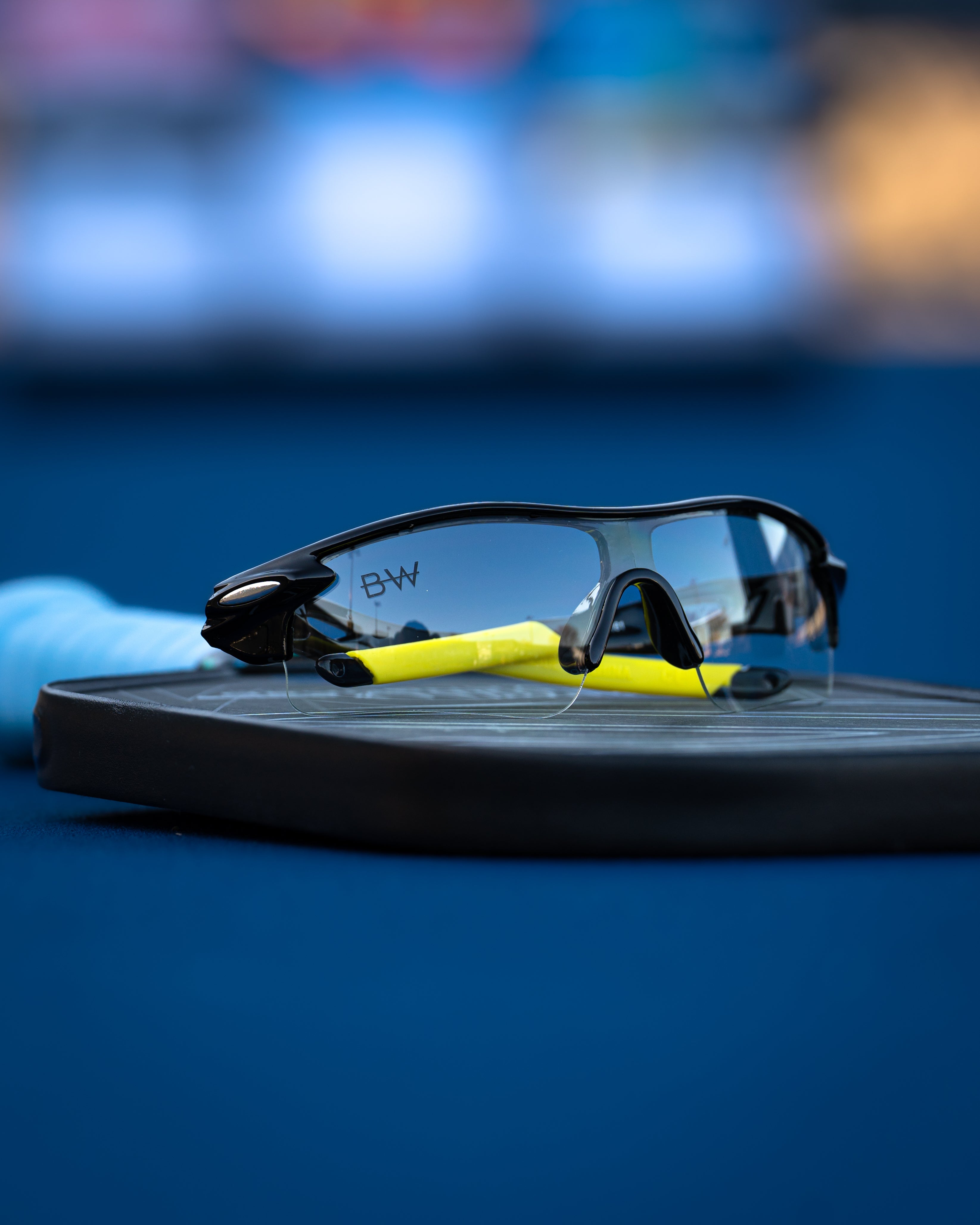
Progressive RX Sports Glasses: See Every Play, Every Distance
Share
Progressive RX Sports Glasses: See Every Play, Every Distance
Pickleball can demand attention at several distances during the same session. One moment you may be looking across the court, and the next you may be checking a phone, reading a tournament bracket, viewing a scoreboard, or handling another close-range task between games.
For players who already wear a multifocal prescription, that raises an important question: can progressive RX sports glasses fit into a pickleball routine, or is another prescription setup better for the way you play?
Progressive lenses are designed with multiple prescription zones within the same lens rather than the visible segment line associated with traditional bifocals. That can make them useful for people whose prescriptions require correction at more than one viewing distance. But sports add another consideration: you move your head and eyes quickly, and different areas of a progressive lens serve different viewing distances.
That is why choosing progressive prescription sports eyewear should start with your actual prescription and how you use it—not with promises that progressives automatically improve depth perception, reaction time, ball tracking, or athletic performance.
Start Your Progressive RX Sports Eyewear Search
What Are Progressive RX Sports Glasses?
Progressive prescription lenses are multifocal lenses designed to provide different prescription powers across different areas of the lens without the distinct visible line found in traditional bifocals.
In everyday life, that can help someone who requires correction at multiple viewing distances use one prescription pair for more of their routine.
In a sports setting, however, the question becomes more specific:
Does your multifocal prescription setup work appropriately for the distances, movements, and viewing habits involved in your sport?
For pickleball players, that can involve several visual tasks:
- Looking across the court
- Watching your opponent's position
- Viewing the ball at different court distances
- Checking the score
- Reading a phone between games
- Viewing tournament brackets
- Reading messages or schedules
- Handling other close-range tasks away from active play
Progressive lenses can address multiple prescription distances within one pair, but that should not be confused with automatically making those athletic tasks easier.
Progressive RX vs. Single-Vision RX Sports Glasses
The first major decision is whether you actually need multiple prescription zones during your sports routine.
| Feature | Single-Vision RX | Progressive RX |
|---|---|---|
| Prescription Design | One primary prescription power | Multiple prescription powers across different areas of the lens |
| Near + Distance Correction in One Pair | Not the primary purpose | Core reason progressives are prescribed |
| Visible Bifocal Line | No | No traditional bifocal segment line |
| Different Lens Zones | Not in the progressive-lens sense | Yes |
| Sports Consideration | Simpler prescription field when single-vision correction meets your needs | Requires consideration of how you use different areas of the lens during movement |
| Best Starting Question | “Do I need one primary correction for this activity?” | “Do I need multiple viewing distances available in the same sports pair?” |
Neither design is automatically superior for pickleball. Your prescription needs and how you use the eyewear should drive the decision.
How Do Progressive Lenses Handle Near, Intermediate, and Distance Vision?
A progressive lens distributes different prescription powers through different portions of the lens.
The exact design depends on the prescription and lens configuration, but the general concept includes:
Distance Viewing
The distance portion of a progressive prescription is intended for farther viewing tasks.
Intermediate Viewing
The intermediate area supports distances between far and close viewing.
Near Viewing
The near portion supports close-range tasks when near correction is part of the prescription.
The transition between these areas is what separates a progressive lens from a traditional lined bifocal.
For sports, the important takeaway is not that progressives give you “perfect vision at every distance.” It is that different areas of the lens serve different prescription needs, which can affect how a wearer uses the glasses during movement.
Can You Play Pickleball in Progressive Lenses?
Some people who wear progressive prescriptions may use progressive eyewear during sports, but the experience is highly dependent on the individual prescription, lens design, frame, and the wearer's familiarity with progressive lenses.
Pickleball also differs from many everyday visual tasks because you are not sitting still while looking between predictable objects.
You may be:
- Moving forward toward the kitchen line
- Backing away from the net
- Turning your head
- Looking across the court
- Tracking action at changing distances
- Looking downward
- Checking something close-up between points
Because progressive lenses contain multiple prescription zones, players should not assume they will feel identical to single-vision lenses during every movement.
Why Can Progressive Lenses Feel Different During Sports?
Progressive lenses are designed around multiple prescription zones. That makes them useful for multifocal correction, but it also means the wearer may need to use particular portions of the lens for different viewing distances.
During everyday activities, an experienced progressive wearer may already be familiar with this.
During pickleball, movements can happen much faster.
This is why claims such as these should be avoided:
- “Progressives improve depth perception.”
- “Progressives eliminate distortion during sports.”
- “Progressives make distance changes instant.”
- “Progressives improve reaction time.”
- “Progressives make the ball easier to track.”
- “Progressives improve spin recognition.”
A better approach is to determine whether your multifocal prescription needs justify having progressive correction available in the sports frame you plan to use.
Who Should Consider Progressive RX Sports Glasses?
Progressive RX sports eyewear may deserve consideration when you already require multifocal correction and want to explore using that prescription structure in a sports-oriented frame.
The use case may be stronger if:
- You already wear progressive lenses regularly
- Your prescription includes different near and distance needs
- You want to avoid repeatedly switching between prescription glasses and readers
- You use your sports eyewear for more than active points
- You need to read your phone, tournament information, or other close-range material between games
- You want one prescription pair to cover a broader portion of your tournament day
The decision should still be based on the exact prescription and current lens options available for the frame you are considering.
Who May Prefer Single-Vision RX for Pickleball?
Progressives are not automatically the best sports prescription just because someone uses them during everyday life.
A player may want to compare single-vision sports RX when:
- The primary requirement during active play is distance correction
- Near correction is not important during points
- The player prefers a simpler prescription field for sports
- The player already uses a separate solution for close-range tasks
- Their eye-care professional recommends a different sports-specific prescription strategy
This creates an important distinction between everyday prescription needs and sports-specific prescription needs.
They may overlap, but they do not have to be identical.
What Viewing Distances Matter in Pickleball?
Pickleball involves a constantly changing playing environment rather than one fixed viewing distance.
| Situation | General Viewing Task |
|---|---|
| Opponent Across the Court | Farther viewing |
| Action Near the Kitchen | Changing court distances |
| Partner Positioning | Changing court distances |
| Scoreboard | Depends on the venue and scoreboard location |
| Phone Between Games | Near viewing |
| Tournament Bracket | Near or intermediate viewing depending on format |
| Digital Match Review | Near or intermediate viewing depending on the device |
Progressive correction may help meet different prescription requirements across these tasks, but it should not be described as automatically enhancing the athletic processing of those distances.
Do Progressive RX Glasses Make It Easier to See From Baseline to Kitchen?
Progressive lenses should not be marketed as automatically improving a player's ability to judge the baseline, kitchen line, ball depth, or opponent positioning.
What they can do is provide the multiple prescription powers prescribed for the wearer within one lens.
That distinction matters.
Correcting the wearer's prescription and improving an athletic skill are not the same claim.
Depth judgment, anticipation, positioning, reaction time, and ball tracking involve more than whether a pair of glasses contains progressive prescription zones.
Where Progressives Can Be Practical: Court to Scoreboard to Phone
The strongest argument for progressive sports eyewear may happen between points rather than during a highlight-reel rally.
Imagine a tournament player who needs different prescription correction for distance and close-range viewing.
During one hour, that player may:
- Play a match
- Look across the facility for the next court assignment
- Check a tournament bracket
- Read a text from a doubles partner
- Look at a watch or phone
- Return to the court
A progressive prescription can potentially allow the wearer to access the different correction zones prescribed for those tasks without immediately reaching for another pair of glasses.
That is a practical convenience argument—not a promise of better pickleball performance.
Why Tournament Players May Compare Progressive RX Glasses
Tournament days can involve much more than active court time.
You may spend hours alternating between:
- Playing
- Waiting
- Watching other matches
- Reading court assignments
- Checking your phone
- Viewing brackets
- Talking with partners
- Reviewing schedules
- Traveling between facilities
For a player who already requires multifocal correction, the ability to keep one prescription structure available through more of that day may be worth comparing with a dedicated single-vision sports setup.
Progressive RX vs. Bifocals vs. Readers for Pickleball
Players who require near and distance correction may have several ways to manage those needs.
| Approach | General Structure | Sports Question to Ask |
|---|---|---|
| Progressive RX | Multiple prescription powers without a traditional visible bifocal line | Do I want multifocal correction available in the same sports pair? |
| Bifocal | Distinct prescription areas, traditionally separated by a visible segment | Does this prescription design fit my sports needs? |
| Single-Vision RX + Readers | Sports pair handles one primary correction; separate readers handle near tasks | Am I comfortable changing eyewear when I need near correction? |
| Single-Vision Sports RX | One primary prescription power | Is one correction sufficient for my active court use? |
The goal is not to eliminate eyewear changes at any cost. The goal is to find a prescription system that makes sense for how you actually use your vision throughout a match, practice, or tournament.
Do Progressive Sports Glasses Take Time to Get Used To?
Someone who is new to progressive lenses may experience them differently from someone who has worn progressives every day for years.
That matters when introducing any new prescription eyewear into a fast-moving sport.
If you receive a new pair of progressive sports glasses, an important tournament does not need to become your first meaningful experience wearing them.
A more practical approach is to become familiar with the prescription during lower-pressure situations before relying on it during competition.
A Practical Way to Test New Progressive RX Sports Glasses
Step 1: Start With Normal Daily Use
Become familiar with how the prescription works for your everyday viewing needs.
Step 2: Try a Low-Pressure Court Session
Use the glasses during warmup or recreational practice rather than introducing them for the first time during an important match.
Step 3: Use Them During Normal Movement
Pay attention to whether the prescription setup works appropriately for the way you naturally move your head and eyes.
Step 4: Include Between-Game Tasks
If near and intermediate correction are part of why you want progressives, test the actual tasks you expect to perform between games.
Step 5: Decide Their Role
Determine whether the pair makes sense as your primary sports RX, a tournament-day crossover pair, or another part of your prescription eyewear system.
New to Progressives? Don't Make Tournament Day Your Experiment
There are two changes that can happen at the same time when you buy new progressive sports glasses:
- You may be wearing a new frame
- You may be using a new prescription or multifocal lens design
If you are unfamiliar with either, introducing both during a competitive match creates unnecessary uncertainty.
Use normal training to determine whether the setup works for you before making it your tournament pair.
Already Wear Progressives Every Day? Your Starting Point Is Different
An experienced progressive wearer already knows how multifocal correction feels during everyday activities.
That does not automatically mean every progressive sports configuration will feel identical, but it gives you a more useful reference point.
When comparing a sports pair, ask:
- How does the new frame compare with glasses I already wear?
- How will I use the prescription during active play?
- Do I actually need near correction while wearing my sports frame?
- Will I keep the glasses on between games?
- Do I want one pair for the entire tournament day?
Why Frame Fit Matters for Progressive Sports Eyewear
Frame fit is important for any prescription eyewear, and it deserves particular attention when you are considering a multifocal prescription setup.
Do not assume a Blinded Wear frame includes unverified features such as adjustable nose pads, special non-slip technology, reinforced hinges, or another fit system unless the current product information specifically confirms it.
Instead, when dimensions are available, compare the sports frame with eyewear that already fits you well.
Useful measurements can include:
- Overall frame width
- Lens width
- Lens height
- Bridge measurement
- Temple length
Use the measurements currently available for the exact frame rather than assuming dimensions that are not listed.
Progressive RX for Indoor vs. Outdoor Pickleball
Progressive describes the prescription structure. Indoor versus outdoor use is a separate lens-selection question.
That means you should avoid assuming that “progressive” automatically means:
- Clear
- Dark tinted
- Transition
- Blue-light-focused
- Anti-reflective
- Anti-fog
- Glare reducing
- Contrast enhancing
Those characteristics need to be evaluated separately according to the current product and lens configuration.
Progressive RX + Indoor Pickleball: What About Clear Lenses?
For an indoor player, avoiding a dark sunglass tint may be an important part of the lens decision.
A clear lens means there is no dark sunglass tint.
That makes clear-lens options relevant for indoor, evening, and lower-light environments where a dark tint may not be preferred.
Clear lenses should not automatically be described as increasing available light, enhancing contrast, improving reaction time, or making the ball easier to track.
Can Progressive and Transition RX Solve the Same Problem?
They address different parts of an eyewear setup.
Progressive refers to having multiple prescription powers within the lens.
Transition refers to a lens approach intended for changing light environments.
For a player whose prescription requires multifocal correction and whose routine also moves through changing environments, both concepts may be relevant—but availability should be confirmed for the exact product and prescription rather than assumed.
If changing light is one of your biggest challenges, read Transition RX Lenses for Travel & Training →.
Progressive RX Sports Glasses: Performance Claims to Be Careful With
Correct prescription eyewear can be important to the person who needs it. That does not mean every benefit associated with sports vision can automatically be attributed to progressive lenses.
| Claim | Better Interpretation |
|---|---|
| “Progressives improve reaction time.” | Progressives provide the prescribed multifocal correction; faster athletic reactions should not be assumed. |
| “Progressives improve depth perception.” | Do not promise an automatic improvement in depth perception from the progressive design itself. |
| “Progressives eliminate distortion.” | Do not make universal distortion-free claims. |
| “Progressives improve ball tracking.” | Do not automatically attribute better ball tracking to progressive lenses. |
| “Progressives make focus shifts instant.” | The lens contains multiple prescription zones; do not turn that structure into a guaranteed athletic response claim. |
| “Progressives prevent eye fatigue.” | Do not promise universal prevention of visual fatigue or eye strain. |
High-Index Prescription Lenses at No Additional Cost
Blinded Wear includes high-index prescription lenses at no additional cost with RX eyewear.
This is relevant when comparing the total value of prescription sports glasses because the purchase includes both the sports frame and prescription lenses.
A specific numerical index such as 1.61 should not be assumed unless that exact lens specification is currently verified for the order.
Impact-Resistant Lenses for Active Sports Use
Blinded Wear sports eyewear uses impact-resistant lenses.
That is a useful characteristic for active sports eyewear, but impact-resistant should not be turned into stronger claims that have not been established.
Impact-resistant does not automatically mean:
- Shatterproof
- Unbreakable
- Indestructible
- Guaranteed against every impact
- Certified to a specific protective standard unless that certification is verified
If eyewear experiences an impact or appears damaged, inspect it before continuing normal use.
Are Blinded Wear RX Sports Lenses Polarized?
Blinded Wear sports eyewear uses non-polarized lenses.
Non-polarized lenses do not add a polarization filter and preserve the visual information available without that filter. Some court players prefer non-polarized eyewear.
This should not be expanded into claims that non-polarized lenses automatically improve depth perception, reaction time, ball tracking, or spin recognition.
What Blinded Wear RX Sports Eyewear Does Include
When comparing Blinded Wear prescription sports eyewear, focus on verified characteristics rather than unsupported technical claims.
- Designed for pickleball players
- Lightweight sports frames
- Impact-resistant lenses
- Non-polarized lenses
- Designed for comfort during extended matches
- Suitable for recreational and competitive players
- Performance-first sports design
- High-index prescription lenses included at no additional cost
- 50% lifetime replacement support if glasses break, subject to current policy terms
Specific progressive availability, lens combinations, coatings, tints, prescription ranges, and other options should be confirmed for the exact RX product rather than assumed across every model.
Blinded Wear RX Frames to Compare
Once you understand the prescription structure you need, you can compare current Blinded Wear RX frames based on their available configurations, dimensions, and design.
Do not assume that every RX model supports progressive prescriptions or every possible lens configuration. Confirm the options currently available for the specific frame and prescription you are considering.
How to Start an RX Sports Glasses Order
-
Start with your prescription.
Know whether your current prescription requires single-vision or multifocal correction.
-
Identify your sports environment.
Consider whether you primarily play indoors, outdoors, at night, or across multiple environments.
-
Choose an RX frame.
Compare current frame information and available dimensions with eyewear that already fits you.
-
Confirm the lens configuration you need is currently available.
Do not assume progressive or specialized lens options are offered on every RX product.
-
Prepare your prescription.
Blinded Wear RX customers upload a clear photo or picture of their eyeglass prescription before purchasing.
-
Review the final configuration.
Make sure the frame and prescription option match the role you intend the glasses to perform.
Should You Consider Progressive RX for Pickleball? 10-Question Check
Use these questions to organize your decision:
- □ I currently wear a multifocal prescription
- □ I already use progressive lenses in everyday life
- □ I need correction at more than one viewing distance
- □ I want to keep the same RX pair on between games
- □ I regularly need to read my phone, bracket, or other close-range information during sessions
- □ I understand progressive lenses contain different prescription zones
- □ I am willing to test new RX sports eyewear before an important competition
- □ I have considered whether single-vision sports RX could meet my active-play needs
- □ I will confirm progressive availability for the exact frame I want
- □ I have another suitable corrective option available if needed
If many of these statements describe your situation, progressive sports RX may deserve a closer comparison with single-vision sports eyewear.
If your main need during pickleball is one primary viewing distance and you do not need near correction while wearing your sports frame, single-vision RX may also deserve serious consideration.
Think Beyond “Progressive or Not”
The progressive decision is only one layer of a complete prescription sports eyewear setup.
You still need to consider indoor versus outdoor use, frame fit, whether your normal prescription should match your sports prescription, how familiar you are with multifocal lenses, whether you need a backup pair, and how the eyewear fits into a full tournament day.
Once those questions are mapped out, it becomes much easier to decide what role progressive RX sports glasses should actually play in your pickleball routine.
Should Your Sports Prescription Be the Same as Your Everyday Prescription?
Your everyday glasses and your sports glasses may be used in very different situations.
Everyday prescription eyewear might need to support:
- Computer work
- Reading
- Driving
- Phone use
- Shopping
- Work or school
- General daily activities
Your pickleball eyewear may spend most of its active time serving court-distance viewing while you are moving.
That does not mean you should independently modify your prescription for sports. Instead, it means the intended use of the eyewear is useful information when discussing prescription sports glasses and multifocal needs with your eye-care professional.
If you already wear progressives every day, ask whether maintaining progressive correction in your sports pair makes sense for your individual prescription and how you intend to use the glasses.
Separate Active-Play Vision From Between-Game Vision
One of the most useful ways to evaluate progressive RX sports glasses is to divide a pickleball session into two different visual environments.
During Active Play
Your attention is primarily directed toward the court, ball, partner, opponents, and surrounding playing environment.
Between Games
Your visual tasks may change dramatically. You might:
- Read your phone
- Check a text
- View the tournament bracket
- Read a court assignment
- Check a watch
- Review recorded points
- Look at a nearby schedule
If near and intermediate correction become important between games, that creates a stronger practical reason to compare progressive sports eyewear with a single-vision sports pair.
If you only care about the prescription during active play and are comfortable using another solution for close-range tasks, single-vision RX may remain worth comparing.
Can One Progressive RX Pair Cover an Entire Tournament Day?
For some progressive wearers, this may be one of the most appealing reasons to explore progressive sports eyewear.
A tournament can involve many different viewing tasks:
| Tournament Activity | General Viewing Need |
|---|---|
| Travel to Venue | Normal prescription needs |
| Check-In | Near and intermediate tasks may be involved |
| Court Assignment | Distance depends on how information is displayed |
| Warmup | Sports-oriented viewing |
| Match | Active court viewing |
| Phone Between Games | Near viewing |
| Tournament Bracket | Near or intermediate viewing |
| Watching Other Matches | Farther viewing |
| Post-Match Video Review | Near or intermediate viewing depending on the device |
If your prescription requires different correction across those distances, a progressive configuration may allow one pair to serve more of the day.
The practical advantage is multifocal prescription availability in one pair, not a guarantee that progressive lenses improve athletic performance.
The Progressive RX Minimalist: One Primary Pair + One Backup
Some players prefer to carry as little eyewear as possible.
A minimalist prescription setup could consist of:
- Primary: A progressive sports RX pair when multifocal correction is appropriate for the wearer
- Backup: Another suitable corrective pair in case the primary becomes unavailable
This approach can be particularly appealing during travel and tournaments because the primary pair may cover more viewing distances throughout the day.
However, reducing the number of pairs should not become more important than selecting the prescription structure that works appropriately for you.
The Hybrid Strategy: Single-Vision Sports RX + Everyday Progressives
There is another way to organize multifocal prescription needs without using progressive lenses during active sports.
A player might use:
- Everyday progressives for normal multifocal prescription needs
- Single-vision sports RX for active pickleball
- A suitable corrective backup when needed
This can make sense for someone who wants their sports pair to serve a narrower prescription role while continuing to use progressives away from active play.
The tradeoff is simple: you may need to switch eyewear when your visual task changes.
For some players that is inconvenient. For others, it is completely acceptable.
Progressive RX vs. Single-Vision RX: Compare the Full System
| Question | Progressive Sports RX | Single-Vision Sports RX |
|---|---|---|
| Need Multiple Prescription Powers? | Designed around multifocal correction | Designed around one primary prescription power |
| Want Near Correction in Same Pair? | Potential reason to consider progressives | May require another solution for near tasks |
| Already Wear Progressives Daily? | Familiar prescription structure may make comparison especially relevant | Still worth comparing if your active-play needs differ from everyday use |
| Want Simplest Sports Prescription Structure? | Contains multiple prescription zones | Single-vision structure may be simpler when it meets your needs |
| Want One Pair Through More of Tournament Day? | Potential practical advantage | May require changing eyewear for other prescription needs |
| Automatic Performance Advantage? | No | No |
Why Head and Eye Movement Matter With Progressive Sports Glasses
Progressive lenses contain different prescription powers across different areas of the lens. That means the part of the lens you look through can matter.
During everyday activities, experienced progressive wearers may already be accustomed to coordinating their viewing habits with the lens design.
Pickleball adds faster movement.
You may quickly:
- Look across the net
- Turn toward your partner
- Move toward the kitchen
- Back away from the line
- Look downward
- Rotate toward another part of the court
This is why testing progressive sports eyewear during actual practice is more useful than assuming that a lens which works well during stationary everyday activities will feel exactly the same during a moving sport.
What About Looking Down Through Progressive Lenses?
Looking downward is particularly relevant to sports because the lower portion of a progressive lens can contain prescription power intended for closer viewing.
Exactly how a wearer experiences a progressive lens depends on the prescription and lens design, so this should not be reduced to a universal claim that progressives either help or hurt every athlete.
Instead, make downward movement part of your real-world testing.
During a lower-pressure practice, become familiar with the glasses while performing the movements that naturally occur in your normal session.
If you have concerns about how your prescription should be configured for sports, discuss the intended use with your eye-care professional.
Do Progressive Lenses Improve Depth Perception in Pickleball?
Progressive lenses should not automatically be marketed as a way to improve depth perception.
The purpose of progressive prescription lenses is to provide multiple prescribed powers within the same lens.
Depth perception involves more than whether the lens is progressive, and an athletic improvement should not be promised from the lens structure itself.
A more accurate way to think about the relationship is:
Your eyewear should provide the prescription correction prescribed for you. Your ability to judge court situations should not be marketed as a special performance feature of progressive lenses.
Do Progressive RX Glasses Improve Ball Tracking?
No automatic improvement in ball tracking should be attributed to progressive lenses.
A progressive prescription provides different corrective powers within the lens. That is different from claiming the lens improves the neurological or athletic process involved in following a moving pickleball.
The same principle applies to claims involving:
- Spin recognition
- Reaction speed
- Opponent anticipation
- Shot-depth judgment
- Hand-eye coordination
- Decision-making speed
Those should not be promised as automatic outcomes of choosing progressive RX eyewear.
Can Progressive RX Glasses Help You Judge Court Lines?
The role of the prescription lens is to provide the correction prescribed for the wearer. It should not be advertised as automatically improving line judgment or spatial awareness.
If accurate prescription correction is important to you, that correction naturally remains important during a sport where you are looking across a defined playing area.
But “provides my prescription” and “makes me better at judging whether a ball is in or out” are different statements.
Keeping those claims separate makes it easier to choose sports eyewear for the right reasons.
Can Progressive RX Glasses Help With Reading Scores Between Points?
If your prescription includes near or intermediate correction, having those prescribed powers available within the same pair may be useful when you switch from active play to a closer viewing task.
For example, between games you may need to:
- Read a score sheet
- Check your phone
- View a watch
- Read a posted bracket
- Check a tournament app
This is one of the clearer practical differences between a progressive sports prescription and a single-vision sports prescription.
Progressive RX Sports Glasses for Players Who Constantly Check Their Phone
Phones are now part of many tournament and league routines.
A player may use a phone to:
- Check start times
- Read bracket updates
- Message a partner
- Check court assignments
- Review recorded video
- Look up event information
If you require near correction for those tasks, switching from a single-vision sports pair to another prescription solution each time may be inconvenient.
For an existing progressive wearer, that convenience can be a legitimate reason to compare progressive sports RX.
Progressive RX Sports Glasses for Pickleball Coaches
Coaches may have an especially varied visual routine.
During a single session, a coach might:
- Look across the court while observing a player
- Move onto the court to demonstrate a drill
- Read notes
- Check a phone or tablet
- Record video
- Review footage
- Return to court observation
If the coach already requires multifocal prescription correction, a progressive sports configuration may deserve comparison because multiple viewing distances are part of the same working session.
Again, the advantage is the availability of prescribed multifocal correction—not an automatic improvement in coaching ability or visual processing.
What About Tournament Organizers, Referees, and Frequent Players?
A sports environment can involve much more than following the ball.
Someone participating in or helping manage an event may repeatedly alternate between:
- Watching the court
- Reading scores
- Viewing a phone
- Checking paperwork
- Looking at distant court numbers
- Talking with players
For a person with multifocal prescription needs, this is another scenario where having multiple prescribed viewing zones available in one pair can be practical.
Progressive RX Sports Glasses for Indoor Pickleball
Indoor use introduces a separate question from the progressive prescription itself: what lens configuration is appropriate for the environment?
If dark sunglass tint is not preferred indoors, clear prescription eyewear becomes an important category to compare.
But remember that “clear” and “progressive” describe different things.
- Clear describes the absence of a dark sunglass tint.
- Progressive describes a multifocal prescription structure.
Whether those characteristics can be combined in the exact RX product you want should be confirmed from the current available configuration rather than assumed.
Explore Clear Lens Pickleball Glasses → if indoor or lower-light play is a major part of your routine.
Progressive RX Sports Glasses for Outdoor Pickleball
Outdoor use adds another set of lens preferences, but the progressive prescription itself does not determine tint, adaptive behavior, coatings, or other outdoor characteristics.
When comparing an outdoor RX setup, separate the decisions:
- What prescription structure do I need?
- What frame do I want?
- What current lens configurations are available?
- What environment will I use the glasses in?
This prevents a common mistake: assuming that because a product is progressive, it automatically includes every other lens feature you might want.
Can You Combine Progressive RX With Transition Lenses?
Progressive and Transition describe two different aspects of a lens system, so they should not be treated as competing definitions.
Progressive relates to prescription powers across multiple viewing zones.
Transition relates to changing light environments.
For someone who needs both multifocal correction and a solution for changing environments, the combination may be worth asking about. However, availability should be confirmed for the exact Blinded Wear product and prescription rather than assumed across all RX models.
Learn more about the environment side of the decision in Transition RX Lenses for Travel & Training →.
Can Progressive RX Be Combined With a Blue-Light-Focused Setup?
This is another situation where two lens concepts can be confused.
Progressive describes how prescription powers are distributed across the lens.
Blue-light-focused describes another lens-configuration preference.
Do not assume every progressive RX product can automatically be ordered with every additional lens option. Confirm availability for the specific product and prescription.
Players whose routine is heavily screen-based can separately evaluate whether a blue-light-focused configuration is relevant to them.
3 Progressive RX Player Profiles
Profile 1: The Everyday Progressive Wearer
You already wear progressive glasses from morning until night and play pickleball several times per week.
What to compare: Progressive sports RX versus a dedicated single-vision sports prescription.
Main question: Do you want your normal multifocal correction available while wearing your sports frame?
Profile 2: The Tournament Player
You may spend six or more hours at an event alternating between matches, phones, brackets, watching other courts, and waiting for your next game.
What to compare: One progressive sports pair for more of the day versus switching between a sports RX pair and everyday progressives.
Main question: How valuable is reducing prescription-frame changes during a long event?
Profile 3: The Sports-Only Single-Vision Player
You use progressives in daily life but only need one primary correction during active pickleball.
What to compare: Dedicated single-vision sports RX while keeping everyday progressives available off court.
Main question: Do you actually need your near prescription while wearing your sports frame?
Are Progressive RX Sports Glasses Worth It? Think About Cost Per Use
The value of a progressive sports pair depends partly on how much of your routine it actually covers.
| Use Pattern | Practical Question |
|---|---|
| Sports Only, Near Correction Rarely Needed | Would single-vision sports RX be sufficient? |
| Sports + Frequent Phone Use | Would multifocal correction reduce eyewear switching? |
| Weekly League Player | Would I keep the progressive sports pair on throughout the entire session? |
| Frequent Tournament Player | Would one multifocal sports pair serve several parts of long event days? |
| Coach / Player | Do I regularly move between court observation and close-range tasks? |
The best value does not necessarily come from the most complex lens. It comes from a configuration that you repeatedly use for the job it was purchased to perform.
Should Progressive Wearers Carry Backup RX Glasses?
If you rely heavily on prescription correction, another suitable corrective pair can provide useful redundancy during tournaments, travel, leagues, and long training sessions.
Your backup does not necessarily need to duplicate every feature of your primary sports pair.
For example, if your primary pair uses a progressive prescription configuration, the appropriate backup strategy depends on what correction you need if the primary becomes unavailable.
The important question is:
Would the backup allow me to safely and appropriately handle the activities I need to perform?
For more planning ideas, read When to Bring a Spare RX Pair in Your Bag →.
Progressive RX Tournament Bag Checklist
- □ Primary prescription sports glasses
- □ Another suitable corrective pair if needed
- □ Appropriate eyewear storage
- □ Current prescription information if you normally keep it accessible
- □ Outdoor or indoor alternative if your event includes substantially different environments
- □ Primary pair inspected before competition
- □ Backup stored where it can be accessed if needed
You do not need to pack every pair of glasses you own. Give each pair a specific role.
How to Protect Your Progressive RX Sports Eyewear
Prescription sports glasses can be used frequently, transported in bags, and exposed to active environments. A simple care routine helps you keep track of their condition.
- Store eyewear appropriately when it is not being worn
- Inspect the frame and lenses for visible damage
- Check the eyewear after a noticeable impact
- Avoid treating impact-resistant lenses as indestructible
- Keep your backup pair stored appropriately as well
Do not assume scratch-resistant, anti-fog, hydrophobic, or other specialized coatings unless they are specifically verified for the exact current product.
What If Your Blinded Wear RX Glasses Break?
Blinded Wear offers 50% lifetime replacement support if glasses break, subject to current policy terms.
This is an ownership benefit rather than a claim that the eyewear is impossible to damage.
Review the current Protection Plan & Returns Information → for applicable terms.
10 Mistakes to Avoid When Buying Progressive RX Sports Glasses
1. Assuming Progressives Automatically Improve Sports Performance
Their purpose is multifocal prescription correction, not guaranteed athletic enhancement.
2. Assuming Your Everyday Setup Must Be Your Sports Setup
Your sports visual tasks may differ from your everyday routine.
3. Ignoring Single-Vision Sports RX
If one primary correction meets your active-play needs, single-vision sports eyewear remains worth comparing.
4. Expecting Instant Adaptation
Become familiar with new prescription sports eyewear before depending on it during important competition.
5. Assuming Better Depth Perception
Do not automatically attribute improved depth perception to progressive lens design.
6. Assuming Better Ball Tracking
Do not promise that progressives inherently improve tracking, spin recognition, or reaction speed.
7. Ignoring Frame Fit
The prescription configuration and frame must work together as an eyewear system.
8. Assuming Every RX Frame Supports Progressives
Confirm progressive availability for the exact product and prescription.
9. Assuming Every Lens Feature Can Be Combined
Transition, blue-light-focused, clear, tinted, and other configurations should be confirmed rather than assumed.
10. Forgetting a Backup Plan
If you depend heavily on prescription correction, know what you will use if your primary pair becomes unavailable.
Progressive RX Sports Glasses Decision Tree
Do you require multifocal correction?
→ No: Start by comparing single-vision RX sports eyewear.
→ Yes: Do you already wear progressives regularly?
→ No: Discuss your multifocal prescription needs and intended sports use with your eye-care professional before assuming progressives are the best sports configuration.
→ Yes: Do you want your near and intermediate correction available while wearing your sports frame?
→ No: Compare a dedicated single-vision sports RX strategy.
→ Yes: Confirm progressive availability for the RX frame you want and test the resulting eyewear during normal training before depending on it for competition.
Progressive RX Sports Glasses FAQs
What are progressive RX sports glasses?
They are prescription sports glasses using a progressive multifocal lens design, providing different prescription powers across different areas of the lens without the traditional visible line of a bifocal.
Can you play pickleball with progressive lenses?
Some progressive wearers may use progressive prescription eyewear during sports. The experience depends on the individual prescription, lens design, frame, familiarity with progressives, and intended use.
Are progressive lenses good for pickleball?
They may deserve comparison when a player requires multifocal correction and wants those prescription zones available within the sports pair. They are not automatically the right choice for every player.
Are single-vision lenses better for pickleball?
Not universally. Single-vision sports RX may be worth comparing when one primary correction meets your active-play needs. Progressive RX may be relevant when multiple prescription distances are important within the same pair.
Do progressive glasses improve depth perception?
No automatic improvement in depth perception should be attributed to the progressive design itself.
Do progressive glasses improve reaction time?
No. Faster reaction time should not be promised simply because eyewear uses progressive prescription lenses.
Do progressive lenses help track a pickleball?
No automatic ball-tracking improvement should be claimed from progressive lens design.
Do progressive glasses help you see pickleball spin?
No inherent improvement in spin recognition should be assumed.
Can progressive glasses help me read my phone between matches?
If your progressive prescription includes the correction you need for near viewing, having that prescription available within the same pair can be practical for close-range tasks.
Can progressive sports glasses replace reading glasses?
That depends on your individual prescription and the progressive configuration. The reason many people use progressives is to access multiple prescribed viewing distances without switching to a separate pair for every task.
Do progressive sports glasses have a bifocal line?
Progressive lenses do not use the traditional visible segment line associated with lined bifocals.
Can I wear my normal progressives for pickleball?
Your individual prescription, frame, lens design, and sports needs determine whether your normal eyewear is appropriate for the activity. If you are unsure, discuss the intended sports use with your eye-care professional.
Should my pickleball prescription match my everyday prescription?
Do not independently alter a prescription for sports. If you believe your sports visual needs differ from everyday use, discuss those activities with your eye-care professional.
Do progressive sports glasses take time to get used to?
Experience varies. Someone who has worn progressives for years may have a different starting point from someone receiving their first progressive prescription. Become familiar with new sports eyewear before important competition.
Can progressive RX be used indoors?
Progressive describes the prescription structure rather than whether the lens is intended for indoor or outdoor use. The environmental lens configuration is a separate decision.
Can progressive RX be clear?
Progressive and clear describe different characteristics. Confirm whether the exact combination you want is available for the product and prescription you are considering.
Can progressive RX use Transition lenses?
These are different lens concepts and may potentially be relevant to the same wearer, but availability should be confirmed for the exact product and prescription rather than assumed.
Can progressive RX include blue-light-focused options?
Do not assume every progressive product supports every additional lens configuration. Confirm the current options for the exact RX model.
Are Blinded Wear RX lenses impact-resistant?
Blinded Wear sports eyewear uses impact-resistant lenses. Impact-resistant does not mean shatterproof or indestructible.
Are Blinded Wear sports lenses polarized?
Blinded Wear sports eyewear uses non-polarized lenses.
Does Blinded Wear include high-index RX lenses?
Yes. High-index prescription lenses are included at no additional cost with Blinded Wear RX eyewear.
How do I submit my prescription?
Blinded Wear RX customers upload a clear photo or picture of their eyeglass prescription before purchasing.
Should I bring backup prescription glasses to a tournament?
If you rely heavily on prescription correction, another suitable corrective pair can provide useful redundancy.
Does my backup pair need to be progressive?
Not necessarily. The important question is whether the backup provides suitable correction for the activities you need to perform if your primary pair becomes unavailable.
Which Prescription Sports Eyewear Setup Fits Your Pickleball Routine?
The final decision is not simply “progressive or single vision.” Your best starting point depends on which prescription distances you need, when you need them, and how much of your day you want one sports pair to cover.
| If This Sounds Like You... | Start by Comparing... |
|---|---|
| I only need one primary prescription correction during active play. | Single-vision RX sports glasses |
| I already wear progressives and want multifocal correction available in my sports pair. | Progressive RX sports glasses |
| I play tournaments and constantly move between the court, phone, bracket, and other viewing distances. | Progressive RX vs. single-vision sports RX + everyday progressives |
| I use progressives every day but prefer a dedicated prescription for active sports. | Single-vision sports RX + everyday progressive eyewear |
| I primarily play indoors and do not want dark sunglass tint. | Confirm whether an appropriate clear RX configuration is available |
| I constantly move between different light environments. | Ask about available RX configurations and compare Transition RX options |
| I depend heavily on prescription correction. | Primary RX sports pair + another suitable corrective pair |
The 60-Second Progressive RX Sports Glasses Check
1. Does Your Prescription Require Multifocal Correction?
No: There may be little reason to make progressive sports eyewear the center of your search.
Yes: Continue to the next question.
2. Do You Already Wear Progressive Lenses Regularly?
Yes: You already have experience with a progressive prescription structure, making progressive sports RX particularly relevant to compare.
No: Do not assume sports competition should be your introduction to progressive eyewear. Discuss your prescription needs and intended use with your eye-care professional.
3. Do You Need Near or Intermediate Correction While Wearing Your Sports Glasses?
Yes: Progressive RX may provide practical value by keeping multiple prescribed viewing zones available in one pair.
No: Compare whether single-vision sports RX can meet your active-play needs.
4. Do You Want to Keep One Pair on Between Games?
Yes: The convenience of multifocal correction becomes more relevant.
No: Using dedicated sports RX and switching to everyday progressives may work well for your routine.
5. Have You Tested the Prescription During Actual Practice?
Yes: You have more useful information about how the setup fits your normal movement and viewing habits.
No: Become familiar with new prescription sports eyewear before relying on it during important competition.
Map the Distances You Actually Use During Pickleball
Instead of assuming you need every possible prescription distance during sports, identify the tasks that actually occur in your routine.
| Visual Task | When It Happens | Question to Ask |
|---|---|---|
| Court Viewing | During active play | What correction do I need for my primary sports viewing? |
| Looking Around the Facility | Before, during, and after play | Does my normal prescription appropriately serve this distance? |
| Score Information | During or between games | How far away is the information I need to read? |
| Phone | Between games | Do I need near correction while keeping my sports glasses on? |
| Tournament Bracket | Between rounds | Would multifocal correction reduce my need to change glasses? |
| Video Review | Before or after matches | Will I use the same sports pair for digital viewing? |
If multiple prescription distances are genuinely part of your normal sports routine, the progressive comparison becomes more relevant.
If almost everything you need from your sports pair occurs at one primary prescription distance, a simpler setup may deserve equal consideration.
4 Ways to Build Your Prescription Pickleball Eyewear System
1. Single-Vision Sports System
Primary: Single-vision RX sports glasses
Off Court: Everyday prescription eyewear as needed
This system may fit players whose active sports needs are primarily served by one prescription power.
2. Progressive Crossover System
Primary: Progressive RX sports glasses when available and appropriate for the prescription
Backup: Another suitable corrective pair
This approach may fit an existing progressive wearer who wants multifocal correction available through more of a practice, league, or tournament day.
3. Hybrid System
Active Play: Single-vision sports RX
Between Games: Everyday progressive eyewear
This system prioritizes a dedicated active-play prescription while accepting that eyewear may need to be changed for other viewing tasks.
4. Multi-Environment System
Indoor: RX configuration selected for indoor use
Outdoor: RX configuration selected for outdoor use
Backup: Another suitable corrective option
This strategy may make sense when your prescription needs overlap with substantially different playing environments.
What to Do Before Your First Match in Progressive Sports Glasses
A new pair of prescription sports glasses should not have to prove itself for the first time at 10–10 in an important match.
Before competition:
- Wear the glasses in normal situations. Become familiar with the prescription and frame.
- Use them during a low-pressure practice. Include the normal movements involved in your game.
- Test your between-game tasks. Check your phone, tournament information, or other close-range material if that is part of why you chose progressives.
- Try a normal-length session. Determine how the eyewear fits your actual routine rather than judging it after a few minutes.
- Establish a backup plan. Know what suitable corrective pair you will use if the primary becomes unavailable.
Progressive RX Tournament-Day Workflow
Before Leaving
- Inspect your primary prescription eyewear
- Pack another suitable corrective pair if needed
- Store unused eyewear appropriately
- Confirm you packed the RX pair intended for the tournament environment
During Warmup
- Use prescription eyewear you have already tested during normal training
- Pay attention to how your normal head and eye movements interact with the prescription setup
- Do not introduce an unfamiliar lens configuration solely because the event is important
Between Matches
- Use the prescribed viewing areas as you normally would for close and intermediate tasks
- Determine whether having one pair for phone, bracket, and court use is actually useful to you
- Keep your backup pair accessible if you rely heavily on correction
After the Tournament
- Inspect eyewear if it experienced an impact
- Store the glasses appropriately
- Evaluate whether the progressive configuration served the jobs you expected it to perform
Progressive RX Sports Glasses Buying Checklist
- □ I know whether my prescription requires multifocal correction
- □ I know whether I already use progressives successfully in everyday life
- □ I know which viewing distances matter during my pickleball routine
- □ I have compared progressive sports RX with single-vision sports RX
- □ I know whether I want near correction available while wearing my sports pair
- □ I have considered whether I am willing to switch eyewear between games
- □ I have identified my primary playing environment
- □ I have reviewed current frame dimensions when available
- □ I have compared those dimensions with eyewear that already fits me
- □ I will confirm progressive availability for the exact RX frame I want
- □ I will confirm any additional lens configuration rather than assuming it is available
- □ I have a clear photo or picture of my eyeglass prescription ready to upload
- □ I understand that impact-resistant does not mean shatterproof
- □ I understand that progressive lenses do not automatically improve reaction time, depth perception, or ball tracking
- □ I know what suitable corrective eyewear I can use if my primary pair becomes unavailable
Progressive Sports Glasses: Myth vs. Reality
| Common Claim | What Progressive RX Actually Means |
|---|---|
| “Progressives let athletes instantly focus at every distance.” | Progressive lenses provide multiple prescribed powers across different areas of the lens. |
| “Progressives improve depth awareness.” | Do not automatically attribute improved depth perception to progressive lens design. |
| “Progressives eliminate distortion.” | Universal distortion-free claims should not be made. |
| “Progressives make you react faster.” | Reaction-time improvements should not be attributed to the progressive design itself. |
| “Progressives make the ball easier to track.” | Ball-tracking improvements should not automatically be claimed. |
| “Progressives prevent eye fatigue.” | No universal prevention of eye fatigue or eye strain should be promised. |
| “Every athlete who needs readers should use progressives.” | The appropriate prescription strategy depends on the individual wearer's needs. |
| “Every Blinded Wear RX frame is available as a progressive.” | Progressive availability should be confirmed for the exact frame and prescription. |
What Makes a Progressive Sports Pair Valuable?
The value is not created by making the lens sound more technologically impressive than it is.
For the right wearer, the practical value may come from something much simpler:
one prescription pair potentially serving more of the viewing distances encountered throughout a sports day.
That could mean fewer moments spent switching between:
- Sports glasses
- Everyday progressives
- Readers
- Another corrective pair
For another player, that convenience may not matter at all. A dedicated single-vision sports pair and separate everyday progressives may fit their routine perfectly.
That is why progressive RX should be treated as a prescription strategy—not an automatic upgrade tier.
More Questions About Progressive Prescription Sports Glasses
Are progressive sports glasses only for older athletes?
No. The relevant factor is whether the wearer's prescription requires multifocal correction, not an arbitrary age threshold.
What is the difference between progressive glasses and bifocals?
Both can provide more than one prescription power, but progressive lenses transition through multiple powers without the traditional visible segment line associated with lined bifocals.
What is the difference between progressive and single-vision sports glasses?
Single-vision lenses provide one primary prescription power, while progressive lenses contain multiple prescription powers across different areas of the lens.
Are progressive glasses harder to use for sports?
The experience varies by wearer, prescription, lens design, frame, and familiarity with progressive lenses. Testing new prescription eyewear during normal practice is more useful than assuming every athlete will have the same experience.
Can I play doubles in progressive glasses?
Whether progressive RX is appropriate does not depend simply on playing singles or doubles. Your individual prescription and how you use the eyewear are more important factors.
Can I play singles in progressive glasses?
Potentially, depending on your prescription needs and how the progressive configuration works for you during sports movement.
Are progressives useful for pickleball tournaments?
They may be practical for multifocal wearers who want the same prescription pair available across court viewing, phones, brackets, and other tournament-day tasks.
Can progressive RX glasses be used for other sports?
Progressive prescription eyewear may be used in different contexts depending on the individual's prescription, frame, activity, and lens configuration. A product designed around pickleball should not automatically be claimed as optimized for every sport.
Can I use progressive RX glasses for driving to the court?
Whether a particular prescription pair is appropriate for driving depends on your prescription and individual vision needs. Do not assume sports branding determines driving suitability.
Can progressive RX glasses be worn all day?
That depends on your prescription, frame preference, lens configuration, and intended use. A sports-oriented frame may serve more than the active match for some wearers.
Are progressive lenses good for indoor pickleball?
Progressive describes the prescription structure rather than the amount of tint. For indoor use, evaluate the progressive prescription and environmental lens configuration separately.
Should indoor progressive sports glasses be clear?
If you prefer no dark sunglass tint indoors, clear RX is a relevant configuration to investigate. Confirm availability for the exact progressive prescription product you are considering.
Can progressive lenses be used for outdoor pickleball?
Progressive prescription structure and outdoor lens characteristics are separate decisions. Review the current configuration available for the exact RX product.
Should I choose progressives just so I can read my phone?
That depends on how important near correction is throughout your overall routine. If close-range tasks are rare and you are comfortable switching eyewear, another setup may be simpler.
What if I only need readers occasionally?
Compare the convenience of keeping multifocal correction in one pair with using a dedicated sports prescription and another solution for occasional near tasks.
Should I practice in progressive sports glasses before competing?
Yes. Becoming familiar with new prescription sports eyewear during normal training gives you a better understanding of how it fits your routine before important competition.
Do progressive lenses make the pickleball look distorted?
Do not assume a universal experience. Progressive lens experience varies according to the prescription, design, frame, and wearer.
Do progressive lenses make the ball look closer or farther away?
There should not be a universal claim about how every progressive wearer perceives a moving ball. If you experience concerns with a new prescription, discuss them with your eye-care professional.
Can progressives improve my hand-eye coordination?
No automatic improvement in hand-eye coordination should be attributed to progressive lens design.
Will progressive lenses help me react faster at the kitchen?
No automatic reaction-time advantage should be promised from progressive lenses.
Will progressive lenses help me judge lobs?
No automatic improvement in shot-depth judgment should be attributed to progressive lens design.
Will progressive lenses help with overhead serves?
The lens should provide the prescription correction prescribed for the wearer, but improved serve performance should not be promised from the progressive design itself.
Does Blinded Wear offer lightweight RX sports frames?
Yes. Blinded Wear RX sports eyewear uses lightweight sports frames designed for pickleball players.
Are Blinded Wear prescription lenses impact-resistant?
Yes. Blinded Wear sports eyewear uses impact-resistant lenses. Impact-resistant should not be interpreted as shatterproof or indestructible.
Are Blinded Wear RX lenses polarized?
Blinded Wear sports eyewear uses non-polarized lenses. Non-polarized lenses do not add a polarization filter and preserve the visual information available without that filter.
Are high-index prescription lenses included?
Yes. Blinded Wear includes high-index prescription lenses at no additional cost with RX eyewear.
Does Blinded Wear have a replacement program?
Blinded Wear offers 50% lifetime replacement support if glasses break, subject to current policy terms.
How do I send in my prescription?
Upload a clear photo or picture of your eyeglass prescription before purchasing Blinded Wear RX eyewear.
Where to Start Shopping for Progressive RX Sports Eyewear
Begin with the prescription requirement, then evaluate the frame and current lens options.
| Your Goal | Next Step |
|---|---|
| Compare Blinded Wear RX Sports Frames | Explore RX Pickleball Glasses → |
| Compare Phantom II RX | View Phantom II RX → |
| Compare Rocket Fire RX | View Rocket Fire RX → |
| Compare Silver Line RX | View Silver Line RX → |
| Compare Clear Lens Options | Explore Clear Lenses → |
| Find an Eyewear Category | Take the Pickleball Glasses Quiz → |
Confirm progressive availability and any additional lens configuration for the exact RX product and prescription before purchasing.
Continue Exploring Prescription Pickleball Eyewear
Progressive RX Sports Glasses: The Bottom Line
Progressive RX sports glasses can have a practical role for pickleball players who require multifocal prescription correction and want access to more than one prescribed viewing distance within the same sports pair.
That can be especially relevant for existing progressive wearers who move repeatedly between active court viewing and closer tasks such as phones, tournament brackets, schedules, or other information between games.
But progressive lenses should not be treated as an automatic sports-performance upgrade. They do not inherently guarantee faster reaction time, improved depth perception, better ball tracking, easier spin recognition, improved court anticipation, or greater endurance.
For some players, progressive sports RX may simplify an entire tournament day. For others, single-vision sports RX combined with everyday progressive eyewear may create a more appropriate division of jobs.
Start with your prescription. Identify the distances you actually use. Decide whether multifocal correction needs to remain available during active play. Test new prescription eyewear during normal practice. Then build the rest of your setup around your playing environment and backup needs.