
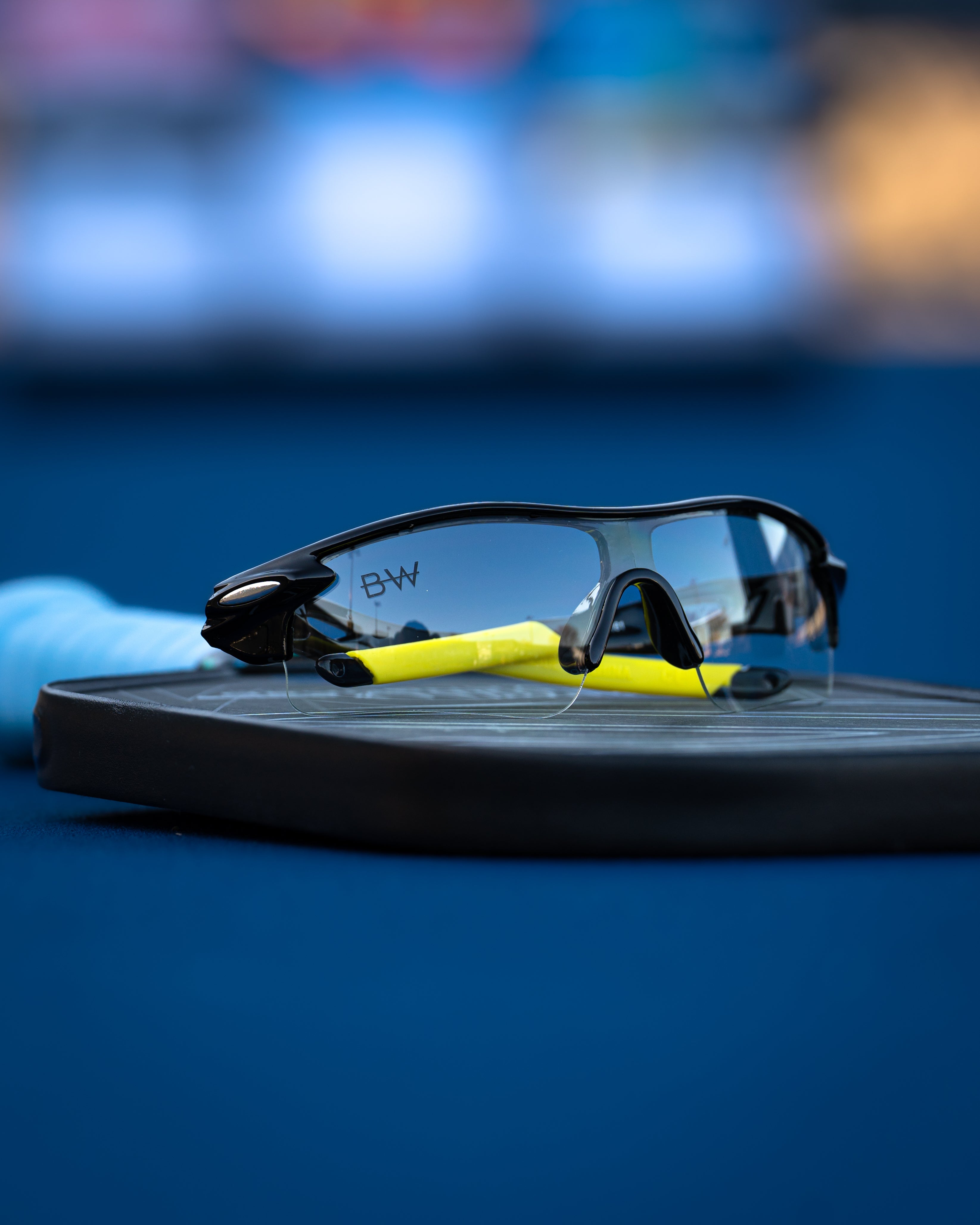
The Glasses Built for Recovery Flights and Court Restarts
Share
RX Pickleball Glasses for Travel, Downtime, and Getting Back on Court
A tournament weekend can involve much more than the matches themselves. You may spend hours traveling, moving through an airport, checking into a hotel, waiting between matches, warming up, eating, and returning to the court after a long break.
If you depend on prescription correction, your eyewear can be part of that entire routine. That makes prescription compatibility, comfort, fit, lens configuration, and practical travel habits important considerations when choosing RX pickleball glasses.
The goal is not to find a frame that magically improves recovery or instantly "restarts" your vision. It is to choose prescription sports eyewear that works for your corrective needs and is practical for the environments in which you plan to use it.
Find Your Pickleball Glasses
Compare current prescription and non-prescription options or use the 2026 hub to explore eyewear for your playing environment.
Think Beyond the Match: What a Pickleball Travel Weekend Actually Includes
A traveling player may encounter several different environments before the first rally even begins.
- Driving or flying to the tournament location
- Airport terminals and layovers
- Hotel check-in and indoor lighting
- Outdoor tournament venues
- Shaded waiting areas
- Bright courts
- Indoor courts
- Warmups after extended downtime
- Meals between matches
- Travel home after the event
If you plan to use one prescription pair through several of those situations, consider the complete experience rather than evaluating eyewear only during active points.
Travel Eyewear and Court Eyewear Have Different Demands
A frame that works during a pickleball match also has to meet different expectations if you plan to wear it through travel and downtime.
| Situation | Useful Considerations |
|---|---|
| Airport or Road Travel | Prescription correction, extended comfort, fit, storage, and the lens configuration |
| Hotel and Indoor Time | Whether the lens configuration is appropriate for the indoor environment |
| Waiting Between Matches | Comfort over time, changing lighting, lens cleanliness, and fit |
| Warmup | Frame fit during movement, prescription correction, and comfort |
| Active Play | Prescription compatibility, sports-oriented fit, lens configuration, and playing environment |
| Post-Match Travel | Comfort, storage, cleaning, and having suitable corrective eyewear available |
What Does "Recovery-Ready" Eyewear Actually Mean?
Eyewear should not be marketed as accelerating physical recovery from pickleball. A frame cannot replace hydration, nutrition, sleep, appropriate rest, or other parts of a player's recovery routine.
For this guide, "recovery-ready" simply means considering whether your prescription eyewear is practical during the periods when you are not actively playing.
That can include:
- Extended comfort
- Appropriate prescription correction
- Practical storage
- Lens cleanliness
- A lens configuration appropriate for the environment
- A frame that fits appropriately without unwanted pressure
Do Your Eyes Need to "Recover" Between Pickleball Matches?
A sports frame should not be described as resetting, restoring, or accelerating your visual system between matches.
If you require prescription correction, appropriately prescribed eyewear can provide the correction it is designed to provide. That is different from claiming that a particular frame speeds visual recovery or prepares your eyes for the next rally.
What Is a Court Restart?
For a traveling or tournament player, a court restart can simply mean returning to activity after a period of downtime.
Examples include:
- Starting a second match after a long wait
- Returning after lunch
- Warming up after sitting between bracket rounds
- Playing after traveling to a venue
- Starting an evening session after earlier matches
- Moving from an indoor waiting area to an outdoor court
Your eyewear does not need a special "restart technology." The practical goal is having prescription eyewear and a lens configuration that remain appropriate when you return to normal play.
Do RX Glasses Speed Up Visual Reacclimation?
Do not promise that a frame provides faster visual reacclimation after downtime.
The older version of this guide claimed certain RX frames helped with speed, depth, and angle readjustment when players returned to the court. Those athletic-performance effects should not be attributed to a frame without supporting evidence.
Instead, focus on practical factors such as:
- Wearing the correct prescription
- Using a lens configuration appropriate for the current environment
- Making sure the frame fits appropriately
- Keeping the lenses clean
- Becoming familiar with the eyewear before competition
Blinded Wear RX Styles to Compare for a Tournament Weekend
Rather than naming one universal "travel pair," compare current direct RX options according to your prescription requirements, frame dimensions, lens configuration, fit, and the environments in which you plan to use them.
| RX Style | Configuration | What to Compare |
|---|---|---|
| Frost RX | Direct RX | Prescription compatibility, dimensions, current lens configuration, individual fit |
| Crystal Wave II RX | Direct RX | Prescription compatibility, dimensions, lens configuration, comfort and fit |
| Zebra II RX | Direct RX | Prescription compatibility, dimensions, current configuration, individual fit |
| Lava Rock RX | Direct RX | Prescription compatibility, current lens characteristics, dimensions, fit |
| Steel Ice RX | Direct RX | Prescription compatibility, dimensions, current lens configuration, fit |
| Gray Wash RX | Direct RX | Prescription compatibility, lens characteristics, dimensions, individual fit |
Frost RX for a Travel and Tournament Shortlist
Frost RX is a direct RX option with a white frame and bright blue lens appearance.
The older version of this guide described Frost RX as soft, pliable, pack-flat, resistant to pressure from travel situations, and appropriate for sleeping during flights. Those claims should not automatically be carried forward as current product specifications.
Instead, compare Frost RX based on:
- Your prescription requirements
- Current frame dimensions
- The exact current lens configuration
- Individual fit
- Comfort during the situations in which you plan to wear it
Crystal Wave II RX for Travel and Court Use
Crystal Wave II RX is another direct RX sports option to compare if you want prescription eyewear for a tournament weekend.
Do not assume Crystal Wave II RX automatically adapts to every indoor and outdoor environment. The exact lens configuration determines whether the eyewear is appropriate for a particular lighting condition.
If you want to use the same pair before, during, and after matches, consider whether its current lens configuration makes sense across those environments.
Zebra II RX for Returning to the Court
Zebra II RX is a direct RX sports option that can be included in a tournament eyewear comparison.
The older article claimed Zebra II RX provided fast visual reacclimation and helped players read speed, depth, and angles after downtime. Those claims should not be carried forward as product effects.
Instead, evaluate Zebra II RX according to prescription compatibility, frame dimensions, exact lens configuration, individual fit, and your playing environment.
Lava Rock RX for a Tournament Eyewear Shortlist
Lava Rock RX is another direct RX option worth comparing for tournament use.
Whether it works as an all-day pair for you depends on your prescription, the current lens configuration, individual fit, comfort preferences, and the environments in which you intend to wear it.
What About the Other Frames From the Original Guide?
The previous version highlighted Smoked Shadow RX, Cold Slate RX, Sea Sand RX, Roses Quartz RX, and Ocean Wave RX alongside current direct RX products.
It also attributed product-specific features such as soft construction, pressure-free hinges, anti-fog performance, pack-flat flexibility, no-bounce fit, and extended travel comfort.
Those older product and feature descriptions should not automatically be treated as current specifications. For current shopping, begin with the Blinded Wear RX Pickleball Glasses Collection and verify the exact configuration of the product you are considering.
Can One RX Pair Handle an Entire Pickleball Weekend?
Potentially, but that depends on what you expect one pair to do.
A single pair may need to work across:
- Travel
- Indoor terminals
- Hotel environments
- Outdoor waiting areas
- Bright courts
- Shaded courts
- Indoor courts
- Evening conditions
The wider the range of environments, the more important it becomes to consider the exact lens configuration rather than choosing solely from frame style.
Lens Tint Can Determine Whether One Pair Works Across Environments
A dark sunglass tint that feels appropriate in strong outdoor sunlight may not be what you prefer inside an airport, hotel, restaurant, or indoor pickleball facility.
Likewise, a clear lens avoids dark sunglass tint but should not be assumed to manage bright outdoor conditions in the same way as a sunglass configuration.
When choosing a travel-and-court pair, ask:
- Will I primarily wear it outdoors?
- Will I use it indoors too?
- Will my matches continue into the evening?
- Do I expect major changes in brightness?
- Am I comfortable carrying a second pair when conditions change?
Clear Lenses for Indoor and Lower-Light Environments
Clear means the lens does not have dark sunglass tint. That can make clear configurations relevant for indoor, evening, or lower-light environments when you do not want a dark lens.
Clear appearance alone does not establish:
- UV specifications
- Polarization
- Impact resistance
- Formal safety certification
- Anti-reflective treatment
- Anti-fog treatment
- Scratch resistance
- Blue-light filtering
The Blinded Wear Clear Lens Collection is non-prescription, so it should not be confused with the RX collection.
Contacts Plus Non-RX Eyewear Can Be Another Travel Setup
Players who already use prescribed contact lenses may have another option: using contacts for prescription correction and compatible non-prescription sports eyewear over them.
That can include the Non-RX Pickleball Sunglasses Collection or, when dark sunglass tint is not desired, the Non-RX Clear Lens Collection.
What About Photochromic Lenses for Travel and Changing Light?
Photochromic lenses are designed to change tint in response to certain light conditions. If a photochromic configuration is currently available for a particular RX product, it may be worth considering when your environment changes throughout the day.
However, do not assume:
- Every RX style offers photochromic lenses
- The lens changes tint instantly
- The lens behaves identically in every environment
- Photochromic automatically means polarized
- Photochromic automatically establishes a particular UV specification
- Photochromic lenses improve visual reacclimation or athletic performance
Verify the exact current lens configuration before ordering.
Airport Lighting, Hotel Lighting, and Court Lighting Are Different
Artificial indoor lighting, daylight through terminal windows, shaded outdoor areas, bright courts, and evening environments can all feel different.
A lens should not be promised to create "visual consistency" across every environment. Instead, select a configuration appropriate for the conditions in which you intend to use it.
Do Blinded Wear RX Glasses Reduce Eye Strain During Travel?
Do not promise that a particular frame or lens configuration reduces eye strain unless that claim is supported for the exact product.
If you require prescription correction, wearing appropriately prescribed eyewear provides the correction it is designed to provide. Comfort and visual experience can still vary with prescription, environment, lens configuration, fit, duration of wear, and individual needs.
Can a Long Flight Make Your Eyes Feel Dry?
Some travelers may notice eye discomfort or dryness during long periods of travel. Eyewear should not be marketed as treating or preventing dry eyes unless specifically designed and supported for that purpose.
Blinded Wear RX eyewear should therefore be evaluated as prescription sports eyewear rather than as a treatment for cabin-related eye discomfort.
Glasses, Headphones, and Long Travel Days
If you regularly wear over-ear headphones, a hat, or other headwear while traveling, consider how those items interact with the frame temples.
Do not assume any frame is universally "headphone-proof" or immune to pressure. Headphone shape, clamping force, frame dimensions, temple design, facial dimensions, and duration of wear can all influence comfort.
Should You Sleep in RX Glasses on a Flight?
It is better not to market sports eyewear as designed for sleeping unless the exact product is specifically intended for that use.
Sleeping or reclining against a frame can place unintended pressure on the eyewear. If you do not need the glasses while resting, storing them appropriately can help avoid unnecessary bending, crushing, or lens contact.
If you do need prescription correction immediately after waking, keep the eyewear stored somewhere accessible rather than loose in a seat or travel bag.
Do Blinded Wear RX Frames Pack Flat?
Do not assume a specialized pack-flat design unless it is documented for the exact product.
The safer travel strategy is to protect prescription eyewear from unnecessary compression rather than relying on the frame to flex under pressure.
Don't Toss Custom RX Glasses Loose Into a Travel Bag
A travel bag can contain keys, chargers, paddles, shoes, bottles, clothing, and other objects that can contact eyewear.
When packing prescription glasses:
- Avoid leaving the lenses exposed to abrasive objects.
- Do not intentionally place heavy items on top of the eyewear.
- Keep the frame where it is less likely to be crushed.
- Keep an appropriate cleaning cloth available.
- Inspect the eyewear if it experiences a meaningful impact.
Bring Backup Corrective Eyewear to a Tournament
If you depend on prescription correction, suitable backup corrective eyewear can be one of the most practical items in your tournament bag.
A backup can matter if your primary pair becomes:
- Damaged
- Misplaced
- Unexpectedly uncomfortable
- Unsuitable for a change in lighting conditions
- Otherwise unavailable
The backup does not need to be identical to your sports eyewear. Its purpose is to provide an appropriate corrective alternative if you cannot continue using your primary pair.
Keep Your RX Lenses Clean Between Travel and Play
Travel can expose eyewear to fingerprints, dust, sweat, and other debris before you even reach the court.
For basic care:
- Remove loose debris before rubbing the lenses.
- Use a cleaning method appropriate for the exact lenses.
- Use a clean microfiber cloth intended for eyewear.
- Avoid repeatedly wiping lenses with dirty clothing.
- Inspect the frame and lenses for visible damage before play.
Moving From Air Conditioning to Humidity: What About Fogging?
Moving between environments with different temperatures and humidity can contribute to condensation under some conditions.
Fogging can depend on:
- Temperature differences
- Humidity
- Moisture
- Perspiration
- Airflow
- Eyewear position
- The complete frame and lens configuration
Do not assume every Blinded Wear RX frame uses fog-resistant ventilation or is guaranteed not to fog unless that feature is documented for the exact configuration.
Extended Comfort Starts With Appropriate Fit
A frame that feels fine for ten minutes may feel different after several hours. If you intend to wear RX eyewear throughout a travel day or tournament, fit deserves as much attention as style.
Consider:
- Overall frame dimensions
- Bridge fit
- Temple dimensions
- Your facial dimensions
- The finished prescription configuration
- Interaction with hats or headphones
- Whether unwanted pressure develops during longer wear
Can RX Glasses Be Guaranteed Not to Bounce During Warmups?
No. A universal no-bounce or no-slip guarantee would ignore differences in facial dimensions, frame dimensions, bridge and temple fit, perspiration, prescription configuration, and movement.
The goal should be an appropriate individual fit rather than an impossible promise of zero movement.
Do All Blinded Wear RX Frames Have Grip Nose Pads and Stay-Put Temples?
Do not assume collection-wide grip technology unless those features are documented for the exact product.
A frame's overall fit involves more than one component. Bridge geometry, temple design, dimensions, facial geometry, prescription configuration, and individual preference all contribute.
High-Index Prescription Lenses Are Included at No Additional Cost
Blinded Wear includes high-index prescription lenses at no additional cost with custom RX eyewear.
High-index refers to a category of prescription lens material commonly used to help manage lens thickness, particularly as prescription strength increases. Finished lens thickness depends on your individual prescription, frame and lens dimensions, geometry, optical requirements, and other factors.
Do not assume an exact refractive index such as 1.61 unless that specification is documented for the current configuration.
Impact Resistance and Travel Durability Are Different Concepts
Blinded Wear offers impact-resistant lens options for sports use. Impact resistance should not be translated into a promise that the complete eyewear can withstand being crushed inside luggage or subjected to unlimited travel abuse.
Impact-resistant also does not mean:
- Shatterproof
- Unbreakable
- Crush-proof
- Indestructible
- Automatically certified to a particular protective standard
How to Order Blinded Wear RX Glasses
- Select the product and available options.
- Have your current eyeglass prescription ready.
- Upload a clear photo or picture of your eyeglass prescription on the product page before adding the eyewear to your cart.
- Your prescription information will be associated with your custom RX order.
For more information, read the How to Order RX Glasses guide.
Direct RX vs. RX Clip for Tournament Travel
Blinded Wear prescription eyewear can use different approaches to prescription correction depending on the product. Understanding that difference can help when planning what to pack for a tournament weekend.
Direct RX
With direct RX, prescription correction is incorporated into the direct prescription lens setup.
RX Clip
An RX Clip uses a separate inner prescription insert within a compatible eyewear system. The prescription correction comes from that inner insert rather than the primary outer sports lens.
| Consideration | Direct RX | RX Clip |
|---|---|---|
| Prescription Correction | Integrated into the direct RX setup | Provided by a separate inner prescription insert |
| Outer Sports Lens | Part of the direct prescription configuration | Separate from the inner prescription correction |
| Travel Practicality | Depends on the exact frame, lens configuration, fit, and your travel routine | Depends on the compatible system, outer lens, inner RX insert, fit, and your travel routine |
| High-Index RX Lenses | Included at no additional cost | Included at no additional cost in the custom RX clip |
| Universally Better for Travel? | No. Choose according to prescription compatibility, lens configuration, fit, and how you plan to use the eyewear. | |
Can You Put an RX Clip Into Any Pair of Sunglasses?
No. An RX Clip is designed to work within a compatible eyewear system. It should not be treated as a universal prescription insert for arbitrary sunglasses.
If you are considering an RX Clip for travel and tournament use, verify compatibility with the exact Blinded Wear product before ordering.
Should You Travel With One Pair or Two?
There is no universal requirement to bring multiple pairs, but carrying suitable backup corrective eyewear can be useful if you depend on prescription correction.
A two-pair setup can also make sense when your environments are very different. For example, the lens configuration you prefer on a bright outdoor court may not be what you prefer inside an airport, hotel, restaurant, or indoor venue.
| Setup | Potential Advantage | Consideration |
|---|---|---|
| One RX Pair | Less eyewear to carry and manage | The lens configuration needs to make sense across the environments where you intend to use it |
| RX Sports Pair + Backup Corrective Pair | Provides another corrective option if the primary pair becomes unavailable | Requires additional storage and packing |
| Different Lens Configurations | Can give you options for substantially different lighting environments | You need to keep track of more than one pair |
| Contacts + Non-RX Sports Eyewear | Separates prescription correction from the outer sports eyewear | Only relevant for players who already use appropriately prescribed contacts |
Plan Your Eyewear Around the Entire Tournament Day
A common mistake is choosing eyewear only for the brightest part of the match. A tournament day can expose you to very different lighting conditions before and after that period.
Think through your schedule:
- Travel: Will you be driving, flying, or spending hours indoors?
- Arrival: Will you move from an indoor environment directly to an outdoor venue?
- Waiting: Will you spend substantial time in shade or indoors between matches?
- Competition: Are the courts indoor, outdoor, or a mixture?
- Late rounds: Could your matches continue into substantially lower light?
- Post-match: Do you plan to continue wearing the same pair after leaving the court?
The more varied the environment, the more important it becomes to understand the exact lens configuration you are ordering.
Lens Tint and an All-Day Tournament Schedule
Different tints can change visible-light transmission and color appearance. That does not mean one tint is universally best for a full tournament weekend.
When comparing available lens options, consider:
- The brightness of your outdoor courts
- How much time you expect to spend indoors
- Whether courts have substantial shade
- Whether you play near sunrise or sunset
- Your individual visual preferences
- The exact current lens characteristics
Do not assume a particular tint automatically improves contrast, ball tracking, depth perception, reaction time, or court performance.
Polarized vs. Non-Polarized Lenses While Traveling and Playing
Polarized lenses are designed to reduce certain reflected light. Some players may prefer polarization in particular outdoor environments, while others may prefer non-polarized sports lenses.
Neither option should be described as universally superior for pickleball.
Polarization alone does not determine:
- Depth perception
- Ball tracking
- Reaction time
- Shot accuracy
- Overall pickleball performance
One practical travel consideration is that polarized lenses can interact with some digital displays depending on display technology, viewing angle, and orientation.
Don't Judge a Travel Lens Only by Its Appearance
A mirrored, blue, gray, dark, or clear appearance does not tell you every technical characteristic of a lens.
| What You See | What You Should Not Automatically Assume |
|---|---|
| Dark Lens | A particular UV specification, polarization, impact rating, or safety certification |
| Blue Lens | Blue-light filtering, polarization, or improved court performance |
| Mirrored Appearance | Polarization, UV specifications, or a particular visible-light-transmission value |
| Clear Lens | Specific UV, impact, anti-fog, scratch, AR, or blue-light characteristics |
| Sports Styling | Formal protective certification or guaranteed stability |
Going From an Airport or Hotel Straight to an Outdoor Court
A rapid change from an indoor environment to bright outdoor conditions can make the difference between environments especially noticeable.
That does not mean a particular RX frame can guarantee instant visual adaptation. Your individual vision, prescription correction, lens configuration, and environmental conditions all contribute to what you experience.
If your tournament routine frequently involves large lighting changes, consider that when choosing the exact lens configuration.
Indoor Waiting Areas to Outdoor Court Restarts
Some tournament venues require players to wait indoors before returning to outdoor courts. Others may have shaded staging areas next to bright courts.
Instead of looking for eyewear marketed as providing "instant reacclimation," make sure your prescription is appropriate and give yourself normal warmup time to become comfortable with the current playing environment.
Use Your Warmup to Recheck Eyewear After a Long Break
A warmup after downtime gives you an opportunity to notice whether anything about your eyewear needs attention before competition resumes.
Check:
- Whether the lenses are clean
- Whether the frame is sitting normally
- Whether unwanted pressure has developed
- Whether the current lens configuration feels appropriate for the lighting
- Whether perspiration changes the fit
- Whether hats, visors, or headbands interfere with the temples
- Whether there is any visible damage
This is a practical equipment check, not a claim that eyewear improves your warmup or makes you competition-ready faster.
Can RX Glasses Make You Play Better After a Long Break?
A frame or lens should not be promised to improve your performance after downtime.
Returning to play can involve many factors, including:
- Your prescription correction when needed
- Warmup
- Attention
- Movement
- Timing
- Lighting
- Experience
- Fatigue
- The surrounding environment
Prescription sports eyewear can provide the correction and eyewear configuration it is designed to provide without being positioned as a performance-enhancing device.
Do RX Glasses Restore Depth Perception After Downtime?
Do not describe a particular frame as restoring or recalibrating depth perception between matches.
If you require prescription correction, wearing appropriately prescribed lenses can provide that correction. Depth perception should not be marketed as a feature that a particular frame, tint, or polarization status switches on when you return to the court.
Do RX Glasses Improve Reaction Time After Travel?
No particular Blinded Wear frame should be promised to make you react faster after a flight, drive, layover, meal, or extended tournament break.
Reaction time involves multiple visual, cognitive, and physical factors. Eyewear selection should focus on prescription needs, lens configuration, fit, comfort, and the playing environment.
Can a Travel-Friendly RX Pair Improve Ball Tracking?
Travel convenience and ball-tracking ability are separate issues. A frame that is convenient to bring to a tournament should not automatically be described as improving how you track the ball.
Your individual vision, prescription correction when needed, attention, lighting, experience, and the surrounding environment all contribute to what you see during play.
Travel Fatigue and Eyewear Are Different Issues
A comfortable pair of prescription glasses can be useful during a long travel day, but eyewear should not be presented as preventing or treating travel fatigue.
If you arrive at a tournament after substantial travel, your readiness to play involves much more than the glasses you are wearing.
What Should You Do With RX Sports Glasses During Hotel Downtime?
If you are resting between matches and do not need to wear your sports eyewear, store it where it is protected from unnecessary pressure, falls, and lens contact.
A hotel room can create surprisingly easy opportunities for eyewear damage:
- Leaving glasses on a bed before lying down
- Placing them under clothing or towels
- Leaving them loose inside a gear bag
- Putting heavy equipment on top of them
- Leaving them where they can be knocked from a table
Prescription sports eyewear should not be treated as crush-proof simply because it is intended for athletic use.
Why Sleeping in Sports Glasses Is Not a Travel Feature
The original version of this guide encouraged players to nap and even sleep during flights while wearing certain RX frames. Unless a product is specifically designed and supported for that use, sleeping in eyewear should not be presented as a product benefit.
Pressure from a pillow, headrest, seat, or sleeping position can place unintended force on the frame. Appropriate storage is generally a better way to protect the eyewear while resting.
Protect Custom RX Eyewear While It Is Not Being Worn
Custom prescription eyewear represents more than just a spare accessory during a tournament. If you rely on it for correction, damage can affect the rest of your trip.
When the glasses are not being worn:
- Keep the lenses away from abrasive objects.
- Avoid placing heavy objects on top of the eyewear.
- Do not intentionally test how much the frame can bend.
- Keep the eyewear somewhere you are unlikely to sit or step on it.
- Keep backup corrective eyewear accessible when possible.
Don't Leave RX Eyewear in Unnecessarily Harsh Travel Conditions
Travel gear can spend time in vehicles, luggage, direct sunlight, and crowded storage areas. Avoid assuming sports eyewear is immune to every environmental or mechanical stress simply because it is designed for active use.
Follow the care instructions appropriate for your exact eyewear and avoid unnecessary exposure to conditions that could damage the frame or lenses.
Why Glasses May Fog When You Return to the Court
Moving from a cool indoor environment into warm, humid outdoor air can create conditions where condensation becomes noticeable.
Fogging can depend on:
- Temperature differences
- Humidity
- Moisture
- Perspiration
- Airflow
- Eyewear position
- The complete frame and lens configuration
Do not assume every Blinded Wear RX frame includes an anti-fog coating, specialized fog-resistant ventilation, or a fog-proof guarantee.
Fog, Sweat, and Dirty Lenses Are Not the Same Problem
If your vision through the lens becomes cloudy or obstructed, determine what is actually on the lens before assuming it is fog.
| Issue | What It Means |
|---|---|
| Condensation | Moisture has condensed on the lens surface |
| Sweat | Perspiration has reached the lens |
| Fingerprints | Oil or residue has transferred to the lens |
| Dust or Debris | Material has accumulated on the lens surface |
Each situation can interfere with a clean viewing surface, but they are not technically the same issue.
Are Blinded Wear RX Frames Fog-Resistant?
Do not make a collection-wide fog-resistant or anti-fog claim unless that characteristic is documented for the exact configuration.
The older guide stated that all Blinded RX frames used fog-resistant ventilation and grip stabilizers. That should not be treated as a verified collection-wide specification.
What if Your Glasses Become Uncomfortable During a Long Travel Day?
Extended wear can reveal fit issues that are not obvious during a brief try-on.
Pay attention to persistent:
- Bridge pressure
- Temple pressure
- Pressure around or behind the ears
- Frequent frame repositioning
- Interaction with headphones
- Interaction with hats or headwear
Do not assume discomfort is simply something you need to tolerate because the frame is intended for sports.
Does a Lightweight Frame Automatically Mean Better All-Day Comfort?
Not necessarily. Weight can contribute to the wearing experience, but it is only one factor.
Comfort can also depend on:
- Frame dimensions
- Bridge geometry
- Temple geometry
- Facial dimensions
- Prescription configuration
- How pressure is distributed
- How long the eyewear is worn
- Interaction with other equipment
The original guide described certain frames as "featherweight" and lighter than an average hat. Unless an exact product weight is documented, those comparisons should not be used as specifications.
Does a Flexible Frame Mean You Can Pack It Anywhere?
No. Even if a frame has some flexibility, that does not mean it should be intentionally compressed under tournament gear or packed without protection.
Flexibility, durability, impact resistance, and crush resistance are different concepts.
What About "No Sharp Edges" and "Pressure-Free Hinges"?
Those descriptions appeared in the older version of this guide, but they should not be treated as collection-wide or product-specific specifications unless currently documented.
For travel comfort, evaluate the actual frame dimensions and how the eyewear fits you rather than relying on absolute comfort terminology.
Fit During Travel Does Not Guarantee Fit During Pickleball
A frame can feel comfortable while sitting in an airport and still feel different during active movement.
Before an important tournament, test your finished RX eyewear during ordinary pickleball movements such as:
- Split steps
- Side shuffles
- Kitchen-line movement
- Low reaches
- Head turns
- Looking upward during normal play
- Overhead preparation
- Transitions toward and away from the kitchen
The goal is to evaluate individual fit and comfort, not to prove that a frame is completely motionless.
Should Sports Glasses Have Zero Movement?
Do not use zero-movement as a universal standard or guarantee. Real-world fit depends on the frame, facial dimensions, bridge and temple interaction, perspiration, prescription configuration, and movement.
Repeated slipping or constant adjustment can be a reason to reassess fit, but an absolute "never moves" promise is not realistic for every wearer.
Use Frame Dimensions Instead of Guessing From Face Shape
Labels such as round, oval, square, or heart-shaped face can be useful for style discussions, but they are not a substitute for actual fit information.
When dimensions are published, compare measurements such as:
- Lens width
- Bridge width
- Temple length
- Overall frame width when available
Eyewear that already fits you appropriately can provide a useful reference point. Measurements can narrow your search, but they still do not guarantee an identical fit.
Use the Pickleball Sunglasses Quiz as a Discovery Tool
The Pickleball Sunglasses Quiz can help you explore the collection based on your preferences.
It should not be described as a guaranteed prescription assessment, medical recommendation, or perfect fit determination. Your complete prescription and the exact product configuration still matter when ordering RX eyewear.
Travel Convenience Does Not Override Prescription Compatibility
A frame can look ideal for a tournament trip and still need to be compatible with your actual prescription.
Compatibility can depend on:
- Sphere values
- Cylinder values
- Axis
- The relationship between the right and left prescriptions
- Lens and frame dimensions
- Geometry
- Other optical requirements
Do not assume every prescription can be placed into every sports frame.
High-Index Can Help Manage Prescription Lens Thickness
Blinded Wear includes high-index prescription lenses at no additional cost with custom RX eyewear.
Higher refractive-index material can help manage lens thickness in comparable prescriptions, particularly as prescription strength increases. Final thickness still varies based on prescription, frame and lens dimensions, geometry, optical design, and other requirements.
High-index should not be confused with:
- Impact rating
- Safety certification
- Scratch resistance
- Anti-fog treatment
- Polarization
- Tint darkness
- UV specifications
Inspect Your RX Eyewear After Travel Damage or a Court Impact
If your prescription eyewear experiences a meaningful impact, fall, or crushing force, inspect it before continuing to rely on it.
Look for:
- Visible cracks
- Chips
- Lens displacement
- Frame deformation
- Loose components
- An unexpected change in fit
Impact-resistant eyewear should still be inspected after significant impact and should never be treated as indestructible.
Don't Rely on a Visibly Damaged Frame for Tournament Play
If a frame or lens is visibly damaged or significantly deformed, do not assume it remains unchanged simply because it can still be worn.
Damage can affect how the eyewear sits and functions. Use suitable backup corrective eyewear when necessary and review the applicable replacement policy for eligible broken Blinded Wear eyewear.
RX Eyewear Checklist Before Leaving for a Pickleball Trip
- Primary RX eyewear: Inspect the frame and lenses before packing.
- Backup correction: Bring suitable backup corrective eyewear if you depend on prescription correction.
- Lens configuration: Make sure it is appropriate for the expected environment.
- Cleaning supplies: Pack an appropriate clean microfiber cloth and lens-care supplies.
- Protected storage: Keep eyewear away from unnecessary compression and abrasive objects.
- Prescription information: Keep access to your current prescription information when practical.
- Fit check: Make sure the frame feels appropriate before tournament day.
- Practice test: Use new RX sports eyewear during ordinary practice before an important event.
What to Check When You Arrive at the Tournament
Before your first competitive match, give your eyewear a quick practical check.
- Inspect the lenses and frame for visible travel damage.
- Clean any fingerprints, dust, or travel residue appropriately.
- Confirm the frame is sitting as expected.
- Check that your normal hat, visor, or headwear does not interfere with fit.
- Evaluate the lens configuration in the actual venue lighting.
- Use your warmup to become familiar with the eyewear in the current environment.
A Simple Eyewear Routine Between Matches
Between matches, you do not need a complicated "visual recovery" protocol for your glasses. Basic equipment care is more useful.
- Inspect: Check for obvious damage.
- Clean: Remove sweat, fingerprints, or debris appropriately.
- Store: Protect the eyewear if you remove it.
- Recheck conditions: Notice whether the lighting has changed substantially.
- Warm up: Use normal practice time to become comfortable again before the next match.
Common RX Eyewear Mistakes During Tournament Travel
| Mistake | Better Approach |
|---|---|
| Sleeping in sports glasses because they are assumed to be flexible | Store eyewear appropriately when it is not needed for vision. |
| Tossing custom RX eyewear loose into a gear bag | Protect it from unnecessary compression and abrasive objects. |
| Assuming one tint works perfectly everywhere | Consider the complete range of lighting expected during the trip. |
| Traveling without backup correction | Consider bringing suitable backup corrective eyewear. |
| Trying new RX sports glasses for the first time in competition | Become familiar with them during ordinary practice first. |
| Assuming fog means the product failed | Distinguish condensation from sweat, fingerprints, and other lens contamination. |
| Assuming lightweight means perfect fit | Evaluate dimensions, bridge fit, temples, prescription configuration, and comfort together. |
| Assuming sports styling means safety certification | Verify documented certification if a particular protective standard is required. |
Build Your Travel + Court RX Shortlist
For current direct RX options, start by comparing:
- Frost RX — direct RX with a white frame and bright blue lens appearance.
- Crystal Wave II RX — direct RX sports option to compare for tournament use.
- Zebra II RX — direct RX option for your prescription sports-eyewear shortlist.
- Lava Rock RX — another direct RX style to compare based on current configuration and fit.
- Steel Ice RX — direct RX option for expanding your comparison.
- Gray Wash RX — direct RX style to evaluate according to prescription compatibility, lens configuration, dimensions, and fit.
No single model should be labeled universally best for every flight, hotel, tournament venue, prescription, face, or lighting condition.
What to Verify Before Ordering a Tournament Travel Pair
Before purchasing custom RX eyewear, review the factors that will actually determine whether the finished pair suits your needs:
- Your complete current prescription
- Prescription compatibility with the exact product
- Whether the product is direct RX or uses a compatible RX Clip system
- Current frame dimensions
- The exact available lens configuration
- Lens tint when applicable
- Polarization status when relevant
- Documented UV specifications when relevant
- Impact-resistant characteristics when relevant
- Any documented coatings or treatments
- Your expected indoor and outdoor environments
- Whether you plan to use one pair throughout the entire day
- Your normal headwear or headphones
- Your backup corrective-eyewear plan
That creates a stronger basis for choosing RX pickleball glasses than unsupported promises such as "recovery-ready," "no-bounce," "fog-proof," "pack-flat," or "instant visual reacclimation."
FAQ: RX Pickleball Glasses for Flights, Travel, and Tournament Weekends
What are the best RX glasses for pickleball travel?
There is no single prescription frame that is universally best for every traveler. Compare prescription compatibility, frame dimensions, the exact lens configuration, individual fit, comfort, and the environments in which you expect to wear the eyewear.
Current direct RX options to compare include Frost RX, Crystal Wave II RX, Zebra II RX, Lava Rock RX, Steel Ice RX, and Gray Wash RX.
Can I wear the same RX glasses on a flight and on the pickleball court?
Potentially. Whether one pair works across both environments depends on your prescription, fit, comfort, and the exact lens configuration. A dark outdoor lens, for example, may not be what you prefer inside an airport or hotel.
Are pickleball glasses designed for sleeping on a plane?
Do not assume that they are. Unless an exact product is specifically designed and supported for sleeping, sports eyewear should not be marketed as sleep eyewear. Pressure from a seat, headrest, pillow, or sleeping position can place unintended force on the frame.
Can I nap while wearing RX sports glasses?
If you do not need the eyewear while resting, appropriately storing it can help avoid unnecessary pressure, bending, or lens contact. Keep your corrective eyewear accessible if you will need it when you wake.
Do Blinded Wear RX glasses pack flat?
Do not assume a specialized pack-flat construction unless it is documented for the exact product. Protect custom RX eyewear from unnecessary compression while traveling.
Can I put RX glasses loose in my carry-on?
Keeping prescription eyewear loose around keys, chargers, bottles, sports equipment, or other objects can expose it to unnecessary contact or compression. Protect the lenses from abrasive objects and keep the frame where it is less likely to be crushed.
Should I bring backup glasses to a pickleball tournament?
If you depend on prescription correction, suitable backup corrective eyewear can be useful. It gives you another corrective option if your primary pair becomes damaged, misplaced, unexpectedly uncomfortable, or otherwise unavailable.
Do I need two different sports pairs?
Not necessarily. Some players may be comfortable using one appropriate pair, while others may prefer different configurations for substantially different lighting environments. Backup corrective eyewear does not have to be identical to your primary sports pair.
Can I travel with contacts and use non-RX pickleball sunglasses?
If you already use appropriately prescribed contact lenses, you may consider contacts for correction with compatible non-prescription sports eyewear. Explore the Blinded Wear Non-RX Pickleball Sunglasses Collection for current options.
Are Blinded Wear clear lenses prescription?
The Blinded Wear Clear Lens Collection is non-prescription. Players who use prescribed contacts may consider non-RX eyewear while their contacts provide the corrective function.
FAQ: Recovery, Downtime, and Returning to the Court
Can RX glasses help me recover between pickleball matches?
Prescription sports eyewear should not be marketed as accelerating physical recovery. Recovery can involve factors outside the eyewear itself, while RX glasses provide the prescription correction and eyewear configuration they are designed to provide.
Do sports glasses help my eyes recover after a match?
Do not promise that a particular frame resets, restores, or accelerates visual recovery. If you require prescription correction, appropriately prescribed eyewear can provide that correction without being positioned as a recovery device.
Can RX glasses help me read the ball faster after sitting between matches?
A frame should not be promised to make you read ball speed faster after downtime. Your individual vision, prescription correction when needed, attention, experience, lighting, movement, and other factors can contribute to what you see during play.
Do RX glasses improve depth perception when I return to the court?
Do not promise improved or restored depth perception from a particular frame, tint, or polarization status. Prescription correction can address the corrective requirements represented in your prescription.
Can sports eyewear improve reaction time after a flight?
No particular frame should be promised to make you react faster after traveling. Reaction time involves multiple visual, cognitive, and physical factors.
Can RX glasses improve ball tracking after downtime?
Do not promise a ball-tracking improvement simply because a frame is designed for sports. Prescription correction, individual vision, attention, lighting, experience, head movement, and the surrounding visual environment can all contribute.
What should I do before restarting play after a long break?
Use your normal warmup to become comfortable with the playing environment again. You can also check that your lenses are clean, the frame is sitting normally, the current lens configuration suits the lighting, and the eyewear has not been damaged during downtime.
FAQ: Comfort During Flights and Long Tournament Days
Are lightweight glasses automatically more comfortable for travel?
No. Frame weight is only one part of comfort. Frame dimensions, bridge geometry, temples, facial dimensions, prescription configuration, pressure distribution, headwear, headphones, and duration of wear can all matter.
Should sports glasses feel tight so they stay on during pickleball?
A tighter fit is not automatically a better fit. Excessive pressure can become uncomfortable, especially during longer wear. The goal is an appropriate individual fit rather than maximum tightness.
Can any RX frame guarantee zero movement?
No. Frame movement can depend on dimensions, facial geometry, bridge and temple fit, prescription configuration, perspiration, and the movement involved in play.
Do all Blinded Wear RX glasses have non-slip nose pads?
Do not assume collection-wide non-slip or grip technology unless that feature is documented for the exact product.
Do all Blinded Wear RX glasses have grip temples?
Do not assume that they do. Temple characteristics should be verified for the exact frame.
Can I wear over-ear headphones with RX sports glasses?
Potentially, but comfort depends on the exact headphones, frame temples, clamping force, facial dimensions, and duration of wear. Test the combination you actually plan to use.
Can I wear a hat or visor with RX pickleball glasses?
Potentially. Compatibility depends on the exact headwear, frame, facial dimensions, and fit. Test your normal tournament setup before competition.
How do I know whether a frame will fit me?
Compare published frame dimensions with eyewear that already fits you appropriately when possible. Lens width, bridge width, temple length, and overall frame width when available can provide more useful information than face-shape labels alone.
FAQ: Lens Choices for Travel and Changing Tournament Conditions
What lens is best if I travel indoors and then play outdoors?
There is no universal best configuration. Consider how much time you expect to spend indoors, the brightness of the outdoor venue, whether your matches continue into the evening, and which current lens configurations are available for your RX product.
Are clear lenses better for airports and hotels?
Clear lenses avoid dark sunglass tint, which may make them relevant when you do not want a dark lens. Clear appearance alone does not establish any additional technical characteristics.
Are dark lenses better for outdoor tournaments?
A darker tint changes visible-light characteristics, but darker is not automatically better for every player or every outdoor environment.
Does tint color improve pickleball performance?
Do not promise that a particular tint improves reaction time, depth perception, ball tracking, shot accuracy, or overall performance. Different tints can change visible-light transmission and color appearance, and individual preferences can vary.
Are polarized lenses better for traveling pickleball players?
Polarized lenses are designed to reduce certain reflected light, which some people may prefer in particular outdoor environments. They are not universally better for pickleball or travel.
Do polarized lenses hurt depth perception?
Polarization alone does not determine depth perception. Your prescription, individual vision, lighting, playing environment, and complete eyewear configuration also contribute to what you see.
Do polarized glasses affect airport screens or phones?
Polarized lenses can interact with some digital displays depending on the display technology, viewing angle, and orientation.
Are photochromic lenses useful for tournament travel?
If a photochromic configuration is currently available for the exact RX product, it may be worth considering when your environment changes throughout the day. Exact behavior depends on the lens technology and environmental conditions.
Do photochromic lenses change instantly?
Do not assume or promise an exact transition speed unless it is documented for the exact lens.
Are photochromic lenses automatically polarized?
No. Photochromic behavior and polarization are separate characteristics.
FAQ: Fogging, Sweat, and Lens Care While Traveling
Why might my glasses fog after leaving an air-conditioned airport or hotel?
Changes in temperature and humidity can contribute to condensation. Fogging can also depend on moisture, perspiration, airflow, eyewear position, and the complete frame and lens configuration.
Are Blinded Wear RX glasses anti-fog?
Do not assume a collection-wide anti-fog treatment or fog-proof guarantee unless that characteristic is documented for the exact product and lens configuration.
Does ventilation guarantee glasses will not fog?
No. Even when a frame has an open or ventilated appearance, frame geometry alone should not be treated as a fog-proof guarantee.
Is sweat on the lens the same as fog?
No. Sweat is liquid reaching the lens surface, while fogging generally refers to condensation. Fingerprints, dust, and other residue can also make a lens appear cloudy without being fog.
How should I clean RX glasses during a tournament?
Remove loose debris before rubbing the lenses, use a cleaning method appropriate for the exact lens, and use a clean microfiber cloth intended for eyewear. Avoid repeatedly wiping lenses with dirty or sweaty clothing.
Are Blinded Wear RX lenses scratch-resistant?
Do not assume a collection-wide scratch-resistant coating unless it is documented for the exact lens configuration.
Do all RX lenses have an anti-reflective coating?
Do not assume that they do. Anti-reflective treatment should be verified for the exact prescription lens configuration.
FAQ: High-Index Prescription Lenses for Tournament Eyewear
Does Blinded Wear include high-index RX lenses?
Yes. Blinded Wear includes high-index prescription lenses at no additional cost with custom RX eyewear.
Does high-index mean 1.61?
Do not assume an exact refractive index such as 1.61 unless that specification is documented for the current configuration.
Does high-index always mean thinner lenses?
Higher refractive-index material can help manage lens thickness in comparable prescriptions, particularly as prescription strength increases. Final thickness still depends on the prescription, frame and lens dimensions, geometry, optical design, and other requirements.
Are high-index lenses automatically lighter?
Not necessarily. Finished lens weight depends on more than refractive index, including prescription requirements, lens dimensions, geometry, and material characteristics.
Does high-index mean more impact resistance?
No. Refractive index is not an impact rating.
Does high-index make glasses better for travel?
High-index is primarily relevant to prescription lens design and thickness management. It does not establish crush resistance, flexibility, comfort, polarization, tint, anti-fog performance, or travel durability.
FAQ: Impact Resistance and Travel Durability
Does Blinded Wear offer impact-resistant lens options?
Yes. Blinded Wear offers impact-resistant lens options for sports use.
Does impact-resistant mean shatterproof?
No. Impact-resistant should not be translated into shatterproof, unbreakable, or indestructible.
Does impact-resistant mean my glasses can be crushed in luggage?
No. Lens impact resistance should not be interpreted as a guarantee that the complete eyewear can withstand crushing or unlimited mechanical pressure.
Are Blinded Wear RX glasses safety-certified?
Do not infer a formal protective certification from sports styling or impact-resistant characteristics. If you require a particular standard, verify documented certification for the exact product and configuration.
What should I do if my glasses are hit or crushed during travel?
Inspect the lenses and frame for visible cracks, chips, displacement, deformation, loose components, or an unexpected change in fit before continuing to rely on the eyewear.
FAQ: Direct RX and RX Clip for Travel
What is direct RX?
Direct RX incorporates prescription correction into the direct prescription lens setup.
What is an RX Clip?
An RX Clip uses a separate inner prescription insert within a compatible eyewear system. The inner RX clip provides prescription correction rather than the primary outer sports lens.
Is direct RX better for travel?
Not universally. Compare prescription compatibility, the complete lens configuration, frame fit, comfort, and how you plan to use the eyewear.
Can an RX Clip fit any sunglasses?
No. An RX Clip is intended for a compatible eyewear system rather than arbitrary sunglasses.
Are high-index lenses included in the RX Clip?
Yes. High-index prescription lenses are included at no additional cost in the custom RX clip.
Common Myths About RX Glasses for Pickleball Travel
| Myth | More Accurate Explanation |
|---|---|
| "Travel-friendly glasses should fold or pack completely flat." | Do not assume specialized pack-flat construction unless it is documented for the exact frame. |
| "Sports glasses are safe to sleep in." | Unless specifically designed for sleeping, avoid treating sleep as an intended sports-eyewear use. |
| "Lightweight automatically means all-day comfort." | Comfort also depends on dimensions, bridge and temple fit, facial geometry, prescription configuration, and duration of wear. |
| "Flexible means crush-proof." | Flexibility and resistance to crushing are different characteristics. |
| "Impact-resistant means indestructible." | Impact resistance is not a guarantee against every form of damage. |
| "A sports frame will never bounce or slide." | Fit and movement vary by frame, facial dimensions, perspiration, prescription configuration, and activity. |
| "A dark lens is always best for a tournament weekend." | The appropriate lens depends on the environments and lighting conditions in which you plan to wear it. |
| "Polarized lenses improve depth perception." | Polarization alone does not determine depth perception. |
| "Non-polarized lenses improve ball tracking." | Polarization status alone does not determine ball-tracking ability. |
| "Anti-fog performance is standard across sports eyewear." | Verify any anti-fog treatment or claim for the exact configuration. |
| "The right glasses make you recover faster." | Prescription sports eyewear should not be marketed as accelerating physical recovery. |
| "RX glasses make you react faster after downtime." | A frame or lens should not be promised to improve reaction time. |
Common Mistakes When Choosing RX Glasses for a Pickleball Trip
1. Shopping for Travel Features Before Prescription Compatibility
A frame first needs to work with your prescription requirements. Convenience does not override optical compatibility.
2. Assuming One Lens Works Equally Well Everywhere
Airport terminals, hotels, bright outdoor courts, shaded areas, indoor courts, and evening sessions can create very different lighting environments.
3. Ignoring Frame Dimensions
A frame that looks compact or sporty in a product image is not automatically an appropriate fit for you.
4. Treating Tightness as Stability
A frame does not need to create excessive pressure to be appropriate for active use.
5. Traveling Without Backup Correction
If you depend on prescription correction, a backup can be useful if your primary pair becomes unavailable.
6. Putting Custom RX Eyewear Loose in a Gear Bag
Sports eyewear can still be scratched, bent, or damaged by other objects during travel.
7. Sleeping in the Frame Because It Is "Sports Eyewear"
Athletic use does not automatically make a frame appropriate for sleeping or sustained pressure against a headrest.
8. Using New RX Eyewear for the First Time in a Tournament
Become familiar with the finished eyewear during normal practice before an important event.
9. Assuming Every Technical Feature Applies Across the Collection
Verify lens characteristics, coatings, polarization, frame features, and other specifications for the exact product.
10. Expecting Eyewear to Replace a Normal Restart Routine
Use normal warmup and equipment checks after extended downtime instead of relying on unsupported claims about instant visual recalibration or performance recovery.
Pickleball Tournament Eyewear Packing Checklist
- Primary RX sports eyewear
- Suitable backup corrective eyewear
- Protected storage for eyewear when not worn
- Clean microfiber cloth intended for eyewear
- Appropriate lens-cleaning supplies
- Access to your current prescription information when practical
- Any additional eyewear configuration you need for substantially different lighting
- Your normal hat or visor if you want to confirm compatibility before competition
Match-Day RX Eyewear Checklist
- Inspect the frame. Look for visible deformation or loose components.
- Inspect the lenses. Look for visible damage or displacement.
- Clean the lenses. Remove fingerprints, dust, sweat, or other debris appropriately.
- Check the fit. Make sure the frame is sitting as expected.
- Check the lighting. Make sure the lens configuration is appropriate for the current environment.
- Check your equipment combination. Confirm that hats, visors, or other headwear do not create unwanted interference.
- Warm up normally. Become familiar with the eyewear and current court conditions before competitive play.
Between-Match RX Eyewear Checklist
When you have a long break between matches:
- Clean the lenses if needed.
- Inspect the eyewear if it was dropped or hit.
- Store it appropriately if you remove it.
- Reassess the lighting before the next match.
- Use your normal warmup to re-enter play.
No special "visual reset" feature is required for this routine.
Can You Return Custom RX Pickleball Glasses?
Blinded Wear offers a 30-day return policy for eligible standard purchases. Customized RX eyewear is final sale and excluded from the standard 30-day return policy.
Because RX eyewear is customized, review your prescription, product configuration, frame dimensions, available lens options, and current policy information carefully before ordering.
Custom RX final-sale status does not eliminate applicable 50% lifetime replacement support for eligible broken eyewear under the current policy terms.
What if Your RX Glasses Break During a Trip?
Blinded Wear offers 50% lifetime replacement support if eligible glasses break, subject to current policy terms.
The damaged eyewear must be returned. Once the applicable claim and return requirements are satisfied, qualifying customers can receive 50% credit toward a replacement pair.
This is not a free full replacement.
For damaged RX eyewear, contact blindedwearco@gmail.com before returning the pair.
Review the Blinded Wear Protection Plan, Replacement & Returns information for current eligibility and policy details.
Does Replacement Support Cover Glasses Lost During Travel?
Do not assume that loss qualifies for the same support as eligible broken eyewear. Eligible broken-eyewear claims require the damaged pair to be returned.
This is another reason suitable backup corrective eyewear can be useful during travel.
Does a Prescription Change Qualify for Replacement Support?
Do not assume a prescription change qualifies solely because replacement support exists for eligible broken eyewear. Prescription changes and eligible physical breakage are separate situations unless current policy terms specifically state otherwise.
How to Order Blinded Wear RX Pickleball Glasses
- Select the product and available options.
- Have your current eyeglass prescription ready.
- Upload a clear photo or picture of your eyeglass prescription on the product page before adding the eyewear to your cart.
- Your prescription information will be associated with your custom RX order.
For additional ordering information, read the How to Order RX Glasses guide.
Final Checklist Before Ordering RX Glasses for Tournament Travel
- Prescription: Do you have your current eyeglass prescription?
- Compatibility: Is the exact product compatible with your prescription requirements?
- RX configuration: Do you understand whether it is direct RX or uses a compatible RX Clip system?
- Frame dimensions: Have you compared them with eyewear that already fits you appropriately?
- Lens configuration: Have you verified the exact current options?
- Lighting: Will you use the pair indoors, outdoors, at night, or across several environments?
- Polarization: If relevant, have you verified it rather than inferring it from lens appearance?
- Technical specifications: Have you verified any UV, coating, impact, or other characteristics important to your decision?
- Comfort: Have you considered longer wear rather than only short periods on court?
- Movement: Have you tested new sports eyewear during normal practice?
- Travel storage: Do you have a plan to protect the eyewear when it is not being worn?
- Backup: Will you have suitable corrective eyewear if your primary pair becomes unavailable?
- Return policy: Do you understand that customized RX eyewear is final sale?
- Replacement support: Have you reviewed the current terms for eligible broken eyewear?
More Pickleball Eyewear Resources
- RX Pickleball Glasses — Browse current prescription options.
- How to Order RX Glasses — Review the custom RX ordering process.
- Pickleball Performance Lens Guide — Learn about lens terminology, colors, clarity, and RX options.
- Pickleball Sunglasses Quiz — Explore the collection based on your preferences.
- Best Pickleball Glasses 2026 — Visit the main pickleball eyewear hub.
- Best Pickleball Sunglasses 2026 — Explore the broader sunglasses guide.
- Non-RX Pickleball Sunglasses — Browse current non-prescription sports eyewear.
- Non-RX Clear Lens Glasses — Explore options without dark sunglass tint.
- Protection Plan, Replacement & Returns — Review current policy information.
Final Takeaway: Build Your RX Setup Around the Whole Trip
"The Glasses Built for Recovery Flights and Court Restarts" captures a real challenge for traveling pickleball players: your eyewear may need to remain useful through much more than a single match.
But the best solution is not an unsupported promise about recovery technology, instant visual recalibration, pressure-free travel, pack-flat frames, or guaranteed zero movement.
Instead, start with prescription compatibility. Then compare the exact lens configuration, frame dimensions, individual fit, extended comfort, expected lighting conditions, and how you plan to protect the eyewear while traveling.
If you depend on prescription correction, consider bringing suitable backup corrective eyewear. Become familiar with new sports glasses during practice before competition, protect custom RX eyewear when it is not being worn, and use ordinary warmups after long breaks to become comfortable with the current court environment.
Keep the technical categories separate. Lightweight does not guarantee comfort. Flexible does not mean crush-proof. Impact-resistant does not mean indestructible. High-index does not describe impact strength. Polarization does not determine depth perception. Tint does not determine fit. Sports styling does not establish safety certification. And prescription eyewear should not be promised to accelerate recovery, reaction time, ball tracking, or athletic performance.
Current direct RX styles worth comparing include Frost RX, Crystal Wave II RX, Zebra II RX, Lava Rock RX, Steel Ice RX, and Gray Wash RX.
Explore Blinded Wear RX Pickleball Glasses and compare current options around your prescription, travel routine, playing environment, lens preferences, and individual fit.