
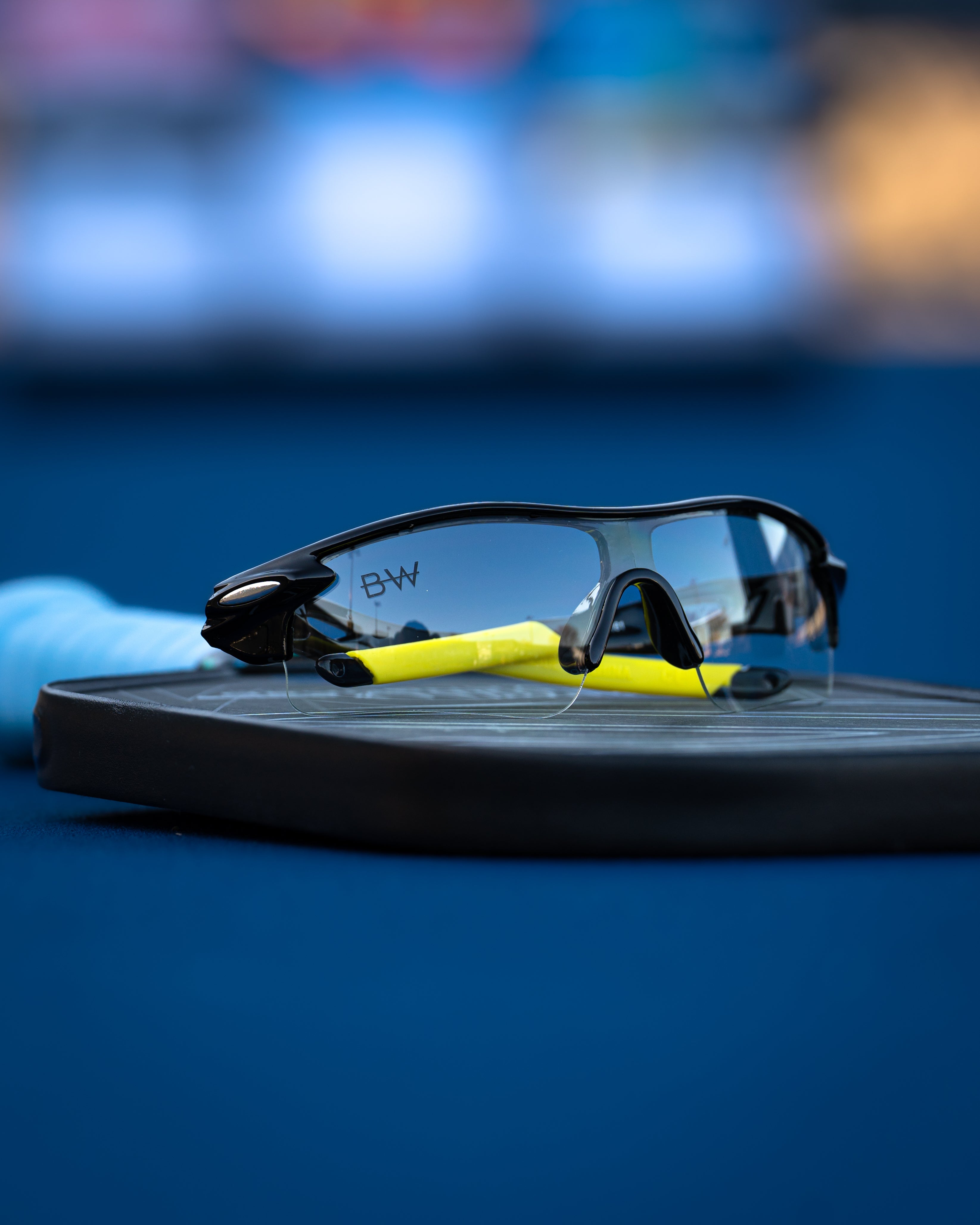
How to Reduce Eye Burn After Long Play 🧘♂️
Share
How to Reduce Eye Burn After Long Pickleball Sessions
After hours of pickleball, some players notice burning, dryness, irritation, a gritty feeling, or general eye discomfort. Long sessions can expose your eyes to a combination of wind, perspiration, environmental conditions, sustained visual attention, and extended time outdoors or under indoor lighting.
There is not one universal cause of post-match "eye burn," and eyewear should not be presented as a cure for an underlying eye condition. However, understanding common sources of irritation can help you make more informed decisions about your playing environment, eyewear, breaks, and post-match routine.
This guide covers practical ways to think about eye comfort during long pickleball sessions, what prescription and non-prescription eyewear can realistically do, and when persistent symptoms deserve professional attention.
Explore Pickleball Eyewear Options
If eyewear is part of your on-court routine, compare prescription and non-prescription options according to your vision needs, playing environment, frame preferences, and individual fit.
What Do Players Mean by "Eye Burn"?
"Eye burn" is an informal description rather than a specific diagnosis. Different players can use the phrase to describe different sensations.
That might include:
- Burning or stinging
- Dryness
- A gritty or sandy sensation
- Watery eyes
- General irritation
- Tired-feeling eyes
- Temporary discomfort after a long session
Because those symptoms can have different causes, avoid assuming that every case is simply "eye strain" or that changing glasses will automatically solve it.
Why Might Your Eyes Burn After Pickleball?
Several conditions associated with long playing sessions can contribute to eye discomfort.
Potential factors can include:
- Wind or moving air around the eyes
- Perspiration reaching the eye area
- Dry environmental conditions
- Heat
- Extended outdoor exposure
- Long periods of sustained visual attention
- Contact lens wear for players who use contacts
- Individual dry-eye tendencies
- Other eye or health conditions
More than one factor can be present during the same session.
Sweat Can Be an Obvious Source of Eye Irritation
Long rallies, warm conditions, and repeated movement can mean more perspiration. If sweat reaches the eye area, it can be uncomfortable.
This is different from claiming that a particular pair of glasses prevents eye burn. Eyewear fit, perspiration, facial anatomy, and movement vary between players.
If sweat is repeatedly reaching your eyes, consider the entire on-court setup rather than assuming your prescription or lens color is responsible.
Wind and Moving Air Can Matter During Outdoor Play
Outdoor pickleball can expose players to wind for extended periods. Some players may notice that their eyes feel drier or more irritated under certain environmental conditions.
The amount of exposure can vary based on:
- Weather
- Court location
- Playing duration
- Individual sensitivity
- Eyewear configuration
Do not assume that a wrap-style appearance or a particular frame completely eliminates wind exposure or prevents dryness.
Heat, Humidity, and Eye Comfort
Hot or humid playing conditions can change the overall experience of a long session, including perspiration and how your eyewear feels.
Heat and humidity should not automatically be described as causing "lens irritation." The lens itself is not necessarily the source of a burning sensation.
Instead, consider the complete environment and your individual symptoms.
Long Sessions Require Sustained Visual Attention
Pickleball repeatedly asks you to watch the ball, opponents, your partner, court positioning, and changing shot trajectories.
However, avoid reducing post-match eye discomfort to "strained focusing from ball tracking." Burning or irritation can have multiple causes.
Likewise, prescription eyewear should not be marketed as preventing eye fatigue simply because it is designed for sports.
Is Blue Light From Court Lights Causing Your Eye Burn?
Do not automatically blame blue light from indoor court lighting, phones, tablets, or coaching displays for post-match burning.
A blue-light filtering feature should also not be assigned to a Blinded Wear product unless that characteristic is specifically documented for the exact lens configuration.
If screen use itself feels uncomfortable after a long session, taking a break from the screen may simply be more comfortable for you. That is different from claiming that blue light is the underlying cause of your symptoms.
Why Can Your Eyes Still Burn While Wearing RX Glasses?
Prescription glasses provide vision correction. They do not make the eyes immune to irritation, dryness, perspiration, environmental exposure, or other potential causes of discomfort.
If your prescription eyewear provides appropriate correction, you could still experience symptoms associated with factors unrelated to the prescription itself.
That distinction matters: experiencing eye burn while wearing RX glasses does not automatically mean the glasses are causing it.
Prescription Correction and Eye Comfort Are Related but Different
Prescription eyewear should provide the correction prescribed for your individual vision needs. It should not be marketed as guaranteeing that your eyes will never feel tired, dry, or irritated during long play.
If you experience persistent visual discomfort, headaches, unusual changes in vision, or symptoms that seem connected to your prescription, consider discussing them with an eye-care professional.
Avoid Making Eye Rubbing Your Default Response
When eyes feel irritated, rubbing them can be tempting. If sweat, dirt, or another irritant is around the eye area, repeatedly rubbing may add to the discomfort.
Instead of automatically rubbing your eyes during a match, take a moment away from play and address the source of the irritation appropriately.
If symptoms are significant, persistent, painful, or accompanied by changes in vision, stop treating them as ordinary post-match discomfort and seek appropriate professional guidance.
Take Breaks During Very Long Playing Sessions
You do not need to follow an arbitrary rule that every player must rest for exactly two minutes after a specific number of minutes.
Instead, pay attention to how you feel during extended play.
A normal break between games can give you an opportunity to:
- Step away from active play
- Address perspiration
- Hydrate
- Check whether your eyewear needs cleaning
- Rest before beginning another game
- Notice whether eye discomfort is improving or worsening
Individual needs vary with playing duration, environment, intensity, and personal health factors.
Do Not Ignore Basic Hydration During Long Play
Long pickleball sessions can involve substantial physical activity, particularly in warm environments.
Maintaining appropriate hydration is part of general athletic preparation and recovery. However, drinking more water should not be presented as a guaranteed treatment for eye burn or dry eye.
If you repeatedly experience significant eye dryness despite otherwise appropriate habits, the underlying issue may deserve individual evaluation.
What About Blinking More Often?
Blinking helps distribute the tear film across the eye's surface. During periods of intense visual attention, simply being conscious of eye comfort can be useful.
You do not need to force yourself into an exact blink schedule while trying to play a point.
During natural breaks, give your eyes an opportunity to relax rather than turning blinking into another performance task.
What About Artificial Tears?
Lubricating eye drops are commonly used for dry-eye symptoms, but the right product and frequency can depend on the individual.
If dryness is frequent enough that you regularly need eye drops during or after sports, consider asking an eye-care professional which type is appropriate for you, particularly if you wear contact lenses or use other eye medications.
A blog about sports eyewear should not diagnose the cause of persistent dryness or prescribe a specific treatment regimen.
Can a Cool Compress Feel Good After a Long Session?
Some people find a clean, comfortably cool compress soothing when their eyes or surrounding area feel tired after activity.
A cool compress should be described as a comfort measure rather than a cure for an unknown cause of eye burning.
Avoid extreme temperatures, and do not use a comfort routine to delay appropriate care for significant pain, injury, persistent redness, or changes in vision.
Warm vs. Cool Compresses: Do Not Treat Them as Interchangeable Cures
The old version of this guide recommended both cooling eye masks and nightly warm compresses as broad recovery strategies.
Different eye symptoms can have different causes, so there is no reason to promise that either temperature-based routine will solve every player's post-match eye burn.
If recurring symptoms are significant enough that you are building a daily treatment routine around them, professional guidance can be more useful than guessing at the underlying cause.
Do You Need to Massage Your Eyelids After Pickleball?
Not as a universal post-match recommendation.
The previous version suggested massaging the eyelids toward the nose to stimulate tear ducts. That should not be presented as a standard recovery technique for every player experiencing eye irritation.
Persistent dryness or irritation can have different causes, and an eye-care professional can provide guidance appropriate to your individual situation.
Do You Need Supplements for Post-Match Eye Burn?
This guide does not recommend adding a supplement solely because your eyes feel irritated after pickleball.
The previous article included omega-3 supplementation as a recovery strategy. Supplement decisions involve individual health considerations and should not be turned into a universal sports-eyewear recommendation.
If you are concerned about persistent dry-eye symptoms, discuss the symptoms and appropriate options with a qualified health professional.
Keep Your Eyewear Clean During Long Sessions
Perspiration, fingerprints, dust, and other debris can accumulate on eyewear during extended play.
Follow appropriate care instructions for your specific eyewear and avoid aggressive cleaning methods that could damage the lenses or frame.
Keeping the lens surface clean can improve your experience looking through the eyewear, but cleaning should not be marketed as a treatment for eye burn.
Skip Saliva as a Lens-Cleaning Method
The previous article referenced using a microfiber cloth for "saliva or sweat spots." A cleaner approach is to follow appropriate lens-care instructions rather than intentionally using saliva to clean eyewear.
A clean microfiber cloth can be useful for appropriate lens care when used according to the eyewear's cleaning guidance.
Store Your Eyewear Properly Between Sessions
After a long session, do not simply throw prescription or non-prescription eyewear loose into a gym bag with paddles, keys, bottles, and other equipment.
Appropriate storage can help reduce unnecessary contact and accidental damage between uses.
Storage does not treat eye discomfort, but taking care of your eyewear is still part of maintaining your overall playing setup.
Do You Need an Anti-Reflective Coating?
The previous version of this article broadly recommended adding an anti-reflective coating and stated that existing RX frames could receive the coating later.
Do not assume that an anti-reflective coating is included with every Blinded Wear RX configuration or that it can automatically be added later to an existing pair.
If a particular coating is important to you, verify current availability for the exact prescription product before ordering.
Anti-Fog and Eye Comfort Are Separate Topics
Fogging can be annoying during play, but anti-fog characteristics should not automatically be presented as a treatment for eye dryness or burning.
Likewise, do not assume every Blinded Wear RX product includes an anti-fog coating unless that feature is documented for the exact product or lens configuration.
Fogging can be influenced by temperature, humidity, airflow, perspiration, surface conditions, and the complete eyewear configuration.
Do Ventilated Frames Prevent Dry Eyes?
No collection-wide or product-specific claim should be made that frame ventilation prevents dry eyes unless there is appropriate support for that exact claim.
Airflow and environmental exposure are more complicated than simply labeling one frame "ventilated."
Choose eyewear according to verified product characteristics, prescription compatibility, fit, comfort, and playing environment rather than an unsupported promise to prevent dryness.
How Should You Choose RX Eyewear for Long Pickleball Sessions?
If you wear prescription correction for extended sessions, prioritize characteristics that can actually be evaluated.
Consider:
- Your current prescription
- Compatibility with the exact RX product
- Available frame dimensions
- Individual bridge and temple fit
- How the frame feels over longer sessions
- Direct RX versus compatible RX Clip configuration
- Available lens configurations
- Your indoor or outdoor playing environment
- Your individual visual and comfort preferences
A frame does not need unsupported medical or performance claims to be worth considering.
Lightweight Frames and Long Sessions
Blinded Wear offers lightweight sports-frame options, which can appeal to players who prefer less perceived bulk during extended play.
However, lightweight construction does not automatically mean:
- No eye fatigue
- No eye dryness
- No pressure
- No frame movement
- No fogging
- Better athletic performance
Individual comfort depends on more than frame weight alone.
High-Index RX Lenses and Long-Session Eyewear
Blinded Wear includes high-index prescription lenses at no additional cost with custom RX eyewear.
High-index refers to a category of prescription lens material commonly used to help manage finished lens thickness, particularly as prescription strength increases.
Finished lens thickness can vary depending on your prescription, frame and lens dimensions, lens geometry, and other optical requirements.
High-index should not be described as automatically preventing eye strain, dryness, or burning.
Impact Resistance Is Different From Eye-Comfort Claims
Blinded Wear offers impact-resistant lens options.
Impact resistance is a physical lens characteristic. It does not mean a lens automatically:
- Prevents eye fatigue
- Prevents dryness
- Prevents burning
- Prevents fogging
- Resists scratches
- Is unbreakable
- Meets a particular safety certification
Keeping these characteristics separate helps players compare eyewear without turning legitimate product features into unsupported health claims.
Current RX Options to Explore
If you need prescription correction for pickleball, compare current frames based on prescription compatibility, dimensions, available lens configuration, individual fit, playing environment, and style.
- Frost RX
- Steel Ice RX
- Zebra II RX
- Blue Shield RX
- Havana Melt RX
- Lava Rock RX
- Gray Wash RX
- Crystal Wave II RX
- Rippled X RX
Browse the full RX Pickleball Glasses Collection for current prescription options.
Havana Melt RX for Long-Session Players
Havana Melt RX is one current direct RX option to compare.
The older version of this guide described Havana Melt RX as providing "minimal pressure." Rather than guaranteeing a particular pressure level for every wearer, evaluate the current frame dimensions and your individual fit.
Comfort is subjective, particularly across several hours of activity.
Crystal Wave II RX Without Unsupported Dry-Eye Claims
Crystal Wave II RX is another current prescription option to explore.
The previous guide claimed that Crystal Wave II RX used ventilation to reduce fog and dryness. Those claims should not be repeated without verified support for the exact product configuration.
Instead, compare Crystal Wave II RX based on its current specifications, prescription compatibility, available dimensions, lens configuration, individual fit preferences, and style.
Why Some Older Product Claims Are Not Repeated Here
The previous guide attached specific eye-comfort benefits to individual frames, including glare protection, blue-light filtering, ventilation, dryness reduction, and anti-fog performance.
Those characteristics should only be attributed to a product when they are verified for the exact current configuration.
This guide therefore focuses on current RX options with supportable characteristics rather than carrying older marketing language forward.
Direct RX vs. RX Clip for Long Playing Sessions
Blinded Wear prescription options can include direct RX and compatible RX Clip configurations.
Direct RX incorporates prescription correction into the direct prescription configuration of a compatible product.
An RX Clip uses a separate inner prescription insert within a compatible eyewear system. The prescription correction is contained in the inner RX clip rather than the primary outer sports lens.
Neither configuration should automatically be promised to prevent:
- Eye burning
- Dryness
- Eye fatigue
- Fogging
- General irritation
Compare them according to your prescription requirements, compatible products, individual fit preferences, available lens configurations, and playing environment.
Clear Lenses for Indoor and Lower-Light Sessions
A clear lens means there is no dark sunglass tint. Some players may prefer that configuration indoors, in the evening, or in lower-light environments.
Clear appearance alone does not establish:
- UV specifications
- Polarization
- Impact resistance
- Anti-fog treatment
- Scratch resistance
- Anti-reflective treatment
- Blue-light filtering
- Safety certification
Clear lenses should also not be promised to prevent eye fatigue or improve ball tracking.
For non-prescription options, browse the Clear Lens Collection.
Tinted Lenses and Eye Comfort
Different tints can change visible-light transmission and color appearance. Players may have different preferences depending on brightness, playing environment, and individual visual preference.
Do not assume that a specific tint automatically prevents eye burning, dryness, or fatigue.
Tint color also does not by itself establish UV specifications, polarization, impact resistance, scratch resistance, or another protective characteristic.
Polarized vs. Non-Polarized Lenses
Polarized lenses are designed to reduce certain reflected light. Blinded Wear also offers non-polarized lens options.
Some players may prefer one configuration over another depending on their environment and individual preferences.
Polarization alone does not determine:
- Eye fatigue
- Dry-eye symptoms
- Reaction time
- Depth perception
- Ball tracking
- Impact resistance
For more lens education, visit the Pickleball Performance Lens Guide.
What if You Play Pickleball in Contact Lenses?
Some players use contact lenses instead of prescription glasses, while others combine contacts with non-prescription sports eyewear.
If you experience recurring dryness, burning, redness, or discomfort while wearing contacts during long sessions, avoid assuming that sports sunglasses alone will solve the issue.
Contact-lens comfort and appropriate wear are individual eye-care matters. Persistent symptoms are worth discussing with an eye-care professional.
When Eye Burn Deserves More Attention
Occasional mild discomfort after a long day is different from significant or persistent eye symptoms.
Consider seeking appropriate professional care if symptoms are severe, persistent, recurrent, associated with an injury, or accompanied by concerning changes such as significant pain or changes in vision.
Eyewear selection can be part of your sports setup, but it should not substitute for evaluation of an ongoing eye problem.
Start by Identifying the Problem Instead of Blaming the Glasses
Post-match eye burn can describe several different symptoms and may have more than one contributing factor.
Wind, perspiration, environmental conditions, contact lens use, extended play, and individual eye-health factors can all be relevant. Prescription eyewear provides correction, but it should not be marketed as a universal treatment for dryness, burning, or eye fatigue.
For players comparing eyewear, focus on prescription compatibility, frame dimensions, individual fit, comfort, verified lens characteristics, and the environment in which you actually play.
Part 2 will go deeper into before-match preparation, during-match comfort habits, post-match recovery, indoor versus outdoor conditions, RX versus contacts, direct RX versus RX Clip, stronger prescriptions, screen use, long tournament days, cleaning and storage, common eye-burn myths, and a practical routine for players who spend hours on court.
Before You Play: Set Up for a Long Pickleball Session
If your eyes regularly feel uncomfortable after several hours of pickleball, think about your routine before the first game rather than waiting until irritation becomes distracting.
A practical pre-play check can include:
- Starting with clean eyewear
- Confirming that your prescription setup feels normal
- Considering the expected indoor or outdoor environment
- Selecting an available lens configuration appropriate for your preferences
- Making sure the frame feels comfortable before extended wear
- Planning normal hydration and rest breaks during a long session
- Bringing another appropriate corrective option if you depend on prescription correction
None of these steps guarantees that your eyes will never feel irritated. They simply reduce the number of avoidable equipment and routine issues you have to address once play begins.
Start With Clean Lenses
Long sessions can add perspiration, fingerprints, dust, and other debris to eyewear. Starting with a clean pair gives you a better baseline for evaluating how the eyewear feels throughout the day.
Follow the appropriate care instructions for your exact eyewear rather than improvising with aggressive cleaners or abrasive materials.
Clean lenses should not be described as preventing eye burn, but proper eyewear care can make the viewing experience more comfortable than looking through a dirty lens surface.
Check the Playing Environment Before Choosing Your Lens Setup
The same lens configuration may not be your preference for every court.
Before a long session, consider:
- Indoor versus outdoor play
- Expected brightness
- Time of day
- Whether conditions may change during the session
- Your individual sensitivity and visual preferences
- Which lens configurations are actually available for your eyewear
Your playing environment is more useful for lens selection than assuming one tint is universally best for preventing tired or irritated eyes.
Long Outdoor Pickleball Sessions
Outdoor players can experience changing conditions over several hours. Brightness, wind, temperature, humidity, and perspiration may all change between the beginning and end of a session.
That makes it useful to evaluate your eyewear as part of the complete environment rather than expecting one frame or lens color to eliminate every source of discomfort.
If symptoms consistently appear only under particular outdoor conditions, that pattern can also be useful information when trying to understand what contributes to your discomfort.
Long Indoor Pickleball Sessions
Indoor players face a different environment, but indoor play does not automatically eliminate eye discomfort.
Some players may prefer a lens without a dark sunglass tint for indoor or lower-light environments. A clear lens simply means there is no dark sunglass tint.
Clear appearance alone should not be interpreted as proof of:
- Blue-light filtering
- Anti-reflective treatment
- Anti-fog treatment
- Impact resistance
- UV specifications
- Polarization
- Scratch resistance
- Safety certification
Likewise, clear lenses should not be promised to prevent eye strain, dryness, or burning.
What if Your Session Spans Different Lighting Conditions?
A long afternoon session can extend into the evening, while tournament players may move between different courts or environments.
Consider whether your chosen lens configuration remains appropriate for the conditions in which you expect to use it.
If you are interested in photochromic or transitional prescription lenses, verify availability for the exact RX product. Do not assume every Blinded Wear RX frame supports every lens configuration.
During Play: Pay Attention Before Mild Irritation Becomes Significant
Players sometimes ignore discomfort because they want to finish another game. A long session gives you multiple opportunities to notice how your eyes and eyewear are feeling.
Between games, consider whether you are experiencing:
- Increasing burning or stinging
- Increasing dryness
- Excessive watering
- A gritty sensation
- Persistent irritation
- Unusual visual discomfort
- Frame pressure that becomes more noticeable over time
Those observations can help distinguish a minor temporary annoyance from a pattern that deserves more attention.
Build Natural Breaks Into Long Sessions
There is no need to force every player into an exact rest schedule. Instead, use natural breaks between games, matches, or drills.
A break can give you time to:
- Step away from active play
- Address perspiration
- Hydrate appropriately
- Check the condition of your eyewear
- Clean the lenses appropriately if necessary
- Rest before another period of activity
- Notice whether your symptoms settle or continue
If discomfort consistently worsens every time you return to play, that pattern may be more informative than simply trying to push through it.
Let Blinking Stay Natural
Blinking helps distribute the tear film across the surface of the eye, but you do not need to count blinks or consciously interrupt every rally to follow an artificial schedule.
During breaks, allow yourself to relax rather than maintaining the same level of visual concentration you use during a point.
If dryness remains a recurring problem despite normal breaks, the underlying cause may deserve individual evaluation.
Address Sweat Before It Reaches Your Eyes
During a long session, perspiration can become a recurring source of discomfort for some players.
If sweat is reaching the eye area, address it during an appropriate break rather than repeatedly rubbing irritated eyes while continuing to play.
Do not assume that changing lens color or prescription configuration will solve a perspiration-related problem. Sweat management and prescription correction are separate issues.
Notice Whether Wind Is Part of the Pattern
If your eyes feel comfortable indoors but repeatedly become dry or irritated during windy outdoor sessions, that difference can be useful information.
It does not establish a diagnosis, but it can help you recognize environmental patterns.
Likewise, do not assume a particular frame completely blocks wind simply because it has a curved or sports-oriented appearance.
Hydration Is Part of the Bigger Athletic Routine
Hydration matters during extended physical activity, especially in warm conditions. Treat it as part of your overall playing routine rather than a guaranteed treatment for eye symptoms.
If your eyes repeatedly feel dry or irritated despite otherwise appropriate hydration and breaks, simply drinking more water may not address the actual cause.
RX Glasses vs. Contacts During Long Sessions
Players who need prescription correction have several possible approaches. There is no universal option that prevents eye burn for everyone.
| Correction Option | Why Someone Might Choose It | What to Consider During Long Play |
|---|---|---|
| Everyday prescription glasses | Familiar and already owned | Individual fit, comfort, and suitability for your activity |
| Direct RX sports eyewear | Dedicated prescription sports setup | Prescription compatibility, frame dimensions, fit, lens configuration, and extended comfort |
| Compatible RX Clip system | Correction through a separate inner prescription insert | Compatibility, individual fit, prescription requirements, and outer lens configuration |
| Contact lenses | Keeps correction separate from the eyewear frame | Individual contact-lens comfort and appropriate wear |
| Contacts + non-RX sports eyewear | Separates prescription correction from sports-eyewear selection | Contact-lens comfort plus the characteristics of the outer eyewear |
If one corrective approach repeatedly coincides with significant discomfort, discuss your individual symptoms with an eye-care professional rather than assuming another sports frame is automatically the solution.
Contact Lens Wearers Should Treat Recurring Burning Seriously
If you wear contacts for pickleball, recurring burning, dryness, redness, or irritation during long sessions should not simply be dismissed as normal athletic discomfort.
Contact-lens type, wear time, environment, individual eye health, and other factors can influence comfort.
A sports-eyewear guide cannot determine which contact lens or wear schedule is appropriate for you. If symptoms are persistent, professional guidance is the more appropriate next step.
Direct RX vs. RX Clip for Extended Play
Direct RX and RX Clip configurations organize prescription correction differently, but neither should automatically be described as preventing eye fatigue or irritation.
| Consideration | Direct RX | RX Clip |
|---|---|---|
| Prescription correction | Incorporated into the direct RX configuration | Contained in a separate inner prescription insert |
| High-index RX lenses | Included at no additional cost | Included at no additional cost in the custom RX clip |
| Prescription compatibility | Verify for the exact product | Verify for the exact compatible system |
| Automatically prevents dry eyes? | No | No |
| Automatically prevents eye fatigue? | No | No |
| Automatically prevents fogging? | No | No |
Stronger Prescriptions and Long-Session Eyewear
Players with stronger prescriptions may pay particular attention to prescription compatibility and finished lens characteristics.
Blinded Wear includes high-index prescription lenses at no additional cost with custom RX eyewear.
High-index lens material is commonly used to help manage finished lens thickness, particularly as prescription strength increases. Final thickness can still depend on:
- Your individual prescription
- Lens dimensions
- Frame dimensions
- Lens geometry
- Other optical requirements
High-index should not be presented as a treatment for eye strain, dryness, burning, or fatigue.
What if Your Prescription Includes Astigmatism Correction?
If your prescription includes cylinder and axis values, those values are part of your individual prescription requirements.
Astigmatism does not automatically mean you need a specific frame color, tint, or sports-eyewear configuration.
Confirm compatibility with the exact RX product rather than choosing based on a generalized claim about eye comfort.
Progressive and Specialized Prescription Needs
Do not assume every RX product supports every progressive, multifocal, or specialized prescription.
If you require a specialized prescription configuration, verify compatibility with the exact product before ordering.
This is particularly important because customized RX eyewear is final sale.
Sometimes "Eye Fatigue" Is Actually Eyewear Discomfort
After several hours, discomfort around the bridge, temples, or behind the ears can become more noticeable.
That physical frame pressure is different from dryness or burning on the surface of the eye.
When evaluating a long-session setup, ask:
- Do my eyes themselves feel irritated?
- Does the frame feel uncomfortable?
- Am I feeling pressure around the temples?
- Is the bridge becoming uncomfortable?
- Is the discomfort associated with perspiration?
- Does removing the eyewear change what I am feeling?
Separating these sensations can help you describe the problem more accurately.
Lightweight Does Not Automatically Mean No Fatigue
Blinded Wear offers lightweight sports-frame options. Some players may prefer less perceived bulk during several hours of play.
However, lightweight construction does not guarantee:
- No bridge pressure
- No temple pressure
- No dry-eye symptoms
- No eye burning
- No visual discomfort
- No frame movement
Evaluate the complete frame rather than relying on weight alone.
Use a Full Session to Evaluate Comfort
A frame that feels comfortable for five minutes may feel different after several games.
During a normal session, evaluate:
- Initial comfort
- Bridge pressure
- Temple pressure
- Comfort behind the ears
- How perspiration affects the fit
- Whether you repeatedly reposition the frame
- Whether comfort changes as the session continues
This evaluates your individual experience with the frame. It does not prove that the eyewear prevents eye fatigue or other symptoms.
Do Certain Lens Colors Prevent Eye Burn?
No tint should universally be promised to prevent burning, dryness, or eye fatigue.
Different tints can change visible-light transmission and color appearance. Individual preferences can vary according to brightness, environment, and personal visual preference.
Keep these characteristics separate:
- Tint color
- Tint darkness
- Polarization
- UV specifications
- Impact resistance
- Anti-fog characteristics
- Scratch characteristics
- Anti-reflective characteristics
One does not automatically establish the others.
Does Polarization Prevent Eye Fatigue?
Polarized lenses are designed to reduce certain reflected light, but polarization should not be presented as a universal treatment for eye fatigue or burning.
Some players may prefer polarized lenses in certain environments, while others may prefer non-polarized options.
Polarization alone does not determine:
- Eye comfort
- Dry-eye symptoms
- Reaction time
- Depth perception
- Contrast
- Ball tracking
Blinded Wear offers non-polarized lens options. Compare the actual configuration available for the product you are considering.
Should You Avoid Screens After a Long Match?
You do not need to assume that post-match screen use is damaging your eyes or that blue light is responsible for your pickleball-related discomfort.
However, if looking at your phone or another display feels uncomfortable immediately after a long session, taking a break from the screen may simply feel better.
That subjective comfort choice is different from claiming that avoiding screens treats an underlying eye condition.
Do You Need Blue-Light Filtering Pickleball Glasses?
A blue-light filtering feature should only be claimed when it is documented for the exact lens configuration.
Do not choose a frame based on an unsupported promise that blue-light filtering will prevent post-match burning, improve recovery, or reduce athletic eye fatigue.
If screen use is a significant part of your routine and you have persistent visual discomfort, discuss your individual symptoms with an eye-care professional.
After Play: Start With a Simple Recovery Routine
After a long session, recovery does not need to become complicated.
A practical routine can include:
- Finish the session and step away from active play.
- Address perspiration around the face and eye area appropriately.
- Hydrate as part of your normal athletic recovery.
- Remove or change eyewear when appropriate for your situation.
- Clean your eyewear according to appropriate care instructions.
- Store the eyewear appropriately.
- Notice whether eye discomfort begins to improve after the session ends.
If symptoms do not improve, repeatedly return after play, or become significant, a more individualized evaluation may be appropriate.
Using a Cool Compress for Comfort
Some people find a clean, comfortably cool compress soothing around tired or irritated eyes after activity.
Think of this as a comfort measure rather than a treatment for every possible cause of eye burning.
Avoid extreme temperatures and do not use a compress to delay appropriate evaluation of significant pain, injury, persistent redness, or changes in vision.
What if You Regularly Reach for Artificial Tears?
Lubricating eye drops are commonly used for dry-eye symptoms, but individual needs can vary.
If you repeatedly need eye drops during or after pickleball, particularly if you wear contact lenses or use other eye medications, consider asking an eye-care professional which products and usage patterns are appropriate for you.
The goal is to avoid turning a recurring symptom into a self-diagnosed condition based solely on a sports blog.
Eye Comfort During an All-Day Pickleball Tournament
Tournament days can involve much more total time at the venue than a normal recreational session.
Your day may include warmups, multiple matches, waiting periods, outdoor exposure, indoor play, travel, and screen use between matches.
Prepare for the entire day rather than only the first match.
- Begin with eyewear you have already used in practice.
- Know which prescription correction you will rely on.
- Bring another appropriate corrective option if necessary.
- Use natural breaks between matches.
- Address perspiration appropriately.
- Keep eyewear clean using appropriate care methods.
- Store eyewear appropriately when it is not being worn.
- Pay attention if minor irritation becomes progressively worse.
Bring a Backup if You Depend on Prescription Correction
If you depend on prescription correction, losing access to your only corrective option can create a practical problem during a long tournament day.
Depending on your individual needs, a backup could be another prescription pair or another corrective option you already use.
A backup does not prevent eye burn and does not mean your primary pair is expected to fail. It simply gives you another option if the primary setup becomes unavailable or damaged.
Keep Your Lens-Care Routine Simple During Competition
Repeatedly wiping lenses with whatever material happens to be nearby can be a poor substitute for appropriate eyewear care.
Follow the cleaning guidance appropriate for your specific eyewear. Avoid intentionally using saliva as a lens-cleaning solution.
If your lenses repeatedly collect sweat or debris, address them during a break rather than trying to clean them while actively playing.
Protect Your Eyewear Between Matches
Tournament bags can contain paddles, balls, bottles, keys, clothing, and other equipment. Loose eyewear can come into contact with those objects while you move around the venue.
Use appropriate storage rather than leaving prescription eyewear unprotected in a crowded bag.
Proper storage does not treat eye irritation, but it can help avoid unnecessary equipment damage during an already long day.
Common Mistakes When Trying to Fix Post-Match Eye Burn
Mistake #1: Assuming the Glasses Must Be the Cause
Eye discomfort can have multiple contributing factors. Wearing glasses while symptoms occur does not prove that the eyewear caused them.
Mistake #2: Assuming a Different Tint Will Cure the Problem
Lens tint can change visible-light transmission and color appearance, but it should not be treated as a universal dry-eye or eye-burn treatment.
Mistake #3: Blaming Blue Light Automatically
Do not assume court lighting or a coaching tablet is the underlying cause of burning simply because it produces visible light.
Mistake #4: Rubbing Irritated Eyes Repeatedly
If perspiration or debris is involved, repeatedly rubbing the area may add to the discomfort.
Mistake #5: Assuming Every Sports Frame Is Anti-Fog
Anti-fog characteristics should only be claimed when verified for the exact product or lens configuration.
Mistake #6: Assuming Ventilation Prevents Dry Eye
A frame should not be promised to prevent dryness solely because of its shape or an unverified ventilation claim.
Mistake #7: Treating Supplements as the Automatic Answer
Recurring eye symptoms deserve more individualized consideration than simply adding a supplement because a sports article recommends it.
Mistake #8: Ignoring Contact-Lens Discomfort
Persistent burning or dryness while wearing contacts should not automatically be dismissed as a normal consequence of exercise.
Mistake #9: Continuing Through Significant Symptoms
Severe pain, injury, significant persistent redness, or changes in vision should not be treated as ordinary post-match fatigue.
A Practical Long-Play Eye-Comfort Routine
Before Play
- Start with clean eyewear.
- Use your appropriate prescription correction.
- Choose an available lens configuration that suits your environment and preferences.
- Make sure the frame initially feels comfortable.
- Prepare for normal hydration and breaks.
During Play
- Use natural breaks between games.
- Address perspiration appropriately.
- Keep eyewear reasonably clean.
- Notice whether irritation is increasing.
- Pay attention to frame pressure separately from eye-surface symptoms.
After Play
- Allow yourself to recover from the session.
- Address perspiration around the face and eyes appropriately.
- Hydrate as part of normal athletic recovery.
- Clean and store eyewear appropriately.
- Notice whether symptoms improve after play ends.
- Seek appropriate professional guidance when symptoms are significant, persistent, recurrent, associated with injury, or accompanied by concerning visual changes.
RX Options for Players Who Spend Hours on Court
No RX frame should be declared the universal best choice for preventing eye burn. Instead, compare current options according to prescription compatibility, dimensions, available lens configuration, individual fit, extended comfort, playing environment, and style.
- Frost RX
- Steel Ice RX
- Zebra II RX
- Blue Shield RX
- Havana Melt RX
- Lava Rock RX
- Gray Wash RX
- Crystal Wave II RX
- Rippled X RX
Browse the full RX Pickleball Glasses Collection for current prescription options.
Need Help Narrowing Your Eyewear Options?
Use the Pickleball Sunglasses Quiz to organize your preferences and narrow your options.
You can also explore the 2026 Pickleball Glasses Hub or the Pickleball Performance Lens Guide.
A quiz can help organize eyewear preferences, but it cannot diagnose the cause of recurring eye irritation or replace prescription-compatibility verification.
How to Order Blinded Wear RX Eyewear
- Browse the RX Pickleball Glasses Collection.
- Select the RX product you want to explore.
- Review its current specifications, dimensions, and RX configuration.
- Confirm compatibility with your prescription requirements.
- Have your current eyeglass prescription ready.
- Upload a clear photo or picture of your prescription on the product page before adding the eyewear to your cart.
- Review your customized selection carefully before purchasing.
For additional guidance, visit How to Order RX Glasses.
Customized RX Eyewear Is Final Sale
Blinded Wear offers a 30-day return policy for eligible standard purchases, but customized RX eyewear is final sale and excluded from the standard 30-day return policy.
Before ordering custom RX eyewear, review:
- Your prescription information
- Prescription compatibility
- The exact frame
- Available dimensions
- Direct RX or RX Clip configuration
- Current lens options
- Your normal playing environment
- Your individual fit preferences
Custom RX final-sale status is separate from applicable 50% lifetime replacement support for eligible broken eyewear.
Review the Blinded Wear Protection Plan, Replacement & Returns information for current policy details.
Think in Terms of Patterns, Not One Universal Fix
Post-match eye burn can be frustrating, but the most useful response is not automatically buying a darker tint, adding an unverified coating, taking a supplement, or assuming a particular frame will eliminate the problem.
Pay attention to when symptoms appear, where you are playing, whether you use contacts or RX glasses, how long you have been active, whether perspiration or wind is involved, and whether the discomfort improves after play ends.
For eyewear, focus on verified characteristics: prescription compatibility, frame dimensions, individual fit, long-session comfort, high-index prescription lenses, impact-resistant lens options, and the lens configurations actually available for the exact product.
Part 3 will complete the guide with a comprehensive eye-burn FAQ, dryness and irritation myths versus facts, eyewear claims to avoid, RX and contact-lens questions, tint and polarization FAQs, artificial-tear and compress guidance, warning signs, tournament recovery checklists, eyewear care, replacement support, ordering resources, and a final decision framework for players dealing with eye discomfort after long pickleball sessions.
Eye Burn After Long Pickleball Sessions: FAQ
Burning, dryness, irritation, watering, or a gritty feeling after hours on court can have more than one possible cause. Eyewear can be part of your overall playing setup, but prescription glasses, sunglasses, lens colors, and coatings should not be presented as universal treatments for recurring eye symptoms.
Why do my eyes burn after playing pickleball for hours?
There is no single explanation that applies to every player. Environmental conditions, wind, perspiration, extended activity, contact lens wear, individual dry-eye tendencies, and other eye-health factors may be relevant.
Does eye burn mean I have dry eyes?
Not necessarily. Burning can be one symptom associated with dryness, but an informal description such as "eye burn" is not enough to identify the underlying cause.
Can my eyes burn even when I wear prescription glasses?
Yes. Prescription eyewear provides vision correction. It does not make your eyes immune to environmental irritation, perspiration, dryness, or other potential causes of discomfort.
Does eye burn mean my prescription is wrong?
Not automatically. However, persistent visual discomfort, headaches, unusual changes in vision, or symptoms that seem connected to your prescription are reasonable reasons to discuss your experience with an eye-care professional.
Should I keep playing if my eyes start burning?
Mild temporary discomfort and significant symptoms are not the same thing. If symptoms become severe, persistent, painful, associated with an injury, or accompanied by concerning changes in vision, stop treating them as ordinary post-match discomfort and seek appropriate professional care.
Eye Burn Myths vs. Facts
| Myth | What to Know |
|---|---|
| "Sports glasses prevent eye burn." | Sports eyewear should not be presented as a universal treatment for burning or irritation. |
| "Burning always means dry eye." | Similar symptoms can have different causes. |
| "A darker tint prevents eye fatigue." | Tint darkness does not automatically prevent fatigue, dryness, or burning. |
| "Blue light from the court is causing the problem." | Do not automatically attribute post-match burning to blue light. |
| "Polarized lenses prevent eye strain." | Polarization is designed to reduce certain reflected light and should not be presented as a universal eye-strain treatment. |
| "High-index lenses reduce eye fatigue." | High-index primarily relates to refractive index and prescription lens thickness management. |
| "Anti-fog means anti-dry-eye." | Fogging characteristics and eye-surface symptoms are separate topics. |
| "A ventilated frame prevents dryness." | A frame should not be promised to prevent dry-eye symptoms solely because of its shape or airflow characteristics. |
| "Drinking more water will always fix eye burn." | Hydration is part of general athletic care but is not a guaranteed treatment for recurring eye symptoms. |
| "Recurring burning is just part of playing for hours." | Persistent or significant symptoms should not automatically be dismissed as normal. |
What Pickleball Eyewear Can and Cannot Do
| What You Can Evaluate | What Should Not Be Guaranteed |
|---|---|
| Prescription correction through compatible RX configurations | Elimination of eye burning |
| Lightweight sports-frame options | Zero eye fatigue |
| High-index prescription lenses included at no additional cost | High-index preventing dryness or irritation |
| Impact-resistant lens options | Impact resistance treating eye discomfort |
| Direct RX and compatible RX Clip options | One prescription configuration preventing dry eye |
| Different available lens appearances and configurations | A specific tint curing eye fatigue |
| Non-polarized lens options | Non-polarized lenses eliminating eye strain |
| Individual frame fit and comfort | One frame preventing irritation for every wearer |
Dryness and Irritation FAQ
Can wind contribute to uncomfortable eyes during outdoor pickleball?
Some players may notice more dryness or irritation under windy conditions. Individual experience can vary with environment, playing duration, eyewear configuration, and personal sensitivity.
Can sweat cause eye discomfort?
Perspiration reaching the eye area can be uncomfortable. Address sweat appropriately during breaks rather than assuming the prescription or lens tint is responsible.
Can heat and humidity matter?
Hot or humid conditions can change perspiration and the overall experience of a long playing session. They should not automatically be described as causing "lens irritation."
Can indoor players still experience eye discomfort?
Yes. Moving indoors removes some outdoor environmental factors but does not guarantee that dryness, burning, irritation, or other symptoms will disappear.
Can a sports frame completely block wind?
Do not assume that a sports-oriented or curved frame completely eliminates wind exposure.
Prescription Eyewear and Eye Burn FAQ
Will RX pickleball glasses prevent eye burn?
No. Prescription eyewear provides corrective vision through a compatible prescription configuration. It should not be presented as a treatment for eye burning.
Can the right prescription help me see appropriately without eliminating dryness?
Yes. Prescription correction and eye-surface comfort are separate considerations. Appropriate correction does not guarantee that your eyes will never become dry or irritated.
Does Blinded Wear include high-index prescription lenses?
Yes. Blinded Wear includes high-index prescription lenses at no additional cost with custom RX eyewear.
Do high-index lenses reduce eye strain?
High-index should not automatically be marketed as reducing eye strain. It refers to a category of prescription lens material commonly used to help manage finished lens thickness, particularly as prescription strength increases.
Are stronger prescriptions automatically less comfortable for long play?
No universal conclusion should be made based only on prescription strength. Prescription compatibility, lens geometry, frame dimensions, fit, and individual needs can all matter.
Does every prescription work with every RX product?
No. Verify compatibility with the exact product and your individual prescription requirements.
Direct RX vs. RX Clip FAQ
Which is better for preventing eye burn?
Neither configuration should be declared universally better for preventing burning, dryness, or irritation.
How does direct RX work?
Direct RX incorporates prescription correction into the direct prescription configuration of a compatible product.
How does an RX Clip work?
An RX Clip uses a separate inner prescription insert within a compatible eyewear system. Prescription correction is contained in the inner RX clip rather than the primary outer sports lens.
Can I attach an RX Clip to any sunglasses?
No. RX Clips should be used within compatible eyewear systems rather than assumed compatible with arbitrary sunglasses.
Are high-index lenses included in a custom RX Clip?
Yes. High-index prescription lenses are included at no additional cost in Blinded Wear custom RX Clip configurations.
Contact Lens FAQ for Long Pickleball Sessions
Can contact lens wearers experience burning during long play?
Yes. If you experience recurring burning, dryness, redness, or discomfort while wearing contacts during sports, do not automatically dismiss the symptoms as normal.
Should I switch from contacts to RX glasses because my eyes burn?
A sports-eyewear guide cannot determine which corrective option is appropriate for your individual eyes. Persistent contact-lens discomfort is better discussed with an eye-care professional.
Can I wear contacts with non-RX sports eyewear?
Some players use contact lenses for prescription correction and separate non-prescription sports eyewear. Whether contacts are appropriate for you is an individual eye-care question.
Will sunglasses fix contact-lens dryness?
Do not assume that adding sunglasses will resolve recurring contact-lens discomfort.
Lens Tint and Eye Comfort FAQ
Which tint is best for reducing eye burn?
No tint should universally be described as preventing eye burn. Different tints can change visible-light transmission and color appearance, and preferences can vary by environment and individual wearer.
Does a darker tint mean better eye protection?
Tint darkness alone does not establish UV specifications, impact resistance, or safety certification.
Does a darker tint prevent eye fatigue?
Not automatically. Do not treat tint darkness as a universal eye-fatigue solution.
Are clear lenses better for tired eyes indoors?
A clear lens avoids a dark sunglass tint. That does not establish that it reduces fatigue, prevents dryness, or treats irritation.
Does lens color improve ball tracking when my eyes are tired?
Different tints can change visible-light transmission and color appearance, but a particular lens color should not universally be promised to improve ball tracking.
Polarization and Eye Comfort FAQ
What do polarized lenses do?
Polarized lenses are designed to reduce certain reflected light.
Do polarized lenses prevent eye burn?
They should not be presented as a universal treatment for burning or irritation.
Are non-polarized lenses better for eye comfort?
Some players may prefer non-polarized eyewear, but polarization status alone does not determine eye comfort.
Does polarization determine UV specifications?
No. Polarization and UV characteristics are separate.
Does polarization determine impact resistance?
No. Polarization and impact resistance are separate characteristics.
Can polarized lenses affect how a screen looks?
Polarized lenses can interact with some digital displays depending on display technology, viewing angle, and orientation.
Blue Light and Screen FAQ
Does blue light from indoor court lighting cause eye burn?
Do not automatically attribute post-match burning to blue light from court lighting.
Do Blinded Wear RX glasses automatically filter blue light?
No collection-wide blue-light filtering claim should be made. That characteristic should only be stated when documented for the exact lens configuration.
Should I stop using my phone after playing?
If looking at a screen feels uncomfortable after a long session, taking a break may simply feel better. That is different from claiming that post-match screen use is causing damage or that avoiding screens treats an underlying condition.
Do I need blue-light glasses for coaching tablets?
Do not assume that a blue-light filtering product is necessary solely because you use a tablet between matches.
Anti-Reflective Coating FAQ
Does every Blinded Wear RX lens include anti-reflective coating?
Do not assume a collection-wide anti-reflective feature unless it is documented for the exact lens configuration.
Can I add anti-reflective coating to my existing RX pair later?
Do not assume an existing custom RX configuration can automatically receive a coating after purchase. Verify current options for the exact product before ordering.
Does anti-reflective coating cure eye fatigue?
No coating should be presented as a universal cure for eye fatigue or post-match eye burning.
Fogging and Eye Burn FAQ
Is lens fog the same thing as dry eye?
No. Lens fogging and eye-surface dryness are separate issues.
Are all Blinded Wear RX glasses anti-fog?
No collection-wide anti-fog claim should be made unless the feature is verified for the exact product or configuration.
Does anti-fog treatment prevent eye irritation?
An anti-fog characteristic should not automatically be presented as preventing eye burning, dryness, or irritation.
Can fogging occur during long play?
Fogging can be influenced by temperature, humidity, airflow, perspiration, surface conditions, and the complete eyewear configuration.
Artificial Tears and Eye Drops FAQ
Can lubricating eye drops be used for dry-eye symptoms?
Lubricating eye drops are commonly used for dry-eye symptoms, but the appropriate product and frequency can vary by individual.
Should every pickleball player use artificial tears after playing?
No. There is no reason to make eye drops a universal post-match recommendation.
What if I use eye drops every time I play?
If recurring symptoms lead you to regularly use eye drops during or after sports, consider asking an eye-care professional which products and usage patterns are appropriate for you.
What if I wear contact lenses?
Contact-lens wear can affect which eye-care products are appropriate. Seek individualized guidance rather than assuming every lubricating product is suitable for your situation.
Cool and Warm Compress FAQ
Can I use a cool compress after playing?
Some people find a clean, comfortably cool compress soothing around tired or irritated eyes after activity. Treat it as a comfort measure rather than a cure for an unknown cause of eye burning.
Should the compress be extremely cold?
Avoid extreme temperatures around the eye area.
Should every player use a warm compress at night?
No. A nightly warm compress should not be prescribed as a universal recovery routine for every player experiencing post-match eye discomfort.
Can a compress replace professional evaluation?
No. A comfort measure should not delay appropriate evaluation of significant pain, injury, persistent redness, or concerning changes in vision.
Supplements and Eye Recovery FAQ
Should I take omega-3 supplements because my eyes burn after pickleball?
This guide does not recommend adding a supplement solely because you experience post-match eye irritation.
Why not recommend a supplement to everyone?
Recurring eye symptoms can have different causes, while supplement decisions involve individual health considerations. A universal recommendation would oversimplify both issues.
What should I do if dryness keeps returning?
Persistent or recurring symptoms are a better reason to seek individualized professional guidance than to assume a supplement will address the underlying cause.
When Eye Discomfort Should Not Be Treated as Normal Post-Match Fatigue
A sports-eyewear article cannot determine the cause of an individual eye symptom. Some situations deserve more attention than a routine recovery checklist.
Seek appropriate professional care when symptoms are significant, persistent, recurrent, associated with an eye injury, or accompanied by concerning changes such as substantial pain or changes in vision.
If something gets into your eye, your eye is struck, or you experience an abrupt visual change during play, do not assume that the problem is simply ordinary "eye burn" from a long session.
Pay Attention to Patterns When Symptoms Keep Returning
If eye discomfort happens repeatedly, consider what is consistent about the sessions in which it occurs.
Useful questions include:
- Does it happen indoors, outdoors, or both?
- Does it happen mainly on windy days?
- Does it begin after a particular amount of playing time?
- Is perspiration reaching my eye area?
- Am I wearing contact lenses when it occurs?
- Does it happen with RX glasses as well?
- Do my eyes feel dry, watery, gritty, burning, or painful?
- Does the discomfort improve after I stop playing?
- Does it recur during most long sessions?
- Are there any changes in vision?
These observations do not diagnose the problem, but they can help you describe your experience more clearly if professional evaluation becomes necessary.
Before-Play Eye Comfort Checklist
- Start with clean eyewear.
- Use the corrective setup appropriate for your prescription needs.
- Consider the expected playing environment.
- Choose from the lens configurations actually available for your eyewear.
- Make sure the frame initially feels comfortable.
- Prepare for normal hydration during extended activity.
- Bring appropriate eyewear-care items.
- Consider a backup corrective option if you depend on prescription correction.
During-Play Eye Comfort Checklist
- Use natural breaks between games and matches.
- Address perspiration around the eye area appropriately.
- Clean eyewear appropriately when necessary.
- Avoid repeatedly rubbing irritated eyes.
- Notice whether symptoms are increasing or remaining mild.
- Separate frame pressure from burning or dryness of the eyes themselves.
- Notice whether wind or another environmental condition seems relevant.
- Do not continue treating severe or unusual symptoms as routine fatigue.
Post-Match Eye Recovery Checklist
- Step away from active play.
- Address perspiration around your face and eye area appropriately.
- Hydrate as part of your normal athletic recovery.
- Remove or change eyewear when appropriate for your situation.
- Clean your eyewear using appropriate care methods.
- Store the eyewear appropriately.
- Give yourself time to recover from the session.
- Notice whether the discomfort begins to improve.
- Pay attention if the same symptoms repeatedly return.
- Seek appropriate professional guidance for significant, persistent, recurrent, injury-related, or visually concerning symptoms.
All-Day Tournament Eye Comfort Checklist
A tournament may involve much more total time than a normal recreational session, so plan for the full day rather than only your first match.
- Use eyewear you have already worn during practice.
- Know which prescription correction you will rely on.
- Consider another appropriate corrective option as a backup.
- Use natural breaks between matches.
- Address perspiration appropriately.
- Keep eyewear clean using appropriate methods.
- Store eyewear appropriately between uses.
- Pay attention to changing outdoor or indoor conditions.
- Notice whether mild irritation becomes progressively worse.
- Do not let tournament pressure turn a significant eye symptom into something you simply ignore.
Eyewear Care After a Long Session
Taking care of the eyewear itself is different from treating eye discomfort, but both can be part of your post-match routine.
After play:
- Follow appropriate cleaning instructions for your eyewear.
- Avoid abrasive cleaning materials.
- Avoid intentionally using saliva as a lens cleaner.
- Inspect the frame and lenses if the eyewear experienced an accidental impact.
- Store the eyewear appropriately instead of leaving it loose with other equipment.
Good eyewear care can help maintain the equipment you rely on without turning cleaning into a medical treatment claim.
What if Your Eyewear Takes a Hit During Play?
If your prescription or non-prescription eyewear experiences a significant accidental impact, inspect it before continuing to rely on it.
Look for obvious changes such as:
- Visible frame damage
- Visible lens damage
- A lens that no longer appears properly positioned
- Loose or visibly damaged components
- An obvious change in frame alignment
- A noticeable change in how the eyewear sits on your face
Do not intentionally continue stressing damaged eyewear to test how much more force it can withstand.
Remember the Custom RX Policy Before Ordering
Blinded Wear offers a 30-day return policy for eligible standard purchases. Customized RX eyewear is final sale and excluded from the standard 30-day return policy.
Before purchasing custom RX eyewear, review:
- Your prescription information
- Prescription compatibility
- The exact frame
- Available frame dimensions
- Direct RX or RX Clip configuration
- Current lens options
- Your normal playing environment
- Your individual fit preferences
Custom RX final-sale status is separate from applicable 50% lifetime replacement support for eligible broken eyewear.
50% Lifetime Replacement Support for Eligible Broken Eyewear
Blinded Wear offers 50% lifetime replacement support if eligible glasses break, subject to current policy terms.
For an eligible claim, the damaged eyewear must be returned. Once the applicable claim and return requirements are satisfied, qualifying customers can receive 50% credit toward a replacement pair.
This is not a free full replacement.
For damaged RX eyewear, contact blindedwearco@gmail.com before returning the pair.
Review the Blinded Wear Protection Plan, Replacement & Returns information for current eligibility and policy details.
Replacement Support FAQ
Does the replacement policy cover eye irritation?
The replacement support discussed here concerns eligible broken eyewear. Do not assume that eye discomfort by itself creates an eligible replacement claim.
What if my RX glasses break?
Eligible broken eyewear may qualify for 50% lifetime replacement support, subject to current policy terms.
Do I return the damaged pair?
Yes. Eligible damaged eyewear must be returned as part of the applicable replacement process.
What should I do with damaged RX eyewear?
Contact blindedwearco@gmail.com before returning the prescription pair.
Do I receive a free replacement?
No. Once applicable requirements are satisfied, eligible support provides 50% credit toward a replacement pair.
Does a new prescription automatically qualify for replacement support?
No. A prescription change by itself should not automatically be treated as an eligible broken-eyewear replacement claim.
Current RX Options for Long-Session Players
No single frame should be presented as the universal solution to eye burn. If you need prescription correction for pickleball, compare current RX options according to prescription compatibility, dimensions, lens configuration, individual fit, extended comfort, playing environment, and style.
- Frost RX
- Steel Ice RX
- Zebra II RX
- Blue Shield RX
- Havana Melt RX
- Lava Rock RX
- Gray Wash RX
- Crystal Wave II RX
- Rippled X RX
Browse the full RX Pickleball Glasses Collection for current prescription options.
How to Order Blinded Wear RX Glasses
- Browse the RX Pickleball Glasses Collection.
- Select the RX product you want to explore.
- Review its current specifications, dimensions, and RX configuration.
- Confirm compatibility with your prescription requirements.
- Have your current eyeglass prescription ready.
- Upload a clear photo or picture of your prescription on the product page before adding the eyewear to your cart.
- Review your customized selection carefully before purchasing.
For a complete walkthrough, visit How to Order RX Glasses.
More Pickleball Eyewear Resources
- RX Pickleball Glasses — Compare current prescription eyewear.
- Non-RX Pickleball Sunglasses — Explore non-prescription sports eyewear.
- Clear Lens Collection — Browse non-prescription clear-lens options.
- 2026 Pickleball Glasses Hub — Compare broader RX and non-RX eyewear categories.
- Best Pickleball Sunglasses 2026 — Explore the broader sunglasses guide.
- Pickleball Performance Lens Guide — Learn about lens colors, clarity, and RX options.
- Pickleball Sunglasses Quiz — Narrow eyewear options according to your preferences.
- How to Order RX Glasses — Review the prescription ordering process.
- Protection Plan, Replacement & Returns — Review current policy information.
A Better Way to Think About Eye Burn After Long Play
If your eyes feel uncomfortable after hours of pickleball, avoid jumping immediately to one explanation.
Instead, work through the situation logically:
- Describe the symptom. Is it burning, dryness, watering, grittiness, pressure, pain, or something else?
- Look at the environment. Were you indoors, outdoors, in wind, heat, or changing conditions?
- Consider perspiration. Was sweat repeatedly reaching the eye area?
- Consider your corrective setup. Were you wearing contacts, everyday prescription glasses, direct RX eyewear, or an RX Clip system?
- Separate frame discomfort from eye symptoms. Pressure at the bridge or temples is not the same as burning on the eye's surface.
- Consider duration. Does discomfort only appear during unusually long sessions?
- Notice recovery. Does it improve after play ends?
- Watch for recurrence. Does the same pattern happen repeatedly?
- Take significant symptoms seriously. Persistent, severe, injury-related, or visually concerning symptoms deserve appropriate professional attention.
Reduce Avoidable Irritation Without Overpromising What Eyewear Can Do
Long pickleball sessions can expose your eyes and eyewear to hours of movement, perspiration, changing environmental conditions, and sustained visual attention.
A sensible routine includes appropriate prescription correction when needed, comfortable eyewear, verified lens characteristics, natural breaks, normal athletic hydration, appropriate eyewear cleaning and storage, and attention to recurring symptoms.
What it does not require is assuming that one frame, tint, coating, supplement, or recovery trick will eliminate eye burn for every player.
If you are choosing new eyewear, start with the characteristics you can actually evaluate: prescription compatibility, frame dimensions, individual fit, long-session comfort, available lens configuration, and your normal playing environment.
Explore the Blinded Wear RX Pickleball Glasses Collection, compare broader options in the 2026 Pickleball Glasses Hub, or learn more about lens choices in the Pickleball Performance Lens Guide.
Your eyewear can be part of a comfortable playing setup. Recurring eye symptoms still deserve to be understood rather than covered up by a marketing promise.