
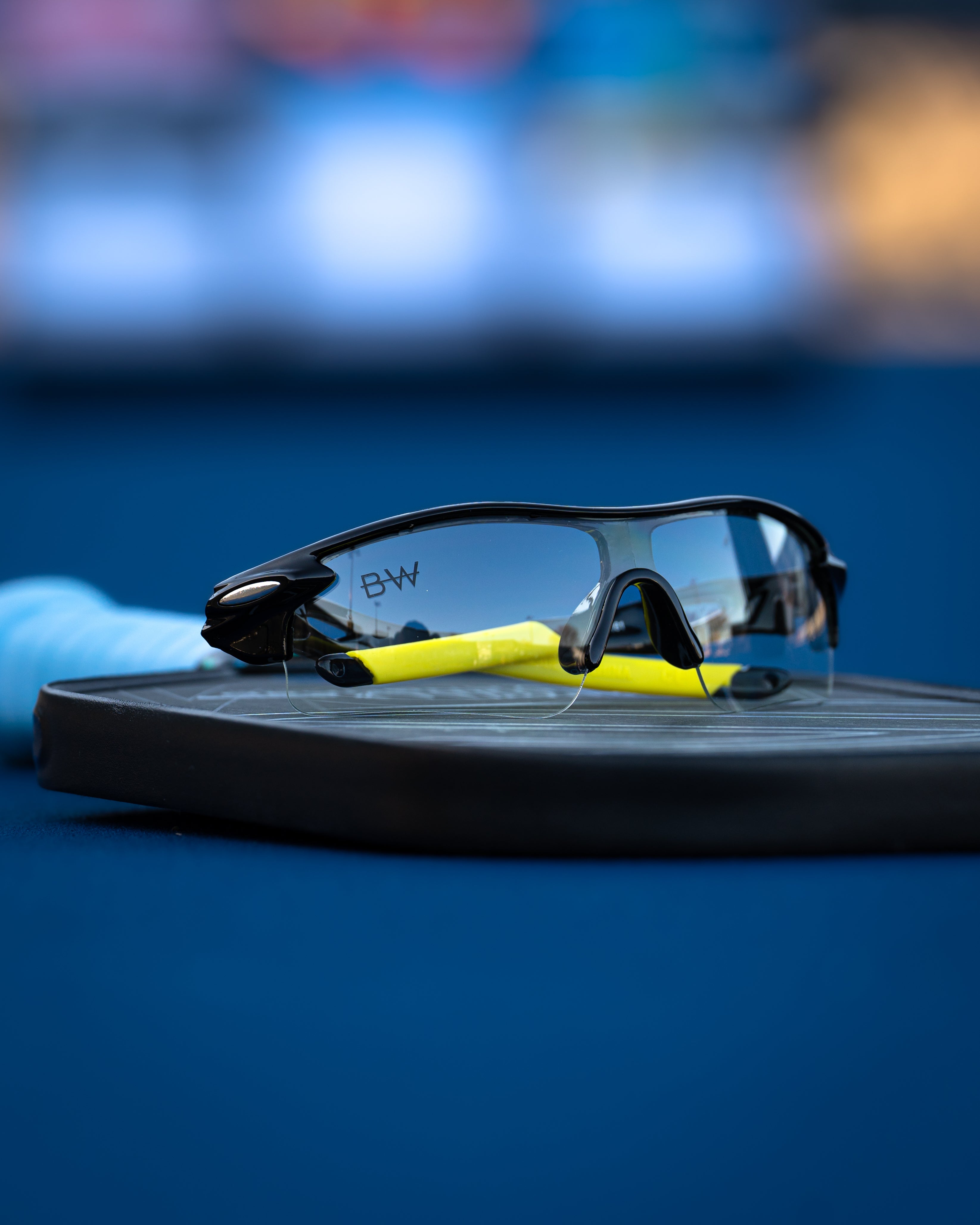
What RX Frame Styles Hold Up to Rough Travel?
Share
Find Your Perfect Pickleball Glasses
If you travel for pickleball tournaments, leagues, vacations, or regular court sessions, your prescription eyewear may spend almost as much time in bags, cars, hotels, and airports as it does on your face. Choosing an RX frame for travel means thinking about fit, construction, storage, lens protection, and how you actually transport your glasses—not relying on claims that any frame is indestructible.
What RX Frame Styles Hold Up to Rough Travel?
Travel can be demanding on prescription glasses. An RX frame may be packed and unpacked repeatedly, placed in a tournament bag, carried through airports, transported in a vehicle, exposed to changing environments, or accidentally compressed by other gear.
That makes durability important—but no RX frame style should be assumed to survive every drop, crush, temperature exposure, or luggage mishap.
Instead of looking for an allegedly indestructible frame, evaluate how the complete eyewear system is constructed, how well it fits you, how the lenses are retained, and how you plan to protect it while traveling.
What Makes an RX Frame Travel-Friendly?
There is no single frame shape that automatically makes prescription glasses travel-proof. Several characteristics can matter.
- Appropriate frame construction: The complete frame should be suitable for its intended active use.
- Comfortable fit: Travel eyewear may be worn for extended periods, so excessive pressure can become inconvenient.
- Stable lens retention: The lens and frame function as a complete eyewear system.
- Practical dimensions: The frame should be easy to store without forcing it into an unsuitable space.
- Active-use fit: If the glasses will go directly from travel to the pickleball court, evaluate how they sit during normal movement.
- Protective storage: Even durable eyewear benefits from being protected from compression and abrasion.
Frame material matters, but material alone cannot predict how a finished pair of RX glasses will perform under every travel condition.
“Durability” Actually Means Several Different Things
One of the biggest mistakes when comparing travel eyewear is treating durability as a single specification.
| Durability Concern | What It Means | What It Does Not Automatically Prove |
|---|---|---|
| Impact resistance | Performance under relevant impact conditions | Crush resistance, scratch resistance, or heat resistance |
| Frame flexibility | Ability of a particular frame or material to flex under certain conditions | That the frame cannot permanently deform or break |
| Scratch resistance | Resistance to some forms of surface abrasion | Scratchproof construction or impact resistance |
| Heat resistance | Material response to elevated temperatures | Protection from unlimited vehicle or direct-sun exposure |
| Compression resistance | Ability to tolerate particular compressive forces | Survival under luggage, furniture, or heavy equipment |
| Lens retention | How the lens remains mounted within the eyewear system | That a lens can never become displaced after significant force |
A product can perform well in one category without being exceptional in every other category.
Frame Style vs. Frame Material: Which Matters More?
Both can matter, but neither should be evaluated in isolation.
Frame style affects geometry, dimensions, lens shape, and how the eyewear sits on the wearer. Material affects physical properties of the components. The finished frame also includes hinges, lens mounting, temples, and other structural elements.
That means broad statements such as “wrap frames never break” or “lightweight frames always survive travel better” are not reliable buying rules.
Are Wraparound RX Frames Good for Travel?
Wraparound and sports-oriented frame shapes can be useful for active wear, but the shape alone does not make them travel-proof.
A wrap-style frame should not automatically be described as:
- Crushproof
- More flexible
- Impossible to bend
- Better at surviving drops
- Heat resistant
- TSA-proof
- Indestructible in checked luggage
Evaluate the exact product rather than assigning durability characteristics based solely on appearance.
What About Full-Rim RX Frames?
In a full-rim design, the frame surrounds the lens perimeter. That describes the construction style, but it does not by itself establish a durability rating.
The finished performance still depends on the frame, lens, mounting system, dimensions, prescription, handling, and the type of force involved.
A full-rim appearance therefore should not be marketed as proof that an RX pair can withstand suitcase compression or repeated drops.
Are Lightweight RX Frames Better for Frequent Travelers?
Lightweight eyewear can be convenient when you are wearing prescription glasses through a long travel day or several matches. Less mass can also make a frame feel more comfortable for some wearers.
But lightweight does not automatically mean more durable.
It also does not automatically mean:
- More flexible
- More impact resistant
- More crush resistant
- Better lens retention
- Longer lifespan
- Zero frame movement
Weight is one product characteristic, not a complete durability score.
Is a Flexible Frame Automatically Better for Rough Travel?
Flexibility can be useful in some eyewear designs, but more flexibility is not universally better.
Different frame components can behave differently under bending, twisting, impact, and repeated loading. A frame capable of flexing under one type of force may still be damaged by another.
Do not intentionally bend or twist prescription glasses to test how “travel tough” they are.
Why Hinges Matter During Travel
Hinges are moving components and can experience repeated opening and closing during daily use and travel. They may also be exposed to force if eyewear is packed carelessly.
Good travel habits include:
- Opening and closing the temples normally rather than forcing them
- Avoiding storage where heavy objects can press against the temples
- Checking the frame after a significant drop or compression event
- Not continuing to bend a component that appears damaged
Do not assume a frame has reinforced, impact-resistant, or proprietary hinges unless that specification is confirmed for the exact product.
Lens Retention Matters Too
The frame is only part of prescription eyewear. The lenses must remain properly positioned within the finished eyewear system.
If a pair experiences substantial force during travel, inspect whether:
- Both lenses appear properly seated
- A lens edge appears displaced
- The frame has visibly deformed around a lens
- A lens has cracked or chipped
Do not force a displaced prescription lens back into a frame if you are unsure whether the frame or lens has been damaged.
Does RX Lens Material Determine Travel Durability?
Lens material is relevant, but it does not provide a complete answer.
Blinded Wear includes high-index prescription lenses at no additional cost. High-index material can help manage finished lens thickness, particularly as prescription requirements increase.
However, high-index should not automatically be described as:
- Shatterproof
- Crushproof
- Scratchproof
- Heatproof
- Warp-proof
- Travel-proof
Refractive index is an optical material property, not a universal durability rating.
Does 1.61 High-Index Mean a Lens Is Travel-Tough?
An exact refractive index such as 1.61 describes an optical material characteristic. It does not establish how a finished pair of glasses will perform when dropped, compressed, scratched, or exposed to heat.
Likewise, an exact 1.61 specification should not be assumed across every Blinded Wear RX configuration unless it is confirmed for the particular product.
The verified broader benefit is that high-index RX lenses are included at no additional cost.
Are Thinner RX Lenses More Durable for Travel?
Not automatically.
High-index material can often help manage finished lens thickness, but thinner does not mean unbreakable or more resistant to every type of force.
Finished lens thickness depends on several factors, including:
- Prescription
- Lens material
- Frame and lens dimensions
- Lens positioning
- Lens design
- Other optical requirements
Choose high-index for appropriate optical and thickness-management reasons rather than treating thinness as a guarantee against travel damage.
Travel Often Creates an Abrasion Risk Before a Breakage Risk
Prescription eyewear does not need to snap in half to be damaged during travel. Loose storage can expose lens surfaces to keys, grit, hard objects, and other abrasive contact.
A practical rule is simple: do not store prescription glasses loose among objects that can contact the lenses.
Even if a lens has a verified scratch-resistant treatment, scratch-resistant does not mean scratchproof.
Protective Storage Matters More Than Trying to Find a Crushproof Frame
It is better to reduce unnecessary forces on your RX glasses than to assume the frame can survive them.
When the eyewear is not being worn, use appropriate protective storage and avoid placing it where other belongings can compress or abrade it.
Protective storage is especially useful when glasses are placed inside:
- Pickleball bags
- Backpacks
- Carry-on luggage
- Suitcases
- Gym bags
- Vehicle storage areas
Do not assume a particular storage accessory is included with a Blinded Wear purchase unless it is listed with the exact product.
Carry-On vs. Checked Luggage for Prescription Glasses
If prescription glasses are important to your ability to see and play, keeping essential eyewear accessible during travel can be practical.
Checked baggage can separate you from your eyewear and may expose luggage to handling outside your control. That does not mean checked luggage will automatically damage glasses, but relying on a frame to survive any possible baggage condition is unnecessary when better storage options are available.
When practical, keep essential RX eyewear accessible and protected.
Do You Need to Remove RX Glasses at Airport Security?
Do not remove prescription glasses simply because you believe an airport scanner will bend them. Follow current security instructions and keep control of your eyewear when practical.
The more important travel principle is avoiding unnecessary loose handling, compression, or storage with abrasive objects.
There Is No Meaningful “TSA-Proof” RX Frame Claim
Prescription sports eyewear should not be marketed as guaranteed to survive TSA handling, airport baggage systems, or every travel accident unless there is specific evidence supporting a narrowly defined claim.
Travel conditions are too variable for a blanket promise.
A durable sports-oriented design can still be damaged by sufficient force.
Can RX Glasses Survive Suitcase Pressure?
No universal pressure limit should be assumed for prescription eyewear.
A suitcase can expose glasses to different amounts and directions of force depending on:
- How tightly it is packed
- Where the glasses are located
- What objects surround them
- How the luggage is handled
- Whether the eyewear has appropriate protective storage
Instead of relying on frame flexibility, reduce the compression risk through sensible packing.
Heat Is a Separate Travel Concern
Heat exposure is different from impact, compression, or scratching.
Frames, lenses, and any applicable treatments can respond differently to environmental conditions, so there is no useful universal temperature threshold at which every pair of RX glasses becomes damaged.
A practical approach is to avoid unnecessary prolonged extreme heat rather than testing how much heat your eyewear can tolerate.
Should You Leave RX Glasses in a Hot Car?
A vehicle can become an unnecessarily harsh storage environment. When practical, avoid prolonged extreme heat rather than leaving prescription eyewear in a hot vehicle simply because the frame is marketed for sports.
Sports-oriented design does not automatically establish heat resistance for every frame, lens, and treatment.
What About Traveling in Cold Weather?
Cold-weather travel can introduce changing temperatures and condensation when moving between environments.
Condensation on a lens surface should not automatically be interpreted as lens damage. Likewise, avoid blanket claims that cold weather makes all high-index lenses brittle.
If eyewear experiences a significant environmental exposure and then appears physically damaged or visually abnormal, inspect it rather than diagnosing the material from temperature alone.
Rain, Sweat, and Moisture During Travel
Traveling players may encounter rain, perspiration, humidity, and condensation. Moisture on the lens can temporarily interfere with visibility, while residue can remain after the moisture dries.
High-index material does not automatically provide moisture resistance, and sports frames should not be called waterproof unless that claim is verified for the exact product.
After the eyewear becomes wet:
- Inspect it for grit or debris before wiping.
- Use an appropriate lens-care method.
- Avoid unnecessary concentrated heat as a drying shortcut.
- Do not store heavily contaminated or wet eyewear indefinitely.
Pack Lens Care for Tournament Travel
Repeated travel can expose eyewear to fingerprints, sweat, sunscreen, dust, and other contaminants.
Use lens-care methods and products appropriate for your eyewear. Cleaning compatibility can vary depending on the lens and any treatments present.
Avoid improvised abrasive cleaning and do not attempt to restore scratched prescription lenses with:
- Toothpaste
- Baking soda
- Automotive polish
- Household abrasives
- Wax
A physical scratch is not simply dirt that can be polished away safely at home.
What to Check After Dropping RX Glasses While Traveling
If your glasses hit the floor, court, pavement, or another hard surface, inspect them before assuming nothing happened.
- Look for visible lens cracks or chips.
- Check for new scratches.
- Confirm that both lenses appear properly seated.
- Look for obvious frame deformation.
- Check the temples and hinges.
- Notice whether the frame now sits differently.
- Have questionable damage evaluated when appropriate.
A drop does not automatically damage prescription glasses, but no frame should be promised to survive every fall.
What to Check After Your Glasses Are Compressed
If a bag, suitcase, or heavy object has pressed against your RX eyewear, check more than whether the lenses are still present.
Look for:
- Frame asymmetry
- Changed temple position
- Lens displacement
- Visible cracks or chips
- Changed fit on your face
- A sudden difference in the viewing experience
Do not repeatedly bend the frame back and forth if it appears significantly deformed.
Does Travel Damage Change Your Prescription?
Physical damage to eyewear does not change the prescription your eye-care professional wrote.
However, a damaged frame can change how the lenses physically sit relative to the wearer, and a damaged lens can interfere with the view.
That distinction matters. The appropriate response may be an eyewear inspection rather than assuming your eyes suddenly require a different prescription.
So, What Is the Best RX Frame Style for Travel?
There is no universally best travel frame shape. For a pickleball player, a useful travel-oriented RX choice is generally one that:
- Accommodates the appropriate prescription
- Fits comfortably during active use
- Uses a construction suitable for its intended sports use
- Can be stored without forcing or excessive compression
- Provides the verified lens characteristics the player actually needs
- Can transition conveniently from travel to the court
Choose the complete eyewear system rather than assuming one visual style is inherently indestructible.
Blinded Wear RX Frames to Compare for Travel and Pickleball
Instead of ranking individual models by unverified crush, bend, or travel-resistance claims, compare current Blinded Wear RX options based on fit, frame style, your prescription needs, and the verified configuration of each product.
- Steel Ice RX
- Blue Shield RX
- Havana Melt RX
- Gray Wash RX
- Zebra II RX
- Lava Rock RX
- Frost RX
- Rippled X RX
- Crystal Wave II RX
See the full Prescription Pickleball Glasses Collection for current options.
How to Compare RX Frames for Frequent Travel
| Factor | Why It Matters | What Not to Assume |
|---|---|---|
| Frame shape | Affects fit, dimensions, and storage | One shape is automatically strongest |
| Frame weight | Can affect comfort and portability | Lighter always means tougher |
| Frame material | Contributes to physical properties | Material name alone predicts total durability |
| Hinge construction | Part of the moving frame system | Every hinge survives unlimited cycles or force |
| Lens material | Influences optical and physical characteristics | High-index means shatterproof |
| Lens mounting | Part of the finished eyewear system | A lens can never become displaced |
| Protective storage | Reduces unnecessary abrasion and compression | A strong frame makes storage unnecessary |
| Fit | Important for active use after travel | One frame fits every face securely |
Frequent Travelers Should Consider Backup RX Eyewear
If you depend on prescription correction to play, backup eyewear can be more valuable than trying to find a supposedly unbreakable primary pair.
A backup may help if your main pair is:
- Lost during travel
- Damaged
- Accidentally left somewhere
- Temporarily unusable
Make sure the backup prescription remains appropriate for you. An old pair should not automatically be treated as equivalent to current prescription eyewear.
RX Pickleball Travel Packing Checklist
For tournament trips, consider packing:
- Your primary RX pickleball glasses
- Usable backup prescription eyewear when practical
- Appropriate protective storage
- Compatible lens-care supplies
- Your current prescription information when useful
- Any separate lens configuration you intentionally use for different playing environments
Keeping prescription eyewear organized also reduces unnecessary handling and the chance of placing it somewhere vulnerable.
Start With the Right Prescription Before You Travel
A durable frame cannot compensate for an inappropriate prescription.
For applicable Blinded Wear RX products, upload a clear image of your eyeglass prescription on the product page before adding the eyewear to your cart.
Do not substitute a contact-lens prescription or independently change SPH, CYL, AXIS, ADD, or prism values because the glasses will be used for sports or travel.
Review How to Order RX Glasses for additional ordering guidance.
Common Myths About Travel-Ready RX Frames
| Myth | More Accurate Explanation |
|---|---|
| Sports frames are impossible to break. | Sufficient force can potentially damage eyewear. |
| Wraparound frames are automatically crushproof. | Frame shape alone does not establish compression resistance. |
| Flexible means indestructible. | Flexibility and resistance to every type of damage are different. |
| Lightweight frames survive drops better. | Weight alone does not predict drop performance. |
| High-index lenses are travel-proof. | Refractive index is not a complete durability rating. |
| Thin lenses are always stronger. | Thickness alone does not establish fracture resistance. |
| A hard-looking frame is safe loose in luggage. | Protective storage remains useful. |
| Sports glasses are safe in any hot car. | Sports styling does not establish unlimited heat resistance. |
| Travel damage changes the written RX. | Physical damage and the wearer's prescription are separate issues. |
FAQ: RX Frame Styles for Rough Travel
What is the toughest RX frame style for travel?
There is no universally toughest frame style. Finished durability depends on the complete frame, lens system, construction, handling, storage, and type of force involved.
Are sports frames better for travel than fashion frames?
A sports-oriented frame can be appropriate for players who want eyewear intended for active use, but it should not automatically be declared more durable than every conventional frame without comparative evidence.
Are wraparound frames better for airports?
Wrap styling alone does not determine travel durability.
Are lightweight RX frames fragile?
Not necessarily. Weight alone cannot establish whether a frame is durable or fragile.
Does a flexible frame mean it cannot snap?
No. Flexibility under certain conditions does not mean a frame cannot be permanently deformed or broken by sufficient force.
Are high-index RX lenses good for travelers?
High-index can be useful for managing lens thickness. Blinded Wear includes high-index prescription lenses at no additional cost. That benefit is separate from travel durability.
Are high-index lenses shatterproof?
No blanket shatterproof claim should be made based solely on refractive index.
Should I put RX glasses in checked luggage?
If the eyewear is essential to your vision, keeping it accessible and appropriately protected can be practical. No frame should be relied upon to survive every possible baggage-handling condition.
Can a suitcase crush sports glasses?
Sufficient compression can potentially damage eyewear. Protective storage and sensible packing are preferable to relying on a crushproof claim.
Can heat warp RX glasses?
Materials can respond differently to environmental exposure. Avoid unnecessary prolonged extreme heat rather than relying on a universal damage threshold.
Should I leave my RX glasses in the car?
When practical, avoid prolonged extreme vehicle heat. Sports styling does not make eyewear immune to environmental exposure.
Can airport security scanners damage my prescription?
Your written prescription is not altered by passing through an airport. Follow current security instructions and protect the physical eyewear from unnecessary handling or compression.
Should I intentionally bend a new frame to test its durability?
No. Destructive home testing can damage prescription eyewear and does not provide a standardized durability measurement.
Can I test travel durability by dropping my glasses?
No. Intentionally dropping prescription eyewear creates unnecessary risk and does not replicate a controlled product test.
Do scratch-resistant lenses mean I can pack them loose?
No. Scratch-resistant does not mean scratchproof, and loose storage can expose lenses to abrasive objects.
Does a lens scratch change my prescription?
No. A physical scratch does not rewrite the prescribed lens power, although it may interfere with the view depending on its location and characteristics.
What if the frame looks bent after a flight?
Check how the glasses sit and inspect for lens displacement or other damage. Avoid aggressive DIY bending if the frame appears significantly altered.
What if a lens pops out during travel?
Do not assume the lens or frame is undamaged. If you are unsure about the condition of the eyewear, appropriate inspection is preferable to forcing components back together.
Do I need backup prescription glasses for a tournament trip?
They are not mandatory, but a usable backup can be practical if you depend on prescription correction and your primary pair is lost or damaged.
How long should travel-ready RX frames last?
There is no responsible universal lifespan because wear, handling, environment, prescription configuration, and accidents vary substantially between users.
The Bottom Line on Travel-Ready RX Frame Styles
The best prescription frame for frequent pickleball travel is not simply the one that looks toughest. Travel durability involves multiple separate concerns: impact, compression, abrasion, heat, lens retention, hinges, frame deformation, fit, and storage.
No frame should be promised to survive every suitcase, airport, vehicle, drop, or tournament scenario. Instead, choose RX eyewear that accommodates your prescription, fits comfortably for active use, provides the verified lens characteristics you need, and can be stored safely between matches.
Blinded Wear offers sports-focused prescription eyewear with high-index RX lenses included at no additional cost. High-index can help manage finished lens thickness, while travel protection still depends on the complete eyewear system and how you care for it.
What Actually Damages RX Glasses During Travel?
When prescription glasses are damaged on a trip, the cause is often more specific than simply “rough travel.” Different travel situations expose eyewear to different types of stress, and those stresses should not be treated as interchangeable.
| Travel Situation | Primary Concern | Practical Response |
|---|---|---|
| Loose inside a backpack | Abrasion and compression | Use appropriate protective storage |
| Under clothing in an overpacked suitcase | Compression | Do not rely on soft items alone to protect the frame |
| Dropped at an airport or hotel | Impact and abrasion | Inspect the frame and lenses before continued use |
| Left in a vehicle | Potentially harsh temperature exposure | Avoid unnecessary prolonged extreme heat |
| Carried in a pickleball bag | Contact with paddles, bottles, keys, or other gear | Keep eyewear separated from hard or abrasive objects |
| Used immediately after a flight | Fit, cleanliness, or unnoticed travel damage | Perform a quick pre-match inspection |
| Moved between different climates | Condensation and environmental changes | Distinguish temporary moisture from physical damage |
A Better Way to Choose RX Frames for Frequent Travel
Instead of searching for the single “strongest” frame, evaluate a potential pair in layers.
Step 1: Start With Your Prescription
The frame must first be appropriate for the prescription configuration being ordered. Travel durability is irrelevant if the eyewear does not appropriately accommodate your visual correction.
Step 2: Evaluate Individual Fit
A frame should sit comfortably and consistently on your face. This becomes particularly important when the same pair may be worn through travel and then during several hours of pickleball.
Step 3: Consider the Complete Construction
Look beyond whether the frame appears thick, thin, sporty, or flexible. The complete eyewear system includes the frame front, temples, hinges, lenses, and the way those components work together.
Step 4: Compare Verified Lens Features
High-index material, tint, polarization, photochromic technology, impact characteristics, and lens treatments are separate specifications. Verify the features of the exact configuration rather than assuming them from the frame style.
Step 5: Plan How You Will Store It
A good storage routine can prevent avoidable damage regardless of which frame you choose.
Comparing Common RX Frame Shapes for Travel
Frame shape can influence fit and storage, but it should not be used as a standalone durability ranking.
| Frame Characteristic | Potential Travel Consideration | Do Not Automatically Assume |
|---|---|---|
| Sport-oriented shape | May suit players who want one pair for travel and active use | It is stronger than every conventional frame |
| Wrap-style shape | Can provide a different fit and coverage profile | It is crushproof or impact-certified |
| Large lens area | Changes frame dimensions and storage requirements | It improves biological peripheral vision or durability |
| Compact frame | May occupy less storage space | Smaller automatically means stronger |
| Lightweight construction | May be comfortable for extended wear | Low weight guarantees durability |
| Flexible construction | May tolerate some movement depending on the exact design | It cannot permanently deform or break |
Why Fit Still Matters After You Arrive
Travel durability should not overshadow the reason pickleball players are buying sports prescription eyewear in the first place: the glasses still need to function comfortably during active use.
Once you reach the court, evaluate whether the frame:
- Sits comfortably at the nose and temples
- Maintains a practical wearing position during normal movement
- Does not create distracting pressure points
- Works with your individual face and head shape
- Remains comfortable as the session continues
No frame should be promised to provide zero movement for every player. Fit is individual, and secure does not necessarily mean choosing the tightest possible frame.
A Tighter Frame Is Not Necessarily a More Travel-Durable Frame
Fit on the wearer and durability inside a suitcase are separate issues.
A tight-fitting frame is not automatically more resistant to:
- Compression
- Impact
- Scratching
- Heat
- Hinge damage
- Lens displacement
Choose fit based on comfort and active use rather than assuming that tighter eyewear is mechanically stronger.
Do Not Buy an RX Frame Based on a Material Name Alone
Material names can provide useful information, but they do not tell the entire story of a finished pair of prescription glasses.
Two frames using materials from the same broad category can differ in geometry, dimensions, component design, hinges, lens mounting, and manufacturing.
That means the material label alone cannot establish:
- How many drops a frame can survive
- How much suitcase pressure it can tolerate
- How long it will last
- Whether the hinges will ever fail
- Whether it will deform under heat
- Whether a lens can become displaced
Impact Resistance Is Not the Same as Travel Resistance
Blinded Wear can offer impact-resistant lens options, but impact resistance should not be expanded into unrelated claims about the complete eyewear system.
In particular:
- Impact resistance does not mean scratchproof.
- Impact resistance does not mean crushproof.
- Impact resistance does not mean heatproof.
- Impact resistance does not mean a frame cannot break.
- Impact resistance does not automatically establish a particular safety certification.
- Impact resistance does not mean ballistic protection.
If you require eyewear for a specific occupational or impact hazard, use eyewear appropriately designed and rated for that hazard rather than relying on a general sports-eyewear description.
Why the Finished Lens and Frame Must Be Considered Together
The finished prescription lens has its own geometry, including dimensions and edge thickness. The frame provides the physical structure in which that lens is mounted.
Neither should be evaluated independently when discussing finished eyewear durability.
Prescription strength, lens material, lens dimensions, frame dimensions, and mounting configuration can all contribute to the finished product. There is no responsible universal rule that a particular lens thickness or frame shape will always survive travel better.
Where High-Index RX Lenses Fit Into a Travel Setup
High-index lens material is useful primarily because of its optical characteristics and its ability to help manage finished lens thickness under comparable conditions.
Blinded Wear includes high-index prescription lenses at no additional cost.
For travelers, that can be a useful RX feature, but it should not be confused with a special travel-strength technology.
| High-Index Can Relate To | High-Index Does Not Automatically Establish |
|---|---|
| Refractive index | Impact certification |
| Thickness management | Scratch resistance |
| Prescription lens design considerations | Heat resistance |
| Finished lens geometry | Compression resistance |
| Optical correction when made to the appropriate RX | Indestructibility |
Thinner Does Not Always Mean Lighter
Refractive index and material density are not the same property. A higher-index material can help manage lens thickness, but finished lens mass depends on multiple factors.
These can include:
- Lens material
- Prescription power
- Lens dimensions
- Finished thickness
- Lens design
For that reason, avoid reducing travel-frame selection to “high-index equals lighter equals tougher.” Each step in that statement oversimplifies a different characteristic.
Do Not Stress-Test New RX Glasses at Home
If you are preparing for a major tournament trip, intentionally testing how much abuse your prescription glasses can tolerate is more likely to damage them than provide useful information.
Avoid destructive tests such as:
- Twisting the frame aggressively
- Standing or sitting on the eyewear
- Placing weights on it
- Repeatedly dropping it
- Freezing it
- Heating it intentionally
- Leaving it in a hot vehicle as a test
- Forcing the temples beyond their normal range
Home abuse tests are not standardized durability measurements.
Why a DIY “Suitcase Test” Proves Very Little
Putting a pair of RX glasses inside a packed suitcase and pressing on it does not provide a meaningful compression rating.
The result depends on variables such as:
- Where force is applied
- How the frame is oriented
- What surrounds it
- How much force is applied
- How long the force remains
- Whether protective storage is used
A pair surviving one improvised test does not prove it will survive another travel accident.
Why You Should Not Perform Your Own Drop Test
Dropping RX glasses from a desk, balcony, staircase, or other height creates an unnecessary risk of damage and does not reproduce a standardized laboratory test.
The surface, orientation, impact point, height, and lens configuration can all change the outcome.
If your glasses are accidentally dropped, inspect them. Do not repeatedly drop them to see how durable they are.
Inspect RX Glasses Before a Tournament Trip
A quick pre-trip check can help you identify an existing problem before you are hundreds of miles from home.
- Clean the lenses appropriately.
- Look for visible cracks, chips, or significant scratches.
- Confirm that the lenses appear properly seated.
- Look at the frame from the front for obvious asymmetry.
- Check the temples and hinges.
- Put the glasses on and assess normal fit.
- Make sure your protective storage is usable.
- Pack a backup RX option when appropriate.
If something appears structurally wrong before the trip, addressing it before departure is preferable to discovering it immediately before a match.
Inspect Them Again After Rough Travel
Not every travel problem produces an obvious snapped frame. A post-travel inspection is useful if your eyewear experienced substantial handling, compression, or an accidental impact.
Compare the current pair with how it normally sits. Look for:
- New asymmetry
- Lens displacement
- Cracks
- Chips
- New significant scratches
- Hinge problems
- Unexpected changes in fit
If the eyewear appears normal and feels normal, there is no reason to assume that ordinary travel secretly changed the prescription.
A Bent Frame Can Change Wearing Position Without Changing RX Power
This distinction is especially important after rough travel.
Your SPH, CYL, AXIS, ADD, prism, and other prescribed values do not change because a suitcase compressed your glasses. However, substantial frame deformation can change the physical relationship between the finished lenses and your eyes.
If the eyewear suddenly sits at a noticeably different angle or position after being damaged, appropriate inspection is more useful than trying to compensate by changing the prescription.
Travel Does Not Change Your PD
Pupillary distance is used as part of positioning prescription lenses appropriately for the wearer. A flight, road trip, or suitcase does not alter your PD.
If a frame becomes physically deformed, the wearing position of the finished eyewear may change. That is a frame or fitting concern—not evidence that your PD measurement changed during travel.
When Professional Inspection Makes Sense
If a pair looks abnormal after significant travel damage or the visual experience has changed unexpectedly, an optical professional can inspect relevant aspects of the eyewear.
A lensmeter or focimeter can assess relevant characteristics of spectacle lenses, while a physical inspection can help evaluate the condition of the frame and lens mounting.
This is different from an eye examination. An eyewear inspection evaluates the glasses; an eye-care professional evaluates your vision and whether the prescription remains appropriate.
A Travel Scratch Is Different From a Crack
Scratches and cracks should not be treated as the same type of damage.
A scratch involves the lens surface, while a crack is a structural concern. Dirt, dried water, sunscreen, and residue can also look like lens damage until the surface is appropriately cleaned.
If you see a suspicious mark:
- Do not aggressively rub it.
- Check for loose grit or debris.
- Clean the lens using an appropriate method.
- Reinspect the area.
- If a permanent mark remains, do not attempt abrasive DIY polishing.
- If you suspect a crack or chip, consider appropriate inspection.
Do Not Diagnose Coating Damage From Appearance Alone
If a lens develops an unusual haze, pattern, or surface appearance after travel, it may not be possible to identify the cause from a photograph or quick visual inspection.
Do not automatically label the problem:
- Anti-reflective coating failure
- Heat crazing
- Delamination
- Stress cracking
- UV coating failure
Those descriptions require more evidence than “the lens looks strange after my flight.”
Build a Simple RX Travel-Care Kit
Players who travel frequently can make eyewear care easier by keeping appropriate cleaning and storage supplies with their gear.
The goal is not to carry a complicated repair kit. It is to avoid situations where a dirty lens gets wiped aggressively with whatever happens to be available.
Use cleaning products and materials appropriate for the exact eyewear. Compatibility can vary depending on the lens and any treatments present.
How to Store RX Glasses in a Hotel Room
Hotel rooms introduce simple but avoidable risks. Glasses can be knocked from a nightstand, buried under clothing, left on bedding, or placed near luggage that is being repacked.
When the eyewear is not being worn:
- Use a consistent storage location.
- Keep it away from the edge of furniture.
- Do not leave it underneath clothing or towels.
- Keep it away from heavy luggage.
- Use appropriate protective storage.
A consistent routine can matter more than trying to buy a frame that supposedly survives anything.
RX Glasses and Rental Cars
Vehicles can create two common travel risks: eyewear gets forgotten inside the vehicle, or it remains exposed to an unnecessarily harsh temperature environment.
When practical, take essential prescription eyewear with you instead of treating the vehicle as long-term storage.
There is no need to identify an exact universal temperature threshold. The safer principle is simply to avoid unnecessary prolonged extreme heat.
Traveling to Beaches or Dusty Destinations
Sand, dust, and grit introduce an abrasion concern. If particles are present on the lenses, avoid immediately grinding them across the surface with clothing or another improvised material.
Remove loose contamination appropriately before wiping the lens.
High-index material does not make a lens dust-resistant or scratchproof.
Traveling Through Rain and Humidity
Rainwater or condensation can interfere with visibility temporarily, but moisture on the surface does not mean the prescription has changed.
Likewise, do not assume every RX sports lens has:
- A hydrophobic coating
- An anti-fog coating
- A sealed frame
- Waterproof construction
- Moisture-proof lens material
Those characteristics should only be stated when verified for the exact product.
Does Photochromic Technology Make a Pair Better for Travel?
Photochromic lenses can offer convenience for some travelers who move between different environments, when that technology is available in the desired RX configuration.
However, photochromic describes a lens technology that changes tint according to particular activating and environmental conditions. It is not a durability feature.
Photochromic lenses are not automatically:
- More impact resistant
- More scratch resistant
- More heat resistant
- More crush resistant
- Polarized
- Hydrophobic
- Anti-fog
Evaluate convenience and durability separately.
Does Lens Tint Affect Travel Durability?
Tint primarily concerns how the lens handles visible light. It should not be used as a durability indicator.
A grey lens, clear lens, or other tinted configuration is not inherently more resistant to suitcase pressure simply because of its color.
Likewise, darker tint does not establish greater impact resistance or stronger UV protection.
Does Polarization Make RX Glasses More Durable?
No. Polarization and physical durability are separate characteristics.
Polarization is designed to manage certain reflected light. It does not automatically provide:
- Impact resistance
- Scratch resistance
- Heat resistance
- Compression resistance
- Stronger hinges
- Better frame flexibility
Do not use polarization status as a shortcut for judging travel durability.
UV Protection and Travel Durability Are Separate Too
UV-related lens characteristics should be evaluated from verified specifications. They are not established by frame thickness, lens darkness, refractive index, or travel durability.
A frame surviving a rough trip tells you nothing about its UV characteristics, just as a verified UV characteristic does not establish that the frame can survive compression.
Anti-Reflective Properties Do Not Make a Lens Travel-Proof
If an exact lens configuration has a verified anti-reflective treatment, that feature concerns reflections at lens surfaces. It does not mean the lens can tolerate unlimited scratching, heat, pressure, or impact.
Each lens feature should be evaluated for the job it is actually designed to perform.
Scratch-Resistant Does Not Mean Scratchproof
If a lens has a verified scratch-resistant treatment, appropriate care is still important.
Keys, grit, hard objects, and abrasive cleaning can remain relevant risks. Protective storage should not be abandoned because a lens is marketed as scratch resistant.
The Two-Pair Strategy for Frequent Tournament Travelers
If prescription correction is essential to your ability to play, one of the most practical travel strategies is redundancy.
A primary-and-backup system can reduce the consequences of:
- Accidental breakage
- Loss
- Misplaced luggage
- Unexpected frame damage
- A lens becoming unusable
The backup should contain an appropriate prescription for you rather than simply being any old pair left in a drawer.
Do Not Pack Both RX Pairs in the Same Vulnerable Place
If both your primary and backup prescription glasses are packed together in a bag that is lost or severely damaged, the backup provides little redundancy.
When practical, organize essential eyewear so that a single travel problem does not necessarily eliminate every usable prescription option.
From Airport to Pickleball Court: Check Your RX Before Playing
After a long trip, take a moment to check the eyewear before your first match.
- Inspect the lenses for contamination and damage.
- Check that both lenses appear properly seated.
- Look at the frame for obvious deformation.
- Put the glasses on and check normal fit.
- Clean them appropriately if needed.
- Test them during ordinary movement before competitive play.
This is more useful than assuming that because the glasses survived the flight, they must be in exactly the same physical condition.
A Practical Active-Fit Check After Travel
If your frame was packed for several hours, confirm that it still feels normal before beginning a match.
With the glasses on, perform ordinary pickleball-related movement in a safe area:
- Look left and right.
- Look upward and downward.
- Walk normally.
- Make controlled head movements.
- Notice any unusual pressure or movement.
Avoid exaggerated head shaking or unsafe movement as a homemade stability test.
When Not to Play in a Potentially Damaged Pair
If your eyewear has experienced significant travel damage, do not ignore obvious structural concerns simply because a match is about to start.
Issues that deserve attention include:
- A visible crack
- A significant chip
- A lens that appears displaced
- A severely deformed frame
- A broken component
- A sudden, persistent visual problem through the eyewear
When you are uncertain whether damaged eyewear remains appropriate to use, professional inspection is preferable to guessing.
Avoid Emergency DIY Repairs That Can Make Damage Worse
A tournament trip can create pressure to fix damaged eyewear immediately. Some temporary solutions may be inappropriate depending on where and how the frame is damaged.
Avoid:
- Forcing a displaced lens into a damaged frame
- Aggressively bending a deformed frame
- Using abrasive compounds on scratched lenses
- Applying unknown chemicals to lens surfaces
- Heating a frame in an attempt to reshape it without appropriate knowledge
- Assuming glue or another improvised repair restores original structural performance
If a repair is needed, the correct approach depends on the actual damage.
How Long Should Travel RX Frames Last?
There is no responsible universal lifespan for prescription sports eyewear.
Two players can own the same frame and experience very different service lives because of differences in:
- Frequency of use
- Travel frequency
- Storage habits
- Cleaning habits
- Accidental impacts
- Environmental exposure
- Individual fit
- Prescription configuration
Claims that a particular frame will survive a specific number of years of tournament travel should require evidence rather than assumption.
When Should You Consider Replacing Travel-Worn RX Eyewear?
Age alone does not determine whether eyewear needs replacement. Condition and prescription needs matter more.
Replacement or professional evaluation may be appropriate when there is:
- Meaningful structural damage
- A cracked or chipped lens
- A frame that can no longer maintain an appropriate fit
- A lens that will not remain properly seated
- Persistent visual concerns that need evaluation
- A prescription change that makes the existing eyewear no longer appropriate
Do not replace an otherwise usable pair solely because it has accumulated a certain number of flights.
Blinded Wear Lifetime Replacement Support
Travel can involve accidents, but Blinded Wear's policy should be described accurately rather than as an unlimited travel warranty.
Blinded Wear offers 50% lifetime replacement support if eligible glasses break, subject to current policy terms.
For eligible replacement claims, the damaged eyewear must be returned. Under the current policy, eligible customers can receive 50% credit toward a replacement pair.
This is not a promise of a free replacement, unlimited claims, or automatic coverage for every suitcase, TSA, heat, scratch, loss, prescription change, or travel-related issue.
For damaged prescription eyewear, contact blindedwearco@gmail.com before returning the pair.
Review the Blinded Wear Protection Plan, Replacement & Returns information for current eligibility and policy details.
RX Final Sale and Lifetime Replacement Support Are Different
Customized RX eyewear is final sale and excluded from the standard 30-day return policy. That does not mean applicable lifetime replacement support for eligible broken eyewear is necessarily eliminated.
| Situation | General Policy Guidance |
|---|---|
| Customized RX order | Final sale rather than part of the standard 30-day return policy |
| Eligible broken glasses | May qualify for 50% lifetime replacement support under current terms |
| Eligible replacement | 50% credit toward a replacement pair, not an automatic free pair |
| Damaged RX eyewear | Contact blindedwearco@gmail.com before returning |
| Prescription changed | Do not assume this automatically qualifies as breakage |
| Lost eyewear | Do not assume loss qualifies for broken-eyewear replacement support |
Travel RX Buying Checklist
Before choosing your next pair of prescription pickleball glasses for frequent travel, ask:
- Does this frame support the RX configuration I need?
- Does it fit me comfortably?
- Will I be comfortable wearing it for long travel and match days?
- What lens material is actually included?
- Which impact characteristics are verified?
- Which coatings or treatments are actually specified?
- What tint or VLT does the exact lens use, if provided?
- Is polarization present or absent?
- Is photochromic technology available if I want it?
- How will I protect the glasses when they are not on my face?
- Will I carry a backup RX pair?
- Do I understand the current return and replacement policies?
Those questions are more useful than asking whether a frame is simply “travel-proof.”
More Travel Durability Myths to Avoid
Myth: A frame that bends is impossible to break.
Flexibility under one type of force does not establish unlimited resistance to damage.
Myth: A thicker frame is always stronger.
Visible thickness alone cannot predict the performance of a complete frame.
Myth: High-index lenses are tougher because they are thinner.
Refractive index and finished thickness should not be used as universal fracture-resistance ratings.
Myth: Sports eyewear can be packed loose because it is built for impact.
Sports use does not eliminate abrasion and compression risks during storage.
Myth: If the glasses did not break, travel caused no change.
After substantial compression or impact, it is still worth checking fit, frame condition, and lens seating.
Myth: Any blur after a flight means the lenses warped.
Blur alone cannot diagnose lens warping. Check cleanliness, fit, lens condition, and whether the visual concern persists.
Myth: A hot car always ruins RX glasses instantly.
There is no universal instant-damage threshold. The practical recommendation is to avoid unnecessary prolonged extreme heat.
Myth: A lifetime replacement policy means the glasses are guaranteed never to break.
Replacement support and product durability are different concepts.
FAQ: Frequent Travel With Prescription Pickleball Glasses
Can I travel with only one pair of RX glasses?
You can, but if prescription correction is essential to your daily vision or ability to play, a usable backup can reduce the consequences of loss or damage.
Should my backup pair be identical?
Not necessarily. The important consideration is whether the backup provides an appropriate prescription and is usable for its intended purpose.
Can I use an old prescription pair as my backup?
That depends on whether the prescription remains appropriate for you. Do not assume an old pair is suitable simply because you can still see through it.
Can I pack my glasses with my paddles?
You can transport them in the same overall bag, but avoid leaving prescription eyewear loose where paddles or other hard equipment can press against or abrade it.
Are RX glasses safer in a hard container?
Appropriate protective storage can reduce exposure to direct compression and abrasion. Do not assume a specific accessory is included with a product unless listed.
Can I wrap my glasses in a shirt instead?
Soft clothing may provide some separation, but it should not be treated as equivalent to purpose-appropriate protective storage against significant compression.
Should I store glasses lens-down?
Avoid placing lens surfaces directly against potentially abrasive surfaces. Protective storage is preferable when the eyewear is not being worn.
Can a scratch spread into a crack?
A surface scratch and a structural crack are different types of damage. Do not assume every scratch will propagate into a crack.
Can travel loosen the hinges?
Hinges are mechanical components, and eyewear exposed to force or extensive use can warrant inspection. Do not assume every change in hinge feel was caused specifically by travel.
Can I tighten my RX glasses myself?
The appropriate adjustment depends on the exact frame and issue. Avoid forcing or over-tightening components when you are uncertain.
Does airplane cabin pressure alter my RX lenses?
Do not assume ordinary air travel changes the prescribed optical power of spectacle lenses.
Can flying change my PD?
No. Air travel does not change your pupillary distance.
Can travel change my prescription?
A trip does not mechanically rewrite your eyeglass prescription. If your vision changes persistently, that is a separate reason to consider appropriate eye-care evaluation.
Are clear RX lenses more durable than tinted RX lenses?
Clear versus tinted does not by itself establish physical durability.
Are polarized RX lenses more durable?
Polarization addresses certain reflected light and should not be used as a durability rating.
Are photochromic RX lenses more fragile?
Do not infer overall durability solely from photochromic functionality. Exact material and construction specifications matter.
Can a scratched RX lens still have the correct prescription?
Yes. A physical surface scratch does not rewrite the prescribed optical power, although its location and severity may affect the viewing experience.
Can a bent frame make vision feel different?
A substantially changed frame can alter the physical wearing position of the lenses. That is different from changing the written prescription.
Does Blinded Wear guarantee its frames will survive checked luggage?
No blanket checked-luggage survival guarantee should be assumed. Protect prescription eyewear appropriately rather than relying on an indestructibility claim.
Does the lifetime replacement policy mean every travel accident qualifies?
No. Eligibility is subject to the current policy. Review the current protection and replacement information rather than assuming every type of travel damage qualifies automatically.
Key Takeaways for Traveling With RX Pickleball Glasses
- No RX frame style is universally travel-proof.
- Frame shape, material, hinges, lenses, mounting, fit, and storage all contribute to the finished eyewear system.
- Lightweight does not automatically mean fragile or durable.
- Flexible does not mean indestructible.
- Impact resistance does not mean crushproof, scratchproof, heatproof, or ballistic.
- High-index is an optical material characteristic, not a travel-durability rating.
- Blinded Wear includes high-index RX lenses at no additional cost.
- Protective storage can reduce avoidable abrasion and compression.
- Keeping essential RX eyewear accessible can be practical while traveling.
- A usable backup pair can reduce the consequences of loss or damage.
- Inspect glasses after significant impact or compression.
- Travel damage does not rewrite your prescription or change your PD.
- A bent frame can change wearing position without changing prescribed lens power.
- A scratch, crack, residue, and lens displacement are different issues.
- Customized RX eyewear is final sale, while applicable lifetime replacement support is a separate policy.
For frequent travelers, the strongest strategy is not trying to find an indestructible pair. It is choosing appropriate RX sports eyewear, protecting it between uses, carrying a backup when practical, and checking the glasses after unusually rough handling.
How to Decide Whether Your RX Glasses Are Ready for Another Trip
Frequent travel does not automatically mean prescription eyewear needs to be replaced. A better approach is to evaluate the actual condition of the pair before packing it again.
| What You Notice | What It May Mean | Practical Next Step |
|---|---|---|
| Frame and lenses appear normal | No obvious travel-related problem | Clean, store, and use normally |
| Minor removable residue | Surface contamination | Clean using an appropriate lens-care method |
| Permanent surface mark | Possible scratch or other surface issue | Do not use abrasive DIY polishing |
| Lens appears displaced | Possible mounting or frame issue | Avoid forcing it into place if damage is uncertain |
| Frame sits noticeably differently | Possible deformation or adjustment issue | Consider appropriate inspection or adjustment |
| Visible crack or chip | Potential structural lens damage | Have the eyewear evaluated rather than ignoring it |
| Persistent unexpected visual change | Could involve eyewear, prescription, or another visual issue | Determine whether eyewear inspection or eye-care evaluation is appropriate |
Vision Feels Different After Traveling? Troubleshoot Before Assuming the Lens Warped
If your view suddenly seems different after a flight, road trip, or tournament weekend, lens warping is only one possible explanation and should not be assumed from symptoms alone.
- Check the lens surface. Fingerprints, dried moisture, sunscreen, dust, and other residue can interfere with the view.
- Check for fog or condensation. Temporary condensation is different from permanent lens damage.
- Inspect for scratches, cracks, or chips. Physical damage should be separated from contamination.
- Look at the frame. Determine whether it appears noticeably bent or asymmetrical.
- Check the wearing position. A frame that sits differently can change how the lenses are positioned relative to your eyes.
- Consider whether the problem persists. A persistent visual change deserves more attention than a lens that simply needed cleaning.
Do not change your prescription values yourself in an attempt to compensate for a frame or lens problem.
Frame Deformation and Prescription Accuracy Are Different Issues
It is possible for the prescription power inside a lens to remain what was ordered while the physical frame no longer sits as intended.
That distinction is especially relevant after substantial suitcase compression or another significant force.
Frame deformation can potentially alter aspects of the wearing position, while your written prescription remains unchanged. The appropriate response is therefore not automatically a new prescription.
If the frame appears significantly altered, an optical professional can help assess the physical eyewear. If your vision itself has changed, an eye-care professional can evaluate that separately.
Why Optical Positioning Matters After Frame Damage
Prescription eyewear involves more than placing a prescription somewhere inside a frame. Lens positioning is part of the finished optical system.
Depending on the prescription and lens design, relevant considerations can include:
- Horizontal positioning
- Vertical positioning when applicable
- Frame geometry
- Vertex distance
- Pantoscopic tilt
- Wrap or face-form characteristics
These concepts are more nuanced than saying the “optical center must always sit directly over the pupil.” The appropriate reference points depend on the lens design and prescription.
That is another reason significant frame deformation should not be corrected through aggressive DIY bending.
What an Optical Professional Can Check
If you are uncertain about a pair after rough travel, an optical professional may be able to evaluate aspects that are difficult to assess at home.
Depending on the situation, evaluation can include:
- Physical frame condition
- Lens seating
- General frame alignment
- Fit and wearing position
- Relevant lens characteristics using appropriate optical instruments
A lensmeter or focimeter can help evaluate spectacle-lens characteristics, but it is not a universal durability test and does not determine every possible form of lens or coating damage.
When the Problem May Be Your Prescription Instead of Travel Damage
Not every visual concern that appears during a trip was caused by the trip.
If the glasses appear physically normal but you are experiencing persistent changes in vision, an outdated or no-longer-appropriate prescription is one possibility that an eye-care professional can evaluate.
Likewise, symptoms alone cannot establish whether the problem is:
- The prescription
- Frame fit
- Lens positioning
- Surface contamination
- A scratch
- Physical lens damage
- An eye or vision issue
Persistent new double vision, meaningful vision changes, eye pain, or other concerning symptoms should not simply be blamed on travel eyewear.
A Better Packing System for RX Pickleball Players
Players who travel regularly can reduce unnecessary eyewear handling by giving prescription glasses a dedicated place in their travel setup.
Primary RX Pair
Keep the pair you depend on most accessible and appropriately protected.
Backup RX Pair
When practical, carry a usable backup prescription pair in case the primary pair becomes lost or damaged.
Lens-Care Supplies
Bring cleaning materials appropriate for the eyewear so you are less likely to resort to abrasive improvised cleaning.
Prescription Information
Having access to your current prescription information can be useful during longer trips, although it does not guarantee immediate replacement availability.
Separate Hard and Abrasive Objects
Do not let keys, tools, chargers, paddles, or other hard objects repeatedly contact exposed lens surfaces.
A Two-Pair Strategy Can Also Help With Different Playing Environments
Some players may choose different eyewear configurations for different lighting environments rather than expecting one lens to be ideal everywhere.
For example, a player could prioritize one configuration for brighter conditions and another for lower-light environments, depending on the exact products available and the player's prescription needs.
However, do not assume:
- Every Blinded Wear RX model is available in every tint
- Every RX model offers photochromic technology
- Every lens has the same VLT
- A particular tint universally improves pickleball performance
- Clear lenses transmit 100% of visible light
- Darker lenses automatically provide greater UV protection
Verify the exact lens configuration before purchasing.
Check VLT When It Is Provided
Visible Light Transmission, or VLT, describes the percentage of visible light transmitted through a lens. A higher VLT allows more visible light through, while a lower VLT allows less.
VLT can help describe a lens, but it is not a durability measurement.
It also does not independently establish:
- UV protection
- Polarization
- Impact resistance
- Scratch resistance
- Anti-fog properties
- Photochromic behavior
Use the verified specification for the exact lens rather than estimating VLT from a product photograph.
Fixed Tint vs. Photochromic Lenses for Travel
Traveling players sometimes move between indoor courts, outdoor courts, hotels, vehicles, airports, and changing weather in the same day. That can make lens-light management an important consideration.
| Lens Approach | Potential Advantage | Important Limitation |
|---|---|---|
| Fixed tint | Predictable tint level for the exact lens | Does not automatically adjust when the environment changes |
| Clear lens | No dark sunglass tint | Does not automatically mean 100% VLT or suitability for every environment |
| Photochromic | Can change tint according to the technology and environmental conditions | Response, darkness, clearing, temperature behavior, and availability depend on the exact technology |
None of these options is automatically the most durable simply because of how it manages light.
Can Contacts Be a Travel Backup Instead?
For some players who appropriately use contact lenses, contacts combined with compatible non-prescription sports eyewear can be another legitimate setup.
Contacts and prescription glasses have different practical considerations. Contacts sit directly on the eye, while ordinary sports glasses sit in front of the eyes and may provide some physical coverage depending on the design and fit.
Neither option is universally better for every traveler.
Remember that a contact-lens prescription is not interchangeable with an eyeglass prescription. Do not use contact-lens values as an eyeglass order without appropriate prescription information.
Does Trip Length Change What You Should Pack?
The longer you will be away from home, the more inconvenient lost or damaged prescription eyewear may become.
For a short local trip, your packing strategy may be simple. For a multi-day tournament trip, it may be useful to consider:
- Primary RX eyewear
- Backup prescription eyewear
- Appropriate storage
- Lens-care supplies
- Different verified lens configurations if your playing environments require them
- Access to current prescription information
This is risk management, not an indication that your primary pair is expected to fail.
Road Trips: Keep RX Glasses Out of Vulnerable Storage Areas
During a road trip, glasses can easily migrate from your face to a cup holder, seat, dashboard, center console, or pile of equipment.
Some of those locations can expose eyewear to unnecessary heat, pressure, dirt, or accidental contact.
When you remove your glasses, putting them in a consistent protected location is generally better than setting them wherever there happens to be space.
Airport Travel: Accessibility Matters
If you rely heavily on prescription glasses, consider the consequences of placing every usable pair inside luggage you cannot immediately access.
Keeping essential eyewear accessible can help if:
- Checked luggage is delayed
- A bag is misplaced
- Your primary pair is damaged
- You need your prescription correction during the journey
This is a practical travel consideration rather than a claim that checked baggage will necessarily damage eyewear.
How to Pack RX Glasses in a Pickleball Bag
A pickleball bag can contain paddles, balls, water bottles, keys, shoes, chargers, and other equipment. That creates several opportunities for unnecessary contact with eyewear.
Try to keep prescription glasses:
- Separated from abrasive objects
- Away from heavy items that can compress them
- Protected when they are not being worn
- Easy to locate without digging through equipment
Do not assume that placing the glasses in a soft pocket makes them immune to pressure from the rest of the bag.
Do Not Pack RX Glasses Away Immediately After a Sweaty Match
After play, eyewear can have sweat, skin oils, sunscreen, dust, or other residue on its surfaces.
Before long-term storage, inspect and care for the glasses appropriately rather than repeatedly placing heavily contaminated eyewear directly back into a travel bag.
Sweat exposure does not automatically mean the frame has been damaged, and sports eyewear should not be described as universally sweat-proof unless that characteristic has been specifically established.
Condensation After Entering a Hotel or Indoor Court
Moving between environments can cause temporary condensation on lenses. This is a surface visibility issue and should not automatically be interpreted as structural damage.
Likewise, fogging does not prove that the prescription is wrong.
If fogging is a recurring concern, verify whether the exact eyewear has any specific anti-fog feature rather than assuming every sports RX lens does.
Sports Styling Does Not Mean Waterproof Construction
A frame can look highly athletic without being sealed against water, wind, or dust.
Wrap coverage should not be confused with a seal, and ordinary prescription sports glasses should not automatically be described as:
- Waterproof
- Dustproof
- Windproof
- Fog-proof
- Moisture-proof
If a particular characteristic matters for your travel environment, verify it for the exact product.
Specifications Worth Verifying Before Buying Travel RX Eyewear
When comparing prescription pickleball glasses for frequent travel, treat each specification independently.
| Specification | Question to Ask |
|---|---|
| Prescription compatibility | Is this exact configuration appropriate for my prescription? |
| High-index | What high-index option is included or available? |
| Impact characteristics | What exactly is claimed for this lens or eyewear? |
| Tint | What tint does this exact lens use? |
| VLT | Is a verified VLT provided? |
| Polarization | Is this exact lens polarized or non-polarized? |
| Photochromic | Is photochromic technology available in this configuration? |
| Scratch resistance | Is a scratch-resistant treatment actually specified? |
| Anti-reflective treatment | Is it included or available? |
| Anti-fog | Is an anti-fog treatment specifically stated? |
| Hydrophobic treatment | Is water repellency specifically verified? |
| UV characteristics | What does the exact product specification state? |
| Safety certification | Does the exact eyewear carry a relevant certification if one is required? |
One verified feature should never be used to imply all the others.
Explore Current Blinded Wear RX Pickleball Glasses
Rather than assigning unsupported “most durable” rankings, compare current models based on the verified product configuration, your prescription, fit preferences, and playing environment.
- Steel Ice RX
- Blue Shield RX
- Havana Melt RX
- Gray Wash RX
- Zebra II RX
- Lava Rock RX
- Frost RX
- Rippled X RX
- Crystal Wave II RX
Browse the complete Blinded Wear RX Pickleball Glasses Collection for current options.
How to Order Blinded Wear RX Glasses Before Your Next Trip
Start with your appropriate eyeglass prescription rather than trying to create a separate “sports prescription” yourself.
- Choose an applicable RX product.
- Review the exact product and lens options currently offered.
- Prepare a clear image of your eyeglass prescription.
- Upload the prescription image on the product page before adding the eyewear to your cart.
- Do not substitute a contact-lens prescription.
- Do not independently round, change, or transpose prescription values.
For additional guidance, visit How to Order RX Glasses.
Prioritize These Factors in the Right Order
If you are buying RX eyewear specifically because you travel for pickleball, a useful hierarchy is:
- Appropriate prescription correction
- Compatibility with the selected frame and lens configuration
- Comfortable individual fit
- Verified lens and frame characteristics
- Suitability for your playing environments
- Protective storage strategy
- Backup eyewear plan
- Understanding current replacement and return policies
Marketing terms such as “travel tough,” “rugged,” or “sports frame” should never replace those checks.
10 Rules for Traveling With Prescription Pickleball Glasses
- Do not assume any frame is indestructible.
- Keep essential RX eyewear accessible when practical.
- Use appropriate protective storage.
- Keep exposed lenses away from abrasive objects.
- Avoid unnecessary prolonged extreme heat.
- Inspect eyewear after significant impact or compression.
- Do not perform destructive home durability tests.
- Do not aggressively repair damaged eyewear yourself when the condition is uncertain.
- Carry usable backup correction when the consequences of losing your primary pair would be significant.
- Verify exact product specifications instead of assuming features from appearance.
Final FAQ: Choosing RX Frames for Rough Travel
What RX frame style is best for someone who flies to pickleball tournaments?
There is no universally best shape. Prioritize an appropriate prescription configuration, comfortable active fit, verified product characteristics, practical storage, and a backup plan when needed.
Should I choose the thickest frame I can find?
No. Visible frame thickness alone does not provide a reliable durability ranking.
Should I choose the most flexible frame?
Not automatically. Flexibility is one characteristic and does not establish resistance to every type of damage.
Are wrap frames automatically better for rough travel?
No. Wrap geometry can affect fit and coverage, but it does not independently establish crush, impact, heat, or scratch resistance.
Are lighter frames more likely to break?
Not necessarily. Weight alone does not determine durability.
Does high-index make my RX lenses stronger?
High-index describes an optical material characteristic and can help manage finished lens thickness. It should not be treated as a universal strength rating.
Does Blinded Wear include high-index RX lenses?
Yes. Blinded Wear includes high-index prescription lenses at no additional cost.
Can I leave sports RX glasses loose in my suitcase?
It is better to protect the eyewear from direct compression and abrasion rather than relying on sports styling to prevent damage.
Can I keep RX glasses in my car during a tournament weekend?
When practical, avoid unnecessary prolonged extreme heat and take essential prescription eyewear with you rather than using a hot vehicle as long-term storage.
Can flying change the optical power of my prescription?
Ordinary travel does not rewrite the prescription values prescribed for your eyes.
Can suitcase pressure change how my glasses sit?
Sufficient force can potentially deform a frame. A changed wearing position is different from a changed written prescription.
Can I straighten a bent frame myself?
Minor adjustment and significant structural deformation are not the same. Avoid aggressive DIY bending when you are uncertain about the condition of the eyewear.
How do I know whether a mark is a scratch or dirt?
Inspect for loose debris and clean the lens appropriately. If a permanent mark remains, avoid abrasive attempts to polish it away.
Should I keep wearing a cracked lens?
A visible crack or chip deserves attention rather than being treated as ordinary cosmetic wear.
Does a scratched lens mean my prescription is now wrong?
No. A scratch does not rewrite your prescribed lens power, although it may interfere with the view depending on its characteristics.
What if everything looks normal but my vision suddenly feels different?
Check cleanliness, fit, frame condition, and whether the concern persists. Persistent or meaningful new visual changes may warrant appropriate professional evaluation.
Does Blinded Wear provide a free pair whenever travel damages my glasses?
No. Blinded Wear offers 50% lifetime replacement support for eligible broken glasses under the current policy. It is not an automatic free replacement for every travel-related issue.
Do customized RX glasses have the same 30-day return policy as standard products?
No. Customized RX eyewear is final sale. Applicable lifetime replacement support for eligible broken eyewear is a separate policy.
Where can I check the current replacement terms?
Review the Blinded Wear Protection Plan, Replacement & Returns information for current details.
More Blinded Wear Pickleball Eyewear Resources
- Prescription Pickleball Glasses – Browse current Blinded Wear RX options.
- Non-Prescription Pickleball Sunglasses – Compare current non-RX eyewear.
- Clear-Lens Pickleball Glasses – Explore current clear-lens options.
- Pickleball Performance Lens Guide – Learn about lens colors, clarity, and RX options.
- How to Order RX Glasses – Review the prescription ordering process.
- Best Pickleball Glasses 2026 Hub – Compare broader eyewear options and guides.
- Protection Plan, Replacement & Returns – Review current policy information.
Final Verdict: The Best Travel RX Frame Is the One You Protect Properly
There is no single prescription frame shape that becomes automatically crushproof, heatproof, scratchproof, or airport-proof. Rough travel exposes eyewear to several different risks, and each one involves different parts of the finished eyewear system.
For pickleball players who travel frequently, the better strategy is to choose RX eyewear based on appropriate prescription correction, individual fit, verified product characteristics, and your actual playing environment. Then protect that investment with sensible storage and handling.
Blinded Wear includes high-index prescription lenses at no additional cost, giving RX players access to a lens category commonly used to help manage finished lens thickness. High-index should still be evaluated separately from impact, scratch, heat, compression, coating, and safety characteristics.
If you depend on prescription eyewear to play, consider carrying a usable backup on important trips. Inspect your primary pair after unusually rough handling, and do not mistake a bent frame, dirty lens, scratch, or condensation for an automatic change in your prescription.
Durability is not about finding glasses you can abuse without consequence. It is about choosing appropriate eyewear, understanding what its specifications actually mean, and reducing avoidable damage before your next match begins.